

1. The decision
The authority must decide which mix of conservation, reuse, recharge and desalination will meet a defined drought service at acceptable lifecycle cost, timing and risk. The answer varies with source water, demand shape, network, institutions, environmental constraints and financing capacity.
The relevant question is how much dependable water each measure can deliver, to whom, by when and for how long. Project labels provide insufficient evidence.
2. Drought is a service gap
A drought becomes an operating and investment problem when available supply falls below the service the system intends to protect. The gap can arise from low rainfall, reduced streamflow, depleted groundwater, poor quality, infrastructure failure, demand growth or allocation restrictions.
The plan should distinguish a temporary deficit from a structural imbalance. Temporary events may favour flexible measures; structural deficits may justify durable new supply.
3. Define protected service
Protected service should state customer classes, minimum volumes, pressure, quality, location and duration. Hospitals, households, industry, agriculture, ecosystems and firefighting can require different standards. The allocation hierarchy must be agreed before an emergency.
An option can only be compared after the service boundary is clear. Water available in one basin or quality class may not satisfy another need.
4. Use common measures
Each option should be assessed through dependable yield, implementation time, duration, energy, capital, operating cost, land, environmental impact, social acceptance, reversibility and network deliverability. The analysis should separate gross water from compliant water delivered to customers.
Reported unit cost should identify volume, utilisation, financing, power and asset boundary. Numbers from different studies cannot be compared safely without normalisation.
The comparison should also separate capacity from utilisation. A conservation programme may deliver savings only when customers participate; a reuse plant may have available capacity without connected demand; a recharge scheme may hold inventory that cannot be recovered quickly; and a desalination plant may remain idle until a drought trigger. The planner should value the available service and then model the cost of actual use.
5. Build a portfolio
The OECD Global Drought Outlook describes demand management, reuse and desalination as parts of long-term resilience rather than isolated responses [1]. Portfolio design combines measures with different lead times and drought correlations.
The first measure selected should not consume the budget, permits or network capacity needed for later stages. Options should preserve one another where practical.
6. Map the four pathways
Each pathway acts on a different part of the water balance.
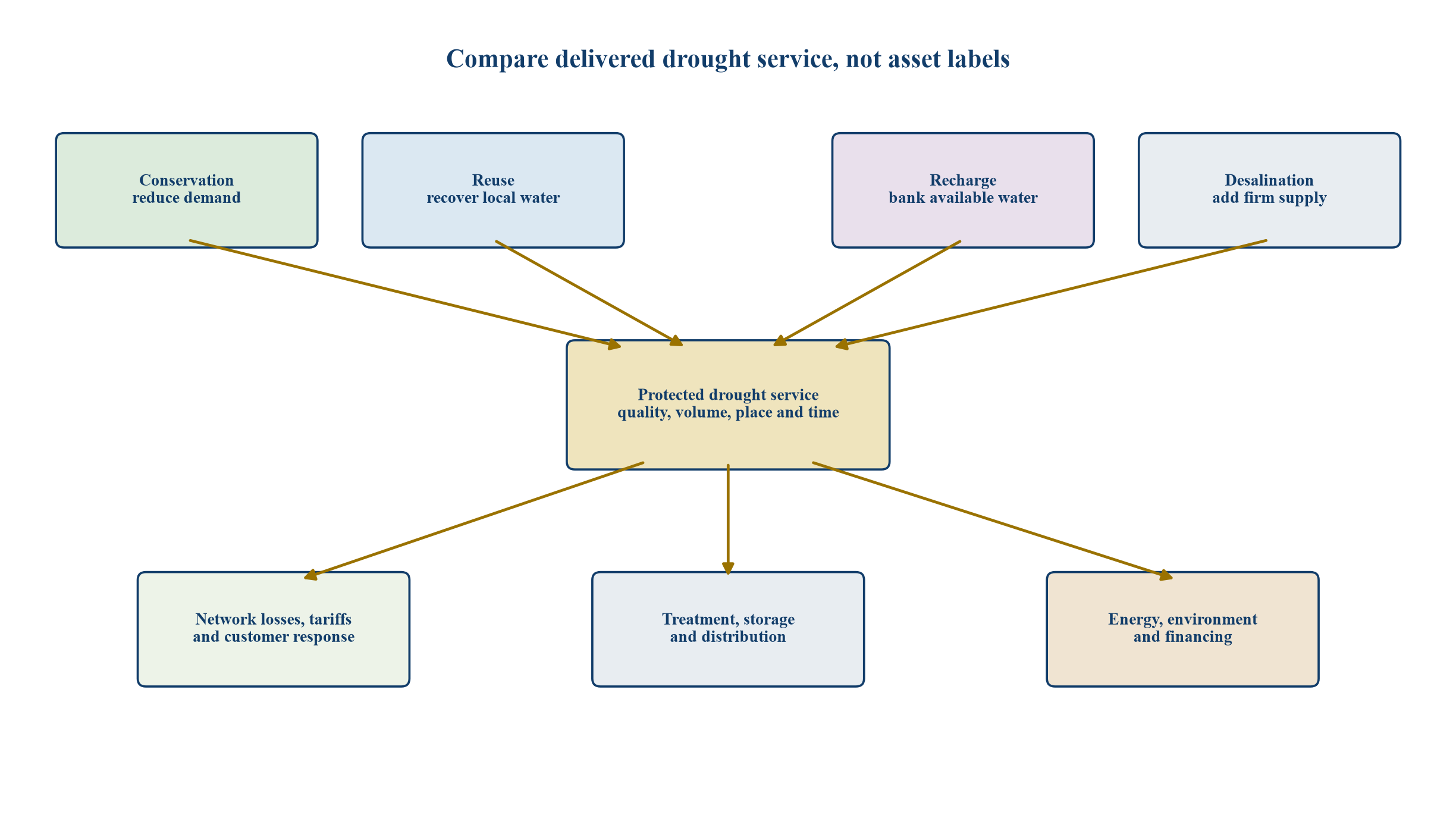
Generic system map; actual sources, treatment, rights and delivery arrangements depend on jurisdiction and project conditions.
7. Establish the baseline
The baseline should reconcile source yield, storage, treatment, imports, losses, customer demand, environmental obligations and emergency resources. Historical production alone can overstate future reliability when it includes depletion or favourable hydrology.
Asset condition and outage history matter. A drought plan built on unavailable capacity is weaker than its volume balance suggests.
8. Separate forecast classes
Observed demand, contracted demand, approved developments, policy targets and management estimates should remain distinct. Climate and hydrological scenarios should identify their source and period.
The model should avoid one deterministic demand line. Investment value often depends on the distribution and timing of shortages.
9. Measure the gap over time
Annual deficit hides the sequence that determines service. A system can have adequate annual water and still fail through a short peak, low reservoir level or network constraint. Monthly or daily modelling may be required.
The duration curve should show how often a measure is used. This affects unit cost, operating readiness and finance.
10. Conservation as supply
Conservation reduces the water that must be produced and delivered. It can include leakage control, pressure management, efficient fixtures, irrigation rules, industrial optimisation, tariffs and customer information. EPA identifies water efficiency and loss control as drought-resilience tools [2].
Savings count as dependable capacity only when measured, persistent and additional to the baseline.
11. Network loss reduction
Leak detection, district metering, pressure control, pipe renewal and active repair can recover treated water already in the system. Benefits can include lower production, energy and chemical use.
The programme should distinguish real losses from apparent losses caused by metering and billing. Both affect utility economics, but only real loss reduction creates physical supply.
12. Pressure management
Pressure management can reduce leakage and burst frequency while preserving customer service and firefighting. It requires network zoning, control valves, monitoring and hydraulic analysis.
Excessive reduction can impair service. Savings should be verified against weather, demand and operational changes.
13. Efficient fixtures
Fixtures and appliances can reduce indoor demand across many customers. Standards, labelling, rebates and replacement programmes influence adoption. EPA's WaterSense programme links product efficiency to water and energy conservation [2].
The model should consider stock turnover, free riders and rebound. A rated product does not guarantee behavioural savings.
14. Outdoor demand
Landscape irrigation can create a large seasonal opportunity in some systems. Measures include schedules, soil moisture controls, drought-tolerant planting, pricing and restrictions. Climate and property type determine potential.
Permanent landscape change differs from temporary watering bans. The plan should value them separately.
15. Industrial conservation
Industrial audits can identify recycling, cooling optimisation, process change, cleaning efficiency and leak reduction. The value to the customer may include production continuity and avoided discharge cost.
Contracts or incentives should define baseline, measurement and persistence. A facility closure should not be counted as successful conservation.
16. Tariff design
Tariffs can signal scarcity, fund infrastructure and encourage efficiency. Increasing blocks, seasonal rates, drought surcharges and fixed charges distribute incentives differently. Affordability and revenue stability require attention.
Price response should be supported by local evidence. Essential use and vulnerable customers need explicit protection.
17. Restrictions
Restrictions can reduce demand quickly during a declared event. They may cover irrigation, vehicle washing, pools, non-essential industry or hours of use. Enforcement, exemptions and communication influence results.
Emergency restrictions are difficult to treat as a permanent source. Their economic and social cost can rise with duration.
18. Persistence
Conservation savings can decay when prices fall, enforcement ends, occupancy changes or customers increase use elsewhere. Durable equipment and network measures may persist longer than behavioural campaigns.
The finance model should apply a persistence curve and ongoing programme cost.
19. Equity
Uniform percentage reductions can burden already-efficient or low-income customers. Baselines, household size, medical needs and housing conditions matter. Equity design supports legitimacy and compliance.
The drought portfolio should report service and cost distribution, not only aggregate volume.
20. Conservation economics
Conservation can have short lead time and modular investment. Its marginal cost rises as inexpensive savings are exhausted. Later increments may require deep retrofits, industrial process change or network renewal.
The supply curve should therefore rank specific measures rather than use one average conservation cost.
Savings should be counted at the same system boundary as new supply. Reduced customer demand may avoid raw-water abstraction, treatment, pumping and distribution. Leakage reduction creates a different benefit because the recovered water remains within the utility system. Where tariffs fall with consumption, the utility may lose revenue while retaining fixed cost. Programme economics should therefore show physical water, utility cash flow and customer expenditure separately.
21. Reuse as local supply
Reuse treats wastewater, stormwater or other impaired water for a beneficial use. EPA describes reuse as a reliable source that can reduce drought impacts and support potable, industrial, irrigation and groundwater applications [3][4].
Its reliability depends on wastewater availability, treatment, quality, distribution and customer demand. Indoor wastewater can remain comparatively stable during drought, but conservation can reduce feed volume.
22. Fit-for-purpose quality
Treatment should match end use. Irrigation, cooling, industrial process, environmental support, groundwater recharge and potable supply require different controls. Over-treatment wastes capital and energy; under-treatment creates health and compliance risk.
The water-quality plan should state source envelope, treatment barriers, monitoring, response and responsible authority.
23. Non-potable reuse
Non-potable systems can serve landscaping, cooling, construction or industry. They may require a separate distribution network and customer conversion. Proximity to a treatment plant improves economics.
Demand can be seasonal or interruptible. Fixed pipeline cost should be tested against contracted use.
24. Potable reuse
Potable reuse can be indirect through an environmental buffer or direct through advanced treatment and controlled introduction. It requires rigorous treatment, monitoring, governance and public-health oversight.
Approval and public acceptance can extend lead time. The project should avoid assuming acceptance before a transparent engagement and regulatory process.
25. Industrial reuse
Industrial users can provide anchor demand and a clear avoided-cost benchmark. Quality, pressure, redundancy, expansion and shutdown rights should be contractual.
Customer concentration creates credit and volume risk. A parent guarantee or replacement-customer mechanism may support finance.
26. Reuse feedstock
Wastewater collection determines feed reliability. Infiltration, salinity, industrial discharge and sewer condition can affect treatment. A reuse plant cannot control every source condition unless the contract and authority do so.
Source-control programmes and influent envelopes should precede performance guarantees.
27. Reuse distribution
The treatment plant may be distant from customers or recharge sites. Pumping, easements, crossings, storage and connection can dominate marginal cost.
The analysis should include the complete delivery chain. Plant-gate water is not delivered drought service.
28. Residual management
Advanced treatment produces concentrates, brines, spent media and sludge. Disposal routes need permits, capacity and lifecycle cost. The environmental benefit of reuse can be weakened by an unresolved residual.
Residual risk should be allocated to the party controlling treatment and disposal, subject to source-water relief.
29. Reuse acceptance
Trust depends on public-health evidence, transparent monitoring, governance and credible response to failure. Communication cannot compensate for weak engineering or regulation.
Engagement should begin during option design. It should include customers, health authorities, communities and environmental users of the current discharge.
30. Reuse finance
Revenue can combine capacity payment, volumetric offtake, utility tariff, availability payment and public funding for environmental benefits. EPA and Bureau of Reclamation programmes show public financing support for reuse infrastructure [5][6].
Base debt should rely on enforceable demand and payment, not the assumption that future customers will connect.
Reuse can also require coordination between wastewater and water utilities whose incentives differ. One entity may own the feedstock and treatment plant, another may own advanced treatment, and a third may distribute the product. The commercial structure should allocate influent quality, minimum feed, product acceptance, connection delay, residual disposal and tariff collection. A technically complete scheme can remain underused when these interfaces are unresolved.
31. Recharge as banking
Managed aquifer recharge moves available water underground for later use or resource protection. Aquifer storage and recovery adds planned recovery. EPA distinguishes recharge from storage and recovery [7].
Recharge can reduce evaporation and support groundwater, but value depends on the right to recover, where recovery occurs and what service is protected.
32. Recharge sources
Sources can include stormwater, river flows, treated wastewater, desalinated water and imported water. Availability may be episodic. Treatment and conditioning depend on source and aquifer.
The recharge project needs a water right or supply agreement. Empty capacity without source water has limited drought value.
33. Recharge methods
Infiltration basins, spreading grounds, galleries and injection wells offer different rates, land needs and treatment requirements. Surface methods may require permeable soil and large area; wells can reach deeper aquifers.
Clogging, maintenance, pressure and water-quality reactions affect sustained performance.
34. Hydrogeology
Aquifer geometry, permeability, confinement, native water, gradients, nearby abstraction and geochemistry determine feasibility. USGS identifies hydrogeological, geochemical and microbiological uncertainties in ASR [8].
Site investigation, pilot cycles and monitoring are core investment evidence. Regional potential does not prove project yield.
35. Recovery yield
The drought service is compliant water recovered and delivered. Some injected water may remain to protect quality or may move beyond practical recovery. Yield can vary by cycle and operating strategy.
The financial model should use tested or conservative recovery assumptions and account for treatment after recovery.
36. Recharge timing
Recharge requires water before the drought or during intermittent wet periods. A project commissioned after reservoirs are depleted may have no source to bank. Lead time includes investigation, permits, construction and conditioning.
The portfolio should therefore invest in recharge readiness before scarcity becomes acute.
37. Groundwater protection
Recharge can support aquifer levels, reduce saltwater intrusion or limit subsidence. It can also introduce contaminants or mobilise native constituents. Regulation and monitoring should protect existing users.
Environmental benefits may justify public funding when recoverable supply alone does not capture full value.
38. Recovery rights
Legal rights to inject do not necessarily confer rights to recover an equivalent volume. Competing abstraction, basin accounting and public-trust rules may apply.
Title, priority, accounting, losses and emergency allocation require jurisdiction-specific advice before debt commitment.
39. Recharge finance
Recharge may be utility-funded, publicly financed, corporately financed or placed in a concession. Revenue can follow storage availability, recovered volume, basin benefit or resilience service.
Long test periods and uncertain yield can require staged capital, grants or concessional funding before commercial debt.
Recharge projects also require an inventory-accounting policy. The balance should record water injected, deemed losses, third-party abstraction, water-quality restrictions and recovered volume. If the basin provides public environmental benefits, the project may need compensation beyond recovered-water sales. A transparent ledger supports regulation, customer confidence and lender diligence while avoiding unsupported claims that every injected unit remains privately recoverable.
40. Desalination as firm supply
Desalination converts seawater or brackish water into freshwater and can reduce rainfall dependence. The World Bank and Australian public sources identify it as part of drought-resilient supply portfolios [9][10].
Its firmness depends on intake, power, marine conditions, plant availability, brine disposal, network connection and contract.
41. Seawater desalination
Seawater reverse osmosis can provide large coastal supply. Site selection should consider intake, outfall, marine environment, power, land, pipeline and customer location.
Long conveyance or lift can materially change delivered cost and carbon.
42. Brackish-water desalination
Brackish groundwater may require less treatment energy than seawater, subject to salinity and chemistry. Resource sustainability, drawdown, rights and brine disposal can constrain scale.
Australian government research highlights both the opportunity and the need for site and disposal assessment [11].
43. Technology
Pretreatment, membranes, energy recovery, post-treatment and controls influence output and cost. New technology should be tested against feedwater and availability requirements before financing.
Efficiency improvement does not remove intake, residual, power and network obligations.
44. Energy
Power price and reliability can dominate operating exposure. Renewable arrangements can reduce emissions where physically and contractually aligned. Storage can allow some dispatch flexibility.
The contract should allocate power price, volume and outage risks clearly. Unhedged long-term exposure weakens tariff certainty.
45. Brine
Concentrate discharge requires environmental assessment, dispersion, monitoring and permit compliance. Inland brine can be particularly difficult. Mineral recovery may be an option in some projects, subject to evidence.
The financing case should use a permitted residual route rather than an assumed future solution.
46. Intake
Open intake, beach wells and other designs have different cost and ecological effects. Harmful algal bloom, contamination, marine activity and storm can interrupt operation.
The drought plan should test common-mode failure across plants on the same coast.
47. Modularity
Desalination can be staged through trains or modular units. Staging preserves flexibility and reduces overbuild, while very small scale can lose economies. Shared intake and outfall can preserve expansion options.
Option rights should cover land, power, pipelines and permits, not only plant space.
48. Desalination finance
Long-term purchase agreements or availability payments can support project finance. Tariff should cover fixed capacity and variable production without depending on optimistic utilisation.
Termination compensation, power, change in law, marine permits and network interface matter to lenders.
Utilisation risk requires particular attention. A plant built as drought insurance may operate infrequently after wet years, yet must remain maintained, staffed and testable. Capacity payment can fund readiness while a variable charge pays for dispatched water. The authority should state the trigger, minimum run, preservation regime and customer allocation. Without this structure, low utilisation can create disputes over tariff, maintenance and perceived value.
49. Four-way comparison
Table 1. Comparative drought-response characteristics
| Attribute | Conservation | Reuse | Recharge | Desalination |
|---|---|---|---|---|
| Principal service | Reduce demand | Recover local water | Bank water and support aquifer | Add treated supply |
| Typical lead time | Short to medium | Medium to long | Medium to long | Long |
| Rainfall dependence | Indirect | Generally low for municipal feed | Depends on source water | Low for seawater |
| Key constraint | Persistence and equity | Treatment, distribution and acceptance | Hydrogeology, source and recovery | Energy, marine permits and capital |
| Modularity | High | Moderate | Moderate | Moderate |
| Drought readiness | Can activate rapidly | Requires built system | Must charge before need | Requires built and maintained plant |
| Financeable revenue | Programme funding or tariff | Offtake, tariff or availability | Storage or resilience service | Purchase or availability payment |
50. Time to delivery
Lead time affects drought value. The following curve is hypothetical and illustrates the ordering of decisions.
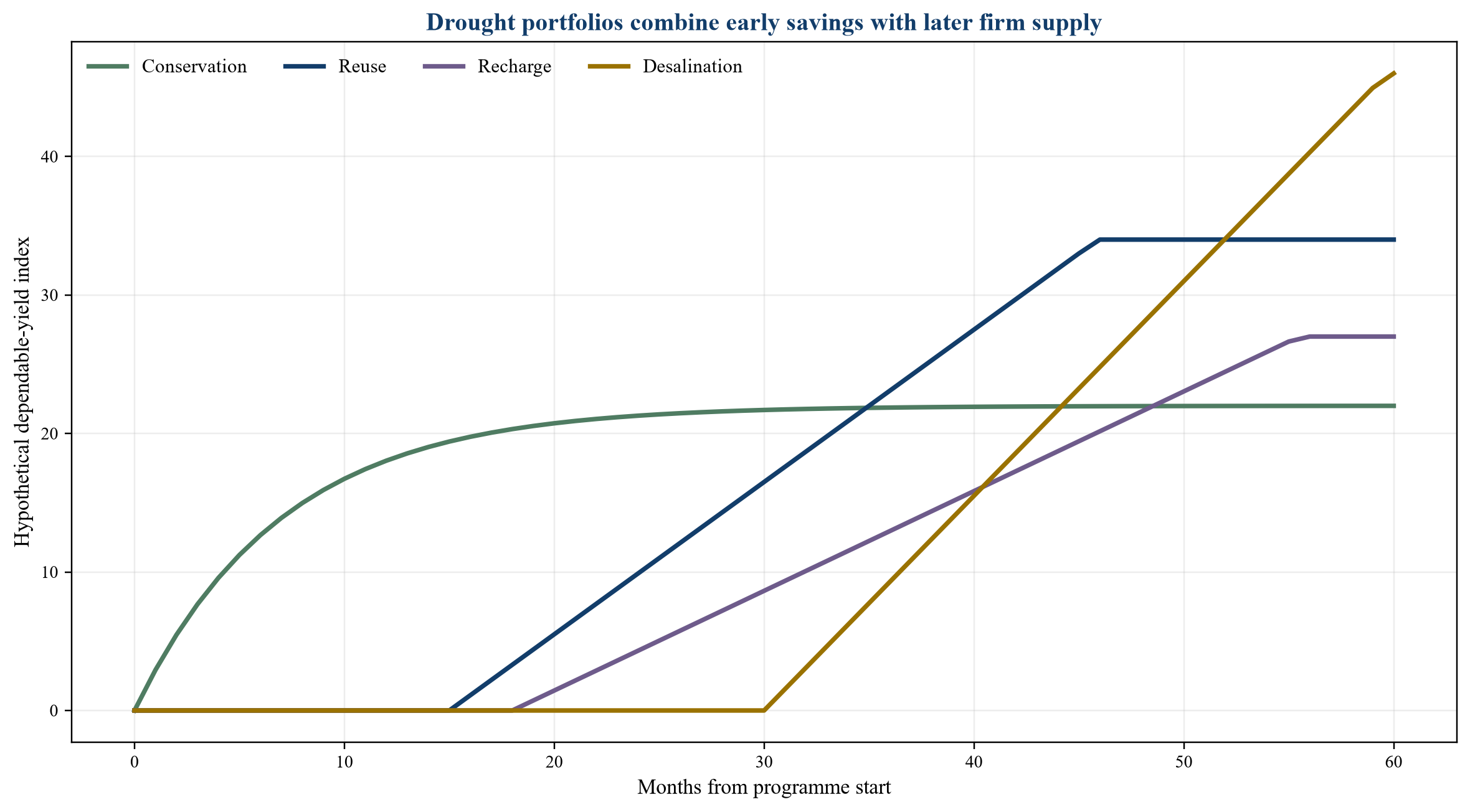
Illustrative indices only; not a forecast, tariff, valuation or project proposal.
51. Interpret lead time
Conservation can begin quickly, while infrastructure requires design, approval, procurement and construction. Reuse and recharge may need pilots and customer conversion. Desalination commonly requires intake, outfall, power and transmission.
Emergency urgency should not erase due diligence. An accelerated project with unresolved interfaces may arrive late or fail to provide dependable yield.
52. Reliability
Reliability measures the probability that the option delivers its stated service during the drought. Conservation depends on participation and enforcement; reuse on feedstock and plant; recharge on stored inventory and recovery; desalination on plant, intake and power.
Portfolio value rises when failure modes are less correlated.
53. Correlation
Two options can fail together through shared power, source, network, regulation or public acceptance. Reuse and conservation may interact because lower indoor use reduces wastewater feed. Recharge and surface supply may share wet-year availability.
The model should represent these dependencies rather than add independent firm yields.
54. Energy intensity
Conservation can avoid treatment and pumping. Reuse and recharge consume energy according to treatment and lift. Desalination has a significant power requirement and can also involve long conveyance.
Energy should be measured per delivered compliant unit, including losses and distribution.
55. Land and location
Conservation is distributed. Reuse needs treatment and pipelines. Recharge may require basins, wells and protected catchment. Desalination needs coastal or brackish-water access and connection.
Location can outweigh process cost when the drought gap is regional.
56. Environmental effects
Every pathway has effects. Conservation can reduce return flows; reuse can alter river or coastal discharge; recharge can affect groundwater; desalination can affect marine systems and emissions.
The comparison should include the counterfactual and cumulative impact, not assume one option is automatically benign.
57. Social licence
Restrictions, tariffs, potable reuse, recharge and coastal infrastructure can all face opposition. Transparent evidence, fairness and governance shape acceptance.
Engagement should inform design and risk allocation. It should not be treated as a late communications task.
58. Unit cost
Unit cost should include development, capital, finance, operations, power, replacement, environmental mitigation, residuals, distribution and decommissioning over expected use. It should identify public subsidies and externalities.
Low utilisation can raise the realised cost of a drought-only asset while preserving valuable insurance. Both facts can be true.
59. Avoided shortage value
The value of dependable supply includes avoided rationing, lost production, health risk and emergency procurement. It varies by customer and event severity.
The analysis should avoid unsupported economy-wide precision. Scenario ranges and service priorities can inform decisions without pretending to forecast every consequence.
Avoided-cost analysis should include the next credible alternative and its timing. A conservation measure may defer a pipeline; reuse may avoid imported water; recharge may defer surface storage; desalination may replace emergency transfers. Double counting is a risk when several measures claim the same avoided asset. The portfolio model should allocate a deferral benefit once and update it when the investment sequence changes.
60. Hypothetical sources and uses
Table 2. Hypothetical funding plan for a diversified drought portfolio
| Uses | Index | Sources | Index |
|---|---|---|---|
| Conservation and loss reduction | 95 | Senior utility or project debt | 405 |
| Reuse treatment and distribution | 310 | Concessional or subordinated debt | 115 |
| Recharge sites, wells and monitoring | 180 | Public resilience funding | 175 |
| Desalination option works and first trains | 290 | Sponsor or utility equity | 160 |
| Development, permits and engagement | 55 | ||
| Contingency and initial reserves | 75 | ||
| Total uses | 1,005 | Total sources | 855 |
The illustrative funding gap of 150 demonstrates that prioritisation and staging remain necessary. Actual values require project-specific models and committed funding.
61. Portfolio allocation
The portfolio should allocate early capital to information, quick savings and enabling works while preserving later options. Conservation can buy time; reuse and recharge can create local resilience; desalination can provide firm capacity when triggers justify it.
The sequence should be refreshed as demand, hydrology, cost and project evidence change.
62. Portfolio sensitivity
The figure illustrates how dependence on one pathway can expose the system to its principal risk.
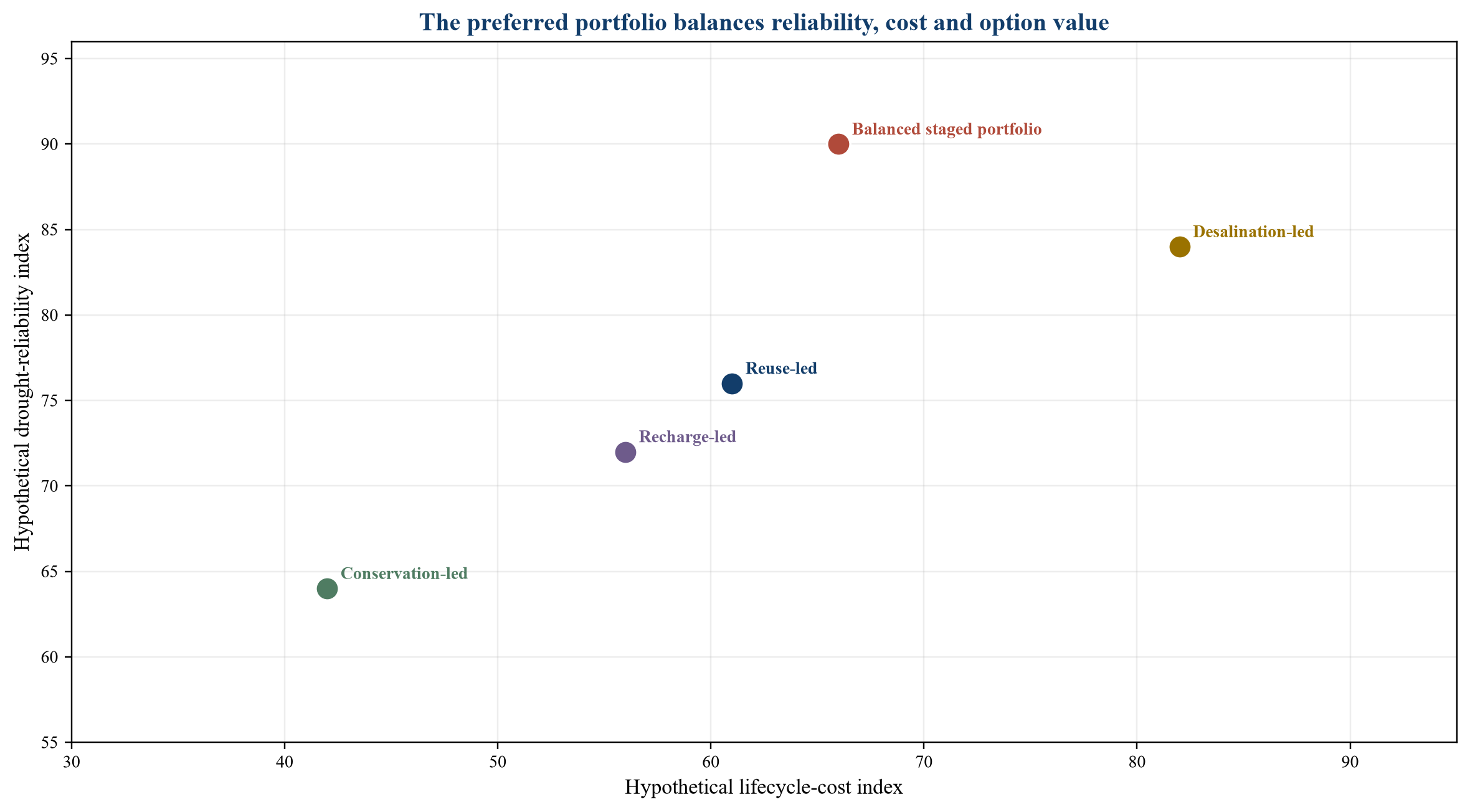
Illustrative indices only; portfolio positions are not forecasts, tariffs, valuations or project recommendations.
63. Financing architecture
Funding can combine utility borrowing, project finance, corporate finance, grants, concessional debt, climate adaptation facilities and customer contributions. The structure should match revenue and risk.
World Bank and OECD work highlights the need for investable water-resilience structures and public-private capital mobilisation [9][12].
Financing should follow the service purchased. Short-lived campaigns may belong in operating budgets. Long-lived treatment and pipelines may support utility or project debt. Early hydrogeological tests may need public or concessional risk capital. Desalination capacity can support long-term debt when payment is contracted. Blended finance should address a defined risk or public benefit, with conditions and performance reporting that remain visible in the cost comparison.
64. Revenue
Conservation may be funded through tariffs, budgets, performance contracts or shared savings. Reuse can use offtake or availability payments. Recharge can use storage or basin-service payments. Desalination can use purchase or capacity agreements.
Each revenue line should correspond to a measurable service and creditworthy payer.
65. Debt sizing
Debt should rely on contracted or regulated cash flow and conservative delivery assumptions. Unverified savings, future customers, recharge yield and discretionary desalination dispatch should not support base leverage.
Coverage should be tested across lower demand, higher energy, construction delay, reduced recovery and environmental mitigation.
66. Public funding
Public funding can purchase resilience, health, equity and environmental benefits that direct users do not fully pay for. Eligibility, timing, conditions and reporting should be defined before financial close.
Subsidy should remain visible in option comparison. It changes affordability and funding, not the underlying resource cost.
67. Procurement
Procurement should present demand, drought triggers, source data, sites, permits, interfaces, payment, environmental requirements and draft contracts. Market engagement can test capacity and risk appetite.
Evaluation should consider dependable yield, time, lifecycle cost, resilience, financing certainty and qualifications.
68. Staged contracting
Framework agreements, development contracts, option rights and phased notices can preserve speed without committing full capital. The authority can procure pilots or enabling works while evidence develops.
Expiry and exercise terms should protect competition and value.
69. Drought triggers
Triggers can use reservoir level, groundwater, inflow, seasonal forecast, demand, storage duration and project lead time. Each stage should activate defined conservation, procurement, construction or dispatch actions.
The trigger must act early enough for the measure's lead time. A desalination trigger reached after depletion may be too late.
70. Option value
Land, permits, intake corridors, interconnections, designs and procurement readiness can create option value. They reduce future response time without requiring immediate full construction.
Option cost should be compared with the risk of stranded capital and emergency scarcity.
71. Governance
A drought portfolio committee should own scenarios, service priorities, triggers, project gates, customer measures and public reporting. Decision rights across utilities, regulators, health agencies and emergency authorities require clarity.
Governance should continue after rain returns so readiness does not decay.
72. Data
The authority needs source, storage, demand, loss, quality, project and cost data. Definitions should reconcile across operations, finance and public communication.
Uncertainty should be visible. Missing data is an action item, not a zero.
73. Monitoring
Conservation needs verified savings; reuse needs quality and availability; recharge needs injection, storage and recovery; desalination needs production, energy and environmental compliance. Common dashboards should report service contribution.
Metrics should distinguish installed capacity from dependable delivered yield.
74. Climate uncertainty
Historical drought may understate future severity or timing. The plan should test a range of sequences and compound events, including heat, power stress, contamination and demand growth.
Scenario analysis supports robust decisions without claiming one forecast is certain.
75. Environmental water
Rivers, wetlands and aquifers can require water during drought. Reuse of current discharges may reduce ecological flows; conservation can leave more source water; recharge can support groundwater; desalination can reduce abstraction while creating marine effects.
Environmental obligations should enter the protected-service definition and option model.
76. Agriculture
Agricultural demand can dominate some basins. Conservation, crop change, irrigation efficiency, reuse, recharge and brackish desalination have different economics and distribution effects.
Efficiency can increase consumptive use when saved water expands production. Basin accounting should track actual depletion.
77. Industry
Industry may finance dedicated reuse, desalination or efficiency for continuity. Cluster solutions can share infrastructure and diversify demand.
The contract should allocate quality, volume, credit, shutdown and expansion risks.
78. Emergency operation
The drought playbook should define restrictions, communications, priority supply, temporary transfers, stored-water release and emergency procurement. It should identify legal authority and funding.
Regular exercises can test whether the plan works before an event.
79. First 180 days
The first phase should define protected service, reconcile the water balance, rank conservation measures, map wastewater and customers, screen recharge sites, preserve desalination options, assess networks, establish triggers and open market engagement.
By day 180, the sponsor should know which measures are executable, which require pilots and which capital decisions can be deferred.
The programme should also establish a live decision register. Each option should have an accountable owner, evidence list, permit path, commercial model, funding status, next gate and stop condition. Dependencies should be explicit: reuse may require a pipeline corridor; recharge may require seasonal source water; desalination may require power and marine approvals. This register turns the portfolio from a conceptual list into an executable sequence.
80. Implementation sequence
Implementation should move through baseline, service definition, option screening, site work, environmental review, commercial structure, funding, procurement, construction, commissioning and operating review. Conservation and data measures can proceed while infrastructure evidence develops.
Each gate should retire a material uncertainty before irreversible spending.
81. Risk matrix
Table 3. Drought-portfolio risk and response matrix
| Risk | Exposed options | Evidence | Response |
|---|---|---|---|
| Savings do not persist | Conservation | Metered baseline and cohorts | Ongoing programme, verification and diversified measures |
| Feedwater or demand is insufficient | Reuse | Wastewater and customer contracts | Stage capacity and secure offtake |
| Recovery yield is weak | Recharge | Pilot cycles and monitoring | Reduce base yield, redesign or stop |
| Power or brine cost rises | Desalination | Contract and disposal route | Hedge, index, efficiency and contingency |
| Drought deepens faster | All | Trigger and lead-time model | Earlier gates and emergency layer |
| Network blocks delivery | Reuse, recharge, desalination | Hydraulic model and tests | Connection works and distributed assets |
| Public acceptance delays | Reuse, recharge, desalination | Engagement and regulator evidence | Transparent process and alternative staging |
| Funding is incomplete | All | Committed sources and conditions | Reprioritise, phase or close the gap |
82. Red flags
Red flags include comparing plant-gate costs with delivered savings, treating restrictions as permanent yield, reuse without customers, recharge without source or recovery rights, desalination without a permitted brine route, annual balances for short drought peaks and debt supported by uncommitted volume.
Each red flag requires evidence, redesign, contract support or reduced commitment.
83. Decision rule
Select measures that meet the protected service under tested scenarios, preserve affordable essential supply, comply with health and environmental requirements and retain flexibility where uncertainty remains. The lowest headline cost should not override deliverability.
The decision record should state assumptions, evidence, exclusions and triggers for review.
84. Portfolio review
The portfolio should be reviewed when demand, climate evidence, cost, regulation, project performance or customer behaviour changes. Completed projects should be compared with the original service case.
Review protects against both underinvestment and locked-in overcapacity.
The annual review should also reconcile committed funding, remaining option life, permit expiry, contractor capacity and operating readiness. Measures that no longer meet the protected service should be redesigned or retired through an explicit decision. This discipline prevents inactive projects and outdated assumptions from remaining inside the reported drought portfolio.
85. Conclusion
Conservation, reuse, recharge and desalination solve different parts of drought. Conservation can reduce demand quickly, reuse can recover a local flow, recharge can move water through time and desalination can add rainfall-independent supply. Their value depends on dependable delivery, timing, location, quality and the failures they share.
The strongest programme defines protected service, measures the gap, sequences low-regret action, pilots uncertain sites, preserves firm-supply options and links capital to observable triggers. Finance should follow contracted or regulated cash flow, complete interfaces and conservative yield. A diversified portfolio can provide more resilient service than a single large response when its components are evidence-based, governed together and ready before the drought.
References
- Organisation for Economic Co-operation and Development. Global Drought Outlook: Adapting to Drought Risk for Long-Term Resilience. https://www.oecd.org/en/publications/global-drought-outlook_d492583a-en/full-report/adapting-to-drought-risk-for-long-term-resilience_55e0232a.html
- United States Environmental Protection Agency. Drought Resilience and Water Conservation. https://www.epa.gov/water-research/drought-resilience-and-water-conservation
- United States Environmental Protection Agency. Basic Information about Water Reuse. https://www.epa.gov/waterreuse/basic-information-about-water-reuse
- United States Environmental Protection Agency. Case Studies that Demonstrate the Benefits of Water Reuse. https://www.epa.gov/waterreuse/case-studies-demonstrate-benefits-water-reuse
- United States Environmental Protection Agency. Clean Water State Revolving Fund: Water Reuse and Conservation. https://www.epa.gov/cwsrf/clean-water-state-revolving-fund-cwsrf-water-reuse-and-conservation
- United States Bureau of Reclamation. Water Recycling and Desalination. https://www.usbr.gov/watersmart/title/index.html
- United States Environmental Protection Agency. Aquifer Recharge and Aquifer Storage and Recovery. https://www.epa.gov/uic/aquifer-recharge-and-aquifer-storage-and-recovery
- United States Geological Survey. Feasibility of Regional-Scale Aquifer Storage and Recovery: Scientific Uncertainties. https://water.usgs.gov/ogw/pubs/ofr0289/crg_feasibility.htm
- World Bank Group. Governance and Economics of Desalination and Reuse. https://www.worldbank.org/en/topic/water/publication/governance-and-economics-of-desalination-and-reuse
- Australian Government Department of Climate Change, Energy, the Environment and Water. Australia State of the Environment: Water Sources. https://soe.dcceew.gov.au/inland-water/environment/water-sources
- Australian Government Department of Climate Change, Energy, the Environment and Water. Options for Small to Medium-Scale Desalination Brine Disposal. https://www.dcceew.gov.au/water/national-water-grid/projects/options-small-medium-scale-desalination-brine-disposal
- Organisation for Economic Co-operation and Development. Private Finance Mobilisation Report 2026. https://www.oecd.org/en/publications/private-finance-mobilisation-report-2026_a871a032-en/full-report/trends-in-private-finance-mobilisation_b2e9782d.html
- World Bank Group. What the Future Has in Store: A New Paradigm for Water Storage. https://www.worldbank.org/en/topic/water/publication/what-the-future-has-in-store-a-new-paradigm-for-water-storage
- Organisation for Economic Co-operation and Development. Water Governance in Cape Town, South Africa. https://www.oecd.org/content/dam/oecd/en/publications/reports/2021/03/water-governance-in-cape-town-south-africa_9ea13a18/a804bd7b-en.pdf
- Australian Government Department of Climate Change, Energy, the Environment and Water. Resource Availability and Security. https://soe.dcceew.gov.au/urban/environment/resource-availability-and-security
- World Bank Group. Dealing with Water Scarcity through Desalination, Non-Revenue Water Reduction and PPPs. https://documents1.worldbank.org/curated/en/699621623939602427/pdf/Dealing-with-Water-Scarcity-Through-Desalination-Non-revenue-Water-Reduction-and-PPPs.pdf
- United States Environmental Protection Agency. Select Outputs from the National Water Reuse Action Plan. https://www.epa.gov/waterreuse/select-outputs-national-water-reuse-action-plan
About the Author
Chennakeshav (CK) is a corporate finance and investment banking executive with 25+ years of global experience in deal origination, structuring and execution across M&A, growth capital and corporate strategy. He has led value-creation mandates for founders, corporates and funds — bridging the boardroom view to hands-on execution and close.
His career spans Morgan Stanley, HSBC, Lloyds Banking Group, EWEC, ADQ portfolio companies and Emirates Growth Fund, across TMT, real estate, fintech, deeptech, cleantech, infrastructure and energy. He has partnered with C-suite leaders, private equity and venture funds, sovereign wealth funds and family offices to finance complex fund raises and scale-up ventures, and has led M&A due diligence, post-merger integration and business-transformation initiatives to create value.
At Matchpoint Partners he is Managing Partner, leading the firm's corporate finance, M&A and capital-raising practice. He holds an MBA from London Business School, an engineering degree from VTU and a Master of Laws (LLM, in progress) from UCL London.
An active start-up mentor, CK mentors at Techstars, DIFC FinTech Hive, Startup Grind, Founder Institute and IN5, serves as Entrepreneur Mentor in Residence (EMiR) at London Business School, and judges the Entrepreneurship World Cup.
LinkedIn: https://www.linkedin.com/in/ckadya/
Profile: https://www.matchpoint-partners.com/team/ck-adya.html
