
1. The investment question
Carbon utilisation covers several businesses that share a feedstock but little else. A company may inject carbon dioxide into fresh concrete, react it with alkaline waste to make aggregate, incorporate it into a polymer, convert it into methanol, or use it to cultivate biomass. Each route has its own unit economics, energy balance, product specification, addressable market and carbon-retention period. The common investment question is whether the process creates value that survives technical, commercial and carbon-accounting diligence.
The decision cannot start with tonnes of carbon dioxide consumed. It must start with the product's function and the incumbent product or service it replaces. Investors then need to establish how much carbon enters the product, how much is released across the full system, how long the carbon remains out of the atmosphere, and whether customers will pay for the resulting performance. This paper calls value durable when the commercial proposition remains viable without an inflated carbon claim and the carbon outcome remains credible under a defined lifecycle boundary.
2. Utilisation is a portfolio of pathways
The International Energy Agency groups prominent utilisation opportunities into fuels, chemicals, building materials and biological uses. The US Department of Energy distinguishes mineralisation, biological and catalytic conversion pathways. These classifications are useful because they expose different physical and financial drivers.
Mineralisation uses reactions that form stable carbonates. Catalytic conversion normally requires energy to transform a low-energy carbon dioxide molecule into fuels or chemicals. Biological pathways depend on organisms, cultivation conditions and downstream processing. Direct uses, such as food, beverages or greenhouses, may avoid chemical conversion but generally provide limited storage. A portfolio label such as carbon utilisation therefore needs to be unpacked before comparable multiples, market-size claims or capital structures are applied.
3. Carbon use is not automatically carbon removal
The IEA states that using carbon dioxide does not necessarily reduce emissions. The result depends on the source of the carbon dioxide, the displaced product, conversion energy, retention time and scale. Carbon captured from a fossil facility and incorporated into a fuel can be released when the fuel is used. Carbon taken directly from the air and mineralised into a stable product may support a removal claim if the complete lifecycle produces a net atmospheric reduction and the storage is appropriately monitored.
The investment memorandum should describe the claim precisely. An emissions-avoidance claim compares the project with a counterfactual. A circular-carbon claim concerns repeated use of carbon as a feedstock. A removal claim requires atmospheric or biogenic origin, net-negative lifecycle performance and durable storage. These propositions can all have commercial merit. Their cash flows, evidence and liabilities differ.
4. The counterfactual defines the claim
A utilisation project creates an environmental benefit only relative to an explicit alternative. For a concrete product, the alternative may be a conventional mix with a particular cement content and strength class. For synthetic aggregate, it may be quarried stone transported over a stated distance. For methanol, it may be fossil-derived methanol with a specified energy system. Changing the counterfactual can change the result.
The project should lock the functional unit before presenting emissions savings. A tonne of product may be misleading if products have different strength, useful life or yield. A functional unit such as one cubic metre of concrete meeting a defined performance specification over a stated service life can support a fairer comparison. The Global CO₂ Initiative's lifecycle and techno-economic guidance emphasises consistent functional units and system boundaries for this reason.
5. Carbon source and custody
Carbon dioxide can come from concentrated industrial streams, biomass conversion, direct air capture or natural deposits. Purity, pressure, contaminants, intermittency and distance affect both cost and eligibility. A cheap stream can become expensive after purification, drying, compression and transport. A stream derived from fossil production may support displacement but cannot by itself establish atmospheric removal.
Custody should be documented from capture point to product and end of life. Contracts need metering rules, quality specifications, title transfer, responsibility for off-specification deliveries and rights to any environmental attribute. The same tonne must not be sold as a removal by one party and counted again as a product benefit by another. A registry entry does not correct weak physical data or an inconsistent lifecycle boundary.
6. Retention time changes economic meaning
The IEA reports that retention can range from less than a year for fuels, through years for many chemical intermediates, to much longer periods for polymers and potentially geological timescales for mineralised building materials. Duration affects the integrity and price of the carbon attribute. A short-lived product may still reduce fossil feedstock demand, but its carbon value should reflect re-release.
The contract should specify the retention period being purchased and the evidence supporting it. For mineralised products, investors should examine reaction completeness, leaching, demolition, recycling and disposal. For polymers, they should examine product life and end-of-life treatment. For fuels, the base assumption should be re-emission during use unless the system captures the carbon again.
7. The durable-value screen
The proposed screen has six tests: product utility, net lifecycle effect, retention, market depth, economic resilience and verifiability. A project advances only when it can show that the product works, the lifecycle comparison is credible, the retention period matches the claim, the market can absorb realistic volume, margins survive downside cases, and custody can be audited.
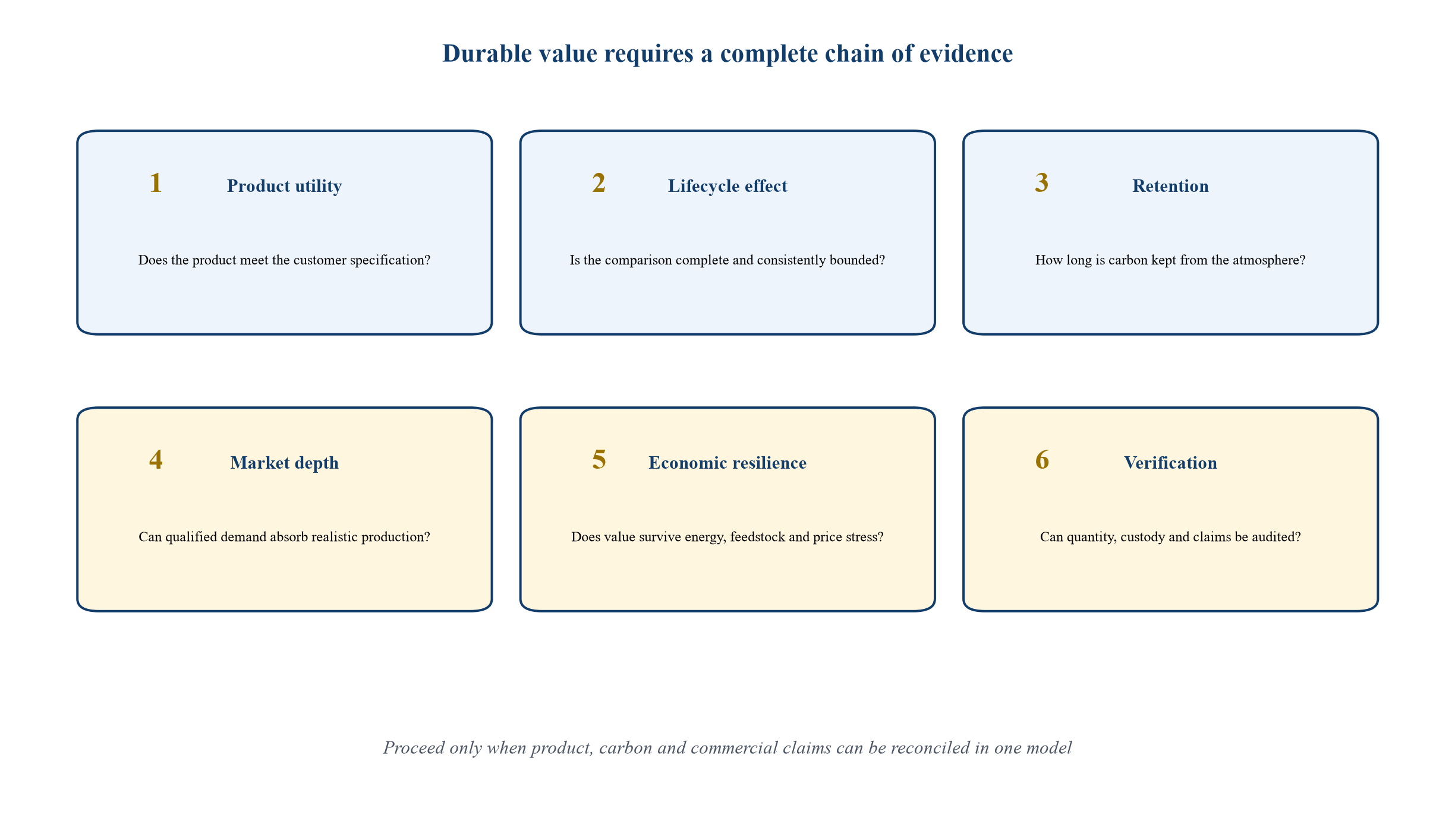
Decision framework. A favourable answer at one gate does not compensate for failure at another.
8. Product utility comes first
Customers generally buy cementitious performance, aggregate grading, polymer properties, fuel quality or chemical purity. The carbon attribute can influence procurement, but it cannot substitute for safety, reliability and specification. Product qualification should therefore precede a volume forecast.
The evidence package should include relevant standards, third-party testing, consistency across batches, aging or durability results, handling requirements and customer trials. A product that performs better can create value through lower material use, faster curing, reduced waste or improved service life. These operating benefits should be quantified separately from carbon revenue.
9. Mineralisation and building materials
The US Department of Energy describes mineralisation as a pathway in which carbon dioxide reacts with alkaline materials to form inorganic products such as synthetic aggregates and other building materials. Carbonates are at a lower energy state than carbon dioxide, which can reduce the thermodynamic burden compared with conversion into energy-rich fuels or chemicals.
Commercial attractiveness still depends on local materials. Alkaline feedstock may include natural minerals, industrial residues or demolition-derived material. Availability, contaminants, pretreatment, transport, competing uses and waste classification can determine cost. Finished products must meet construction standards and customer requirements. The theoretical durability of a carbonate does not establish a profitable plant.
10. Concrete curing
Carbon dioxide curing can introduce carbon during production of concrete products and may alter curing time, strength development or cement requirements. The commercial case can combine product performance, manufacturing productivity and embodied-carbon reduction. The investor should examine the actual dose, mineralised fraction, process modifications and product range.
Precast operations may offer controlled conditions and repeatable testing. Ready-mix applications involve different logistics and field controls. Adoption can be constrained by codes, conservative procurement, warranty allocation and the need to demonstrate long-term performance. An offtake memorandum should identify the qualified product, plant, geography and specification rather than relying on the size of the total concrete market.
11. Synthetic aggregates and industrial residues
Synthetic aggregate can turn carbon dioxide and alkaline material into a saleable construction input. The concept may reduce disposal cost, avoid quarrying and store carbon. Its economics are highly site-specific. A residue can carry collection cost, processing cost or a gate fee. Its chemistry and contaminants can vary by source.
The project should map feedstock quantity, quality, ownership, regulatory classification and competing demand. It should then test aggregate density, grading, strength, leaching and acceptance in the intended application. Transport often matters because aggregates are heavy and relatively low-value. A regional market and short haul can be more valuable than a large theoretical global market.
12. Chemicals and polymers
Carbon dioxide can replace part of the fossil carbon used in selected chemicals and polymers. The commercial case depends on conversion yield, catalyst performance, energy, hydrogen or co-reactant cost, separation, product purity and the fraction of carbon dioxide incorporated. High-value products can support early scale at lower volume, though market capacity may be limited.
Retention varies. An intermediate may be converted or released within years; a polymer may retain carbon over a longer service life. End-of-life incineration can return carbon to the atmosphere. The project should avoid applying a permanent-removal value to a product with uncertain disposal. Product margin and fossil-feedstock displacement can still support investment under a more precise claim.
13. Fuels
Synthetic fuels can use carbon dioxide as a carbon source where direct electrification is difficult. Their climate performance depends heavily on low-carbon energy, hydrogen production, process efficiency, carbon source and the displaced fuel. Combustion generally releases the carbon dioxide.
The appropriate commercial question concerns fuel specification, delivered cost, policy eligibility, customer willingness to pay and lifecycle emissions relative to the counterfactual. The appropriate carbon description is generally recycled or displaced carbon, not durable storage. A valuation should avoid capitalising removal-credit revenue unless the product and methodology genuinely qualify.
14. Biological products
Biological pathways can convert carbon dioxide into biomass, fuels, food ingredients or specialty products. Their economics depend on organism productivity, light or energy, nutrients, contamination control, harvesting and downstream processing. High-value coproducts can improve early economics while limiting scale.
Biogenic uptake can be temporary. Carbon can return to the atmosphere through consumption, decomposition or combustion. Investors should distinguish a productive carbon input from durable storage. Scale-up evidence should include sustained yield, contamination rates, batch consistency, water and nutrient balances, and a realistic market for every material coproduct.
15. Technology readiness is insufficient
Technology readiness levels describe the maturity of a technical system. They do not describe customer qualification, market capacity, regulatory acceptance or carbon integrity. A technically mature process can fail commercially because its product lacks a standard, its feedstock is scarce or its target market is saturated.
The matrix below adds market durability to technical readiness. Projects in the upper-right can progress toward contracted deployment. Projects with high technical readiness and weak market durability need product-market work. Projects with strong demand and low technical readiness need staged technical capital rather than project debt.
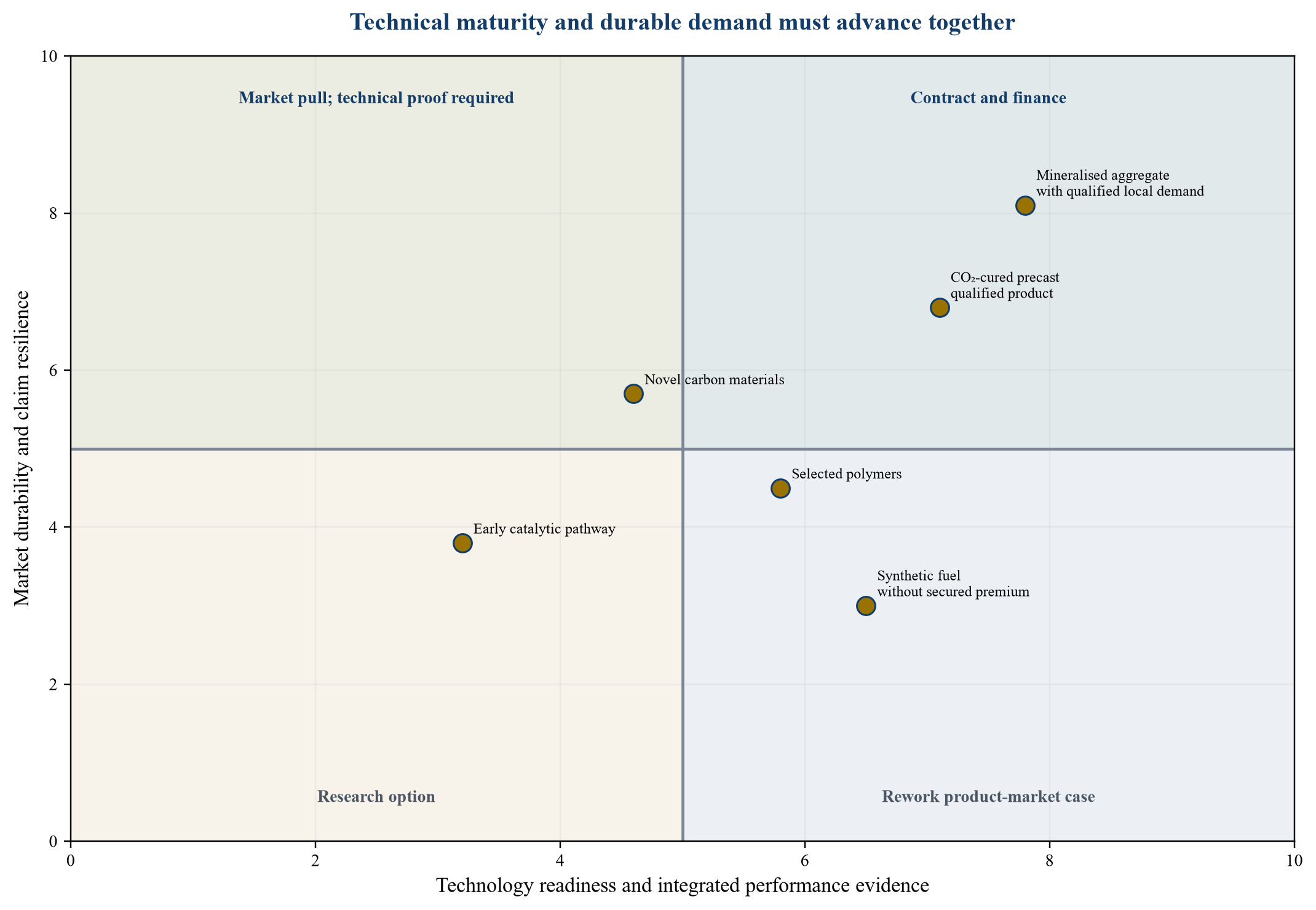
Illustrative positioning. Actual assessment requires product-specific evidence.
16. Integrated lifecycle and techno-economic assessment
Lifecycle assessment measures environmental effects across a defined system. Techno-economic assessment models technical performance, capital, operating cost, scale and price. The Global CO₂ Initiative recommends integrating these disciplines because an economic improvement can worsen lifecycle performance and an environmental improvement can destroy commercial viability.
Both assessments should use aligned process data, scale, location, energy mix and product output. They should show current performance and a justified future case. Learning assumptions should be tied to engineering actions and deployment volume. A model that combines pilot energy use with mature capital cost creates a misleading result.
17. System boundaries
The boundary should include capture or acquisition, purification, compression, transport, conversion, inputs, product finishing, distribution, use and end of life where material. Capital goods can matter for early plants. Credits for avoided production or waste treatment need transparent allocation.
Sensitivity should show electricity carbon intensity, heat source, carbon source, transport distance, conversion yield, product substitution and end-of-life outcome. The board should see which assumption changes the sign of the lifecycle result. That threshold is more useful than a single favourable number.
18. Cost-performance benchmark
The following benchmark uses hypothetical index values to demonstrate comparison. It does not represent market prices or operating data. Each pathway is scored on a common basis and should be replaced with project evidence during diligence.
Scores should be supported by a written evidence scale. Technical readiness can reflect integrated operating hours, scale, feedstock range and repeatability. Retention can reflect chemical form, expected service life and end-of-life pathway. Market depth can reflect qualified regional demand rather than headline sector size. Verification can reflect metering, sampling, chain of custody and an applicable methodology. Conversion cost should include delivered inputs, rejects and product finishing.
The benchmark is most useful as a sensitivity map. A sponsor can show the evidence required to move one score and the economic effect of that movement. An investor can identify the weak link instead of averaging away a critical failure. A low retention score does not make a fuel project unattractive; it prevents the project from being presented as permanent storage. A high retention score does not rescue a mineralised product without qualified demand.
Table 1. Hypothetical cost-performance benchmark for four utilisation pathways
| Pathway | Technical readiness (1-10) | Retention durability (1-10) | Product-market depth (1-10) | Verification strength (1-10) | Conversion-cost index |
|---|---|---|---|---|---|
| CO₂-cured precast concrete | 8 | 9 | 7 | 8 | 72 |
| Mineralised synthetic aggregate | 7 | 10 | 8 | 8 | 78 |
| CO₂-based polymer intermediate | 6 | 6 | 5 | 6 | 108 |
| Synthetic liquid fuel | 7 | 1 | 9 | 5 | 145 |
Illustrative index values only. They are not market data, engineering estimates or forecasts. Higher scores are favourable except conversion-cost index.
19. Revenue architecture
A utilisation project can receive product revenue, carbon-attribute revenue, avoided disposal cost, avoided input cost, policy support and technology-licence income. These sources should be modelled separately. Product revenue depends on qualification and customer value. Carbon revenue depends on methodology, title and durability. Avoided disposal cost depends on feedstock contracts and regulation.
Separating revenue protects the decision. If the project works only when a permanent-removal price is applied to temporary storage, the commercial thesis is weak. If product performance supports margin before carbon value, the carbon attribute can add resilience. Policy support should be treated according to eligibility, duration, cash timing and clawback.
20. Feedstock contracts
The carbon dioxide supply contract should specify quantity, quality, pressure, contaminants, availability, delivery point, metering and title. A utilisation plant may depend on an emitter that later shuts, reduces output or changes process. A take-or-pay obligation can protect the supplier while burdening the plant when demand falls.
Alkaline feedstock contracts require equal discipline. Industrial residues can change composition or regulatory status. The project needs sampling, rejection, price adjustment, replacement supply and liability provisions. Long-term exclusivity should be limited to volumes that the plant can process and the supplier can deliver.
21. Offtake and product qualification
An offtake contract should identify the qualified product, specification, plant, volume, price, testing, acceptance and remedies. A memorandum covering future products cannot substitute for a purchase obligation. Construction lenders will examine termination rights, credit support and the buyer's ability to replace the product.
Qualification often requires several production runs, third-party tests and customer trials. The schedule should connect qualification to equipment design and financing. If full-scale product cannot be tested before construction, the sponsor should define a staged acceptance route and contingency for redesign.
22. Carbon rights and claims
Contracts should allocate ownership of captured carbon, stored carbon, product attributes, certificates and public claims. The product buyer may want to report lower embodied emissions. A separate credit buyer may want exclusive retirement. These rights can conflict.
The project should maintain one claims ledger linking physical quantity, lifecycle calculation, certificate, transfer and retirement. Marketing language should follow the evidence. Reversal or methodology-change obligations need caps, replacement rules and insurance where available.
23. Hypothetical unit economics
The example below separates revenue and cost for a mineralised-product plant. Values are indices. They demonstrate the questions an investment committee should ask: product margin before carbon revenue, sensitivity to feedstock and energy, qualification volume, and cash conversion.
Table 2. Hypothetical unit economics for a mineralised-product project
| Item per qualified product unit | Base index | Downside index | Diligence question |
|---|---|---|---|
| Product selling price | 125 | 110 | Is the price supported by a binding qualified offtake? |
| Carbon-attribute value | 12 | 0 | Does the methodology recognise the claim and duration? |
| Feedstock or gate-fee contribution | 8 | 0 | Is payment durable under regulation and contract? |
| Carbon dioxide delivery | (14) | (20) | Who bears purification, compression and interruption? |
| Alkaline feedstock and pretreatment | (22) | (30) | How variable are chemistry and processing requirements? |
| Energy and utilities | (15) | (22) | What is the cost and carbon-intensity threshold? |
| Conversion, labour and maintenance | (38) | (48) | Has integrated operation been demonstrated? |
| Logistics, testing and sales | (18) | (24) | Does the regional market absorb plant output? |
| Contribution before fixed financing cost | 38 | (34) | Which contracts or design changes protect downside? |
Illustrative index values only. They are not market data, offers, engineering estimates or forecasts.
24. Scenario valuation
Valuation should begin with qualified production, contribution margin and capital required to reach steady operation. It should not begin with tonnes of carbon dioxide multiplied by a headline credit price. The base case should include ramp-up, rejects, maintenance, working capital and contract timing.
The probability-weighted case should separate technical completion, product qualification and commercial ramp. These are different events and can fail independently. Development spending before each gate should be explicit. Future capital should be discounted for timing and dilution. An acquisition case should distinguish the value of the existing plant, reusable process knowledge, customer approvals and the option to build further sites.
Carbon value should be modelled by eligible verified unit. The model should deduct lifecycle emissions, ineligible output, measurement uncertainty and any buffer or replacement obligation. A buyer premium embedded in product price should not be counted again as a separate credit. The valuation committee should reconcile every environmental cash-flow line to a contract and a claims right.
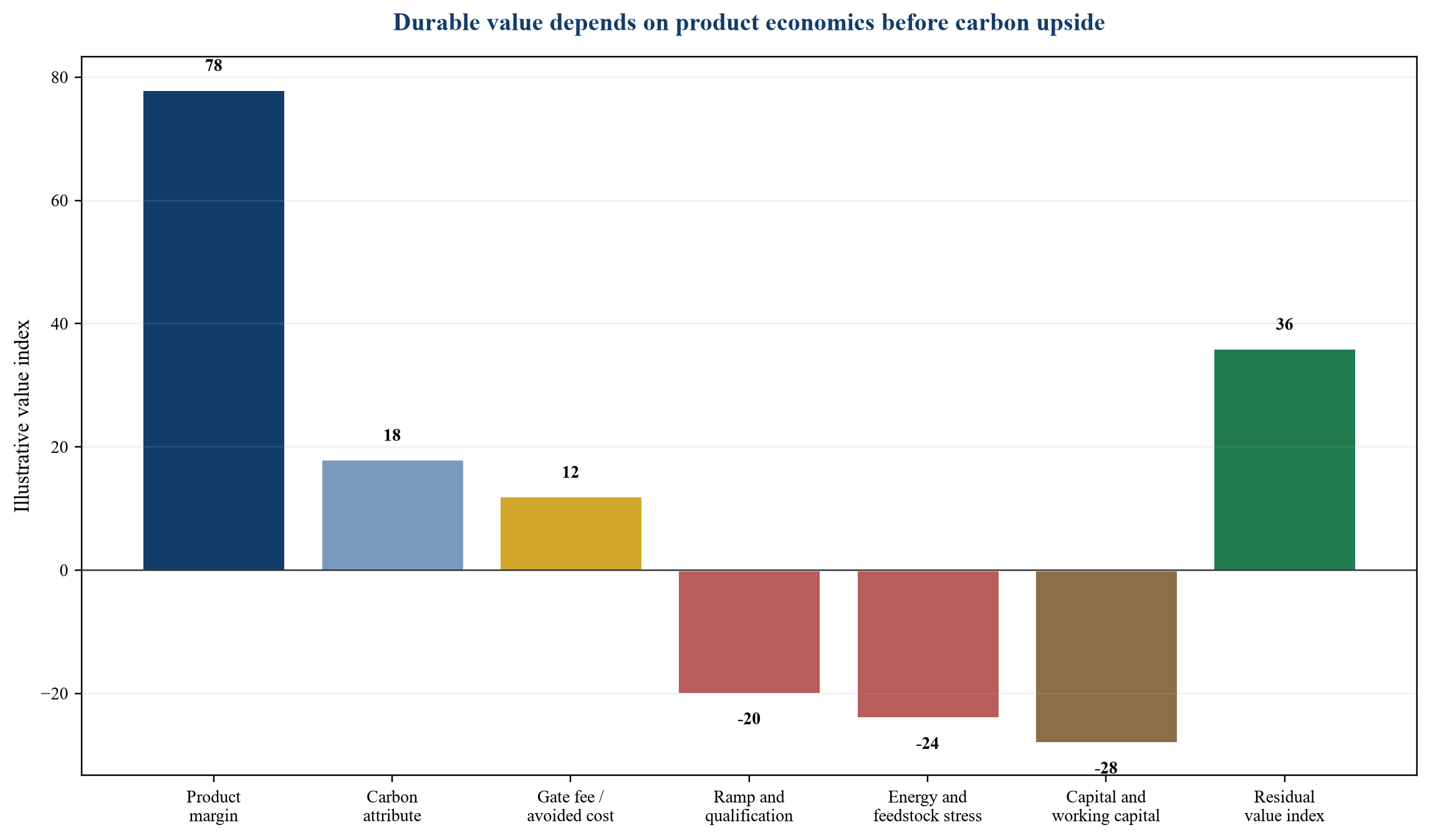
Illustrative index values only. The figure is a decision tool and not a valuation or forecast.
25. Financing by stage
Laboratory and pilot work requires grants, strategic capital or venture equity. Demonstration facilities require risk capital, public support and customer participation. Project debt becomes plausible after integrated performance, product qualification, feedstock security, offtake and a bounded construction plan are established.
Equipment finance may cover standard assets while technology-specific equipment remains equity-funded. Buyer prepayments can support construction if refund, security and delivery rights are compatible with senior lenders. A carbon-credit forward should be discounted for methodology, issuance and delivery risk.
26. Commercialisation roadmap
The roadmap should retire one class of risk at each gate. It should identify evidence, capital, contract and stop decision. Expansion follows proven qualified demand rather than installed technical capacity alone.
Table 3. Stage-gated commercialisation roadmap
| Gate | Required evidence | Commercial instrument | Capital fit | Stop or redesign trigger |
|---|---|---|---|---|
| Laboratory | repeatable conversion, material balance and product sample | evaluation agreement | grant and seed equity | unstable yield or unacceptable inputs |
| Pilot | integrated runs, energy, quality and preliminary lifecycle result | customer trial | strategic and venture capital | product fails specification or lifecycle threshold |
| Demonstration | sustained operation, third-party testing and regional market study | conditional offtake | public support and growth equity | no qualification route or insufficient local demand |
| First commercial | qualified product, firm feedstock, permits, construction plan and contracted anchor volume | binding offtake and direct agreements | equity, buyer capital and structured debt | unfunded completion or unallocated performance risk |
| Replication | operating history, validated margin and transferable design | portfolio procurement | project debt and infrastructure capital | site economics depend on non-repeatable subsidy |
Generic framework. Evidence thresholds require project-specific engineering, legal and commercial advice.
27. Risk allocation
Technology providers should bear risks they can control through warranties, performance tests and remedies. Feedstock suppliers should bear quality and committed-delivery obligations. Buyers should bear accepted-product demand under agreed take-or-pay terms. Sponsors retain integration and residual market risk.
Carbon-accounting risk requires special treatment. Methodology changes can affect eligibility after the plant is built. Parties can agree a compliance plan, price adjustment, substitute claim and termination threshold. An uncapped promise to deliver a future environmental outcome creates an obligation that cannot be priced reliably.
Insurance may cover property damage, machinery breakdown, delay, liability and selected performance exposures. It will not replace a sound process or create a market for the product. Policy exclusions, testing conditions and maximum indemnity should be reconciled with contract liabilities. The project should identify uninsured exposure and the capital available to absorb it.
Interface risk deserves a separate register. A capture supplier may meet its outlet specification while a conversion unit rejects the stream. A conversion unit may make compliant material while the customer's application fails for another reason. Direct agreements, shared test protocols and coordinated cure rights can prevent each party from declaring success while the integrated project remains unable to sell.
28. Investment committee questions
The committee should ask whether the product has a verified customer function; whether lifecycle and techno-economic models share one data set; whether carbon duration matches the claim; whether qualified demand fits realistic output; whether the plant survives without disputed carbon revenue; and whether expansion can repeat the feedstock, energy and market conditions.
It should also ask who owns the environmental attribute, who bears off-specification feedstock, what happens if product qualification is delayed, how working capital is funded, and which evidence releases each capital tranche. A clear negative answer is useful. It can prevent construction capital from being committed to a research problem.
29. Implications for sponsors and advisers
Sponsors should present one integrated evidence room containing process data, product tests, lifecycle model, techno-economic model, contracts, permits, claims ledger and financing model. Advisers should reconcile the documents before marketing capital. A product forecast should not exceed qualified demand. A carbon claim should not exceed verified retention.
The strongest proposition may be a conventional product with better performance, lower delivered cost and an additional verified carbon benefit. This structure broadens the buyer base and reduces dependence on voluntary environmental markets. It also supports a more conventional financing conversation after technical and contractual risks are retired.
30. Market-capacity discipline
Market-capacity analysis should move from total market to serviceable qualified demand. A global construction-materials figure does not show how much output a specific plant can sell within an economic haul radius. The model should segment customers by application, specification, plant approval, procurement cycle and delivered price. It should also recognise that a low-carbon premium may apply to only part of the market.
The base case should use contracted or evidenced demand. A development case can include customers in active qualification, discounted for probability and timing. Uncontacted market potential belongs in an expansion case. This separation prevents capacity from being financed against an addressable-market slide. It also reveals whether the plant needs one anchor buyer, several regional buyers or a portfolio of products to reach stable utilisation.
31. Location and industrial symbiosis
A favourable site may combine a suitable carbon dioxide source, alkaline feedstock, low-carbon energy, water, transport and nearby customers. This industrial symbiosis can reduce cost and lifecycle emissions. It can also concentrate dependencies. Closure of one host facility may remove carbon dioxide, feedstock, utilities or land access at the same time.
Site diligence should model each shared service as a contract and a replacement problem. The sponsor should identify alternative carbon supply, feedstock stockpiles, utility back-up, transport routes and step-in rights. Shared infrastructure charges should be transparent and survive a change of control. A low-cost co-location arrangement that cannot survive host distress may be unsuitable for long-tenor debt.
32. Energy and hydrogen exposure
Catalytic conversion routes can be highly sensitive to electricity and hydrogen. The relevant metric is delivered clean energy at the required load profile, not an annual average power price. Electrolysers, compression, separation and synthesis can create correlated demand and availability risks. Curtailment can reduce output while fixed costs continue.
The model should show energy intensity per qualified product unit, source-specific emissions, hourly or seasonal availability where material, network charges, balancing and hedging. A power-purchase agreement can provide price visibility while leaving basis, shape and connection risk. Hydrogen supply requires its own quantity, quality, carbon-intensity and delivery terms. Investors should see the energy price and carbon-intensity thresholds at which the product loses margin or lifecycle advantage.
33. Standards and procurement
Building products, chemicals and fuels enter regulated and specification-driven markets. Standards protect safety and comparability, while their revision can take time. A technically successful product may face delayed approval if the relevant standard is prescriptive or if customers require evidence beyond regulatory minimums.
The commercialisation plan should map every required test, certifier, authority, customer approval and procurement list. It should identify sequence, cost, sample volume and decision time. Public procurement can create early demand for lower-carbon materials when tender rules recognise verified performance. The project should avoid assuming that a general net-zero policy creates a purchase obligation. Bankable demand requires an eligible product, an authorised budget and an enforceable procurement route.
34. Scale-up and replication
Scale can change mixing, heat transfer, mass transfer, impurity behaviour, solids handling and maintenance. A demonstration plant may validate chemistry while leaving equipment integration and uptime unresolved. Replication should therefore be based on a defined design envelope and operating evidence.
The first-commercial facility should capture data needed for the second site: equipment reliability, consumables, labour, quality variation, maintenance, customer acceptance and working capital. Modular replication can reduce engineering change if modules truly repeat. Site-specific feedstock and product rules can still require redesign. A portfolio valuation should separate reusable intellectual property from local development work and should apply replication credit only where evidence supports transfer.
35. Construction and completion
First-commercial plants often combine standard equipment with proprietary integration. A single fixed-price engineering contract may be unavailable or expensive. The sponsor can use package contracts, technology guarantees, owner contingency and completion support. The resulting interface risk must have a named owner.
Completion tests should cover sustained throughput, product specification, carbon incorporation, energy use, emissions and availability. A test based only on gross conversion can allow a plant to pass while producing unsaleable material. Debt conversion should require the evidence that supports cash flow. Cost-overrun funding should be committed before notice to proceed, with draw rules and consequences if contingency is exhausted.
36. Working capital and inventory
Carbon-utilisation projects can carry carbon dioxide supply payments, feedstock processing, testing and product inventory before customer acceptance. Certification or environmental-attribute payment can arrive after physical sale. These lags should be modelled separately from steady-state operating margin.
Inventory finance depends on product shelf life, quality, title, storage cost and resale value. A lender may advance against accepted product under a firm offtake and decline unqualified output. The sponsor should model rejected material, reprocessing and disposal. Cash-flow stress during ramp-up can exceed accounting loss because production consumes inputs before qualification and collection. A committed working-capital facility should be sized to the combined downside.
37. Downside and break-even analysis
A useful downside combines lower yield, delayed qualification, weaker product price, higher energy cost and reduced carbon value. These variables may be correlated. A methodology change can reduce carbon revenue while increasing testing cost. A weak construction market can lower both demand and aggregate price.
The board should see break-even product price, minimum utilisation, maximum delivered carbon dioxide cost, maximum energy intensity and required working-capital headroom. It should also see the cure available for each breach. A project with several feasible levers can be resilient. A project that requires simultaneous best-case performance, premium price and permanent-removal revenue should remain in staged development.
38. Valuation method
An operating utilisation plant can be valued through discounted cash flow and relevant industrial comparisons after normalising carbon revenue and policy support. A development company requires probability-weighted stages, funding needs and dilution. Comparable transactions should be adjusted for pathway, product, technology rights, contracts, plant ownership and maturity.
Intellectual property value depends on defensibility, freedom to operate, know-how, data and the cost for a customer to adopt the system. A patent count is not a valuation method. Carbon credits should be included only to the extent that methodology, title, issuance and buyer terms support cash flow. Terminal value should reflect finite feedstock contracts, asset life, renewal capital and the durability of product demand.
39. Due-diligence evidence room
The technical folder should contain mass and energy balances, test protocols, raw data, equipment specifications, scale-up basis, maintenance assumptions and independent reports. The commercial folder should contain customer tests, qualification status, executed contracts, pipeline evidence and regional logistics. The carbon folder should contain lifecycle files, source data, methodology, metering, custody and claims allocation.
The financial folder should reconcile these materials to capacity, ramp-up, price, costs, capital, working capital and funding. Version control matters because a change in yield should flow through energy, product output, lifecycle performance and cash. Diligence findings should be recorded as resolved, priced, allocated or open. An unresolved matter should not disappear into a blended contingency.
40. Decision checklist
Before approving development capital, the investment committee should require a defined product, customer use, functional unit and counterfactual. Management should explain why the chosen route creates customer value and which evidence supports the claim. The committee should see representative feedstock tests, conversion data, product samples, preliminary lifecycle results, intellectual-property position and a budget tied to the next evidence gate. The approved capital should buy information that can change the investment decision.
Before approving a demonstration facility, the committee should require integrated operating evidence over a representative period. The package should show input variability, output quality, energy and material consumption, maintenance, rejects, emissions and safety. Customer qualification should have a documented path, named decision makers and test requirements. The lifecycle and techno-economic models should use the same operating case. A demonstration facility should answer remaining scale and market questions; it should not merely reproduce a favourable laboratory result at higher cost.
Before approving first-commercial construction, the committee should require site control, permits, a completed design basis, a cost and schedule review, feedstock contracts, utility arrangements, product qualification evidence, binding anchor demand and an allocated completion plan. Contract conditions should align. The carbon dioxide supply date, plant commissioning date, customer acceptance date and environmental-attribute issuance date should form one executable schedule. Funding should cover construction, contingency, commissioning, qualification, working capital and downside liquidity.
Before approving senior debt, lenders should test whether debt service is supported by accepted-product cash flow after operating cost, maintenance, working capital, taxes, reserves and required reinvestment. Carbon revenue should receive a haircut for methodology, issuance, volume and buyer risk. Uncontracted expansion and unqualified products should not support base debt sizing. Security should include material project assets and contracts, with step-in and cure rights that preserve safe operation and product obligations.
Before approving replication, the board should distinguish learning that transfers from conditions that are site-specific. It should compare actual and underwritten yield, energy, availability, quality, price, customer uptake, maintenance and cash conversion. The second project should incorporate proven design changes and retain contingency for new feedstock, regulation and market conditions. Portfolio value should be based on repeatable unit economics and executable sites. A successful first plant does not by itself establish that every region has suitable inputs, standards or demand.
Throughout ownership, reporting should reconcile physical carbon, product output, environmental claims and cash. Management should report captured or acquired carbon dioxide, incorporated carbon, lifecycle emissions, qualified product, sold product, certificates issued, certificates transferred and claims retired. Variances should flow into the operating model and covenant forecast. This reconciliation allows the board to identify whether value is being created by product performance, policy, carbon attributes or temporary market scarcity.
41. Conclusion
Carbon utilisation can create commercially useful products and support emissions reduction. Durable value is pathway-specific. Mineralisation can offer long retention and favourable reaction energetics, while product standards, feedstock quality, logistics and market depth remain decisive. Fuels and many chemicals may create strategic value under a circular-carbon thesis while providing little durable storage.
The investment discipline is to separate product revenue, carbon value and avoided cost; align lifecycle and techno-economic boundaries; qualify the product; contract feedstock and demand; and release capital against evidence. A project that passes these tests can move from an attractive carbon story to a financeable industrial proposition.
References
- International Energy Agency. Putting CO₂ to Use: Creating Value from Emissions. Paris: IEA, 2019. https://www.iea.org/reports/putting-co2-to-use
- International Energy Agency. Carbon Capture, Utilisation and Storage. https://www.iea.org/fuels-and-technologies/carbon-capture-utilisation-and-storage/
- US Department of Energy. Carbon Conversion. https://www.energy.gov/hgeo/carbon-conversion
- US Department of Energy. Carbon Mineralization Pathway. https://www.energy.gov/hgeo/carbon-mineralization-pathway
- US Department of Energy. Multi-Year Program Plan: Carbon Conversion. January 2025. https://www.energy.gov/sites/default/files/2025-01/Carbon%20Conversion%20Multi-Year%20Program%20Plan.pdf
- Global CO₂ Initiative. Techno-Economic Assessment and Life Cycle Assessment Guidelines for CO₂ Utilization, Version 2.0. https://www.globalco2initiative.org/evaluation/co2nsistent-project/
- Global CO₂ Initiative. AssessCCUS Detailed Process. https://assessccus.globalco2initiative.org/tea/detailed-process/
- National Academies of Sciences, Engineering, and Medicine. Gaseous Carbon Waste Streams Utilization: Status and Research Needs. Washington, DC: National Academies Press, 2019. https://doi.org/10.17226/25232
- Intergovernmental Panel on Climate Change. Climate Change 2022: Mitigation of Climate Change. Working Group III contribution to the Sixth Assessment Report. Cambridge University Press, 2022. https://www.ipcc.ch/report/ar6/wg3/
- ISO. ISO 14040:2006 Environmental management: Life cycle assessment: Principles and framework.
- ISO. ISO 14044:2006 Environmental management: Life cycle assessment: Requirements and guidelines.
- ISO. ISO 14067:2018 Greenhouse gases: Carbon footprint of products.
- European Union. Regulation (EU) 2024/3012 establishing a Union certification framework for permanent carbon removals, carbon farming and carbon storage in products. Official Journal of the European Union, 2024.
- European Commission. Carbon removals and carbon farming certification. https://climate.ec.europa.eu/eu-action/carbon-removals-and-carbon-farming_en
- Zimmermann, A. et al. Techno-Economic Assessment and Life Cycle Assessment Guidelines for CO₂ Utilization. Frontiers in Energy Research, 2020. https://doi.org/10.3389/fenrg.2020.00005
- Artz, J. et al. Sustainable Conversion of Carbon Dioxide: An Integrated Review of Catalysis and Life Cycle Assessment. Chemical Reviews, 2018. https://doi.org/10.1021/acs.chemrev.7b00435
- Hepburn, C. et al. The technological and economic prospects for CO₂ utilization and removal. Nature, 2019. https://doi.org/10.1038/s41586-019-1681-6
- Global Cement and Concrete Association. Concrete Future: The GCCA 2050 Cement and Concrete Industry Roadmap for Net Zero Concrete. 2021. https://gccassociation.org/concretefuture/
About the Author
Chennakeshav (CK) is a corporate finance and investment banking executive with 25+ years of global experience in deal origination, structuring and execution across M&A, growth capital and corporate strategy. He has led value-creation mandates for founders, corporates and funds — bridging the boardroom view to hands-on execution and close.
His career spans Morgan Stanley, HSBC, Lloyds Banking Group, EWEC, ADQ portfolio companies and Emirates Growth Fund, across TMT, real estate, fintech, deeptech, cleantech, infrastructure and energy. He has partnered with C-suite leaders, private equity and venture funds, sovereign wealth funds and family offices to finance complex fund raises and scale-up ventures, and has led M&A due diligence, post-merger integration and business-transformation initiatives to create value.
At Matchpoint Partners he is Managing Partner, leading the firm's corporate finance, M&A and capital-raising practice. He holds an MBA from London Business School, an engineering degree from VTU and a Master of Laws (LLM, in progress) from UCL London.
An active start-up mentor, CK mentors at Techstars, DIFC FinTech Hive, Startup Grind, Founder Institute and IN5, serves as Entrepreneur Mentor in Residence (EMiR) at London Business School, and judges the Entrepreneurship World Cup.
LinkedIn: https://www.linkedin.com/in/ckadya/
Profile: https://www.matchpoint-partners.com/team/ck-adya.html
