
1. Demand should be project backed
Electrolyser consolidation should begin with the projects that can support equipment demand. A factory has economic value when credible customers can reach notice to proceed, pay deposits, fund construction and accept delivered systems. Announced hydrogen capacity, policy ambition and non-binding memoranda help define market direction, but they do not establish an executable order book.
The International Energy Agency reports that more than half of potential electrolyser capacity expected by project developers may slip beyond stated operating dates. Large projects continue to face obstacles in offtake, regulation, infrastructure and financing [1]. The consequence for manufacturers is direct: lower factory utilisation, delayed milestone receipts, slower inventory turns and weaker absorption of fixed engineering and production costs.
A buyer should therefore build demand from individual projects upward. Each opportunity should be classified by development stage, sponsor quality, subsidy award, power access, product route, offtake, permits, financing, procurement status and contractual commitment. Volume enters the acquisition case only when the evidence supports the assigned probability and timing. This discipline prevents a strategic narrative from becoming a substitute for cash-generating demand.
2. Boom capacity outran bankable deployment
Water-electrolysis capacity grew rapidly, yet manufacturing investment moved faster than completed deployment. The IEA recorded about 2 GW of installed global capacity in 2024 and more than 1 GW added through July 2025. China accounted for roughly 65 percent of installed capacity and about 60 percent of manufacturing capacity [2]. The same review estimated Chinese manufacturing capability near 20 GW a year against 2024 demand of about 2 GW.
Europe also created substantial capacity. The IEA's Northwest European Hydrogen Monitor reports that the region contains about 85 percent of European electrolyser manufacturing capacity and that announced capacity could exceed 36 GW a year by 2030 [4]. A 2026 European Commission assessment states that European electrolyser plants operated at just below 20 percent of nameplate capacity in 2024 [9]. These measures use different geographic and methodological boundaries, but both point to weak utilisation.
Low utilisation changes transaction economics. A recently built line can still require maintenance, calibration, software support, minimum staffing, security, insurance and working capital. Its book value reflects historical expenditure. Its market value depends on future throughput, conversion potential and avoided replacement cost. The buyer should treat every expansion announcement as a diligence item, not as evidence of scarcity.
3. Capacity numbers need a common denominator
Electrolyser capacity is reported through factory output, stack output, complete-system output, megawatts of orders or expected annual shipments. Product ratings may refer to direct-current stack input, alternating-current system input or a broader plant boundary. A line capable of assembling stacks may depend on external balance-of-plant suppliers, testing stations, power electronics and final integration elsewhere.
The transaction team should restate capacity by technology, product generation, standard module, shift pattern, yield, bottleneck, test time and saleable-system boundary. It should identify which equipment is installed, commissioned, qualified, mothballed or merely planned. Capacity should also be adjusted for realistic labour, supplier availability and customer-specific engineering.
A common denominator allows the buyer to compare factories and identify genuine redundancy. Two facilities described as one gigawatt each may serve different pressure classes, current densities, module sizes or certification regimes. Their tools and know-how may not be interchangeable. A consolidation plan based on headline gigawatts can close the wrong facility and damage the only line qualified for a valuable customer segment.
4. Delay moved risk back to manufacturers
When customer projects slip, manufacturers carry more than lost revenue. Reserved components remain in inventory. Engineering teams continue customer-specific design work. Factory slots become difficult to refill. Supplier commitments, rental obligations and guarantees remain outstanding. Revenue recognition and cash collection move later while fixed costs continue.
Order contracts allocate this exposure unevenly. Deposits may be refundable, conditional or protected by bank guarantees. Cancellation rights may become available after a long-stop date. Change orders can compensate redesign but create disputes. Liquidated damages can apply to late delivery even when the upstream project also changed. A buyer needs the complete contract and correspondence history, not a backlog spreadsheet.
The risk can also pass through the acquisition. A share purchase normally preserves the contractual entity, including warranty, guarantee and litigation exposure. An asset purchase may allow selected assets and contracts to move, subject to consent and local law. The transaction structure should match the obligations the buyer can price and operate.
5. Consolidation can take six forms
Consolidation is broader than buying an entire manufacturer. A whole-company acquisition can preserve licences, contracts, people, installed-base relationships and operating continuity. It can also transfer legacy liabilities and cash needs. An asset acquisition can select patents, designs, software, test rigs, tooling, inventory or a factory while excluding some obligations, subject to insolvency, employment, environmental and transfer rules.
A product-line carve-out can combine a complementary technology without acquiring the seller's full platform. Licensing can provide access to designs or markets with less capital, although control and enforceability require careful drafting. Toll manufacturing can use idle capacity while leaving technology ownership separate. A joint venture can combine market access, local content and technology. Orderly wind-down can preserve service and warranty support while releasing property and equipment.
The correct form follows the acquisition thesis. A buyer seeking a differentiated stack may need intellectual property, test data and a small technical team. A buyer seeking regional delivery may need qualified assembly, supplier relationships and local certification. A buyer seeking the installed base may need field records, spares, service contracts and control-system access. The perimeter should be designed around that value.
6. Start with the transaction perimeter
The perimeter is a map of what creates value, what must accompany it and what should remain behind. It should separate technology, products, factories, equipment, people, contracts, service rights, inventory, data, intellectual property, grants, permits and liabilities. Each element should have an evidence source, transfer route, dependency and value treatment.
Perimeter design should also identify shared functions. A product business may rely on the seller's enterprise systems, laboratories, procurement, quality management, treasury, insurance and brand. Removing the product without those capabilities can interrupt delivery or invalidate certification. Transitional services can bridge the gap, but they should have scope, service levels, data rights, exit plans and cost.
The figure presents a decision sequence. It is hypothetical and applies no conclusion to a named company. Its purpose is to keep the acquisition thesis tied to project-backed demand and to direct each asset toward the transaction form that preserves the most risk-adjusted value.
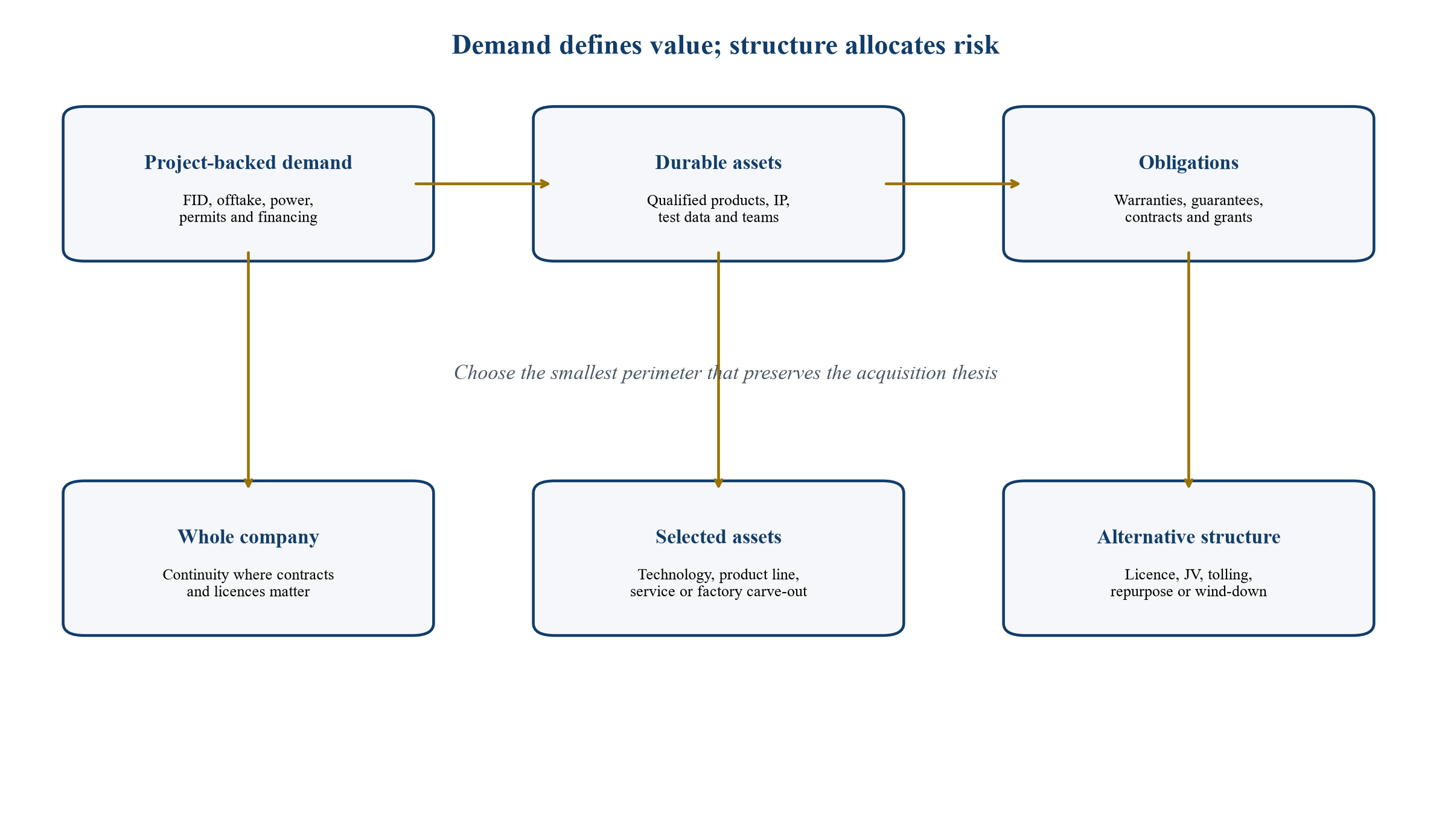
The map is a hypothetical decision architecture. It is not a recommendation for a named business or transaction.
7. Separate assets, liabilities and obligations
An asset register should reconcile fixed assets, intangible assets, inventory, customer-funded tooling and leased equipment to physical inspection and accounting records. The buyer should identify title, liens, location, condition, remaining useful life, calibration and whether each asset is required for a qualified production process.
Liability diligence should cover trade payables, customer advances, tax, employment, environmental matters, product claims, performance guarantees, bonds and grant clawback. Some obligations do not appear fully on the balance sheet. A parent guarantee, letter of credit or performance bond can require cash collateral after a covenant or rating change. Customer deposits can create a cash balance and an equal delivery obligation.
The purchase agreement should connect the register to price, debt-like items, working-capital treatment, indemnities, escrows and closing conditions. Legal allocation alone is insufficient when the buyer must operate the product and support customers. The operating model should show who will fulfil every retained and transferred obligation after closing.
Table 1. Transaction perimeter and structure choices
| Value objective | Assets required | Obligations to diligence | Potential structure | Principal control |
|---|---|---|---|---|
| Preserve contracted delivery | Entity, customer contracts, supplier agreements, workforce and qualified line | Customer advances, delay exposure, guarantees and working capital | Whole-company acquisition | Closing liquidity and covenant headroom |
| Acquire differentiated technology | Patents, know-how, design files, software, test data and inventors | IP ownership, grants, licences and employee claims | Asset or product-line acquisition | Assignment, retention and freedom to operate |
| Expand regional manufacturing | Facility, permits, tooling, quality system and local suppliers | Environmental, lease, labour and certification | Facility carve-out or joint venture | Requalification and transition services |
| Build service platform | Installed-base data, field team, spares, software access and service contracts | Warranty claims, cybersecurity and response commitments | Service carve-out or whole company | Customer consent and data continuity |
| Use temporary excess capacity | Qualified equipment, operators and test capability | Product liability, confidentiality and scheduling | Toll manufacturing | Quality agreement and capacity priority |
| Exit uneconomic capacity | Property, equipment, inventory and employee plan | Closure costs, decommissioning and customer support | Repurpose, sale or orderly wind-down | Funded separation plan |
The table is a generic framework. Transferability and liability allocation require jurisdiction-specific legal advice.
8. Backlog quality matters more than headline volume
Backlog should be rebuilt contract by contract. The buyer should distinguish firm purchase orders, framework agreements, preferred-supplier status, conditional awards, memoranda and internal sales pipeline. It should reconcile quoted megawatts and price to legal commitments, revenue recognition and expected cash collection.
A risk-adjusted backlog model should include customer credit, project equity, debt, subsidy, power supply, offtake, permits, site access, engineering maturity, notice to proceed, cancellation rights, deposits and expected margin. Each factor should have documentary evidence and a named owner. The probability assigned to an order should be approved independently from the sales team that originated it.
Backlog quality also depends on economics. An order signed during a period of high raw-material prices or aggressive market entry may contain weak margin, fixed-price exposure or demanding performance guarantees. A low-margin order can consume scarce engineering and working capital while adding little value. The acquisition model should rank orders by contribution after risk, not by megawatts.
9. Customer project gates determine order probability
An electrolyser order is embedded in a larger hydrogen project. The project needs power, land, water, interconnection, construction, storage, transport, product certification and a buyer for hydrogen or derivatives. A delay in any critical path can stop equipment delivery. Manufacturer diligence should therefore include selected project-level evidence.
The European Hydrogen Bank auction illustrates the evidence expected from project developers. Auction materials address technical maturity, electricity sourcing, offtake, procurement, permits and linked-project status [21, 22]. A subsidy award can strengthen a project but does not complete financing or construction. The buyer should verify the award conditions and milestones.
The backlog model should use stage gates such as development, front-end engineering, permit ready, financed, notice to proceed, under construction and commissioned. A project should not advance because management expects policy support. It should advance when the required evidence exists. This creates a consistent connection between project maturity, factory planning and valuation.
10. Deposits and termination rights change cash conversion
Customer deposits can reduce working-capital exposure and demonstrate commitment. Their value depends on refundability, milestone conditions, guarantee requirements and the manufacturer's obligation to reserve capacity or procure long-lead items. A deposit protected by an on-demand bank guarantee may provide less net liquidity than the cash balance suggests.
Termination rights determine how long weak projects occupy the backlog. The contract should be tested for convenience termination, long-stop dates, suspension, force majeure, financing conditions, subsidy failure and change in law. The buyer should understand the cash and inventory outcome under each route.
The model should connect contract terms to expected cash flow. It should show deposit receipt, supplier prepayments, work in progress, milestone invoices, retention, warranty security and final acceptance. Purchase price should reflect the obligations carried with customer cash. Treating deposits as surplus cash without the associated delivery burden can materially overstate equity value.
11. Technology portfolios are not interchangeable
Alkaline, proton-exchange membrane, solid-oxide and anion-exchange membrane technologies have different materials, operating envelopes, maturity, efficiency, dynamic response, pressure, footprint and supply chains. Within each category, product generations can differ in cell design, catalyst loading, coating, sealing, compression, control and balance of plant.
A buyer should define the customer problem each platform solves and the evidence supporting performance. It should compare stack efficiency, degradation, availability, turndown, start-stop behaviour, product purity, pressure, replacement interval and serviceability at the relevant operating profile. Laboratory peak performance should be separated from commercial field operation.
Portfolio overlap can be beneficial when technologies address distinct markets. It can also create duplicated engineering, fragmented procurement and customer confusion. The integration plan should decide which products continue, converge, migrate or close. That decision should follow field evidence, certification and customer commitments rather than internal politics.
12. Manufacturing lines require qualification
Electrolyser quality depends on materials, process control, assembly, sealing, coating, electrical connection, cleaning, testing and traceability. Moving a product between factories can change equipment, suppliers, environment, labour and measurement. Customers and certifiers may require requalification before accepting the transferred product.
The buyer should inspect process flow, control plans, work instructions, non-conformance history, yield, rework, calibration, test capacity and genealogy. It should identify special processes where output cannot be fully verified by final inspection. The diligence team should determine whether critical know-how is documented or held by a small number of employees.
The consolidation business case should include validation batches, customer approval, certification, ramp loss and dual-running. Closing the original line too early can interrupt delivery and weaken warranty defence. Keeping both lines indefinitely can preserve excess cost. A gate-based transfer plan allows capacity to close only after the receiving site meets defined quality and throughput evidence.
13. Supply-chain localisation can affect value
Manufacturing value depends partly on access to membranes, catalysts, porous transport layers, electrodes, coatings, plates, seals, power electronics, compressors, controls and fabricated balance-of-plant equipment. Supplier concentration and geographic exposure can affect cost, lead time and policy eligibility.
European policy increasingly connects support to resilience and domestic manufacturing. The Net-Zero Industry Act covers electrolysers and sets a benchmark for European manufacturing capacity relative to annual deployment needs [7]. Hydrogen-auction requirements have included resilience criteria affecting sourcing [18]. Transaction diligence should determine whether a product can comply with applicable rules and how a change in supplier or ownership affects eligibility.
Local content can also create joint-venture opportunities. A technology owner may combine with a regional manufacturer that has fabrication, customer access and public-procurement credentials. The value of the combination depends on technology transfer, quality control, IP protection, export rights and minimum volume. Localisation should be modelled as a specific operating system, not as a general synergy.
14. IP diligence goes beyond patents
Patents provide only one part of the technology perimeter. Valuable know-how can reside in process recipes, material specifications, test methods, models, control logic, commissioning procedures, failure analysis and supplier collaboration. The buyer should identify how each capability is protected and whether it can be transferred.
Ownership diligence should cover employees, contractors, universities, strategic partners, customers, licensors and public grants. Joint development may create shared improvements or field-of-use restrictions. Grant funding may impose reporting, location, access or clawback obligations. Open-source software can create licence duties within control platforms.
Freedom to operate requires a separate analysis from ownership. A business can own important patents and still depend on third-party rights. The transaction team should map material claims to current and planned products, relevant countries, expiry, validity and design alternatives. IP value enters the base case only when the buyer can legally and operationally use it.
15. Test data and field evidence are core assets
Electrolyser performance claims gain value when they are supported by controlled test data and operating history. The buyer should obtain raw data, methods, calibration, boundary conditions, sample size, failures and change records. A summary chart without the underlying protocol provides weak evidence.
Field data should connect serial numbers, configuration, site conditions, operating profile, maintenance and degradation. The buyer should distinguish internal test stands, customer demonstrations, pilot systems and commercial operation. It should identify survivorship bias where failed or replaced units are omitted from reported averages.
Data rights matter. Customer confidentiality, cybersecurity and contractual restrictions can prevent transfer or future use. The acquisition agreement should specify access, anonymisation, retention and permitted analysis. When field evidence transfers cleanly, it can reduce qualification time and strengthen service, product improvement and warranty forecasting.
16. Installed base can anchor service value
New-equipment demand is cyclical and project dependent. An installed base can create more recurring activity through inspection, preventive maintenance, remote monitoring, spare parts, stack refurbishment, replacement and performance optimisation. The durability of this value depends on customer contracts, equipment age, access and product support capability.
Service diligence should map every installed system by site, technology, warranty status, uptime, software version, maintenance history and expected intervention. It should reconcile contract revenue, parts margin, response obligations and field staffing. The buyer should identify systems sold through partners where the manufacturer lacks direct customer rights.
The service thesis can justify acquiring a smaller technology platform even when new-build capacity is redundant. It can also create a hidden liability if the installed base has unresolved reliability issues. The model should therefore separate contracted service margin, probable parts demand, discretionary upgrades and warranty cost.
17. Warranties and guarantees survive the transaction
Electrolyser warranties can cover defects, efficiency, availability, degradation, purity and output. Their measurement boundary, exclusions and remedy determine exposure. Replacement obligations can include stack, labour, logistics, site work and lost production. A buyer should test the reserve against actual failure and claim history.
Performance guarantees can be supported by parent guarantees, letters of credit or bonds. Change of control may trigger consent, replacement security or default. The treasury diligence team should catalogue amount, beneficiary, expiry, collateral, covenant and release condition. It should model the liquidity required if facilities are reduced after closing.
The integration plan should preserve claim handling, root-cause analysis, spares and field response. A transaction that separates engineers from the installed base can increase cost and customer frustration. Warranty data should also feed product decisions. Repeated failure modes may require redesign, supplier recovery or a purchase-price adjustment.
18. Working capital can reverse purchase price logic
Electrolyser manufacturing can consume cash before revenue is recognised. Long-lead components, customer-specific engineering, supplier prepayments and staged assembly create work in progress. Acceptance delays can leave finished systems unpaid. Customer deposits can reduce or temporarily mask this burden.
The buyer should build working capital by contract and production stage. It should identify obsolete inventory, non-cancellable commitments, slow-moving spares and materials tied to cancelled product generations. Inventory should be valued by expected recoverability within the buyer's product roadmap, not solely by accounting cost.
Purchase-price mechanisms should address normal working capital, customer advances, contract assets, contract liabilities and debt-like guarantees. A low headline price can still require substantial day-one liquidity to complete orders and stabilise suppliers. The investment committee should approve the combined purchase price, restructuring cost, working-capital injection and guarantee capacity.
19. Excess capacity has negative carry
An idle factory has option value only when demand, conversion potential or strategic scarcity can justify its holding cost. Otherwise it creates negative carry through rent, depreciation, maintenance, utilities, insurance, calibration, security, minimum staffing and management attention.
The buyer should compare five routes: retain ready capacity, mothball, convert, sell or close. Retention requires a demand trigger and maximum holding period. Mothballing requires a preservation plan and restart estimate. Conversion requires technical feasibility, qualification and a market. Sale depends on alternative use and removal costs. Closure requires employment, environmental, lease and decommissioning funding.
The IEA notes that manufacturers outside China have experienced revenue pressure, losses, bankruptcies and acquisitions, while Chinese excess capacity has intensified competition [2, 3]. This environment reduces the probability that unused general capacity will command a scarcity premium. Specific qualified capability may still be valuable. The analysis must distinguish the two.
20. A diligence heatmap should direct deal effort
Diligence resources should follow value sensitivity and evidence weakness. Backlog quality, product performance, warranties, liquidity and IP often deserve early attention because failure in any one can change the transaction form. Property detail can follow once the strategic assets survive those gates.
The heatmap below is hypothetical. It shows one way to rank impact and evidence weakness. A buyer should replace every score with findings from the target. High-priority areas require primary documents, specialist review, management challenge and a contractual or operational response before approval.
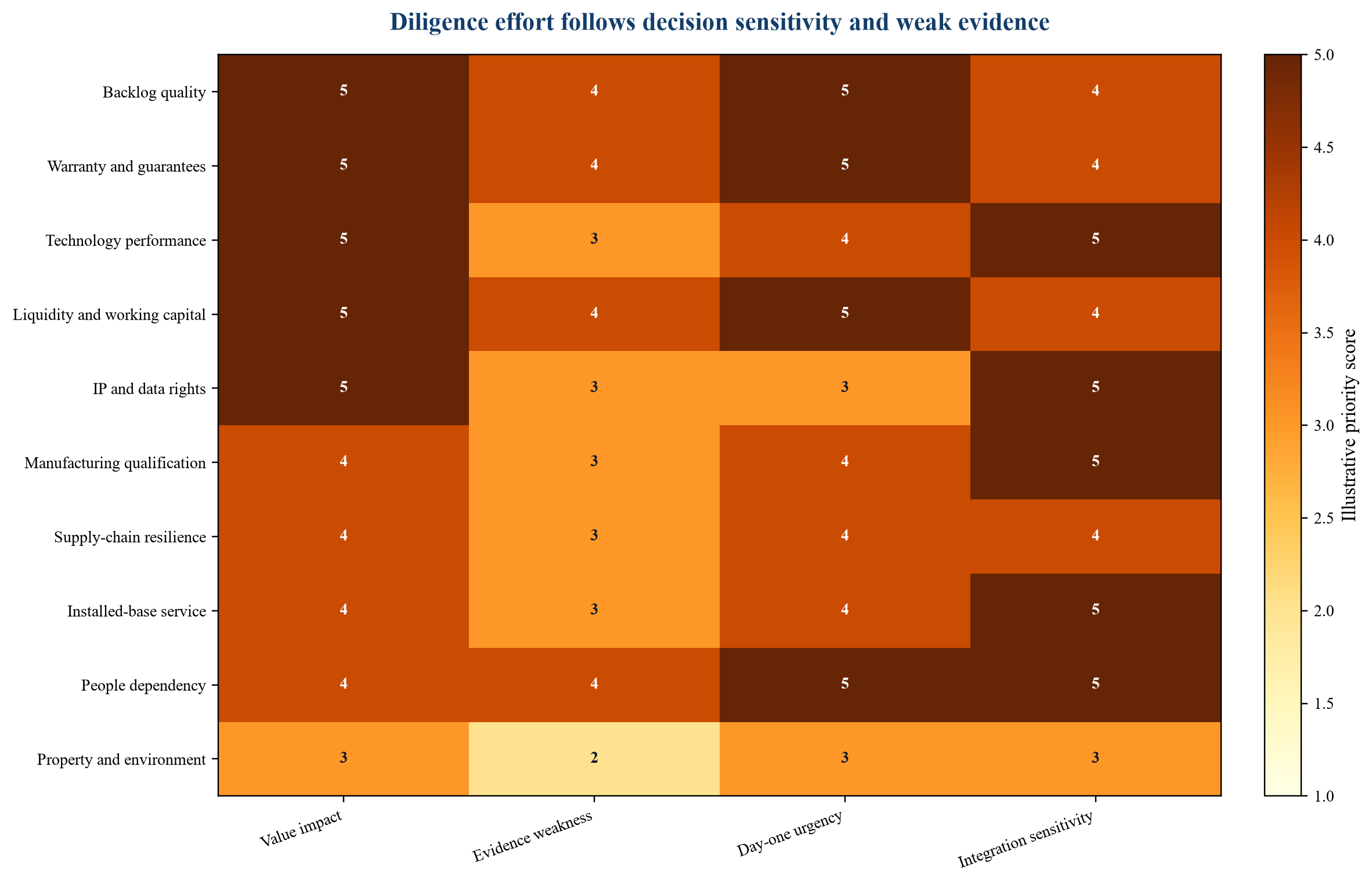
Scores are hypothetical analytical assumptions and do not describe a named manufacturer.
21. Valuation begins with backlog probability
The revenue forecast should begin with individual customer projects and manufacturing capacity that can serve them. Each order should have probability, timing, price, margin, cash conversion and downside. Framework agreements and pipeline can be shown as optional scenarios rather than base-case backlog.
The buyer should model price pressure explicitly. IEA evidence shows a substantial gap between Chinese and non-Chinese installed costs, although shipping, tariffs and project integration narrow the equipment-price difference [2]. The relevant price is the complete delivered and warranted system for the target market. A low stack price may not translate into a lower installed plant cost.
Margin should reflect utilisation and product mix. Low throughput can produce negative gross margin after unabsorbed factory costs. Consolidation synergies can improve absorption, procurement and engineering leverage, but they require time and execution. The base case should show standalone economics before synergies and a separate owner-approved synergy case.
22. The bridge must include restructuring and capex
Headline enterprise value is only the opening point. The buyer should deduct weak backlog, excess working capital, guarantee exposure, warranty deficits, obsolete inventory, required capex, closure cost and separation. It can add proven service value and risk-adjusted synergies where evidence supports them.
The figure illustrates a hypothetical bridge. Values are unitless and cannot be applied to a named business. Its purpose is to show that a nominally inexpensive acquisition can require substantial additional capital before the buyer reaches an adjusted value.
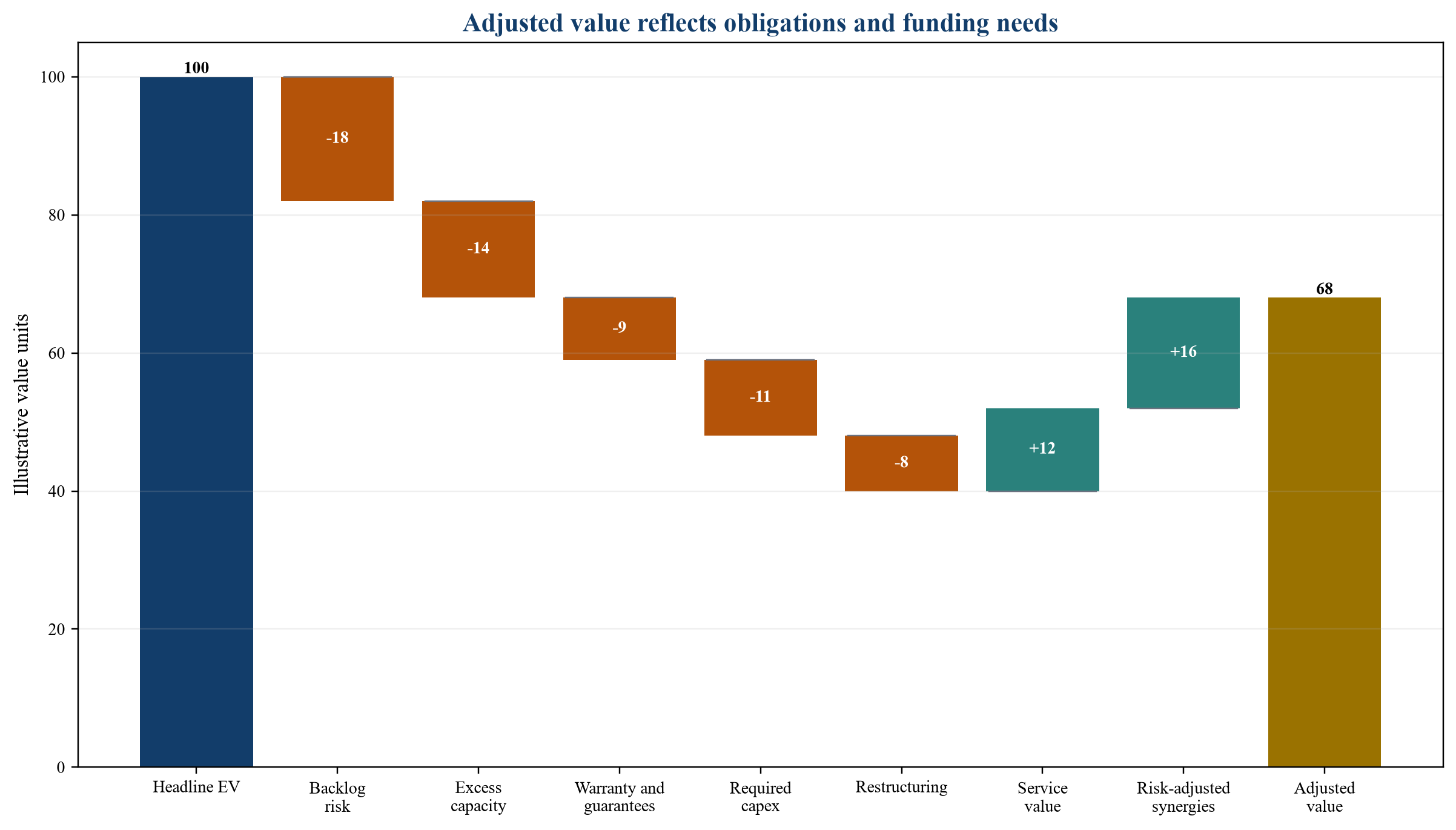
Values are illustrative units. They are not a forecast, offer, fairness opinion or valuation of a named company.
Table 2. Hypothetical valuation scenario bridge
| Component | Downside | Base case | Upside | Evidence required |
|---|---|---|---|---|
| Headline enterprise value | 100 | 100 | 100 | Indicative transaction terms |
| Backlog and project adjustment | -28 | -18 | -8 | Contract-level project-gate analysis |
| Excess capacity and inventory | -22 | -14 | -6 | Line utilisation, conversion and recoverability |
| Warranty, guarantees and claims | -15 | -9 | -5 | Claims history, reserves and security schedule |
| Required product and factory capex | -17 | -11 | -7 | Qualified engineering and capex plan |
| Restructuring and separation | -14 | -8 | -5 | Site, employee and TSA plan |
| Installed-base service value | 7 | 12 | 18 | Contract, field and margin evidence |
| Risk-adjusted synergies | 7 | 16 | 28 | Named owner, cost, timing and dependency |
| Adjusted transaction value | 18 | 68 | 115 | Combined evidence and board-approved scenario |
Values are illustrative units. The scenarios are analytical examples and are not forecasts or valuations.
23. Synergies need owners and timing
Procurement, engineering, facility, service and commercial synergies should be described as operating changes. Each synergy needs a baseline, action, owner, cost, dependency, start date and confidence. A percentage applied to combined cost provides little control.
Procurement savings may require common specifications, supplier qualification and volume commitments. Engineering savings may require product convergence that customers resist. Facility savings may require requalification and dual-running. Revenue synergies may depend on cross-selling to customers with long procurement cycles. The model should reflect these delays.
Dis-synergies should be equally visible. Customer uncertainty, employee departures, supplier repricing, change-of-control consents and systems separation can reduce value. The integration budget should include retention, quality, service continuity and transitional operations before net synergy enters the valuation.
24. Asset deals can ring fence legacy risk
An asset deal can select technology, equipment, contracts and employees while leaving some corporate liabilities with the seller. This can be attractive in restructuring or insolvency. The protection is not absolute. Local law can transfer employment, environmental, product or successor liabilities, and critical contracts may require consent.
The buyer should verify that the selected assets form a viable business. Patents without test data, equipment without process know-how, or designs without key engineers may have limited value. Customer contracts may depend on guarantees from the seller's group. Software and cloud accounts may not transfer automatically.
The asset purchase agreement should include schedules detailed enough to operate on day one. It should address books and records, technical data, spares, tooling, domain names, certifications, quality records and cooperation with claims. The transition plan should identify every dependency that remains with the seller.
25. Whole company deals can preserve contracts
A share acquisition keeps the legal entity and can preserve licences, certifications, bank accounts, contracts, employees and customer history. It may reduce the number of consents and protect continuity. It also transfers the entity's full liability perimeter, subject to contractual protection and local law.
The buyer should model closing and post-closing liquidity. A manufacturer under pressure may need cash to pay suppliers, release bank guarantees, complete contracts and retain people. A purchase price paid to shareholders does not solve those needs. Funding certainty should be a closing deliverable.
Representations, indemnities and warranty insurance cannot replace operational diligence. A distressed seller may have limited recovery capacity. The buyer should price risks it must operate and use escrow, holdback, contingent consideration or specific conditions where appropriate. The board should understand which exposures remain unprotected.
26. Licensing and toll manufacturing preserve option value
Licensing can separate technology deployment from factory ownership. It may allow a manufacturer to monetise IP, reach a new geography and reduce capital. The licensee gains access while retaining its own production platform. The agreement needs field, territory, exclusivity, improvements, sublicensing, quality, audit, data and termination rules.
Toll manufacturing uses one party's facility to make another party's product. It can absorb temporary spare capacity and avoid immediate factory investment. The quality agreement should define materials, process controls, yield, scrap, confidentiality, liability, scheduling and change management. Customers and certifiers may need approval.
Both structures preserve strategic options when demand timing remains uncertain. They can also create dependency and IP leakage. A buyer should compare them with acquisition using the same project-backed volume, margin, control and downside framework. Optionality has value only when exit and enforcement rights are credible.
27. Joint ventures can match capacity with market access
A joint venture can combine technology with local manufacturing, customer relationships, project development or public-sector access. It can support localisation and share capital. Its economics depend on contribution valuation, governance, reserved matters, funding obligations, IP rights and exit.
The venture should have a defined product and market. A broad strategic memorandum can delay hard decisions about technology transfer, customer ownership and pricing. The parties should establish who qualifies the factory, controls design changes, carries warranty, owns improvements and supplies critical components.
Deadlock and underperformance require planned responses. Funding calls, dilution, buy-sell rights, licence termination and transition support should be agreed before demand disappoints. A venture that cannot close or restructure excess capacity can preserve the very inefficiency consolidation was meant to address.
28. Integration must protect product qualification
Integration should begin with a product-and-customer continuity plan. The buyer should identify every order, system and service commitment affected by legal entity, facility, supplier, software or personnel changes. Quality and engineering leaders should approve the sequence.
Product convergence should be evidence gated. The combined group may select one control platform, stack design or balance-of-plant architecture, but migration can require redesign, testing and customer acceptance. Existing warranties must remain supportable. Spares and software updates should continue for discontinued products.
Day-one controls should include authority, cash, bank facilities, customer communication, supplier release, cybersecurity, data access, quality escalation and retention. The first hundred days should prioritise continuity and evidence. Accelerated cost removal that damages field performance or qualification can destroy more value than it saves.
29. Separation must preserve customer support
A carve-out requires the buyer and seller to separate people, data, systems, contracts, facilities and brand. Service and warranty functions frequently cross those boundaries. The separation design should preserve access to field history, serial-number records, drawings, bills of material and customer correspondence.
Transitional service agreements should have measurable outputs and exit milestones. They should cover enterprise systems, finance, procurement, laboratory, quality, IT, cybersecurity, facilities and legal support where needed. The buyer should identify which capability must be rebuilt and budget it.
Customer communication should explain who owns delivery, warranty and service. Ambiguity can delay acceptance and payment. The transaction should include a joint transition protocol for open claims and critical sites, while respecting confidentiality and competition law.
30. Consolidation should follow a gated roadmap
The roadmap should connect diligence, signing, closing, stabilisation, product decisions, facility moves and value creation. Each gate should state evidence, owner and authority. Closing is the beginning of operating execution, not the end of the transaction.
The first phase validates perimeter and liquidity. The second secures customer, supplier, employee and guarantee continuity. The third determines product and facility architecture after evidence review. The fourth executes transfer, requalification, closure or repurposing. The fifth measures service, margin, cash and reliability against the investment case.
The table presents a generic roadmap. Timing should follow transaction complexity, competition approvals, employee consultation, customer consent and product qualification. A board should resist a calendar that ignores those dependencies.
Table 3. Integration or separation roadmap
| Phase | Core decision | Required evidence | Primary owner | Exit gate |
|---|---|---|---|---|
| Thesis and perimeter | Which value pools justify a transaction | Project-backed demand, asset map and downside | Deal lead and business sponsor | Approved perimeter and walk-away tests |
| Confirmatory diligence | Which risks change price or structure | Contracts, technology, quality, cash, guarantees and IP | Functional diligence leads | Signed risk schedule and funding plan |
| Signing to close | How continuity will be protected | Consents, liquidity, TSA, retention and Day One plan | Integration leader | Closing readiness certification |
| Stabilise | Which customer and operating failures need immediate control | Order-by-order and site-by-site dashboard | Business and quality leaders | Stable delivery, service and cash control |
| Product and footprint decision | Which platforms and facilities continue | Field evidence, qualification, demand and cost | Product and operations committee | Approved target architecture |
| Transfer or separation | How capability moves without loss of qualification | Validation, customer acceptance and systems cutover | Operations and separation leaders | Receiving capability proven and support preserved |
| Value realisation | Whether the transaction case is being delivered | Margin, cash, reliability, service and synergy evidence | Business sponsor and finance | Board-verified value and corrective actions |
Timing is illustrative. Legal, employee, regulatory and customer requirements differ by transaction and jurisdiction.
31. Governance and clean team controls
Consolidation among competitors can involve sensitive pricing, customer, cost and strategy information. Competition counsel should define what can be shared before closing, who may access it and how it is retained. Clean teams can analyse necessary data while limiting operating-team exposure.
Governance should maintain one decision log linking evidence, assumptions, risks and approvals. The investment committee should see a reconciled view across commercial, technical, operational, legal, tax, finance and integration work. Material unresolved items should have price, condition, contractual allocation or explicit exclusion from the base case.
Post-close governance should preserve challenge. Product discontinuation, facility closure and warranty reserves affect customers and long-term value. A cross-functional committee should approve them against defined evidence. Synergy reporting should remain separate from one-time restructuring and market recovery.
32. Limits of the analysis
This paper provides a general transaction framework. It does not assess a named company, factory, technology, jurisdiction or project. Technology performance, market demand, contract enforceability, subsidy eligibility and liability transfer require transaction-specific technical, commercial, legal, tax, accounting and regulatory advice.
The numerical exhibits are hypothetical analytical assumptions. They are not observed company results, market forecasts, engineering quotations, financing terms, fairness opinions or valuations. Actual outcomes depend on product performance, customer projects, pricing, supply chains, contracts, labour, policy, financing, integration and competition.
Public company disclosures and institutional reports use different definitions and reporting periods. Comparisons should be normalised before use. Current policy and market conditions can change. A buyer should update every source and assumption at the decision date and retain documentary evidence for the approved case.
33. Conclusion
Electrolyser manufacturing consolidation can preserve valuable technology, field evidence, service capability and industrial capacity when the transaction begins with executable customer demand. Nameplate gigawatts and headline backlog do not provide that proof. Each order, product, line, contract and obligation requires its own evidence.
The strongest acquisition thesis separates durable assets from excess capacity and project risk. Qualified products, test data, IP, installed-base relationships and capable teams can justify investment. Weak orders, idle lines, obsolete inventory, warranties, guarantees and restructuring can consume that value. A transaction perimeter and valuation bridge make the trade-off explicit.
Structure should follow the thesis. Whole-company acquisitions preserve continuity. Asset deals, product carve-outs, licensing, tolling and joint ventures can isolate specific value. Integration and separation must protect product qualification, customer support and liquidity. A disciplined buyer pays for evidence, funds the complete transition and keeps the option to stop when the value case fails.
References
- International Energy Agency. Global Hydrogen Review 2025: Production prospects to 2030. https://www.iea.org/reports/global-hydrogen-review-2025/production-prospects-to-2030-2
- International Energy Agency. Global Hydrogen Review 2025: Executive summary. https://www.iea.org/reports/global-hydrogen-review-2025/executive-summary
- International Energy Agency. Global Hydrogen Review 2026: Production. https://www.iea.org/reports/global-hydrogen-review-2026/production
- International Energy Agency. Northwest European Hydrogen Monitor 2025: Executive summary. https://www.iea.org/reports/northwest-european-hydrogen-monitor-2025/executive-summary
- International Energy Agency. Global Hydrogen Review 2024: Low-emissions hydrogen projects grow as policy support races to catch up. https://www.iea.org/news/low-emissions-hydrogen-projects-grow-as-policy-support-races-to-catch-up
- International Energy Agency. Breakthrough Agenda Report 2025: Hydrogen. https://www.iea.org/reports/breakthrough-agenda-report-2025/hydrogen
- European Commission. Net-Zero Industry Act. https://single-market-economy.ec.europa.eu/industry/sustainability/net-zero-industry-act_en
- European Commission. Hydrogen. https://energy.ec.europa.eu/topics/eus-energy-system/hydrogen_en
- European Commission. Impact assessment on net-zero manufacturing. 2026. https://single-market-economy.ec.europa.eu/document/download/ef967653-d886-4c14-a68a-65ea6ef25bce_en
- European Commission Joint Research Centre. Water Electrolysis and Hydrogen in the European Union. 2025. https://publications.jrc.ec.europa.eu/repository/handle/JRC144106
- European Commission. Innovation Fund 2025 Hydrogen Auction. https://climate.ec.europa.eu/areas-action/eu-funding-climate-action/innovation-fund/calls-proposals/if25-hydrogen-auction_en
- Nel ASA. Annual Report 2025. https://nelhydrogen.com/wp-content/uploads/2026/02/Annual-Report-2025.pdf
- Nel ASA. Fourth Quarter 2025 Report. https://nelhydrogen.com/wp-content/uploads/2026/02/Q4-report-2025.pdf
- thyssenkrupp nucera. Financial Year 2024/2025 results. https://investors.thyssenkrupp-nucera.com/news/geschaeftsjahr-20242025-thyssenkrupp-nucera-entwickelt-sich-in-herausforderndem-marktumfeld-solide-und-steigert-ebit-deutlich/765ddc3c-82a0-440c-8806-e9acd6daff80
- thyssenkrupp nucera. Quarterly Statement Q1 2025/26. https://www.thyssenkrupp-nucera.com/wp-content/uploads/2026/02/thyssenkrupp-nucera_Quarterly-Statement_Q1-2025_26.pdf
- thyssenkrupp nucera. Agreement to acquire key technology assets from Green Hydrogen Systems. https://investors.thyssenkrupp-nucera.com/news/thyssenkrupp-nucera-signs-an-agreement-to-acquire-key-technology-assets-from-green-hydrogen-systems/a1107202-6319-4797-97bf-d04c30806132
- thyssenkrupp nucera. Completion of Green Hydrogen Systems technology acquisition. September 2025. https://files.thyssenkrupp-nucera.com/tknucera-typo3/Dateien/Newsroom/Press_Releases/2025/9-September/Green_Hydrogen_System.pdf
- European Commission. Resilience requirements for the European Hydrogen Bank auction. https://climate.ec.europa.eu/document/download/b996825e-cd36-44c1-895d-a780062f626d_en
- European Commission. TopSOEC: energy-efficient electrolyser components. https://climate.ec.europa.eu/news-other-reads/news/topsoec-fuelling-europes-renewable-hydrogen-ambitions-energy-efficient-electrolyser-components-2024-09-30_en
- Plug Power. Continued cash-flow improvement and path-to-profitability update. 2025. https://www.ir.plugpower.com/press-releases/news-details/2025/Plug-Power-Announces-Continued-Cash-Flow-Improvement-and-Progress-on-Path-to-Profitability/
- European Commission. Over-subscribed European Hydrogen Bank auction receives 61 bids. 7 March 2025. https://climate.ec.europa.eu/news-other-reads/news/over-subscribed-european-hydrogen-bank-auction-receives-61-bids-innovation-fund-support-including-8-2025-03-07_en
- European Commission. Innovation Fund 2025 Auction call fiche. https://ec.europa.eu/info/funding-tenders/opportunities/docs/2021-2027/innovfund/wp-call/2025/call-fiche_innovfund-2025-auc-h2_en.pdf
- International Renewable Energy Agency. Green Hydrogen Cost Reduction: Scaling up Electrolysers to Meet the 1.5 C Climate Goal. https://www.irena.org/publications/2020/Dec/Green-hydrogen-cost-reduction
- International Finance Corporation. Environmental, Health, and Safety Guidelines. https://www.ifc.org/en/insights-reports/2000/general-environmental-health-and-safety-guidelines
- International Valuation Standards Council. International Valuation Standards. https://www.ivsc.org/standards
- International Energy Agency. Global Hydrogen Review 2025. https://www.iea.org/reports/global-hydrogen-review-2025
About the Author
Chennakeshav (CK) is a corporate finance and investment banking executive with 25+ years of global experience in deal origination, structuring and execution across M&A, growth capital and corporate strategy. He has led value-creation mandates for founders, corporates and funds — bridging the boardroom view to hands-on execution and close.
His career spans Morgan Stanley, HSBC, Lloyds Banking Group, EWEC, ADQ portfolio companies and Emirates Growth Fund, across TMT, real estate, fintech, deeptech, cleantech, infrastructure and energy. He has partnered with C-suite leaders, private equity and venture funds, sovereign wealth funds and family offices to finance complex fund raises and scale-up ventures, and has led M&A due diligence, post-merger integration and business-transformation initiatives to create value.
At Matchpoint Partners he is Managing Partner, leading the firm's corporate finance, M&A and capital-raising practice. He holds an MBA from London Business School, an engineering degree from VTU and a Master of Laws (LLM, in progress) from UCL London.
An active start-up mentor, CK mentors at Techstars, DIFC FinTech Hive, Startup Grind, Founder Institute and IN5, serves as Entrepreneur Mentor in Residence (EMiR) at London Business School, and judges the Entrepreneurship World Cup.
LinkedIn: https://www.linkedin.com/in/ckadya/
Profile: https://www.matchpoint-partners.com/team/ck-adya.html
