
1. The investment decision begins with the operating hour
Electrolytic hydrogen converts electricity into a molecule through a capital-intensive production plant. The project can run continuously, follow a dedicated renewable generator, respond to electricity prices or combine those modes. Each choice changes hydrogen output, electricity cost, attributed emissions, equipment wear and the evidence required for a premium or subsidy.
Additionality and temporal matching turn the operating hour into a commercial unit. Additionality asks whether hydrogen demand caused, or is linked to, new qualifying electricity supply. Temporal correlation asks whether qualifying electricity was generated during the period in which the electrolyser consumed power. Geographic correlation tests whether the electricity can credibly serve the production location under the relevant rules.
The financing question is how to preserve compliance without leaving an expensive plant idle for too many hours. A project that ignores the rules can lose certification or support. A project that pursues perfect physical coincidence without valuing unused equipment can produce compliant hydrogen at an uncompetitive cost. The project company needs a procurement and dispatch design that states which product is made in each hour and which cash flow supports debt.
2. Electricity cost and capital recovery move in opposite directions
Electricity is commonly the largest variable input for renewable hydrogen. The electrolyser, balance of plant, grid connection, water treatment, compression and storage create a fixed capital base. More operating hours spread that capital across more kilograms. Additional hours can also expose the project to higher power prices, more carbon-intensive grid supply or electricity that fails the applicable matching test.
The resulting cost curve is not monotonic. Low utilisation increases capital recovery per kilogram. High utilisation can increase the weighted electricity price and weaken product eligibility. The lowest-cost operating point depends on the complete hourly price and renewable profile, rather than a single assumed capacity factor.
The United States Department of Energy publishes clean-hydrogen cost scenarios that vary electricity price, electricity capacity factor and electrolyser capital cost [1]. Its technical targets also state that high availability with low-cost electricity can support cost objectives, while lower-cost electricity at lower capacity factors can provide another path [2]. These are scenario relationships. They do not establish the optimum for a specific project.
3. Additionality links hydrogen growth to electricity investment
The European Commission describes additionality as the requirement that increased hydrogen production should be accompanied by new renewable generation capacity [3]. Commission Delegated Regulation (EU) 2023/1184 permits qualifying grid electricity through owned generation or renewable power purchase agreements, subject to conditions on commissioning date, support and the required quantity of electricity [4].
The core policy concern is displacement. An electrolyser that claims an existing renewable plant can divert that plant's output from another consumer. The power system may respond with fossil generation, weakening the lifecycle result attributed to hydrogen. Additionality seeks to connect new electrical load with new low-carbon supply.
For finance, the rule creates development interdependence. The electrolyser and renewable plant may need compatible commissioning dates, contract tenors and volumes. Delay in one asset can affect the other's eligibility and revenue. A lender must examine both projects' schedules, land, permits, grid rights, equipment and funding, even when they sit in separate companies.
4. Temporal matching changes the value of a power purchase agreement
A conventional renewable power purchase agreement can settle financially over a month or year. The generator sells its output into the market and the buyer receives an agreed price and environmental attributes. That structure can hedge annual energy cost while leaving a mismatch between the hours of generation and the hours of electrolyser consumption.
The EU framework allows monthly temporal correlation through 31 December 2029 and moves to one-hour correlation from 1 January 2030, subject to stated exceptions and the possibility of earlier national application [4]. The United States section 45V final rules retain annual matching during transition and require hourly matching from 2030 [5]. The United Kingdom Low Carbon Hydrogen Standard version 4 defines temporal correlation by reference to generation and claimed consumption within each reporting unit [6].
An annual megawatt-hour is therefore insufficient evidence for a project exposed to hourly rules. The power contract must provide timestamped volumes, eligible attributes, location evidence and transfer rights. The financial model must use the same time granularity as the compliance ledger.
5. Geographic correlation creates basis and congestion risk
Electricity generated far from the electrolyser may not relieve the system at the production node. Network congestion can cause the generator and electrolyser to face different prices, losses and dispatch conditions. Geographic correlation rules seek a credible relationship between supply and consumption.
EU rules use bidding-zone and interconnected-zone conditions in the qualifying framework [4]. The United States final section 45V rules use grid regions based on the Department of Energy's National Transmission Needs Study and provide a route for demonstrating transfers between regions [5]. The applicable definitions differ, while the financing effect is similar: a project can hold a renewable contract and still face location-basis exposure.
The project model should therefore separate the generator price, electrolyser-node price, network charges, losses, curtailment settlement and attribute value. A fixed PPA price does not eliminate basis risk. Debt sizing should use the net delivered and compliant electricity cost under the contractual settlement formula.
6. The compliance ledger belongs inside the dispatch system
Certification is often treated as a reporting exercise after production. Hourly matching makes it an operating control. Before consuming grid electricity, the dispatch system should know whether a qualifying renewable megawatt-hour is available, whether storage holds eligible charged energy, whether the location test is satisfied and whether the planned hydrogen output can be sold under the intended label.
The ledger should reconcile meter data, generator data, energy attributes, power trades, storage charging and discharging, electrolyser consumption, hydrogen production and product transfers. Each claimed kilogram needs a traceable electricity record. Double counting, missing timestamps or inconsistent meter boundaries can impair eligibility even when the physical plant performs.
Australia's Guarantee of Origin programme illustrates the wider development of renewable-electricity and hydrogen product certification outside the EU and United States [7]. The relevant rules remain jurisdiction-specific. A financeable project needs a scheme map, responsible data owners, audit rights, retention periods and a change-control process.
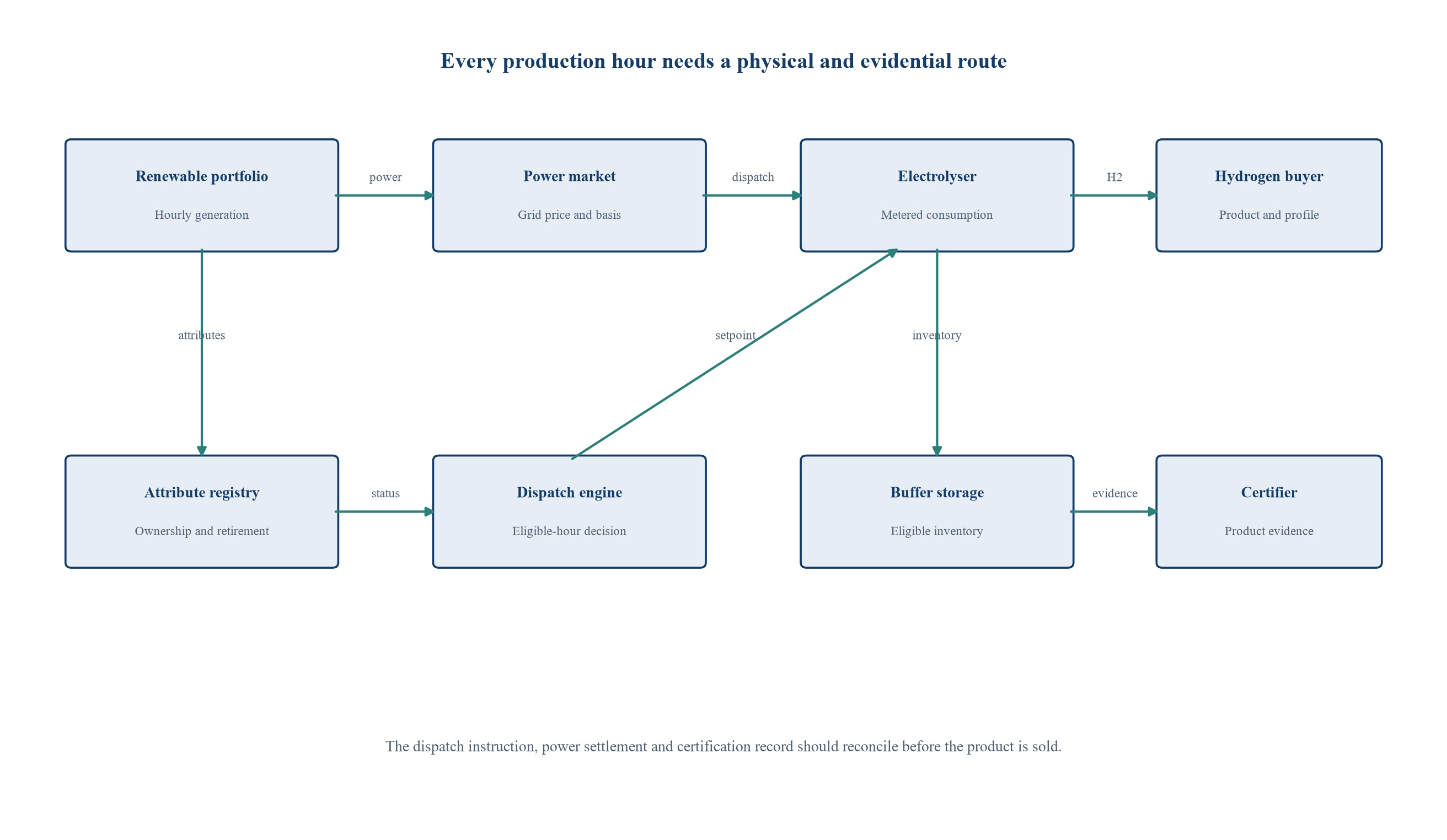
The diagram shows the information and physical flows required to connect renewable generation, electricity trading, electrolysis, hydrogen storage and product certification. Actual rules and metering boundaries remain jurisdiction-specific.
7. A dedicated renewable plant offers control and concentration
A co-located wind or solar plant can simplify geographic evidence and reduce network exposure. Direct connection can also lower some grid charges and provide clear meter boundaries. The electrolyser then inherits the generator's variability and curtailment profile.
Solar-only supply concentrates production during daylight. Wind can provide a broader profile but remains variable and location-specific. Oversizing generation increases matched hours while raising capital and creating surplus electricity. The project needs a route to sell or curtail that surplus without disturbing the hydrogen economics.
Dedicated supply also concentrates construction risk. A renewable delay can strand the electrolyser. An electrolyser delay can leave the generator dependent on merchant power sales. Cross-defaults, aligned long-stop dates, substitute supply and interim power-sale rights should be designed before notice to proceed.
8. A renewable portfolio can increase matched utilisation
Combining solar, wind and other eligible generation can smooth the hourly profile. Assets in different locations may reduce weather concentration when the rules permit geographic matching. A portfolio can also stagger commissioning and contract maturities.
Portfolio design should use chronological production data and correlation, rather than annual capacity factors. Two generators with similar annual output can produce at the same time and add little profile diversity. The useful metric is the increase in matched electrolyser hours and the reduction in residual grid purchases after applying the actual rule set.
Contract complexity rises with the number of assets. Each PPA may have different prices, settlement points, curtailment rules, attribute delivery, credit support and change-in-law terms. A portfolio manager or aggregator can coordinate the contracts, but the project company remains exposed if an intermediary fails to transfer valid attributes.
9. Grid access creates flexibility and eligibility choices
A grid connection allows the electrolyser to operate when dedicated renewable output is insufficient. Grid power can support commissioning, freeze protection, standby systems and production for customers who accept a different carbon or certification class. The commercial model must distinguish those uses.
Unmatched grid production should not be blended silently into a premium renewable product. The plant can maintain separate production batches, certificates and sales contracts where the law and physical system permit. Metering and mass-balance rules must support the separation.
Grid access also gives the project optionality during negative or low-price hours. EU rules include specified price-based circumstances in which temporal correlation can be satisfied [4]. Such exceptions should be modelled from the legal text and market data. They should not be assumed from a generic expectation of cheap surplus power.
10. Electrolyser utilisation is a portfolio outcome
Capacity factor is the ratio of actual electrical consumption or hydrogen production to the maximum possible output over the period, with the exact definition stated. It reflects renewable availability, power prices, outages, dispatch, storage limits, water, compression, hydrogen demand and compliance.
A single flat capacity-factor assumption hides these causes. A project model should calculate utilisation from an hourly dispatch simulation. Planned maintenance, stack degradation, ramp limits, minimum load, start-up energy, auxiliary consumption and forced outages should be explicit.
High utilisation is valuable only when the incremental hour contributes positive compliant margin or fulfils a contract. Running to maximise a plant statistic can destroy value if power is expensive, attributes are unavailable or hydrogen storage is full. The operating policy should maximise risk-adjusted project cash flow within product and equipment constraints.
11. Technology choice influences flexible operation
Alkaline and proton-exchange-membrane electrolysers can both operate flexibly, with performance depending on design and operating conditions. The IEA notes that both technologies can be coupled with variable renewable electricity [8]. The project should rely on supplier guarantees and reference evidence for the proposed duty.
Frequent ramping can affect efficiency, auxiliaries, gas quality, stack condition and maintenance. Minimum stable load and restart time determine how closely the plant can follow renewable output. Compression and downstream equipment may have narrower operating ranges than the electrolyser stacks.
The procurement specification should include efficiency across the load curve, start-stop capability, ramp rate, product purity, pressure, availability and degradation. Guarantees should use the same dispatch duty as the financial model. A guarantee measured at steady full load offers limited protection for a plant expected to cycle daily.
12. Hydrogen storage converts power variability into product reliability
Buffer storage allows the electrolyser to follow qualifying electricity while the buyer receives a steadier hydrogen profile. Storage can therefore increase the commercial value of variable production without changing the matching rule applied to the electricity consumed.
The storage duty should be calculated chronologically. Required inventory depends on generation shape, buyer nominations, outage coverage, injection and withdrawal rates, pressure and minimum stock. A generic number of hours can be inadequate during a prolonged low-renewable period.
Storage adds capital, compression energy, losses, safety requirements and working capital. Its value comes from avoided offtake shortfalls, improved electrolyser dispatch and reduced exposure to high-price electricity. The financial model should compare these benefits with the full storage cost and recognise any common-mode failure across production and delivery.
13. Flexible offtake can be more valuable than maximum volume
An industrial buyer often wants a firm hourly or daily hydrogen delivery. A generator-led project produces a variable profile. Requiring the producer to deliver a flat volume transfers profile risk to the project company and can force storage or unmatched electricity purchases.
A flexible offtake can define minimum annual volume, nomination windows, permitted production bands and make-up rights. The buyer may accept more hydrogen during renewable-rich periods and less during scarcity if its process, inventory or substitute fuel allows. In return, the producer can offer a lower price or share electricity-market value.
Flexibility needs a price. Contracts should state the value of downward and upward nominations, missed volume, imbalance and rescheduling. A vague obligation to cooperate provides little protection for debt. The base case should rely only on enforceable flexibility.
14. Power and hydrogen contracts must share one volume logic
The PPA purchases electricity. The hydrogen offtake sells a product created from electricity. Mismatched volume obligations can leave the project buying power without a hydrogen customer or owing hydrogen without eligible power.
The contracts should share definitions for operating year, planned outages, force majeure, commissioning, curtailment, change in law and meter correction. Their long-stop dates and termination rights should recognise the integrated project. A PPA termination payment can be unaffordable if the hydrogen offtake ends without equivalent compensation.
Tenor matters. Senior debt may extend beyond one contract. The project should show a credible recontracting case and avoid assuming that expiring attributes, electricity or product premiums renew on unchanged terms. Lenders can require minimum remaining tenor, cash sweeps and reserve funding before a merchant tail begins.
15. Shape risk differs from price risk
A fixed-price PPA can stabilise the price of generated electricity while leaving the project exposed to the hourly shape. The electrolyser may need power when the generator produces little and receive excess when production exceeds plant load. The difference is settled through the market or curtailed.
Shape risk can be quantified by comparing the contracted generation profile with electrolyser demand. The model should show unmatched consumption, surplus generation, settlement prices and eligible storage in each period. Annual netting removes the very exposure that hourly rules make material.
Price hedges can reduce market volatility without delivering the required shape or attributes. A contract for differences may protect the generator price while the electrolyser pays its nodal tariff. The project therefore needs separate limits for PPA price, basis, imbalance and shape.
16. Curtailment can help or harm the hydrogen project
An electrolyser can consume electricity that would otherwise be curtailed, subject to connection and market rules. This can lower the marginal electricity price and improve renewable utilisation. The opportunity is location- and hour-specific.
System-wide annual curtailment does not prove access. The relevant generator may be curtailed because export is constrained, while the electrolyser sits behind another bottleneck. Curtailment compensation can also reduce the generator's incentive to supply the electrolyser under the agreed price.
The PPA should define whether curtailed volume counts as available, who controls dispatch, how compensation is shared and whether local consumption avoids the constraint. The base case should use verified node-level or project-level evidence. Future network reinforcement can reduce the cheap-power opportunity.
Table 1. Power-procurement structures and financing implications
| Structure | Utilisation effect | Main compliance strength | Principal financial exposure | Debt implication |
|---|---|---|---|---|
| Dedicated co-located renewable plant | Electrolyser follows one generation profile unless grid or storage is added | Clear physical and meter relationship | Weather concentration, mutual construction delay and surplus power | Financeable with aligned completion, robust offtake and profile support |
| Multi-asset renewable portfolio | Higher matched hours when generation profiles are genuinely diverse | Multiple qualifying assets can support a broader profile | Contract complexity, attribute transfer and multi-node basis | Stronger production case if portfolio evidence and credit are reliable |
| Sleeved or synthetic PPA with grid supply | Grid enables operational continuity | Contracted attributes can qualify when rule conditions are met | Shape, basis, imbalance, grid charges and intermediary credit | Requires hourly settlement model, collateral and conservative basis assumptions |
| Merchant grid purchases | Dispatch can respond to price and buyer demand | Eligibility depends on grid and rule-specific conditions | Price volatility, emissions classification and attribute availability | Limited debt credit unless capped, hedged or supported |
| Renewable portfolio plus eligible storage | Storage can shift qualifying electricity within permitted rules | Can preserve time correlation when charging and discharge evidence qualifies | Storage capital, losses, degradation and metering | Supports firmer output when the storage duty and evidence chain are bankable |
The comparison describes contractual mechanisms. Actual eligibility and allocation depend on the applicable jurisdiction, project documents and verified generation profile.
17. Negative prices need contractual and regulatory treatment
Negative electricity prices can create attractive operating hours, yet their duration and location vary. Network charges, taxes, levies and PPA settlement can leave the electrolyser with a positive all-in cost even when the wholesale price is negative.
The EU temporal-correlation framework includes a price condition linked to the day-ahead clearing price and emissions-allowance value [4]. Project counsel and certifiers should confirm how that condition applies. An analyst should not translate every negative or low-price interval automatically into compliant production.
Revenue stacking should avoid double counting. The same hour cannot be valued simultaneously as avoided curtailment, a balancing payment, a negative-price benefit and a fixed PPA saving unless the contractual structure permits each cash flow. The dispatch model should reconcile the actual settlement sequence.
18. A two-product plant can preserve operating optionality
Some projects may produce more than one class of hydrogen. Hours supported by qualifying electricity can supply a premium certified product. Other hours can supply a lower-carbon, grid-average or unlabelled product where law and customer specifications permit.
The products need separate meter, ledger, storage and contract treatment. If molecules are commingled, the accepted mass-balance method must support the claimed allocation. Premium customers should not bear the emissions or eligibility risk of other production.
A second product can raise utilisation and spread capital cost. Its price may be lower and its market less secure. Debt should be sized to contracted and evidenced revenue, with conservative credit for the secondary product. Product switching can remain an equity option until a reliable market develops.
19. Hypothetical project design
Consider a hypothetical 100-megawatt electrolyser supported by a portfolio of new wind and solar PPAs, a grid connection and hydrogen buffer storage. The plant sells a certified renewable product under a ten-year offtake and can sell a separate lower-value product when eligible renewable electricity is unavailable.
The example assumes a staged construction programme, supplier performance guarantees and an hourly dispatch system. It does not represent a real project, quotation or market forecast. The purpose is to show how power profile, utilisation and financing interact.
The capital structure includes sponsor equity, senior debt, a public capital contribution and a liquidity facility. Debt is sized against the compliant contracted production case. Secondary-product revenue and balancing income are excluded from minimum debt service and treated as cash-sweep upside.
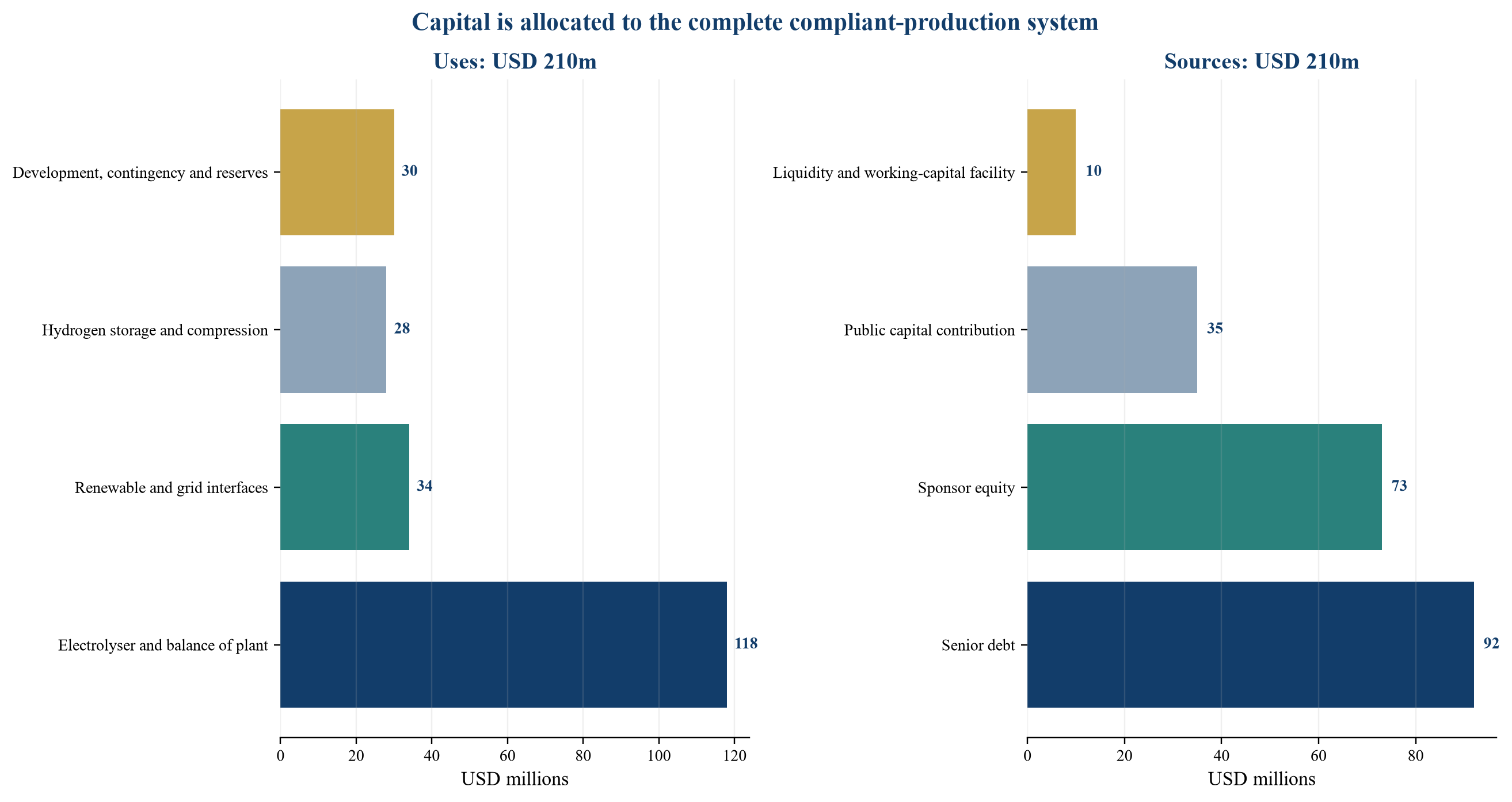
Values are hypothetical analytical assumptions in USD millions. They do not represent observed project costs, financing terms or a forecast.
20. Sources and uses should include the evidence system
The investment budget should extend beyond stacks and electrical equipment. Metering, data integration, attribute registry interfaces, cybersecurity, independent verification and audit retention are part of the revenue system. Omitting them can create a plant that produces hydrogen without evidence needed for the contracted price.
Grid works, renewable interfaces, storage and compression can exceed the apparent electrolyser boundary. The IEA reported that more than half of installed electrolyser project cost outside China can relate to engineering, procurement, construction and contingency, depending on location [9]. That observation supports complete-system budgeting. It does not determine the cost of the hypothetical project.
Contingency should reflect design maturity and interfaces. Separate reserves may be needed for construction, ramp-up, power-market collateral, stack replacement and debt service. A single undifferentiated contingency can obscure which risk remains unfunded.
21. The base case should be chronological
The hypothetical base case assumes that the renewable portfolio supports 68 per cent compliant electrolyser utilisation after outages, curtailment, matching and storage constraints. The downside reduces qualifying generation and increases power-basis cost. The stress case combines weaker generation, equipment underperformance, offtake limits and a delay in a renewable asset.
The model calculates hydrogen output from hourly electricity consumption and net efficiency. It then applies product classification, storage and buyer nominations. Annual production is an output of these steps. It is not a manually entered utilisation percentage.
Chronology also identifies cash requirements. The project may pay PPA invoices and market collateral before collecting hydrogen revenue. A period of low production can coincide with fixed PPA payments, debt service and minimum operating cost. Liquidity sizing should use the worst cumulative cash deficit, not an average month.
Table 2. Hypothetical base, downside and stress cases
| Variable | Base case | Downside case | Stress case |
|---|---|---|---|
| Compliant electrolyser utilisation | 68% | 54% | 39% |
| Total electrolyser utilisation | 76% | 63% | 48% |
| Renewable portfolio output versus expected profile | 100% | 90% | 78% |
| Weighted delivered power cost versus budget | 100% | 118% | 142% |
| Net hydrogen efficiency versus guarantee | 100% | 96% | 91% |
| Certified hydrogen sold versus contracted annual volume | 100% | 86% | 68% |
| Storage availability | 97% | 90% | 76% |
| Completion delay | 0 months | 6 months | 14 months |
| Illustrative DSCR | 1.50x | 1.17x | 0.78x |
Every value is a hypothetical analytical assumption. The scenarios illustrate interaction among matching, utilisation and debt service and are not market forecasts.
22. Utilisation and power price should be sensitised together
A one-variable sensitivity can mislead because utilisation and electricity price are related. Restricting operation to the lowest-price renewable hours reduces the weighted power price and the number of kilograms. Expanding operation can add higher-price or unmatched hours.
The relationship should be tested under several renewable portfolios and contract structures. A project with fixed PPA payments can incur cost even when the electrolyser is unavailable. A pay-as-produced contract reduces volume commitment but can charge a higher unit price. A sleeved PPA adds fees, collateral and basis.
Investment committees should request a two-dimensional sensitivity showing levelised cost or cash margin across compliant utilisation and delivered power price. The model should hold the remaining assumptions visible and calculate debt service after maintenance and working capital.
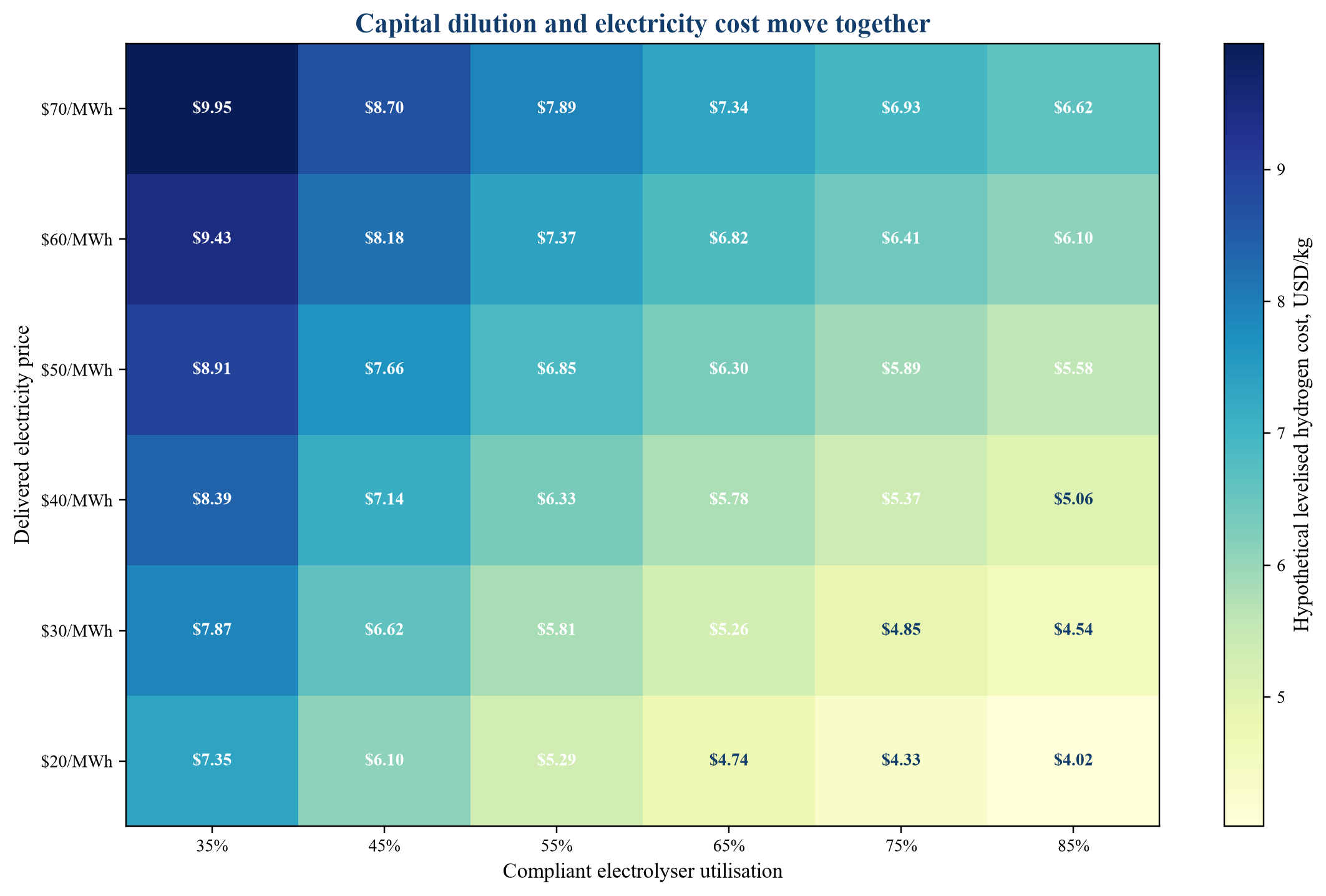
Values are hypothetical analytical assumptions in USD per kilogram. They illustrate direction and interaction and do not represent a project forecast or market quotation.
23. Debt should be sized to compliant contracted output
Senior lenders require predictable cash flow. A hydrogen plant exposed to renewable variability, policy conditions and equipment performance cannot support debt solely from nameplate capacity. The debt case should use compliant production that remains after outages, matching losses, storage limits and buyer flexibility.
The revenue basis should also recognise support mechanics. The European Commission's 2025 Hydrogen Auction offers a fixed premium for verified and certified production for up to ten years [10]. Its selected projects and bid prices demonstrate a current support architecture. They do not establish each project's realised cost or financing status.
Debt tenor should fit the PPA, offtake, support and certification periods. Cash sweeps can accelerate repayment when merchant or secondary-product revenue outperforms. Distribution tests should require compliance, minimum forward cover, reserves and no unresolved audit qualification.
24. Performance tests must reproduce the intended duty
Mechanical completion confirms construction. Commercial completion should test the operating system that underpins revenue. The test should include variable input, ramping, minimum load, efficiency, purity, pressure, data capture and dispatch control over a representative period.
The renewable and grid interfaces should be available during the test. A full-load test on stable grid power can prove equipment capacity while leaving flexible-operation risk unresolved. Separate tests can establish nameplate output, dynamic performance and integrated compliant production.
Delay damages and performance damages should correspond to financial loss. Efficiency shortfalls raise electricity cost. Lower availability reduces output. Data-system failure can impair certification. Aggregate liability caps and exclusions should be assessed against the downside they leave with the project company.
25. Degradation and stack replacement affect dispatch value
Electrolyser stacks degrade with use and operating conditions. The effect can appear as lower efficiency, reduced capacity or shorter replacement intervals. A dispatch policy that captures every low-price hour may accelerate degradation and increase lifecycle capital.
The model should include an efficiency curve over time, planned replacement, outage duration, spares and supplier support. Replacement timing can be optimised around electricity seasonality and offtake flexibility. Debt reserves should cover the portion not funded from operating cash.
Warranty conditions deserve close review. A supplier may limit starts, ramping, water quality or operating range. The financial dispatch algorithm must respect those conditions or price the risk of warranty loss. Operating flexibility has value only when the equipment contract permits it.
26. Policy change can alter product value without stopping the plant
A change in matching, emissions methodology, registry rules or support eligibility can change revenue while the physical equipment remains available. This differs from ordinary plant failure because the same hydrogen may continue to have a buyer at another classification or price.
Change-in-law provisions should allocate mandatory capital, operating cost, lost premium and adaptation obligations. The PPA and offtake should use compatible relief. A project cannot pass a new compliance cost through to the buyer if the power contract leaves the same cost with the project company.
The financing plan should identify a fallback product and dispatch mode. This can reduce loss given policy change. Lenders may still require a reserve, sponsor support or reduced leverage when the certified premium is essential to debt service.
27. Risk allocation follows control and absorbency
The renewable generator controls generation performance within weather limits. The electrolyser operator controls dispatch, maintenance and meter integrity. The PPA counterparty controls attribute transfer. The hydrogen buyer controls nominations and payment. Public agencies control support and certification frameworks within law.
No contract can transfer a risk to a party that lacks the capacity to perform or pay. A small aggregator may accept broad attribute liability without sufficient balance sheet. A technology supplier may guarantee efficiency while excluding variable operation. Credit and remedy analysis should follow every allocation.
Residual risks remain with the project company and equity. Debt sizing, contingency, reserves, insurance and sponsor support should cover the combined residual rather than each risk in isolation.
28. Counterparty credit should follow the hourly cash-flow chain
The project can have several electricity counterparties, an aggregator, a grid supplier, an attribute registry, a hydrogen buyer and a public-support authority. Their obligations occur at different times. A generator can deliver attributes after the settlement month, while the project must invoice certified hydrogen earlier. A delay can create a temporary compliance and liquidity gap even when final annual volumes reconcile.
Credit assessment should cover replacement cost. If a PPA counterparty defaults, the project may need to procure qualifying electricity and attributes in a market with higher prices or limited supply. Damages based only on the original contract price can leave the project undercompensated. Replacement rights, collateral and direct agreements should reflect the cost of restoring the complete compliant position.
The hydrogen buyer's credit matters because fixed power obligations continue after a missed payment. Take-or-pay protection is useful only when it is enforceable and supported by sufficient credit. A parent guarantee, letter of credit, reserve or diversified buyer portfolio can reduce concentration. The model should assume realistic collection timing and cure periods.
Public support can have verification, milestone and production conditions. A grant or premium receivable should not be treated as cash until the project has met the required evidence and payment process. Lenders may apply a delay haircut or maintain a working-capital facility sized to the longest credible verification cycle.
29. Commissioning needs an interim electricity and product regime
The electrolyser, renewable assets, grid connection, storage and buyer facilities may reach completion on different dates. Commissioning consumes electricity and produces hydrogen before the full certification and offtake system is operational. The project needs an agreed regime for those volumes.
The PPA should state when commercial obligations begin, whether commissioning energy is included, and how attributes are transferred during tests. The offtake should define when the buyer must accept product and which tests establish specification. Storage and transport operators need compatible readiness milestones.
Early production may be saleable only at a lower price. The financing budget should include commissioning power, vented or downgraded product, temporary logistics and delayed support payments. Assuming full premium revenue from first energisation can understate funding needs.
Completion tests should separate plant capability from compliant commercial production. A capability test can use controlled grid power to demonstrate nameplate performance. A subsequent integrated test can demonstrate dispatch, metering, attribute reconciliation, storage and buyer delivery. Senior debt conversion or final draw should depend on the tests relevant to repayment.
30. Valuation should separate contracted value from operating options
A renewable-hydrogen project contains a contracted core and several operating options. The core may include fixed or floored hydrogen revenue, a renewable portfolio and production support. Options can include secondary-product sales, balancing services, merchant power optimisation, oxygen sales, heat integration and future expansion.
The discounted cash-flow base case should use the contracted core and realistic compliant production. Optional revenues can be valued separately with probability, development cost, operational conflict and capital requirements. This prevents an attractive portfolio of possibilities from compensating implicitly for weak contracted economics.
Hourly flexibility can have material option value. The electrolyser can reduce load during high-price hours, increase load during renewable surplus, use storage to protect deliveries and select between product classes. That value depends on control rights in the PPA and offtake. A fixed-volume buyer obligation can remove flexibility even when the equipment is technically responsive.
Comparable-company or transaction multiples require caution because projects differ in support, power structure, utilisation, technology, location and product. A value per megawatt ignores these distinctions. Investment committees should reconcile enterprise value to contracted margin, compliant output, replacement cost and the specific options the owner can exercise.
Table 3. Risk-allocation matrix for hourly matched electrolytic hydrogen
| Risk | Party best placed to control or absorb it | Contract or financing tool | Evidence before commitment |
|---|---|---|---|
| Renewable project completion | Renewable sponsor and project sponsors for residual interface | Aligned long-stop dates, substitute supply, delay support and termination coordination | Integrated schedule, permits, grid rights and financing |
| Generation profile | Project company and power portfolio manager | Diversified PPAs, storage, grid access and conservative production case | Correlated hourly resource data and dispatch simulation |
| Temporal and geographic compliance | Project company, PPA counterparty and registry operator | Attribute-transfer covenant, metering protocol, audit rights and indemnity | Rule map, meter design, registry pathway and verifier review |
| Electricity price and basis | Project company, aggregator and hydrogen buyer where indexed | Fixed or collared PPA, basis hedge, pass-through and liquidity facility | Nodal price history, settlement model and collateral terms |
| Electrolyser efficiency and flexibility | Equipment supplier, EPC contractor and operator | Load-curve guarantee, availability guarantee, warranty and lifecycle service | Reference data and representative dynamic test protocol |
| Hydrogen demand and profile | Buyer and sponsor for uncontracted volume | Take-or-pay, flexible nomination bands, storage and make-up rights | Credit-approved offtake and buyer readiness |
| Certification-method change | Shared according to control and policy benefit | Change-in-law clause, adaptation plan, reserve and fallback product | Legal analysis and approved certification route |
| Data-system failure | Operator, metering contractor and software provider | Service levels, redundancy, cybersecurity, retention and liability | End-to-end data test and independent assurance plan |
| Stack degradation and replacement | Supplier and project company | Degradation guarantee, long-term service agreement and funded reserve | Duty-cycle model, replacement price and outage plan |
| Merchant secondary product | Sponsor equity | Conservative valuation, cash sweep and restricted distributions | Executed sales route or zero base-case value |
The matrix describes a financing approach. Contract enforceability, credit and project-specific technical evidence remain decisive.
31. Investment committee requirements
Before commitment, the board should receive an hourly model that reconciles renewable output, electricity purchases, attributes, electrolyser consumption, hydrogen output, storage and sales. The model should use the rules expected to apply during operations, including transition dates.
The diligence package should include executed or bankable PPAs, offtake, grid and attribute arrangements; an independent resource and market review; technology guarantees; integrated commissioning tests; certification advice; and a complete data architecture. The model should show base, downside and combined stress conditions.
Approval should identify the uncontracted layer. Merchant power, basis, unmatched production, secondary-product revenue and support after contract expiry should be visible. Each item should have a responsible risk owner, a limit and a funded response.
32. Limits of the analysis
The rules summarised here can change and can be implemented differently across jurisdictions. The project must verify the legal text, national application, certification scheme and destination-product requirements in force when investment and production occur.
The numerical cases are hypothetical analytical assumptions. They do not represent a named project, observed financing, engineering quotation, power forecast or hydrogen price. Actual performance depends on technology, site, renewable resource, network, contracts, tax, policy, financing and operations.
Chronological modelling improves visibility and remains dependent on input quality. Historical renewable and price data do not guarantee future conditions. Weather, market design, competing flexible demand and network investment can change the relationship between generation and electrolyser dispatch.
33. Conclusion
Hydrogen additionality and temporal matching shape the operating system of an electrolytic-hydrogen investment. They determine which electricity can support a product claim, when the plant should run, which contracts must align and how much output can support debt.
The financeable design begins with chronological evidence. A diversified renewable portfolio, controlled grid access, eligible storage, flexible offtake and a reliable compliance ledger can improve matched utilisation. Each feature adds cost and contractual interfaces that must be tested against the value it creates.
Senior debt should rely on compliant contracted output after realistic outages, profile losses and equipment constraints. Secondary products, balancing revenue and merchant optimisation can enhance equity returns when evidenced. They should not disguise a weak base case.
The decisive investment question is whether the project can produce the promised hydrogen in the promised hours with the promised electricity evidence and a cash margin that survives downside conditions. Matching the hour makes that question measurable.
References
- United States Department of Energy. Clean Hydrogen Production Cost Scenarios with PEM Electrolyzer Technology. Hydrogen Program Record 24005. 2024. https://www.hydrogen.energy.gov/docs/hydrogenprogramlibraries/pdfs/24005-clean-hydrogen-production-cost-pem-electrolyzer.pdf
- United States Department of Energy. Technical Targets for Proton Exchange Membrane Electrolysis. https://www.energy.gov/cmei/fuels/technical-targets-proton-exchange-membrane-electrolysis
- European Commission. Renewable hydrogen. https://energy.ec.europa.eu/topics/eus-energy-system/hydrogen/renewable-hydrogen_en
- European Commission. Commission Delegated Regulation (EU) 2023/1184, consolidated text. https://eur-lex.europa.eu/legal-content/EN/TXT/?uri=CELEX:02023R1184-20240610
- United States Department of the Treasury. Final rules for the section 45V Clean Hydrogen Production Tax Credit. 3 January 2025. https://home.treasury.gov/news/press-releases/jy2768
- United Kingdom Department for Energy Security and Net Zero. UK Low Carbon Hydrogen Standard, version 4. January 2026. https://assets.publishing.service.gov.uk/media/69678bc53d6914d0c58d0d94/uk-low-carbon-hydrogen-standard-v4-january-2026.pdf
- Australian Department of Climate Change, Energy, the Environment and Water. Guarantee of Origin scheme. https://www.dcceew.gov.au/energy/renewable/guarantee-of-origin-scheme
- International Energy Agency. Electrolysers. https://www.iea.org/energy-system/hydrogen/electrolysers
- International Energy Agency. Global Hydrogen Review 2025, Executive summary. https://www.iea.org/reports/global-hydrogen-review-2025/executive-summary
- European Commission. Innovation Fund 2025 Hydrogen Auction. https://climate.ec.europa.eu/areas-action/eu-funding-climate-action/innovation-fund/calls-proposals/if25-hydrogen-auction_en
- International Energy Agency. Global Hydrogen Review 2026. https://www.iea.org/reports/global-hydrogen-review-2026
- International Energy Agency. Key questions about hydrogen, Global Hydrogen Review 2026. https://www.iea.org/reports/global-hydrogen-review-2026/key-questions-about-hydrogen
- International Energy Agency. Demand, Global Hydrogen Review 2026. https://www.iea.org/reports/global-hydrogen-review-2026/demand
- International Energy Agency. Production, Global Hydrogen Review 2026. https://www.iea.org/reports/global-hydrogen-review-2026/production
- International Energy Agency. Investment and innovation, Global Hydrogen Review 2026. https://www.iea.org/reports/global-hydrogen-review-2026/investment-and-innovation
- European Commission. European Hydrogen Bank. https://energy.ec.europa.eu/topics/eus-energy-system/hydrogen/european-hydrogen-bank_en
- European Commission. IF23 auction for renewable hydrogen production. https://climate.ec.europa.eu/areas-action/eu-funding-climate-action/innovation-fund/calls-proposals/if23-auction-renewable-hydrogen-production_en
- European Commission. Call document for the Innovation Fund 2025 Hydrogen Auction. https://ec.europa.eu/info/funding-tenders/opportunities/docs/2021-2027/innovfund/wp-call/2025/call-fiche_innovfund-2025-auc-h2_en.pdf
- United States Department of Energy. Hydrogen Shot Water Electrolysis Technology Assessment. 2024. https://www.energy.gov/sites/default/files/2024-12/hydrogen-shot-water-electrolysis-technology-assessment.pdf
- United States Department of Energy. Hydrogen Production: Electrolysis. https://www.energy.gov/cmei/fuels/hydrogen-production-electrolysis
- United Kingdom Department for Energy Security and Net Zero. UK Low Carbon Hydrogen Standard. https://www.gov.uk/government/publications/uk-low-carbon-hydrogen-standard-emissions-reporting-and-sustainability-criteria
- United Kingdom Department for Energy Security and Net Zero. Hydrogen production delivery roadmap. https://www.gov.uk/government/publications/hydrogen-production-delivery-roadmap/hydrogen-production-delivery-roadmap
- European Commission. Quarterly report on European gas markets, first quarter 2025. https://energy.ec.europa.eu/document/download/54588f71-70af-4663-b822-8cc26fdf790f_en
- European Climate, Infrastructure and Environment Executive Agency. Innovation Fund auctions. https://cinea.ec.europa.eu/programmes/innovation-fund/auctions_en
- International Renewable Energy Agency. Green Hydrogen Cost Reduction. 2020. https://www.irena.org/publications/2020/Dec/Green-hydrogen-cost-reduction
- National Renewable Energy Laboratory. Cost of Electrolytic Hydrogen Production with Existing Technology. 2020. https://www.nrel.gov/docs/fy20osti/72740.pdf
About the Author
Chennakeshav (CK) is a corporate finance and investment banking executive with 25+ years of global experience in deal origination, structuring and execution across M&A, growth capital and corporate strategy. He has led value-creation mandates for founders, corporates and funds — bridging the boardroom view to hands-on execution and close.
His career spans Morgan Stanley, HSBC, Lloyds Banking Group, EWEC, ADQ portfolio companies and Emirates Growth Fund, across TMT, real estate, fintech, deeptech, cleantech, infrastructure and energy. He has partnered with C-suite leaders, private equity and venture funds, sovereign wealth funds and family offices to finance complex fund raises and scale-up ventures, and has led M&A due diligence, post-merger integration and business-transformation initiatives to create value.
At Matchpoint Partners he is Managing Partner, leading the firm's corporate finance, M&A and capital-raising practice. He holds an MBA from London Business School, an engineering degree from VTU and a Master of Laws (LLM, in progress) from UCL London.
An active start-up mentor, CK mentors at Techstars, DIFC FinTech Hive, Startup Grind, Founder Institute and IN5, serves as Entrepreneur Mentor in Residence (EMiR) at London Business School, and judges the Entrepreneurship World Cup.
LinkedIn: https://www.linkedin.com/in/ckadya/
Profile: https://www.matchpoint-partners.com/team/ck-adya.html
