

1 The acquisition decision
The proposed acquisition review begins with a practical question. Which revenues, data permissions and operating capabilities can the purchaser use after closing, and what costs are required to keep them usable? An investment committee can answer that question only after defining the target entity, transaction structure, customer perimeter and intended product strategy. An asset purchase, a share purchase and a software carve-out can expose different transfer dependencies. Record the proposed structure before discussing a revenue multiple.
This paper concerns energy and industrial software used for forecasting, asset monitoring, dispatch support, portfolio optimisation and operational analysis. These examples define the analytical scope. They establish no measured market size, growth rate or willingness to pay. A target may combine several products, each with its own contract, data source, deployment architecture and service obligation. The buyer should maintain a product-level map that reconciles to the legal entities and financial statements.
The framework links five decisions: accepting recurring revenue, clearing rights for the intended use, testing concentration, calculating cash value and designing the transaction response. The sequence matters because a change in one input can alter several later calculations. A missing permission can affect a customer renewal, a model's performance and its replacement cost together.
Before commissioning diligence, state the acquisition thesis in a form that can fail. For example, the buyer proposes to acquire a particular forecasting product because named customer contracts and demonstrable replacement barriers support its projected cash. Specify the evidence needed to accept that thesis and the exposure that would make the proposed price unacceptable. This gives diligence a financial decision to resolve.
2 Public evidence and the limits of comparison
Emerson's fiscal 2025 Form 10-K reports that it purchased the AspenTech common shares it did not already own on 12 March 2025 for approximately USD 7.2 billion. That amount concerns the remaining shares. It requires that precise transaction perimeter whenever cited and supplies no standalone enterprise-value benchmark for a smaller target. Emerson also describes term-software arrangements in which licence revenue is recognised upfront on delivery and customer billing follows a contractual schedule [1].
AspenTech's fiscal 2024 Form 10-K defines annual contract value as an estimate of annual billings for specified licence and maintenance agreements. Its definition identifies circumstances in which the measure can include delinquent or otherwise doubtful customer agreements. It also describes bookings and total contract value as separate measures [2]. These disclosures establish the importance of reading a company's metric definitions. They provide no findings about the hypothetical company used later in this paper.
The review should therefore retain the period, business perimeter, ownership interest and measurement definition beside every public comparison. A transaction involving an already-controlled company can have a different information and integration position from a first-time acquisition. A term-licence business can have a different cash profile from a monthly cloud subscription. Treat each difference as a modelling question.
Comparable evidence is useful when it identifies an assumption that needs inspection. It becomes unreliable when a headline price or revenue measure is inserted into a model without its underlying perimeter. The proposed method uses the cited disclosures to frame diligence questions and relies on explicit assumptions for its numerical illustration. No private transaction multiple or target performance is inferred from the public filings.
3 Define the transaction perimeter
Prepare an inventory of acquired legal entities, product code, customer contracts, datasets, model versions, infrastructure, licences and employees with operational authority. Give each item an owner, supporting document and transfer condition. The inventory should distinguish an item held by the target from an item accessed under another party's permission. Physical possession of a file supplies evidence of possession; the applicable agreement determines the permitted use.
For a carve-out, map the services currently supplied by the seller. Identity management, billing, security monitoring, model training and customer support may sit outside the sale perimeter. The buyer's cash forecast should include the cost of replacing or temporarily purchasing those services. A transition agreement needs a duration, service definition, charging basis, exit process and responsibility for failures. Leaving those fields unresolved leaves the operating cost unresolved as well.
Map the revenue contract to the technical components required for delivery. A customer paying for asset optimisation may rely on an equipment data licence, a cloud environment and a particular integration connector. The acquisition can contain the customer agreement while excluding one of those dependencies. Document the connection at product and customer level so that financial and technical reviewers work from the same perimeter.
The first figure presents a proposed review structure. Its boxes represent evidence categories, with no claim that every target follows this architecture. The practical output is a signed perimeter schedule that can be compared with the purchase agreement and opening operating budget. Resolve material inconsistencies before approving the cash case.
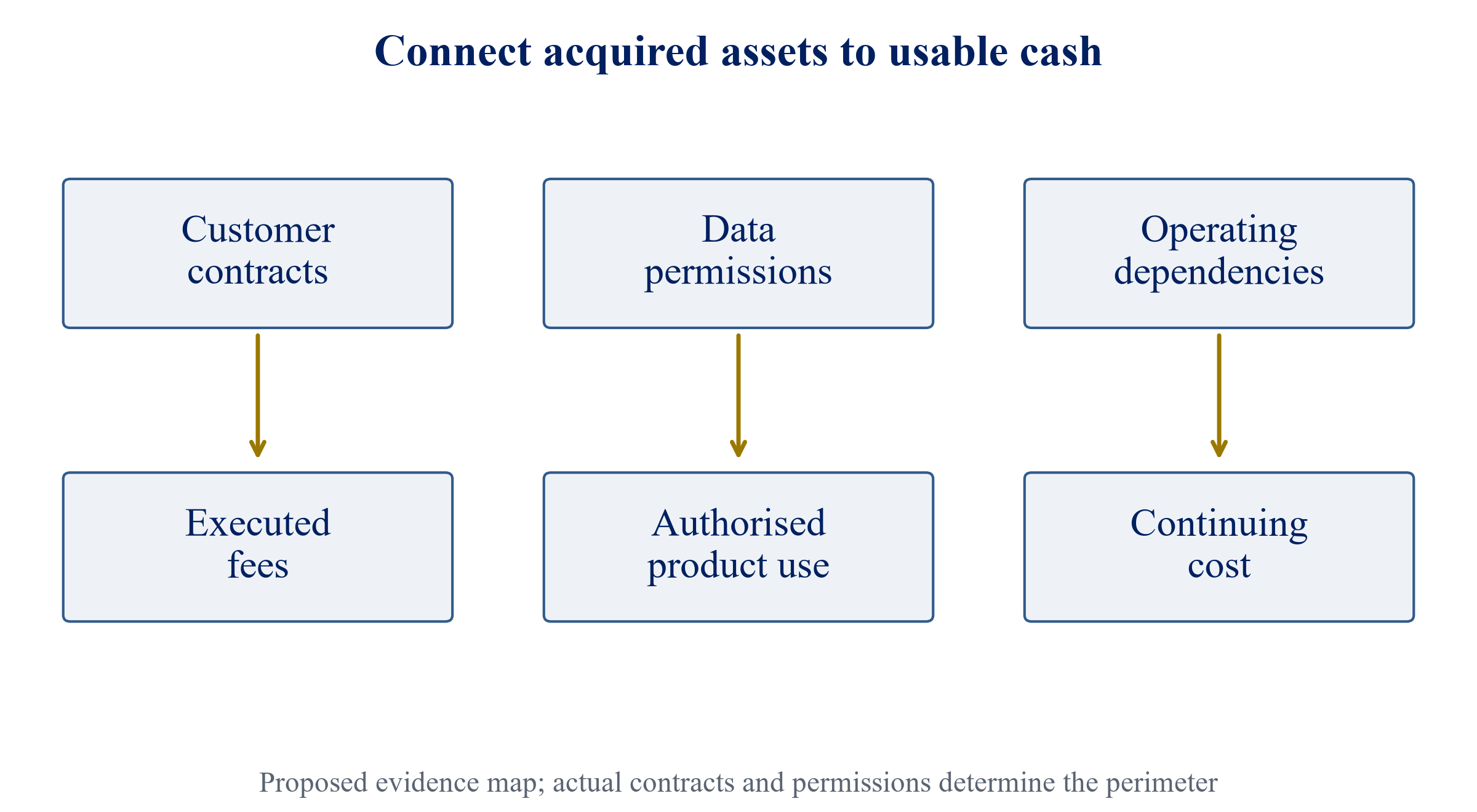
Author-developed acquisition schematic. Each connection requires target-specific contract and technical evidence.
4 Reconstruct recurring revenue
Reconstruct recurring revenue from individual executed contracts. Capture the contracted product, fee basis, term, renewal date, payment schedule, cancellation rights, minimum commitment and delivery conditions. Link that record to invoices, collections, credit notes and the general ledger. A reconciliation should explain timing and classification differences rather than force all measures to agree. Preserve the original accounting measure alongside the buyer's analytical measure.
Separate implementation, bespoke development, hardware resale and reimbursed third-party expenditure. A service can recur commercially while still requiring substantial new delivery effort. The relevant question is the cash contribution and resource commitment needed to earn the next period's receipts. Review product subscriptions and labour-dependent services separately, then show their combined economics if the acquisition includes both.
For usage-based contracts, define the annualisation period and disclose unusual consumption. A short period of commissioning or extreme market activity can create a different usage profile from normal operations. Test at least the actual observed period and a documented forward assumption. An expansion opportunity needs its own status. Distinguish signed amendments, customer-approved budgets and seller forecasts in the supporting schedule.
The proposed recurring-revenue schedule includes a reconciliation date and evidence owner for each adjustment. Keep actual executed fees, billing, collected cash and projected renewals in separate fields. Where collections are overdue, assess the exposure explicitly. The AspenTech definition cited earlier is one reason to inspect what a contractual metric includes [2]. The buyer should establish its own consistent definition and retain the bridge to reported results.
5 Measure renewal economics by cohort
A renewal analysis should identify which customers entered each cohort, what they originally purchased and what they subsequently paid. Use the same customer identifiers and currency treatment across periods. Show price increases, product additions, reductions, cancellations and acquisitions within the customer group separately. This permits a reviewer to distinguish customer behaviour from changes in measurement or reporting perimeter.
Report both customer counts and contract value. A value-weighted retention measure can be dominated by one account, while a customer-count measure can be dominated by small users. Inspect the distribution and its relationship with delivery cost. For energy software, also consider the contracted asset count, site count or usage entitlement where the agreement defines the charging basis that way. Keep those operational measures reconciled to the financial record.
A proposed renewal discussion should ask the customer to confirm its current use, approval process, competing options, unresolved support issues and next renewal decision. Record what the customer actually states. A positive product comment supplies different evidence from a signed renewal. Where confidentiality or procurement restrictions limit discussion, preserve that limitation in the diligence findings and select another verifiable evidence route.
The acquisition model should give expiring contracts a visible renewal assumption. Avoid carrying them indefinitely at their current price without an explicit rationale. The committee can approve a sensitivity range or conditional price for that exposure. Preserve the renewal assumption in the closing model and revisit it after integration, using the same cohort definitions so that forecast variance remains interpretable.
6 Identify the concentration perimeter
Customer concentration should be measured by economic group as well as contracting entity. Two subsidiaries may share procurement authority, funding or an operating platform. Conversely, a group agreement may contain separate site-level decisions. Inspect the actual contract and decision process before aggregating or separating the exposures. Record revenue, contribution and outstanding receivables for each relevant grouping.
Extend the map to dependencies that do not appear in the sales ledger. The largest customer might also provide the dataset used to train the product. A cloud provider, equipment manufacturer or model supplier can support several products simultaneously. The useful stress question is which receipts and costs change if a specified dependency fails. Model that event across the affected products once, using an explicit overlap schedule.
Concentration thresholds in this paper are proposed review tools. No universal safe percentage is established. A buyer can accept a concentrated business when its expected cash, contractual protection, price and capital structure suit its risk tolerance. The investment memorandum should identify the actual exposure and the agreed response. A generic label such as diversified provides insufficient detail for that decision.
The review should also inspect concentration over time. A customer that represents a modest current share may represent most of next year's contracted expansion. A data supplier may become more important as a new product launches. Include those forward dependencies in a separate forecast schedule and retain their evidential status. Do not mix proposed expansion with executed revenue when calculating current concentration.
7 Establish rights for the intended data use
For each material dataset, identify the origin, contractual owner or relevant rights holder, collecting entity, licence, permitted purposes, duration and onward-use restrictions. Link the dataset to the product and revenue that depend on it. The rights schedule should distinguish operational access, storage, model training, model evaluation, sharing and commercial resale. Approval for one purpose does not establish permission for another.
The European Commission states that the Data Act applies from 12 September 2025 and addresses access to connected-product data and switching between data-processing services [3]. Its explanatory material describes trade-secret safeguards and conditions on sharing [4]. These provisions require a scoped legal assessment. They establish no unrestricted permission to commercialise every industrial dataset or transfer every customer relationship.
The proposed diligence response is to ask counsel to record which regime and contract applies to each intended use. Identify the affected product, counterparty and required action. A legal memorandum that addresses the target generally should be supported by a data-to-revenue schedule where material permissions differ. The financial reviewer can then model the actual restricted activity and the cost of a permitted alternative.
Where permission is absent or uncertain, use a defined transaction condition. The condition might require an amendment, a substitute dataset, an excluded product or deferred consideration linked to a completed milestone. Record who decides whether the condition has been met. The commercial model should remain tied to that determination rather than assume that closing alone resolves the data rights.
8 Handle personal data in acquisition diligence
The UK Information Commissioner's Office identifies data-sharing diligence where an acquisition or organisational change transfers personal data to a different or additional controller. Its guidance addresses original collection purposes, lawful basis, documentation, security and information supplied to individuals [5]. Apply that source within its stated context and obtain advice for the transaction's actual jurisdictions.
The buyer should first identify whether the diligence material contains personal data and why each recipient needs it. Customer contacts, support tickets, employee records and operational logs can require different handling. Prepare staged disclosure rules and a record of access. Use aggregated or redacted information where it answers the diligence question, and document any decision to disclose more detailed material.
Create a separate plan for post-closing access. A permission to review a dataset during diligence can have different limits from permission to operate the acquired business, migrate data or train an AI system. The proposed plan specifies the data controller or processor roles, permitted access, retention period, security controls and responsible legal reviewer. Material changes require a documented review before implementation.
The numerical model later in this paper treats unresolved rights as an explicit scenario assumption. It supplies no conclusion about lawful processing in a real transaction. If a proposed remedy takes time, model the corresponding revenue delay and cost. Record the final legal assessment with the operating plan so that the integration team can implement the agreed restrictions without relying on the seller's general description.
9 Test whether data supports defensible economics
Evaluate a proposed data advantage through observable commercial mechanisms. The buyer might test whether a dataset improves a defined customer outcome, lowers delivery cost, shortens implementation or supports a feature that customers actually purchase. Select the mechanism before inspecting performance claims. A large volume of records has no fixed valuation consequence within this framework.
Prepare a comparison using the target's authorised data and a documented alternative. Fix the evaluation period, task, information available at decision time and allowable operating conditions. Include acquisition, cleansing, labelling, integration and continuing refresh costs. Measure the agreed technical outcome and its financial consequence separately. Any conclusion about replacement difficulty should identify the tested alternative and the limits of the test.
Trace the proposed advantage to customer cash. A model may improve forecasting while the software contract remains fixed-price. In that case, the immediate financial consequence may concern retention or delivery cost rather than additional fees. A performance-linked agreement can allocate the benefit differently. Use the actual contract to decide which entity earns the incremental receipts and which party bears a failure.
The acquisition memorandum should contain a specific description of the advantage and the period over which it is expected to persist. A temporary integration lead, an exclusive permission and accumulated customer knowledge require different assumptions. Each may have commercial value, subject to evidence. The model should price that supported mechanism and show what changes when the permission, dataset or customer relationship ends.
10 Review AI provenance and supplier dependencies
NIST's Generative AI Profile recommends incorporating intellectual-property, privacy, security and supplier risks into acquisition and procurement diligence. It also discusses training-data curation and contingency arrangements for third-party dependencies [6]. NIST's broader AI risk-management material connects evaluation with expected conditions of use and discusses data provenance [7]. These publications guide the proposed review; they supply no certification of the target.
Inventory the target's models, retrieval sources, fine-tuning datasets, evaluation sets and third-party services. Record the licence version and the terms governing the intended commercial deployment. Establish which artefacts the target can reproduce, which are available only through an external service and which are restricted to the existing legal entity. Link those dependencies to product delivery and cost.
For a proposed AI feature, examine the full delivery cost. Include inference, data retrieval, human review, monitoring, support and the cost of correcting errors. Compare the feature's receipts with the resources required under expected and stressed usage. A pilot budget can differ from the production budget. Identify that difference in the model and seek evidence for the transition assumptions.
The proposed transaction schedule should identify a fallback for each material supplier dependency, with an estimated transition effort supported by technical review. A model replacement can require new testing and revised customer permissions. Keep those tasks in the integration budget. Any purchase-price uplift attributed to AI should reconcile to an explicit cash contribution and the evidence needed to sustain it.
11 Verify operational continuity
The buyer should inspect how the software is deployed and who can alter its behaviour. Separate analytical recommendations from functions that can affect operational assets. Map customer approval steps, change controls, incident response and support responsibilities. The acquisition thesis should state the approved use of each product, particularly where a new owner intends to extend its functions.
Review the build and release process with the technical team. Ask for evidence that the acquired code can be built, tested and deployed from the included repositories and licences. Identify credentials and production authority through a controlled transfer process. Record essential dependencies on named roles, seller infrastructure or undocumented procedures. The cost forecast should include the agreed work needed to make those dependencies manageable.
Prepare a customer continuity test that covers billing, support, scheduled deliveries and incident handling. A desktop demonstration can show a feature operating in a limited environment. The buyer also needs evidence relevant to the contracted production service. The proposed review uses controlled tests with stated boundaries; it claims no measured reliability for a target that has not been inspected.
For integration, preserve an approved rollback route. Define the conditions requiring rollback, the authorised decision-maker and the data reconciliation needed afterwards. Put continuity expenditure in the purchase model and identify whether the seller bears any part through a transition agreement. This gives the committee a costed delivery plan and avoids leaving essential operating work outside the valuation perimeter.
12 Prioritise diligence by cash exposure
Use a diligence matrix to connect an unresolved issue to an affected cash flow, required evidence, owner and transaction response. The proposed priority categories reflect the consequence of the issue for the acquisition decision. They are qualitative judgements requiring review; they are not measured probabilities or a validated scoring model. Keep the supporting documents beside each entry.
An issue that blocks a material product's lawful delivery may require a closing condition. A modest cost uncertainty may require a budget provision and monitoring. A renewal exposed to customer approval may require a retention scenario or deferred payment. The appropriate response depends on the actual evidence and the buyer's accepted exposure. Record that decision in plain language.
Avoid an arithmetic average that allows a severe rights issue to disappear among well-reviewed operational items. Consider the individual dependencies and their financial consequences. The second figure arranges proposed diligence domains by current evidence and potential cash exposure. Its purpose is to direct work and committee discussion. It establishes no factual ranking of real targets.
The table supplies examples of evidence and response fields. Populate those fields with target-specific findings before using them to approve a transaction. An issue can move between categories when new evidence appears. Preserve the earlier assessment and the document that changed it so that reviewers can reconstruct the decision and the closing team can implement it.
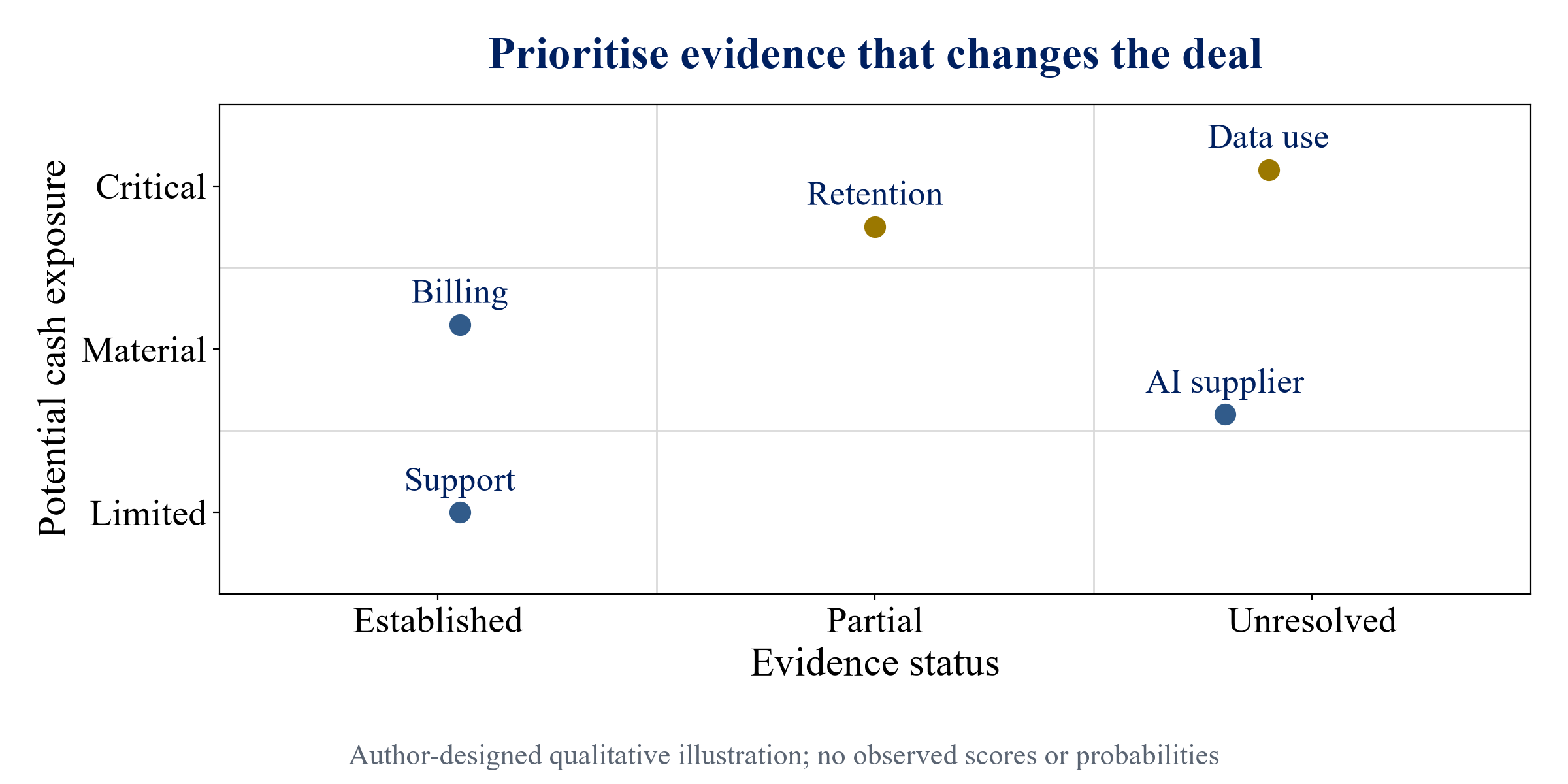
Qualitative author-designed matrix. Placement illustrates review priorities and contains no observed target scores or risk probabilities.
Table 1. Proposed diligence evidence and transaction responses
| Domain | Evidence to inspect | Possible response |
|---|---|---|
| Recurring fees | Executed contracts and collection bridge | Adjust accepted revenue |
| Data use | Purpose-specific licence and transfer terms | Consent or exclusion condition |
| Customer overlap | Group and dependency schedule | Joint retention stress |
| AI supplier | Licence version and fallback test | Costed replacement plan |
| Operating continuity | Reproducible deployment and support | Transition agreement |
| Renewal expansion | Signed amendment and delivery plan | Conditional consideration |
Author-developed review schedule. Actual responses require the target's evidence and the buyer's approval.
13 Establish the hypothetical revenue bridge
The remainder of the numerical example uses author-selected inputs for a fictional target, with all amounts in USD million. No amount is drawn from the cited public companies. Assume a seller presents an annualised headline of 20.0, comprising 18.0 of claimed recurring software business and 2.0 of implementation services. For this simplified calculation, exclude implementation services from the recurring software perimeter and assign them no separate acquisition value.
Assume that the 18.0 includes 2.0 of proposed expansion for which no executed customer amendment exists. Removing that amount leaves 16.0 of executed recurring business. This measure is an analytical contract schedule. It is distinct from recognised accounting revenue and collected cash. A real review would retain all three measures and reconcile them by period.
Assume next that 3.0 of the executed recurring amount depends on data permissions or transfer conditions that remain unresolved in the rights-cleared case. The worked bridge therefore reaches 13.0. This treatment assumes the affected activity produces no receipts until the condition is resolved. It establishes no legal conclusion or expected loss for an actual contract.
The bridge makes each adjustment inspectable and mutually defined. A buyer could also value the implementation activity, price signed future expansion or assign conditional value to a rights remedy. Such changes require additional cash schedules. The illustration excludes them to show how a headline measure changes when the buyer defines a usable recurring perimeter. Table 2 records the starting point and each explicit adjustment.
Table 2. Hypothetical recurring-revenue bridge
| Stage | Adjustment | Remaining amount |
|---|---|---|
| Annualised seller headline | Starting measure | 20.0 |
| Recurring software claim | Exclude implementation 2.0 | 18.0 |
| Executed recurring business | Exclude unsigned expansion 2.0 | 16.0 |
| Rights-cleared case | Exclude unresolved activity 3.0 | 13.0 |
| Customer-loss stress | Exclude incremental loss 4.0 | 9.0 |
Author-selected fictional assumptions. USD million; no observed target or transaction amounts.
14 Model overlapping concentration exposures
Assume the largest customer accounts for 5.0 of the executed 16.0 recurring amount. Its share is therefore 31.25 percent of that explicitly defined perimeter. Assume that 1.0 of this customer's business is already included in the 3.0 unresolved-rights adjustment. The rights-cleared case therefore contains 4.0 of additional business exposed to this customer.
If the customer leaves entirely in the stated stress, the accepted recurring amount falls from 13.0 to 9.0. Subtracting the full 5.0 again would count the overlapping 1.0 twice. An equivalent calculation starts with 16.0, removes the joint exposure of 3.0 plus 5.0 less the 1.0 overlap, and reaches the same 9.0. Keep the overlap schedule at contract level so that reviewers can verify the calculation.
The example assigns no probability to the customer leaving. It also assumes no replacement sales, no additional rights remedy and no partial retention. Those restrictions define the scenario. A real acquisition should include the credible alternatives and the evidence for their timing. The stress should identify whether the customer loss also affects data availability, cost or other customers' product performance.
The practical transaction question is the exposure the buyer accepts at the proposed price and financing level. A retention milestone, consent condition or lower fixed payment may change that exposure, subject to negotiated terms. The stress result remains a scenario output. Avoid presenting it as a predicted loss, or as a valuation discount automatically appropriate for every concentrated software business.
15 Convert accepted revenue into cash
Assume the rights-cleared recurring amount of 13.0 earns a cash contribution margin of 60 percent after direct delivery costs, producing 7.8. Assume continuing operating costs of 4.8 and annual maintenance investment of 0.6. The resulting annual unlevered cash is 2.4. For this simplified example, cash tax, incremental working capital and all additional investment are assumed zero. These exclusions are material modelling limitations.
Apply the same assumptions to the customer-loss stress. Revenue of 9.0 produces contribution of 5.4, which is fully absorbed by the 4.8 operating cost and 0.6 maintenance investment. Annual cash is zero. The example holds fixed cost unchanged after the loss. A restructuring response would need its own achievable cost reductions, timing and implementation expenditure.
Before applying this method to a real target, verify the cost perimeter. Direct cost can include cloud usage, licensed data, customer-specific support and externally supplied models. Continuing cost can include product development needed to meet existing obligations. Capitalised expenditure still consumes cash. The review should reconcile the accounting treatment with the cash required to maintain the acquired service.
The model also needs a receipts schedule where billing and collections differ. Contract balances can affect the cash required immediately after closing. The public accounting disclosure in Section 2 supplies context for that review [1]. The worked example assumes annual cash receipt and expenditure at each year-end solely to make the discounting transparent. Actual debt service, taxes and transaction expenses require separate schedules.
16 Calculate conditional enterprise value
Assume annual unlevered cash of 2.4 at each year-end for five years and an annual discount rate of 14 percent. The five-year annuity factor is approximately 3.4331. Multiplying by 2.4 gives approximately 8.239 of present value. This figure values only the five explicit assumed cash receipts; it establishes no contractually guaranteed collection or renewal.
For a separate continuation case, assume that cash remains 2.4 every year after year five, indefinitely, with zero growth and the same discount rate. The terminal amount at the end of year five is 2.4 divided by 0.14, or approximately 17.143. Discounting that amount back five years gives approximately 8.903. Combining the explicit period and this conditional terminal contribution gives approximately 17.143 before one-time integration expenditure.
Assume one-time integration cash of 0.8 paid at closing. The resulting model value is approximately 16.343. The calculation is a cash illustration, with no claim that 14 percent is an appropriate target discount rate or that perpetual renewal is justified. More than half the pre-integration value comes from the stated continuation assumption. That dependency should be visible in the committee's decision.
The stress in Section 15 produces zero operating cash under its assumptions. Its model value becomes negative 0.8 if the same integration payment is incurred. This is a scenario cash result, rather than a recommendation to pay a negative purchase price. It identifies a condition under which the assumed operating cash provides no capacity to recover that expenditure.
17 Inspect valuation sensitivities
Vary one clearly identified input at a time before constructing joint scenarios. Holding annual cash at 2.4 and zero-growth continuation unchanged, a 12 percent discount rate produces 20.0 of value before integration; a 16 percent rate produces 15.0. After the assumed 0.8 closing expenditure, the amounts become 19.2 and 14.2. Those differences are model sensitivities with no assigned likelihood.
Holding the 14 percent rate constant, a 50 percent contribution margin on 13.0 of revenue produces annual cash of 1.1 after the same costs. A 70 percent margin produces 3.7. Under the same indefinite zero-growth assumption, the respective pre-integration values are approximately 7.857 and 26.429. The resulting range shows the importance of inspecting the delivery-cost perimeter.
A joint scenario should reflect internally consistent operating conditions. If customer loss reduces cloud cost but leaves specialist support staff in place, apply the relevant changes to both revenue and cost. If replacement data requires integration work, include that work and the delay before receipts resume. Record the dependencies instead of combining independent percentage adjustments mechanically.
The third figure displays the main model bridge and a proposed execution sequence. Its values are outputs of the stated assumptions. It supplies no market multiple, expected transaction price or lender position. The investment committee should record which scenario supports its approved payment and which unresolved assumptions require conditions. Retain the sensitivity workbook with the agreed definitions so that the closing calculation can be reproduced.
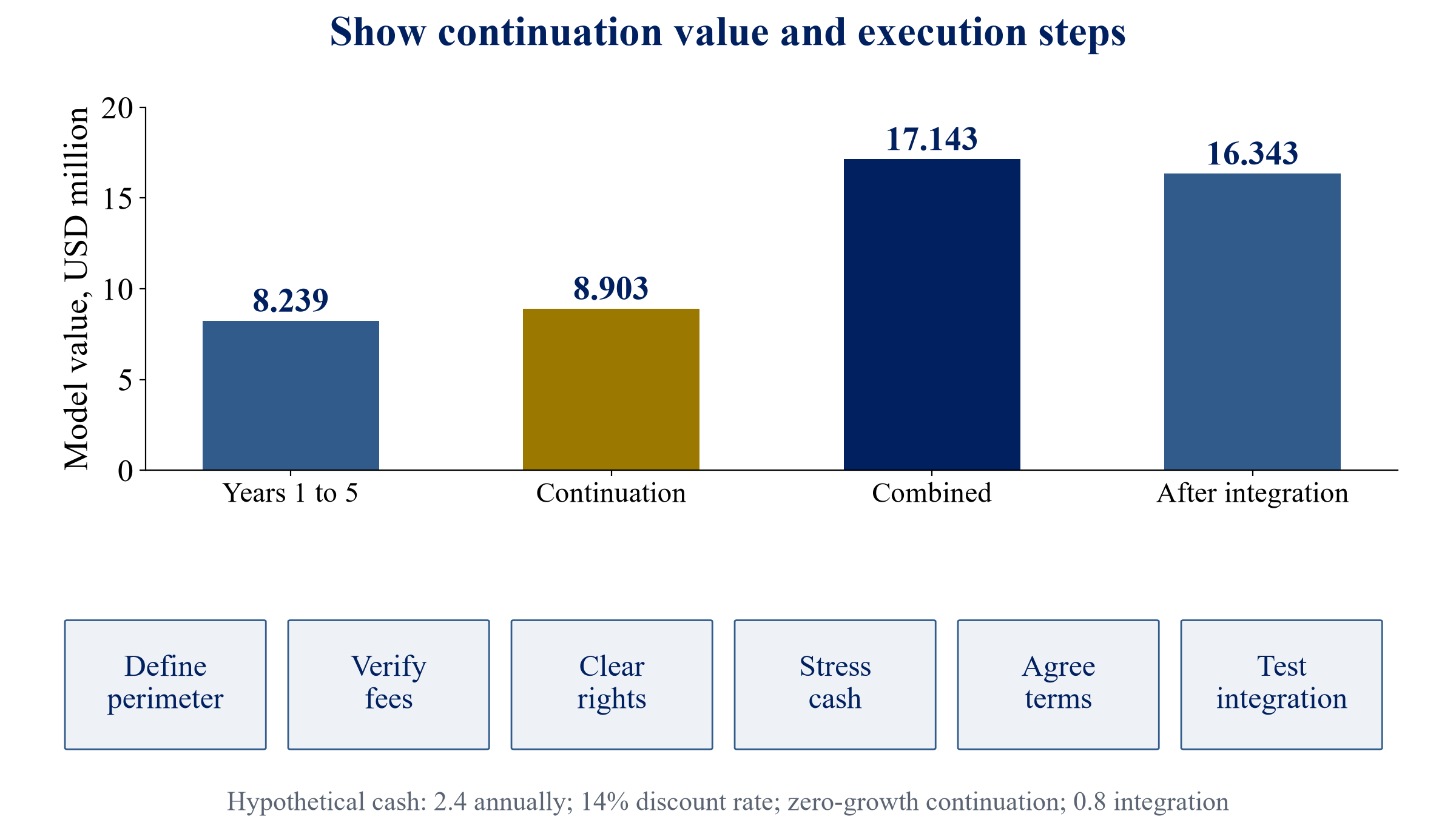
USD million. Five-year cash and continuation value use a 14 percent rate; all inputs are author assumptions. Roadmap stages are proposed actions.
18 Keep enterprise value and payment separate
An enterprise cash model needs a defined bridge to the amount paid for equity or assets. Prepare schedules for debt, cash, working capital, transaction costs and excluded assets as required by the actual agreement. Each item needs an agreed definition and measurement date. An enterprise valuation output does not determine the contractual treatment of those balances.
For software, scrutinise deferred revenue and obligations attached to prepaid customer fees. A buyer may inherit a service obligation whose cash was collected before closing. The completion mechanism should describe the agreed treatment and the resources required to fulfil the obligation. Avoid adding the associated cash and ignoring the remaining delivery cost. The appropriate contractual adjustment requires the actual accounts and negotiated definitions.
Earn-outs and deferred payments should also have a visible place in the bridge. A revenue milestone may be affected by the buyer's integration decisions, discounts or product migration. Specify how the metric is calculated, who can inspect the records and which actions affect it. A contingent payment transfers defined exposure only to the extent that the agreement and practical enforcement support that result.
The proposed committee paper presents operating enterprise value, immediate purchase payment, contingent payment scenarios and total funding need separately. Funding need includes acquisition expenses and the budget required to keep the business operating through integration. Keep each cash flow counted once. The model's illustrative 0.8 integration amount should appear in the appropriate place consistently, with its timing stated throughout the decision materials.
19 Align financing with contracted cash
If the buyer proposes acquisition debt, prepare a debt-service model using the actual facility terms under discussion. Define available cash, permitted distributions, interest, amortisation, fees and covenants. Test customer and supplier events that could affect those amounts. The enterprise valuation discount rate used in the illustration supplies no loan pricing or borrowing capacity.
Map renewal dates and customer approvals against debt obligations. A large contract expiring before a scheduled repayment creates a timing question that an annual headline measure can conceal. Include collection delays and the cash required to deliver prepaid services. Show the maximum funding requirement over the relevant period and the assumption supporting it. Obtain an actual financing indication before reporting lender acceptance.
The buyer can compare structures with different fixed-payment and contingent-payment profiles. A lower closing payment may leave more liquidity for integration, while a deferred obligation can create later cash demands. Inspect restrictions in the proposed financing and purchase agreements together. The objective is an approved payment schedule consistent with the business's stress cash and the buyer's available resources.
This framework establishes no generally safe leverage ratio for energy software. An actual facility requires lender assessment and negotiated terms. The proposed financing memorandum should name the scenario used, the contractual cash perimeter, unresolved diligence conditions and the source of each assumption. After closing, monitor the same measures so that deterioration in collections or renewal evidence can trigger the agreed management response.
20 Translate diligence findings into deal terms
For each material finding, choose a specific commercial response and identify its limitations. A condition precedent can require a named permission before closing. A purchase-price adjustment can address an agreed balance. A warranty describes a contractual statement, while an indemnity or escrow can allocate particular exposures subject to negotiated terms. The paper proposes examining these tools with transaction counsel; it supplies no enforceability conclusion.
Draft milestones that an independent reviewer can measure. A data-rights milestone might require an executed amendment permitting the named product and use for a stated term. A retention milestone might require a specified customer renewal and collection. Keep the metric aligned with the revenue and cash model. A broadly worded requirement to preserve the data moat leaves the evidence and payment trigger unclear.
Estimate the remedy's time and cost. Customer approval may involve procurement, legal and operational review. A software replacement may require development and testing. Assign those tasks to actual owners and retain the relevant correspondence. Until that evidence exists, describe the timetable as a proposed planning assumption and keep the corresponding cash sensitivity visible.
The agreement should also address who controls the action after closing. An earn-out linked to a product can become difficult to interpret when the buyer changes pricing or combines products. A transition covenant can require access that the seller cannot authorise alone. Resolve these dependencies in the deal design and document any accepted residual exposure in the committee's approval.
21 Design integration and separation
Integration should follow the acquired rights and customer obligations. Start with service continuity, access control and a verified operating baseline. Identify any activities that require additional permissions or customer approval before migration. A product's technical compatibility with the buyer's systems leaves its contractual permission and operating approval as separate questions.
For a carve-out, establish the separation plan before closing. Record the source of billing data, repositories, infrastructure configurations, support procedures and product documentation. Assign owners for extraction, migration, reconciliation and acceptance. Define the seller's ongoing obligations through the transition agreement. Include the buyer's independent replacement capability and a documented exit from temporary services.
The proposed roadmap uses evidence-dependent stages rather than fixed claims of a universal hundred-day outcome. The first stage preserves contracted delivery. The next reconciles systems and permissions. Later changes to the product or data architecture proceed after the relevant tests and approvals. Management should set actual dates using the target's operational evidence and customer commitments.
Table 3 connects those stages to acceptance evidence. The responsible buyer can use it as a planning schedule and expand it for the transaction. Record delayed or failed acceptance alongside the effect on cost and receipts. The acquisition model should be updated when integration evidence changes a material assumption, retaining the original approved case for comparison.
Table 3. Proposed closing and integration acceptance schedule
| Stage | Acceptance evidence | Financial connection |
|---|---|---|
| Before signing | Defined contracts and acquired assets | Accepted revenue perimeter |
| Before closing | Required permissions and funding | Closing conditions and payment |
| Initial operation | Support and delivery continuity tests | Transition cost and receipts |
| System migration | Reconciled data and customer approval | Ongoing cost and retention |
| Product change | Authorised use and technical evaluation | Conditional improvement case |
| Steady operation | Collections and renewal reconciliation | Forecast variance and debt review |
Author-developed roadmap. Dates and accountabilities must be agreed for the actual transaction.
22 Adapt the review across geographies
Use a common analytical schedule for contracts, data and cash, with jurisdiction-specific legal assessments attached. The public European and UK sources cited here have defined scopes. They provide questions for those contexts and should not be presented as rules for every country. A target operating across borders requires a contract and data-flow map showing the relevant entities and intended uses.
The proposed geographic review asks where customers contract, where data is collected and processed, which counterparties supply it and where the buyer plans to deploy the product. Record governing law, approval requirements and restrictions from the actual documentation. Use local counsel for legal conclusions. The acquisition model should reflect the assessed cost or restriction rather than rely on a generic regional assumption.
For a GCC, Indian, UK, European or US expansion case, create a separate commercial scenario using actual customer evidence where available. Identify currency, payment, deployment and support assumptions. A successful product in one customer environment supplies evidence about that environment. Test the proposed new deployment and price its implementation before attributing expansion value to the acquisition.
The committee should see current executed business and proposed geographic expansion in separate schedules. Expansion can be a legitimate source of conditional value when its assumptions and required capital are visible. The buyer should record the evidence needed to release that capital and the scenario if demand develops more slowly. This preserves geographic ambition within a reviewable acquisition decision.
23 Limitations and future empirical testing
The framework has no target-company sample, observed customer-loss frequency or validated relationship between data rights and valuation multiples. Its public sources establish selected disclosures and guidance. Its numerical amounts demonstrate arithmetic under explicit assumptions. The paper provides no estimate of the prevalence of any diligence issue, expected return or probability of acquisition success.
The constant-cash valuation omits cash tax and working-capital movement and assumes maintenance investment fully captures the required ongoing investment. Actual businesses may need more detailed expenditure and renewal schedules. The indefinite zero-growth case assigns continued cash beyond the explicit five-year period. That assumption requires substantive support in a real valuation and can be replaced with a finite-life or other justified model.
A useful empirical extension would assemble a lawfully obtained transaction dataset with consistent definitions of contract revenue, transfer permissions, customer groups, integration expenditure and post-closing collections. Researchers could test whether specific diligence findings are associated with forecast variance. Selection effects, confidentiality constraints and differences in deal structure would require explicit treatment. Such an association alone would establish no causal effect.
Prospective research could also compare customer-approved data substitutes under a fixed evaluation protocol and measure their delivery cost. That work would make replacement assumptions inspectable. Any results should report the period, product, authorised data and test conditions. Until such evidence is obtained, this paper's data-advantage and integration recommendations remain proposed analytical methods rather than proven performance improvements.
24 Investment committee decision record
The proposed decision record should state the acquired perimeter, accepted recurring revenue, required data permissions, concentrated dependencies, cash case and payment structure. Attach the evidence for each material assumption. The committee should be able to reproduce the revenue bridge and the cash valuation without relying on an unexplained seller headline or an unsupported assertion about proprietary data.
For the fictional example, the record would show 16.0 of executed recurring business, 13.0 in the rights-cleared case and 9.0 in the stated customer-loss stress. It would identify the 1.0 overlap and the cost assumptions that produce annual cash of 2.4 or zero. It would separately approve or reject the continuation assumption responsible for approximately 8.903 of model value before integration expenditure.
Record the transaction responses beside the unresolved findings. Name the permission required before closing, the customer milestone used for any contingent payment and the budget allocated to continuity or migration. State which matters remain open and who has authority to accept them. The purchase agreement, financing case and integration plan should use compatible definitions for those decisions.
After closing, compare actual receipts, renewal outcomes and integration costs with the approved schedules. Explain changes in perimeter before interpreting variance. The proposed discipline keeps the acquisition thesis connected to the acquired business's usable cash and the buyer's obligations. It also supplies a clear basis for further investment, renegotiation or corrective action when the original assumptions require revision.
References
- Emerson Electric Co. (2025). Form 10-K for the year ended 30 September 2025, transaction disclosures and revenue recognition notes. https://www.sec.gov/Archives/edgar/data/32604/000003260425000087/emr-20250930.htm Accessed 4 October 2026.
- Aspen Technology, Inc. (2024). Form 10-K for the year ended 30 June 2024, Key Business Metrics. https://www.sec.gov/Archives/edgar/data/1897982/000189798224000053/azpn-20240630.htm Accessed 4 October 2026.
- European Commission (2026). Data Act, policy and application overview. https://digital-strategy.ec.europa.eu/en/policies/data-act Accessed 4 October 2026.
- European Commission (2026). Data Act explained, connected-product data and trade-secret safeguards. https://digital-strategy.ec.europa.eu/en/factpages/data-act-explained Accessed 4 October 2026.
- Information Commissioner's Office (n.d.). Due diligence when sharing data following mergers and acquisitions. https://ico.org.uk/for-organisations/uk-gdpr-guidance-and-resources/data-sharing/data-sharing-a-code-of-practice/due-diligence/ Accessed 4 October 2026.
- National Institute of Standards and Technology (2024). Artificial Intelligence Risk Management Framework Generative Artificial Intelligence Profile, NIST AI 600-1. https://nvlpubs.nist.gov/nistpubs/ai/NIST.AI.600-1.pdf Accessed 4 October 2026.
- National Institute of Standards and Technology (n.d.). AI Risks and Trustworthiness, AI Risk Management Framework resource. https://airc.nist.gov/airmf-resources/airmf/3-sec-characteristics/ Accessed 4 October 2026.
About the Author
Chennakeshav (CK) is a corporate finance and investment banking executive with 25+ years of global experience in deal origination, structuring and execution across M&A, growth capital and corporate strategy. He has led value-creation mandates for founders, corporates and funds — bridging the boardroom view to hands-on execution and close.
His career spans Morgan Stanley, HSBC, Lloyds Banking Group, EWEC, ADQ portfolio companies and Emirates Growth Fund, across TMT, real estate, fintech, deeptech, cleantech, infrastructure and energy. He has partnered with C-suite leaders, private equity and venture funds, sovereign wealth funds and family offices to finance complex fund raises and scale-up ventures, and has led M&A due diligence, post-merger integration and business-transformation initiatives to create value.
At Matchpoint Partners he is Managing Partner, leading the firm's corporate finance, M&A and capital-raising practice. He holds an MBA from London Business School, an engineering degree from VTU and a Master of Laws (LLM, in progress) from UCL London.
An active start-up mentor, CK mentors at Techstars, DIFC FinTech Hive, Startup Grind, Founder Institute and IN5, serves as Entrepreneur Mentor in Residence (EMiR) at London Business School, and judges the Entrepreneurship World Cup.
