

1 Price the capital right and the outcome together
Preferred equity is attractive when a company needs capital with a negotiated seniority and return profile while ordinary-equity value remains uncertain. A transition project may need equipment, workforce systems or operational changes whose cost arrives before savings. The preferred instrument can bridge that interval. If its return also depends on a sustainability outcome, the financing decision must value the economic right and the outcome condition at the same time. A percentage-point ratchet cannot be judged in isolation from cash availability, liquidation priority, redemption terms, voting rights and the investment's likely exit path.
The essential question is what the company is paying for. A lower return after a verified improvement can share the benefit of reduced operating risk. A higher return after failure can compensate an investor for a risk it consciously underwrote. Either design can also transfer money without improving the outcome. The sponsor should document how the chosen mechanism is expected to affect investment, management attention or downside protection. It should test whether a higher investor return after an environmental miss could make the investor economically better off when the stated objective fails. That possibility calls for deliberate governance, not a marketing label.
The 2024 Sustainability-Linked Bond Principles provide a useful design analogy: material key performance indicators, ambitious targets, changes to financial or structural characteristics, reporting and verification [1]. They describe bond-market practice; they do not establish the legal terms of preferred shares. The paper therefore uses those principles as a checklist while grounding the equity right in actual constitutional documents and local law. Delaware's company statute, for example, expressly permits rights and preferences for classes or series of stock when properly established [10]. The applicable rule for a UK or other company differs.
This paper gives an investment and documentation framework, not a legal opinion or an empirical estimate of ESG-linked preferred-equity returns. Every financial amount below is a hypothetical author assumption. A real investment requires issuer data, a negotiated term sheet, verified outcome evidence, current jurisdictional advice and an accounting analysis before any claim about expected value or classification can be made.
2 Keep two ledgers that reconcile at each observation date
The first ledger records capital rights. It names the issuer, share class, subscription amount, dividend or preferred return, compounding rule, payment capacity, cumulative accrual, liquidation preference, participation, conversion, redemption, transfer restrictions, governance and enforcement. It also records whether a cash payment is mandatory or contingent on distributable resources. A board can model the ledger through successful operations, a missed target, weak cash generation, a sale and insolvency. The investor should know which terms change automatically when an outcome test is met.
The second ledger records outcome rights and duties. It names each indicator, baseline year, operational perimeter, data owner, measurement method, target date, assurance provider, permitted recalculations, acquisition or disposal treatment, reporting deadline, dispute procedure and consequence of missing information. If a company claims to cut emissions intensity, the denominator and scope must be fixed. If the outcome is a safety or water metric, the counted population and measurement process require equal care. A company may improve one metric by selling a high-emitting subsidiary; the contract must state whether that transaction counts as progress.
The ledgers connect through a test certificate. A specified decision-maker compares independently evidenced performance to the target on a specified date. The certificate then applies a defined financial change, subject to caps and any correction period. Without this junction, a well-written sustainability covenant can fail to alter the return, while a clear ratchet can rest on a metric that no one can audit. ICMA describes the same need for transparency about triggers and financial or structural characteristics in the bond context [1].
The reconciliation has a timing dimension. The company might incur transition capital expenditure in years one and two, measure its target in year three and distribute cash only at exit in year five. Management should be able to show the capital required to pursue the target, the cash available to service the preference and the exit waterfall if no cash is paid earlier. Each board report should present the two ledgers together, including any change in baseline, ownership or reporting boundary.
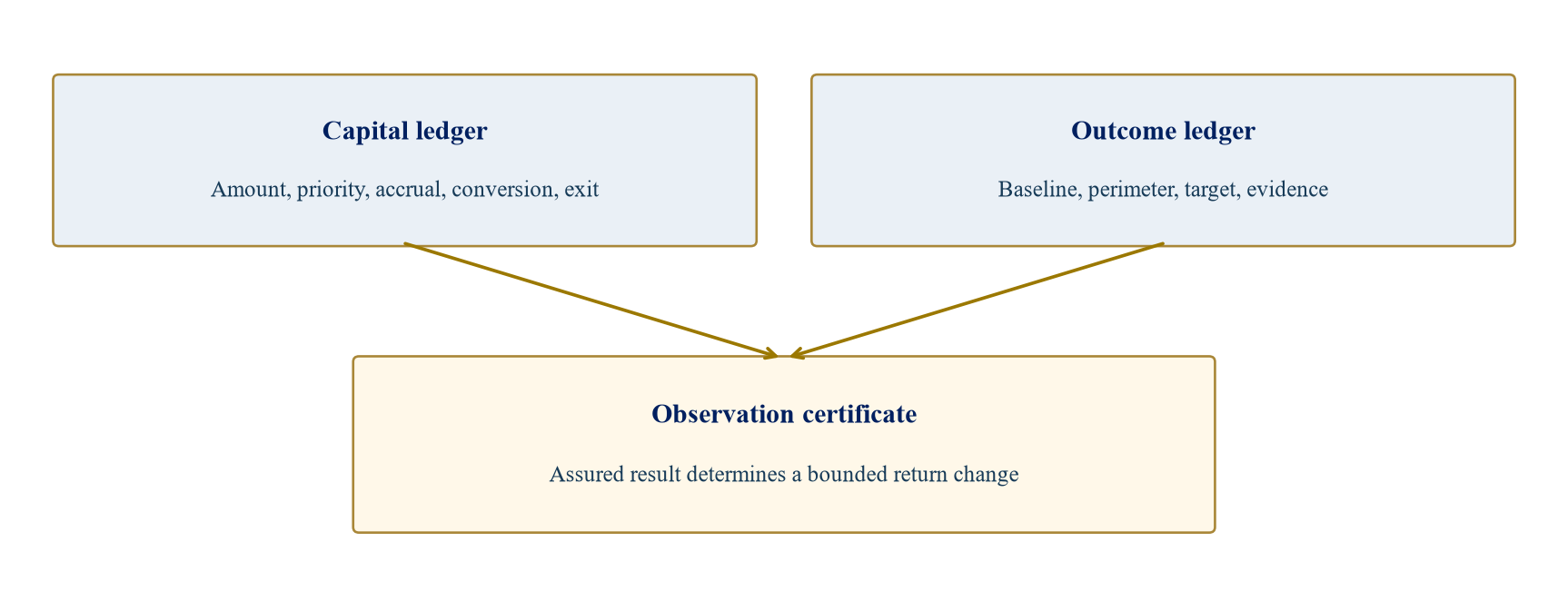
Author-developed analytical framework. Legal rights and measurement procedures must be specified for the particular issuer and jurisdiction.
3 Select a decision-relevant outcome
The choice of metric should follow the asset and business model. A data centre's purchased-electricity emissions, an industrial plant's process emissions, a logistics fleet's fuel intensity and a water utility's leakage are different operating problems. A generic composite ESG score may blend unrelated practices and obscure which project the preferred investment finances. For an outcome-linked instrument to influence decisions, the indicator should be material to enterprise risk or opportunity, under meaningful management influence, consistently measurable and capable of independent review. ICMA's bond principles put materiality, strategic significance, consistent method, external verification and benchmarking at the centre of KPI selection [1].
The metric must also be stable enough to survive a transaction. An absolute-emissions target can change when a facility is acquired or sold. An intensity metric can improve even as total emissions rise. A renewable-electricity share can be affected by contractual instruments and the location of power consumed. GHG Protocol's Scope 2 Guidance sets out location-based and market-based accounting approaches, while its Scope 3 Standard explains the importance of consistent value-chain boundaries [7,8]. The finance contract should identify which accounting approach and version apply, rather than citing an undefined 'carbon reduction'.
Materiality is a business question as well as a sustainability question. An engineering company with severe safety exposure might prioritize lost-time injury frequency, subject to carefully defined hours worked and contractor inclusion. A water business could prioritize physical losses, contingent on calibrated metering and network changes. A governance target might concern independently assessed control remediation, but a count of new policies is a weak proxy for actual performance. The diligence team should compare each candidate metric to the company's baseline, costed transition plan and principal risks. It should reject a metric whose improvement can be purchased cheaply while the underlying problem persists.
The investment memorandum should explain why the metric matters, what management can do, where data are collected, what alternatives were rejected and who bears measurement cost. Historical values should be shown with their assurance status. A target that is only barely above a credible business-as-usual trajectory cannot support a claim of ambition. Where no historical series exists, the term sheet should condition the final target on independent baseline confirmation or choose an observable milestone with clear evidence.
4 Calibrate ambition against a defensible baseline
A target is meaningful only when the reference point can be reconstructed. The sponsor should retain source data, operational boundaries, metering methods, consolidation rules and any restatements. A baseline built from an incomplete acquisition perimeter may be unusable for a post-acquisition target. The data owner should identify extraordinary operating periods, changes in production mix and missing readings. The verifier must be able to reproduce the number from specified records, not merely accept a management slide.
ICMA recommends benchmarking a sustainability target against an issuer's own history, comparable peers where available and relevant scientific or official trajectories; its principles describe ambitious targets as a material improvement beyond business as usual [1]. These are useful tests, although a preferred investment remains a negotiated equity instrument. The target should also be costed. An apparently ambitious 30% reduction can be implausible if the permitted capital budget buys only a small improvement; a modest target may still be important when the baseline is already strong. The investment committee needs both the trajectory and the resources required to execute it.
Benchmark quality varies. Peer emissions data can differ in boundary, location and electricity-accounting method. GHG Protocol cautions that value-chain Scope 3 inventories are designed chiefly for tracking a company's performance through time, and cross-company comparison requires consistent methods and data [8]. A peer chart should state differences rather than presenting all published numbers as directly comparable. If a regulation changes the calculation method, the contract needs a recalculation procedure that preserves the original economic bargain as far as practicable.
The target date should precede the financial consequence by enough time for evidence, assurance and cure. A target set near the final exit can leave little incentive to invest early; a target tested too soon may reward a temporary accounting or operational change. The memorandum should show intermediate milestones, forecast expenditure and expected physical outcomes. A missed interim milestone can trigger enhanced reporting without automatically changing dividends, while the agreed final observation triggers the contractual adjustment. This distinguishes information rights from economic penalties.
Table 1. Design benchmark across linked finance and preferred-equity terms
| Decision component | Published reference point | Preferred-equity drafting question | Evidence before signing |
|---|---|---|---|
| KPI materiality and definition | ICMA SLBP selection guidance [1] | Does the outcome affect the financed business and can management influence it? | Operating data, boundary and method |
| Target ambition | ICMA SPT calibration guidance [1] | Is the result beyond a justified baseline trajectory? | Historical series, comparable context and costed plan |
| Disclosure | IFRS S1 and S2 where adopted [5,6] | What information may investors receive and what is public? | Reporting map and confidentiality protocol |
| Verification | ICMA verification and impact-management principles [1,9] | Who assures the target test and resolves disagreement? | Independent scope and appointment terms |
| Financial consequence | ICMA financial-characteristic guidance for bonds [1] | Which share rights change, within what cap and on which date? | Executable constitutional and investor terms |
| Classification | IAS 32 presentation rules where applicable [11] | Does cash obligation affect liability or equity presentation? | Specialist accounting analysis |
The bond and disclosure columns summarize cited published frameworks; the preferred-equity column is an author-developed application, not a market standard.
5 Define the security and the shareholder bargain
Preferred equity is not a single security design. A non-participating preferred share may take a defined preference or convert into ordinary equity; a participating share may receive a preference and share in further proceeds. A cumulative return can accrue when distributions cannot be made. A redemption feature can create a future cash need that behaves differently from perpetual capital. Voting and consent rights can become more important than a small return ratchet when the company changes strategy or sells the financed asset. Every term needs to be written in the issuer's constitutional and investment documents with the applicable company law in view.
Delaware law illustrates the point rather than supplying a global answer: its corporate statute allows classes or series with specified voting powers, designations, preferences and rights, including dividend and redemption terms [10]. UK company law contains its own provisions on variation of class rights and redeemable shares [12,13]. Investors across multiple jurisdictions cannot safely copy a US venture term sheet into a UK company, or an infrastructure SPV into a growth company, without counsel checking capital maintenance, distribution and enforceability. The actual governing law and charter determine the result.
An outcome condition can operate on a dividend rate, accrued return, redemption premium, conversion ratio, participation cap or other economic term. These mechanisms are not interchangeable. A rate step-up may accrue into a larger exit preference when operating cash is scarce. A conversion adjustment may dilute ordinary shareholders and alter control. A redemption premium may intensify a liquidity cliff. The board should model every candidate through base, stress and exit cases before choosing a design. It should record whether the intended incentive belongs to management, the issuer, the investor or another party.
There is also an accounting question. IAS 32 distinguishes financial liabilities from equity instruments by contractual substance, including obligations to deliver cash or another financial asset [11]. A preferred share carrying mandatory redemption or payments may need a different presentation from one without such obligations under applicable accounting standards. This paper makes no classification determination. Accounting and legal advisers should inspect the full instrument, including contingencies and settlement choices, before the company describes the capital as equity in a financing forecast.
6 Choose a consequence that changes a decision
The most familiar linked-finance design increases the issuer's financing cost after a missed sustainability target. That design can make missed performance costly to ordinary shareholders. It can also award the investor more money precisely when the outcome is worse. The economic effect depends on bargaining power, cash availability, the size and timing of the change, whether management holds ordinary shares, and whether the preferred investor can influence the relevant operations. A term sheet should state its intended incentive and test that intention under realistic ownership and cash-flow conditions.
Several alternatives warrant comparison. A successful result could reduce the investor's preference, leaving more value for ordinary owners, while a miss leaves the base return unchanged. A miss could route a specified amount to verified remediation expenditure rather than to the investor. An investor could waive part of a preference in exchange for independently evidenced progress. A reserve could pay for external verification and corrective action. Each option has tax, governance, enforceability and possible accounting consequences. None is automatically superior; the correct choice follows the investment's real incentive problem and the rights permitted by law.
The first design test is materiality. A ten-basis-point adjustment on capital committed for five years may be economically small beside a costly plant retrofit. A very large adjustment can crowd out the very expenditure required to achieve the target. The second is timing. An amount payable only at a distant exit may carry limited current discipline if owners expect a refinancing or sale before the test. The third is symmetry. The rationale for rewarding success and pricing failure should be explicit even if the adjustments differ. The fourth is visibility. A board needs a forecast of cash, value transfer and dilution under each outcome.
ICMA requires a sustainability-linked bond's financial or structural variation to be clear and proportionate to the original financial characteristics [1]. That guidance is not a preferred-share rule, but its transparency test is relevant. A proposed preferred-equity ratchet should be rejected if the formula cannot be reproduced by another professional from the executed documents and verified observations. It should also be rejected if the issuer can acquire an outcome cheaply through an accounting choice while the operating problem remains unresolved.
7 Put measurement risk inside the contract
No outcome data are perfect. Meter replacement, a delayed supplier report, an acquired facility, a change in emissions factors or a methodology update can alter a reported KPI without a comparable change in physical performance. The documents need an explicit procedure for these events. A vague reference to 'prevailing ESG standards' gives no one a predictable result at the observation date. The procedure should identify the first measurement method, version, data hierarchy, permitted restatements and the independent person who decides a dispute.
The contract should distinguish three states: target achieved, target missed and target unmeasurable under the agreed method. Treating unmeasurable as success rewards missing records. Treating every data failure as a miss can give a verifier or third-party data supplier excessive influence over share economics. A practical document can provide a short cure period, a fallback metric or an expert determination, with a fixed final date. The investment model should then price the probability-free cash consequences of each state; it should not assign invented event probabilities to imply a market value.
Boundary changes require particular care in M&A. If a company sells its most energy-intensive facility, an absolute emissions number falls while the retained business may be no more efficient. If it buys a cleaner facility, an intensity figure may improve without upgrading the existing plants. A restatement policy should specify whether the acquired or disposed assets are included, how long a newly acquired facility receives to establish a baseline, and whether the preferred holder can consent to a material target reset. The policy should be agreed before a transaction becomes imminent.
Data governance belongs in the term sheet. The issuer should preserve meter readings, source invoices, inventory calculations, selected emissions factors, board-approved corrections and verifier communications. GHG Protocol supplies detailed approaches for purchased-electricity and value-chain accounting [7,8]. Those standards inform the measurement method, but an issuer must still select a perimeter, reporting period and evidence chain for the specific investment. A board cannot settle a disputed return by pointing to an unspecific sustainability report.
8 Make verification independent and proportionate
Verification should answer a narrow contractual question: did the specified outcome meet the specified target, under the specified method and boundary, at the specified date? The verifier needs access to source records and authority to request corrections. Its engagement should state assurance level, materiality threshold, qualifications, reliance parties, conflict policy, reporting deadline and dispute handling. A broad sustainability scorecard may be useful to management while failing to answer the share-contract test.
The ICMA bond principles recommend post-issuance verification of performance against each target by an independent external reviewer [1]. IFC's Operating Principles for Impact Management require signatories to disclose alignment publicly and arrange periodic independent verification of that alignment [9]. These sources concern different instruments and processes. Together they support a discipline of named scope, independent scrutiny and transparent limits. They do not establish that any preferred investment has achieved a particular impact.
Assurance expense and evidence availability should be budgeted before the shares are issued. A small operating company may lack automated data systems, creating a disproportionate cost for a complex target. The investment could fund metering and controls as part of its use of proceeds. The board should then distinguish the cost of compliance from the cost of physical improvement. Financing a verifier without financing the transition plan would leave the company with an auditable miss rather than an improved operation.
The International Auditing and Assurance Standards Board describes ISSA 5000 as an overarching sustainability assurance standard effective 15 December 2026, with early adoption encouraged [14]. As of this paper's October 2026 date, that effective date lies ahead. The term sheet may specify an assurance framework appropriate to the issuer and jurisdiction; it should not imply that ISSA 5000 is already mandatory for this transaction. Professional advice is needed on any applicable reporting or assurance requirement.
9 Separate public claims from private information rights
An investor can require detailed operating information that an issuer cannot publish without commercial or legal review. The preferred-share documents should distinguish confidential investor reporting, board reporting, assurance materials and public statements. The public version may show a verified KPI and methodology summary while redacting facility-sensitive details. A confidentiality clause must still allow the verifier access to evidence. If the company wants to describe the security as ESG-linked, its statements should accurately disclose the trigger, materiality and limits of verification.
IFRS S1 and IFRS S2 provide requirements for sustainability-related financial information and climate-related disclosures for entities applying those standards [5,6]. Whether they apply to a particular issuer depends on adoption and other applicable requirements. The standards can inform a reporting map, especially the links between sustainability risks and cash flows, cost of capital and financing. They cannot replace the contract's own measurement definitions. A broad IFRS climate disclosure might use a different consolidation perimeter from one plant-specific preferred-investment target.
UK-authorised firms face the Financial Conduct Authority's anti-greenwashing rule and associated guidance for sustainability-related claims about products and services [15]. That is a jurisdiction- and firm-specific obligation. Other jurisdictions have different rules, and this paper does not apply the UK rule globally. Even where a formal rule does not apply, investors should ask whether public language exaggerates an untested outcome or implies that capital proceeds were ring-fenced when the instrument has no such covenant.
The communications review should compare five records: the executed investment documents, the baseline certificate, the verifier's scope, the latest observation and the public claim. A claim of 'transition-aligned equity' is weak if the target is immaterial or the investor can waive it without disclosure. A claim of 'verified emissions reduction' requires clarity about period, scope and measurement method. Precise language improves both credibility and transaction diligence because a prospective buyer can trace the statement to evidence.
10 Model the preference before assigning value
Consider a wholly fictional investment of USD 40 million in a non-participating preferred class held for five years. Assume no interim cash distributions, a non-compounding annual accrual and a liquidation preference equal to invested capital plus accrued return. Assume an 8% base rate, a 7.5% rate after a verified target success and a 9% rate after a verified miss. These author-selected values are pedagogical. They are not observed market terms, a recommended yield, a forecast of company performance or an estimate of target probability.
Under those simplifying assumptions the investor's accrued claim at year five is USD 40 million plus five times the annual return. It equals USD 55 million at 7.5%, USD 56 million at 8% and USD 58 million at 9%. The difference between success and miss is USD 3 million at that date. A real instrument may compound, pay interim dividends, convert, participate, cap its preference or be redeemable. Any of those terms changes the waterfall. A tax or accounting treatment can change effective financing cost without altering the stated rate.
Now assume the company has USD 80 million available to distribute to equity at exit after senior claims and transaction costs. The preferred investor receives USD 55 million, USD 56 million or USD 58 million under the three illustrative cases; ordinary equity receives USD 25 million, USD 24 million or USD 22 million. At a weaker USD 50 million exit pool, the preferred claim exceeds available proceeds in every case. On the simple assumed non-participating waterfall, the investor receives USD 50 million and ordinary owners receive zero; the notional rate adjustment does not produce additional distributable cash.
This arithmetic shows why the ratchet must be tested against the whole capital structure. A rate change that appears substantial as a percentage can have no marginal payout in a downside sale. In a stronger sale it reallocates value between share classes. The investment committee should inspect the corresponding incentives and the amount of transition capital expenditure needed to reach the target. It should never treat the numerical result as an investment return forecast without modelling the probability and timing of cash receipts, dilution, conversion, debt and taxes from real evidence.
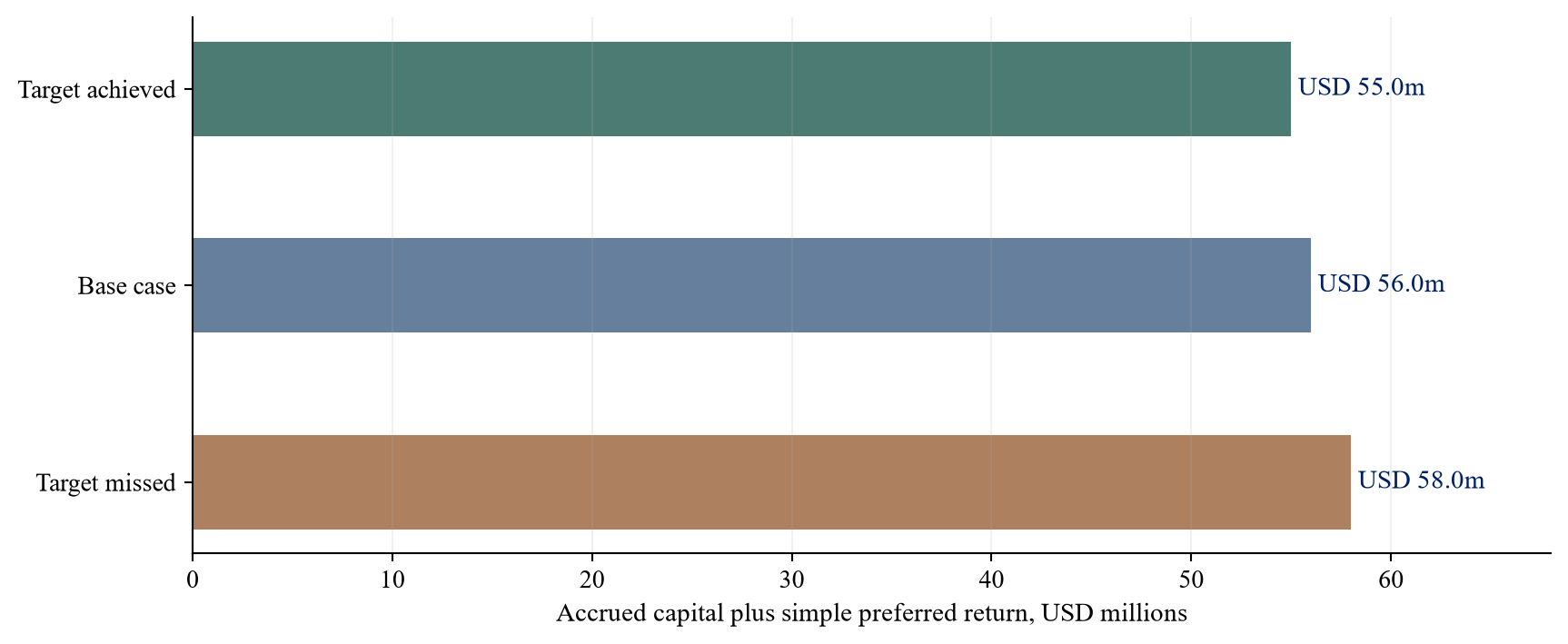
Author-selected USD 40m capital, simple annual accrual, five-year horizon; success 7.5%, base 8%, miss 9%. The amounts are not market benchmarks or projections.
11 Test the exit pool, cash schedule and cost of change
The exit waterfall is only one part of the decision. An operating company might need USD 12 million of hypothetical retrofit expenditure to reach the outcome target, while the illustrative return difference over five years is USD 3 million. Those numbers are selected to show scale; they do not show that the retrofit is uneconomic. It may save energy costs, meet customer requirements, preserve a licence, avoid future capex or create sale value. A board needs a full incremental cash-flow and strategic-risk analysis. The preferred ratchet is a transfer between capital providers, while physical investment can affect the enterprise's operating economics.
The model should vary at least four inputs: target outcome, exit proceeds, annual free cash flow and intervention cost. A company with low liquidity may be unable to pay a current dividend but can still build an accrued preference. A company with strong liquidity may pay dividends yet lack the budget to complete the capital works. A preferred investor might have a blocking right over new debt that would finance the works. These interactions should be addressed in the investment agreement and operating plan, not discovered after a target is missed.
Under the simple hypothetical waterfall, a USD 80 million exit pool leaves USD 22 million to USD 25 million for ordinary equity across the three outcome tests. A USD 50 million pool leaves no ordinary proceeds and caps the investor's realised proceeds at available cash. A USD 120 million pool leaves USD 62 million to USD 65 million for ordinary equity. The numbers expose a consequence: the ratchet reallocates a fixed amount only when there is enough value to meet the claim. It does not guarantee that a failure penalty can be collected.
Where the issuer holds multiple preferred series, senior debt, tax claims or employee options, the sequence must be expanded. A later financing might rank senior to the original preferred class. Conversion may become more valuable than preference at a high exit price. Anti-dilution or consent terms can change who approves the transition budget. The term sheet should attach a waterfall with each relevant security and a board-approved capex plan. The sustainability claim should be tested against the incentives created by the full stack.
Table 2. Hypothetical preferred payout sensitivity at year five
| Available equity proceeds | Target achieved, 7.5% claim 55 | Base, 8% claim 56 | Target missed, 9% claim 58 | Ordinary-equity implication |
|---|---|---|---|---|
| 50 | Preferred receives 50 | Preferred receives 50 | Preferred receives 50 | Ordinary receives 0 in all three cases |
| 80 | Preferred receives 55 | Preferred receives 56 | Preferred receives 58 | Ordinary receives 25, 24 or 22 |
| 120 | Preferred receives 55 | Preferred receives 56 | Preferred receives 58 | Ordinary receives 65, 64 or 62 |
USD millions; author assumptions only. Invested capital is 40, accrual is simple, there are no interim distributions, conversion or participation, and exit proceeds are after senior claims. Payout cannot exceed available proceeds.
12 Protect the issuer's ability to finance the transition
A target is credible only if the issuer can execute the operating plan. The preferred investor may protect its capital through consent rights over new debt, acquisitions, disposals, budgets and distributions. Those rights can also slow a necessary plant upgrade or prevent a bridging facility. A negotiator should map every planned transition expenditure to the corresponding approval right. The financing documents can permit a defined capex envelope, require a board-approved plan and specify when new senior financing needs consent. The investor's protection and the issuer's implementation capacity should be resolved in one negotiation.
Cash waterfalls deserve particular attention. A rate step-up can increase accrued preference while a lender restricts dividends. If the target failure also indicates weak operating performance, the company may have less cash to perform the remediation. The preferred holder's rights to accelerate redemption or block a sale can intensify distress. An outcome-linked feature should therefore be tested with lender covenants, mandatory reserves and contractual capex. Where a material miss occurs, a governance response such as an agreed remediation plan may preserve more value than an automatic cash payment.
The investment plan should specify which actions are under the issuer's control. A grid operator may delay renewable connection, a public authority may change a permit, or a supplier may fail to deliver low-carbon equipment. The target contract should separate performance risk that management can reasonably manage from events requiring a defined review. Any relief mechanism needs objective evidence and a bounded adjustment. An unbounded discretion to waive targets can hollow out the investment's claimed linkage; an inflexible target can impose a return change after an event unrelated to management conduct.
The implementation budget should be updated at each reporting date with committed spend, physical completion, expected operating effect and remaining contingency. An investment committee can then see whether the issuer is on a path to meet the target and whether additional capital is required. A late disclosure that the target is impossible can damage the relationship even if the contract specifies a clear ratchet. Early escalation preserves financing choices and gives the investor an opportunity to support a credible cure.
13 Document the boundary of a transaction
M&A can alter both preferred rights and sustainability measurement. A change of control might trigger conversion, redemption or consent under the security documents. It may also change the measured operating perimeter. The purchase price model should therefore include the value of the preferred preference, any outcome-related adjustment, the cost of a target reset and the likely assurance work. A buyer of shares inherits the issuer's contractual obligations; an asset buyer may face a different allocation. Legal advice must determine the position under the actual documents and law.
The data room should contain the executed charter and investment agreement, side letters, board consents, KPI protocol, baseline certificate, source records, assurance opinions, target reports, disputes, waivers and correspondence about recalculation. The buyer should reconcile public sustainability claims to those records. A target that appears achieved in a marketing report may use a different period or business perimeter from the preferred-share certificate. This discrepancy can affect both price and reputational risk.
An acquisition could be allowed to reset the target only under a specified formula. An approach is to preserve the original businesses' target, establish a separately assured baseline for the acquired operation, and then combine both through a weighted method. The weights and calculation should be written before results are known. Alternatively the parties can choose an interim freeze with an expert determination. These are possible drafting approaches, not universal market practices. The governing principle is to avoid rewarding or penalising an ordinary strategic transaction through a silent change in denominator.
Sellers should address survival and evidence access. A post-closing verifier may need facility records that the seller controlled before the deal. A waiver of the financial adjustment should be documented with the same formality as the original rights. A buyer's debt financing may rely on a projected preferred repayment; uncertain ratchet treatment can affect leverage and distributions. The transaction timetable should therefore include the outcome certificate and preferred-share payoff calculation as separate closing deliverables.
14 Check accounting, tax and regulatory consequences early
A return formula can be economically clear and still produce an accounting or legal result different from the parties' expectations. IAS 32 focuses on contractual substance in classifying a financial instrument as liability or equity [11]. A mandatory cash redemption, contingent settlement obligation or dividend requirement can alter presentation. The outcome-linked feature may also require analysis as a component of a broader instrument under applicable financial-reporting rules. This paper does not determine the answer for any issuer. Specialist analysis belongs at term-sheet stage, when rights can still be changed.
Corporate law matters to dividend and redemption mechanics. Delaware law addresses the creation of stock classes and specified preferences [10]. UK company law has detailed provisions for class rights and redeemable shares [12,13], alongside broader capital-maintenance rules. A structure that depends on paying cash after a KPI failure should be examined against the issuer's legal ability to make that payment. The documents should also specify what accrues if cash cannot be paid and whether any unpaid amount ranks ahead of later financing. A stated step-up with no enforceable payout path can mislead both parties.
Tax analysis can change the net economics for issuer and investor. The treatment of distributions, redemption proceeds, withholding, cross-border ownership and any performance-linked premium depends on the parties and jurisdiction. No general tax result is asserted here. The investment memorandum should request a tax opinion or advice where the proposed terms make tax treatment material. The financial model should show pre-tax contractual cash separately from any tax-adjusted return, with assumptions and adviser conclusions documented.
Regulation and marketing need a similar jurisdiction map. A fund placing the security may have disclosure duties; a UK-authorised firm making sustainability claims should consider the FCA's guidance [15]; an issuer applying IFRS S1 or S2 has defined disclosure requirements [5,6]. Other markets have their own rules. An investment should not be described as compliant with a standard merely because its term sheet borrows terminology from that standard. The claim must match the instrument, issuer and applicable reporting perimeter.
15 Use a decision matrix for term-sheet approval
The investment committee can reduce ambiguity with a one-page approval matrix. For each proposed outcome, it records the business reason, baseline source, target, comparator, budget, operational owner, measurement boundary, assurance scope, financial consequence, maximum transfer and unresolved diligence. The matrix should identify the source of each factual assertion. Management estimates must be marked as such and placed beside the evidence needed for confirmation. A blank assurance field should block final pricing of a supposedly measured result.
The economics column should show expected contractual payments as scenarios, without pretending to know probabilities that have not been estimated from evidence. It should state whether the investor's return increases after failure, whether the extra amount is paid in cash or accrues, who ultimately bears it and whether a cap applies. It should also show the cost of the physical measures required to improve the outcome. If management lacks the budget or authority to act, a strong-looking KPI covenant may have little operational effect.
The governance column should identify which decisions the investor can consent to, when a waiver is permitted and how conflicts are handled. An investor representative could have influence over capital expenditure and later benefit from a missed outcome through a higher preference. The transaction should expose that potential conflict and allocate decision rights transparently. Minutes should record the commercial rationale for the chosen design and any alternative considered, particularly where the return adjustment is asymmetric.
A final approval should be conditional on executable documents and baseline evidence. Counsel should confirm the constitutional mechanics; accountants should address classification; the assurance provider should confirm scope and data access; finance should reconcile the waterfall; operations should accept the costed plan. If those workstreams disagree, the board should resolve the conflict before issuance. A label on the cover page cannot cure an instrument whose metric, rights or financial effect remains indeterminate.
16 Sequence the work before and after closing
The first stage is diagnosis. The issuer and investor identify the operating outcome that matters to the business, the capital required to improve it and the existing data series. They map the intended financing against other debt and equity. The technical team checks whether the proposed outcome can be measured and influenced. A preliminary legal and accounting review identifies features that might prevent the proposed preferred-right structure. This stage should end with a decision on whether an outcome-linked term belongs in the instrument at all.
The second stage is specification. The parties agree a baseline, perimeter, target, observation dates and financial formula. The operating plan records responsible managers, expenditure, milestones and evidence. Counsel drafts the preferred-right provisions and an outcome protocol with an order of precedence for inconsistent documents. The verifier reviews access and methodology before final sign-off. The parties should not defer the essential measurement definition to a later side letter, since the return mechanism cannot be priced without it.
The third stage is execution. The company issues the shares under valid authority, funds the agreed work and maintains a data register. Finance reports accrued preference and potential ratchet exposure; operations reports physical progress and source-data quality. The board sees both on a common timetable. If an acquisition or major method change occurs, the recalculation procedure starts promptly. An investor waiver, if granted, is recorded with its commercial rationale and required approvals.
The final stage is observation and settlement. The independent reviewer tests the data, the agreed decision-maker issues the certificate, and finance applies the resulting share term. An expert-determination path handles a narrow unresolved dispute. At sale, redemption or conversion, the paying agent follows the verified waterfall. The audit trail should allow a later buyer, lender or regulator to reconstruct the target test. A post-transaction review can examine whether the financing actually supported the operating improvement claimed in the original investment thesis.
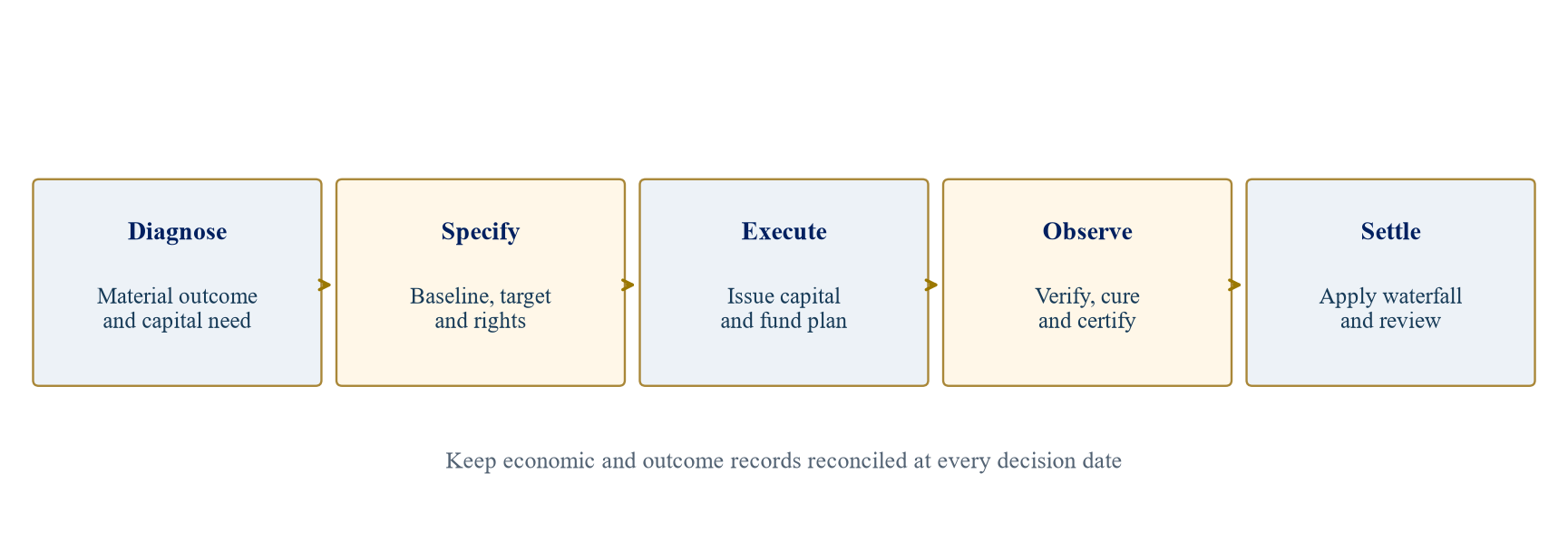
Author-developed transaction roadmap; required approvals, disclosure and assurance depend on issuer, investor and jurisdiction.
17 Stress the claim before making it public
The issuer should run a claims audit before announcing an outcome-linked financing. First, is the target genuinely attached to the share right, or is it only an informal intention? Second, does the chosen KPI capture a material part of the business and transition plan? Third, has the baseline been independently checked or labelled provisional? Fourth, will the data method let an external reviewer reproduce the observation? Fifth, are the financial consequences clear enough to calculate under success, failure and missing-data states? The answers should be documented, rather than summarized by a colour or score.
The audit should also check whether public materials imply a use-of-proceeds restriction. Sustainability-linked instruments can tie financing terms to issuer outcomes even when proceeds fund general corporate purposes. The ICMA principles make that distinction for sustainability-linked bonds [1]. A preferred share may or may not include a separate restricted-use covenant. If no such restriction exists, marketing should not suggest that each unit of capital directly paid for a specified physical improvement. The reader should see whether the instrument finances general operations, a defined project or a broader transition budget.
Claims about expected investor returns require similar discipline. The illustrative USD 55 million to USD 58 million accrued claims in this paper are not investor proceeds unless sufficient value and legally available cash exist at settlement. If an issuer presents an 8% preferred return, the investor should ask how accrual, priority, conversion and unpaid amounts work. If the target is missed, a higher contractual claim may coincide with a lower exit pool. The company should show the actual stress waterfall in investor communications.
A public statement can remain concise while retaining qualifications. It can name the outcome, target date, reporting boundary, verification status and financial feature without releasing confidential plant data. Any assertion of regulatory compliance should be tied to the specific rule and entity. Investor diligence and marketing review should compare the same underlying records. This practice reduces the risk that the transaction is described more confidently than its evidence supports.
18 Set an ongoing review and correction mechanism
An annual review can lose relevance if it only confirms last year's number. The issuer should maintain an event register of operational changes, asset purchases or sales, data-system changes, new regulations and material financing. Each event should be tested for its effect on the KPI boundary, costed plan, cash availability and preferred-right calculation. A named owner should issue a short decision note and, where required, invite the verifier or expert to confirm the treatment. This creates a reproducible record before the outcome test is contested.
Corrections should be governed by pre-agreed thresholds. A minor metering adjustment might flow into the next report; a material error in the baseline may require restatement and target recalibration. The documents should say who decides materiality, whether an already issued certificate can be reopened and how an overpayment or underpayment is addressed. They should also identify the finality point after which investors can rely on the certificate for a sale or distribution. Without a finality rule, every exit model carries unresolved sustainability-contingent value.
Governance must remain proportionate. A small issuer may not need a standing specialist committee, but it needs an accountable operations lead, finance owner, legal contact and independent reviewer. The board should receive an integrated schedule showing target progress, capital spend, assurance issues and current preference amount. If the financial feature is capped, the report should show remaining exposure. If a target becomes impossible because a permitted method changes, the agreed expert process should propose a replacement preserving the intended ambition, subject to investor approval.
At the end of the investment, parties should review both ledgers. Did the company achieve the independently verified operating outcome? Did the preferred investment finance actions that contributed to it? Did the financial adjustment work as the parties intended under stress and at exit? Those questions require actual records and cannot be answered from an index score. A candid review may improve the next financing even when the target was missed.
Table 3. Investment-committee approval and monitoring record
| Workstream | Approval evidence | Post-closing trigger | Decision owner |
|---|---|---|---|
| Outcome selection | Materiality rationale, baseline data, method | Business model or boundary change | Operations and board |
| Capital economics | Share rights, waterfall, stress model | New capital, weak liquidity or exit | Finance and investor |
| Transition plan | Costed action plan and milestone owners | Budget or delivery slippage | Operating executive |
| Measurement | Source records, verifier scope, correction rules | Data error, acquisition or method revision | Data owner and verifier |
| Legal and accounting | Executed documents and specialist advice | Amendment, conversion or redemption | Counsel and accounting lead |
| Public claim | Approved wording and evidence map | New report or investor communication | Legal and communications |
Author-developed checklist; the fields show decisions to be populated with issuer-specific verified data, not findings about a current transaction.
19 Make the mandate executable
A transaction team can start with a defined diligence package rather than an abstract request for an ESG strategy. It needs the current capitalisation table, charter, draft preferred term sheet, five-year cash forecast, existing debt covenants, current sustainability disclosures, three years of relevant operating records where available, asset register and capital plan. The team can then prepare two schedules: one for contractual payouts and one for outcome measurement. Missing evidence is assigned to an owner and date. Any management estimate is kept separate from independently checked data.
The first deliverable is a decision memorandum. It identifies the actual financing need, measures the selected outcome's relevance, tests baseline quality and compares candidate financial features under multiple exit and operating cases. It should recommend whether to proceed with an outcome-linked preference, use a conventional preferred instrument with a separate governance covenant, or defer linkage until measurement is credible. These are decision alternatives; the memorandum should explain the value and limits of each for the issuer and investor.
The second deliverable is executable documentation. Counsel writes the class rights and investment agreement; operations and the verifier write the measurement protocol; finance attaches a reproducible waterfall and budgets the transition plan. The documents name the observation dates, rights affected, cap, cure, waiver authority and dispute mechanism. They also specify whether a claim is public or confidential. A test calculation using fictional data can expose drafting ambiguity before signing without presenting the fictional data as the company's expected performance.
The third deliverable is a post-closing control. The board receives a reconciled report on capital deployed, progress, evidence quality and potential payout. A change in ownership, measurement method or debt structure prompts a retest. At exit, the verified certificate feeds the waterfall. That sequence allows the financing to be priced, governed and settled as a real security rather than as a sustainability slogan. It also gives a buyer or subsequent lender a tractable diligence file.
20 State the boundary of the research
This paper synthesises selected published principles and rules into an investment framework. The Sustainability-Linked Bond Principles govern a voluntary bond-market process and are used here as an analogy, not as a formal certification of preferred equity [1]. IFRS S1 and S2 apply where adopted and relevant to the reporting entity [5,6]. GHG Protocol methods require defined organisational and operational boundaries [7,8]. Delaware and UK company-law examples are jurisdiction-specific [10,12,13]. No universal instrument treatment or assurance result is asserted.
The USD 40 million investment, five-year holding period, 7.5%, 8% and 9% simple accrual rates, USD 50 million to USD 120 million exit pools and illustrative USD 12 million retrofit are hypothetical author assumptions. They are not observed transactions, recommended rates, security values, market benchmarks, probability estimates or an expected investment return. The simplified model excludes interim payments, taxes, inflation, debt interactions, conversion, participation, legal limits on distributions and the time value of realised cash. A real transaction needs verified issuer data and professional analysis.
The central decision is whether an outcome condition improves the financing bargain and the financed operation under testable terms. A material, measurable target with a documented baseline and independent evidence can be joined to a clearly modelled preferred right. A vague target, ambiguous financial consequence or unfinanceable capex plan cannot be repaired by adding more sustainability terminology. Investment approval should depend on the quality of both ledgers and the operating choices they create.
For a live mandate, the next step is a bounded diligence review of current share rights, debt, cash flow, operating data and the proposed transition project. The team can then decide whether to issue an outcome-linked preference, restructure the incentive or retain a conventional security with separate reporting. That decision should be dated, sourced and revisited when the issuer's business or measurement perimeter changes.
References
- International Capital Market Association. Sustainability-Linked Bond Principles: Voluntary Process Guidelines. June 2024. Accessed 6 October 2026. https://www.icmagroup.org/assets/documents/Sustainable-finance/2024-updates/Sustainability-Linked-Bond-Principles-June-2024.pdf
- World Bank. Setting Robust Indicators for Sustainability-Linked Finance. 2023. Accessed 6 October 2026. https://documents1.worldbank.org/curated/en/099438410202318972/pdf/IDU0fa2292fc0b6df046af086620791bb4e9073e.pdf
- International Finance Corporation. Sustainable Buildings Finance Reference Guide. 2025. Accessed 6 October 2026. https://www.ifc.org/content/dam/ifc/doc/2025/sustainable-buildings-finance-reference-guide.pdf
- International Capital Market Association. Sustainability-Linked Bond Principles and related KPI Registry. Accessed 6 October 2026. https://www.icmagroup.org/sustainable-finance/the-principles-guidelines-and-handbooks/sustainability-linked-bond-principles-slbp/
- IFRS Foundation. IFRS S1 General Requirements for Disclosure of Sustainability-related Financial Information. Accessed 6 October 2026. https://www.ifrs.org/issued-standards/ifrs-sustainability-standards-navigator/ifrs-s1-general-requirements/
- IFRS Foundation. IFRS S2 Climate-related Disclosures. Accessed 6 October 2026. https://www.ifrs.org/issued-standards/ifrs-sustainability-standards-navigator/ifrs-s2-climate-related-disclosures/
- Greenhouse Gas Protocol. Scope 2 Guidance. Accessed 6 October 2026. https://ghgprotocol.org/scope-2-guidance
- Greenhouse Gas Protocol. Corporate Value Chain (Scope 3) Standard. Accessed 6 October 2026. https://ghgprotocol.org/corporate-value-chain-scope-3-standard
- International Finance Corporation. Operating Principles for Impact Management. 2019. Accessed 6 October 2026. https://www.ifc.org/content/dam/ifc/doclink/2019/operating-principles-for-impact-management.pdf
- Delaware General Corporation Law. Title 8, section 151, classes and series of stock. Accessed 6 October 2026. https://delcode.delaware.gov/title8/c001/sc05/
- IFRS Foundation. IAS 32 Financial Instruments: Presentation. Accessed 6 October 2026. https://www.ifrs.org/issued-standards/list-of-standards/ias-32-financial-instruments-presentation/
- UK Companies Act 2006. Part 17, Chapter 9, variation of class rights. Accessed 6 October 2026. https://www.legislation.gov.uk/ukpga/2006/46/part/17/chapter/9
- UK Companies Act 2006. Part 18, acquisition by limited company of its own shares. Accessed 6 October 2026. https://www.legislation.gov.uk/ukpga/2006/46/part/18
- International Auditing and Assurance Standards Board. ISSA 5000 Adoption and Implementation. Accessed 6 October 2026. https://www.iaasb.org/consultations-projects/issa-5000-adoption-and-implementation
- UK Financial Conduct Authority. FG24/3: Finalised non-handbook guidance on the anti-greenwashing rule. Accessed 6 October 2026. https://www.fca.org.uk/publications/finalised-guidance/fg24-3-finalised-non-handbook-guidance-anti-greenwashing-rule
About the Author
Chennakeshav (CK) is a corporate finance and investment banking executive with 25+ years of global experience in deal origination, structuring and execution across M&A, growth capital and corporate strategy. He has led value-creation mandates for founders, corporates and funds — bridging the boardroom view to hands-on execution and close.
His career spans Morgan Stanley, HSBC, Lloyds Banking Group, EWEC, ADQ portfolio companies and Emirates Growth Fund, across TMT, real estate, fintech, deeptech, cleantech, infrastructure and energy. He has partnered with C-suite leaders, private equity and venture funds, sovereign wealth funds and family offices to finance complex fund raises and scale-up ventures, and has led M&A due diligence, post-merger integration and business-transformation initiatives to create value.
At Matchpoint Partners he is Managing Partner, leading the firm's corporate finance, M&A and capital-raising practice. He holds an MBA from London Business School, an engineering degree from VTU and a Master of Laws (LLM, in progress) from UCL London.
An active start-up mentor, CK mentors at Techstars, DIFC FinTech Hive, Startup Grind, Founder Institute and IN5, serves as Entrepreneur Mentor in Residence (EMiR) at London Business School, and judges the Entrepreneurship World Cup.
