

1 Define the evidence and price decision
The investment decision is a dated commitment to acquire rights and fund a development through its permitted completion and exit. A buyer needs the rights being purchased, the obligations assumed and the money available at each payment date to be explicit. Title records, planning approvals, construction contracts and bank-account arrangements can change those inputs. Their significance depends on the transaction. A missing permission can suspend a proposed acquisition even when a spreadsheet shows a positive return. A corrected cost estimate can reduce the amount available for the acquisition payment. An account restriction can require additional sponsor funding without changing the projected sales receipts.
This paper asks which evidence changes those decisions under an explicitly defined project model. It develops a practical assessment for an international investor considering development in the Gulf. Dubai, Abu Dhabi and Saudi official sources illustrate distinct documentary routes. Their geographic coverage is limited to the authorities and processes identified. No statement establishes a common GCC property, escrow or enforcement regime. The paper has no confidential project files and no dataset of investment committee decisions. Numerical examples are fictional calculations designed to make the proposed method reproducible.
The decision record should state a conditional maximum acquisition payment, a separately dated funding schedule and conditions that must be satisfied before signing or drawing money. That separation gives each finding an identifiable consequence. A valuation adjustment changes the price calculation. A contractual payment restriction changes the cash schedule. An unresolved ownership or development-right question goes to qualified counsel and can stop the decision pending confirmation. Combining them in a single unexplained risk score would leave the investor unable to identify the basis of the recommendation.
The intended outcome is a reasoned choice to proceed on specified terms, request evidence, restructure the proposed funding or suspend the transaction. The framework supports that choice through documented inputs and explicit limitations. It gives no assurance that the seller can transfer the rights, the bank will lend or the project will perform as modelled.
2 Establish the scope of the research
The research is a structural and analytical study. It combines primary professional valuation materials with official property-administration sources and two deterministic numerical examples. The first example calculates a price ceiling using discounted development cash flows. The second tests the availability of construction funding in quarterly periods. Neither example is calibrated to observed Gulf transactions. The discount rate, receipts, costs, delays, account restrictions and loan availability are assumptions selected by the author. They represent no quoted market terms or measured probabilities.
RICS development-property guidance provides a basis for sensitivity testing and reviewing current completion costs and remaining development risks [1]. The comparable-evidence standard supports scrutiny of headline transaction information and underlying property terms [2]. These sources establish professional review context. They contain no numerical discount that can be assigned automatically to a missing document in this paper. The official administrative sources identify routes for obtaining or checking evidence; using those routes still requires the actual property and authorised access to its records.
The proposed contribution is an organised connection between a finding, the cash-flow input it changes and the authority required to act. This is a research method and transaction checklist. Prior guidance already addresses development valuation, due diligence and project controls. The paper makes no claim that its subject has never been researched, that the framework predicts investor behaviour or that a calculated difference is an observed market premium. Its examples can be replicated without accepting an empirical conclusion.
For a real engagement, the scope should distinguish records reviewed from records requested, outstanding legal opinions and engineering work still required. The investor should know whether a document was checked against an issuing authority, supplied by a counterparty or extracted from a secondary summary. A source list alone provides insufficient project-level evidence. Each material assertion needs a date, document identifier, responsible reviewer and consequence for the proposed transaction. The absence of those items remains visible in the assessment rather than being filled with an invented assumption about the actual asset.
3 Specify the rights and entities being acquired
A development proposal needs an explicit asset and entity perimeter. The proposed consideration may purchase land, a leasehold development right, shares in an asset-owning company or an interest in a joint venture. Those arrangements create different evidence requests. An investor should identify the legal holder of the rights, the plot or unit identifiers, the seller's authority and the approvals needed for the intended transaction. The purchase perimeter should also identify existing debt, shareholder claims and related-party obligations where they are relevant to the rights or entity being acquired.
Dubai Land Department provides a property-status enquiry route with identifiers and restraint-related information [3]. The existence of that interface does not establish that a particular property has been checked. This study searched no private title and verified no seller's ownership. In an actual review, the authoritative record and the transaction documents should be matched to the same identifiers. A discrepancy in plot number, area, tenure, registered holder or restriction should be resolved with the appropriate authority and counsel before a conclusion is assigned.
The model should use only the development capacity supported by the verified rights and applicable approvals. A sales forecast based on an additional tower or use category needs the corresponding permission evidence. The proposed review records the incremental cash flows separately until the necessary rights are confirmed. An investment committee can then evaluate a transaction conditional on approval, a permitted-use case or a hold. Recording the unresolved case separately avoids presenting an unapproved scheme as the current legal development opportunity.
Entity review also needs to establish who receives sale proceeds and who owes construction payments. A company owning land can have a different cash position from the sponsor that supports the project. A forecast of group resources requires evidence that transfers are available and permitted. The proposed acquisition payment and subsequent support commitment should therefore be assigned to named transaction entities. Any conclusion about authority, security priority, ownership eligibility or enforceability requires the relevant jurisdiction-specific professional review.
4 Trace planning and permission dependencies
A permit review should connect the proposed physical scheme to the permissions required at each stage. The assessment needs a sequence of application, approval, mobilisation, construction, inspection and completion events. An investor should identify the issuing authority, scope, conditions, validity and evidence of satisfaction for each relevant approval. A drawing or application receipt supplies different information from an issued permission. The status should remain precise so that a modelled construction start does not silently assume a missing consent.
ADREC's developer journey describes project registration, an approved-bank escrow agreement, DMT building permits and engineering progress documentation [7]. These are Abu Dhabi workflow references. They identify useful evidence routes and do not establish that a particular project is registered, permitted or at a stated completion percentage. The paper applies the same analytical discipline to other jurisdictions while requiring their actual applicable records and advice. It transfers the review question, with no transfer of Abu Dhabi legal requirements to another location.
For modelling, a permission finding can change the earliest construction payment, the terminal sale date, holding expenditure or the permitted saleable quantity. Each affected input should have an identified reason. A six-month delay in the fictional model below postpones both the twelve construction instalments and final receipt. It also adds a selected monthly carrying cost. Those relationships are invented scenario rules. An actual project could incur substantial costs during suspension, preserve some sale dates or face an entirely different permission outcome.
The proposed committee record should distinguish a date supported by evidence from a date adopted for sensitivity testing. If the authority has supplied no reliable decision date, the analyst should avoid calling the assumed delay a forecast. Conditional closing, a long-stop date or a staged commitment can be evaluated as transaction options subject to negotiated terms. The investment decision should retain the consequences of non-approval, expiry and a requirement to redesign. Their legal or contractual operation must be verified before they become an asserted protection in the transaction.
5 Reconcile the remaining construction obligation
The construction review needs the current scope of work and the amount required to complete it. A quoted contract price can omit variations, exclusions, unpaid certified work, retention, interface obligations or replacement expenditure. The investor should ask the cost adviser to identify what has been paid, what has been earned, what remains to be certified and what is still forecast. The evidence should connect those amounts to the same technical scope and completion programme used in the investment case.
RICS identifies current completion cost and remaining risks as relevant to valuation of development in progress [1]. The proposed method extends that review into a dated cost ledger. An engineering or quantity-surveyor report should be linked to its inspection date, measurements and assumptions. A report covering an earlier scope needs reconciliation to subsequent design changes and claims. The analyst should record which amounts are supported by executed documents, which are professional estimates and which are unresolved. This classification supplies a clear basis for selecting a downside case.
A contractor's financial position and contractual responsibilities require their own evidence. The file should identify the contracting entity, parent or third-party support, insurance, bonds, expiry dates and conditions for recourse. A marketing claim about group strength supplies no verified support commitment. Replacement cost should consider what happens to design information, partially completed work, warranties and subcontractor arrangements. Those questions call for technical and legal review before any claimed recovery or uninterrupted completion date is incorporated.
The hypothetical cost increases used below represent selected additional expenditures. They are neither industry averages nor probability-weighted outcomes. An investor applying the method should revise the amounts using an authorised cost report, dated tender evidence and the actual risk allocation. Where a claim is already known, the proposed ledger assigns it once to the relevant cost or contingent exposure. Separate recording of disputed claims, forecast variation and replacement contingency allows a reviewer to detect overlap and challenge the cash requirement before it affects the acquisition ceiling.
6 Distinguish contracted receipts from permitted cash
The receipt review should identify the customer obligation, payment date, collection evidence and account into which money is paid. A sales reservation, signed sale agreement, booked receivable, bank deposit and permitted construction release are separate records. The model needs the cash that can fund a particular payment at its due date. A gross contract value provides useful commercial context while the construction funding schedule needs the applicable receipt and release conditions.
Dubai Law No. 8 of 2007 addresses project escrow within its specified off-plan scope, including separate project accounts and deposit of secured project-financing proceeds [5]. DLD's FAQ explains payment review under trustee arrangements and engineering verification [4]. The proposed analysis requests the actual account agreement, statements, release conditions and authorisation process. A statutory framework or service description does not prove a particular account's balance or a requested transfer's availability. The paper derives no conclusion about access to a private project's restricted money.
The investor should map each projected buyer payment to a dated route through the relevant account. The cash schedule records collection, restriction and authorised release separately. If the release depends on certified progress or another condition, the corresponding evidence needs a date and reviewer. A delay in that evidence can shift the available receipt beyond a contractor payment. A condition that is never satisfied requires a different scenario from an administrative delay. Those outcomes should be tested distinctly without assigning an unsupported probability.
Account control also affects how funding instruments are described. An undrawn commitment can require additional conditions before a lender advances money. A sponsor support letter can have a limit, expiry or obligation weaker than assumed by the model. The fictional liquidity example later credits only advances explicitly assumed to be eligible and buyer cash explicitly assumed to be permitted. Actual transaction models require confirmation of those inputs. A restricted account balance remains excluded from unrestricted funding until the particular proposed use and release have been verified.
7 Build the evidence register around the decision
The proposed evidence register assigns each material finding to a right, input, payment or decision condition. Its minimum useful record is the assertion under review, the source document, date, authority or counterparty, reviewer and consequence. The consequence can be a revised cash amount, a changed milestone date, an outstanding professional opinion or a condition that prevents approval pending resolution. The register should distinguish an identified problem from an unanswered question. Missing information supplies no direct measurement of the underlying loss.
Table 1. Proposed evidence review for a cross-border development commitment
| Review area | Evidence to reconcile | Decision or model consequence |
|---|---|---|
| Ownership and authority | Current title identity rights restrictions and signing powers | Confirm acquisition perimeter or hold pending advice |
| Permitted scheme | Issued approvals plans conditions and expiry | Adjust permitted capacity and milestone dates |
| Remaining construction | Dated cost report earned payments variations and scope | Update completion cost and payment timing |
| Contractor obligations | Executed contract securities expiry and replacement terms | Assess funded completion and professional-review conditions |
| Buyer receipts | Registered agreements payment ledger and matched deposits | Date collected receipts and outstanding obligations |
| Escrow permissions | Account agreement statements release rules and approvals | Include only cash permitted for the proposed payment |
| Loan availability | Executed terms draw conditions security and settlement | Date eligible advances and discharge obligations |
| Sponsor support | Executable amount timing expiry and payer capacity | Test separately funded gaps and unmet conditions |
Author-proposed checklist. Official evidence routes are identified in references 3 to 11. No project record, permission, account balance or recovery has been verified in this study.
The committee should use the register to identify which findings require a pricing revision and which require a hold. An unresolved transfer-right issue should receive a legal decision route. An evidenced increase in remaining construction cost should change the cost schedule. Treating both as an arbitrary percentage adjustment would obscure the different actions needed. The proposed classification remains a decision method; it creates no universal order of importance across projects.
A version history connects every revised input to the evidence that prompted it. The buyer can then compare a seller's forecast, the initial investment case and the reviewed case without losing the reasons for change. An open-item list should identify what additional evidence would permit reconsideration. A closing condition should specify the document and approval required, with its operation checked in the transaction terms. This makes the recommendation auditable and leaves unresolved matters visible to the person authorised to commit capital.
8 Calculate a conditional acquisition ceiling
The fictional valuation example considers an acquisition followed by construction and a final development receipt. All amounts are monetary units with no asserted currency or market calibration. The annual effective discount rate is twelve percent. Construction costs of seventy are paid in twelve equal monthly instalments at the end of months one through twelve. Gross receipts of 120 arrive at the end of month twenty-four. Date-zero transaction costs are three. The investor additionally requires eight of present-value surplus after the acquisition payment. Taxes, debt financing costs, interim operating income and other expenditures are omitted.
For any payment at month m, the model divides its amount by 1.12 raised to m divided by twelve. The maximum acquisition payment is the discounted terminal receipt less discounted construction payments, any modelled carrying payments, date-zero transaction costs and the required surplus. It is a conditional analytical ceiling under the inputs. The calculation does not establish a formal market valuation or an executable bid. An actual valuation needs the appropriate basis, market evidence, scope and professional opinion [1, 2].
In the baseline, the present value of receipts is 95.663265 and the present value of construction is 65.867177. Subtracting transaction costs of three and the selected surplus of eight leaves 18.796089 for a date-zero acquisition payment. The zero-price case would leave a present-value surplus of 26.796089 after the other stated costs. Setting the acquisition payment to the calculated ceiling leaves exactly the required surplus of eight before omitted items. These identities permit independent reproduction of the calculation.
The model deliberately keeps financing separate. Its twelve-percent rate is a selected unlevered discount assumption. No lender commitment or debt interest is credited or charged in the price formula. A proposed loan changes the subsequent financing assessment and can add costs that reduce the amount affordable in a complete transaction model. The committee should therefore treat the ceiling as a conditional input to negotiations and subject it to additional evidenced taxes, obligations and financing terms before approving an actual acquisition.
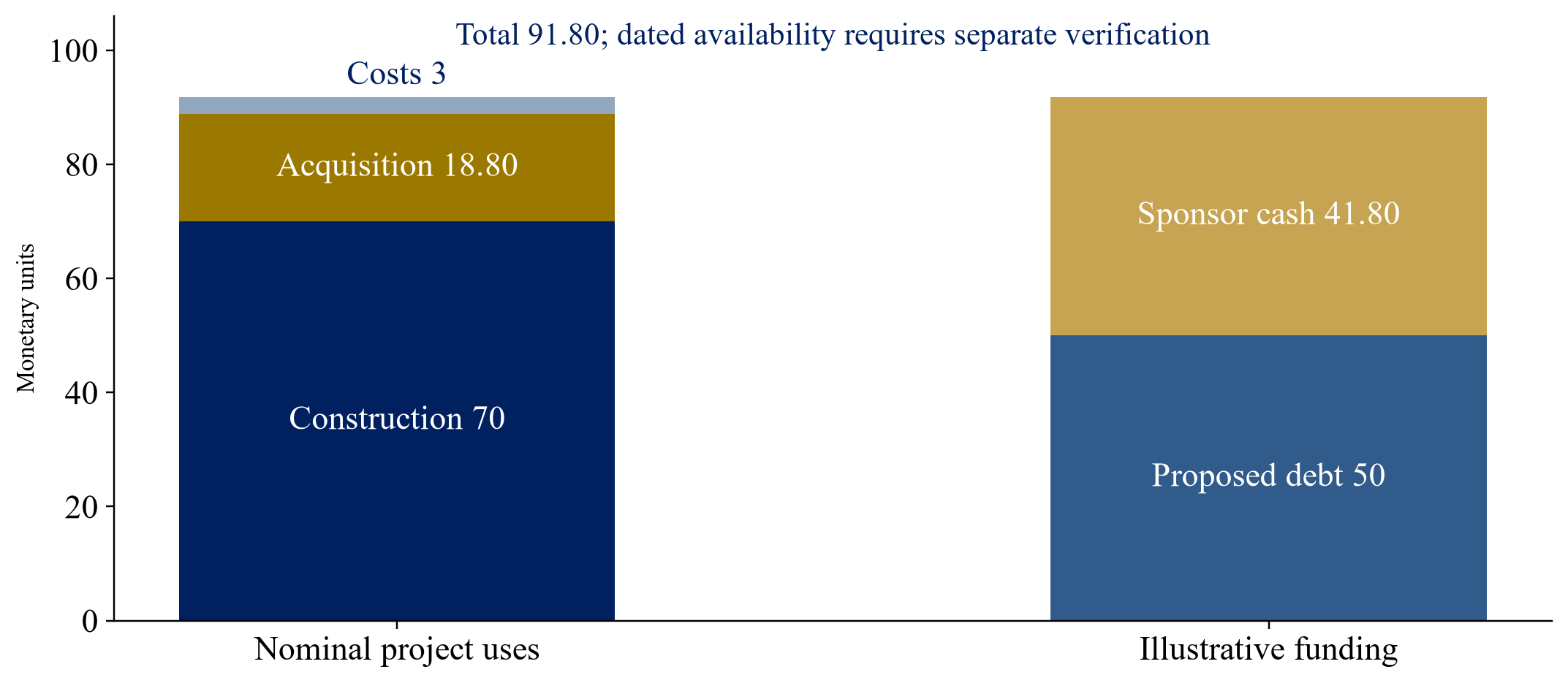
Nominal monetary units. Uses are construction 70 acquisition payment 18.796089 and transaction costs 3. A proposed debt amount 50 leaves sponsor cash 41.796089. Financing costs are excluded. This static allocation establishes no timing sufficiency draw approval or market valuation; the separate dated funding test remains necessary.
9 Translate delay and completion cost into price
The sensitivity model changes two assumptions at a time. A delay d moves each of the twelve construction instalments later by d months and moves the terminal receipt to month twenty-four plus d. The delay also incurs one unit of carrying expenditure at the end of each month from one through d. A cost increase c multiplies the construction total of seventy by one plus c. The discount rate, gross receipt, transaction costs and required surplus remain unchanged. The delay and cost selections carry no observed frequency or forecast probability.
Table 2. Fictional acquisition price ceiling under cost and delay changes
| Delay months | Cost 0 percent | Cost 10 percent | Cost 20 percent | Cost 30 percent |
|---|---|---|---|---|
| 0 | 18.80 | 12.21 | 5.62 | -0.96 |
| 3 | 15.02 | 8.62 | 2.21 | -4.19 |
| 6 | 11.35 | 5.13 | -1.10 | -7.32 |
| 9 | 7.78 | 1.73 | -4.32 | -10.37 |
Monetary units rounded to two decimals. Delay postpones construction and terminal receipt and adds one unit of monthly carrying cost during the delay. Construction has twelve equal instalments. Rate 12 percent annual effective fees 3 and required present-value surplus 8. A negative ceiling means the selected case cannot support a positive acquisition payment at these terms.
The baseline ceiling of 18.796089 falls to 11.348986 with a six-month delay and unchanged construction cost. A twenty-percent cost increase with no delay produces 5.622653. Combining both selections yields minus 1.098741. The combined result uses the delayed payment dates for the higher construction costs, so independently calculated changes should not simply be added. The comparison shows how different evidence can change affordability in this model. It does not rank title, permit or contractor findings universally and supplies no empirical pricing discount.
A negative ceiling is a signal to reconsider the specified economics. Potential revisions include a supported change in receipts, reduced completion expenditure, a different timing arrangement or a negotiated allocation of obligations. The model identifies none of those revisions as available in the actual market. A purported remedy needs its own evidence and professional review. A missing legal right can also require a hold independently of every cell in the table. A positive value supplies no substitute for that verification.
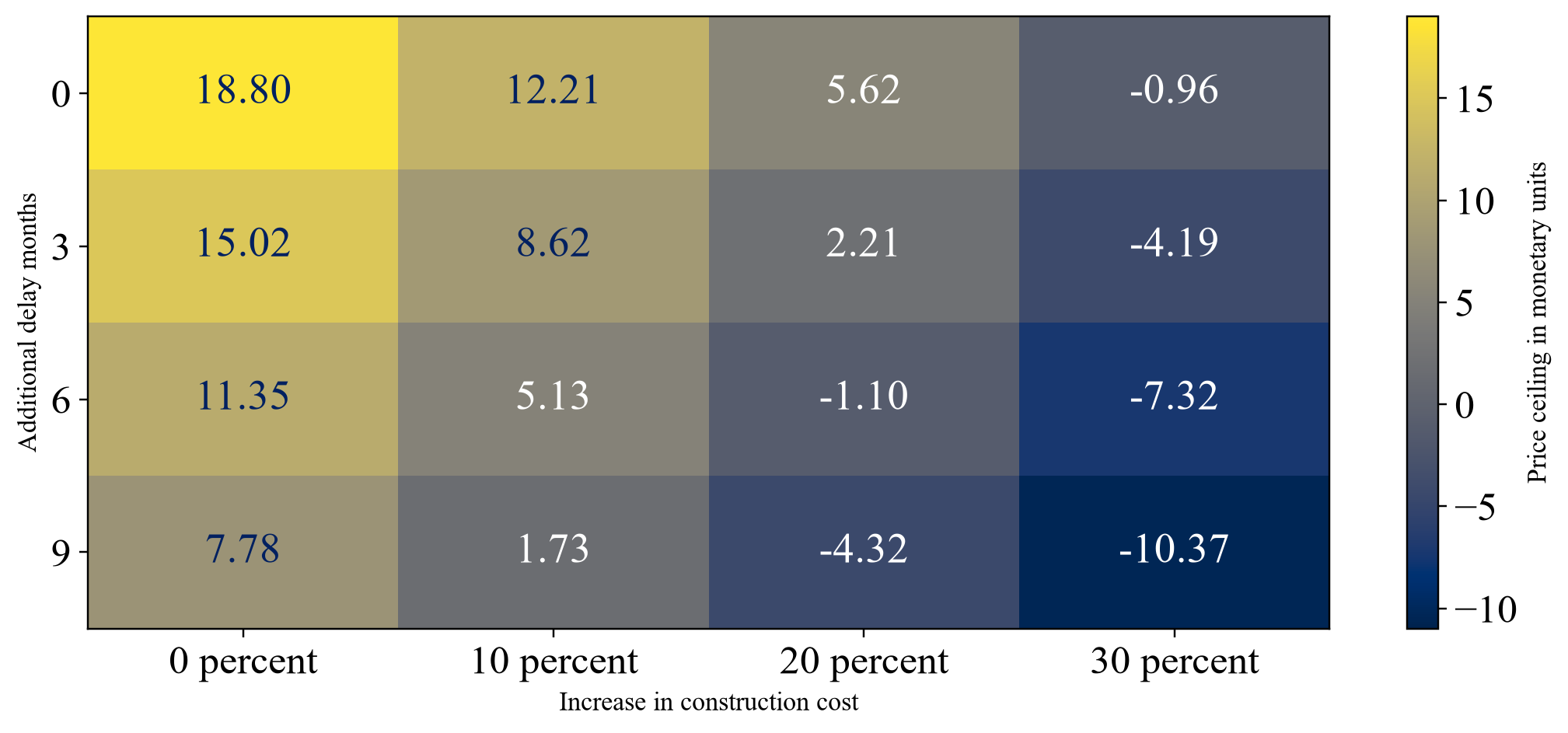
Same inputs as Table 2. The display is a deterministic sensitivity grid with no probabilities or market calibration. Values are monetary units. Negative cells indicate a failure to retain the selected surplus with a positive acquisition payment.
10 Test available funding on its own dates
The separate liquidity example uses four quarters and nominal construction payments of twelve, eighteen, twenty and twenty. Initial unrestricted cash is five. Eligible bank advances are assumed to be ten in each quarter. Permitted buyer releases are zero, ten, twenty and twenty in the baseline. These values are fictional and use a different cash perimeter from the monthly valuation example. They establish no relationship to its terminal receipt, acquisition payment or discount rate. The examples answer separate questions and their differences should not be summed.
The unfunded cumulative balance starts with five and adds each period's eligible advances and permitted releases before subtracting construction payments. Baseline quarter-end balances are three, five, fifteen and twenty-five. Delaying buyer releases to zero, zero, ten and twenty produces balances of three, minus five, minus five and five. The greatest negative balance is five, identifying peak additional timely support needed to maintain a zero cash floor. The calculation assumes within-quarter receipts arrive before payments; intra-quarter funding requirements need a finer schedule.
Combining the delayed release sequence with a twenty-percent increase in every construction payment produces payments of 14.4, 21.6, twenty-four and twenty-four. The unfunded balances become 0.6, minus eleven, minus fifteen and minus nine. A timely initial support injection of fifteen would keep all four quarter-end balances non-negative under these assumptions. The model excludes its funding cost and imposes no contractual repayment to the sponsor. The quarter-four remaining nine-unit underlying shortfall and the peak fifteen-unit support requirement measure different aspects of the same path.
Negative plotted values represent unfunded requirements. The example grants no overdraft. A restricted account balance of fifteen is deliberately outside the available pool until the proposed use and release are verified. Changing that assumption needs account evidence and a revised schedule. A committee should identify the payer, executable support amount and availability date before concluding that the scenario has funding. A positive eventual receipt cannot make an earlier payment available on its own due date.
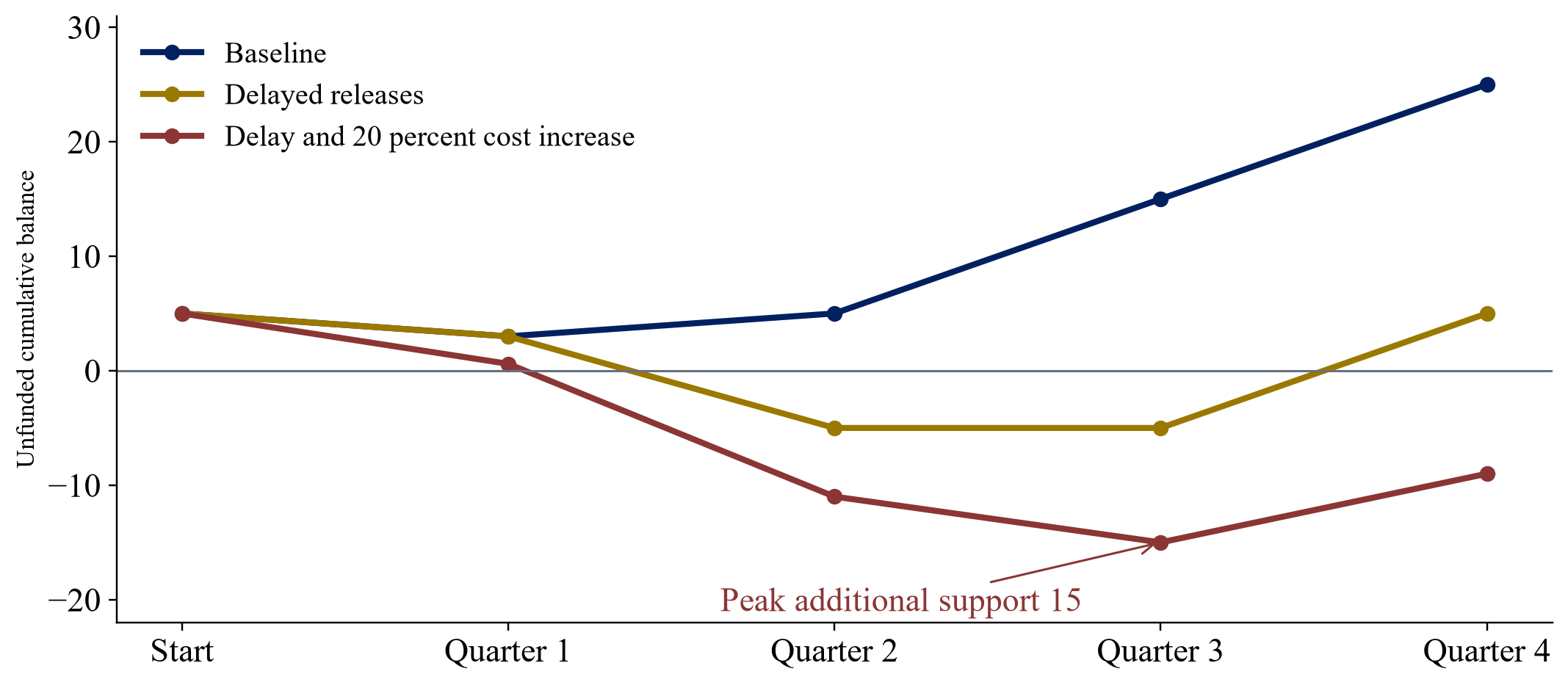
Four-quarter nominal funding example separate from the price model. Initial unrestricted cash 5 eligible bank advances 10 each quarter. Delayed permitted buyer releases 0 0 10 20. Twenty-percent cost stress gives peak additional support 15. Negative balances are unfunded requirements and do not represent an arranged overdraft. Restricted cash 15 is excluded.
11 Record the finding that changes the decision
The proposed decision bridge starts with the reviewed finding and follows it into the relevant calculation or approval condition. A corrected construction scope can alter completion expenditure. A permit condition can alter programme dates or permissible output. An account term can alter when money becomes available. The investor should identify each change separately and retain the evidence supporting it. The price example supplies a calculable consequence for assumed cost and timing changes; the liquidity example supplies a different consequence for assumed cash-release changes.
Table 3. Proposed response to evidenced changes and unresolved conditions
| Finding or open question | Proposed treatment | Required follow-through |
|---|---|---|
| Rights do not match the acquisition | Hold the rights-dependent case | Reconcile title authority and transfer advice |
| Permission changes the programme | Re-date affected costs and receipts | Verify scope conditions and revised engineering programme |
| Completion cost rises | Revise cost schedule and price ceiling | Obtain cost report and identify overlap in contingencies |
| Release follows a later milestone | Re-date permitted funding | Review account terms authorisations and actual cash path |
| Loan draw condition remains open | Exclude the unverified advance | Obtain lender confirmation or alternative timely funding |
| Contractor replacement is unresolved | Test scoped replacement cases | Review contractual rights technical scope and cost evidence |
| Support expires before a cash gap | Treat later support as unavailable | Obtain executable extension or restructure payment timing |
| Evidence contradicts a forecast | Suspend the unsupported input | Resolve document conflict and record authorised revised case |
Author-proposed decision framework. Responses require the actual documents and authorised professional review. No finding listed establishes an available remedy or verified project condition.
The bridge should identify whether a proposed response has been executed, negotiated or merely suggested. A new guarantee, changed loan condition or additional sponsor contribution needs its own evidence. The analysis should not credit the benefit before its amount, date and conditions are established. This discipline makes open work relevant to the decision and avoids silently turning a proposed restructuring into completed funding.
The committee can use the register to request a conditional bid, revised capital arrangement or pause. It should name the person authorised to accept a pricing change and the advisers responsible for the outstanding legal and technical questions. The numerical models remain scenario tools. Their outputs require transaction-specific inputs before being used in an actual recommendation. A proposed offer should state the assumptions on which it depends and the consequences of the evidence changing before completion.
12 Contract Evidence and the Price Condition
A proposed acquisition price becomes decision-ready when the evidence supporting the cash-flow assumptions has an identifiable contractual basis. The committee should begin with a contract schedule linking each material receipt, payment and dependency to the relevant executed document. The schedule should record the contracting parties, document version, governing language, signature status and unresolved amendments. A quotation, unsigned heads of terms and executed agreement should retain their separate evidential descriptions throughout the review.
For construction expenditure, the proposed review asks whether the scope corresponds to the drawings used for the cost estimate, how variations are authorised, and which party bears identified changes. It also asks whether the payment schedule is sufficiently detailed to support the modelled timing. A fixed headline amount alone leaves these questions open. Where a cost assumption remains unsupported, the model should describe it as a management estimate and retain a scenario showing the consequence of that uncertainty.
For receipts, the review should connect the assumed purchaser payment dates to the actual contractual milestones and their conditions. A scheduled instalment may depend on certification, account permissions or another action requiring separate evidence. The underwriting file should distinguish a contractual receivable from cash available for project expenditure. The fictional receipts in this paper illustrate that distinction; they provide no evidence about collections on a real development.
The proposed price condition should identify precisely which documents are required before approval becomes effective. It might require confirmation of the works scope, reconciliation of the payment schedule, or resolution of an amendment affecting termination payments. These are proposed diligence requirements, subject to the transaction team's legal advice. They are not claims about enforceability. The committee can then trace a price revision to the assumption changed by new evidence, with the previous model version preserved for review. This record makes the reasoning behind the authorised offer inspectable.
13 Cash-Control Permissions and Usable Funds
Cash-control review begins with an account map. Each account should have a named holder, stated purpose, authorised signatories and documented release conditions. The map should identify the evidence required for a payment instruction and the person responsible for obtaining it. A balance confirmation establishes the amount recorded at a particular date. The permission to use that balance requires its own review.
Dubai's project escrow framework provides a relevant statutory starting point, including separate project accounts and the treatment of financing proceeds under Article 13. [5] The DLD FAQ also describes trustee agreements and checks involving construction milestones and a site engineer. [4] Those sources do not establish the release permissions of a particular project. The proposed underwriting file therefore needs the applicable agreements, current account statements and a transaction-specific explanation from the appropriate advisers and account administrator.
In the separate fictional liquidity illustration, an account contains 15 units of restricted money. That invented balance remains outside available cash until its release conditions are evidenced. Moving it into unrestricted opening cash would change the model's perimeter and conceal an unresolved permission question. Any subsequently verified release should enter the model on its supported date, with the evidence reference recorded beside the entry.
The proposed cash-control checklist should also capture practical execution dependencies. These include the submission format, certification sequence, instruction authority and any outstanding documentation identified by the administrator. Their timing should remain unverified where no current evidence is available. A scenario may explore a hypothetical delay while retaining that description explicitly.
Approval should require a clear distinction between cash already usable, cash expected subject to conditions and funds whose availability remains unverified. This classification supports a transparent funding assessment. It does not predict an administrator's decision or imply that every contractual milestone produces an immediate release. The dated permission record should be refreshed when the approval file changes.
14 A Separate Liquidity Model
The liquidity test uses a separate nominal cash schedule with its own dates and funding perimeter. It answers whether eligible funds cover expenditure when payments fall due. The residual-price calculation answers a discounted underwriting question under its stated assumptions. Each calculation should have a distinct title, input register and result description. Combining their outputs would require a new, fully specified model and would change the question being answered.
The fictional liquidity example assumes four quarters of expenditure, invented opening unrestricted cash of 5 units and hypothetical eligible bank advances of 10 units in each quarter. Baseline buyer releases are fictional inputs of zero, 10, 20 and 20 units. The resulting balances are positive throughout. A second fictional schedule delays those releases to zero, zero, 10 and 20 units. Its cumulative path reaches a shortfall of 5 units before recovering to a positive closing balance.
The negative entries identify an unfunded cumulative cash path. They do not describe an arranged overdraft. The proposed sponsor requirement is calculated from the largest cumulative shortfall, using a zero floor. The example therefore identifies a peak support requirement of 5 fictional units, subject to the model's stated assumptions and payment dates. It makes no claim about an actual sponsor's capacity or commitment.
When fictional construction expenditure is increased by 20 per cent while the delayed releases are retained, the largest cumulative shortfall becomes 15 invented units. Hypothetical support of 20 units, assumed committed and timely solely for this illustration, covers that scenario's modelled gap. Evidence of commitment, draw conditions and timing would still be required for a real transaction.
The liquidity gap must remain separate from the reduction in the residual-price ceiling. The two results use different dates and cash definitions. Adding them together would produce a number without a defined economic interpretation in these models.
15 Lender Security and SPV Boundaries
A financing review should establish which entity borrows, which entity owns or holds the development rights, and which entity receives the relevant project cash. The proposed structure map should use the actual legal names and document references. Where an SPV appears in the structure, the file should explain its role through verified ownership, constitutional and transaction documents. A label on an organisation chart cannot establish the assets or obligations within that entity.
The security schedule should list the proposed secured assets, security provider, beneficiary and relevant documentation status. Questions about creation, registration, priority, enforcement and recovery require transaction-specific legal advice. An underwriting paper should record those questions and the advice obtained, with any unresolved issue clearly labelled. It should avoid attributing a recovery outcome to the existence of a security document.
The DLD mortgage-into-escrow service describes service-specific documentation requirements, including a financing contract or undertaking and a technical report subject to stated recency requirements. [6] Those administrative requirements support a document checklist. They provide no lender-recovery promise. Basel supervisory criteria can similarly frame questions about project finance risk without establishing the terms a particular lender will offer. [12]
For the proposed funding model, a lender advance should be included as eligible cash only on the assumptions expressly documented for that scenario. A signed facility may still contain conditions affecting the draw date. Those conditions should be mapped to the party responsible for satisfying them, the evidence available and the remaining dependency. An unverified advance date should retain that label.
The committee should receive a concise statement of boundaries: project obligations, sponsor obligations, guarantees offered, restricted accounts and any cross-entity reliance included in the analysis. The supporting legal review should address the exact transaction structure. This record helps reviewers identify where a funding assumption depends on another entity, while preserving the limits of the evidence available.
16 Cross-Border Jurisdiction Review
Cross-border development review requires a jurisdiction-specific evidence file for each relevant property, entity and cash movement. The proposed review should identify the project location, land-rights basis, development permissions and account framework before translating their implications into model assumptions. Similar terminology across locations should be accompanied by the relevant source and transaction documents. Any unresolved interpretation belongs in a question for local advisers.
Abu Dhabi's published developer journey identifies documents including a project identifier, escrow agreement, DMT permits and engineering reports. [7] Its FAQ covers ownership-related routes and information concerning completion and account identification through DARI. [8] These materials provide starting points for requesting evidence. They do not confirm a supplied property's status or establish that a particular applicant meets the relevant requirements.
The published Abu Dhabi regulations also describe guarantees within controlled arrangements for releases before the stated construction threshold. [9] That provision should be examined within its exact regulatory context. The proposed method records its applicability as an open legal question until transaction-specific advice and supporting documents are available. It does not generalise the provision into a universal account-release assumption.
Saudi Arabia requires a separate review. REGA's Wafi materials identify licensing evidence concerning owner agreements, approved plans, consultant and accountant contracts, cost and duration feasibility, and escrow arrangements. [11] The proposed checklist should use those materials for the Saudi project concerned. UAE account rules should retain their own jurisdictional scope.
For every location, the committee file should show the verified document, its issuing authority, the date checked and the question it answers. Catalogue entries and service descriptions can guide the search for records, including through DARI. [10] They remain distinct from completed checks. No actual property was searched through the DLD Property Status Enquiry for this paper. [3] The illustrations consequently support a proposed review method and make no statement about a real property's regulatory standing.
17 Information Cost and Decision Value
Further diligence has a decision value when its possible findings can change an action the committee is authorised to take. The proposed review starts by defining that action: revise an offer, retain a condition, obtain additional funding evidence or defer approval. Each outstanding evidence request should then be linked to a model input or approval condition. This connection makes the purpose of the request explicit and supports a disciplined decision about its scope.
The cost of obtaining information includes the professional fee, the time needed and the internal effort required to reconcile the result. Those costs should be evidenced through actual quotations and work plans where available. Any preliminary allowance should be identified as a management estimate. This paper has no verified diligence-cost dataset and provides no measured return on an additional review.
A useful proposed exercise is to calculate the price ceiling under defined possible findings without assigning unsupported probabilities. For example, the committee could compare the model using a verified cost estimate with the model using a labelled adverse-cost scenario. It could then ask whether the difference crosses its intended offer or approval threshold. Such a calculation identifies decision sensitivity within the stated model; it does not establish the likelihood of either finding.
Where probabilities are unavailable, a bounded scenario discussion can describe what information would resolve the decision. A valuation specialist might identify which assumptions require stronger support, consistent with the attention RICS gives to development sensitivities and current cost assumptions. [1] Comparable evidence can also require careful assessment of its relevance and quality. [2] Neither source supplies a project-specific probability distribution for this paper.
The resulting evidence budget should state the question, requested deliverable, responsible reviewer and approval consequence. Once the information arrives, the team should record whether it changed the decision and why. That record provides a basis for examining diligence usefulness across future cases.
18 Document Tools and Human Verification
Document tools can be assigned a bounded supporting role in the proposed review. The first requirement is a controlled source set containing the agreements, schedules, reports and official records authorised for analysis. Each extracted item should carry a document reference and page or clause location. The review file should preserve the source wording alongside any proposed model entry so that a human reviewer can check the relationship directly.
The proposed automation workflow should retain every extraction as a draft until a named reviewer checks it against the source. It requires explicit human confirmation of dates, amounts, entities, conditions and the scope of any permission. A machine-produced description without that confirmation should remain outside the verified approval record. This is a proposed review policy; the study tests no document tool or language model and measures no extraction accuracy or time saving.
The proposed reconciliation process should also separate arithmetic checking from interpretation. A formula check can reproduce the calculation using the supplied inputs. Deciding whether a clause permits a payment, whether a document is current or whether a legal condition applies requires the appropriate reviewer and evidence. Where specialist advice is needed, the tool's extraction can identify the passage for review and retain the question as unresolved.
Version control is equally important. An amendment may change a payment date without changing the agreement title. The source register should retain the version examined, the later document received and the decision about which provisions govern the model input. Conflicting source passages should remain visible until the discrepancy is resolved by the authorised team.
For this proposed method, the final approval paper should contain only checked source references, clearly labelled management estimates and explicitly fictional scenario inputs. Supporting drafts should retain their verification status. Human reviewers remain responsible for the resulting underwriting recommendation, the interpretation of transaction documents and the communication of any material uncertainty to the committee.
19 Data and Identification Limitations
This paper does not contain a transaction dataset. Its numerical illustrations are fictional, and its calculated results describe those invented inputs. They cannot establish observed price discounts, investor preferences, financing availability or the frequency of evidence gaps across GCC developments. The official materials cited support the document and regulatory context described within their scope. They do not supply empirical observations for the models.
A future empirical study would face a separate identification problem. Projects with incomplete records may differ in location, design, sponsor resources, construction progress and other features relevant to their transaction terms. An observed association between documentation quality and an agreed price would require careful examination of those differences. The proposed study should state which variables were measured and which remained unavailable before interpreting any relationship.
Selection also requires attention. A sample drawn from completed transactions excludes projects that never reached agreement. A dataset assembled from publicly accessible records could omit private negotiations and unpublished conditions. Each sample should disclose its inclusion rules, missing fields and access limitations. Those boundaries should accompany the results wherever the study is discussed.
Measurement presents further questions. The price initially proposed, the price agreed and the amount ultimately paid can refer to different stages and conditions. Evidence completeness also needs a reproducible definition tied to a review date. A document obtained after negotiation should not be silently treated as information available during negotiation. The proposed data dictionary should distinguish these dates and preserve the documentary basis for each field.
Finally, the research should separate calculated counterfactuals from observed outcomes. A modelled offer ceiling under a hypothetical delay remains a scenario result, even when the underlying project is real. Any management estimate should retain that designation. These limitations define what a future analysis could responsibly claim and the additional evidence needed to support a stronger conclusion about transaction decisions.
20 An Executable Committee Decision
The committee paper should end with a decision that the authorised transaction team can execute. A proposed approval record should specify the offer ceiling, its calculation date, the model version and the conditions attached to the authority. It should also name the person permitted to communicate the offer. Where those fields are unresolved, the recommendation should state the missing information and the decision required.
The proposed record should distinguish evidence conditions from commercial choices. A requirement to receive an executed agreement can be checked against the source register. A choice to accept a particular sensitivity requires an explicit committee judgement. Each should have its own owner and completion record. This structure allows a later reviewer to determine what was verified and what risk was knowingly accepted.
Funding authority should be stated separately. The liquidity illustration in this paper uses hypothetical sponsor support, so it provides no authority to commit real funds. For an actual transaction, the committee should identify the amount authorised, the entity providing it, the timing requirement and the supporting commitment evidence. Draw conditions and account permissions should remain visible wherever they affect cash availability.
The decision should also define the events requiring renewed review. Proposed triggers include a changed cost estimate, a revised payment schedule, an amendment affecting a material condition or newly received evidence that changes the model's assumptions. The transaction team should return the affected calculation and explanation to the authorised decision-maker. Any threshold for that process requires an explicit policy choice.
An executable outcome may be a conditional offer, a request for specific evidence or a deferred decision. The paper should record the chosen action in plain language and attach the relevant supporting schedule. An adverse fictional model result is an illustration of a decision boundary; it is not a recommendation concerning an unidentified property. Completion of the record gives the team a traceable instruction within the authority actually granted.
21 Proposed Empirical Validation
The proposed method could be evaluated through a prospective study designed before transaction outcomes are known. The study would register the underwriting questions, document-completeness definitions and review dates in advance. Participating teams would preserve the evidence available at each decision point, together with the corresponding model version and authorised offer. Access, confidentiality and consent arrangements would need agreement before collecting private transaction records.
The primary proposed measurement is the change in a stated underwriting input following newly verified evidence. That design asks what changed in the review file and how the authorised decision responded. It does not require a claim that documentation alone caused an observed market-price movement. A secondary analysis could examine associations with negotiated terms, subject to the data and identification limitations described above.
The study should record revisions to construction cost, payment timing, account permissions and funding eligibility separately. It should also capture the information-acquisition cost where a verified invoice or quotation is available. Management-estimated costs would retain their label. Dates should distinguish the evidence request, receipt, verification and committee decision, allowing the study to examine the actual review sequence.
Independent reviewers could test whether the same source set produces consistent classifications. Disagreements would be retained and analysed using the study's documented review rules. The sample size, observation period and statistical approach should be chosen through a research design appropriate to the available records. This paper supplies no invented sample size, measured effect or claimed finding.
Any published results should include the sampling frame, missing-data account, source-access restrictions and sensitivity to alternative definitions. A future study might establish that some proposed classifications need revision; its protocol should permit that result to be reported plainly. The objective is an evidence-based assessment of whether the review method makes decisions traceable and whether its defined evidence measures have a reproducible relationship with the observed underwriting revisions.
22 Conclusion
The question in this paper is what evidence would support a change in an authorised development offer. The proposed answer is a traceable chain from a verified document to a model input, from that input to a calculation, and from the calculation to an explicit committee decision. Each link has its own scope. A public service description guides a document request; a project-specific record supports a particular assumption when its relevance and current status have been checked.
The fictional residual-price example shows how its stated cost and timing assumptions change a calculated offer ceiling. The separate fictional liquidity example shows how eligible receipts and expenditure can create a peak funding requirement. Their outputs remain separate because their cash definitions and dates differ. Neither illustration establishes a market valuation, an observed discount or an available funding commitment for an actual property.
Contract review, account permissions and entity boundaries provide the proposed practical foundation for applying the method. Jurisdiction-specific sources help define the questions for local verification and professional advice. Unresolved legal interpretations, release conditions and funding dates should retain their unverified status in the decision file. Management estimates and hypothetical scenarios should carry equally clear descriptions.
The committee's resulting instruction should identify the offer authority, required evidence, accepted scenario exposure and separate funding authority. The record should also identify when changed information requires another decision. This is a proposed governance method whose usefulness requires testing through real, appropriately controlled evidence. The empirical design outlined above provides a way to evaluate its classifications and decision records without inventing findings.
For a transaction team, the immediate deliverable is a review file that states what has been checked, what remains open and which action has been authorised. That file gives the price discussion an inspectable basis while preserving the exact limits of the supporting information and calculations.
References
- Royal Institution of Chartered Surveyors. Valuation of development property. First edition October 2019, effective 1 February 2020, reissued April 2023 as a professional standard. Sections 7 and 8; accessed 8 October 2026. https://www.rics.org/content/dam/ricsglobal/documents/to-be-sorted/Valuation%20of%20development%20property_ready%20for%20approvals.pdf
- Royal Institution of Chartered Surveyors. Comparable evidence in real estate valuation. First edition October 2019, reissued April 2023. Current supplied first-edition professional standard; accessed 8 October 2026. https://www.rics.org/content/dam/ricsglobal/documents/standards/Comparable%20evidence%20in%20real%20estate%20valuation.pdf
- Dubai Land Department. Property Status Enquiry. Official Dubai administrative interface; no particular property searched. Accessed 8 October 2026. https://dubailand.gov.ae/en/eservices/property-status-overview/property-status
- Dubai Land Department. Frequently Asked Questions. Official project escrow and administrative explanations; exact transaction permissions require current project records. Accessed 8 October 2026. https://dubailand.gov.ae/en/frequently-asked-questions/
- Dubai Legislation Portal. Law No. 8 of 2007 concerning real estate development escrow accounts in Dubai. Arabic original issued 6 May 2007; Articles 3, 7, 9 and 13 within their stated scope. Accessed 8 October 2026. https://dlp.dubai.gov.ae/Legislation%20Ar%20Reference/2007/%D9%82%D8%A7%D9%86%D9%88%D9%86%20(8)%20%D9%84%D8%B3%D9%86%D8%A9%202007.html
- Dubai Land Department. Depositing a mortgage into an escrow account application. Official service-specific financing and technical documentation requirements; accessed 8 October 2026. https://dubailand.gov.ae/en/eservices/request-for-mortgage-payment-in-escrow-account/
- Abu Dhabi Real Estate Centre. Developer Journey. Official project registration, permit, engineering and escrow workflow; accessed 8 October 2026. https://adrec.gov.ae/en/sectors/regulatory-services/project-development/developer-journey
- Abu Dhabi Real Estate Centre. Frequently Asked Questions. Official project and property-administration evidence routes; accessed 8 October 2026. https://adrec.gov.ae/en/faqs
- Abu Dhabi Real Estate Centre. Rules and regulations compilation, including Law No. 2 of 2025 and Administrative Decision No. 24 of 2025. Review limited to the identified controlled guarantee route for earlier construction disbursements. No Gazette publication date or project applicability established; accessed 8 October 2026. https://adrec.gov.ae/en/rules_and_regulations/Tenancy
- DARI. Consumer Services. Official catalogue of title, project, mortgage, escrow and audit services; no private certificates or account records retrieved. Accessed 8 October 2026. https://services.dari.ae/consumer-services/
- Real Estate General Authority. Wafi Off-Plan Sales and Lease. Official Saudi licensing evidence and project escrow service description; accessed 8 October 2026. https://rega.gov.sa/en/rega-services/platforms/wafi-off-plan-sales-and-lease/
- Basel Committee on Banking Supervision. CRE33 IRB approach: supervisory slotting approach for specialised lending. Selected edition published 8 December 2022, effective 15 December 2019. Supervisory criteria provide risk-review context and establish no particular facility terms; accessed 8 October 2026. https://www.bis.org/committees/bcbs/basel-framework/standard/cre/33/inforce/2019-12-15/published/2022-12-08
About the Author
Chennakeshav (CK) is a corporate finance and investment banking executive with 25+ years of global experience in deal origination, structuring and execution across M&A, growth capital and corporate strategy. He has led value-creation mandates for founders, corporates and funds — bridging the boardroom view to hands-on execution and close.
His career spans Morgan Stanley, HSBC, Lloyds Banking Group, EWEC, ADQ portfolio companies and Emirates Growth Fund, across TMT, real estate, fintech, deeptech, cleantech, infrastructure and energy. He has partnered with C-suite leaders, private equity and venture funds, sovereign wealth funds and family offices to finance complex fund raises and scale-up ventures, and has led M&A due diligence, post-merger integration and business-transformation initiatives to create value.
At Matchpoint Partners he is Managing Partner, leading the firm's corporate finance, M&A and capital-raising practice. He holds an MBA from London Business School, an engineering degree from VTU and a Master of Laws (LLM, in progress) from UCL London.
An active start-up mentor, CK mentors at Techstars, DIFC FinTech Hive, Startup Grind, Founder Institute and IN5, serves as Entrepreneur Mentor in Residence (EMiR) at London Business School, and judges the Entrepreneurship World Cup.
