

1 DEFINE THE CURRENT EXECUTABLE MANDATE
The decision facing a financing team is whether to spend scarce preparation and diligence time on a named provider for a defined transaction. A usable answer requires the identity of the investing entity, an eligible instrument, a compatible cheque range, a current decision route and evidence that the vehicle can consider the proposal within the required period. This paper calls that condition a current executable mandate. Execution remains conditional on the provider's investment decision, documentation and funding requirements; the classification records permission and capacity to consider the transaction, rather than an obligation to supply capital.
The unit of analysis is a provider and transaction at a stated observation date. A private-credit fund might qualify for a senior secured loan and fail for a minority-equity raise by the same issuer. A growth fund could be compatible with an initial investment but unable to finance a bridge outside its permitted instrument set. These are illustrative distinctions. Their relevance in an actual mandate must be established through the fund's own current documents and an appropriately authorised contact. A brand name or previous investment supplies a research lead whose suitability still requires examination.
The question has two parts. First, how many records have sufficiently strong evidence for a current classification? Second, how much additional checking is commercially justified? The first is a measurement problem with an incomplete denominator. The second is a resource-allocation decision with uncertain costs and consequences. Combining them into a single confidence score would conceal useful distinctions between an attractive transaction, incomplete evidence and a confirmed constraint.
The scope includes institutional equity, private credit and commercial lending. Relevant verification documents differ across these categories, so the proposed fields require adaptation. This paper provides no empirical estimate of investor willingness, deployable capital or fundraising success. It offers a testable method and reproducible hypothetical calculations for an advisory team that wishes to collect that evidence lawfully.
2 Define the longlist before measuring its quality
The starting longlist should be fixed before a team begins reporting conversion or compatibility rates. Record the transaction specification, geographic perimeter, eligible instrument types, minimum and maximum required contribution, desired timetable and source of each candidate. Separate an investing vehicle from its manager, parent group and external adviser. The same provider may appear through several contacts or databases. A count of names can therefore differ from a count of independent capital decisions, with direct consequences for every percentage built on that count.
A proposed list identifier should connect each entry to its source snapshot and collection date. Keep the original entry alongside the canonical entity record so that deduplication remains reviewable. If two entries are merged, record the evidence for the merge and preserve both source references. Different vehicles managed by the same firm should remain distinct when their decision rights or investment permissions differ. Group relationships can be added as a separate analytical field without erasing the underlying vehicle identities.
GLEIF distinguishes identity reference data from information about direct and ultimate accounting-consolidating parents. Those parent relationships support group mapping, subject to the coverage of the available records. They do not constitute a complete map of beneficial ownership or delegated investment authority. Applying that source to a financing list requires this narrower interpretation. A common parent may justify a duplicate review; it does not establish that two funds share one investment committee or the same available capital. [3]
The denominator must also define how replacements are handled. Adding a newly discovered provider after another has declined can make the list appear more productive without exposing the additional search effort. Preserve the original cohort, record subsequent additions in dated cohorts and disclose whether a reported percentage refers to the original list or a changing inventory. This accounting discipline is necessary for a prospective test of longlist quality.
3 Establish what each source can support
An entity register can support identity and regulatory checks within its jurisdiction. It supplies a different kind of evidence from a dated fund mandate or a transaction-specific confirmation. The FCA's current guidance explains how to check authorisation and permissions and to verify contact details, including safeguards against clone firms. The paper's analytical implication is to verify that a contact represents the intended entity before attributing a statement to it. Such verification alone leaves the transaction's cheque capacity and decision timetable unresolved. [2]
The SEC's July 2024 Form ADV instructions provide a concrete reason to interpret assets under management carefully. For private funds, regulatory assets under management include fund assets and uncalled contractual commitments, without deducting outstanding indebtedness. Certain non-discretionary advisory arrangements can also enter the calculation. A reported regulatory AUM total consequently requires examination of its definition and reporting date before it is used in a transaction model. It supplies no direct measurement of cash available for a particular cheque. [1]
The ILPA Due Diligence Questionnaire separates the manager, general partner and fund; asks about investment and follow-on periods, strategy and geography; and examines governance and approval arrangements. These distinctions support a proposed evidence matrix for institutional funds. The questionnaire is an industry due-diligence instrument, rather than a regulation or dataset demonstrating how frequently a fund fits an external issuer. A completed answer also requires appropriate authority and a current date before it supports the specific transaction being assessed. [4]
Each field should therefore carry an evidence description, source, observation date, permitted use and reviewer. A field may be established from a document, explicitly denied by the provider or remain unknown. A secondary database description can help locate a primary source. It should retain its secondary status until corroborated. When sources conflict, preserve both statements and refer the conflict to the person responsible for the classification.
Table 1. Proposed transaction-specific evidence matrix
| Field | Preferred evidence | Unresolved issue |
|---|---|---|
| Legal entity | Official identity record and verified contact | Correct investing vehicle |
| Instrument | Current mandate or authorised confirmation | Eligible structure |
| Cheque range | Dated provider confirmation | Amount available for this deal |
| Investment period | Current fund document | New investment or follow-on only |
| Geography and sector | Current mandate restriction | Exact issuer and asset eligibility |
| Approval route | Authorised explanation of decision rights | Who can progress the proposal |
| Timing | Transaction-specific response | Review feasible before deadline |
| Communication | Counsel-reviewed distribution conditions | Lawful recipient and permitted use |
Author-proposed review fields; completion does not establish an investment commitment.
4 Preserve compatible incompatible and unknown states
The proposed classification has three states: confirmed compatible, confirmed incompatible and unknown. Confirmed compatible requires the specified mandatory conditions to be supported at the observation date. Confirmed incompatible requires a documented failed condition. Unknown includes insufficient identity evidence, a missing mandate document, a stale confirmation, an unresolved conflict and a non-response. Recording the reason within each state enables a reviewer to distinguish several types of work without manufacturing a binary answer.
This definition makes the label transaction-specific and temporary. A confirmed incompatible state can change after the issuer adjusts its terms or a provider changes its mandate. A compatible state can become unknown when supporting evidence expires or a stated decision route becomes unavailable. Record every transition with its effective date and the evidence responsible for it. Keep historical states so that later information does not silently improve the apparent quality of an earlier longlist.
An unknown record cannot be counted as a false fit without an additional assumption. It may be compatible, incompatible or even a duplicate requiring resolution. Similarly, non-response supplies evidence about the observed communication process; it leaves the underlying capital mandate unclassified. A contact may decline to answer a verification request for reasons that the team cannot observe. The analysis should retain that limit instead of assigning a convenient motive.
Figure 1 uses a wholly constructed list to illustrate these states. The 120 records and their allocations are assumptions, with no claim that they represent a sector or geography. Eighteen are compatible, forty-two are incompatible and sixty remain unknown. The illustration makes the missing-status problem visible before any resource decision is taken. If classifications are later found incorrect, its calculations must be recomputed.
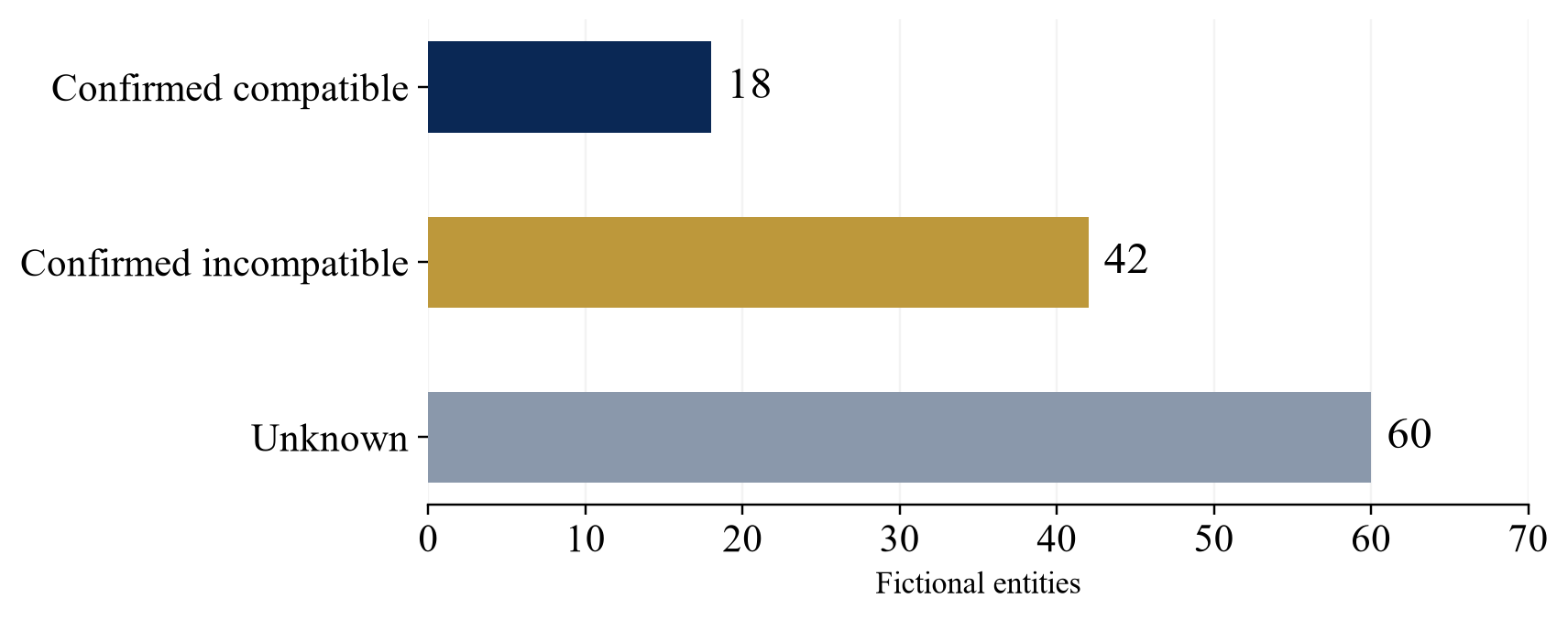
Fictional counts only. Unknown records remain unclassified; no market prevalence estimate is shown.
5 Report the denominator and the unresolved range
In the constructed example, 60 of the 120 records have a known classification. Verification coverage is therefore 50 percent. Eighteen compatible records constitute 15 percent of the full list and 30 percent of the classified subset. Both ratios are arithmetically correct under the assumptions. They answer different questions. Presenting only the 30 percent figure would conceal that half of the original list remains unresolved and would require an unsupported assumption to generalise it to all 120 records.
The logical lower bound assumes that none of the 60 unknown records is compatible, giving 18 divided by 120, or 15 percent. The upper bound assumes that all 60 are compatible, giving 78 divided by 120, or 65 percent. This interval reflects missing classification information conditional on the known statuses being correct and stable. It is not a confidence interval, a probability forecast or a claim about the broader investor population. Statistical sampling uncertainty would require a separately specified sample design and analysis.
Incomplete-outcome research provides a useful conceptual distinction between identification uncertainty and sampling variability. The accessible abstract of Manski, Newman and Pepper discusses evaluation when outcomes are incompletely observed. The investor application here is an author-proposed adaptation; the simple logical bounds are derived directly from the constructed counts. No estimator from the full article is implemented or claimed to have been reproduced. [12]
The observed subset may be easier to contact or more willing to disclose its mandate than the unresolved subset. Selection research identifies the need to examine how observations enter an analysed sample. It does not supply the direction or size of that selection effect in this longlist. Accordingly, the paper keeps the full-list bounds and the classified-subset ratio together. A management report should also publish the reasons for unresolved status and the date of its last review. [9]
Table 2. Denominators in the constructed classification example
| Measure | Calculation | Result | Interpretation |
|---|---|---|---|
| Verification coverage | 60 / 120 | 50 percent | Records with known status |
| Full-list confirmed share | 18 / 120 | 15 percent | Supported compatible records |
| Classified-subset share | 18 / 60 | 30 percent | Ratio within assessed records |
| Logical full-list bounds | 18 / 120 to 78 / 120 | 15 to 65 percent | Range due to unknown statuses |
All records are fictional. Bounds assume correct current classifications and make no sampling claim.
6 Separate initial exclusions from current mandate checks
A verification funnel should explain where a record left the review process and why. In the constructed example, identity checking resolves 96 of the 120 records, leaving 24 unknown. Initial screening then excludes 24 of those 96 as confirmed incompatible. Seventy-two enter the current-mandate review queue. Thirty-six receive that review: eighteen become compatible and eighteen incompatible. The remaining thirty-six have no current-mandate decision and remain unknown. The final totals are therefore 18 compatible, 42 incompatible and 60 unknown.
This construction demonstrates a potential confusion in funnel reporting. Sixty records are classified across the complete process, although only thirty-six received the final current-mandate check. The other twenty-four known classifications arose from earlier documented exclusions. A report that calls all sixty records current-mandate confirmations would misdescribe the work. A report that calculates coverage from only thirty-six would omit the earlier valid classifications. Publish stage counts and end-state counts separately.
The funnel in Figure 2 is a verification sequence before any investment solicitation. The last stage means eligible for appropriately reviewed next contact under the scenario assumptions. It represents no observed meeting, diligence progression, commitment or funding. A subsequent outreach study must add its own timestamps and outcome definitions. Engagement should only occur within applicable communication, privacy and activity rules, determined for the actual entity, instrument and location by qualified advisers.
Every transition should have an accountable reason. Examples of possible initial exclusions include a documented incompatible instrument or a verified vehicle outside its investment period. Those reasons belong to the provider's current evidence record. A generic industry label cannot substitute for the underlying restriction. Reasons also help teams reconsider a record responsibly when a transaction changes, rather than deleting unsuccessful names and presenting an improved retrospective list.
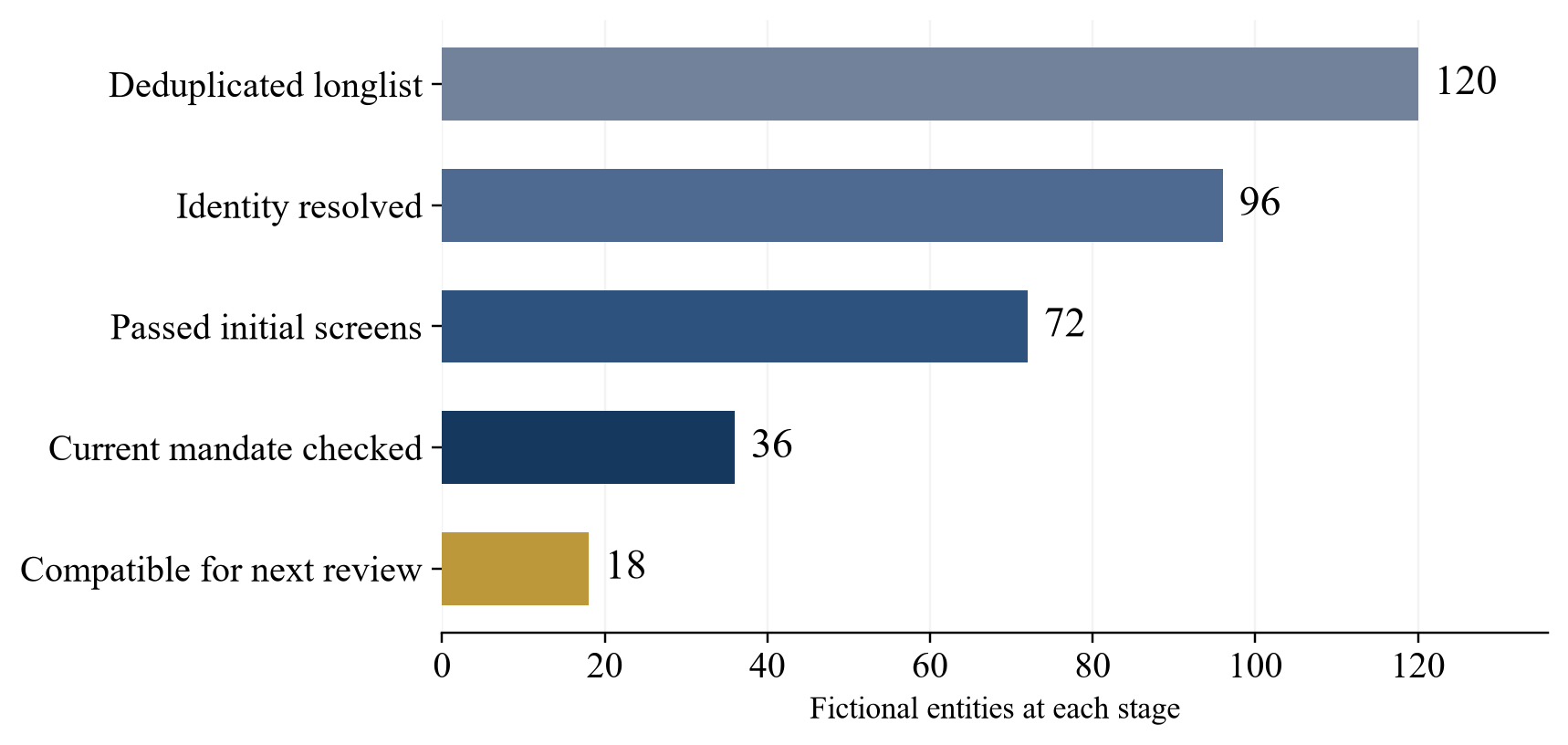
Fictional sequence: 24 identity unknowns plus 36 pending mandate checks make 60 unknown records. Stage counts are not fundraising outcomes.
7 Measure the cost of a false fit precisely
For this paper, a false fit is a record treated as suitable for costly transaction review that subsequently fails a mandatory compatibility condition supported by current evidence. This definition distinguishes a targeting mistake from an eligible provider declining the investment on its merits. It also distinguishes a genuine constraint from insufficient information. An unanswered email, a commercially unattractive proposal or a slow negotiation should receive its own outcome code unless evidence establishes a failed mandatory condition.
The cost journal should record staff time by task, external expenses and the event that caused the work. Assign identity verification, mandate checking, issuer preparation, meetings and documentation to separate categories. Fixed research infrastructure can be allocated using a stated rule or reported separately. Internal staff time multiplied by a planning rate is an economic valuation convention; it does not establish an invoice, a cash outflow or incremental payroll saving. Report actual cash expenses independently when evidence is available.
Gompers and co-authors surveyed 885 institutional venture capitalists at 681 firms across sourcing, selection, valuation and other decision activities. The original study supports treating investment selection as a multi-stage process. Its historical survey population and investor-side work differ from an advisory team's present longlist verification. This paper therefore uses no published diligence-hour figure as a forecast of intermediary costs. The hypothetical effort assumptions below are stated separately and require replacement with measured operational data. [7]
Potential downstream costs include repeated issuer preparation, time spent resolving unsuitable terms and displacement of review capacity. This paper supplies no monetary estimate for those consequences. Record them as observed events where possible and distinguish direct expenses from management valuations and causal assertions. A provider may have received a high-quality review that creates reusable knowledge even when it fails the present mandate. A cost model should retain that potential reuse as a separately documented assumption.
8 Specify a comparable hypothetical effort model
The constructed cost comparison covers deep review of the sixty records whose status is known. It excludes deep review of the sixty unknown records from both alternatives. This boundary is deliberate and restrictive. It permits a transparent arithmetic comparison with equal assumed coverage of the eighteen compatible records; it does not demonstrate that a real screening programme would achieve the same classifications or discover the same eligible providers. The counterfactual is a planning illustration whose feasibility requires prospective testing.
The first alternative gives all sixty classified records four hours of deep review. The total is 240 hours. At an assumed valuation rate of USD 150 per hour, the resulting effort value is USD 36,000. Both the four-hour requirement and the valuation rate are author-chosen assumptions. They represent no quoted professional fee, observed salary or recorded fundraising expense. The model assigns identical effort to compatible and incompatible records to expose its dependence on this simplification.
The second alternative adds initial screening of every record in the original list. At half an hour for each of 120 records, this requires sixty hours. An additional six hours are assigned to evidence quality review. The sixty-six screening hours have a planning value of USD 9,900. Deep review then covers the eighteen compatible records at four hours each, requiring seventy-two hours valued at USD 10,800. The total is 138 hours and USD 20,700.
Subtracting the second total from the first gives a difference of 102 hours, valued at USD 15,300. This calculation assumes that screening correctly identifies every incompatible record and retains every compatible record in the classified subset. It leaves unresolved-provider discovery, delay, false exclusions and financing outcomes outside the numerical comparison. Those omissions are material. A business case would need measured evidence and sensitivity analysis before claiming a realised or expected economic benefit.
Table 3. Constructed effort comparison for the sixty classified records
| Component | Review classified set | Screen then review compatible set |
|---|---|---|
| Initial screening | No incremental hours | 120 times 0.5 hours = 60 hours |
| Evidence quality review | No incremental hours | 6 hours |
| Compatible deep reviews | 18 times 4 hours = 72 hours | 18 times 4 hours = 72 hours |
| Incompatible deep reviews | 42 times 4 hours = 168 hours | None under assumed perfect screening |
| Total effort | 240 hours | 138 hours |
| Effort value | USD 36,000 | USD 20,700 |
| Difference under assumptions | Reference alternative | 102 hours or USD 15,300 |
Fictional planning assumptions. USD 150 per hour values effort; it is not a fee quote or cash saving. Unknown-record deep review is excluded from both alternatives.
9 Test the effort threshold and the omitted costs
The incremental screening and quality-review burden is sixty-six hours. If a documented false fit would otherwise consume four hours of deep review, the arithmetic break-even point is 16.5 avoided reviews. At least seventeen complete reviews must be avoided to exceed that burden when the review count is restricted to integers. Within the example's forty-two incompatible records, the continuous threshold is approximately 39.29 percent. These numbers are derived from the stated assumptions; they are not a recommended performance target for an unmeasured programme.
The sensitivity varies the deep-review effort assigned to each of the forty-two incompatible records while holding the screening burden constant. At one hour, the avoided effort is forty-two hours, producing a net difference of minus twenty-four hours, valued at minus USD 3,600. At two hours, the net difference is eighteen hours, or USD 2,700. At four hours it is 102 hours, or USD 15,300; at eight hours it is 270 hours, or USD 40,500. Figure 3 displays this conditional arithmetic.
Real workloads may stop an unsuitable review earlier than planned, reducing avoidable effort. Screening may also take longer for complex vehicle structures or incur additional legal costs. A false exclusion can remove an eligible provider, creating a consequence that the model has not priced. Add these terms explicitly to a prospective cost journal and publish the corresponding sensitivity. Reporting only the four-hour illustration would conceal conditions in which the proposed screening sequence consumes more effort.
The result also depends on what the saved capacity does next. Hours reassigned to other work can have a commercial value, but their reassignment alone cannot establish additional revenue. A cash benefit requires evidence of an actual avoided payment or collected income, with an appropriate attribution method. The paper maintains the distinction between a hypothetical effort difference, observed operational time and cash in the firm's accounts.
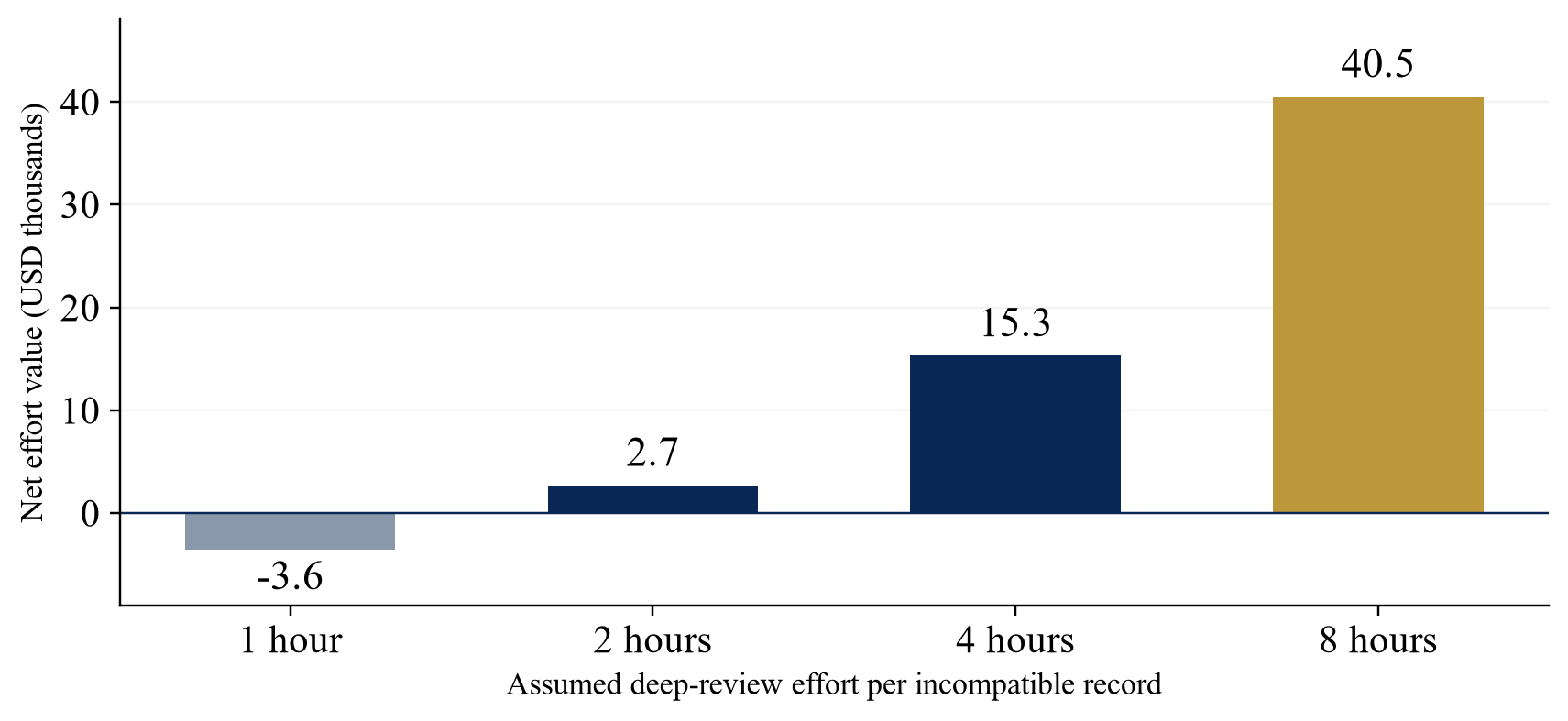
Forty-two assumed avoided false-fit reviews, sixty-six screening hours and USD 150 per hour. Omission and delay costs remain unmeasured.
10 Sequence verification under limited review capacity
Verification work can be ordered by the information required for the next decision. Resolve entity identity before assigning statements from a contact. Examine hard instrument or geographic restrictions before commissioning detailed issuer analysis for that provider. Confirm the relevant vehicle and investment period before interpreting a historical deal as evidence of present eligibility. Investigate transaction-specific capacity and approval timing before scheduling work that depends on them. This is a proposed sequence whose efficiency and error rates require evaluation in the actual process.
Weitzman's original search model formalises the cost of investigating uncertain alternatives and derives a stopping rule under specified assumptions. It supplies a useful economic rationale for accounting for information-acquisition costs. Fundraising may involve interacting providers, syndicates, correlated information and several needed commitments. Those features differ from choosing one best alternative under the original model. This paper therefore implements no claimed optimal investor-search rule and supplies no source-derived reservation price for a particular transaction. [8]
A practical queue can instead use explicit unresolved questions, estimated staff effort and the decision that an answer would change. Any expected benefit entered by management should retain its assumption status and sensitivity range. A verified hard exclusion can justify stopping work on the present transaction. A missing document can justify a request for clarification or a scheduled review. It should not become a permanent rejection automatically.
The decision log should state who paused a record, which condition remains unresolved and when it will be reconsidered. Keep a bounded allocation for checking some unresolved or lower-priority records so that the process can discover mistakes in its early screens. A queue that never revisits its exclusions cannot measure the eligible opportunities it might have missed. Its apparent efficiency would omit an important part of targeting quality.
11 Date financing evidence and reassess changed conditions
Mandate verification is sensitive to time. Evidence about a fund's investment period, a committee route or a lender's underwriting position has an observation date. Record the event that should trigger another review, such as a changed instrument, a new vehicle, a revised issuer forecast or a notification from the provider. A team's proposed review interval should be justified by the kind of evidence and its operational use. This paper establishes no universal expiry period for every investor field.
The July 2026 Federal Reserve lending survey reports different conditions across lending categories during the second quarter. Commercial and industrial standards were broadly unchanged, commercial real-estate standards generally eased, and the separate level questions placed non-depository financial-institution lending standards toward the tighter ends of their historical ranges. These are aggregate survey statements. They require category and period labels and cannot classify a named provider's present appetite for a particular issuer. [5]
The ECB's July 2026 survey reports a net seven percent of banks tightening enterprise credit standards in the second quarter. A net balance compares respondents reporting tightening with those reporting easing. It is not a transaction-rejection rate or the proportion of providers without an executable mandate. A fundraising team can use such a dated signal to prioritise refreshed evidence while keeping each transaction's classification dependent on its own current documentation. [6]
Original research on credit assessment discusses collecting and processing information and the changing relevance of accumulated knowledge. The proposal here applies that general consideration to dated investor evidence. It makes no causal forecast that a particular economic development will change a named provider's decision. A verified change should update the record prospectively and preserve the earlier classification used in any completed measurement period. [11]
12 Define the target population and the sampling frame
A proposed evaluation should begin with a written definition of the providers to which its conclusions are intended to apply. The definition could specify financing instrument, transaction size, sector, geography, investment period, and the date at which eligibility is assessed. Each boundary should reflect the actual research question and retain its documentary basis. A claim about providers capable of funding a particular opportunity requires criteria tied to that opportunity. A broader claim about research efficiency across transactions requires a sampling design covering those transactions and their relevant differences.
The sampling frame is the operational list from which records enter the evaluation. Its construction should document directories searched, permitted correspondence reviewed, search dates, query rules, and source exclusions. The protocol should explain how trading names, managers, vehicles, and parent entities map to the chosen unit. It should preserve the original source entries and the reasons for consolidation. When a provider appears through several channels, a single research record can retain those multiple discovery routes without counting each appearance as a separate provider. Records with unresolved identity should remain traceable through the same process.
Coverage outside the frame remains an open question unless additional evidence addresses it. A register assembled from existing contacts, for example, supports conclusions about those included records under the stated procedure. Extrapolation would require a justified relationship between that frame and the intended population. Selection-bias research motivates examining the mechanism through which observations enter an analysis; it supplies no automatic direction or correction for this register.[9] The proposed study should therefore predeclare whether its purpose is an internal workflow comparison, a description of the assembled frame, or an estimate concerning a wider population. Reporting language should remain within that declared purpose.
13 Independently audit classification errors
The numerical illustration assumes correct classifications. A live evaluation should test that assumption using an independently reviewed set of records. The audit plan should specify how records are selected from compatible, incompatible, and unresolved categories before auditors see the results. Reviewing only disputed cases would answer a narrower question about disputes. A broader audit needs a selection procedure that gives ordinary decisions an opportunity for review and records any deliberate oversampling of higher-consequence cases. Conclusions about the entire register would then require an analysis appropriate to that selection procedure.
The proposed reference review should have access to the underlying documents and the eligibility definition, with the initial decision concealed where feasible. Auditors should record their own classification, criterion-level reasons, evidence dates, and confidence limitations before comparing conclusions. Agreement alone does not establish truth when reviewers rely on the same incomplete source. The protocol should identify circumstances requiring independent corroboration, counterparty clarification, or continued uncertainty. Where commercial permissions restrict additional enquiries, the audit should disclose the resulting evidence limitation and retain unresolved cases in its accounting.
Disagreements should enter a structured adjudication process that separates source interpretation, entity matching, criterion application, and evidence freshness. The adjudicator should record both initial judgments and the reason for the final disposition. A changed decision should also receive a temporal explanation: information available at the original review may support an error finding, while subsequently changed circumstances may support a dated status update. Audit costs belong in the workflow evaluation. Reports should disclose the records examined, selection method, unresolved disagreements, and scope of independent corroboration. Any accuracy claim should state its denominator and remain limited to the evidence the audit actually obtained.
14 Account for omitted eligible providers and unequal review scope
The assumed retention of eligible providers requires a direct test before a cost comparison can support implementation decisions. A proposed omission review would inspect excluded records and a prespecified portion of unresolved records for eligibility at the relevant decision date. The review should use the same transaction requirements applied to retained entities. Where later research identifies an eligible provider, the case should be traced through the earlier evidence, decision, and queue history. This establishes what the workflow recorded and leaves the commercial consequence open until suitable evidence addresses it.
Eligibility, timely accessibility, and eventual participation require separate observations. A provider may satisfy documented criteria while its willingness to engage remains unknown. An omission review should therefore state which endpoint it can assess and the evidence needed for any further conclusion. The study should register how it handles providers discovered after the cutoff, transactions whose requirements changed, and records awaiting permitted clarification. Claims about lost financing would require substantially more evidence than a reversed screening decision. The workload comparison should retain that limitation wherever the commercial significance of omissions is discussed.
Review scope also needs a common specification. Required outputs should identify the checks, source standards, escalation conditions, and acceptable unresolved questions for both workflows. A reviewer completing fewer required tasks creates a difference in service scope that should be separately reported. The evaluation should record unfinished work and any outputs reused from screening, including the allocation of shared research. If operational constraints require different review depths, results should describe those actual workflows and avoid attributing the entire labour difference to false-fit removal. The hypothetical comparison remains conditional on comparable eligible coverage and review scope; empirical validation of those conditions is a distinct workstream.
15 Preserve reproducibility as evidence changes
A reproducible review requires a dated record of what the researcher could access when the decision was made. The proposed evidence packet should contain permitted source copies or stable references, retrieval dates, relevant extracts, and the exact eligibility rule applied. Private material should remain within approved access controls. When retaining a copy is prohibited, the log should describe the access limitation and the alternative record retained. A later reviewer can then assess the available trail and identify gaps that restrict reconstruction of the original decision.
The register should preserve classification events rather than silently replacing their history. Each event should identify the previous state, new state, reviewer, evidence reference, effective date, and reason for change. Corrections, newly received evidence, changes in provider circumstances, and changes in transaction requirements should have distinct reason fields. Those distinctions are necessary for the proposed analysis of stability: a correction addresses a prior decision, while new circumstances require evaluation against a new information state. An export used for analysis should identify its cutoff and retain a recoverable version of the records included.
Reproduction also depends on the measurement procedure. The study team should retain its classification manual, cost-category definitions, source-selection rules, and analysis instructions with version dates. Any change during the observation period should identify the affected records and whether reassessment occurred. Reconciliation checks should confirm that every original record has a documented disposition and that each reported total can be traced to its underlying entries. A controlled rerun using the frozen evidence packet can assess procedural reproducibility. A fresh review using current evidence answers a separate, explicitly dated question about present eligibility. Reporting both exercises, where undertaken, would preserve their respective purposes and limitations.
16 Valuing hours and recording consequential costs
The assumed USD 150 hourly value is a common conversion factor within the example. It is neither a verified payroll rate nor an invoiced saving. A reduction in attributed hours may release capacity without reducing salaries, overheads, or cash payments. To assess realised financial effects, an organisation would need its own cost definitions and evidence about how released time was used. Those definitions should distinguish paid external expenditure, internal labour allocation, and the value assigned to scarce specialist attention. Combining them without disclosure would obscure the decision being evaluated.
A prospective cost journal could record start and stop times, entity identifier, reviewer role, task category, evidence consulted, and whether the output was reused. Proposed categories include identity resolution, mandate checking, source retrieval, counterparty clarification, deep review, assurance, correction, and escalation. Waiting time should have a separate field from active labour. Shared research covering several records should use a declared allocation rule, with sensitivity testing where the allocation materially affects conclusions. The journal should also record abandoned work so that the assessment captures effort spent before a record leaves the active queue.
Omission and delay need their own outcome register. Relevant observations might include a later discovery that an excluded entity was eligible, a missed submission window, or an opportunity postponed while evidence was sought. Attribution would require a documented chronology and an agreed review process. An eventual unsuccessful financing cannot, by itself, establish that screening caused the result. Conversely, a successful financing cannot establish that the screening process created its value. The proposed assessment should report measured labour differences alongside unresolved commercial consequences, preserving the distinction between accounting observations and causal claims that the study cannot support.
17 Registering a prospective evaluation before work begins
The proposed registration should contain a versioned eligibility manual with worked examples drawn from permitted material. Reviewers should document disagreement before adjudication, preserving their original reasons. Where a new ambiguity requires a revised rule, the study team should record the change date and identify previously assessed records that may require reconsideration. This provides a basis for assessing consistency across reviewers and across the observation period.
A credible prospective evaluation should define its unit of analysis, eligible population, assignment procedure, outcomes, and stopping rules before the first workflow comparison. A legal entity may be the appropriate unit for identity work, while an entity paired with a specific financing opportunity may be required for mandate compatibility. The chosen unit should remain stable throughout the analysis. The protocol should specify how duplicate firms, multiple vehicles, repeat opportunities, and related managers are handled, since those relationships can otherwise create artificial increases in sample size or repeated counts of the same research effort.
One proposed design would allocate comparable research batches to the two workflows using a prespecified assignment method, subject to commercial permissions and operational feasibility. Both groups would receive the same eligibility definition and access to the same permitted source classes. The protocol would state which staff can know the assignment, how cross-group sharing is logged, and whether a separate reviewer adjudicates compatibility without seeing the workflow cost. Assignment alone would leave several practical questions: team learning, queue priorities, transaction urgency, and uneven information availability all require monitoring within the study.
Primary outcomes could be recorded active labour and the proportion of independently adjudicated eligible entities retained by a declared deadline. Secondary outcomes could include unresolved records, rework, elapsed time, and documented opportunity omissions. Any acceptable margin for lost eligible coverage should be approved before analysis. The protocol should also declare the analysis population, treatment of missing logs, follow-up horizon, and handling of stopped transactions. A dated registration would make later changes visible. Results should report those deviations, including operational reasons, so readers can distinguish the original evaluation from questions developed after the outcomes were known.
18 Response bias, censoring and unresolved records
Counterparty responses can improve evidence while introducing a further selection problem. Firms that answer a mandate enquiry may differ from firms that remain silent, and publicly visible firms may be easier to classify than organisations with limited disclosure. The direction and size of those differences cannot be determined from response counts alone. A study should record every attempted contact, channel, date, permitted follow-up, and outcome. It should then report verification coverage separately for predefined groups whose characteristics were recorded before the response arrived, subject to privacy and sample-size constraints.
Silence should remain an unresolved status unless another acceptable source supplies a decision. The protocol should distinguish a delivered enquiry awaiting response, a failed delivery, an explicit refusal to disclose, and a response that leaves the criterion unanswered. Each state has a different evidential meaning. A standard follow-up policy can make the process more consistent, but repeated contact also consumes time and requires appropriate authority. The research log should count that effort and retain the reason follow-up ended. Later responses should enter the event history with their actual receipt dates.
Time-limited observation creates censoring when a record remains open at the analysis cutoff. Closing the study does not resolve the record's substantive status. Reports should preserve the number still open, their elapsed observation periods, and the tasks awaiting completion. Where later follow-up is possible, the protocol should define a second reporting point before reviewing those outcomes. Comparisons between workflows should disclose differences in observation time and response opportunities. Missing-status bounds may provide a transparent descriptive supplement, provided their assumptions are explicit. A numerical adjustment for nonresponse would require additional, defensible assumptions and should receive its own explanation and sensitivity analysis.[9][12]
19 Capacity, mandate timing and evidence expiry
Executable fit requires a dated judgment about a specified opportunity. Identity, regulatory permissions, investment strategy, vehicle restrictions, decision process, and capacity are different evidence domains. The SEC's regulatory-assets-under-management instructions include uncalled commitments in relevant private-fund calculations and do not deduct outstanding indebtedness when determining regulatory assets under management. Those figures cannot establish available cash for a proposed transaction.[1] The FCA's authorisation guidance can support identity, contact and permission checks within its scope; it does not establish cheque capacity.[2] These source boundaries should remain visible in the register.
Organisational relationships require similar care. GLEIF Level 2 data concerns direct and ultimate accounting-consolidating parent relationships within its reporting framework. It should not be presented as a complete beneficial-ownership determination.[3] The ILPA due diligence questionnaire distinguishes fund, general partner and manager information, investment and follow-on periods, and investment-committee matters.[4] Those distinctions support a structured enquiry into who can decide and which vehicle could participate. The register should attach every capacity statement to the relevant entity or vehicle, the source date, the opportunity type, and any disclosed conditions.
A proposed refresh policy should respond to the consequence of stale information and to events affecting relevance. Fundraising changes, altered investment periods, personnel changes, or a revised transaction structure may justify a new check where reliable evidence indicates their occurrence. The information-economics literature provides grounds to examine changing relevance, without supplying a fixed expiry period for investor records.[11] Any routine review interval is therefore an operational choice that needs explicit justification. Before external circulation or substantial diligence spending, the responsible reviewer should confirm which evidence remains current, which requires renewal, and which capacity questions still lack a verifiable answer.
20 Human review, assisted research and access controls
Implementation can begin with a bounded pilot whose records, users, and permitted actions are expressly identified. The pilot should have a named owner, an escalation route, and a documented method for restoring earlier classifications after an error. Expansion should follow review of the pilot's recorded discrepancies and workload. Any unresolved discrepancy affecting a commercial decision should remain visible to the person authorised to take that decision.
An assisted-research workflow should define which tasks a software system may perform and which decisions require a named human reviewer. Proposed permitted tasks include extracting candidate facts, identifying missing fields, locating inconsistencies, and assembling evidence packets from authorised sources. Every extracted statement should retain a retrievable source, date, entity association, and review status. Any generated summary should remain provisional until a reviewer checks its support. A record should become confirmed compatible or confirmed incompatible only through the documented approval process established for the study or commercial operation.
The system design should also account for source permissions and confidentiality. Access to a public register does not authorise reuse of private correspondence, and an internal mandate document may carry restrictions on circulation. The operating policy should specify approved repositories, access roles, retention periods, and the information permitted in external enquiries. Automated contact, CRM changes, document sharing, and deletion require their own authority. Logs should capture who approved those actions and the exact records affected. Where the necessary permission is absent, the proposed workflow leaves the action pending for an authorised decision.
Quality assurance should include source-to-claim checks, entity-matching tests, duplicate detection, and review of contradictory evidence. A sample of accepted records and a sample of rejected records should both receive attention, together with unresolved cases that expose classification difficulties. Error reporting should distinguish extraction mistakes, identity mistakes, outdated evidence, and incorrect application of eligibility criteria. Remediation can then address the recorded cause. The evaluation should count human checking, correction, and incident response as workload. Excluding those activities would understate the effort needed to operate the assisted process and weaken any comparison with a manually researched alternative.
21 Applying the method across markets and institutions
The method can be proposed for investor research beyond a single region by retaining its central accounting discipline: identify the entity, define the opportunity, record evidence, preserve unknowns, and reconcile denominators. Implementation in any jurisdiction requires local review of the sources, permissions, privacy obligations, and financial-promotion rules relevant to the intended activity. This paper supplies a research and workload-assessment method. It supplies no jurisdiction-specific legal conclusion or authorisation to solicit investment. Local professional advice and the organisation's own approval process remain separate prerequisites where applicable.
Market-level surveys can inform the questions researchers ask without classifying an individual counterparty. The Federal Reserve's July 2026 survey reported broadly unchanged commercial and industrial lending standards, easier commercial real-estate standards, and comparatively tight standards levels for lending to nondepository financial institutions.[5] The ECB's July 2026 survey reported net tightening of enterprise credit standards of 7%; that balance is not a loan-rejection rate.[6] Neither observation establishes the capacity, appetite, or decision of a named lender. Each belongs in contextual analysis with its population, period, and measurement preserved.
Research on venture-capital decision processes, sequential search, and credit rationing can similarly frame hypotheses within the limits of its evidence.[7][8][10] A survey of venture capitalists does not supply verified diligence hours for this illustration. A costly-search model does not validate a fundraising stopping rule. Credit-rationing theory does not estimate the prevalence of false investor fits in a live register. A cross-market application should state which concepts motivate its design, which operating assumptions it introduces, and which results it measures directly. That separation makes the method easier to challenge, reproduce, and adapt responsibly.
22 Decision discipline before expanding the longlist
The central operational question is whether additional names improve the available set of evidenced financing options enough to justify their research burden. Answering it requires more than a count of organisations collected. A decision report should show original identities, deduplication rules, resolved entities, confirmed incompatibilities, current compatible records, and unknowns. It should also identify which records have received comparable checks and which remain pending. Those disclosures allow a reader to assess the breadth of the register together with the depth of the evidence supporting it.
In the hypothetical example, 18 compatible entities, 42 incompatibilities, and 60 unknowns reconcile to the 120-entity starting register. The 15% complete-register proportion and 30% classified-subset proportion are simultaneously valid within their stated denominators. Verification covers half the register, and the missing-status bounds extend from 15% to 65%. The separate workload illustration produces a calculated 102-hour difference valued at USD 15,300 under its four-hour review assumption. Unknown entities receive no deep review in either counterfactual. Comparable eligible coverage is assumed, and omission and delay costs remain unmeasured.
The next evidential step is a prospective evaluation with a registered protocol, activity journals, independent classification checks, and explicit treatment of unresolved outcomes. Management can then examine whether early verification changes labour use while retaining the eligible coverage its mandate requires. Decisions about widening or narrowing research should follow those observed results and the organisation's approved commercial priorities. Until such evidence is available, the example remains a transparent calculation for testing a workflow. Its practical contribution is a disciplined set of questions about who has been verified, what each decision rests on, and how much work is being committed before those answers are known.
References
- US Securities and Exchange Commission (July 2024). Form ADV General Instructions, especially annual/interim updates and regulatory assets under management definitions. https://www.sec.gov/files/formadv-instructions.pdf
- Financial Conduct Authority (updated 22 September 2026). How to check a firm or individual is authorised. https://www.fca.org.uk/consumers/how-check-firm-individual-authorised
- Global Legal Entity Identifier Foundation (accessed 8 October 2026). Level 2 Data Who Owns Whom; accounting-consolidating parent relationships. https://www.gleif.org/en/lei-data/access-and-use-lei-data/level-2-data-who-owns-whom
- Institutional Limited Partners Association (November 2021). Due Diligence Questionnaire 2.0; fund identity, investment periods and decision governance. https://ilpa.org/wp-content/uploads/2021/11/ILPA-DDQ-2.0.pdf
- Board of Governors of the Federal Reserve System (3 August 2026). July 2026 Senior Loan Officer Opinion Survey on Bank Lending Practices. https://www.federalreserve.gov/data/sloos/sloos-202607.htm
- European Central Bank (21 July 2026). July 2026 euro area bank lending survey. https://www.ecb.europa.eu/press/pr/date/2026/html/ecb.pr260721~44ee50f75c.en.html
- Gompers, P., Gornall, W., Kaplan, S. N. and Strebulaev, I. A. (2016). How Do Venture Capitalists Make Decisions? Original NBER research record and abstract; survey of 885 VCs at 681 firms. https://www.nber.org/papers/w22587
- Weitzman, M. L. (1979). Optimal Search for the Best Alternative. Econometrica 47(3), 641-654; author-hosted original paper. https://scholar.harvard.edu/files/weitzman/files/optimalsearchbestalternative.pdf
- Heckman, J. J. (1977). Sample Selection Bias As a Specification Error with an Application to the Estimation of Labor Supply Functions. NBER original research abstract; subsequently published in Econometrica in 1979. https://www.nber.org/papers/w0172
- Stiglitz, J. E. and Weiss, A. (1987). Macro-Economic Equilibrium and Credit Rationing. NBER original research abstract. https://www.nber.org/papers/w2164
- Stiglitz, J. E. (1989). Money, Credit, and Business Fluctuations. NBER original research abstract. https://www.nber.org/papers/w2823
- Manski, C. F., Newman, J. and Pepper, J. V. (2002). Using Performance Standards to Evaluate Social Programs with Incomplete Outcome Data: General Issues and Application to a Higher Education Block Grant Program. Evaluation Review 26(4); accessible publisher abstract and explanatory notes only, full article unavailable for this review. https://journals.sagepub.com/doi/abs/10.1177/0193841X02026004001
About the Author
Chennakeshav (CK) is a corporate finance and investment banking executive with 25+ years of global experience in deal origination, structuring and execution across M&A, growth capital and corporate strategy. He has led value-creation mandates for founders, corporates and funds — bridging the boardroom view to hands-on execution and close.
His career spans Morgan Stanley, HSBC, Lloyds Banking Group, EWEC, ADQ portfolio companies and Emirates Growth Fund, across TMT, real estate, fintech, deeptech, cleantech, infrastructure and energy. He has partnered with C-suite leaders, private equity and venture funds, sovereign wealth funds and family offices to finance complex fund raises and scale-up ventures, and has led M&A due diligence, post-merger integration and business-transformation initiatives to create value.
At Matchpoint Partners he is Managing Partner, leading the firm's corporate finance, M&A and capital-raising practice. He holds an MBA from London Business School, an engineering degree from VTU and a Master of Laws (LLM, in progress) from UCL London.
An active start-up mentor, CK mentors at Techstars, DIFC FinTech Hive, Startup Grind, Founder Institute and IN5, serves as Entrepreneur Mentor in Residence (EMiR) at London Business School, and judges the Entrepreneurship World Cup.
