
Introduction
Agricultural residues sit between farming and industry. Straw, husks, stalks, cobs, shells, bagasse, pruning material and processing by-products can be converted into heat, power, biomethane, liquid fuels, biochar, chemicals and construction inputs. Their appeal is straightforward: they arise from an existing agricultural activity and can replace open burning, unmanaged decay or low-value disposal in appropriate circumstances. Their financeability is less straightforward.
A project lender does not finance theoretical biomass potential. It finances cash flow generated by a plant that must receive a specified quantity and quality of material on time, at a predictable delivered cost, through droughts, floods, crop switches, competing demand, road disruption, supplier default and policy change. A feedstock contract therefore has to connect field-level behaviour with plant availability, product revenue and debt service.
This paper addresses one transaction question: how should an agricultural-residue supply system be designed and contracted so that lenders can rely on it? The framework is relevant to bioenergy, biogas, sustainable aviation fuel, renewable diesel, cellulosic ethanol and other residue-dependent assets. It focuses on the terms, evidence, controls and reserves that make a fragmented supply chain measurable and resilient.
1. Define the financed product before the feedstock
The supply contract should start with the plant's required product, operating profile and conversion pathway. A boiler may tolerate a broader range of moisture and ash than a biochemical process. Anaerobic digestion depends on volatile solids, contaminants and biological stability. A cellulosic-fuel process may require tighter limits on composition, particle size and inhibitors. The plant's product specification, offtake obligations and availability regime determine what feedstock is usable.
The project should convert output obligations into monthly and daily feedstock requirements. This calculation should include conversion yield, auxiliary use, start-up inventory, planned maintenance, minimum stable load, degradation, expected rejection and storage loss. The required quantity should be stated in a consistent unit, usually dry metric tonnes or an agreed energy basis, rather than as wet truck weight alone.
A lender model should distinguish gross contracted volume from qualified delivered volume. Contracted tonnes can fail through non-delivery, excess moisture, contamination, degradation or sustainability ineligibility. Debt sizing should rely on qualified tonnes after these deductions and after a conservative allowance for operational loss.
2. Separate theoretical, sustainable and financeable supply
Regional residue studies often begin with crop production and a residue-to-product ratio. This produces a theoretical resource estimate. A sustainable estimate then deducts material required for soil cover, nutrient cycling, erosion control, animal feed, bedding and other established uses. A recoverable estimate further reflects field access, collection technology, terrain, weather and transport. A financeable estimate applies supplier commitment, credit quality, contract enforceability, storage, logistics capacity and replacement options.
IRENA's regional work on agricultural-residue bioenergy stresses resource assessment, supply-chain development and instruments that reduce biomass supply risk.[1] FAO's bioenergy work similarly treats food security, land use and sustainability monitoring as core design questions.[2] A bankable resource report should therefore show the steps from theoretical potential to the quantity available to the project under defined conditions.
The project should avoid counting the same residue twice. Public studies, developer surveys and competing projects may use overlapping catchment areas. Supplier-level records, geospatial boundaries and existing use data are needed to reconcile the supply stack.
3. Map the catchment as a delivered-cost curve
A supply radius is not a single number. The economic catchment changes with road quality, truck configuration, material density, fuel price, harvest window, storage location and competing demand. Low-density loose residue can become uneconomic over short distances, while baling, chipping, pelletising or other densification adds cost and may change moisture or degradation risk.
The resource model should place each supply zone on a delivered-cost curve. The first tonnes may come from a nearby processor or concentrated farming cluster. Later tonnes may require smaller farms, additional aggregation, longer haulage, more storage and greater mobilisation cost. The marginal tonne often determines the resilience of the plant rather than the average tonne.
Each zone should record crop area, historical production, sustainable removal factor, existing uses, supplier concentration, collection method, road distance, seasonal accessibility, storage option, delivered quality and expected price. The model should include alternative routes and depots. A map that identifies only straight-line distance can understate logistics cost and disruption exposure.
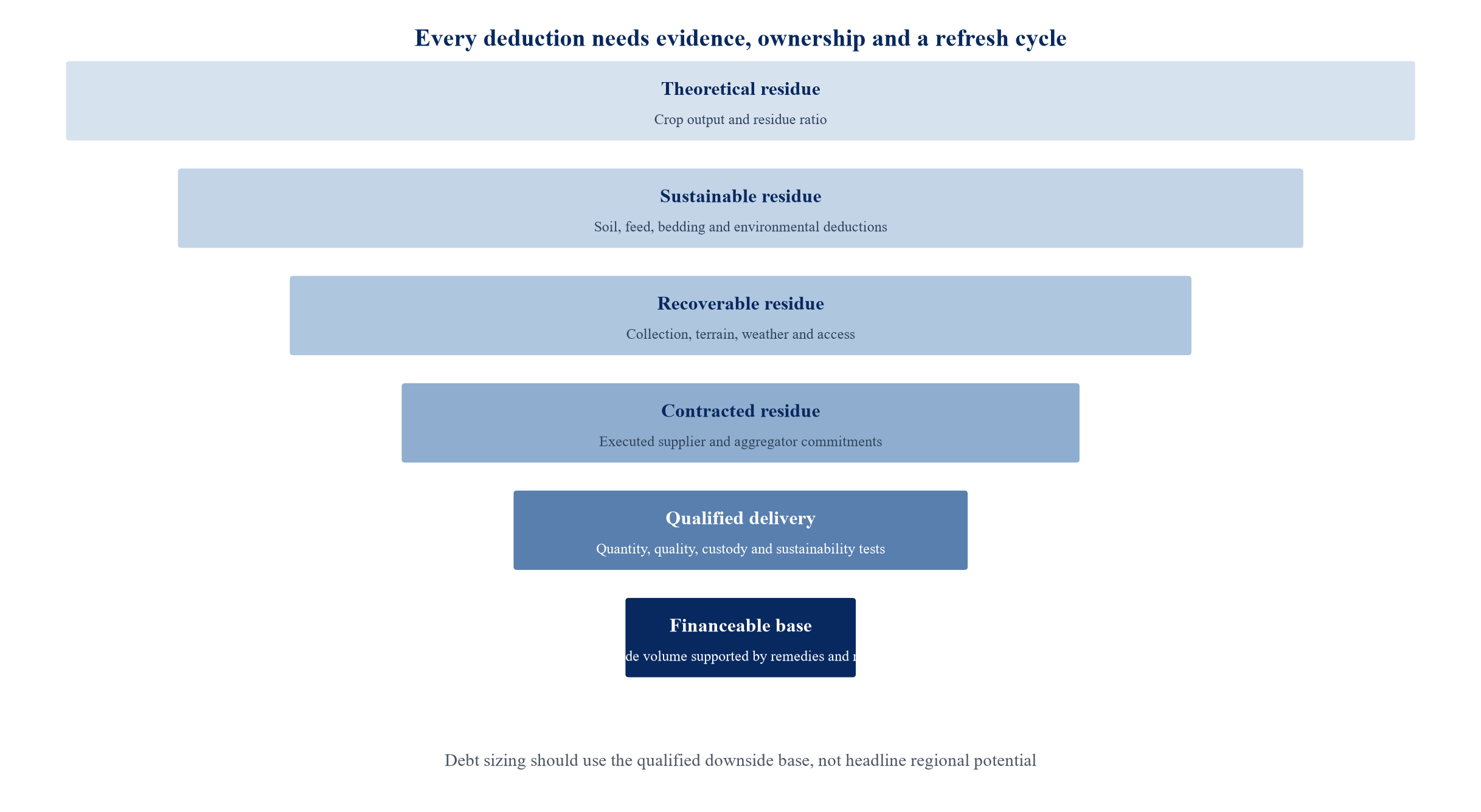
Conceptual supply funnel; project-specific quantities require agronomic, commercial and legal diligence.
4. Establish agronomic removal limits
Residue is part of a farming system. Removing too much material can affect soil organic carbon, nutrients, moisture retention and erosion. The appropriate limit varies by crop, soil, climate, slope, tillage, rotation and the return of digestate or other nutrients. A fixed regional percentage may be unsuitable for individual fields.
The supply programme should use an agronomic protocol developed for the relevant jurisdiction and crop. It should specify excluded land, minimum retained cover, collection conditions, nutrient replacement, burning avoidance, record keeping and audit. Where the residue is a processing by-product rather than field material, the protocol should address the upstream crop and any competing food, feed or material use.
The contract should make sustainability compliance a delivery condition and should allocate the cost of evidence. Suppliers may lack the systems to produce detailed records. An aggregator can provide mapping, training, digital collection and audit support. Payment should not incentivise removal beyond the approved limit.
5. Build a portfolio rather than a single promise
Agricultural supply is naturally distributed. Concentrating the project on one large counterparty can simplify negotiation while creating correlated crop, location and credit risk. A portfolio can diversify those risks, yet it also increases administration, traceability and enforcement complexity.
The structure can combine anchor suppliers, farmer cooperatives, processors, aggregators and spot or replacement arrangements. Anchor contracts provide a base volume and operating history. Aggregators manage smaller suppliers, equipment and logistics. Direct farmer relationships can improve transparency. Replacement agreements create contingency access without overstating committed tonnes.
The lender should see the portfolio by supplier, crop, region, harvest month, contract tenor, price formula, quality, delivery point and remedy. Concentration limits can restrict dependence on one supplier, crop or depot. The model should test whether one weather event or policy change can affect several nominally different suppliers at the same time.
6. Match contract tenor to debt exposure
A ten-year loan supported by two-year feedstock contracts leaves a renewal gap. Long tenor alone is insufficient if volume is optional, pricing is reopenable without limits or termination rights are broad. The effective tenor is the period during which quantity, price, quality and remedies are sufficiently defined.
Farmers may resist long fixed commitments because crop choice, input prices and market conditions change. A practical structure can use a long framework agreement with annual acreage or volume nominations, minimum participation, transparent price adjustment and defined exit compensation. An aggregator can absorb individual churn by maintaining a qualified supplier pool.
Debt documents should set a minimum weighted-average contract life and require renewal before exposure falls below a stated threshold. The project should deliver a rolling supply plan well before each harvest. Failure to renew should trigger a distribution lock-up, additional liquidity or reduced production rather than an immediate unmanageable default.
7. Define quantity in usable terms
The contract should state annual and seasonal minimums, permitted tolerance, nomination procedure, delivery schedule and measurement method. Wet tonnes should be converted to dry tonnes or energy value using an agreed moisture test. The treatment of foreign matter, soil, stones, metals, plastics and other contaminants should be explicit.
Quantity risk arises at several points: the crop may not grow, the residue may not be recoverable, the supplier may divert it, collection equipment may fail, storage may degrade it, transport may be interrupted or the plant may reject it. The agreement should identify when title and risk transfer and which party bears loss before and after that point.
Take-or-pay language may be unsuitable for a fragmented supplier base without credible security. A more financeable package can combine minimum-delivery obligations, liquidated damages calibrated to replacement cost, security deposits, retention, performance bonuses, insurance where available and aggregator replacement duties.
8. Make quality objective and testable
Quality definitions should reflect conversion performance. Common variables include moisture, ash, soil contamination, particle size, bulk density, chlorine, sulphur, alkali metals, volatile solids, calorific value and biological contamination. The relevant list depends on the technology and should come from tested operating requirements.
United States Department of Energy research highlights that moisture, ash, composition, particle characteristics and storage conditions can affect handling, equipment reliability, yield and cost.[7][8] The contract should link sampling to these operational consequences. A broad phrase such as merchantable residue leaves too much uncertainty.
Testing should specify sampling location, composite method, laboratory standard, frequency, chain of custody, calibration, dispute laboratory and data hierarchy. Rapid field instruments can guide acceptance while periodic accredited testing confirms the result. The project should retain samples when practical for dispute resolution.
9. Pay for qualified value
A flat price per wet tonne can reward water and contamination. Payment should reflect dry matter, energy content or conversion value. The formula can start with a reference price and adjust for moisture, ash, contamination, haulage zone, sustainability evidence, delivery timing and reliability.
Quality adjustment should be understandable to suppliers. Complex formulas can create disputes or discourage participation. The project can publish a delivery ticket showing gross weight, tare, moisture, deductions, accepted dry tonnes, price and payment. Suppliers should have a defined period to challenge the result.
The formula should distinguish normal variation from rejection. Material within a tolerable band can attract a discount. Material outside a critical limit may be rejected or redirected at the supplier's cost. A blending facility may recover value from variable lots, but the model should include blending cost and the risk of contaminating compliant inventory.
10. Allocate harvest and collection responsibility
The party controlling collection should control equipment, scheduling and field compliance. A farmer-delivered structure transfers logistics to many parties and can create inconsistent handling. An aggregator-collected structure centralises equipment and scheduling while placing working capital and operational risk on the aggregator.
The contract should state who owns balers, loaders, chippers, trucks and storage. It should cover mobilisation, maintenance, spare equipment, operator standards, fuel, permits, field damage, fire prevention and weather suspension. Collection windows should align with agricultural operations and residue moisture.
Equipment capacity should be tested against the narrowest harvest window rather than average annual demand. A project that requires most of its inventory in six weeks needs redundancy during those six weeks. Lenders should review equipment availability, maintenance records, contractor credit and replacement arrangements.
11. Treat storage as a production asset
Seasonal residue must often support year-round operation. Storage therefore performs the economic function of a reservoir. It carries quantity, quality, fire, weather, pest, theft and working-capital exposure. The storage design should state capacity, throughput, layout, drainage, ventilation, fire separation, monitoring and first-in-first-out rules.
DOE guidance identifies moisture management, degradation, material loss and fire risk as central storage concerns.[8] A base case should apply dry-matter loss by storage method and duration. The loss should reduce both physical inventory and expected conversion yield where quality deteriorates.
Ownership and financing of inventory must be explicit. The project may pay at farm gate, on depot acceptance or on plant delivery. Early payment supports suppliers but increases project working capital and loss exposure. Warehouse controls, insurance, independent inspection and lender security may be required when stored biomass is material collateral.
12. Verify inventory rather than assuming it
Inventory records should reconcile opening stock, accepted receipts, transfers, processing, rejected material, dry-matter loss, fire or spoilage, and closing stock. Physical surveys can test the ledger. Weighbridge records, moisture-adjusted quantities, depot maps and batch identifiers should form one custody system.
The operator should report days of qualified inventory by feedstock category and storage site. A headline total can hide unusable or inaccessible material. The covenant definition should exclude disputed, off-specification, uninsured, sustainability-ineligible or encumbered inventory.
Digital records can improve traceability, though a technology label does not create evidence by itself. The system should preserve source, field or processor, harvest date, supplier, quality tests, transport, storage location and movements. Access controls, reconciliation and independent audit determine reliability.
13. Design an enforceable delivery hierarchy
The contract should state delivery priority during scarcity. A supplier serving animal feed, industrial heat and the financed plant may have competing obligations. Exclusivity can protect the project but may be commercially unacceptable or difficult to enforce. A right of first offer or minimum reserved quantity can be more workable.
The hierarchy should cover committed quantity, excess quantity, force majeure, allocation among buyers and diversion remedies. The project may pay a capacity component for reservation and a commodity component on delivery. Reservation payments should be recoverable or reduced when the supplier fails to maintain the agreed capacity.
The supplier should disclose existing commitments and notify new ones. Aggregator contracts should prohibit double counting across depots or projects. Audit rights should extend to supplier records that substantiate acreage, production and delivery.
14. Price indexation should track real cost drivers
Feedstock price can be linked to farm costs, alternative uses, inflation, diesel, labour and haulage. A single consumer-price index may not reflect the supply chain. A commodity index may introduce volatility unrelated to collection cost. The formula should identify which risks the project can pass through to its product buyer.
A practical structure can separate a residue value, collection charge, transport charge and quality adjustment. Each component can use a relevant index with caps, floors and review periods. Extraordinary change mechanisms should be narrow and objective.
The financial model should apply the contractual formula, including lag and floor effects, rather than an independent inflation assumption. If feedstock price rises while product revenue remains fixed, the project carries basis risk. That risk should be hedged, shared or reflected in debt sizing.
15. Allocate crop failure without destroying the contract
Weather and biological events can reduce crop output. A force-majeure clause should define the affected area, evidence, notice, mitigation and allocation. A broad clause that excuses all shortfall after any adverse weather may leave the project with no remedy.
The agreement can use objective crop-yield evidence from government statistics, insurer assessment, remote sensing or field inspection. Relief should apply only to the affected volume and period. Suppliers should be required to offer available residue pro rata and assist replacement sourcing.
The project should carry part of systemic crop risk through diversification, inventory and liquidity. Attempting to transfer every catastrophic agricultural risk to small suppliers may create a contract that cannot perform when needed. Financeability depends on credible risk-bearing capacity as well as legal wording.
16. Address competing uses before financial close
Residue can already have value as fodder, bedding, soil amendment, fuel or raw material. New policy, subsidy or industrial demand can increase that value. A resource study should identify current use and the price at which users may compete.
The price formula can reduce diversion risk, while exclusivity, reservation payments and audit improve enforceability. The project should also qualify alternative crops or by-products within the plant's technical envelope. Flexibility has capital and operating costs but can reduce dependence on one market.
The downside case should assume a credible competing use captures part of the contracted pool. Replacement cost should include mobilisation, longer haulage, different quality, additional testing and any conversion penalty. A nominal penalty that is far below this cost may not deter diversion.
17. Use aggregators with measurable obligations
An aggregator can bridge many farmers and one industrial buyer. Its obligations should extend beyond passing through farmer contracts. It should maintain a supplier network, equipment, depots, quality control, data, logistics and replacement capacity.
The lender should review the aggregator's balance sheet, working capital, operating history, management systems and subcontractors. Where the aggregator is thinly capitalised, the project can require a parent guarantee, performance security, reserve, assignment of supplier contracts or direct agreements.
The aggregator agreement should define key personnel, minimum supplier coverage, equipment availability, storage capacity, reporting and audit. Change of control and subcontracting should require consent where they affect performance. Step-in rights can allow the project or lenders to preserve the network after default.
18. Build a replacement feedstock protocol
Replacement rights are meaningful only when the plant can use the substitute. The project should pre-qualify alternative residues by composition, contaminants, handling, emissions, yield and sustainability. Permits and offtake claims may restrict substitution.
The protocol should state who sources, tests, transports and approves replacement material. It should establish the maximum proportion that can be blended, any required plant adjustment and the treatment of incremental cost. Emergency procurement should still preserve traceability and legal compliance.
A lender case can assume a limited replacement volume supported by identified suppliers and logistics. It should not assume an unlimited spot market where no established market exists. The World Bank has long identified resource assessment, stockpiles, densification, flexible technology and broader supply areas as practical responses to biomass supply uncertainty.[11]
19. Align the feedstock and product contracts
Feedstock and product agreements should use compatible force-majeure, quality, scheduling and change-in-law rules. A plant should not owe full product delivery when feedstock suppliers receive broad relief, unless inventory or replacement capacity closes the gap. Conversely, product curtailment can leave the project holding perishable or costly inventory.
The product price formula should recognise material feedstock indexation where possible. Sustainability definitions should also align. A product buyer may require certification or carbon intensity evidence that the feedstock contract does not deliver.
Completion tests should use representative feedstock and prove sustained operation, quality acceptance, inventory control and product compliance. A short test on ideal material may not establish performance across the contracted envelope.
20. Convert physical risk into debt-service tests
The debt model should translate supply variables into output and cash flow. Relevant inputs include qualified tonnes, moisture, dry-matter loss, conversion yield, plant availability, delivered price, product price, working capital and replacement cost. Each should trace to a contract, technical report or expressly hypothetical downside assumption.
The base case should avoid stacking optimistic assumptions. High crop yield, full supplier performance, low moisture, low transport cost and high conversion yield may be individually plausible while jointly unlikely. Correlation matters because wet weather can reduce harvest, increase moisture, raise transport cost and lower conversion performance at the same time.
Debt service coverage should be tested under single and combined shocks. The project should identify the point at which inventory, liquidity or covenant action protects debt service.
Table 1. Feedstock risk and evidence matrix
| Risk | Required evidence | Contract control | Financial response |
|---|---|---|---|
| Sustainable availability | Field-level resource study, removal protocol and existing-use survey | Eligible-source schedule, annual certification and audit | Discount gross resource to financeable base |
| Seasonal shortfall | Crop history, weather analysis and harvest plan | Monthly delivery profile, notice and mitigation | Inventory minimum and seasonal liquidity |
| Quality variation | Plant specification, sampling plan and test history | Quality bands, price adjustment, rejection and dispute lab | Yield haircut and operating-cost sensitivity |
| Supplier diversion | Existing commitments, alternative-use pricing and supplier concentration | Reserved quantity, exclusivity where enforceable and replacement-cost damages | Higher replacement-price case |
| Aggregator failure | Financial statements, equipment, depot and supplier coverage | Security, assignment, direct agreements and step-in rights | Replacement-operator reserve |
| Storage loss | Engineering design, insurance, fire plan and historical loss | Custody rules, monitoring and stock reconciliation | Dry-matter loss and working-capital haircut |
| Logistics disruption | Route survey, fleet plan and alternate depots | Minimum fleet, subcontractor controls and emergency routing | Delivery delay and incremental haulage case |
| Sustainability failure | Certification scheme, chain of custody and audit plan | Evidence condition, cure and indemnity | Exclude ineligible inventory and revenue premium |
Illustrative diligence framework; project documents should define the exact evidence and responsible party.
21. Build sources and uses for the supply system
Feedstock infrastructure may include collection equipment, depots, weighbridges, laboratories, roads, storage, fire systems, preprocessing, information systems and initial inventory. These are part of project cost even when some assets sit outside the plant fence.
The sources-and-uses plan should separate sponsor-owned assets, aggregator assets, leased equipment, grants and working-capital facilities. It should identify who has security over inventory and equipment. A lender relying on feedstock assets should verify ownership, location, perfection and access.
The illustrative structure below is a management model. It does not represent a market quotation or identified project.
Table 2. Hypothetical sources and uses for a residue-dependent project
| Use | USD million | Funding source | USD million |
|---|---|---|---|
| Conversion plant and balance of plant | 72 | Senior term debt | 70 |
| Collection and preprocessing equipment | 12 | Sponsor equity | 35 |
| Depots, storage and fire systems | 14 | Equipment or working-capital facility | 10 |
| Development, engineering and owner's costs | 8 | Grant or subordinated capital | 5 |
| Initial qualified inventory | 5 | ||
| Contingency and debt-service reserve | 9 | ||
| Total | 120 | Total | 120 |
Illustrative management assumptions only; values are rounded and exclude tax, financing fees and project-specific contingencies.
22. Size working capital across the harvest cycle
The project may purchase months of inventory during a short harvest. Cash outflow can peak before product revenue is generated. The working-capital facility should match the inventory cycle, eligible collateral and borrowing-base rules.
Eligible inventory should be accepted, insured, traceable, within storage limits and free of competing liens. Advance rates should reflect degradation, price volatility and liquidation difficulty. Ineligible inventory should be excluded promptly.
The model should include supplier payment terms, inventory days, processing lag, product receivables and tax. A project that appears profitable annually can face a seasonal liquidity deficit. A committed facility, sponsor support or prefunded reserve should cover the downside cycle.
23. Link reserves to observable triggers
Reserves should have a defined purpose and release test. A feedstock liquidity reserve can cover replacement price, haulage, emergency storage or supplier prepayment. A debt-service reserve supports scheduled debt service while corrective action takes effect. A major-maintenance reserve covers equipment replacement.
Trigger design should use observable metrics: qualified inventory days, contracted coverage, supplier concentration, weighted-average tenor, rejected deliveries, moisture-adjusted loss, aggregator credit and forecast coverage ratio. Breach can require cash retention, additional contracting, inventory build or production adjustment.
Permanent overfunding is expensive. A dynamic reserve can rise before harvest or when coverage deteriorates and fall after verified inventory and contracts improve. Release should require independent or lender-agent confirmation.
24. Model a transparent hypothetical base case
Consider a plant requiring 180,000 qualified dry tonnes a year at full production. The hypothetical base case contracts 225,000 dry tonnes, applies 8 per cent non-delivery, 5 per cent quality rejection or adjustment and 4 per cent storage and handling loss. Qualified supply is therefore approximately 189,000 dry tonnes before operational buffer.
Assume a delivered feedstock price of USD 68 per qualified dry tonne and a conversion yield that supports annual product revenue of USD 42 million. Fixed and variable operating costs excluding feedstock are assumed at USD 13 million, leaving USD 16.1 million before debt service after feedstock cost. These values are hypothetical and should be replaced with project-specific contracts, engineering and market evidence.
The purpose is to expose relationships. A 10 per cent qualified-volume shortfall may reduce revenue, increase fixed cost per unit and require higher-priced replacement material. The effect is larger than the lost tonnes alone.
25. Test combined supply shocks
A drought case can reduce gross availability while raising prices. A wet-harvest case can increase moisture, storage loss and transport cost. An aggregator-default case can interrupt delivery and require emergency mobilisation. A competing-use case can increase diversion and replacement price.
The model should calculate debt-service coverage under each event and a combined event. It should show how inventory, contractual damages, reserves and flexible operations mitigate the loss. Contract remedies should be capped at amounts realistically recoverable from the responsible party.
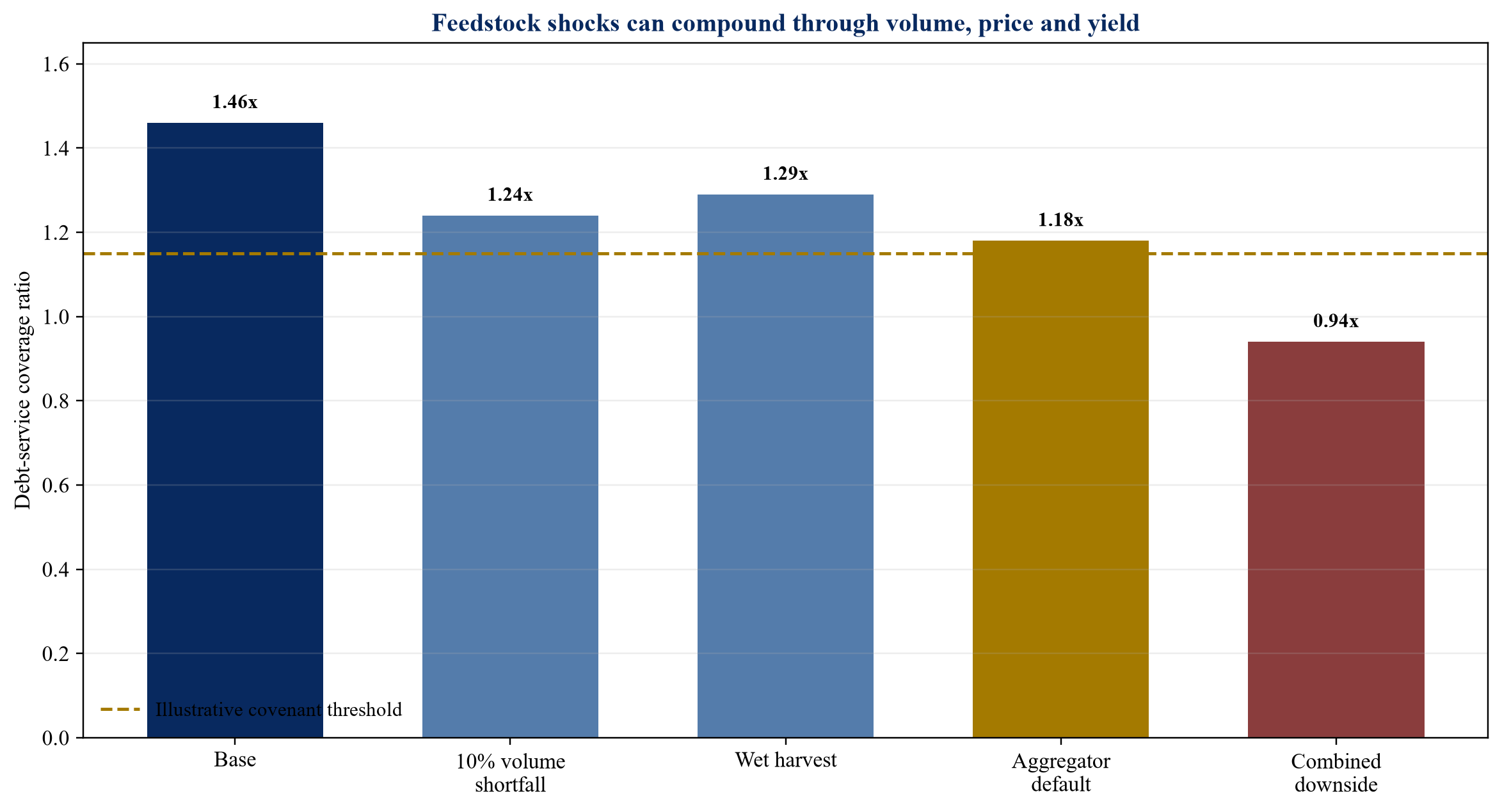
Illustrative management model; values are hypothetical and do not describe an identified project or financing.
26. Use contractual damages that reflect replacement economics
Damages should estimate the project's incremental loss without becoming an unenforceable penalty under applicable law. The formula can include replacement feedstock price, additional haulage, testing, processing loss and documented production loss, subject to agreed limits.
A supplier's liability cap should reflect its financial capacity. Small farmers may provide little credit support. The structure can retain part of payment, require cooperative or aggregator support, use performance security, or rely more heavily on portfolio diversification and reserves.
The project should avoid assuming full recovery in the debt base case. Damages are a secondary remedy after physical replacement. Lenders need to know how quickly cash can be collected and whether disputes suspend payment.
27. Draft force majeure around mitigation
Force majeure should require prompt notice, evidence, continued performance where possible and active mitigation. It should distinguish supplier-specific events from regional events. Equipment failure, lack of funds, avoidable labour issues and price increases should not automatically qualify.
The clause should address allocation of available residue, use of inventory, alternative routes and replacement sourcing. Relief should end when the event no longer prevents performance. Extended force majeure should permit replacement, contract reduction or termination.
The feedstock and financing documents should align on the consequences. A long relief period without lender action can consume inventory and liquidity before a remedy becomes available.
28. Treat sustainability evidence as a deliverable
Sustainability can determine market access, subsidy, carbon value and buyer acceptance. The supply contract should specify the applicable scheme, required data, audit rights, retention period and consequences of failure. Evidence may include land status, crop and field, removal practice, chain of custody, transport, greenhouse-gas inputs and mass balance.
FAO's sustainability frameworks and the Global Bioenergy Partnership indicators provide structured approaches to environmental, social and economic performance.[2][3] Project requirements should be tailored to the governing law and product market.
An ineligible lot may remain physically usable while losing a premium or legal status. The model should distinguish physical value from certified value. The contract should allocate the lost premium, reprocessing, segregation and replacement cost.
29. Include environmental and social supply-chain controls
Feedstock procurement can create labour, traffic, dust, noise, fire, land-use and community impacts outside the plant. IFC Performance Standards require attention to supply-chain and environmental and social risks where relevant.[5] Public IFC biomass transactions also identify biomass-related supply-chain issues as part of diligence.[6]
The project should maintain supplier standards, contractor training, grievance mechanisms, incident reporting and corrective action. Collection should respect land access and crop operations. Transport plans should address road safety and community routes.
Serious non-compliance should permit suspension and replacement. The project should avoid designing a remedy that forces continued use of disputed material merely to protect supply volume.
30. Integrate insurance with operational controls
Insurance may cover fire, property damage, business interruption, cargo and some weather exposures. It rarely replaces a complete feedstock risk system. Policy terms, deductibles, exclusions, insured values and claims timing should be tested against the loss scenario.
Stored residue can present elevated fire risk. Insurers may require separation distances, temperature monitoring, access, water supply, housekeeping and maximum stack size. Compliance should be monitored continuously.
Crop insurance held by farmers may protect farm revenue without guaranteeing residue delivery to the project. Lenders should distinguish supplier financial resilience from project supply protection.
31. Establish completion tests for the whole chain
Mechanical completion of the plant does not establish feedstock readiness. Supply-chain completion should demonstrate executed contracts, trained suppliers, functioning collection equipment, operating depots, inventory, calibrated measurement, laboratories, traceability and representative feedstock performance.
The test should cover sustained operation across a defined period and quality envelope. It should prove conversion yield, emissions, product specification, inventory reconciliation and delivery scheduling. Seasonal commissioning may require interim tests and later confirmation during the main harvest.
Debt drawdown and final completion can be tied to different milestones. A contingency or sponsor support can remain until the supply system completes a representative cycle.
32. Create a monthly lender dashboard
The dashboard should connect operations to covenant action. Useful measures include contracted volume, delivered qualified volume, supplier concentration, weighted-average tenor, inventory days, moisture, ash, rejection, storage loss, delivered cost, replacement purchases, plant yield and forecast coverage.
Metrics should be shown against budget, prior period and trigger. Narrative should explain causes and corrective action. Data should reconcile to weighbridge, laboratory, inventory and financial records.
The lender's technical adviser may review the dashboard during ramp-up and after material breach. Audit rights should extend to depots, supplier records and information systems subject to appropriate confidentiality and data protection.
33. Allocate risk to the party that can act
Risk allocation should follow control, capacity and remedy speed. Farmers control field practices and truthful source data. Aggregators control mobilisation, equipment, depots and supplier substitution. The project controls plant specification, acceptance, inventory strategy and working capital. Product buyers control nomination and acceptance. Government controls permits and some policy conditions.
Transferring an uncontrollable risk to a weak counterparty creates a legal claim without operational protection. The financeable structure combines contractual allocation with physical redundancy and liquidity.
Table 3. Illustrative feedstock risk-allocation matrix
| Risk | Primary bearer | Control mechanism | Lender protection |
|---|---|---|---|
| Field sustainability and source accuracy | Supplier with aggregator oversight | Approved protocol, records, audit and suspension | Eligibility covenant and replacement right |
| Aggregate volume shortfall | Aggregator and project | Portfolio coverage, inventory, replacement network and damages | Minimum coverage, reserve and distribution lock-up |
| Quality outside specification | Supplier or aggregator before acceptance | Sampling, price adjustment, rejection and cure | Qualified-inventory definition and yield testing |
| Storage loss after acceptance | Project or depot operator | Design, monitoring, insurance and reconciliation | Stock covenant, loss limits and security |
| Transport interruption | Logistics provider and aggregator | Fleet redundancy, routes and subcontractor controls | Emergency plan and liquidity |
| Systemic crop failure | Project with limited supplier mitigation | Geographic and crop diversification, inventory and flexible feedstock | Downside debt sizing and reserve |
| Feedstock price escalation | As allocated by indexation and product pass-through | Component formula, caps, floors and hedge where available | Basis-risk sensitivity and covenant headroom |
| Certification failure | Party causing the evidence or practice failure | Data condition, audit, cure and indemnity | Exclusion from eligible inventory and cash-flow base |
| Aggregator insolvency | Project and aggregator security providers | Assignment, direct agreements, step-in and replacement operator | Security, reserve and transition plan |
Allocation is a starting framework and requires project-specific legal, technical, tax and insurance advice.
34. Use covenant escalation rather than one late default
Feedstock deterioration is often visible before production fails. Falling contract coverage, delayed harvest, rising rejection and declining inventory can trigger early action. Covenants should create an escalation ladder.
An early-warning level can require enhanced reporting. A second level can restrict distributions and require a remediation plan. A severe level can require reserve funding, sponsor support, independent review or production adjustment. Default should remain available for persistent or material failure.
Triggers should be calibrated to seasonality. Inventory naturally falls before harvest. The covenant profile should reflect the approved annual cycle while preserving minimum protection.
35. Govern annual resource refresh
The resource base changes with crop patterns, yields, suppliers, competing uses, roads, regulation and climate. The project should refresh the supply study annually and commission a deeper independent review periodically or after a material event.
The refresh should reconcile forecast and actual acreage, production, collection rate, quality, loss, cost and supplier retention. Variance analysis should update the lender model and procurement plan. A repeated optimistic forecast after several misses should not remain the debt case.
Board and lender reporting should identify changes in sustainable removal assumptions and certification rules. Expansion should rely on newly evidenced supply rather than unused theoretical potential.
36. Build data architecture around custody points
The data model should follow the physical chain. Supplier registration establishes identity, field or facility and approved material. Harvest records establish date and quantity. Transport records connect the load to vehicle and route. Weighbridge and laboratory records establish accepted quantity and quality. Storage and processing records preserve mass balance.
Data controls should include unique identifiers, role-based access, time stamps, exception reports, backups and audit trails. Automated sensors can improve timeliness, while calibration and manual verification remain necessary.
The project should define the authoritative record when systems disagree. Payment, inventory, sustainability and operations should reconcile from the same accepted event.
37. Plan for plant flexibility without hiding cost
Technical flexibility can accept several feedstocks, wider moisture or variable particle size. It can reduce supply risk while requiring additional preprocessing, storage segregation, emissions controls and operator skill. The benefit should be tested against capital and efficiency cost.
The permit, product specification and sustainability regime must allow the alternative. A plant designed for one residue should not assume another is usable based only on calorific value. Pilot testing and vendor confirmation may be required.
The financial model can value flexibility as avoided outage or lower replacement cost. It should include any yield penalty and additional consumables.
38. Sequence the transaction before financial close
First, define the product, plant operating envelope and feedstock specification. Second, commission a field-level sustainable resource and competing-use study. Third, design the supplier portfolio, logistics and storage system. Fourth, test representative material. Fifth, negotiate aligned feedstock, aggregation, logistics, storage and product agreements. Sixth, build the integrated model and downside cases. Seventh, complete legal, technical, environmental, social, insurance and tax diligence.
Financial close should require executed anchor contracts, a credible small-supplier mobilisation plan, permits, depots, equipment, working capital and the initial inventory strategy. Conditions subsequent should be limited, dated and supported by remedies.
The transaction team should maintain one interface matrix across documents. Quantity, quality, timing, force majeure, change in law, sustainability, measurement and liability should use compatible definitions.
39. Apply a lender decision framework
A lender can assess financeability through six questions. Is sustainable supply sufficient after conservative deductions? Are contract quantity and quality objectively measurable? Can the project replace shortfall quickly? Are counterparties capable of meeting obligations and remedies? Does the model reflect correlated downside? Do covenants, reserves and step-in rights act before debt service fails?
An affirmative answer requires evidence. Resource potential without supplier commitment is insufficient. Executed contracts without quality and remedies are insufficient. Remedies without counterparty capacity are insufficient. Inventory without custody and storage controls is insufficient.
The final credit case should state the residual risks the lender retains and the headroom available. Transparency strengthens the transaction more than a claim that feedstock risk has been eliminated.
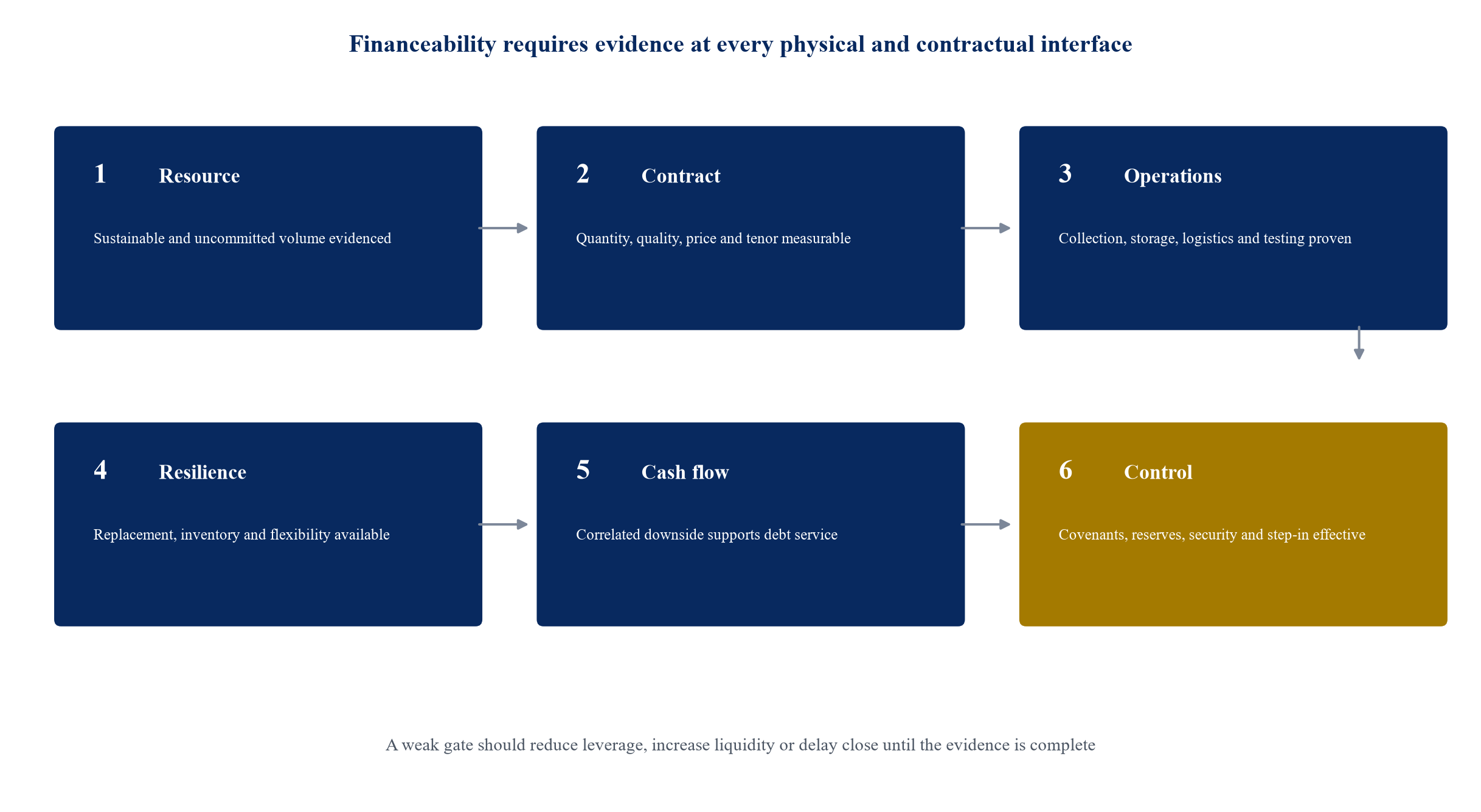
Illustrative lender workflow; the governing finance documents determine actual approval conditions.
Conclusion
Agricultural residue becomes financeable through a system of evidence and control. The project must establish sustainable availability, translate plant requirements into qualified tonnes, contract a diversified supplier base, measure quality, fund seasonal inventory, protect storage, preserve traceability and maintain replacement capacity. Each promise should connect to an observable metric, a capable risk bearer and a timely remedy.
The strongest structure combines contracts with physical resilience. Long tenor helps, yet inventory, depots, equipment, data, supplier diversity, operating flexibility and liquidity determine whether the project continues through disruption. Debt sizing should reflect the qualified downside supply base and correlated shocks.
A feedstock agreement is therefore part purchase contract, part logistics operating system and part credit support package. When drafted around delivered usable value and supported by verified operations, it can convert fragmented seasonal residue into a cash-flow input that lenders can assess and monitor.
FREQUENTLY ASKED QUESTIONS
1. What makes an agricultural-residue contract financeable?
A financeable contract defines qualified quantity, quality, price, timing, sustainability evidence, measurement, remedies and replacement rights. It is supported by credible counterparties, storage, logistics, inventory, liquidity and reporting that connect supply performance to project cash flow.
2. Should debt sizing use contracted tonnage?
Debt sizing should use a conservative qualified-volume case after deductions for non-delivery, quality rejection, sustainability ineligibility, storage loss and operational buffer. Contracted tonnage remains an input to that calculation.
3. How should feedstock quality be priced?
Payment can be based on dry tonnes, energy value or conversion value, with transparent adjustments for moisture, ash, contamination, haulage, timing and sustainability evidence. The testing and dispute process should be specified.
4. How can a project manage many small farmers?
A qualified aggregator or cooperative can manage onboarding, equipment, collection, depots, testing, data and payment. Its obligations, credit support, supplier coverage, audit and replacement duties should be measurable.
5. How much storage is required?
Storage should reflect the harvest calendar, plant consumption, delivery reliability and downside interruption. The required capacity is project-specific and should include dry-matter loss, quality segregation, fire controls and working-capital cost.
6. Can force majeure transfer crop risk to suppliers?
Force majeure can allocate legal relief and mitigation duties. Systemic crop risk still requires diversification, inventory, replacement supply, liquidity and conservative debt sizing because suppliers may lack capacity to absorb a regional event.
7. What should lenders monitor after closing?
Lenders should monitor contracted coverage, weighted-average tenor, concentration, qualified deliveries, inventory days, quality, rejection, storage loss, delivered cost, replacement purchases, conversion yield and forecast debt-service coverage.
8. Are the financial examples in this paper market forecasts?
No. They are hypothetical management-model assumptions used to demonstrate transaction mechanics. An actual project requires current supplier contracts, engineering, market evidence and professional legal, tax, technical and environmental advice.
References
- International Renewable Energy Agency, Agricultural residue-based bioenergy: Regional potential and scale-up strategies, 2023, https://www.irena.org/Publications/2023/Nov/Agricultural-residue-based-bioenergy-Regional-potential-and-scale-up-strategies
- Food and Agriculture Organization of the United Nations, Sustainable bioenergy from agriculture, accessed 3 October 2026, https://www.fao.org/energy/areas-of-work/sustainable-bioenergy-from-agriculture/1/en
- Global Bioenergy Partnership, Sustainability indicators for bioenergy, accessed 3 October 2026, https://www.fao.org/energy/areas-of-work/global-bioenergy-partnership/en
- International Finance Corporation, Environmental, Health, and Safety Guidelines, https://www.ifc.org/en/insights-reports/2007/general-environmental-health-and-safety-guidelines
- International Finance Corporation, Performance Standards on Environmental and Social Sustainability, 2012, https://www.ifc.org/en/insights-reports/2012/ifc-performance-standards
- International Finance Corporation, Omnicane Thermal Energy Operations biomass collaboration disclosure, accessed 3 October 2026, https://disclosures.ifc.org/project-detail/AS-SCCP/607920/cnc-omnicane
- United States Department of Energy, Feedstock Supply, accessed 3 October 2026, https://www.energy.gov/cmei/fuels/feedstock-supply
- United States Department of Energy, Feedstock Logistics, accessed 3 October 2026, https://www.energy.gov/cmei/fuels/feedstock-logistics
- United States Department of Energy, Biomass Feedstock Capabilities and Facilities, accessed 3 October 2026, https://www.energy.gov/cmei/fuels/fcic-biomass-feedstock-capabilities-and-facilities
- United States Department of Energy, Feedstock Variability Research, accessed 3 October 2026, https://www.energy.gov/cmei/fuels/fcic-feedstock-variability-research
- World Bank, Biomass Energy: Lessons from Case Studies in Developing Countries, https://documents1.worldbank.org/curated/en/701271468340801242/pdf/esm3000051Biomass0Energy01PUBLIC1.pdf
- International Finance Corporation, Converting Biomass to Energy: A Guide for Developers and Investors, 2017, https://www.ifc.org/content/dam/ifc/doc/mgrt-pub/biomass-report-06-2017.pdf
- IEA Bioenergy, Mobilizing Sustainable Bioenergy Supply Chains, 2015, https://www.ieabioenergy.com/blog/publications/mobilizing-sustainable-bioenergy-supply-chains/
- IEA Bioenergy, Bioenergy's Contribution to Sustainable Development, 2021, https://www.ieabioenergy.com/wp-content/uploads/2021/10/IEA-Bioenergy-SDG-Case-Study-Report-FINAL.pdf
- International Renewable Energy Agency, Renewable Power Generation Costs in 2024, 2025, https://www.irena.org/Publications/2025/Jul/Renewable-Power-Generation-Costs-in-2024
- Food and Agriculture Organization of the United Nations, Fuel not fire: from burning crop waste to bioenergy, 2020, https://www.fao.org/newsroom/story/Fuel-not-fire-from-burning-crop-waste-to-bioenergy/
- Food and Agriculture Organization of the United Nations, Enabling alternative sustainable uses of crop residue burning in Punjab, accessed 3 October 2026, https://www.fao.org/climate-change/projects-and-programmes/project-detail/enabling-alternative-sustainable-uses-of-crop-residue-burning-in-the-state-of-punjab2-loas-fao--centre-for-research-in-rural-and-industrial-development-crrid%29--india/en
- United States Department of Energy, FCIC Techno-Economic Case Study, 2021, https://www.energy.gov/cmei/fuels/articles/fcic-techno-economic-case-study
- United States Department of Energy, Feedstock-Conversion Interface Consortium Annual Review of Research FY 2021, 2022, https://www.energy.gov/cmei/fuels/articles/feedstock-conversion-interface-consortium-annual-review-research-fy-2021
- IEA Bioenergy, Annual Report 2024, 2025, https://www.ieabioenergy.com/wp-content/uploads/2025/06/IEA-Bioenergy-Annual-Report-2024.pdf
- European Commission Directorate-General for Research and Innovation, Mobilisation of industrial capacity building for advanced biofuels, 2026, https://www.ieabioenergy.com/wp-content/uploads/2026/02/2026_EC-DG-Research_Mobilization-of-industrial-capacity-building-for-advanced-biofuels.pdf
- International Renewable Energy Agency, World Energy Transitions Outlook 2022, https://www.irena.org/Digital-Report/World-Energy-Transitions-Outlook-2022/
About the Author
Chennakeshav (CK) is a corporate finance and investment banking executive with 25+ years of global experience in deal origination, structuring and execution across M&A, growth capital and corporate strategy. He has led value-creation mandates for founders, corporates and funds — bridging the boardroom view to hands-on execution and close.
His career spans Morgan Stanley, HSBC, Lloyds Banking Group, EWEC, ADQ portfolio companies and Emirates Growth Fund, across TMT, real estate, fintech, deeptech, cleantech, infrastructure and energy. He has partnered with C-suite leaders, private equity and venture funds, sovereign wealth funds and family offices to finance complex fund raises and scale-up ventures, and has led M&A due diligence, post-merger integration and business-transformation initiatives to create value.
At Matchpoint Partners he is Managing Partner, leading the firm's corporate finance, M&A and capital-raising practice. He holds an MBA from London Business School, an engineering degree from VTU and a Master of Laws (LLM, in progress) from UCL London.
An active start-up mentor, CK mentors at Techstars, DIFC FinTech Hive, Startup Grind, Founder Institute and IN5, serves as Entrepreneur Mentor in Residence (EMiR) at London Business School, and judges the Entrepreneurship World Cup.
