
1. The financing decision
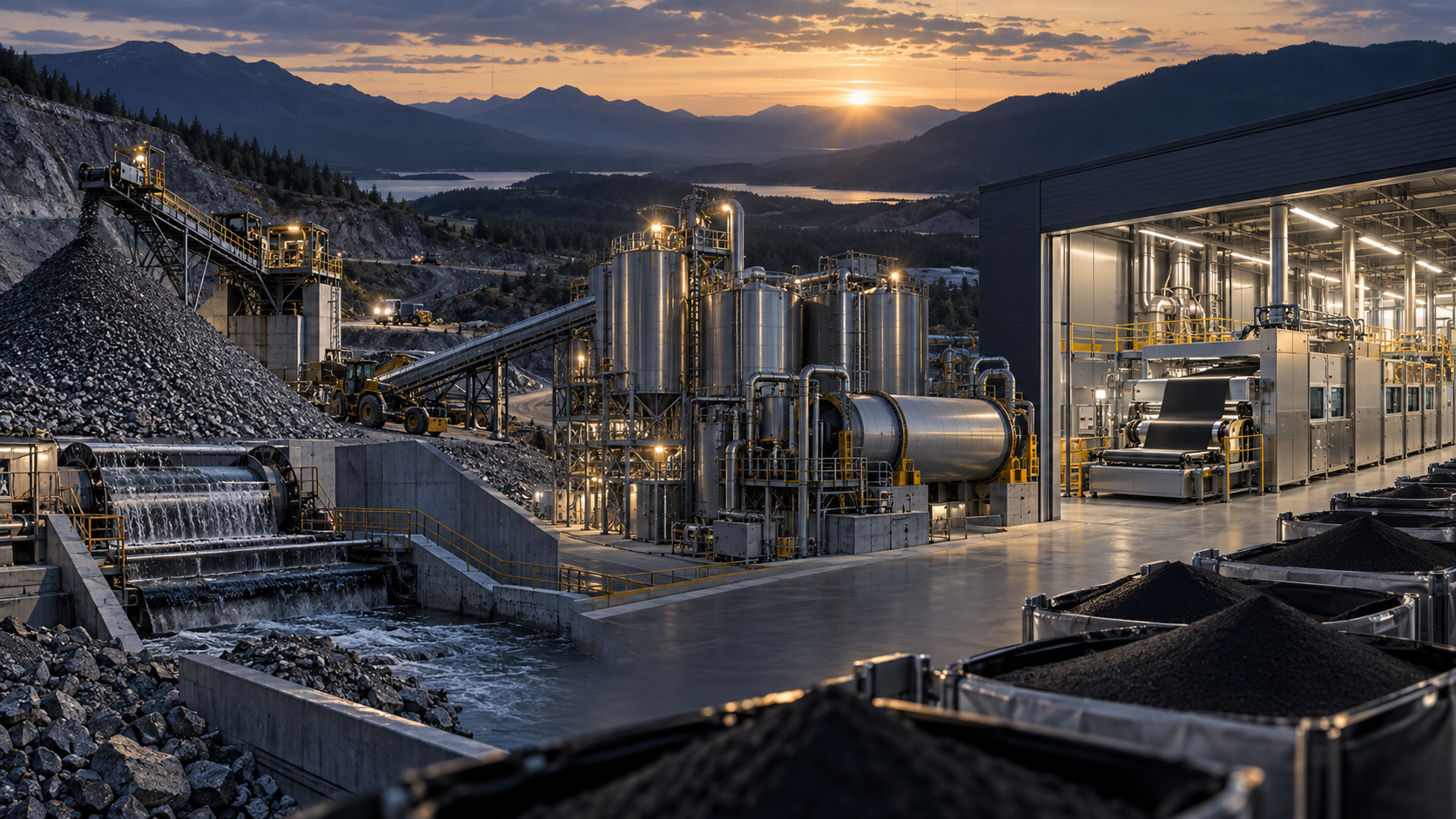
The decision is whether an alternative graphite-processing chain can produce a qualified active anode material at a complete cost and generate cash through price, yield and ramp-up stress. The financed perimeter may begin with a mine, purchased concentrate, petroleum-derived precursor, recycled material or an intermediate spherical product.
Debt analysis must follow the actual product. Flake concentrate, purified spherical graphite, coated spherical graphite and qualified active anode material have different customers, specifications, prices and risks.
2. Market context
Graphite is used in batteries, refractories, lubricants, brake materials and other industrial applications. The United States Geological Survey estimated United States natural-graphite consumption of 71,000 tonnes in 2025 and no domestic mine production [1]. Imports of natural and synthetic battery-anode material increased during 2025 [1].
These observations support strategic interest. They do not establish the price, market share or credit quality available to an individual project.
3. Product before commodity
Battery anodes require controlled purity, particle size, morphology, surface area, tap density, electrochemical performance, consistency and contamination. The product must work with a cell maker's chemistry, electrolyte, manufacturing process and performance targets.
A lender should avoid applying an active-anode-material benchmark to mine concentrate. Revenue begins with saleable qualified output after mass loss, yield, rejects, customer discounts and logistics.
4. Natural and synthetic pathways
Natural graphite is mined and concentrated, then may be purified, shaped, classified and coated. Synthetic graphite commonly starts from carbonaceous precursors that are calcined, formed and graphitised at high temperature before further processing.
Natural material can offer lower process energy where the resource and route are favourable. Synthetic material can offer controlled properties and established performance while carrying precursor, power and emissions exposure. Blended anodes create additional product combinations.
5. Alternative-chain architecture
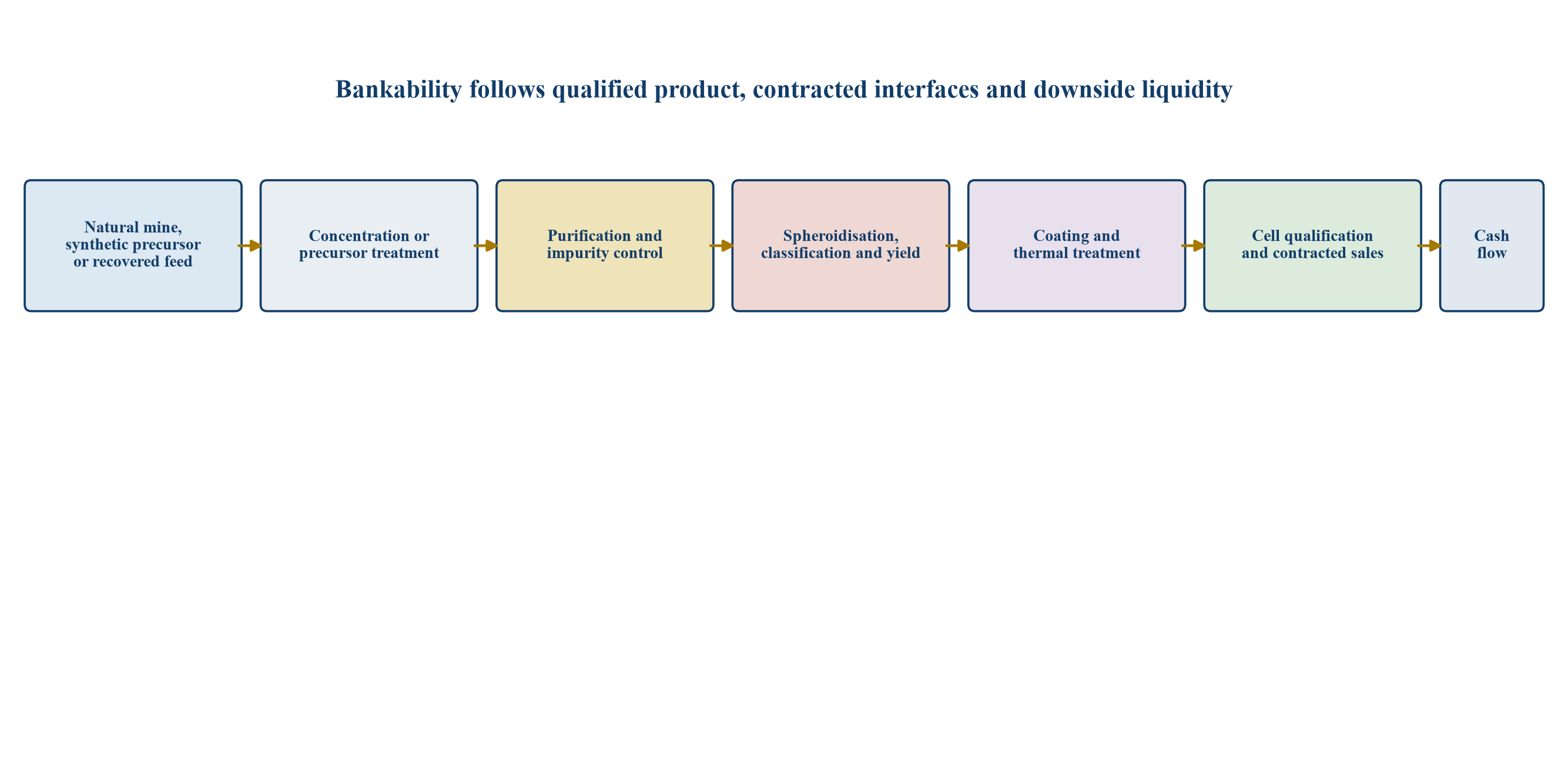
Generic decision framework; actual projects require asset-specific technical, commercial, legal and financial evidence.
6. Feed definition
Natural feed should be defined by mineralogy, flake-size distribution, carbon grade, impurities, liberation, recovery and variability. Synthetic feed requires precursor specification, availability, traceability, price and suitability for the selected process. Recycled feed adds collection, state, contamination and pre-treatment variables.
The financing model should reconcile feed contracts and mine schedules to the plant's accepted envelope. A nominal tonne of feed is not interchangeable with another tonne.
7. Mine and concentration
For natural graphite, mining and concentration determine feed consistency. Ore hardness, liberation, weathering, dilution, flotation response, water and drying affect recovery and concentrate grade. Large flakes can attract different markets, while battery processing may consume selected fractions.
The reserve schedule should connect to concentrate tonnes by size and grade. Mine output above the processing plant's needs still requires a credible market.
8. Purification route
Battery-grade applications require very high carbon purity and strict impurity control. Chemical purification and thermal purification have different reagent, energy, equipment, residue and emissions profiles. Route selection depends on feed mineralogy and customer specifications.
Laboratory purity does not establish commercial yield or cost. Evidence should include representative feed, integrated mass balance, reagent recycle, equipment materials, waste handling and sustained product consistency.
9. Spheroidisation
Spheroidisation shapes flake into rounded particles suited to anode manufacture. Milling and classification can create substantial mass loss into fines and by-products. Particle-size distribution, tap density and surface characteristics influence downstream performance.
The economic model should use saleable spherical yield rather than purification input. By-product revenue requires an identified product, customer and price after additional handling.
10. Coating
Carbon coating modifies surface performance and can improve initial efficiency, cycle life and compatibility. Coating feed, application, thermal treatment and process control affect consistency.
Coating capacity can become a bottleneck. Lenders should require evidence for coating yield, energy use, emissions control, quality release and customer approval. A purified spherical product may be commercially distinct from coated active anode material.
11. Synthetic graphitisation
Synthetic graphite production can require prolonged high-temperature treatment. Precursor quality, furnace design, loading, power price, power reliability, cycle time and yield drive economics.
Energy and emissions intensity can influence customer procurement and policy eligibility. A low-cost power contract should be tested for tenor, curtailment, indexation and network charges. Furnace throughput should reflect actual campaign time and maintenance.
12. Blended anodes
Cell makers may use blends of natural and synthetic graphite to balance performance, cost and supply. Silicon-containing materials can also be introduced in limited proportions depending on design.
The project should target a defined customer need rather than assume displacement of every incumbent material. Qualification evidence must cover the supplied product within the customer's formulation and process.
13. Qualification pathway
Qualification can progress from laboratory samples through pilot lots, production trials, cell testing, process audits and commercial approval. Each customer may require different data and change-control commitments.
Revenue timing should follow qualification milestones. A memorandum of understanding or sample shipment is not a purchase obligation. The model should include rejected batches, discounts, inventory and the cost of repeated testing.
14. Product traceability
Battery customers increasingly require lot traceability, process control and source information. Traceability should connect feed, process parameters, laboratory results, packaging and shipment.
Digital records need calibrated instruments, access controls and retention. Traceability can support qualification and responsible sourcing, but it cannot correct inconsistent material.
15. Structural bankability test
Table 1. Graphite-processing structural bankability test
| Dimension | Evidence | Downside exposure | Bankable response |
|---|---|---|---|
| Feed | Reserve, precursor or supply contracts | Variable impurities or interrupted volume | Accepted envelope and alternative supply |
| Process | Representative integrated campaigns | Purity or yield below design | Performance milestones and contingency |
| Product | Qualification and repeat specifications | Output discounted or rejected | Approved grades and multiple customers |
| Capital | Classed estimate and contracting plan | Completion funding gap | Funded contingency and sponsor support |
| Operations | Team, maintenance and quality systems | Slow ramp and high rejects | Readiness gate and vendor support |
| Sales | Binding volume and pricing provisions | Spot exposure and concentration | Creditworthy offtake with remedies |
| Finance | Debt service and liquidity cases | Covenant breach during ramp | Sculpted debt and liquidity reserve |
| Sustainability | Water, energy, chemicals and residues | Permit delay or recurring liability | Costed controls and closure obligations |
16. Mass balance
The mass balance should follow carbon from feed through concentration, purification, shaping, coating, rejects and by-products. Yield losses at consecutive stages compound. Internal recycle may improve recovery while increasing inventory and process load.
Each yield should be supported by representative evidence. A financial model that converts all purified feed into saleable active anode material overstates output and understates waste.
17. Product yield
Saleable yield incorporates physical recovery and quality acceptance. Production may meet carbon purity while failing particle, surface or electrochemical requirements. Customer-specific rejects can have limited alternative value.
The debt case should use demonstrated product yield and include a ramp curve. Upside from future optimisation should sit outside minimum debt service.
18. Capacity utilisation
Nameplate capacity reflects design conditions. Feed availability, furnace cycles, maintenance, laboratory release, coating throughput, customer orders and qualification can limit utilisation.
The model should identify the binding stage by month. Intermediate storage helps schedule operations but consumes cash and cannot cure a persistent bottleneck.
19. Market concentration
Processing and active-anode-material production are highly concentrated in China. Strategic projects can receive policy support and customer interest because alternative supply has continuity value.
An alternative supplier still competes on specification, delivered cost and reliability. Strategic value should be evidenced in contract terms, grants, guarantees, procurement or customer funding rather than assumed in valuation.
20. Natural-graphite trade
USGS reported that United States natural-graphite imports during 2021 to 2024 came principally from China, Canada, Mozambique and Mexico [1]. It also reported rising imports of battery-anode material in 2025 [1].
Trade data should be separated by product form and specification. Mine concentrate, purified product and finished active anode material can follow different tariff, origin and logistics rules.
21. Policy benchmarks
The EU Critical Raw Materials Act identifies battery-grade graphite as strategic and sets 2030 capacity benchmarks for extraction, processing and recycling, alongside a limit on single-country dependence [2]. The United States has used public lending to support active-anode-material capacity [3].
Policy support can close financing gaps when its eligibility, appropriation, milestones and remedies are clear. Policy ambition alone is not cash.
22. Public-finance precedent
The United States Department of Energy reported a USD 102.1 million direct loan issued in 2022 for expansion of the Syrah Vidalia active-anode-material facility [3]. The disclosure identifies project, employment and climate estimates made at closing.
This precedent shows that public debt can support strategic processing. It does not establish terms or bankability for another project. Each case requires independent underwriting.
23. Revenue architecture
Revenue depends on product specification, qualification status, contractual index, floor, premium, logistics and customer credit. Natural and synthetic products can have different benchmarks and negotiated adjustments.
The model should calculate realised price at the delivery point. A premium for alternative supply should only be included where a binding contract or defensible procurement mechanism supports it.
24. Feed pricing
Natural concentrate can be priced by grade, flake distribution, impurities and market reference. Synthetic precursors may link to petroleum or industrial markets. Transfer pricing matters in integrated structures.
Feed and product prices may reset on different schedules. Margin compression can arise when input prices move faster than sales contracts. Pass-through provisions and inventory timing should be modelled.
25. Conversion margin
Processing value equals qualified product revenue less feed, conversion, logistics, working capital and required returns. A low feed price can reflect poor quality or high treatment cost.
The margin should be shown before and after policy support and by-product credits. Costs allocated to an upstream affiliate should not disappear from the consolidated case.
26. Capital cost
Capital includes feed handling, purification, furnaces, mills, classifiers, coating, thermal treatment, laboratories, utilities, emissions control, residues, buildings, spares, commissioning, owner costs and working capital.
Benchmark capital must be normalised for capacity, product boundary, feed, geography and environmental scope. First-of-a-kind integration requires contingency tied to design maturity and interfaces.
27. Operating cost
Operating costs include feed, reagents, energy, labour, consumables, maintenance, laboratory, waste, packaging and logistics. Yield loss can dominate unit cost because purchased carbon leaves as fines or rejects.
The model should separate fixed and variable costs and calculate cost per accepted product tonne. A unit cost based on plant input can misstate competitiveness.
28. Energy exposure
Thermal purification, coating and synthetic graphitisation can consume substantial energy. Power contract, reliability, carbon intensity and network charges influence economics and qualification.
The downside case should include outages, curtailment, escalation and fuel or power basis risk. Renewable claims require clear contractual and accounting boundaries.
29. Chemical exposure
Chemical purification may require acids, alkalis and treatment reagents. Consumption depends on feed impurities, recycle and product standard. Supply, storage, worker protection and neutralisation add cost.
Reagent assumptions should come from integrated test work. Supplier concentration and transport corridors deserve contingency. Waste-treatment capacity should match peak impurity load.
30. Water and residues
Processing can require water for washing, classification, purification and emissions control. Residues may contain fluorides, metals, salts or other regulated constituents depending on route.
The project should have a complete water balance and residue characterisation. Permit conditions, treatment, storage, transport and closure obligations belong in capital and operating costs.
31. Working capital
Feed inventory, work in process, qualification lots, finished stock, receivables and reagent stocks consume cash. Long thermal cycles and customer approval can extend the cash-conversion period.
The financing plan should size working capital for ramp-up and downside timing. Inventory borrowing bases need conservative value, assay, title and liquidation assumptions.
32. Debt-service sensitivity
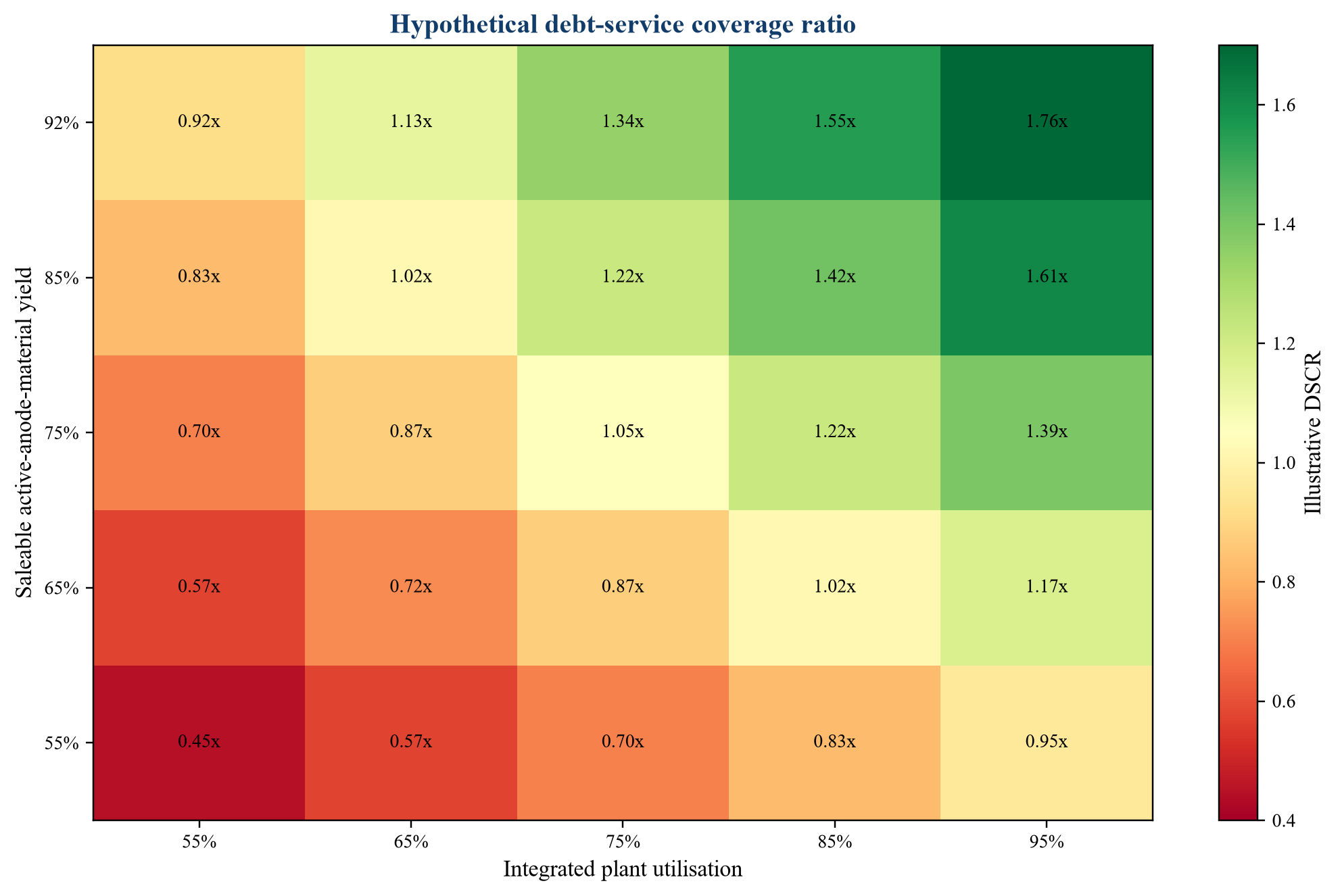
Illustrative index only; not a forecast, valuation or description of a project.
33. Debt sizing
Debt should be sized to stressed cash flow after sustaining capital, working capital and taxes. Completion delay and qualification risk can require an extended grace period and capitalised interest.
Leverage based on strategic importance can create refinancing risk. The lender case should remain viable without an uncontracted premium or rapid expansion.
34. Completion tests
Mechanical completion confirms construction status. Financial completion should require sustained throughput, accepted feed, product purity, morphology, coating performance, saleable yield, environmental compliance and customer acceptance.
Tests should run long enough to demonstrate stable operations. Waivers should require independent evidence and compensating support. One successful batch does not establish continuous performance.
35. Construction contracting
Engineering, procurement and construction allocation should reflect process maturity and vendor capability. Proprietary equipment, long-lead furnaces and imported controls can remain outside fixed-price protection.
The contract matrix should identify every battery limit, interface, exclusion and performance guarantee. Liquidated damages need credible caps and contractor credit.
36. Sponsor support
Sponsors may provide cost-overrun commitments, completion guarantees, working-capital support or subordinated funding. Support should cover defined risks and remain available when needed.
The lender should test sponsor liquidity and competing commitments. A support letter without enforceable amount, term and trigger provides limited protection.
37. Reserve accounts
Debt-service, maintenance and operating reserves can protect the project during ramp-up or disruption. Qualification and feed-transition reserves may also be appropriate.
Reserve size should follow modelled cash volatility. Funding reserves with additional senior debt can weaken leverage unless repayment capacity is adequate.
38. Covenants
Covenants can address debt-service coverage, leverage, liquidity, capital spending, distributions, contracts and environmental compliance. Operational information undertakings should cover yield, quality and qualification.
Thresholds need early warning before cash failure. Cure rights should distinguish temporary underperformance from a broken process or market case.
39. Offtake
Bankable offtake defines product, volume, qualification, price, tenor, delivery, credit support, rejection rights and remedies. A buyer may reserve capacity without accepting take-or-pay risk.
The contract should allocate change-control and customer-specific investment. Termination after qualification delay can create a severe refinancing gap.
40. Customer concentration
Early plants may rely on one anchor customer. Concentration can support technical collaboration and financing while increasing bargaining and termination exposure.
The model should test loss or delay of the largest customer. Designs and licences should permit sales to alternatives where possible. Exclusivity needs volume and credit protection.
41. Feed contracts
Merchant processors need sufficient feed of consistent composition. Contracts should cover quantity, specification, pricing, assay, delivery, rejection, force majeure and expansion rights.
Mine-linked plants should still test schedule and recovery. Vertical integration does not remove operational risk; it transfers it inside the financed group.
42. Logistics
Concentrate, chemicals, precursors and finished powders require suitable packaging, storage and transport. Moisture, contamination and dangerous-goods rules can matter.
The logistics plan should include border, port and route contingencies. Remote mine supply and imported reagents can create long lead times and working-capital exposure.
43. Foreign exchange
Revenue may be denominated in United States dollars while feed, power, labour, equipment and debt span currencies. Construction and operating exposures differ by phase.
The model should identify natural hedges, indexation and available instruments. Currency weakness can reduce local cost while raising imported inputs and debt service.
44. Scenario matrix
Table 2. Hypothetical graphite-processing financing scenarios
| Case | Product market | Execution | Contract position | Financing response |
|---|---|---|---|---|
| Diversified growth | Qualified demand expands | Ramp broadly achieved | Several creditworthy buyers | Base debt and expansion option |
| Delayed qualification | Sales begin later | Inventory and testing rise | Anchor buyer remains engaged | Extend liquidity and defer amortisation |
| Yield shortfall | Unit cost increases | Fines and rejects exceed plan | Price unchanged | Require cure plan and sponsor support |
| Feed disruption | Input price and variability rise | Utilisation falls | Alternative feed unqualified | Draw reserves and accelerate qualification |
| Price compression | Premium narrows | Operations stable | Pass-through protection limited | Restrict distributions and resize debt |
| Policy upside | Strategic support increases | Milestones achieved | Grant or guarantee becomes effective | Apply support after legal confirmation |
45. Natural versus synthetic financing
Natural projects combine mining and chemical-processing risk when integrated. Stand-alone processors depend on concentrate supply. Synthetic plants carry precursor, energy and furnace risks.
Debt terms should reflect the dominant failure mode. A natural route may require reserve and mine covenants; a synthetic route may require power and precursor protections. Both require product qualification.
46. Recycling
Battery manufacturing scrap and end-of-life batteries can provide carbon-bearing feed. Collection, separation, contamination, binder removal and economics vary.
Recycled output requires the same product evidence as virgin supply. Future end-of-life availability should be discounted for collection timing and competing recovery routes. Feed contracts remain fundamental.
47. Technology diligence
Diligence should review flowsheets, representative feed, mass and energy balances, test protocols, scale factors, equipment, controls, failure modes and intellectual property. Results should be reproducible.
Vendor guarantees should align with the financed product. Confidentiality does not remove the need for independent review. Design targets should be labelled as targets until demonstrated.
48. Intellectual property
Process know-how may include purification chemistry, furnace cycles, coating recipes, analytics and quality systems. Ownership, licences, improvements, jurisdiction and change-of-control provisions require review.
A patent does not prove yield or product acceptance. Dependence on a few specialists requires retention and knowledge-transfer plans.
49. Permitting
Permits can cover mining, chemicals, air emissions, water, residues, waste, transport and construction. Synthetic and thermal routes may face significant energy and emissions review.
The schedule should reflect complete applications, appeals and conditions. Strategic status can support coordination without guaranteeing approval or economics.
50. Responsible sourcing
Responsible sourcing covers labour, community, environment, corruption, security and traceability across mine, precursor and processing inputs. OECD due-diligence principles provide a risk-based framework [4].
Policies should lead to supplier assessment, monitoring and remediation. Certification supports evidence but does not replace site-specific diligence.
51. Community and workforce
Projects affect land, water, traffic, employment and local services. Chemical operations require trained process, laboratory, maintenance and emergency-response teams.
Community commitments and workforce plans belong in budget and schedule. Operator readiness should be a commissioning gate. Vendor teams should transition to sustainable local capability.
52. Insurance
Coverage may include construction, property, machinery breakdown, business interruption, cargo, environmental and political risks. Furnaces and specialised lines can have long replacement times.
Limits, exclusions and waiting periods should match the downside model. Insurance cannot replace maintenance, spares or redundant supply routes.
53. Data and quality systems
Statistical process control can track feed, purity, particle size, surface properties, coating and cell-test results. Data integration supports traceability and faster deviation response.
Models depend on calibrated instruments and governed data. Customer release remains subject to approved methods and human accountability. Cybersecurity protects process and commercial information.
54. Investment-committee scorecard
Table 3. Alternative graphite investment-committee scorecard
| Dimension | Required evidence | Decision question | Protective action |
|---|---|---|---|
| Feed | Resource or binding supply | Is composition stable and sufficient? | Contract alternatives and limits |
| Process | Integrated representative campaign | Are purity and yield demonstrated? | Stage capital and performance tests |
| Product | Qualification and repeat lots | Will customers accept output? | Tie value to approved grades |
| Market | Binding volume and price terms | Is revenue enforceable? | Diversify buyers and credit support |
| Capital | Complete estimate and interfaces | Is construction fully funded? | Contingency and sponsor commitment |
| Operations | Team, spares and quality systems | Can output remain consistent? | Readiness gate and monitoring |
| Sustainability | Permits, energy and residue plan | Are obligations financeable? | Cost controls and closure security |
| Debt | Stress case and reserves | Can cash service debt through delay? | Sculpt amortisation and reserves |
55. Stage gates
The first gate defines feed and product. The second proves integrated processing. The third secures permits, engineering and contracts. The fourth releases construction. The fifth requires sustained output and qualification before full debt amortisation.
Each gate needs objective evidence and capital limits. Failure should lead to redesign, partnership, pause or exit.
56. Implementation roadmap
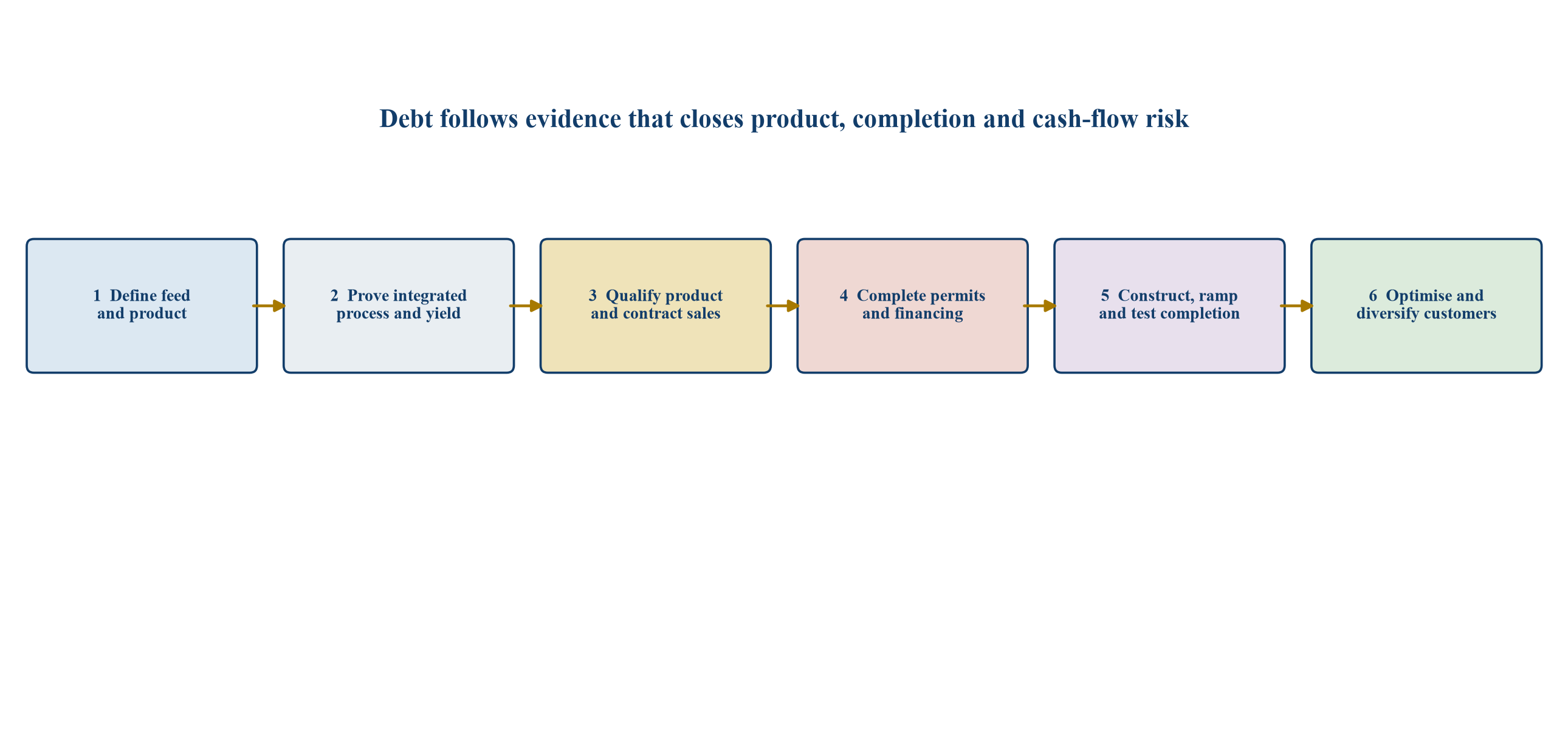
Generic sequence; timing and evidence vary by feed, route, jurisdiction and customer.
57. First 100 days after acquisition
The first 100 days should reconcile feed, inventory, mass balance, laboratory methods, product certificates, customer status, maintenance, permits, contracts and liquidity. One operational and commercial dataset should replace inconsistent versions.
Throughput increases should follow control of quality and safety. Management should validate the acquisition case before committing expansion capital.
58. Monitoring dashboard
The board should monitor feed specification, throughput, purification yield, spherical yield, coating yield, accepted product, rejects, energy, reagents, inventory, qualification, contracted orders, cash and debt-service coverage.
Targets should distinguish design, ramp and steady state. Variances need owners, deadlines and defined escalation.
59. Trigger framework
Triggers can cover feed deviation, purity, yield, qualification delay, customer rejection, construction cost, liquidity and covenant headroom. Each trigger should link to an action.
Actions include alternate feed, technical review, capital hold, sponsor funding, reserve draw, contract remedy or shutdown. Early action protects options.
60. Final financing test
The final test asks whether a defined feed can be converted repeatedly into qualified active anode material, sold under enforceable terms and delivered through a fully funded project with enough cash to survive delay and price stress.
Approval should specify conditions, completion tests, reserves, covenants, reporting and sponsor obligations. Strategic demand strengthens a proven project; it does not replace product and cash-flow evidence.
61. Price-index design
Graphite markets contain several products and negotiated specifications. A published flake quotation may not represent purified spherical or coated active anode material. The financing model should identify the exact index, conversion, quotation period, currency, location and quality adjustments used in each contract.
Floors and collars can protect debt service when they bind a creditworthy buyer for adequate volume and tenor. Reopeners, hardship provisions and qualification conditions can weaken that protection. Independent review should test the contract against the model.
62. Tariffs and origin
Tariffs, anti-dumping measures, origin requirements and subsidy rules can affect delivered price and customer eligibility. Processing location may not determine origin when feed, precursor or value addition comes from another jurisdiction.
The project should obtain current legal analysis for its product and trade route. The base case should use enacted rules and documented eligibility. Proposed measures belong in scenarios, with no value assigned until their legal and operational effect is established.
63. Tax and incentives
Tax credits, grants, accelerated depreciation, production support and customs relief can improve returns. Their value depends on qualifying activity, domestic-content tests, taxable income, transferability, appropriation and compliance.
The model should show economics before and after incentives. A benefit should enter debt sizing only when legal entitlement, timing and monetisation are sufficiently certain. Clawbacks and change-in-law exposure need explicit treatment.
64. Intercreditor structure
Projects can combine public loans, commercial debt, equipment finance, working-capital facilities, grants and shareholder funding. Each instrument may claim security, cash flow and decision rights.
Intercreditor arrangements should define priority, enforcement, cure, standstill, voting, permitted payments and collateral releases. Working-capital lenders need access to inventory and receivables without undermining project continuity. Conflicting conditions precedent can delay financial close.
65. Security package
Security may cover project-company shares, accounts, contracts, permits, equipment, land rights, insurance and receivables. Specialised process assets can have limited liquidation value outside the operating chain.
Lenders should evaluate security as a control and restructuring tool rather than assume full recovery through asset sale. Direct agreements with key customers, feed suppliers, technology licensors and contractors can preserve project value after default.
66. Debt amortisation
Amortisation should follow conservative cash generation after qualification and stable operations. A steep schedule beginning immediately after mechanical completion can consume liquidity while the customer approval process remains open.
Sculpting can align payments with contracted cash flow, while maintaining a tail before contract or permit expiry. Cash sweeps can accelerate repayment after outperformance. Balloon debt needs a credible refinancing or repayment path.
67. Interest-rate exposure
Variable-rate debt creates cost exposure during construction, ramp-up and operation. Delays increase both capitalised interest and the period before revenue. Hedging should reflect expected draw profile, tenor and prepayment flexibility.
The downside model should include rate and schedule stress together. A hedge can reduce rate volatility while creating break costs. Documentation should align hedge termination, lender enforcement and project restructuring.
68. Inflation and escalation
Specialised furnaces, corrosion-resistant equipment, automation, power infrastructure and imported components can face vendor concentration and escalation. Fixed-price contracts often retain indexation, currency and change exclusions.
Capital estimates should state price date, currency and escalation basis. Procurement packages should preserve technical compatibility. Contingency should reflect remaining definition and interface risk rather than serve as a general balancing item.
69. Commissioning inventory
Commissioning requires feed, reagents, consumables, spare parts and laboratory materials before stable sales. Early output can be unsuitable for the intended customer, creating inventory or disposal cost.
The funding plan should include repeated start-up campaigns and qualification lots. Feed suppliers and customers may provide material or prepayments, but the contract must allocate ownership, loss, assay and off-specification consequences.
70. Maintenance strategy
Mills, furnaces, classifiers, coating systems, emissions controls and laboratories have different maintenance cycles. Specialised parts can have long lead times. Deferred maintenance may improve short-term cash while damaging yield and reliability.
The operating case should include preventive maintenance, critical spares, shutdowns and vendor support. Completion testing should not rely on unsustainable maintenance deferral. A maintenance reserve can protect debt service from predictable major events.
71. Laboratory capability
Laboratories release feed, intermediates and finished product. Methods, sampling, calibration, reference materials, turnaround time and data integrity influence production decisions and customer trust.
A laboratory bottleneck can delay shipments even when the plant operates. Diligence should compare internal and independent results, review method validation and confirm capacity across shifts. Disputes need agreed referee procedures.
72. Change control
Customers may restrict changes to feed source, process, equipment, location or specification after qualification. A technically beneficial change can trigger requalification and delay revenue.
Project governance should integrate engineering and customer change control. The model should include requalification where alternate feed or debottlenecking is planned. Lender consent should focus on changes that affect product, contracts, permits or completion evidence.
73. Expansion financing
Expansion can add purification, coating, synthetic capacity, alternate feed or downstream integration. Shared utilities and teams may improve returns, while construction can disrupt operating output.
Expansion debt should rely on proven base operations and incremental contracts. Ring-fencing can protect the original lenders. Optional phases should not enter initial repayment capacity before permits, funding and execution evidence exist.
74. Acquisition finance
Buying an operating or development-stage processor can accelerate market entry. Diligence should reconcile historical production, quality, customer approvals, maintenance, environmental liabilities, working capital and remaining capital.
Acquisition debt should distinguish purchase price from required remediation and growth funding. Earn-outs and seller support can allocate uncertainty when qualification or capacity claims remain unproven. Integration planning should protect customers and critical technical staff.
75. Exit and refinancing
Potential buyers include battery-material companies, cell manufacturers, miners, industrial groups, infrastructure funds and strategic public investors. Each values different combinations of supply security, qualification, technology and cash flow.
Refinancing readiness requires stable accepted production, audited data, durable contracts, permit compliance and a complete maintenance plan. A project should avoid depending on a sale or refinancing to bridge an unresolved process problem.
76. Board decision record
The board should document evidence, assumptions, unresolved risks, funding sources, stage gates, covenants and decision rights. Observed performance, management estimates and contractual commitments should remain distinguishable.
Material changes in feed, route, product, customer, budget, schedule or policy support should return for approval. A disciplined record improves lender communication, transaction readiness and accountability during ramp-up.
77. Portfolio construction
An investor may combine upstream natural graphite, merchant processing, synthetic production and recycling exposures. Their cycles, feed risks and capital requirements differ. Portfolio analysis should avoid treating every asset as the same battery-demand exposure.
Diversification is strongest when products, customers and jurisdictions differ and operating risks are independently controlled. Correlation can increase during battery-market weakness or trade disruption. Capital allocation should compare marginal risk, liquidity and follow-on funding obligations.
78. Strategic-buyer perspective
A cell maker or vehicle manufacturer may value continuity, product co-development, regional content and visibility over input specifications. A mining or materials group may value feed integration and processing know-how.
The transaction case should quantify the buyer-specific benefit and implementation cost. Strategic value should not be applied as a universal premium. Competition, exclusivity and security-review constraints influence the attainable price.
79. Independent-engineer scope
The independent engineer should review feed, process, design, capital, schedule, contracts, permits, commissioning, performance tests and operating readiness. The scope should extend through qualified product and saleable yield.
Reports should identify evidence gaps and reliance on management or vendors. Periodic construction monitoring should reconcile physical progress, cost, change orders and remaining contingency. Certification supports draw control and does not transfer lender responsibility.
80. Restructuring pathway
If performance falls short, options can include technical remediation, reduced throughput, alternate feed, product downgrade, tolling, customer partnership, capital injection or sale. The value of each option depends on liquidity and contractual flexibility.
Security enforcement alone may interrupt qualification and destroy operating value. A restructuring plan should preserve safety, permits, data, customers and key personnel while independent experts determine whether the process can reach an economic product.
81. Disclosure discipline
Public and lender reporting should use consistent definitions for feed, purified material, spherical product, coated product, qualified output and nameplate capacity. Recovery and yield should state their boundaries.
Management should distinguish contracted sales from non-binding discussions, and actual operating data from design targets. Transparent disclosure reduces valuation error and supports timely corrective action. Commercial confidentiality can be protected without collapsing distinct metrics into promotional totals.
82. Final credit memorandum
The credit memorandum should state the financed product, feed source, demonstrated process boundary, qualification status, contracted revenue, capital requirement, completion tests, sponsor support and downside liquidity. It should identify every assumption that remains dependent on future testing or negotiation.
Approval conditions should be measurable and assigned to an accountable party. The memorandum should show debt service under delayed completion, lower yield, reduced utilisation, weaker price and increased working capital. Credit judgment should remain traceable to evidence rather than strategic narrative.
83. Cost-overrun allocation
Cost overruns can arise from incomplete design, imported equipment, electrical infrastructure, environmental controls, commissioning changes and delayed qualification. The financing documents should distinguish contractor responsibility, sponsor support, contingency and lender discretion.
Remaining contingency should be measured against remaining exposure rather than original budget. Draw certification should track commitments, forecast at completion and unresolved claims. A nominal contingency balance can be unavailable when already absorbed by pending changes. Lenders should require a funded pathway before permitting discretionary scope or distributions.
84. Supply-chain redundancy
Redundancy can include alternate feed, dual reagent suppliers, critical spares, backup power, secondary laboratories and more than one logistics corridor. Each alternative must remain technically and commercially usable.
Alternate graphite feed may require process adjustment or customer requalification. The continuity plan should specify accepted ranges, inventory, testing and decision authority. Redundancy has cost, so its value should be compared with outage frequency, recovery time and lost margin. A list of potential suppliers is not equivalent to contracted and qualified backup capacity.
85. Contract interface matrix
The project should maintain one matrix covering feed, technology, construction, utilities, offtake, logistics, insurance and finance. For every interface, it should identify quantity, quality, timing, price, credit, termination and remedy.
Gaps often arise when one contract assumes responsibility sits in another. The matrix should reconcile definitions and force-majeure treatment across documents. A late feed delivery, qualification rejection or utility curtailment can trigger different consequences in connected agreements. Financing conditions should close material gaps before debt draw.
86. Ramp-up governance
Ramp-up governance should integrate operations, engineering, quality, customer teams, finance and lenders. Daily technical data and weekly cash forecasts should support rapid decisions. Throughput targets should not override safety or product consistency.
Authority for process changes, feed substitutions, customer communication and contingency draw should be explicit. Independent review is appropriate when performance remains below plan or assumptions change materially. Governance should maintain a current recovery plan, responsible owner, cost, schedule and evidence required to close each issue.
87. Market-entry strategy
Market entry can begin with development samples, limited commercial lots, toll processing or a lower specification product while battery qualification advances. Each route has different margin, brand and contract consequences.
The financing model should avoid treating temporary sales as proof of the intended product market. A phased plan can generate operating evidence and customer familiarity if it preserves feed, equipment and cash for the final specification. Management should disclose product mix, discounts and remaining qualification steps.
88. Lender reporting package
Monthly lender reporting should include construction or operating progress, feed, mass balance, yield, quality, customer approvals, contracted sales, inventory, cash, forecast debt service, covenant headroom, environmental compliance and material claims.
Definitions should remain consistent with the credit model and completion tests. Management estimates should be identified, with variance explanations and corrective actions. Reporting should arrive early enough for decisions before liquidity is exhausted. Independent testing or engineer review should be triggered by defined performance deviations.
89. Conclusion
Alternative graphite processing addresses a real concentration and supply-security challenge. Bankability remains product specific. Mines, purification plants, spherical-graphite facilities, coating lines and synthetic-graphite operations face different feed, process, energy and qualification risks.
The strongest projects demonstrate integrated yield, secure feed, qualified output, binding sales, complete capital and operating readiness. Debt should be sized to stressed cash flow and released through evidence-based stage gates.
Public policy and customer interest can improve financing. Durable value comes from repeatable conversion of feed into an accepted anode material with margins and liquidity sufficient to meet obligations through the ramp.
References
- United States Geological Survey. Mineral Commodity Summaries 2026: Graphite (Natural). Reston, Virginia: USGS, February 2026. https://pubs.usgs.gov/periodicals/mcs2026/mcs2026-graphite.pdf
- European Parliament and Council. Regulation (EU) 2024/1252 establishing a framework for ensuring a secure and sustainable supply of critical raw materials. 11 April 2024. https://eur-lex.europa.eu/eli/reg/2024/1252/oj
- United States Department of Energy Loan Programs Office. Syrah Vidalia project summary. Information stated as current at July 2022. https://www.energy.gov/edf/syrah-vidalia
- Organisation for Economic Co-operation and Development. OECD Due Diligence Guidance for Responsible Supply Chains of Minerals from Conflict-Affected and High-Risk Areas, Third Edition. Paris: OECD Publishing, 2016. https://doi.org/10.1787/9789264252479-en
- United States Department of Energy. Commercial-scale Domestic Production of Battery Grade Graphite from Synthetic and Natural Feedstocks, funding-opportunity technical scope. 2022. https://eere-exchange.energy.gov/FileContent.aspx?FileID=afe3902a-e587-4838-a195-9541bac7f25b
About the Author
Chennakeshav (CK) is a corporate finance and investment banking executive with 25+ years of global experience in deal origination, structuring and execution across M&A, growth capital and corporate strategy. He has led value-creation mandates for founders, corporates and funds — bridging the boardroom view to hands-on execution and close.
His career spans Morgan Stanley, HSBC, Lloyds Banking Group, EWEC, ADQ portfolio companies and Emirates Growth Fund, across TMT, real estate, fintech, deeptech, cleantech, infrastructure and energy. He has partnered with C-suite leaders, private equity and venture funds, sovereign wealth funds and family offices to finance complex fund raises and scale-up ventures, and has led M&A due diligence, post-merger integration and business-transformation initiatives to create value.
At Matchpoint Partners he is Managing Partner, leading the firm's corporate finance, M&A and capital-raising practice. He holds an MBA from London Business School, an engineering degree from VTU and a Master of Laws (LLM, in progress) from UCL London.
An active start-up mentor, CK mentors at Techstars, DIFC FinTech Hive, Startup Grind, Founder Institute and IN5, serves as Entrepreneur Mentor in Residence (EMiR) at London Business School, and judges the Entrepreneurship World Cup.
LinkedIn: https://www.linkedin.com/in/ckadya/
Profile: https://www.matchpoint-partners.com/team/ck-adya.html
