

1. Define the anticipatory-investment decision
Anticipatory transmission commits capital before all generation or demand is contracted. The decision is whether future system benefits justify early expenditure, which risks consumers should bear and which conditions should govern release of funding.
The working file should identify the governing plan, regulatory instrument, benefit evidence, cost owner and approval date. Engineering, economic and financing conclusions should remain traceable to current authoritative sources.
A practical review asks which capacity is needed, why it must be built early, who benefits, who pays and how stranded risk is controlled. The output should support staged capital rather than an undifferentiated programme commitment.
2. Explain why the grid must move first
Transmission often takes longer to plan, permit and build than renewable generation, industrial load or data centres. Waiting for firm demand can create queues, curtailment and delayed economic activity.
The assessment should distinguish committed projects, scenario demand and policy aspirations. Regulators, network owners, users and financiers should use one reconciled need statement, programme and cost baseline.
The issue should be translated into dated actions, evidence tests and quantified risk allocation. Regulated recovery, public support, user funding and private finance should remain visible as separate sources.
3. Separate forecast need from committed need
Scenario evidence, signed projects, policy targets and contracted load carry different certainty. The plan should show which capacity is supported by each evidence class and how that evidence can change.
The decision should be updated when demand, generation, route, cost or regulation changes. Every material assumption should have an owner, validation method and review date.
The objective is a financeable grid programme that arrives before credible demand without transferring uncontrolled risk. Early expenditure should proceed only where consumer and investor protections are commensurate with the uncertainty.
4. Compare the regional models
The UK, United States, GCC and India use different combinations of regulated investment, regional planning, public direction, utility balance sheets and competitive delivery. The framework should preserve those legal differences.
The working file should identify the governing plan, regulatory instrument, benefit evidence, cost owner and approval date. Engineering, economic and financing conclusions should remain traceable to current authoritative sources.
A practical review asks which capacity is needed, why it must be built early, who benefits, who pays and how stranded risk is controlled. The output should support staged capital rather than an undifferentiated programme commitment.
5. Map the investment lifecycle
The lifecycle should connect system need, scenarios, options, route, land, permits, engineering, procurement, financing, construction, commissioning and cost recovery to explicit approval gates.
The assessment should distinguish committed projects, scenario demand and policy aspirations. Regulators, network owners, users and financiers should use one reconciled need statement, programme and cost baseline.
The issue should be translated into dated actions, evidence tests and quantified risk allocation. Regulated recovery, public support, user funding and private finance should remain visible as separate sources.
Table 1. Comparative anticipatory-transmission models
| Market | Planning anchor | Principal funding route | Consumer or public protection | Core execution challenge |
|---|---|---|---|---|
| United Kingdom | Strategic network need and ASTI project approval | Regulated recovery with staged early funding | Cost evidence, incentives, clawback and independent review | Accelerated permitting and supply chain |
| United States | Long-term regional scenarios under FERC planning rules | Utility and transmission-provider investment with approved allocation | Benefit-based allocation, state engagement and transparent selection | Multi-state agreement and siting |
| GCC | National plans and regional interconnection strategy | Utility, sovereign and project finance combinations | Member-state approvals, benefit sharing and delivery oversight | Cross-border allocation and dispatch |
| India | National and state transmission plans and renewable corridors | Regulated, public and competitively awarded transmission | Regulatory approval, tariff discipline and programme monitoring | Scale, land, state coordination and utility credit |
The summary is conceptual and subject to the governing law, regulatory decisions and project documents.
6. Build long-term scenarios
Scenarios should cover load growth, generation mix, retirements, storage, electrification, data centres, industry, climate resilience and policy. They should be updated as material evidence changes.
The decision should be updated when demand, generation, route, cost or regulation changes. Every material assumption should have an owner, validation method and review date.
The objective is a financeable grid programme that arrives before credible demand without transferring uncontrolled risk. Early expenditure should proceed only where consumer and investor protections are commensurate with the uncertainty.
7. Map demand drivers
Population, urbanisation, cooling, electric mobility, industrial policy, hydrogen, desalination and digital infrastructure can create concentrated or corridor-specific demand. Timing and flexibility matter as much as headline volume.
The working file should identify the governing plan, regulatory instrument, benefit evidence, cost owner and approval date. Engineering, economic and financing conclusions should remain traceable to current authoritative sources.
A practical review asks which capacity is needed, why it must be built early, who benefits, who pays and how stranded risk is controlled. The output should support staged capital rather than an undifferentiated programme commitment.
8. Map generation drivers
Renewable zones, nuclear, gas, storage and cross-border imports create different transmission patterns. The plan should distinguish evacuation, reliability and market-integration needs.
The assessment should distinguish committed projects, scenario demand and policy aspirations. Regulators, network owners, users and financiers should use one reconciled need statement, programme and cost baseline.
The issue should be translated into dated actions, evidence tests and quantified risk allocation. Regulated recovery, public support, user funding and private finance should remain visible as separate sources.
9. Price reliability and resilience
Transmission can provide redundancy, stability, restoration and access to diverse resources. Reliability value should be supported by system studies and avoided-event analysis rather than broad assertions.
The decision should be updated when demand, generation, route, cost or regulation changes. Every material assumption should have an owner, validation method and review date.
The objective is a financeable grid programme that arrives before credible demand without transferring uncontrolled risk. Early expenditure should proceed only where consumer and investor protections are commensurate with the uncertainty.
10. Recognise option value
A corridor built with headroom can accommodate future projects and reduce repeated permitting and construction. Option value depends on credible future use, design flexibility and the cost of unused capacity.
The working file should identify the governing plan, regulatory instrument, benefit evidence, cost owner and approval date. Engineering, economic and financing conclusions should remain traceable to current authoritative sources.
A practical review asks which capacity is needed, why it must be built early, who benefits, who pays and how stranded risk is controlled. The output should support staged capital rather than an undifferentiated programme commitment.
11. Build the project portfolio
A portfolio can combine urgent reinforcement, strategic corridors, replacements and digital upgrades. Ranking should reflect benefits, deliverability, dependencies and system-wide interactions.
The assessment should distinguish committed projects, scenario demand and policy aspirations. Regulators, network owners, users and financiers should use one reconciled need statement, programme and cost baseline.
The issue should be translated into dated actions, evidence tests and quantified risk allocation. Regulated recovery, public support, user funding and private finance should remain visible as separate sources.
12. Stage capacity deliberately
Phased circuits, substations and equipment can align capital with demand while preserving the corridor. Staging should not create avoidable rework or strand early assets.
The decision should be updated when demand, generation, route, cost or regulation changes. Every material assumption should have an owner, validation method and review date.
The objective is a financeable grid programme that arrives before credible demand without transferring uncontrolled risk. Early expenditure should proceed only where consumer and investor protections are commensurate with the uncertainty.
13. Protect strategic corridors
Securing routes and substation sites early can preserve scarce options. The programme should define the minimum rights needed, holding cost and route-change protection.
The working file should identify the governing plan, regulatory instrument, benefit evidence, cost owner and approval date. Engineering, economic and financing conclusions should remain traceable to current authoritative sources.
A practical review asks which capacity is needed, why it must be built early, who benefits, who pays and how stranded risk is controlled. The output should support staged capital rather than an undifferentiated programme commitment.
14. Secure land and easements
Land acquisition should align with route alternatives, environmental surveys, access and compensation. Early funding requires controls for land that later becomes unnecessary.
The assessment should distinguish committed projects, scenario demand and policy aspirations. Regulators, network owners, users and financiers should use one reconciled need statement, programme and cost baseline.
The issue should be translated into dated actions, evidence tests and quantified risk allocation. Regulated recovery, public support, user funding and private finance should remain visible as separate sources.
15. Integrate permitting and consultation
Transmission approval can depend on environmental review, community engagement, heritage, aviation, marine and land-use decisions. The programme should budget time and mitigation before the construction date is committed.
The decision should be updated when demand, generation, route, cost or regulation changes. Every material assumption should have an owner, validation method and review date.
The objective is a financeable grid programme that arrives before credible demand without transferring uncontrolled risk. Early expenditure should proceed only where consumer and investor protections are commensurate with the uncertainty.
16. Map supply-chain constraints
Transformers, cables, conductors, towers, switchgear and specialist vessels or labour can constrain delivery. Pipeline visibility and standardisation can support supplier investment.
The working file should identify the governing plan, regulatory instrument, benefit evidence, cost owner and approval date. Engineering, economic and financing conclusions should remain traceable to current authoritative sources.
A practical review asks which capacity is needed, why it must be built early, who benefits, who pays and how stranded risk is controlled. The output should support staged capital rather than an undifferentiated programme commitment.
17. Use early procurement selectively
Long-lead equipment can be reserved before final approval where delay cost is high. Cancellation rights, storage, specification risk and recoverability should be explicit.
The assessment should distinguish committed projects, scenario demand and policy aspirations. Regulators, network owners, users and financiers should use one reconciled need statement, programme and cost baseline.
The issue should be translated into dated actions, evidence tests and quantified risk allocation. Regulated recovery, public support, user funding and private finance should remain visible as separate sources.
18. Standardise designs where useful
Standard voltage, substation and equipment families can reduce engineering, procurement and spares complexity. Standardisation should retain room for site and system requirements.
The decision should be updated when demand, generation, route, cost or regulation changes. Every material assumption should have an owner, validation method and review date.
The objective is a financeable grid programme that arrives before credible demand without transferring uncontrolled risk. Early expenditure should proceed only where consumer and investor protections are commensurate with the uncertainty.
19. Embed digital capability
Dynamic line ratings, sensors, control, protection and data can increase transfer capability and asset utilisation. Cybersecurity, interoperability and lifecycle support belong in the investment case.
The working file should identify the governing plan, regulatory instrument, benefit evidence, cost owner and approval date. Engineering, economic and financing conclusions should remain traceable to current authoritative sources.
A practical review asks which capacity is needed, why it must be built early, who benefits, who pays and how stranded risk is controlled. The output should support staged capital rather than an undifferentiated programme commitment.
20. Value flexibility alternatives
Storage, demand response, topology changes and grid-enhancing technologies can defer or resize conventional investment. The comparison should use equivalent reliability and service outcomes.
The assessment should distinguish committed projects, scenario demand and policy aspirations. Regulators, network owners, users and financiers should use one reconciled need statement, programme and cost baseline.
The issue should be translated into dated actions, evidence tests and quantified risk allocation. Regulated recovery, public support, user funding and private finance should remain visible as separate sources.
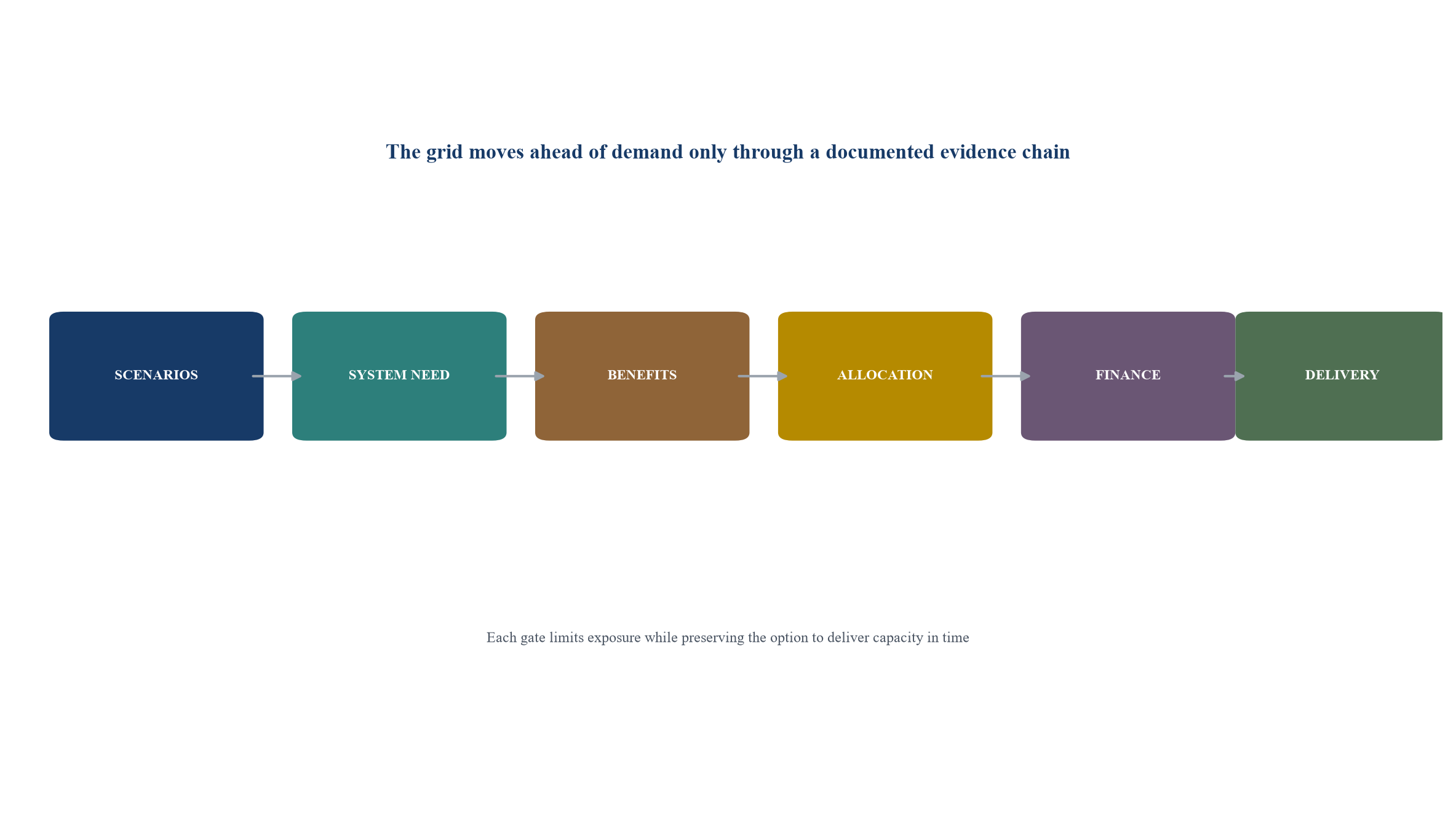
Early capital should move through evidence-based approvals from scenario to operating asset.
21. Define the benefit-cost framework
The framework should compare capital and operating cost with reliability, congestion, generation access, avoided curtailment, loss reduction, resilience, competition and economic-development benefits.
The decision should be updated when demand, generation, route, cost or regulation changes. Every material assumption should have an owner, validation method and review date.
The objective is a financeable grid programme that arrives before credible demand without transferring uncontrolled risk. Early expenditure should proceed only where consumer and investor protections are commensurate with the uncertainty.
22. Measure avoided delay
Building ahead can shorten connection waits for future projects. The value should use realistic project probabilities and distinguish social value from revenues available to the transmission owner.
The working file should identify the governing plan, regulatory instrument, benefit evidence, cost owner and approval date. Engineering, economic and financing conclusions should remain traceable to current authoritative sources.
A practical review asks which capacity is needed, why it must be built early, who benefits, who pays and how stranded risk is controlled. The output should support staged capital rather than an undifferentiated programme commitment.
23. Avoid double counting benefits
Congestion reduction, lower generation cost and renewable integration can overlap. The model should trace each benefit to one causal mechanism and one beneficiary group.
The assessment should distinguish committed projects, scenario demand and policy aspirations. Regulators, network owners, users and financiers should use one reconciled need statement, programme and cost baseline.
The issue should be translated into dated actions, evidence tests and quantified risk allocation. Regulated recovery, public support, user funding and private finance should remain visible as separate sources.
24. Identify beneficiaries
Beneficiaries can include load, generators, network users, regions, future customers and neighbouring systems. Cost allocation should follow supported benefits and applicable law.
The decision should be updated when demand, generation, route, cost or regulation changes. Every material assumption should have an owner, validation method and review date.
The objective is a financeable grid programme that arrives before credible demand without transferring uncontrolled risk. Early expenditure should proceed only where consumer and investor protections are commensurate with the uncertainty.
25. Design cost allocation
Allocation can be postage-stamp, zonal, beneficiary-based, connection-funded, public-funded or hybrid. The chosen method should be transparent, durable and capable of handling future entrants.
The working file should identify the governing plan, regulatory instrument, benefit evidence, cost owner and approval date. Engineering, economic and financing conclusions should remain traceable to current authoritative sources.
A practical review asks which capacity is needed, why it must be built early, who benefits, who pays and how stranded risk is controlled. The output should support staged capital rather than an undifferentiated programme commitment.
26. Protect current consumers
Consumers should receive evidence that early investment is prudent, efficient and governed. Controls can include staged approvals, independent review, cost sharing, incentives and clawback.
The assessment should distinguish committed projects, scenario demand and policy aspirations. Regulators, network owners, users and financiers should use one reconciled need statement, programme and cost baseline.
The issue should be translated into dated actions, evidence tests and quantified risk allocation. Regulated recovery, public support, user funding and private finance should remain visible as separate sources.
27. Price stranded-capacity risk
Demand can arrive late, move or fail. The downside model should show unused capacity, carrying cost, alternative uses, cancellation recoveries and responsibility for shortfall.
The decision should be updated when demand, generation, route, cost or regulation changes. Every material assumption should have an owner, validation method and review date.
The objective is a financeable grid programme that arrives before credible demand without transferring uncontrolled risk. Early expenditure should proceed only where consumer and investor protections are commensurate with the uncertainty.
28. Plan cancellation and scope change
Early work can become unnecessary after scenario, route or technology changes. Contracts should define termination, reuse, resale, compensation and documentation.
The working file should identify the governing plan, regulatory instrument, benefit evidence, cost owner and approval date. Engineering, economic and financing conclusions should remain traceable to current authoritative sources.
A practical review asks which capacity is needed, why it must be built early, who benefits, who pays and how stranded risk is controlled. The output should support staged capital rather than an undifferentiated programme commitment.
29. Define early-development funding
Development allowances can fund engineering, land, permits, surveys and supply-chain commitments before final construction approval. The scope and evidence standard should be narrow and auditable.
The assessment should distinguish committed projects, scenario demand and policy aspirations. Regulators, network owners, users and financiers should use one reconciled need statement, programme and cost baseline.
The issue should be translated into dated actions, evidence tests and quantified risk allocation. Regulated recovery, public support, user funding and private finance should remain visible as separate sources.
30. Use the regulated asset base carefully
A regulated asset base can support low-cost financing where prudent expenditure earns a return through tariffs. Entry timing, depreciation and disallowance risk shape financeability.
The decision should be updated when demand, generation, route, cost or regulation changes. Every material assumption should have an owner, validation method and review date.
The objective is a financeable grid programme that arrives before credible demand without transferring uncontrolled risk. Early expenditure should proceed only where consumer and investor protections are commensurate with the uncertainty.
Table 2. Anticipatory-investment risk-allocation matrix
| Risk | Network owner | Regulator or public authority | Users or beneficiaries | Evidence and control |
|---|---|---|---|---|
| Demand arrives late | Efficient staged design and mitigation | Approve scenarios and sharing rules | Commit where direct benefits are identifiable | Scenario updates and utilisation triggers |
| Route or permit failure | Develop alternatives and engage stakeholders | Coordinate statutory process | Support project-specific access where applicable | Route studies, permits and consultation record |
| Cost escalation | Procure efficiently and control scope | Allow prudent cost and set incentives | Pay allocated share under approved method | Baseline, tender evidence and change log |
| Project cancellation | Recover, reuse or resell early assets | Set clawback and recovery rules | Meet contractual exit obligations | Cancellation plan and asset register |
| Under-delivery | Manage contractors and interfaces | Enforce output and incentive regime | Preserve agreed information and access | Milestones, independent review and testing |
| Benefit shortfall | Operate and optimise the completed asset | Review allocation and future planning | Provide actual use data | Post-completion benefit and utilisation review |
Allocation should follow controllability, benefit and the governing regulatory framework.
31. Decide when revenue begins
Recovery can begin during construction, at commissioning or through milestones. Earlier recovery lowers financing cost while exposing consumers before assets provide service.
The working file should identify the governing plan, regulatory instrument, benefit evidence, cost owner and approval date. Engineering, economic and financing conclusions should remain traceable to current authoritative sources.
A practical review asks which capacity is needed, why it must be built early, who benefits, who pays and how stranded risk is controlled. The output should support staged capital rather than an undifferentiated programme commitment.
32. Evaluate construction-work-in-progress treatment
CWIP or equivalent mechanisms can improve cash flow and credit metrics. The regulator should balance financing savings against delivery discipline and intergenerational fairness.
The assessment should distinguish committed projects, scenario demand and policy aspirations. Regulators, network owners, users and financiers should use one reconciled need statement, programme and cost baseline.
The issue should be translated into dated actions, evidence tests and quantified risk allocation. Regulated recovery, public support, user funding and private finance should remain visible as separate sources.
33. Design delivery incentives
Incentives can reward timely output, efficient cost, capacity and availability. Penalties and sharing factors should reflect risks the transmission owner can control.
The decision should be updated when demand, generation, route, cost or regulation changes. Every material assumption should have an owner, validation method and review date.
The objective is a financeable grid programme that arrives before credible demand without transferring uncontrolled risk. Early expenditure should proceed only where consumer and investor protections are commensurate with the uncertainty.
34. Test competitive delivery
Competition can reveal cost and capability for suitable projects. The model should account for tender time, interfaces, financing, standards and long-term operation.
The working file should identify the governing plan, regulatory instrument, benefit evidence, cost owner and approval date. Engineering, economic and financing conclusions should remain traceable to current authoritative sources.
A practical review asks which capacity is needed, why it must be built early, who benefits, who pays and how stranded risk is controlled. The output should support staged capital rather than an undifferentiated programme commitment.
35. Evaluate PPP and concession structures
A concession can allocate design, finance, construction and availability risk to a project company. Revenue, dispatch, land, interconnection and termination must remain bankable.
The assessment should distinguish committed projects, scenario demand and policy aspirations. Regulators, network owners, users and financiers should use one reconciled need statement, programme and cost baseline.
The issue should be translated into dated actions, evidence tests and quantified risk allocation. Regulated recovery, public support, user funding and private finance should remain visible as separate sources.
36. Evaluate sovereign and public funding
Budget, development-bank or sovereign funding can support strategic projects and lower cost. Governance should retain transparent project selection and lifecycle accountability.
The decision should be updated when demand, generation, route, cost or regulation changes. Every material assumption should have an owner, validation method and review date.
The objective is a financeable grid programme that arrives before credible demand without transferring uncontrolled risk. Early expenditure should proceed only where consumer and investor protections are commensurate with the uncertainty.
37. Use green and sustainability-linked debt
Labelled debt can broaden capital access where use of proceeds and reporting meet recognised standards. The underlying credit and cost recovery remain decisive.
The working file should identify the governing plan, regulatory instrument, benefit evidence, cost owner and approval date. Engineering, economic and financing conclusions should remain traceable to current authoritative sources.
A practical review asks which capacity is needed, why it must be built early, who benefits, who pays and how stranded risk is controlled. The output should support staged capital rather than an undifferentiated programme commitment.
38. Mobilise institutional capital
Pension, insurance and infrastructure investors can fund operating or construction-stage assets where risk, duration and regulation align. Portfolio structures can diversify project exposure.
The assessment should distinguish committed projects, scenario demand and policy aspirations. Regulators, network owners, users and financiers should use one reconciled need statement, programme and cost baseline.
The issue should be translated into dated actions, evidence tests and quantified risk allocation. Regulated recovery, public support, user funding and private finance should remain visible as separate sources.
39. Use blended finance where constraints bind
Guarantees, subordinated capital, grants and technical assistance can address sovereign, currency, utility or early-stage risk. Concessional support should target a defined financing barrier.
The decision should be updated when demand, generation, route, cost or regulation changes. Every material assumption should have an owner, validation method and review date.
The objective is a financeable grid programme that arrives before credible demand without transferring uncontrolled risk. Early expenditure should proceed only where consumer and investor protections are commensurate with the uncertainty.
40. Manage currency and emerging-market risk
Local-currency revenue paired with foreign debt creates mismatch. Hedging cost, convertibility, inflation, indexation and sovereign support should be modelled.
The working file should identify the governing plan, regulatory instrument, benefit evidence, cost owner and approval date. Engineering, economic and financing conclusions should remain traceable to current authoritative sources.
A practical review asks which capacity is needed, why it must be built early, who benefits, who pays and how stranded risk is controlled. The output should support staged capital rather than an undifferentiated programme commitment.
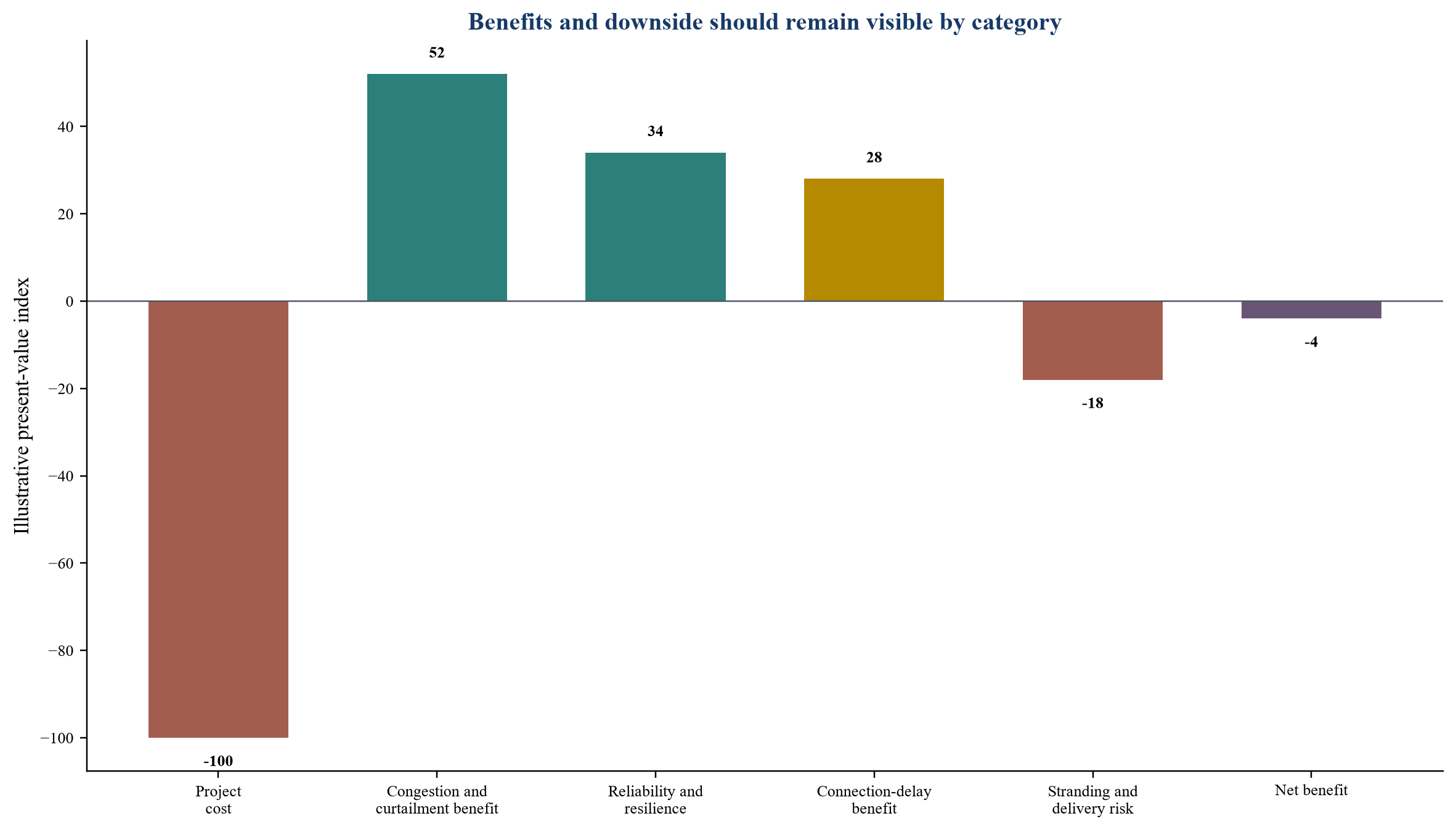
Values are hypothetical management assumptions used solely to demonstrate the framework.
41. Apply the framework to the United Kingdom
Ofgem's ASTI model accelerates strategic projects through streamlined assessment and early construction funding while retaining consumer protections, cost evidence and recovery controls.
The assessment should distinguish committed projects, scenario demand and policy aspirations. Regulators, network owners, users and financiers should use one reconciled need statement, programme and cost baseline.
The issue should be translated into dated actions, evidence tests and quantified risk allocation. Regulated recovery, public support, user funding and private finance should remain visible as separate sources.
42. Apply the framework to the United States
FERC Orders 1920, 1920-A and 1920-B require long-term regional planning, scenario analysis, benefit evaluation and cost-allocation processes with enhanced state involvement.
The decision should be updated when demand, generation, route, cost or regulation changes. Every material assumption should have an owner, validation method and review date.
The objective is a financeable grid programme that arrives before credible demand without transferring uncontrolled risk. Early expenditure should proceed only where consumer and investor protections are commensurate with the uncertainty.
43. Apply the framework to the GCC
Regional interconnection and national expansion can support resilience, trade and future load growth. Project design should reconcile member-state benefits, sovereignty, dispatch and cost sharing.
The working file should identify the governing plan, regulatory instrument, benefit evidence, cost owner and approval date. Engineering, economic and financing conclusions should remain traceable to current authoritative sources.
A practical review asks which capacity is needed, why it must be built early, who benefits, who pays and how stranded risk is controlled. The output should support staged capital rather than an undifferentiated programme commitment.
44. Apply the framework to India
India's notified transmission plan and green-energy corridors plan network capacity ahead of fast renewable additions. Financing must coordinate central, state and competitive transmission development.
The assessment should distinguish committed projects, scenario demand and policy aspirations. Regulators, network owners, users and financiers should use one reconciled need statement, programme and cost baseline.
The issue should be translated into dated actions, evidence tests and quantified risk allocation. Regulated recovery, public support, user funding and private finance should remain visible as separate sources.
45. Value interregional transmission
Interregional links can share reserves, diversify weather and access lower-cost resources. Benefits and cost allocation should reflect multiple systems and credible transfer capability.
The decision should be updated when demand, generation, route, cost or regulation changes. Every material assumption should have an owner, validation method and review date.
The objective is a financeable grid programme that arrives before credible demand without transferring uncontrolled risk. Early expenditure should proceed only where consumer and investor protections are commensurate with the uncertainty.
46. Structure cross-border investment
Cross-border projects require treaty, market, dispatch, currency, tax, security and dispute arrangements. A physical line needs a durable commercial and institutional framework.
The working file should identify the governing plan, regulatory instrument, benefit evidence, cost owner and approval date. Engineering, economic and financing conclusions should remain traceable to current authoritative sources.
A practical review asks which capacity is needed, why it must be built early, who benefits, who pays and how stranded risk is controlled. The output should support staged capital rather than an undifferentiated programme commitment.
47. Build sources and uses
Sources should match development, land, equipment, construction, financing and contingency uses by approval stage. Public, regulated and private capital should have clear priority and recovery.
The assessment should distinguish committed projects, scenario demand and policy aspirations. Regulators, network owners, users and financiers should use one reconciled need statement, programme and cost baseline.
The issue should be translated into dated actions, evidence tests and quantified risk allocation. Regulated recovery, public support, user funding and private finance should remain visible as separate sources.
48. Test debt-service capacity
Debt sizing should reflect revenue commencement, construction profile, indexation, incentive exposure and cost-recovery risk. DSCR should be tested under delay, disallowance and under-utilisation.
The decision should be updated when demand, generation, route, cost or regulation changes. Every material assumption should have an owner, validation method and review date.
The objective is a financeable grid programme that arrives before credible demand without transferring uncontrolled risk. Early expenditure should proceed only where consumer and investor protections are commensurate with the uncertainty.
49. Build the downside cases
Cases should include delayed demand, route change, permit delay, equipment escalation, cancellation, weaker benefit realisation and lower allowed recovery. Mitigation should have quantified value.
The working file should identify the governing plan, regulatory instrument, benefit evidence, cost owner and approval date. Engineering, economic and financing conclusions should remain traceable to current authoritative sources.
A practical review asks which capacity is needed, why it must be built early, who benefits, who pays and how stranded risk is controlled. The output should support staged capital rather than an undifferentiated programme commitment.
50. Control cost overruns
The baseline should separate owner scope, market escalation, design development, risk allowance and contingency. Change control should assign responsibility and preserve independent evidence.
The assessment should distinguish committed projects, scenario demand and policy aspirations. Regulators, network owners, users and financiers should use one reconciled need statement, programme and cost baseline.
The issue should be translated into dated actions, evidence tests and quantified risk allocation. Regulated recovery, public support, user funding and private finance should remain visible as separate sources.
Table 3. Hypothetical financing and debt-service sensitivity
| Scenario | Capital cost, USD m | Revenue begins | Allowed recovery of prudent cost | Minimum DSCR | Decision implication |
|---|---|---|---|---|---|
| Staged regulated build | 1,000 | During construction | 95% | 1.35x | Supports early procurement with staged gates |
| Recovery at commissioning | 1,000 | Year 6 | 95% | 1.18x | Requires larger construction liquidity |
| Cost escalation | 1,250 | During construction | 90% | 1.12x | Sharing and contingency become critical |
| Demand delayed five years | 1,000 | During construction | 85% | 1.04x | Headroom and alternative use drive value |
| Partial disallowance and delay | 1,200 | Year 7 | 75% | 0.86x | Capital structure requires reset or support |
All values are hypothetical management assumptions and do not represent an actual project or forecast.
51. Maintain liquidity through construction
Long programmes need committed facilities, reserve policy and draw flexibility. Liquidity should cover schedule downside without relying on unapproved tariff recovery.
The decision should be updated when demand, generation, route, cost or regulation changes. Every material assumption should have an owner, validation method and review date.
The objective is a financeable grid programme that arrives before credible demand without transferring uncontrolled risk. Early expenditure should proceed only where consumer and investor protections are commensurate with the uncertainty.
52. Align covenants with regulation
Covenants should recognise approval milestones, allowed revenue, cost sharing, completion and incentive exposure. Cure rights should activate before delivery or liquidity becomes irrecoverable.
The working file should identify the governing plan, regulatory instrument, benefit evidence, cost owner and approval date. Engineering, economic and financing conclusions should remain traceable to current authoritative sources.
A practical review asks which capacity is needed, why it must be built early, who benefits, who pays and how stranded risk is controlled. The output should support staged capital rather than an undifferentiated programme commitment.
53. Procure for a repeatable programme
Framework agreements, supplier capacity reservations and standard packages can improve delivery across a portfolio. Competition, performance and concentration risks still require oversight.
The assessment should distinguish committed projects, scenario demand and policy aspirations. Regulators, network owners, users and financiers should use one reconciled need statement, programme and cost baseline.
The issue should be translated into dated actions, evidence tests and quantified risk allocation. Regulated recovery, public support, user funding and private finance should remain visible as separate sources.
54. Create integrated governance
System planners, regulators, transmission owners, governments, users and financiers need defined decision rights, data and escalation. Governance should separate advocacy from approval.
The decision should be updated when demand, generation, route, cost or regulation changes. Every material assumption should have an owner, validation method and review date.
The objective is a financeable grid programme that arrives before credible demand without transferring uncontrolled risk. Early expenditure should proceed only where consumer and investor protections are commensurate with the uncertainty.
55. Publish transparent evidence
Public confidence improves when scenarios, alternatives, benefits, costs and performance are reported clearly. Commercially sensitive information can be protected without obscuring the decision basis.
The working file should identify the governing plan, regulatory instrument, benefit evidence, cost owner and approval date. Engineering, economic and financing conclusions should remain traceable to current authoritative sources.
A practical review asks which capacity is needed, why it must be built early, who benefits, who pays and how stranded risk is controlled. The output should support staged capital rather than an undifferentiated programme commitment.
56. Run the system-need gate
This gate confirms scenarios, reliability need, demand and generation evidence, alternatives and timing. It prevents strategic language from substituting for a defined network requirement.
The assessment should distinguish committed projects, scenario demand and policy aspirations. Regulators, network owners, users and financiers should use one reconciled need statement, programme and cost baseline.
The issue should be translated into dated actions, evidence tests and quantified risk allocation. Regulated recovery, public support, user funding and private finance should remain visible as separate sources.
57. Run the benefits and allocation gate
This gate validates benefit methods, beneficiaries, cost allocation and consumer protection. It should show who pays, when and why.
The decision should be updated when demand, generation, route, cost or regulation changes. Every material assumption should have an owner, validation method and review date.
The objective is a financeable grid programme that arrives before credible demand without transferring uncontrolled risk. Early expenditure should proceed only where consumer and investor protections are commensurate with the uncertainty.
58. Run the financing gate
This gate confirms sources, revenue, debt capacity, currency, contingency, incentives and downside liquidity. Funding should remain conditional on the approved risk perimeter.
The working file should identify the governing plan, regulatory instrument, benefit evidence, cost owner and approval date. Engineering, economic and financing conclusions should remain traceable to current authoritative sources.
A practical review asks which capacity is needed, why it must be built early, who benefits, who pays and how stranded risk is controlled. The output should support staged capital rather than an undifferentiated programme commitment.
59. Run the delivery gate
This gate confirms route, land, permits, engineering, supply chain, procurement, interfaces and milestones. Early work should have recoverability and cancellation controls.
The assessment should distinguish committed projects, scenario demand and policy aspirations. Regulators, network owners, users and financiers should use one reconciled need statement, programme and cost baseline.
The issue should be translated into dated actions, evidence tests and quantified risk allocation. Regulated recovery, public support, user funding and private finance should remain visible as separate sources.
60. Adopt the decision record and 90-day plan
The final record states need, preferred solution, staged capital, cost allocation, risk owners, evidence conditions and fallback. The first 90 days should close the most valuable planning and financing gaps.
The decision should be updated when demand, generation, route, cost or regulation changes. Every material assumption should have an owner, validation method and review date.
The objective is a financeable grid programme that arrives before credible demand without transferring uncontrolled risk. Early expenditure should proceed only where consumer and investor protections are commensurate with the uncertainty.
Table 4. Illustrative 90-day anticipatory-investment programme
| Period | Workstream | Core actions | Decision output | Accountable owner |
|---|---|---|---|---|
| Days 1-15 | Need and scenarios | Reconcile plans, load, generation, reliability, corridors and timing | Confirmed system-need statement | System planner |
| Days 16-30 | Options and delivery | Compare conventional, digital, flexibility and staged solutions | Preferred technical options | Transmission engineer |
| Days 31-45 | Benefits and allocation | Quantify benefits, beneficiaries, downside and cost-sharing routes | Allocation recommendation | Economist and regulator team |
| Days 46-60 | Financing | Model regulated, public, private and blended funding with sensitivities | Financeable capital structure | Financial adviser |
| Days 61-75 | Risk and procurement | Allocate route, supply-chain, cost, cancellation and performance risk | Executable delivery strategy | Commercial director |
| Days 76-90 | Decision record | Set staged approvals, consumer protections, owners and reporting | Approved anticipatory programme | Authorised board and regulator |
Timing is indicative and should be adapted to the governing planning and regulatory process.
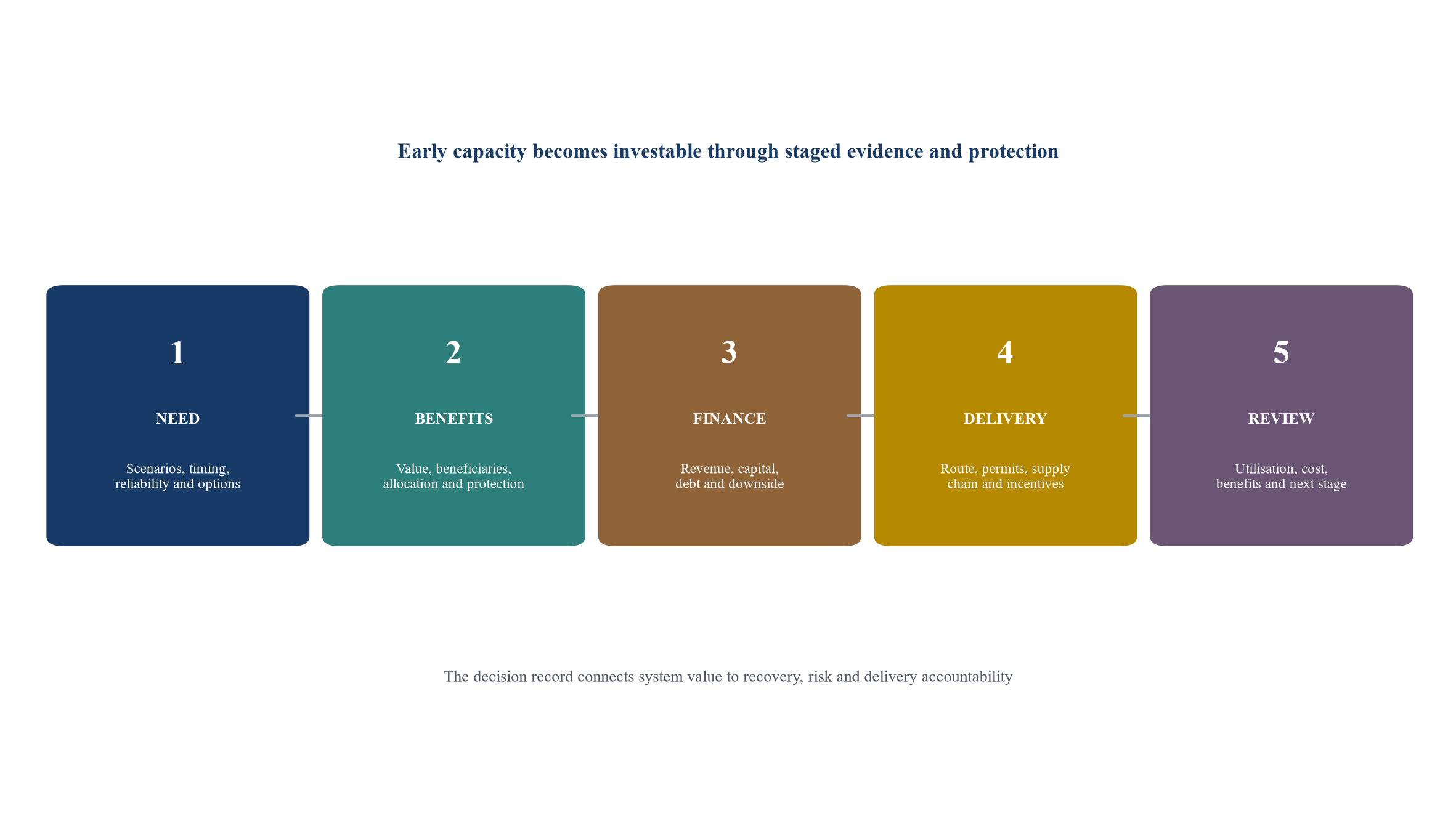
Each gate requires documented evidence before the next capital commitment.
The framework turns anticipatory transmission from a broad policy ambition into a staged capital programme. It links long-term system evidence to benefits, cost allocation, financing, delivery and consumer protection.
Execution quality depends on maintaining the evidence as the system changes. Early capital should preserve strategic options and delivery capacity while retaining explicit controls for cancellation, cost and under-utilisation.
References
- International Energy Agency, "Electricity Grids and Secure Energy Transitions," 2023, https://www.iea.org/reports/electricity-grids-and-secure-energy-transitions
- International Energy Agency, "Building the Future Transmission Grid," https://www.iea.org/reports/building-the-future-transmission-grid
- International Energy Agency, "Electricity 2026," https://www.iea.org/reports/electricity-2026
- Ofgem, "Decision on Accelerating Onshore Electricity Transmission Investment," 2022, https://www.ofgem.gov.uk/decision/decision-accelerating-onshore-electricity-transmission-investment
- Ofgem, "Accelerated Strategic Transmission Investment Guidance and Submission Requirements," https://www.ofgem.gov.uk/sites/default/files/2023-08/Accelerated%20Strategic%20Transmission%20Investment%20Guidance%20And%20Submission%20Requirements%20Document.pdf
- Federal Energy Regulatory Commission, "Explainer on the Transmission Planning and Cost Allocation Final Rule," https://www.ferc.gov/explainer-transmission-planning-and-cost-allocation-final-rule
- Federal Energy Regulatory Commission, "Order No. 1920 Fact Sheet," https://www.ferc.gov/news-events/news/fact-sheet-building-future-through-electric-regional-transmission-planning-and
- GCC Interconnection Authority, "Our Plans," https://gccia.com.sa/gccia-grid/our-plans/
- GCC Interconnection Authority, "Projects Under Construction," https://gccia.com.sa/gccia-grid/projects-under-construction-2/
- Central Electricity Authority, "National Electricity Plan, Volume II: Transmission," https://cea.nic.in/psp___a_i/national-electricity-plan-volume-ii-transmission/?lang=en
About the Author
Chennakeshav (CK) is a corporate finance and investment banking executive with 25+ years of global experience in deal origination, structuring and execution across M&A, growth capital and corporate strategy. He has led value-creation mandates for founders, corporates and funds — bridging the boardroom view to hands-on execution and close.
His career spans Morgan Stanley, HSBC, Lloyds Banking Group, EWEC, ADQ portfolio companies and Emirates Growth Fund, across TMT, real estate, fintech, deeptech, cleantech, infrastructure and energy. He has partnered with C-suite leaders, private equity and venture funds, sovereign wealth funds and family offices to finance complex fund raises and scale-up ventures, and has led M&A due diligence, post-merger integration and business-transformation initiatives to create value.
At Matchpoint Partners he is Managing Partner, leading the firm's corporate finance, M&A and capital-raising practice. He holds an MBA from London Business School, an engineering degree from VTU and a Master of Laws (LLM, in progress) from UCL London.
An active start-up mentor, CK mentors at Techstars, DIFC FinTech Hive, Startup Grind, Founder Institute and IN5, serves as Entrepreneur Mentor in Residence (EMiR) at London Business School, and judges the Entrepreneurship World Cup.
