
Introduction
A power system cannot assume that another power station will be available to restart it after a widespread shutdown. A black-start resource can establish voltage and frequency without an external electricity supply, energise a defined path, start other plant and support the progressive reconstruction of stable power islands. The service sits at the beginning of the restoration chain. Failure at that point can delay the recovery of generation, substations, communications, water, transport, health services and digital infrastructure.
The service has strong public value and weak natural merchant revenue. A provider may invest in dedicated diesel generators, batteries, grid-forming controls, switchgear, protection, fuel storage, telecommunications, studies and training. Normal energy-market dispatch may pay for none of these costs. The owner therefore needs a separate payment route with a term, credit support and performance regime that supports capital recovery.
System operators already procure restoration capability through several models. PJM uses tariff-based annual revenue requirements and monthly credits [1][2]. NESO procures restoration services across zones and is widening participation beyond large transmission-connected stations [3][4]. AEMO procures System Restart Ancillary Services against technical and reliability requirements [5]. CAISO and ERCOT use targeted procurement where restoration plans identify needs [6][7]. These models provide practical evidence for a financing framework.
1 Define the service before the asset
The procurement should begin with the restoration outcome. The system operator must specify the zone, energisation path, minimum output, start time, duration, voltage and frequency performance, reactive capability, switching sequence, communications, fuel or energy endurance, testing and co-ordination requirements. The resulting product may include a primary black-start resource, a top-up resource, an anchor generator, a transmission path or a distributed-restoration service.
An asset labelled black-start capable has limited financing value without a place in an approved restoration plan. Its location, electrical path and compatibility with other resources determine whether the system operator can use it. The European network code recognises geographical distribution and aggregation as matters that restoration-service terms should address [8]. NESO similarly procures capability by restoration zone and requires providers to create and manage stable power islands [3].
The financing perimeter should include every component required for successful delivery. A gas turbine may require a diesel starter, fuel systems, auxiliaries, substation equipment, protection, telecommunications and trained operators. A battery may require grid-forming controls, sufficient state of charge, auxiliary power and a verified cranking sequence. Omitting a shared or third-party component from the project perimeter creates an interface risk that lenders cannot price reliably.
2 Treat readiness as the purchased output
Black start is an availability service. The system pays for a resource to be ready for an event that may never occur during the contract. Payment based only on emergency energy would leave the provider unable to recover the cost of continuous readiness. The primary payment should therefore compensate accepted capability, with separate treatment for testing, instructed operation, fuel, exceptional dispatch and approved capital expenditure.
PJM's tariff illustrates an annual revenue-requirement approach. Eligible units can recover defined fixed and variable black-start costs, training, fuel-storage costs and an incentive factor through monthly credits, subject to testing and other requirements [1][2]. World Bank guidance on availability payments reaches the same structural principle: payment should be linked to specified service availability and performance rather than usage volume where demand risk belongs with the procuring authority [9].
The contract should define availability at the component level. An asset can be mechanically available while its starter, fuel inventory, protection, communications or cranking path is unavailable. The payment and deduction regime should reflect the service chain and distinguish provider-controlled outages from network failures outside the provider's control.
3 Map the restoration chain
Restoration is a sequence rather than a single start. The resource must start, establish a stable electrical island, energise transformers and lines, manage inrush and reactive power, pick up block load, start other generation, expand the island and eventually synchronise with neighbouring islands. Each stage has different technical and commercial dependencies.
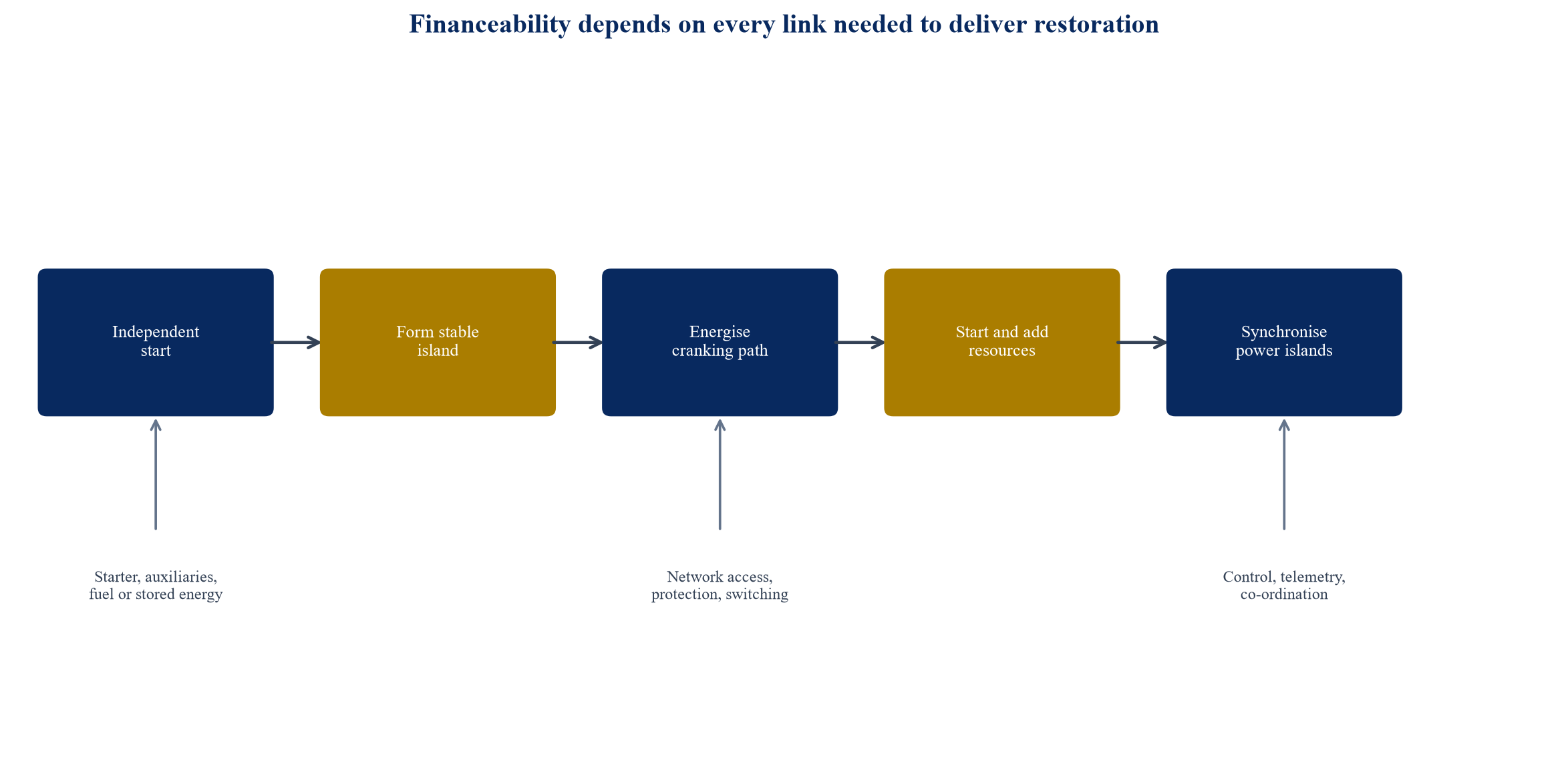
The diagram is an author-developed framework and does not represent a specific system operator or network.
The contract map should allocate ownership, operation, testing and failure at each interface. The asset owner should control the equipment it is expected to guarantee. The network operator should bear availability and switching risks for shared transmission or distribution assets under its control. Joint tests should establish the boundary between the parties.
Communications deserve separate treatment. European rules require periodic testing of communications and backup power [8]. NESO's distributed-restoration work identifies communications resilience as a common limitation for distributed resources [10]. A provider should receive neither full availability credit nor full failure liability where the communications architecture remains outside its control and has not been acceptance-tested.
4 Establish the technical acceptance gate
Financial close can precede technical acceptance, but service payments and term debt should depend on objective completion tests. The acceptance schedule should cover independent start, energisation, voltage and frequency control, reactive performance, load pickup, endurance, repeated starts, communications, dispatch response, protection and recovery after a failed attempt.
Model validation is necessary before field tests. Inverter-based resources can face current-limiting, transformer inrush and protection challenges. NREL research finds that inverter-based black start can be technically feasible under defined conditions and highlights the importance of modelling current limits, soft-start methods and network dynamics [11][12]. Field acceptance should use the actual asset configuration and restoration path.
The contract should state who approves the test protocol, what constitutes failure, how retesting occurs and which costs are recoverable. A minor defect with a prompt remedy should not automatically terminate a long-term service. Repeated failure, material misrepresentation or inability to meet the approved restoration plan should trigger stronger remedies.
5 Select the procurement model
Four broad models can support black-start investment. A tariff-based cost-of-service model reimburses approved costs and can include an incentive. A competitive tender awards a fixed or indexed availability price. A regulated asset model places approved capability into a network owner's revenue base. A bilateral reliability contract can fund a specific resource, path or region.
Table 1. Comparison of restoration-service procurement models
| Model | Revenue basis | Capital recovery | Main financeability issue | Suitable use |
|---|---|---|---|---|
| Tariff revenue requirement | Approved cost plus incentive | Formula or filed rate | Cost eligibility and review | Existing or designated units |
| Competitive availability tender | Bid price for verified readiness | Contract price over term | Term, indexation and deductions | Contestable zonal requirement |
| Regulated asset treatment | Allowed return and depreciation | Regulatory allowance | Disallowance and timing | Network-owned enabling works |
| Bilateral reliability contract | Negotiated fixed and variable payments | Contracted schedule | Counterparty and termination | Locational or bespoke capability |
The table is a generic financing framework. Applicable rules and terms depend on jurisdiction.
Procurement should separate the system operator's technical selection from the regulator's cost and consumer-protection review. A lowest-price tender can fail if it ignores locational effectiveness, fuel assurance or cranking-path reliability. A cost-of-service mechanism can overpay if cost eligibility and continuing performance remain weak.
The evaluation should calculate whole-life cost for a portfolio that meets the restoration standard. Diversification can have value where common fuel, weather, technology or network dependencies could disable several resources. Award decisions should disclose evaluation principles while protecting sensitive system information.
6 Determine a bankable contract term
The payment term should reflect the useful life and unamortised cost of the black-start investment. A short contract may work where the asset already has capability and requires limited continuing cost. A material retrofit or new resource may need a longer term, a works contribution, residual-value payment or termination compensation.
Lenders will compare debt tenor with contracted cash flow. Debt extending beyond the firm service term creates merchant re-contracting risk. The model should avoid assuming renewal unless the system requirement, procurement rules and asset competitiveness support it. A renewal option controlled solely by the procurer has limited credit value unless price and exercise conditions are defined.
The service term should begin after acceptance. Construction delay caused by the provider can reduce the payment period or trigger liquidated damages. Delay caused by network works, approvals or system-operator changes should extend milestones and protect committed financing costs.
7 Build sources and uses around the full capability
Uses can include the starting system, battery, grid-forming controls, fuel storage, switchgear, protection, transformers, network works, resilient telecommunications, engineering studies, testing, owner costs, financing fees, contingency and initial reserves. Continuing training, testing, maintenance and fuel management belong in the operating model.
Sources may include sponsor equity, senior debt, subordinated debt, a system-operator works contribution, regulated funding, grant or guarantee. Public support can be justified where system value exceeds the revenue that a contestable service contract can support. The support should target the funding gap and retain delivery incentives.
The model should separate shared equipment from dedicated black-start equipment. A battery may earn energy and ancillary-service revenue outside restoration obligations. Cost allocation should reflect incremental capability and any restrictions imposed by the restoration contract. Double recovery through another regulated or market payment should be prevented.
8 Size debt to contracted cash flow
Debt service should rely on fixed or formula-based availability revenue after expected deductions, operating cost, testing cost, fuel or energy assurance and reserve funding. Emergency dispatch revenue should be excluded from the base case because a system shutdown is rare and timing is unpredictable.
The lender model should calculate debt-service coverage under base, partial-deduction, extended outage, delayed indexation and retest scenarios. It should test contract expiry, termination, change in restoration plan and technology replacement. A tail between debt maturity and contract expiry creates time to cure performance issues and refinance if needed.
Where payment depends on approved costs, the model should distinguish accepted costs from owner estimates. A regulatory filing or tariff process can delay recovery. Construction financing may require sponsor support until the approved revenue requirement becomes effective.
9 Design the availability payment
The availability payment should cover efficient capital recovery, fixed operating cost, assurance obligations and an appropriate return. It can be fixed, indexed or divided into capacity, fixed cost, variable test and energy components. Indexation should match material cost drivers without transferring ordinary operating inefficiency.
Payment should be monthly or quarterly to support predictable debt service. Annual true-ups may address approved cost, inflation, fuel storage or changed testing. The contract should define invoicing, dispute periods, set-off and late payment. A government or regulated counterparty may still require a clear appropriation or tariff-recovery route.
Performance deductions should be proportionate to lost readiness. A full deduction can apply when the contracted capability is unavailable. Partial deductions can reflect reduced output, endurance or communications. Deductions should stop when failure is caused by the procurer, network or a defined relief event.
10 Price performance without making the service unfinanceable
The performance regime should motivate readiness and preserve a realistic cure pathway. Excessive uncapped deductions can make the contract unbankable and raise the bid price. Weak deductions can leave consumers paying for unavailable capability.
PJM withholds or forfeits black-start revenue under specified testing and readiness failures [1]. Comparable contracts can use monthly availability deductions, test-failure deductions, repeat-failure escalation and termination after defined persistent default. The provider should receive a grace period where the restoration plan remains protected by other resources and the failure can be cured safely.
Aggregate liability should distinguish service deductions from damages caused by misconduct or breach of confidentiality. The contract should address whether deductions are the sole financial remedy for availability failure. Lenders need clarity on cure rights before termination.
11 Allocate construction and retrofit risk
The provider should usually bear design, procurement and construction risk for its dedicated equipment. It should warrant compliance with agreed specifications and manage contractors. The procurer or network owner should bear works under its control and provide timely access, outages, data and approvals.
Interface milestones should be integrated. A completed starting system has no service value if the network path or control system is late. The financing schedule should identify long-lead equipment, factory testing, site testing, energisation and integrated acceptance.
Fixed-price engineering, procurement and construction arrangements can transfer defined risk, but specialist black-start integration may remain with the owner or original equipment manufacturer. Contingency should reflect design maturity and interface exposure. Delay liquidated damages should cover a reasonable portion of debt carry and lost availability revenue.
12 Allocate fuel and stored-energy risk
Traditional resources need assured fuel for the required number of starts and operating duration. Risks include inventory, degradation, delivery interruption, gas-system outage, environmental limits and competing dispatch. Fuel assurance can require on-site storage, dual-fuel capability or firm supply.
Battery resources require a state-of-charge policy that preserves restoration readiness while allowing other market activity. The contract should define reserved energy, replenishment, degradation, test recovery and opportunity cost. A battery dispatched into another service shortly before a shutdown may be technically capable but commercially unavailable.
The provider should control routine inventory and state-of-charge obligations. System-operator instructions that consume reserved energy should trigger restoration of the required state and compensation. Force majeure should not excuse a foreseeable fuel-supply weakness that the contracted design was meant to solve.
13 Finance fuel assurance
Fuel assurance can require tanks, pipelines, conversion, inventory and working capital. PJM's framework recognises fuel storage and fuel-assurance capital costs in defined circumstances [1][2]. A project model should identify which costs enter fixed capital recovery and which remain variable or pass-through.
Inventory financing introduces price, quality, carrying and replenishment risks. A fuel reserve account or committed facility can fund minimum stock. Title, security interest and use restrictions should permit lenders to recognise the inventory while preserving operational access.
For batteries, the equivalent issue is energy reservation and degradation. The model should price lost arbitrage or ancillary-service revenue where the restoration obligation constrains dispatch. This opportunity cost should be transparent and avoid paying twice for the same reserved capacity.
14 Allocate network-path risk
The cranking path can include transformers, lines, substations, breakers, reactive devices and distribution assets owned by other parties. A provider should not guarantee components it cannot maintain or dispatch. The system operator should define the path, coordinate outages and maintain an alternative where required by the restoration standard.
Testing should cover the integrated path at an appropriate frequency without creating unacceptable system risk. Simulation alone may not reveal every switching, protection or communications issue. Field tests can be staged, with agreed limitations where live-system conditions prevent a complete end-to-end test.
If the system operator changes the path, the contract should provide studies, modification, schedule relief and cost recovery. A material relocation of the requirement can make the resource unusable. Termination compensation should address stranded dedicated investment.
15 Make communications and control bankable
Restoration may occur when ordinary telecommunications, control centres or commercial power supplies have failed. The service design should include redundant communication routes, backup power, local control, authentication, cyber protection and tested procedures. The European restoration code requires communications and backup-power testing [8].
The contract should specify provider and system-operator interfaces. A failure to receive a dispatch instruction can have different causes: provider equipment, carrier network, system-operator platform or widespread event. Logs and time synchronisation should support attribution.
Capital for resilient communications should be included in the service economics. Shared telecommunications may require a separate network agreement. Lenders should review service-level commitments, replacement time, spares and cyber incident response.
16 Address cyber and operational-technology risk
Black-start controls are part of critical operational technology. Remote access, firmware, identity, segmentation, backups and incident response affect readiness. Cyber controls should support restoration without preventing authorised emergency operation.
The provider should comply with applicable reliability and security obligations. The contract should allocate new requirements through change-in-law or change-in-standard provisions. A general obligation to comply at the provider's cost can create uncapped capital exposure over a long term.
Testing should include loss of enterprise systems, compromised remote access and manual operation where safe. Sensitive restoration information requires controlled access. Transaction and lender diligence should use protected data rooms and specialist review.
17 Use a complete risk-allocation matrix
Table 2. Illustrative black-start contract risk allocation
| Risk | Provider | System operator or network | Shared or relief mechanism |
|---|---|---|---|
| Dedicated equipment design and performance | Primary | Technical approval | Acceptance tests and cure rights |
| Shared network and cranking path | Interface duty | Primary | Joint testing and path-change compensation |
| Fuel inventory or stored-energy readiness | Primary | Dispatch discipline | Pass-through for instructed consumption |
| Communications | Site systems | Control platform and shared links | Logs, redundancy and attribution rules |
| Restoration-plan change | Mitigation duty | Primary | Modification payment or termination compensation |
| Change in law or reliability standard | Efficient implementation | Approval and recovery | Defined thresholds and sharing |
| Force majeure | Protection and recovery | System coordination | Time relief; cost allocation by event |
| Persistent service failure | Cure and lender support | Replacement procurement | Deductions, step-in and termination |
The table is an author-developed framework. Final allocation depends on control, law and procurement design.
Risk should follow control, ability to mitigate and capacity to absorb. Transferring an uncontrollable system risk to the provider raises price and can create an uninsurable exposure. Retaining every risk with the public sector weakens delivery incentives.
The matrix should flow into contractual obligations, insurance, reserve accounts and the financial model. A risk described in a procurement document but absent from the payment and relief clauses remains unresolved.
18 Model debt-service sensitivities
The model should test the variables that can interrupt contracted cash flow. Key cases include delayed acceptance, partial availability, failed annual test, extended forced outage, fuel-price increase, communications upgrade, change in standards, lower indexation and early termination.
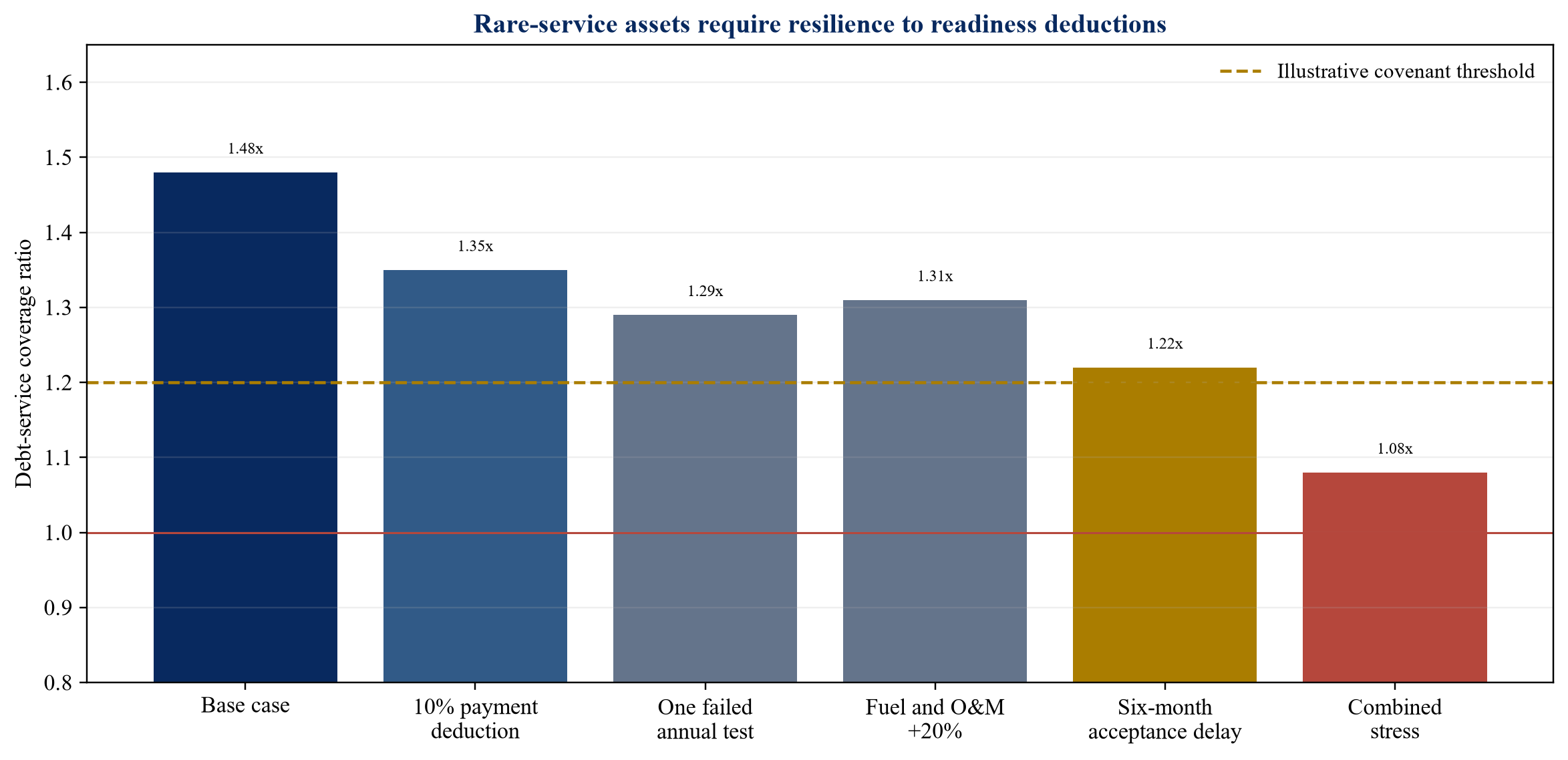
All values are hypothetical author-modelled assumptions and do not represent a project forecast, market price or financing offer.
The base case should include a realistic deduction allowance rather than perfect availability. The combined case should assume correlated problems where appropriate. A failed test can lead to lost payment, repair cost and a period of increased monitoring at the same time.
Debt sizing should be based on a minimum coverage level, contract tenor and reserve policy. Where payment deductions can be volatile, cash sweep or distribution lock-up provisions can rebuild resilience after underperformance.
19 Establish reserve accounts
A debt-service reserve can protect scheduled payments during a temporary service deduction or repair. A major-maintenance reserve can fund overhaul of dedicated starting equipment. A fuel or energy reserve can support minimum inventory or state of charge. A change-in-standard reserve may be appropriate where foreseeable upgrades remain the provider's responsibility.
Reserve sizing should use scenario cash flow rather than a generic number of months. A failed test may require repair, retest and delayed payment. The model should estimate the full cure period and any working-capital lag.
Cash should remain accessible under the event being protected. Restrictions at an operating subsidiary, counterparty set-off or a shared facility can reduce practical availability. Replenishment mechanics should balance lender protection with service continuity.
20 Define insurance and uninsurable risk
Construction, property damage, machinery breakdown, business interruption, cyber, liability and terrorism insurance may cover parts of the risk. Policies can exclude grid failure, war, gradual deterioration, contractual penalties or failure to perform. Insurance therefore cannot replace service design and reserves.
The contract should require reasonable coverage available in the market and provide a process when terms become unavailable or uneconomic. The procurer should avoid demanding insurance for risks that the market does not cover. Lenders need loss-payee rights while the system operator may need proceeds applied to reinstatement.
Business-interruption coverage should be checked against availability deductions and the waiting period. A policy may respond to physical damage but not a failed test or communications outage. The financial model should use documented policy terms rather than assumed recovery.
21 Protect lenders through direct agreement
A direct agreement can provide notice of provider default, cure periods, step-in rights, transfer rights and restrictions on termination. The system operator retains safety and reliability authority. Lender rights cannot require continued reliance on an unsafe resource.
Step-in should permit a qualified operator to cure commercial and operational defaults. Technical acceptance may need to be repeated after a material change. Transfer to a substitute owner should be subject to licensing, security and capability requirements.
Termination compensation should distinguish procurer default, provider default, prolonged force majeure, change in restoration plan and illegality. Compensation for procurer-driven termination should cover outstanding senior debt, break costs and an agreed treatment of equity. Provider-default compensation can be lower while avoiding a windfall to either party.
22 Address change in law and standards
Restoration standards evolve as generation mix, inverter penetration, cyber requirements and public expectations change. The UK's Electricity System Restoration Standard has driven new targets and procurement changes [4][13]. A long-term service contract should therefore include a process for changed technical or regulatory requirements.
The clause should define qualifying changes, notification, efficient design, approval, cost sharing and schedule. Small routine compliance changes may sit with the provider. Material system-driven changes can require capital recovery or price adjustment.
The provider should not receive automatic payment for elective upgrades. The system operator should not impose an unfunded material change through general compliance language. Independent expert determination can resolve technical scope and cost disputes.
23 Make testing part of the revenue model
Testing proves readiness and creates cost. The contract should specify frequency, notice, permitted operating conditions, fuel or energy reimbursement, market opportunity cost, wear, data, witnesses and retest procedures. European rules require periodic black-start tests for qualifying generators and HVDC providers [8]. AEMO's guideline sets modelling, assessment and testing requirements [5].
Testing can be paid through the fixed fee, a separate allowance or actual cost. The choice should prevent both under-testing and inefficient cost pass-through. Extraordinary tests requested after a system change should receive separate treatment.
Test results should feed asset management and lender reporting. A marginal pass can reveal growing maintenance risk. The provider should close findings under an agreed plan before they become a service failure.
24 Procure a portfolio rather than isolated units
System restoration requires locational diversity, technology diversity and network compatibility. Several resources can share common fuel, flood, telecommunications or equipment risk. Portfolio evaluation should identify these correlations.
The procurer can combine primary resources, top-up services, interconnectors, batteries and distributed resources. NESO's distributed-restoration work aims to broaden the technology and voltage levels able to support recovery [3][10]. The portfolio should still meet stable islanding, endurance and coordination needs.
Competitive procurement can occur by zone with minimum diversity constraints. The evaluation should consider whole-system cost, not only each bid's price. A higher-priced resource can reduce portfolio risk where it adds an independent path or fuel.
25 Finance batteries and grid-forming inverters
Batteries can start rapidly, provide voltage and frequency control and support a conventional generator. Grid-forming capability allows an inverter to establish a voltage reference without a strong external grid. NREL studies demonstrate promising configurations while identifying current-limiting, inrush, protection and dynamic-control issues [11][12].
The financing model should separate restoration-dedicated capacity from merchant capacity. The contract should define state of charge, minimum energy, degradation, augmentation, control-software updates, auxiliary loads and restoration priority. Warranty terms must allow the required operating mode and tests.
Revenue stacking can improve economics, but conflicting obligations need dispatch rules. The provider should not sell the same capacity simultaneously where another service can leave it unable to meet restoration readiness. The system operator may require priority or a pre-event charging instruction.
26 Finance distributed restoration
Distributed resources can form local islands, serve critical loads and support bottom-up restoration. The model can reduce dependence on a small number of large stations and create local resilience. It also increases coordination across distribution operators, aggregators, communications systems and many devices.
NESO's work identifies wind, solar, storage, demand response and electric vehicles as potential contributors and highlights the need for adequate incentives and communications resilience [10]. Procurement can be organised by distribution restoration zone, with an anchor resource and top-up services [14].
Financeability requires a responsible contracting entity. An aggregator may combine resources, but it needs control rights, telemetry, replacement rules and credit support. The service payment must cover distribution-network enabling works, device upgrades, communications and continuing portfolio management.
27 Use interconnectors and HVDC carefully
Voltage-source converter interconnectors can provide voltage control and potentially support restoration, subject to availability of the connected system, controls and contractual rights. The capability can diversify a restoration portfolio but introduces cross-border and common-event dependencies.
The contract should define external-system availability, capacity reservation, energy settlement, test rights, outages and priority during simultaneous stress. A foreign system may need its own capacity during a regional event. Assured access requires more than physical capability.
European rules include testing requirements for HVDC restoration providers [8]. Investment analysis should include converter modifications, control coordination, network studies and any opportunity cost from reserving capability.
28 Integrate restoration with project-finance documents
The service agreement, connection agreement, network-support agreement, fuel or energy arrangements, engineering contracts, operating agreement, insurance and financing documents should use consistent definitions and milestones. A conflict over commercial operation date or force majeure can impair debt service.
Conditions precedent should include licences, land rights, approved studies, technical design, key contracts, insurance, equity funding and a credible network programme. Drawdown conditions can track equipment milestones. Conversion from construction debt to term debt should follow integrated acceptance.
Financial covenants should reflect the payment regime. Distribution tests can use historic and forward coverage. Additional debt should be constrained by remaining contract term, reserve funding and performance history. Hedging may address interest, currency or indexed-cost exposure.
29 Evaluate four illustrative financing structures
Table 3. Illustrative restoration-capability financing structures
| Structure | Total uses | Contract term | Senior debt share | Base DSCR | Primary protection |
|---|---|---|---|---|---|
| Existing turbine retrofit | 24m | 10 years | 55% | 1.45x | Cost-based availability payment |
| Battery-supported black start | 58m | 12 years | 60% | 1.40x | Reserved-energy and augmentation regime |
| Distributed restoration zone | 41m | 8 years | 45% | 1.52x | Portfolio replacement and network support |
| HVDC restoration capability | 76m | 15 years | 65% | 1.38x | Long-term regulated or contracted revenue |
All values are hypothetical author-modelled assumptions and do not constitute financing terms or investment advice.
The structures are not directly comparable because asset lives, merchant revenue and network roles differ. The analysis should isolate the restoration-service cash flow and then allocate shared costs and revenue under a documented method.
Higher leverage can be supportable where revenue is long-term, inflation-linked and protected from provider-uncontrolled risk. Complex portfolio or technology risk can justify lower leverage, stronger reserves and sponsor support during the operating ramp-up.
30 Apply a transaction diligence checklist
An investor or lender should review the approved restoration plan, service designation, contract, tariff or regulatory decision, asset configuration, network path, studies, test history, outage records, fuel or energy arrangements, communications, cyber controls, capital plan, warranties, insurance and compliance.
The diligence team should trace one complete restoration sequence and one failed-test scenario. It should identify every decision maker, physical interface, payment consequence and cure step. Site inspection should verify dedicated equipment, spares, fuel, auxiliary supply and manual controls.
Financial diligence should reconcile availability invoices, deductions, operating costs and capital recovery. Forecast renewal, indexation and regulatory recovery should be supported by current documents. Management estimates should remain identified in the transaction model.
31 Use an investment-committee scorecard
The investment committee should receive a concise evidence-based assessment. Technical capability, locational need, contract durability, payment credit, risk allocation, fuel or energy assurance, communications, test performance and residual value should each have an owner and condition.
Critical conditions can include successful integrated acceptance, execution of a direct agreement, approval of cost recovery, minimum contract tail, funded reserves, warranty confirmation and closure of test findings. A red technical interface should not be offset mechanically by a high financial score.
The committee should distinguish system value from investor cash flow. Avoided national outage cost can support public procurement, but debt service depends on the enforceable payment mechanism.
32 Implement through a 180-day financing programme
Days 1 to 30 should confirm the restoration requirement, service zone, asset configuration and approved path. Days 31 to 60 should complete technical studies, interface mapping and market sounding. Days 61 to 90 should select the procurement and payment model, draft the risk matrix and build the financial model.
Days 91 to 120 should negotiate the service agreement, network interfaces, fuel or energy arrangements and direct agreement. Days 121 to 150 should complete diligence, approvals, insurance and financing commitments. Days 151 to 180 should finalise conditions precedent, testing plans and governance.
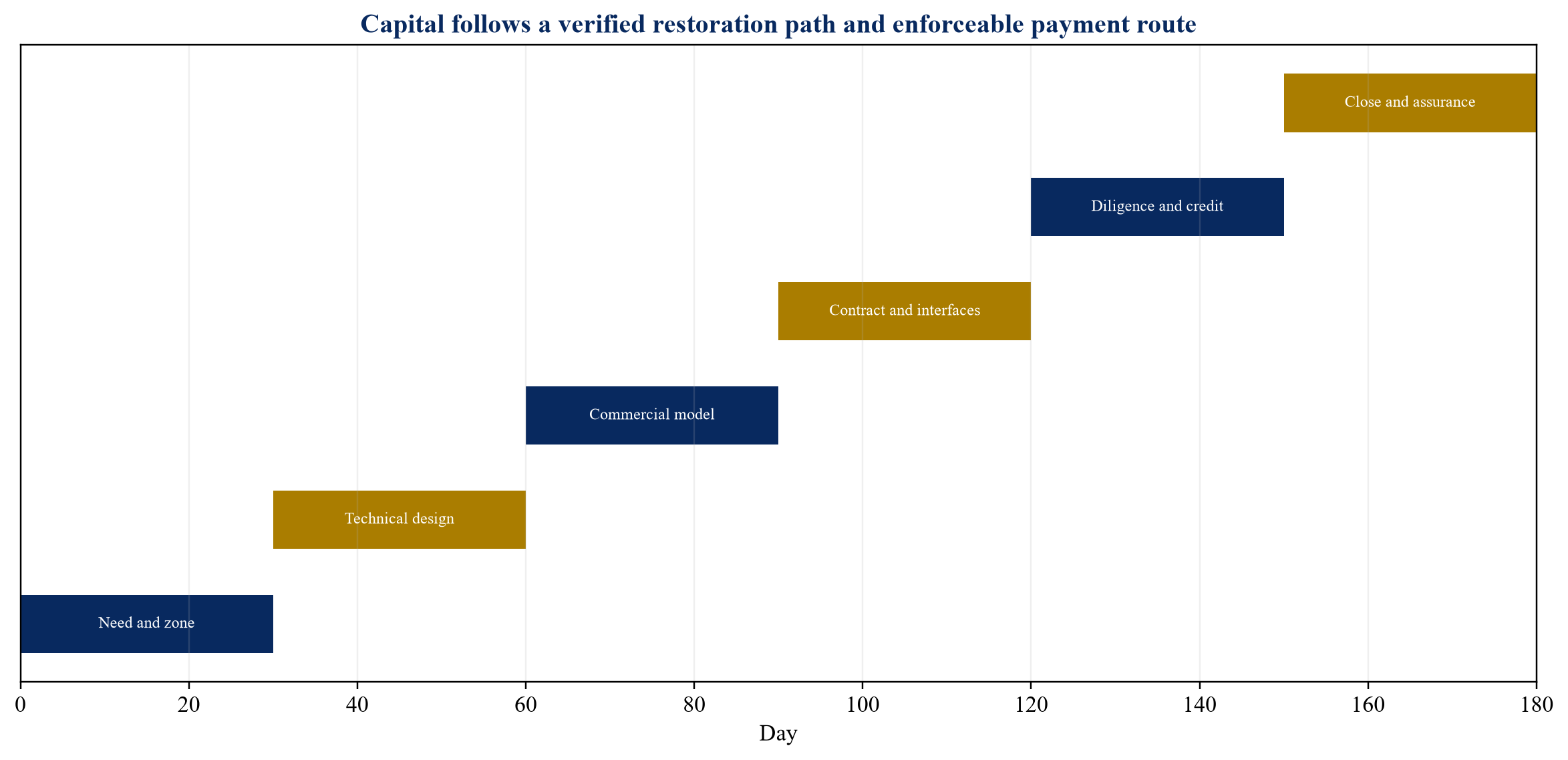
The roadmap is an author-developed implementation framework.
Each gate should have documentary evidence and decision authority. Technical design should not advance to final pricing with unresolved network interfaces. Financing should not close with material payment or termination provisions left to future agreement.
33 Establish operating governance
The provider should maintain a restoration-service management plan covering equipment, people, fuel or energy, communications, cyber, testing, outages, changes and reporting. Named executives should own readiness. The system operator should manage the integrated restoration plan and joint exercises.
The dashboard should track availability, test results, start reliability, endurance, fuel or state of charge, communications, unresolved findings, maintenance, spares and compliance. Lenders need timely notice of material failure and termination risk without receiving sensitive operational detail beyond their need.
Governance should address competing commercial priorities. A merchant operator may prefer dispatch or maintenance that conflicts with restoration readiness. The contract, operating procedures and board reporting should preserve the contracted priority.
34 Prepare for actual activation
An actual event may involve incomplete information, damaged communications, unavailable staff and changing restoration instructions. The contract should preserve the system operator's emergency authority while documenting compensation and relief. Safety and restoration should take precedence over ordinary commercial scheduling.
Emergency energy, starts, fuel, degradation and extraordinary operating cost should have a settlement method. Price calculation during a suspended or disrupted market needs clear fallback rules. Delayed measurement should not prevent interim payment where delivery is documented.
After the event, the parties should reconcile instructions, performance, cost, damage, insurance and lessons. The review should update technical procedures and commercial assumptions. It should not disclose security-sensitive information publicly.
35 Recognise limitations
This framework does not determine whether a specific resource meets a system operator's restoration requirements. Electrical studies, field testing, grid-code compliance and system-plan approval are required. Contract enforceability, tariff recovery, public procurement, security restrictions and finance terms depend on jurisdiction.
The illustrative figures and tables are author-modelled and are not market benchmarks. Severe-event probabilities and activation costs can be uncertain. Procurement should use scenario analysis, portfolio testing and transparent assumptions.
Black-start information can reveal critical system dependencies. Diligence and disclosure should follow applicable security, confidentiality and data-handling requirements.
Conclusion
Black-start capability is a small physical component with system-wide economic importance. Its financing challenge comes from the gap between continuous readiness cost and rare activation. An energy-only payment cannot reliably support dedicated capital, fuel assurance, resilient communications, testing and lender obligations.
A financeable structure purchases verified readiness through a defined service, zone and restoration path. It aligns technical acceptance, availability payments, performance deductions, fuel or stored-energy obligations, network interfaces, change protection, direct agreements and termination compensation. Debt is sized to contracted cash flow after realistic deductions and reserves.
The decisive investment question is whether the asset, contract and network form one executable restoration chain. When that chain is evidenced, tested and paid over a term consistent with capital recovery, system restoration can move from an unfunded reliability duty to a bankable critical-infrastructure service.
References
- PJM Interconnection, Open Access Transmission Tariff, Schedule 6A, Black Start Service. https://agreements.pjm.com/eTariff/transformedTariffs/oatt/Sections/4406.html
- PJM Interconnection, Review of Black Start Formula and Cost Components, 2024. https://www.pjm.com/-/media/DotCom/markets-ops/ancillary/black-start-service/review-of-black-start-formula-and-cost-components.pdf
- National Energy System Operator, Restoration Services. https://www.neso.energy/industry-information/balancing-services/system-security-services/restoration-services
- National Energy System Operator, Electricity System Restoration Standard. https://www.neso.energy/industry-information/balancing-services/electricity-system-restoration-standard
- Australian Energy Market Operator, System Restart Ancillary Services Guideline. https://aemo.com.au/energy-systems/electricity/national-electricity-market-nem/system-operations/ancillary-services/system-restart-ancillary-services-guideline
- California ISO, Black Start and System Restoration Phase 2. https://www.caiso.com/library/black-start-and-system-restoration-phase-2
- Electric Reliability Council of Texas, Black Start Services Request for Proposal for 2024-2026. https://www.ercot.com/services/comm/mkt_notices/W-A080122-02
- European Union, Commission Regulation (EU) 2017/2196 establishing a network code on electricity emergency and restoration. https://eur-lex.europa.eu/legal-content/en/ALL/?uri=CELEX%3A32017R2196
- World Bank, Payment Mechanism for Public-Private Partnerships. https://ppp.worldbank.org/payment-mechanism
- National Energy System Operator, Distributed ReStart Feasibility Studies. https://www.neso.energy/about/our-projects/distributed-restart/feasibility-studies
- National Renewable Energy Laboratory, Blackstart of Power Grids with Inverter-Based Resources, 2020. https://www.nrel.gov/docs/fy20osti/75327.pdf
- National Renewable Energy Laboratory, Resilient Inverter-Driven Black Start with Collective Parallel Grid-Forming Operation, 2023. https://www.nrel.gov/docs/fy23osti/83947.pdf
- Ofgem, ESO Centralised Strategic Network Plan Review: Restoration, 2024. https://www.ofgem.gov.uk/sites/default/files/2024-03/ESO%20CF%20W3%20Report%20-%20Final.pdf
- National Energy System Operator, Distributed ReStart Procurement and Compliance. https://www.neso.energy/about/our-projects/distributed-restart/procurement-and-compliance
- North American Electric Reliability Corporation, EOP-005 System Restoration from Blackstart Resources. https://www.nerc.com/standards/reliability-standards-under-development/2015-08-emergency-operations
- North American Electric Reliability Corporation, Reliability Standards. https://www.nerc.com/pa/Stand/Pages/ReliabilityStandards.aspx
- Federal Energy Regulatory Commission, Electric Reliability Organization Reliability Standards. https://www.ferc.gov/electric-reliability
- PJM Interconnection, Manual 12: Balancing Operations. https://www.pjm.com/-/media/documents/manuals/m12.ashx
- PJM Interconnection, Manual 27: Open Access Transmission Tariff Accounting. https://www.pjm.com/-/media/documents/manuals/m27.ashx
- PJM Interconnection, Guide to Billing: Black Start Service. https://www.pjm.com/markets-and-operations/billing-settlements-and-credit/guide-to-billing
- California ISO, Procurement and Cost Allocation for Black Start Capability. https://www.caiso.com/documents/presentation-losangelesbasinblackstartrequest-proposals.pdf
- California ISO, Western Los Angeles Basin Black Start Resource Selection. https://www.caiso.com/documents/western-los-angeles-basin-black-start-request-for-proposal-black-start-resource-selected.html
- Australian Energy Market Commission Reliability Panel, System Restart Standard. https://www.aemc.gov.au/market-reviews-advice/system-restart-standard
- Australian Energy Market Operator, Non-Market Ancillary Services Annual Summary. https://www.aemo.com.au/energy-systems/electricity/national-electricity-market-nem/data-nem/ancillary-services/non-market-ancillary-services-annual-summary
- National Energy System Operator, Distributed ReStart Closedown Report, 2023. https://www.neso.energy/document/280946/download
- Ofgem, Black Start Strategy and Procurement Methodology Decision, 2017. https://www.ofgem.gov.uk/decision/black-start-strategy-and-procurement-methodology-authoritys-decision
- International Energy Agency, Energy System Resilience, 2026. https://www.iea.org/reports/energy-system-resilience
- International Energy Agency, Electricity 2026: Reliability. https://www.iea.org/reports/electricity-2026/reliability
- World Bank, Lifelines: The Resilient Infrastructure Opportunity, 2019. https://documents1.worldbank.org/curated/en/775891600098079887/pdf/Lifelines-The-Resilient-Infrastructure-Opportunity.pdf
- World Bank, PPP Risk Allocation Tool 2019: Energy, Communications and Industrial Parks. https://ppp.worldbank.org/library/ppp-risk-allocation-tool-2019-edition-energy-communications-and-industrial-parks
About the Author
Authored by Chennakeshav Adya Independent Researcher
Chennakeshav (CK) is a corporate finance and investment banking executive with 25+ years of global experience in deal origination, structuring and execution across M&A, growth capital and corporate strategy. He has led value-creation mandates for founders, corporates and funds — bridging the boardroom view to hands-on execution and close.
His career spans Morgan Stanley, HSBC, Lloyds Banking Group, EWEC, ADQ portfolio companies and Emirates Growth Fund, across TMT, real estate, fintech, deeptech, cleantech, infrastructure and energy. He has partnered with C-suite leaders, private equity and venture funds, sovereign wealth funds and family offices to finance complex fund raises and scale-up ventures, and has led M&A due diligence, post-merger integration and business-transformation initiatives to create value.
At Matchpoint Partners he is Managing Partner, leading the firm's corporate finance, M&A and capital-raising practice. He holds an MBA from London Business School, an engineering degree from VTU and a Master of Laws (LLM, in progress) from UCL London.
An active start-up mentor, CK mentors at Techstars, DIFC FinTech Hive, Startup Grind, Founder Institute and IN5, serves as Entrepreneur Mentor in Residence (EMiR) at London Business School, and judges the Entrepreneurship World Cup.
LinkedIn: https://www.linkedin.com/in/ckadya/ Matchpoint Partners: https://www.matchpoint-partners.com/team/ck-adya.html
This paper is part of a continuing series on the structure of private and alternative markets. The views expressed are the author's own. The paper is for information only, describes market structure in general terms, and does not constitute investment, legal, tax or regulatory advice or a recommendation in respect of any security, vehicle or counterparty.
