
1. The financing decision
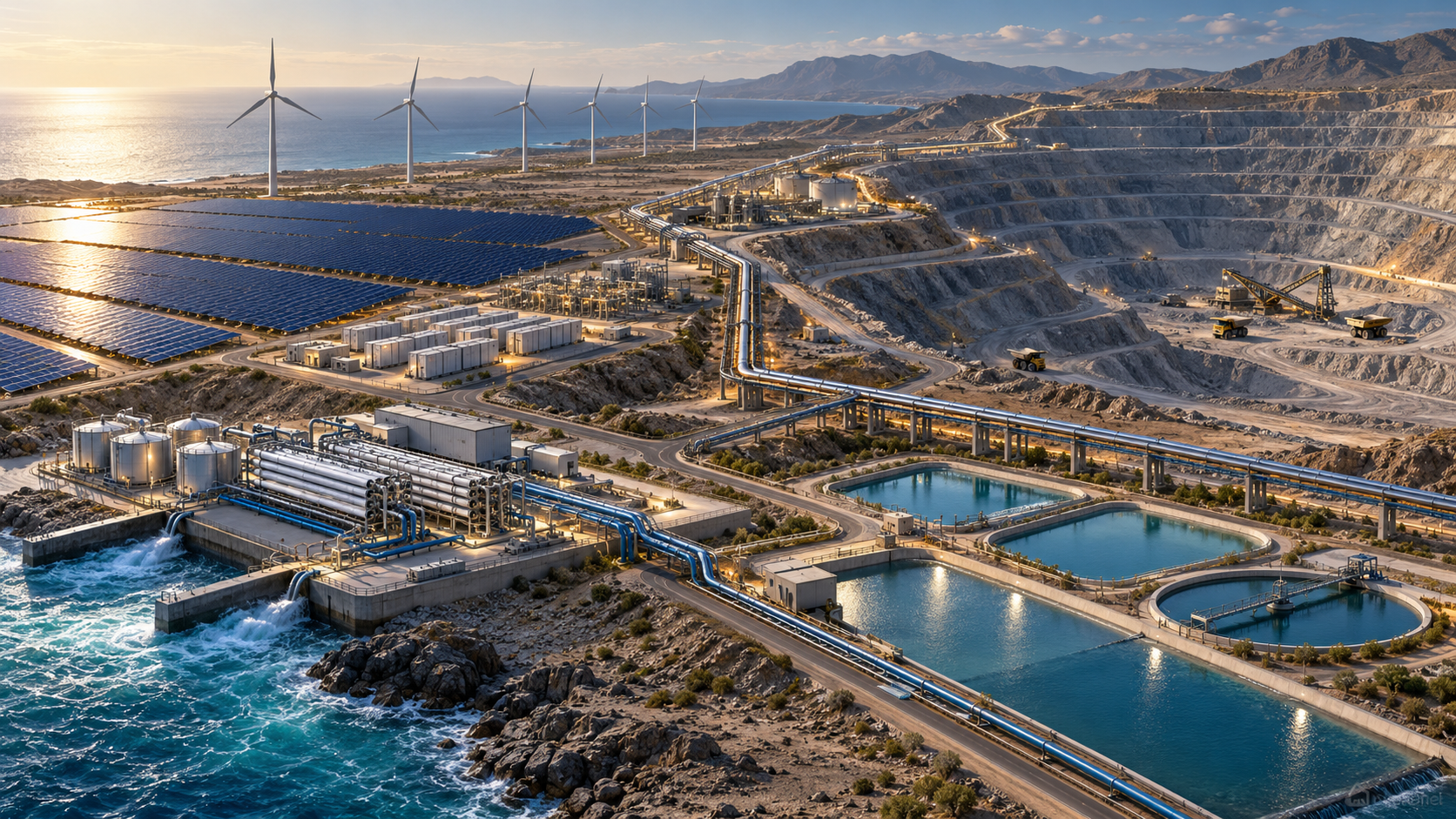
A mine needs dependable electricity and water before it can produce saleable mineral. The financing decision is whether those utilities should be funded inside the mine, contracted from third parties, or placed in a dedicated vehicle with long-term service agreements.
The answer changes risk, leverage and control. A separate utility can mobilise specialist capital and preserve mining-company liquidity. It can also introduce payment, interface and termination exposure. The structure should be selected after the physical system is defined and the mine's ability to pay under downside conditions is tested.
2. Why the constraint matters
The International Energy Agency identifies power and water infrastructure gaps among the constraints on expanding and processing critical minerals in resource-rich regions [1]. Water and climate risk already threaten production in several mineral systems [2].
Utilities therefore affect both production volume and social licence. A mine with ore and processing equipment can still be uneconomic when power is intermittent, diesel is costly, water is contested or a discharge route is unavailable. Infrastructure planning should sit inside the investment case rather than follow the plant design.
3. The protected output
The system should protect a defined production outcome. This may be tonnes of concentrate, refined chemical, cathode material or another saleable product. Engineers can translate that output into hourly and seasonal power, water and quality requirements.
The financing model should then value avoided downtime, fuel savings, emissions performance, water security and mine-life flexibility. It should not treat every megawatt or cubic metre as equally critical. Separating essential, interruptible and deferrable loads creates design and financing options.
4. Evidence from power-to-mine
IFC disclosed a 2025 collaboration to support power-to-mine opportunities across several African countries, including financing feasibility work and reviewing bankability considerations [3]. The disclosure recognises the mining sector's high energy intensity and the role of cleaner distributed supply.
The useful lesson is structural. Power should be developed as a service to a specific industrial load, with attention to feasibility, environmental and social risk, and a credible customer. A mine's consumption profile can anchor investment, while mine delay or closure concentrates offtaker risk.
5. Evidence from integrated investment
IFC provided a EUR 100 million green loan toward OCP's solar plants serving mining operations in Morocco. The disclosed facilities combine 400 MWp of solar capacity with up to 100 MWh of battery storage [4]. IFC separately disclosed a EUR 100 million facility financing water conveyance infrastructure to deliver desalinated water to the Khouribga phosphate mine zone [5].
These transactions show that power and water can be financed as identifiable investment programmes. Their applicability to another mine depends on sponsor credit, contracts, jurisdiction, permits and technical integration.
6. The integrated utility system
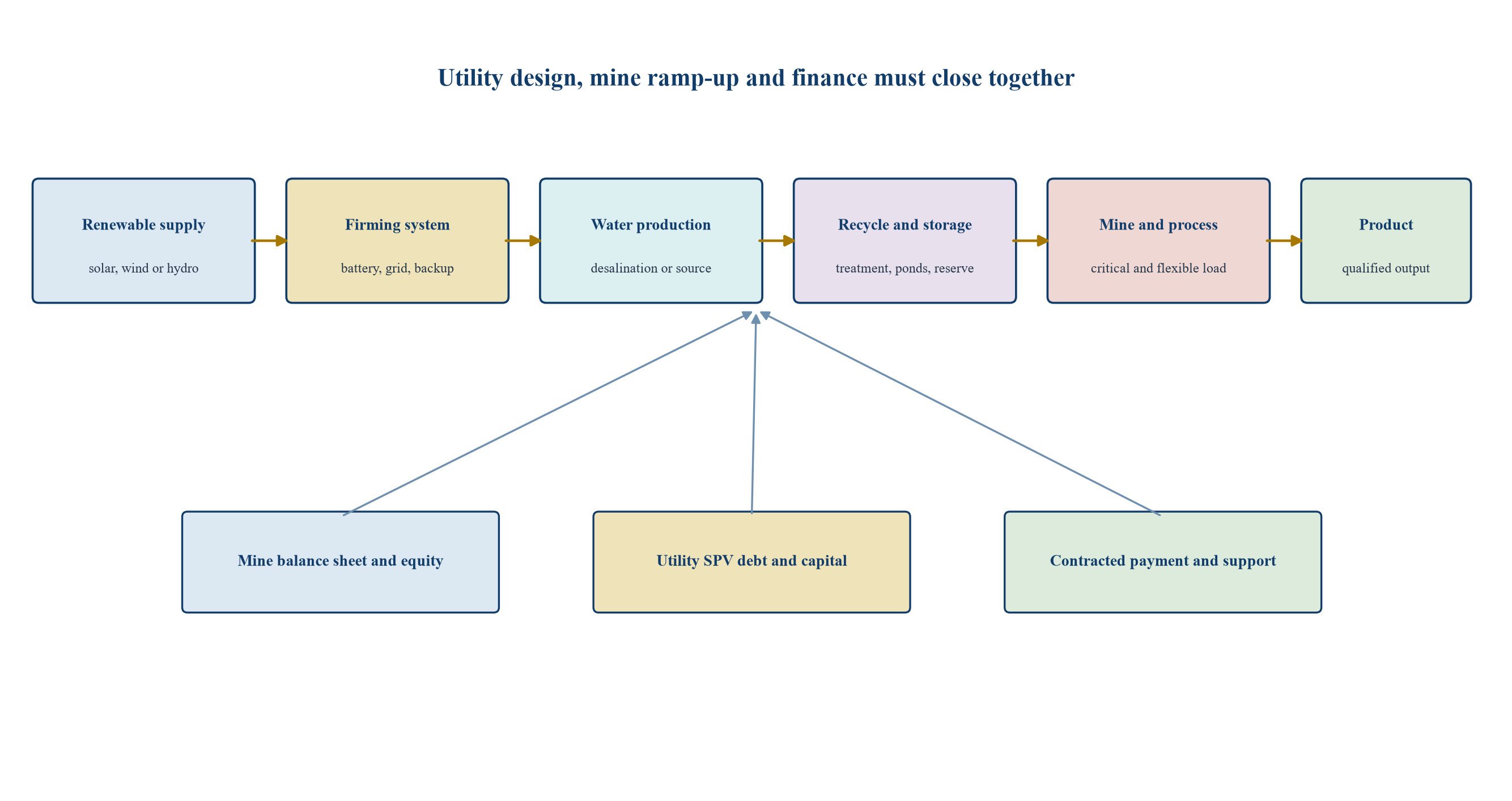
Generic framework; technical configuration, contracts and security require project-specific verification.
7. System boundary
The boundary should identify generation, transmission, substations, storage, backup fuel, intake, desalination, pipelines, pumping, treatment, recycling, reservoirs, discharge and control systems. Shared assets and connection points need explicit ownership.
An omitted interface can become an unfunded condition precedent. The design should state who builds each component, who accepts it, who operates it and who bears loss when another component is late.
8. Load definition
Power demand should be modelled by hour, season and operating state. Crushing, grinding, pumping, ventilation, refining, camp loads and desalination have different profiles. Starting currents and power-quality requirements can matter as much as annual energy.
The model should distinguish dependable capacity, energy and ancillary services. A renewable plant sized only to annual consumption may not support night operations or process restart. Storage and backup should be evaluated against specific interruption scenarios.
9. Water definition
Water demand should be mapped by source, quality, use, loss, recovery and discharge. Process water, potable water, cooling, dust suppression, washing and environmental flows may require different standards.
A site-wide water balance should cover dry, normal and wet cases. It should incorporate ramp-up, evaporation, tailings return, seepage, stormwater and closure. Financing cannot rely on a single average-demand figure.
10. Critical and flexible demand
Critical loads require firm supply to protect people, assets and process stability. Flexible loads can move to periods of renewable availability. Desalination, pumping, crushing and some storage operations may provide flexibility where tanks, ponds or stockpiles create buffers.
Flexibility can reduce battery and backup capacity. It requires controls, operational discipline and sufficient storage. The mine plan should identify the cost of curtailing each load so dispatch decisions preserve the highest-value production.
11. Ownership options
Table 1. Captive utility ownership and financing options
| Model | Capital source | Revenue basis | Principal advantage | Principal weakness |
|---|---|---|---|---|
| Mine-owned utility | corporate debt and equity | internal cost allocation | operational control | consumes mine liquidity and leverage |
| Utility SPV | limited-recourse debt and sponsor equity | long-term power or water payments | specialist capital and risk separation | concentrated mine offtaker risk |
| Third-party service | provider balance sheet | availability and consumption tariff | simple customer interface | provider credit and contract dependence |
| Shared infrastructure | multiple users and public or private capital | capacity and usage charges | scale and diversification | coordination and allocation complexity |
| Grid or public utility extension | regulated or negotiated funding | tariff and connection charge | integration with wider system | schedule and reliability outside mine control |
| Hybrid ownership | mixed corporate and SPV capital | combined fixed and variable payments | tailored control and finance | complex interfaces and intercreditor terms |
12. Selection test
Mine ownership may suit integrated systems that cannot be separated operationally or legally. An SPV may suit stand-alone generation, storage, desalination or pipelines with measurable output and long-term contracts.
Shared infrastructure can create value where several mines, communities or industries use the same asset. It also raises allocation, expansion and governance questions. The selection test should compare whole-life cost, control, bankability, flexibility and failure consequences.
13. Corporate financing
Corporate financing relies on sponsor credit and pooled cash flow. It can accommodate construction interfaces and operating changes more easily than a tightly contracted SPV. Lenders may accept broader security and covenants.
The disadvantage is competition for capital with the mine itself. Utility spending can reduce headroom for development, working capital and acquisitions. The sponsor should evaluate total leverage rather than present captive assets as separate merely because they have individual budgets.
14. Utility SPV
A special-purpose vehicle can own and operate defined assets and contract power or water to the mine. Its debt is repaid from service payments. Bankability depends on contract tenor, tariff, availability, mine credit, termination compensation and asset residual value.
The SPV should have limited permitted activities, clear ownership and direct agreements. The mine and utility construction schedules must be coordinated. An SPV that reaches completion before the mine may have no revenue; one that arrives late can delay mineral production.
15. Shared infrastructure
Shared power or water can diversify revenue and improve scale. Anchor users may support initial capacity, while later users pay connection or expansion charges. Public participation may support regional development.
The structure should allocate capacity, priority during shortage, expansion rights, credit support and stranded-capacity risk. A dominant mine should not assume access that conflicts with community, environmental or regulatory obligations.
16. Contract suite
The core suite may include a power purchase agreement, water purchase agreement, connection agreement, land rights, EPC contract, operations and maintenance contract, equipment supply, grid agreement, fuel backup, permits, direct agreements and intercreditor deed.
Schedules should align definitions of availability, force majeure, commissioning and termination. Inconsistent documents can leave an interface unallocated. A contractual matrix should identify the party bearing each risk and the remedy that follows.
17. Sources and uses
Table 2. Hypothetical USD 420 million captive utility capital plan
| Sources | Amount | Uses | Amount |
|---|---|---|---|
| Senior project debt | 250 | Solar and wind generation | 135 |
| Sponsor and mine equity | 105 | Battery and control systems | 70 |
| Subordinated or blended capital | 35 | Desalination and intake | 90 |
| Contingent cost-overrun support | 30 | Pipelines, recycling and storage | 70 |
| Grid, backup and substations | 30 | ||
| Development, fees and contingency | 25 | ||
| Total committed sources | 420 | Total uses | 420 |
18. Reading the illustration
The capital plan is hypothetical. Senior debt represents 60% of committed sources before cost-overrun support. Actual leverage depends on mine credit, construction risk, resource quality, contract protection and jurisdiction.
Each use should include owner, schedule and contingency. A single blended contingency can hide weak estimates in pipelines or marine works. The model should identify which sponsor funds a utility overrun and whether the mine can continue without the affected component.
19. Revenue architecture
Utility revenue can combine capacity, availability, energy, water-volume, pass-through and performance payments. Fixed payments support debt service; variable payments align use. Minimum take or deemed-availability provisions protect the SPV when the mine does not consume.
The mine should avoid paying for unavailable service. Tariff design should distinguish resource shortfall, equipment failure, mine curtailment and grid instruction. The payment mechanism is the financial expression of risk allocation.
20. Availability payment
An availability payment is earned when contracted capacity meets defined standards. Tests may include dependable power, response time, water volume, quality, pressure and reserve level.
Deduction regimes should be material enough to drive performance and capped to preserve financeability. Persistent failure can trigger cure, replacement and termination. Planned maintenance requires agreed windows and coordination with mine shutdowns.
21. Variable tariff
Variable charges can cover energy delivered, water produced, chemicals, fuel, grid imports and disposal. Indexation may reference inflation, exchange rates and selected inputs.
Pass-through should include procurement standards and audit rights. A broad pass-through transfers efficiency risk to the mine. A fixed tariff can overprice risk or expose the utility to volatile costs. A hybrid approach can allocate controllable and uncontrollable items.
22. Mine credit
The SPV's revenue is concentrated in the mine. Lenders should assess reserve life, production cost, commodity price, ramp-up, offtake, working capital and sponsor support. A long utility contract has limited value if the mine closes early.
Credit support can include parent guarantee, letter of credit, reserve account, minimum payment and termination compensation. The package should reduce as the mine establishes operating performance, if agreed thresholds are met.
23. Construction interface
Generation, storage, desalination, pipelines and mine facilities may have different EPC contractors. Interface schedules should define design data, access, energisation, testing, temporary supply and liability.
An independent engineer can monitor integrated milestones. Separate completion tests should be followed by a system test at representative load. Mechanical completion without mine-interface performance does not prove availability.
24. Common long-stop date
The mine and utility need coordinated long-stop dates. If the mine is late, the utility may face debt service without revenue. If the utility is late, the mine may lose product sales.
Delay protection can include liquidated damages, deemed payments, interim supply and termination. The parties should model correlated delay and avoid assuming that each contractor pays full loss. Liability caps can leave a material gap.
25. Cost overrun
Cost overrun support should identify amount, provider, form, draw sequence and expiry. Equity is commonly funded before or alongside debt. Contingency should reflect design maturity and site risk.
A cost-to-complete test should precede each major draw. If remaining sources are inadequate, the structure needs a cure before further senior funding. Value already spent does not justify completing an uneconomic system.
26. Renewable resource risk
Solar irradiance and wind resource should be supported by measured and modelled data. Energy forecasts should show probability cases, losses, degradation and correlation with demand.
Debt sizing may use a conservative energy case. The mine's operating plan should use dependable power after storage, grid and backup rather than headline renewable capacity. Resource shortfall risk can be shared through tariff design and reserve margins.
27. Battery role
Battery storage can shift energy, smooth ramps, provide reserve, support restart and improve power quality. Duration and power rating should follow the service need. A large energy figure can conceal insufficient discharge power.
The model should cover cycling, degradation, augmentation, thermal management, warranty and replacement. Revenue or savings assigned to several services should avoid double counting. End-of-life and recycling obligations require funding.
28. Grid connection
A grid connection can supply backup, export surplus and reduce captive capacity. It also creates connection-delay, curtailment, tariff and reliability exposure. Studies should confirm capacity, fault levels and upgrade responsibility.
The contract should allocate grid outages and changes in network charges. A remote mine may need islanding capability. Export revenue should be treated conservatively unless permits, capacity and offtake are secured.
29. Backup generation
Thermal or other dispatchable backup can protect critical loads. Fuel storage, logistics, emissions, maintenance and start reliability should be modelled. Backup that has not been tested under full load offers weak protection.
The mine should define acceptable interruption and fuel autonomy. Carbon cost and renewable commitments should include backup use. The financing case can treat backup as insurance rather than base-load generation.
30. Desalination choice
Reverse osmosis can provide a controllable source where seawater or brackish water and disposal routes are available. Intake, pretreatment, membranes, pumping, remineralisation and brine management are integral to cost and permitting.
World Bank guidance emphasises governance, economic viability, delivery models and financial structure when unconventional water becomes mainstream [6]. A mine-specific system still needs local water rights, marine assessment and community engagement.
31. Water recycling
Recycling can reduce abstraction and discharge. The system may recover tailings water, treat process streams, reuse sewage and capture stormwater. Recovery quality and variability matter.
High recycling can increase concentration of salts or contaminants and require purge treatment. The model should include chemical, energy, membrane, sludge and replacement costs. A percentage target should not replace a mass balance.
32. Storage and resilience
Water reservoirs and energy storage decouple production from demand. Storage size should follow outage duration, seasonal variation and recovery time. Emergency volume should be protected from normal optimisation.
Losses, evaporation and sedimentation affect usable capacity. Dams and ponds introduce geotechnical, safety and biodiversity risk. Financing should cover inspection, maintenance and closure.
33. Water rights
Lawful access may depend on abstraction permits, marine rights, land, discharge consent and priority rules. Climate stress can reduce allocations or increase competition.
The project should test rights under dry conditions and during community shortage. A permit is not proof of physical availability or social acceptance. Alternative sources and demand reduction should form part of resilience planning.
34. Community interface
Mine utilities can compete with communities for land, water and grid capacity. They can also expand local access when designed with governance and funding. Shared benefits require clear service obligations and sustainable operating budgets.
IFC Performance Standards address risk management, resource efficiency, community health, land, biodiversity and Indigenous Peoples [7]. Lender diligence should treat these as project risks with schedule and cash-flow consequences.
35. Environmental and social conditions
E&S studies should cover cumulative impacts of the mine and associated utilities. Separate permits can miss combined water, biodiversity, land and livelihood effects.
Action plans should be costed and scheduled. Conditions precedent and covenants should identify completion evidence. A financing model that excludes committed mitigation understates capital and operating cost.
36. Brine and discharge
Desalination brine and process effluent require lawful and environmentally acceptable management. Diffuser design, salinity, temperature, chemicals and marine ecology can affect approval and operation.
Discharge capacity should match worst-case production and water quality. Zero-liquid-discharge or concentrate treatment can materially increase energy and capital. The selected solution should be technically demonstrated before debt sizing.
37. Tailings and water
Tailings design affects water recovery, storage and risk. Thickening, filtration or dry stacking may reduce water demand while increasing power and capital requirements.
The utility paper should coordinate with tailings engineering. Water return assumptions should reflect operating performance, not design maximums. Tailings interruption can stop the mine even when power and freshwater remain available.
38. Operating interface
Control systems should coordinate renewable output, battery dispatch, grid, backup, desalination, pumps, tanks and mine loads. Decision rights must be clear during abnormal conditions.
The mine and utility operators should share forecasts, outage plans and incident procedures. Cybersecurity and communications are part of availability. Manual fallback should be tested.
39. Performance tests
Tests should measure dependable power, voltage, frequency, storage response, water volume, quality, pressure, recovery and integrated operation. Seasonal tests may be required.
Acceptance should use calibrated instruments and agreed protocols. Failure should lead to remediation, retest and damages. Provisional acceptance can retain security until final performance is achieved.
40. Operations and maintenance
Long-term O&M contracts can transfer routine performance risk to specialists. Scope should include spares, major maintenance, membrane replacement, battery augmentation, software, laboratories and emergency response.
Fees should align with availability and whole-life cost. A low fixed fee can encourage deferred maintenance. Lenders need step-in and replacement rights if the operator defaults.
41. Spare parts and supply chains
Remote systems can depend on imported inverters, cells, membranes, pumps and control components. Lead times and single-source exposure should be mapped.
Critical spares, framework agreements and alternative suppliers can reduce outage. Inventory funding belongs in sources and uses or operating reserves. Obsolescence should be reviewed through the mine life.
42. Insurance
Construction all-risk, delay in start-up, property damage, business interruption, machinery breakdown, marine cargo, environmental and liability cover may apply. Coverage gaps can occur at interfaces.
Insured values, waiting periods, deductibles and loss-payee rights should match financing. Business-interruption proceeds should support both mine recovery and utility debt service according to an agreed waterfall.
43. Force majeure
Force majeure should distinguish natural events, grid failure, water restriction, political action, supply-chain disruption and mine events. Notice, mitigation and restoration obligations are essential.
Relief should follow the risk the affected party cannot reasonably control. Prolonged events require payment, termination and debt treatment. A broad clause should not convert poor maintenance into excused unavailability.
44. Change in law
Renewable tariffs, grid rules, water charges, discharge standards, carbon pricing and local-content requirements can change. The contract should define qualifying changes and compensation.
Relief can use tariff adjustment, capital contribution or extension. The parties should avoid double compensation and require mitigation. Disputes need a timely expert or arbitration route.
45. Mine delay
If the mine is delayed after the utility is ready, deemed payments can protect debt service. The mine may resist paying before production. A phased capacity plan or interim customer can reduce exposure.
The financing model should show the maximum supported delay and security required. Construction schedules should be monitored together. A utility lender needs notice of material mine changes.
46. Utility delay
Utility delay can defer mineral revenue and create substitute fuel or water cost. Delay damages should reflect credible loss and contractor capacity.
Interim diesel, grid, trucking or temporary treatment may preserve commissioning. Their logistics, permits and costs should be planned. The mine should retain the right to procure substitute service and recover agreed cost.
47. Commodity-price downside
Low mineral prices can reduce mine output or cause care and maintenance. The utility then loses volume and possibly fixed payments. Lenders should stress the mine's position on the cost curve and liquidity.
Minimum payments, guarantees and reserve accounts can bridge a temporary downturn. Permanent closure requires termination compensation or alternative use. The model should avoid assuming uninterrupted mine operation through the full utility tenor.
48. Curtailment
Renewable production can be curtailed by grid, mine demand, water storage or equipment. The contract should distinguish causes and payment consequences.
Flexible loads and storage can absorb surplus. Export can add value where available. Deemed energy payments should be limited to capacity the utility could have delivered and the mine or grid prevented from using.
49. Payment security
The utility may require a debt-service reserve, letter of credit, parent guarantee, escrow or direct debit. Size should reflect billing period, dispute resolution and mine volatility.
Security should be accessible during stress and replenished after use. A promise from the same thin mine entity provides limited enhancement. Sponsor and jurisdiction credit must be assessed.
50. Security package
SPV lenders may take security over shares, assets, accounts, contracts, insurance and receivables. Land, permits and concessions may have transfer limits. Direct agreements preserve notice, cure and substitution.
Mine lenders may claim security over offtake, accounts and project assets. Intercreditor documents should govern payments, enforcement and shared dependencies. Utility isolation should not be assumed from incorporation alone.
51. Termination compensation
Termination payment is central when assets have little alternative use. For utility default, compensation may reflect fair value or debt after deductions. For mine default or convenience, it may cover senior debt, break costs and equity components.
The formula should be affordable, lawful and secured. It should define valuation date, disputed amounts, insurance and asset transfer. An unfunded promise can provide weak lender protection.
52. Residual value
Solar, wind, batteries, desalination and pipelines can have lives different from the mine. Residual value depends on grid access, alternate customers, land rights, removal obligations and technology condition.
Debt tenor should not rely heavily on uncertain post-mine use. Optional expansion and shared infrastructure can improve value. Decommissioning and site restoration remain costs even when assets are transferable.
53. Debt sizing
Debt should be sized to contracted and stressed cash flow after operating cost, tax, reserves and lifecycle capital. Coverage tests should include mine delay, resource downside, low consumption, tariff caps and cost inflation.
The base case should use realistic availability and degradation. A separate recovery analysis should value assets and contracts after default. Cash-flow and collateral approaches should not double count the same support.
54. Hypothetical base case
Assume USD 250 million of senior debt, a 15-year tenor and annual debt service of USD 28 million after completion. Contracted fixed payments are USD 46 million, variable margin is USD 8 million and annual fixed operating cost is USD 20 million.
Base-case cash available for debt service is USD 34 million, producing a hypothetical 1.21 times coverage ratio. The case excludes tax and is illustrative. Actual debt service and coverage depend on detailed modelling.
55. Coverage sensitivity
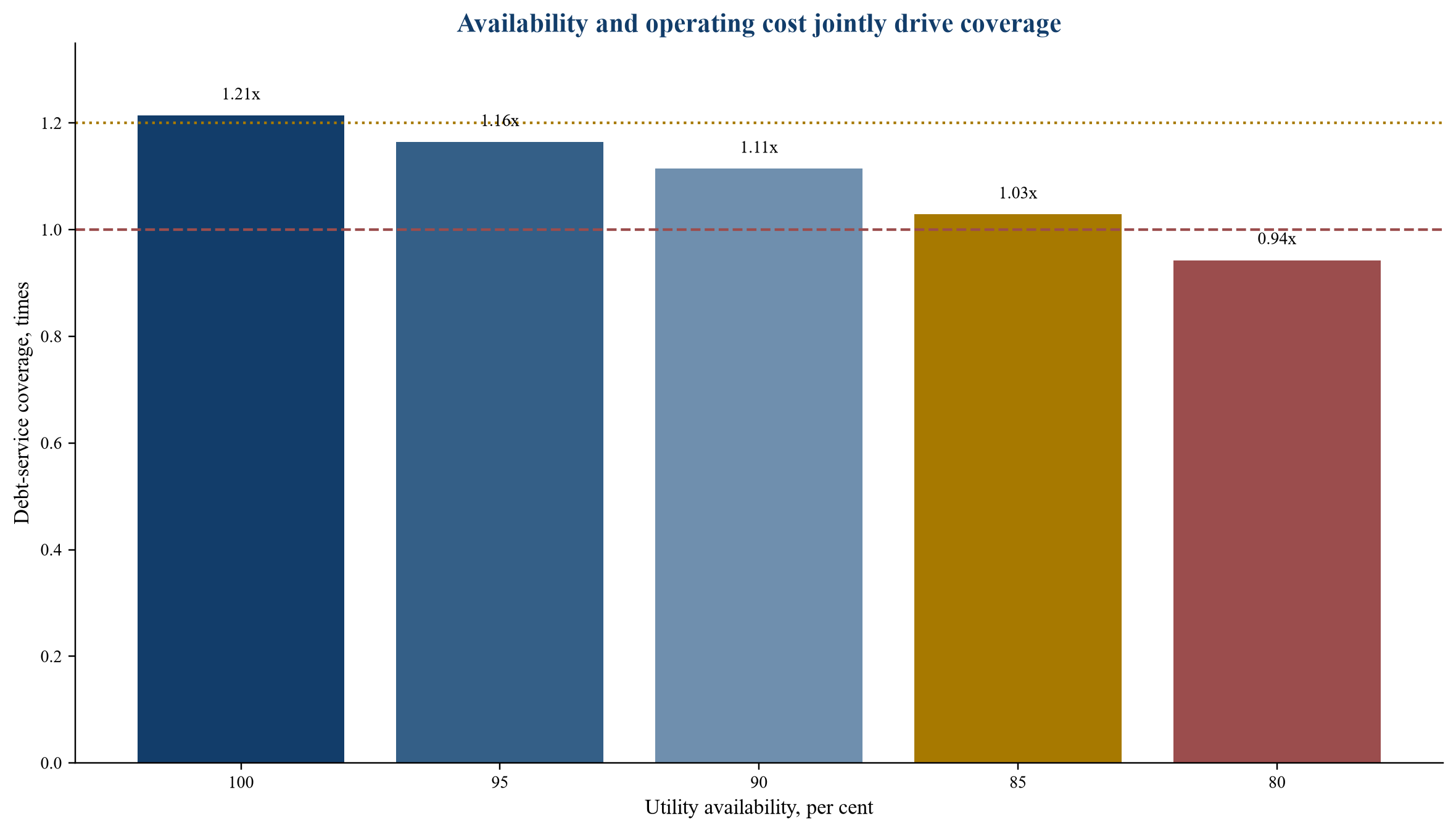
Illustrative cash flow; no tax, reserve movement or refinancing; not a forecast.
56. Sensitivity interpretation
The hypothetical coverage declines from about 1.21 times at full availability to 1.00 times at 80% availability as variable margin falls and operating cost rises. Fixed revenue supports debt service, while severe underperformance can still consume headroom.
The lender should test deductions, cost inflation and payment delay together. A contractual minimum payment has limited value if mine liquidity fails in the same downside case.
57. Risk-allocation matrix
Table 3. Captive power and water risk-allocation matrix
| Risk | Primary control | Typical bearer | Financing response |
|---|---|---|---|
| Mine construction delay | integrated schedule and deemed payment | mine and its sponsors | guarantee and delay reserve |
| Utility completion delay | fixed-price EPC and long-stop | utility and contractors | contingency, damages and support |
| Renewable resource | measured data and conservative forecast | utility, subject to contract | debt sizing and reserve margin |
| Water availability | lawful source and dry-case balance | allocated by source control | diversification and storage |
| Technology performance | warranties and tests | supplier and utility | retention and replacement reserve |
| Mine demand reduction | minimum payment and flexibility | mine | credit support and alternate use |
| Environmental and social | assessment, plans and monitoring | each responsible party | conditions, covenants and reserves |
| Change in law | defined relief mechanism | shared by cause and control | tariff adjustment or contribution |
| Prolonged force majeure | restoration and long-stop | shared | insurance, reserve and termination |
| Early mine closure | termination payment or alternate users | mine and sponsors | debt protection and residual-value limit |
58. Integrated downside
Single-variable sensitivities can understate risk. Drought can reduce hydropower or water availability while increasing community pressure. A commodity-price fall can weaken mine credit and delay expansion. Grid constraints can increase backup fuel and emissions.
The downside model should combine related events. It should show liquidity, covenant cure, required sponsor support and recovery. Management should identify the point at which continued operation destroys value.
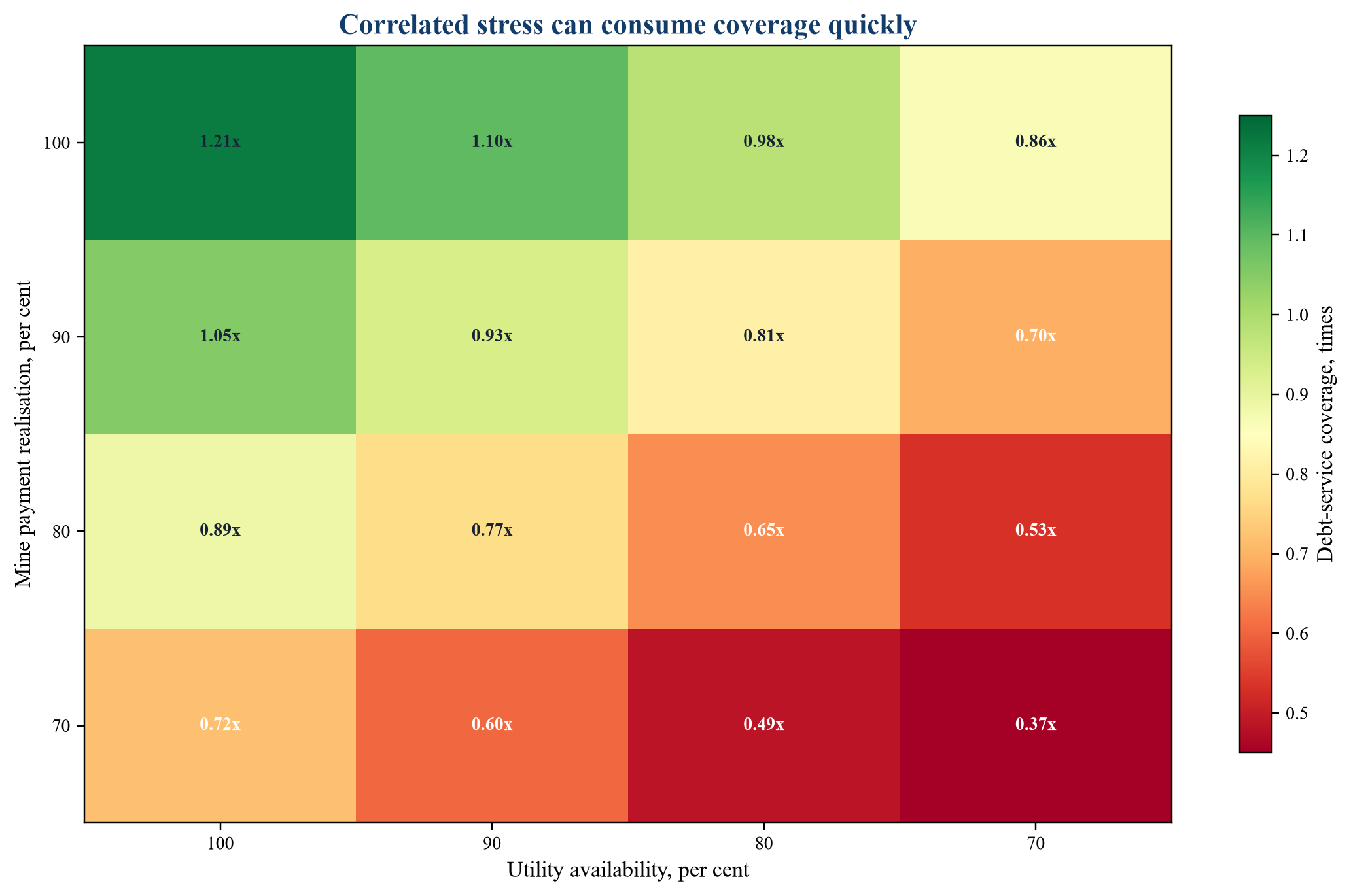
Illustrative coverage ratios derived from the paper's hypothetical case; no tax, reserves or refinancing; not a forecast.
59. Liquidity reserves
Separate reserves may cover debt service, major maintenance, battery augmentation, membranes, fuel and emergency water. Their size and funding sequence should be explicit.
Cash trapped in several accounts can raise tariff. The model should distinguish predictable lifecycle capital from contingent shock reserves. Letters of credit may substitute for cash where credit remains strong.
60. Blended finance
Concessional or subordinated capital can support first-of-kind technology, climate benefits or market development. It should address a defined risk and preserve commercial discipline.
The World Bank and IFC examples show public and climate capital operating alongside private investment in energy and water systems [8]. Eligibility, additionality and reporting should be confirmed before the base case relies on support.
61. Local-currency finance
Utility revenue and operating cost may be local currency while equipment and debt are hard currency. Depreciation can raise tariff and weaken mine affordability.
Local-currency debt, hedging, indexation and reserve accounts can mitigate exposure. Convertibility and transfer risk require separate analysis. Currency relief should be transparent rather than hidden in broad tariff reopening.
62. Tax and accounting
Asset ownership affects depreciation, interest, lease or service accounting, withholding and indirect tax. Carbon credits and renewable certificates can add complexity.
The parties should model after-tax cash flow and avoid assuming the legal form determines accounting. Related-party tariffs require transfer-pricing support. Tax change should be allocated in the contract.
63. Expansion
Mine plans evolve. The utility should define expansion triggers, capacity reservation, pricing and financing. Oversizing initial assets can strand capital; undersizing can constrain production.
Modular generation, storage and treatment can preserve flexibility. Shared corridors and land can be sized for expansion while major equipment follows confirmed demand. Existing lenders need consent rights that do not block economic growth.
64. Closure
Closure planning should address utility shutdown, residual users, asset transfer, decommissioning, water treatment and monitoring. Water obligations can continue after mineral production ends.
Financial assurance should reflect these costs. A utility SPV should not be left without revenue while long-term treatment remains. Mine and utility closure plans should be integrated from financing.
65. Governance
A joint operating committee can coordinate forecasts, outages, expansion and incidents. Reserved matters should cover budget, material contracts, tariff change, security release, major maintenance and enforcement.
Decision deadlock needs escalation. Lenders require information and cure rights without running the system. Technical and credit decisions should be documented separately and reconciled.
66. Monitoring dashboard
The dashboard should show mine load, renewable output, storage state, grid and backup use, water production, recycling, reservoir levels, quality, availability, tariff, cash and coverage.
Leading indicators include membrane pressure, battery degradation, deferred maintenance, water-quality drift, permit complaints and mine schedule variance. Thresholds should trigger action before service failure.
67. Reserve life and utility tenor
The utility contract and debt tenor should sit comfortably inside the mine's economically supported operating life. Mineral reserves, resources and expected extensions have different confidence. Lenders should avoid treating exploration upside as contracted revenue.
The mine plan should show production and utility demand through downside commodity prices and cost inflation. If utility debt extends close to reserve exhaustion, amortisation should accelerate or credit support should strengthen. Expansion capital should not lengthen exposure without updated technical evidence.
68. Refinancing risk
Shorter debt can reduce initial pricing or accommodate uncertain technology, while creating refinancing exposure before the utility contract ends. The model should identify the maturity balance and test interest rates, coverage, asset condition and mine life at refinancing.
Cash sweep, amortisation, extension options and sponsor support can reduce a refinancing cliff. A base case should not assume that future lenders accept higher leverage or unproven residual value. Lifecycle capital must remain funded before refinancing proceeds are distributed.
69. Interface security
Security over the utility may have limited value if access roads, land, grid connection, intake, discharge or mine control systems belong to another entity. Direct agreements and easements should preserve use after default.
Lenders should map each physical and contractual dependency to ownership, duration and cure. Enforcement that disconnects the utility from its only customer can destroy value. A coordinated sale or transfer process may achieve more than isolated asset enforcement.
70. Demand flexibility contract
Flexible mine loads can provide a valuable operating service to the utility. The contract can specify load-reduction windows, notice, maximum duration, recovery energy and compensation. Performance should be measured against an agreed baseline.
The mine should retain enough control to protect production and equipment. The utility should not count flexibility simultaneously as firm capacity, battery substitution and grid service unless operating evidence supports all uses. Dispatch incentives should reflect the actual value of avoided backup and curtailment.
71. Cyber and control resilience
Integrated utilities depend on operational technology, telemetry, forecasting and remote control. Cyber failure can interrupt power, water and mine safety systems. The design should segment networks, control access, preserve backups and monitor anomalies.
Contracts should allocate security standards, incident notice, patching, data ownership and recovery. Insurance may offer limited relief. The financing model should include required systems, specialists and replacement. Emergency procedures should support safe manual operation when communications fail.
72. Procurement strategy
Procurement can use a single integrated contractor, multiple specialist packages or an alliance. A single interface can simplify accountability while concentrating contractor capacity. Multiple packages can improve competition and technology choice while leaving integration risk with the owner.
Bid evaluation should compare whole-life cost, schedule, guarantees, financial strength, supply chain and E&S capability. Cheapest capital price may create larger operating and interface exposure. Contract packaging should match the sponsor's ability to manage it.
73. Permitting sequence
Power, storage, intake, desalination, pipelines, reservoirs, discharge, land and mine modifications may follow separate approval paths. The critical path should use realistic review, consultation and appeal periods.
Financing conditions should distinguish permits required for construction, commissioning and operation. Early works should not prejudice final approval or create stranded expenditure. Permit renewal and transfer rights matter for the debt tenor and enforcement case.
74. Water pricing
Water tariff should recover capital, energy, chemicals, membranes, labour, disposal, reserves and return. Volume-only pricing can under-recover fixed cost when mine demand falls. A fixed availability component supports capacity readiness.
The mine should understand marginal and full cost. Recycling, desalination and abstraction can have different economics and external impacts. Tariff adjustment should reward efficiency while passing through genuinely uncontrollable items under audit. Community service, where included, needs a separate payment and governance basis.
75. Carbon attributes
Renewable certificates, carbon credits and product-emissions claims can create value or compliance support. Ownership should be explicit across the generator, utility and mine. The mine should avoid claiming attributes that have been sold elsewhere.
Additionality, registry, metering and jurisdiction rules require verification. Carbon revenue should be treated conservatively in debt sizing unless contracted. Future methodology change can reduce value. The main investment case should remain dependable utility service and operating economics.
76. Implementation assurance
An implementation assurance plan should combine schedule, cost, technical, E&S, contractual and financing gates. Each gate should identify evidence, decision owner and permitted next expenditure. Independent review should focus on system integration rather than isolated packages.
The plan should continue after financial close. Commissioning, ramp-up, performance, reserve funding and handover require active governance. Early operating data should refresh availability, cost and maintenance assumptions. Persistent deviations should trigger corrective action before covenant headroom disappears.
77. First 30 days
Define mine production, critical loads, water balance, source rights and resilience standard. Map existing grid, fuel, water and discharge infrastructure. Select candidate ownership models.
Build a preliminary integrated technical and financial case. Identify permits, communities, land and environmental constraints. Appoint engineering, legal, E&S and finance leads.
78. Days 31 to 60
Complete resource, load, water and routing studies. Develop concept design, contracting strategy, construction interfaces and tariff. Test corporate, SPV and shared models.
Engage lenders and providers using consistent data. Develop base and downside cases. Resolve critical rights and define required sponsor support.
79. Days 61 to 100
Issue bankable procurement documents, negotiate key contract principles, establish integrated milestones and confirm finance structure. Prepare permits, action plans and direct agreements.
Run outage, drought, mine-delay and low-price tabletop exercises. Close material gaps before committing major development capital. Preserve alternative structures until bids confirm price and risk transfer.
80. Decision rule
Proceed when the system protects defined mine output, has lawful and sustainable sources, matches dependable supply to critical demand, aligns construction schedules, allocates interfaces, supports debt service under integrated downside and provides funded remedies for delay, termination and lifecycle replacement.
Defer when annual averages conceal hourly shortage, water rights are uncertain, utility completion is disconnected from mine ramp-up, sponsor support is unfunded, or debt depends on unproven residual value. These conditions can turn enabling infrastructure into the project's binding risk.
81. Conclusion
Power and water are productive assets in a mine. Captive renewable generation, storage, desalination and recycling can reduce disruption and operating exposure when engineered as an integrated system. Their value comes from dependable service to the mineral process.
Finance should follow that service design. Mine ownership, utility SPV and shared infrastructure each have valid uses. Bankability requires credible offtake, coordinated completion, realistic resource and water cases, lifecycle funding, environmental and social performance, and termination protection. A structure that survives mine delay, utility underperformance and commodity downside is more likely to deliver both minerals and debt repayment.
References
- International Energy Agency. Global Critical Minerals Outlook 2026: Executive Summary. 2026. https://www.iea.org/reports/global-critical-minerals-outlook-2026/executive-summary
- International Energy Agency. Global Critical Minerals Outlook 2025: Executive Summary. 2025. https://www.iea.org/reports/global-critical-minerals-outlook-2025/executive-summary
- International Finance Corporation. Voltalia Power-to-Mine Collaboration, Project 609809. 2025. https://disclosures.ifc.org/project-detail/AS-SCCP/609809/cnc-voltalia-ptm
- International Finance Corporation. IFC and OCP Sign a EUR 100 Million Green Loan to Build Solar Power Plants for Low-Carbon Fertilizer Production. 10 October 2023. https://www.ifc.org/en/pressroom/2023/ifc-and-ocp-sign-a-100-million-green-loan-to-build-solar-power-p
- International Finance Corporation. OCP Green Water, Project 49203. Updated 7 September 2026. https://disclosures.ifc.org/project-detail/ESRS/49203/ocp-green-water
- World Bank. Governance and Economics of Desalination and Reuse. https://www.worldbank.org/en/topic/water/publication/governance-and-economics-of-desalination-and-reuse
- International Finance Corporation. Performance Standards on Environmental and Social Sustainability. 2012. https://www.ifc.org/en/insights-reports/2012/ifc-performance-standards
- International Finance Corporation. Green Climate Fund and IFC Pipeline Projects. https://www.ifc.org/en/what-we-do/sector-expertise/blended-finance/climate/green-climate-fund
- International Finance Corporation. Environmental, Health, and Safety Guidelines for Mining. 10 December 2007. https://www.ifc.org/content/dam/ifc/doc/2000/2007-mining-ehs-guidelines-en.pdf
- International Energy Agency. Sustainable and Responsible Critical Mineral Supply Chains. 2023. https://www.iea.org/reports/sustainable-and-responsible-critical-mineral-supply-chains
About the Author
Chennakeshav (CK) is a corporate finance and investment banking executive with 25+ years of global experience in deal origination, structuring and execution across M&A, growth capital and corporate strategy. He has led value-creation mandates for founders, corporates and funds — bridging the boardroom view to hands-on execution and close.
His career spans Morgan Stanley, HSBC, Lloyds Banking Group, EWEC, ADQ portfolio companies and Emirates Growth Fund, across TMT, real estate, fintech, deeptech, cleantech, infrastructure and energy. He has partnered with C-suite leaders, private equity and venture funds, sovereign wealth funds and family offices to finance complex fund raises and scale-up ventures, and has led M&A due diligence, post-merger integration and business-transformation initiatives to create value.
At Matchpoint Partners he is Managing Partner, leading the firm's corporate finance, M&A and capital-raising practice. He holds an MBA from London Business School, an engineering degree from VTU and a Master of Laws (LLM, in progress) from UCL London.
An active start-up mentor, CK mentors at Techstars, DIFC FinTech Hive, Startup Grind, Founder Institute and IN5, serves as Entrepreneur Mentor in Residence (EMiR) at London Business School, and judges the Entrepreneurship World Cup.
LinkedIn: https://www.linkedin.com/in/ckadya/
Profile: https://www.matchpoint-partners.com/team/ck-adya.html
