

Introduction
An outage becomes a financing problem when the replacement equipment is unavailable. A utility may have crews, insurance and emergency procedures, yet restoration can remain constrained by one transformer, cable termination, pump, motor drive or control cabinet. The economic loss then arises from service interruption rather than the purchase price of the missing component.
The United States Department of Energy describes large power transformers as essential grid components with extended replacement lead times and complex transport requirements. Its 2024 resilience report reviews industry sharing arrangements, strategic reserves, flexible designs and logistics. The United States Environmental Protection Agency makes the corresponding point for water systems: loss of power or critical pumping can interrupt treatment, reduce pressure and produce cascading public-health consequences.
The investment case for critical spares is therefore an availability case. Capital is committed today to preserve an option that may be exercised infrequently. That option has value only when equipment can be identified, released, moved, installed and energised within the required restoration window. This paper sets out the evidence and contractual structure needed to finance that capability.
1 Define the resilience service
The first decision is the service standard. A programme should state which essential loads or water services must be restored, within what period, after which events and for how long. An undefined aspiration to hold more stock cannot support a reliable capital plan.
The service standard should distinguish routine failures, regional disasters, coordinated attacks, supply-chain disruptions and planned replacement. Each event can require a different inventory and mobilisation response. Routine failures may be covered by local utility spares. A regional event may require mutual aid. A widespread event can exhaust commercial stocks and justify a strategic reserve.
The standard also needs a consequence measure. Electricity analysis can consider unserved energy, restoration time, safety, system stability and critical-load exposure. Water analysis can consider treatment capacity, pressure, storage duration, wastewater overflow and service to hospitals or firefighting. The resulting measure links inventory to an observable public or customer outcome.
2 Build the asset-to-service chain
A spare is one element of a chain. The chain begins with an identified failure mode and ends with restored service. Intermediate links include compatible design, title, physical custody, preservation, inspection, release authority, transport, site access, installation equipment, skilled labour, testing and commissioning.
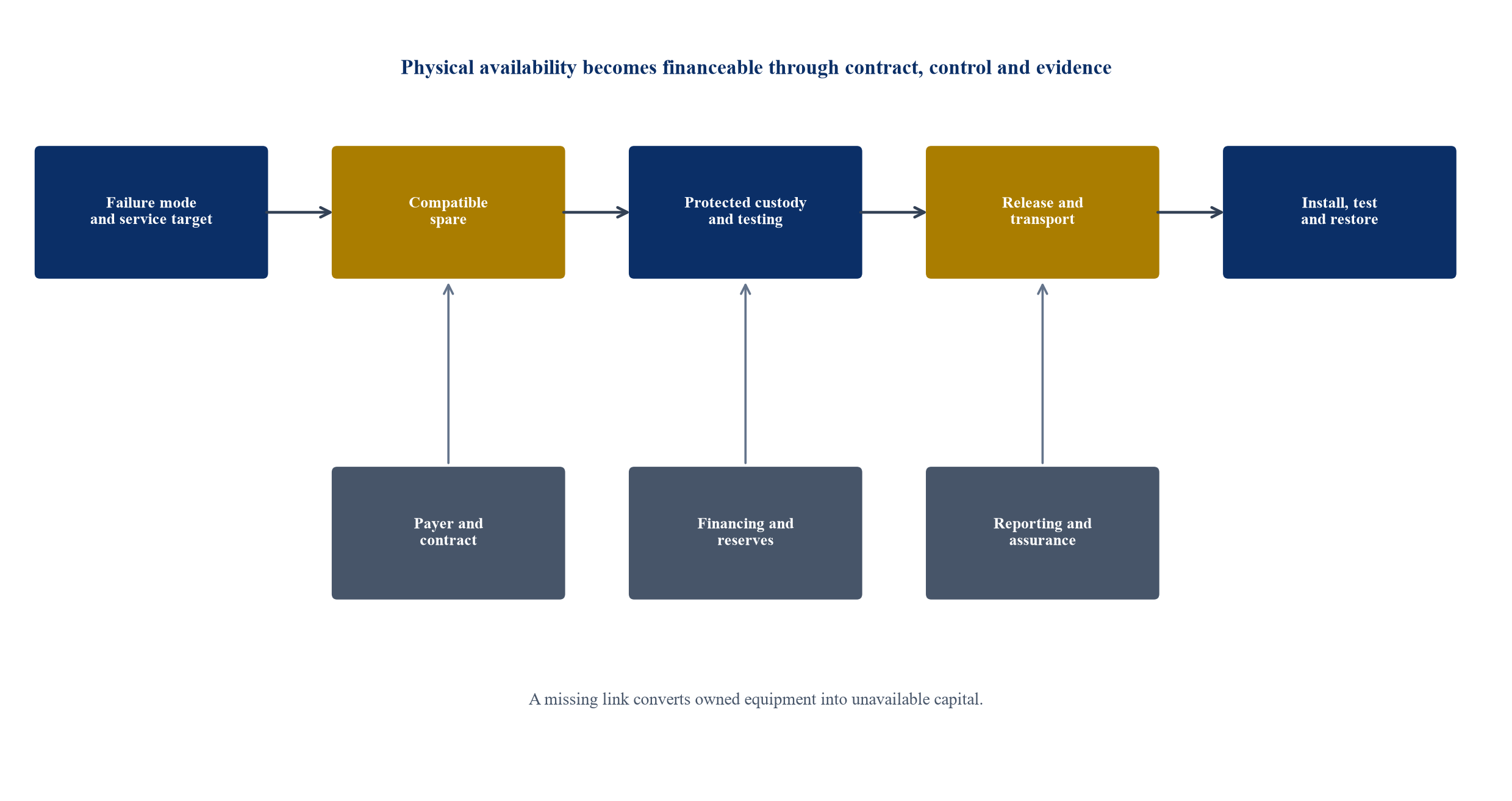
The diagram is an author-developed framework. Every link requires evidence before inventory can be treated as an available resilience asset.
The financing review should test the weakest link. A transformer held in a distant warehouse may have no resilience value if bridge clearances, rail access or installation pads are unresolved. A compatible pump may remain unusable if its motor, drive, controls, couplings or seals are missing. A control cabinet may be mechanically available while its software, credentials or cyber approval prevent commissioning.
3 Establish a criticality method
The asset register should rank equipment by service consequence, likelihood of failure, replacement time, common-mode exposure and availability of alternatives. A high purchase price does not automatically imply high criticality. A low-cost proprietary controller can stop an entire process, while an expensive component may have redundant capacity or a short replacement route.
Criticality should be reviewed at system level. A transformer can be redundant during normal demand and critical during maintenance or peak load. A pump can be non-critical when storage tanks are full and critical during fire demand. Network reconfiguration, mobile equipment and operating procedures may reduce the required stock more economically than buying another fixed spare.
The scoring method should remain auditable. Inputs need owners, evidence dates and approval. Management judgement can be recorded separately from observed failure history and supplier quotations. The board should approve the service threshold and risk appetite rather than individual technical scores.
4 Translate criticality into coverage
Coverage is the number, location and configuration of spares required to meet the service standard. It should reflect simultaneous failures, maintenance outages, geographic concentration, transport routes and replenishment time. A single spare can cover several sites only when compatibility and deployment time are demonstrated.
The Department of Energy's transformer work highlights the tension between custom designs and broader interchangeability. Flexible transformer designs can cover more configurations, while added flexibility can increase cost, footprint and testing requirements. Coverage analysis should compare tailored stock, standardised stock and adaptable stock using the same restoration objective.
The coverage standard should state residual risk. A pool may cover a defined set of credible events without protecting against every nationwide scenario. Explicit exclusions support funding decisions and emergency planning. They also prevent a programme from claiming comprehensive resilience from a limited inventory.
5 Define eligible equipment
Eligibility converts an asset register into a financeable pool. Equipment should satisfy technical, legal, operational and documentary tests. The following table provides a starting point.
Table 1. Illustrative critical-spares eligibility framework
| Equipment class | Service consequence | Compatibility evidence | Storage and testing requirement | Financing treatment |
|---|---|---|---|---|
| Large power transformer | Loss of transmission capacity, stability or supply | Voltage, winding, impedance, tap, protection, footprint and transport study | Oil, bushings, seals, heaters, periodic electrical tests and transport readiness | Individually identified asset with conservative advance rate and deployment reserve |
| Distribution transformer | Local capacity and connection constraint | Standard specification, rating, mounting and accessories | Dry protected storage, inspection and rotation policy | Borrowing-base pool where specifications and counts are verified |
| High-voltage cable and accessories | Circuit outage with specialist repair dependency | Conductor, insulation, joint, termination and test compatibility | Controlled environment, drum management, accessory shelf-life and trained jointers | Eligible only with full repair kit and verified installation capacity |
| Pump, motor and variable-speed drive | Loss of treatment, transfer, pressure or wastewater handling | Duty point, materials, power, coupling, controls and hydraulic fit | Corrosion protection, shaft rotation, seals, firmware and test records | Asset pool with component completeness and commissioning reserve |
| Switchgear and protection | Isolation, fault-clearing or substation availability loss | Rating, interrupting duty, bus geometry, protection logic and communications | Environmental control, mechanism exercise and relay test | Advance rate reduced for proprietary or ageing equipment |
| SCADA and control equipment | Loss of visibility, automation or process control | Hardware, firmware, licences, configuration, cyber baseline and interfaces | Secure custody, patch control, backup configuration and functional testing | Eligible only with controlled software, credentials and cyber approval |
Criteria should be adapted to the utility, jurisdiction and service standard. Lead-time and consequence ratings require current supplier and system evidence.
Equipment should leave the eligible pool when inspection expires, warranty is impaired, title is disputed, configuration changes, storage is inadequate or deployment is no longer practical. The borrowing base and resilience dashboard should use the same eligibility status.
6 Choose the ownership model
Utility ownership provides direct control and simple dispatch. It can also duplicate equipment across neighbouring systems and concentrate capital on one balance sheet. A mutual-aid pool spreads cost and expands coverage, while access depends on shared rules and compatible designs.
Manufacturer-managed inventory can improve preservation, technical support and replenishment. The contract must address competing customer demand during a widespread event, title, segregation and supplier distress. An availability-service company can own equipment and charge participating utilities for access. Its credit depends on durable payments and enforceable step-in rights.
A public strategic reserve can address national or regional consequences that extend beyond one utility. Public ownership adds procurement, budget and accountability requirements. The reserve still needs an operator, maintenance regime and deployment protocol. Public title alone does not create operational readiness.
7 Compare contracting structures
Table 2. Ownership and payment structures for critical-spares programmes
| Model | Primary payer | Availability promise | Capital advantage | Principal control requirement |
|---|---|---|---|---|
| Utility-owned stock | Utility customers or corporate balance sheet | Direct access subject to internal dispatch | Simple title and local accountability | Ring-fenced maintenance, testing and replenishment budget |
| Mutual-aid pool | Participating utilities through fees and asset contributions | Defined release after an agreed triggering event | Wider coverage and lower duplication | Standard specifications, priority rules and enforceable sale or loan obligation |
| Manufacturer-managed inventory | Utility through reservation and service fees | Reserved equipment, production slot or rapid supply | Supplier expertise and inventory rotation | Segregation, audit rights, insolvency protection and competing-demand rules |
| Availability-service SPV | Contracting utilities or public authority | Contracted readiness and mobilisation standard | Ring-fenced project finance and performance incentives | Long-term payment, asset security, direct agreements and operator replacement |
| Public strategic reserve | Government, levy or public-private cost sharing | Deployment for defined national or regional events | Funds wider resilience benefits | Transparent eligibility, release, custody, oversight and replenishment rules |
The comparison identifies core design questions. It does not prescribe legal or accounting treatment.
The chosen structure should reflect the payer's authority. A regulator may approve recovery of prudent utility inventory through tariffs. A government can fund national resilience. A group of utilities can contract for mutual access. A financing vehicle should not depend on a benefit whose recipient has no obligation to pay.
8 Build the revenue architecture
Critical inventory rarely produces sales in normal operation. Revenue should therefore pay for availability, preservation and mobilisation rather than depend on repeated equipment turnover. Possible payments include an annual capacity fee, a tested-readiness fee, mobilisation charges, sale proceeds upon dispatch and public grants.
An availability payment should be linked to measurable outputs: eligible asset count, coverage ratio, test compliance, dispatch readiness, logistics exercises and reporting. Deductions can apply when an asset is unavailable or records are incomplete. Severe failure can trigger replacement of the operator or termination.
Mobilisation pricing should avoid opportunistic renegotiation during an emergency. The contract can pre-agree the sale price, rental charge, transport allocation and replacement obligation. Indexation may cover commodity or manufacturer cost, subject to evidence and caps.
9 Define the borrowing base
Asset-based finance can fund eligible inventory when title, value and control are sufficiently clear. A borrowing base should start with verified acquisition cost or a conservative eligible value. It should deduct ineligible items, concentration, obsolescence, damage, unpaid duties and required reserves. An advance rate then determines debt availability.
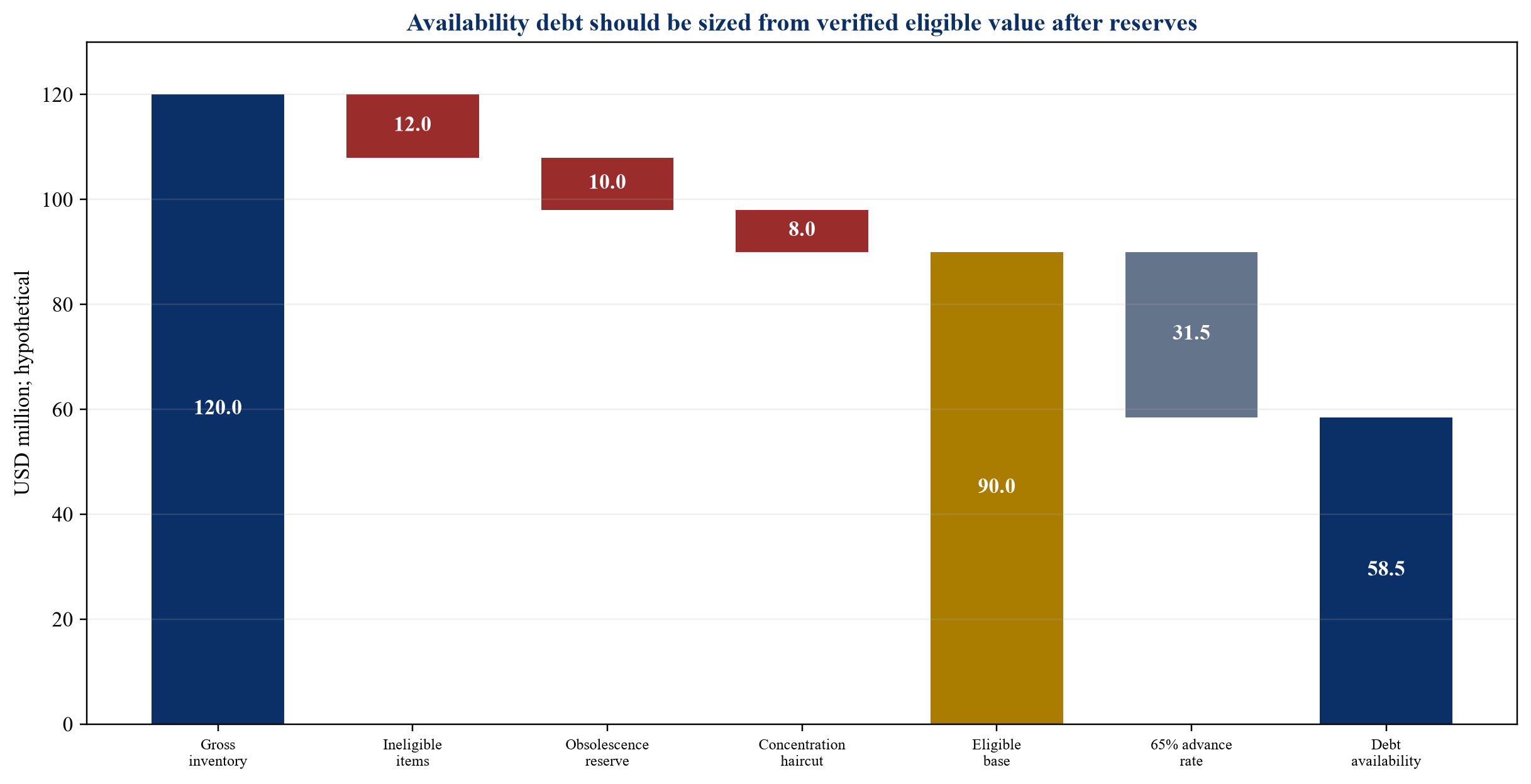
Values are author-modelled assumptions in USD millions for demonstrating the method. They are not market data or a financing recommendation.
The waterfall is illustrative. A large customised transformer may require individual appraisal and a lower advance rate. Standard distribution equipment can support pool-based verification. Proprietary controllers can lose value rapidly when software or product support changes. Lenders should test both liquidation value and resilience-service value because the two can diverge.
10 Secure title and control
The financing documents should identify each material asset and its location. Serial numbers, photographs, purchase records, acceptance tests and warehouse receipts support title. The security package should cover equipment, insurance proceeds, contracts, accounts and relevant receivables.
Control must coexist with emergency access. A lender should not be able to obstruct a valid life-safety dispatch, while the borrower should not remove collateral outside agreed rules. A pre-authorised release protocol can define triggering evidence, notice, sale or substitution mechanics and application of proceeds.
Shared pools require special attention. Participants may contribute assets, cash or access rights. The agreement should determine whether equipment is jointly owned, owned by a pool company or transferred only upon dispatch. Insolvency and enforcement analysis should follow the selected structure and jurisdiction.
11 Design custody and preservation
Storage conditions can determine whether a spare is usable. Requirements vary by equipment and manufacturer. Transformers can need preservation of oil, gas pressure, bushings and seals. Cable accessories can have environmental and shelf-life constraints. Pumps and motors can require corrosion control, shaft rotation and periodic testing. Electronics require controlled temperature, humidity, firmware and cyber custody.
The operator should maintain asset-specific preservation plans, inspection intervals and exception logs. Work orders should capture who performed each task, the method, readings, photographs and approval. Missed maintenance should change eligibility automatically until the asset is inspected and any defect remedied.
Warehouses need physical security, fire protection, flood protection, lifting capacity and access for oversized transport. Geographic diversification can reduce common-mode exposure. It also increases logistics and oversight costs. Site selection should use a whole-chain restoration analysis.
12 Prove compatibility
Compatibility is an engineering conclusion supported by controlled data. The programme should maintain specifications, drawings, interface dimensions, protection requirements, software versions and site constraints. A nominal voltage or pump rating is insufficient.
Standardisation can widen the coverage of each spare. DOE work on distribution transformers reports extensive specification variety and identifies interoperability as one route to reducing production pressure. Utilities can review legacy specifications, accessories and mounting requirements to identify acceptable common designs.
Adaptability needs limits. A flexible transformer or configurable drive may cover multiple sites while requiring additional commissioning time, adapters or protection studies. The deployment record should state the exact sites covered, the modifications required and the maximum restoration time.
13 Plan logistics before funding
Large equipment can require route surveys, permits, heavy-haul vehicles, railcars, barges, cranes and temporary works. A route that was feasible when equipment was purchased can be blocked later by bridge limits, road changes or site development. Logistics evidence should be refreshed periodically.
The mobilisation plan should identify transport suppliers, equipment, escorts, permits, site access and contingency routes. Framework agreements can reserve response support, while emergency priority and competing demand should be explicit. Drills can test communications and physical constraints without moving the full asset.
Water equipment presents different challenges. A replacement pump may be transportable while removal, alignment, electrical connection and process isolation remain critical. The spare package should include specialist tooling, consumables, drawings and commissioning procedures.
14 Integrate workforce readiness
Equipment availability does not replace skilled labour. The programme should identify engineers, operators, jointers, riggers, electricians, controls specialists and commissioning personnel. Competence records and call-out arrangements belong in the readiness evidence.
Workforce concentration can create a common constraint across multiple utilities. Mutual aid should include people and specialist tools as well as stock. Supplier service agreements can provide expertise, while widespread events may create competing demand. The programme should test a scenario in which the normal manufacturer team is unavailable.
Knowledge preservation matters for ageing assets. Retiring staff may hold undocumented installation and operating knowledge. Controlled procedures, training and exercises reduce dependence on individuals. Modernisation decisions should consider whether continued sparing of obsolete equipment preserves or delays a more resilient standard.
15 Protect cyber and control assets
SCADA controllers, relays, drives and communications equipment combine physical inventory with software and credentials. A spare device without the approved configuration may be unusable. A stored configuration can become unsafe if patches, certificates or network architecture change.
The cyber custody plan should manage firmware, licences, cryptographic material, configuration backups, malware checks and access. CISA and EPA guidance for water systems emphasises practical cyber controls alongside resilience planning. Stored equipment should follow the same governance as operating technology.
Testing should occur in an isolated environment where practical. The commissioning process should verify integrity before connection to an operational network. Emergency urgency should not bypass essential safety and cyber approval; the response plan should make those approvals rapid and pre-defined.
16 Address insurance
Insurance should cover stored assets, transit, installation and relevant liability. Policy terms need to match the ownership and dispatch structure. A utility-owned asset moving to another participant can cross from property coverage into transit, installation and operational policies.
The insured value should reflect replacement and logistics rather than historical book value. Deductibles and exclusions should be included in liquidity reserves. Insurance proceeds should support restoration or replenishment, subject to lender and public-funder rights.
Coverage cannot replace readiness. A cash payment after loss does not shorten manufacturer lead time. Insurance is one financial recovery layer within a wider availability plan.
17 Account for inventory and impairment
Accounting classification depends on facts and applicable standards. Inventory held for sale, strategic operating spares and major standby equipment may receive different treatment. Management should obtain accounting advice on classification, depreciation, impairment and presentation.
Financing analysis should remain independent of accounting labels. An asset can have low accounting value and high resilience value, or a high book value and little deployment utility. Eligibility should use technical and contractual evidence, with accounting information reconciled rather than treated as the sole measure.
Obsolescence testing should consider system retirement, specification changes, manufacturer support, software compatibility and storage condition. A reserve should be updated when evidence changes. Disposal proceeds and environmental obligations should be included in lifecycle economics.
18 Size lifecycle funding
The initial purchase is only part of programme cost. Storage, maintenance, testing, insurance, systems, logistics exercises, staffing, financing and replenishment continue through the asset life. A sources-and-uses schedule should fund the full readiness period.
The model should include periodic overhaul and test events. It should also include dispatch. Once equipment is deployed, the pool can lose coverage until replenishment arrives. A replenishment facility or committed participant payment can restore the service standard.
Public grants may fund acquisition while leaving operating cost unfunded. A durable programme requires an annual payer. Tariff approval, membership fees or availability payments should cover efficient lifecycle cost and a defined reserve.
19 Structure debt service
Debt service should be supported by contracted availability payments, regulated recovery or strong corporate credit. Sale proceeds after an emergency are too uncertain to form the primary debt base. They can fund replenishment or mandatory prepayment.
The financing tenor should reflect contract life, equipment life and obsolescence risk. Amortisation can preserve collateral coverage as assets age. Covenants can require minimum eligible value, minimum coverage, maintenance compliance, insurance and liquidity.
Distribution lock-up should apply when service coverage falls below the approved threshold. The cure may involve new equity, replacement equipment or debt reduction. A default regime should preserve emergency access while protecting creditor rights.
20 Test debt-service sensitivity
The model should stress delayed payer approval, lower eligible value, higher storage cost, dispatch, replenishment delay and interest rates. These factors can interact. A dispatch can reduce collateral and revenue deductions can occur at the same time as extraordinary logistics cost.
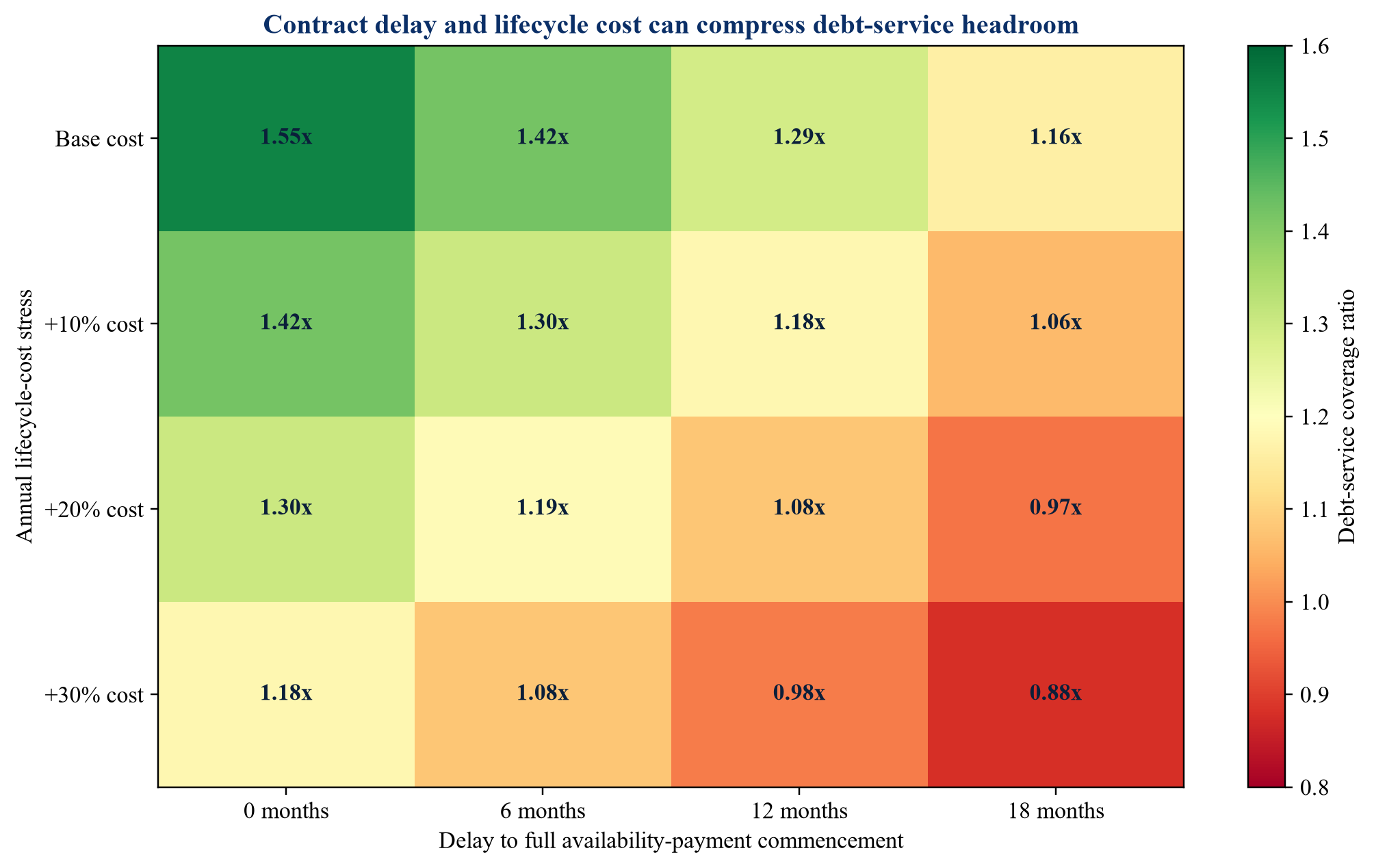
Ratios use author-modelled assumptions for a demonstration case. They are not forecasts or observed programme performance.
The illustrative matrix shows why funding should include commissioning and payment-delay liquidity. The base case should not rely on immediate full payment when acceptance requires testing across multiple locations. A minimum coverage threshold can determine debt size and contingency.
21 Allocate risk explicitly
Table 3. Illustrative risk-allocation matrix
| Risk | Preferred operational owner | Contract mechanism | Financing response |
|---|---|---|---|
| Specification and compatibility | Utility engineering authority with supplier support | Approved coverage matrix, warranties and change control | Eligibility condition and independent engineer review |
| Storage and deterioration | Warehouse or programme operator | Service standard, inspection regime and deductions | Maintenance reserve, audit right and asset exclusion |
| Dispatch priority | Pool governing body or public authority | Defined triggers, priority hierarchy and emergency override | Pre-authorised collateral release and proceeds waterfall |
| Transport and installation | Logistics coordinator and receiving utility | Framework contracts, route plans and mobilisation tests | Contingency, insurance and liquidity facility |
| Obsolescence | Asset owner with utility planning input | Technology review, rotation and replacement obligation | Haircuts, amortisation and minimum eligible value |
| Replenishment after use | Receiving utility, insurer or programme payer | Fixed replenishment timetable and payment security | Replenishment reserve, equity cure and distribution lock-up |
| Supplier distress | Programme company and contracting authority | Segregation, step-in, source-code or configuration escrow where suitable | Counterparty limits and alternative-supplier plan |
| Cyber integrity | Utility security authority and operator | Baseline, access control, patching and commissioning approval | Eligibility test and incident reserve |
| Public-procurement challenge | Contracting authority | Transparent procedure, records and standstill compliance | Conditions precedent and schedule contingency |
| Funding or tariff reset | Payer, regulator and sponsor under allocated rules | Long-term approval, indexation and change-in-law process | Debt sizing, reserve and termination compensation |
Allocation should be reflected in enforceable project documents and adapted to applicable law.
Risk should sit with the party that controls it and can bear its consequences. Some risks remain shared. A national emergency can exceed contractual assumptions, requiring public coordination and extraordinary funding. The documents should define the boundary between ordinary performance and sovereign emergency powers.
22 Design mutual-aid governance
Mutual-aid programmes can improve access without requiring every participant to own every spare. Governance should define membership, contributions, inventory commitments, trigger events, priority, price, transport, liability and replenishment. The DOE transformer report describes several industry arrangements with different triggers and obligations.
Trigger design affects usefulness. A programme limited to formally declared catastrophic events may preserve inventory for severe cases while remaining unavailable for important non-declared outages. A flexible exchange can respond more often but may provide less certainty during simultaneous demand. Participants can create tiers with separate local, regional and national triggers.
The pool should publish an anonymised coverage and readiness report to members while protecting sensitive asset and site information. Independent assurance can verify asset existence, maintenance and governance. Exercises should test decision speed as well as technical logistics.
23 Integrate water and electricity planning
Water systems depend on electricity for abstraction, treatment, pumping and wastewater management. Electricity systems depend on water for some generation and operational needs. Separate spares plans can miss these dependencies.
EPA's power-resilience guidance recommends assessing critical electrical loads and strengthening coordination with power providers. A water utility should know which pumping and treatment sites receive restoration priority, which have backup power and which equipment failures remain uncovered. The electricity provider should understand the public-health consequence of extended loss.
A joint resilience programme can share emergency generation, fuel planning, communications, logistics and exercises. It can also identify incompatible assumptions. A water utility may expect grid restoration within hours while the grid plan depends on water service for a critical substation or fuel route.
24 Use public funding selectively
Public funding is justified when benefits extend beyond the contracting utility or when affordability prevents timely resilience investment. National security, public health and regional economic continuity can create wider value. Funding should remain tied to a measurable service standard.
Grant conditions should address eligible expenditure, procurement, milestones, asset use, disposal, reporting and clawback. A grant-funded asset should not become unavailable because lifecycle cost was omitted. Co-funding can align utility accountability with public benefit.
Public-private structures can combine public first-loss or grant capital with contracted availability payments and private debt. The structure should avoid using concessional capital to conceal weak operating governance. Technical eligibility and readiness requirements should remain constant across funding sources.
25 Establish procurement discipline
Procurement should start with the service and coverage requirement, not a list of preferred equipment. Market engagement can test specifications, standardisation, production capacity, maintenance and logistics. Competition should preserve interoperability and lifecycle support.
Framework agreements can reserve capacity and shorten call-off time. They should define pricing, indexation, quality, delivery, priority and remedies. A framework without committed production or stock may provide limited protection during a common shock.
Public buyers should maintain a complete decision record. Emergency procurement rules can accelerate response after an event, while strategic inventory is foreseeable and should ordinarily be competed in advance. Transparent pre-qualification and performance criteria support value and defensibility.
26 Govern data and assurance
The programme needs a controlled digital register linking each asset to technical specifications, title, location, condition, maintenance, coverage, insurance and financing status. Access should reflect security sensitivity. Changes should be logged and approved.
Assurance should reconcile physical counts, serial numbers and records. The independent engineer can sample inspections, review tests, validate coverage and witness exercises. The lender's collateral report and the utility's resilience report should draw from the same controlled source.
Dashboard metrics should include eligible value, service coverage, overdue maintenance, logistics readiness, dispatch events, replenishment status and covenant headroom. A single percentage can conceal a critical gap. Reporting should show coverage by service and failure scenario.
27 Set decision gates
Gate one approves the service standard and criticality method. Gate two approves the coverage plan and ownership model. Gate three confirms procurement, payer, legal structure and funding. Gate four accepts assets into controlled custody. Gate five confirms operational readiness through tests and exercises.
Each gate should have evidence requirements and an accountable decision maker. Conditional approval should identify the missing evidence, owner and deadline. Capital should not move to the next stage through informal assumption.
The final investment paper should show the residual risk after controls. It should explain which events remain outside coverage, how emergency powers interact with contracts and how the programme will adapt to network and technology change.
28 Implement in twelve months
The first ninety days should establish governance, service targets, asset data and the initial criticality assessment. The next ninety days should complete compatibility, logistics and ownership analysis and launch market engagement. Months seven to nine should secure contracts, funding approvals and custody arrangements. The final quarter should accept priority assets, test systems and conduct a mobilisation exercise.
Existing inventory should be brought into the programme through verification rather than assumed compliant. Missing title, maintenance or compatibility evidence should create a remediation plan. Assets that fail the eligibility standard can remain operational property without supporting financing or coverage claims.
Implementation should prioritise the largest service gaps. A staged programme can finance the first high-criticality pool while later specifications are standardised. Early reporting should distinguish purchased stock, eligible stock and fully deployable coverage.
29 Measure value
The primary value measure is expected outage consequence avoided, adjusted for the probability that the spare can be deployed in time. This measure can include direct service restoration, safety and wider economic effects where evidence is available. Wider effects should remain separate from contracted cash flow.
Programme efficiency can be measured through coverage per unit of lifecycle cost. Standardisation, pooling and rotation can improve this ratio. Excessive concentration, proprietary equipment and weak preservation can reduce it.
The board should review value alongside affordability and residual risk. A positive expected-value calculation does not remove liquidity, procurement or governance constraints. The approved plan should identify the capital committed, the service protected and the evidence that connects them.
30 Adapt the framework to regional conditions
The framework is portable, while its inputs remain local. Grid topology, utility ownership, water scarcity, climate, import dependence, customs procedures, public-procurement law and emergency authority can materially change the required stock and financing structure. A programme should therefore begin with local service and logistics evidence rather than copy an inventory list from another system.
Island systems can face limited interconnection and high dependence on ports. They may require greater local depth for transformers, generation auxiliaries, pumps and controls because regional mutual aid cannot arrive within the restoration target. Coastal and desert environments can impose salt, heat, sand and humidity requirements on storage and preservation. Inland systems may have wider road access while remaining exposed to flood, wildfire or winter transport restrictions.
Rapidly growing markets face a different problem. New substations, water plants and industrial loads can create many specifications before an operating history exists. The programme should use design standardisation, framework procurement and commissioning spares from the outset. Growth should be included in coverage forecasts so that today's reserve does not become undersized when new capacity enters service.
Mature systems may have ageing equipment with discontinued parts and incomplete drawings. A targeted lifetime-buy can preserve service during an approved transition, while indefinite accumulation can lock the utility into obsolete technology. The business case should compare continued sparing, refurbishment, adaptable replacements and accelerated system renewal. Each option should include outage exposure during transition.
Cross-border pools need customs, tax, sanctions, export-control and liability analysis. Emergency status does not automatically remove border procedures. Pre-clearance, harmonised documentation and named authorities can shorten movement. Currency and payment arrangements should also be determined before dispatch.
The regional design should preserve one common control principle: every asset counted toward coverage must have a verified route to service. Local conditions determine that route. The programme record should show the covered sites, technical adaptations, transport path, decision authority, required people, expected restoration interval and residual constraints. Funding approval can then reflect the actual resilience delivered in that jurisdiction.
Conclusion
Critical grid and water spares are infrastructure assets only when they form part of a functioning restoration system. Purchase orders and warehouse counts provide incomplete evidence. Financeable availability requires a defined service standard, verified compatibility, controlled custody, active maintenance, tested logistics, skilled labour, clear release authority and funded replenishment.
The ownership model can vary. Utility stock supports local control. Mutual-aid pools can reduce duplication. Manufacturer-managed stock can provide technical capability. Availability-service vehicles can ring-fence performance. Public reserves can fund wider resilience. Each model needs a durable payer and enforceable operating rules.
The investment decision should proceed through gates. The programme first defines service and criticality, then coverage and ownership, then payer and funding, then asset acceptance and operational testing. Debt should be sized from verified eligible value and contracted cash flow under stressed conditions. Public capital should address defined public benefits and preserve lifecycle readiness.
The practical objective is simple: equipment must be available when normal supply cannot respond. Achieving that objective requires the same discipline applied to any essential infrastructure project: a service specification, an accountable owner, a complete risk allocation, reliable funding and evidence that the system works.
References
- U.S. Department of Energy, Large Power Transformer Resilience, July 2024. https://www.energy.gov/sites/default/files/2024-10/EXEC-2022-001242%20-%20Large%20Power%20Transformer%20Resilience%20Report%207-10-24.pdf
- U.S. Department of Energy, Strategic Transformer Reserve Report to Congress, March 2017. https://www.energy.gov/sites/prod/files/2017/04/f34/Strategic%20Transformer%20Reserve%20Report%20-%20FINAL.pdf
- U.S. Department of Energy, Addressing Security and Reliability Concerns of Large Power Transformers. https://www.energy.gov/oe/addressing-security-and-reliability-concerns-large-power-transformers
- U.S. Department of Energy, R&D Efforts to Address Transformer Supply. https://www.energy.gov/oe/rd-efforts-address-transformer-supply
- U.S. Department of Energy, Supply Chain Resources. https://www.energy.gov/oe/supply-chain-resources
- U.S. Department of Energy, Supply Chain and Market Analysis. https://www.energy.gov/oe/supply-chain-and-market-analysis
- U.S. Department of Energy Office of Inspector General, Western Area Power Administration Would Benefit From Improvements to Its Management of Critical Spare Parts, 2024. https://www.energy.gov/ig/articles/audit-doe-oig-24-30
- U.S. Environmental Protection Agency, Power Resilience Guide for Water and Wastewater Utilities, updated May 2023. https://www.epa.gov/waterresilience/power-resilience-guide-water-and-wastewater-utilities
- U.S. Environmental Protection Agency, Emergency Response for Drinking Water and Wastewater Utilities. https://www.epa.gov/waterutilityresponse
- U.S. Environmental Protection Agency, Emergency Drinking Water Supply Guidance. https://www.epa.gov/waterutilityresponse/emergency-drinking-water-supply-guidance
- Cybersecurity and Infrastructure Security Agency, Infrastructure Dependency Primer: Implement. https://www.cisa.gov/topics/critical-infrastructure-security-and-resilience/resilience-services/infrastructure-dependency-primer/implement
- Cybersecurity and Infrastructure Security Agency, EPA and FBI, Top Cyber Actions for Securing Water Systems, February 2024. https://www.cisa.gov/news-events/alerts/2024/02/21/cisa-epa-and-fbi-release-top-cyber-actions-securing-water-systems
- Cybersecurity and Infrastructure Security Agency, National Infrastructure Advisory Council Water Sector Resilience Report. https://www.cisa.gov/resources-tools/resources/niac-water-sector-resilience-final-report-and-recommendations
- Federal Emergency Management Agency, Public Assistance Program and Policy Guide. https://www.fema.gov/assistance/public/policy-guidance-fact-sheets/pappg
- Federal Emergency Management Agency, Building Resilient Infrastructure and Communities. https://www.fema.gov/grants/mitigation/building-resilient-infrastructure-communities
- North American Electric Reliability Corporation, Reliability Standards. https://www.nerc.com/pa/Stand/Pages/Default.aspx
- North American Electric Reliability Corporation, Electricity Information Sharing and Analysis Center. https://www.eisac.com/
- Federal Energy Regulatory Commission, Reliability and Security. https://www.ferc.gov/reliability-and-security
- U.S. Government Accountability Office, Electricity Grid Resilience. https://www.gao.gov/electricity-grid-resilience
- National Institute of Standards and Technology, Community Resilience Planning Guide. https://www.nist.gov/topics/community-resilience/planning-guide
- International Energy Agency, Electricity Grids and Secure Energy Transitions, 2023. https://www.iea.org/reports/electricity-grids-and-secure-energy-transitions
- International Energy Agency, Energy Technology Perspectives 2023. https://www.iea.org/reports/energy-technology-perspectives-2023
- World Bank, Utility of the Future. https://www.worldbank.org/en/topic/water/publication/utility-of-the-future
- World Bank, Building the Resilience of Water Supply and Sanitation Utilities to Climate Change and Other Threats. https://openknowledge.worldbank.org/handle/10986/31090
- Asian Development Bank, Water and Other Urban Infrastructure and Services. https://www.adb.org/what-we-do/topics/water-and-other-urban-infrastructure-services
- European Investment Bank, Water and Wastewater Management. https://www.eib.org/en/projects/sectors/water-and-wastewater-management/index.htm
- European Commission, Critical Entities Resilience Directive. https://home-affairs.ec.europa.eu/policies/internal-security/counter-terrorism-and-radicalisation/protection/critical-infrastructure-resilience_en
- ENTSO-E, Power System Needs. https://www.entsoe.eu/outlooks/system-needs/
- Ofwat, Resilience in the Round. https://www.ofwat.gov.uk/publication/resilience-in-the-round/
- UK Government, National Infrastructure Resilience. https://www.gov.uk/government/collections/national-infrastructure-resilience
- Australian Energy Market Operator, Integrated System Plan. https://aemo.com.au/energy-systems/major-publications/integrated-system-plan-isp
- Australian Energy Regulator, Network Resilience. https://www.aer.gov.au/industry/networks
- ISO, ISO 55000 Asset Management. https://www.iso.org/iso-55001-asset-management.html
- IFRS Foundation, IAS 2 Inventories. https://www.ifrs.org/issued-standards/list-of-standards/ias-2-inventories/
- IFRS Foundation, IAS 36 Impairment of Assets. https://www.ifrs.org/issued-standards/list-of-standards/ias-36-impairment-of-assets/
About the Author
Authored by Chennakeshav Adya
Independent Researcher
Chennakeshav (CK) is a corporate finance and investment banking executive with 25+ years of global experience in deal origination, structuring and execution across M&A, growth capital and corporate strategy. He has led value-creation mandates for founders, corporates and funds — bridging the boardroom view to hands-on execution and close.
His career spans Morgan Stanley, HSBC, Lloyds Banking Group, EWEC, ADQ portfolio companies and Emirates Growth Fund, across TMT, real estate, fintech, deeptech, cleantech, infrastructure and energy. He has partnered with C-suite leaders, private equity and venture funds, sovereign wealth funds and family offices to finance complex fund raises and scale-up ventures, and has led M&A due diligence, post-merger integration and business-transformation initiatives to create value.
At Matchpoint Partners he is Managing Partner, leading the firm's corporate finance, M&A and capital-raising practice. He holds an MBA from London Business School, an engineering degree from VTU and a Master of Laws (LLM, in progress) from UCL London.
An active start-up mentor, CK mentors at Techstars, DIFC FinTech Hive, Startup Grind, Founder Institute and IN5, serves as Entrepreneur Mentor in Residence (EMiR) at London Business School, and judges the Entrepreneurship World Cup.
