
1. The subsurface financing decision
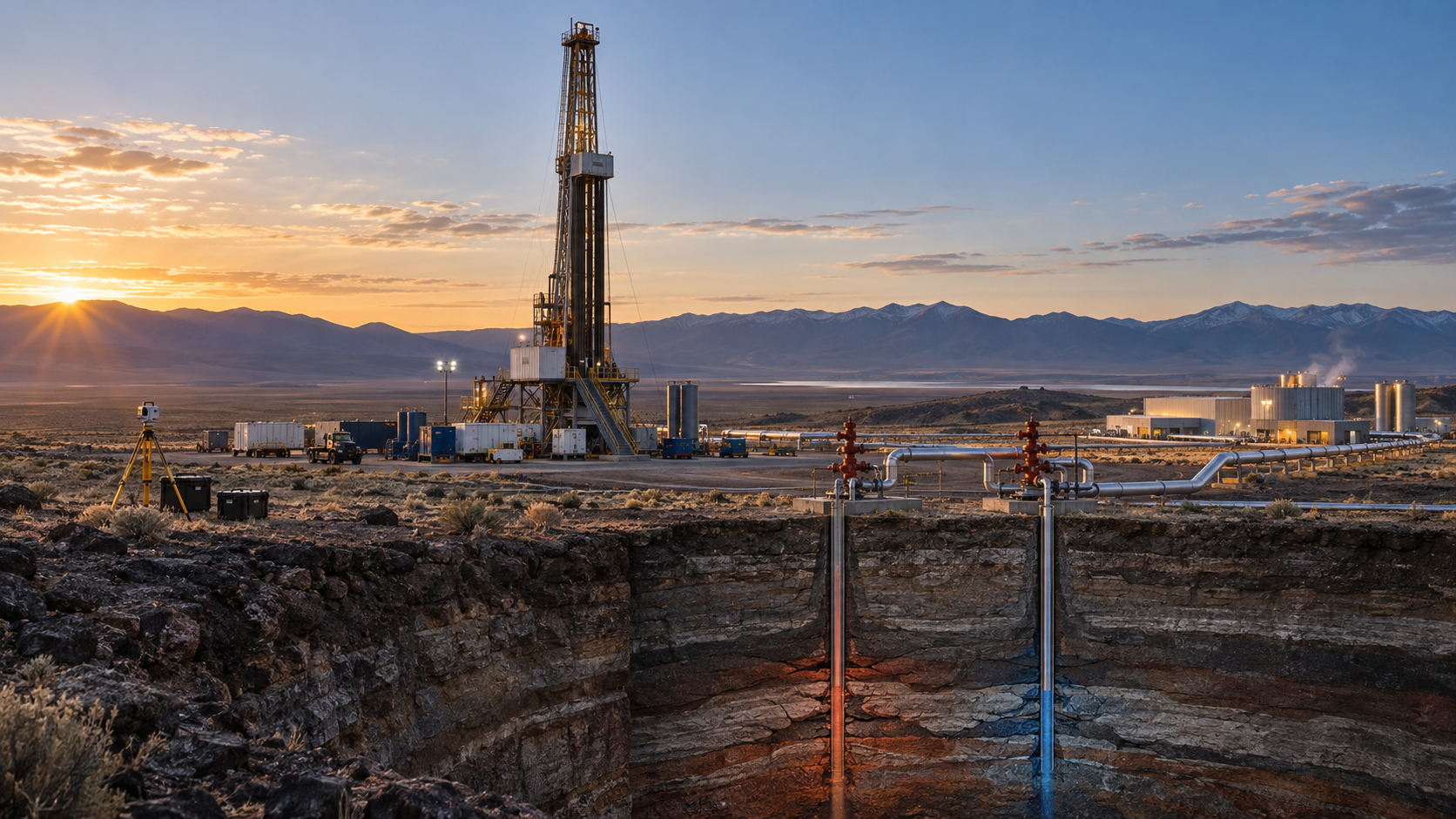
The investment decision is whether the next drilling tranche creates enough expected information and resource value to justify the capital at risk. Enhanced geothermal development requires money before a bankable reservoir exists. The financing structure should therefore align capital type with geological maturity. Early risk capital buys evidence; later debt finances repeatable wells, surface facilities and contracted production.
This framing changes the approval question. Management should not ask whether the full project is attractive on one base case. It should ask which uncertainties remain, what work can resolve them, what failure means, and which capital provider is paid to bear each stage. The result is a sequence of controlled commitments with explicit stop, redesign and advance rules.
2. Why geothermal risk is different
Solar and wind resource assessment can often proceed with relatively low-cost measurement before construction. Geothermal temperature, permeability, stress, fluid chemistry and sustainable flow may require drilling to confirm. Drilling is expensive and partly irreversible. Resource discovery and construction therefore overlap in a way that challenges conventional project-finance sequencing.
The World Bank identifies exploration drilling cost and uncertainty as the principal upstream barrier to geothermal investment and notes that commercial debt is commonly unavailable before the field is confirmed [1]. The financing gap reflects incomplete collateral and cash flow, not the absence of long-term infrastructure value after successful resource validation.
3. Enhanced geothermal system boundaries
Enhanced geothermal systems create or improve subsurface flow pathways in hot rock and circulate fluid between wells. Closed-loop concepts circulate fluid inside sealed wellbores. Conventional hydrothermal projects depend more heavily on naturally occurring fluid and permeability. Each architecture has a different risk distribution across drilling, stimulation, circulation, decline and surface conversion.
The United States Department of Energy distinguishes hydrothermal, enhanced geothermal and closed-loop systems within its next-generation geothermal work [2]. A financing memorandum should name the actual technical system, target depth, well geometry, heat-extraction method and commercial product. A broad technology label is insufficient for credit analysis.
4. Resource maturity is an asset state
Resource maturity progresses from regional evidence to prospect, discovery, appraisal, development and operating field. Each state has a different probability range, data set and financing capacity. A permit or surface study does not establish commercial productivity. One successful well does not prove field-wide repeatability or decline behaviour.
The project should maintain a resource-maturity register supported by maps, logs, tests, models and independent interpretations. Movement between states should require defined evidence. This creates a common language for engineers, investors, insurers and public risk-sharing facilities.
5. The subsurface data room
The data room should contain title and permits, geological and geophysical surveys, temperature data, offset wells, seismicity, stress orientation, drilling histories, well logs, cores, fluid chemistry, stimulation records, flow tests, interference tests, reservoir models and environmental baselines. Each item should show source, date, quality and limitations.
Interpretations should remain traceable to raw data. Models are decision tools and need version control, calibration and uncertainty ranges. A lender or insurer should be able to determine which facts are observed, which values are derived and which assumptions depend on management judgement.
Data governance should identify custodianship, access rights, file lineage and disclosure obligations. Proprietary seismic processing, offset-well licences and contractor data can restrict sharing with lenders or insurers. These constraints should be resolved before underwriting begins. A controlled index should show missing items, pending validation and superseded models so reviewers do not rely on an obsolete interpretation.
6. The staged capital model
The financing plan can use six gates: prospect qualification; slim-hole or test well; full-size exploration; appraisal and stimulation; repeat development drilling; and plant completion. Each gate releases capital only after agreed evidence and governance conditions are satisfied.
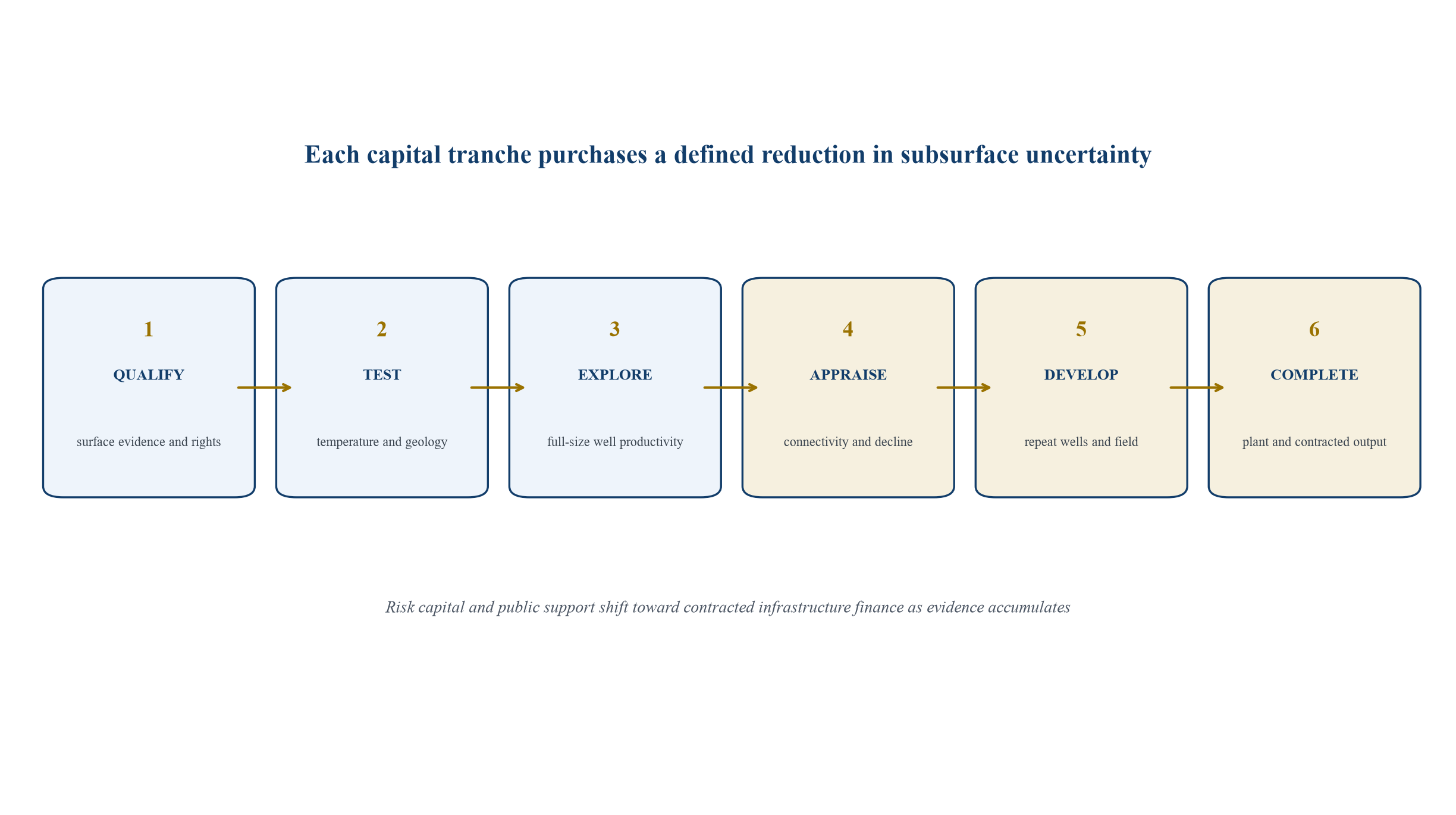
Generic structure; actual stages, decision rights and funding sources depend on the project and jurisdiction.
The sponsor should establish evidence, budget and time limits for every gate. Work that exceeds one limit requires a formal reapproval. The model prevents cumulative spend from becoming the justification for further spend. Sunk cost remains outside the forward decision.
7. Land, mineral and resource rights
The project needs enforceable rights to access the surface, drill, use the geothermal resource, inject fluids, build pipelines and export energy. Rights may be divided among landowners, mineral holders, water authorities and the state. Their term should cover exploration, development, operation and decommissioning.
Financiers need assignment, mortgage, step-in and cure rights where law permits. Competing subsurface uses, oil and gas operations, carbon storage or neighbouring geothermal projects can affect pressure and access. A title report should map these interactions before drilling capital is committed.
8. Permitting sequence
Exploration permits, environmental review, water approvals, drilling consents, induced-seismicity plans, construction permits and grid approvals can follow different pathways. The programme schedule should show the evidence required for each approval and the point at which expenditure becomes exposed.
The project should avoid drilling before downstream permits have a credible route. It should also avoid waiting for every construction approval before low-cost evidence work begins when law permits parallel progress. The sequence is a capital-allocation decision as well as a regulatory plan.
9. The conceptual resource model
The conceptual model describes heat source, stratigraphy, structures, stress, fluid pathways, recharge, temperature and target zones. It integrates multiple data types and generates testable hypotheses. Several models may fit sparse early data; the decision pack should preserve alternatives and their consequences.
Each drilling stage should target the uncertainty with the greatest effect on value. A well designed only to maximise immediate flow can provide less information than a well positioned to distinguish competing models. The sponsor should state the learning objective before approving the well.
10. Surface studies
Geological mapping, geochemistry, geophysics, remote sensing and legacy-well analysis can reduce the drilling search space. Their value lies in improving target selection and defining uncertainty. They cannot remove the need for subsurface confirmation.
Public funding often supports regional data because one survey can benefit several prospects and reduce duplication. The commercial project should still verify data quality and licensing rights. Old data may use inconsistent coordinates, tools or processing methods.
11. Slim holes and test wells
Slim holes can confirm temperature gradient, geology and fluids at lower cost than full-size production wells in suitable settings. They may not prove commercial flow or full-scale drilling performance. The gate should specify which decisions a slim hole can support.
Saint Lucia's World Bank-supported geothermal programme has used an integrated procurement for slim exploration wells within a donor-financed resource-development effort [3]. The example shows how public capital can fund targeted evidence before private project finance is available.
12. Full-size exploration wells
Full-size exploration wells can test temperature, permeability, drilling conditions and productivity using geometry closer to commercial development. They carry substantial cost and can fail mechanically or geologically. Success criteria should distinguish well integrity from resource performance.
The approval package should include well design, target rationale, cost range, contingency, contractor strategy, logging and testing plan, suspension or abandonment plan and follow-on decisions. A well without a funded test programme can leave value-critical questions unresolved.
13. Appraisal drilling
Appraisal wells test reservoir extent, connectivity, variability and repeatability. They support field layout and estimate sustainable capacity. The programme may include production, injection and observation wells. The relevant evidence is a field system, not one headline flow result.
Debt readiness improves when appraisal demonstrates a repeatable well concept and constrains downside. Independent engineers should review test duration, boundary effects, interference and model calibration. Short tests can overstate long-term performance when the reservoir response is not captured.
An appraisal plan should define the minimum number and spatial distribution of wells required for the financing case. The answer depends on reservoir complexity and well productivity rather than a universal count. The plan should also state how conflicting results change capacity, plant size and the next well. Information value is highest when each appraisal location distinguishes between credible field-development alternatives.
14. Production and injection balance
Commercial operation requires both heat production and fluid management. Injection supports pressure and environmental control but can create pumping, cooling, breakthrough or seismicity issues. Well placement and operating strategy should be tested as a coupled system.
The financial model should include production and injection well counts, replacement wells, workovers, parasitic load and decline. A project that models only initial production can understate sustaining capital and debt-service pressure.
15. Stimulation design
Enhanced geothermal systems can require stimulation to create or improve flow pathways. Design depends on stress, fractures, rock properties, pressure, fluid and target geometry. The project should define treatment limits, monitoring and acceptance criteria.
Stimulation success should be measured through injectivity, connectivity, thermal performance and controllable operating conditions. A technically successful stimulation can still be commercially insufficient if flow, pumping cost or seismic constraints reduce deliverable output.
16. Induced seismicity
Injection and stimulation can alter subsurface stress and cause seismic events. The project needs baseline monitoring, a traffic-light protocol, reporting, community engagement, operational thresholds and response procedures. Regulatory obligations vary by jurisdiction.
Financiers should model the consequences of reduced injection, suspension or redesign. Insurance may exclude known seismic risk or cover only specified physical damage. A resource policy cannot rely on insurance to replace prudent monitoring and control.
17. Drilling design and cost
Depth, temperature, pressure, geology, trajectory, casing, cementing, completion and rig market conditions drive well cost. Enhanced geothermal projects may use horizontal drilling and techniques adapted from oil and gas, subject to geothermal temperature and materials requirements. Cost estimates should separate mature operations from project-specific novelty.
Reference-class estimating should use comparable sections and learning assumptions. A fixed percentage contingency can understate discrete events such as lost circulation, sidetrack, tool failure or casing redesign. The budget should include event-based allowances and decision points.
18. Drilling contract strategy
Contract forms include day-rate, footage, turnkey and integrated services. Risk transfer is limited by subsurface uncertainty and contractor exclusions. An apparent fixed price can contain change mechanisms that return geological risk to the sponsor.
The contract should define scope, data, performance standards, non-productive time, lost tools, well control, suspension, abandonment, testing, insurance and liability. Incentives should reward safe, quality delivery and useful information. Speed alone can damage well integrity or data quality.
19. Testing programme
Testing can include temperature logs, pressure-transient analysis, injectivity, flow, tracer, interference and extended circulation. Test design should match the commercial question. Duration and measurement quality affect the reliability of capacity and decline estimates.
The project should pre-agree data acceptance, independent review and model update. Test results should flow directly into the gate memorandum. Management interpretation should not replace the raw curves, calibration and sensitivity ranges.
20. Resource definition
A bankable resource definition should state expected capacity, uncertainty, decline, operating pressure, temperature, well count, replacement schedule and limitations. It should reconcile the reservoir model with the surface plant and contract output.
Definitions such as proven, probable or contingent can carry different meanings across institutions. The financing documents should define the project's categories and evidence. Ambiguous labels can create false confidence.
21. Probability and portfolio effects
One exploration well has a binary or highly skewed outcome. A portfolio of prospects or wells can diversify idiosyncratic failure, provided geological risks are not strongly correlated. Common drilling methods, regional structures or shared contractors can create correlation.
Public facilities and insurers can pool risk across projects, while individual developers often cannot. Portfolio design should disclose selection rules and avoid concentrating weak prospects. Pooling redistributes loss and does not improve the underlying geology.
22. Sources and uses by stage
The sources-and-uses schedule should separate surface studies, early wells, appraisal, development wells, stimulation, surface plant, grid, financing and reserves. It should identify which source is committed, conditional or expected. Each stage needs a complete funding plan through its decision point.
Table 1. Staged geothermal sources and uses
| Stage | Principal uses | Suitable capital | Release evidence |
|---|---|---|---|
| Prospect qualification | Rights, surveys, permits and conceptual model | Sponsor equity, grants and public technical assistance | Target ranked, rights secured and drill decision defined |
| Test well | Slim hole or initial well, logs and tests | Risk equity, grant or contingent-recovery funding | Temperature and geology meet approved thresholds |
| Full-size exploration | Commercial-diameter well and flow test | Risk equity, cost-share and resource insurance where available | Productivity, integrity and test quality accepted |
| Appraisal and stimulation | Additional wells, connectivity and circulation tests | Sponsor equity, strategic capital and concessional bridge | Field model supports capacity and repeatability |
| Development drilling | Repeat production and injection wells | Construction equity, development debt and guarantee support | Proven well design, contracted revenue and completion plan |
| Plant completion | Surface facilities, grid, reserves and commissioning | Senior project debt, equity and subordinated facilities | Full funding, permits, contracts and completion support |
Generic structure; project amounts and instruments require site-specific evidence and committed terms.
The schedule should avoid using future senior debt to fund work before debt conditions are achievable. A bridge facility can connect stages when its repayment source and downside are explicit. Unfunded future equity is a completion risk.
Uses should include owner costs, independent review, permitting, community engagement, insurance premium, interest, taxes and site restoration. These items can be material during a long appraisal period. Sources should identify currency, draw conditions, expiry and ranking. A facility described as available remains contingent when its conditions depend on results that the current tranche is intended to produce.
23. Risk equity
Sponsor, venture, strategic and specialist infrastructure equity can fund early drilling. Investors need return potential proportionate to total-loss risk and follow-on capital. Governance rights should cover drilling budgets, contractor selection, model changes and stop decisions.
Early equity should have a clear path to project-level value after resource confirmation. Conversion into development equity, sale to an infrastructure investor or reimbursement from refinancing can provide that path. The structure should avoid terms that make later project finance uneconomic.
24. Grants and public cost share
Grants can fund data, drilling or technical assistance where market failures prevent private investment. Cost sharing can require the developer to retain meaningful exposure. Public programmes should define eligibility, procurement, disclosure and additionality.
The World Bank's Global Geothermal Development Plan and regional facilities have used grants and concessional resources to address upstream drilling risk [1][4]. Public funding should purchase transferable evidence or additional private investment rather than conceal weak project economics.
25. Contingent recovery instruments
A contingent-recovery grant or loan can be repaid after success and forgiven or reduced after a defined failure. This recycles public capital from successful projects while preserving downside protection. Terms require objective success measures and verification.
Repayment should not overburden the successful project before senior debt service. The waterfall can defer recovery until operations or refinancing. Failure definitions should distinguish poor resource performance from avoidable execution failure.
26. Resource insurance
Resource insurance can pay when measured productivity falls below an insured threshold, subject to attachment, limit, exclusions and claims verification. It converts a specified part of subsurface outcome risk into a premium and insurer credit exposure. Coverage is more feasible when data support underwriting.
The World Bank's comparative analysis identifies resource-risk insurance as one tool for well productivity risk and notes that it has been used or considered in several markets [5]. Industry guidance also observes that limited initial data can make insurance better suited to later drilling stages [6].
The insured interest should match the financing objective. Cover can protect part of eligible drilling expenditure, a lender's principal or the cost of a replacement well. Each formulation changes incentives and claims evidence. The project should compare premium and retained risk with alternatives such as additional equity, a public cost share, a smaller first phase or a portfolio investment.
27. Indemnity and parametric design
Indemnity insurance pays verified loss under the policy definition. Parametric cover pays when an objective measure crosses a threshold, regardless of the insured's exact financial loss. Geothermal triggers can reference flow, temperature, enthalpy or combined productivity, subject to measurement design.
A parametric structure can simplify claims and create basis risk. The trigger may fail while project economics deteriorate, or pay when the project could still operate. A hybrid can combine objective resource measures with verified expenditure or loss.
28. Attachment, limit and retention
The policy should state the productivity reference, attachment point, insured percentage, maximum limit, deductible or co-insurance and policy period. A sponsor should retain enough risk to preserve discipline. The insurer's maximum exposure must align with the capital actually protected.
Coverage should also specify whether several wells aggregate, whether replacement wells qualify and how partial success is treated. A single-well policy can leave field-level risk uncovered. A portfolio policy needs allocation rules and aggregate limits.
29. Exclusions and conditions
Typical exclusions can address defective design, wilful misconduct, inaccurate disclosure, drilling outside approved parameters, mechanical failure, permit breach, war, sanctions, pollution or seismic events. The exact policy governs. Sponsors should not assume that a dry or low-productivity well automatically creates a claim.
Conditions precedent can include independent review, approved drilling plans, testing procedures and timely notice. Policy compliance should be assigned to named owners. Lenders need notice, cure and loss-payee rights where available.
30. Premium and subsidy
Premium reflects expected loss, uncertainty, expenses, capital and portfolio diversification. Sparse data can make pricing high or capacity unavailable. Public subsidy can lower premium or capitalise a guarantee fund where policy objectives justify support.
The European Commission approved a French deep-geothermal guarantee scheme designed to cover resource quality or quantity failure, with public and project-holder contributions [7]. Public support should remain transparent and comply with applicable state-aid or subsidy rules.
31. Risk pools
A pooled fund collects premiums or contributions across projects and pays defined losses. It can build market data and diversify outcomes. Governance needs underwriting rules, reserves, investment policy, claims independence and replenishment.
Adverse selection can weaken a voluntary pool if stronger projects leave and weaker projects remain. Mandatory or subsidised participation can change incentives. The fund should publish performance while protecting project-confidential data.
32. Government-led exploration
A government agency can undertake surveys and exploration drilling, then tender a confirmed field to private developers. This moves early risk to the public balance sheet and can attract later private capital. It requires technical capability, procurement integrity and a credible route to development.
World Bank analysis documents government-led exploration in several geothermal markets and notes that some public costs can be recovered when risk-reduced prospects are transferred [8]. Public exploration should preserve competitive access and prevent indefinite warehousing of confirmed resources.
33. Cost-shared drilling
Public and private parties can share eligible drilling cost. The developer retains exposure and operating expertise, while the public contribution reduces the amount of risk capital required. Reimbursement can depend on audited expenditure and technical milestones.
The agreement should define overruns, procurement, related-party cost, data ownership and failure. A percentage contribution without a cost cap can expose the public party to poor cost control. A cap without enough funding can leave the programme incomplete.
34. Bridge finance
Bridge finance can fund appraisal or early development pending insurance proceeds, grants, equity or senior debt. It should have a realistic repayment source, maturity and extension mechanism. High-cost bridge debt can compound quickly when drilling or permits delay.
Lenders may require sponsor recourse, a borrowing base tied to committed proceeds, or a successful-well condition. The project should model repayment after partial success and failure. A bridge should not transform uncertain risk equity into hidden senior leverage.
35. Project debt readiness
Senior project debt becomes plausible when the resource, development plan, permits, contracts, cost and completion support are sufficiently defined. Lenders need a field model, independent engineer, proven well concept, operating history or credible analogues, PPA or heat contract, and funded reserves.
Debt sizing should include well decline and replacement capital. A project can meet initial output and breach coverage later if sustaining wells are omitted. The base repayment case should not rely on refinancing or uncontracted price upside.
The lender case should reconcile dependable capacity with the PPA or heat contract, deduct parasitic load and apply availability assumptions to both wells and plant. It should include downside capital expenditure before distributions. Covenants can monitor deliverability, reserve funding, replacement-well milestones and resource-model updates. Technical triggers are useful only when measurement and cure actions are specified.
36. Revenue contract
The power purchase agreement or heat contract converts resource output into cash flow. It should define dependable capacity, energy, availability, curtailment, indexation, delay, force majeure and termination. Enhanced geothermal's firm output can have capacity and flexibility value where market rules recognise it.
The contract term should support debt and sustaining capital. A strong resource cannot compensate for weak offtaker credit. A strong offtaker cannot compensate for an output obligation unsupported by the field.
37. Completion support
Completion should require both surface-plant performance and sufficient field output. Sponsors may provide equity commitments, guarantees or contingency facilities until integrated tests pass. Well underperformance can require additional drilling before completion.
The completion test should use corrected, sustained output rather than a short peak. It should also confirm injection, parasitic load, environmental compliance and operating readiness. Release of sponsor support needs objective evidence.
38. Reserve accounts
Debt-service, major-maintenance, replacement-well and decommissioning reserves address different risks. The replacement-well reserve is particularly important where decline or mechanical failure requires periodic drilling. Funding can be scheduled or triggered by performance.
Reserve sizing should reflect well cost and lead time, not a generic percentage of debt. Cash traps can begin when deliverability falls or drilling milestones slip. The project should preserve liquidity for safe operation and resource maintenance.
39. Security and step-in
Security can include project-company shares, accounts, contracts, permits, equipment and assignable resource rights. Subsurface assets may have limited liquidation value without licences, operators and surface infrastructure. Recovery therefore depends on preserving the operating project.
Direct agreements should give lenders notice and cure rights. Step-in remains subject to technical qualification and regulatory approval. Insurance proceeds should follow the agreed loss-payment and reinstatement waterfall.
40. Cost boundary and benchmark
The cost boundary includes rights, studies, permits, wells, testing, stimulation, gathering, plant, grid, owner cost, financing, reserves, insurance, replacement wells and decommissioning. Management should separate sunk exploration, committed development and future sustaining capital.
Table 2. Geothermal cost and performance benchmark
| Cost or performance item | Commercial purpose | Principal evidence | Downside test |
|---|---|---|---|
| Resource model | Define target, capacity range and uncertainty | Integrated data, calibration and independent review | Alternative conceptual model or lower temperature |
| Exploration well | Confirm geology, temperature and initial productivity | Well record, logs, integrity and flow test | Mechanical failure, dry hole or inadequate flow |
| Appraisal programme | Prove repeatability, connectivity and sustainable field output | Multiple wells, interference and extended testing | Heterogeneity, boundary effects or rapid decline |
| Development wells | Deliver contracted production and injection | Proven design, contractor plan and learning curve | Cost growth, poor repeatability or injection constraint |
| Surface plant and grid | Convert heat into contracted power or useful heat | EPC design, performance guarantees and connection agreement | Efficiency shortfall, delay or curtailment |
| Insurance and reserves | Protect specified downside and fund sustaining work | Bound policy, claims protocol and funded accounts | Exclusion, basis risk, insurer default or inadequate reserve |
Generic categories; actual requirements and costs depend on geology, technology, jurisdiction and contract.
41. Hypothetical sources and uses
Consider a hypothetical next-generation geothermal project that advances through four capital tranches. Early sponsor and public capital fund qualification and exploration. Strategic equity and insurance support appraisal. Senior debt enters only after field evidence, permits and contracted revenue meet agreed conditions.
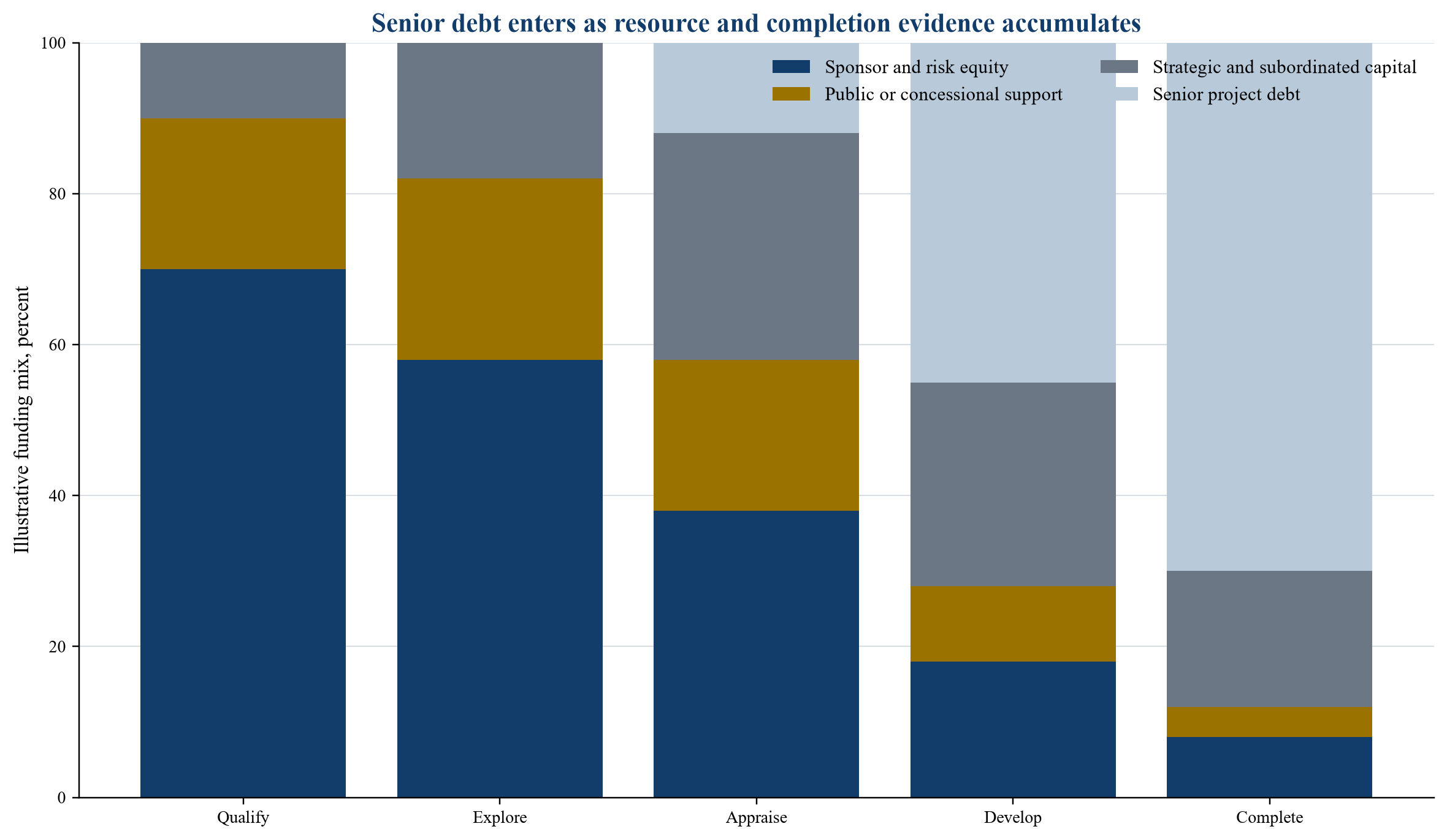
Unattributed values are illustrative indices and do not represent a named project, forecast or offer.
The exhibit shows financing logic rather than a recommended allocation. Actual debt may enter later when technology or market risk remains high. Public support should decline as private capital can price the risk. Senior leverage should reflect the downside field case.
In the hypothetical sequence, each funding source has a defined exit or conversion. Grants do not require repayment unless the agreed success mechanism applies. Risk equity converts into project equity or receives proceeds at refinancing. Subordinated capital can amortise after senior coverage thresholds. Senior debt funds only approved development scope. This separation prevents early-stage loss from being hidden inside infrastructure leverage.
42. Success curves
The project should estimate probabilities for mechanical success, target encounter, usable temperature, injectivity, production, connectivity and sustainable field output. These events are related and should not be multiplied mechanically without a coherent model. Historical data and analogues need quality adjustment.
Bayesian updating can revise probabilities as wells and tests arrive. The decision committee should see prior assumptions, new evidence and the posterior range. A successful result that was already expected creates less information value than a result that resolves a major uncertainty.
43. Debt-service sensitivity
Debt service depends on delivered output, availability, tariff, operating cost, sustaining wells and timing. Sensitivities should include lower initial productivity, faster decline, additional well, delayed completion, higher pumping load and insurer non-payment.
Coverage ratios should be calculated after replacement-well funding and required reserves. A model that excludes sustaining capital can overstate cash available for debt service. Cure rights should not depend solely on new equity after a known decline trend.
44. Scenario valuation
The valuation should compare the risk-adjusted present value at each gate. Cash flows include stage cost, probability-weighted advancement, power or heat revenue, operating cost, insurance premium and proceeds, taxes, financing, reserves and abandonment. Failure value can be zero or negative when restoration remains.
Management should report value before and after the next evidence purchase. This supports rational continuation and farm-down decisions. A full-project net present value based on assumed success can hide the cost of reaching resource confirmation.
Scenario trees should avoid false precision. Probabilities should be presented as ranges with sensitivity to correlation and selection bias. The committee should understand how much value comes from geological success, well-cost learning, tariff, tax support and financing. A project that depends mainly on uncontracted market upside should not be described as de-risked because two wells succeeded.
45. Real options
Staged drilling creates options to stop, pause, redirect, deepen, sidetrack, add wells, expand or sell. Option value comes from contractual and technical flexibility. It should not be used as a vague premium.
The model should identify exercise cost, decision date, evidence and alternative use. Rig slots, permits, data rights and modular plant design can preserve options. Expiring rights can destroy them.
46. Risk allocation
Risk should sit with the party able to control, price or absorb it. The drilling contractor controls execution within the agreed design. The sponsor chooses the prospect and capital plan. The insurer covers defined resource outcomes. Government may absorb market-creation risk. The licensed operator retains legal duties.
Table 3. Enhanced geothermal subsurface risk allocation
| Risk | Primary control | Possible bearer | Decision evidence |
|---|---|---|---|
| Geological target | Surveys, conceptual model and staged drilling | Sponsor, risk investor and public facility | Independent resource model and target rationale |
| Drilling execution | Design, contractor capability and well control | Drilling contractor and sponsor by contract | Well programme, performance record and security |
| Productivity | Appraisal, testing and insured threshold | Sponsor, insurer and risk-sharing facility | Bound policy, test protocol and measurement plan |
| Cost overrun | Estimate, contingency and change control | Sponsor, contractor and completion provider | Reference class, event risks and funded contingency |
| Decline and replacement wells | Reservoir management and reserves | Project company and equity within covenants | Long-term model, monitoring and funded reserve |
| Permits and social acceptance | Early engagement and compliant operations | Sponsor and public authority by allocation | Approvals register, seismicity plan and consultation record |
| Offtaker and market | Bankable contract and credit support | Offtaker, guarantor and project company | Executed contract, credit diligence and direct agreement |
Generic commercial structure; legal and regulatory duties remain with the responsible parties.
47. Technical diligence
Technical diligence should test data quality, conceptual alternatives, target design, well engineering, stimulation, test interpretation, field model, decline, plant integration and environmental controls. Reviewers should have relevant geothermal and drilling experience.
The report should state limitations and unresolved questions. A favourable conclusion subject to missing core data should not be treated as confirmation. Conditions should flow into financing covenants and gate requirements.
48. Insurance diligence
Insurance diligence should review insurer credit, policy wording, trigger, measurement, exclusions, limit, retention, aggregation, premium, claims process, cancellation and lender rights. A broker summary is not the policy.
The financial model should show policy timing and proceeds. Claims can take time and incur dispute cost. The project needs liquidity between loss and payment. Insurer concentration creates counterparty risk.
49. Governance
The board should establish a subsurface committee with geology, reservoir, drilling, finance, insurance, environmental and independent challenge. Reserved matters should include well approval, budget increase, target change, stimulation, policy amendment and gate advancement.
Decision papers should separate observed data from interpretation. Dissent and uncertainty should be recorded. Commercial urgency should not suppress well-control, seismicity or environmental decisions.
The committee should receive an independent gate certificate and a management recommendation. The certificate confirms whether evidence conditions were met; management decides whether the commercial case merits advancement. Separating these roles reduces pressure on technical reviewers. Conflicts of interest should be disclosed when advisers, contractors or insurers benefit from another drilling tranche.
50. Programme controls
Cost, schedule, risk, technical maturity and permits should share a work-breakdown structure. Each well should reconcile budget, commitment, actual cost, forecast, contingency, progress and test deliverables. Field-level reporting should aggregate without hiding well variance.
Leading indicators include design changes, rig readiness, lost circulation, non-productive time, logging recovery, test quality, permit actions and insurance compliance. Percentage drilled is not evidence of resource maturity.
51. Procurement and supply chain
Rig availability, tubulars, cement, high-temperature tools, directional services and experienced crews can constrain the programme. Framework contracts can preserve continuity and learning. They can also create minimum commitments before resource confirmation.
Procurement should balance optionality with supply security. Long-lead orders require cancellation terms and storage plans. Local capability can reduce mobilisation and build market depth, subject to qualification.
52. Claims and failure management
A low-productivity result should trigger preservation of data, independent verification, policy notice, model update and a formal decision. Claims teams need the drilling and test record. Poor documentation can weaken recovery.
Failure options include sidetrack, stimulation, alternative zone, conversion to injection, sale of data, farm-down or abandonment. Each requires cost and permit analysis. The organisation should protect safety and evidence before allocating blame.
53. Restructuring after partial success
Partial success can support a smaller plant, heat project, phased expansion or additional appraisal. Revenue contracts, debt and permits may need resizing. The sponsor should compare forward value with a clean stop.
Creditors can agree covenant reset, maturity extension or new-money priority when a credible revised plan preserves value. Restructuring should be based on verified resource evidence and funded completion, not on optimism about the next well.
54. Commercialisation roadmap
Commercialisation progresses from data and public learning to insured or cost-shared exploration, independently verified appraisal, repeat development wells, contracted plant finance and portfolio refinancing. Each successful reference project improves cost and underwriting data.
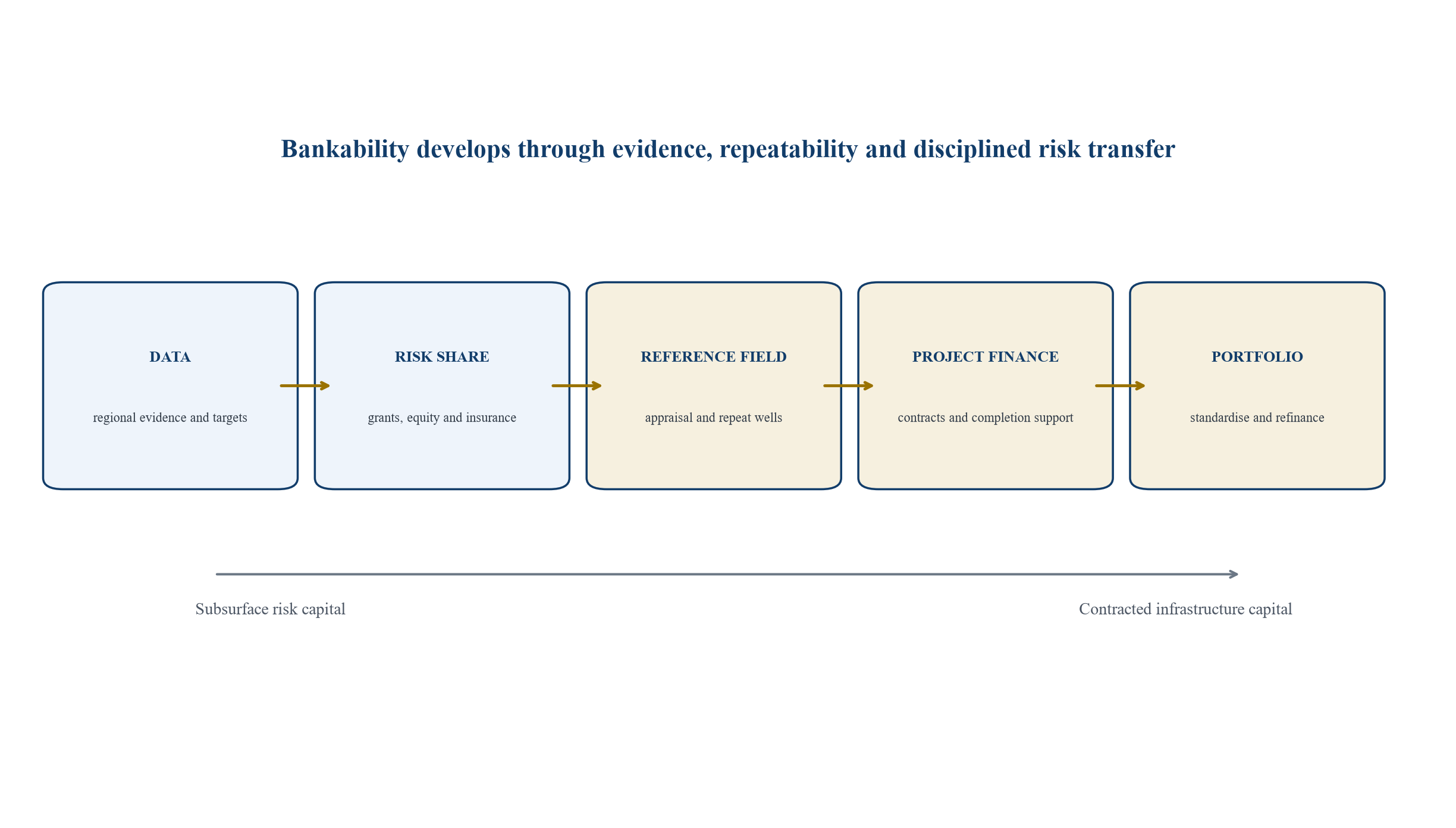
Generic roadmap; timing and capital sources depend on project evidence, technology and market.
The roadmap should be applied at portfolio and project levels. Public institutions can create shared data and facilities. Private sponsors can create repeatable drilling and contract packages. Lenders can enter after the evidence supports predictable completion and cash flow.
55. Investment-committee decision pack
The committee should receive rights, permits, resource model, alternative targets, well design, cost and schedule, procurement, testing, insurance, sources and uses, scenario valuation, gate conditions and failure plan. The papers should show changes since the prior gate.
A contract-to-model bridge should trace every material financial term. A risk-to-contingency bridge should link each risk to budget, insurance, guarantee, covenant or retained exposure. Unfunded mitigation should remain an open condition.
The pack should include a change log from the prior approval: resource range, probability, capacity, well count, cost, schedule, financing and valuation. Management should explain why evidence moved each assumption. This prevents gradual optimism from entering through successive revisions. The decision minute should record conditions, delegated limits and the evidence required for the next gate.
56. Lender and insurer information pack
Lenders need the integrated project case, contracts, completion support, reserves and downside coverage. Insurers need the resource evidence, approved well and test plan, measurement protocol and disclosure. The packs overlap and should reconcile.
Information undertakings should continue through drilling and operation. Material changes require notice. Data access should protect legitimate confidentiality while allowing independent verification and claims administration.
57. Red flags and conclusion
Red flags include a single deterministic resource model, insurance quoted without policy wording, senior debt assumed before resource confirmation, success defined by a short test, replacement wells omitted, permits disconnected from the drilling schedule, contingent public funding treated as committed, and a bridge loan without a downside repayment plan.
Enhanced geothermal becomes financeable through disciplined sequencing. Each tranche should purchase a named reduction in uncertainty, preserve a rational stop and use capital suited to the current risk. Insurance, guarantees and public cost sharing can mobilise private capital when their triggers, limits and additionality are clear. The final project-finance case rests on verified field performance, repeatable wells, contracted revenue, funded sustaining capital and credible completion support.
References
- United States Department of Energy. Pathways to Commercial Liftoff: Next-Generation Geothermal Power. Washington, DC: DOE, 2025 update. https://www.energy.gov/sites/default/files/2025-07/LIFTOFF_DOE_Next-Generation-Geothermal%20Power.pdf
- United States Department of Energy, Geothermal Technologies Office. Enhanced Geothermal Systems. https://www.energy.gov/hgeo/enhanced-geothermal-systems
- United States Department of Energy. GeoVision: Harnessing the Heat Beneath Our Feet. Washington, DC: DOE, 2019. https://www.energy.gov/eere/geothermal/geovision
- World Bank. The Global Geothermal Development Plan: Mitigating Upstream Cost and Risk. Washington, DC: World Bank, 2020. https://www.worldbank.org/en/results/2020/11/10/the-global-geothermal-development-plan-mitigating-upstream-cost-and-risk
- World Bank. Indonesia Geothermal Resource Risk Mitigation Project. Project Appraisal Document PAD2932. Washington, DC: World Bank, 2019. https://documents.worldbank.org/en/publication/documents-reports/documentdetail/972941569608786496
- World Bank and Energy Sector Management Assistance Program. Comparative Analysis of Approaches to Geothermal Resource Risk Mitigation. Washington, DC: World Bank, 2016. https://documents1.worldbank.org/curated/en/621131468180534369/pdf/105172-ESM-P144569-PUBLIC-FINAL-ESMAP-GeoRiskMitigation-KS024-16-web.pdf
- World Bank. Saint Lucia Renewable Energy Sector Development Project: Early Market Engagement for Integrated Drilling Services. 2026. https://www.worldbank.org/en/events/2026/01/07/saint-lucia-eme-for-an-integrated-drilling-service
- International Renewable Energy Agency. Unlocking Renewable Energy Investment: The Role of Risk Mitigation and Structured Finance. Abu Dhabi: IRENA, 2016. https://www.irena.org/-/media/Files/IRENA/Agency/Publication/2016/IRENA_Risk_Mitigation_and_Structured_Finance_2016.pdf
- International Renewable Energy Agency. Global Geothermal Market and Technology Assessment. Abu Dhabi: IRENA, 2023. https://www.irena.org/Publications/2023/Feb/Global-geothermal-market-and-technology-assessment
- International Energy Agency. The Future of Geothermal Energy. Paris: IEA, 2024. https://www.iea.org/reports/the-future-of-geothermal-energy
- International Finance Corporation. Success of Geothermal Wells: A Global Study. Washington, DC: IFC, 2013. https://documents.worldbank.org/en/publication/documents-reports/documentdetail/829261468327682400
- Geothermal Energy Association. The Manageable Risks of Conventional Hydrothermal Geothermal Power Systems. Washington, DC: GEA, 2014. https://www.geothermal.org/sites/default/files/2021-02/Geothermal_Risks_Publication.pdf
- European Commission. Geothermal Energy. Brussels: European Commission. https://energy.ec.europa.eu/topics/renewable-energy/geothermal-energy_en
- European Commission. State Aid: Commission Approves French Deep-Geothermal Guarantee Fund. 24 July 2023. https://france.representation.ec.europa.eu/informations/aides-detat-la-commission-autorise-un-regime-daides-francais-de-1956-millions-eu-mettant-en-place-un-2023-07-24_fr
- European Commission Joint Research Centre. Geothermal Energy Status Report. Luxembourg: Publications Office of the European Union, 2015. https://publications.jrc.ec.europa.eu/repository/bitstream/JRC99264/2015%20jrc%20geothermal%20energy%20status%20report_online.pdf
- European Commission Joint Research Centre. The Geothermal Industry in the European Union. Luxembourg: Publications Office of the European Union, 2020. https://aquaknow.jrc.ec.europa.eu/system/files/Annex65_JRC_TechnicalReportGeothermalIndustry_ver5.pdf
- International Partnerships, European Commission. Unlocking Latin America's Geothermal Potential. https://international-partnerships.ec.europa.eu/policies/programming/projects/unlocking-latin-americas-geothermal-potential_en
- International Partnerships, European Commission. Building Energy Independence in the Eastern Caribbean. https://international-partnerships.ec.europa.eu/policies/programming/projects/building-energy-independence-eastern-caribbean_en
- Geothermal Risk Mitigation Facility. Application Manual and Programme Information. https://grmf-eastafrica.org/
- International Association of Drilling Contractors. IADC Drilling Manual. Houston: IADC. https://iadc.org/drilling-manual/
About the Author
Chennakeshav (CK) is a corporate finance and investment banking executive with 25+ years of global experience in deal origination, structuring and execution across M&A, growth capital and corporate strategy. He has led value-creation mandates for founders, corporates and funds — bridging the boardroom view to hands-on execution and close.
His career spans Morgan Stanley, HSBC, Lloyds Banking Group, EWEC, ADQ portfolio companies and Emirates Growth Fund, across TMT, real estate, fintech, deeptech, cleantech, infrastructure and energy. He has partnered with C-suite leaders, private equity and venture funds, sovereign wealth funds and family offices to finance complex fund raises and scale-up ventures, and has led M&A due diligence, post-merger integration and business-transformation initiatives to create value.
At Matchpoint Partners he is Managing Partner, leading the firm's corporate finance, M&A and capital-raising practice. He holds an MBA from London Business School, an engineering degree from VTU and a Master of Laws (LLM, in progress) from UCL London.
An active start-up mentor, CK mentors at Techstars, DIFC FinTech Hive, Startup Grind, Founder Institute and IN5, serves as Entrepreneur Mentor in Residence (EMiR) at London Business School, and judges the Entrepreneurship World Cup.
LinkedIn: https://www.linkedin.com/in/ckadya/
Profile: https://www.matchpoint-partners.com/team/ck-adya.html
