

Introduction
An essential facility needs electricity for a service that cannot wait for the wider grid to recover. A hospital must support clinical systems, refrigeration, sterilisation, communications and life-safety equipment. An airport must protect airfield systems, navigation support, security, baggage, communications and terminal functions. A defence installation must sustain critical missions under physical, cyber and supply disruption. The power requirement is therefore a service-continuity obligation rather than a simple annual energy purchase.
An islandable microgrid can coordinate generation, storage, controllable load, protection and a local distribution network. During normal operation it can reduce energy cost or provide grid services where rules permit. During a qualifying disturbance it separates at the point of common coupling and supplies defined loads. The financing challenge comes from this dual use. Ordinary savings may be measurable, while the largest resilience benefit appears during rare events and often accrues to patients, passengers, public agencies or national security rather than to the project company.
A bankable structure must convert the protected mission into contractual performance. The host must state what needs power, for how long, at what quality and under which initiating conditions. The engineering design must prove the required operating modes. The payment mechanism must reward verified readiness without creating an open-ended obligation. The financing plan must keep public support, energy savings, capacity payments and market revenue separate so that lenders can identify the cash available for debt service.
1 Define the protected mission
The project should begin with a mission statement approved by the facility operator. It should identify the services that must continue, the consequences of interruption and the authority that can change priorities during an emergency. A generic objective such as improving resilience gives designers and lenders too little information.
The mission should be expressed through critical loads, service tiers, operating duration and restoration requirements. Life-safety loads may require uninterrupted supply. Operational loads may tolerate a short transfer interval. Recovery loads may be energised after the system is stable. This hierarchy determines generation capacity, storage duration, switching, redundancy, fuel inventory and control logic.
The host should also define conditions that are outside the contracted service. A microgrid cannot protect a facility whose internal distribution system has failed beyond the project boundary. It cannot guarantee fuel delivery during every regional emergency. The contract must therefore distinguish microgrid availability from the wider facility's ability to receive and use power.
2 Establish the electrical boundary
The boundary should show the utility connection, point of common coupling, on-site distribution, protected buses, generation, storage, controllable loads and excluded systems. ICAO guidance identifies the point of common coupling and local distribution upgrades as core elements of an airport microgrid. IEEE's intentional-island guidance covers separation, reconnection, interoperability, protection and communications with other electric power systems.
Boundary clarity prevents interface disputes. The utility may control interconnection protection and export permissions. The facility may control mission priorities. A project company may operate the microgrid controller and generation assets. Existing generators may belong to the host, while new storage belongs to the project company. Each interface needs a physical definition, operating protocol, metering standard and liability allocation.
The boundary should include communications and cybersecurity. A controller that depends on unavailable cloud connectivity can become a single point of failure. Local control, authenticated commands, protected credentials, event logging and manual fallback belong in the design and the acceptance test.
3 Measure critical load accurately
Annual electricity consumption does not size an islandable system. The relevant evidence includes interval load data, motor-starting requirements, power quality, load coincidence, seasonal peaks and the sequence in which equipment must restart. Hospital loads can change with clinical activity. Airport demand can vary by flight schedule and weather. Defence loads may include protected information that requires controlled handling.
The host should verify the critical-load list with facility operators rather than rely only on utility bills or nameplate ratings. Each load should carry a service tier, maximum interruption time, restart requirement and shed priority. The model should distinguish continuous load from short peaks and identify equipment that can be curtailed without compromising the mission.
Load reduction can lower capital cost. Efficiency, thermal storage, demand control and operational procedures can reduce the capacity that must be financed. The savings case should remain separate from the resilience case because the two may have different measurement, payment and performance rules.
4 Specify outage duration and initiating events
The required operating duration should follow hazard and restoration evidence. A short utility disturbance, a multi-day storm, a fuel interruption and a coordinated physical or cyber event create different design requirements. NREL research on long-duration storage for military installations models survival probabilities over a 14-day outage and shows that higher survival targets raise cost.
The contract should define which event activates islanding obligations. Automatic islanding may follow voltage or frequency conditions. Planned islanding may support utility requests or pre-event preparation. Manual activation may apply when a facility commander anticipates disruption. The project must also define reconnection authority and synchronisation requirements.
Duration should be tested as a distribution rather than one deterministic number. Lenders should see the probability that critical load remains served across different outage start times, resource availability and weather conditions. A system that survives one favourable test case can still fail when an outage begins during low battery charge, maintenance or a prolonged period of poor renewable output.
5 Build the operating architecture
An islandable microgrid can combine solar, wind, combined heat and power, conventional generators, batteries, thermal storage, vehicle-to-building resources and demand control. The preferred mix depends on load shape, climate, fuel access, emissions rules, space, noise, maintenance capacity and the duration requirement. Technology diversity can reduce common-mode failure when the resources do not share the same dependency.
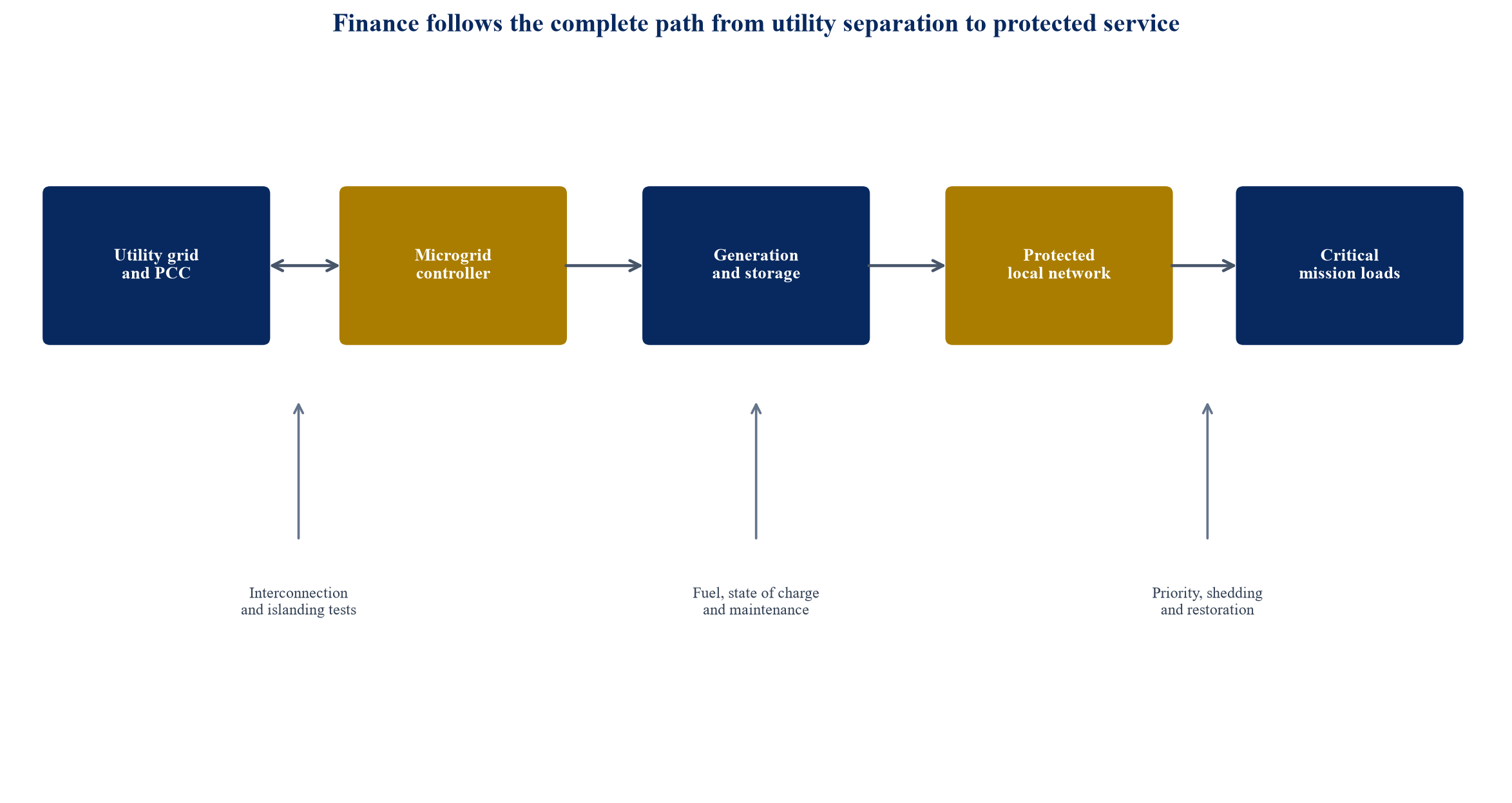
The diagram is an author-developed framework. It does not describe a particular facility or prescribe an engineering design.
The controller should manage dispatch, protection, load shedding, state of charge, generator commitment and transition between grid-connected and islanded modes. Critical manual procedures remain necessary. Operators need local visibility, tested communications and authority to override automated priorities when safety or mission conditions require it.
6 Treat islanding as a system capability
Installing solar panels or batteries does not create a microgrid by itself. The system needs protection changes, switching, controls, communications, black-start capability, stable frequency and voltage, and a local network able to carry critical loads. The US Department of Energy's microgrid overview distinguishes grid-connected backup microgrids from fully off-grid systems and explains that island-mode capability changes the design and cost.
The completion regime should therefore test the integrated system rather than individual equipment. Factory tests can validate controller logic. Site tests should demonstrate separation, stable island operation, load steps, resource failure, black start, resynchronisation and reconnection. Tests should include degraded conditions rather than only ideal commissioning conditions.
The acceptance certificate should list residual defects and their consequence for service. A minor documentation item can remain on a punch list. A failed transition, protection defect or inability to serve the contracted critical load should prevent final acceptance and debt term-out.
7 Separate resilience from reliability
Reliability describes performance under expected operating conditions. Resilience concerns severe disruption, adaptation and recovery. A facility may have reliable utility supply and still face a low-frequency event with large consequences. Conversely, a microgrid can reduce outage consequences without improving every routine reliability metric.
The payment mechanism should reflect this distinction. Ordinary energy supply can be measured through kilowatt-hours, demand reduction or shared savings. Resilience availability should be measured through tested readiness, usable capacity, fuel sufficiency, state of charge, transition performance and exercised operating procedures. Emergency performance should be measured after an actual activation.
Combining all value into one energy price can obscure the resilience obligation. A host may pay a competitive electricity tariff while receiving no enforceable assurance that the system will island successfully. A separate readiness payment makes the service visible and supports debt, provided deductions are meaningful and measurement remains auditable.
8 Value avoided interruption carefully
Resilience value begins with the cost of service loss. The US Department of Energy's Customer Damage Function approach estimates facility-specific outage costs. NREL's REopt materials describe avoided outage cost through lost revenue, equipment damage, injury or life impacts and restart costs. These tools support decision analysis, yet they do not automatically create project cash flow.
The host should separate direct financial loss, mission consequence and wider public loss. A hospital's protected clinical service may have substantial social value that does not appear in the hospital's cash account. An airport closure can affect airlines, passengers and regional activity. A defence mission may have no appropriate public monetary estimate. These benefits can justify public funding or an availability payment, while debt service still requires an enforceable payer.
The analysis should document duration, affected load, recovery curve and transferability of each value. It should avoid multiplying an economy-wide value by every kilowatt-hour without testing whether the facility can actually preserve that service.
9 Use savings as one revenue layer
Energy efficiency, demand management, on-site generation and storage can reduce utility expenditure during normal operations. These savings can support an energy performance contract or lower the net availability payment. US federal ESPC and UESC structures demonstrate how capital improvements can be repaid from verified savings, sometimes combined with appropriations or grants.
Savings should be measured against a defined baseline with agreed tariff, weather and operating adjustments. DOE's 2024 guidance on utility-rate estimation and weather normalisation recognises that payment calculations depend on consistent assumptions. Lenders should test whether baseline adjustments can materially reduce contracted savings.
The resilience assets may cost more than savings can support. DOE guidance on federal microgrid finance states that avoided costs and savings may need to be combined with appropriated funding. The financial model should show the residual resilience funding requirement explicitly rather than assume that all microgrid capacity pays for itself through energy arbitrage.
10 Select the ownership model
The host can own the assets directly, procure an energy service company, use a utility service contract, enter an energy-as-a-service agreement, purchase energy from a project company or combine ownership across assets. The choice affects tax treatment, accounting, operational control, procurement, security, handback and the lender's security package.
Direct ownership can preserve command and simplify integration with protected systems. It requires public or corporate capital and long-term operating capability. Third-party ownership can provide specialist design, finance and lifecycle maintenance. It requires a durable contract and carefully controlled access to the facility.
Mixed ownership is common where existing generators remain with the host and new storage or controls sit in a project vehicle. Interface risk then becomes central. The contract must state who maintains each asset, who dispatches it, how existing equipment contributes to tests and which party bears failure when the integrated system misses the service level.
11 Choose a payment structure
Potential structures include availability payments, shared savings, capacity charges, energy sales, service fees and market-revenue sharing. A critical-facility project often needs more than one stream. The base payment should cover a defined service and come from a creditworthy payer. Variable revenue can reduce host cost but should not weaken readiness.
An availability payment can reward tested islanding capability, critical-load capacity and maintenance. Deductions can apply for failed tests, unavailable resources, inadequate fuel, overdue maintenance or cyber-control failures. Energy charges can reflect ordinary generation. Market revenue can be shared when participation does not compromise state of charge or mission priority.
Payment priority must be clear. The microgrid should not discharge its battery into an energy market when that action would reduce the contracted emergency reserve. The host's resilience requirement should govern operating limits, and lost market revenue arising from those limits should be reflected in the agreed price.
12 Build a transparent sources and uses plan
The uses schedule should include development, engineering, interconnection, equipment, civil works, distribution upgrades, control systems, cybersecurity, commissioning, financing costs, reserve accounts and contingency. Historical rules of thumb can support early screening, but they are not a substitute for site design. DOE's 2024 overview cites an older NREL finding of approximately USD 2 million to USD 5 million per megawatt for continental US projects; location and complexity can make actual costs materially different.
Sources can include host equity, sponsor equity, senior debt, concessional debt, grants, tax incentives where available, utility contributions and appropriated funds. Each source should identify timing, conditions, repayment and permitted use. A grant that reimburses costs after commissioning does not fund construction liquidity unless bridged.
The model should also fund lifecycle replacement. Batteries, inverters, controls and communications may require replacement before the contract ends. A debt case that omits these costs can overstate coverage and transfer an unfunded obligation to the host.
Table 1. Illustrative sources and uses framework
| Use or source | Primary evidence | Timing issue | Finance treatment | Main control |
|---|---|---|---|---|
| Development and design | Load study, interconnection scope and permits | Paid before financial close | Sponsor or development facility | Milestone budget and stop rights |
| Equipment and construction | Priced EPC scope and contingency | Drawn during build | Senior debt, equity and grants | Independent engineer certification |
| Distribution and controls | Protection study, cybersecurity design and integration plan | Often critical path | Debt and host contribution | Integrated completion tests |
| Lifecycle replacement | OEM life, duty cycle and maintenance plan | After commissioning | Funded reserve or contracted service price | Minimum reserve and renewal test |
| Senior debt | Contracted cash flow and security package | Available after conditions precedent | Amortising project or corporate facility | Coverage, liquidity and distribution tests |
| Public or host support | Appropriation, grant award or budget approval | May reimburse after spend | Capital contribution or availability payment | Eligibility, audit and clawback controls |
This table is an author-developed framework. Project amounts and proportions require site-specific engineering, procurement and financing evidence.
13 Define the contracted service
The service specification should identify protected loads, islanding time, duration, power quality, renewable or emissions constraints, fuel requirements, black-start performance, reconnection, maintenance windows and reporting. It should state the measurement point for each obligation.
Availability should be observable before an outage. The project company can report usable generation, battery state of health, minimum state of charge, fuel inventory, controller status, communications, alarms and maintenance. Independent tests should confirm that reported data correspond to actual performance.
The contract should avoid absolute claims that exceed the system boundary. A service provider can commit to maintain specified capacity and follow tested procedures. It cannot promise that every external fuel route, utility signal, public communication system or host-owned circuit will remain available under every catastrophe. These dependencies should appear in the risk matrix and emergency plan.
14 Allocate design and construction risk
The project company can accept detailed design, equipment selection, coordination, construction and completion risk within a defined site condition and host interface. An engineering, procurement and construction contract can pass down performance obligations, delay damages and defect remedies.
The host should provide accurate site data, access, existing-system records, hazardous-material information and timely approvals. Unknown underground infrastructure, legacy protection settings and undocumented host modifications can create cost and schedule risk. Due diligence should reduce these uncertainties before a fixed price is accepted.
Interconnection and utility works require a separate schedule. The utility may control studies, protection changes, metering and permission to operate. A project company cannot fully control utility timing. The contract should assign cooperation obligations, long-stop dates and cost treatment rather than treat all delay as contractor default.
15 Allocate technology and degradation risk
The project company should remain responsible for equipment meeting contracted performance throughout the term. Battery degradation, inverter availability, generator efficiency and controller obsolescence need warranty, maintenance and replacement plans. Performance guarantees should use measurable output and availability rather than promotional specifications.
Technology choice may need adjustment as equipment changes. The contract should permit equivalent or better replacements subject to compatibility, security and host approval. A rigid equipment list can create obsolescence, while broad substitution rights can introduce untested interfaces.
The debt model should reflect degradation and augmentation. Usable storage energy can decline even when the battery remains operational. If resilience requires a fixed duration, the project may need additional modules or earlier replacement. The corresponding capex should appear in the lifecycle schedule and reserve account.
16 Allocate fuel and resource risk
Conventional generators and combined heat and power depend on fuel. Renewable generation depends on weather. Batteries depend on prior charging and operating limits. A credible design combines resources and procedures that match the hazard scenario.
The host may retain regional fuel-supply risk while the project company manages on-site inventory, testing, quality and consumption. Minimum fuel stock should reflect outage duration and replenishment assumptions. A paper fuel contract provides limited value if access routes or suppliers fail during the same event.
Renewable output should be modelled across seasons and extreme conditions. Storage dispatch should preserve the emergency reserve. Firm capacity should not include uncommitted grid imports during an islanded event. Resource uncertainty belongs in survival simulations and sizing rather than in a single average-year energy forecast.
17 Allocate utility and interconnection risk
The utility controls the distribution network outside the project boundary and may set interconnection, export, protection, metering and operating requirements. FERC Order 2222 can create opportunities for aggregated distributed resources in organised US markets, but implementation schedules and local participation rules differ. Wholesale revenue therefore requires jurisdiction-specific confirmation.
The interconnection agreement should address intentional islanding, transfer trip, anti-islanding settings, protection coordination, reconnection and information exchange. The project should not energise the utility network unintentionally. The utility should provide timely operating notices and define circumstances in which it may block export or require disconnection.
Changes in grid rules can affect market revenue or operating cost. The contract should separate mandatory safety changes from discretionary upgrades and allocate resulting cost through an agreed change mechanism. Base debt should rely on revenue that survives foreseeable rule changes or carries contractual compensation.
18 Protect operational command
The facility operator must retain command over mission priorities during an emergency. The project company operates within that command structure and remains accountable for the contracted electrical service. The interface should identify who declares an emergency, who authorises manual islanding, who can shed loads and who approves reconnection.
Defence and aviation facilities may restrict physical and digital access. Staff vetting, escort rules, protected information, remote-access limits and supply-chain requirements can affect cost and response. These requirements should be included before procurement so bidders price them consistently.
Emergency procedures should be exercised with the utility, facility teams and external responders where appropriate. A technically available microgrid can still fail operationally if staff do not recognise alarms, conflicting instructions delay islanding or critical loads are connected to the wrong bus.
19 Design cyber resilience into the contract
NIST's distributed-energy reference architecture emphasises authenticated information exchange, identity management, command logging, device gateways and a cyber demarcation point between utility and microgrid networks. CISA's energy-sector goals and resilient-power guidance also treat cyber risk as part of critical-facility resilience.
The contract should specify architecture, asset inventory, access control, patching, logging, incident response, backup configurations, recovery tests and notification. The project company should maintain the microgrid control environment. The utility and host remain responsible for their own networks. Each party must control the interface it owns.
Cybersecurity obligations should be measurable. A broad promise to use best practice creates uncertainty. Compliance evidence can include approved architecture, vulnerability management, privileged-access reviews, recovery exercises and independent testing. Security-sensitive details should remain protected while lenders and the host receive sufficient assurance.
20 Define completion tests
Completion should require mechanical and electrical readiness plus integrated service performance. Tests can include protection verification, utility separation, black start, stable island operation, load steps, loss of a generator, battery dispatch, load shedding, communications failure, resynchronisation and reconnection.
The test conditions should approximate the contracted mission. A demonstration at light load does not prove performance at the critical peak. Temporary test equipment should not mask a permanent deficiency. Fuel, state of charge and host operating conditions should be documented.
An independent engineer can witness tests and certify objective results. The host retains safety and mission authority. Lenders should receive the completion certificate and a schedule of residual items. Material failures should delay conversion from construction financing to term debt.
21 Test routine readiness
Readiness degrades without exercise. Engines, switchgear, batteries, protection, communications and operator procedures need scheduled tests. The contract should state frequency, notice, duration, allowed maintenance windows and consequences of failure.
Tests should vary the scenario. A project that repeats the same scripted sequence may miss dependencies. Periodic exercises can start with different battery states, unavailable components, communication loss or altered load priorities. Results should lead to corrective action and contract updates.
Readiness evidence supports payment and credit monitoring. The lender should not rely only on annual availability percentages. It should see critical test results, unresolved defects, maintenance backlog, resource sufficiency and cyber incidents that can affect the service.
22 Structure availability deductions
Deductions should correspond to service consequence. Failure of one reporting field should not trigger the same deduction as an inability to island. The mechanism can use severity bands for reduced capacity, failed tests, delayed response, overdue maintenance, insufficient reserve and repeated breach.
The deduction cap must balance lender predictability with public protection. A low cap can turn persistent non-performance into an affordable operating cost. An unlimited deduction regime can make debt unfinanceable. Severe or repeated failure can trigger enhanced monitoring, cure rights, replacement of key subcontractors, step-in or termination.
Cure periods should reflect safety and urgency. A reporting error may be corrected quickly. A protection defect may require immediate unavailability. The host should retain emergency step-in where public safety or national security requires action before the commercial dispute is resolved.
23 Develop a bankable revenue bridge
Debt requires predictable cash from an enforceable payer. The project should identify the legal appropriation, tariff, corporate obligation, utility contract or budget mechanism supporting payment. Public projects should test multi-year payment authority and termination obligations. Private hosts should be assessed for credit quality and business continuity.
Energy savings, energy sales and availability payments should be reconciled into a cash waterfall. Operating cost, taxes, insurance, lifecycle reserves and debt service come before distributions. Market revenue can provide upside or a debt-service buffer when evidence supports it. It should not displace the contracted payment unless the project can control and reliably earn it.
The contract should address inflation, electricity tariffs, fuel price, change in law and refinancing. Indexation should match controllable cost exposure. A generic inflation index may not track battery replacement, specialist labour or fuel.
24 Size debt to contracted cash flow
The base debt case should use contracted payment after realistic operating cost, deductions, reserve funding and tax. It should exclude uncontracted resilience value and uncertain merchant revenue. Coverage ratios should be tested across energy-price, availability, operating-cost and refinancing scenarios.
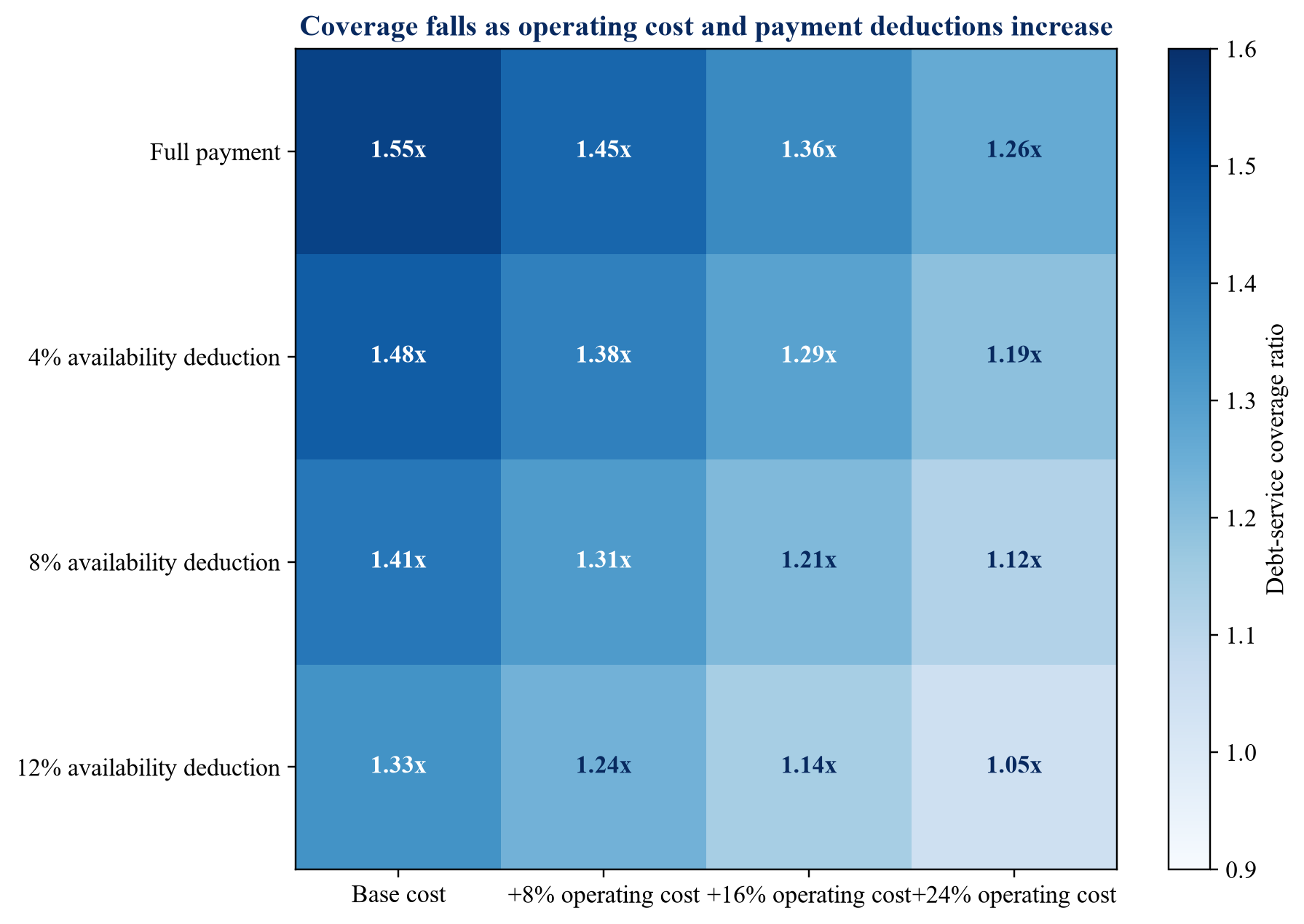
All values are hypothetical author-modelled assumptions for method demonstration. They are not financing terms, forecasts or project data.
Debt tenor should remain within the payment term and major equipment life. Amortisation may need to accelerate before a battery replacement or contract break. A funded debt-service reserve can absorb short payment delays, while a maintenance reserve protects long-term performance.
25 Stress outage survival
The engineering and financial models should connect. A cheaper system that frequently fails the mission can create a false saving. An oversized system can impose unaffordable payment. The project should show the incremental cost of higher survival targets and longer outage duration.
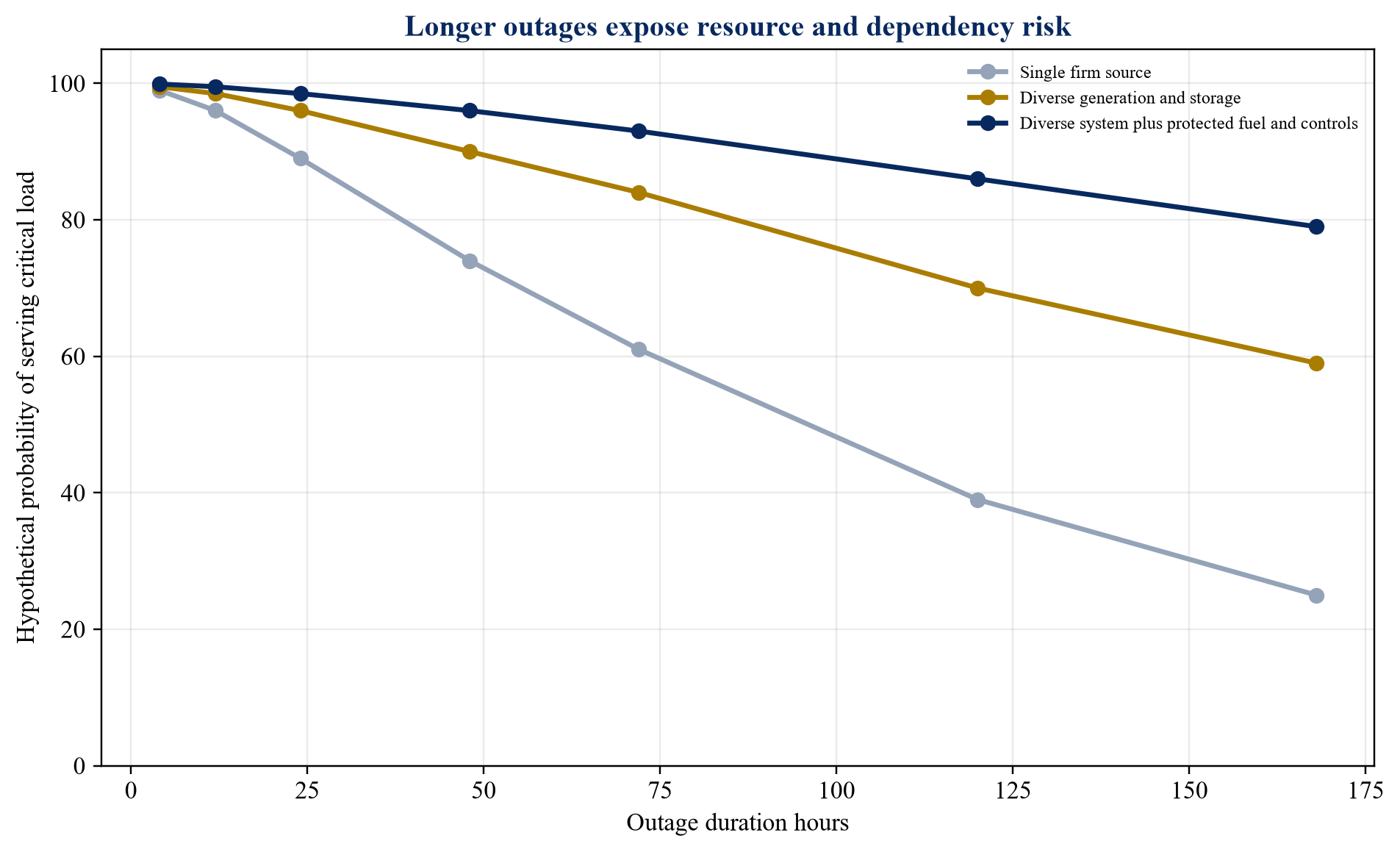
All values are hypothetical author-modelled assumptions. They demonstrate sensitivity to resource diversity and do not represent an actual facility.
The model should vary outage start time, battery state of charge, renewable output, generator availability, fuel, load and component failure. Results should be reported as conditional probabilities under stated assumptions. They should not be presented as guarantees.
26 Use public funding selectively
Grants and appropriations can fund the portion of resilience value that does not generate private cash. FAA's 2025 Airport Improvement Program guidance recognises microgrid components that improve airport power reliability and permit islanding, subject to programme eligibility. US federal facilities can combine appropriations, UESCs, ESPCs and other authorities. European programmes may support energy-community and distributed-energy preparation or investment under their own rules.
Public funding should buy a defined public benefit. Eligibility, milestones, audit rights, clawback and asset ownership need to align with the project contracts. Grant timing should be reflected in construction liquidity.
Subsidy should not conceal weak operations. The project must still fund maintenance, replacement and emergency readiness. A low initial capital contribution can lead to later failure if the service price cannot sustain the asset.
27 Treat market revenue as conditional
Grid services, demand response, capacity and energy-market participation can improve economics where rules, metering and interconnection permit. FERC Order 2222 addresses participation by distributed-resource aggregations in organised US wholesale markets, with implementation differing by regional operator.
Market participation must remain subordinate to the protected mission. Minimum battery charge, generator availability and fuel inventory can restrict bids. The financial model should deduct aggregator fees, telemetry, performance penalties, degradation and curtailment.
Lenders should require evidence before relying on merchant revenue. This evidence includes applicable tariff, registration, historical price, dispatch constraints and enforceable rights to the resource. A general statement that the microgrid can earn grid-services revenue is insufficient for debt sizing.
28 Address environmental performance
Critical-facility resilience can conflict with emissions, noise and local air-quality objectives if it relies heavily on combustion. The design should compare conventional generation, combined heat and power, renewable resources, storage, efficiency and fuel alternatives across the required duration and location.
Environmental permits should cover routine and emergency operation. Fuel storage, spill control, battery safety, fire protection, noise and end-of-life treatment affect development and operating cost. A low-carbon option may need more storage or firm backup to meet long-duration service.
The contract should state which environmental attributes belong to the host, project company or energy buyer. Carbon credits or certificates should not be counted twice. Emissions targets should remain compatible with emergency operating rights.
29 Protect healthcare operations
Healthcare facilities already operate under emergency-power and life-safety requirements. CMS guidance for US hospitals, critical access hospitals and long-term care facilities refers to inspection, testing, maintenance, generator location and fuel planning under applicable health-care and life-safety codes. A microgrid should integrate with these obligations rather than replace them by assumption.
Clinical engineering, infection control and facilities teams should validate load priorities and maintenance windows. Power quality, transfer time and restart sequence can matter as much as total capacity. Medical gas, cooling, sterilisation, pharmacy refrigeration, information systems and elevators may have different continuity requirements.
Financing should recognise the hospital's reimbursement, credit and capital constraints. An availability or energy-service payment may spread capital cost, but the hospital must retain operational authority and confirm that the contract meets regulatory and patient-safety duties.
30 Protect airport operations
Airports contain several electrical systems with different owners and functions. Airfield lighting, navigation support, communications, security, baggage, terminal systems and tenant loads require a defined boundary. FAA electrical-power policy requires reliability and availability commensurate with National Airspace System functions, while ICAO guidance explains microgrid infrastructure, islanding and airport operating considerations.
An airport microgrid may combine grants, airport revenue, utility arrangements and project finance. Passenger or airline charges may be legally restricted. The project should identify the lawful payment source and allocate benefits among the airport operator, airlines, tenants, emergency services and the utility.
Construction and testing must respect aviation operations. Phasing, outage windows, security access and electromagnetic or operational compatibility can drive schedule and contingency. Completion should require integrated tests without creating unacceptable operational risk.
31 Protect defence missions
Defence energy resilience begins with critical mission requirements. The US Department of Defense identifies appropriated funding, power-purchase agreements, enhanced-use leasing, ESPCs, UESCs and special agreement authority among available project routes. Each route carries its own approvals and limitations.
The installation should state protected missions, duration, security classification, access controls, fuel assumptions and command authority. Some information may be unsuitable for public disclosure. The finance package can use controlled diligence, independent certification and aggregate performance data.
GAO reviews show that utility disruptions and funding prioritisation have been persistent issues for military installations. A microgrid investment case should therefore compare mission consequence, asset condition and alternative resilience measures. Technology procurement alone does not prove mission assurance.
32 Allocate risk through a complete matrix
The risk matrix should identify cause, consequence, owner, mitigation, financial treatment, contract mechanism and evidence. Allocation should follow control. The project company can manage design integration, construction, maintenance and performance. The host controls mission priorities and host-owned systems. The utility controls its network. Government retains sovereign and national-security decisions.
Table 2. Illustrative critical-facility microgrid risk allocation
| Risk | Indicative allocation | Principal mitigation | Contract mechanism | Lender focus |
|---|---|---|---|---|
| Design integration and completion | Project company | Reference design, interface survey and integrated tests | Fixed-price obligations, delay damages and completion security | Contingency, test protocol and long-stop date |
| Host load and existing assets | Host or shared | Verified load data, asset condition survey and change control | Baseline warranty and relief for host changes | Reliance on host equipment and data quality |
| Utility interconnection | Shared | Early studies, utility agreement and protection coordination | Cooperation, schedule relief and defined cost sharing | Permission to operate and export assumptions |
| Fuel and resource sufficiency | Shared | On-site inventory, diverse resources and supplier planning | Minimum stock, availability tests and force-majeure rules | Long-duration survival and replenishment |
| Technology degradation | Project company | Warranties, augmentation and lifecycle reserves | Output guarantee and replacement obligation | Fixed duration, reserve funding and OEM support |
| Cybersecurity and controls | Each party for its network | Segmentation, identity control, logging and recovery tests | Security schedule, audit and incident duties | Remote access, common-mode failure and cure |
| Mission priority and emergency command | Host | Approved load hierarchy and exercises | Dispatch protocol, step-in and indemnity boundary | Clear service scope and host obligations |
| Change in law and grid rules | Shared by cause | Monitoring and pre-agreed adjustment method | Relief, compensation or tariff reset | Cash-flow preservation and termination rights |
The allocation is an author-developed starting point. Applicable law, procurement rules, security requirements and project facts determine final allocation.
33 Compare contract models
No single model fits every facility. A public hospital may prefer an energy performance contract. An airport may combine public grants with a private operating agreement. A defence installation may use an authorised federal contract vehicle. A private industrial campus may use energy-as-a-service.
Table 3. Contract-model decision framework
| Decision factor | Direct ownership | Performance contract | Energy as a service | Availability-based project |
|---|---|---|---|---|
| Capital source | Host budget or public borrowing | ESCO finance and host payments | Provider equity and debt | Project equity, debt and public or host support |
| Revenue basis | Internal budget | Verified savings and agreed charges | Energy and service fee | Contracted readiness and performance |
| Operational control | Highest host control | Shared through service scope | Provider operates defined assets | Project company operates within host command rules |
| Best fit | Capable host with available capital | Measurable savings and established authority | Standardised service with creditworthy host | Large integrated system with explicit resilience payment |
| Main challenge | Capital and lifecycle capability | Savings may not fund full resilience scope | Long-term interface and termination | Contract complexity, payment authority and risk allocation |
| Lender focus | Host credit | Savings guarantee and host payment | Service contract and asset rights | Completion, availability, deductions, step-in and termination |
This table summarises general characteristics. Legal, tax, accounting and procurement advice is required for each jurisdiction and facility.
34 Preserve step-in and continuity
Critical facilities require continuity when the service provider fails. The host should have emergency step-in rights for safety, public service and national security. Lenders need notice and cure rights where the default can be remedied without immediate host action.
Step-in provisions should define triggers, access, data, staff, spares, software credentials, cost and return to ordinary operation. The host should receive current operating manuals and backups throughout the term. An emergency right is weak if the host cannot access the controller or understand the system.
Termination compensation should distinguish host default, project default, prolonged force majeure and voluntary termination. Compensation must preserve public accountability and lender bankability. The formula should not reward serious non-performance.
35 Fund lifecycle and handback
Microgrid components have different lives. Civil works and switchgear may outlast batteries, inverters, communications and control hardware. The lifecycle plan should show inspection, overhaul, augmentation, replacement and software support across the contract term.
Cash should be reserved before major replacement dates. Distribution restrictions can protect the reserve. The host should receive evidence of asset condition and remaining life. Deferred maintenance can temporarily improve cash flow while weakening the protected service.
Handback should require condition surveys, functional tests, spares, licences, credentials, records and defect correction. Planning should start several years before expiry. A handback reserve or security can support compliance.
36 Monitor performance for lenders and the host
The host needs operating evidence. Lenders need cash-flow and asset evidence. Reports should cover critical-load capacity, resource availability, state of charge, fuel, tests, incidents, cyber events, maintenance, deductions, insurance, reserves and debt coverage.
Data should reconcile to the payment mechanism. A reported availability percentage should show excluded periods and waivers. Test failures should remain visible until corrective action closes. The independent engineer can review material technical events without becoming the operator.
Security-sensitive information requires controlled distribution. Public reports can present service outcomes and fiscal exposure. Detailed architecture, vulnerabilities and access data should remain protected.
37 Plan insurance and contingency liquidity
Construction, property, machinery breakdown, liability, cyber and business-interruption insurance may cover defined losses. Policies can exclude grid failure, fuel shortage, war, cyber events or regional catastrophe. Insurance availability and deductibles should be reviewed at financial close and renewal.
Insurance does not replace operating liquidity. The project may need cash before a claim is adjusted. A debt-service reserve, operating reserve, host emergency budget or contingent facility can bridge delayed receipts and response expenditure.
The contract should address insurance becoming unavailable or materially more expensive. Cost sharing should depend on market evidence and compliance with risk-management obligations. The project company should not receive relief for loss caused by its failure to maintain required controls.
38 Implement through evidence gates
Development should proceed through service definition, feasibility, utility engagement, procurement, financing, construction, testing and operations. Each gate should have a decision owner and evidence requirement. Early engineering should identify whether existing distribution and generators can support islanding.
Market engagement can test technology, contractor capacity, financing and contract terms. It should preserve competition and protected information. Bidders should price the same service specification and interface assumptions.
Financial close should require permits, interconnection progress, site rights, EPC and operating contracts, insurance, funding commitments, base-case model, security documents and direct agreements. Construction drawdowns should follow independent certification.
39 Build a repeatable programme
A portfolio of hospitals, airports or public facilities can use standard service definitions, risk allocation, testing and reporting while tailoring engineering to each site. Standardisation can reduce transaction cost, support portfolio financing and improve supplier competition.
The programme should rank facilities by mission consequence, outage exposure, asset condition, interconnection feasibility and development readiness. It should avoid allocating scarce capital solely to sites with the simplest projects.
Operating evidence should update future procurements. Test outcomes, degradation, maintenance, utility delays and actual savings can improve cost estimates and contract terms. A central assurance function can compare projects while local operators retain mission authority.
40 Recognise limitations
This framework does not provide electrical design, protection settings, cybersecurity certification, clinical or aviation approval, national-security assessment, procurement authority, legal opinion, tax advice or investment recommendation. Each facility requires qualified technical, operational, regulatory, legal and financial review.
The figures and tables use hypothetical author-modelled assumptions. They should not be treated as observed performance, market pricing, financing terms or forecasts. Costs, energy prices, market rules, incentives and contract authority vary by location and time.
Resilience cannot be reduced to one metric. Outage probability, mission consequence, system dependencies and response capability remain uncertain. The purpose of the framework is to make those assumptions visible and connect them to contracts and finance.
Conclusion
An islandable microgrid becomes financeable when the protected mission is translated into a measurable service. The host defines critical loads, duration, priority and emergency command. The project company integrates generation, storage, controls, protection and local distribution, then proves performance through completion tests and recurring exercises.
The revenue structure should separate resilience readiness from ordinary energy value. A dependable availability or service payment can support debt. Energy savings and contracted energy sales can supplement that payment. Merchant grid revenue and wider social benefit require conservative treatment unless an enforceable payment converts them into cash.
Debt sizing should follow contracted cash flow after operating cost, lifecycle funding and realistic deductions. The risk matrix should allocate design, construction, technology, fuel, utility, cyber and command risks to parties with control. Lender step-in, reserves, insurance and handback protect continuity over the contract term.
The resulting investment is a local service-continuity platform. Its value depends on the complete chain from interconnection and islanding through generation, storage, controls, protected distribution and mission loads. Evidence at each link determines whether the facility can keep operating when the wider grid cannot.
References
- US Department of Energy, Fiscal Year 2024 Microgrid Grid and Integrated Microgrid Systems Program Report to Congress, January 2025. https://www.energy.gov/documents/fy-2024-microgrid-report-congress
- US Department of Energy, Microgrid Overview, January 2024. https://www.energy.gov/sites/default/files/2024-01/2024-01-18%20Microgrid%20Overview%20Fact%20Sheet.pdf
- US Department of Energy, Power in the Storm: Capturing the Value of Microgrids Resilience, 2026. https://www.energy.gov/oe/articles/power-storm-capturing-value-microgrids-resilience
- US Department of Energy Federal Energy Management Program, Kickstart Your Federal Microgrid Project: Financing Opportunities and Best Practices, August 2025. https://www.energy.gov/cmei/femp/articles/kickstart-your-federal-microgrid-project-financing-opportunities-and-best
- US Department of Energy Federal Energy Management Program, Financing Microgrids in the Federal Sector. https://www.energy.gov/eere/femp/articles/financing-microgrids-federal-sector
- US Department of Energy Federal Energy Management Program, Federal On-Site Distributed Energy Procurement Options. https://www.energy.gov/cmei/femp/federal-site-distributed-energy-procurement-options
- US Department of Energy Federal Energy Management Program, Utility Energy Service Contract Basics. https://www.energy.gov/cmei/femp/utility-energy-service-contract-basics
- US Department of Energy Federal Energy Management Program, Energy Savings Performance Contracts for Federal Agencies. https://www.energy.gov/cmei/femp/energy-savings-performance-contracts-federal-agencies
- US Department of Energy Federal Energy Management Program, Guidance on Utility Rate Estimations and Weather Normalization in Performance Contracts, 2024. https://www.energy.gov/cmei/femp/articles/guidance-utility-rate-estimations-and-weather-normalization-performance
- US Department of Energy Federal Energy Management Program, Resilience Planning and Valuation. https://www.energy.gov/cmei/femp/resilience-planning-and-valuation
- National Renewable Energy Laboratory, Microgrids for Energy Resilience, revised January 2020. https://www.nrel.gov/docs/fy19osti/72586.pdf
- National Renewable Energy Laboratory, Finance for Power Sector Resilience, 2019. https://research-hub.nrel.gov/en/publications/finance-for-power-sector-resilience
- National Renewable Energy Laboratory, REopt Overview and Decision Support Platform. https://www.nrel.gov/reopt/
- National Renewable Energy Laboratory, REopt Lite Overview: Resilience. https://www.nrel.gov/docs/fy22osti/81636.pdf
- National Renewable Energy Laboratory, Resilience Valuation and Planning for Solar and Storage Projects at Critical Facilities, 2024. https://www.nrel.gov/docs/fy24osti/90010.pdf
- National Renewable Energy Laboratory, Long-Duration Energy Storage: Resiliency for Military Installations, 2024. https://www.nrel.gov/docs/fy24osti/87646.pdf
- National Renewable Energy Laboratory, REopt/Microgrid Analysis Cooperative Research and Development Final Report, 2025. https://doi.org/10.2172/2583499
- Federal Energy Regulatory Commission, Order No. 2222 Fact Sheet. https://www.ferc.gov/media/ferc-order-no-2222-fact-sheet
- Federal Energy Regulatory Commission, Order No. 2222 Explainer. https://www.ferc.gov/ferc-order-no-2222-explainer-facilitating-participation-electricity-markets-distributed-energy
- IEEE Standards Association, P1547.4 Guide for Design, Operation, Integration and Interoperability of Intentional Electric Power Systems Islands. https://standards.ieee.org/ieee/1547.4/11292/
- National Institute of Standards and Technology, Cybersecurity Framework Smart Grid Profile, NIST TN 2051, 2019. https://doi.org/10.6028/NIST.TN.2051
- National Institute of Standards and Technology, Securing Distributed Energy Resources: An Example of Industrial Internet of Things Cybersecurity, NIST SP 1800-32, 2022. https://doi.org/10.6028/NIST.SP.1800-32
- Cybersecurity and Infrastructure Security Agency, Resilient Power Best Practices for Critical Facilities and Sites. https://www.cisa.gov/sites/default/files/publications/CISA%20Resilient%20Power%20Best%20Practices%20for%20Critical%20Facilities%20and%20Sites.pdf
- Cybersecurity and Infrastructure Security Agency, Cross-Sector Cybersecurity Performance Goals. https://www.cisa.gov/cybersecurity-performance-goals
- US Department of Defense, On-Site Distributed Energy Resources and Installation Energy Resilience. https://www.acq.osd.mil/eie/ero/ier/on-site.html
- US Government Accountability Office, Defense Infrastructure: Actions Needed to Strengthen Utility Resilience Planning, GAO-17-27, 2016. https://www.gao.gov/products/gao-17-27
- US Government Accountability Office, Military Installations: DOD Should Improve Natural Disaster Cost Tracking and Planning for Resilience Improvements, GAO-26-107786, 2026. https://files.gao.gov/reports/GAO-26-107786/index.html
- Centers for Medicare and Medicaid Services, Emergency Preparedness Requirements and Emergency and Standby Power Systems Guidance. https://www.cms.gov/regulations-and-guidance/guidance/transmittals/2019downloads/r186soma.pdf
- Federal Aviation Administration, Airport Improvement Program Guidance Letter 25-02, April 2025. https://www.faa.gov/airports/aip/guidance_letters/R-PGL-25-02-AIP-Discretionary-Set-Aside
- Federal Aviation Administration, Order JO 6030.20G Electrical Power Policy. https://www.faa.gov/regulations_policies/orders_notices/index.cfm/go/document.current/documentNumber/6030.20
- International Civil Aviation Organization, Renewable Energy for Aviation: Practical Applications to Achieve Carbon Reductions and Cost Savings, airport microgrids chapter. https://www.icao.int/environmental-protection/Documents/ICAO_UNDP_GEF_RenewableEnergyGuidance_0.pdf
- International Civil Aviation Organization, The Eco-Design of Airport Buildings. https://www.icao.int/environmental-protection/Documents/ecoairports/Final%20Airport%20Eco%20Design%20Overview.pdf
- European Commission, Financing Guide for Energy Communities, 2023. https://managenergy.ec.europa.eu/publications/financing-guide-energy-communities-0_en
- European Commission, Setting Up an Energy Community, updated 2026. https://energy.ec.europa.eu/topics/markets-and-consumers/energy-consumers-and-prosumers/citizens-energy-package/setting-energy-community_en
- European Commission Joint Research Centre, Early Stage Technologies in the Field of Energy: Islanded Microgrid Cluster, 2024. https://knowledge4policy.ec.europa.eu/sites/default/files/JRC%20Technical%20Report%202024%20-%20Early%20Stage%20Technologies%20in%20the%20field%20of%20Energy.pdf
About the Author
Authored by Chennakeshav Adya Independent Researcher
Chennakeshav (CK) is a corporate finance and investment banking executive with 25+ years of global experience in deal origination, structuring and execution across M&A, growth capital and corporate strategy. He has led value-creation mandates for founders, corporates and funds — bridging the boardroom view to hands-on execution and close.
His career spans Morgan Stanley, HSBC, Lloyds Banking Group, EWEC, ADQ portfolio companies and Emirates Growth Fund, across TMT, real estate, fintech, deeptech, cleantech, infrastructure and energy. He has partnered with C-suite leaders, private equity and venture funds, sovereign wealth funds and family offices to finance complex fund raises and scale-up ventures, and has led M&A due diligence, post-merger integration and business-transformation initiatives to create value.
At Matchpoint Partners he is Managing Partner, leading the firm's corporate finance, M&A and capital-raising practice. He holds an MBA from London Business School, an engineering degree from VTU and a Master of Laws (LLM, in progress) from UCL London.
An active start-up mentor, CK mentors at Techstars, DIFC FinTech Hive, Startup Grind, Founder Institute and IN5, serves as Entrepreneur Mentor in Residence (EMiR) at London Business School, and judges the Entrepreneurship World Cup.
LinkedIn: https://www.linkedin.com/in/ckadya/ Matchpoint Partners: https://www.matchpoint-partners.com/team/ck-adya.html
This paper is part of a continuing series on the structure of private and alternative markets. The views expressed are the author's own. The paper is for information only, describes market structure in general terms, and does not constitute investment, legal, tax or regulatory advice or a recommendation in respect of any security, vehicle or counterparty.
