

1 Define the financing decision and the port asset perimeter
The financing decision begins with a defined asset and a defined payer. A proposed offshore-wind terminal can include quay reinforcement, dredging, assembly land, access roads, utilities, buildings and specialised handling equipment. The proposed investment memorandum should identify which entity owns each component, which party operates it and which receipts are available to repay its financing. A shared channel or breakwater also needs an allocation of construction cost, maintenance responsibility and access rights. Those boundaries determine which expenditure and revenue belong in the proposed investment.
The analysis in this paper treats financing structures and contract provisions as proposals for transaction assessment. It establishes no executed tenant agreement, security package or lender commitment for a named port. For a hypothetical terminal, the asset perimeter would distinguish the port authority's common infrastructure from the terminal company's improvements and the user's movable equipment. Each boundary would have a corresponding agreement, payment mechanism and responsibility for upkeep. A lender assessing the terminal company would then see the rights that company can actually exercise and the costs it must fund.
The electricity project's development timetable supplies a further boundary. A terminal may be needed before a wind project reaches construction, while its user may retain rights to change turbine design or delay mobilisation. The proposed financing case should identify the expenditure committed before a binding customer payment obligation begins. Sponsor equity, conditional public support and customer reservation payments would be shown separately, with their respective availability conditions.
The resulting investment question is whether documented rights and cash obligations support the specified infrastructure through construction and operation. Regional development objectives and anticipated wind deployment provide context. The proposed underwriting case requires a transaction-specific path from those objectives to permitted works, usable facilities, contracted payments and recoverable cash.
2 Read the primary evidence within its disclosed limits
The public record contains several different financing stages. The Crown Estate's 17 June 2025 announcement describes programme capital intended for port and supply-chain investment. It supplies an institutional funding context without identifying every subsequent investment decision. [3] The EIB project pages provide signature records for two named port programmes, alongside their promoters, approximate total costs and broader investment scopes. [12][14] These records support a dated account of commitments and intended works.
Table 1. Public financing evidence and its underwriting boundary
| Evidence | Disclosed status | Supported scope | Unanswered financing question |
|---|---|---|---|
| Esbjerg EIB project | €60m signed 20 June 2024; €55m signed 6 June 2025 | €115m aggregate signatures; channel, terminal and protection works | Tenor, security and drawdown conditions |
| Klaipėda EIB project | €100m signed 8 July 2026 | Combined transport, energy and dual-use programme | Allocation to wind facilities and actual payments |
| Crown Estate announcement | Programme proposal published 17 June 2025 | Up to £400m across two programmes | Project approval, instrument and commitment date |
Status checked on 11 October 2026. Signatures establish disclosed commitments; the reviewed pages do not establish actual drawdowns.
A proposed diligence file should preserve the source date and the status evidenced on that date. A later announcement can describe the same programme without supplying a new signed facility. The published project promoter also requires reconciliation to the legal borrower and guarantors in the executed financing documents. Numerical tenor, pricing, security, cancellation rights and payment histories remain unknown where the reviewed material does not disclose them.
Public examples can inform the questions asked of a transaction. They supply no substitute for its agreements, permits and bank records. This distinction also limits comparisons between ports whose published financing covers different combinations of infrastructure.
3 Translate functional capacity into a usable terminal
The proposed technical assessment should describe the service sold to each customer. An assembly terminal needs a defined sequence from component arrival through storage, handling, integration and departure. The assessment would identify the required berth, water depth, ground-bearing capacity, usable land, access corridor and handling method for that sequence. An operations base would require its own specification. A single acreage figure leaves the movement and interface requirements unresolved.
Historical study scenarios illustrate these functional distinctions. DOE's 26 September 2023 summary of NREL's West Coast study described four staging/integration sites and at least eight operations-and-maintenance sites for a 25 GW California scenario in 2045. [1] The NREL executive summary assumed approximately ten years for staging/integration development planning. [2] These are dated study assumptions; they establish no committed 2026 project pipeline. EIB's separate Esbjerg announcement describes channel deepening and a 57-hectare terminal without establishing customer slot allocations. [13]
For a hypothetical terminal, the technical adviser would map the complete route taken by a component and identify the controlling restriction at each transfer. A quay could meet the handling specification while an access route or storage area limits the programme. The financial model would use the resulting accepted service capacity, together with operating downtime and the customer's nominated schedule. Unverified engineering quantities would remain assumptions until supported by design and testing.
Shared facilities need a separate access assessment. The proposed operating agreement would address booking priority, restrictions during dredging or maintenance, and the treatment of competing vessel movements. Capacity credited in the investment case should correspond to rights the terminal can exercise within those arrangements. Design margins, future turbine compatibility and contingency areas would be priced explicitly; their commercial value would depend on the user's requirements and the cost of maintaining them.
4 Connect project demand to a surviving payment obligation
The proposed demand assessment should begin with identified wind projects and their procurement decisions. For each prospective user, the diligence file would record the development stage, consent position, expected installation window, equipment decision and party authorised to commit terminal expenditure. A public deployment ambition supplies a policy context. The terminal's revenue case needs evidence showing how a particular project reaches its procurement and payment milestones.
A hypothetical pipeline might contain projects at leasing, consent, auction and construction stages. Their expected terminal requirements would be recorded separately, with any overlapping installation windows made visible. The proposed model would identify the capacity reserved, the period of use and the surviving payment obligation if a project changes its schedule. A customer forecast would remain a forecast until the contract and credit assessment support its inclusion as a committed receipt.
Customer concentration also requires a contractual reading. Several wind projects may depend on the same developer, turbine supplier or installation contractor. The proposed assessment would trace those relationships and identify common exposures such as a delayed equipment platform or shared vessel programme. It would then stress the associated cash receipts together where their contractual dependencies warrant that treatment. The paper assigns no probabilities to these events.
The next test concerns who bears the cost of an unused slot. A reservation, a provisional nomination and an accepted service invoice create different evidence. The proposed revenue bridge would connect each stage to its governing clause and expected collection date. Any release right, commissioning condition or cancellation remedy would be included in the downside case. Debt-service assessment would use the cash obligation that survives those events, with unsupported customer demand retained in a separate development scenario.
A dated policy change also belongs in the demand assessment. On 23 March 2026, the U.S. Department of the Interior announced an agreement under which TotalEnergies would redirect investment and the United States would terminate two offshore-wind leases and reimburse their purchase payments following the specified investment. The announcement establishes a conditional agreement, with no proof here that the later conditions or reimbursements were completed. [16] For a terminal appraisal, a project affected by such a change would need its own updated procurement and payment evidence before remaining in the contracted demand case.
5 Design reservation and usage contracts around the service
The proposed terminal contract should specify what the customer receives during a reservation period. Relevant definitions include the area, berth access, service window, permitted activities, equipment interfaces and rules for changing nominations. A payment described as a reservation fee requires a clear treatment of refundability, credit against later usage and release of the reserved capacity. The investment case would apply those actual provisions once negotiated and executed.
For a hypothetical arrangement, a fixed reservation payment could support part of the terminal's committed availability cost, while variable charges reflect the services actually provided. That structure would require testing against the customer's procurement rules and the terminal's operating obligations. The proposed analysis would identify whether a reservation payment remains payable after delay, whether a substitute user can occupy the slot and how any replacement receipt affects compensation. No named port's contract is established by this proposal.
Usage charges would also need a measurable basis. A contract might refer to occupied area, vessel movements, handling tasks or agreed availability. The proposed model should use the selected unit consistently with the service specification and invoice evidence. Charges for additional storage or changed mobilisation dates would be linked to the relevant notice and acceptance procedure. Disputed quantities and deductions would have their own collection assumptions.
Credit support would be assessed alongside these payment clauses. The proposed diligence would identify the obligor, any guarantor, instrument expiry, drawing conditions and restrictions on assignment. Counsel would assess enforceability and the financing parties' rights after termination or insolvency. A nominal cancellation amount would enter the stress case only after its legal basis, counterparty capacity and recovery timing had been examined. This treatment keeps possible remedies visible without converting them into assumed immediate cash.
6 Match public capital instruments to their economic role
The Crown Estate's Powering Offshore Wind report, updated 30 June 2025, describes expected individual commitments of £10m to £50m, subject to Board approval. Possible forms include minority equity, loans and property interests. The report requires an appropriate financial return and states that the organisation cannot provide grants or subsidies. [4] The investment case should preserve those distinctions when describing available public capital.
The 2 April 2025 Accelerator announcement offered up to £1.5m per eligible project through 50% matched early-stage development funding, with an option to participate in the capital phase. [5] The current programme page records a third round launched in May 2026 with £15m available. [6] The dated second-round terms should remain attached to that round until the applicable later documents have been checked.
Table 2. Proposed treatment of distinct capital instruments
| Instrument | Economic role | Evidence required | Treatment in the financing case |
|---|---|---|---|
| Grant | Contribution to eligible activity | Award, conditions and claim rules | Conditional receipt on its own payment schedule |
| Equity | Risk-bearing ownership capital | Subscription and governance documents | Committed source with agreed funding obligations |
| Loan | Repayable financing | Facility, conditions and repayment terms | Debt source with service and covenant effects |
| Development funding | Early work toward investment readiness | Eligible scope, match funding and participation rights | Separate development-stage source and obligations |
Analytical classification; actual rights and payment conditions depend on the executed documents.
The proposed sources-and-uses statement would identify each instrument's recipient, eligible expenditure, funding date and conditions. An umbrella programme amount would remain outside committed financing until the project has its own approval and binding documents. Where instruments overlap, the diligence would examine permissions for combining them and any effect on distributions, refinancing or ownership changes. Development assistance would also be assessed for rights carried into the later capital transaction, including participation or information rights where the actual agreement provides them.
7 Align concession, company and governance boundaries
The World Bank's port PPP guidance describes the landlord model as a division between public ownership of land and basic infrastructure and private terminal operations and equipment. It also identifies the interface with connecting infrastructure as an important concern. [17] That institutional description offers a starting point for reviewing responsibilities. A particular port's legal allocation requires its own statutes, property documents and agreements.
The proposed structure would map the port authority, asset-owning entity, terminal operator, customers and financing parties. A concession or lease would be reviewed for its duration, permitted use, maintenance obligations, access arrangements and handback requirements. The assessment would identify whether the terminal company can grant security or assign its rights, and which consents would be needed. Those terms remain unknown for the named examples in the public financing record.
An SPV would also require a practical cash boundary. The proposed model would distinguish customer receipts from payments for common infrastructure, services and related-party transactions. Shared costs would have an allocation method and a dispute process. A consolidated sponsor view could then be reconciled to the cash available inside the borrowing entity. Incorporation alone would supply no conclusion about enforceable ring-fencing or creditor access.
Governance proposals would address budget changes, additional borrowing, customer concentration, related-party contracts and expenditure before revenue is committed. The reserved-matters schedule would identify the decision maker and the evidence required for approval. Financing parties would assess the interaction between these controls, public-owner responsibilities and any concession obligations. The objective of the proposed analysis is to connect decision rights to the exposures each party funds, with project-specific legal advice determining the usable structure.
8 Model grant receipts on their actual conditions
The FLOWMIS example terms distinguish an approved maximum from a payable claim. Paragraphs 4.4 to 4.8 address the funding cap, pre-payment conditions and supporting progress and expenditure evidence. Paragraphs 4.10 and 4.11 concern disclosure and approval of other funding. These are published examples; they do not establish either port's executed grant conditions. [7] The parent publication identifies the scheme and its documents, with first publication on 30 March 2023 and last update on 14 June 2023. [8]
The project announcements also have distinct scopes. DESNZ announced a £55.7m award for Cromarty Firth expansion on 5 March 2025 and described investor match-funding as a further step. [9] Its 26 March 2026 Port Talbot announcement described agreed terms subject to the subsidy referral and final approvals. [10] The CMA's 18 May 2026 record identifies up to £64m for development expenditure toward consent readiness, with stated availability between June 2026 and March 2029. [11] None of these sources supplies a complete cash-disbursement history.
The proposed construction ledger would record expenditure, eligibility evidence, claim submission, assessment and cash receipt separately. A hypothetical funding case would examine a claim paid later than the contractor invoice and identify the interim funding source. Grant amounts subject to correction, withholding or repayment would remain visible in the liquidity stress. A forecast receipt would require a stated assumption until verified against the governing documents.
The proposed closing review would also examine match-funding conditions, expenditure dates, reporting obligations and permissions for other support. The executed award would determine which costs qualify and which changes require consent. The financial model would then use the applicable payment mechanism and retain a separate case for delayed or unavailable support.
9 Test completion across the construction and operating interfaces
The proposed completion programme should connect civil works to the terminal service contracted with its customer. Relevant packages can include dredging, quay works, pavement, utilities, access and handling equipment. Each package would have a design boundary, price, completion test and responsible party. The assessment would identify the interfaces whose failure could delay the first accepted customer operation, including facilities owned or delivered outside the terminal company.
For a hypothetical project, civil completion could occur before the agreed handling operation is demonstrated. The proposed contract suite would therefore distinguish completion of individual works from readiness of the combined service. An integrated test would follow the component's route through the terminal, assess the agreed operating specification and reconcile the test evidence to the customer's acceptance requirements. Technical advisers would define the necessary tests and any restrictions remaining afterward.
The funding model would align contractor payments, contingency expenditure and revenue commencement with those milestones. Delay damages or other recoveries would have a separate line, supported by the actual contract and an assessment of collection. The proposed stress would retain the period during which debt or supplier payments continue while the terminal remains unavailable. It would also examine remedial work that changes the capacity or operating cost originally assumed.
Marine and ground conditions would be reviewed through project-specific surveys and design information. The proposed diligence would examine who bears the consequences of changed dredging quantities, unsuitable ground, restricted working periods or defective interfaces. A fixed-price label would require reading the exclusions and relief events that qualify it. Completion acceptance would depend on evidence of the contracted service and the required approvals, with unresolved defects, restrictions and maintenance liabilities carried into the operating plan.
10 Define a reproducible terminal case
The numerical case is an authored hypothetical terminal, expressed in EUR million. Its purpose is to test the interaction between a capacity calendar, customer payment promises and financing. None of its prices, costs, capacities, interest rates or grant assumptions is calibrated to Esbjerg, Klaipėda or another operating port. The calculations provide conditional results under the stated assumptions. They supply no market valuation or financing offer.
Two customers each require 24 turbine-equivalent movements annually. A movement is an abstract logistics unit, with no prescribed turbine rating, weight, foundation type or engineering certification. Receiving capacity is 12 units per month, integration and dispatch capacity is ten, and peak laydown capacity is 16. Components arrive at the beginning of a month and depart at its end. This convention deliberately tests peak occupied storage before dispatch; a year-end throughput total alone cannot establish feasibility.
Table 3. Authored operating and financing assumptions
| Input | Assumed value | Treatment |
|---|---|---|
| Capital expenditure | 100.00 | Paid at financial close in the operating valuation |
| Capital grant | 25.00 | Assumed available at close; no reimbursement bridge |
| Opening unrestricted working capital | 1.00 | Equity-funded liquidity; returned at month 120 |
| Annual readiness revenue | 14.40 | Two customers pay 7.20 each; monthly cash while ready |
| Handling price and variable cost per unit | 0.20 and 0.08 | Invoice at dispatch; cost paid that month |
| Annual fixed readiness cost | 4.80 | Paid evenly through the year |
| Annual maintenance and cash-tax allowance | 0.80 each | Paid in September and December respectively |
| Handling collection lag | Two calendar months | November dispatch is collected in January |
| Senior rate and amortisation | 6%; ten years | One level annuity paid each December |
| Minimum annual DSCR | 1.35 | Debt sized on readiness-floor CFADS only |
| Debt service reserve | Half annual debt service | Restricted funding at close |
| Valuation discount rate | 8% annually | Converted to an effective monthly rate |
Hypothetical values selected for this analysis. Money is EUR million; engineering compatibility, construction interest and jurisdiction-specific tax rules are outside the model.
Prices, operating costs and the annual programme repeat for ten years without inflation. The cash-tax allowance is an authored deduction, with no claim that it replicates a tax regime. The case excludes construction-period financing, VAT timing, foreign exchange, asset resale and uncertain decommissioning costs. Grant availability at close is a particularly material assumption. A reimbursable or conditional grant would require a separate construction cash model and a credible bridge facility before these results could inform commitment.
11 Reconcile receipts dispatch and peak laydown
Inventory is tracked for each month and each customer. Let L denote closing laydown inventory, R incoming units and D dispatched units. The native inventory equation records the stock movement. Peak occupied storage is opening inventory plus incoming units, measured before that month's dispatch. Receiving, dispatch and peak storage each have their own limit.
Equation 1.
Feasibility requires incoming units no greater than 12, outgoing units no greater than ten, peak storage no greater than 16 and closing inventory no less than zero. The case also requires zero inventory at the end of December. These restrictions describe the authored calendar. They do not certify a port's actual land area, loading capacity, tidal access, weather allowance or vessel availability.
Table 4. Capacity tests required before recognising programme revenue
| Test | Monthly rule | Financing implication |
|---|---|---|
| Receiving | At most 12 units | Excess arrivals require a revised delivery agreement |
| Integration and dispatch | At most 10 units | Excess departures cannot earn assumed completed-service income |
| Laydown | At most 16 units at peak | Overnight inventory and incoming components compete for space |
| Stock continuity | Opening plus incoming minus outgoing | Dispatch requires previously received components |
| Year-end clearance | December closing inventory equals zero | A rolled campaign needs a new dated operating case |
Units are hypothetical turbine-equivalent logistics movements. Peak storage is measured after arrivals and before dispatch.
This stock accounting matters because two apparently separate operating tasks share the same land. A component awaiting integration occupies space before the next delivery arrives. A monthly revenue model that recognises dispatch without checking the preceding receipt and peak inventory can create a physically impossible margin. The appropriate financial sequence is to accept a feasible operating schedule and then price the completed work.
The model uses deterministic limits and assumes all permitted movements occur. A project assessment should add engineering restrictions and dated downtime before relying on its capacity output. It should also define which customer can displace another and the cash consequences of that change. The next section illustrates why those commercial permissions are needed even when aggregate annual volume remains unchanged.
12 Resolve campaign overlap through agreed schedules
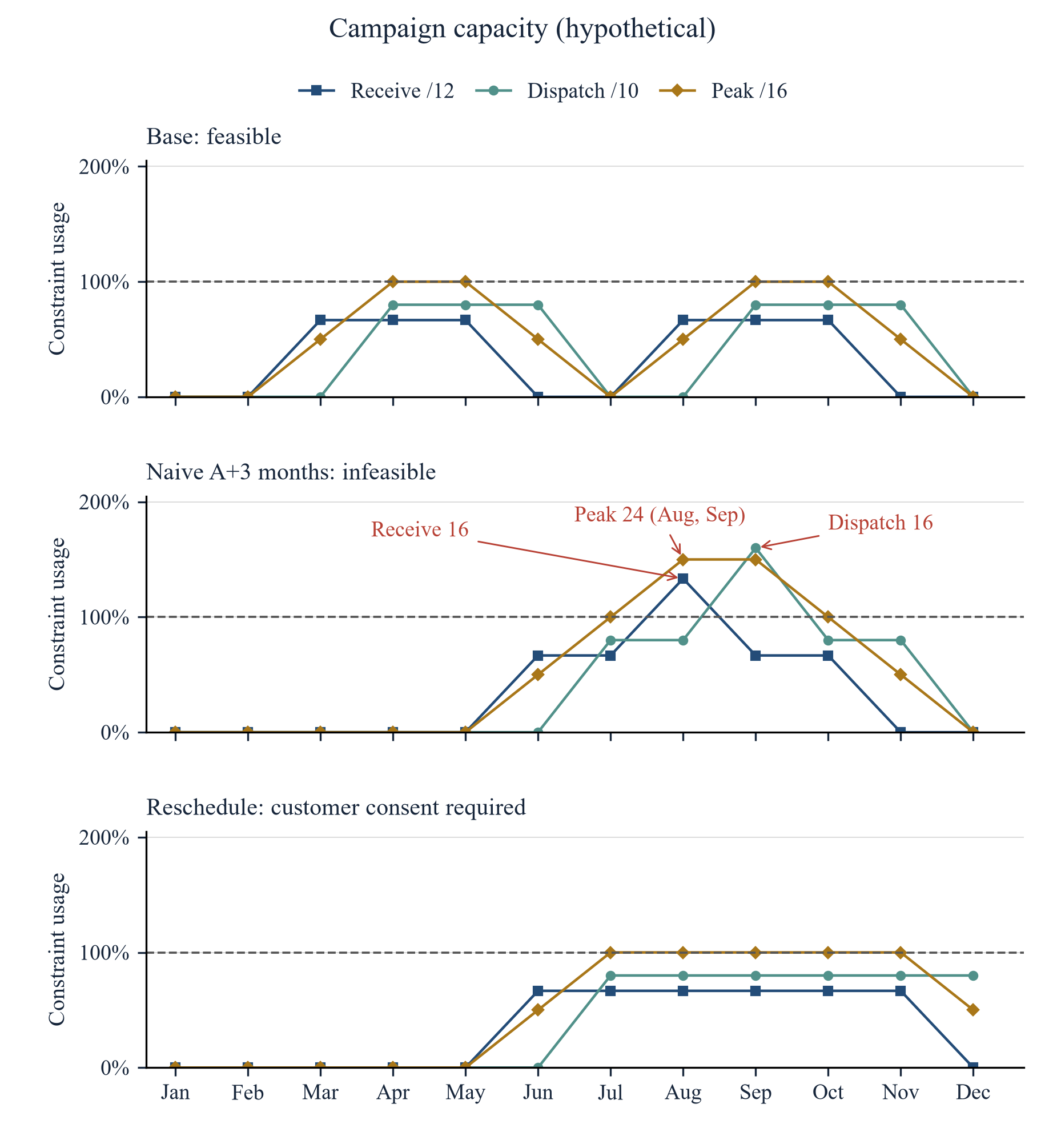
The base calendar receives customer A's components in March, April and May, with eight units arriving each month. A dispatches eight units in April, May and June. Customer B receives in August, September and October and dispatches in September, October and November. Each customer completes 24 units, giving 48 annually. All three capacity tests pass, with peak storage of 16 units.
A three-month delay to A moves its receiving months to June through August and dispatch to July through September. Leaving B's original programme intact then creates an August arrival of 16 units, peak laydown of 24 and September dispatch of 16. Each exceeds a different limit. The combined schedule is rejected before any financial result is calculated from those movements.
Table 5. Calendar feasibility and the agreed rescheduling case
| Calendar | Peak arrivals | Peak laydown | Peak dispatch | Treatment |
|---|---|---|---|---|
| Base A and B programme | 8 | 16 | 8 | Feasible under the authored limits |
| A delayed three months with B unchanged | 16 | 24 | 16 | Infeasible; excluded from finance calculations |
| A delayed and B moved to October to December dispatch | 8 | 16 | 8 | Feasible with assumed customer consent |
Both customers' written consent is assumed solely for the revised scenario. Actual contractual permissions and compensation terms remain unknown.
In the consented case, A receives in June through August and dispatches in July through September. B receives in September through November and dispatches in October through December. The revised sequence fits the assumed facilities. B's last eight units move one month beyond its original November longstop. At an expressly hypothetical compensation rate of EUR 0.03m per delayed unit-month, the economic charge is EUR 0.24m.
The compensation is deducted in the first-year accrued economic comparison. Its payment date has not been assumed, so it is excluded from the separate base and collection-delay monthly cash cases. The model makes no claim that a port can unilaterally impose the revised programme or this remedy. A transaction would need the customer's written acceptance, any affected vessel or equipment changes and an agreed date for payment. The calendar exposes the negotiation required to preserve usable capacity.
View figure at full size; scroll horizontally on smaller screens.
Authored hypothetical 2028 campaigns. Receiving, dispatch and peak laydown are expressed as percentages of their respective limits of 12, 10 and 16 turbine-equivalent units. Above 100% breaches the relevant limit. The rescheduled case assumes customer consent; no earnings are assigned to the infeasible overlap.
13 Build operating cash available for debt service
Readiness revenue supports the terminal's fixed availability cost. Handling provides an incremental margin of EUR 0.12m per completed unit, calculated from the assumed EUR 0.20m price and EUR 0.08m variable cost. With 48 feasible movements, annual handling revenue is EUR 9.60m and its variable cost is EUR 3.84m. The contribution is EUR 5.76m.
Equation 2.
In this equation, F is readiness revenue, Q completed units, p the handling price, v variable cost, C fixed readiness cost, M maintenance and T the authored cash-tax allowance. The annual measure is accrued operating cash available for debt service, or CFADS, before collection timing. Agreed compensation is an additional deduction in the consented comparison. Section 16 separately reconciles accrual to dated receipts.
Table 6. Annual operating bridge for the feasible base programme
| Operating item | Readiness floor only | Base 48-unit programme |
|---|---|---|
| Readiness revenue | 14.40 | 14.40 |
| Handling revenue | 0.00 | 9.60 |
| Variable handling cost | 0.00 | 3.84 |
| Fixed readiness cost | 4.80 | 4.80 |
| Maintenance | 0.80 | 0.80 |
| Cash-tax allowance | 0.80 | 0.80 |
| Accrued CFADS | 8.00 | 13.76 |
EUR million. These are authored model calculations before trade-receivable movements and financing cash flows.
The floor-only case assumes the EUR 14.40m payment survives zero completed handling while the terminal remains ready. That assumption needs a contractual and credit basis in a real transaction. Readiness deductions, release rights, insolvency and disputed performance could reduce the collectible amount. The model therefore presents the EUR 8.00m as a conditional debt-sizing basis and tests its loss separately.
The consented rescheduling case has the same 48 completed units but deducts EUR 0.24m compensation, leaving EUR 13.52m accrued CFADS. A delayed programme can also move invoices across a year end. The same annual completed volume consequently does not establish the same dated liquidity or discounted value. Compensation, invoicing and actual collection belong in the relevant schedule rather than a general operating contingency.
14 Size senior debt against the assumed payment floor
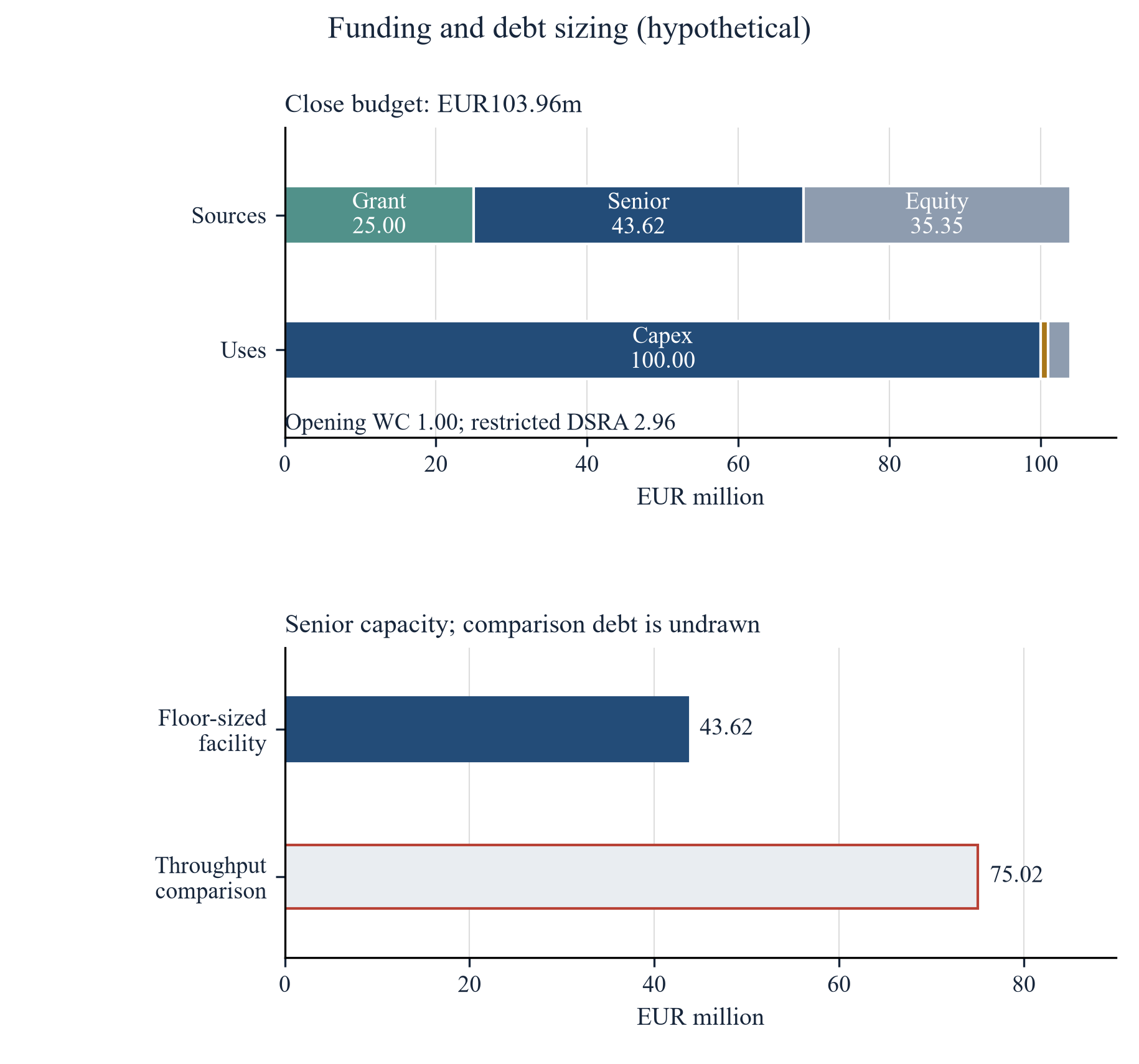
The senior facility is sized using floor-only CFADS of EUR 8.00m and a minimum annual debt-service coverage ratio of 1.35. Dividing these values gives maximum annual service of EUR 5.925926m. A ten-year level annuity at 6% then supports an initial loan of EUR 43.615331m. Interest is charged annually on opening principal and one payment is made each December.
Equation 3.
Here D0 is initial debt, k the minimum DSCR, r the annual interest rate and n the amortisation years. The annuity factor discounts the permitted annual service. The formula assumes the rate, payment dates, amortisation and floor remain as specified. Fees, construction interest, covenant definitions and lender haircuts require additional inputs before a binding facility could be assessed.
Table 7. Debt sizing and the throughput-dependent comparison
| Sizing basis | CFADS | Annual service at 1.35 DSCR | Ten-year loan at 6% |
|---|---|---|---|
| Readiness floor only | 8.000 | 5.926 | 43.615 |
| Floor plus all 48 handling units | 13.760 | 10.193 | 75.018 |
| Difference attributable to handling assumptions | 5.760 | 4.267 | 31.403 |
EUR million except ratios. The throughput-sized figure is a comparison only; it is excluded from the actual sources and uses.
The comparison identifies EUR 31.403m of apparent additional capacity attributable to the handling programme. Drawing that higher loan would require underwriting the additional receipts and their dependencies. The actual model retains the smaller floor-sized senior facility. This gives a transparent separation between the payment floor used for financing and operating upside accruing to the investment case.
Even the smaller loan remains exposed to payment-floor loss. A reserve can fund a temporary service obligation within its terms, while a recurring shortfall changes the ability to amortise. Debt sizing should therefore be accompanied by the credit cases in section 17 and a review of the obligors supporting the assumed floor. A DSCR produced by arithmetic supplies no evidence that the underlying contract is enforceable or that a lender accepts its risk.
15 Reconcile funding uses and restricted reserves
At close, the project funds EUR 100.00m capital expenditure, EUR 1.00m opening unrestricted working capital and EUR 2.962963m in a debt-service reserve account. The reserve equals half the EUR 5.925926m annual debt service. Total uses are EUR 103.962963m. The hypothetical grant contributes EUR 25.00m and senior debt EUR 43.615331m, leaving EUR 35.347632m equity.
Table 8. Closing sources and uses
| Use | Amount | Source | Amount |
|---|---|---|---|
| Capital expenditure | 100.000 | Upfront capital grant | 25.000 |
| Unrestricted working capital | 1.000 | Floor-sized senior loan | 43.615 |
| Restricted debt-service reserve | 2.963 | Sponsor equity | 35.348 |
| Total uses | 103.963 | Total sources | 103.963 |
EUR million, rounded to three decimals. Rounding may create a final decimal difference. Grant availability at close is assumed; the DSRA remains restricted.
The working-capital amount and reserve serve different purposes. The cash schedule starts with the EUR 1.00m unrestricted balance and does not draw on the DSRA. The reserve's existence therefore does not increase operating receipts or remove the need to test payment dates. Its actual permitted draws, replenishment obligations and release conditions would depend on the financing documents.
The assumed grant reduces the sponsor's funding requirement. It creates no operating revenue in CFADS and no borrowing capacity in the debt formula. An unavailable or late grant would change closing sources, construction liquidity or equity, with any bridge facility assessed on its own repayment conditions. The paper's operating model does not quantify that construction bridge and should not be used to imply one is available.
This treatment also limits valuation comparisons. The unlevered project DCF includes the grant as an upfront economic contribution but excludes senior loan receipts, debt service and reserve funding. An equity valuation would need the actual financing waterfall, distributions, reserve release and transaction costs. The sources-and-uses statement supplies the opening financing reconciliation, rather than an estimate of equity investment returns.
View figure at full size; scroll horizontally on smaller screens.
Authored hypothetical EUR million. Uses include EUR100 million capital expenditure, EUR1 million opening unrestricted cash and EUR2.963 million restricted DSRA. The EUR75.018 million throughput-sized amount is a comparison only and is not drawn. The grant is assumed available upfront.
16 Trace monthly invoices receivables and cash
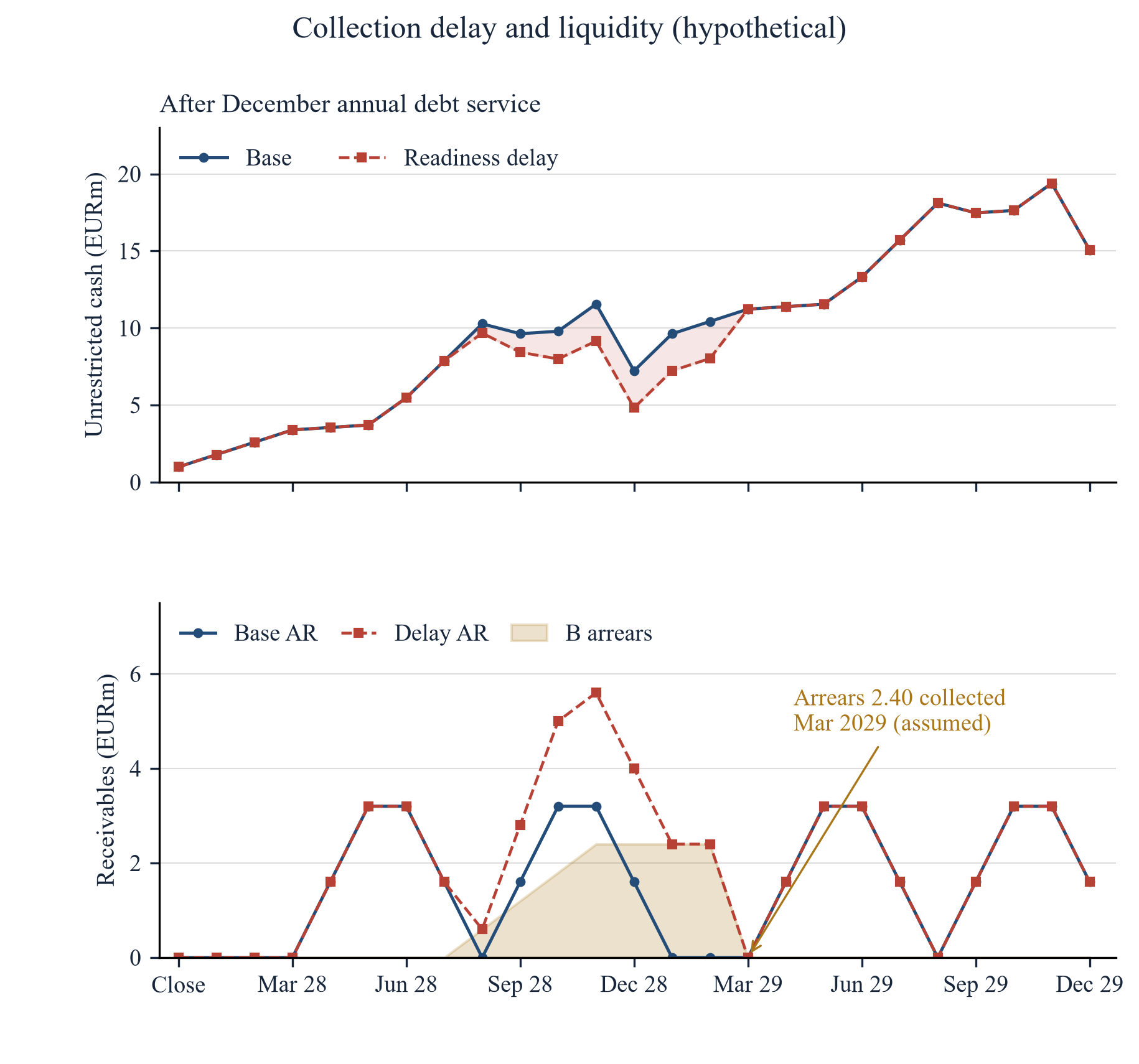
The cash ledger follows the base feasible calendar for 2028 and 2029. Readiness cash of EUR 1.20m is received each month while the terminal remains ready. Handling is invoiced at dispatch and collected exactly two calendar months later. Variable handling cost is paid in the dispatch month, fixed cost is EUR 0.40m monthly, maintenance is paid in September and the cash-tax allowance in December. The entire annual debt annuity is paid in December.
Equation 4.
The cash equation rolls forward unrestricted cash c from the previous month's balance. H represents cash receipts, O variable and fixed operating cash payments, M maintenance, T the authored cash-tax allowance and S scheduled senior debt service; subscript m identifies the month. Restricted reserves are excluded. Because eleven months have no scheduled senior payment, a monthly DSCR would be uninformative; the dated cash balance provides the relevant liquidity test under this payment convention.
Table 9. Cash conversion in the first two operating years
| Case and year | Accrued CFADS | Cash CFADS | Closing trade receivables |
|---|---|---|---|
| Base 2028 | 13.76 | 12.16 | 1.60 |
| Base 2029 | 13.76 | 13.76 | 1.60 |
| Four-invoice delay 2028 | 13.76 | 9.76 | 4.00 |
| Four-invoice delay 2029 | 13.76 | 16.16 | 1.60 |
EUR million. Readiness arrears arise only in the collection-delay scenario and are assumed fully recovered in March 2029. No recovery probability is estimated.
The base first year receives EUR 1.60m less than accrued CFADS because November handling is collected in January 2029. In the collection-delay case, B's four readiness invoices for August through November 2028, each EUR 0.60m, remain unpaid until March 2029. December 2028 readiness is collected normally. Handling retains its original two-month lag. The additional year-end receivable is EUR 2.40m.
The greatest cash difference from the base is EUR 2.40m between November 2028 and February 2029. At the modelled month ends, both cases remain positive without additional bridge funding. The initial unrestricted balance is EUR 1.00m; the minimum month-end balance is EUR 1.80m in January 2028. Intra-month receipt and payment sequencing is unspecified, so this calculation does not establish intra-month liquidity sufficiency. These results depend on December-only debt service and the specified receipt dates. A more frequent amortisation schedule or later recovery requires a new ledger. The calculation records liquidity erosion without asserting a month-end funding deficit that the dated balances do not show.
View figure at full size; scroll horizontally on smaller screens.
Authored hypothetical 2028-2029 cash path. Four EUR0.6 million readiness invoices are delayed and assumed fully collected in March 2029. Handling invoices are collected two months after dispatch. Senior service is paid each December; restricted DSRA is excluded. The test covers month-end balances only.
17 Separate temporary collection delay from permanent credit loss
The collection-delay case assumes full recovery of EUR 2.40m in March 2029. Its accrued annual operating result is unchanged, although cash moves between years. A permanent payment loss changes the recurring economics. The credit cases below therefore apply distinct operating assumptions and retain the same floor-sized loan for comparison.
Table 10. Annual credit stresses against the floor-sized senior facility
| Annual case | Completed units | CFADS EURm | DSCR |
|---|---|---|---|
| Contracted readiness floor only | 0 | 8.00 | 1.350 |
| Feasible base programme | 48 | 13.76 | 2.322 |
| Consented reschedule after compensation | 48 | 13.52 | 2.282 |
| Half readiness payments lost; handling retained | 48 | 6.56 | 1.107 |
| Half readiness payments lost; no handling | 0 | 0.80 | 0.135 |
| B cancelled; A's programme retained | 24 | 3.68 | 0.621 |
Hypothetical permanent operating cases, except the first-year compensation case. DSCR uses accrued annual CFADS divided by EUR 5.925926m service; the table does not imply annual cash collection.
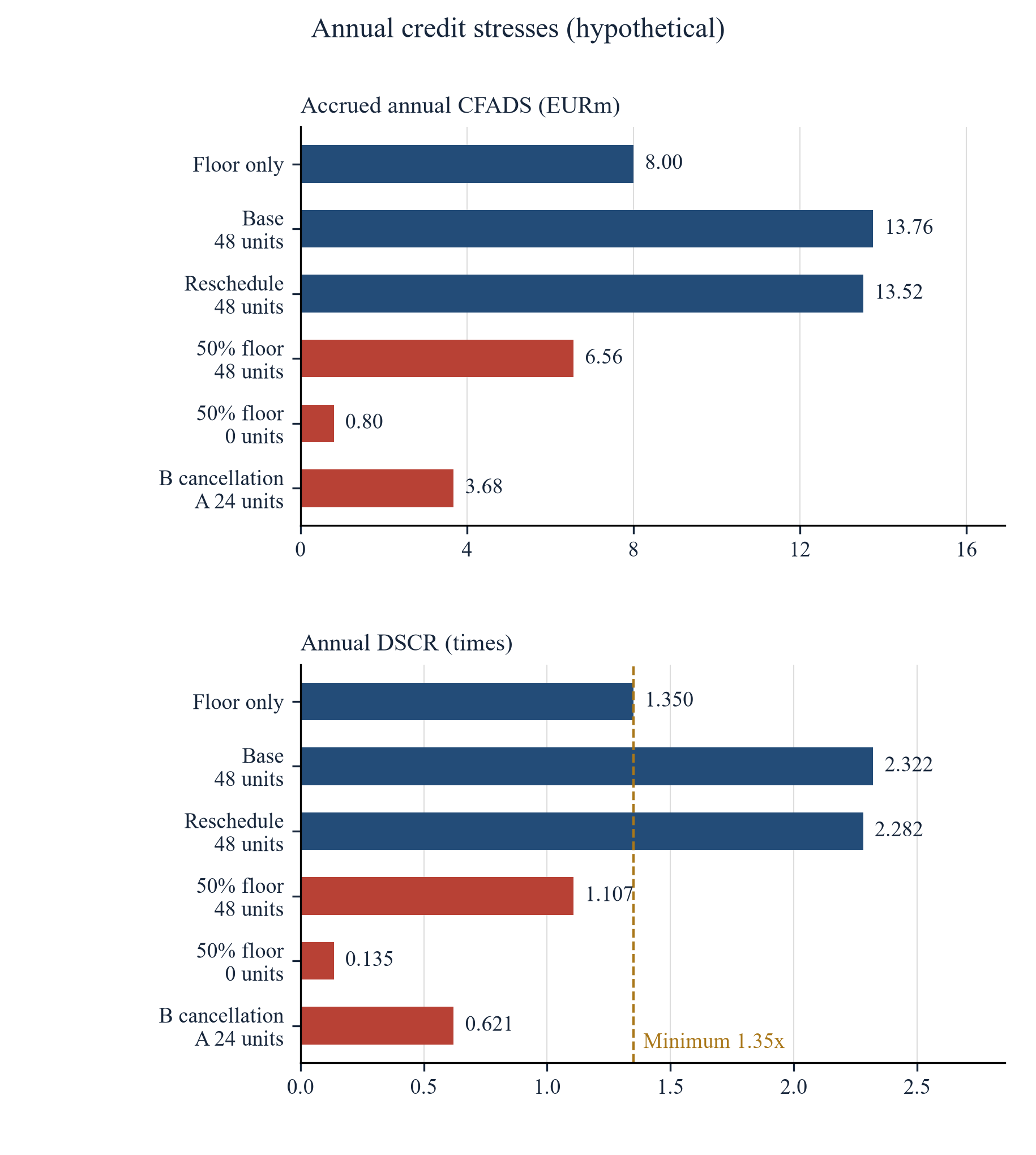
The half-floor case with all handling retained tests loss of payment while service continues. Its EUR 6.56m CFADS covers the EUR 5.925926m annuity but falls below the assumed 1.35 covenant. The floor-only version falls to EUR 0.80m. The separate B cancellation case removes B's EUR 7.20m readiness floor and 24 handling units, leaving EUR 3.68m. That case fails to cover scheduled annual service.
These cases identify different contractual questions. A payment dispute may leave actual movements intact; cancellation may remove both payments and variable contribution. A customer default may also create storage, termination and remarketing costs excluded from these simple calculations. The case definitions should therefore remain explicit when used in financing negotiations. Combining the favourable revenue assumptions from one stress with the cost assumptions from another would produce an unsupported credit result.
No empirical default frequency, recovery rate or insurance payout is assigned. A transaction-specific downside would require actual cancellation rights, guarantees, security, replacement demand and recovery timing. The calculations locate the exposure and quantify its effect under selected conditions; they do not estimate the probability that those conditions occur.
View figure at full size; scroll horizontally on smaller screens.
Authored hypothetical EUR million. The comparison separates baseline, consent compensation, permanent floor loss and customer cancellation. Annual debt service is EUR5.926 million; the assumed 1.35 coverage threshold requires EUR8 million CFADS. These annual cases are separate from the recoverable collection delay.
18 Discount collected project cash over its stated horizon
The primary valuation discounts actual unlevered operating receipts and payments for 120 months. The effective monthly discount rate is derived from an 8% annual rate. Initial investment is EUR 100.00m plus EUR 1.00m working capital, offset by the assumed EUR 25.00m grant. Working capital is returned in December of year ten. The final EUR 1.60m handling receivable from November of that year is collected in January of year eleven, month 121.
Equation 5.
In the equation, I0 is initial capital expenditure, G0 the upfront grant, W0 opening working capital, d the effective monthly discount rate and U the dated unlevered cash flow. U includes the working-capital return at month 120 and the final handling collection at month 121. It excludes debt receipts, debt service and the DSRA. Asset resale proceeds are zero by assumption; uncertain decommissioning expenditure is excluded and remains an appraisal limitation.
Table 11. Valuation results and timing conventions
| Valuation case | With upfront grant | Without grant |
|---|---|---|
| Actual monthly base cash | 19.311 | -5.689 |
| Actual monthly cash with the specified collection delay | 19.233 | -5.767 |
| Annual year-end timing benchmark | 16.794 | -8.206 |
EUR million at the authored 8% annual discount rate. None of the results is a valuation of a named port. The annual benchmark uses accrued year-end CFADS and is not the primary collected-cash measure.
The annual timing benchmark repeats EUR 13.76m accrued CFADS at each year end and returns EUR 1.00m working capital at year ten. Its NPV is EUR 16.794m with the grant. The actual monthly base is EUR 19.311m because its detailed timing differs. Early readiness collections, monthly operating payments, September maintenance and terminal receivable recovery are all explicitly dated in the primary case.
The one-off collection delay reduces primary NPV by EUR 0.078m under the assumed March recovery. Permanent customer loss would require a separate continuing cash forecast. Both reported base valuations are negative without the grant, making grant availability economically material in this authored case. A positive grant-supported NPV does not establish the legal availability of support, adequate customer credit or a financeable construction schedule. Those matters remain conditions for an actual investment decision.
19 Test the annual economics across volume and floor retention
The sensitivity varies completed units from zero to 48 and readiness-floor retention from zero to 100%. Fixed readiness cost, maintenance and the cash-tax allowance remain EUR 6.40m annually in total. Each completed unit contributes EUR 0.12m. These assumptions allow the reader to trace the effect of losing committed payments or completing fewer movements.
Table 12. Annual accrued CFADS sensitivity
| Completed units | 0% floor | 25% floor | 50% floor | 75% floor | 100% floor |
|---|---|---|---|---|---|
| 0 | -6.40 | -2.80 | 0.80 | 4.40 | 8.00 |
| 12 | -4.96 | -1.36 | 2.24 | 5.84 | 9.44 |
| 24 | -3.52 | 0.08 | 3.68 | 7.28 | 10.88 |
| 36 | -2.08 | 1.52 | 5.12 | 8.72 | 12.32 |
| 48 | -0.64 | 2.96 | 6.56 | 10.16 | 13.76 |
EUR million. Column percentages are retained shares of the EUR 14.40m readiness floor. Annual volume is a scalar assumption and does not demonstrate a feasible monthly calendar.
The 48-unit programme uses 40% of the simple annual dispatch limit of 120. That percentage measures only the ten-units-per-month integration limit. It leaves receiving peaks, land occupation, seasonality and customer rights unresolved. A calendar with 48 annual units can still be infeasible, as the overlapping scenario demonstrates. Each additional volume case needs the same monthly tests before its financial output can support commitment.
The NPV sensitivity figure uses the explicitly labelled annual timing benchmark to compare the same grid consistently. It is a screening tool for economic dependence on volume and readiness payments. The actual monthly DCF remains the primary base valuation. A selected point in the grid would require a corresponding dated receipts, cost and inventory schedule before it becomes an investable forecast.
Holding costs fixed also limits interpretation. A real terminal may change staffing, maintenance or configuration when activity declines. Such changes can have notice periods and implementation costs. The present sensitivity isolates the stated revenue exposures without crediting unverified savings or replacement customers. An investment appraisal should add supported cost responses as separate cases.
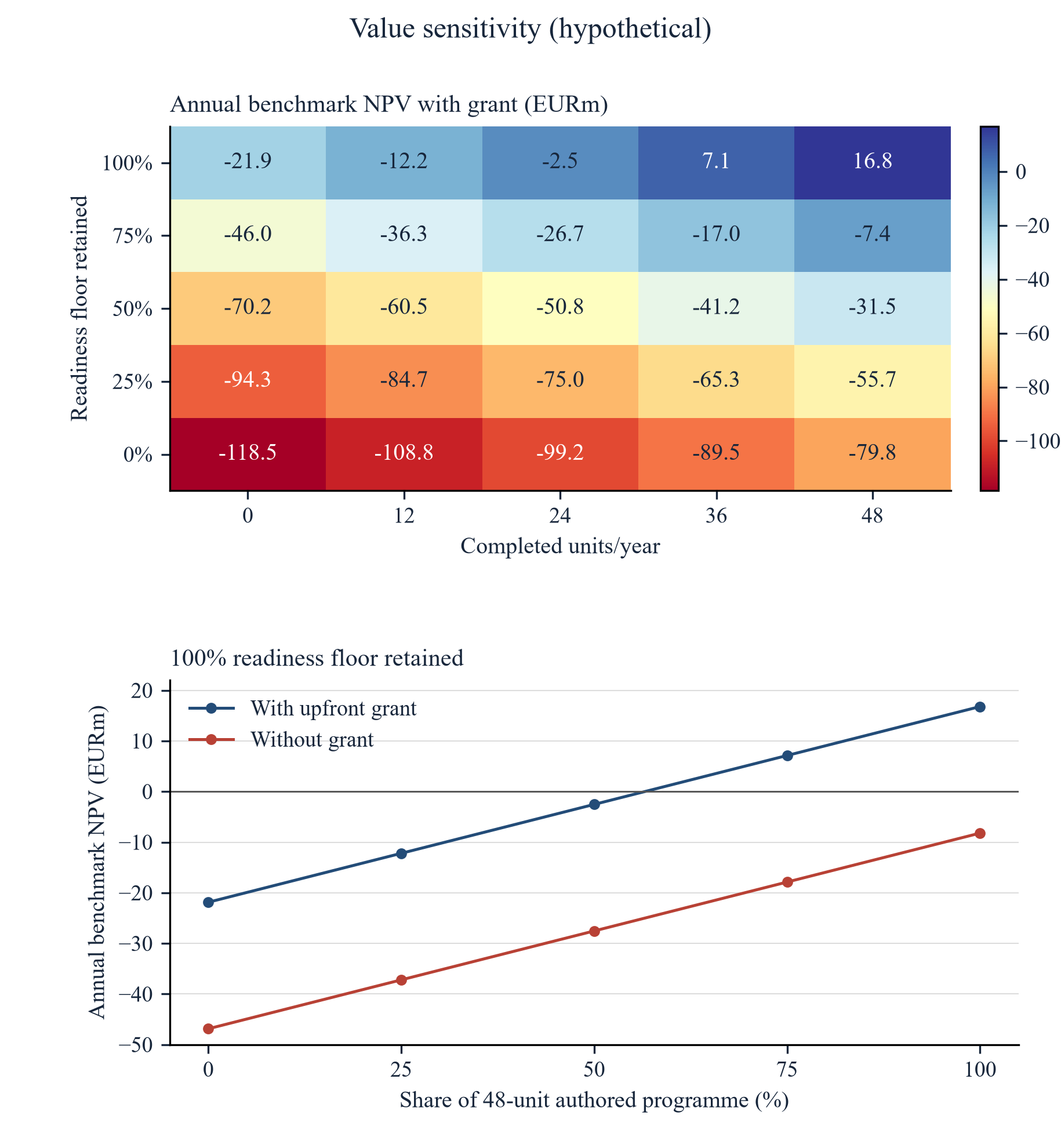
View figure at full size; scroll horizontally on smaller screens.
Authored hypothetical EUR million with the upfront EUR25 million grant. Annual accrued CFADS is discounted at 8% for ten years; working cash returns in year ten. This is the annual timing benchmark, not the primary monthly collected-cash valuation. Annual volume does not establish a feasible monthly calendar.
20 Convert model exposures into financing decisions
The model supports a sequence of transaction decisions. The customer programme first needs a feasible capacity calendar. The contract assessment then identifies which readiness payments remain payable under delay and whether their obligors can support them. Senior sizing uses the accepted payment basis, while the dated ledger tests collections against actual payment dates. Valuation records the same operating assumptions with a separate treatment of financing flows.
Table 13. Financing responses to distinct model exposures
| Exposure | Evidence needed | Decision to test |
|---|---|---|
| Campaign overlap | Engineer-reviewed movement plan and customer consent | Delay commitment or renegotiate slots |
| Conditional readiness floor | Executed payment and relief clauses; obligor assessment | Haircut qualifying receipts or reduce debt |
| Temporary collection delay | Invoice register and credible recovery timetable | Compare dated cash with permitted liquidity sources |
| Permanent customer cancellation | Termination rights and replacement demand evidence | Reforecast debt service and potential equity support |
| Conditional grant | Award and payment conditions; eligible-cost ledger | Establish closing availability or assess a separate bridge |
| Residual-value dependence | Transfer rights, condition and future-user evidence | Price reuse separately from contracted operating cash |
Proposed responses for diligence and negotiation. No actual lender acceptance, available product or executed protection is asserted.
For the authored collection delay, no new bridge is required because unrestricted cash stays positive. An actual facility could still require a minimum liquidity balance or an earlier debt payment. Those requirements need to be added explicitly before concluding that a funding plan is adequate. The DSRA is not treated as cash available for general terminal operations.
The permanent B cancellation case produces a recurring annual service deficit. A short-term reserve draw cannot by itself establish how that deficit is cured over the remaining loan term. The relevant assessment would address contract recovery, remarketing costs, supported replacement business, a revised repayment profile or fresh equity, each with its own timing and approvals. No such outcome is assumed here.
The main practical benefit is traceability. A reviewer can identify the receipt or operating assumption that creates each borrowing or value result and ask for the corresponding evidence. This supports a bounded commitment decision: expenditure may proceed only to the level consistent with the rights, funding conditions and risks accepted by the decision maker. The model's explicit exclusions remain part of that decision.
21 Value adaptable design within documented reuse rights
The proposed design assessment should identify which infrastructure remains useful after the initial wind campaign. Relevant questions include the permitted operating uses, access arrangements, engineering specification and cost of changing the layout. A quay, assembly area and specialist fixture may have different reuse possibilities. Those possibilities would be tested against actual user requirements and site rights before they enter an investment valuation.
For a hypothetical terminal, adaptable design could involve reserving space for a different handling arrangement or separating removable equipment from permanent civil works. The proposed appraisal would price the additional initial expenditure and the later conversion cost. It would identify the condition under which another use becomes available and the party responsible for obtaining approval. An unpriced possibility of reuse would remain outside the contracted cash case.
Terminal value also requires a legal endpoint. The proposed review would compare the valuation horizon with the concession or lease term, renewal conditions and handback obligations. Cash attributed to a sale or refinancing would require an assumption about transferability, buyer demand, required capital expenditure and consent. The model would disclose that assumption separately from cash already contracted during the initial operating period.
A conservative transaction appraisal could examine a case with no sale proceeds, alongside a separately supported reuse case. The difference would show how much value depends on the assumed endpoint. Costs for restoration, removal, maintenance backlog and release of security would be treated on their own dates where the documents require them. The paper verifies no terminal sale price or renewal entitlement for a named port. Its proposed method asks the investor to connect residual value to rights, physical condition and an evidenced route to future income.
22 Carry environmental, community and dual-use duties into operations
The named EIB programmes include objectives beyond offshore wind. The Esbjerg project description combines channel and terminal investment with coastal protection and civil and military use. [12] EIB's 15 September 2026 Klaipėda announcement describes a wider package covering military mobility, shore power, hydrogen, vessels and maritime works alongside offshore-wind quays. [15] These disclosed scopes limit the amount of finance or economic benefit that can be attributed solely to wind infrastructure.
The proposed environmental review would connect each permitted activity to its construction and operating conditions. It would record the applicable assessments, dredging permissions, disposal arrangements, working windows and monitoring obligations. Project advisers would identify the governing jurisdiction and the authority responsible for each approval. The paper supplies no conclusion that a particular design or operating pattern satisfies those requirements.
Community commitments would also have a cash and delivery boundary. Proposed diligence would examine land access, traffic arrangements, consultation obligations and any employment or training commitments included in the actual agreements. Where a requirement affects construction sequence, expenditure or operating hours, its effect would appear in the model. Public statements about anticipated jobs would remain attributed expectations until supported by measured outcomes.
Dual-use infrastructure needs an operating assessment tailored to the relevant rights. The proposed review would ask whether public or military requirements can change access priority, security procedures or the availability of a booked facility. It would examine compensation and alternative arrangements only where the applicable documents provide them. No such priority or compensation terms are established here. The investment case would identify the remaining exposure and its responsible party before relying on uninterrupted customer access.
23 Close against an integrated evidence package
The proposed closing package should allow a reviewer to trace each material receipt and expenditure to a right, obligation or stated assumption. Asset ownership, land access, permits, works contracts, customer commitments, public funding and loan documents would be reconciled to the same project perimeter. Each document would identify its parties, effective date, conditions and dependencies on the remaining agreements.
Technical and commercial acceptance would be reviewed together. The proposed lender or investor checklist would connect the contracted terminal service to the engineer's specification, completion tests and maintenance plan. It would then connect the customer's payment obligation to its reservations, usage rights, relief events and credit support. Any exposure left with the terminal company would appear in the construction or operating stress, with an identified funding response.
The sources-and-uses statement would distinguish subscribed equity, available loan proceeds, conditional grants and receipts dependent on future service. A dated cash ledger would test expenditure before customer operations, delays in eligible claims and cash restricted for reserves or collateral. Financing conditions would address the evidence needed before a source becomes usable. The paper establishes no numerical borrowing capacity from a programme announcement or a public project signature alone.
A final legal review would address the required consents, security rights, assignment, termination, dispute process and concession handback. The investment decision would state which matters are satisfied, which remain conditions to commitment and how much expenditure can proceed while they remain open. The proposed approach gives each unresolved item a direct financing consequence. It leaves unknown tenor, pricing, security, actual drawdowns and tenant cancellation terms as unknown until the transaction evidence supports a conclusion.
Table 14. Proposed risk allocation and closing evidence
| Risk | Proposed responsible party to assess | Closing evidence |
|---|---|---|
| Civil and marine completion | Works contractor and terminal sponsor | Integrated tests, exclusions and funded contingency |
| Shared access and common infrastructure | Port authority and terminal operator | Operating rights, outage rules and maintenance allocation |
| Campaign rescheduling | Affected customers and terminal operator | Consents, revised slots and dated compensation |
| Customer payment | Customer obligor and any credit-support provider | Executed clauses, enforceability and credit evidence |
| Grant eligibility and payment | Award recipient and relevant grant authority | Eligible-cost ledger, claims and funding conditions |
| Handback and residual obligations | Concessionaire and asset owner | Condition standard, restoration scope and funded provision |
Transaction-design questions; the paper establishes no executed allocation or financing protection for a named port.
24 Conclusions and limits of the appraisal
An offshore-wind terminal investment needs a physically feasible programme and a documented route from service obligations to collected cash. In the authored case, a three-month delay creates a receiving, storage and dispatch conflict even though annual volume is unchanged. An agreed reschedule restores feasibility and creates a separate compensation cost. That sequence identifies the customer decisions required before preserving handling revenue in the financial case.
The hypothetical readiness floor supports EUR 43.615m senior debt under the assumed ten-year, 6% annuity and 1.35 annual DSCR. The collection-delay case reduces available month-end cash by EUR 2.40m without creating an additional month-end bridge requirement. Permanent cancellation of customer B reduces annual accrued CFADS to EUR 3.68m, below scheduled debt service. These results depend on different operating and credit assumptions and should remain separate in a transaction assessment.
The primary monthly project NPV is EUR 19.311m with the assumed upfront grant and negative EUR 5.689m without it. The grant's legal and cash availability is therefore material in this example. The public financing records reviewed here establish dated programmes and commitments; actual borrower covenants, disbursement histories, tenant rights and recovery terms remain unavailable. They cannot calibrate those hypothetical values.
The analysis excludes engineering certification, construction financing, inflation, jurisdiction-specific taxation and uncertain decommissioning expenditure. Its liquidity calculation is monthly and does not establish intra-month sufficiency. Further work requires transaction documents, an engineer-reviewed schedule and dated payment evidence. Until that material exists, the model offers a reproducible set of financing questions and conditional calculations, with no conclusion that a named port is financeable at the illustrated terms.
References
- U.S. Department of Energy. Study Identifies Needs and Opportunities for West Coast Ports to Support Floating Offshore Wind Energy. 2023-09-26. https://www.energy.gov/cmei/systems/articles/study-identifies-needs-and-opportunities-west-coast-ports-support-floating Accessed 11 October 2026.
- Shields et al.; National Renewable Energy Laboratory. The Impacts of Developing a Port Network for Floating Offshore Wind Energy on the West Coast of the United States. 2023-09. NREL/TP-5000-86864, executive summary pp. vi-vii (physical PDF pages 6-7). https://docs.nlr.gov/docs/fy23osti/86864.pdf Accessed 11 October 2026.
- The Crown Estate. Boost for UK offshore wind supply chain with £400m investment from The Crown Estate. 2025-06-17. https://www.thecrownestate.co.uk/news/boost-for-uk-offshore-wind-supply-chain-with-400m-investment-from-the-crown-estate Accessed 11 October 2026.
- The Crown Estate. Powering Offshore Wind. 2025-06-30. Pages 7-8. https://www.datocms-assets.com/136653/1751987216-powering-offshore-wind-30-jun-25.pdf Accessed 11 October 2026.
- The Crown Estate. Offshore wind supply chain and port infrastructure set for £15m boost through The Crown Estate’s Supply Chain Accelerator. 2025-04-02. https://www.thecrownestate.co.uk/news/offshore-wind-supply-chain-and-port-infrastructure-set-for-15m-boost-through-supply-chain-accelerator Accessed 11 October 2026.
- The Crown Estate. Supply Chain Accelerator. undated. https://www.thecrownestate.co.uk/our-business/marine/supply-chain-accelerator-fund Accessed 11 October 2026.
- UK Government. Floating Offshore Wind Manufacturing Investment Scheme - example grant terms and conditions. undated. Published example terms, paragraphs 4.4-4.8, 4.10-4.11 and 6.2.5. https://assets.publishing.service.gov.uk/media/66c5c11ecbe60889bddd278e/flowmis-example-grant-offer-letter-terms-conditions.pdf Accessed 11 October 2026.
- UK Government. Floating Offshore Wind Manufacturing Investment Scheme (closed to applications). 2023-06-14. First published 30 March 2023; updated 14 June 2023. https://www.gov.uk/government/publications/floating-offshore-wind-manufacturing-investment-scheme Accessed 11 October 2026.
- Department for Energy Security and Net Zero. Government unlocks floating offshore wind with major investment for Scottish port. 2025-03-05. https://www.gov.uk/government/news/government-unlocks-floating-offshore-wind-with-major-investment-for-scottish-port Accessed 11 October 2026.
- Department for Energy Security and Net Zero. £64 million for Port Talbot offshore wind hub in the Celtic Sea. 2026-03-26. https://www.gov.uk/government/news/64-million-for-port-talbot-offshore-wind-hub-in-the-celtic-sea Accessed 11 October 2026.
- Competition and Markets Authority. Referral of the proposed subsidy to Associated British Ports by the Department for Energy Security and Net Zero. 2026-05-18. First published 7 April 2026; final advisory report published 18 May 2026. https://www.gov.uk/cma-cases/referral-of-the-proposed-subsidy-to-associated-british-ports-by-the-department-for-energy-security-and-net-zero Accessed 11 October 2026.
- European Investment Bank. ESBJERG PORT EXPANSION. 2023-08-08. Project 20220762; signatures recorded on 20 June 2024 and 6 June 2025. https://www.eib.org/en/projects/all/20220762 Accessed 11 October 2026.
- European Investment Bank. EIB bolsters EU defence with support for Danish seaport expansion. 2024-06-25. https://www.eib.org/en/press/all/2024-218-eib-bolsters-eu-defence-with-support-for-danish-seaport-expansion Accessed 11 October 2026.
- European Investment Bank. KLAIPEDA GREEN ENERGY PORT. 2026-02-24. Project 20250497; signature recorded on 8 July 2026. https://www.eib.org/en/projects/all/20250497 Accessed 11 October 2026.
- European Investment Bank. Lithuania: EIB helps transform port of Klaipėda into defence and clean-energy hub with €100 million in financing. 2026-09-15. https://www.eib.org/en/press/all/2026-293-eib-helps-transform-lithuania-s-port-of-klaipeda-into-defence-and-clean-energy-hub-with-eur100-million-in-financing Accessed 11 October 2026.
- U.S. Department of the Interior. Interior and TotalEnergies Agree to End Offshore Wind Projects, Lowering Costs for American Families. 2026-03-23. Page last edited 15 April 2026; announced conditional agreement. https://www.doi.gov/pressreleases/interior-and-totalenergies-agree-end-offshore-wind-projects-lowering-costs-american Accessed 11 October 2026.
- World Bank PPP Resource Center. Public Private Partnerships in Ports / Port Reform. undated. https://ppp.worldbank.org/sector/transportation/ports Accessed 11 October 2026.
About the Author
Chennakeshav (CK) is a corporate finance and investment banking executive with 25+ years of global experience in deal origination, structuring and execution across M&A, growth capital and corporate strategy. He has led value-creation mandates for founders, corporates and funds — bridging the boardroom view to hands-on execution and close.
His career spans Morgan Stanley, HSBC, Lloyds Banking Group, EWEC, ADQ portfolio companies and Emirates Growth Fund, across TMT, real estate, fintech, deeptech, cleantech, infrastructure and energy. He has partnered with C-suite leaders, private equity and venture funds, sovereign wealth funds and family offices to finance complex fund raises and scale-up ventures, and has led M&A due diligence, post-merger integration and business-transformation initiatives to create value.
At Matchpoint Partners he is Managing Partner, leading the firm's corporate finance, M&A and capital-raising practice. He holds an MBA from London Business School, an engineering degree from VTU and a Master of Laws (LLM, in progress) from UCL London.
An active start-up mentor, CK mentors at Techstars, DIFC FinTech Hive, Startup Grind, Founder Institute and IN5, serves as Entrepreneur Mentor in Residence (EMiR) at London Business School, and judges the Entrepreneurship World Cup.
https://www.linkedin.com/in/ckadya/
https://www.matchpoint-partners.com/team/ck-adya.html
Disclaimer
This paper is part of a continuing series on the structure of private and alternative markets. The views expressed are the author's own. The paper is for information only, describes market structure in general terms, and does not constitute investment, legal, tax or regulatory advice or a recommendation in respect of any security, vehicle or counterparty.
