
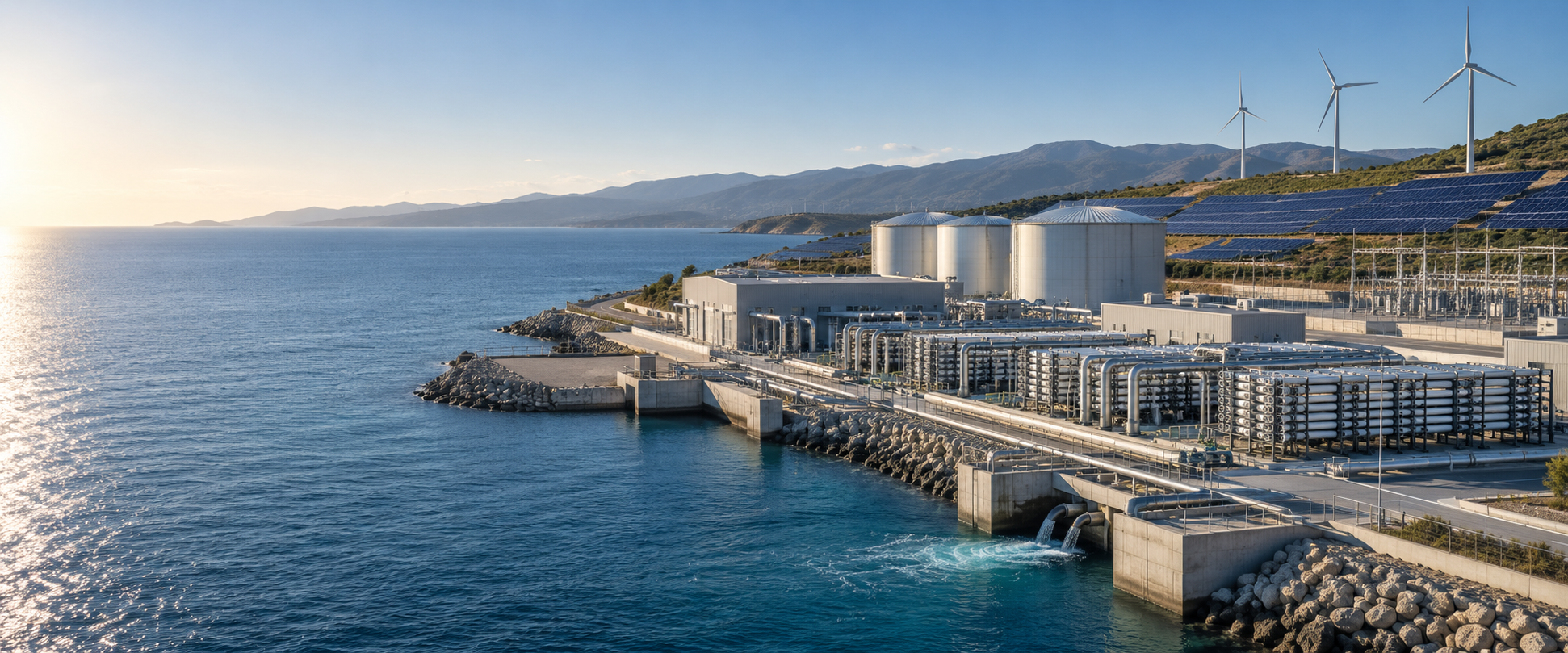
1. The financing question
Renewable desalination joins two systems with different clocks. Solar and wind output follows weather. A water network requires safe water at specified pressure, quality and volume every day. The financing question is therefore how a project can convert variable electricity into a contracted water service without assigning unmanageable risk to the project company.
The answer begins at the delivery meter. Sponsors, offtakers and lenders need an agreed product, operating envelope and payment mechanism. The project should state which party supplies electricity, which party bears grid-price exposure, how storage is dispatched, how water shortfall is measured and which events excuse performance. Technology selection follows that commercial definition.
2. Why reverse osmosis changes the integration problem
Reverse osmosis uses electric pumps to create pressure across membranes. It can be paired directly with renewable electricity or supplied through a grid that increasingly contains renewable generation. IRENA identifies both routes in its desalination work: co-located renewable supply and renewable electricity delivered through the wider power system [1][2].
RO also offers operating flexibility unavailable in many thermal desalination configurations. Pumps and trains can be scheduled within equipment limits, and finished water can be stored more cheaply than electricity in many locations. Flexibility is constrained by membrane fouling, pressure cycling, intake conditions, minimum train loading, chemical systems and the water network's required delivery profile.
3. The delivery obligation
A bankable contract needs a precise delivery point and specification. Daily water volume alone is insufficient. The agreement should define hourly or daily nominations, potable-water quality, pressure, metering, testing, rejected water, permitted outages, storage responsibility and the relationship between availability and delivered volume.
The project company should be accountable for outcomes it can control. A shortfall caused by its plant should be treated differently from a shortfall caused by an offtaker grid interruption, a change in feedwater outside the agreed envelope or an instructed curtailment. These distinctions determine revenue stability, liquidated damages and debt-service resilience.
4. Evidence from operating procurement models
Large desalination projects already use long-tenor offtake structures. ACWA Power states that the Umm Al Quwain IWP has a 35-year water purchase agreement with a sole offtaker and was financed by local and international lenders [3]. Its Jubail 3A disclosure describes limited-recourse, ring-fenced project financing following a water purchase agreement [4].
These examples show that water revenue can support project debt. They do not establish that every renewable-desalination structure is financeable. Lenders still need project-specific credit support, construction protections, operating evidence, tariff sufficiency and a workable allocation of power risk.
5. Renewable integration routes
The first route is grid-connected RO with a renewable-power purchase agreement, certificates or system-level renewable allocation. The grid supplies firmness, while the project contracts the environmental attributes and price structure. This route reduces physical integration risk but can retain basis, congestion, change-in-law and grid-price exposure.
The second route is co-located renewable generation. It can reduce purchased energy and demonstrate direct integration. It introduces land, interconnection, resource, curtailment and balancing questions. A hybrid combines co-located generation, a grid connection and storage. The project should compare these routes on total delivered-water cost, availability and risk, rather than on renewable nameplate capacity.
6. System boundary
The financing model should include intake, pretreatment, high-pressure pumps, membranes, energy recovery, post-treatment, product-water storage, discharge, renewable generation, grid interface, batteries and water delivery. Leaving one system outside the model can transfer cost without reducing it.
The boundary also determines performance tests. A low specific electricity consumption at the membrane skid does not prove a low delivered-water cost if pretreatment, pumping, storage and discharge loads are excluded. The lender model should use metered net electricity and delivered compliant water at the contractual boundary.
7. The integrated system map
The system map connects electricity sources, conversion assets, storage and water obligations. It should show which flows are controlled by the project company and which depend on external parties.
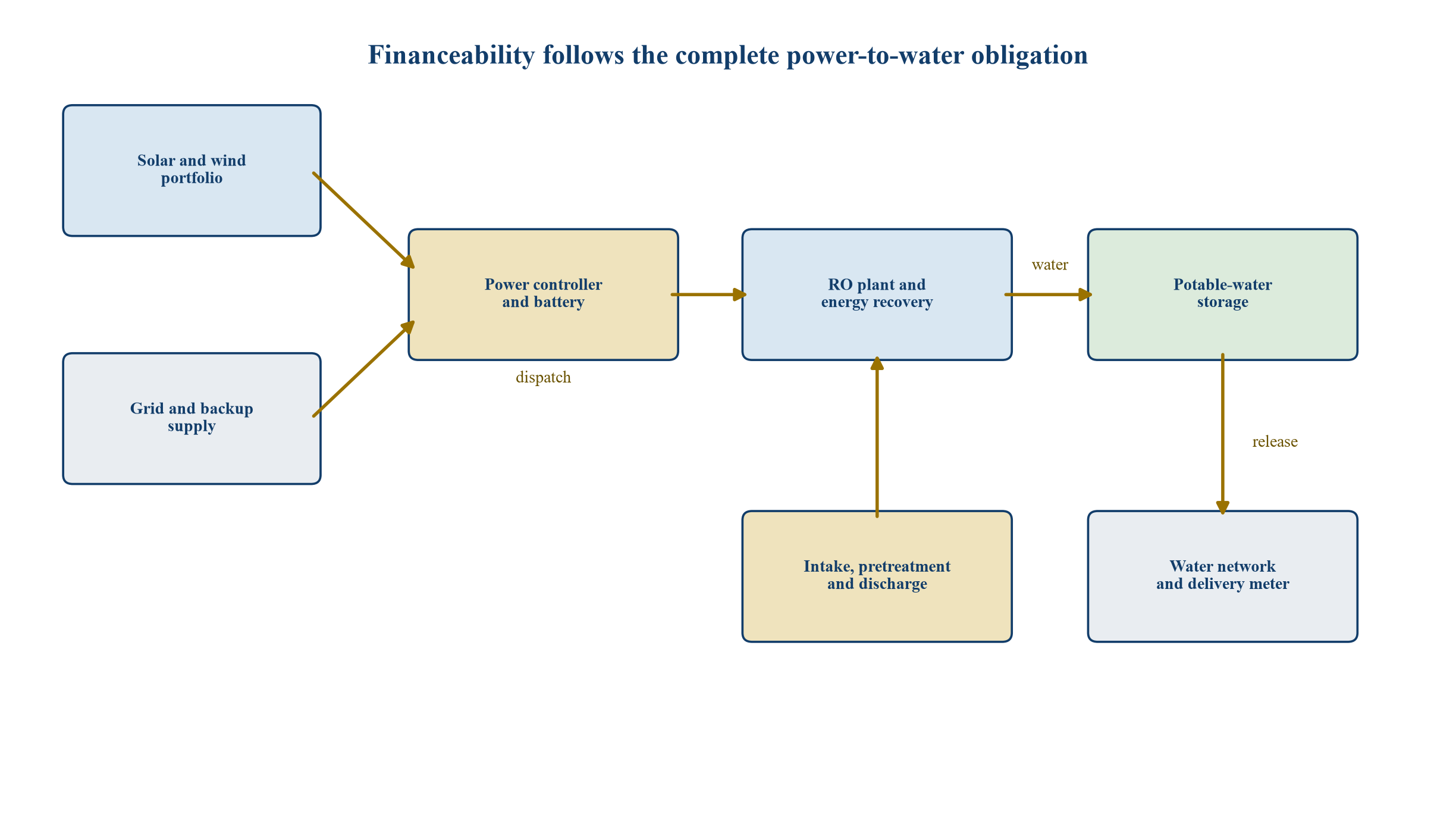
Generic architecture; actual interfaces depend on site, grid, technology and water-network design.
8. Water storage as operational flexibility
Finished-water storage shifts production from windy or sunny hours to the network's delivery schedule. It can absorb short renewable deficits, planned cleaning and part of a plant outage. Its economic value depends on tank cost, land, water-quality management, pumping and the duration of the delivery obligation.
Storage sizing should begin with a time-series model. The model needs renewable generation, plant turndown, membrane recovery, network demand, grid availability and planned outages. A simple average-day calculation can hide consecutive low-renewable periods and seasonal water peaks.
9. Battery storage
Batteries can smooth ramps, protect process controls, reduce demand charges and move electricity across hours. They are useful for high-value, short-duration services. Their cost, degradation and replacement schedule should be compared with water storage, grid capacity and operational flexibility.
The battery should not be sized from renewable nameplate alone. It should respond to a defined service: ride-through, ramp management, peak shaving, renewable capture or islanded operation. Each service has a different power, energy and cycling requirement. The financing documents should state who controls dispatch and receives ancillary-service revenue.
10. The grid as a balancing asset
A grid connection can provide the lowest-cost firmness where capacity is reliable and tariffs are manageable. It can also create exposure to connection delays, congestion, demand charges, time-of-use prices, curtailment and carbon intensity. The project should model the grid as a contracted balancing service.
If the offtaker supplies power, the water tariff can exclude some energy-price risk. If the project buys power, the water tariff needs indexation or a hedging mechanism. A fixed water tariff combined with floating power cost can create an unbounded mismatch.
11. Renewable resource risk
Resource studies should use site-specific solar irradiation or wind data and quantify interannual variation, forecast error, degradation and curtailment. A high average capacity factor does not prove that generation coincides with the plant's flexible hours.
The project should disclose the P50 and downside energy cases, the correlation between renewable output and water demand, and the effect of consecutive low-resource days. Lenders can then size debt against a conservative delivered-water case and require reserves for variability that remains with the project.
12. Membrane operating limits
RO plants can vary output, but repeated starts, stops and pressure changes can affect membrane life, fouling and chemical consumption. The operating envelope should be supported by supplier guarantees and pilot evidence where feedwater conditions are difficult.
The dispatch model should include minimum stable train loading, ramp rates, cleaning frequency, recovery ratio and restart losses. A model that treats every megawatt-hour as instantly convertible into water may overstate flexibility and understate operating cost.
13. Intake and pretreatment
Feedwater salinity, temperature, turbidity, algae and contaminants change plant performance. Pretreatment can be the constraint during adverse marine conditions. Intake and discharge permits can also determine construction schedule and operating limits.
The project should define the feedwater envelope and relief for conditions outside it. EPC and O&M contracts need consistent definitions. If the offtake agreement requires full water delivery during an excluded feedwater event, the project company can retain a gap that lenders will price.
14. Energy recovery
Modern RO plants use energy-recovery devices to reduce net electricity demand. Their efficiency and availability affect tariff and renewable sizing. Performance tests should measure the integrated plant, including auxiliary loads and degradation.
The financial model should use warranted initial performance and an ageing curve. Efficiency upside can support sponsor value, while debt service should rely on a prudent case. Replacement timing and spare strategy belong in lifecycle capital rather than a generic operating allowance.
15. Product definition and testing
Potable-water quality includes chemical and microbiological parameters, not simply salinity. Sampling, laboratory methods, frequency, dispute procedures and consequences of a failed test should be contractually aligned.
Rejected water may be reprocessed, blended or disposed of depending on the failure. The model should include lost output and incremental energy. Persistent non-compliance should trigger remediation and, at defined thresholds, termination rights. Lenders require cure periods that preserve public-health obligations.
16. Payment architecture
The payment mechanism should distinguish capacity or availability from delivered water. An availability component can support fixed costs and debt service when the plant is ready but the offtaker nominates less water. A volume component can cover variable electricity, chemicals and consumables.
Alternative structures include a take-or-pay water tariff, an availability payment plus variable charge, or a utility-supplied energy model. Each can work if definitions, indexation, deductions and credit support match the allocated risks.
Table 1. Renewable desalination payment and contract architecture
| Element | Commercial purpose | Financeability question | Typical control |
|---|---|---|---|
| Availability payment | Recover fixed cost and debt service | Is payment due when the plant is ready and offtaker demand is lower? | Tested available capacity and deemed availability |
| Volume payment | Recover variable operating cost | Does the formula track electricity, chemicals and disposal? | Metered compliant water at delivery point |
| Energy adjustment | Manage power-price exposure | Which index reflects the project's actual marginal cost? | Pass-through, collar or utility-supplied power |
| Renewable attribute | Evidence environmental claim | Who owns certificates and bears shortfall? | Defined registry, vintage and replacement rule |
| Performance deduction | Protect service quality | Are deductions proportionate and capped before default? | Agreed water, quality and availability metrics |
| Credit support | Protect revenue collection | Is the offtaker obligation backed by adequate security? | Guarantee, letter of credit, escrow or payment trust |
| Termination payment | Preserve lender recovery | Does compensation cover debt and defined equity outcomes? | Cause-specific formula and direct agreement |
Generic allocation framework; transaction documents and law determine enforceability.
17. Water purchase agreement tenor
Debt tenor should fit the offtake term, asset life and major replacement cycle. A long contract can amortise capital across a stable service period. It also increases exposure to index design, change in law and technology obsolescence.
The agreement should preserve enough tail after debt maturity for refinancing and downside recovery. Renewal options should be valued conservatively unless their exercise terms are clear. Handback standards and decommissioning obligations need funding before the final years.
18. Indexation
The tariff can contain local and foreign inflation, interest, electricity, labour, chemicals and membrane components. Excessive index complexity makes revenue hard to forecast. Insufficient indexation leaves the project exposed to costs it cannot control.
The index basket should follow the actual cost base and include floors, caps or reset mechanisms where appropriate. Foreign-currency debt and imported equipment require a currency strategy. Lenders will test whether index timing creates working-capital gaps.
19. Credit support
Water is essential, but essential demand does not automatically create creditworthy revenue. The offtaker's legal obligation, budget process, payment record and available security require review. Public-sector structures vary by jurisdiction.
World Bank materials on desalination PPPs illustrate the use of defined payment streams, concessions and payment-security arrangements [5][6]. A project should identify the entity that owes payment, the available guarantee or trust, cure periods and lender step-in rights.
20. Construction structure
The EPC contract should deliver an integrated plant with schedule, capacity, water-quality, energy and reliability guarantees. Split packages can improve competition but leave interface risk with the project company. A wrap can transfer more integration risk at a price.
Renewable generation, RO, marine works, storage and grid connection often have different contractors and critical paths. The schedule should identify the latest date at which each component must be available to preserve water-service testing and revenue commencement.
21. Completion tests
Completion should require sustained compliant water production, energy performance, reliability, storage operation and delivery at the contractual point. A short test under favourable conditions can miss seasonal feedwater and renewable variability.
Tests need agreed correction curves for temperature, salinity and resource conditions. Provisional acceptance can permit revenue while punch-list work continues. Debt conversion and distribution should wait for evidence that the integrated service meets the base-case assumptions.
22. Delay allocation
Delay can originate in permitting, marine works, grid connection, renewable interconnection, equipment supply or offtaker facilities. The contracts should align long-stop dates and relief events across these interfaces.
Liquidated damages should reflect debt service, lost revenue and replacement-water cost without creating an unenforceable penalty. Where an offtaker or authority causes delay, deemed completion or compensation can protect the project. Sponsors should avoid a schedule gap between EPC relief and offtake obligations.
23. O&M model
Long-term O&M can sit with a specialist operator under availability, quality and energy guarantees. The operator needs access to spares, membranes, chemicals, laboratories and trained staff. Interface with the renewable and battery operators must be explicit.
The O&M fee should distinguish fixed staffing from variable consumables. Performance incentives can reward low energy use and high recovery within water-quality and asset-life limits. Aggressive efficiency incentives should not encourage deferred maintenance.
24. Lifecycle capital
Membranes, pumps, energy-recovery devices, battery modules, inverters and marine assets have different replacement cycles. The model should schedule them individually and fund major-maintenance reserves.
An average annual allowance can conceal a large concentrated cash requirement. Debt-service coverage should be tested in replacement years. Warranty, insurance and supplier support can reduce exposure, while technology-specific parts may create concentration risk.
25. Market and operating benchmark
Public disclosures provide useful reference points, while project comparisons require care. Taweelah IWP's disclosed financing included a long tenor and an integrated photovoltaic facility [7]. IRENA reports show that RO can be paired with wind and solar and that water production can provide flexibility [1][2].
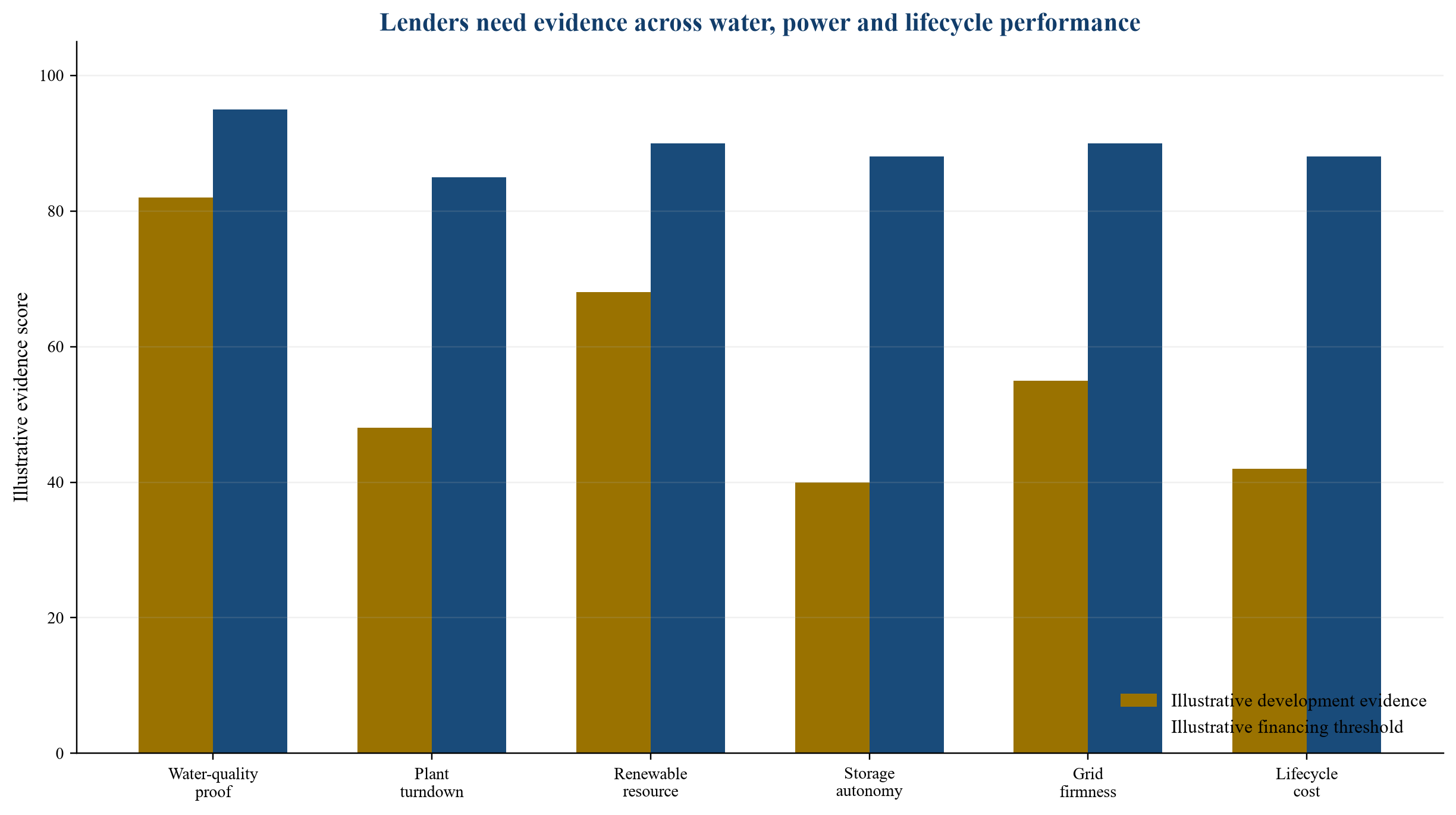
Hypothetical evidence scores for decision structure only; not ratings of named projects.
26. Capital structure
Construction finance typically combines sponsor equity, senior project debt and, where appropriate, bridge facilities or subordinated capital. Debt sizing should follow conservative water availability, tariff, operating cost and completion assumptions.
Limited recourse requires the project contracts to contain the risks that the project company cannot absorb. Equity should fund development, contingencies and uncovered risks. A high headline leverage ratio can weaken resilience if renewable or water-volume variability is under-modelled.
27. Interest-rate and refinancing risk
Long construction and operating periods create interest-rate exposure. Hedging can protect debt service, while hedge break costs affect termination payments and refinancing. The hedge profile should match expected drawdown and amortisation.
Refinancing may release value after completion and operating history. ACWA Power's disclosed Rabigh 3 refinancing shows that operating water assets can access a broader capital structure [8]. Future refinancing should remain an upside case until terms are available.
28. Sustainable finance
Renewable desalination can qualify for green or sustainability-labelled financing when use of proceeds, environmental objectives, reporting and external review meet applicable principles. Taweelah's disclosed sustainable-loan qualification combined efficient RO, monitoring and photovoltaic integration [7].
The label does not replace credit analysis. The project should define renewable-energy attribution, emissions methodology, water and brine metrics, and reporting responsibilities. A failure to meet a sustainability target may affect margin or reputation even when debt remains payable.
29. Environmental and social risk
Marine intake and brine discharge can affect ecosystems. Construction can affect fisheries, navigation, communities and coastal land. Environmental assessment, mitigation and monitoring are central to permits and lender standards.
The project should model energy use, chemical discharge, intake mortality, salinity dispersion and cumulative impacts. Renewable electricity reduces operating emissions but does not resolve marine impacts. Monitoring obligations need budget, governance and transparent escalation.
30. Brine and resource recovery
Brine concentration, discharge design and local circulation determine environmental performance. Resource recovery may create optional value from salts or minerals, but technical yield, purity, market, energy and permitting need proof.
The base case should fund compliant discharge without relying on speculative by-product revenue. A separate pilot or joint venture can preserve upside. Recent disclosed development work linking desalination and industrial salt shows the emerging commercial interest in integrated output [9].
31. Water demand risk
Municipal demand is usually stable, while nomination can vary seasonally. Industrial or tourism projects can face ramp-up and counterparty concentration. The water purchase agreement should identify minimum payments and nomination procedures.
If demand risk remains with the project, debt sizing needs a credible downside volume case and alternative customers or storage. A take-or-pay or availability structure can shift volume risk to the procurer that plans the network.
32. Replacement-water exposure
An unavailable plant may force the offtaker to buy or produce replacement water. Damages should reflect an agreed exposure and remain proportionate to project revenue and insurance. Unlimited replacement cost can make the project unfinanceable.
The contract can use capped damages, performance deductions, reserve requirements and termination thresholds. The public-service need is protected through contingency planning, while lenders retain a defined maximum downside.
33. Dispatch governance
Dispatch instructions can come from the grid operator, renewable optimiser, water offtaker or project controller. Conflicting instructions create operational and contractual risk. A hierarchy is required.
The operating protocol should specify water priority, battery reserve, grid-import limits, renewable curtailment and emergency actions. Metering data should be shared with the relevant parties. Revenue and costs from departures should follow the party issuing the instruction.
34. Data and forecasting
Weather, electricity prices, water demand, feedwater quality and plant condition can be forecast. Better forecasts can reduce reserve margins and improve dispatch. Their financial value depends on measurable improvements and operational integration.
Models should be validated against out-of-sample data and monitored for drift. Safety and water-quality constraints should remain hard limits. Data ownership, cybersecurity and operator override rights belong in the O&M and technology contracts.
35. Cybersecurity
The integrated plant connects process controls, renewable assets, batteries, meters and remote support. A cyber event can affect water safety and availability. Security design should separate critical controls, protect remote access and support recovery.
Lenders and offtakers should review governance, incident response, backups, supplier access and regulatory obligations. Insurance can cover part of the loss. It does not replace resilient architecture or operational drills.
36. Scenario model
The model should test renewable output, grid price, water demand, plant efficiency, storage, availability, interest rate and delay. Each variable should connect to an operational mechanism and a contractual response.
Table 2. Core capex and operating sensitivities
| Sensitivity | Operational transmission | Financial effect | Principal mitigation |
|---|---|---|---|
| Renewable output below plan | Higher grid import or lower production | Higher energy cost or lost volume | Resource downside, diversified supply and water storage |
| Grid price above plan | Higher marginal water cost | Lower operating cash flow | Pass-through, hedge, collar or utility-supplied energy |
| Specific energy use above warranty | More electricity per cubic metre | Lower margin and renewable coverage | EPC guarantee, performance damages and optimisation |
| Storage below required autonomy | Greater exposure to weather sequence | Higher shortfall risk | Time-series sizing and staged tank expansion |
| Completion delay | Later revenue and added interest | Lower equity return and liquidity pressure | Wrapped schedule, delay damages and contingency |
| Membrane life below plan | Earlier replacement and outage | Higher lifecycle capital | Supplier warranty, pretreatment and reserve account |
| Water nomination below plan | Lower variable sales | Revenue shortfall if volume risk retained | Availability payment or take-or-pay floor |
| Interest rate above plan | Higher debt service | Lower coverage and equity value | Hedge and conservative sizing |
Illustrative directions only; a project model requires site-specific values and executed contract terms.
37. Illustrative sensitivity bridge
Sensitivity analysis should show how technical and contractual choices affect equity value and debt coverage. The exhibit below uses hypothetical values solely to demonstrate the decision sequence.
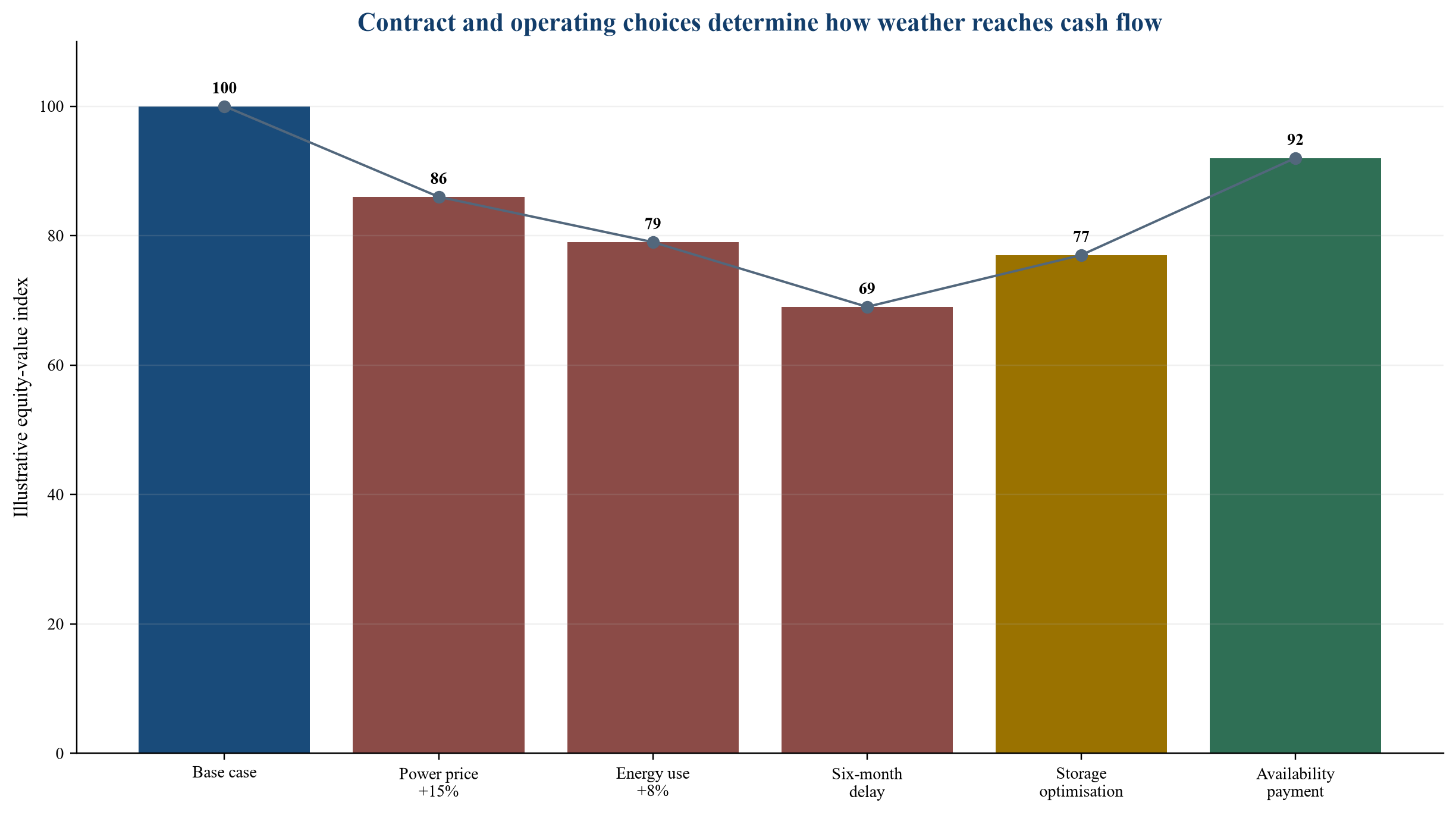
Hypothetical indices; not a tariff, valuation, forecast or description of a named project.
38. Debt sizing
Debt should be sized to a downside case that preserves coverage after power-cost, availability and lifecycle stresses. The lender case may use conservative renewable output, higher grid purchases, lower efficiency and delayed completion.
Coverage ratios should be examined monthly where seasonality matters. Annual averages can conceal a dry-season water peak or low-resource period. Reserve accounts and distribution locks should respond before a payment default.
39. Reserve accounts
Common reserves include debt service, major maintenance, working capital and, where appropriate, renewable or water shortfall. Each reserve should have a defined purpose, target, replenishment rule and release condition.
Large reserves can improve resilience while trapping equity. The project should compare cash reserves with letters of credit, guarantees and insurance. Reserve sizing should reflect the time needed to cure the underlying risk.
40. Insurance
Construction all-risk, delay-in-start-up, property damage, business interruption, marine, liability, environmental and cyber cover may be relevant. Availability, exclusions and deductibles vary by market.
The insurance adviser should test whether an insured event maps to the offtake obligation and debt service. Resource shortfall, ordinary equipment degradation and poor performance may remain uninsured. The model should not treat insurance as universal protection.
41. Risk allocation
Each risk should sit with the party able to control, price or absorb it. Political or utility risks may require public support. Construction and plant performance can be transferred through EPC and O&M contracts within negotiated caps. Weather risk can be shared through storage, grid access and tariff design.
Table 3. Renewable desalination risk-allocation and lender response
| Risk | Natural manager | Contract response | Lender evidence |
|---|---|---|---|
| Renewable variability | Project optimiser and power supplier | Resource case, balancing rights and curtailment rule | Time-series model and supply contracts |
| Grid interruption | Grid or procurer, subject to cause | Relief, deemed availability or backup obligation | Connection agreement and outage history |
| Plant performance | EPC contractor and operator | Energy, output and quality guarantees | Tested design, damages and security |
| Water demand | Network planner or customer | Availability payment or take-or-pay | Demand plan and offtaker credit |
| Feedwater outside envelope | Procurer and project under defined cause | Relief and testing protocol | Baseline marine data and monitor |
| Environmental compliance | Project company with authority interface | Permit covenant and change-in-law relief | Approved assessment and monitoring plan |
| Change in law | Public procurer or shared | Tariff adjustment or termination | Legal opinion and compensation formula |
| Counterparty payment | Offtaker and support provider | Guarantee, escrow or payment trust | Credit analysis and direct agreement |
| Force majeure | Shared according to insurability | Time relief, cost sharing and long-stop | Insurance and termination regime |
Generic framework; actual allocation requires project-specific legal, technical and credit review.
42. Procurement strategy
The procurer should define service outcomes while allowing bidders to optimise renewable mix, storage and grid use. Over-prescribing technology can reduce competition and freeze an immature design. Under-specifying water and environmental outcomes can create disputes.
Bid evaluation should compare levelised water cost, tariff robustness, guaranteed performance, financing, environmental impact and deliverability. A low initial tariff supported by aggressive power or storage assumptions can produce later renegotiation.
43. Bid comparability
Bidders may assume different electricity prices, renewable profiles, grid charges, storage lives and water nominations. The procurement should provide common cases and require transparent deviations.
A shadow financial model can normalise assumptions. Evaluation should examine present value and downside resilience, not only the first-year tariff. Clarifications should preserve equal treatment and an auditable award decision.
44. Development-stage evidence
Before bid or financing, sponsors need site control, resource studies, marine surveys, grid studies, preliminary design, permitting path, demand definition and an offtake term sheet. Each item should have an owner and expiry date.
Development capital should purchase evidence that changes design or risk. A sequence of studies without decision gates can consume cash while leaving the critical interface unresolved. The development budget should include the path to an executable contract and financeable risk matrix.
45. Due diligence
Technical diligence should rebuild the water and energy balances, review technology, examine interface risk and test the time-series model. Market diligence should review water demand, alternative supply and electricity assumptions. Environmental diligence should examine intake, brine and cumulative effects.
Financial diligence should rebuild tariff, capex, operating cost, reserves, tax, debt and sensitivities. Legal diligence should reconcile the offtake, EPC, O&M, power, land, permits, finance and direct agreements. The workstreams should close a single risk-allocation matrix.
46. Red flags
Red flags include renewable nameplate presented as firm supply, average water demand used instead of hourly or seasonal profiles, water storage omitted from optimisation, battery sizing without a defined service, floating power cost behind a fixed water tariff and performance tests that exclude auxiliary loads.
Other warnings include termination compensation that omits hedge breakage, different force-majeure definitions across contracts, feedwater risk outside all guarantees, unproven brine revenue in the base case, and debt service dependent on refinancing. Each requires correction, price or reduced leverage.
47. Investment-committee questions
The committee should ask what is sold, where it is measured, who pays when the plant is available, who bears power price and renewable shortfall, how many hours of water autonomy exist, and which event creates the largest uncovered cash loss.
It should also ask whether construction tests match operating obligations, whether lifecycle capital is reserved, and whether the tariff remains adequate under downside power and membrane assumptions. Approval conditions should be tied to evidence and documents.
48. Implementation roadmap
The roadmap should move from system definition to finance without losing the original water obligation. First define delivery, demand and credit. Then compare grid, renewable and storage portfolios. Develop the permitting and connection paths, allocate risk, procure, finance, construct and test the complete system.
Parallel work can shorten schedule, while dependencies should remain visible. Marine surveys, grid studies and offtake drafting should inform design before major equipment is fixed. Financial close should follow alignment of performance tests, relief events and payment mechanics.
49. Operations after completion
Operating reports should combine water quality, delivered volume, plant availability, specific energy consumption, renewable share, grid import, storage state, curtailment, outages and lifecycle condition. Financial reporting should link these measures to revenue and cost.
Variance should be explained by cause, owner and remedy. A renewable-share target can improve while total electricity consumption worsens. The board should retain the integrated system view and update forecasts using operating evidence.
50. Limits of the framework
This paper does not price a named project or recommend a technology, tariff, capital structure or jurisdiction. Public disclosures omit confidential contracts, technical data and lender terms. Project outcomes depend on site, feedwater, resource, grid, offtaker, law and execution.
The framework supports development, procurement, diligence and financing. A specific decision requires executed documents, independent engineering, environmental and legal advice, a site-specific time-series model and a fully audited financial model.
51. Conclusion
Renewable desalination becomes financeable when the project sells a defined water service and uses flexibility to manage the weather-power mismatch. The system should optimise grid access, diversified renewable supply, RO operating range, potable-water storage and batteries as one portfolio.
The recommended sequence is to define the delivery obligation; measure the complete power-to-water boundary; separate availability and volume payments; align indexation with cost; transfer construction and operating performance through matching contracts; size debt to a downside case; and preserve clear relief, credit support and termination mechanics. Water storage is a financing asset because it converts variable production into a dependable service.
52. Board reporting and value creation
The board should track the commercial variables that govern value: contracted available capacity, delivered water, energy cost per cubic metre, storage autonomy, lifecycle expenditure, deductions, receivables and debt coverage. Technical performance should be reconciled to the financial model each month.
Value can be created through verified efficiency, higher availability, improved dispatch, prudent refinancing and expansion supported by demand. Reported value should exclude uncontracted tariff improvements, unproved resource recovery and unsigned capacity additions. The operating record should determine whether later projects can use more efficient capital.
53. Weather-year design
The base case should use several historical weather years and synthetic stress sequences. A single representative year can conceal a cluster of low-wind days, dust-related solar losses or the coincidence of weak renewable output with peak water demand. The model should preserve the chronological order of hours because storage state depends on what happened previously.
Debt sizing should use a resource case that reflects the agreed probability standard and the project's actual balancing rights. The downside should also test renewable underperformance during a plant outage or grid constraint. If the system survives only because storage begins each stress period full, the assumed dispatch rule and refill opportunity require evidence. Weather-year analysis converts a general variability concern into measurable water shortfall, power purchase and cash-flow outcomes.
54. Portfolio water supply
A procurer may obtain water from several desalination plants, groundwater, reuse facilities and network storage. A new renewable-desalination project should be evaluated within that portfolio. System diversity can reduce the firmness required from each asset, while shared failures such as grid outages, marine events or common contractors can create correlated risk.
The water purchase agreement should state whether the project is dispatched before or after other sources and how nominations are set. A plant that receives variable nominations needs availability protection. Portfolio optimisation can create value by using the renewable plant when electricity is abundant and conserving other sources, provided the payment framework compensates the project for readiness and the network retains adequate resilience.
55. Currency and localisation
Desalination projects can combine local revenue with imported membranes, pumps, energy-recovery devices, inverters, batteries and foreign-currency debt. The currency mix should be mapped through construction and operations. A local-currency water tariff can support local debt, while imported replacement exposure may require indexation, reserves or hedging.
Localisation can reduce currency and supply risk and support public objectives. It can also increase early cost or qualification requirements. Bid evaluation should distinguish verified local capability from future commitments. The EPC and O&M plans should identify which parts can be sourced locally, which require foreign suppliers and how technology transfer affects warranties and quality control. Currency protection should follow the residual cost base after realistic localisation.
56. Expansion and modularity
RO trains, renewable capacity and water tanks can be expanded in modules. Modularity can stage capital against demand and operating evidence. It can also create interface, land and tie-in costs if the first phase does not reserve common infrastructure.
The initial design should identify the ultimate intake, outfall, grid, storage and site envelope. Expansion rights should cover land, permits, offtake nominations and shared-asset charging. Later phases should not rely on the first project's debt-funded assets without a transparent access and compensation mechanism. A modular plan creates option value when the procurer can commit additional capacity after demand is proven and the sponsor retains a financeable route to build it.
57. Contract change control
Long-tenor projects need a disciplined process for technical and commercial change. Membrane technology, grid rules, water standards and renewable markets can evolve during the contract. A change-control mechanism should define the evidence, approval, tariff effect, performance retest and lender consent required.
Minor efficiency improvements can be implemented through an agreed annual plan. Material changes to process, storage, power supply or environmental performance should preserve warranties and permits. Benefits can be shared where the offtaker funds or enables the change. The project company should retain enough operating discretion to improve performance while avoiding unilateral changes that weaken water quality or debt security. Documented change control protects innovation from becoming an unmanaged contractual risk.
58. Sponsor return and public value
Sponsor return should be assessed after development cost, construction equity, contingencies, lifecycle funding, taxes and future capital. A low headline tariff can coexist with a high return if public support or favourable power is excluded from the comparison. A transparent model should identify each contribution and the party bearing each downside.
Public value includes reliable water, lower emissions, efficient electricity use, environmental protection, local capability and a resilient network. These outcomes need measurable baselines. A renewable percentage alone can reward oversizing without reducing delivered-water cost or system emissions. Procurement should therefore link evaluation and reporting to compliant water delivered, net electricity consumed, verified renewable attribution, lifecycle cost and service resilience. This allows commercial return and public outcomes to be examined together.
References
- [1] International Renewable Energy Agency. Water Desalination Using Renewable Energy. March 2012. https://www.irena.org/publications/2012/Mar/Water-Desalination-Using-Renewable-Energy
- [2] International Renewable Energy Agency. Renewable Desalination: Technology Options for Islands. December 2015. https://www.irena.org/Publications/2015/Dec/Renewable-Desalination-Technology-Options-for-Islands
- [3] ACWA Power. Umm Al Quwain IWP. https://acwapower.com/en/what-we-do/projects/umm-al-quwain-iwp/
- [4] ACWA Power. ACWA Power Consortium Announces the Successful Signing of Financing Agreements for Jubail-3A IWP. 7 September 2020. https://acwapower.com/en/media-center/latest-news/acwa-power-consortium-announces-the-successful-signing-of-financing-agreements-for-jubail-3a-iwp/
- [5] World Bank Public-Private Partnership Resource Center. Desalination Plant, Victoria, Australia: Project-Financed Structure. https://ppp.worldbank.org/library/desalination-plant-victoria-australia-project-financed-structure
- [6] World Bank Public-Private Partnership Resource Center. Desalination Plant, Ensenada, Mexico. https://ppp.worldbank.org/water-and-sanitation/desalination-plant-ensenada-mexico
- [7] ACWA Power. Taweelah IWP Obtains the First-Ever Sustainable Loan Qualification for a Desalination Project. https://acwapower.com/en/media-center/latest-news/taweelah-iwp-obtains-the-first-ever-sustainable-loan-qualification-for-a-desalination-project/
- [8] ACWA Power. ACWA Power Successfully Completes Refinancing of Rabigh 3 Independent Water Project. https://www.acwapower.com/en/media-center/latest-news/acwa-power-successfully-completes-refinancing-of-rabigh-3-independent-water-project/
- [9] ACWA Power. ACWA Signs Joint Development Agreement with PT GARAM for Indonesia's First Utility-Scale Integrated Seawater Desalination and Industrial Salt Project. 12 August 2026. https://acwapower.com/en/media-center/latest-news/acwa-signs-joint-development-agreement-with-pt-garam-for-indonesias-first-utility-scale-integrated-seawater-desalination-and-industrial-salt-project/
- [10] United States Department of Energy. Solar Desalination. https://www.energy.gov/cmei/systems/solar-desalination
- [11] United States Department of Energy. Hawaii Tests the Waters of Carbon-Free Desalination. 21 September 2022. https://www.energy.gov/cmei/articles/eere-success-story-hawaii-tests-waters-carbon-free-desalination
- [12] United States Department of Energy. National Laboratory Researchers Deploy Their First Wave-Powered Desalination Device. 1 March 2023. https://www.energy.gov/cmei/water/articles/national-laboratory-researchers-deploy-their-first-wave-powered-desalination
- [13] Emirates Water and Electricity Company. Taweelah and Mirfa 2 Reverse-Osmosis Water Projects. https://ewec.ae/index.php
- [14] Saudi Water Partnership Company. Seven-Year Statement 2024-2030. 2024. https://swpc.sa/wp-content/uploads/2024/09/SWPC_7-Years-Statement-2024_2030.pdf
- [15] International Renewable Energy Agency. Renewable Energy Market Analysis: GCC 2019. 2019. https://www.irena.org/-/media/Files/IRENA/Agency/Publication/2019/Jan/IRENA_Market_Analysis_GCC_2019.pdf
About the Author
Chennakeshav (CK) is a corporate finance and investment banking executive with 25+ years of global experience in deal origination, structuring and execution across M&A, growth capital and corporate strategy. He has led value-creation mandates for founders, corporates and funds — bridging the boardroom view to hands-on execution and close.
His career spans Morgan Stanley, HSBC, Lloyds Banking Group, EWEC, ADQ portfolio companies and Emirates Growth Fund, across TMT, real estate, fintech, deeptech, cleantech, infrastructure and energy. He has partnered with C-suite leaders, private equity and venture funds, sovereign wealth funds and family offices to finance complex fund raises and scale-up ventures, and has led M&A due diligence, post-merger integration and business-transformation initiatives to create value.
At Matchpoint Partners he is Managing Partner, leading the firm's corporate finance, M&A and capital-raising practice. He holds an MBA from London Business School, an engineering degree from VTU and a Master of Laws (LLM, in progress) from UCL London.
An active start-up mentor, CK mentors at Techstars, DIFC FinTech Hive, Startup Grind, Founder Institute and IN5, serves as Entrepreneur Mentor in Residence (EMiR) at London Business School, and judges the Entrepreneurship World Cup.
LinkedIn: https://www.linkedin.com/in/ckadya/
Profile: https://www.matchpoint-partners.com/team/ck-adya.html
