

1. Long duration storage sells preparedness
Energy arbitrage pays a storage asset to buy electricity at a lower price and sell it at a higher price. Long-duration storage can perform that trade, yet its larger system value often appears during infrequent periods that ordinary price history does not describe well. Those periods include several hours or days of low renewable output, transmission constraints, plant outages, extreme weather and delayed replacement capacity.
A lender cannot rely on the social importance of preparedness. It needs a legally enforceable route from the service to cash. The relevant questions are who benefits, who is authorised to procure the service, how performance is measured, when payment is made, and which events reduce or cancel payment.
The financing problem is therefore a translation problem. System adequacy, resilience and optionality must become contracts, regulated allowances or market rules that produce cash before debt service falls due.
2. Duration is a service attribute rather than a universal category
Storage duration is commonly expressed as energy capacity divided by power capacity. A 500 MW asset with 5,000 MWh of usable energy has ten hours of nominal duration at maximum discharge. That measure does not establish how long the project can support the system in practice.
Round-trip efficiency, minimum state of charge, auxiliary load, degradation, reservoir constraints, seasonal conditions, outage probability and operating reserve all affect deliverable duration. A resource committed to several markets can also arrive at a stress event partly depleted.
Financing analysis should therefore use accredited dependable capacity and energy under a defined operating protocol. Nameplate megawatts and megawatt-hours remain engineering inputs. They become revenue measures only after market rules or contracts specify charging availability, dispatch obligations, test conditions and penalties.
3. The revenue gap begins with an incomplete price signal
Wholesale prices reward scarcity when the market design allows scarcity to appear in prices. Price caps, emergency interventions, reserve procurement, out-of-market actions and political pressure can limit that signal. The most severe events are also rare, producing a distribution with many ordinary hours and a small number of extreme outcomes.
An investment model built on a short historical price series can therefore miss the events that create system value. A model built on perfect foresight can overstate trading capture. Both problems become material when the project carries large fixed costs and must service debt in every year.
The sponsor should model dispatch with imperfect forecasts, outages, charging constraints and market rules. Lenders should separate structural value supported by a payment mechanism from merchant value that depends on future prices and trading performance.
4. System adequacy creates a different product
Resource adequacy concerns whether the system has sufficient dependable resources to meet demand under a defined reliability standard. Storage contributes when it can discharge during periods that drive expected unserved energy. The contribution changes with duration, availability, charging opportunity and the composition of the wider resource portfolio.
PJM uses effective load carrying capability to accredit storage and other resources. Its 2025 study shows different class ratings for four-hour and six-hour storage, illustrating that duration affects capacity value and that the rating can change between delivery years. The exact values belong to that market and study; they are not universal valuation inputs.
A finance model should apply the accreditation rule expected during the contracted or debt tenor and test future revisions. Capacity revenue is dependable only to the extent that accredited quantity, clearing price, obligation and penalty remain supportable.
5. Resilience needs an identified payer
Resilience can mean continuity for a hospital, data centre, water system, island grid, industrial plant or wider electricity network. Each beneficiary values different outage durations and consequences. A general claim that storage improves resilience does not create a receivable.
A financeable resilience product requires a service boundary. The contract should identify the protected load or system function, minimum energy, response time, islanding or black-start capability, restoration sequence, testing requirement and excused events. It should also identify the payer and its credit quality.
Payment can take the form of an availability fee, regulated cost recovery, a network-support agreement, a public-service contract or a bundled energy-services agreement. The structure should avoid assigning the same reserved megawatt-hour simultaneously to incompatible obligations.
6. A long night differs from a short peak
A four-hour battery can be highly valuable for daily peaks, reserves and fast response. An extended renewable drought or network contingency can require energy over a much longer period. The relevant need may include overnight discharge, several consecutive evening peaks, multi-day coverage or seasonal balancing.
Long-duration storage technologies include pumped storage hydropower, compressed-air and liquid-air systems, flow batteries, thermal storage and other electrochemical, mechanical or chemical pathways. Their cost structures, lead times, siting constraints, efficiencies, lifetimes and operating characteristics differ.
The contract should procure the required service rather than a technology label. Duration, response, cycling, restoration and availability should follow the system need. Technology selection can then occur through a transparent assessment of whole-life cost and deliverability.
7. Current policy is creating investable precedents
The United Kingdom introduced a cap-and-floor framework for eligible long-duration electricity storage. Ofgem's current materials describe a minimum revenue floor, a maximum revenue cap, project assessment, efficient-cost review, availability obligations and financial-model updates through construction and post-construction review. The first window focuses on projects with more than eight hours of storage and specified delivery tracks.
Australia uses revenue-underwriting mechanisms through national and state programmes, including long-term energy-service agreements and the Capacity Investment Scheme. The United States combines market revenues with federal loan, grant and tax-support tools for qualifying projects. European institutions continue to examine capacity mechanisms and non-fossil flexibility support.
These frameworks differ, but each recognises that market revenue visibility can be insufficient for capital-intensive storage. Sponsors should analyse the exact governing instrument rather than import a precedent's headline label.
8. The revenue stack should be a rights map
A revenue stack lists energy, capacity, ancillary services, congestion relief, renewable curtailment reduction, network support and resilience. A finance model also needs the legal right, dispatch priority, measurement method and conflict rule for each line.
The same power and energy cannot always support several services at once. A capacity obligation may require stored energy during a scarcity window. An ancillary-service award may require headroom or state-of-charge management. A network contract may restrict location or dispatch. A floor regime may include market revenues in the floor calculation.
The sponsor should create an hourly or sub-hourly rights map. It should state which obligation controls in each condition, which revenue is incremental, which payment is netted against another, and which breach creates a penalty. This map becomes a core financing document.
Table 1. Revenue mechanisms for long-duration storage
| Revenue mechanism | Cash-flow basis | Principal lender question | Common protection |
|---|---|---|---|
| Energy and congestion arbitrage | Spread between charging and discharging prices after losses and fees | Does the forecast reflect imperfect foresight, degradation, outages and market saturation? | Conservative capture rate, downside price cases and distribution limits |
| Capacity or resource adequacy | Accredited dependable capacity multiplied by market or contracted price | Can accreditation, obligation and penalty change during the debt term? | Haircut, reserve, covenant and refinancing case |
| Ancillary services | Availability or dispatch payment for defined response | Can the asset preserve energy for longer-duration obligations while providing the service? | State-of-charge protocol and priority rule |
| Regulated cap and floor | Eligible revenue compared with an approved minimum and maximum | Are floor timing, efficient costs, availability and reopeners sufficiently clear? | Liquidity reserve, licence covenant and true-up mechanics |
| Long-term service agreement | Availability, dispatch or option payment from a public or private counterparty | Is the service measurable, enforceable and creditworthy? | Direct agreement, termination payment and step-in rights |
| Network support | Payment for relieving a defined constraint or deferring investment | Does the contract survive network changes and alternative reinforcements? | Minimum term, change protection and transparent baseline |
| Resilience service | Fee for protected-load continuity, islanding or restoration capability | Who pays, what event triggers service, and how is performance tested? | Periodic testing, reserved energy and credit support |
The table describes general structures. Applicable market rules and project documents determine actual cash-flow quality.
9. Regulated floors can support debt when mechanics are explicit
A revenue floor can reduce downside risk, yet the word floor does not establish payment certainty. Lenders need the calculation base, eligible revenues, allowed costs, return parameters, availability threshold, assessment period, payment source, settlement timing, dispute process and consequences of non-compliance.
Ofgem's 2025 financial model and handbook contemplate updates at regime award, financial close and post-construction review. This sequencing recognises that cost of debt, approved expenditure and project-specific inputs can change before an enduring allowance is set.
A financing should bridge the period between expenditure and final regulatory determination. Cost disallowance, delayed true-up or failure to meet minimum availability can weaken coverage. The debt package should include contingency, liquidity and information covenants aligned with the regulatory process.
10. Revenue caps change the equity case
A cap-and-floor regime protects consumers by sharing or returning revenue above an approved level. This limits the equity value of extreme merchant outcomes while preserving an operating incentive inside the band. The exact sharing formula matters to valuation.
Sponsors should calculate project value from cash retained after cap sharing, not gross market revenue. They should also test whether refinancing gains, ancillary-service revenue, insurance proceeds or compensation payments enter the cap calculation.
Debt can benefit from the lower tail of the distribution if the floor is reliable. Equity may still earn value through efficient construction, availability, operating performance and market capture. The financing model should show each stakeholder's exposure across the floor, in-band and cap regions.
11. Capacity payments require accreditation discipline
Capacity revenue can appear fixed when a market publishes a price for the delivery year. The paid quantity may still change through effective-load-carrying-capability rules, testing, forced outages, deliverability studies and performance penalties.
Duration adds value only when the system model attributes incremental reliability to it. As more storage enters the market, the marginal reliability contribution of a given duration can change. Charging energy may become scarce during prolonged stress. Portfolio composition and load shape also matter.
Lenders should underwrite a capacity haircut rather than assume nameplate accreditation. The base case should follow current rules and published studies. Downside cases should apply lower accreditation, lower price and higher penalty exposure separately so the model reveals the dominant risk.
12. Resilience contracts should pay for availability
An availability-based resilience contract can provide predictable revenue while preserving dispatch flexibility. The fee should correspond to a defined reserved capability, supported by regular tests and state-of-charge rules. Variable dispatch payments can cover energy, cycling and extraordinary use.
The contract should specify how ordinary market operation interacts with readiness. A project that earns merchant revenue immediately before an outage can fail the resilience service if it cannot recharge. Minimum reserve requirements and forecast-triggered restrictions may be necessary.
Termination compensation matters because resilience infrastructure often has few alternative customers. A lender will examine counterparty default, change in law, loss of protected load, force majeure and early termination. Direct agreements and step-in rights can preserve service while the parties resolve default.
13. Network support can be locational and temporary
Storage can relieve a constrained network element by charging and discharging at specified times and locations. The value depends on the counterfactual reinforcement, load growth, generation connections and network topology.
A network-support agreement should define the constraint, operating window, dispatch instruction, baseline and payment. It should address what happens when the network owner completes reinforcement earlier than expected or changes the operating requirement.
The project may retain energy and ancillary revenues outside the contracted window. The rights map should prevent double payment for the same action while preserving legitimate incremental value. A termination payment can compensate unrecovered fixed investment when the network need ends before the financing term.
14. Curtailment reduction needs a sharing rule
Storage located near renewable generation can capture energy that would otherwise be curtailed. The project may earn through lower-cost charging, a shared-savings arrangement, a tolling contract or co-location economics.
The baseline is difficult because curtailment depends on weather, congestion, outages, bids and future network reinforcement. A sponsor should avoid modelling all curtailed energy as free input. Charging can face grid fees, losses, taxes, opportunity cost and contractual allocation.
A financeable arrangement defines metering, the counterfactual, energy title and settlement. It should also state whether the storage project can charge from the grid, how renewable attributes are treated, and who bears changes in network rules.
15. Tolling converts dispatch into contracted margin
Under a tolling agreement, a counterparty can control dispatch or nominate charging and discharging while paying the asset owner a fixed or availability-based fee. The counterparty takes some or all market-price risk. The project company retains construction, availability and performance obligations.
The toll should cover fixed operating cost, lifecycle expenditure, debt service and an equity return under agreed availability. Variable payments can pass through charging energy, losses or cycling cost.
The agreement should allocate dispatch-induced degradation, state-of-charge responsibility, imbalance, negative prices and market-rule changes. A weak dispatch protocol can transfer unpriced operating risk back to the project while giving the toller the upside.
16. A capacity option can preserve merchant incentives
A capacity option pays the project for committed availability and gives the buyer a right to call energy or financial protection during defined scarcity conditions. Outside those conditions, the project can trade in other markets.
The strike price, trigger, nomination period, maximum calls, energy quantity, recharge rule and settlement determine economic value. A purely financial option can create basis risk when the project's physical revenue does not match the settlement index.
Lenders should test whether option calls coincide with high charging costs or other obligations. Collateral and margin requirements can create liquidity exposure even when the project is profitable over the year.
17. Contracts for difference can stabilise selected value
A contract for difference can stabilise revenue against a reference price or defined revenue metric. It works best when the reference reflects the project's actual opportunity and can be measured independently.
Long-duration storage earns from complex dispatch across several markets. A simple average price may not capture the duration premium, congestion or ancillary-service value. A reference based on an ideal dispatch model can create disputes over assumptions.
The contract should specify data, algorithm, forecast information, outages, negative prices and market suspension. The project should retain incentives to operate efficiently while receiving sufficient downside protection for financing.
18. Public procurement should buy a measurable service
A public authority may wish to procure adequacy, resilience or strategic storage. The procurement should state the reliability outcome, delivery date, duration, location and performance obligation. Technology neutrality is useful when several technologies can meet the need, subject to environmental and deliverability requirements.
Bid evaluation should compare whole-life consumer cost, system benefit, construction risk and option value. A low nominal support request can conceal optimistic market revenue or insufficient contingency.
The award should include milestone security, reporting, change control and consequences for delay. Public support should follow evidence that the service would remain underprovided under existing market arrangements.
19. Efficient cost assessment influences bankability
Regulated support often covers only costs judged economic and efficient. Sponsors should maintain a traceable cost baseline from feasibility through post-construction review. Related-party contracts, contingency use, scope growth and financing cost require clear evidence.
Ofgem's Window 1 cost-assessment guidance explains the review of submitted capital and operating costs. The regulator's final decision and licence prevail over guidance. A lender should therefore distinguish incurred cost from cost eligible for recovery.
The financing model should include a disallowance case. Sponsor support, contingency or a lower distribution profile may absorb the difference. Debt sized to every submitted cost can become exposed if the regulator approves less.
20. Construction risk is technology specific
Pumped storage can carry tunnelling, geology, reservoir, civil-work and environmental risks over a long construction period. Compressed-air projects depend on cavern conditions and turbomachinery. Liquid-air, flow-battery and thermal projects can face scale-up, supply-chain and integration risk.
The engineering, procurement and construction structure should reflect the actual risk. A single fixed-price turnkey contract may be unavailable or contain broad relief. Interface risk can sit among civil works, power island, grid connection and control systems.
Lenders need a schedule with independent contingency, completion tests and a credible cost-to-complete mechanism. The support regime should tolerate only delays consistent with its rules. Milestone alignment is essential because missing a policy window can impair revenue as well as cost.
21. Completion should prove the contracted service
Mechanical completion does not establish financeable performance. Completion tests should demonstrate dependable power, usable energy, efficiency, response, ramp, availability, cycling and the ability to meet contracted dispatch across the relevant duration.
Some technologies need seasonal or reservoir tests that cannot be completed in a short commissioning window. The financing can use staged completion, holdbacks and performance liquidated damages, provided the remaining risk is bounded.
Tests should use agreed measurement boundaries and account for auxiliary consumption. A ten-hour service measured at grid export differs from ten hours at equipment terminals. The definition should match the revenue contract and capacity accreditation.
22. Operating degradation must enter debt sizing
Electrochemical and thermal systems can lose usable capacity or efficiency with time and cycling. Mechanical systems can experience equipment wear, outage and reservoir constraints. Long-lived projects require major maintenance and replacement planning.
The base case should include warranted and independently assessed degradation. A lifecycle reserve should fund cell augmentation, stack replacement, turbine overhaul or other major work. Revenue contracts should state whether performance is measured against original or maintained capability.
Debt service should remain covered after lifecycle expenditure. A model that treats replacement as discretionary can overstate cash available to lenders and equity.
23. Availability has several meanings
Technical availability measures whether equipment can operate. Commercial availability can require the full contracted power and energy during specified windows. Regulatory availability may apply another test for floor eligibility. Capacity-market availability can include offers, dispatch and performance during critical hours.
The project should calculate each measure separately. Planned maintenance may be excused under one contract and penalised under another. Derating may reduce payment non-linearly.
An availability matrix should connect equipment status, contractual payment, regulatory floor and capacity obligation. This prevents the model from assuming full revenue when a partial outage affects several streams.
24. Charging access is a fuel risk
Storage requires energy before it can discharge. Charging can be limited by transmission congestion, market prices, renewable availability, environmental rules or competing obligations. During an extended event, opportunities to recharge may disappear.
A resilience or capacity contract should specify whether the project must maintain energy in advance and who bears charging cost. A regulated regime may treat some costs as eligible, but settlement timing and efficiency assumptions still matter.
The lender's downside case should include high charging prices, lower efficiency and limited recharge. The operating protocol should preserve sufficient state of charge for the obligation with the highest financial consequence.
25. Grid connection is both an asset and a constraint
A project can have sufficient storage equipment and still fail to deliver because its connection is delayed, constrained or non-firm. The connection agreement, network programme, curtailment rights and loss factors determine usable market access.
The lender should review energisation milestones, security, reinforcement scope and compensation for network delay. Connection capacity should cover both charging and discharging. Shared or co-located connections require dispatch and priority rules.
The support contract should align with the connection position. A requirement to deliver by a fixed policy date creates material risk when the network owner controls critical works.
26. Environmental and water constraints affect dispatch
Pumped-storage projects can affect water bodies, habitats, land use and communities. Compressed-air and thermal projects can require site-specific permits. Battery projects need fire, hazardous-material and end-of-life controls.
Permit conditions can restrict operating levels, seasons, pumping, discharge, construction hours or future expansion. These limits should enter the energy model rather than remain in a legal appendix.
The project should maintain compliance reserves and monitoring. Financing documents should allocate liability for historical conditions, permit breach and remediation. A change in environmental requirements may require a contractual or regulatory reopener.
27. Insurance cannot replace a revenue contract
Construction all-risk, delay-in-start-up, property damage, machinery breakdown and business-interruption insurance can protect defined events. Policies contain deductibles, exclusions, limits and time periods. They rarely cover ordinary market underperformance or policy change.
Novel technology can face restricted coverage and detailed engineering conditions. A prolonged outage may exceed indemnity periods. Insurance proceeds can also interact with revenue caps or lender prepayment requirements.
The insurance programme should follow the risk allocation and completion plan. Lenders should review insurer credit, reinstatement, proceeds application and uninsured tail risk.
28. The hypothetical financing case
This paper uses a hypothetical 500 MW, 5,000 MWh storage project to illustrate financing mechanics. The case does not describe an actual asset, bid, market forecast or investment opportunity. All monetary amounts, prices, costs and ratios are modelling assumptions.
The project has a total funding requirement of USD 1.55 billion, including construction, connection, development cost, interest during construction, reserves and contingency. It receives a twenty-year availability-linked floor or service payment, retains merchant revenue within defined sharing rules, and carries senior debt with sculpted amortisation.
The case assumes staged construction and a two-year ramp to full commercial availability. It tests revenue timing, accredited capacity, availability, operating cost and merchant capture rather than presenting a single deterministic forecast.
Table 2. Hypothetical sources, uses and debt-service cases
| Item | Base assumption | Downside treatment | Financing implication |
|---|---|---|---|
| Total uses | USD 1,550 million | 10 percent cost overrun before relief | Contingency and sponsor cost-to-complete support |
| Senior debt | USD 900 million | No increase for unsupported overrun | Debt limited to contracted downside cash flow |
| Sponsor equity | USD 500 million | First-loss capital | Funded before or pro rata with debt |
| Grant or subordinated support | USD 150 million | Available only after stated milestones | Conditions precedent and draw-stop controls |
| Contracted or regulated revenue at steady state | USD 168 million per year | 10 percent payment reduction from availability and true-up timing | Liquidity reserve and distribution lock-up |
| Merchant net revenue at steady state | USD 62 million per year | 40 percent haircut | Limited reliance in minimum debt-service case |
| Operating and lifecycle cost | USD 74 million per year | 15 percent increase | Lifecycle reserve and cost covenant |
| Minimum annual debt service | USD 83 million | Fixed for sensitivity illustration | Coverage tested against cash after operating cost |
| Base debt-service coverage ratio | 1.88x | Hypothetical calculation | Supports distributions only above covenant threshold |
| Combined downside coverage ratio | 1.23x | Lower payment, lower merchant revenue and higher cost | Near lock-up threshold; no discretionary distributions |
All amounts and ratios are illustrative modelling assumptions. They are not current market quotes, forecasts or project recommendations.
29. Debt should follow downside cash flow
The hypothetical base case produces cash available for debt service of USD 156 million from USD 230 million of total revenue less USD 74 million of operating and lifecycle cost. Dividing that amount by USD 83 million of debt service gives a base coverage ratio of approximately 1.88 times.
In the combined downside, contracted revenue falls to USD 151.2 million, merchant revenue falls to USD 37.2 million and cost rises to USD 85.1 million. Cash available for debt service becomes approximately USD 103.3 million, producing coverage of approximately 1.24 times. Rounding explains the difference from the table.
These calculations illustrate mechanics only. Actual debt sizing requires project-specific tax, working capital, reserves, timing, currency, degradation and contract terms.
30. Merchant revenue should be separated by source
Merchant revenue should be divided into energy spread, ancillary service, congestion and other components. Each component needs a volume, price, capture and cost assumption. Correlation matters because high energy spreads can coincide with reduced ancillary-service availability or expensive charging.
A single merchant-revenue growth rate conceals saturation and rule changes. The lender should apply separate downside cases and exclude revenue that conflicts with contracted obligations.
Historical back-testing is useful when it includes realistic forecasts and asset constraints. Forward scenarios should include changes in renewable penetration, competing storage, network investment, fuel price and market design.
31. Debt service can be sculpted to contract cash
Sculpted debt service aligns principal repayment with forecast downside cash flow. The model should apply a target coverage ratio to contracted or regulated cash after operating cost, lifecycle funding and required reserves.
Merchant upside can accelerate amortisation through cash sweeps or support distributions after covenant tests. A tail between final debt maturity and contract expiry gives lenders recovery time after temporary underperformance.
The financing should avoid a large balloon that depends on refinancing when the support regime is near expiry. A refinancing case can exist as upside, but scheduled repayment should remain credible without it.
32. Liquidity bridges settlement timing
Regulated true-ups, capacity settlements and public payments can arrive after the period in which the project incurs cost and debt service. A project can remain economically entitled to revenue while facing a cash shortfall.
The debt-service reserve should reflect payment timing, dispute periods and seasonal operating cost. A working-capital facility can bridge predictable receivables when its borrowing base and priority are clear.
The model should distinguish permanent revenue loss from delayed receipt. Both affect liquidity, but only the first changes economic value. Cure rights and distribution restrictions should respond accordingly.
33. Currency and inflation need aligned indices
Capital equipment, debt, operating cost and revenue can use different currencies and inflation indices. A domestic revenue floor may not protect imported-equipment cost during construction. A fixed payment can lose value against labour and maintenance cost.
The contract should define indexation, base year, lag and exceptional reopeners. Hedging can reduce currency and interest-rate risk, subject to tenor and collateral.
The project should avoid assuming that general inflation fully tracks specialist equipment or civil-work cost. Residual basis risk belongs in contingency and downside coverage.
34. Refinancing gain and change control affect incentives
Public support regimes may share refinancing gains or adjust allowed returns. Lenders and sponsors need to understand how a refinancing changes the cap, floor or consumer share.
Change control should cover material debt amendments, ownership, related-party contracts, construction scope and revenue hedges. Excessive restrictions can impede efficient refinancing, while weak controls can shift risk to consumers.
The financial model should calculate value after applicable sharing. Transaction documents should preserve lender cure and enforcement rights within the regulatory framework.
35. Technology risk belongs in staged finance
First commercial projects can require demonstration before conventional project debt becomes available. A staged structure can combine grant, strategic equity, vendor support, subordinated capital and senior debt that draws after technical milestones.
The stage gates should prove scale, duration, efficiency, degradation, safety, controllability and service performance. They should use independent evidence and agreed measurement methods.
Later debt can refinance earlier high-risk capital after completion. The structure should state who funds overruns and what happens when a milestone is delayed or only partly achieved.
36. Portfolio finance can diversify operating risk
A portfolio of storage assets can diversify location, counterparty, technology and market exposure. It can also conceal correlated policy, price and weather risk. Cross-collateralisation transfers performance among assets.
Portfolio lenders should test each asset and the combined cash flow. Concentration limits can cover revenue regime, counterparty, grid region and technology. Cash traps can prevent a strong asset from subsidising an unresolved project indefinitely.
Warehouse finance may support construction before long-term takeout. Eligibility criteria and asset-level representations should prevent weak projects from entering the borrowing base.
37. Public and private capital should have clear priority
Grants, concessional loans, guarantees, tax credits and regulated support can reduce financing cost. Their interaction determines cash priority and control.
Conditions may include domestic content, community benefits, environmental review, delivery milestones and reporting. Failure can suspend disbursement or trigger repayment. Senior lenders need cure and coordination rights.
The sources-and-uses model should show each support instrument's timing and eligible cost. A headline award does not equal cash available at financial close.
38. Risk allocation should follow control
Construction contractors can control defined delivery and performance risks, subject to liability limits. Operators control maintenance and dispatch execution. Market counterparties control nominations and payment. Regulators and system operators control rules within legal constraints. Sponsors retain residual risk.
Passing every risk to one contractor can produce exclusions or an unaffordable price. Retaining every risk in the project company can prevent debt financing.
The transaction should allocate each risk to the party with information, capability and balance sheet to manage it. Residual exposure should be quantified through contingency, reserves, insurance, covenants or lower leverage.
Table 3. Finance-risk allocation for long-duration storage
| Risk | Primary evidence | Preferred controller | Financing response | Ongoing monitor |
|---|---|---|---|---|
| Support-mechanism eligibility | Award, licence, statute and guidance | Project and public authority within their legal roles | Conditions precedent and legal opinion | Compliance certificate and regulatory calendar |
| Construction cost and schedule | Design, contracts, ground data and critical path | Contractor and sponsor | Contingency, liquidated damages and cost-to-complete support | Independent engineer report |
| Technical performance | Test protocol, warranty and operating data | Vendor and operator | Staged draw, completion test and reserve | Power, energy, efficiency and availability dashboard |
| Capacity accreditation | Market rules and published studies | System operator under approved methodology | Haircut, covenant and refinancing case | Annual accredited quantity |
| Charging and dispatch | Connection, market rules and operating protocol | Operator and dispatch counterparty | State-of-charge rules and priority waterfall | Charging access and missed-dispatch log |
| Counterparty credit | Financial statements, legal authority and payment history | Contracting counterparty | Security, direct agreement and termination payment | Credit review and receivables ageing |
| Regulatory true-up | Financial model, cost guidance and licence | Project and regulator within the regime | Liquidity reserve and disallowance case | Submitted and approved cost bridge |
| Merchant price | Dispatch back-test and forward scenarios | Sponsor or hedge counterparty | Revenue haircut, hedge limits and cash sweep | Capture rate and basis exposure |
The appropriate allocation depends on technology, jurisdiction, procurement and negotiated documents.
39. The investment committee needs a bankability bridge
The investment committee should receive a bridge from total system value to cash eligible for debt sizing. The bridge begins with physical capability, applies accreditation and availability, maps each service to an enforceable payment, removes conflicting or shared revenue, deducts cost and reserves, and then applies lender haircuts.
The bridge should show unsupported value separately. Avoided outage cost and option value can justify public procurement, yet they should not appear as project cash unless a payer has committed.
Every debt-sizing line should link to a contract, rule, model cell and responsible owner. This evidence map supports diligence and later covenant reporting.
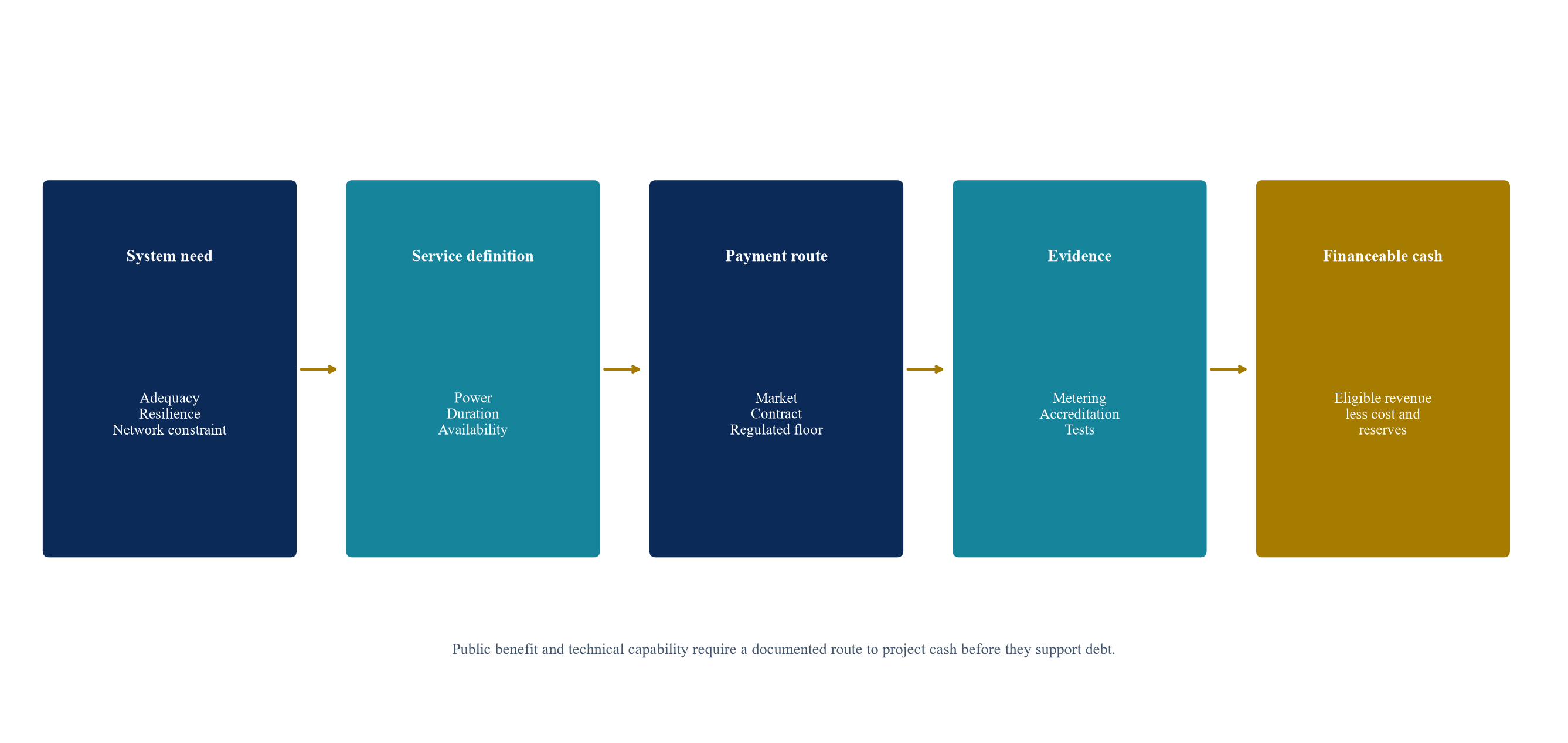
System value becomes debt-supporting cash only after a payer, measurement method, legal obligation and settlement route are established.
40. The hypothetical sensitivity identifies the binding risk
The hypothetical case tests five changes against the same USD 83 million debt service. A ten-percent reduction in contracted revenue weakens coverage more than a forty-percent merchant haircut because contracted revenue is the larger cash-flow component. Higher operating cost also matters because it reduces every revenue dollar available to debt.
A combined case approaches the assumed lock-up threshold. This indicates that liquidity and distribution controls should respond before default. The conclusion depends entirely on the hypothetical inputs.
The model should also test construction delay, accreditation loss, payment delay and major maintenance. Sensitivities should change one variable at a time before combining correlated shocks.
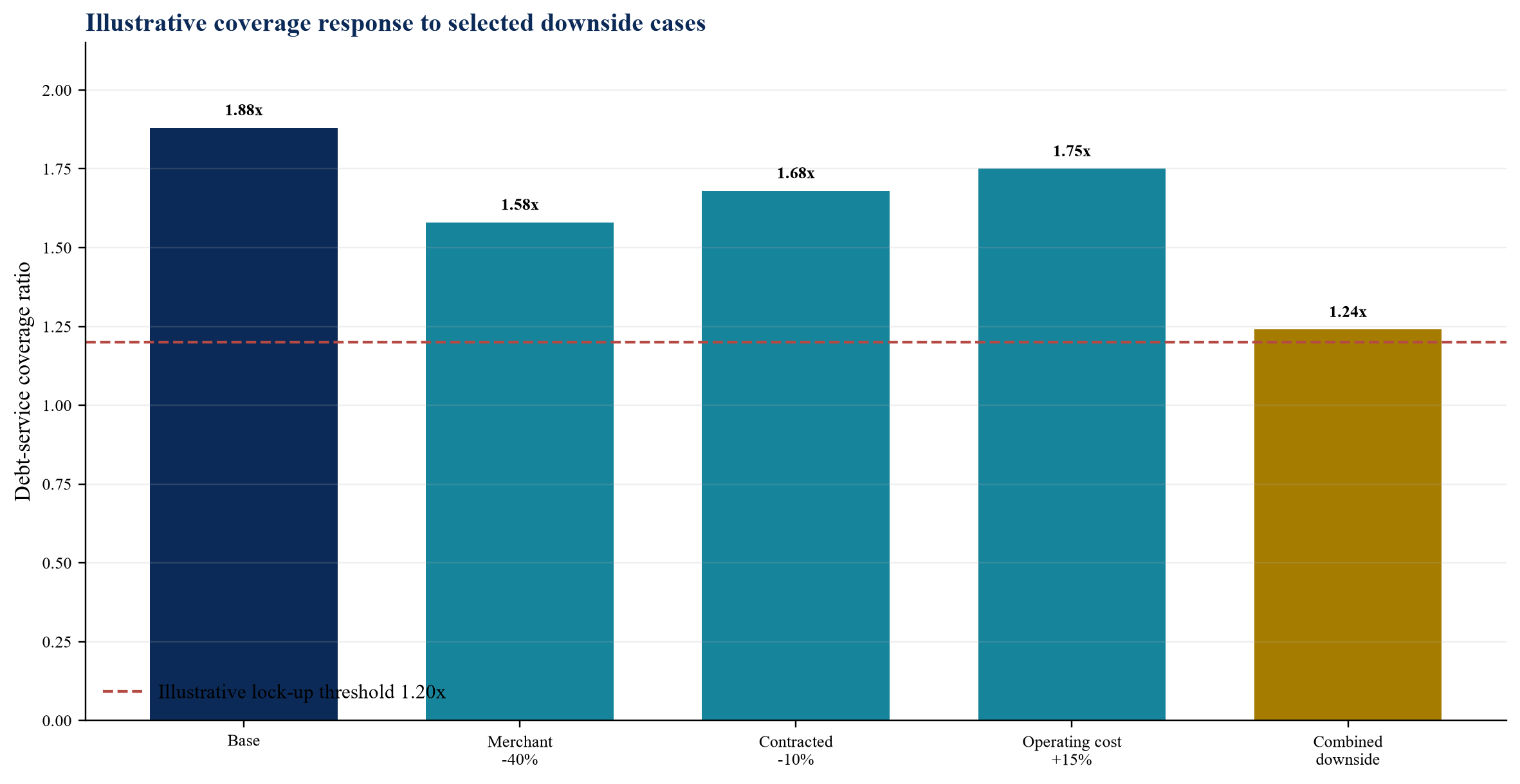
Ratios are illustrative assumptions derived from the hypothetical case and are not market forecasts.
41. Seven gates can discipline a financing decision
The first gate confirms a defined system need and service. The second confirms lawful development and grid access. The third confirms technology and construction evidence. The fourth confirms enforceable revenue and creditworthy payment. The fifth confirms downside debt-service coverage. The sixth confirms liquidity, lifecycle funding and risk allocation. The seventh confirms that closing conditions preserve the support mechanism.
Conditional approval should state the missing evidence, owner, deadline and financial consequence. A project should not rely on a generic expectation that future market reform will create revenue.
The gates can be reused through construction and operation. A change in contract, market rule, cost or accreditation should return to the relevant gate.
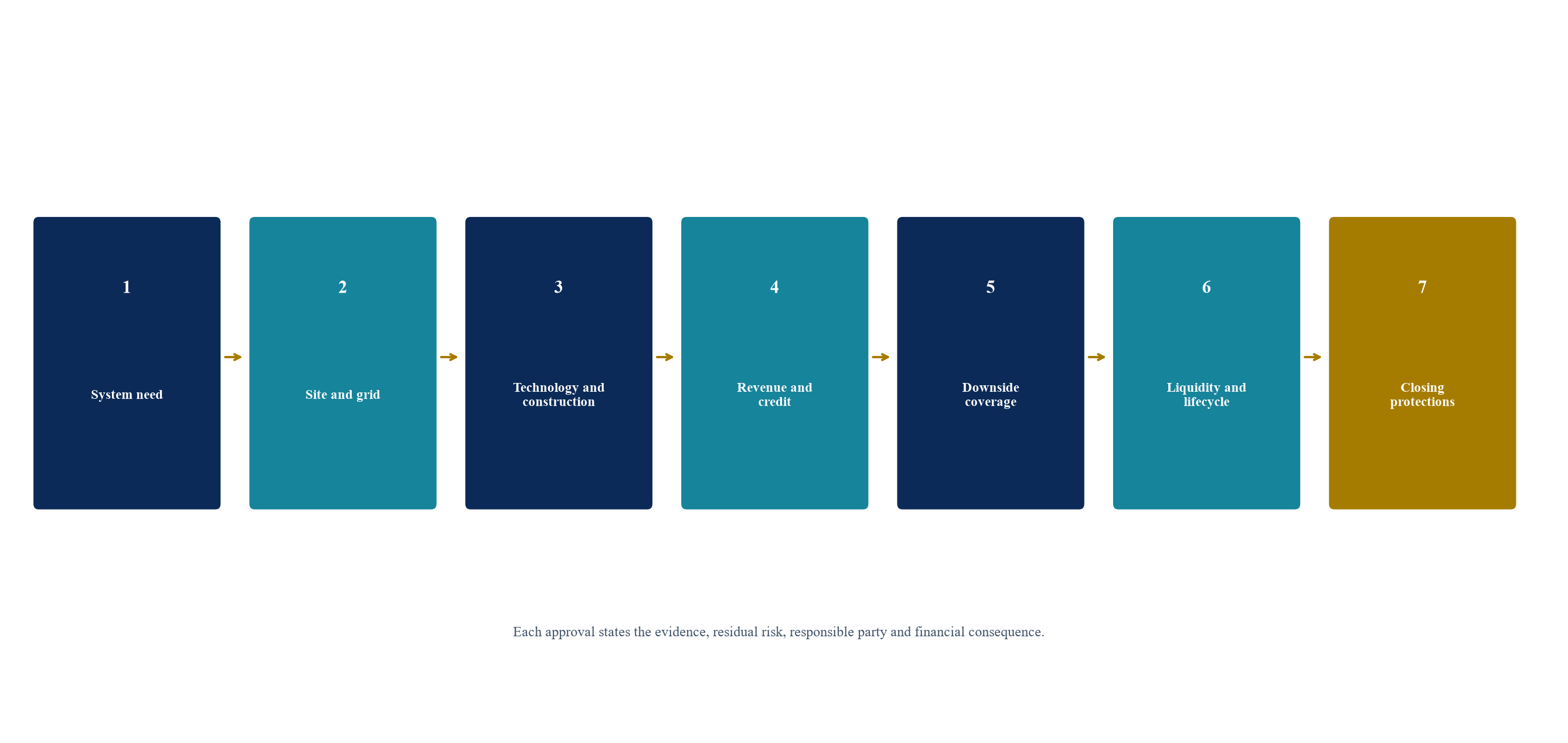
The financing advances when physical capability, legal rights, payment mechanics and lender protections remain aligned.
42. The first hundred days should preserve the revenue case
After financial close, the project team should maintain a single register connecting design, permits, cost, schedule, support-regime requirements and financing covenants. Changes should be tested against the revenue model before approval.
The team should lock measurement boundaries and completion tests early. It should confirm data access for accreditation, regulatory reporting and lender monitoring. Connection, procurement and permit milestones should have named owners and documented dependencies.
The sponsor should also protect the evidence needed for efficient-cost review. Invoices, scope changes, related-party decisions and contingency use should remain traceable through post-construction assessment.
43. Public authorities should avoid double payment
A storage asset can provide several services, but payments should correspond to incremental obligations. A regulated floor may already include market revenue. A capacity payment may compensate dependable power. A resilience contract may reserve additional energy or a different operating capability.
The procurement framework should disclose how revenues interact and which amounts are netted. This protects consumers while allowing the project to retain incentives for efficient dispatch.
Double-payment controls should preserve bankability. Retroactive or ambiguous netting can undermine financed cash flows. The rule should be defined before bids and reflected in the financial model.
44. Limits and further research
Public sources describe market frameworks and system needs, but they cannot establish the economics of a specific project. Construction cost, geology, equipment performance, connection, dispatch and contract terms require project-level evidence. The hypothetical case demonstrates financing mechanics only.
Further research should compare realised revenue capture with contracted forecasts, track changes in capacity accreditation as storage penetration rises, measure the value of multi-day resilience, and assess how different support mechanisms allocate cost and operating incentives.
Legal, tax, regulatory, technical and environmental conclusions require qualified advisers in the relevant jurisdiction. Market rules and public-support terms should be checked at the time of financing.
45. Conclusion
Long-duration storage becomes financeable when a measurable service has a credible payer and a durable settlement route. Energy arbitrage can contribute valuable upside, but it does not by itself capture resource adequacy, resilience, network support or public option value.
The revenue model should separate contracted, regulated and merchant cash. Debt should follow the lower tail of that cash flow after operating cost, lifecycle funding, liquidity and accreditation haircuts. Construction and technology risk require staged evidence and cost-to-complete protection.
Policy frameworks can close the investment gap by procuring defined services, setting transparent support mechanics and preserving efficient operating incentives. Sponsors can improve bankability by connecting every debt-sizing assumption to physical capability, legal rights, payment terms and monitored performance.
References
- Ofgem, Long Duration Electricity Storage Cap and Floor Financial Model and Handbook, 9 October 2025. https://www.ofgem.gov.uk/guidance/long-duration-electricity-storage-ldes-cap-and-floor-financial-model-and-handbook
- Ofgem and Department for Energy Security and Net Zero, Long Duration Electricity Storage Technical Decision Document, 11 March 2025. https://www.ofgem.gov.uk/decision/long-duration-electricity-storage-technical-document
- Ofgem, Long Duration Electricity Storage Window 1 Eligibility Assessment Outcome, 2025. https://www.ofgem.gov.uk/decision/long-duration-electricity-storage-ldes-window-1-eligibility-assessment-outcome
- Ofgem, Decision on the Project Assessment Framework for Window 1, 2025. https://www.ofgem.gov.uk/consultation/consultation-long-duration-electricity-storage-project-assessment
- Ofgem, Cap and Floor Cost Assessment Guidance for Window 1, 23 September 2025. https://www.ofgem.gov.uk/sites/default/files/2025-09/LDES%20Window%201%20-%20Cap%20and%20Floor%20Cost%20Assessment%20guidance.pdf
- Ofgem, Establishing the LDES Scheme under Section 26 of the Planning and Infrastructure Act 2025, 18 February 2026. https://www.ofgem.gov.uk/transparency-document/establishing-ldes-scheme-under-section-26-planning-and-infrastructure-act-2025
- United States Department of Energy, Pathways to Commercial Liftoff: Long Duration Energy Storage, 2023. https://www.energy.gov/sites/default/files/2023-08/Pathways%20to%20Commercial%20Liftoff%20Long%20Duration%20Energy%20Storage%20Opportunities.pdf
- United States Department of Energy Loan Programs Office, Year in Review 2024. https://www.energy.gov/edf/articles/lpo-year-review-2024
- PJM Interconnection, 2025 Effective Load Carrying Capability and Reserve Requirement Study, 2026 publication. https://www.pjm.com/-/media/DotCom/planning/res-adeq/elcc/2025-pjm-elcc-rrs.pdf
- PJM Interconnection, Effective Load Carrying Capability Resource Page, accessed September 2026. https://www.pjm.com/planning/resource-adequacy-planning/effective-load-carrying-capability
- Federal Energy Regulatory Commission, Joint Concurrence Regarding SPP Capacity Accreditation Proposals, 21 July 2025. https://www.ferc.gov/news-events/news/commissioner-rosners-and-commissioner-changs-joint-concurrence-regarding-spps
- Australian Energy Market Operator, Annual Report FY25. https://www.aemo.com.au/-/media/files/about_aemo/annual-report/2025/annual-report-fy25.pdf
- Australian Energy Market Operator, Reliability Outlook Improves, Timely Investment Delivery Essential, 21 August 2025. https://www.aemo.com.au/newsroom/media-release/reliability-outlook-improves-timely-investment-delivery-essential
- Australian Energy Market Operator, Draft 2025 Inputs Assumptions and Scenarios Report Stage 1. https://www.aemo.com.au/-/media/files/major-publications/isp/2025/draft-2025-inputs-assumptions-and-scenarios-report-stage-1.pdf
- ENTSO-E, Policy Paper on Market Design for Utility-Scale Energy Storage, 16 December 2025. https://www.entsoe.eu/news/2025/12/16/entso-e-policy-paper-on-market-design-for-utility-scale-energy-storage/
- ENTSO-E, European Resource Adequacy Assessment 2025 Reports and Results. https://www.entsoe.eu/eraa/2025/reports%26results/
- International Renewable Energy Agency, Renewable Power Generation Costs in 2024. https://www.irena.org/Digital-Report/Renewable-Power-Generation-Costs-in-2024
- National Renewable Energy Laboratory, Enabling Strategies to Facilitate Power Sector Decarbonization, 2024. https://www.nrel.gov/docs/fy24osti/91357.pdf
- National Energy System Operator, Future Energy Scenarios and Clean Power Pathways materials referenced by Ofgem, 2025. https://www.neso.energy/publications/future-energy-scenarios-fes
About the Author
Chennakeshav (CK) is a corporate finance and investment banking executive with 25+ years of global experience in deal origination, structuring and execution across M&A, growth capital and corporate strategy. He has led value-creation mandates for founders, corporates and funds — bridging the boardroom view to hands-on execution and close.
His career spans Morgan Stanley, HSBC, Lloyds Banking Group, EWEC, ADQ portfolio companies and Emirates Growth Fund, across TMT, real estate, fintech, deeptech, cleantech, infrastructure and energy. He has partnered with C-suite leaders, private equity and venture funds, sovereign wealth funds and family offices to finance complex fund raises and scale-up ventures, and has led M&A due diligence, post-merger integration and business-transformation initiatives to create value.
At Matchpoint Partners he is Managing Partner, leading the firm's corporate finance, M&A and capital-raising practice. He holds an MBA from London Business School, an engineering degree from VTU and a Master of Laws (LLM, in progress) from UCL London.
An active start-up mentor, CK mentors at Techstars, DIFC FinTech Hive, Startup Grind, Founder Institute and IN5, serves as Entrepreneur Mentor in Residence (EMiR) at London Business School, and judges the Entrepreneurship World Cup.
LinkedIn: https://www.linkedin.com/in/ckadya/
Profile: https://www.matchpoint-partners.com/team/ck-adya.html
