
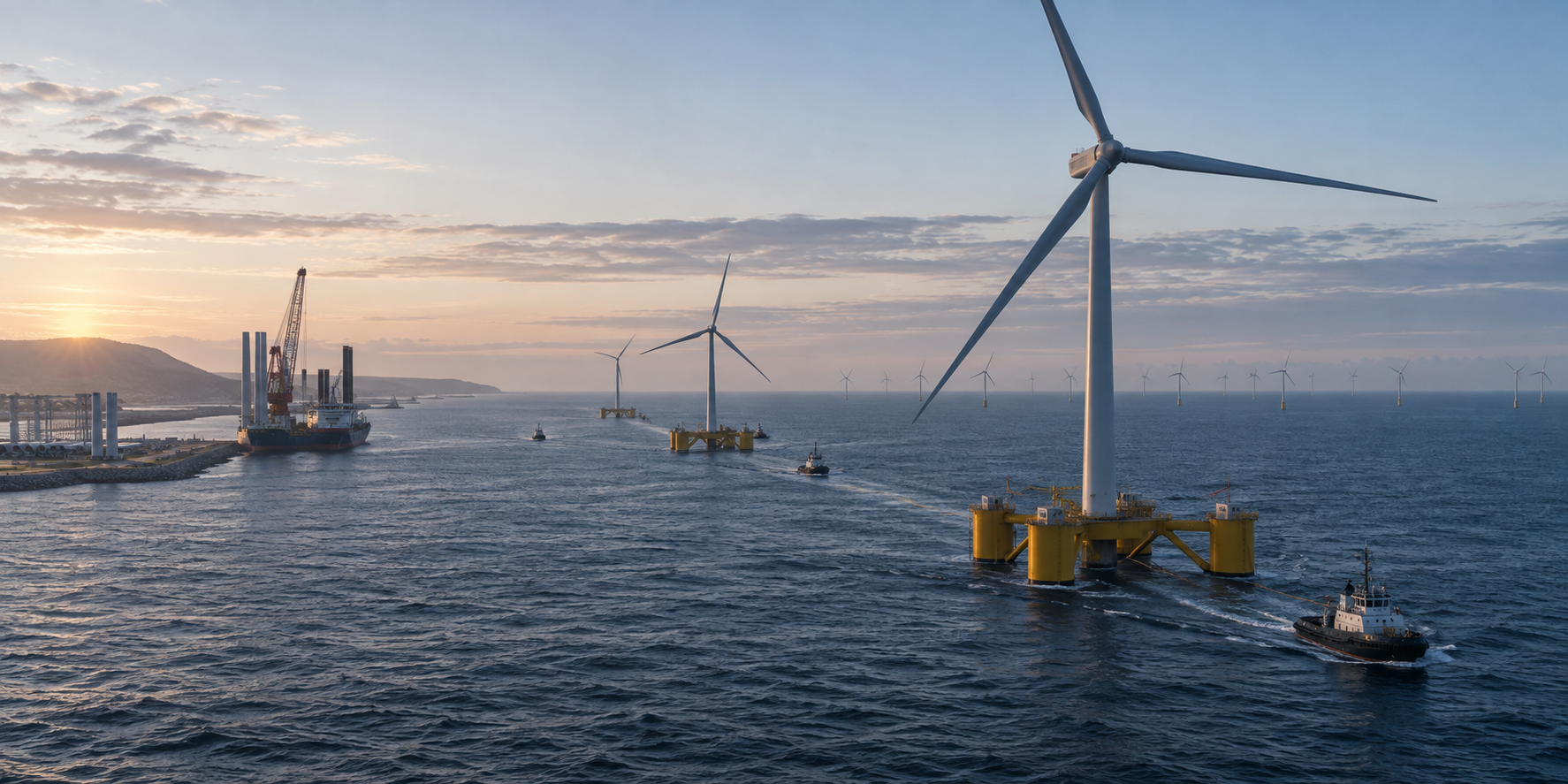
1 Define the lending question
Floating wind becomes a project-finance question when a proposed borrowing can be repaid from an identifiable project's cash flows under an agreed allocation of risk. For this paper, bankability means that the sponsors, lenders and relevant counterparties can approve that specific package on executable terms. The assessment requires an operating asset design, a construction programme, eligible revenue, a maintenance strategy and a documented response to adverse events. A successful demonstration contributes evidence to that assessment. The financing decision still requires its own complete record.
This paper proposes a commercial framework for moving from publicly supported demonstration to limited-recourse borrowing. The research cutoff is 10 October 2026. Dated primary announcements establish selected financing and development milestones in Portugal, France and the United Kingdom. Technical publications identify engineering and maintenance questions. The risk-allocation tables and lending recommendations are the paper's analytical proposals. They describe evidence to obtain and decisions to make. They do not report confidential conditions imposed on the named projects.
The central discipline is to connect each technical uncertainty to a cash-flow consequence and then to an accountable party. A component qualification question can affect completion, energy production, repair expenditure and the availability of insurance. A construction interface can affect several contracts simultaneously. The proposed credit memorandum should follow these pathways through to the dates on which principal and interest become payable. An unsupported assumption should remain visible as an unresolved transaction item.
Public evidence is narrower than a lender's data room. The inspected sources do not disclose the named projects' debt margins, arrangement fees, coverage covenants, reserve balances or equity returns. This paper therefore supplies no observed market range for those variables. A financial illustration can explain how assumptions interact; a project decision requires actual supplier offers, revenue documentation, independent engineering and financing terms.
The proposed transition has three working objectives. First, identify which evidence can be transferred from an earlier installation to the proposed design and site. Second, allocate the remaining exposure through contracts, liquidity and sponsor commitments that can actually be performed. Third, size repayment against cash available after the asset's operational obligations. Each objective requires a dated owner, a verifiable deliverable and a clear approval decision.
2 Keep the project milestones separate
The proposed financing record should distinguish rights to develop, decisions to invest, financing commitments and operating achievement. Each answers a different diligence question. A consent establishes an approval within its stated scope and conditions. An auction result identifies an award. A financing announcement identifies the transaction described by its issuer. First power records an initial production milestone. Full commissioning records a further milestone whose precise contractual meaning should be reconciled to the project's completion tests.
A useful evidence register records the source date, the claim's scope and the next document needed. This makes the project's status reproducible. It also gives the transaction team a way to update one milestone without silently changing other assumptions. A new operating announcement should trigger a review of the production history and completion evidence; it should not automatically change a debt-sizing case or remove a sponsor obligation.
Table 1. Evidence ladder for the financing decision
| Milestone | What to establish | Additional lending evidence proposed |
|---|---|---|
| Development rights | Site, duration and conditions | Transferability and security analysis |
| Consent | Approved scope and outstanding conditions | Discharge plan and challenge assessment |
| Revenue award | Capacity, price base and delivery label | Executed agreement and settlement review |
| Investment decision | Sponsor approval and commitments | Binding sources and uses |
| Financing announced | Facilities actually described | Executed terms and draw conditions |
| First power | Dated initial production event | Completion tests and remaining works |
| Full commissioning | Dated commissioning statement | Performance history and operational acceptance |
Notes: Proposed diligence ladder. A row describes a question to verify; it makes no finding about the legal effect of a particular project's announcement.
For a transaction in progress, the register should also identify dependencies. A permit may constrain the installation season. A revenue deadline may depend on grid energisation. A bank's commitment may expire before a supplier slot becomes firm. The proposed register should show the owner of each dependency, the documentary basis for the expected date, and the cash consequence if it moves.
This approach gives a credit committee a more precise question than whether floating wind has been demonstrated somewhere. The committee can ask which contractual cash flows, construction obligations and operating arrangements have been established for this borrowing. It can then identify the limited set of outstanding items that require a condition precedent, an agreed reserve, a completion undertaking or a decision to defer.
3 Read WindFloat Atlantic as a dated financing precedent
On 19 October 2018, the European Investment Bank announced a EUR 60 million loan to Windplus supported by InnovFin Energy Demonstration Projects. Its release also identified EUR 29.9 million of NER300 funding and up to EUR 6 million from the Portuguese Carbon Fund. These are historical announced amounts. The inspected announcement does not disclose a loan margin or a complete allocation of recourse. [1]
Principle Power subsequently announced that the 25 MW WindFloat Atlantic installation was fully operational on 27 July 2020, following connection of the last of its three platforms. This is a dated supplier-reported operating milestone. [2]
The analytical value of this sequence is its separation of financing support from operating achievement. For a later borrowing, the proposed diligence request should obtain the earlier project's relevant engineering records and determine which features match the new asset. Platform geometry, turbine loads, cable configuration, water depth, seabed, exposure and maintenance access should each have a documented comparison. The transaction should identify the basis for any claimed transfer of learning.
A lender should also request the applicable funding agreements when relying on public support. The proposed review covers eligible expenditure, draw timing, completion requirements, reporting, repayment or recovery provisions, and the interaction with other funding. A headline support amount cannot supply that detail. Sources and uses should reflect the actual permitted cash movements, including any expenditure that must be funded before reimbursement.
The same distinction is important for operating evidence. A commissioning statement can establish the milestone it announces. A production and maintenance record can support a more detailed assessment once its definitions, completeness and measurement periods have been checked. The proposed operating review should reconcile outages, component changes, inspections and insurance claims to the energy data. It should also identify modifications that changed the asset's configuration after commissioning.
The resulting precedent memorandum should contain two conclusions. One describes the verified historical sequence. The other states which evidence is relevant to the new borrowing and which questions remain open. Keeping these conclusions separate allows a transaction to benefit from experience while maintaining a site-specific credit assessment.
4 Understand the French pilot financing evidence
Crédit Agricole CIB's release dated 30 June 2022 describes approximately EUR 300 million of limited-recourse financing for Provence Grand Large. The package combined an equity bridge, direct EIB loans and commercial banking facilities. Its aggregate amount therefore should retain that financing description. The release supplies no disclosed leverage ratio or debt-service covenant. [3]
On 5 June 2025, EDF and Enbridge Éolien France 2 announced full commissioning of the 25 MW, three-turbine project. [4] The EIB's separate 28 June 2022 announcement covered EUR 210 million across three French pilots: EUR 50 million for Provence Grand Large, EUR 85 million for Eolmed and EUR 75 million for EFGL. The EFGL financing was EFSI-guaranteed. [5] ENGIE announced EFGL first power on 4 May 2026; its accompanying June 2026 full-capacity expectation remains a forecast in that release. [6]
Table 2. Selected primary financing and operating evidence
| Project | Financing evidence | Operating evidence verified |
|---|---|---|
| WindFloat Atlantic | EUR 60 million EIB loan announced in 2018 [1] | Fully operational announcement, July 2020 [2] |
| Provence Grand Large | Approximately EUR 300 million limited-recourse package, June 2022 [3] | Full commissioning announcement, June 2025 [4] |
| EFGL | EUR 75 million EIB financing announced in June 2022 [5] | First-power announcement, May 2026 [6] |
Notes: Historical nominal EUR amounts. Financing packages and individual EIB loans have different scopes. No debt margin, drawn balance, return or subsequent commissioning milestone is inferred.
For a proposed transaction, this evidence supports asking how a multi-source structure should work through construction and operation. The paper proposes a facility-by-facility schedule showing borrower, permitted use, draw order, repayment source, security position and conditions. An equity bridge should have a separately documented repayment mechanism. A long-term facility should have a separately documented operating repayment profile. Any common security and intercreditor arrangements require legal analysis.
The financing memorandum should also describe how public support affects the commercial facilities. Relevant questions include the availability of guarantees, conditions on grant receipts and the consequences of a delayed or reduced contribution. The proposed cash-flow case should show each commitment on the date it can actually be used. A contingency should identify its funder and permitted purpose.
This evidence establishes that an arranger has publicly described a limited-recourse floating-wind transaction. The proposed commercial lesson is to examine its structural components individually before using it as a precedent. The published aggregate cannot price a different project. A later deal needs its own construction allocation, support documents, operating assessment and repayment design.
5 Treat Green Volt as a development and revenue case
Green Volt's live project overview identifies onshore and offshore consent in April 2024 and a September 2024 CfD award. It targets first power in 2029. The page was accessed on 10 October 2026 and carries no publication date. [7] DESNZ's AR6 results separately identify Green Volt's 400 MW award, a GBP 139.93/MWh strike price in 2012 prices and delivery year 2028/29. [8]
These source statements have different purposes and should retain their original labels. The developer's first-power target and the auction's delivery-year field should be entered separately in a financing timetable. An actual lender review would need the executed contract and the developer's dated completion programme to reconcile them. The inspected sources do not establish financial close.
The proposed diligence programme for a development-stage project should start with the interfaces needed to convert rights and revenue support into construction. Request the consent conditions, seabed agreements, grid arrangements, supplier commitments, port access and installation plan. Record which are executed, conditional, under negotiation or still to be procured. The transaction team should attach documentary evidence to each status.
A revenue award gives the financial model a defined item to investigate. The model should use the contracted capacity and actual payment mechanics once verified. Any project capacity outside that award requires its own revenue treatment. The same principle applies to a project serving more than one class of electricity buyer: each proposed receipt, delivery obligation and interruption exposure should be documented and modelled separately.
The financing assessment should also identify the cash needed before long-term debt becomes available. Development expenditure, deposits, testing and infrastructure commitments may have distinct approval and funding arrangements. The paper proposes a staged funding plan that names the committed source for each obligation and the conditions for moving to the next stage.
A public development milestone can therefore guide the next diligence request without becoming a credit conclusion. The proposed decision record should state exactly what has been verified, what transaction documents remain outstanding and which party carries the cost of progressing them. That record gives sponsors a practical basis for deciding when to seek committed limited-recourse facilities.
6 Translate UK revenue support into eligible receipts
DESNZ's AR7 outcome, published on 14 January 2026 and updated on 10 February, records 192.50 MW of floating awards: Erebus at 100 MW and Pentland at 92.50 MW. Both show GBP 155.37/MWh in 2012 prices, GBP 216.49/MWh in 2024 prices and delivery year 2029/30. These are award data. [9]
The July 2025 standard terms require reading with the project's CfD Agreement. Condition 20 provides annual indexation using January CPI effective on 1 April, subject to its fallback. The intermittent payment definition sets the difference amount to zero in defined negative-price periods. Annex 3 provides a lender direct-agreement form. Project-specific applicability and rights require document review. [10]
Table 3. Proposed revenue diligence map
| Question | Evidence to obtain | Cash-flow treatment to define |
|---|---|---|
| Which output is eligible? | Capacity and metering provisions | Eligible delivered energy |
| Which price base applies? | Executed strike price and base year | Dated indexation schedule |
| Which hours receive support? | Settlement and exclusion provisions | Hourly payment eligibility |
| What is actually collected? | Sale and balancing agreements | Net electricity receipts |
| Which dates control support? | Agreement and completion programme | Start, expiry and delay cases |
| What protects lender intervention? | Executed direct agreements | Notice, cure and substitution assessment |
Notes: Proposed analytical questions. Published AR6 and AR7 awards remain subject to their own agreements; no AR7 right is attributed retrospectively to Green Volt's AR6 award.
The paper proposes a receipt reconciliation that begins with physical generation and ends with cash in the secured account. Each adjustment should have a named contractual source. Include losses, unavailable equipment, metering adjustments, sale proceeds, balancing charges and support settlement where applicable. The model should distinguish energy produced, energy delivered and energy receiving a particular payment.
Indexation should be applied on the actual contractual dates. Construction expenditure, maintenance expenditure, electricity receipts and debt costs can each follow different conventions. A financing case should state these conventions explicitly and test the resulting exposure. A single common escalation factor would conceal the allocation that the executed documents require.
The proposed lender review should also examine the revenue contract during distress. Obtain the applicable notices, cure periods, transfer restrictions and direct agreements. Legal counsel should describe the actions available to the finance parties and the operational obligations that continue during intervention. A support award then becomes one documented component of the repayment package.
7 Establish the technical boundary of the borrowing
The DOE's May 2024 Floating Offshore Wind Shot report identifies mooring, anchoring, dynamic cables, systems engineering and operations and maintenance among development priorities. Its mooring research examples include rope fatigue testing, condition monitoring and validation of shared configurations. Those are research activities; this paper adopts no achieved cost reduction or failure probability from the programme. [11]
The proposed technical review should define the complete system being financed. It should identify the turbine, floating support, moorings, anchors, electrical network, control systems and interfaces with installation and maintenance equipment. An asset boundary should also specify which components belong to another party and what contractual service the project receives from them. This boundary provides the starting point for analysing completion and operating exposure.
For each important component, request the design basis, qualification evidence, manufacturing controls, installation procedure and inspection plan. The independent engineer should describe the evidence reviewed, its applicability to the proposed conditions and any unresolved departures. A certificate or test result should retain its scope and limitations in the credit memorandum. A design change should have a documented process for evaluating its effect on adjacent systems.
The paper proposes an evidence-transfer matrix for innovations. One column identifies what was demonstrated previously. Another identifies the new operating envelope. A third names the further analysis, test or assurance needed. The matrix should capture a larger turbine, a different cable arrangement or an altered mooring design individually. This gives the transaction a concrete definition of remaining development work.
The financing package should connect each unresolved item to a decision date. Some may require resolution before commitment; others may have an acceptable completion condition or funded remedy, subject to approval. The proposed committee paper should explain the chosen treatment and its cash consequence. It should also identify who can approve a design change after debt commitment.
A technical risk assessment becomes useful to financing when the proposed construction and operating cash flows reflect its findings. Engineering, insurance and legal reviews should share the same asset boundary and configuration record. This allows the credit decision to address the actual system that the project is proposing to build.
8 Allocate mooring and anchor exposure
Mooring and anchor diligence should have its own proposed workstream. Start with the site's geotechnical and metocean evidence, the design load cases and the interfaces between line, connector, anchor and floating support. Ask the engineer to explain inspection access, degradation mechanisms and the procedure following an abnormal reading or loss of a line. The response plan should identify the condition in which continued operation is permitted and the authority responsible for that decision.
The paper proposes a contractual allocation based on controllable scope and executable remedies. Designers should identify their design responsibility. Manufacturers should document material and production requirements. Installers should provide the relevant installation and as-built evidence. The owner should retain an integrated integrity programme. The actual allocation requires negotiated contracts and professional review; no named precedent is presented as having this proposed structure.
Table 4. Proposed mooring risk-allocation schedule
| Exposure | Responsible scope to negotiate | Evidence or protection proposed |
|---|---|---|
| Site design basis | Developer and specialist advisers | Survey coverage and uncertainty record |
| Component design | Identified design authority | Load cases, interfaces and qualification |
| Manufacture | Component supplier | Traceability, acceptance and defect remedies |
| Installation | Marine contractor | Procedure, tolerances and as-built record |
| Integrity monitoring | Owner and service providers | Inspection plan and action thresholds |
| Major intervention | Owner, contractors and insurers | Spares, vessels, liquidity and response plan |
Notes: Proposed allocation for negotiation. Responsibilities, remedies, insurance and recourse depend on executed project documents.
A remedy should be assessed for both scope and timing. Replacement of a defective component can require marine operations and interruption of production. The proposed contract review should identify whether a remedy covers these activities, who funds them pending resolution and which caps or exclusions apply. A nominal warranty period alone cannot describe the cash available during an intervention.
Shared design features also deserve an explicit review. Where several units use the same component or procedure, the technical assessment should consider a finding that requires action across the array. The proposed financing case should examine the cash and scheduling implications of such a campaign. The committee should approve the method used to represent that exposure.
The resulting mooring dossier should connect design, installation and operation. A complete as-built record becomes the baseline for inspections and future repair planning. A controlled change log should identify modifications and their approval. This documentation gives the owner and finance parties a consistent basis for responding to new integrity information.
9 Give dynamic cables an integrated commercial scope
EDF's Provence Grand Large commissioning release describes dynamic cables that accommodate floater movement and connect through subsea and land cables to the onshore connection. That project description illustrates the physical interface being financed; it supplies no general failure frequency or maintenance cost. [4]
The proposed dynamic-cable review should begin with an end-to-end functional boundary. Identify the cable sections, connectors, buoyancy, protection, terminations and interfaces with the floater and seabed. Request evidence for the installed configuration and operating conditions. The technical assessment should state who controls each interface and how a change in one element is assessed across the system.
Contracting should follow that boundary. The paper proposes a responsibility matrix covering design inputs, manufacture, transport, installation, testing, energisation and repair. A supplier may have a defined component scope while a separate contractor controls handling or installation. The project should identify the party responsible for integration and the evidence needed for acceptance. Any unresolved interface should remain an explicit item in the completion assessment.
The commercial review should also define the repair method. Request an engineering basis for isolation, retrieval, replacement, reconnection and testing. Identify compatible spares, termination skills, storage requirements, vessel needs and permissions. The proposed maintenance budget should reflect the chosen strategy and the commitments actually available to the owner. An assumed repair duration should state whether it includes mobilisation, waiting for weather and re-energisation.
Cable topology should be represented in the operating case at the level required to understand interrupted output. The proposed review should examine which units remain connected after a specified fault and which restoration sequence is available. This supports a cash-flow assessment of the affected capacity and interruption period. The technical and financial teams should use the same fault definitions.
The project should keep a linked record of installed cable configuration, test results and subsequent interventions. The paper proposes that financing reports summarise material changes and unresolved findings. A concise engineering statement can then explain whether a change affects the approved operating case, the reserve assessment or the next inspection requirement.
10 Contract for ports, tow-out and return access
DOE's September 2023 summary of an NREL ports study identifies a West Coast network serving manufacturing, assembly, installation and O&M, together with permitting, workforce, vessel and coordination needs. It is a regional planning source. Its scenarios do not establish that an individual port is available to a proposed project. [12]
The paper proposes treating port capability as a transaction input with a defined scope, date and counterparty. Obtain evidence for draft, access, berth, bearing capacity, laydown, assembly, storage, lifting and any other project-specific requirements identified by the engineer. Distinguish existing capability from works that still require approval or construction. The financing programme should name the party funding and delivering those works.
Table 5. Proposed port and logistics completion record
| Requirement | Evidence proposed | Financing question |
|---|---|---|
| Physical capability | Verified survey and engineering review | Can the planned operation be performed? |
| Access rights | Executed berth and site agreements | Are dates and priority secured? |
| Upgrade works | Scope, consents, funding and programme | Who carries delay and overrun? |
| Tow route | Marine assessment and permissions | Which operating windows apply? |
| Installation resources | Binding commitments and interfaces | What happens if a slot moves? |
| Return for maintenance | Documented access and repair method | Is the operating strategy executable? |
Notes: Proposed project-specific evidence schedule. Regional port studies supply context; actual capacity and rights require verification.
Port agreements should be assessed across both construction and operation. A construction berth may have a short availability window. A maintenance strategy may require access years later with different storage or lifting needs. The proposed dossier should identify how each requirement is secured, what can be substituted and the conditions for a substitute to work.
The logistics programme should connect fabrication, assembly, loadout, tow-out, installation and grid readiness. Each handover should have acceptance criteria and a responsible party. The paper proposes a delay assessment that follows a moved milestone through the remaining programme and funding schedule. A remedy should identify the resource that can actually restore progress.
A lender decision can then distinguish firm logistics arrangements from proposed infrastructure. Any remaining dependency should have a documented completion condition, sponsor obligation or other approved treatment. The financial case should reflect that treatment and the associated timing. Port capability belongs in the same evidence chain as turbine and floating-system readiness.
11 Design completion support around the interfaces
The proposed completion package should begin with an integrated definition of the finished project. Identify the tests for mechanical completion, electrical readiness, grid connection, eligible generation, operating acceptance and handover of records. Specify which tests are required for debt drawdown, completion release and the end of any sponsor support. The parties should reconcile these definitions before commitments are signed.
Construction scope should be mapped across contracts. The paper proposes a schedule listing each major deliverable, the counterparty responsible, the dependency on other packages and the remedy for failure. Particular attention should go to activities that span design, fabrication and marine installation. A remedy is useful to the borrowing only if its beneficiary, conditions, amount and timing are clear.
The sources-and-uses schedule should show how the project remains funded through the completion programme. Include committed facilities, equity, public support and other verified sources at their permitted draw dates. Identify expenditure that falls outside a fixed or capped contract. The proposed contingency should have an owner, a permitted use and a replenishment decision. Its size requires the actual risk analysis.
Sponsor support should be documented as a separate contractual item. The proposed review covers amount, expiry, permitted claims, conditions and the credit standing of the support provider. A committee should understand which exposure remains with the project after release. Any planned substitution of insurance, reserves or contractor support should be evaluated on its own terms.
The completion timetable should also identify dates controlling revenue support, seabed rights, grid access and supplier commitments. The paper proposes testing an integrated delay event against all of them. A later completion date may affect both expenditure and eligible receipts. The financing model should record the full sequence and the legal review should address the applicable rights and consequences.
A completion memorandum should end with a finite set of release conditions. Each should specify the evidence required and the approving party. This makes the transition from construction borrowing to operating repayment a documented decision. It also gives the owner a clear record of the obligations and remaining works carried into operation.
12 Fund maintenance as an operating obligation
The May 2024 DOE, Sandia and NREL O&M roadmap identifies combined wind and wave loading and additional floating-system components as maintenance challenges. It calls for region-specific comparison of in-situ and tow-back strategies and suitable supporting ports. These are technical recommendations. [13]
ORE Catapult's public study, listed on 3 September 2026 with a report dated 10 August, uses a representative 900 MW North Sea case. It examines mooring and cable intervention, weather, vessels, spares, topology and downtime. Its case-study repair estimates are excluded from this paper's observed financing evidence. [14]
The paper proposes an operating plan built around the asset's approved maintenance strategy. Define scheduled inspections, routine servicing, corrective work and major interventions separately. For each, identify competence, equipment, access, spares and funding. The owner should reconcile the plan with warranty and service agreements so that exclusions and owner obligations remain visible.
Reserve design should follow these obligations. A proposed reserve assessment should state the event being funded, the cash required before reimbursement and the expected restoration period. Insurance terms should be reviewed for deductibles, waiting periods, exclusions and payment timing. The actual reserve amount requires project-specific evidence and lender approval; no published market convention is assumed here.
The operating model should distinguish routine expenditure from a material repair campaign. The proposed downside case should trace the affected capacity, interruption, mobilisation, repair and return to service through the cash ledger. Consider whether a common component issue affects more than one unit and whether concurrent demands change resource availability. The technical team should review the chosen event definition.
Maintenance reporting should support a repeatable credit decision. The paper proposes a regular summary of integrity findings, deferred work, spare availability, resource commitments and changes to the approved plan. Material items should identify a response owner and funding source. A debt-service forecast can then be reviewed alongside the operational evidence that supports it.
The goal of this proposed framework is an executable maintenance obligation throughout the borrowing. It connects physical work, contractual scope and liquidity, giving the finance parties a documented basis for deciding how much operating cash is available for repayment.
13 Size debt against cash after operational obligations
For the analytical framework in this paper, cash available for debt service is the defined operating cash remaining after the project's specified costs and taxes, with reserve movements treated consistently. Debt service is scheduled interest and principal for the same period. The coverage ratio divides the former by the latter. An actual facility agreement may use its own definitions; those definitions should control the transaction model.
The proposed debt-sizing process should begin with an evidenced operating case and then apply the lender's agreed downside, repayment and maturity constraints. Record the assumptions for eligible energy, receipts, operating cost, tax, reserves and scheduled payments. Reconcile the debt balance period by period. Any refinancing or terminal receipt should be separately identified and approved.
Table 6. Proposed debt-sizing and distribution controls
| Control | Required definition | Decision use |
|---|---|---|
| Cash available | Costs, taxes and reserve treatment | Reconcile operating cash |
| Scheduled debt service | Principal and interest timing | Test each payment period |
| Coverage requirement | Agreed case and threshold | Determine permitted borrowing |
| Liquidity | Reserve uses and replenishment | Fund timing and intervention exposure |
| Maturity | Repayment date and remaining rights | Review dependence on later receipts |
| Distribution test | Conditions and restricted cash | Approve cash release to investors |
Notes: Proposed framework; the table contains no observed covenant, debt margin or leverage assumption.
Average annual output should be supplemented by the timing detail needed for repayment analysis. The paper proposes comparing receipts and scheduled payments over the actual test periods. A repair, delayed support receipt or seasonal production pattern can be represented as a dated scenario once the relevant assumptions are documented. The committee should see both coverage and cash balance.
Rate and inflation exposures should receive the same treatment. State the actual debt-rate convention, proposed hedge, indexation dates and cost escalation assumptions. Any mismatch should be quantified in the transaction model and assigned a response. The paper supplies no assumed market hedge price or financing fee.
Investor returns and lender repayment should have separate approval tests. A financing case can report project value, equity cash flows and debt coverage using clearly defined calculations. The proposed memorandum should explain the source of each threshold and the assumptions behind the result. A favourable output remains conditional on those inputs and the executed financing package.
14 Assemble an evidence-led financing proposition
The paper proposes a financing dossier with four connected parts: verified project status, an integrated technical and delivery assessment, executable commercial documents, and a reconciled cash-flow model. Each part should refer to the same configuration and programme. The dossier should identify the date of the information used, its owner and the decision for which it is relevant.
The initial lender proposition should describe the requested facilities and their intended uses. Separate development funding, construction borrowing, equity bridging, long-term debt and contingent liquidity where proposed. Explain the source of repayment for each and the support that remains available at each stage. A facility request should be tied to actual obligations and funding dates.
The technical section should contain the independent engineer's scope and conclusions, outstanding qualification work, interfaces, completion tests and maintenance strategy. The commercial section should map those findings to contractual responsibility, remedies, insurance and sponsor commitments. The financial section should show the resulting receipts, expenditure, liquidity and repayment. Any unresolved point should name its proposed treatment and approval owner.
A useful committee paper should also explain the decision if a material condition remains unsatisfied. The paper proposes identifying what further equity, revised scope, additional support, lower borrowing or later commitment would be required. These are transaction options for assessment. Their acceptability depends on the project evidence and the parties' terms.
The observed precedents in this paper provide a narrow but useful starting record: announced public-backed lending, a publicly described limited-recourse package, dated operational milestones and UK revenue awards. Technical publications identify further diligence priorities. The proposed financing framework connects that record to the documents and cash flows needed for a new borrowing. It leaves undisclosed commercial conditions unestimated.
Moving from demonstration to debt therefore requires a project-specific approval. The financing proposition should show what has been established, who carries the remaining exposure, how intervention is funded and when the borrowing is repaid. A subsequent financial illustration can test those relationships under explicitly designed assumptions. Actual lending requires current engineering, legal, insurance and commercial diligence on the asset being financed.
15 An explicit hypothetical cash boundary
This hypothetical illustration tests a financing design for a 500 MW floating-wind project. Every technical, cost, revenue and financing input is an author-selected assumption. The results describe the arithmetic of those assumptions; they contain no observed project calibration, lender quotation, cost forecast or investment-return estimate. The calculation separates money required through completion from the operating cash that can service debt after acceptance. Within this boundary, cash-flow coverage supports USD 1,320.352 million of operating debt, below the separate USD 1,560.000 million physical-construction ceiling.
Annual energy is calculated by multiplying 500 MW by 8,760 hours, a 50% gross capacity factor, 94% availability and a further 95% delivery factor. The last factor represents the chosen 5% electrical and curtailment loss. Availability and additional losses therefore enter once each. This produces 1,955,670 MWh a year. The assumed USD 150/MWh price remains flat in nominal terms across the full 25-year operating life, producing annual revenue of USD 293.350 million. There is no separate merchant-price path, inflation adjustment, production degradation or probability distribution.
Cash available for debt service, abbreviated CFADS, equals energy revenue less operating expenditure and the annual maintenance-fund contribution. First-year operating expenditure is USD 85.000 million and rises by 2% each operating year. The maintenance contribution is USD 12.000 million annually. First-year CFADS is consequently USD 196.350 million; it declines to USD 162.330 million in operating year 18 and USD 144.633 million in year 25. These are nominal cash amounts under the selected flat-price assumption. Interest and principal are paid after CFADS is calculated. Deducting interest within CFADS would duplicate the interest already included in debt service.
The maintenance account is tracked separately. Contributions accumulate without interest; the assumed fund pays USD 120.000 million in year 10, USD 120.000 million in year 20 and USD 60.000 million in year 25. Each withdrawal pays the corresponding assumed maintenance bill. Those bills are excluded from ordinary operating expenditure, and fund-financed withdrawals receive no second deduction from CFADS. The reserve closes at zero after year 25. This timing convention is a modelling choice, with no claim about an actual component-replacement schedule.
The operating model excludes taxation, depreciation benefits, subsidies, extraordinary repair costs outside the maintenance schedule, refinancing, terminal value and decommissioning. Working cash is a fixed opening balance without a receivables or payables cycle. These exclusions limit the interpretation of cash remaining after debt service. That remainder is a pre-tax model amount; a forecast of distributable cash or equity returns would require additional inputs and a wider cash-flow boundary.
Table 7. Hypothetical project and financing assumptions
| Input | Assumption | Unit or boundary |
|---|---|---|
| Nameplate and gross capacity factor | 500 / 50 | MW / % |
| Availability and additional loss | 94 / 5 | % / %; multiplied separately |
| Flat energy price | 150.000 | USD/MWh; all operating years |
| Physical construction and cash contingency | 2,400 / 240 | USD m; contingency is funded cash |
| Fixed allowance and working cash | 180 / 30 | USD m; allowance is not calculated IDC |
| First-year opex and annual growth | 85 / 2 | USD m / % nominal |
| Maintenance fund contribution | 12.000 | USD m annually; draws tracked separately |
| Asset life and loan tenor | 25 / 18 | operating years |
| Loan rate and sizing DSCR | 7 / 1.40 | % nominal / times |
| Physical-capex ceiling and DSRA | 65 / 0.5 | % / years of maximum scheduled service |
Hypothetical author-selected design assumptions and calculated results; nominal USD million except stated units. All costs and financing terms are chosen for this illustration.
16 Completion requires a funded bridge
The assumed completion package contains USD 2,400.000 million of physical construction expenditure, USD 240.000 million of cash contingency, USD 180.000 million of fixed development and financing allowance, USD 30.000 million of working cash, and a separately calculated debt-service reserve account. This last account, abbreviated DSRA, requires USD 70.125 million under the base operating loan. Total initial sponsor funding is therefore USD 2,920.125 million. Funds committed and subsequently provided include cash still held in accounts. Physical and allowance expenditure on the on-time base path totals USD 2,580.000 million; the remaining USD 340.125 million comprises three distinct cash balances.
Construction is divided into three payment stages without assigning calendar dates. The physical-spend shares are 15%, 35% and 50%; the fixed allowance follows the same shares. Fabrication start requires USD 387.000 million of expenditure and the full USD 240.000 million cash contingency, giving stage funding of USD 627.000 million. Port and assembly requires a further USD 903.000 million. Installation and acceptance requires USD 1,290.000 million of expenditure, USD 30.000 million of working cash and USD 70.125 million DSRA. Cumulative sponsor funding reaches USD 2,920.125 million at acceptance. The stage table is a funding schedule, with unused contingency retained as cash throughout the on-time case.
The sponsor completion bridge is a standalone, full-recourse funding assumption. All staged contributions are assigned to the sponsor before operating refinancing. The model calculates no construction-loan interest, bridge interest, commitment fee or interest during construction. The USD 180.000 million allowance is a fixed input; it does not represent calculated interest during construction. Its size remains unchanged when the operating loan is resized. This boundary avoids a debt-interest-capital-cost loop and leaves the actual terms of any sponsor borrowing outside the illustration.
Operating debt is drawn only after accepted completion. Its USD 1,320.352 million proceeds repay that amount of sponsor funding; they do not add a second source to the construction-stage totals. Before releasing unused contingency, USD 1,599.774 million of sponsor capital remains in the on-time project. A separately identified release of the unspent USD 240.000 million contingency reduces retained sponsor capital to USD 1,359.774 million. This release does not reduce construction expenditure or increase CFADS. Working cash and the DSRA remain in their own accounts.
Accepted completion is an assumed refinancing condition, without an assessment of actual acceptance tests, lender commitments or sponsor credit capacity. The example consequently identifies a funding dependency: the sponsor must provide the staged cash before the operating loan becomes available. The calculation contains no forecast that a lender would commit, that completion would occur, or that a bridge could be refinanced on the selected terms.
Table 8. Staged sponsor funding before operating refinancing
| Construction stage | Physical and allowance spend | Cash buffers funded | Stage sponsor funding | Cumulative funding |
|---|---|---|---|---|
| Fabrication start | 387.000 | 240.000 | 627.000 | 627.000 |
| Port and assembly | 903.000 | 0.000 | 903.000 | 1,530.000 |
| Installation and acceptance | 1,290.000 | 100.125 | 1,390.125 | 2,920.125 |
Hypothetical author-selected design assumptions and calculated results; nominal USD million except stated units. Cash buffers comprise USD 240m contingency at stage 1, then USD 30m working cash and USD 70.125m DSRA at acceptance. USD 1320.352m operating debt refinances sponsor funding only after accepted completion; it is not an additional construction source.
17 Debt follows the cash available for service
Debt sizing uses 18 end-of-year operating cash periods, a fixed 7% annual loan rate and a selected 1.40 times sizing DSCR. DSCR means CFADS divided by scheduled interest plus principal for the same period. For each debt year, the service capacity equals that year's CFADS divided by 1.40. Discounting those service capacities at the loan rate to accepted completion and summing them gives coverage-supported debt of USD 1,320.352 million. The separate ceiling is 65% of the USD 2,400.000 million physical-construction cost, or USD 1,560.000 million. Selected debt is the lower amount. Contingency, working cash, fixed allowance and DSRA do not enlarge this ceiling.
The repayment path follows the annual CFADS shape. Scheduled debt service equals annual service capacity multiplied by selected debt divided by coverage-supported debt. The multiplier is one in the base case because coverage binds. A ceiling-constrained case has a multiplier below one and coverage above the selected 1.40 threshold. Interest equals opening debt multiplied by 7%; principal equals scheduled service less interest; closing debt equals opening debt less principal. These relationships produce an amortising schedule without a balloon or an assumed refinancing receipt.
In operating year 1, service is USD 140.250 million, comprising USD 92.425 million interest and USD 47.826 million principal. In year 18, service is USD 115.950 million, comprising USD 7.586 million interest and USD 108.364 million principal. Principal remains positive in every base debt year, and the final balance reaches zero within numerical tolerance. Total scheduled service is USD 2,317.330 million, including USD 996.979 million interest. The interest amount is an output of this loan schedule, separate from the fixed completion allowance.
The DSRA is set at half the maximum annual scheduled service. It is therefore USD 70.125 million, funded once at completion through the sponsor package. It earns no interest and receives no scheduled top-up in the base calculation. The full balance remains restricted until the final scheduled service has been paid; its assumed release then becomes a separate cash movement. Initial funding is not deducted again from operating CFADS, and release is excluded from the CFADS used to size the loan. The separate USD 30.000 million working-cash balance is also excluded from debt-service capacity.
The model selects 1.10 times as a cash-lockup test and 1.00 times as complete service coverage. These are disclosed analytical thresholds, with no claim that they match a lender's covenants. The implementation checks debt-service present value, principal conservation and the absence of negative amortisation. If any CFADS year within a proposed debt window is nonpositive, the selected rule assigns zero debt. A proposed sculpt that requires interest capitalisation also receives zero debt. This conservative boundary avoids presenting an unsupported repayment path in extreme cases.
Table 9. Debt sizing and selected sculpted repayment years
| Operating year | CFADS | Debt service | Interest | Principal | Closing debt | DSCR times |
|---|---|---|---|---|---|---|
| 1 | 196.350 | 140.250 | 92.425 | 47.826 | 1,272.526 | 1.400 |
| 5 | 189.344 | 135.246 | 78.102 | 57.144 | 1,058.595 | 1.400 |
| 10 | 179.768 | 128.405 | 56.104 | 72.301 | 729.190 | 1.400 |
| 15 | 169.195 | 120.853 | 28.110 | 92.743 | 308.831 | 1.400 |
| 18 | 162.330 | 115.950 | 7.586 | 108.364 | 0.000 | 1.400 |
Hypothetical author-selected design assumptions and calculated results; nominal USD million except stated units. Coverage capacity USD 1320.352m; physical-capex ceiling USD 1560.000m; selected loan USD 1320.352m. Principal remains positive and closing debt at year 18 is zero within numerical tolerance; no balloon is modelled.

View figure at full size; scroll horizontally on smaller screens.
Hypothetical author-selected assumptions. CFADS deducts ordinary operating costs and maintenance-fund contributions. Debt service then pays interest and principal; reserve-funded maintenance bills are excluded from a second CFADS deduction. The loan is fully amortised in year 18, with seven operating years remaining. Loan interest does not enter CFADS, and no construction IDC is calculated.
18 Operating stress is tested on the signed schedule
Four operating sensitivities are compared with the base design: constant availability of 88%; a 10% reduction in the flat energy price to USD 135/MWh; a 15% increase in the entire operating-cost path; and all three changes together. Other assumptions, including the maintenance contribution and operating life, remain unchanged. These are deterministic hypothetical cases with no assigned likelihood. Each case is first tested against the unchanged base loan's 18-year service schedule. A second calculation sizes a new hypothetical loan from the stressed cash path at the original 1.40 sizing ratio.
Availability of 88% gives annual energy of 1,830,840 MWh and first-year CFADS of USD 177.626 million. Minimum fixed-loan DSCR is 1.239 times. The price reduction produces first-year CFADS of USD 167.015 million and minimum DSCR of 1.147 times. Higher operating costs give first-year CFADS of USD 183.600 million and minimum DSCR of 1.246 times. None of these three individual cases falls below the selected 1.10 test within the debt window. Their minimum ratios occur late in the schedule as the assumed operating-cost inflation reduces CFADS relative to the original service path.
The combined case gives first-year CFADS of USD 137.413 million and year-18 CFADS of USD 98.290 million. Fixed-loan coverage falls below 1.00 in every debt year and reaches a minimum of 0.848 times. Its aggregate service deficit before reserve support is USD 177.443 million. In a separately labelled diagnostic, the opening DSRA pays only those service deficits, earns no interest and receives no replenishment. The account first leaves an unfunded service amount in operating year 11; aggregate unfunded service after its use is USD 107.317 million. Reserve drawings leave CFADS and the reported DSCR unchanged.
Resizing gives USD 1,185.815 million debt for the availability case, USD 1,109.577 million for the price case and USD 1,215.176 million for higher operating costs. The combined path supports USD 883.319 million, a USD 437.033 million reduction from the base amount. These are separate origination illustrations. The lower amount does not amend the contractual base balance, create repayment proceeds, or settle the combined case's service deficits. Any real amendment, additional capital or repayment decision requires separate terms and authority.
An availability-only threshold provides another reading of the fixed loan. Holding the base price and cost path unchanged, constant availability of 82.854% is required to maintain at least 1.10 times coverage throughout all 18 years; 79.138% maintains at least 1.00 times. Year 18 binds both thresholds. These calculated values apply only to the defined annual-average energy relationship. They contain no estimate of outage duration, seasonal generation, recovery time, repair expenditure or the availability level achievable by an actual floating-wind installation.
Table 10. Operating downside against the fixed base loan
| Operating case | First-year CFADS | Minimum fixed-loan DSCR | Years below 1.10 | Resized debt | Reduction from base debt |
|---|---|---|---|---|---|
| Base design | 196.350 | 1.400 | 0 | 1,320.352 | 0.000 |
| Availability at 88% | 177.626 | 1.239 | 0 | 1,185.815 | 134.537 |
| Price lower by 10% | 167.015 | 1.147 | 0 | 1,109.577 | 210.774 |
| Opex higher by 15% | 183.600 | 1.246 | 0 | 1,215.176 | 105.175 |
| Combined operating downside | 137.413 | 0.848 | 18 | 883.319 | 437.033 |
Hypothetical author-selected design assumptions and calculated results; nominal USD million except stated units. Fixed-loan coverage uses the original repayment contract without DSRA support. Resized debt is a separate hypothetical origination calculation; it does not amend or forgive the base loan. Years below 1.10 are counted only within the 18-year debt window.

View figure at full size; scroll horizontally on smaller screens.
Hypothetical author-selected assumptions. Availability falls from 94% to 88%, price falls by 10%, and the operating-cost path rises by 15%; the combined line applies all three. Every line uses the same original base-loan debt-service schedule. DSCR is measured before DSRA draws. The 1.10 cash-lockup and 1.00 service-coverage lines are selected analytical tests, without a claim about actual lender covenants.
19 Cost and delay consume a finite completion buffer
Completion stress applies only to physical construction cost and an explicit delay-carry allowance. A physical overrun is calculated as the chosen percentage multiplied by USD 2,400.000 million. Delay carry equals months of delay multiplied by USD 4.000 million. Total incremental completion cost is their sum. Contingency used is the smaller of that sum and the USD 240.000 million funded contingency. The incremental sponsor call is the positive excess above USD 240.000 million. Residual contingency equals the original funded balance less the amount used. Each dollar of contingency is applied once.
A 10% overrun without delay adds USD 240.000 million of physical cost and consumes the contingency exactly. It requires no incremental sponsor call beyond the initial USD 2,920.125 million funding package. Adding six months of delay contributes USD 24.000 million carry. Incremental completion cost becomes USD 264.000 million, with USD 240.000 million paid from contingency and USD 24.000 million of additional sponsor cash. Total funds provided rise to USD 2,944.125 million. Physical and allowance expenditure including overrun and carry is USD 2,844.000 million; working cash and DSRA together remain USD 100.125 million.
At 20% physical overrun and 12 months of delay, incremental completion cost is USD 528.000 million. The funded contingency covers USD 240.000 million and the extra sponsor call is USD 288.000 million. Total funds provided are USD 3,208.125 million, including USD 3,108.000 million of expenditure and the same USD 100.125 million of separately held cash. The original operating loan then leaves USD 1,887.774 million sponsor capital in the project. Both completion stresses retain the same accepted-completion operating cash path and debt draw as the base case.
The balance identity is explicit: funds provided equal physical and allowance expenditure including incremental completion costs, plus residual contingency, working cash and DSRA. A reserve already counted within the initial package supplies no additional source when spent. The DSRA is unavailable for construction overruns in this model; working cash is also held for its designated operating purpose. In the on-time case, residual contingency remains USD 240.000 million until the separately reported optional release.
Delay carry is a fixed hypothetical allowance. It includes no calculated financing interest, lost-revenue compensation, inflation repricing, contractual liquidated damages or insurance recovery. Operating year 1 starts at eventual accepted completion; the 25-year asset life and 18-year loan then move together. No fixed calendar contract expiry is modelled. The delay cases consequently quantify the selected completion liquidity requirement without valuing the change in investment timing or asserting the adequacy of the sponsor bridge.
Table 11. Completion stress and incremental sponsor liquidity
| Completion case | Overrun and carry | Contingency used | Residual contingency | Extra sponsor call | Total funds provided |
|---|---|---|---|---|---|
| On-time base | 0.000 | 0.000 | 240.000 | 0.000 | 2,920.125 |
| 10% overrun | 240.000 | 240.000 | 0.000 | 0.000 | 2,920.125 |
| 10% overrun and 6 months | 264.000 | 240.000 | 0.000 | 24.000 | 2,944.125 |
| 20% overrun and 12 months | 528.000 | 240.000 | 0.000 | 288.000 | 3,208.125 |
Hypothetical author-selected design assumptions and calculated results; nominal USD million except stated units. Delay carry is USD 4m per month; it is a fixed design allowance, without calculated bridge interest, lost-revenue indemnity or construction IDC. Extra sponsor call equals the positive excess of overrun plus carry over USD 240m funded contingency. Working cash and DSRA stay restricted to their separate purposes.

View figure at full size; scroll horizontally on smaller screens.
Hypothetical author-selected assumptions. Left: incremental physical overrun plus USD 4m monthly delay carry is paid first from the separately funded USD 240m contingency, then incremental sponsor cash. Working cash and DSRA are excluded as completion sources. Right: separate base-case origination calculations at 12, 15, 18 and 20 years, with corresponding operating tails within the assumed 25-year asset life. These are alternatives, without a contractual refinancing or return forecast.
20 Price tenor and the remaining operating tail
The price-availability grid reruns debt sizing across flat prices of USD 120, 135, 150, 165 and 180/MWh and constant availability of 82%, 86%, 90%, 94% and 98%. Gross capacity factor, additional losses, operating costs, maintenance contributions, loan rate and tenor remain fixed. Each cell is a fresh hypothetical origination calculation, with the physical-capex ceiling applied separately. At 94% availability, a USD 120/MWh price supports USD 898.803 million; USD 150/MWh supports the base USD 1,320.352 million. At USD 180/MWh the selected debt reaches the USD 1,560.000 million ceiling. The grid identifies assumptions that bind coverage and assumptions that bind the chosen leverage limit.
Loan tenor is tested separately at 12, 15, 18 and 20 years using the unchanged base operating cash path and 7% rate. Sized debt is USD 1,065.695 million, USD 1,208.417 million, USD 1,320.352 million and USD 1,381.019 million respectively. Corresponding operating tails are 13, 10, seven and five years. The first year's CFADS and service capacity remain unchanged across these uncapped calculations, so the six-month maximum-service DSRA remains USD 70.125 million. This is a consequence of the selected sculpting rule; alternative repayment structures would require their own reserve calculation.
For the 18-year base loan, operating years 19 through 25 generate USD 1,066.925 million cumulative CFADS after operating expenditure and maintenance contributions. This is an undiscounted, pre-tax hypothetical tail amount. It includes no terminal asset sale or new loan. Cash remaining after service within the debt window totals USD 926.932 million, before the separate DSRA release. The USD 70.125 million release after final repayment is excluded from both totals. Working cash receives no assumed terminal release. The maintenance fund continues through the tail and pays its remaining scheduled bills from accumulated contributions.
These outputs support a limited financing-design conclusion within the illustration. The base schedule amortises at the selected coverage level, the combined operating stress cannot meet that unchanged schedule, and completion stresses require a distinct sponsor liquidity commitment once contingency is exhausted. A longer tenor increases calculated debt and reduces the number of operating years beyond maturity. The model supplies no basis for choosing an actual lender's required tail, estimating a refinancing price or measuring shareholder returns.
Reproduction uses the disclosed assumptions, annual cash records, reserve ledgers, repayment schedules and sensitivity cells. Numerical results retain full precision; exhibits round ordinary values to three decimals and years to integers. Tests include a zero-interest boundary and operating extremes that produce zero selected debt. Applying this framework to a live project requires verified engineering yield, dated construction payments, enforceable revenue and maintenance contracts, tax and decommissioning inputs, and actual funding commitments. The present results remain explicitly hypothetical throughout those further diligence questions.

View figure at full size; scroll horizontally on smaller screens.
Hypothetical author-selected assumptions. Each cell recalculates an 18-year loan at 7% and 1.40 times sizing coverage with the base operating-cost and maintenance-fund paths. Cells show USD million rounded to the nearest million. Asterisks mark the USD 1,560m physical-construction debt ceiling. The grid contains no observed tariff, availability benchmark, probability or market quotation.
21 Certification scope and lender reliance
The credit submission should identify what each certificate covers, which design version it concerns and which conditions remain outstanding. DNV's public catalogue for its floating wind design standard identifies edition December 2025 and describes design requirements, assessment and contractual reference roles. Its separate certification specification, edition September 2024, distinguishes lifecycle stages including prototype, type, project and in-service certification, with dynamic power cables within the stated scope [15]-[16]. These public descriptions establish the scope of the documents. Detailed acceptance criteria require the complete applicable standard and qualified engineering assessment.
We propose that the sponsor maintain a certification schedule alongside the financing conditions. Each entry should name the relevant equipment, design revision, environmental envelope, issuer, validity period and unresolved qualification. The independent engineer can then explain how the evidence supports the particular project configuration. The lender should receive a dated statement describing the engineer's work, permitted reliance and exclusions. A generic certificate attached to a presentation leaves these commercial questions unanswered.
A configuration change should trigger a documented review of the assumptions that supported earlier approvals. For example, a hypothetical turbine replacement could change loads, motions, cable requirements or installation sequencing. The assessment should identify which existing evidence remains applicable, which suppliers must confirm compatibility and which tests or approvals need renewal. The financial model should reflect the resulting procurement, schedule and operating implications only after an accountable technical reviewer has established them.
Certification and contract enforcement also require separate evidence. A design approval does not state whether an insolvent supplier can pay a warranty claim, whether a service vessel will be available or whether an insurance exclusion applies. The proposed credit process therefore pairs each material technical conclusion with a contractual remedy, the party responsible for performance and the cash needed while a remedy is pursued. The objective is an auditable explanation of how the project manages each exposure.
22 Contract interfaces at completion
We propose a common completion schedule across the financing, turbine supply, floating foundation, mooring, dynamic cable, port and grid contracts. It should distinguish physical installation, energisation, performance testing, commercial acceptance and the point when sponsor completion support ends. The parties should identify any period during which a contract has been accepted but the project cannot sell the expected output. That period requires a defined funding source and a modelled cash balance.
Interface disputes should be tested before the financing agreement is signed. Consider an illustrative case in which turbine equipment operates within its supplier specification while the combined platform and cable system fails a project acceptance test. The project needs procedures for investigating the cause, access to relevant data and an interim repair plan. Payment obligations and dispute resolution may continue while engineering work proceeds. The financing case should identify who funds that interval and which assumptions depend on a negotiated allocation of responsibility.
Table 12. Proposed completion interface responsibilities
| Interface | Required evidence | Funding question |
|---|---|---|
| Turbine and floating foundation | Confirmed coupled design and acceptance scope | Who pays for integrated retesting |
| Mooring and dynamic cable | Agreed operating envelope and installation records | Who funds repair and lost output |
| Port and marine installation | Access rights, sequencing and contingency plan | Who pays for delay and remobilisation |
| Grid and revenue contract | Energisation, metering and revenue eligibility | How is the acceptance gap financed |
| Operations and major maintenance | Handover records and executable maintenance plan | Which restricted reserve pays each task |
| Sponsor and project lender | Defined completion tests and release conditions | When can completion support terminate |
Notes: Author-proposed diligence matrix. Contractual remedies, liability limits and available security require project-specific legal review.
The completion certificate should refer to supporting records by version and date. Any allowed residual work should have an estimated remaining cost, a funding source and a deadline approved under the financing documents. A lender can evaluate a bounded list of minor defects differently from an unresolved design problem. The proposal requires the engineer to describe that distinction in the project's own terms, supported by tests and inspection records.
23 Data and AI for financing evidence
We propose a controlled evidence register linking each material financing assumption to the underlying document or operating record. Examples include generation assumptions, turbine availability, maintenance costs, marine mobilisation, insurance terms and termination compensation. Each record should state its units, period, scope, owner, approval date and revision history. The register should distinguish an executed obligation from a budget, an indicative quotation or an expired offer. Those distinctions determine whether a figure can support an actual funding commitment.
For any proposed AI-assisted extraction, reviewers should define the required outputs and assess them against a labelled test set before use. Candidate outputs for evaluation include obligations and inconsistencies in dates, capacities, units or document versions. The paper assigns this proposed application no measured accuracy, cost saving, financing benefit or valuation uplift. Material outputs should be checked against the source by a responsible reviewer. The review protocol should require the complete relevant clause and its context, including exclusions and the document's execution status, before an extracted item enters a credit conclusion.
Operating data require equivalent controls. A recorded turbine outage should identify the equipment, timing, classification and any overlap with grid unavailability or curtailment. The proposed analytical process reconciles these records before using them in the financing model. Overlapping losses should have an explicit aggregation rule. The reviewer should investigate an unexplained classification change before approving any revised performance assessment. Independent technical analysis remains necessary to establish a project-appropriate energy case.
Access to supplier and operating data should be considered during contract negotiation. The project and its advisers need permission to use the information for diligence, maintenance and an eventual refinancing. Confidential material should remain within the approved access environment. Automated analysis should preserve source provenance and a correction log. The decision-maker should be able to trace a changed debt-capacity result back to the changed input and the person who approved it.
24 Conditions for an executable financing decision
The proposed financing recommendation should state the amount and timing of each funding source, the conditions that must be met and the exposures that remain with the sponsor. The quantitative case in this paper sizes an operating loan after accepted completion. Its sponsor-funded construction bridge illustrates one allocation of development and completion risk. A transaction using construction debt requires a separate drawdown, interest, security and completion-support model. The illustrated operating loan cannot establish that a lender would accept construction exposure.
The investment committee should receive a reconciled sources-and-uses statement and a separate cash schedule. Funded contingency, working cash, debt-service reserves and major-maintenance balances each require a defined purpose. The same cash cannot cover two simultaneous obligations. Restricted balances should remain visible when the committee assesses sponsor recovery and liquidity. Where grants or other public support are included, payment conditions and any repayment or clawback exposure belong in the funding case.
The credit recommendation should then identify the assumptions that determine the requested debt amount. Lower generation, weaker realised prices and higher operating expenditure should be tested against the original debt schedule. A separately resized downside loan explains how much capital would have been supportable under that scenario. It supplies no automatic right to change an executed loan. An actual covenant breach requires the remedies, consent procedures and funding commitments specified by the governing agreements.
Before approving debt close, the committee should require dated engineering conclusions, executed revenue and key delivery contracts, verified sponsor funding and a legally reviewed security package. Outstanding items should have named owners and an explicit consequence if they remain unresolved. A proposed future refinancing should receive a separate assessment of the operating record, remaining contract term, maintenance liabilities and debt maturity. The decision should follow the evidence available at that point, with no assumed refinancing proceeds used to conceal an unfunded construction or operating gap.
References
- European Investment Bank. Portugal: EU supports breakthrough wind energy technology with EUR 60 million loan granted by the EIB under InnovFin to Windplus. 19 October 2018. https://www.eib.org/en/press/all/2018-259-eu-supports-breakthrough-wind-energy-technology-in-portugal-with-eur-60-million-loan-granted-by-the-eib-under-innovfin-to-windplus.htm Accessed 10 October 2026.
- Principle Power. The first floating wind farm in continental Europe is now fully operational. 27 July 2020. https://www.principlepower.com/news/the-first-floating-wind-farm-in-continental-europe-is-now-fully-operational Accessed 10 October 2026.
- Crédit Agricole CIB. Crédit Agricole CIB structures the financing of a pioneering floating offshore wind farm in the Mediterranean Sea. 30 June 2022. https://pressroom.credit-agricole.com/assets/en-2022-06-30-credit-agricole-cib-structures-the-financing-of-provence-grand-large-mp-pdf-25b8-94727.html?dl=1 Accessed 10 October 2026.
- EDF. Provence Grand Large: mise en service complète du premier parc éolien en mer flottant français. 5 June 2025. https://www.edf.fr/sites/groupe/files/epresspack/10166/CP-Provence-Grand-Large-mise-en-service-complete-du-premier-parc-eolien-en-mer-flottant-francaisVfinale.pdf Accessed 10 October 2026.
- European Investment Bank. France: The EIB, with the support of the European Commission, is co-financing three floating offshore wind farms for a total of EUR 210 million. 28 June 2022. https://www.eib.org/en/press/all/2022-293-france-the-eib-with-the-support-of-the-european-commission-is-co-financing-the-construction-of-three-floating-offshore-wind-farms-for-a-total-of-eur210-million Accessed 10 October 2026.
- ENGIE. ENGIE delivers on its first two offshore wind projects in France. 4 May 2026. https://en.newsroom.engie.com/news/engie-delivers-on-its-first-two-offshore-wind-projects-in-france-448ae-314df.html Accessed 10 October 2026.
- Green Volt Offshore Windfarm. Project overview. Undated. https://greenvoltoffshorewind.com/project-overview/ Accessed 10 October 2026.
- UK Department for Energy Security and Net Zero. Contracts for Difference Allocation Round 6: results (accessible webpage). 3 September 2024. https://www.gov.uk/government/publications/contracts-for-difference-cfd-allocation-round-6-results/contracts-for-difference-cfd-allocation-round-6-results-accessible-webpage Accessed 10 October 2026.
- UK Department for Energy Security and Net Zero. Contracts for Difference Allocation Round 7 results (accessible webpage). 14 January 2026. https://www.gov.uk/government/publications/contracts-for-difference-cfd-allocation-round-7-results/contracts-for-difference-allocation-round-7-results-accessible-webpage Accessed 10 October 2026.
- UK Department for Energy Security and Net Zero. FiT Contract for Difference Standard Terms and Conditions, Version 7. 24 July 2025. https://assets.publishing.service.gov.uk/media/688b9b55fdde2b8f73469577/AR7_-_Standard_Terms_and_Conditions_July_2025_84916781.18_.pdf Accessed 10 October 2026.
- U.S. Department of Energy and Floating Offshore Wind Shot partner agencies. Floating Offshore Wind Shot: Progress and Priorities. May 2024. https://www.energy.gov/sites/default/files/2024-07/DOE-Wind-Floating-Offshore-WindShot-Report-May2024.pdf Accessed 10 October 2026.
- U.S. Department of Energy. Study Identifies Needs and Opportunities for West Coast Ports to Support Floating Offshore Wind Energy. 26 September 2023. https://www.energy.gov/cmei/systems/articles/study-identifies-needs-and-opportunities-west-coast-ports-support-floating Accessed 10 October 2026.
- U.S. Department of Energy; Sandia National Laboratories; National Renewable Energy Laboratory. An Operations and Maintenance Roadmap for U.S. Offshore Wind. May 2024. https://www.energy.gov/sites/default/files/2024-05/operations-and-maintenance-roadmap-for-us-offshore-wind.5.17.24.pdf Accessed 10 October 2026.
- ORE Catapult Floating Offshore Wind Centre of Excellence; Apollo and DOF. Mooring Line and Dynamic Cable Monitoring and Replacement Methodologies. 3 September 2026. https://fowcoe.co.uk/industry-insights/reports/mooring-line-and-dynamic-cable-monitoring-replacement-methodologies/ Accessed 10 October 2026.
- DNV. DNV ST 0119 Floating wind turbines. December 2025. https://www.dnv.com/energy/standards-guidelines/dnv-st-0119-floating-wind-turbines/ Accessed 10 October 2026.
- DNV. DNV SE 0422 Certification of floating wind turbines. September 2024. https://www.dnv.com/energy/standards-guidelines/dnv-se-0422-certification-of-floating-wind-turbines/ Accessed 10 October 2026.
About the Author
Chennakeshav (CK) is a corporate finance and investment banking executive with 25+ years of global experience in deal origination, structuring and execution across M&A, growth capital and corporate strategy. He has led value-creation mandates for founders, corporates and funds — bridging the boardroom view to hands-on execution and close.
His career spans Morgan Stanley, HSBC, Lloyds Banking Group, EWEC, ADQ portfolio companies and Emirates Growth Fund, across TMT, real estate, fintech, deeptech, cleantech, infrastructure and energy. He has partnered with C-suite leaders, private equity and venture funds, sovereign wealth funds and family offices to finance complex fund raises and scale-up ventures, and has led M&A due diligence, post-merger integration and business-transformation initiatives to create value.
At Matchpoint Partners he is Managing Partner, leading the firm's corporate finance, M&A and capital-raising practice. He holds an MBA from London Business School, an engineering degree from VTU and a Master of Laws (LLM, in progress) from UCL London.
An active start-up mentor, CK mentors at Techstars, DIFC FinTech Hive, Startup Grind, Founder Institute and IN5, serves as Entrepreneur Mentor in Residence (EMiR) at London Business School, and judges the Entrepreneurship World Cup.
https://www.linkedin.com/in/ckadya/ https://www.matchpoint-partners.com/team/ck-adya.html
