
Introduction
Food waste enters an anaerobic-digestion project as a physical material and a contractual obligation. The operator receives a stream with a measured weight, composition, contamination level, biodegradability and delivery pattern. The plant must accept or reject that stream, prepare it, convert part of its organic matter into biogas, manage the remaining digestate and prove compliance. Commercial value arises only when each step produces an enforceable service or sale.
Three revenue lines are commonly discussed. A waste generator or collection authority may pay a treatment or tipping fee. Biogas may produce electricity, heat, biomethane or transport fuel. Digestate may displace purchased fertiliser, support a land-spreading service or become a saleable fertiliser or soil-improver product. These lines have different counterparties and settlement evidence. Combining them in a single average price can conceal concentration, quality and timing risk.
Policy can increase available food-waste feedstock. England's Simpler Recycling requirements introduced separate weekly household food-waste collection from 31 March 2026, subject to specified transition arrangements, and identify anaerobic digestion as the preferred treatment where digestate quality permits agricultural use.[1] The policy also requires compliant collection, animal-by-product handling, permitting and treatment. A larger addressable waste stream therefore arrives with collection, contamination and infrastructure obligations.
The International Energy Agency identifies plant size, feedstock composition, collection radius and access to grids and roads as central determinants of biogas economics.[2] Its assessment also notes that digestate can have fertiliser value in suitable markets and can remain a handling or disposal cost elsewhere.[3] This paper converts those observations into a transaction framework for authorities, sponsors, lenders, operators and buyers.
1. Define the commercial decision
The investment decision should specify the jurisdiction, catchment, feedstock classes, design throughput, digestion technology, gas use, digestate route, ownership model, contract term and financing stage. A development decision differs from construction approval. Development capital can fund feedstock audits, sampling, biological tests, permits, connection studies, product trials and procurement. Construction capital requires executable contracts and completed interfaces.
The committee should identify the service that the project must provide. It may treat household food waste, commercial food waste, manufacturing residues, agricultural material or a controlled combination. Each category has a distinct source, collection system, contamination profile and legal status. A plant described only as an organic-waste facility lacks a sufficient investment boundary.
2. Treat the project as three businesses
The treatment business receives material and earns a fee for compliant acceptance and processing. The energy business converts biogas into a metered commodity or avoided cost. The fertiliser business manages nutrients and organic matter as a product, service or disposal obligation. Each business requires a separate volume, price, cost, counterparty and settlement schedule.
Management should prepare standalone contribution accounts. Treatment margin should include receiving, depackaging, preprocessing, rejection and residue costs. Energy margin should include gas yield, onsite use, upgrading, compression, metering, connection and offtake. Fertiliser margin should include separation, storage, testing, transport, application and claims. Shared plant costs can then be allocated transparently.
3. Follow the food-waste hierarchy
Food that can remain safe for human consumption sits above waste treatment. The UK food and drink waste hierarchy prioritises prevention and redistribution before recycling through anaerobic digestion or composting.[4] A credible feedstock forecast should reflect prevention, redistribution, manufacturing efficiency and changes in product design.
A long-term treatment contract should preserve those priorities. Fixed minimum tonnage can create an incentive to maintain waste generation or a payment burden when prevention succeeds. Quantity bands, availability payments and transparent step-down mechanisms can protect essential capacity while allowing upstream reduction.
4. Map material into cash
The project model should begin with generated food waste and trace collection, rejected loads, preprocessing loss, digestion input, biogas, methane, process energy, exported energy, liquid digestate, solid digestate, recovered contaminants and final residues. Every output should connect to a legal route and a cash consequence.
Commercial records should reconcile weighbridge tickets, source declarations, sampling, laboratory results, gas meters, electricity or heat meters, digestate dispatch notes, nutrient analyses, invoices and cash receipts. A tonne received cannot be assumed to create three revenues at fixed rates. Moisture, packaging, inert contamination and volatile solids determine conversion.
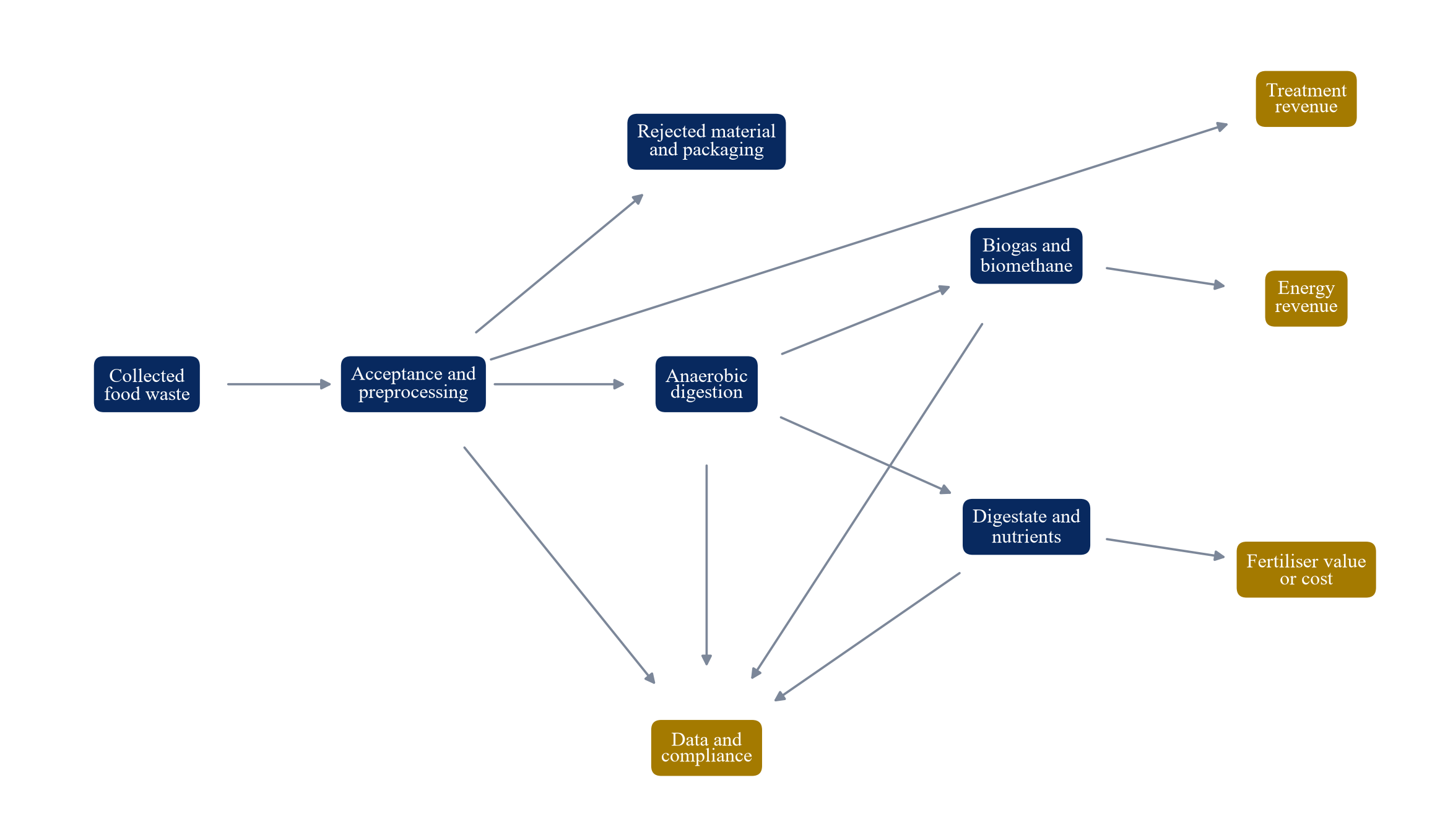
Proposed system map; actual routes, products and classifications depend on feedstock, permits, standards, technology and local markets.
5. Build the feedstock register
The feedstock register should identify every source, location, annual tonnes, weekly profile, container type, collection method, contract, current destination, contamination history and alternative outlet. Household collections, supermarkets, restaurants, food manufacturers and distribution centres require separate records.
Source-separated household waste may have high participation uncertainty during a new collection rollout. Manufacturing residues can be consistent but concentrated in a small number of counterparties. Commercial waste can change with customer turnover and enforcement. The register should preserve those distinctions through the financial model.
6. Verify source separation
Source separation affects product status and treatment cost. The Environment Agency's anaerobic-digestate resource framework applies to digestate produced from source-segregated biodegradable waste and sets conditions for end-of-waste treatment through PAS 110 and associated controls.[5] Feedstock provenance should therefore remain auditable from generator to output.
Contracts should define permitted materials, packaging, liquids, animal by-products, cleaning chemicals and contaminants. Acceptance rules should include sampling, quarantine, rejection, price adjustments and indemnities. Commercial teams should avoid selling capacity before the technical team confirms that the proposed stream can enter the permitted process.
7. Model collection as an operating system
Collection frequency, caddy use, liners, route density and participation determine delivered tonnes and contamination. A policy requirement to offer collection does not establish capture. The forecast should separate households or businesses served, participation, set-out rate, kilograms per participating unit and seasonal change.
The collection interface also influences carbon and cost. Long routes, partial loads and transfer stations can erode the energy benefit and the treatment margin. The plant should receive route, weight and contamination data at a frequency suitable for operational planning and contract settlement.
8. Measure feedstock quality
Representative sampling should measure total solids, volatile solids, chemical oxygen demand where relevant, methane potential, pH, nutrients, packaging, grit and inhibitory compounds. A single laboratory sample cannot describe a multi-year contract. Sampling should cover suppliers, seasons and collection changes.
Quality affects all three revenues. Highly biodegradable feedstock can raise gas output. Packaging can raise treatment effort and residue cost. Salt, metals, plastics or other contaminants can constrain digestate use. The commercial model should price these relationships explicitly.
9. Price the treatment service
Treatment revenue should compensate the plant for accepting a defined material and maintaining compliant capacity. The tariff can include a base fee per accepted tonne, depackaging supplement, contamination adjustment, minimum availability payment, haulage or transfer charge, indexation and change-in-law mechanism.
The US Environmental Protection Agency's survey of food-waste digesters found that 80 percent of 60 respondents collected tipping fees. Among 18 facilities reporting fee data, the 2023 median was USD 22.23 per ton and the average was USD 32.27 per ton.[6] These figures describe a limited US survey and should serve only as an identified benchmark. A project requires local bids, incumbent disposal costs and contract terms.
10. Separate delivered and accepted tonnes
Invoices should distinguish delivered weight from accepted treatment weight. The operator may reject an entire load, remove packaging or grit, or accept part of a load at a different fee. A delivered-tonne tariff without quality adjustment can transfer contamination cost to the project.
The treatment contract should specify the weighing point, calibration, sampling method, dispute process, tax treatment and payment timing. The financial model should match revenue recognition to those terms rather than to plant throughput alone.
11. Contract quantity bands
Quantity bands can provide capacity certainty while preserving waste-prevention incentives. A lower band can define the service level that the supplier expects the plant to reserve. An upper band can protect hydraulic, biological and storage limits. Deliveries outside the band require a planned commercial response.
The project should test supplier concentration. A high minimum from a single authority or food manufacturer may appear bankable, yet contract credit and termination exposure remain concentrated. A portfolio of smaller suppliers can diversify credit while increasing route and quality complexity.
12. Price contamination
Contamination pricing should reflect measurable costs. Packaging may require depackaging equipment, labour and disposal. Grit can damage pumps and reduce digester volume. Cleaning chemicals or incompatible wastes can upset biological performance. Rejected loads require compliant alternatives.
A contamination schedule should define thresholds and consequences. The first band may be included in the base fee. Higher bands can attract a surcharge, rejection or corrective action. Repeated non-compliance can trigger supplier remediation or termination. The operator should retain evidence sufficient to defend each adjustment.
13. Protect treatment-fee credit
The value of a treatment contract depends on counterparty credit, legal authority, term, termination rights, indexation and payment security. A public-sector counterparty may have strong payment capacity while retaining procurement and public-law constraints. A commercial supplier may offer better pricing and shorter commitments.
Security can include deposits, guarantees, parent support, direct agreements or shorter receivable cycles. Lenders should review whether the plant can replace a defaulted supplier, whether replacement feedstock carries comparable quality and whether the fee remains sufficient after transition.
14. Define the energy product
Biogas can be used in boilers, combined heat and power, upgraded to biomethane, compressed as vehicle fuel or sold through another eligible route. Each product requires different capital, efficiency, metering, connection and offtake. The project should select a base route and define optional conversion paths.
Onsite energy use can avoid purchased electricity or heat. Export requires a buyer and connection. Biomethane injection requires upgrading, compression, gas-quality compliance, metering and network capacity. A high headline gas price does not describe net realised value.
15. Forecast methane yield
The IEA assesses biogas suitability through feedstock-specific methane yield and identifies composition and quality as core economic variables.[2] A project forecast should use representative biological methane potential tests, supplier mix and process performance. It should include degradation, retention time, temperature, inhibition and downtime.
Methane yield should be expressed on a consistent basis. Wet tonnes, dry matter and volatile solids can produce different impressions. The model should reconcile received mass to measured biogas volume, methane concentration and usable energy after losses.
16. Account for parasitic energy
Receiving, depackaging, pumping, mixing, heating, pasteurisation, gas cleaning, upgrading, compression and digestate handling consume energy. Parasitic use changes with feedstock, ambient conditions, process design and product route. Net export should therefore sit below gross gas production in the model.
The plant should meter major consumption points. Operational reporting should distinguish gas produced, gas flared, gas used for process heat, electricity consumed, gas upgraded and energy exported. Unmetered balances weaken performance guarantees and revenue settlement.
17. Choose electricity and heat carefully
Combined heat and power can provide electricity and useful heat where stable demand exists. Heat value depends on location, temperature, load profile, backup and connection. A nominal heat offtake without a reliable user can overstate project efficiency and revenue.
Electricity export depends on grid capacity, curtailment, metering and price structure. Onsite use may have a different value because it avoids a retail purchase rather than earning a wholesale sale. The model should separate avoided cost from cash revenue.
18. Test biomethane injection
Biomethane can access a larger gas market when the plant is close to a suitable network. The IEA identifies grid proximity and connection cost as important factors in biomethane competitiveness.[3] Feasibility should cover pressure, capacity, gas quality, odorisation, propane enrichment where applicable, metering and outage arrangements.
The Green Gas Support Scheme provides payments for eligible biomethane injected into the British gas grid.[7] Current rates and eligibility should be taken from Ofgem's applicable tariff table and guidance.[8] The base case should distinguish market gas value from policy support and should model support expiry.
19. Treat support as a separate contract
Policy support has eligibility, audit, sustainability, reporting and timing conditions. The project should identify the responsible entity, evidence system, metering basis, claim period and remedy for non-compliance. Revenue should enter the model only when the project can meet those conditions.
The Green Gas Support Scheme Amendment Regulations 2026 were made on 23 September 2026 and include provisions affecting application and commissioning windows, with specified commencement dates after this paper's publication date.[9] Transaction documents should use the law and guidance effective at financial close.
20. Contract energy offtake
The energy offtake should define quantity, quality, delivery point, price formula, indexation, imbalance, curtailment, metering, credit support, force majeure and change in law. Merchant exposure can remain with equity or be limited through floors, hedges or shorter debt.
The operator should retain operational flexibility when a buyer or connection is unavailable. Gas storage is limited. Flaring may protect safety while destroying revenue and environmental performance. Backup heat or power use, maintenance coordination and network outage rules belong in the commercial design.
Table 1. Proposed three-revenue contract architecture
| Revenue line | Unit and evidence | Main counterparty | Core contract protection | Principal downside |
|---|---|---|---|---|
| Treatment service | accepted tonnes, quality records and availability | authority, waste collector or generator | quantity band, specification, indexation, credit support and change in law | lower capture, contamination, default or competing capacity |
| Energy or biomethane | net metered electricity, heat, gas or avoided purchase | utility, network, host user, fuel buyer or support administrator | connection, quality, price formula, metering, curtailment and audit | lower methane yield, parasitic load, outages, price or support expiry |
| Fertiliser or digestate | tonnes, nutrient analysis, product status and delivery evidence | farm, distributor, land manager or project user | specification, seasonal schedule, storage, transport and liability | contamination, weak demand, spreading limits or disposal cost |
Proposed framework; actual terms require jurisdiction-specific legal, technical, environmental, tax, procurement and credit review.
21. Define the digestate product
Digestate contains water, organic matter and nutrients that remain after digestion. It can be separated into liquid and solid fractions or processed further. Its commercial role depends on feedstock, treatment, stability, nutrient concentration, contaminants, product status and intended use.
The project should define whether digestate is a saleable product, a zero-price offtake, an avoided fertiliser purchase, a paid land-spreading service or a waste requiring controlled management. These cases have different accounting and credit implications.
22. Establish product status
In England, the Environment Agency resource framework describes conditions under which qualifying source-segregated digestate can achieve end-of-waste status, including PAS 110 requirements and contaminant controls.[5] Material outside the framework can remain waste and face different transport, storage and application rules.
The European Union Fertilising Products Regulation sets component-material and process conditions for digestate used in EU fertilising products.[10] It distinguishes fresh crop digestate and other digestate and contains input, process and stability requirements. A project should map the intended market to the applicable national and cross-border regime.
23. Test nutrient value
The fertiliser case should begin with laboratory evidence for total and available nitrogen, phosphorus, potassium, dry matter, organic matter, pH and other relevant properties. Nutrient value depends on crop need, application timing, soil condition, loss factors and competing fertiliser prices.
A nutrient replacement calculation should use the portion that the crop can use, rather than the gross nutrient content. It should deduct testing, storage, transport, spreading, compliance and any additional treatment. The buyer should receive a clear specification and application information.
24. Control contaminants
Physical contaminants can damage buyer confidence and constrain land use. Plastics, glass, metal and grit originate in collection and preprocessing. Chemical contaminants can arise from unsuitable inputs or cleaning practices. Biological risks require process and hygiene control.
Quality should be designed at the collection contract. The plant can remove part of the contamination, yet removal creates residue and cost. Supplier education, container design, inspections, sampling and price adjustments can have greater value than additional downstream separation.
25. Provide storage
Digestate is produced throughout the year while agricultural demand is seasonal and weather dependent. Storage therefore connects continuous plant operation to lawful and agronomically suitable application. The project should size storage for realistic closed periods, rainfall, maintenance and buyer scheduling.
Storage also affects emissions, odour, safety and nutrient retention. Covered systems and appropriate controls can reduce losses. Capital and operating costs belong in the fertiliser business case, even when tanks sit within the main plant budget.
26. Solve transport economics
Liquid digestate has a high water content. Transport cost can exceed nutrient value when buyers are distant or application rates are constrained. The project should map eligible land, road access, seasonal demand, storage and alternative outlets.
Separation, concentration, drying, pelletising or nutrient recovery can reduce transport burden and create different products. These processes consume capital and energy. The decision should compare delivered netback and operational reliability rather than headline product price.
27. Contract fertiliser demand
An offtake agreement should identify product specification, forecast quantity, minimum acceptance, delivery or collection, storage, testing, nutrient information, spreading responsibility, liability, price and remedy. A non-binding letter from a nearby farm provides limited bankability.
The buyer's demand should be tested against crop plans, land area, nutrient limits, existing manure and seasonal windows. The project should maintain alternative qualified routes and should avoid debt sizing that assumes an unproven premium product market.
28. Treat zero price as a real case
The IEA states that digestate can be sold as natural fertiliser in suitable locations and applications, while handling and disposal can remain costly.[3] The US EPA's AgSTAR handbook similarly observes that many projects receive little or no digestate-sale revenue.[11] These findings support a conservative base case.
A zero-price offtake can still create value if the buyer collects the material and assumes compliant use. A paid disposal route can be the prudent downside. The model should show all three cases with clear logistics and credit assumptions.
29. Avoid double counting
The same economic benefit can appear in several labels. A farmer may receive digestate and avoid mineral fertiliser purchases. If the project also records a fertiliser sale at the full avoided cost, the model can double count value. The contract should determine who owns the benefit.
Environmental attributes require similar discipline. Methane avoidance, renewable energy, low-carbon fuel value and fertiliser substitution may interact under different schemes. Each claim needs a legal basis, boundary, owner, measurement method and buyer.
30. Model the revenue stack
The financial model should calculate each revenue line from physical drivers. Treatment revenue equals accepted tonnes multiplied by the applicable tariff and quality adjustment. Energy revenue begins with feedstock, methane yield and conversion, then deducts losses and onsite use. Fertiliser value begins with compliant product tonnes and nutrient value, then deducts logistics and market cost.
Working capital should reflect billing cycles. Treatment invoices may settle monthly. Energy support can require verification. Fertiliser cash may be seasonal. A project with positive annual earnings can still require liquidity during collection ramp-up, biological stabilisation and delayed settlement.
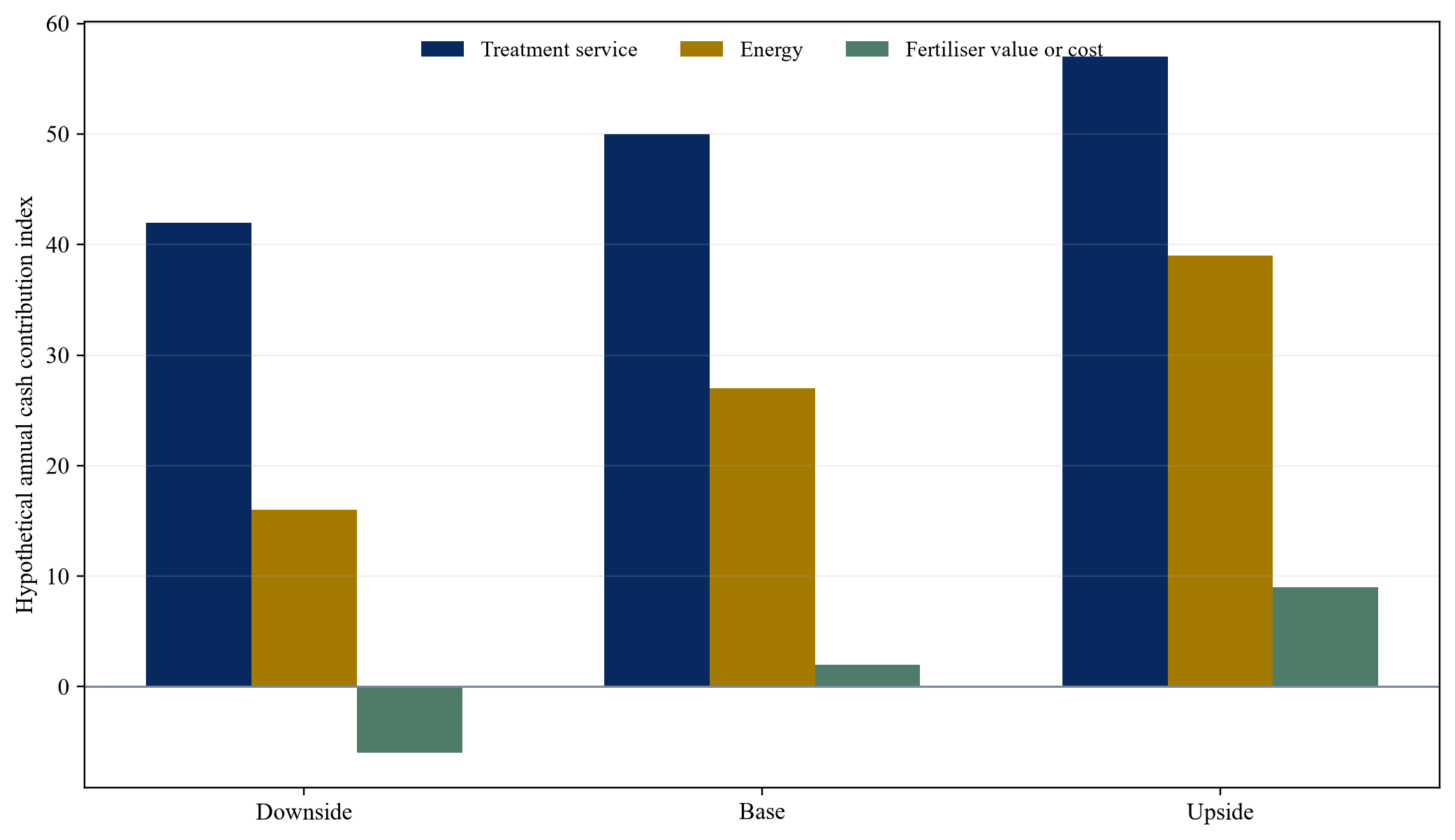
Illustrative scenario only; indexed values are not forecasts, valuations or transaction evidence.
31. Build the capital structure
Capital expenditure can include land, receiving, depackaging, pasteurisation, digesters, gas holders, upgrading or combined heat and power, grid or gas connection, digestate separation, storage, utilities, laboratory systems, development cost, contingency and financing cost. Each package should have a defined completion interface.
Debt should fit resilient cash flows and contract life. Treatment contracts can provide base coverage when credit and termination rights are acceptable. Energy contracts or support can add coverage. Uncontracted fertiliser premiums should remain an equity case until operating evidence and offtake establish durability.
Table 2. Hypothetical anaerobic-digestion sources and uses
| Uses | Amount | Sources | Amount |
|---|---|---|---|
| Site, receiving and preprocessing | 26 | Sponsor equity | 40 |
| Digestion and process systems | 48 | Senior project debt | 56 |
| Gas use, upgrading and connection | 25 | Equipment or vendor finance | 16 |
| Digestate storage and product systems | 14 | Public or climate support | 11 |
| Development, permitting and data | 9 | Contracting-authority contribution | 7 |
| Contingency, reserves and financing | 18 | Contingency facility | 10 |
| Total hypothetical uses | 140 | Total hypothetical sources | 140 |
Hypothetical indexed amounts; actual capital structure requires project-specific technical, legal, environmental, market and credit diligence.
32. Size debt to resilient cash
Debt sizing should use contracted treatment revenue, conservative net energy value and supportable digestate cost or value. It should test feedstock ramp-up, contamination, methane yield, availability, energy price, connection outages, storage and fertiliser logistics together.
Coverage ratios require a cash definition that includes working capital, lifecycle maintenance and required reserves. A maintenance deferral can increase short-term cash while weakening plant availability and permit compliance. The financing case should fund the operating system that preserves revenue.
33. Test treatment-volume sensitivity
Lower accepted tonnes reduce treatment revenue and can raise unit fixed cost. They may also reduce gas and digestate output. Higher tonnes can improve revenue until receiving, hydraulic, biological, gas or storage constraints cause inefficiency.
The model should test both volume and quality. A lower-tonnage stream with high methane potential can outperform a larger dilute stream in energy terms. A high-fee contaminated stream can underperform after depackaging and residue cost.
34. Test energy sensitivity
Energy downside should combine lower methane yield, lower availability, higher parasitic load, lower conversion efficiency, curtailment and price. Support revenue should be tested for delayed accreditation, audit adjustment and expiry. A single energy-price sensitivity misses operational dependencies.
The project should calculate break-even net export and the value of alternative routes. A gas-grid outage may favour onsite use or storage within limits. A failed heat buyer may remove both revenue and an efficiency assumption.
35. Test fertiliser sensitivity
The fertiliser case should test compliant sale, zero-price collection and paid management. It should vary nutrient value, product yield, storage days, haulage distance, spreading cost, seasonal restriction, rejection and additional processing.
The downside can affect plant continuity. Digestate storage that fills during wet weather can constrain feedstock acceptance and therefore treatment and energy revenue. The model should capture this physical link.
36. Combine downside cases
Revenue risks can occur together. A collection rollout can deliver lower tonnes and higher contamination. Biological instability can reduce gas while creating off-specification digestate. A weak agricultural season can increase storage and transport cost.
The combined case should estimate liquidity, debt service, covenant headroom and corrective action. Reserves and contingency should be tied to measured triggers rather than a generic percentage.
37. Allocate feedstock risk
The supplier controls source engagement, bins, collection and part of contamination. The operator controls acceptance, preprocessing and process operation. Policy and market changes can sit outside either party's direct control. Contracts should allocate each element to the party able to prevent, measure or mitigate it.
Quantity bands, quality adjustments, corrective plans and replacement rights can reduce disputes. Absolute guarantees can create liabilities that neither party can manage. Evidence and transparent measurement are central to allocation.
38. Allocate technology risk
The technology provider should warrant defined throughput, methane performance, availability, energy use, output quality and emissions under an agreed feedstock envelope. Tests should use representative material and sufficient duration to expose variability.
Security, liquidated damages, cure and support should match the loss created by underperformance. The operator retains responsibility for operating within specifications and maintaining the plant. The sponsor should coordinate interfaces among receiving, digestion, gas, connection and digestate packages.
39. Allocate product risk
Energy buyers should accept compliant product at the agreed delivery point, subject to defined curtailment and credit terms. Fertiliser buyers should accept compliant digestate or derivative products according to seasonal schedules and specifications.
The project retains risk for product that fails specifications within its control. Supplier indemnities may apply where prohibited inputs caused failure. Disputes require retained samples, chain of custody and agreed laboratories.
40. Protect environmental integrity
Biogas projects should control methane leakage, pressure releases, flare performance, digestate storage emissions, odour, water and nutrient application. The IEA identifies leak detection, covered storage and off-gas treatment as relevant measures.[12] These controls affect both environmental claims and operating cost.
The model should avoid crediting all captured methane as an environmental benefit without accounting for leakage and end use. Monitoring boundaries should match the claim or support mechanism.
41. Build the data architecture
The plant should create a linked record from supplier and load to process batch, gas output, digestate lot and invoice. Weighbridge, laboratory, supervisory-control, gas-meter, energy-meter and enterprise systems should use consistent identifiers.
Management reporting should reconcile mass, energy, nutrients and cash. Exceptions should identify missing data, meter failure, rejected material, inventory changes and timing. Lenders and public counterparties can use the same evidence for performance and audit.
42. Establish completion tests
Completion should require sustained operation across receiving, preprocessing, digestion, gas use and digestate handling. Tests should cover throughput, feedstock envelope, methane yield, availability, parasitic use, product quality, emissions, storage and settlement data.
Short tests with selected feedstock can overstate durable performance. The acceptance period should include representative suppliers and operating conditions. Failure should trigger cure, retest, price adjustment, support or restructuring.
43. Phase commercial ramp-up
Feedstock should ramp with biological capacity, staff competence, product routes and storage. Early suppliers can provide consistent material for commissioning. More complex or contaminated streams can enter after the plant demonstrates control.
Energy offtake and fertiliser trials should begin before full throughput. A plant that fills its receiving contract before proving gas and digestate routes can create operational congestion and working-capital pressure.
44. Use staged capital release
Development gates can cover feedstock evidence, permit pathway, site control, connection, product trials and commercial term sheets. Construction release should require executed core contracts, completed design interfaces, funded contingency and a credible completion plan.
Operating release can depend on performance tests, support registration, product status and qualified digestate routes. Refinancing should follow stable production, settlement and contract evidence.
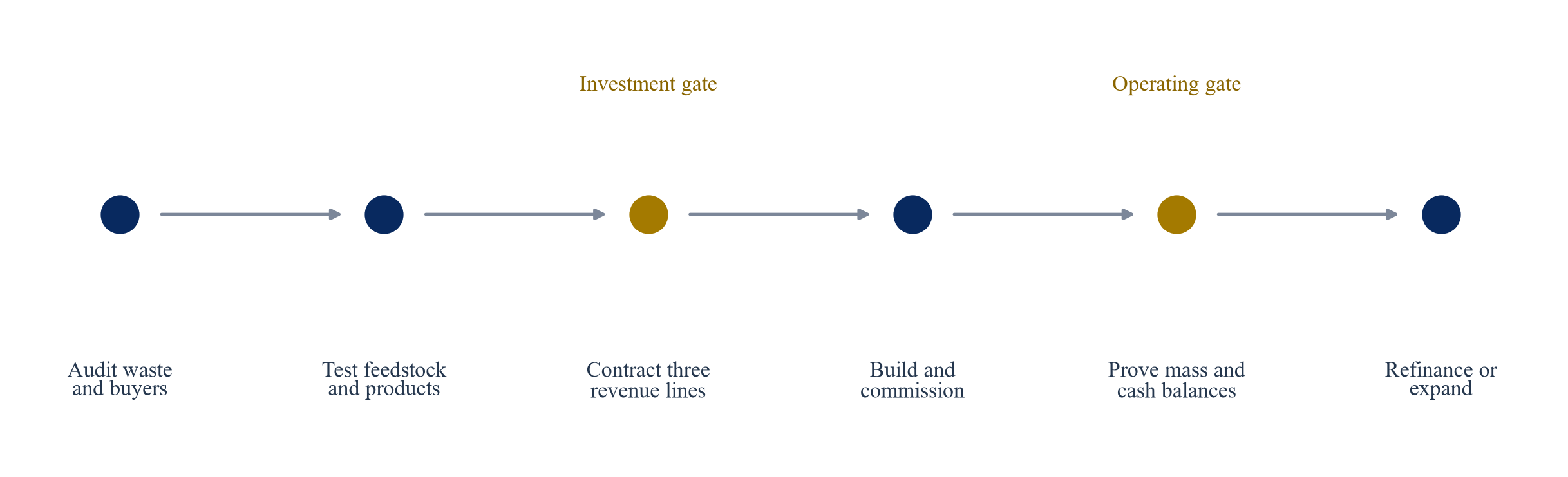
Proposed sequence; timing depends on collection, permits, feedstock, contracts, technology, connection and product qualification.
45. Monitor operating performance
The monthly pack should report delivered and accepted tonnes, suppliers, contamination, rejection, process input, volatile solids, biogas, methane, flaring, parasitic energy, net export, availability, digestate volume, product status, storage, dispatch, revenue and cash.
Variance should distinguish volume, quality, price, efficiency and timing. A treatment-fee gain can coincide with lower gas yield or higher residue cost. A fertiliser sale can coincide with increased processing and transport expense. Contribution accounts should reveal the net effect.
46. Plan lifecycle maintenance
Receiving and depackaging equipment can face abrasion and contamination. Digesters, mixers, pumps, gas-cleaning systems, engines, upgrading skids, compressors and storage require planned maintenance. Lifecycle replacement should sit in the cash model and reserve policy.
Availability guarantees usually decline after the initial warranty period. The operator should build maintenance capability and spares before vendor support expires. Debt tenor should remain within the period supported by feedstock, contracts and asset condition.
47. Plan for product-market change
Energy markets, support schemes and fertiliser prices can change during a plant's life. The project can retain options for combined heat and power, biomethane, local fuel, nutrient separation or product upgrading where physical design and permits allow.
Options have costs. Reserved space, pipework, electrical capacity and modular equipment can preserve flexibility. The investment committee should approve options with a clear trigger and budget.
48. Test expansion
Expansion should follow evidence from existing mass, energy and cash balances. Additional feedstock may require new receiving, depackaging, digestion, gas, storage and product capacity. The bottleneck can sit outside the digester.
The expansion case should assess marginal feedstock quality, collection radius, counterparty concentration and product demand. Existing performance should remain protected during construction and integration.
49. Define stop rules
Development should stop or change route when representative feedstock cannot support process performance, permits remain unavailable, connection cost destroys the energy case, digestate lacks a compliant outlet, or contract terms transfer unmanageable risk.
Operating stop rules can trigger feedstock restriction, temporary diversion, biological recovery, alternative product management or restructuring. These rules protect safety, compliance and liquidity.
50. Apply the investment-committee test
Approval should state the selected feedstock, treatment obligation, energy product, digestate route, capacity, capital, contracts, reserves and completion tests. It should identify which revenues support debt and which remain equity upside.
The final test is reconciliation. Accepted tonnes, organic conversion, gas, exported energy, digestate, residues, invoices and cash should form one auditable chain. A project with three revenue labels and incomplete evidence remains exposed to one physical system.
Table 3. Proposed food-waste project risk-allocation matrix
| Risk | Natural owner | Contract mechanism | Evidence for capital release |
|---|---|---|---|
| Collection and delivered quantity | supplier within control; sponsor for portfolio design | quantity bands, route data, replacement rights and rebasing | source register, rollout evidence and contracted suppliers |
| Contamination and prohibited inputs | supplier and operator within control | specification, sampling, rejection, price adjustment and indemnity | representative campaigns and agreed protocol |
| Biological and plant performance | operator and technology provider | performance guarantees, security, cure and liquidated damages | representative sustained completion tests |
| Energy connection and offtake | project company, network and buyer as allocated | connection agreement, quality, metering, curtailment and credit support | executed connection and offtake documents |
| Support eligibility | project company | eligibility conditions, audit covenant and reserve | confirmed route, evidence system and registration plan |
| Digestate product status | project company and operator | input control, process standard, testing and corrective action | approved pathway, trials and certification evidence |
| Fertiliser demand and logistics | project company and buyer as allocated | specification, seasonal schedule, storage, transport and alternatives | qualified land, product trials and executed offtake |
| Methane, odour and nutrient emissions | operator and project company | monitoring, operating limits, remediation and liability | approved monitoring plan and operating controls |
| Construction and integration | sponsor and package contractors | coordinated design, schedule, contingency and completion support | design freeze and funded completion plan |
| Working capital and ramp-up | sponsor and project company | reserve, staged contracts and draw conditions | integrated ramp-up and downside liquidity model |
Proposed framework; allocation requires project-specific legal, technical, environmental, procurement, market and credit review.
Conclusion
Food-waste anaerobic digestion can create treatment, energy and fertiliser cash flows. Each cash flow begins with the same feedstock and depends on a different contract and quality system. Treatment revenue reflects an essential service. Energy revenue reflects biological conversion, equipment, connection and market settlement. Fertiliser value reflects product status, nutrient evidence, storage, logistics and buyer demand.
The treatment contract commonly provides the first financing anchor. Net energy value can provide contracted or policy-supported cash when yield and connection are proven. Digestate should enter the base case at the value supported by product and offtake evidence, including a possible zero or negative value.
Sponsors can improve bankability through source-separated feedstock, quality pricing, representative tests, three contribution accounts, conservative debt sizing, sufficient storage, qualified alternatives and a linked data architecture. The project becomes auditable when every tonne, unit of energy, nutrient lot, invoice and cash receipt can be reconciled.
Investment-committee questions
1. Which food-waste sources are contracted, and which remain forecasts? 2. How do prevention and redistribution change available tonnes? 3. Which collection records support participation and capture? 4. What feedstock categories and contaminants are permitted? 5. How representative are composition and methane-potential tests? 6. Which tonnes earn the treatment fee: delivered, accepted or processed? 7. How do quantity bands preserve waste-prevention incentives? 8. Which contamination adjustments reflect measurable cost? 9. What supplier concentration and credit exposure remain? 10. Which energy product is the base route? 11. What net methane and export assumptions follow representative evidence? 12. Which connection, metering and curtailment terms apply? 13. Which support rules are effective at financial close? 14. What happens during a network or buyer outage? 15. Which digestate standard and product status apply? 16. What nutrient analysis supports buyer value? 17. How much storage is required through closed or wet periods? 18. Which land, transport and spreading routes are qualified? 19. Does the fertiliser base case assume sale, zero-price collection or paid management? 20. Are environmental attributes owned and measured without double counting? 21. Which revenue lines support debt service? 22. What combined downside creates the lowest liquidity? 23. Which completion tests use representative feedstock? 24. Can mass, energy, nutrients, invoices and cash be reconciled? 25. Which expansion, conversion or stop triggers have been approved?
References
- UK Department for Environment, Food and Rural Affairs, Simpler Recycling: Household Recycling in England, updated 13 May 2025. https://www.gov.uk/guidance/simpler-recycling-household-recycling-in-england
- International Energy Agency, Assessing the Sustainable Potential and Cost of Feedstocks for Biogas and Biomethane. https://www.iea.org/reports/outlook-for-biogas-and-biomethane/assessing-the-sustainable-potential-and-cost-of-feedstocks-for-biogas-and-biomethane
- International Energy Agency, Sustainable Supply Potential and Costs. https://www.iea.org/reports/outlook-for-biogas-and-biomethane-prospects-for-organic-growth/sustainable-supply-potential-and-costs
- UK Department for Environment, Food and Rural Affairs, Food and Drink Waste Hierarchy: Deal with Surplus and Waste, updated 1 January 2024. https://www.gov.uk/government/publications/food-and-drink-waste-hierarchy-deal-with-surplus-and-waste
- UK Environment Agency, Anaerobic Digestate: Resource Framework. https://www.gov.uk/guidance/anaerobic-digestate-resource-framework
- United States Environmental Protection Agency, Anaerobic Digestion Facilities Processing Food Waste in the United States, 2022 and 2023. https://www.epa.gov/anaerobic-digestion/anaerobic-digestion-facilities-processing-food-waste-us-2022-2023
- Ofgem, Green Gas Support Scheme and Green Gas Levy: Applicants. https://www.ofgem.gov.uk/environmental-and-social-schemes/green-gas-support-scheme-and-green-gas-levy/applicants
- Ofgem, Green Gas Support Scheme Guidance, updated 28 September 2026. https://www.ofgem.gov.uk/guidance/green-gas-support-scheme-guidance
- UK Government, The Green Gas Support Scheme Amendment Regulations 2026. https://www.legislation.gov.uk/uksi/2026/1051/made
- European Union, Regulation EU 2019/1009 Laying Down Rules on EU Fertilising Products, consolidated 17 November 2024. https://eur-lex.europa.eu/eli/reg/2019/1009/2024-11-17/eng/pdf
- United States Environmental Protection Agency, AgSTAR Project Development Handbook. https://www.epa.gov/sites/default/files/2014-12/documents/agstar-handbook.pdf
- International Energy Agency, Key Issues Affecting Biogas and Biomethane Projects. https://www.iea.org/reports/outlook-for-biogas-and-biomethane/key-issues-affecting-biogas-and-biomethane-projects
- UK Department for Environment, Food and Rural Affairs, Anaerobic Digestion: Farm Practices Survey February 2026, published 11 June 2026. https://www.gov.uk/government/statistics/farm-practices-survey-february-2026/anaerobic-digestion
- UK Government, The Separation of Waste England Regulations 2025: Impact Assessment. https://www.legislation.gov.uk/ukia/2025/30/pdfs/ukia_20250030_en.pdf
- Ofgem, Green Gas Support Scheme Tariff Table 2026 to 2027. https://www.ofgem.gov.uk/data/green-gas-support-scheme-tariff-table
- UK Department for Energy Security and Net Zero, Green Gas Support Scheme Annual Tariff Review 2025. https://www.gov.uk/government/publications/green-gas-support-scheme-ggss-annual-tariff-reviews-and-tariff-change-notices/green-gas-support-scheme-ggss-annual-tariff-review-2025
- European Commission, Fertiliser Action Plan, adopted 19 May 2026. https://agriculture.ec.europa.eu/common-agricultural-policy/agri-food-supply-chain/ensuring-availability-and-affordability-fertilisers_en
- United States Environmental Protection Agency, Project Planning and Financing for Anaerobic Digestion. https://www.epa.gov/agstar/project-planning-and-financing
- United States Environmental Protection Agency, The Benefits of Anaerobic Digestion. https://www.epa.gov/agstar/benefits-anaerobic-digestion
- United States Department of Energy, Generic Counterfactual Greenhouse Gas Emission Factor for Life-Cycle Assessment of Manure-Derived Biogas and Renewable Natural Gas, January 2025. https://www.energy.gov/sites/default/files/2025-01/generic-counterfactual-greenhouse-gas-emission-factor-for-life-cycle-assessment-of-manure-derived-biogas-and-renewable-natural-gas_010225.pdf
About the Author
Authored by Chennakeshav Adya Independent Researcher
Chennakeshav (CK) is a corporate finance and investment banking executive with 25+ years of global experience in deal origination, structuring and execution across M&A, growth capital and corporate strategy. He has led value-creation mandates for founders, corporates and funds — bridging the boardroom view to hands-on execution and close.
His career spans Morgan Stanley, HSBC, Lloyds Banking Group, EWEC, ADQ portfolio companies and Emirates Growth Fund, across TMT, real estate, fintech, deeptech, cleantech, infrastructure and energy. He has partnered with C-suite leaders, private equity and venture funds, sovereign wealth funds and family offices to finance complex fund raises and scale-up ventures, and has led M&A due diligence, post-merger integration and business-transformation initiatives to create value.
At Matchpoint Partners he is Managing Partner, leading the firm's corporate finance, M&A and capital-raising practice. He holds an MBA from London Business School, an engineering degree from VTU and a Master of Laws (LLM, in progress) from UCL London.
An active start-up mentor, CK mentors at Techstars, DIFC FinTech Hive, Startup Grind, Founder Institute and IN5, serves as Entrepreneur Mentor in Residence (EMiR) at London Business School, and judges the Entrepreneurship World Cup.
Matchpoint profile: https://www.matchpoint-partners.com/team/ck-adya.html LinkedIn: https://www.linkedin.com/in/ckadya/
