

1. Define the decision
A continuation transaction must answer three separate questions. First, does continued ownership offer a better risk-adjusted path than a sale, structured liquidity or orderly wind-down? Second, what price transfers the asset fairly between the existing fund and a new vehicle? Third, what governance permits the same sponsor to represent sellers, rolling investors and new buyers without allowing one constituency to subsidise another?
These questions become harder before market proof because the asset lacks recurring revenue, comparable exits or a reliable path to free cash flow. The process should therefore begin with an evidence inventory, an alternatives analysis and a conflict map rather than a target price.
2. Explain why the winner remains illiquid
Frontier-technology value can concentrate in a company that is technically advanced and commercially immature. The company may own scarce intellectual property, specialist talent, facilities, data or regulatory relationships. Its next milestone may unlock strategic value, but the milestone can require time and capital beyond the original fund term.
The illiquidity can reflect a financing gap rather than a weak asset. It can also conceal a failing thesis. The continuation decision must distinguish duration created by valuable experimentation from duration created by repeated missed milestones. A longer runway has value only when current evidence supports a credible route to de-risking and eventual liquidity.
3. Separate fund-life pressure from asset value
The expiry of a fund does not determine the value of a portfolio company. It changes the owner's constraints. Selling investors may prioritise cash and finality. Rolling investors may accept duration. New investors may demand a return that compensates for technical, financing and governance risks. The sponsor may seek more time, fees and carried-interest potential.
Pricing should not convert the seller's time pressure into an unsupported discount or convert the sponsor's optimism into an unsupported premium. The transaction model should show enterprise value, transfer price, net proceeds, reinvestment, follow-on reserves and expected outcomes separately for each constituency.
4. Define market proof
Market proof is not one event. It can include a validated technical system, repeatable manufacturing yield, regulatory permission, customer acceptance, contracted deployment, reliable unit economics and collected cash. Different frontier technologies reach these states in different sequences.
A satellite company may prove orbit performance before scaled manufacturing. A battery company may show cell performance before bankable warranty data. A quantum company may improve logical performance before a commercial workload is economical. The valuation should identify the precise proof still missing, the evidence needed to obtain it, the capital required and the probability-weighted time to resolution.
5. Use a multidimensional readiness map
NASA's technology-readiness scale describes maturation from basic principles to an operational system [1]. GAO treats readiness assessment as a systematic, evidence-based process and stresses the importance of demonstration in a relevant environment [2]. Investment decisions require additional dimensions because technical maturity does not establish commercial or financial viability.
The framework therefore scores technology, manufacturing, regulatory, customer, commercial and financing readiness separately. It records evidence, owner, test conditions, date, remaining gap and dependency. A composite score can hide the weakest link; the valuation should retain each dimension and model the bottleneck directly.
Table 1. Frontier-technology continuation-fund evidence ladder
| Evidence dimension | Verified state | Contingent state | Valuation consequence | Required challenge |
|---|---|---|---|---|
| Technology | Independent test against defined performance criteria | Laboratory claim, simulation or unreplicated result | Support only the demonstrated capability; price remaining performance as an option | Technical expert review, test protocol and failure analysis |
| Manufacturing | Qualified process, measured yield and repeatable output | Pilot line, unqualified supplier or unproven scale | Reflect capex, yield ramp, scrap and schedule in cash flows | Site review, supplier evidence and capacity reconciliation |
| Regulatory | Applicable approval, licence or accepted pathway | Early engagement, incomplete submission or uncertain classification | Model approval timing and failure separately | Regulatory counsel and precedent analysis |
| Customer | Paid trial, accepted deployment or binding contract | Letter of intent, pilot discussion or strategic interest | Separate contracted cash from pipeline and option value | Customer confirmation, acceptance terms and credit review |
| Financing | Committed capital sufficient to reach a defined milestone | Indicative interest or unfunded plan | Deduct financing need and model dilution and failure risk | Sources-and-uses, syndicate capacity and downside runway |
The ladder is a valuation-control framework. Company-specific evidence and probabilities require direct verification.
6. Distinguish capability from company value
A verified capability is an input to value, not the value itself. The company must also control the relevant intellectual property, retain the team, access necessary supply chains, fund the next programme and convert performance into customer benefit. Technical superiority can coexist with weak economics or a blocked route to market.
The valuation should link each capability to a right, cost, timetable and customer use. It should identify whether value belongs to patents, know-how, facilities, data, licences, contracts or human capital. This prevents a continuation price from capitalising scientific progress that the company cannot exclusively commercialise.
7. Identify the valuation unit
The transaction may involve one company, several related holdings, preferred securities, shareholder loans, warrants, special-purpose vehicles or contractual rights. The valuation unit should match the interest being transferred and the rights a market participant would price.
Preferred terms can materially change outcomes when value is below, near or above the preference stack. Debt, liquidation preferences, anti-dilution, participation, conversion and pay-to-play provisions should be modelled explicitly. A headline enterprise value does not show what the selling fund, rolling investors and continuation vehicle actually receive.
8. Build the rights waterfall
The model should reconstruct the capital structure security by security. It should include senior debt, venture debt, convertibles, preference multiples, accrued dividends, participation, common equity, options and management incentives. Every scenario should allocate proceeds through this waterfall.
This exercise can reveal that the original fund's apparent ownership differs from its economic share. It also shows how new money changes priorities and dilution. The continuation transaction should disclose any reset, rollover, strip sale or incentive pool that changes relative outcomes among selling, rolling and new investors.
9. Calibrate to the last orderly transaction
IPEV describes calibration as the process of ensuring that a valuation technique reproduces fair value at entry using contemporaneous market inputs [3]. A recent financing round can therefore anchor the analysis when it was orderly, arm's length and representative of the interest being valued.
The last round should not remain the answer by default. The valuer should update performance, financing conditions, rights, market inputs and elapsed time. A round led by an insider, tied to strategic rights, structured as rescue capital or too small to establish price may require adjustment or rejection as a calibration point.
10. Backtest prior valuations
Backtesting compares prior fair-value estimates with later transactions or outcomes and explains differences using information known or knowable at the earlier date [3]. It is particularly important when the sponsor proposes transferring an asset it has valued for several reporting periods.
The committee should review forecast accuracy, milestone timing, financing need, dilution, customer conversion and previous valuation changes. Persistent optimism, delayed impairments or unexplained method changes should influence governance and scenario weights. Backtesting is a control over the process and an input to the risk premium.
11. Define the status quo
Limited partners need a genuine basis for comparison. The status quo may be continued ownership in the existing fund, a term extension, a distribution in kind, a sale, a partial liquidity solution or a wind-down. Each route has different costs, timing, tax, governance and execution risks.
ILPA guidance emphasises a clear commercial rationale and meaningful options for investors [4]. The transaction memorandum should present the status quo in operational detail, including capital requirements and consequences. A nominal option that cannot be implemented does not provide a useful benchmark.
12. Map conflicts before choosing advisers
The sponsor can sit on both sides of the transfer, influence valuation, select advisers, negotiate new economics and earn future fees and carried interest. Management may receive new incentives. A lead buyer can seek preferential rights. Existing investors may have different liquidity needs and information access.
The conflict map should identify decision rights, economic benefits, relationships, expense allocation and information asymmetries. It should be reviewed before adviser appointment because adviser selection, scope and compensation can themselves affect independence. The map should be updated when terms change.
13. Establish independent challenge
Independent challenge can include the limited partner advisory committee, independent counsel, valuation specialists, technical experts, fairness analysis and competitive price discovery. No single mechanism substitutes for a coherent process. The role of each adviser should be defined, including client, duty, scope, fee source and access to information.
ILPA states that the advisory committee should be able to obtain independent legal and specialist advice in complex or conflicted transactions [5]. Independence should be assessed in substance, including prior relationships, contingent fees and reliance on sponsor-provided assumptions.
14. Design meaningful sell and roll choices
Selling investors need a cash price, timing, expenses and certainty. Rolling investors need the new vehicle's terms, governance, duration, reserve policy, tax treatment and expected dilution. Both groups need enough time and information to decide.
The process should avoid coercive features such as compressed deadlines, unequal disclosure, punitive rollover terms or a default that disadvantages non-responding investors. Elections should be supported by consistent data and a clear explanation of differences. The sponsor should record how the process treats investors that cannot roll for policy, regulatory or allocation reasons.
15. Set the measurement date
Fair value is measured at a date. Frontier-technology evidence can change sharply after a test, financing round, regulatory decision or customer award. The transaction should identify the measurement date, information cut-off, subsequent-event policy and price-adjustment mechanism.
Long signing-to-closing periods can create value transfer. A milestone achieved after pricing but before closing may benefit the buyer; a failed test may burden it. The parties can use closing accounts, milestone adjustments, earn-outs, contingent value rights or termination conditions. Each mechanism should be modelled and disclosed.
16. Separate observed value and option value
Observed value is supported by current rights, assets, contracts and demonstrated performance. Option value depends on future events. The model should show these components rather than embedding both in a single multiple.
Option value can be estimated through probability-weighted scenarios, decision trees or option methods where inputs are supportable. The output should remain transparent. The committee should understand the milestone, probability, investment, time, dilution and payoff behind each option. Unsupported terminal value should not become a substitute for missing evidence.
17. Build the milestone tree
The milestone tree starts with the current verified state and branches at events that change value materially. Examples include prototype validation, manufacturing yield, certification, customer acceptance, contract conversion and refinancing. Each branch should state the decision, capital and time required.
Branches should include technical success with commercial failure, technical delay with strategic sale, financing failure and orderly wind-down. Correlations matter because one event can affect several milestones. The tree should avoid multiplying independent probabilities when the underlying risks share one cause.
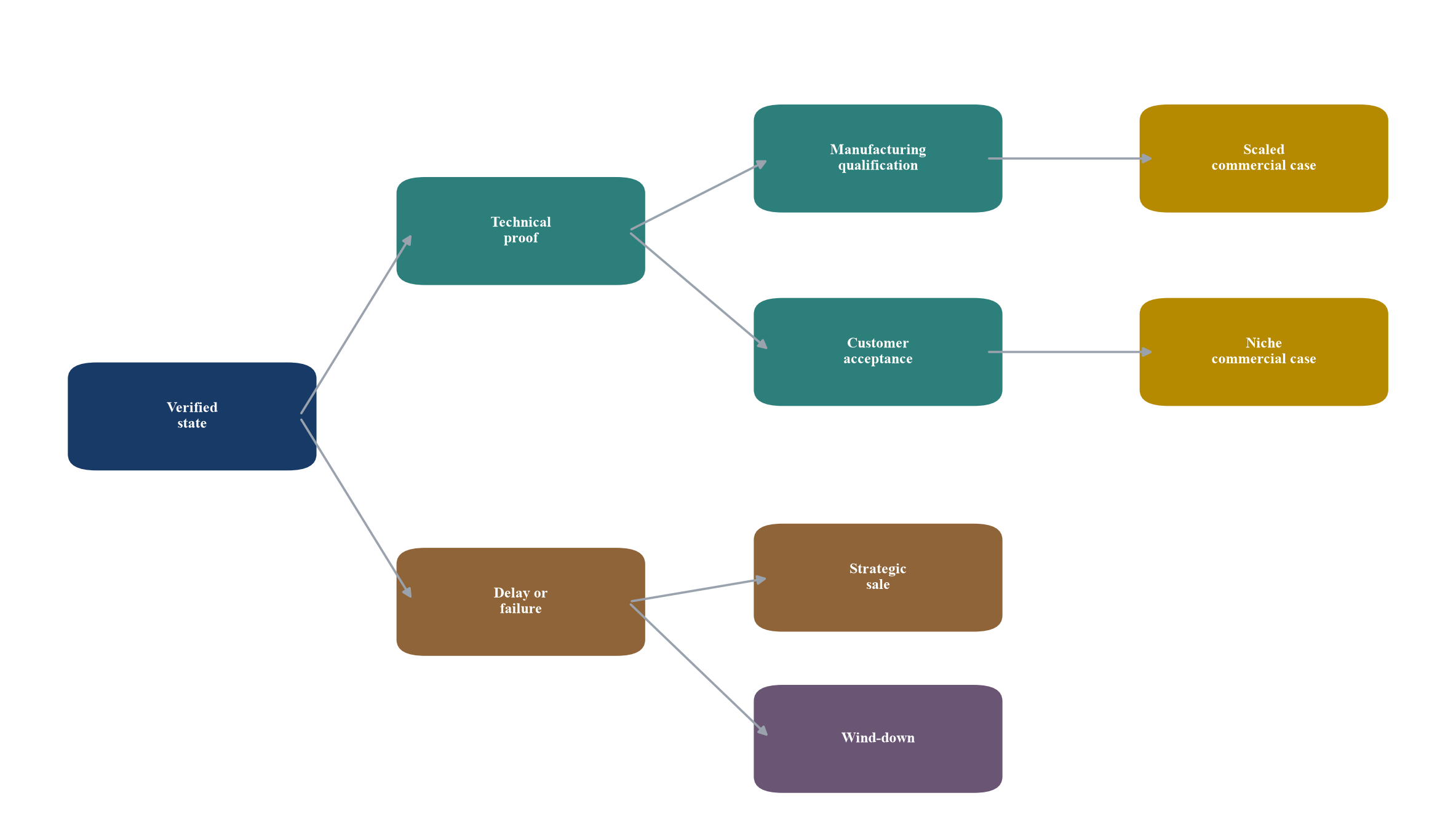
Probabilities and values are hypothetical management assumptions used only to demonstrate the framework.
18. Estimate probability from evidence
Scenario probability should reflect the quality and relevance of evidence. Independent replication, representative operating conditions, customer acceptance and repeated manufacturing results should carry more weight than internal targets. The team should document the basis, date and owner of each probability.
Expert judgement remains necessary, but it should be elicited and challenged systematically. Technical, commercial and financial experts can estimate ranges separately before a reconciliation session. The record should preserve disagreements. A consensus number without an audit trail can create false precision.
19. Model time as a value driver
Time affects discounting, fund expenses, financing need, competitive position and the probability that a technology becomes obsolete. A delayed success can be worth less even if the final technical result is unchanged. The model should therefore treat time as a scenario variable rather than a fixed assumption.
Milestone dates should be connected to engineering plans, regulatory pathways, procurement schedules and customer decisions. A schedule reserve should reflect uncertainty. The continuation vehicle's term and extensions should cover the downside path, not just the sponsor's base case.
20. Model financing need before return
Frontier-technology assets often consume cash before market proof. The continuation price is only one use of funds. The vehicle may need reserves for research, pilot manufacturing, equipment, certification, working capital and follow-on rounds.
The model should show sources and uses through the next value-inflecting milestone and through self-sufficiency or exit. An attractive transfer price can still produce a poor return if unfunded needs cause emergency dilution. A credible financing plan should include syndicate capacity, instrument terms, covenant headroom and downside runway.
21. Price dilution explicitly
Future capital can dilute the continuation vehicle through new shares, convertibles, warrants, option pools or recapitalisation. Scenario returns should model ownership after each financing rather than assume a constant percentage.
The dilution analysis should include participation rights, pay-to-play provisions and the cost of defending ownership. It should identify which investors can or must provide follow-on capital. If the continuation vehicle lacks reserves, the price should reflect the risk that another investor captures the value of later de-risking.
22. Value technical debt and rework
A prototype can meet a performance target while remaining expensive, fragile or difficult to manufacture. Technical debt includes undocumented design choices, non-scalable components, incomplete software, reliability gaps and dependence on scarce personnel. Rework can consume time and capital before commercial deployment.
Technical diligence should estimate the cost and schedule required to reach a maintainable product. The valuation should deduct this burden or include it in scenarios. A milestone that demonstrates possibility does not necessarily demonstrate repeatability, quality or economic production.
23. Model manufacturing scale-up
Manufacturing risk includes yield, throughput, supplier qualification, tooling, quality control, warranty and capacity. Unit cost often changes nonlinearly during scale-up. The model should separate laboratory output, pilot output and qualified volume production.
The European Innovation Council focuses on deep-technology companies from prototype through deployment and uses milestone-based follow-on investment [6]. A continuation vehicle can adopt the same discipline by releasing reserves against defined evidence. Manufacturing assumptions should reconcile physical capacity, labour, materials, cycle time and cash.
24. Model regulatory pathways
Regulatory pathways differ across biotechnology, medical devices, energy, aerospace, defence, quantum encryption and advanced materials. Approval timing can depend on classification, study design, evidence quality and regulator capacity. The transaction should not treat regulatory progress as a generic probability.
Counsel and subject-matter experts should define the pathway, submissions, decision points, dependencies and post-approval obligations. Scenario value should reflect the right geography and intended use. A licence in one market may not support commercialisation elsewhere.
25. Assess intellectual-property durability
Patents, trade secrets, data, software and know-how can support value when the company owns or controls them. Diligence should verify chain of title, employee and contractor assignments, licences, government rights, university obligations, freedom to operate and remaining term.
The analysis should distinguish a broad blocking position from a narrow implementation claim. It should also consider detectability and enforcement cost. Intellectual property with uncertain ownership or limited commercial relevance should not receive a strategic premium merely because it is scientifically sophisticated.
26. Test team concentration
Frontier-technology value can depend on a small group of founders, scientists and engineers. The continuation vehicle extends the holding period and can intensify retention risk. The model should identify critical roles, replacement time, incentives, vesting, non-compete constraints where applicable and succession.
Management incentives proposed alongside the transaction should be assessed for value transfer and alignment. A refreshed plan may be necessary, but it should be sized against dilution, performance and market practice. Existing investors should see its impact in every scenario.
27. Test customer evidence
Customer evidence should be classified by economic commitment and acceptance. A discussion, memorandum, letter of intent, paid trial, development agreement, purchase order and accepted recurring deployment carry different weight. The model should not convert pipeline into contracted revenue without stated probabilities and timing.
Customer diligence should verify budget, authority, technical criteria, integration burden, procurement, cancellation and concentration. A strategic customer can validate technology while negotiating economics that limit wider adoption. The continuation thesis should connect technical success to repeatable customer value.
28. Test market size and adoption
Large top-down market estimates can obscure the narrow segment a product can serve at its current performance and price. The model should begin with use cases, buyer requirements, switching costs, deployment capacity and procurement cycles. It should distinguish total market, serviceable market and capacity that the company can actually deliver.
Adoption scenarios should include competitive response, substitute technologies and price erosion. An early lead may create strategic value, but the continuation period can also allow incumbents or alternative architectures to close the gap.
29. Test unit economics before scale
Unit economics should include direct materials, yield loss, labour, energy, cloud cost, service, warranty, logistics, royalties and customer-support burden. Gross margin based on pilot production or engineering allocations may not represent scaled economics.
The model should bridge current cost to target cost through verifiable drivers. Learning curves, volume discounts and design changes should have owners and milestones. A valuation that requires simultaneous technical success, perfect yield and premium pricing should disclose that compound dependency.
30. Select valuation methods
Relevant methods can include recent transactions, market approaches, income approaches, replacement cost, scenario-weighted present value and option methods. Method choice should reflect the asset's stage, rights and available evidence. Several methods can provide a range and expose sensitivities.
IPEV's central principle is fair value at each measurement date using market-participant assumptions [3]. The committee should avoid method shopping. Changes in method should follow changes in facts or evidence, with a reconciliation to the prior valuation.
Table 2. Valuation-method selection before market proof
| Method | Useful evidence | Principal weakness | Appropriate control |
|---|---|---|---|
| Recent transaction and calibration | Orderly financing with comparable rights and informed participants | Round may be stale, structured, insider-led or tied to strategic rights | Adjust for elapsed evidence, rights, market inputs and financing context |
| Market approach | Comparable companies or transactions with explainable differences | Sparse observations and wide differences in maturity, rights and economics | Use ranges, reconcile metrics and disclose adjustments |
| Scenario-weighted income approach | Milestone tree, cash flows, capital needs, dilution and timing | High sensitivity to probabilities, terminal value and discount rate | Independent assumption review, sensitivities and backtesting |
| Replacement-cost approach | Identifiable assets, facilities, data and development effort | Cost may not equal utility, exclusivity or commercial value | Test obsolescence, ownership and economic usefulness |
| Option approach | Defined technical or commercial options with staged investment | Inputs can create false precision and overlook financing constraints | Show the underlying scenarios and reconcile with simpler methods |
Method weights are company-specific and require documented judgement; no method removes the need for evidence and conflict controls.
31. Use market comparables carefully
Frontier-technology comparables often differ in maturity, capital intensity, regulation, geography, rights and funding environment. A public company may have liquidity, diversified revenue and access to capital that the target lacks. A strategic acquisition may include synergies unavailable to a financial buyer.
The analysis should state the comparable metric and adjustment rather than present a broad multiple range as evidence. Negative revenue or EBITDA may require operating metrics, but those metrics must link to economic value. Patent counts, technical performance or contracted capacity can inform comparison only when definitions are consistent.
32. Build scenario cash flows
Each scenario should include milestone dates, capital expenditure, operating cost, revenue, margin, tax, working capital, financing and exit. Cash flows should follow physical and contractual reality. The model should allow technical success with commercial delay and commercial interest with financing failure.
Discount rates should reflect the risk remaining after scenario probability. The team should avoid double counting by applying severe probabilities and an unexplained premium for the same risk. The output should show present value, required capital, ownership and investor return by scenario.
33. Treat terminal value as a claim
Terminal value can dominate a pre-commercial valuation. It should be treated as a claim requiring evidence about sustainable economics, market position and capital intensity. The model should disclose how much value comes from the explicit forecast and how much from the terminal period.
Multiple and growth assumptions should reconcile with mature economics and comparable businesses. A terminal value that assumes market leadership before the company has customer acceptance should receive explicit challenge. Exit costs, dilution and preference rights should be deducted before calculating investor proceeds.
34. Reconcile enterprise value to transfer price
Enterprise value is not the continuation-fund purchase price. The bridge should include debt, cash, preference rights, transaction expenses, escrows, contingent consideration and any stake retained by the selling fund. It should also show the portion sold, rolled or distributed.
The transfer price should be tested against the consideration received by each group. Sponsor reinvestment, management rollover and buyer incentives can affect alignment. Any discount or premium should have an economic explanation tied to rights, liquidity, control or process evidence.
35. Separate price from process fairness
A price within a valuation range can still arise from an unfair process. A robust process can still produce a low price when risk and capital need are high. The decision record should assess both dimensions independently.
IOSCO identifies valuation ambiguity and conflicts between existing and new investors as continuation-fund risks, and notes that independent valuation, unaffiliated investors or auctions can mitigate conflicts [7]. These measures should be designed around the asset rather than used as procedural decoration.
36. Run competitive price discovery
Price discovery can include an auction, limited process, lead-buyer negotiation, third-party tender or independent valuation. The method should reflect confidentiality, technical diligence burden, financing certainty and market depth. A narrow buyer universe may be rational for sensitive technology, but it increases the need for independent challenge.
The data room should give qualified buyers consistent information. Bid instructions should distinguish price, rollover, governance, reserves, conditions and certainty. The sponsor should document excluded bidders and any relationship with the selected buyer.
37. Evaluate the lead investor
The lead continuation investor can validate price and provide governance, reserves and sector expertise. It can also negotiate preferential economics that reduce comparability with the headline price. Side letters, stapled commitments, future-fund allocations and co-investment rights should be disclosed and valued.
The committee should assess the lead's diligence, funding certainty, conflicts and ability to support follow-on capital. A high headline price paired with fee offsets or valuable strategic rights may produce lower effective consideration.
38. Assess fairness analysis
A fairness opinion can address whether consideration is fair from a financial point of view under stated assumptions. It does not replace technical diligence, commercial underwriting or an alternatives analysis. Its scope, information reliance, fee structure and limitations should be understood.
The opinion should be one input to a broader record. The transaction should disclose whether the provider also advised on the sale, raised the continuation vehicle or expects future work. Independent technical and valuation work may be especially important before market proof.
39. Set reserve policy
The continuation vehicle should define how much capital is reserved, for what milestones, under whose control and with what consequences if reserves prove insufficient. Reserves should cover the downside path and portfolio concentration rather than only the base plan.
The policy should distinguish committed, discretionary and contingent reserves. It should state whether investors can be called for additional capital, whether recycling is permitted and how unfunded obligations affect distributions. A reserve shortfall should be visible in the pricing model.
40. Stage capital against evidence
Capital staging links funding to evidence. Tranches can depend on technical tests, manufacturing qualification, regulatory progress, customer acceptance or syndicate participation. Milestones should be objective, measurable and within management's influence where possible.
Poorly drafted milestones can create disputes or encourage gaming. The vehicle should define test conditions, independent verification, cure periods and partial outcomes. It should also preserve discretion to stop investing when expected value deteriorates, even if a narrow milestone is met.
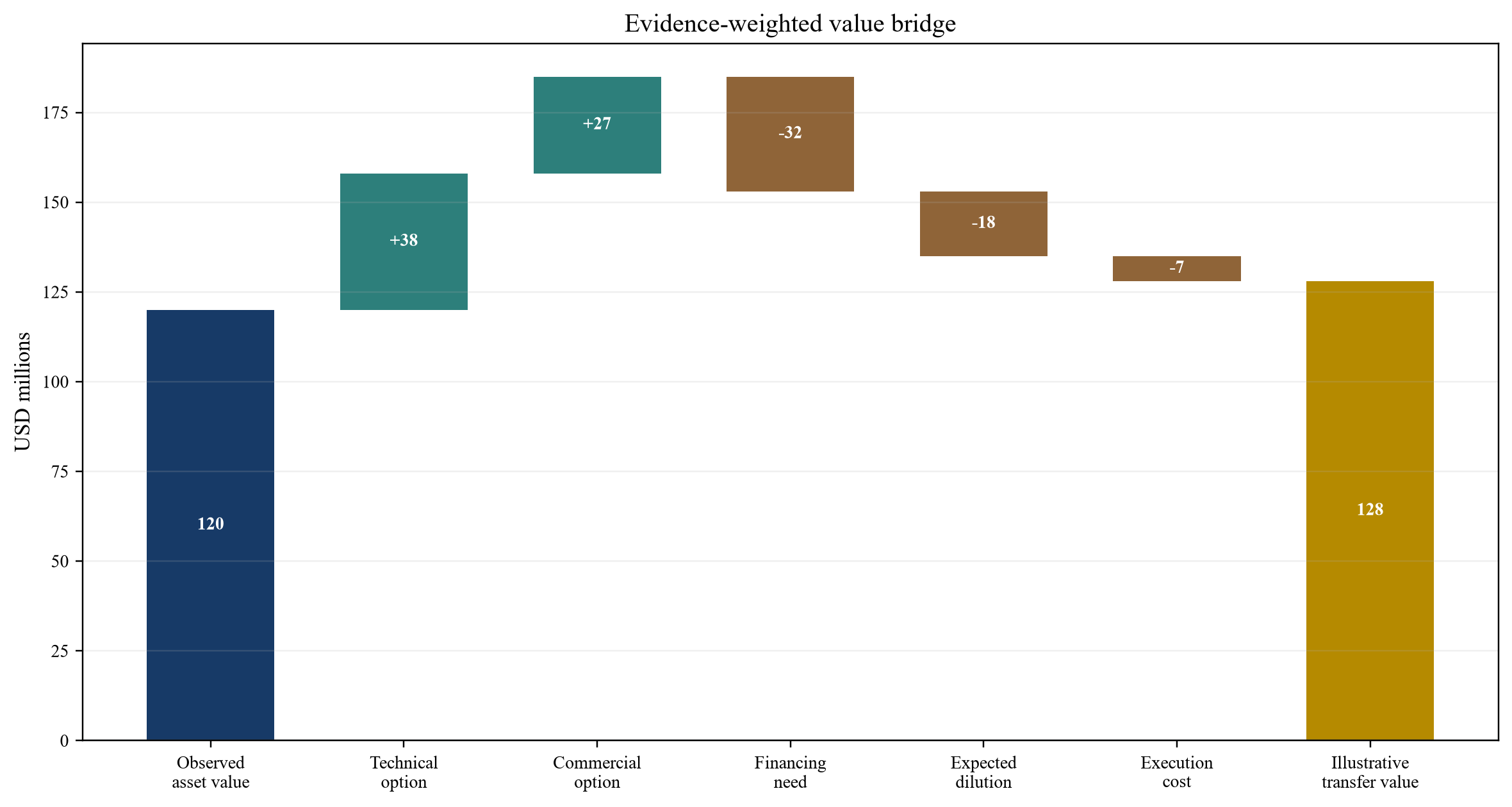
Values are hypothetical management assumptions in USD millions and demonstrate reconciliation only.
41. Design the continuation vehicle
The vehicle's life, investment period, extensions, governance, fees, carry, hurdle, recycling and borrowing should match the asset's evidence path. A structure copied from a mature buyout continuation fund may not fit a pre-commercial technology company with repeated financing needs.
The vehicle should state how expenses are allocated between the selling fund, rolling investors and new investors. It should also address broken-deal costs, technical diligence, insurance, tax structuring and future transactions. Terms should be presented in a comparison against the existing fund.
42. Reset economics transparently
New management fees and carried interest can be justified by additional work and risk, but they create direct conflicts. The transaction should show sponsor economics under sale, rollover and continuation scenarios. Existing accrued carry, crystallisation and any reset should be explained.
Rolling investors should understand whether value created before transfer is subject to new carry. New investors should understand the sponsor's reinvestment and incentive. Fee offsets, transaction fees and monitoring fees should be disclosed consistently.
43. Allocate transaction expenses
Expenses can materially affect net proceeds and effective price. The schedule should include advisers, legal, tax, valuation, technical diligence, financing, insurance, administration and placement costs. It should identify which vehicle or investor group bears each amount.
Expense allocation should follow disclosed principles and avoid shifting buyer costs to sellers without justification. Caps, approval thresholds and post-closing reconciliations can strengthen control. The final election materials should show expected and maximum net proceeds.
44. Govern inside information
Frontier-technology diligence can involve export-controlled information, classified work, sensitive customer data, patent strategy and unpublished test results. The process needs access controls, clean teams, confidentiality terms and cyber security proportionate to the information.
Restricted disclosure can reduce price discovery. The sponsor should explain what buyers and investors could review, how advisers validated withheld information and whether asymmetry affected bids. Legal restrictions should be separated from sponsor preference.
45. Address national-security constraints
Investment screening, export controls, foreign-ownership limits and strategic-technology policy can restrict buyers or governance rights. These constraints can change liquidity, financing and exit value. The continuation vehicle should map relevant jurisdictions, investors, technologies and control rights.
The valuation should reflect a market-participant pool permitted to transact. A strategic premium from an ineligible buyer is not executable value. Conditions, timing and mitigation obligations should enter the closing and downside scenarios.
46. Assess tax and legal continuity
Transfer structure can trigger tax, consent, licence, change-of-control or contractual consequences. The analysis should identify asset transfers, share transfers, partnership-interest transfers, blocker entities and rollover mechanics. Tax treatment can differ among selling and rolling investors.
The legal review should verify authority under fund documents, advisory-committee rights, investor consents and fiduciary obligations. A technically efficient structure should not obscure economic changes. Investors need a clear comparison of old and new rights.
47. Design governance after closing
The continuation vehicle may need board representation, reserved matters, information rights, technical committees and approval of related-party transactions. Governance should reflect concentration and uncertainty. It should also allow timely operating decisions.
The board should receive an evidence dashboard covering technical, manufacturing, regulatory, commercial, financing and liquidity milestones. Material deviations should trigger re-underwriting. Governance should preserve a documented route to sell, syndicate, stop or wind down.
48. Establish valuation governance
Post-closing valuation should follow a written policy with method selection, calibration, backtesting, independent review and escalation. The same evidence map used at entry should support subsequent measurement. Changes in assumptions should reconcile to events and market inputs.
The valuation committee should be sufficiently independent from the deal team and compensation outcome. Third-party work should have a defined scope. Limited partners should receive enough information to understand method, key inputs and change drivers without compromising protected technology.
49. Report evidence, not narrative
Reports should distinguish achieved milestones, pending work, missed dates and revised plans. They should quantify capital consumed, remaining runway, ownership, dilution and reserve coverage. Technical claims should identify test conditions and independent verification.
Narrative can explain context, but it should not replace reconciled data. The reporting package should preserve prior targets so investors can see slippage and learning. A change in milestone definition should be explicit.
50. Protect liquidity at vehicle level
The vehicle needs liquidity for portfolio funding, expenses, debt service and contingencies. A concentrated asset can consume more capital after adverse evidence. The manager should maintain a rolling sources-and-uses schedule across base, delay and failure cases.
Borrowing can bridge timing but may increase loss severity and constrain decisions. Any NAV facility, subscription line or asset-level debt should be modelled with covenants, maturity and enforcement. Liquidity policy should specify minimum cash and escalation thresholds.
51. Design exit pathways
Potential exits include strategic sale, sponsor-to-sponsor sale, public listing, structured secondary, licensing, asset sale, merger, distribution in kind and wind-down. The likely route depends on proof, buyer universe, capital need and policy constraints.
The vehicle should maintain more than one executable path. A strategic sale may offer the highest value but require regulatory clearance. A public listing may require scale and predictability. A licensing transaction may preserve option value while reducing capital. Exit readiness should be reviewed at each milestone.
52. Trigger a sale process
A sale trigger can arise from milestone achievement, buyer interest, financing need, competitive change, fund-life limits or deterioration in expected value. The manager should define the evidence that warrants market testing and the authority to begin.
Waiting for perfect proof can destroy value if the company runs short of cash or the competitive window closes. Selling too early can surrender upside. The trigger framework should compare expected value, capital at risk, time and execution probability at each decision point.
53. Trigger a stop decision
Continuation capital should remain conditional. Stop triggers can include failed replication, inability to manufacture, loss of key rights, regulatory blockage, customer rejection, financing failure or a superior substitute. The vehicle should specify who can stop and how assets are preserved.
A stop decision can still maximise value through patents, data, equipment, team placement or licensing. The wind-down plan should be prepared before distress. It should include employee, customer, regulatory and security obligations.
54. Measure realised learning
Frontier-technology programmes generate information even when milestones fail. The investment committee should ask whether new evidence increases or decreases expected value and whether further capital has positive incremental value. Sunk cost should not determine the decision.
The evidence register should record hypothesis, test, result and implication. This supports disciplined follow-on decisions and improves future underwriting. It also helps distinguish productive delay from repeated rationalisation.
55. Run sensitivities that change decisions
Sensitivities should test probability, time, capital, dilution, price, margin, terminal value and exit multiple. They should also test correlated changes, such as technical delay causing both additional capital and later customer adoption. The purpose is to identify decision thresholds.
The committee should see the transfer price at which new investors earn the target return, the reserve required to survive downside and the milestone probability needed to justify continued ownership. These thresholds support negotiation and governance.
Table 3. Hypothetical continuation-fund return scenarios
| Scenario | Probability | Transfer price | Follow-on capital | Exit proceeds to vehicle | Holding period | Gross multiple |
|---|---|---|---|---|---|---|
| Technical and commercial success | 25% | 128 | 45 | 520 | 6 years | 3.01x |
| Technical success, niche adoption | 30% | 128 | 35 | 265 | 7 years | 1.63x |
| Delay and strategic sale | 25% | 128 | 28 | 155 | 5 years | 0.99x |
| Financing failure and asset sale | 20% | 128 | 12 | 48 | 3 years | 0.34x |
All values are hypothetical management assumptions in USD millions except multiples and probabilities; they are not observed market data or forecasts.
56. Compare investor elections
The seller compares cash proceeds with continued exposure and reinvestment opportunities. The rolling investor compares old and new terms, tax, duration, capital calls and expected return. The new investor compares the transaction with alternative investments. One headline valuation cannot answer all three decisions.
Election materials should provide comparable cash-flow views. They should show fees, carry, expenses, dilution and timing. The sponsor should not describe rollover as economically neutral when rights or economics change.
57. Apply five transaction gates
The transaction should pass five gates: commercial rationale, evidence-supported value, process integrity, funded continuation plan and fair investor choice. Failure at one gate should pause or redesign the transaction.
Each gate should have an owner, evidence pack, independent challenge and recorded decision. The board and advisory committee should receive exceptions rather than a polished summary alone. Conditions approved at one stage should be tested again before closing.
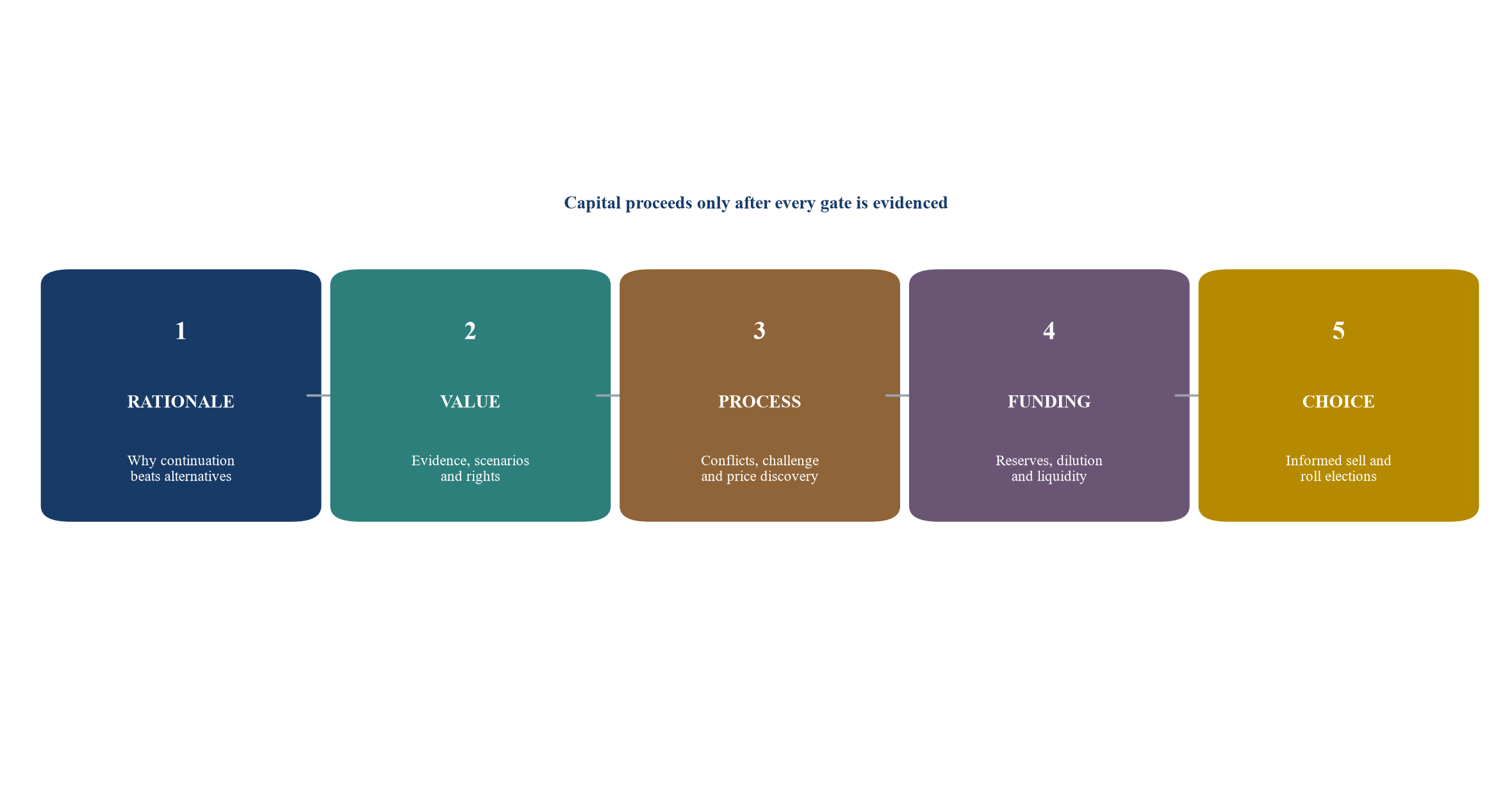
Each gate requires current evidence and a recorded decision.
58. Build the decision record
The record should include alternatives, conflicts, adviser mandates, evidence maps, valuation methods, scenarios, bids, committee materials, investor disclosures, elections and closing adjustments. It should show what was known, who challenged it and why the final terms were selected.
The record supports accountability and future backtesting. It should be complete enough for a new committee member, auditor or investor to reconstruct the decision. Protected technical information can be stored under appropriate controls while the decision logic remains accessible.
59. Use a ninety-day execution plan
The first thirty days should establish the conflict map, alternatives, evidence register, capital structure and adviser scope. The next thirty should complete technical, commercial, legal and valuation work while testing buyer interest. The final thirty should reconcile bids, terms, reserves, governance and investor disclosures.
Timing should expand when diligence requires it. ILPA highlights the harm caused by compressed review periods [4]. The plan should protect informed elections and permit independent advisers to complete their work. Urgency created by an avoidable late start should not be transferred to investors.
Table 4. Ninety-day frontier-technology continuation-fund execution plan
| Period | Core work | Decision output | Principal control |
|---|---|---|---|
| Days 1-30 | Alternatives, conflicts, evidence map, rights waterfall, financing need and adviser mandates | Approved transaction rationale and diligence plan | Advisory-committee engagement and independent adviser access |
| Days 31-60 | Technical, manufacturing, customer, regulatory, valuation and market work | Evidence-weighted valuation range and buyer feedback | Consistent data room, expert challenge and backtesting |
| Days 61-75 | Bid comparison, structure, reserves, governance, expenses and tax | Selected proposal and documented basis | Effective-price reconciliation and conflict review |
| Days 76-90 | Disclosure, sell and roll elections, financing confirmation and closing conditions | Informed elections and closing approval | Adequate review time, final evidence update and decision record |
Timing is illustrative and should expand for technical complexity, regulatory review and investor approval requirements.
60. Conclusion
A frontier-technology continuation fund can preserve valuable upside when technical progress extends beyond the original fund life. The structure also concentrates conflicts, uncertainty, capital need and duration. A defensible transaction must therefore connect price to verified evidence and process fairness to independent governance.
The Evidence-Weighted Continuation Fund Framework separates current capability from contingent option value, models financing and dilution, reconciles rights, tests alternatives and provides meaningful sell and roll choices. Its purpose is disciplined decision-making before market proof. The sponsor earns the right to continue ownership by demonstrating why the asset, price, funding plan and process serve investors under realistic success, delay and failure cases.
References
- National Aeronautics and Space Administration. Technology Readiness Levels. September 2023. https://www.nasa.gov/directorates/somd/space-communications-navigation-program/technology-readiness-levels/
- United States Government Accountability Office. Technology Readiness Assessment Guide: Best Practices for Evaluating the Readiness of Technology for Use in Acquisition Programs and Projects. GAO-16-410G. August 2016. https://www.gao.gov/products/gao-16-410g
- International Private Equity and Venture Capital Valuation Board. IPEV Valuation Guidelines 2025. December 2025. https://www.privateequityvaluation.com/Valuation-Guidelines
- Institutional Limited Partners Association. Continuation Funds: Considerations for Limited Partners and General Partners. May 2023. https://ilpa.org/resources-tools/resource-library/continuation-funds-considerations-for-limited-partners-and-general-partners/
- Institutional Limited Partners Association. Continuation Funds: Independent Counsel and Specialist Advisor to the LPAC. May 2023. https://ilpa.org/wp-content/uploads/2023/05/Continuation-Funds-Considerations-for-Limited-Partners-and-General-Partners.pdf
- European Innovation Council. EIC Fund Investment Guidelines and Approach. August 2026. https://eic.ec.europa.eu/eic-fund/eic-fund-investment-guidelines-approach_en
- International Organization of Securities Commissions. Thematic Analysis: Emerging Risks in Private Finance. FR10/23. September 2023. https://www.iosco.org/library/pubdocs/pdf/IOSCOPD745.pdf
- International Private Equity and Venture Capital Valuation Board. Frequently Asked Questions. https://www.privateequityvaluation.com/FAQs
- Institutional Limited Partners Association. Continuation Vehicles. https://ilpa.org/industry-guidance/principles-best-practices/continuation-funds/
- Institutional Limited Partners Association. Continuation Fund Disclosure Template. June 2026. https://ilpa.org/industry-guidance/principles-best-practices/continuation-funds/
- International Financial Reporting Standards Foundation. IFRS 13 Fair Value Measurement. https://www.ifrs.org/issued-standards/list-of-standards/ifrs-13-fair-value-measurement/
- Financial Accounting Standards Board. Accounting Standards Codification Topic 820, Fair Value Measurement. https://asc.fasb.org/topic&trid=2127586
- International Organization of Securities Commissions. Principles for the Valuation of Collective Investment Schemes. May 2013. https://www.iosco.org/library/pubdocs/pdf/IOSCOPD413.pdf
- European Innovation Council. About the EIC Fund. https://eic.ec.europa.eu/eic-fund/about-eic-fund_en
- European Innovation Council. EIC Fund Trusted Investor Network Charter: Frequently Asked Questions. https://eic.ec.europa.eu/eic-fund-trusted-investor-network-charter-frequently-asked-questions_en
- European Commission. EIC Work Programme 2026. https://eic.ec.europa.eu/document/download/52598755-1351-4b54-b46b-e2682d0a3aec_en
- National Aeronautics and Space Administration. Technology Readiness Level Definitions. https://www.nasa.gov/pdf/458490main_TRL_Definitions.pdf
- National Aeronautics and Space Administration. Systems Engineering Handbook. https://www.nasa.gov/reference/systems-engineering-handbook/
- United States Government Accountability Office. Cost Estimating and Assessment Guide. GAO-20-195G. https://www.gao.gov/products/gao-20-195g
- United States Government Accountability Office. Schedule Assessment Guide. GAO-16-89G. https://www.gao.gov/products/gao-16-89g
- Institutional Limited Partners Association. ILPA Principles 3.0. https://ilpa.org/industry-guidance/principles-best-practices/
- Institutional Limited Partners Association. Model Limited Partnership Agreement. https://ilpa.org/model-limited-partnership-agreement/
- Institutional Limited Partners Association. Quarterly Reporting Standards Initiative. https://ilpa.org/reporting-template/
- United States Securities and Exchange Commission. Private Fund Advisers. https://www.sec.gov/investment/private-fund-advisers
- United States Securities and Exchange Commission. Investment Adviser Fiduciary Duty Interpretation. July 2019. https://www.sec.gov/files/rules/interp/2019/ia-5248.pdf
- Financial Conduct Authority. Review of Valuation Processes for Private Market Assets. March 2025. https://www.fca.org.uk/publications/multi-firm-reviews/valuation-processes-private-market-assets
- European Securities and Markets Authority. Guidelines on Performance Fees in UCITS and Certain Types of AIFs. https://www.esma.europa.eu/document/guidelines-performance-fees-in-ucits-and-certain-types-aifs
- Organisation for Economic Co-operation and Development. Financing Growth and Turning Data into Business. https://www.oecd.org/finance/
- European Investment Bank. EIB Venture Debt. https://www.eib.org/en/products/equity/venture-debt/index.htm
- European Investment Fund. Technology Transfer and Venture Capital. https://www.eif.org/what_we_do/equity/
- World Intellectual Property Organization. IP Due Diligence. https://www.wipo.int/sme/en/ip_business/valuation/
- United States Patent and Trademark Office. Intellectual Property and Technology Transfer Resources. https://www.uspto.gov/ip-policy
- Committee on Foreign Investment in the United States. CFIUS Overview. https://home.treasury.gov/policy-issues/international/the-committee-on-foreign-investment-in-the-united-states-cfius
- United Kingdom Government. National Security and Investment Act Guidance. https://www.gov.uk/government/collections/national-security-and-investment-act
- European Commission. Foreign Direct Investment Screening. https://policy.trade.ec.europa.eu/enforcement-and-protection/investment-screening_en
- United States Bureau of Industry and Security. Export Administration Regulations. https://www.bis.gov/regulations/ear
- International Organization for Standardization. Innovation Management, ISO 56000 family. https://www.iso.org/committee/4587737.html
- Project Management Institute. Practice Standard for Project Estimating. https://www.pmi.org/standards
- International Valuation Standards Council. International Valuation Standards. https://www.ivsc.org/standards/
- European Private Equity and Venture Capital Association. Invest Europe Professional Standards Handbook. https://www.investeurope.eu/industry-professional-standards/professional-standards/
About the Author
Chennakeshav (CK) is a corporate finance and investment banking executive with 25+ years of global experience in deal origination, structuring and execution across M&A, growth capital and corporate strategy. He has led value-creation mandates for founders, corporates and funds — bridging the boardroom view to hands-on execution and close.
His career spans Morgan Stanley, HSBC, Lloyds Banking Group, EWEC, ADQ portfolio companies and Emirates Growth Fund, across TMT, real estate, fintech, deeptech, cleantech, infrastructure and energy. He has partnered with C-suite leaders, private equity and venture funds, sovereign wealth funds and family offices to finance complex fund raises and scale-up ventures, and has led M&A due diligence, post-merger integration and business-transformation initiatives to create value.
At Matchpoint Partners he is Managing Partner, leading the firm's corporate finance, M&A and capital-raising practice. He holds an MBA from London Business School, an engineering degree from VTU and a Master of Laws (LLM, in progress) from UCL London.
An active start-up mentor, CK mentors at Techstars, DIFC FinTech Hive, Startup Grind, Founder Institute and IN5, serves as Entrepreneur Mentor in Residence (EMiR) at London Business School, and judges the Entrepreneurship World Cup.
