

1 Define the first payment decision
A developer considering construction before the first presale needs to know whether the next committed bill can be paid through an authorised route. The relevant decision is specific: approve an early-works package, limit its scope, change its funding terms or defer it until usable finance is evidenced. The proposed assessment starts with the payment calendar and follows the money needed for each obligation. It identifies the party that supplies cash before the lender's reimbursement, the account from which payment may be made and the documents required to release the subsequent financing amount. A signed construction programme and a committed facility enter different parts of that assessment.
This paper studies a deliberately narrow case with no buyer receipts during the modelled horizon. It assumes that construction payments fall due before each month's reimbursement arrives. The sequence exposes a timing requirement that an aggregate sources-and-uses calculation can omit. Opening equity and eventual senior receipts may equal the total construction budget while leaving a contractor unpaid on an earlier date. The framework therefore calculates both the cash position immediately after each bill and the position after the subsequent lender receipt. Each amount is attached to a defined event and an explicit permission assumption.
The first-payment decision also requires a boundary around future exposure. An early package may involve mobilisation, excavation or other works whose interruption creates additional obligations. The team should document the approved scope, the amount irrevocably committed, the next decision point and the cost of stopping. This paper proposes a funding procedure for that bounded scope and a separate review of remaining completion obligations. It provides no conclusion that a project should commence merely because one invoice can be paid. The board needs sufficient evidence for the whole approved package and a documented response if the expected draw, approval or presale fails to arrive.
2 Establish the research and evidence boundary
The source review covers Dubai Land Department operating guidance, Abu Dhabi Real Estate Centre materials, development-property valuation standards, accounting guidance and project-finance publications [1–12]. They have different functions. Government materials describe published legal or administrative conditions. RICS materials supply valuation context. IFRS guidance addresses a defined cash-presentation question. World Bank and IFC publications provide financing and sponsor-assessment context. The numerical model is independently constructed for this paper. Its assumptions have no claimed statistical relationship to UAE loan terms, typical approval delays or observed construction expenditure.
The analytical contribution combines the permission sequence with an event-ordered liquidity calculation. Cost eligibility, first-draw conditions and reimbursement lag are separately parameterised, allowing a reviewer to identify the dependency responsible for a deficit. Construction finance, escrow administration and sponsor support already appear in the cited literature. This bounded review establishes no claim that the method is unprecedented or that no comparable research exists. Its practical value rests on transparent definitions, reproducible arithmetic and documentary questions suitable for an actual transaction. A consented project dataset would be needed to assess how often the identified failure occurs.
The paper distinguishes documented public conditions from proposed transaction controls and fictional modelling inputs. The controls are recommendations for organising a diligence and financing discussion. They become binding only through the relevant approval or executed contract. A live analysis should preserve the evidence date, applicable entity and outstanding qualification for every material input. An application awaiting approval should remain conditional in the model. A management forecast should retain its assumption status. The model should show the resulting cash consequences without silently upgrading either item into an established receipt. These distinctions allow the investment committee to understand the basis and limitations of each decision presented for approval.
3 Separate six financing events
The proposed evidence sequence contains six events: project registration, permission for sale or marketing where applicable, financing deposited into the designated account, activation of the disbursement mechanism, authority for a particular construction payment and satisfaction of the lender's draw conditions. Each event needs its own supporting record. The presence of one record should not be used to populate all six statuses. An approved project can still have an unresolved payment request. A funded account can still contain balances subject to restrictions. A facility can still require an independently certified paid invoice before reimbursement.
For each event, the team should record the responsible authority or contractual party, relevant document, amount covered, effective date and outstanding conditions. The funding calendar should then attach each proposed transfer to the event that permits it. A payment expected on a particular day may depend on both the trustee's instruction and the lender's availability test. The reviewer should retain both dependencies, identify their sequence and avoid treating parallel workstreams as completed approvals. This procedure is intended to expose the exact missing evidence when a scheduled transfer remains uncertain.
The resulting schedule can be used to divide an early-works package into funded and conditional portions. An amount supported by current cash and confirmed payment authority may be considered separately from an amount dependent on a later approval. The commercial decision can then specify a spending limit and a reapproval trigger rather than relying on one overall funding label. The approach also gives advisers a concrete work product: a reconciled transfer map with document references and dated action owners. Initial financing deposits require their own contractual lender conditions. The final box in Figure 1 concerns subsequent reimbursement after payment. The project location, account arrangement and executed documents determine the applicable route.
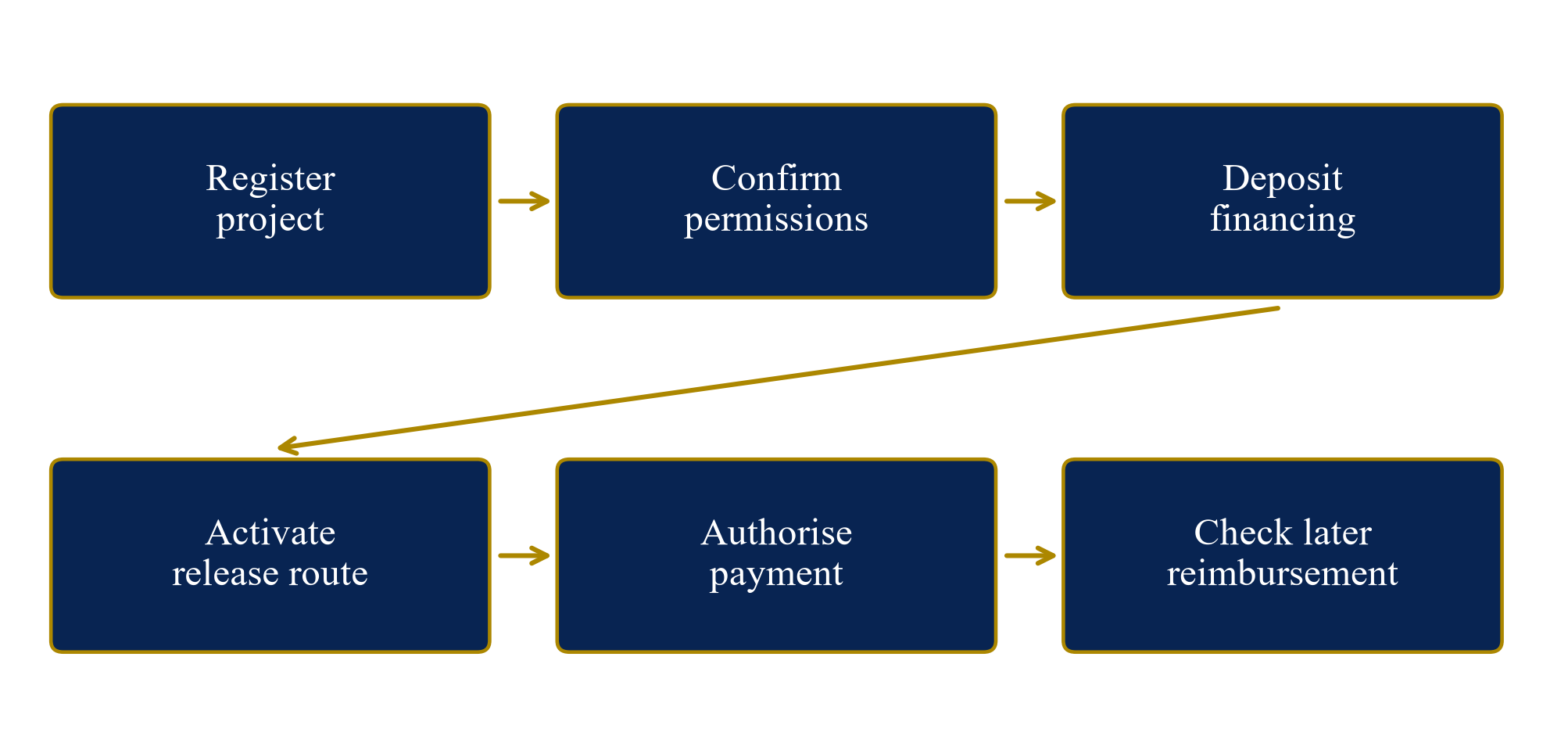
Author-developed framework. Each box requires project-specific evidence; the diagram gives no automatic entitlement to draw or release funds.
4 Read Dubai registration and activation separately
Dubai Land Department's Register Project service lists project review and escrow opening within the registration process. Its published construction-related alternatives include 30% completion, a construction-cost bank guarantee or an equivalent cash deposit. Required records include a final building permit and master-developer consent addressing off-plan sale and marketing [1]. These service conditions supply registration context. They establish no universal 30% sponsor-equity contribution or lender advance rate. The financing team should obtain the approval relevant to its own project and record the specific route used.
The separate escrow-activation service requires an application, trustee review and approval or rejection. Published routes distinguish bank guarantees, deposited developer contributions, deposited mortgage financing and financial solvency after the stated construction threshold. Its technical-report condition specifies three months [2]. The service description refers to an off-plan sold project. Its applicability to a project with no executed presale cannot be verified from that public description alone. Written confirmation is therefore an input to a live no-presale case. The fictional model assumes a permitted financing-payment route solely to isolate cash timing.
An actionable review should set out the precise question for the trustee and legal adviser. It should identify the current project status, source of deposited money, proposed recipient and construction purpose, then ask which release approval applies before the first sale. The response should be preserved with its conditions and date. An account-opening record should not replace that response. Where confirmation is outstanding, the spending decision should either rely on separately confirmed available funds or remain conditional. The team should also distinguish a stated administrative service time from an evidenced project approval date; the former does not establish that its own complete application will produce cash on the planned invoice date.
5 Keep deposits and financing settlement distinct
The Dubai mortgage-deposit service lists a financing contract, bank undertaking, bank consent, active-project status and a technical report within four months. Financing-instalment settlement has separate completion-funding and account conditions [3]. Those conditions concern different cash movements. The deposit of financing, the release of construction payments and the settlement of financing instalments should therefore occupy separate lines in the proposed transaction schedule. The activation service's three-month report condition and this service's four-month condition should retain their respective scope.
Dubai Land Department's FAQ describes a construction-milestone process involving the trustee agreement, a payment request and engineering verification before authorised disbursement [4]. The published explanation supports investigating the milestone and payment sequence. It supplies no assumed 80% reimbursement percentage or unconditional entitlement to withdraw a loan deposit. In the worked case, the lender reimbursement rule is invented. A real agreement may instead fund eligible certified work directly, require prior payment or impose additional retention and availability conditions. The team should translate the executed wording into dated cash events before modelling the first draw.
The proposed account reconciliation records unrestricted operating cash, deposited financing awaiting payment authority, approved transfers awaiting processing and amounts already paid to contractors. Each balance should identify its account and permitted use. Recording a loan both as an undrawn commitment and as an existing deposit would double-count funding. Recording approved payment authority as a completed transfer would advance the receipt date without bank evidence. A reconciled schedule should preserve the difference between expected processing and a cleared payment. This makes the model useful for daily execution and provides a traceable basis for checking why a cash balance changed between two reporting dates.
6 Assess Abu Dhabi early release within its conditions
ADREC's published compilation includes Law 2/2025's amended Article 19 and Administrative Decision 24/2025. The amendment restricts escrow uses and excludes land price and broker commissions. The decision provides a Centre-approved bank-guarantee route before 20% construction completion, subject to developer eligibility and discretionary exemptions. The guarantee minimum is 20% of construction cost, with specified technical evidence and callable terms. Early return includes at least 60% completion and adequate remaining-work funds [5]. The compilation also reproduces legacy provisions. This discussion refers specifically to the amendment and decision; their Gazette publication date and applicability to a particular no-presale project remain unverified.
ADREC's Project Development overview presents registration, off-plan permissions, escrow management and progress reporting as distinct services [6]. For a live early-works financing case, the adviser should establish which service, approval and operative text govern the proposed transfer. The team should ask whether the specific developer qualifies, whether any exemption is required and which application records can be supplied before sales commence. The worked figures in this paper assume no approved statutory guarantee route. They illustrate lender reimbursement timing independently of any actual guarantee approval or its economics.
A bank guarantee requires its own commercial review. The sponsor should obtain evidenced issuance conditions, collateral requirements, fees, claim mechanics and expiry provisions. Any cash collateral should enter a separate restricted-balance schedule and affect available sponsor liquidity. A guarantee should not be entered as a construction receipt merely because its face value has been agreed. The lender should also establish how a claim or replenishment obligation interacts with its own security and remaining funding. These are proposed diligence questions, not findings about an inspected guarantee. The decision to rely on early release requires project-specific confirmation from the relevant authority and transaction advisers.
7 Define the funded construction perimeter
Before building a draw model, the sponsor should specify the works being financed and identify every obligation attached to that scope. The fictional case includes AED 120 million of eligible construction payments over six months. It excludes land purchase, selling commissions, financing charges, taxes, utility obligations, post-completion defects and final senior principal repayment. These exclusions isolate the reimbursement mechanism. A real project must add each applicable obligation with its due date and funding treatment. The illustrative AED 120 million should never be presented as a complete all-in project budget.
Eligibility should be determined cost by cost. A contract sum, consultant invoice, equipment deposit and disputed variation may have different treatment under the financing documents. The proposed schedule identifies the gross cash payable, the amount accepted as eligible, certification requirements, prior-payment requirements and the resulting reimbursement amount. It should also record taxes, retention and excluded expenditure separately. A lender's agreement to fund a percentage of eligible costs can leave a larger sponsor requirement when actual payable costs contain exclusions. The case assumes full eligibility to make that relationship transparent before introducing further complexity.
The evidence perimeter should include cancellation and interruption costs. An early package that can be stopped after one certified milestone has a different exposure from an order requiring the full purchase price despite construction suspension. The team should ask the contractor to identify binding payment dates and termination consequences, then reconcile these with technical advice and the draw agreement. The proposed investment approval should specify which commitments may be entered and which remain conditional. This work gives the board a documented exposure limit and a dated funding requirement. It does not estimate an actual contractor's willingness to accept deferred payment or the cost of changing an existing contract.
8 Translate invoices into an event ledger
The central proposed data structure is an event ledger containing invoice issue, contractual due date, payment authority, actual payment, certification, draw notice, lender approval and receipt. Several events may occur on the same day; their ordering still matters when one is a condition of another. If reimbursement requires a paid invoice, the first payment must be funded from another usable source. If direct lender payment is permitted, the ledger should show the lender paying the authorised recipient and exclude that amount from sponsor-funded invoices. Both routes require documentary support.
The fictional model simplifies the ledger to two events each month. The complete monthly construction bill is paid first. The month's permitted senior receipt arrives later, at month-end. Even a zero-month operational lag preserves that ordering. It means reimbursement occurs in the same month, after payment. This convention differs from a simultaneous payment-and-draw assumption. The author-developed result depends directly on this convention and should be interpreted within it. Exact project dates could reduce or increase the peak requirement, and additional invoices within the month could create a different pattern.
The ledger should preserve pending and actual events separately. A draw notice can be prepared while an invoice remains under review, but preparing the notice does not establish a receipt. Each projected event should identify its prerequisite and a responsible owner. The cash model can then recalculate when the engineer rejects a cost, the trustee requests further evidence or the lender delays payment. The proposed control is to maintain one shared event identifier through the supporting records so reviewers can trace a modelled receipt back to the relevant invoice and approval. This procedure supports reconciliation; its accuracy depends on complete and current source records.
9 Specify the fictional capital stack
The worked programme has opening unrestricted sponsor cash of AED 24 million. Its six monthly eligible construction bills are AED 20 million, 25 million, 30 million, 25 million, 15 million and 5 million. The assumed lender reimburses 80% of each eligible paid bill, subject to its first-draw threshold and operational lag. Total senior commitment is AED 96 million. Initial sponsor cash and eventual reimbursements sum to AED 120 million. There are no buyer receipts, asset-sale proceeds, interest costs or other inflows during the six-month calculation. All these inputs are author-developed fiction.
The 80% advance, AED 24 million equity and threshold amounts are modelling parameters. They represent no legal minimum, regulatory permission or observed UAE financing practice. The case assumes that each tested lender receipt may lawfully reach an account from which later eligible bills can be paid. Actual restrictions could change that path. It also assumes that extra sponsor contributions can be transferred before a bill falls due and remain available through month six. Repayment of those contributions is outside the model. A transaction review should test permissions for both incoming and outgoing transfers.
The programme's concentration in its first four months makes sequencing visible. Cumulative bills reach AED 100 million at month four, while the initial sponsor has provided only AED 24 million. Remaining construction funding is supplied through eventual senior receipts. An additional timing contribution may therefore be necessary even when the eventual construction split is fully financed. The analysis calculates that temporary requirement without pricing it as a debt instrument or assuming that it can be returned on completion. Its availability, cost, priority and eventual distribution treatment need separate negotiated inputs before a commercial financing choice can be made.
10 Calculate the paid-first cash requirement
Let U(t) be the construction bill paid at the beginning of month t and D(t) the assumed permitted senior receipt at its end. Let C(t) be the unsupported closing cash position, with C(0) equal to 24. The model calculates C(t) = C(t−1) − U(t) + D(t). The pre-reimbursement position is B(t) = C(t−1) − U(t). Negative unsupported positions are counterfactual funding requirements. They do not represent a permitted overdraft or a project continuing to pay without money. The purpose is to identify the contribution needed before that event.
For a cash floor F, the required additional contribution capacity is the largest positive value of F − B(t) across the tested payment events, also checking closing positions and opening cash. The case reports floors of zero and five. Zero tests the ability to meet the bills. Five is an invented operating cushion. It establishes no statutory account minimum or covenant. If extra cash is contributed before the relevant payments and retained, a total equal to this peak covers the specified event path. The calculation includes the floor once and should not be combined with another identical cushion.
With no first-draw threshold and zero operational lag, receipts are 16, 20, 24, 20, 12 and 4. Closing cash is 20, 15, 9, 4, 1 and zero. The corresponding pre-reimbursement positions are 4, minus 5, minus 15, minus 16, minus 11 and minus 4. The first payment deficit occurs in month two and the peak is 16 in month four. A month-end-only view would report no additional zero-floor requirement. The paid-first test requires AED 16 million. Maintaining the assumed floor of five raises the requirement to AED 21 million, with the first floor breach at month one.
Table 1. Payment sequencing in the zero-lag base case
| Month | Bill paid first | Senior receipt later | Pre-receipt cash | Closing cash |
|---|---|---|---|---|
| 1 | 20 | 16 | 4 | 20 |
| 2 | 25 | 20 | −5 | 15 |
| 3 | 30 | 24 | −15 | 9 |
| 4 | 25 | 20 | −16 | 4 |
| 5 | 15 | 12 | −11 | 1 |
| 6 | 5 | 4 | −4 | 0 |
Wholly fictional author model; AED million. Negative unsupported positions identify funding needs. The bill is paid before the month's senior receipt. No buyer receipts or financing costs are included.
11 Test reimbursement lag separately
The operational lag moves each reimbursement to a later month while leaving its eligible base unchanged. A one-month lag produces receipts of zero, 16, 20, 24, 20 and 12 within the horizon. The final four arrives in month seven. Unsupported closing positions become 4, minus 5, minus 15, minus 16, minus 11 and minus 4. The pre-reimbursement positions become 4, minus 21, minus 35, minus 40, minus 31 and minus 16. The paid-first zero-floor support requirement is therefore AED 40 million, compared with AED 16 million from checking closing cash alone.
A two-month lag produces receipts of zero, zero, 16, 20, 24 and 20. A further 12 and four arrive in months seven and eight. Pre-reimbursement positions are 4, minus 21, minus 51, minus 60, minus 55 and minus 36. The additional zero-floor requirement is AED 60 million. The optional floor raises it to AED 65 million. Those results assume that the postponed amounts remain payable and permitted when their modelled dates arrive. An actual refusal, disallowance or expired availability period would require a different receipt schedule.
The lag analysis should be used to identify an executable response. The sponsor can examine additional cash, a documented direct-payment route, a smaller works package or a later start. Each alternative should be evaluated against the same invoice dates and permissions. An unsupported assumption that processing will accelerate should remain a sensitivity. Evidence could include executed notice periods and actual records for this project, with the limits of any small sample retained. The model establishes how a specified lag changes the required support. It provides no estimate of the probability of that lag or the typical processing speed of a UAE financing institution.
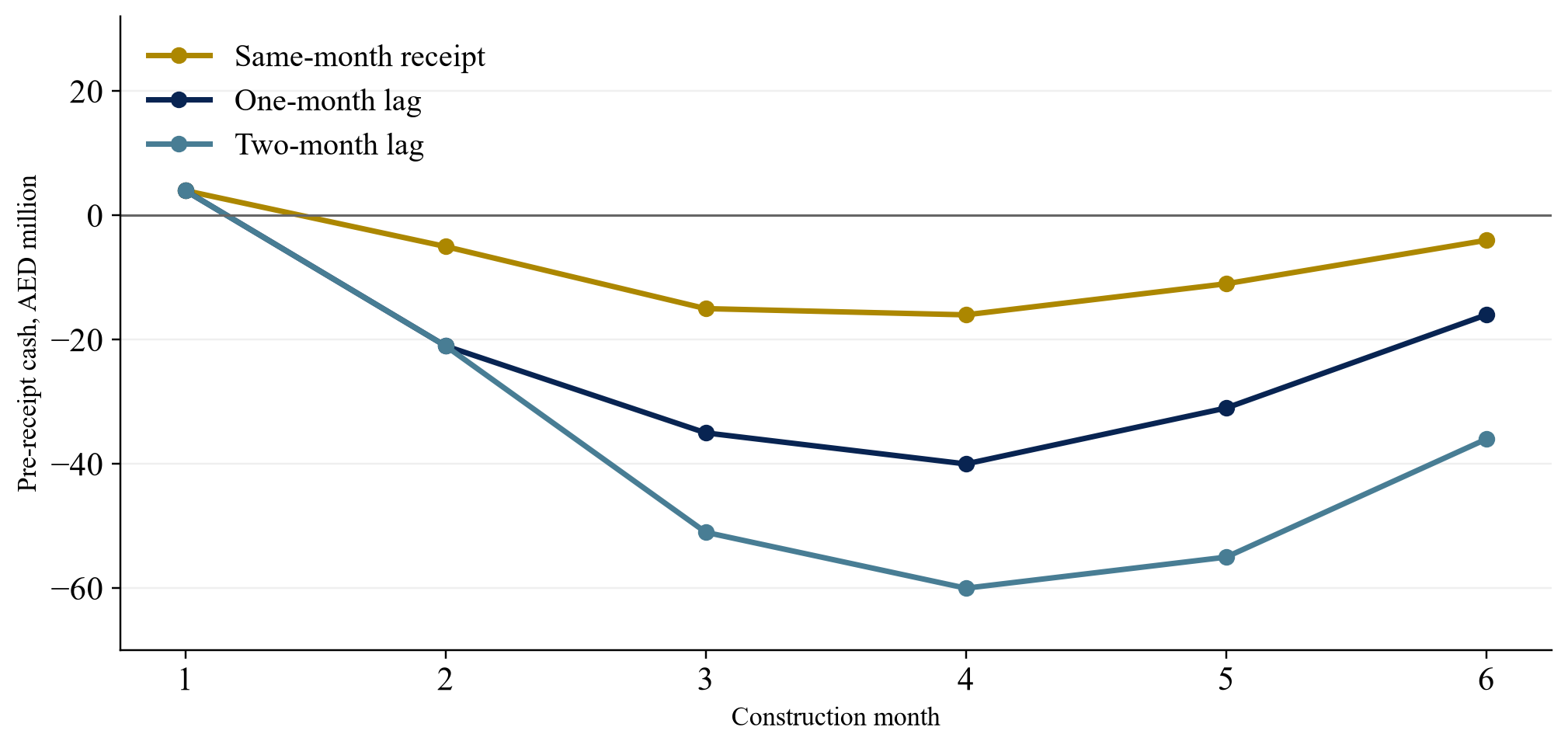
Wholly fictional author calculation; AED million; no first-draw threshold. Each monthly bill precedes the reimbursement. The minimum cash position determines the zero-floor contribution capacity.
12 Model the first-draw threshold
A contractual first-draw threshold can create a further timing constraint. The fictional tests use cumulative paid eligible costs of zero, AED 40 million or AED 80 million. The 40 threshold is first met in month two, when cumulative bills reach 45. The 80 threshold is first met in month four, when cumulative bills reach 100. The model assumes that earlier eligible reimbursements can catch up once the threshold is satisfied. These amounts and catch-up rights are invented financing terms. A construction-completion percentage in legislation should not be converted into either hypothetical paid-cost threshold.
For each invoice, the model assigns its receipt to the later of its operational reimbursement month and the first month satisfying the threshold. At zero lag with the 40 threshold, receipts become zero, 36, 24, 20, 12 and four. The month-two bill must be paid before the catch-up receipt of 36 arrives. The unsupported pre-reimbursement position is minus 21, requiring AED 21 million of additional support at a zero floor. A month-end view again reports no deficit. The initial paid-cost requirement creates a funding dependency before it unlocks reimbursement.
At the 80 threshold, the first four bills require cumulative payments of 100 before any catch-up receipt. The sponsor's opening 24 leaves a pre-reimbursement shortfall of 76 in month four. That amount is the peak zero-floor support requirement in all three tested lag cases. The eventual receipt differs by lag, but the earlier first-draw condition dominates the peak. A proposed facility should therefore be reviewed for the funding needed to satisfy its initial availability conditions. The sponsor should identify that source explicitly and document whether the first payment can be made through it. An undrawn reimbursement facility cannot fund a prior-payment condition without another permitted mechanism.
Table 2. Bankability checks before the first construction payment
| Decision item | Evidence to obtain | Funding consequence |
|---|---|---|
| Project and works scope | Current approvals and binding package obligations | Limit the commitments being funded |
| Payment permission | Trustee and authority confirmation for the proposed transfer | Identify the permitted account and recipient |
| Cost eligibility | Executed facility definition and invoice evidence | Calculate the reimbursable amount |
| First-draw conditions | Certification, prior-payment and catch-up requirements | Date the earliest permitted receipt |
| Sponsor support | Cleared cash or binding transferable contribution | Fund bills before reimbursement |
| Completion and repayment | Remaining-cost review, support terms and maturity sources | Keep later obligations in separate decisions |
Proposed author-developed checklist. Each item needs current project-specific evidence. Completion of the table establishes no regulatory approval or lender entitlement by itself.
13 Size contributions before each invoice
The support requirement can be met through an assumed upfront contribution or a binding staged-contribution schedule. In the zero-lag, zero-threshold case, additional calls of zero, five, ten, one, zero and zero before the six bills total AED 16 million. Each call raises available cash just enough to pay the next bill while retaining previous additional contributions. This schedule is a modelled funding plan. It assumes that approvals and transfers complete before each payment and that contributed cash remains available through the horizon. A promise to contribute after certification would not satisfy this sequence.
At a first-draw threshold of 40 with zero lag, the sponsor instead needs an additional AED 21 million before month two. The modelled first catch-up receipt arrives after that contribution has funded the second bill. With a one-month lag and no threshold, the staged calls are zero, 21, 14, five, zero and zero, totalling 40. For the optional floor of five, the equivalent calls are one, 25, 14, five, zero and zero, totalling 45. The extra floor is measured once. It should be included within the contribution commitment rather than added again to its total.
A live staged commitment should identify the obligor, funding account, due date, payment notice and consequences of a missed contribution. The financing team should verify that the sponsor can supply cash through the proposed route before relying on it. A property valuation or consolidated group balance alone does not establish a transferable cash amount. The investment committee should also review competing demands on the same sponsor resources. If the support depends on a pending asset sale, the model should preserve that dependency and test an earlier usable alternative. The fictional schedules assume timely contributions and provide no assessment of an actual sponsor's liquidity or legal obligation.
14 Evaluate a direct-payment alternative
A documented direct-payment arrangement can change the order of funding events. In a hypothetical alternative, the lender pays 80% of each eligible monthly invoice directly to the approved recipient at the same time as the sponsor pays the remaining 20%. Sponsor cash of 24 then covers its share of the 120 programme, with no additional zero-floor timing contribution under those assumptions. This calculation depends on simultaneous authorised payment, full cost eligibility and the absence of a first-draw constraint. It gives no evidence that such an arrangement is offered or approved for a specific UAE project.
The proposed comparison should record exactly which contractual and operational provisions change. The lender may require independent certification before direct payment, while the contractor's due date may fall earlier. An account restriction may require both payments to pass through an approved mechanism. A retention or excluded invoice item can increase the sponsor's payable share. The direct-payment case should therefore be rebuilt from evidenced events rather than simply deleting the reimbursement lag. The team should reconcile recipient details, payment instructions, authority, amount and cleared date so the alternative remains comparable to the paid-first base case.
The commercial assessment also needs the lender's pricing and risk conditions. A faster payment route may change fees, monitoring obligations, recourse or security. The paper supplies none of those market inputs. The board should compare the all-in evidenced cost and completion-risk allocation of each executable structure, alongside its cash requirement. A lower timing contribution has value only if the proposed payment route can actually operate and its broader terms are acceptable. The method provides a way to identify that potential benefit and the documentary work needed to test it, with an unresolved route remaining a sensitivity rather than the approved funding basis.
15 Separate cash collateral and contingent obligations
A regulatory or contractual guarantee should have its own schedule of face value, cash collateral, issuance fees, replenishment obligations and permitted release. Cash collateral can reduce the money available for construction even if the instrument supports an approval application. A guarantee claim can also create a later reimbursement obligation to its issuer. These items should be modelled using the actual proposed terms and their confirmed account treatment. The fictional construction example excludes all guarantee costs and collateral. Adding a guarantee requires a new cash path and evidence of the route it supports.
The distinction can be shown through an additional hypothetical input. If ten of the sponsor's opening 24 were unavailable as cash collateral throughout the horizon, opening usable cash would fall to 14. With every other base assumption unchanged, the zero-lag paid-first support requirement would increase from 16 to 26. The increase follows directly from removing ten of usable cash. The illustration represents no typical collateral ratio or actual guarantee product. The team should also check whether the collateral requirement and contribution commitment draw on the same funds, which would prevent counting both amounts as available resources.
World Bank project-finance materials discuss sponsor support and intercreditor arrangements, including draw order, subordination and payment management [10,11]. Their context supplies useful investigation questions. Applicable UAE law and transaction documents determine the permitted arrangement. For an early-works bridge, the adviser should document how incoming cash ranks, whether it may be repaid before completion and which consents govern enforcement or distributions. The financial model should use the same ranking and repayment assumptions as the proposed documents. Any mismatch should be reported to the approving committee before the bridge is included in the executable capital stack.
16 Price completion exposure explicitly
The research question asks whether milestone funding can support early construction without leaving lenders with unpriced completion exposure. The proposed answer requires an explicit allocation of remaining cost, delay and funding shortfall. A payment mechanism defines when money moves; it does not establish who bears each economic loss. The lender and sponsor should document the scope of recourse, the completion standard, cost-overrun responsibility and available support. The early-works decision should identify these terms before assuming that a progress certificate transfers all future risk to an adequately funded party.
The fictional model deliberately omits financing prices and market probabilities. It calculates the cash quantity needed under specified events. A commercial pricing exercise would need an evidenced margin, fees, collateral costs, maturity, repayment route and recovery assumptions. It should also distinguish a timing contribution from permanent loss-bearing equity. A sponsor contribution retained through the construction period may ultimately be returnable, subject to project results and permissions. An overrun not covered by the lender can require additional permanent capital. Different instruments and obligations should have separate lines, with their cost and downside exposure explained to both committees.
The proposed completion review asks the independent technical adviser to reconcile accepted work, remaining quantities, committed prices, variations, schedule and contingency. Legal advisers should identify enforceable obligations and consent requirements. The financing adviser can then model the amount and date of any residual shortfall. The output should state the risk retained by each party and any part awaiting commercial agreement. A contract can allocate a liability to an obligor with insufficient resources; the resource assessment remains necessary. This procedure establishes no guarantee of completion. It makes the proposed allocation and its funding basis available for challenge before the lender or sponsor approves the next commitment.
17 Build the bankability evidence schedule
The proposed evidence schedule groups records around each funding decision. The first group establishes the project and payment perimeter: entity authority, relevant rights, approved scope and the obligations being incurred. The second establishes the payment route: applicable approval, account agreement, recipient and restrictions. The third establishes financing availability: executed draw terms, eligible-cost definition, certification, notices and evidence of timely sponsor support. IFC's published financing application guidance asks for sponsor, technical, implementation and financing information [12]. It provides context for organising the inquiry without approving this particular project or financing structure.
Each schedule entry should identify a current record, a qualified reviewer, an unresolved question and the payment affected. A completed checklist entry should reflect an actual document or confirmation. The phrase approval expected supplies an assumption rather than a completed item. Expired reports and changed scope should trigger renewed review before reliance. The team should also record whether a cost is funded directly, reimbursed after payment or excluded from the facility. This creates a traceable link between the financing agreement and the cash model, reducing ambiguity when a reviewer asks why a receipt is available in a particular month.
For the initial draw, the proposed decision pack should include a short reconciliation of opening cash, the first bill, support required before payment and the receipt expected afterwards. The committee should be able to trace each figure to its records without reworking the whole model. Where multiple reviewers have different evidence dates, the pack should explain the mismatch and select a consistent basis for the decision. A technical confirmation issued before a major scope change should not be treated as covering the changed package without further evidence. The schedule is a proposed governance tool; completion of its entries remains a project-specific verification exercise.
18 Distinguish accounting balances and payable cash
The IFRS Interpretations Committee's demand-deposit decision addresses contractual restrictions in a defined accounting fact pattern. Its January 2026 update replaces presentation-standard references [9]. The accounting classification of a balance and the permissions for using it to pay a contractor require separate investigation. The paper makes no accounting conclusion about an actual escrow account. A live review should obtain the relevant adviser assessment and maintain an account-level record of the amount presently permitted for each proposed use.
The cash model should reconcile bank statements to approved payments and financing records. A balance awaiting release approval should appear with that condition. A pending transfer should retain its expected date until bank evidence confirms settlement. Funds received after a bill's due date should not be moved backwards merely to make the monthly closing position satisfactory. The paid-first case demonstrates how this distinction changes the support requirement even when closing cash never becomes negative. In actual execution, a shorter-frequency schedule should reflect bank cut-offs, holidays and the sequencing of the specific payment instructions.
The reporting pack should also reconcile debt outstanding, undrawn commitments, sponsor contributions and payable construction obligations. A reimbursement receipt normally changes more than one accounting line, but this research model reports only the cash sequence. The finance team should maintain the separate balance-sheet and repayment model required for its transaction. At month six, additional contribution cash retained in this illustrative programme is not automatically distributable. Later debt service, remaining obligations and permissions still require assessment. This boundary should remain visible in reporting so construction-payment coverage is not described as verified investment solvency or an approved distribution amount.
19 Reconcile valuation and liquidity assumptions
RICS identifies development-property valuations as potentially complex and variable, with optionality and a need to apply current valuation standards [7,8]. A financing decision should obtain the relevant valuation evidence and specify the basis, date and development assumptions. The cost of waiting or altering the early-works package can affect project economics, while payment authority and available cash govern immediate execution. The proposed framework records both assessments, with their respective assumptions and outstanding qualifications. The model supplies no actual land value, residual development value or market-derived return.
An author-developed comparison can examine immediate commencement, a reduced package and delayed commencement using the same scoped obligations. Each option should state additional financing costs, changes to construction obligations and the evidence needed for future receipts. A delayed option can reduce the immediate reimbursement bridge while introducing other expenditure or contractual consequences. A reduced package may postpone a larger milestone and its related receipt. The preferred commercial choice therefore requires a complete option-specific schedule and an evidenced economic comparison. The liquidity calculation identifies a necessary cash condition for the assumed option; it cannot determine the investment choice by itself.
The board should resist assigning a single expected-sales value to unresolved cash events. A sale forecast has its own pricing, absorption and collection assumptions. The no-presale case isolates early funding before those receipts. A later case can add evidenced buyer payments and permitted releases, retaining their dates and limitations. The initial senior repayment route also requires separate analysis, particularly if the financing matures before the expected sales settle. The valuation and cash models should use consistent scope, cost and timetable assumptions, while preserving different outputs: economic value, payment coverage, debt repayment and authorised distributions.
20 Test cost increases against the commitment cap
The additional cost stress increases every monthly construction bill by an invented 10%, making total uses AED 132 million. Opening cash stays at 24 and total senior commitment stays capped at 96. The hypothetical lender reimburses 80% of paid eligible costs until the commitment is exhausted, allocating capacity chronologically. The resulting invoice entitlements are 17.6, 22, 26.4, 22, eight and zero. Their total is 96. There is no first-draw threshold in this stress. The receipt lag changes only the dates, while the commitment cap changes the amount of the last reimbursements.
The paid-first zero-floor requirement rises to AED 20 million with same-month receipts, AED 46.4 million with a one-month lag and AED 68.4 million with a two-month lag. Each minimum occurs before reimbursement in month four. An assumed floor of five raises these totals to 25, 51.4 and 73.4. These amounts already include the modelled permanent shortfall. Construction equity ultimately required is 132 less senior financing of 96, or 36. Opening sponsor cash provides 24, leaving twelve of additional permanent construction funding. Adding that twelve again to the reported peak would double-count it.
The cost stress illustrates why a budget increase and a timing delay require linked calculations. A capped lender commitment may stop the sponsor from maintaining the initial percentage split across all later invoices. A live team should obtain the actual facility cap, availability rules and treatment of variations before extrapolating a loan percentage. It should then extend the schedule beyond the construction horizon to capture delayed receipts, debt repayment and any retained support. In the fictional two-month cost-stress case, eight arrives in month seven. The other tested cost-stress cases have received the full capped commitment by month six, with eventual senior principal repayment still excluded.
Table 3. Combined construction-cost and reimbursement-delay tests
| Receipt lag | Base uses 120, floor 0 | Stress uses 132, floor 0 | Stress uses 132, floor 5 |
|---|---|---|---|
| Same month | 16 | 20 | 25 |
| One month | 40 | 46.4 | 51.4 |
| Two months | 60 | 68.4 | 73.4 |
Wholly fictional author model; AED million. No first-draw threshold; loan commitment capped at 96. Support is additional to opening cash of 24 and is retained through the horizon. Stress support already includes the permanent construction shortfall of 12.
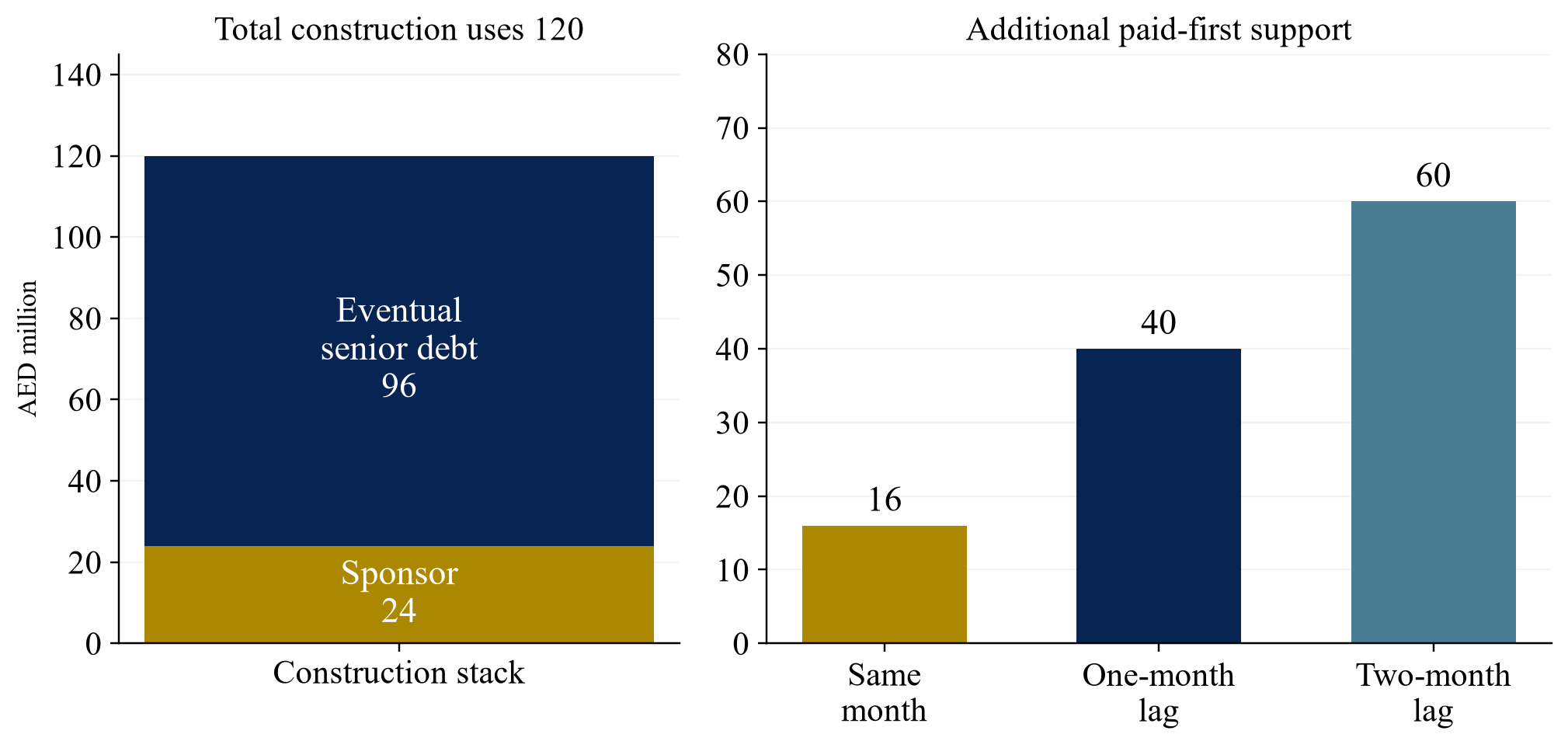
Wholly fictional author illustration; AED million. The construction stack totals 120 through opening sponsor cash and eventual debt receipts. Additional support is a separate timing requirement and remains subject to repayment and distribution permissions.
21 Set the approval and monitoring protocol
The proposed board protocol begins with a bounded spending decision supported by current evidence. It identifies the approved works, current payable cash, first payment date, conditional reimbursements and committed additional support. The committee should see the paid-first and closing positions for the base schedule and the selected downside cases. It should also see any unresolved permissions and the action required before reliance. The approval can then state a scope limit, funding conditions, authority to commit and a reapproval trigger. These proposed controls require adoption through the project's actual governance arrangements.
Execution should follow the invoice event ledger. Before each bill, the finance owner should reconcile cleared balances, available support, payment authority and the permitted recipient. After payment, the team should trace certification and draw processing to the expected receipt. A changed cost, rejected certificate, late contribution or revised permission should trigger recalculation. Where the forecast shows a payment deficit, the team should obtain an executable cure or reconsider the pending commitment. Continuing on an unexplained negative balance would violate the model's assumption that every bill needs actual payable cash.
The monitoring pack should compare forecast and actual event dates without overwriting the approved baseline. Variances can then be investigated by cause, including documentation, construction progress, account permissions and lender processing. Repeated observations from the same project may support an updated timing assumption, with sample limitations retained. A useful retrospective would report payment coverage, draw timing, cost exclusions and support contributed. The procedure should also retain the later debt-repayment review. The paper's six-month funding result cannot establish that senior maturity, guarantee reimbursement or sponsor distributions have been resolved. Those obligations remain separate approval items with their own cash sources and conditions.
22 Conclusions and further research
The fictional case answers the financing question conditionally. A milestone reimbursement facility can cover its agreed share of construction expenditure while requiring additional cash before the first and subsequent qualifying receipts. With the stated zero-lag payment order, the programme needs AED 16 million of extra timely support despite non-negative month-end cash. A one-month lag requires 40, and a first-draw paid-cost threshold of 80 requires 76 across the tested lag cases. These figures apply only to the author's inputs. They establish no general UAE reserve requirement, lender practice or probability of payment failure.
The proposed financing response is to align approved payment authority, contract draw rules and dated sponsor resources before committing the early package. Direct payment, staged support, a smaller scope or delayed commencement can each be tested through the same event ledger. Completion exposure and pricing require separate evidence. Additional cash used for reimbursement timing should retain its terms, source and later obligations in the model. The optional floor and cost stress demonstrate how stated policy and budget choices affect support, with the permanent shortfall already included in the peak calculation.
Further research could apply the method to consented transactions using actual invoices, technical certificates, account approvals, draw notices and bank receipts. It would need consistent event definitions and a clear sampling boundary before estimating typical lags or support needs. Project-specific no-presale permissions and current legal applicability also require direct confirmation. The immediate contribution is an auditable decision method: define the approved works, document each funding route, calculate cash before every dependent receipt, allocate the resulting support and completion exposure, and keep later repayment obligations visible. The framework supplies a structured basis for that investigation while preserving every material assumption and unresolved evidence item.
References
- Dubai Land Department. Register Project, official registration documents and service conditions; accessed 7 October 2026. https://dubailand.gov.ae/en/eservices/register-project/
- Dubai Land Department. Escrow Account activation, official application and disbursement conditions; no-presale project applicability requires confirmation; accessed 7 October 2026. https://dubailand.gov.ae/en/eservices/request-to-activate-an-escrow-account/
- Dubai Land Department. Depositing a mortgage into an escrow account application, financing deposit and separate settlement conditions; accessed 7 October 2026. https://dubailand.gov.ae/en/eservices/request-for-mortgage-payment-in-escrow-account/
- Dubai Land Department. Frequently Asked Questions, project-financing and trustee milestone guidance; undated; accessed 7 October 2026. https://dubailand.gov.ae/en/frequently-asked-questions/
- Abu Dhabi Real Estate Centre. Legislative compilation including Law 2/2025 amending Article 19 of Law 3/2015 and Administrative Decision 24/2025; Gazette publication date and project-specific no-presale applicability remain unverified; accessed 7 October 2026. https://adrec.gov.ae/en/rules_and_regulations/Tenancy
- Abu Dhabi Real Estate Centre. Project Development, official operating overview; accessed 7 October 2026. https://adrec.gov.ae/en/sectors/regulatory-services/project-development
- Royal Institution of Chartered Surveyors. Valuation of development property, professional-standard overview; published 1 October 2019; accessed 7 October 2026. https://www.rics.org/profession-standards/rics-standards-and-guidance/sector-standards/valuation-standards/valuation-of-development-property
- Royal Institution of Chartered Surveyors. Valuation of development property, first edition 2019, effective February 2020; read with applicable current global standards; accessed 7 October 2026. https://www.rics.org/content/dam/ricsglobal/documents/to-be-sorted/valuation-of-development-property---first-edition.pdf
- IFRS Interpretations Committee. Demand Deposits with Restrictions on Use arising from a Contract with a Third Party, IAS 7 agenda decision; April 2022, presentation references updated January 2026; accessed 7 October 2026. https://www.ifrs.org/content/dam/ifrs/supporting-implementation/agenda-decisions/2026/demand-deposits-with-restrictions-on-use-jan-26.pdf
- World Bank Public-Private Partnership Resource Center. Intercreditor Arrangements, draw order, sponsor support and payment-management context; undated; accessed 7 October 2026. https://ppp.worldbank.org/intercreditor-arrangements
- World Bank Public-Private Partnership Resource Center. Key Issues in Developing Project-Financed Transactions, lender support and security context; undated; accessed 7 October 2026. https://ppp.worldbank.org/financing/issues-in-project-financed-transactions
- International Finance Corporation. How to Apply for Financing, sponsor, feasibility, implementation and financing information; undated; accessed 7 October 2026. https://www.ifc.org/en/what-we-do/products-and-services/how-to-apply-for-financing
About the Author
Chennakeshav (CK) is a corporate finance and investment banking executive with 25+ years of global experience in deal origination, structuring and execution across M&A, growth capital and corporate strategy. He has led value-creation mandates for founders, corporates and funds — bridging the boardroom view to hands-on execution and close.
His career spans Morgan Stanley, HSBC, Lloyds Banking Group, EWEC, ADQ portfolio companies and Emirates Growth Fund, across TMT, real estate, fintech, deeptech, cleantech, infrastructure and energy. He has partnered with C-suite leaders, private equity and venture funds, sovereign wealth funds and family offices to finance complex fund raises and scale-up ventures, and has led M&A due diligence, post-merger integration and business-transformation initiatives to create value.
At Matchpoint Partners he is Managing Partner, leading the firm's corporate finance, M&A and capital-raising practice. He holds an MBA from London Business School, an engineering degree from VTU and a Master of Laws (LLM, in progress) from UCL London.
An active start-up mentor, CK mentors at Techstars, DIFC FinTech Hive, Startup Grind, Founder Institute and IN5, serves as Entrepreneur Mentor in Residence (EMiR) at London Business School, and judges the Entrepreneurship World Cup.
