
Introduction
Cooling is part of the revenue engine of a data centre. It protects computing equipment, determines attainable rack density and influences the amount of contracted capacity that can be delivered through extreme ambient conditions. In a hot, water-constrained market, cooling also creates claims on two public systems: electricity and water. A transaction model that treats cooling as a fixed percentage of operating cost misses capacity, retrofit and stranded-asset risk.
The GCC combines high ambient temperatures, accelerating artificial-intelligence infrastructure and structurally scarce freshwater. The World Bank describes the region's dependence on desalination, wastewater treatment and energy-intensive water systems. The UAE's national strategy seeks lower demand and greater treated-water reuse. These conditions make source quality, pipeline proximity, tariff structure and emergency continuity material to site value. [1][3][4]
The governing transaction question is deliverable computing capacity after cooling constraints. Installed megawatts, building shell and grid connection are incomplete measures. The buyer needs hourly information-technology load, cooling topology, design temperatures, water balance, electricity profile, maintenance history, water and discharge rights, customer specifications, retrofit cost and evidence of performance in the hottest operating window.
Water and cooling also affect the sequencing of development capital. Land and grid rights can be secured before the final customer load is known, while water pipelines, dry-cooling equipment and high-density liquid loops require early design choices. An investor therefore needs a stage-gated view of value: site feasibility, utility allocation, customer qualification, completed construction, commissioned capacity and paid operation. Each stage should have its own evidence threshold and capital-at-risk limit.
1. Define the valuation perimeter
State whether the transaction concerns a stabilized operating facility, a development site, a powered shell, a cooling-technology platform or a portfolio. Identify the legal entities that own land, grid connection, water connection, mechanical plant, cooling distribution units, software, customer contracts and environmental permissions. Set the valuation date, acquisition structure, funding plan, return threshold and expected holding period.
Separate base data-centre economics from cooling improvement. The base case should stand on contracted capacity, pricing, power cost, operating expenditure and maintenance capital. The cooling case should show incremental water cost, electricity cost, customer revenue, avoided downtime, capex and residual value. Combining them too early can turn an engineering aspiration into purchase price.
2. Map the complete thermal chain
Trace heat from processors and accelerators through cold plates or air handlers, rack manifolds, cooling distribution units, facility water loops, heat exchangers, chillers, cooling towers, dry coolers and the external environment. Record temperatures, flow, pressure, redundancy, control logic, chemical treatment, leakage detection and failure modes at each boundary.
Direct-to-chip cooling does not by itself prove zero water consumption. The internal loop can be closed while the facility heat-rejection stage uses evaporative towers. Conversely, a dry cooler can avoid operational water while consuming more electricity during high ambient temperatures. The diligence model must describe both loops and the transfer point between them. [5][6][7]
3. Build the facility water balance
Reconcile incoming potable, desalinated, recycled and process water to cooling make-up, humidification, cleaning, sanitary use, treatment losses, drift, evaporation, blowdown and discharge. Obtain monthly meter records and hourly data for peak months. Tie volumes to invoices, laboratory results, chemical-treatment logs and discharge records.
Water Usage Effectiveness divides annual site water use by information-technology energy. It creates a comparable intensity measure, subject to boundary and source definitions. A transaction review should retain absolute volume because a low WUE applied to a very large computing load can still require material water infrastructure. [5][6]
Reconcile design values with actual operating mode. Cooling towers can cycle concentration and blowdown differently as source-water chemistry changes. Leaks, bypasses, failed sensors and manual overrides can produce material variance from design. Calculate WUE by month and by hall, then bridge the result to weather, load and maintenance events. This creates an auditable baseline for retrofit savings and identifies whether the forecast assumes correction of current operational defects.
4. Separate withdrawal, consumption and discharge
Withdrawal measures water taken from a source; consumption measures the portion not returned to the same watershed or system; discharge measures water released after use. Evaporative cooling can have high consumption because water leaves as vapour. Once-through systems can have lower consumption but high withdrawal and significant discharge obligations.
These distinctions affect tariffs, permits, public reporting and stakeholder claims. The buyer should reconcile each metric to the relevant regulator and contract. A sustainability statement based on withdrawal reduction should not be modelled as a consumption reduction unless the measured boundary supports it.
5. Screen the water source hierarchy
Classify each source by legal right, capacity, pressure, quality, treatment need, interruption risk, tariff, escalation, carbon and energy intensity, connection capex and emergency substitutability. Potable or desalinated water may offer quality and reliability while carrying scarcity and energy implications. Recycled water can reduce demand on potable supply but may require treatment, storage and separate distribution infrastructure.
Abu Dhabi's district-cooling policy expressly evaluates recycled, desalinated and seawater alternatives against technical and commercial feasibility and discharge standards. Its sector evidence is relevant to data-centre diligence because both applications operate heat-rejection assets; asset-specific permits and engineering remain decisive. [11][12][13]
6. Test water rights and utility capacity
Obtain the executed connection agreement, allocated capacity, tariff schedule, meter class, curtailment provisions, quality specification, notice rights and change-of-control terms. Confirm that stated capacity is reserved for the asset and not shared informally across a campus. Compare contracted daily volume with design-day demand and emergency storage.
A utility letter, construction drawing and paid bill prove different things. Build an evidence ladder from indicative availability through binding allocation, completed connection and paid operation. Value should increase only when the evidence supports the relevant stage.
7. Apply the UAE water-security direction
The UAE Water Security Strategy 2036 targets lower total demand and higher reuse of treated water. The Ministry of Energy and Infrastructure also identifies the country's arid geography, limited natural resources and high development demand as structural constraints. These are policy facts, not a forecast of a particular tariff or permit decision. [1][2]
For valuation, test exposure to demand-management requirements, source restrictions, disclosure, recycling obligations and emergency planning. Request correspondence with federal, emirate and municipal authorities. Record assumptions as scenarios until specific legal or contractual evidence exists.
8. Price desalinated-water dependency
Desalinated water embeds production, transmission, storage and energy infrastructure. A facility may pay a regulated or contracted tariff that does not reveal full system cost. The acquisition model should use the tariff actually payable and separately test escalation, subsidy reform, scarcity charges and alternative supply capex.
The World Bank identifies the GCC water-energy nexus and the role of desalination, wastewater reuse, renewable energy and pricing. A buyer should avoid converting regional production-cost estimates into a target tariff. Use current bills, published tariff schedules and signed utility terms. [3][4]
9. Evaluate recycled-water feasibility
Recycled water can reduce potable-water demand, yet availability, quality and network proximity may be uncertain. Review source plant capacity, seasonal supply, pipeline route, storage, treatment specification, corrosion potential, biological control, customer restrictions and discharge compatibility. Identify the party funding connection and pretreatment.
Model recycled water as an operating input only after confirming binding supply, quality and completion. Before that point it is a development option with probability-weighted capex and schedule. The Abu Dhabi policy framework supports technical and economic evaluation of this source. [10][11][15]
10. Establish the hourly computing-load profile
Cooling demand follows actual processor load, rack density and operating mode. Obtain interval information-technology power, total facility power, coolant temperatures, pump loads and external ambient data. Separate installed, commissioned, occupied, reserved and billed capacity. Test the ramp schedule for each customer and hall.
AI workloads can change thermal density faster than building occupancy. A 60 MW facility operating at 70 per cent average load produces a different water and power profile from a fully loaded facility with the same nameplate. The cooling model should use hourly load and credible customer ramps.
11. Reconcile WUE, PUE and useful computing
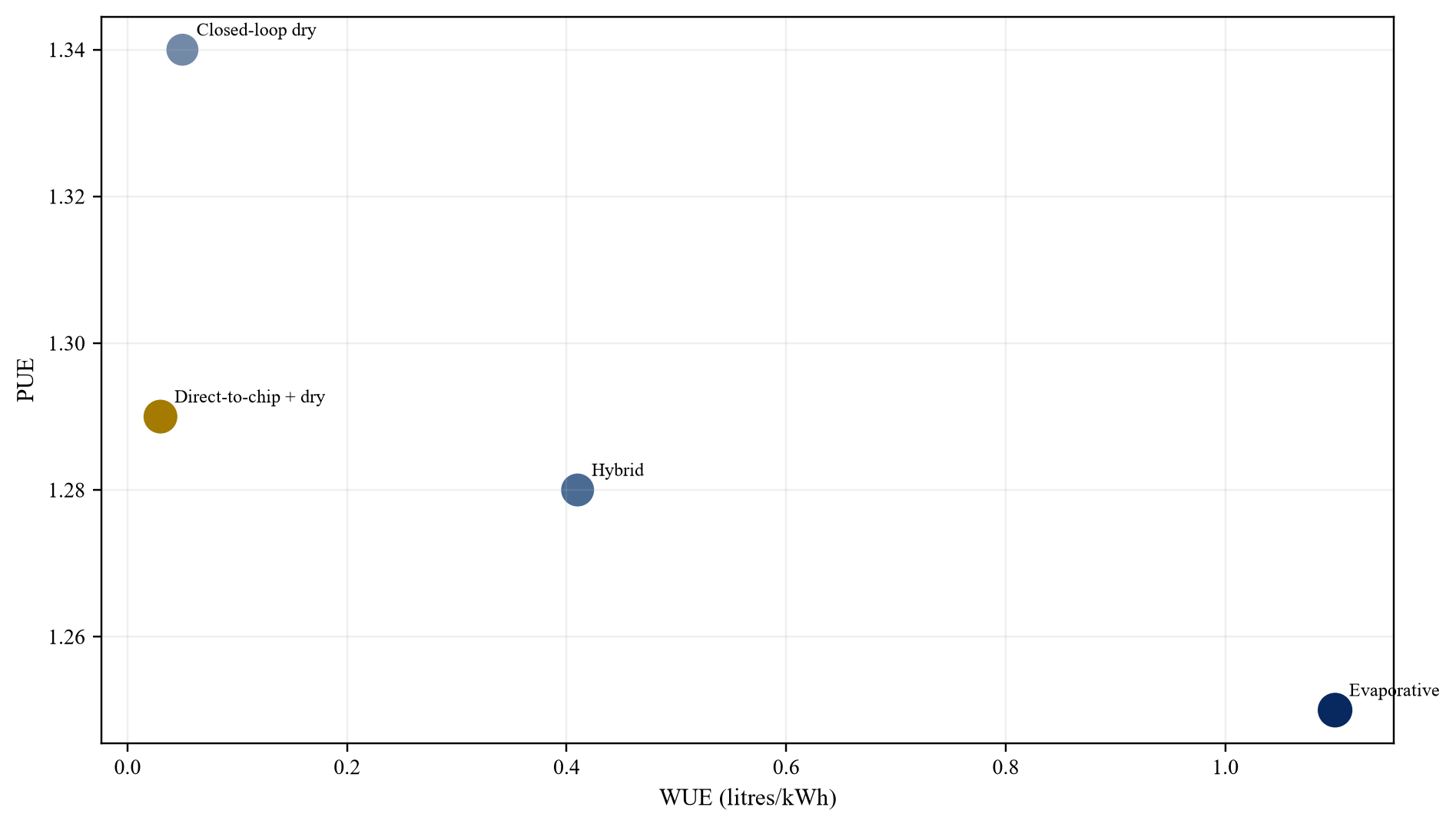
Water Usage Effectiveness and Power Usage Effectiveness can move in opposite directions. Evaporation can reduce mechanical-cooling electricity; dry rejection can reduce water while increasing compressor or fan energy. Compare both metrics under the same weather, workload and boundary.
Add a useful-computing denominator where hardware and workload data permit. ASHRAE's AI data-centre framework identifies WUE, Water Usage Impact, PUE, carbon metrics and information-technology work capacity. The investment committee should avoid rewarding an intensity improvement caused by lower utilization or a shifted boundary. [5]
12. Model ambient temperature and humidity
Use hourly dry-bulb and wet-bulb weather data, including design extremes and projected hotter cases. Evaporative systems depend on wet-bulb conditions; air-cooled chillers and dry coolers lose efficiency as dry-bulb temperature rises. Record the number of hours at which the plant approaches design limits.
Model coincident heat and computing peaks. A cooling design that performs efficiently on annual averages may constrain capacity during the most valuable hours. Test degradation, fouling, sand, salt, dust and air-filter loading where relevant to the site.
Climate scenarios should inform sensitivity rather than become a single deterministic forecast. Use observed weather for the operating baseline, design weather for equipment capacity and a hotter stress case for investment resilience. Record which weather station, period and percentile supports each input. Where a site depends on coastal air or seawater, include humidity, salinity and corrosion implications alongside temperature.
13. Classify liquid-cooling readiness
Inspect rack manifolds, piping, cooling distribution units, heat exchangers, leak detection, water chemistry, controls and redundancy. Confirm which ASHRAE liquid-cooling temperature class the system can support and which customer hardware has been qualified. Review warranties and responsibility at the facility-to-equipment boundary.
ASHRAE identifies W17, W27, W32, W40, W45 and W+ classes, named for maximum facility liquid-supply temperature. Higher-temperature systems can create more opportunities for chiller-free operation, subject to equipment and climate. The target's design and acceptance tests determine value. [5][6]
14. Compare four cooling architectures
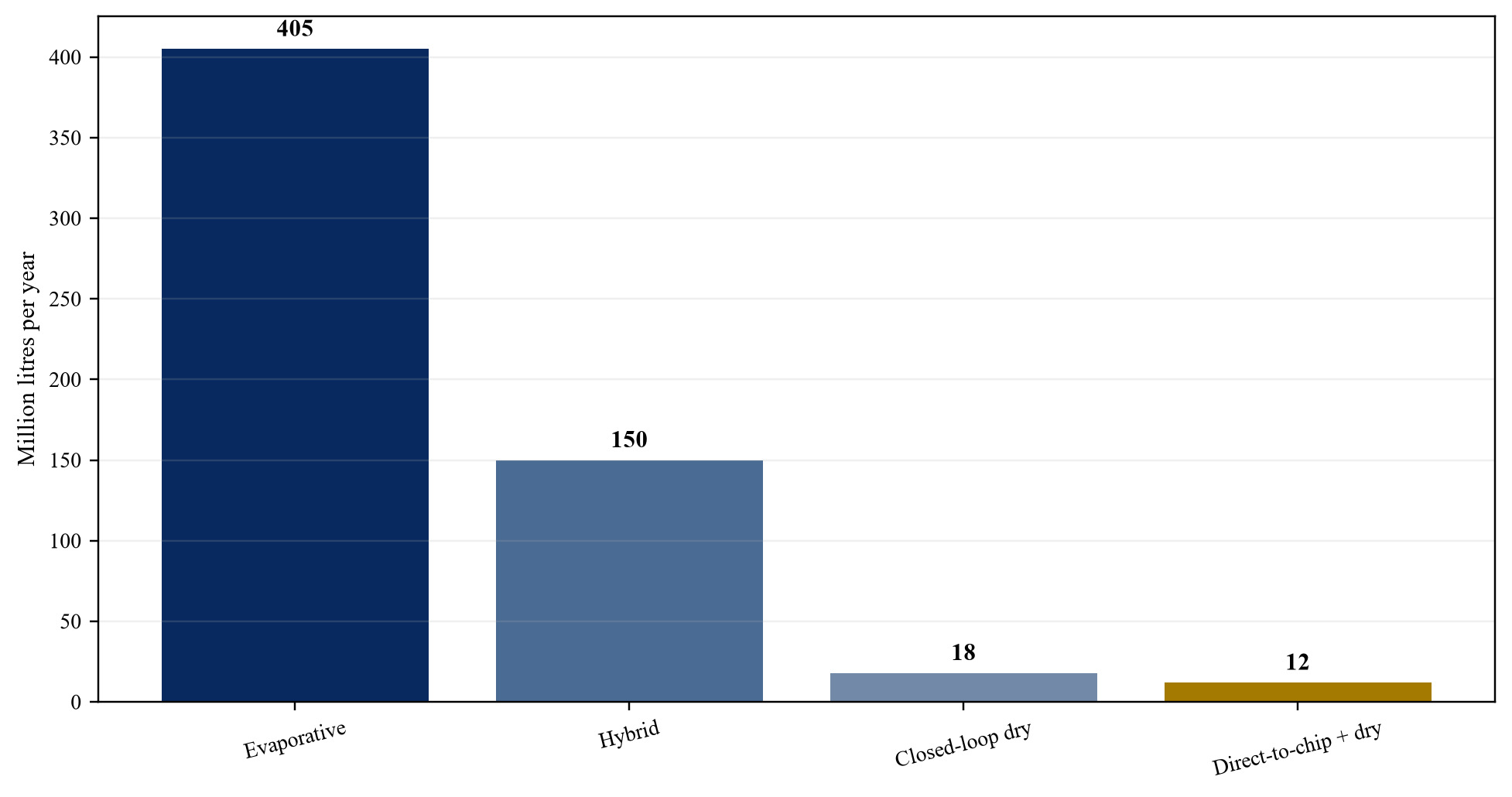
Compare conventional evaporative rejection, hybrid towers, closed-loop air-cooled chillers and direct-to-chip liquid cooling with dry rejection. Score each against water use, peak power, rack density, capex, maintainability, redundancy, vendor concentration, retrofit disruption and customer acceptance.
Architecture labels can conceal mixed systems. A direct-to-chip facility may retain evaporative towers for heat rejection; a hybrid plant may consume water only above a threshold. Model actual modes by hour rather than assigning one annual marketing label.
15. Test the zero-water claim
Microsoft describes a new design that recirculates water in a closed loop and avoids operational water evaporation, with expected savings exceeding 125 million litres per year per data centre relative to its fiscal-year 2024 average. It also states that mechanical cooling can increase power use and that warmer liquid temperatures help mitigate the penalty. [7][8]
Use this as evidence of technical direction. For a target asset, verify make-up water, humidification, cleaning, leaks, commissioning, sanitary use and heat rejection. Define whether zero applies to cooling consumption, cooling withdrawal or the whole facility.
16. Quantify the power penalty
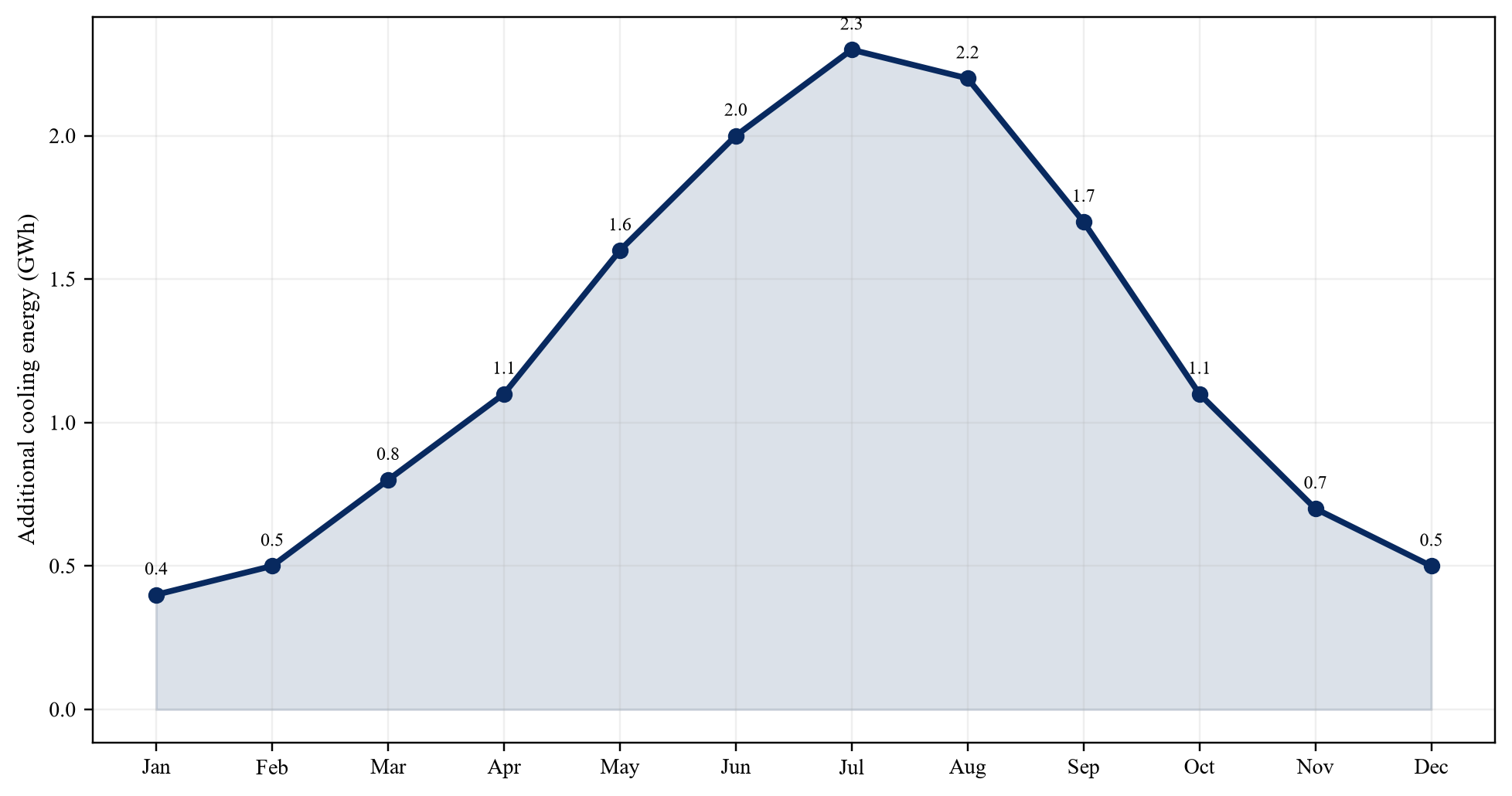
Build an hourly cooling-power model for pumps, fans, chillers, towers, cooling distribution units and controls. Test tariff periods, demand charges, grid constraints and backup-generation implications. A water-saving retrofit can reduce deliverable information-technology capacity if the electrical connection cannot support the added load.
Calculate marginal PUE and incremental megawatt-hours for each cooling mode. Link power assumptions to the signed tariff and meter history. Include degradation and part-load performance rather than relying only on design efficiency.
Test whether cooling power competes with computing load under a capped grid connection. The economic cost can exceed the electricity bill when an additional cooling megawatt displaces billable information-technology capacity. Model both outcomes: purchased energy where headroom exists, and lost or deferred customer capacity where it does not. Include the capex and timing of any grid reinforcement required to preserve load.
17. Value peak-capacity preservation
Cooling creates value when it preserves contracted computing output during the hottest hours. Map thermal headroom to customer service levels, liquidated damages, credits and termination rights. Determine whether the facility can derate workloads, shift them, use redundant equipment or tolerate higher inlet temperatures.
Avoid assigning a general resilience premium. Value the expected avoided cash loss under evidenced contracts, outage history and probability. Record any customer-specific capacity reservation or qualification that depends on the cooling design.
18. Review AI customer qualification
Obtain technical schedules for rack density, coolant temperatures, water chemistry, pressure, redundancy, maintenance and telemetry. Confirm whether target customers have accepted the architecture through design review, factory tests, commissioning and operating history. Unqualified cooling capacity is development inventory rather than contracted operating capacity.
Customer concentration can magnify design risk. A system optimized for one accelerator generation or vendor may require retrofit for another. Review change provisions and who funds customer-driven upgrades.
19. Map permits, discharge and environmental obligations
Compile water connection, abstraction, recycled-water, chemical storage, blowdown, discharge, noise, refrigerant, construction and environmental permits. Reconcile permit limits to design-day operation. Confirm monitoring, sampling, reporting and renewal obligations.
Abu Dhabi's water-management policy references water-quality, recycled-water, trade-effluent, marine-discharge and district-cooling technical rules. A data-centre transaction requires its own legal mapping; this policy demonstrates the range of interfaces that can affect heat-rejection infrastructure. [11][15]
20. Test physical resilience and redundancy
Review N, N+1 or 2N configuration for chillers, towers, pumps, cooling distribution units, heat exchangers, pipes and controls. Test common-mode dependencies such as one water main, one treatment plant, one control system or shared electrical switchgear. Inspect isolation, bypass and black-start procedures.
Compare design redundancy with maintenance records and actual failover tests. A redundant component adds little value when valves, controls or electrical supply create a single point of failure.
21. Build the lifecycle capex schedule
Separate remaining construction cost, deferred maintenance, expansion capex, customer-fit-out capex and technology-conversion capex. Record equipment age, operating hours, maintenance cycles, refrigerants, spare parts, vendor support and replacement lead times.
Model towers, chillers, dry coolers, pumps, heat exchangers, cooling distribution units, controls and water-treatment assets separately. Cooling assets can have different useful lives from the building and customer lease. Use evidence from condition assessments and service contracts.
22. Model the retrofit pathway
Define phases by hall, load and customer window. Identify shutdown requirements, temporary cooling, design approvals, procurement, commissioning tests and rollback plans. Link expenditure to objective milestones and retained contract capacity.
Retrofit value depends on execution while the facility earns revenue. A theoretically superior system can destroy value through downtime, schedule delay or lost customer qualification. Include owner engineering, contingency, interest during construction and revenue interruption.
Create a hall-by-hall migration plan with temporary cooling and reversible cutover points. Link payments to design approval, factory acceptance, delivery, installation, integrated systems testing and sustained performance. Confirm access to long-lead equipment and specialist labour. The acquisition agreement and financing documents should use the same milestone definitions so that completion risk does not fall between contractual regimes.
23. Apply the hypothetical central case
The hypothetical asset has 60 MW of installed information-technology capacity and a 70 per cent average load, producing approximately 368 GWh of annual information-technology electricity. Its existing cooling system uses 1.10 litres per kilowatt-hour, equal to approximately 405 million litres of annual cooling-water withdrawal. These assumptions describe no identified facility.
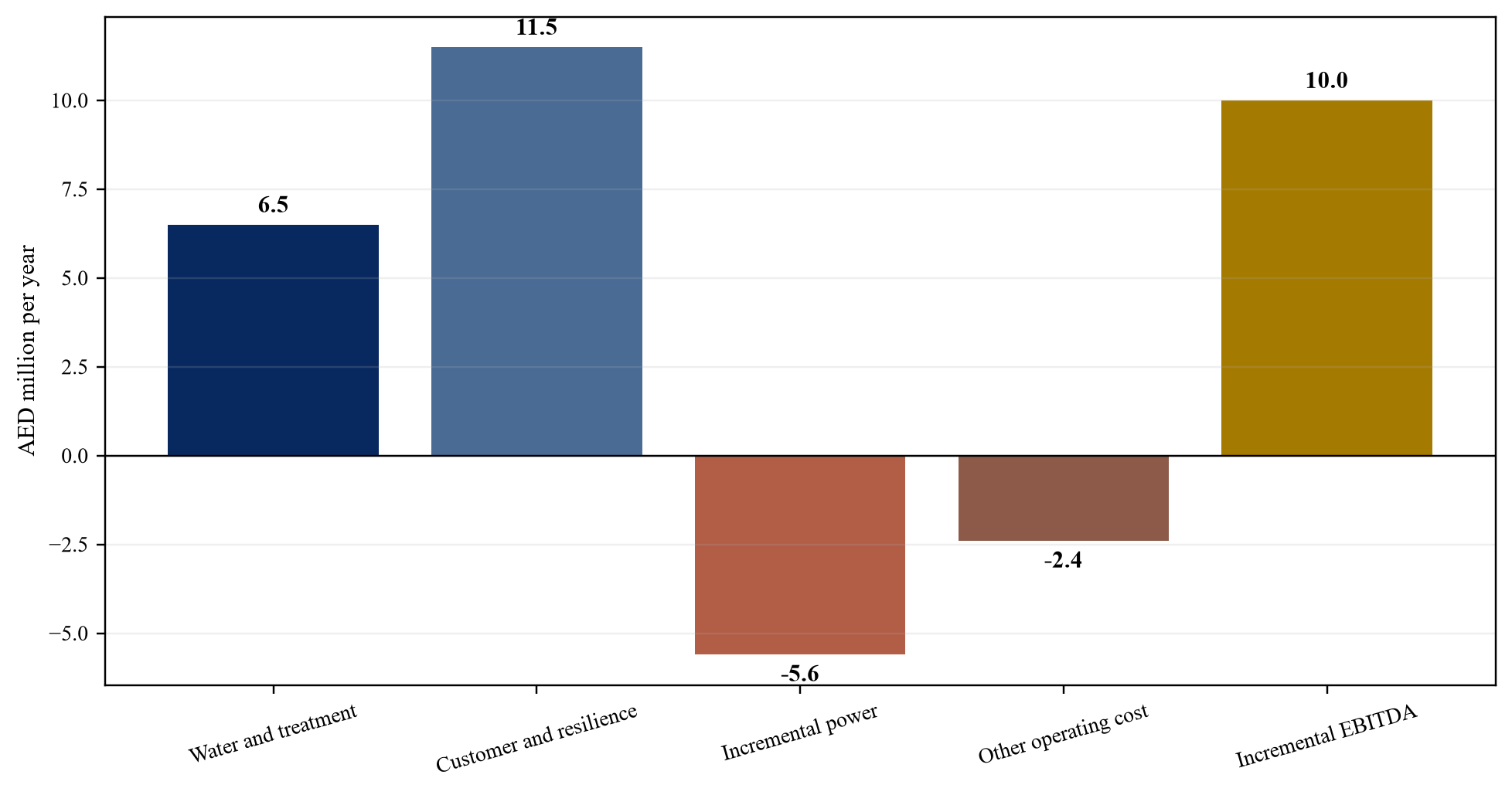
A staged direct-to-chip, closed-loop and dry-heat-rejection programme costs AED 52 million and reduces annual cooling-water withdrawal by 360 million litres. Avoided water and treatment cost, customer qualification and resilience benefits total AED 18.0 million per year. Incremental power, maintenance and operating cost total AED 8.0 million. Incremental EBITDA is AED 10.0 million.
The central case assumes the retrofit is accepted by customers, preserves contracted capacity through design weather and has sufficient electrical headroom. It assumes the water reduction is measurable at the facility boundary and that no material permit or discharge cost remains outside the capex budget. None of these assumptions should enter purchase price without engineering, customer, utility and legal evidence. The model should retain a no-retrofit case as the acquisition floor.
24. Run the combined downside
The downside assumes a hotter weather profile, higher electricity tariffs, a nine-month retrofit delay, a 20 per cent capex overrun, lower customer benefit and weaker operating performance. Incremental annual benefit falls to AED 12.0 million and incremental cost rises to AED 9.6 million, leaving AED 2.4 million of EBITDA.
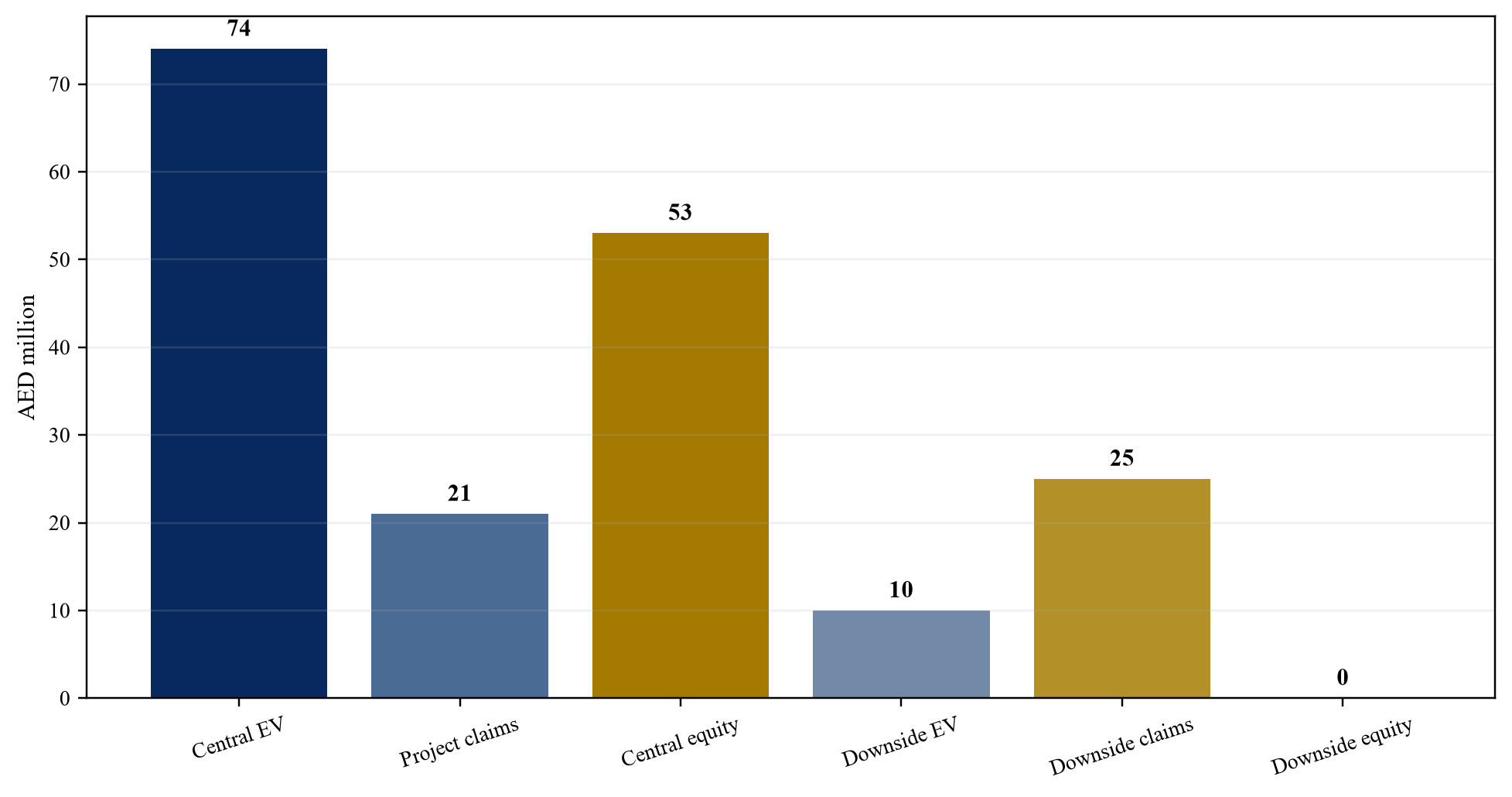
Incremental enterprise value falls from AED 74 million to AED 10 million. Project claims rise from AED 21 million to AED 25 million. The downside therefore provides no positive incremental equity value and can create impairment or covenant pressure. The transaction should survive without assuming the central cooling premium.
25. Build the integrated cash-flow model
Model capacity revenue, customer premiums, avoided downtime, water, treatment, chemicals, electricity, maintenance, insurance, permits, capex, taxes and financing. Use monthly periods through retrofit and ramp, then annual periods. Separate cash flows by legal entity and contract.
Drivers should include information-technology load, WUE, PUE, ambient temperature, water source mix, tariff, power price, capex, schedule, customer acceptance and availability. Reconcile physical units before monetizing them.
26. Triangulate enterprise value
Use discounted cash flow as the primary method where incremental cash can be isolated. Cross-check against avoided replacement cost, cost to cure, contracted capacity economics and observed asset pricing. Do not add water savings, resilience and customer premium when they represent the same underlying benefit.
The hypothetical central indication is AED 74 million of incremental enterprise value. This is an output of stated assumptions and not a market valuation. Change the indication when target evidence changes.
27. Build the enterprise-to-equity bridge
Deduct project debt, equipment leases, unpaid capex, water-connection obligations, customer credits, decommissioning provisions and contingent claims from incremental enterprise value. Add only unrestricted cash attributable to the acquired perimeter.
The hypothetical central case deducts AED 21 million of project claims, producing AED 53 million of incremental equity value. The combined downside has AED 25 million of claims against AED 10 million of enterprise value; incremental equity is therefore nil before considering any support from the broader asset.
28. Apply IFRS valuation discipline
IFRS 13 requires market-participant assumptions under current market conditions. IAS 36 requires reasonable and supportable cash-flow assumptions and recognizes that regulatory or environmental change can indicate impairment. Cooling valuation should reflect current asset condition and separately identify uncommitted enhancement capex. [23][24]
Under IFRS 3, determine whether customer contracts, permits, software or other rights meet identifiability criteria. Avoid double counting between property, plant, customer relationships, contract-based intangibles and goodwill. Tie purchase-price allocation to evidence.
29. Assess debt capacity
Lenders may recognize cooling benefits when they improve contracted capacity, reduce volatile water cost or support customer retention. They may exclude benefits dependent on uncommitted retrofit, uncertain utility rights or discretionary customer premiums.
Separate operating asset debt from retrofit facilities. Test debt-service coverage under water tariff, power price, load, capex and delay cases. Require completion tests based on capacity, WUE, PUE, temperature and customer acceptance.
Review reserve accounts, cost-overrun support, draw conditions and cure rights. A lender may require the sponsor to fund the retrofit before recognizing incremental cash flow. Where equipment finance or vendor credit is used, reconcile title, security and step-in rights with the property mortgage and customer contracts. Ensure that a default does not permit removal of cooling equipment needed to operate the facility.
30. Convert diligence into transaction protection
Use conditions precedent for water allocation, permits, customer approval, funding and contractor commitments. Use purchase-price adjustments for unpaid capex and working capital. Use escrow, indemnity or contingent consideration for unresolved retrofit, permit, performance or customer risks.
Milestones should be objective: signed allocation, completed pipeline, factory acceptance, commissioned cooling stage, specified WUE and PUE at defined load and weather, and customer acceptance. Avoid protections based only on equipment installation.
31. Test change of control and assignment
Review utility, recycled-water, land, easement, maintenance, software, customer and vendor agreements for assignment and consent. A water allocation or technical warranty that terminates on acquisition can remove expected value.
Map consent timing to closing and financing. Any consent required after closing should have a clear consequence, long-stop date and funded alternative.
32. Evaluate vendor and technology concentration
Identify sole-source cooling distribution units, control software, pumps, valves, refrigerants and specialist service providers. Review intellectual property, source code access, cybersecurity, spare parts, training and alternative suppliers.
Technology concentration can create both performance and replacement-cost risk. Model a vendor failure or product discontinuation. Confirm whether customer warranties require an approved vendor.
33. Use AI controls as measured operating evidence
The UAE Ministry of Energy and Infrastructure announced a 2026 pilot with Khazna and Agility to evaluate AI control agents across data-centre and district-cooling operations. The stated aims include lower cooling energy, higher information-technology capacity and greater resilience in high ambient temperatures. Results require measured evidence when available. [18]
For a target using optimization software, inspect training data, sensors, control boundaries, fallback modes, human oversight, model-change governance and actual before-and-after performance. Value verified savings and capacity, not the presence of an AI label.
Separate automated advisory recommendations from direct control. Record the permitted operating envelope, safety interlocks and responsibility for overrides. Test performance across seasons and maintenance states, not only a selected demonstration period. Where the supplier receives operating data, review data rights, cybersecurity, confidentiality, export, service continuity and termination assistance. Any value attributed to proprietary optimization should survive vendor failure and change of control.
34. Reconcile sustainability claims
Tie public claims to water meters, energy meters, invoices, discharge records, source classification and calculation methodology. Confirm reporting boundary, baseline, renewable-energy treatment and whether avoided water is potable, desalinated or recycled.
Separate operational reductions from replenishment projects and purchased attributes. Each can be useful, though they represent different cash, physical and reputational outcomes.
35. Separate stand-alone value from buyer synergies
Stand-alone value includes benefits available to a market participant under existing rights and funded plans. Buyer synergies may include portfolio procurement, shared control centres, preferred technology, customer relationships, data aggregation and financing scale.
Do not transfer all synergy into seller value. The purchase model should identify execution cost, timing, probability and which party created the opportunity. Preserve headroom for integration risk.
36. Establish post-closing value control
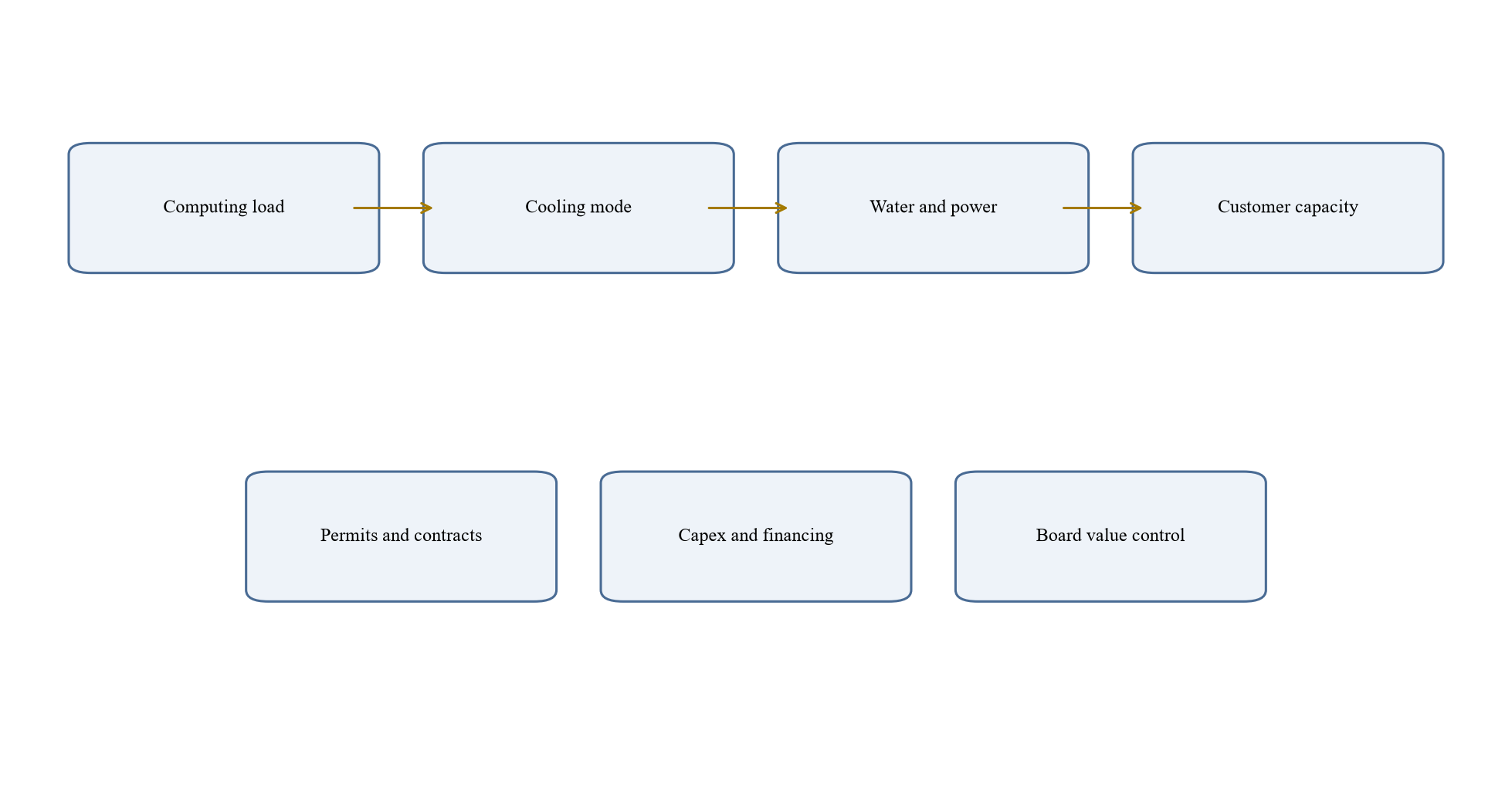
Create a monthly dashboard for information-technology load, rack density, WUE, PUE, water source, withdrawal, consumption, discharge, peak cooling power, temperature compliance, downtime, customer credits, capex and permit status. Assign accountable owners and escalation thresholds.
Compare actual results with the acquisition model and debt case. Maintain calibration, change control and audit trails. Reforecast when load, tariffs, weather, customer requirements or retrofit milestones move.
The dashboard should retain both numerator and denominator for every efficiency measure. A reported improvement in WUE can arise from a genuine reduction in water withdrawal, a change in computing load, a boundary change or a meter failure. The control process should therefore reconcile facility water, cooling-system water, information-technology electricity, total facility electricity and billable computing output. Finance should connect the same period to utility invoices, customer billing, service credits and maintenance expenditure. Engineering should explain weather normalization, operating mode and exceptional maintenance. This creates a common record for the board, lenders and customers.
Post-closing capital approval should use explicit gates. The first gate confirms design basis, utility rights and customer requirements. The second confirms vendor scope, outage plan, guarantees and contingency. The third confirms commissioning evidence and customer acceptance. The final gate releases retained consideration or project reserves only after the agreed measurement period. A failed gate should trigger a documented response: remedial work, revised operating limits, additional capital, a price mechanism or abandonment of the affected phase. The governance design turns the valuation assumptions into accountable operating decisions.
37. Frame the investment-committee decision
The committee should approve a price and funded operating plan, not a cooling slogan. State which water and power rights are proven, which capacity is customer-qualified, which retrofit is committed and which benefits remain contingent. Present central, downside and no-retrofit cases.
The final record should identify evidence, assumptions, legal advice, engineering reliance, conflicts, open conditions and monitoring owners. Where water or cooling evidence is incomplete, reduce base value and preserve the option through contingent consideration or staged capital.
The committee paper should show a clean bridge from physical capacity to cash. Begin with installed information-technology capacity, reduce it for commissioning, redundancy and thermal constraints, then identify customer-qualified and billable capacity. Reconcile the resulting load with annual water withdrawal, electricity demand, cooling operating cost and customer revenue. Show the retrofit as a separate investment with its own capex, completion date, performance test and financing. This prevents a buyer from paying for both unproven capacity and the capital required to make that capacity usable.
Decision rights should match exposure. Engineering should sign the thermal design and performance evidence. Legal advisers should identify the enforceability and transferability of water, power, discharge, customer and vendor rights. Finance should own the cash-flow reconciliation, valuation bridge and funding plan. Operations should own commissioning, maintenance and contingency procedures. The investment committee should approve the unresolved-risk treatment and the maximum capital at risk before each gate. A single named executive should be accountable for the integrated outcome because water, power, customers and financing can fail together.
Appendix A. Cooling cash-flow model
Begin with hourly information-technology load and ambient weather. Select cooling mode by operating rule. Calculate pumps, fans, chillers, towers and control power; calculate make-up, evaporation, drift, blowdown and discharge; then apply tariffs, treatment, maintenance and customer economics.
The model should distinguish facility cost, customer revenue, avoided loss and project financing. Reconcile monthly meters and invoices to cash. Use a transparent scenario register for weather, load, WUE, PUE, tariffs, capex and completion.
For each month, calculate information-technology electricity from installed capacity, utilization and hours. Apply the cooling architecture to derive cooling-system power and total facility power. Calculate water withdrawal from the selected WUE boundary and show consumption, discharge and treatment separately. Price each source using the contractual tariff, fixed charge, connection cost and escalation rule. Add maintenance, consumables, chemicals, specialist labour, software and insurance. Customer benefit should enter the model only where the technical requirement, commercial consideration and collection route are evidenced.
The valuation schedule should then translate operating cash into enterprise value and equity value. It should identify sustaining capex, expansion capex, retrofit capex, tax, working capital, debt service, leases, vendor finance, reserves and contingent claims. Scenario logic should preserve physical relationships. Higher dry-cooling use may reduce water while increasing power. Greater computing load may improve revenue while increasing heat rejection. A delayed retrofit may defer capital and also defer customer qualification. Every scenario should include a short written explanation of these linked effects.
Appendix B. Minimum confirmatory evidence
Technical evidence includes design drawings, equipment schedules, hydraulic models, weather files, rack-density plans, commissioning tests, capacity tests, water balance, energy meters and maintenance records. Commercial evidence includes utility contracts, tariffs, water bills, customer technical schedules, credits and service-level history.
Legal evidence includes permits, licences, easements, discharge consents, change-of-control provisions, warranties and insurance. Financing evidence includes debt documents, leases, security, completion tests and reserves. Grade every item by source, date, owner and reconciliation status.
The confirmatory process should include meter sampling and a period reconciliation. Select representative high-load, low-load and hot-weather periods. Trace raw meter readings through the building-management system, sustainability report, utility invoice and management accounts. Inspect sensor calibration and missing-data rules. Where derived data are used, reproduce the calculation independently. Reconcile customer service reports with the same timestamps. This exercise can reveal boundary changes, estimated readings, excluded auxiliary loads or cooling events that annual averages conceal.
Evidence quality should affect valuation directly. A signed utility allocation with proven delivery supports a different value than an application or management statement. A commissioned performance test supports a different value than a vendor specification. An executed customer requirement supports a different value than a sales forecast. The diligence register should assign each material input an evidence grade and map that grade to a valuation treatment, financing condition or transaction protection.
Appendix C. Hypothetical worked case
Installed information-technology capacity is 60 MW; average load is 42 MW; annual information-technology energy is approximately 368 GWh. Existing cooling withdrawal is 405 million litres. The retrofit reduces withdrawal by 360 million litres and costs AED 52 million.
Central annual benefit is AED 18.0 million and incremental cost is AED 8.0 million, producing AED 10.0 million of EBITDA. Incremental enterprise value is AED 74 million; project claims are AED 21 million; incremental equity value is AED 53 million. The combined downside produces AED 2.4 million of EBITDA, AED 10 million of enterprise value and no positive incremental equity after AED 25 million of claims. These figures are wholly hypothetical.
Appendix D. Investment-committee questions
Which water source is legally and physically secured? Which cooling boundary does WUE measure? What happens during the hottest coincident computing load? Which customers have qualified the system? What electrical headroom remains after dry cooling? What retrofit shutdown is required?
Who funds capex and overruns? Which permits and consents survive closing? What benefits are contracted? Which claims rank ahead of equity? What is the no-retrofit value? Which post-closing metric triggers intervention?
Appendix E. Scenario governance
Preserve the approved valuation date and evidence set. Run load-ramp, hot-weather, water-curtailment, power-price, capex-overrun, retrofit-delay, customer-rejection and combined cases. Do not alter one driver without its physical counterpart.
Record actual performance monthly and explain variance. Reopen valuation when a utility right, customer requirement, cooling technology or environmental obligation changes materially.
Appendix F. Data dictionary
The computing record should include installed, commissioned, occupied and billed MW; rack density; energy; hardware class and customer. The cooling record should include topology, temperatures, flow, redundancy, WUE, PUE, power and availability. The water record should include source, withdrawal, consumption, discharge, quality, tariff and permit.
The capex record should include asset, owner, supplier, amount, completion, useful life and milestone. The contract record should include customer, utility, term, capacity, price, service level, assignment and termination. The valuation record should identify cash recipient, method, discount rate, term, claims and sensitivity.
Appendix G. Decision figures and tables
Wholly hypothetical; Matchpoint Partners analysis.
| Architecture | Water profile | Power profile | Principal transaction issue |
|---|---|---|---|
| Evaporative rejection | high operational consumption | lower in favourable wet-bulb conditions | water right and escalation |
| Hybrid rejection | seasonal water use | mode-dependent | controls and design thresholds |
| Closed-loop dry | low cooling water | higher peak fan and chiller load | electrical headroom |
| Direct-to-chip plus dry | low cooling water and high density | design-dependent | customer and hardware qualification |
Proposed framework unless stated otherwise.
Wholly hypothetical; Matchpoint Partners analysis.
| State | Minimum evidence | Valuation treatment |
|---|---|---|
| Indicative availability | utility correspondence | feasibility only |
| Allocated capacity | binding agreement and tariff | contracted input, subject to completion |
| Connected supply | commissioned pipeline and meter | operational capacity |
| Proven operation | bills, quality tests and peak history | operating cash flow |
| Substitutable supply | tested backup source and storage | resilience value |
Proposed framework unless stated otherwise.
Wholly hypothetical; Matchpoint Partners analysis.
| Asset | Hypothetical cost | Diligence focus |
|---|---|---|
| Rack and hall liquid loop | AED 18m | customer qualification and leaks |
| Cooling distribution units | AED 11m | redundancy, controls and vendor support |
| Dry heat rejection | AED 15m | peak power and ambient performance |
| Electrical and controls | AED 5m | grid headroom and cybersecurity |
| Commissioning and contingency | AED 3m | outage window and completion evidence |
Figures describe no identified asset.
Wholly hypothetical; Matchpoint Partners analysis.
| Method | Central indication | Principal dependency |
|---|---|---|
| Discounted cash flow | AED 74m | contracted benefits and operating cost |
| Cost-to-cure cross-check | AED 52m | remaining capex and execution |
| Capacity-value cross-check | AED 81m | qualified load and customer economics |
| Reconciled incremental EV | AED 74m | evidence-weighted conclusion |
Proposed framework unless stated otherwise.
Wholly hypothetical; Matchpoint Partners analysis.
| Item | Central | Combined downside |
|---|---|---|
| Average IT load | 42 MW | 34 MW |
| Water withdrawal reduction | 360 ML | 290 ML |
| Incremental EBITDA | AED 10.0m | AED 2.4m |
| Incremental enterprise value | AED 74m | AED 10m |
| Incremental equity value | AED 53m | AED 0m |
Figures describe no identified asset.
Proposed governance framework.
| Unresolved issue | Protection | Release evidence |
|---|---|---|
| Water allocation | closing condition | executed agreement and connection |
| Retrofit completion | holdback or contingent consideration | passed capacity and efficiency test |
| Capex overrun | price adjustment or cap | final cost and completion certificate |
| Customer qualification | earn-out | signed acceptance and billed capacity |
| Permit exposure | specific indemnity | consent and compliance confirmation |
Proposed framework unless stated otherwise.
| Metric | Source | Trigger |
|---|---|---|
| IT load and rack density | facility and customer meters | ramp or design variance |
| WUE and water source | water meters and invoices | intensity or source deviation |
| PUE and peak cooling power | electrical meters | headroom or tariff breach |
| Temperature and availability | control system and incident log | service-level exposure |
| Retrofit capex and completion | project ledger and certificates | overrun or delay |
| Permits and contract compliance | obligations register | consent or renewal risk |
Proposed framework unless stated otherwise.
Sources
- UAE Ministry of Energy and Infrastructure, Water Security is a National Priority, 23 March 2025. Read the primary source
- UAE Ministry of Energy and Infrastructure, Initiatives to Ensure Sustainability of Water Resources, 24 March 2022. Read the primary source
- World Bank, Gulf Economic Update: Navigating the Water Challenge in the GCC, 2024. Read the primary source
- World Bank, Advancing Knowledge of the Water-Energy Nexus in the GCC Countries. Read the primary source
- ASHRAE, AI Data Center Energy Performance Framework: Introduction and Purpose. Read the primary source
- ASHRAE Handbook, Data Centers and Telecommunication Facilities, Chapter 20. Read the primary source
- Microsoft, Next-generation datacenters consume zero water for cooling, 9 December 2024. Read the primary source
- Microsoft, Transforming datacenter water efficiency, 25 July 2024. Read the primary source
- Microsoft, 2024 Environmental Sustainability Report. Read the primary source
- Microsoft, Understanding water use at Microsoft datacenters, 2026. Read the primary source
- Abu Dhabi Department of Energy, Water Management in District Cooling Plants Policy. Read the primary source
- Abu Dhabi Department of Energy, District Cooling economic regulation. Read the primary source
- Abu Dhabi Department of Energy, District Cooling Regulatory Framework Activated, 15 April 2021. Read the primary source
- Abu Dhabi Department of Energy, Price Controls. Read the primary source
- Abu Dhabi Department of Energy, Water Supply Regulations 2024. Read the primary source
- Environment Agency Abu Dhabi, Integrated Water Resources Management Plan. Read the primary source
- Khazna Data Centers, UAE's first 100 MW AI-optimized data centre, 15 October 2024. Read the primary source
- UAE Ministry of Energy and Infrastructure, Khazna and Agility announce Phaidra AI pilot, 4 February 2026. Read the primary source
- Dubai Electricity and Water Authority, Empower IPO announcement, 24 October 2022. Read the primary source
- Dubai Electricity and Water Authority, Sustainability Report 2025. Read the primary source
- Dubai Electricity and Water Authority, Projects and Subsidiaries. Read the primary source
- Dubai Electricity and Water Authority, Empower acquisition of Dubai International Airport district cooling systems, 2021. Read the primary source
- IFRS Foundation, IFRS 13 Fair Value Measurement. Read the primary source
- IFRS Foundation, Effects of climate-related matters on financial statements. Read the primary source
- IFRS Foundation, IFRS 3 Business Combinations. Read the primary source
- IFRS Foundation, IAS 36 Impairment of Assets. Read the primary source
- Flex Ltd, 2026 annual report: data-centre power, water and cooling risks. Read the primary source
- Blackstone Data Center Trust, 2026 prospectus: data-centre water, lease and acquisition assumptions. Read the primary source
- European Commission, Delegated Regulation (EU) 2024/1364 establishing a data-centre reporting scheme. Read the primary source
- UAE Ministry of Energy and Infrastructure, National Guide of the UAE Groundwater Economic Value, 3 January 2026. Read the primary source
