

1. Define the investment decision
The investment committee must decide whether a frontier-technology transaction creates an investable capability in the host economy, how much capital that capability warrants and which contractual rights make delivery credible. The decision extends beyond company valuation. It concerns what the investor will own, what local organisations can do after closing and whether the capability contributes to financial performance.
The committee should require a capability baseline, a target operating state, a funded transfer plan and evidence gates. A strategic label should not substitute for these elements. The same discipline applies to equity, joint ventures, licences, acquisitions, project finance and corporate partnerships.
2. Define capability
A capability is the repeatable ability to perform a valuable activity to an agreed standard. It combines people, process, knowledge, rights, tools, data, suppliers and governance. It exists when the local operating system can deliver an output under normal and stressed conditions.
Presence is not capability. Imported equipment, a memorandum, a training event or a foreign-managed facility may support transfer without establishing independent performance. The investor should define the output, quality, cost, capacity, owner and evidence. Capability should be measured at the level where decisions and cash flows occur.
3. Distinguish transfer from access
Access permits use of a technology or service. Transfer changes who can operate, improve, govern or commercialise it. A cloud subscription provides access. A controlled platform, trained local team, documented architecture, transferable data and operating rights can create a deeper capability.
Access may be the economically rational choice when technology changes rapidly or scale is global. The mandate should state the intended depth rather than assume local ownership is always superior. The framework evaluates whether the selected depth supports the investor's return, resilience and policy objectives.
4. Define the dual return
Financial return includes cash flow, capital appreciation and distributions. Capability return includes measurable improvements in skills, productivity, local ownership, supplier quality, research, resilience and export capacity. These returns can reinforce one another when capability lowers cost, improves delivery or creates new revenue.
They can also conflict. A rapid financial exit may interrupt transfer. Excessive localisation may raise cost or delay scale. The investment memorandum should show the relationship explicitly. Strategic outcomes should enter underwriting through cash flows, risk, options or a separately governed mandate rather than an unexplained premium.
5. Establish the policy context
The UAE's Operation 300bn seeks to increase industrial contribution to GDP, strengthen in-country value, develop future industries and accelerate advanced-technology adoption [1]. Saudi Arabia's National Industrial Strategy identifies advanced and emerging technology localisation, skills and research capacity as industrial priorities [2]. PIF's MUSAHAMA programme connects procurement, supplier development, talent, technology and supply-chain localisation [3].
These policies establish direction, not company-specific value. Each transaction still requires a business case, evidence and accountability. The investor should translate policy objectives into a bounded capability mandate that the company can deliver and the board can govern.
6. Define six transfer channels
The framework uses six channels: people, process, intellectual property and data, physical systems, suppliers and market access. Each channel has a current state, target state, owner, investment, milestone and evidence source. Together they create an operating capability.
The channels should remain separate because progress can be uneven. A facility may be complete while suppliers remain unqualified. Staff may be trained without authority to modify the system. Intellectual property may be licensed without data or know-how needed for use. The weakest critical channel limits capability.
Table 1. Capability-transfer evidence ladder
| Transfer channel | Activity indicator | Capability evidence | Failure mode | Financial connection |
|---|---|---|---|---|
| People | Training hours, hires or secondments | Named roles performing work to standard without continuous external supervision | Attendance without proficiency or decision authority | Labour productivity, service cost, uptime and innovation cycle |
| Process | Manuals, workshops or procedures delivered | Controlled process used repeatedly with measured quality and improvement rights | Documentation detached from operations | Yield, cost, schedule, safety and customer acceptance |
| IP and data | Licence signed or database provided | Enforceable rights, usable know-how, governed data and freedom to operate | Narrow rights, inaccessible knowledge or vendor lock-in | Product margin, licensing income, switching cost and option value |
| Physical systems | Equipment installed or facility opened | Commissioned capacity with local operation, maintenance and upgrade capability | Imported asset dependent on remote specialists or scarce parts | Output, availability, capex efficiency and resilience |
| Suppliers | Local spend or supplier count | Qualified suppliers meeting quality, delivery and cost thresholds | Nominal sourcing without competitiveness or depth | Working capital, lead time, cost, continuity and export potential |
| Market access | Partnership, exhibition or announced customer | Accepted product, contracted revenue, distribution rights or export certification | Visibility without repeatable sales | Revenue growth, concentration, margin and strategic premium |
The ladder is a transaction-control framework. Company-specific obligations and performance require direct verification.
7. Establish the baseline
Transfer can be measured only against a credible starting point. The baseline should record existing skills, process maturity, IP rights, equipment, supplier capability, standards, output, cost, quality and customer access. It should identify what is already local and what depends on foreign parties.
Baseline evidence can include competency assessments, process audits, asset registers, contracts, supplier scorecards and operating data. The sponsor should avoid claiming credit for capability that existed before the investment. The baseline date and measurement boundary should be fixed before material execution begins.
8. Define the target operating state
The target operating state describes the capability at a specified date. It should state output, quality, capacity, cost, resilience, authority and ownership. It should also define acceptable external dependence. Complete autonomy may be unnecessary; controlled interdependence can provide better economics.
Targets should be precise enough for investment, contract and board decisions. “Develop local talent” should become a set of roles, proficiency levels, decision rights and operating results. “Transfer technology” should become defined rights, know-how, data, tools and verified use cases.
9. Assign capability ownership
Every target needs an accountable owner. Ownership can sit with a portfolio company, joint venture, research institution, supplier, operating partner or government entity. The owner should control the people, assets, rights and budget needed to sustain performance.
Fragmented ownership can make an announced ecosystem unusable. The investor should map legal ownership, operational control, funding responsibility and benefit. Shared capability should have governance for access, prioritisation, maintenance and future investment.
10. Map dependencies
Capabilities depend on utilities, inputs, licences, standards, specialist talent, software, data, export permissions and customers. A local assembly line can remain dependent on one imported component or proprietary diagnostic tool. A research centre can remain dependent on foreign principal investigators or inaccessible data.
The dependency map should show criticality, concentration, substitution time and contractual control. Transfer depth should be measured at bottlenecks, not averaged across the programme. The board should know which dependency can stop output and what mitigation exists.
11. Measure people capability
Headcount and training hours are inputs. Capability evidence includes assessed proficiency, observed task completion, error rates, decision authority, retention and progression into expert and leadership roles. The investor should define competency by role and operating context.
Secondments can transfer tacit knowledge when local staff perform real work with mentors and gradually assume responsibility. Classroom delivery alone rarely establishes operating competence. The plan should include assessment, supervised practice, certification where relevant and a path from execution to design and improvement.
12. Measure process transfer
Process transfer includes documented methods, control points, quality criteria, data capture and improvement routines. Evidence comes from repeated production or service cycles that meet defined outcomes. The local organisation should know how to diagnose variation and correct failure.
Manuals can support transfer but do not prove it. The investor should inspect process ownership, change control, root-cause analysis and audit results. A process that cannot be adapted locally may preserve dependence even when daily operation is local.
13. Measure intellectual-property rights
Intellectual property should be mapped by type, owner, territory, field of use, duration, exclusivity, sublicensing, improvement rights and termination. The transaction should distinguish patents, trade secrets, software, data, designs, trademarks and know-how. Each supports a different capability.
WIPO notes that IP value depends on technical advantage, market applicability, freedom to operate and context [4]. A licence can be valuable without ownership when rights are durable and economically sufficient. The mandate should state the intended control and the evidence required.
14. Measure know-how transfer
Know-how is often tacit, distributed and difficult to specify. It can include process settings, failure signatures, test methods, supplier choices, software tools and design judgement. Transfer requires interaction, supervised execution and access to the underlying rationale.
The contract should identify key know-how packages, personnel availability, deliverables and acceptance. The operating team should demonstrate use under representative conditions. Retention plans should protect locally accumulated expertise after foreign specialists leave.
15. Measure data capability
Data capability includes lawful access, quality, lineage, rights, storage, security, models and the ability to derive decisions. Data may be central to AI, life sciences, industrial systems and customer platforms. A local data centre does not establish data capability if control and analytics remain elsewhere.
The investor should map ownership, permitted use, portability, interoperability and exit. It should test whether local teams can maintain pipelines, monitor quality, retrain models and respond to incidents. Data rights should survive changes in vendor or control where the mandate requires continuity.
16. Measure physical-system capability
Physical capability includes commissioned equipment, qualified facilities, operating procedures, spare parts, maintenance, calibration and upgrade rights. Installation is an intermediate milestone. Acceptance should require output, quality, availability and safety evidence.
The plan should identify imported components, lead times, remote support and obsolescence. Local teams should be able to operate and diagnose the system at the intended depth. Where specialist external service remains necessary, the contract should secure access, response and knowledge continuity.
17. Measure supplier capability
Local procurement can create capability when suppliers improve quality, cost, delivery, standards and innovation. Spend alone can rise through low-value inputs without changing productive depth. The investor should segment suppliers by criticality and value-added activity.
OECD analysis identifies supplier relationships and strategic partnerships as channels for knowledge diffusion when domestic firms have sufficient absorptive capacity [5]. Supplier development should include gap assessments, technical support, qualification, financing and demand visibility. Graduation to competitive performance is the outcome.
18. Measure market-access capability
Market access includes customer qualification, certification, distribution, references, export permissions and recurring commercial relationships. A product can be locally manufactured yet unable to reach buyers. The investment should define which barriers capital and partners will remove.
Evidence includes accepted products, contracted sales, renewal, margin and expansion into additional customers or markets. A sponsor's network can accelerate access, but the company should build repeatable commercial capability rather than depend permanently on introductions.
19. Measure absorption capacity
Transfer requires a recipient able to absorb it. Absorption capacity includes foundational skills, management systems, capital, infrastructure, incentives and learning routines. The same technology package can produce different outcomes across recipients.
The investor should assess the gap before setting obligations. A plan may need preparatory training, supplier finance, standards support or management capacity. Unrealistic transfer targets can create paper compliance while the operating organisation remains dependent.
20. Build the capability map
The capability map connects each target to evidence, owner, investment, dependency and business outcome. It should show current, committed, demonstrated and independent states. It should also identify which capabilities are common across portfolio companies.
The map supports transaction structuring and post-close governance. It reveals gaps between a strategic narrative and the operating system required. It also prevents double counting when several investments claim the same shared laboratory, supplier or workforce.
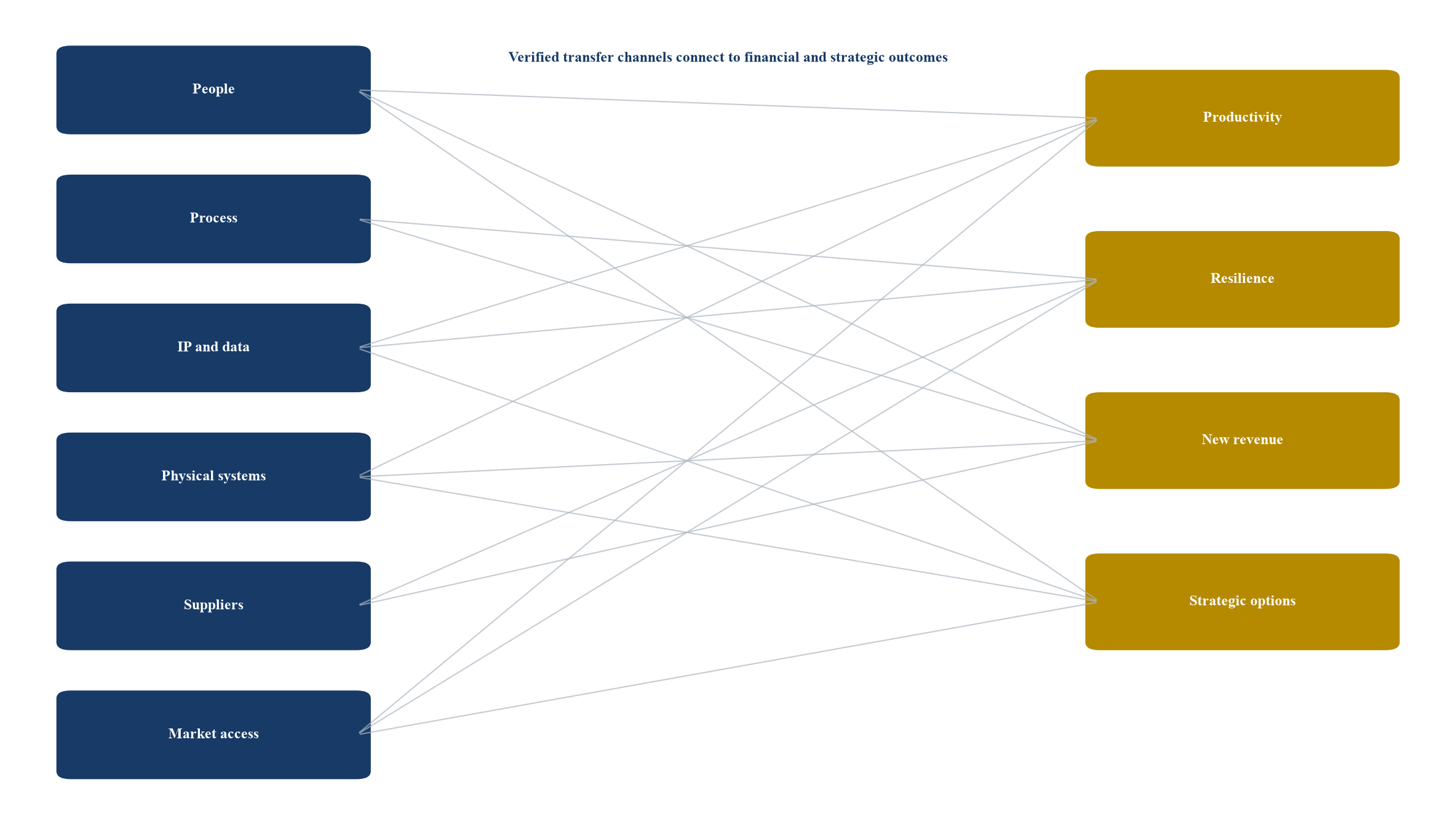
Nodes and links are hypothetical management assumptions prepared to demonstrate the framework.
21. Translate the map into contracts
The transaction documents should convert capability targets into obligations, milestones, information rights and remedies. Deliverables should specify content, quality, timing, acceptance and ownership. Key personnel, access to facilities and data, licences and supplier support may require separate schedules.
The contract should distinguish best efforts from outcome obligations. Some research outcomes cannot be guaranteed, but the programme design, resources, tests and reporting can be committed. Remedies can include withheld consideration, additional support, licence changes or exit rights.
22. Link consideration to evidence
Staged consideration can align payment with transfer. Upfront value may cover existing assets and rights. Deferred payments can depend on commissioning, proficiency, qualification, customer acceptance or independent operation. Earn-outs should use metrics that management can influence and the buyer can verify.
The pricing model should identify the value attributed to each capability. Milestones should avoid rewarding activity without outcome. The parties should define evidence, measurement window, dispute resolution and treatment of partial performance.
23. Finance the transfer programme
Transfer requires a funded work plan. Costs can include trainers, secondments, facilities, tooling, data migration, licences, supplier upgrades, certification and working capital. These uses should be distinct from the acquisition price and normal operating budget.
The sources-and-uses model should show who funds each component and what happens if costs rise. Grant, debt, equity, procurement commitments and vendor contributions can be combined. Funding should extend through the independent operating milestone rather than stop at installation.
24. Set milestone reserves
Investors should reserve capital against evidence gates and downside needs. A portfolio of capability programmes can create correlated demand for specialist talent, facilities or supplier finance. Reserves should reflect programme dependencies and not only company forecasts.
Release criteria should be measurable. The committee should retain authority to reallocate or stop capital when evidence changes. Unused reserves can support adjacent capability, return to investors or strengthen liquidity according to agreed policy.
25. Use a capability scorecard carefully
A scorecard improves visibility when it preserves underlying measures. It should not compress all channels into one number that hides failure. Critical capabilities should have minimum thresholds. Weighting should reflect the investment thesis and operational bottlenecks.
Scores should be supported by evidence and commentary. Changes in definitions or scope should be recorded. The board should see trends, exceptions and financial consequences. Independent review can test material claims.
26. Define leading and lagging indicators
Leading indicators include curriculum completion, process documentation, supplier audits and test readiness. Lagging indicators include independent operation, quality, productivity, local value added, revenue and export performance. Both are needed.
Leading indicators support early intervention but can be gamed. Lagging indicators arrive after capital is committed. The control system should connect each leading activity to a later operating result and test the assumed relationship.
27. Measure proficiency, not attendance
Training should be evaluated through task performance, problem solving, decision quality and certification where relevant. Assessments should use representative equipment, data and operating conditions. The required proficiency should differ by operator, engineer, manager and researcher role.
The programme should record who can perform independently, who needs supervision and who can train others. Retention and role deployment matter because a trained person outside the capability does not contribute to it. Compensation and career paths should support continuity.
28. Measure localisation depth
Localisation can progress from import and distribution to assembly, testing, manufacturing, design, research and ownership of improvements. The appropriate depth depends on economics, scale, security and policy. The framework should state the intended rung for each component.
Moving deeper requires supplier, talent and market capacity. The investor should avoid claiming full transfer when only final assembly changes location. It should also avoid forcing uneconomic depth that weakens competitiveness and financial sustainability.
29. Measure local value added
Local value added is the value created locally after imported inputs. It can include labour, locally sourced materials and services, depreciation, profit and taxes, subject to the applicable definition. Procurement spend alone can overstate value when inputs are imported through local intermediaries.
The investor should use consistent rules and reconcile them to financial records. It should distinguish direct, indirect and induced effects. Company-level decisions require verified operating measures rather than broad economic multipliers.
30. Measure supplier graduation
A supplier graduates when it meets defined cost, quality, delivery, capacity and compliance requirements and can compete for repeat business. Qualification without orders may not sustain capability. Orders without improvement may create dependence on preference.
The programme should track baseline gaps, support, qualification, awarded volume, performance and diversification into other customers. Supplier finance and demand visibility can support investment. The ultimate test is commercial competitiveness and resilience.
Table 2. Capability scorecard and evidence standard
| Dimension | Baseline measure | Target evidence | Review frequency | Escalation trigger |
|---|---|---|---|---|
| Skilled roles | Proficiency by critical role | Required roles independently performing and training others | Monthly during transfer; quarterly thereafter | Critical role below threshold or unexpected attrition |
| Process control | Yield, defects, cycle time and audit findings | Stable process meeting approved quality and cost range | Monthly | Repeated deviation or reliance on external intervention |
| Rights and data | Licence scope, ownership, access and portability | Enforceable operating, improvement and continuity rights | At closing and on material change | Restricted use, inaccessible know-how or termination risk |
| Supplier depth | Qualified suppliers and share of critical value | Competitive local suppliers with repeat orders and alternative customers | Quarterly | Quality failure, concentration or nominal pass-through spend |
| Market capability | Accepted products, contracts, margin and exports | Repeatable sales with customer diversity and required certification | Quarterly | Pipeline without acceptance or persistent negative margin |
Targets are illustrative; investment-specific thresholds require documented approval.
31. Measure productivity change
Productivity connects capability to economics. Measures can include output per labour hour, yield, cycle time, uptime, energy intensity and unit cost. The baseline and target should use consistent boundaries and product mix.
The investor should separate transfer effects from volume, price and external conditions. Operational improvement can support valuation when it is durable and attributable. A strategic programme that does not change performance may still have option value, but that value should be identified separately.
32. Measure resilience
Resilience is the ability to continue critical output through disruption. Metrics can include supplier concentration, inventory, substitution time, repair capability, data recovery and recovery time. Local presence alone does not create resilience when critical rights or inputs remain concentrated.
The investment case should identify the disruptions the capability is designed to withstand. Resilience benefits can enter value through avoided downtime, lower risk, contractual reliability or policy support. Hypothetical avoided loss should be labelled and tested.
33. Measure innovation capacity
Innovation capacity includes the ability to define problems, conduct research, test, protect knowledge, engineer products and commercialise results. Patent counts and research spending are activity measures. Evidence should include quality, relevance, adoption and economic output.
The operating model should show how local teams choose research priorities, access equipment and data, collaborate and fund follow-on work. Improvement rights matter because capability can stagnate if all future development remains with the provider.
34. Measure standards capability
Standards, testing, certification and metrology allow products to enter markets and supply chains. Capability includes laboratories, accredited methods, qualified personnel and recognition of results. It can be a shared ecosystem asset.
The investment should identify applicable standards and evidence gaps early. Certification support can accelerate supplier graduation and exports. The scorecard should distinguish preparation from successful qualification and continued compliance.
35. Measure research-to-market conversion
Research value depends on translation into protected, fundable and commercially relevant assets. The pathway includes invention disclosure, validation, IP strategy, prototype, partner selection, licensing or company creation. Each stage needs decision criteria and capital.
WIPO's guidance separates qualitative evaluation from monetary valuation and recognises cost, market, income and option approaches [4]. The investor should apply methods consistent with maturity and use ranges. Research activity should not be booked as commercial value without a credible route to use.
36. Measure export capability
Export capability requires competitive product, certification, distribution, logistics, financing, service and compliance. An export announcement or one shipment does not establish a repeatable channel. The company should demonstrate customer acceptance and collected revenue across defined markets.
The investor should map trade restrictions, content rules, data requirements and after-sales support. Export capability can diversify demand and test competitiveness beyond protected procurement. It can also increase working-capital and compliance needs.
37. Connect capability to valuation
Capability affects value through revenue, margin, capital efficiency, risk, duration and strategic options. The valuation should state the causal link. For example, supplier qualification may reduce lead time and working capital; improvement rights may support product extension; trained maintenance teams may increase availability.
The model should avoid adding a separate strategic premium for benefits already included in cash flows or discount rates. Capability claims without quantified economics can remain a governed strategic outcome rather than an unsupported valuation uplift.
38. Calibrate to transaction price
The acquisition or investment price should be allocated across existing business value, identifiable rights, growth options and the funded transfer programme. This helps distinguish what is purchased from what must still be created.
Future valuations should backtest transfer assumptions. If a milestone was delayed, cost more or produced less value, the model should explain the change. Consistent calibration supports investment discipline and reporting.
39. Value intellectual property in context
IP value depends on control, technical relevance, market need, development cost, legal strength and the user's capability. WIPO emphasises that the same technology can have different value in different contexts [4]. A GCC investor may value regional rights, local improvement and supply security differently from a passive licensee.
The valuation should identify the specific rights and cash flows. Cost, market, income and real-option methods can provide ranges. Technology transfer assistance and know-how should be valued separately when material.
40. Price strategic options
Strategic options can include entry into an adjacent sector, access to scarce know-how, faster crisis response, supplier diversification or a platform for future ventures. Each option needs an exercise decision, cost, timing and payoff.
Option language should not justify unlimited premiums. The model should identify which capabilities make the option exercisable and which evidence changes its probability. Governance should decide whether additional capital is warranted when the option becomes clearer.
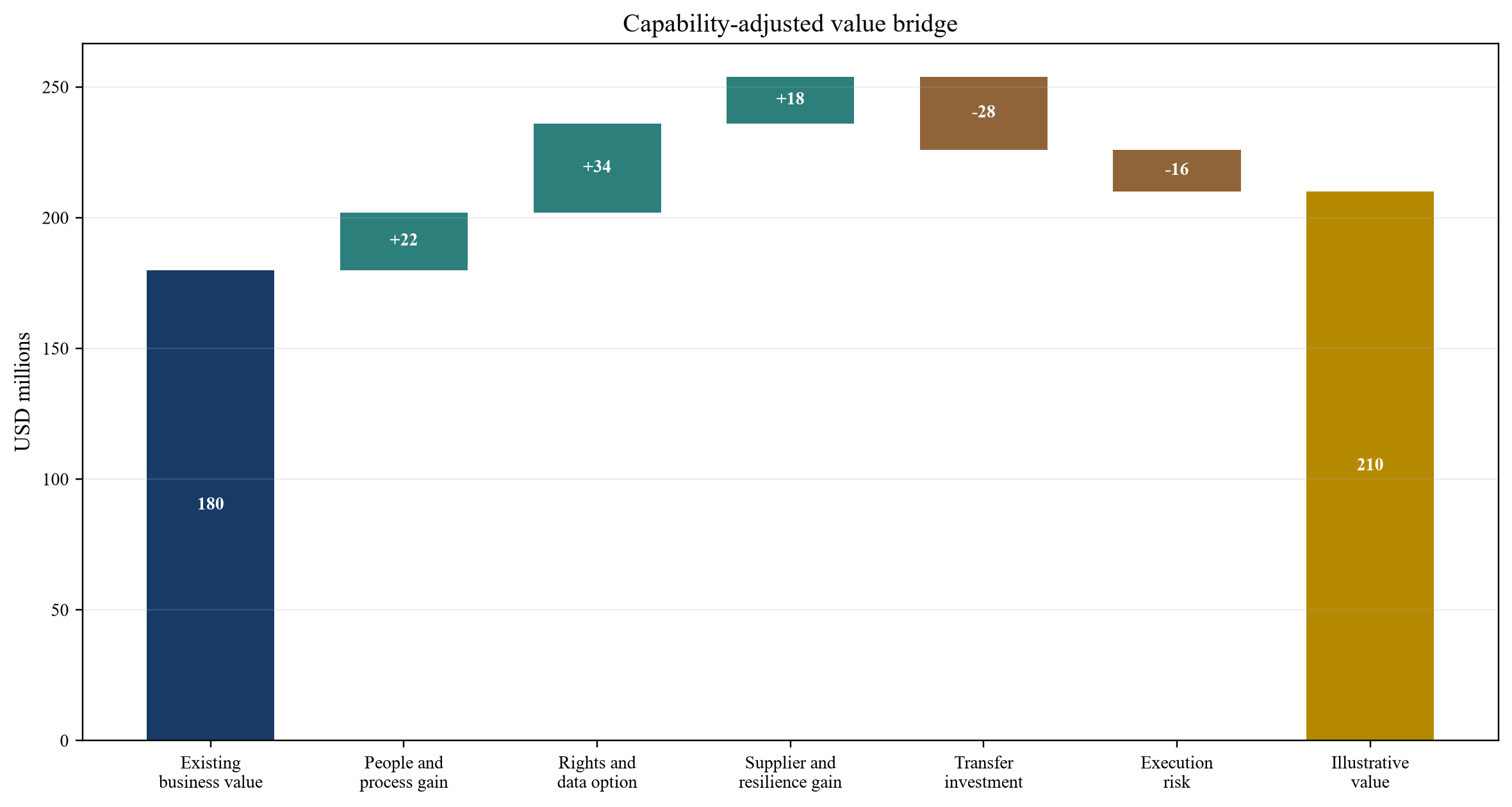
Values are hypothetical management assumptions in USD millions and demonstrate reconciliation only.
41. Model downside cases
Downside cases should include delayed transfer, staff attrition, restricted rights, supplier failure, cost overrun, weak demand and technology obsolescence. Capability investments can create stranded facilities or fixed costs when commercial scale does not emerge.
The model should show cash, covenant and strategic consequences. Remedies, alternative uses and exit routes should be developed before closing. A programme can preserve some value through licensing, contract manufacturing, shared facilities or supplier redeployment even when the original case fails.
42. Structure joint ventures
Joint ventures can combine technology, capital, market access and local operating capacity. Their effectiveness depends on contributions, governance, reserved matters, funding, IP, data, personnel, procurement and exit. A percentage ownership split does not establish transfer.
The documents should define capability deliverables and decision rights. Deadlock and termination provisions should preserve continuity and rights where feasible. The board should monitor transfer alongside financial performance.
43. Structure licences
Licences can provide a faster and more capital-efficient route than acquisition. Terms should cover scope, territory, field, exclusivity, sublicensing, improvements, know-how, support, data, audit and termination. The licensee must have the capability to use the rights.
Milestone fees and royalties can align payment with commercialisation. Continuity provisions can address insolvency, change of control and support failure. The investor should test dependence on tools or knowledge outside the written licence.
44. Structure acquisitions
An acquisition can provide control over technology, team and customers. Integration can still destroy capability through attrition, system separation or loss of autonomy. The plan should identify what must be preserved and what should move.
Consideration can include retention, earn-outs and milestone payments. Diligence should verify rights and dependencies before assigning strategic value. Post-close governance should protect transfer from short-term cost actions that remove critical expertise.
45. Structure project finance
Frontier-technology infrastructure may combine proven assets with newer systems. Lenders require contracted cash flow, completion support, warranties and risk allocation. Capability transfer can improve operations and resilience but should not be assumed to service debt before it is demonstrated.
The financing plan should separate proven and contingent components. Grants, sponsor equity, subordinated capital or guarantees may fund learning. Performance tests, reserve accounts and step-in rights should reflect the actual technology and operating maturity.
46. Use procurement as a transfer lever
Procurement provides demand visibility that can justify supplier investment. Specifications, qualification, lot sizes, payment terms and multi-year commitments can shape local capability. Preference without performance can weaken competitiveness.
PIF's MUSAHAMA programme explicitly connects procurement with supplier development, technology, talent and innovation [3]. An investment portfolio can use common demand while preserving open competition. Contracts should reward quality, cost and innovation as suppliers mature.
47. Use supplier finance
Suppliers may need tooling, certification, working capital and equipment before they can meet demand. Bank debt may be unavailable without contracts or collateral. Investors can use purchase commitments, receivables finance, equipment leases, guarantees or targeted equity.
Finance should follow a verified capability plan and customer demand. It should avoid supporting uneconomic capacity solely to meet a headline local-content target. Repayment and return should connect to supplier cash flow.
48. Govern conflicts
Strategic investors may direct procurement, select partners or value policy outcomes. Related parties can benefit from contracts or facilities. The governance framework should disclose relationships, decision rights and economic transfers.
Independent review may be needed for material transactions, capability claims and valuation changes. The board should distinguish commercial decisions from mandate expenditure. Costs undertaken primarily for policy outcomes should be visible to the sponsor and investors.
49. Protect competition and productivity
Local capability should become productive and competitive. Permanent protection can reduce incentives to improve and raise portfolio costs. The plan should include performance thresholds, benchmarking and a route from support to market discipline.
OECD work notes that spillovers depend on domestic absorptive capacity and appropriate linkages [5]. Policy and investment support should address real gaps while preserving incentives for quality and innovation. The investor should measure outcomes, not entitlement.
50. Report capability evidence
Reporting should show baseline, target, current evidence, spend, variance, owner and financial effect. It should separate activity, demonstrated capability and independent operation. Claims should be supported by operating data, contracts, assessments or third-party verification.
The report should retain missed milestones and changed definitions. Narrative can explain learning, but it should not erase prior commitments. Portfolio reporting should aggregate comparable measures while preserving company-specific bottlenecks.
Table 3. Hypothetical capability-investment scenarios
| Scenario | Transfer investment | Independent capability date | Annual operating benefit | Export revenue at maturity | Strategic outcome |
|---|---|---|---|---|---|
| Full transfer and scale | USD 28m | Year 3 | USD 17m | USD 42m | Local design, production and supplier network |
| Operational transfer only | USD 22m | Year 3 | USD 10m | USD 18m | Local operation with continuing design dependence |
| Delayed absorption | USD 34m | Year 5 | USD 7m | USD 9m | Partial capability and extended external support |
| Programme failure | USD 19m | Not achieved | USD 1m | Nil | Asset redeployment and licence exit |
All values are hypothetical management assumptions. They are not observed market data, forecasts or investment recommendations.
51. Verify independently
Independent verification can test proficiency, process performance, IP rights, supplier qualification, standards and market acceptance. The verifier should have appropriate expertise and access. Its scope should define evidence and limitations.
Verification should focus on material claims and milestones tied to capital or valuation. Internal audit can test control and data lineage. External experts can assess technical performance. Customers and certifiers can provide operating evidence.
52. Audit data lineage
Metrics should reconcile to source systems and financial records. The audit trail should show definition, owner, period, calculation and evidence. Local content, jobs and training can be overstated through inconsistent boundaries or duplicate counting.
Automated dashboards improve timeliness but do not establish accuracy. Controls should cover access, change, approval and exceptions. Material management estimates should be labelled and later replaced with observed data when available.
53. Govern portfolio synergies
A fund may create shared laboratories, procurement, talent academies, data platforms or suppliers across holdings. These can reduce cost and deepen capability. They can also shift expenses and obscure company economics.
The manager should define access, allocation, ownership and pricing. Synergy claims should be supported by usage and outcomes. A shared asset should have a sustainable operating model and not rely indefinitely on discretionary support.
54. Trigger intervention
Intervention triggers can include missed proficiency, failed qualification, restricted rights, cost overrun, supplier concentration or customer rejection. The board should define escalation, corrective action and capital consequences.
Interventions can change partner, add expertise, modify scope, fund absorption or stop the programme. The response should address the root cause. Repeated activity without evidence should not justify continued capital.
55. Trigger a stop decision
A capability programme should stop when expected benefit falls below remaining cost or when a critical right, market or dependency becomes unavailable. Sunk cost and policy visibility should not determine the decision. The record should show evidence and alternatives.
The exit plan should preserve usable assets, knowledge, data and supplier relationships. Staff redeployment, licensing and shared facilities can retain value. Contractual termination should protect continuity and confidentiality.
56. Rebalance the mandate
Evidence can justify deeper transfer, narrower scope or a shift from ownership to access. The investor should revisit objectives when technology, markets or policy change. Rebalancing protects capital and keeps the mandate relevant.
Changes should be approved through the same governance used at entry. The board should show which targets changed, why and with what financial effect. Rebalancing is disciplined adaptation when it follows evidence.
57. Apply five capability gates
The framework uses five gates: mandate clarity, rights and resources, absorption, operating proof and economic sustainability. Capital should progress only when the preceding gate has credible evidence. Exceptions should be explicit.
Each gate has an owner, evidence pack and decision. The sequence prevents equipment or licences from being treated as complete transfer. It also connects strategic outcomes to cash flow and valuation.
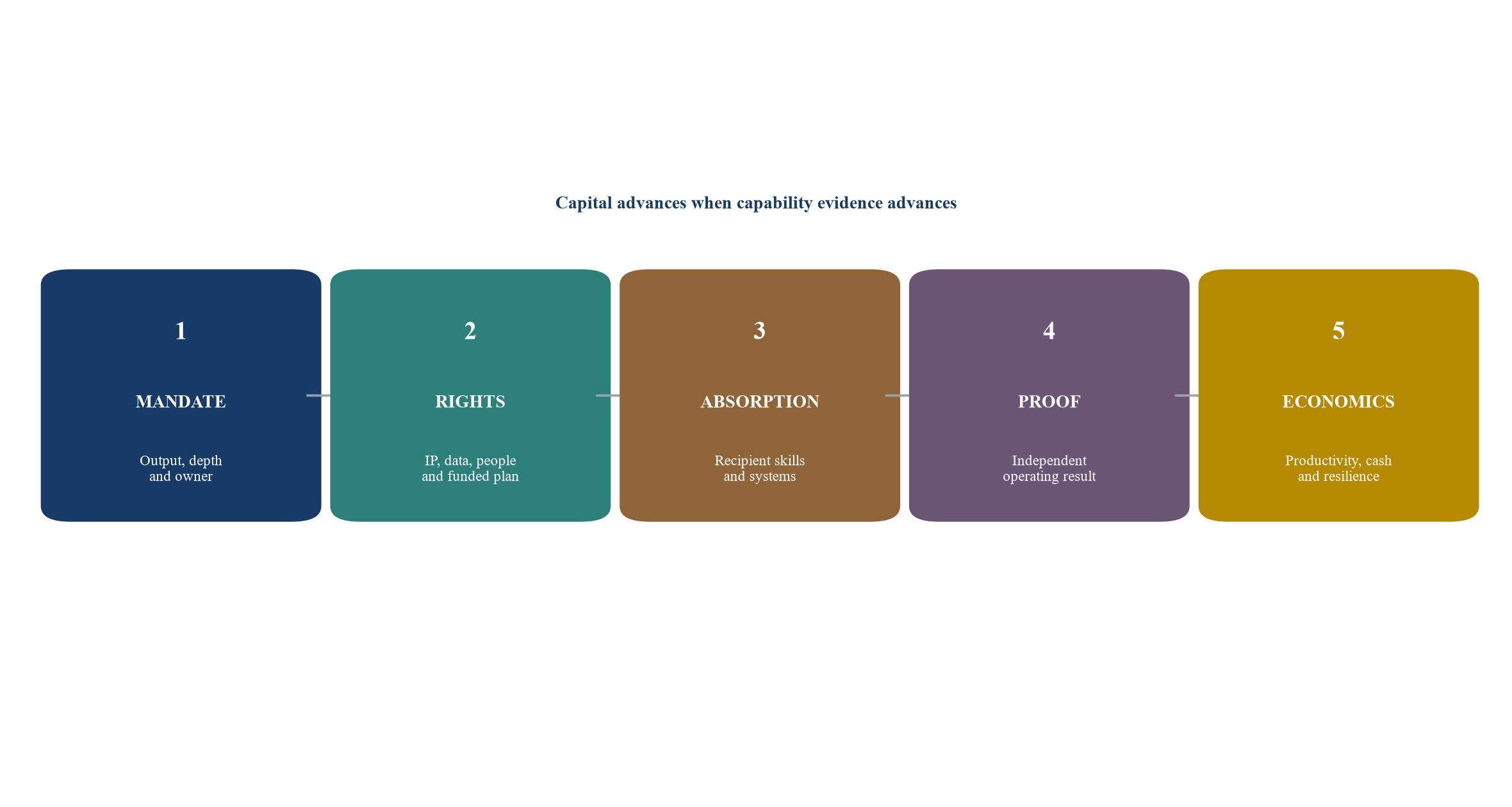
Each gate requires current evidence and a recorded investment decision.
58. Build the decision record
The record should include baseline, target state, capability map, contracts, financing, evidence, valuation and board decisions. It should show which claims were observed, estimated or contingent. It should retain changes and exceptions.
The record allows audit, backtesting and learning across investments. It also supports institutional continuity when teams change. Sensitive technology and commercial data can remain protected while decision logic and accountability are preserved.
59. Use a hundred-day mobilisation plan
The first month should establish baseline, ownership, dependencies and contract gaps. The second should finalise work packages, budget, assessments and data controls. The third should launch transfer, supplier and market programmes with board reporting. The final period should complete the first evidence review and capital decision.
Mobilisation should focus on the capabilities that determine value and continuity. A large activity register can distract from critical bottlenecks. The programme office should report evidence and financial consequence.
Table 4. Hundred-day capability-mandate mobilisation plan
| Period | Core work | Decision output | Principal control |
|---|---|---|---|
| Days 1-25 | Baseline, target state, ownership, rights and dependency map | Approved capability mandate and critical gaps | Source evidence, legal rights and accountable owners |
| Days 26-50 | Work packages, budget, proficiency standards, supplier and data plans | Funded transfer programme and milestones | Sources-and-uses, acceptance criteria and risk register |
| Days 51-75 | Contracts, training, process transfer, supplier upgrades and market actions | Active delivery with measurable leading evidence | Data lineage, independent assessments and exception reporting |
| Days 76-100 | First operating tests, valuation bridge and capital review | Continue, correct, deepen or stop decision | Gate review and documented financial consequence |
Timing is illustrative and should be adapted to the transaction and technology.
60. Conclusion
Capital with a capability mandate should purchase more than presence or activity. It should create a verified operating ability owned by identifiable local organisations and people, supported by rights, processes, assets, suppliers and customers. The capability should contribute to productivity, resilience, revenue or strategic options.
The Capability Mandate Investment Framework turns broad transfer ambitions into an investable control system. It establishes a baseline, defines depth, funds absorption, stages capital against evidence and links outcomes to valuation. This discipline allows GCC investors to pursue strategic development and commercial returns through the same transparent decision architecture.
References
- UAE Ministry of Industry and Advanced Technology. About Operation 300bn. https://www.moiat.gov.ae/en/about-us/about-the-strategy
- Kingdom of Saudi Arabia. National Industrial Strategy. https://www.vision2030.gov.sa/media/t0uiiudv/nsd_en.pdf
- Public Investment Fund. MUSAHAMA Local Content Growth Program. https://www.pif.gov.sa/en/private-sector-hub/private-sector-initiatives/musahama-program/
- World Intellectual Property Organization. Transferring Technology from Lab to Market: IP Valuation. https://www.wipo.int/en/web/technology-transfer/access-market
- Organisation for Economic Co-operation and Development. Foreign Direct Investment Qualities and Impact. https://www.oecd.org/en/topics/sub-issues/foreign-direct-investment-qualities-and-impact.html
- Organisation for Economic Co-operation and Development. FDI Qualities Indicators. 2019. https://doi.org/10.1787/0894dfba-en
- Organisation for Economic Co-operation and Development. FDI Qualities Policy Toolkit. 2022. https://doi.org/10.1787/7ba74100-en
- Organisation for Economic Co-operation and Development. Policy Toolkit for Strengthening FDI and SME Linkages. https://www.oecd.org/investment/fdi-qualities.htm
- World Bank Group. Global Investment Competitiveness Report: Supplier Development and FDI Spillovers. https://documents1.worldbank.org/curated/en/186291494256209814/pdf/114819-WP-REVISED-PUBLIC.pdf
- World Intellectual Property Organization. Intellectual Property Valuation Basics for Technology Transfer Professionals. 2025. https://www.wipo.int/publications/en/details.jsp?id=4805
- UAE Ministry of Industry and Advanced Technology. Industrial Investment Guide. 2026. https://moiat.gov.ae/-/media/site/moiat/navigation/moiatexecutive-industrial-investment-guide-v12-4webhr.ashx
- UAE Ministry of Industry and Advanced Technology. About the Ministry. https://moiat.gov.ae/en/about-us/about-the-ministry
- UAE Ministry of Industry and Advanced Technology. National In-Country Value Program. https://moiat.gov.ae/en/programs/icv
- Emirates Development Bank. Strategy and Priority Sectors. https://www.edb.gov.ae/
- Public Investment Fund. Local Content Growth Program Launch. October 2022. https://www.pif.gov.sa/en/news-and-insights/press-releases/2022/pif-launches-local-content-growth/
- Kingdom of Saudi Arabia. Vision 2030 Public Investment Fund Program. https://www.vision2030.gov.sa/media/mdppqvmv/v2030_pif_2025_en.pdf
- Local Content and Government Procurement Authority. Local Content Framework. https://www.lcgpa.gov.sa/
- Organisation for Economic Co-operation and Development. FDI Qualities Review of Jordan. 2022. https://www.oecd.org/en/publications/fdi-qualities-review-of-jordan_736c77d2-en.html
- Organisation for Economic Co-operation and Development. FDI Qualities Review of Viet Nam. 2026. https://www.oecd.org/en/publications/fdi-qualities-review-of-viet-nam_a3c78dac-en.html
- Organisation for Economic Co-operation and Development. Strengthening FDI and SME Linkages in the Baltic States. 2026. https://www.oecd.org/en/publications/strengthening-fdi-and-sme-linkages-in-the-baltic-states_26532e46-en.html
- United Nations Conference on Trade and Development. Investment Policy Framework for Sustainable Development. https://investmentpolicy.unctad.org/investment-policy-framework
- United Nations Conference on Trade and Development. World Investment Report. https://unctad.org/topic/investment/world-investment-report
- International Finance Corporation. Supplier Development and Local Linkages. https://www.ifc.org/
- International Labour Organization. Skills for Trade and Economic Diversification. https://www.ilo.org/skills/projects/WCMS_115959/lang--en/index.htm
- International Organization for Standardization. Innovation Management, ISO 56000 family. https://www.iso.org/committee/4587737.html
- International Organization for Standardization. Quality Management Systems, ISO 9001. https://www.iso.org/iso-9001-quality-management.html
- International Private Equity and Venture Capital Valuation Board. IPEV Valuation Guidelines 2025. https://www.privateequityvaluation.com/Valuation-Guidelines
- Institutional Limited Partners Association. Portfolio Company Metrics Template. https://ilpa.org/reporting-template/
- International Valuation Standards Council. International Valuation Standards. https://www.ivsc.org/standards/
- International Financial Reporting Standards Foundation. IFRS 13 Fair Value Measurement. https://www.ifrs.org/issued-standards/list-of-standards/ifrs-13-fair-value-measurement/
- National Aeronautics and Space Administration. Technology Readiness Levels. https://www.nasa.gov/directorates/somd/space-communications-navigation-program/technology-readiness-levels/
- United States Government Accountability Office. Technology Readiness Assessment Guide. https://www.gao.gov/products/gao-16-410g
- European Innovation Council. EIC Fund Investment Guidelines and Approach. https://eic.ec.europa.eu/eic-fund/eic-fund-investment-guidelines-approach_en
- World Intellectual Property Organization. IP and Technology Transfer. https://www.wipo.int/technology-transfer/en/
- World Intellectual Property Organization. Intellectual Property for Business. https://www.wipo.int/sme/en/
- Organisation for Economic Co-operation and Development. Policy Framework for Investment. https://www.oecd.org/investment/pfi.htm
- World Bank Group. Global Value Chains Development Report. https://www.worldbank.org/en/topic/global-value-chains
- International Trade Centre. SME Competitiveness Outlook. https://intracen.org/resources/publications
- World Economic Forum. Global Lighthouse Network. https://www.weforum.org/projects/global-lighthouse-network/
- United Nations Industrial Development Organization. Industrial Development Report. https://www.unido.org/resources-publications-flagship-publications-industrial-development-report-series
About the Author
Chennakeshav (CK) is a corporate finance and investment banking executive with 25+ years of global experience in deal origination, structuring and execution across M&A, growth capital and corporate strategy. He has led value-creation mandates for founders, corporates and funds — bridging the boardroom view to hands-on execution and close.
His career spans Morgan Stanley, HSBC, Lloyds Banking Group, EWEC, ADQ portfolio companies and Emirates Growth Fund, across TMT, real estate, fintech, deeptech, cleantech, infrastructure and energy. He has partnered with C-suite leaders, private equity and venture funds, sovereign wealth funds and family offices to finance complex fund raises and scale-up ventures, and has led M&A due diligence, post-merger integration and business-transformation initiatives to create value.
At Matchpoint Partners he is Managing Partner, leading the firm's corporate finance, M&A and capital-raising practice. He holds an MBA from London Business School, an engineering degree from VTU and a Master of Laws (LLM, in progress) from UCL London.
An active start-up mentor, CK mentors at Techstars, DIFC FinTech Hive, Startup Grind, Founder Institute and IN5, serves as Entrepreneur Mentor in Residence (EMiR) at London Business School, and judges the Entrepreneurship World Cup.
