

1. Define the commercial decision
GCC utilities and the interconnector operator must decide which services to trade, how to allocate scarce transfer capacity and how infrastructure costs will be recovered. The design should strengthen reliability, produce transparent settlement and support investment without forcing unlike services into one price.
The evidence file should reconcile secure transfer capability, market rule, participant obligation, meter source, settlement formula and accountable authority. Assumptions about trade volume, price and utilisation should remain explicit and should be updated from observed transactions.
A durable regional market needs transparent rules, common data and predictable settlement. The preferred design should increase useful trade while preserving national security obligations and fair cost recovery.
2. State the market objectives
Objectives may include emergency support, reserve sharing, economic energy exchange, renewable integration, capacity adequacy, fuel savings and export development. Each objective requires a distinct product, performance standard and benefit measure.
The analysis should distinguish reliability service, commercial energy, capacity, reserves and financial rights. Benefits should be measured against a credible counterfactual and separated from transfers between countries, utilities and customers.
The decision body should see base, low-liquidity, congestion, payment-default and expansion-delay cases. The model should remain financially sustainable without assuming continuous scarcity or unrestricted cross-border access.
3. Map physical transfer capability
Commercial rights must reflect secure transfer capability after contingencies, maintenance, losses, stability and national-grid constraints. Nameplate line capacity does not equal simultaneously saleable capacity at every border.
The commercial model should show who pays, what service is delivered, when cash is settled and which party bears curtailment, credit, currency and regulatory risk. Approval should depend on enforceable arrangements and operational feasibility.
Implementation should translate the design into legal, regulatory, market, system, settlement and financing workstreams. Readiness gates should control progression from bilateral trade to more integrated products.
4. Separate firm and non-firm service
Firm service carries defined availability and curtailment obligations, while non-firm trade yields to reliability needs. Pricing, compensation, collateral and investment value should reflect the difference.
The evidence file should reconcile secure transfer capability, market rule, participant obligation, meter source, settlement formula and accountable authority. Assumptions about trade volume, price and utilisation should remain explicit and should be updated from observed transactions.
A durable regional market needs transparent rules, common data and predictable settlement. The preferred design should increase useful trade while preserving national security obligations and fair cost recovery.
5. Value emergency support
Emergency transfers can avoid outages and reserve activation. The framework should define triggers, priority, energy price, availability payment, restoration obligations and settlement after the event.
The analysis should distinguish reliability service, commercial energy, capacity, reserves and financial rights. Benefits should be measured against a credible counterfactual and separated from transfers between countries, utilities and customers.
The decision body should see base, low-liquidity, congestion, payment-default and expansion-delay cases. The model should remain financially sustainable without assuming continuous scarcity or unrestricted cross-border access.
Table 1. GCC interconnector product and revenue map
| Product | Buyer need | Operator obligation | Primary revenue | Principal risk |
|---|---|---|---|---|
| Emergency support | Avoid outage and accelerate restoration | Secure transfer when triggered | Availability plus event energy | Coincident regional stress |
| Bilateral energy | Seasonal or hourly economic exchange | Capacity allocation and schedule | Wheeling and transaction charge | Counterparty and curtailment |
| Installed-capacity sharing | Reduce duplicated adequacy investment | Deliverability and testing | Capacity reservation payment | Availability and policy change |
| Operating reserves | Regional balancing and contingency response | Telemetry, activation and settlement | Reserve availability and activation | Response failure |
| Short-term market | Transparent optimisation of surplus and deficit | Auction, dispatch interface and settlement | Market fee and congestion revenue | Low liquidity and market power |
Product design remains subject to system studies, governing agreements and national law.
6. Design scheduled bilateral trade
Bilateral contracts can match buyers and sellers across seasons and hours. Standard nomination, capacity reservation, imbalance and credit rules reduce negotiation cost while preserving commercial choice.
The commercial model should show who pays, what service is delivered, when cash is settled and which party bears curtailment, credit, currency and regulatory risk. Approval should depend on enforceable arrangements and operational feasibility.
Implementation should translate the design into legal, regulatory, market, system, settlement and financing workstreams. Readiness gates should control progression from bilateral trade to more integrated products.
7. Design a spot market
A central platform can match short-term supply and demand where bids, offers, network availability and settlement are transparent. Liquidity should be assessed before assuming a single market price is robust.
The evidence file should reconcile secure transfer capability, market rule, participant obligation, meter source, settlement formula and accountable authority. Assumptions about trade volume, price and utilisation should remain explicit and should be updated from observed transactions.
A durable regional market needs transparent rules, common data and predictable settlement. The preferred design should increase useful trade while preserving national security obligations and fair cost recovery.
8. Introduce day-ahead trading
Day-ahead auctions can coordinate generation schedules and cross-border capacity before real time. Gate closure, forecast quality and national dispatch interfaces determine operational value.
The analysis should distinguish reliability service, commercial energy, capacity, reserves and financial rights. Benefits should be measured against a credible counterfactual and separated from transfers between countries, utilities and customers.
The decision body should see base, low-liquidity, congestion, payment-default and expansion-delay cases. The model should remain financially sustainable without assuming continuous scarcity or unrestricted cross-border access.
9. Introduce intraday adjustment
Intraday trading can manage renewable and load forecast changes closer to delivery. The product requires timely metering, dispatch communication, credit checks and reliable capacity recalculation.
The commercial model should show who pays, what service is delivered, when cash is settled and which party bears curtailment, credit, currency and regulatory risk. Approval should depend on enforceable arrangements and operational feasibility.
Implementation should translate the design into legal, regulatory, market, system, settlement and financing workstreams. Readiness gates should control progression from bilateral trade to more integrated products.
10. Create capacity products
Installed-capacity sharing or reliability options can reduce duplicated reserve investment. The contract should define qualification, availability, deliverability, testing, penalties and treatment during regional stress.
The evidence file should reconcile secure transfer capability, market rule, participant obligation, meter source, settlement formula and accountable authority. Assumptions about trade volume, price and utilisation should remain explicit and should be updated from observed transactions.
A durable regional market needs transparent rules, common data and predictable settlement. The preferred design should increase useful trade while preserving national security obligations and fair cost recovery.
11. Create reserve products
Spinning, non-spinning and replacement reserves can be procured regionally where response can cross the network securely. Activation, telemetry, response time and opportunity cost require common definitions.
The analysis should distinguish reliability service, commercial energy, capacity, reserves and financial rights. Benefits should be measured against a credible counterfactual and separated from transfers between countries, utilities and customers.
The decision body should see base, low-liquidity, congestion, payment-default and expansion-delay cases. The model should remain financially sustainable without assuming continuous scarcity or unrestricted cross-border access.
12. Set imbalance pricing
Unscheduled deviations should face a price that encourages accurate nomination and funds balancing actions. The method should distinguish system-caused events, participant deviations and emergency support.
The commercial model should show who pays, what service is delivered, when cash is settled and which party bears curtailment, credit, currency and regulatory risk. Approval should depend on enforceable arrangements and operational feasibility.
Implementation should translate the design into legal, regulatory, market, system, settlement and financing workstreams. Readiness gates should control progression from bilateral trade to more integrated products.
13. Allocate congestion
When requested transfers exceed secure capacity, allocation can use pro rata rules, explicit auctions, implicit market coupling or priority rights. The method affects efficiency, bankability and participant incentives.
The evidence file should reconcile secure transfer capability, market rule, participant obligation, meter source, settlement formula and accountable authority. Assumptions about trade volume, price and utilisation should remain explicit and should be updated from observed transactions.
A durable regional market needs transparent rules, common data and predictable settlement. The preferred design should increase useful trade while preserving national security obligations and fair cost recovery.
14. Price transmission losses
Loss factors should reflect the incremental energy required by cross-border flows without creating arbitrary barriers. Publication and periodic calibration improve confidence in settlement.
The analysis should distinguish reliability service, commercial energy, capacity, reserves and financial rights. Benefits should be measured against a credible counterfactual and separated from transfers between countries, utilities and customers.
The decision body should see base, low-liquidity, congestion, payment-default and expansion-delay cases. The model should remain financially sustainable without assuming continuous scarcity or unrestricted cross-border access.
15. Set the wheeling charge
A wheeling charge can recover interconnector and national-network costs. The base may be capacity, energy, distance, zone or a hybrid, with safeguards against double recovery.
The commercial model should show who pays, what service is delivered, when cash is settled and which party bears curtailment, credit, currency and regulatory risk. Approval should depend on enforceable arrangements and operational feasibility.
Implementation should translate the design into legal, regulatory, market, system, settlement and financing workstreams. Readiness gates should control progression from bilateral trade to more integrated products.
16. Define transmission rights
Physical or financial transmission rights can hedge congestion and support longer-term trade. Rights must remain compatible with reliability curtailment and should not exceed dependable transfer capability.
The evidence file should reconcile secure transfer capability, market rule, participant obligation, meter source, settlement formula and accountable authority. Assumptions about trade volume, price and utilisation should remain explicit and should be updated from observed transactions.
A durable regional market needs transparent rules, common data and predictable settlement. The preferred design should increase useful trade while preserving national security obligations and fair cost recovery.
17. Use counterflow value
Opposite-direction transactions can relieve a binding flow and create additional commercial capacity. Settlement should reward the physical benefit without treating counterflow as firm capacity in every condition.
The analysis should distinguish reliability service, commercial energy, capacity, reserves and financial rights. Benefits should be measured against a credible counterfactual and separated from transfers between countries, utilities and customers.
The decision body should see base, low-liquidity, congestion, payment-default and expansion-delay cases. The model should remain financially sustainable without assuming continuous scarcity or unrestricted cross-border access.
18. Integrate renewable energy
Solar and wind diversity across geography and time can create trade value. Renewable attributes, forecast error, curtailment priority and balancing responsibility should be specified separately from energy.
The commercial model should show who pays, what service is delivered, when cash is settled and which party bears curtailment, credit, currency and regulatory risk. Approval should depend on enforceable arrangements and operational feasibility.
Implementation should translate the design into legal, regulatory, market, system, settlement and financing workstreams. Readiness gates should control progression from bilateral trade to more integrated products.
19. Integrate storage and flexibility
Storage, flexible demand and desalination loads can shape imports and exports. Market rules should permit participation while preventing double counting of capacity, reserve and energy services.
The evidence file should reconcile secure transfer capability, market rule, participant obligation, meter source, settlement formula and accountable authority. Assumptions about trade volume, price and utilisation should remain explicit and should be updated from observed transactions.
A durable regional market needs transparent rules, common data and predictable settlement. The preferred design should increase useful trade while preserving national security obligations and fair cost recovery.
20. Protect reliability priority
System security should remain the operating constraint for every commercial arrangement. Curtailment order, emergency override, restoration and compensation should be predetermined.
The analysis should distinguish reliability service, commercial energy, capacity, reserves and financial rights. Benefits should be measured against a credible counterfactual and separated from transfers between countries, utilities and customers.
The decision body should see base, low-liquidity, congestion, payment-default and expansion-delay cases. The model should remain financially sustainable without assuming continuous scarcity or unrestricted cross-border access.
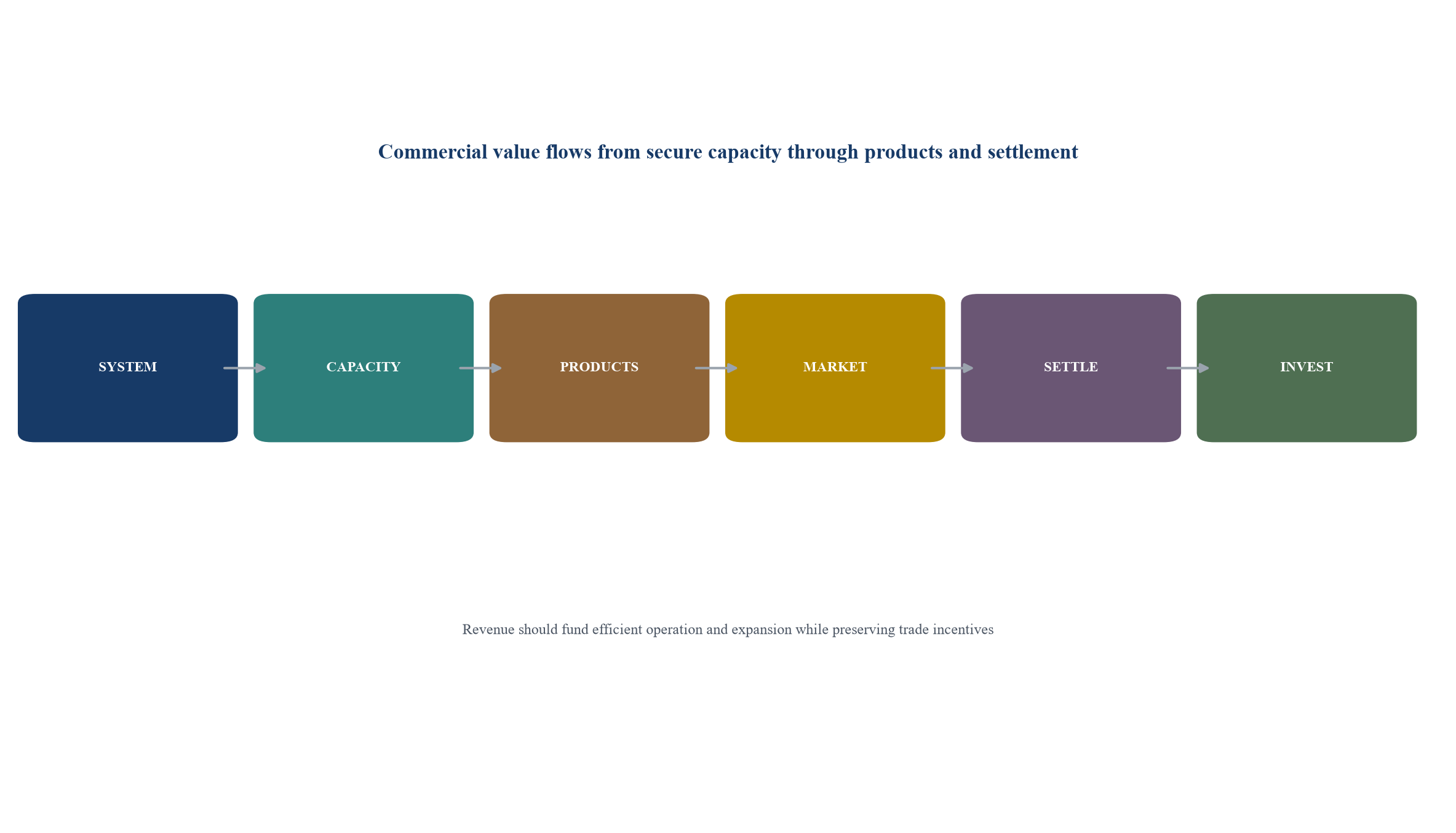
Physical security constrains every commercial product and settlement layer.
21. Choose the price-formation model
The market can use administratively agreed prices, avoided-cost sharing, bilateral negotiation, auctions or nodal and zonal prices. The method should match liquidity, governance and data maturity.
The commercial model should show who pays, what service is delivered, when cash is settled and which party bears curtailment, credit, currency and regulatory risk. Approval should depend on enforceable arrangements and operational feasibility.
Implementation should translate the design into legal, regulatory, market, system, settlement and financing workstreams. Readiness gates should control progression from bilateral trade to more integrated products.
22. Use cost-based exchange carefully
Cost-based trade can create early transactions where competition is limited. Auditable variable cost, start cost, fuel treatment and allocation of fixed cost are necessary to avoid dispute.
The evidence file should reconcile secure transfer capability, market rule, participant obligation, meter source, settlement formula and accountable authority. Assumptions about trade volume, price and utilisation should remain explicit and should be updated from observed transactions.
A durable regional market needs transparent rules, common data and predictable settlement. The preferred design should increase useful trade while preserving national security obligations and fair cost recovery.
23. Use bid-based trading
Bid-based markets reveal willingness to buy and sell but require participation, monitoring and transparent clearing. Caps, floors and mitigation rules should reflect scarcity and market concentration.
The analysis should distinguish reliability service, commercial energy, capacity, reserves and financial rights. Benefits should be measured against a credible counterfactual and separated from transfers between countries, utilities and customers.
The decision body should see base, low-liquidity, congestion, payment-default and expansion-delay cases. The model should remain financially sustainable without assuming continuous scarcity or unrestricted cross-border access.
24. Design scarcity pricing
Scarcity prices can signal the value of reserves and capacity during tight hours. Caps, emergency actions and consumer protection should preserve operational incentives without uncontrolled exposure.
The commercial model should show who pays, what service is delivered, when cash is settled and which party bears curtailment, credit, currency and regulatory risk. Approval should depend on enforceable arrangements and operational feasibility.
Implementation should translate the design into legal, regulatory, market, system, settlement and financing workstreams. Readiness gates should control progression from bilateral trade to more integrated products.
25. Control market power
Concentrated generation, limited interconnector capacity and national policy can create pivotal suppliers. Monitoring should cover bidding, withholding, affiliate transactions and physical availability.
The evidence file should reconcile secure transfer capability, market rule, participant obligation, meter source, settlement formula and accountable authority. Assumptions about trade volume, price and utilisation should remain explicit and should be updated from observed transactions.
A durable regional market needs transparent rules, common data and predictable settlement. The preferred design should increase useful trade while preserving national security obligations and fair cost recovery.
26. Recognise subsidy and fuel-price differences
Domestic fuel pricing, subsidies and tariff structures can distort cross-border offers. The settlement framework should disclose relevant adjustments and avoid embedding opaque transfers.
The analysis should distinguish reliability service, commercial energy, capacity, reserves and financial rights. Benefits should be measured against a credible counterfactual and separated from transfers between countries, utilities and customers.
The decision body should see base, low-liquidity, congestion, payment-default and expansion-delay cases. The model should remain financially sustainable without assuming continuous scarcity or unrestricted cross-border access.
27. Build the settlement architecture
Settlement should reconcile schedules, meters, losses, congestion, reserves, imbalances, taxes and currency. Timelines, corrections, disputes and finality should be common across participants.
The commercial model should show who pays, what service is delivered, when cash is settled and which party bears curtailment, credit, currency and regulatory risk. Approval should depend on enforceable arrangements and operational feasibility.
Implementation should translate the design into legal, regulatory, market, system, settlement and financing workstreams. Readiness gates should control progression from bilateral trade to more integrated products.
28. Create the credit framework
Utilities and traders present different sovereign, corporate and liquidity risks. Limits, collateral, guarantees, netting and suspension rights should follow enforceable exposure calculations.
The evidence file should reconcile secure transfer capability, market rule, participant obligation, meter source, settlement formula and accountable authority. Assumptions about trade volume, price and utilisation should remain explicit and should be updated from observed transactions.
A durable regional market needs transparent rules, common data and predictable settlement. The preferred design should increase useful trade while preserving national security obligations and fair cost recovery.
29. Design collateral efficiency
Cash, letters of credit, sovereign support and parent guarantees have different liquidity and legal value. Portfolio netting and variation margin can reduce exposure while preserving market access.
The analysis should distinguish reliability service, commercial energy, capacity, reserves and financial rights. Benefits should be measured against a credible counterfactual and separated from transfers between countries, utilities and customers.
The decision body should see base, low-liquidity, congestion, payment-default and expansion-delay cases. The model should remain financially sustainable without assuming continuous scarcity or unrestricted cross-border access.
30. Manage participant default
Default procedures should protect operations and prevent socialisation of uncontrolled losses. The waterfall should define collateral use, close-out, mutualised funds and recovery from the defaulter.
The commercial model should show who pays, what service is delivered, when cash is settled and which party bears curtailment, credit, currency and regulatory risk. Approval should depend on enforceable arrangements and operational feasibility.
Implementation should translate the design into legal, regulatory, market, system, settlement and financing workstreams. Readiness gates should control progression from bilateral trade to more integrated products.
Table 2. Revenue-model comparison
| Revenue element | Stability | Cost signal | Market effect | Core control |
|---|---|---|---|---|
| Member contribution | High | Broad regional-benefit allocation | Supports readiness and public-good functions | Agreed allocation and review |
| Availability tariff | High to medium | Pays for dependable access | Supports financeable capacity | Performance deductions |
| Capacity auction | Medium | Reveals scarcity by period and direction | Allocates rights competitively | Market-power and credit rules |
| Energy charge | Volume dependent | Charges actual throughput | Can discourage low-margin trade | Efficient rate and loss treatment |
| Congestion revenue | Volatile | Reveals network scarcity | Supports hedging or expansion | Transparent permitted use |
| Transaction fee | Volume dependent | Recovers platform and settlement | Scales with participation | Published tariff and cap |
The preferred mix should reflect cost causation, market maturity, revenue stability and participant incentives.
31. Manage currency risk
Energy, capacity and transmission charges may be invoiced in different currencies. The framework should specify settlement currency, conversion source, timing, hedging responsibility and payment disruption.
The evidence file should reconcile secure transfer capability, market rule, participant obligation, meter source, settlement formula and accountable authority. Assumptions about trade volume, price and utilisation should remain explicit and should be updated from observed transactions.
A durable regional market needs transparent rules, common data and predictable settlement. The preferred design should increase useful trade while preserving national security obligations and fair cost recovery.
32. Address tax and customs treatment
Cross-border energy and services may have VAT, withholding, customs or permanent-establishment implications. Tax treatment should be confirmed by jurisdiction before pricing is finalised.
The analysis should distinguish reliability service, commercial energy, capacity, reserves and financial rights. Benefits should be measured against a credible counterfactual and separated from transfers between countries, utilities and customers.
The decision body should see base, low-liquidity, congestion, payment-default and expansion-delay cases. The model should remain financially sustainable without assuming continuous scarcity or unrestricted cross-border access.
33. Define market governance
Member states, national utilities, system operators, regulators and GCCIA need explicit decision rights. Governance should separate rulemaking, operation, monitoring, settlement and dispute resolution.
The commercial model should show who pays, what service is delivered, when cash is settled and which party bears curtailment, credit, currency and regulatory risk. Approval should depend on enforceable arrangements and operational feasibility.
Implementation should translate the design into legal, regulatory, market, system, settlement and financing workstreams. Readiness gates should control progression from bilateral trade to more integrated products.
34. Set transparent access rules
Eligibility, licensing, connection, credit and technical requirements should be published. Comparable participants should receive comparable access subject to system security and national law.
The evidence file should reconcile secure transfer capability, market rule, participant obligation, meter source, settlement formula and accountable authority. Assumptions about trade volume, price and utilisation should remain explicit and should be updated from observed transactions.
A durable regional market needs transparent rules, common data and predictable settlement. The preferred design should increase useful trade while preserving national security obligations and fair cost recovery.
35. Allocate scarce capacity
Long-term rights, annual auctions, monthly products and short-term allocation compete for the same network. A reserve for reliability and short-term liquidity can coexist with bankable long-term access.
The analysis should distinguish reliability service, commercial energy, capacity, reserves and financial rights. Benefits should be measured against a credible counterfactual and separated from transfers between countries, utilities and customers.
The decision body should see base, low-liquidity, congestion, payment-default and expansion-delay cases. The model should remain financially sustainable without assuming continuous scarcity or unrestricted cross-border access.
36. Define curtailment and compensation
Curtailment priority should distinguish emergency, maintenance, congestion and participant default. Compensation should reflect firmness and avoid rewarding service that was never guaranteed.
The commercial model should show who pays, what service is delivered, when cash is settled and which party bears curtailment, credit, currency and regulatory risk. Approval should depend on enforceable arrangements and operational feasibility.
Implementation should translate the design into legal, regulatory, market, system, settlement and financing workstreams. Readiness gates should control progression from bilateral trade to more integrated products.
37. Build common metering standards
Revenue-grade metering, time synchronisation, validation and substitution rules are essential for cross-border settlement. Responsibilities should extend from border meters into national systems where needed.
The evidence file should reconcile secure transfer capability, market rule, participant obligation, meter source, settlement formula and accountable authority. Assumptions about trade volume, price and utilisation should remain explicit and should be updated from observed transactions.
A durable regional market needs transparent rules, common data and predictable settlement. The preferred design should increase useful trade while preserving national security obligations and fair cost recovery.
38. Create the data architecture
Participants require network availability, prices, awards, schedules, meter data and settlement statements. Access control, audit trails, retention and data ownership should support oversight and dispute resolution.
The analysis should distinguish reliability service, commercial energy, capacity, reserves and financial rights. Benefits should be measured against a credible counterfactual and separated from transfers between countries, utilities and customers.
The decision body should see base, low-liquidity, congestion, payment-default and expansion-delay cases. The model should remain financially sustainable without assuming continuous scarcity or unrestricted cross-border access.
39. Protect cybersecurity
Market and operational platforms are critical infrastructure. Security design should include segmentation, identity, logging, incident response, vendor access, recovery and coordinated cross-border exercises.
The commercial model should show who pays, what service is delivered, when cash is settled and which party bears curtailment, credit, currency and regulatory risk. Approval should depend on enforceable arrangements and operational feasibility.
Implementation should translate the design into legal, regulatory, market, system, settlement and financing workstreams. Readiness gates should control progression from bilateral trade to more integrated products.
40. Coordinate dispatch
Commercial schedules must be translated into feasible national dispatch and interconnector flows. Common procedures should cover gate closure, redispatch, outages, reserves and emergency instructions.
The evidence file should reconcile secure transfer capability, market rule, participant obligation, meter source, settlement formula and accountable authority. Assumptions about trade volume, price and utilisation should remain explicit and should be updated from observed transactions.
A durable regional market needs transparent rules, common data and predictable settlement. The preferred design should increase useful trade while preserving national security obligations and fair cost recovery.
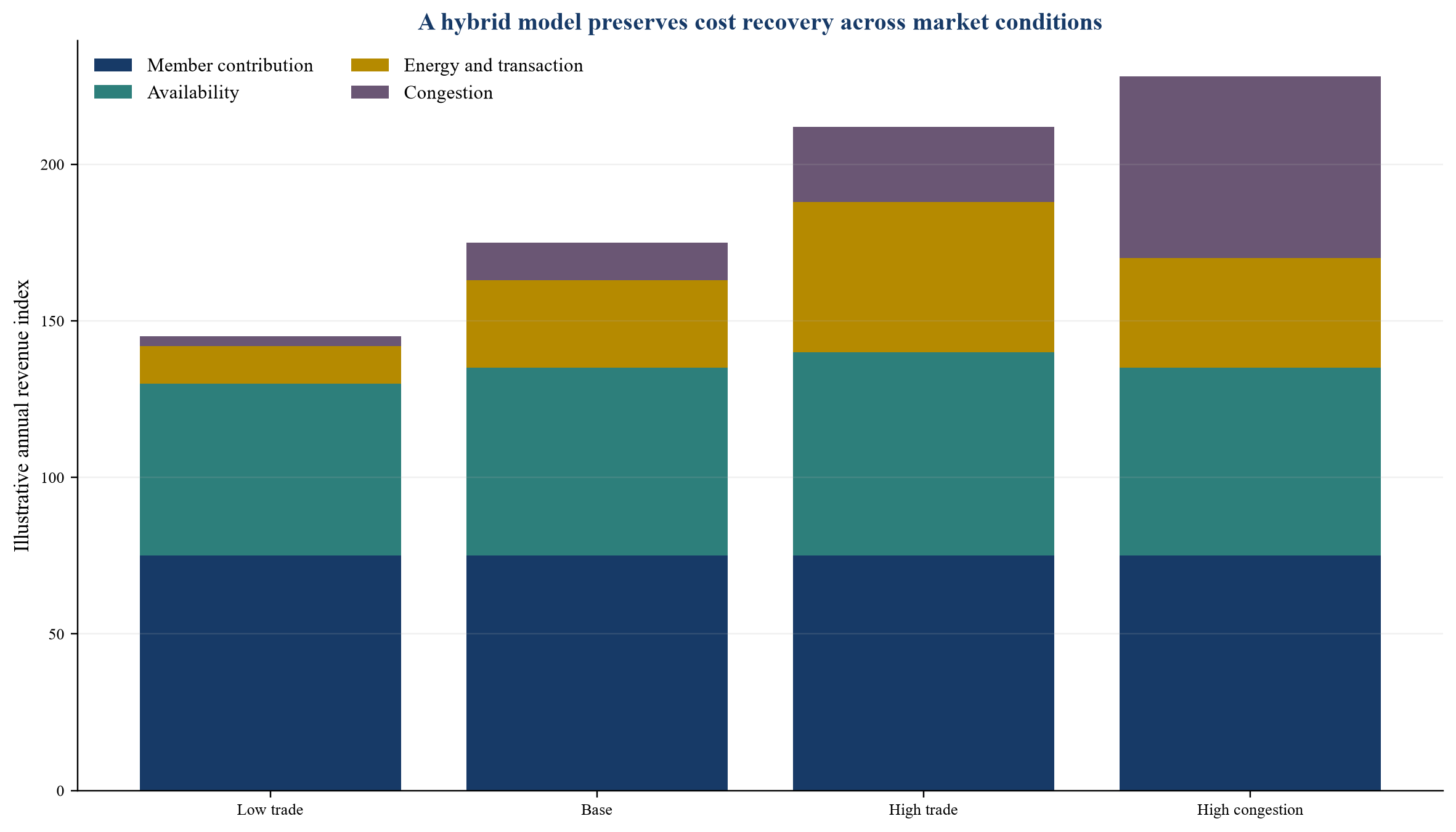
Values are hypothetical management assumptions used solely to demonstrate revenue resilience.
41. Build the interconnector cost model
The cost base should distinguish existing assets, expansions, national reinforcements, control systems, operations, losses and financing. Shared assets and country-specific works should remain transparent.
The analysis should distinguish reliability service, commercial energy, capacity, reserves and financial rights. Benefits should be measured against a credible counterfactual and separated from transfers between countries, utilities and customers.
The decision body should see base, low-liquidity, congestion, payment-default and expansion-delay cases. The model should remain financially sustainable without assuming continuous scarcity or unrestricted cross-border access.
42. Use a regulated network tariff
A regulated charge can provide stable recovery where access and prudence are supervised. Incentives should reward availability, efficiency and timely expansion while protecting users from avoidable cost.
The commercial model should show who pays, what service is delivered, when cash is settled and which party bears curtailment, credit, currency and regulatory risk. Approval should depend on enforceable arrangements and operational feasibility.
Implementation should translate the design into legal, regulatory, market, system, settlement and financing workstreams. Readiness gates should control progression from bilateral trade to more integrated products.
43. Use availability revenue
Capacity users or member states can pay for dependable interconnector availability. Performance deductions should reflect outages, constraints and service firmness within operator control.
The evidence file should reconcile secure transfer capability, market rule, participant obligation, meter source, settlement formula and accountable authority. Assumptions about trade volume, price and utilisation should remain explicit and should be updated from observed transactions.
A durable regional market needs transparent rules, common data and predictable settlement. The preferred design should increase useful trade while preserving national security obligations and fair cost recovery.
44. Use volume revenue cautiously
Energy-based charges rise with trade and align payment with use. They can create revenue volatility and discourage efficient transactions if charges exceed marginal network cost.
The analysis should distinguish reliability service, commercial energy, capacity, reserves and financial rights. Benefits should be measured against a credible counterfactual and separated from transfers between countries, utilities and customers.
The decision body should see base, low-liquidity, congestion, payment-default and expansion-delay cases. The model should remain financially sustainable without assuming continuous scarcity or unrestricted cross-border access.
45. Use congestion revenue
Auction or market-coupling congestion rents can signal scarcity and fund rights or network investment. Governance should define permitted use and prevent reliance on deliberately persistent congestion.
The commercial model should show who pays, what service is delivered, when cash is settled and which party bears curtailment, credit, currency and regulatory risk. Approval should depend on enforceable arrangements and operational feasibility.
Implementation should translate the design into legal, regulatory, market, system, settlement and financing workstreams. Readiness gates should control progression from bilateral trade to more integrated products.
46. Create a hybrid revenue model
A hybrid can combine fixed member contributions, regulated availability, capacity auctions, energy charges and congestion revenue. The mix should cover efficient cost and preserve trading incentives.
The evidence file should reconcile secure transfer capability, market rule, participant obligation, meter source, settlement formula and accountable authority. Assumptions about trade volume, price and utilisation should remain explicit and should be updated from observed transactions.
A durable regional market needs transparent rules, common data and predictable settlement. The preferred design should increase useful trade while preserving national security obligations and fair cost recovery.
47. Finance network expansion
Expansion finance should connect incremental capability to contracted access, regulated recovery or member support. Construction, interface, delay and utilisation risk should be allocated before debt is raised.
The analysis should distinguish reliability service, commercial energy, capacity, reserves and financial rights. Benefits should be measured against a credible counterfactual and separated from transfers between countries, utilities and customers.
The decision body should see base, low-liquidity, congestion, payment-default and expansion-delay cases. The model should remain financially sustainable without assuming continuous scarcity or unrestricted cross-border access.
48. Consider an SPV
A project SPV can ring-fence a new link or reinforcement when assets, contracts and cash flows are separable. National-grid interfaces, sovereign obligations and operating control remain critical.
The commercial model should show who pays, what service is delivered, when cash is settled and which party bears curtailment, credit, currency and regulatory risk. Approval should depend on enforceable arrangements and operational feasibility.
Implementation should translate the design into legal, regulatory, market, system, settlement and financing workstreams. Readiness gates should control progression from bilateral trade to more integrated products.
49. Structure government and utility support
Guarantees, take-or-pay capacity payments, liquidity facilities and termination compensation can support debt. Their legal authority, budget treatment and enforceability require independent review.
The evidence file should reconcile secure transfer capability, market rule, participant obligation, meter source, settlement formula and accountable authority. Assumptions about trade volume, price and utilisation should remain explicit and should be updated from observed transactions.
A durable regional market needs transparent rules, common data and predictable settlement. The preferred design should increase useful trade while preserving national security obligations and fair cost recovery.
50. Size debt against downside cash flow
Debt service should rely on contracted or regulated revenue with tested availability, volume and payment downside. Congestion rent and optional trade should receive conservative credit.
The analysis should distinguish reliability service, commercial energy, capacity, reserves and financial rights. Benefits should be measured against a credible counterfactual and separated from transfers between countries, utilities and customers.
The decision body should see base, low-liquidity, congestion, payment-default and expansion-delay cases. The model should remain financially sustainable without assuming continuous scarcity or unrestricted cross-border access.
Table 3. Hypothetical expansion financing sensitivity
| Case | Expansion capex index | Contracted revenue share | Utilisation | Minimum debt-service coverage | Decision implication |
|---|---|---|---|---|---|
| Regulated availability | 100 | 85% | 45% | 1.65x | Strong recovery with performance discipline |
| Volume-led tariff | 100 | 25% | 60% | 1.12x | Trade growth exposure constrains leverage |
| Capacity-auction model | 100 | 60% | 55% | 1.42x | Requires credible auction liquidity |
| Hybrid model | 100 | 72% | 55% | 1.58x | Balances recovery and trading incentives |
| Expansion delay | 112 | 72% | 45% | 1.23x | Needs contingency and completion support |
All values are hypothetical management assumptions and do not represent GCCIA, a member state or an actual project.
51. Phase market development
A staged route can move from emergency exchange and bilateral contracts to capacity auctions, day-ahead trading and deeper market coupling. Each phase should have objective readiness gates.
The commercial model should show who pays, what service is delivered, when cash is settled and which party bears curtailment, credit, currency and regulatory risk. Approval should depend on enforceable arrangements and operational feasibility.
Implementation should translate the design into legal, regulatory, market, system, settlement and financing workstreams. Readiness gates should control progression from bilateral trade to more integrated products.
52. Create the legal framework
Treaties, national laws, market rules, operating agreements and participant contracts should align. Legal review should address jurisdiction, sovereign immunity, enforcement and change in law.
The evidence file should reconcile secure transfer capability, market rule, participant obligation, meter source, settlement formula and accountable authority. Assumptions about trade volume, price and utilisation should remain explicit and should be updated from observed transactions.
A durable regional market needs transparent rules, common data and predictable settlement. The preferred design should increase useful trade while preserving national security obligations and fair cost recovery.
53. Align national regulation
National tariff, dispatch, subsidy and procurement rules can undermine regional trade. A coordination mechanism should identify conflicts and approve time-bound transition arrangements.
The analysis should distinguish reliability service, commercial energy, capacity, reserves and financial rights. Benefits should be measured against a credible counterfactual and separated from transfers between countries, utilities and customers.
The decision body should see base, low-liquidity, congestion, payment-default and expansion-delay cases. The model should remain financially sustainable without assuming continuous scarcity or unrestricted cross-border access.
54. Design dispute resolution
Technical, settlement, contractual and sovereign disputes may require different forums. Escalation, expert determination, arbitration, interim performance and payment security should be agreed.
The commercial model should show who pays, what service is delivered, when cash is settled and which party bears curtailment, credit, currency and regulatory risk. Approval should depend on enforceable arrangements and operational feasibility.
Implementation should translate the design into legal, regulatory, market, system, settlement and financing workstreams. Readiness gates should control progression from bilateral trade to more integrated products.
55. Address GCC system diversity
Member systems differ in size, generation mix, fuel economics, peak timing and regulatory structure. Product design should capture complementarities without assuming complete market harmonisation.
The evidence file should reconcile secure transfer capability, market rule, participant obligation, meter source, settlement formula and accountable authority. Assumptions about trade volume, price and utilisation should remain explicit and should be updated from observed transactions.
A durable regional market needs transparent rules, common data and predictable settlement. The preferred design should increase useful trade while preserving national security obligations and fair cost recovery.
56. Connect external markets
Links to Iraq, Egypt, Oman reinforcements and other regions can broaden trade and diversify resources. External access requires compatible technical, commercial, credit and geopolitical frameworks.
The analysis should distinguish reliability service, commercial energy, capacity, reserves and financial rights. Benefits should be measured against a credible counterfactual and separated from transfers between countries, utilities and customers.
The decision body should see base, low-liquidity, congestion, payment-default and expansion-delay cases. The model should remain financially sustainable without assuming continuous scarcity or unrestricted cross-border access.
57. Allocate benefits between countries
Benefits include avoided capacity, fuel savings, reliability, renewable integration and option value. Allocation should distinguish system benefit from cash transfer and support durable political agreement.
The commercial model should show who pays, what service is delivered, when cash is settled and which party bears curtailment, credit, currency and regulatory risk. Approval should depend on enforceable arrangements and operational feasibility.
Implementation should translate the design into legal, regulatory, market, system, settlement and financing workstreams. Readiness gates should control progression from bilateral trade to more integrated products.
58. Run commercial and financial diligence
Diligence should validate demand, offers, rules, utilisation, price formation, credit, costs and revenue. Historical emergency support should not be treated automatically as future commercial volume.
The evidence file should reconcile secure transfer capability, market rule, participant obligation, meter source, settlement formula and accountable authority. Assumptions about trade volume, price and utilisation should remain explicit and should be updated from observed transactions.
A durable regional market needs transparent rules, common data and predictable settlement. The preferred design should increase useful trade while preserving national security obligations and fair cost recovery.
59. Create the market scorecard
The scorecard should report reliable capacity, traded energy, liquidity, price convergence, reserve sharing, availability, curtailment, payment performance and consumer benefit.
The analysis should distinguish reliability service, commercial energy, capacity, reserves and financial rights. Benefits should be measured against a credible counterfactual and separated from transfers between countries, utilities and customers.
The decision body should see base, low-liquidity, congestion, payment-default and expansion-delay cases. The model should remain financially sustainable without assuming continuous scarcity or unrestricted cross-border access.
60. Adopt the decision record and 90-day plan
The final record should state products, access, pricing, revenue, governance, risk, financing and implementation gates. The first 90 days should close evidence gaps that could change the preferred model.
The commercial model should show who pays, what service is delivered, when cash is settled and which party bears curtailment, credit, currency and regulatory risk. Approval should depend on enforceable arrangements and operational feasibility.
Implementation should translate the design into legal, regulatory, market, system, settlement and financing workstreams. Readiness gates should control progression from bilateral trade to more integrated products.
Table 4. Illustrative 90-day GCC market-design programme
| Period | Workstream | Core actions | Decision output | Accountable body |
|---|---|---|---|---|
| Days 1-15 | System and products | Confirm capacity, reliability priority and product definitions | Approved service catalogue | System operators and GCCIA |
| Days 16-30 | Access and pricing | Define allocation, firmness, wheeling, losses and congestion | Draft commercial rules | Market-design committee |
| Days 31-45 | Settlement and credit | Specify metering, invoices, collateral, default and currency | Settlement rulebook | GCCIA and utilities |
| Days 46-60 | Revenue and finance | Model costs, tariffs, utilisation, expansion and downside | Risk-adjusted revenue model | Finance working group |
| Days 61-75 | Legal and regulatory | Align agreements, national rules, tax and dispute routes | Implementable legal map | Member states and regulators |
| Days 76-90 | Pilot and governance | Select products, participants, controls, KPIs and readiness gates | Authorised pilot plan | GCCIA board and members |
Timing is indicative and should be adapted to GCCIA and member-state governance.
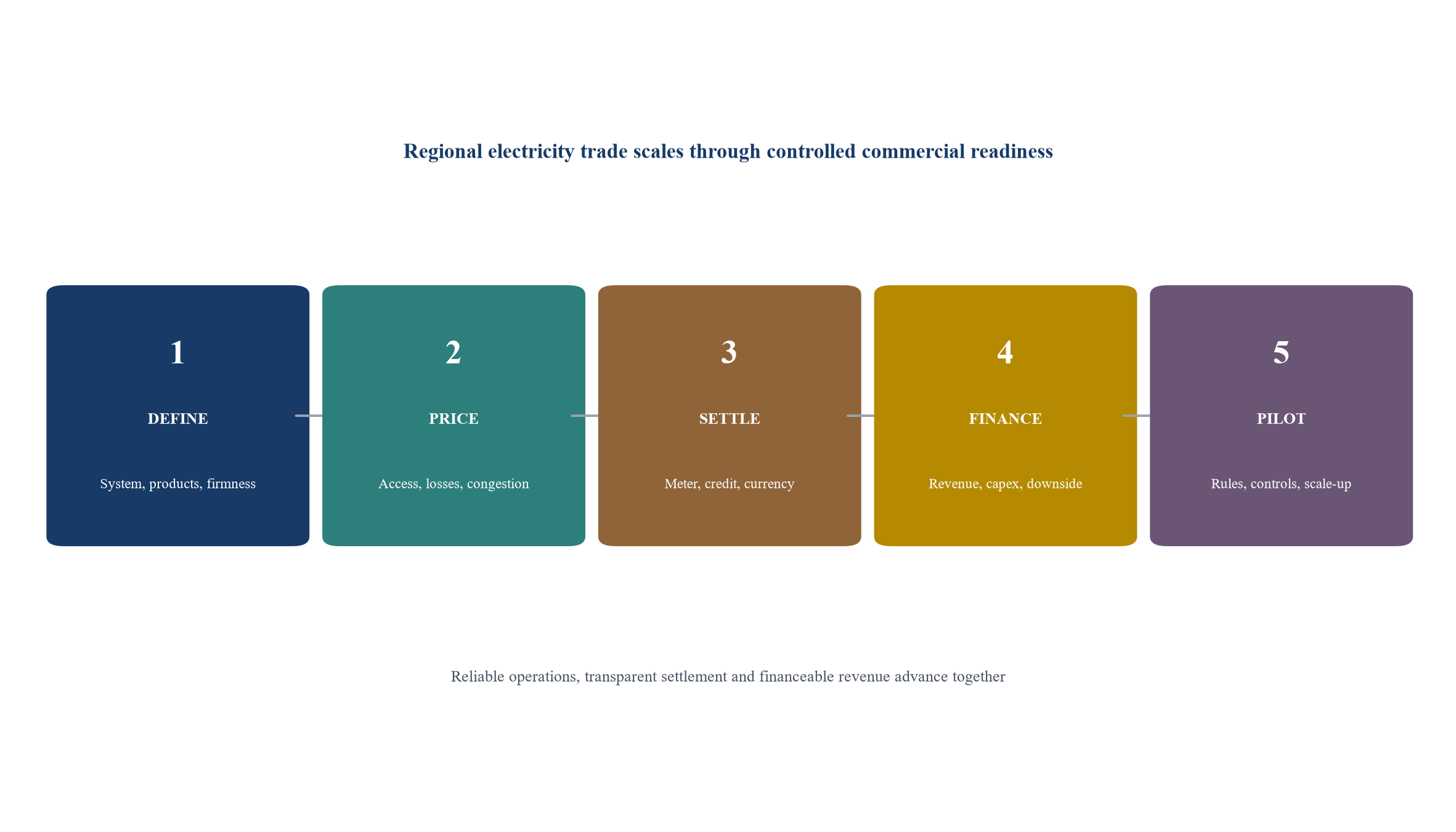
Each gate requires documented evidence before market scope and capital commitment expand.
The framework converts physical interconnection into a governed portfolio of reliability, capacity and energy services. It aligns access, pricing, settlement and investment with the secure capability of the regional network.
Commercial depth should expand through measurable readiness. Product performance, payment discipline, market liquidity and consumer benefit should determine progression toward more integrated trading.
References
- GCC Interconnection Authority, "Electricity Market," https://gccia.com.sa/gcc-power-trade-market/
- GCC Interconnection Authority, "2024 Annual Report," https://gccia.com.sa/wp-content/uploads/2025/10/Annual-Report-English-Arabic-Final.pdf
- International Renewable Energy Agency, "Renewable Energy Markets: GCC 2023," December 2023, https://www.irena.org/-/media/Files/IRENA/Agency/Publication/2023/Dec/IRENA_Rnewable_energy_markets_GCC_2023.pdf
- GCC Interconnection Authority, "Energy Trading," https://gccia.com.sa/fiber-optic-iru-agreement/
- World Bank, "Beyond Borders: Power Grid Interconnections and Regional Electricity Markets for the Sustainable Energy Transition," 2025, https://documents.worldbank.org/en/publication/documents-reports/documentdetail/099011525114533597
- World Bank Public-Private Partnership Resource Center, "Guidebook for Economic and Financial Analysis of Regional Electricity Projects," https://ppp.worldbank.org/library/guidebook-economic-and-financial-analysis-regional-electricity-projects
- World Bank, "Connecting West Africa through Regional Power Integration and Expanded Electricity Access," 11 May 2026, https://www.worldbank.org/en/results/2026/05/11/connecting-west-africa-through-regional-power-integration-and-expanded-electricity-access
- World Bank, "Central Asia Regional Electricity Market Interconnectivity and Trade Program," 22 January 2026, https://www.worldbank.org/en/news/press-release/2026/01/22/central-asia-regional-electricity-market-interconnectivity-and-trade-program
- World Bank, "Potential of Regional Power Sector Integration: GCC Region," https://documents1.worldbank.org/curated/en/415281468059650302/pdf/ACS71240ESW0WH0I0and0II000Final0PDF.pdf
- GCC Interconnection Authority, "2025 Annual Report," https://gccia.com.sa/wp-content/uploads/2026/08/Annual-Report-Arabic-English.pdf
About the Author
Chennakeshav (CK) is a corporate finance and investment banking executive with 25+ years of global experience in deal origination, structuring and execution across M&A, growth capital and corporate strategy. He has led value-creation mandates for founders, corporates and funds — bridging the boardroom view to hands-on execution and close.
His career spans Morgan Stanley, HSBC, Lloyds Banking Group, EWEC, ADQ portfolio companies and Emirates Growth Fund, across TMT, real estate, fintech, deeptech, cleantech, infrastructure and energy. He has partnered with C-suite leaders, private equity and venture funds, sovereign wealth funds and family offices to finance complex fund raises and scale-up ventures, and has led M&A due diligence, post-merger integration and business-transformation initiatives to create value.
At Matchpoint Partners he is Managing Partner, leading the firm's corporate finance, M&A and capital-raising practice. He holds an MBA from London Business School, an engineering degree from VTU and a Master of Laws (LLM, in progress) from UCL London.
An active start-up mentor, CK mentors at Techstars, DIFC FinTech Hive, Startup Grind, Founder Institute and IN5, serves as Entrepreneur Mentor in Residence (EMiR) at London Business School, and judges the Entrepreneurship World Cup.
