

Introduction
The phrase power pipeline can conceal several different assets. It may include an operating plant, a development-stage generator, a battery, a substation site, a generator interconnection request, a large-load connection application, transmission capacity, easements, permits, fuel arrangements, equipment reservations and a customer commitment. An acquisition succeeds only when those pieces create a legally usable and technically dependable route from generation to computing load.
That route has become a transaction perimeter in its own right. A data-centre buyer can purchase land and buildings while remaining unable to energise them. A generation buyer can acquire output that cannot reach the intended load, or output whose timing and shape do not match computing demand. A portfolio buyer can inherit deposits, network-upgrade liabilities and withdrawal exposure that were absent from the headline purchase price.
This paper addresses the acquisition decision. It asks what is being bought, which rights survive closing, what capital and time remain, how delivery uncertainty affects value, and which transaction terms preserve recourse. It is designed for use before exclusivity, during confirmatory diligence and through post-close control.
1. Define the acquisition thesis in operational terms
Begin with the computing service the power pipeline must support. State the target information-technology load, facility overhead, commissioning ramp, redundancy standard, maximum interruption, power-quality limits, hourly flexibility and target energisation dates. A buyer seeking 300 MW of campus capacity over five years faces a different transaction from a buyer seeking 50 MW of initial capacity within twelve months.
Translate that demand into a dated capacity schedule. Separate base load, flexible load, emergency supply and expansion. Identify which portion must be firm, which can accept curtailment and which can shift in time. The schedule becomes the test against which generation, network and contractual assets are assessed.
The thesis should describe the intended control model. The buyer may own generation and load in one group, hold minority interests in generation special-purpose vehicles, contract for output, or rely on a utility connection with financial hedges. Each model creates different consent, credit, regulatory and operating requirements. A transaction memorandum should state the chosen model before applying a valuation multiple.
2. Draw the complete rights chain
A complete rights chain begins with site control and ends with commissioned, accepted and paid computing service. Between those points sit land options, planning and environmental permits, generation licences, fuel or resource access, equipment supply, generator interconnection, network upgrades, transmission or distribution service, load interconnection, energy procurement, metering, system operations and customer contracts.
Map every link to a legal instrument, holder, counterparty, term, milestone, security requirement, change-of-control clause and remedy. A document index is insufficient. The diligence team needs a rights ledger that shows whether each instrument is executed, effective, transferable, current and consistent with adjacent instruments.
The chain also reveals stranded combinations. Generation may have interconnection rights at one point while the data-centre load depends on another network. A campus may hold a load offer whose delivery depends on upstream works outside the seller's control. A power-purchase agreement may settle financially and provide no physical delivery priority. These distinctions should appear in the transaction perimeter and model.
3. Distinguish assets, rights and applications
An operating generation asset is tangible plant supported by licences, land, interconnection and operating history. A development right is a conditional bundle whose value depends on future milestones. An application is a request for a study or offer. A queue position records process priority under applicable rules. None should be described as equivalent to dependable power.
Classify capacity into six evidence states: requested; accepted into study; studied with identified works; contracted through executed connection documents; energised at the relevant point; and dependable for the intended operating profile. The buyer should also distinguish nameplate generation, expected output, accredited capacity, network export limit, import capacity and usable data-centre load.
This classification supports both diligence and price. Operating assets can be valued through contracted and merchant cash flows. Development rights require probability, time, remaining capital and failure analysis. Applications may have strategic option value while failing to support debt or base-case consideration.
4. Test title and beneficial ownership
Confirm the entity that owns each asset and holds each right. Review corporate registers, project-company ownership, land title, leases, options, security interests, interconnection customer identity, permits, equipment orders, guarantees and shareholder arrangements. Trace historic assignments and reorganisations to identify gaps.
Beneficial ownership matters when a nominal holder acts for a joint venture, developer or affiliate. Side letters may allocate economics, decision rights or transfer proceeds differently from the registered position. Lenders may hold security over project assets, shares, accounts or material contracts and may control enforcement or consent.
The transaction structure should follow the ownership map. A share purchase may preserve permits and agreements that an asset sale cannot transfer easily. An asset purchase can isolate unwanted liabilities but require fresh consents and novations. Where title remains uncertain, exclude the item from base value until evidence or a specific protection is available.
5. Verify transferability and change-of-control requirements
Connection rights are governed by tariffs, codes, contracts and system-operator procedures. The buyer should identify whether assignment is permitted, whether consent is discretionary, whether financial or technical qualifications apply, and whether a share-level change of control triggers notice or approval. PJM publishes consent-to-assignment routes for projects before and after interconnection agreement execution and asks owners to identify affected agreements.[8]
Transfer analysis should cover each project stage. A development project may move between affiliates under one process and to an unrelated buyer under another. Deliverability rights, upgrade rights and capacity accreditation may follow separate rules. A modification to technology, capacity, point of interconnection or commercial-operation date can trigger restudy.
Make required consents conditions to closing where their absence would impair the thesis. If consent timing is uncertain, use a staged acquisition, option, nominee structure or delayed transfer only after qualified legal and regulatory review. Economic ownership should not be assumed to cure a missing legal transfer.
6. Reconstruct the queue chronology
Build a dated chronology from original application through studies, restudies, agreements, deposits, milestones, modifications and communications. Reconcile the seller's data room to the public queue and system-operator record. Explain every difference in project name, capacity, technology, point of interconnection, status and target date.
FERC Order No. 2023 requires a first-ready, first-served cluster process, site control, commercial-readiness deposits and withdrawal penalties under the pro forma generator interconnection framework.[1][2] The rules can change the cash and evidence needed to remain in the queue. A position that appears senior can therefore be exposed to cluster restudy, milestone failure or increasing security.
The chronology should show elapsed time and remaining path. Berkeley Lab reported nearly 2,600 GW of generation and storage seeking U.S. transmission interconnection at the end of 2023; only 19 per cent of projects entering a studied subset from 2000 to 2018 had reached commercial operation by the end of 2023.[5] Queue presence is evidence of development interest, not proof of completion.
7. Confirm commercial readiness
Readiness combines site control, development maturity, deposits, financing capability and credible progress. Review the evidence submitted to the network operator and test whether it remains true. A seller may have satisfied an initial threshold while subsequent land, planning, equipment or funding conditions remain open.
Confirm the amount, form, issuer, expiry and beneficiary of every deposit, letter of credit, surety bond and parent guarantee. Determine whether it transfers, must be replaced at closing, can be called after a breach, or is released at a milestone. Treat restricted cash and contingent calls separately from purchase consideration.
In Great Britain, connections reform uses Gate 2 readiness evidence and strategic alignment to determine which projects receive confirmed connection dates.[11][12] Similar evidence-based queue curation can alter the value of portfolios assembled under earlier assumptions. The buyer should assess current rules and the status of each project at the latest practicable date.
8. Quantify study and restudy exposure
An interconnection study identifies network impacts, facilities and allocated upgrades under stated assumptions. Its result can change when neighbouring projects withdraw, modify or proceed. The diligence team should obtain every study version, model assumption, cost estimate, facilities requirement and correspondence concerning affected systems.
Create a restudy register. For each project, record the events that can trigger restudy, potential scope changes, timing, cost responsibility and consequence for lower-priority projects. Test whether the target has modelled the loss of a cluster member, a technology change, an altered commercial-operation date and a different network configuration.
Cost uncertainty should appear as a range and a timing profile. A single seller estimate conceals both probability and liquidity. Purchase-price adjustments can address known changes before closing; escrows, contingent consideration and termination rights can address exposures that remain unresolved.
9. Underwrite network upgrades as a construction programme
Network upgrades are real assets with engineering, procurement, land, outage and commissioning dependencies. Identify the party that designs, procures, constructs, owns and operates each facility. Determine whether the target has only a cost allocation or also a delivery obligation.
Rebuild the schedule from long-lead equipment, rights of way, environmental approvals, substation works, transmission outages, protection systems, telecommunications, energisation tests and system-operator acceptance. Link each activity to payment and security milestones. A stated connection date has limited value when critical-path evidence is absent.
Review cost recovery. Some jurisdictions reimburse or credit network-upgrade expenditure; others allocate it differently. The legal entitlement, timing, counterparty and conditions control value. Model gross cash need, possible reimbursement and financing carry separately.
10. Assess generation deliverability
Generation ownership does not establish supply to the data centre. Test the generator's interconnection service, export limit, deliverability status, congestion exposure, outage history, curtailment, fuel or resource availability and environmental limitations. Determine whether the network can deliver output to the intended load and whether any priority exists during constraints.
For renewable portfolios, use chronological production profiles rather than annual energy. Compare hourly output with computing demand, storage capability, flexible load and residual grid purchases. For thermal assets, test fuel arrangements, heat rate, emissions, maintenance and start capability. For batteries, distinguish power, energy duration, cycle limits and state-of-charge requirements.
The dependable contribution can be much smaller than nameplate capacity. A transaction model should show nameplate, expected output, firm or accredited capacity, network deliverability and load-serving contribution as separate measures.
11. Assess large-load connection requirements
Generation and load follow different processes. The buyer must verify the data-centre connection application, studies, service agreement, construction scope and operating requirements. ERCOT's Planning Guide Section 9 establishes a Large Load Interconnection Study process to identify system limitations, facilities and reliability requirements for new or modified large loads.[9]
Test the load ramp submitted to the utility or system operator. Compare it with the campus construction programme, customer commitments and financing case. An inflated ramp can create unnecessary network work and security; an understated ramp can constrain commercial delivery or require a fresh study.
Power-electronic loads also raise stability and ride-through questions. ERCOT guidance calls for sensitivity analysis for data-centre and other power-electronic loads that may fail to ride through voltage disturbances.[10] The acquisition should include models, control settings, equipment specifications and compliance obligations needed to preserve the connection.
12. Reconcile generation and load into one power balance
Construct an hourly or representative-period power balance. Show data-centre demand, facility overhead, generation output, storage charge and discharge, imports, exports, curtailment, losses and reserve. Apply network limits and outage assumptions at the actual connection points.
The model should reveal location and timing mismatches. A portfolio can be energy-neutral over a year and still depend on substantial grid imports during critical hours. A generator can be adjacent to a campus yet require utility delivery and settlement. A private-wire arrangement can reduce some exposure while creating permitting, protection and operating obligations.
Translate the balance into commercial instruments: utility tariff, physical supply, power-purchase agreement, tolling arrangement, fuel contract, hedge, capacity product and renewable certificate. State what each instrument does and does not protect.
13. Verify land, easements and route control
Power infrastructure occupies land beyond the generation site and data-centre parcel. Review substation plots, cable corridors, transmission easements, access roads, construction compounds, fuel connections, water rights and crossing agreements. Confirm term, exclusivity, capacity, assignability and lender rights.
Map every route on current title and engineering drawings. Identify third-party parcels, public land, compulsory-acquisition dependencies and rights that expire before the expected asset life. Test whether a route supports the final equipment size and whether parallel or replacement circuits can be installed.
Route risk should be linked to the schedule and purchase agreement. Missing easements can become conditions, retained liabilities, specific indemnities or excluded assets. A generic warranty over property rights provides weak protection when one corridor controls energisation.
14. Review permits and environmental obligations
Prepare a permit matrix covering generation, grid works, data-centre load, fuel, emissions, water, noise, habitat, aviation, cultural heritage, construction and operations. Record the issuing authority, holder, capacity, term, conditions, appeals, transfer process and outstanding compliance.
Environmental obligations can limit dispatch or expansion. Thermal generation may face operating-hour or emissions constraints. Renewable projects can face seasonal curtailment or habitat conditions. Transmission routes can require mitigation and monitoring. Data centres can face water, noise and backup-generation limits.
Value should follow the permitted configuration. An unpermitted expansion is an option subject to cost, time and probability. Where permits depend on representations made by the seller, confirm that the intended transaction and operating model remain consistent.
15. Examine equipment and supply-chain commitments
Long-lead transformers, switchgear, turbines, generators, batteries and control systems can determine the delivery date. Review reservation agreements, deposits, specifications, manufacturing slots, warranties, termination rights, liquidated damages, shipping and customs exposure.
Confirm that equipment matches the studied configuration. A substitution can trigger network or permit review. A reservation held by an affiliate may not transfer with the project. Warranty coverage may depend on approved installation, operating profile and service arrangements.
Build an equipment ledger with committed and remaining spend, payment dates, security, cancellation value and interface requirements. Treat recoverable deposits separately from sunk development cost.
16. Test operating control and dispatch rights
The buyer needs defined authority over generation, storage, load flexibility and outages. Review dispatch rights, scheduling responsibility, balancing exposure, market participation, minimum-run obligations, maintenance coordination and emergency instructions. Identify conflicts among joint-venture partners, utilities, customers and lenders.
For co-located arrangements, establish who can curtail the data centre or generator, under what conditions and with what compensation. Define the priority between computing service, grid support, merchant energy sales and contractual delivery. Operating rights should match the revenue model and technical design.
Post-close integration should include a control-room responsibility matrix, communication protocols, cyber access, model governance, incident escalation and change approval. Commercial ownership without operating control can leave the buyer unable to protect the acquired value.
17. Audit data, models and cyber dependencies
Power-pipeline diligence depends on network models, production data, load forecasts, equipment files, geographic information, permits and commercial contracts. Build a controlled data register showing source, date, owner, version and permitted use. Reconcile repeated values across documents.
Review rights to use proprietary models after closing. Engineering consultants, original equipment manufacturers, utilities and affiliates may retain ownership or restrict disclosure. Confirm access to passwords, portals, certificates, telemetry and historical databases.
Cyber diligence should cover operational technology, remote access, third-party support, segmentation, patching, incident history, backup and recovery. A compromise can affect safety, connection compliance and service continuity. Remediation cost and operating restrictions belong in the acquisition plan.
18. Build a rights-adjusted valuation
Value operating generation from risk-adjusted cash flows supported by contracts, operating evidence and remaining life. Value development assets from future cash flow after deducting remaining capital, delay cost and failure probability. Value rights only when the buyer can identify the economic benefit, legal control and counterfactual.
Use an evidence ladder rather than a single price per megawatt. Requested capacity can receive limited option value. Studied capacity can receive additional value after cost and timing are known. Executed, transferable and funded connection rights support a stronger case. Energised and dependable capacity can support operating value when matched to commercial demand.
IFRS 13 defines fair value as an exit price in an orderly transaction between market participants at the measurement date.[13] International valuation standards require appropriate bases, approaches and evidence.[14] Transaction value can differ from accounting fair value because the buyer may have specific synergies, financing or risk appetite. Keep those layers separate.
19. Establish the counterfactual
The value of the pipeline is measured against the buyer's best feasible alternative. The counterfactual may be a conventional utility connection, another powered site, a greenfield development, a tolling agreement or a smaller phased campus. State its capacity, timing, capital, operating cost and risks using current evidence.
Calculate incremental value from earlier energisation, larger usable load, lower expected energy cost, improved reliability, retained expansion rights and avoided duplicate development. Deduct the additional generation, network, security, operating and integration costs required to achieve those benefits.
Keep scarcity language outside the model unless supported by observable evidence. A constrained market can raise strategic interest while leaving a weak project uneconomic. The counterfactual disciplines the premium and helps the buyer identify a walk-away price.
20. Model probability and time together
Development risk is not captured adequately by increasing the discount rate alone. Build a probability tree for connection, permits, equipment, construction, generation performance, load ramp and commercial demand. Link dependencies so that one failure does not appear as several independent deductions.
Model time explicitly. Delay increases land carry, security, escalation, financing cost and foregone computing revenue. It can also change technology, customer demand and network rules. Use a range of energisation dates and identify the decisions available at each stage.
The board should see both expected value and capital at risk. A high expected value can still be unsuitable when downside liquidity exceeds available funding. State maximum committed cash before each de-risking event.
21. Avoid double counting the power premium
Power value can appear in land price, development value, generation cash flow, data-centre rent, customer pricing and terminal value. Reconcile those components in one bridge. If early energisation increases data-centre cash flow, avoid also applying an unsupported scarcity multiple to the same capacity.
Separate stand-alone asset value from combination benefits. Operating generation can have value without the campus. The connection pathway can create incremental value when generation and load are combined. The buyer may also realise portfolio synergies from shared operations, financing or procurement. Show each layer once.
Review terminal assumptions. A premium based on temporary constraint should not be capitalised indefinitely. Expansion rights require fresh evidence at the expected exercise date.
22. Determine the financeable value
Lenders generally rely on enforceable contracts, perfected security, funded construction, tested assets, predictable operating cash and controlled accounts. A queue application or management estimate may support sponsor strategy while providing little borrowing-base value.
Build a lender evidence map for each cash-flow source. Identify counterparty credit, tenor, termination, indexation, volume risk, operating conditions and step-in rights. Match debt maturity to contract and asset life. Include reserve requirements, hedging, completion support and covenant headroom.
If development rights are financed, link draws to verified milestones and cap exposure by project. Preserve sufficient liquidity for deposits, network upgrades and schedule slippage. Do not treat refundable security as freely available cash.
23. Design the purchase-price mechanism
Allocate headline consideration among operating assets, development projects and contingent rights. Use closing accounts or locked-box protections for operating working capital and debt-like items. Use milestone consideration for value that depends on future connection, permit or commissioning events.
Define each milestone objectively. Examples include executed assignment, accepted study result, fixed network scope, permit finality, delivery of long-lead equipment, energisation, dependable capacity test and customer acceptance. State the evidence, verifier, deadline, dispute process and consequence.
Cap contingent payments at the incremental value they release. Avoid paying for capacity that the buyer must fund independently. The mechanism should address partial achievement, capacity reduction, delay and substitute delivery.
24. Use conditions precedent for binary risks
A condition precedent is appropriate when closing without the item would defeat the acquisition thesis or create unacceptable illegality. Typical candidates include system-operator consent, material land rights, key permits, lender release, transfer of connection agreements and replacement of required security.
Conditions should be specific, controllable and time-bounded. Allocate responsibility for applications, information, costs and appeals. Include conduct obligations that preserve the projects while conditions are pending.
Set a long-stop date based on process evidence. Provide extension rights only where remaining steps are defined. Termination should address deposits, confidential data, regulatory commitments and any interim funding provided by the buyer.
25. Use escrows, retentions and indemnities precisely
Escrow can protect against quantified exposures that may crystallise after closing, such as network-cost true-ups, security replacement, tax or remediation. Retention can support completion of identified deliverables. A specific indemnity can allocate loss from a known historic breach or title defect.
Define the covered loss, claim evidence, control of defence, mitigation, survival, cap and release schedule. Avoid using broad protections as a substitute for understanding the exposure. Where the consequence is loss of the entire connection pathway, the cap should reflect transaction economics.
Insurance may supplement protection for warranties and identified risks, subject to exclusions and diligence standards. Review whether permits, grid rights, projections and known conditions fall outside coverage.
26. Protect against interim value leakage
Between signing and closing, the seller can alter projects through modifications, withdrawals, new security, contract amendments, equipment cancellations or delayed milestone submissions. Establish a detailed ordinary-course covenant and a list of actions requiring buyer consent.
Require periodic reporting on queue status, studies, network works, permits, land, equipment, claims and cash. Define immediate notification events. Give the buyer access to relevant operator communications within confidentiality and regulatory limits.
Where the buyer funds preservation costs, document repayment, priority, security and decision rights. Interim funding should follow approved budgets and evidence gates.
27. Prepare a closing capacity certificate
At closing, management should certify the state of every capacity tranche. The certificate should state requested, studied, contracted, funded, expected energisation, operating limits, security posted and outstanding conditions. Attach the underlying ledger and source documents.
Independent technical and legal advisers should report within their scopes. Their work should identify assumptions, reliance and open items. The investment committee retains the acquisition decision.
The certificate becomes the baseline for post-close control and any contingent consideration. It also reduces later disputes over what the buyer believed it had acquired.
28. Apply a hypothetical acquisition case
Consider a wholly hypothetical buyer evaluating a portfolio with 180 MW of operating generation, 300 MW of generation projects in interconnection studies, 200 MW of contracted large-load capacity and an additional 150 MW load application. The seller requests AED 2.4 billion enterprise value and attributes AED 650 million to pipeline scarcity.
The diligence team confirms the operating assets and 120 MW of transferable load capacity. Eighty MW depends on a network upgrade whose cost has a current range of AED 220 million to AED 410 million. One generation project lacks durable route rights; another faces a restudy after a cluster withdrawal. The additional load application has limited option value and no confirmed delivery date.
The buyer therefore allocates base consideration to operating cash flow and the verified capacity tranche. It deducts unfunded upgrade capital, retains an escrow for security replacement and makes part of the pipeline payment contingent on consent, fixed network scope and energisation tests. The figures illustrate method only.
29. Build downside sensitivities
Test connection delay, capacity reduction, network-cost increase, generation underperformance, higher energy prices, lower customer demand, curtailment and financing stress. Combine related risks. A delayed upgrade can increase cost, postpone revenue and extend security simultaneously.
Show value at several capacity and energisation outcomes. Identify the break-even purchase price and liquidity requirement. Include a severe but plausible case where one project fails and another proceeds late.
Sensitivity results should change the transaction structure. If value is highly dependent on one uncertain consent, move consideration behind that consent. If liquidity dominates, require seller funding, a price deduction or committed financing.
30. Plan the first 100 days before signing
The buyer should enter closing with an integration plan for governance, operator relationships, milestone control, engineering, treasury, insurance, cyber and reporting. Assign an accountable owner to each project and right.
In the first 30 days, confirm access, authority, security and deadline calendars. By day 60, reconcile budgets, schedules, models and counterparties. By day 100, approve the portfolio capital plan, stop or redesign weak projects and integrate operating controls.
Do not change project scope casually. Technology, capacity, site or date changes can trigger consent or restudy. Use a formal change-control process that records technical, commercial, regulatory and valuation effects.
31. Govern the portfolio through evidence gates
Create gates for acquisition, assignment, study, fixed network scope, permits, equipment, financing, construction, energisation and operation. Each gate should specify evidence, decision authority, capital release and stop condition.
Maintain a portfolio dashboard showing capacity by evidence state, next milestone, security at risk, remaining capital, expected energisation, critical path and downside value. Report exceptions rather than relying on aggregate megawatts.
Re-underwrite projects when rules, studies, costs or customer demand change. A right can lose value after closing if obligations are missed. Portfolio governance is therefore part of acquisition value preservation.
32. Use AI and data tools with accountable controls
Document intelligence can extract dates, parties, milestones, capacities and change-of-control provisions from large data rooms. Geospatial tools can reconcile routes, parcels and network assets. Scenario engines can compare thousands of capacity, timing and cost combinations.
These tools require controlled sources, versioning, human review and reproducibility. A model should link every material input to a document, owner and date. Conflicts should remain visible until resolved. Legal interpretation, engineering acceptance, valuation and investment approval remain accountable professional decisions.
Protect confidential system and customer information. Apply role-based access, secure environments, retention limits and output review. Avoid submitting sensitive network data to unapproved systems.
33. Define the investment-committee decision
The committee should receive a concise decision record: acquisition thesis; verified rights chain; capacity by evidence state; remaining capital and liquidity; base, downside and failure cases; required consents; transaction protections; post-close plan; and unresolved exceptions.
Approval should state maximum purchase price, contingent consideration, required escrow, committed completion capital, permitted deviations and named authority. Conditions should align with the model rather than appear as a separate legal list.
The decision record should also state what would cause termination or re-approval. Examples include loss of a key connection right, material capacity reduction, a network-cost increase above threshold or a delay that removes the customer case.
34. Limitations
Interconnection and large-load rules vary by jurisdiction, operator, voltage, project stage and contract. This paper provides a transaction framework and cannot determine the legal status, technical deliverability or value of any specific project.
Public queue data can be incomplete or lag current operator records. Cost and completion evidence varies across regions. Market, regulatory and technology conditions can change after the stated date. Qualified legal, regulatory, engineering, environmental, tax, accounting, insurance and valuation advisers should review the actual transaction.
All numerical examples are hypothetical management assumptions used only to demonstrate the method. They are not market quotations, observed transaction terms, forecasts or investment recommendations.
35. Conclusion
A power-pipeline acquisition is a purchase of coordinated rights, obligations, assets and execution capability. Its value depends on preserving the chain from generation and network access to dependable data-centre service.
The disciplined buyer defines demand, verifies title and transferability, reconstructs the queue, underwrites network works, reconciles generation and load, maps land and permits, prices evidence states and protects unresolved value through transaction terms. The disciplined lender finances tested assets and contracted cash while controlling development exposure.
Headline megawatts do not settle the decision. A verified, transferable, funded and executable pathway does. The acquisition should close only when the price, protections and post-close capital plan reflect that evidence.
Decision exhibits
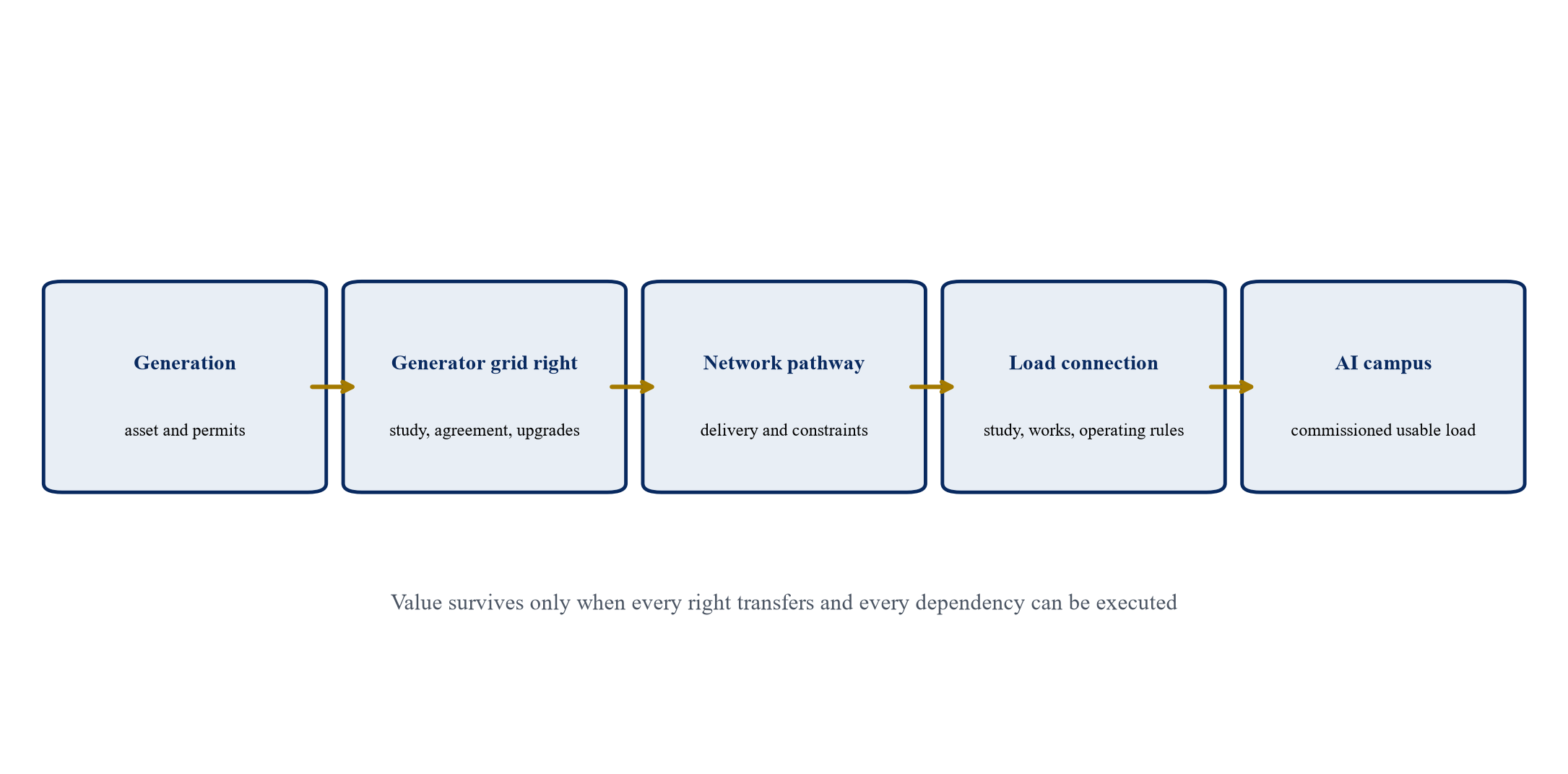
Proposed transaction architecture; actual legal rights and network arrangements control.
Table 1. Rights-led acquisition diligence ledger
| Item | Evidence | Principal failure | Transaction response |
|---|---|---|---|
| Generation asset | title, licences, operating data | impaired ownership or output | condition, warranty, price adjustment |
| Queue position | operator record, studies, deposits | milestone failure or restudy | contingent value, preservation covenant |
| Connection agreement | executed contract and consents | non-transfer or scope change | condition precedent |
| Network works | design, programme and cost | delay or cost increase | escrow, capex deduction, long-stop |
| Land and route | title, leases and easements | missing corridor | specific condition or exclusion |
| Load connection | large-load study and agreement | unusable capacity | capacity test and earn-out |
Proposed framework unless stated otherwise.
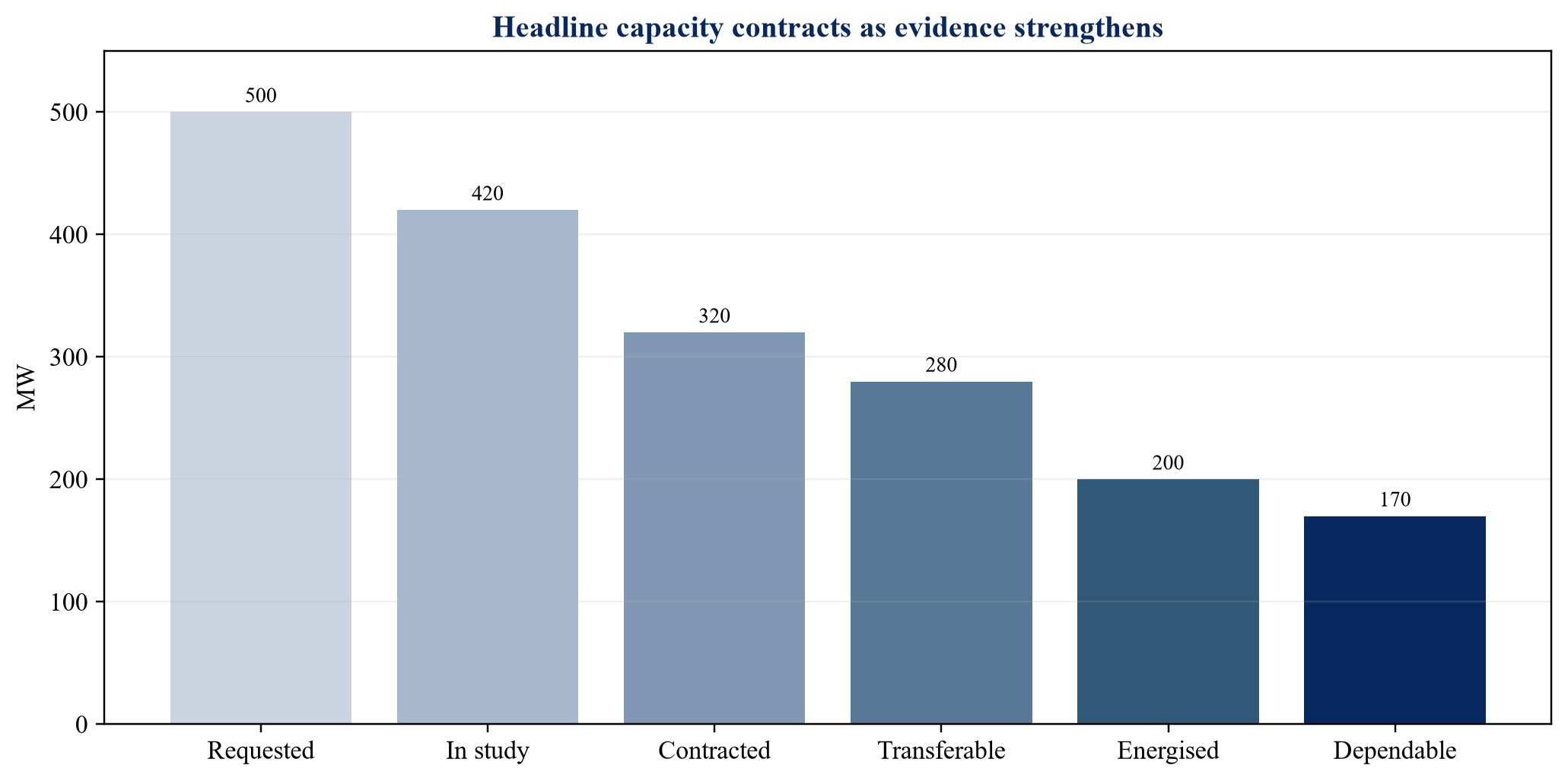
Wholly hypothetical; figures describe no identified transaction.
Table 2. Transaction protection matrix
| Exposure | Best evidence before signing | Protection if unresolved | Release event |
|---|---|---|---|
| Assignment consent | operator confirmation | closing condition | executed consent |
| Network upgrade cost | completed study and estimate | escrow or price deduction | fixed scope and funding |
| Delivery date | integrated critical path | contingent consideration | energisation |
| Capacity | tested operating limit | capacity-based earn-out | dependable-capacity test |
| Title or route gap | registries and executed easements | specific indemnity or exclusion | cured title |
| Security replacement | instrument schedule | retention | replacement accepted |
Proposed framework unless stated otherwise.
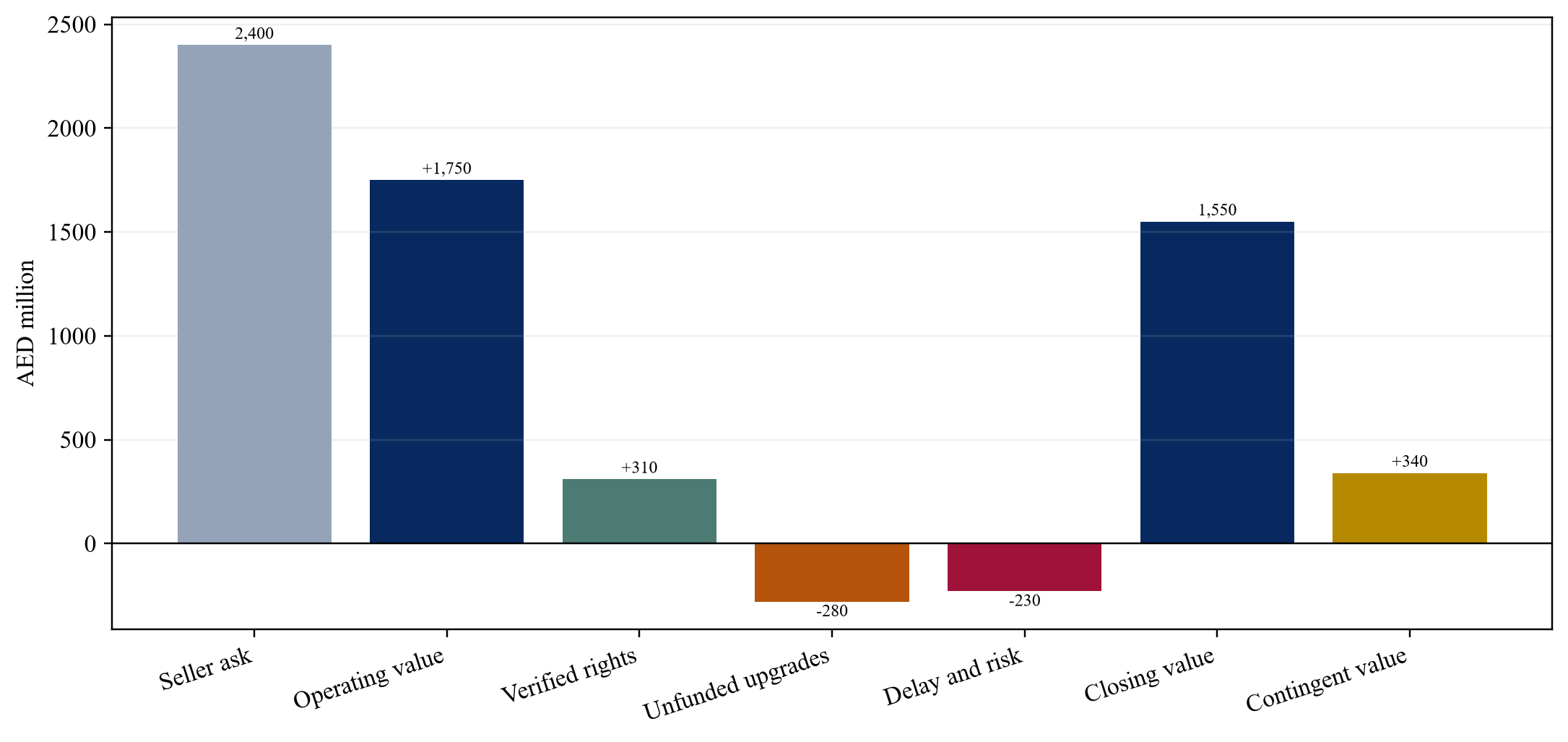
Wholly hypothetical; AED amounts are illustrative and are not market evidence.
Table 3. Hypothetical acquisition gates
| Gate | Evidence required | Maximum new capital at risk | Decision |
|---|---|---|---|
| Exclusivity | title map, operator status and thesis | AED 8m | enter diligence |
| Signing | verified ledger, downside model and protections | AED 35m | sign subject to conditions |
| Closing | consents, security and funded plan | AED 1,550m base value | acquire |
| Fixed network scope | accepted study and cost plan | AED 280m construction allocation | release capital |
| Energisation | passed grid and capacity tests | AED 200m contingent value | release payment |
| Dependable operation | performance and customer acceptance | AED 140m contingent value | final release |
All amounts and outcomes are illustrative and describe no identified transaction.
Appendix A Questions for the investment committee
1. Which generation, grid and load rights are included in the legal perimeter?
2. Who owns each right, and which consents are required for closing?
3. How much capacity is requested, studied, contracted, transferable, energised and dependable?
4. Which network works control the critical path and who funds them?
5. What deposits, securities and withdrawal liabilities transfer to the buyer?
6. Which land, route, permit and equipment rights remain incomplete?
7. How do generation output and data-centre demand reconcile by hour and location?
8. What is the buyer's best feasible counterfactual?
9. Which value is operating, development, contingent or buyer-specific synergy?
10. What consideration is paid at closing and what remains behind evidence gates?
11. What is the maximum liquidity need under combined downside conditions?
12. Which events require termination, price reset or re-approval?
References
- Federal Energy Regulatory Commission, Order No. 2023, Improvements to Generator Interconnection Procedures and Agreements, 28 July 2023. https://www.ferc.gov/sites/default/files/2023-07/20230728-3060.PDF
- Federal Energy Regulatory Commission, Explainer on the Interconnection Final Rule, accessed 2 October 2026. https://www.ferc.gov/explainer-interconnection-final-rule
- Federal Energy Regulatory Commission, Order No. 2023-A explainer, 21 March 2024. https://www.ferc.gov/explainer-interconnection-final-rule-2023-A
- United States Department of Energy, Transmission Interconnection Roadmap, April 2024. https://www.energy.gov/sites/default/files/2024-04/i2X%20Transmission%20Interconnection%20Roadmap_1.pdf
- Lawrence Berkeley National Laboratory, Queued Up: 2024 Edition, April 2024. https://emp.lbl.gov/publications/queued-2024-edition-characteristics
- Lawrence Berkeley National Laboratory, Grid connection barriers to renewable energy deployment in the United States, December 2024. https://emp.lbl.gov/publications/grid-connection-barriers-renewable
- California Independent System Operator, Queue management, accessed 2 October 2026. https://www.caiso.com/generation-transmission/generation/generator-interconnection/queue-management
- PJM Interconnection, Application and Forms; Consent to Assignment Agreement Templates, accessed 2 October 2026. https://www.pjm.com/planning/service-requests/application-and-forms
- Electric Reliability Council of Texas, Planning Guide Section 9: Large Load Interconnection or Modification, 1 June 2026. https://www.ercot.com/files/docs/2026/05/29/June-1-2026-Plannng-Guide.pdf
- Electric Reliability Council of Texas, Large Load Stability Studies Whitepaper, 25 August 2025. https://www.ercot.com/files/docs/2025/08/25/Large_Load_Stability_Whitepaper.pdf
- National Energy System Operator, Connections Reform, accessed 2 October 2026. https://www.neso.energy/industry-information/connections-reform
- National Energy System Operator, Evidence handbook and Gate 2 to Whole Queue submission resources, accessed 2 October 2026. https://www.neso.energy/industry-information/connections-reform/evidence-handbook-and-other-g2wq-submission-resources
- IFRS Foundation, IFRS 13 Fair Value Measurement, accessed 2 October 2026. https://www.ifrs.org/issued-standards/list-of-standards/ifrs-13-fair-value-measurement/
- International Valuation Standards Council, International Valuation Standards, effective 31 January 2025. https://www.ivsc.org/standards/
About the Author
Authored by Chennakeshav Adya Independent Researcher
Chennakeshav (CK) is a corporate finance and investment banking executive with 25+ years of global experience in deal origination, structuring and execution across M&A, growth capital and corporate strategy. He has led value-creation mandates for founders, corporates and funds — bridging the boardroom view to hands-on execution and close.
His career spans Morgan Stanley, HSBC, Lloyds Banking Group, EWEC, ADQ portfolio companies and Emirates Growth Fund, across TMT, real estate, fintech, deeptech, cleantech, infrastructure and energy. He has partnered with C-suite leaders, private equity and venture funds, sovereign wealth funds and family offices to finance complex fund raises and scale-up ventures, and has led M&A due diligence, post-merger integration and business-transformation initiatives to create value.
At Matchpoint Partners he is Managing Partner, leading the firm's corporate finance, M&A and capital-raising practice. He holds an MBA from London Business School, an engineering degree from VTU and a Master of Laws (LLM, in progress) from UCL London.
An active start-up mentor, CK mentors at Techstars, DIFC FinTech Hive, Startup Grind, Founder Institute and IN5, serves as Entrepreneur Mentor in Residence (EMiR) at London Business School, and judges the Entrepreneurship World Cup.
Matchpoint profile: https://www.matchpoint-partners.com/team/ck-adya.html LinkedIn: https://www.linkedin.com/in/ckadya/
