

1 The decision to invest in a reusable evidence pack
A company considering several grant opportunities needs an explicit decision about the information that it will maintain centrally and the work that each application will still require. A reusable pack can contain incorporation records, approved financial information, staff biographies, technical evidence, cost assumptions and documented permissions. Each item acquires meaning through its owner, reporting period, project boundary and intended use. The preparation decision concerns the effort required to establish those records, keep them current and adapt them accurately to a particular application. The financing decision also depends on the resources that the company can commit before a submission deadline.
Official processes provide specific examples of permitted reuse and retained responsibility. NIH's Common Forms implementation notice allows investigators to transfer existing information into the appropriate forms, followed by accuracy checks and individual certification. The EIC Work Programme 2027 permits information to be reused or revised between specified Accelerator application stages. These permissions have defined contexts. They provide a basis for examining controlled reuse while leaving the actual opportunity, submission template and responsible person's declaration as separate matters to verify. Neither example establishes a general permission to submit an unchanged pack to every funder. [7,8]
The central management question is which proposed application can be supported by the same underlying facts at an acceptable preparation cost. A financial statement may establish historical revenue for one entity and period. A forecast describes a particular set of assumptions. A signed support letter may concern one project, timetable and role. The evidence register should make those boundaries visible before an author starts drafting an answer. When an application asks for a different fact, the team needs an additional source or an expressly documented explanation of the difference. A fluent paragraph cannot supply the missing evidence.
This paper proposes an eligibility-constrained evidence-pack framework. It treats reusable records, application-specific claims and formal declarations as separately governed objects. A documentary comparison identifies selected official requirements. Constructed cases then show how preparation, checking, refresh and prospective setup hours can be compared under stated compatibility conditions. The numerical exercise is a decision method for supplied company inputs. No applicant cohort, observed preparation-time dataset or linked award-outcome population has been obtained for this paper. The calculations therefore support conditional planning and sensitivity analysis; they establish no measured funding-success effect.
The intended management output is a submission decision supported by a traceable record. The team should be able to identify the source of each material number, the version used in each application, the owner who checked it and the conditions under which another application can use it. A pack that requires extensive refresh may still be useful as a discovery index. A small application pipeline may justify a simpler approach. The proposed investment rule compares the prospective work of the available policies and retains mandatory approval and checking effort under each policy.
2 Documentary scope and the limits of the available evidence
The documentary review covers selected UKRI and Innovate UK guidance, Horizon Europe and EIC materials, US NIH and NSF instructions, relevant US federal assistance cost rules and a specific UAE university checklist. Sources were checked on 13 November 2026. Each reference is used for its stated institutional and instrument scope. A general guidance page, an example application form, an explanatory grant-agreement annotation and an executed award have different roles. The proposed register keeps those roles distinct and gives the actual call and signed agreement priority when a company assesses a live opportunity.
Version identification is material to this review. The canonical EU Annotated Grant Agreement file served version 3.0 dated 1 November 2026 when checked. Search results referring to its earlier version do not describe that current file. The linked Innovate UK terms PDF is internally dated October 2025, although its filename contains a September reference and its publication page was updated in November. The document register should record the title-page version and the retrieval date separately from a filename or search-index date. This paper's source descriptions follow those distinctions. [3,6]
The planned empirical extension would require a defined population of eligible projects, the documents actually submitted, the funding terms that applied and a consistent record of later decisions and milestones. Access to that linked population has not been established. Publicly visible winning projects would leave unsuccessful and withdrawn applications incompletely observed. Published award amounts would also require careful treatment of project size, funding form and timing. Accordingly, this paper conducts no award ranking, causal comparison or estimate of the effect of a reusable pack on selection probability. Such questions remain candidates for a separately designed study.
The constructed experiment supplies declared hours and compatibility states. Its unit is an evidence requirement for one application. The experiment examines the work generated by a preparation policy under those inputs. Its results depend on the specified source availability, accepted versions, checking requirements and staff-capacity assumptions. A requirement for an unavailable fact remains unresolved. The model gives no authority to manufacture evidence, obtain another person's certification or treat a provisional financial assumption as an observed result. These limits are part of the method and should remain attached when a reader changes its inputs.
The paper's proposed contribution is an auditable way to connect evidence provenance, application compatibility and prospective effort. Existing official guidance and common-form systems already establish important components of this problem. No claim of first publication or exclusive novelty is made. Further research could test the framework against consented submission histories, measure actual review effort and examine whether particular controls identify inconsistencies before submission. Such work would need explicit access permissions, consistent outcome definitions and a protocol that accounts for repeated applicants and changes in programme design.
| Source | Version or status checked | Use and limitation |
|---|---|---|
| Innovate UK guidance and grant terms | Guidance updated July and November 2026; terms internally October 2025 | Application, cost and award controls; actual competition and offer remain relevant |
| Horizon Europe example form | Part A v3.0; 10 November 2025 | Example declarations; actual submission-system template may differ |
| EU Annotated Grant Agreement | v3.0; 1 November 2026 | Explanatory Article 20 evidence guidance; signed agreement controls |
| EIC Work Programme 2027 | C(2026)7629; pages 79 to 80 | Specified Accelerator-stage reuse; no general cross-funder permission |
| NIH Common Forms notices | December 2025 and April 2026 notices | Transfer, version transition and certification in the stated process |
| NSF Common Form and SciENcv | Dated form and current guidance | Version and certification instructions within their scope |
| US federal assistance cost provisions | Cited eCFR sections current through 10 November 2026 | Applicable awards and exceptions require identification |
| Zayed University RIF checklist | Page footer April 2024; current call unverified | Faculty-programme example; no general UAE SME eligibility claim |
Targeted documentary comparison, checked 13 November 2026; no programme census or funding-availability ranking. References identify the individual sources.
3 Separate records claims and declarations in the evidence model
A source record is a document, dataset or attestation that supports a defined fact. Examples include an approved account, a dated test report and an authorised staff biography. An application claim is a statement made for a specified opportunity, such as the revenue attributed to the applicant in a stated year or the evidence supporting a technical milestone. A declaration is a responsible person's representation about the application or their own information. The proposed data model stores a link among these objects while retaining their different owners and approval conditions. A single file can contain several objects and several independent review obligations.
For a financial claim, the link should identify the legal entity, accounting period, currency, unit and definition. Revenue, order intake and pipeline should have their own fields. A group figure should carry the consolidation boundary that produced it. The application writer can then see whether the funder's question matches the stored record. Where a requested measure differs, an explicit calculation or new source is needed. Copying the most recent figure into several labelled fields would obscure that distinction. The proposed control requires the finance owner to approve any conversion, allocation or reconciliation used in the submission.
A technical claim needs its own scope. A laboratory result may concern a particular prototype, operating condition and test date. A prospective milestone may describe planned work. A customer interview may support a statement about one interviewee's requirements. The evidence pack should retain these boundaries and the permission to use the underlying material. A new application may cite the same experiment when the claim remains within the experiment's scope. Claims about a different product, environment or achieved readiness need supporting evidence that reaches those additional conditions.
The W3C PROV ontology provides a published vocabulary for representing provenance through entities, activities and agents. It can inform a record of which source was used, which transformation produced an application statement and which person performed or approved that activity. This paper uses that conceptual distinction to design a compact evidence register. It proposes no requirement that a grant applicant implement RDF, use a particular software product or treat a provenance standard as a funder certification. A well-controlled spreadsheet and document store can express the required relationships for a small application pipeline. [18]
An effective register also preserves the difference between an original record and a derived presentation. An approved financial statement can support several application tables, each with a documented mapping. The record remains unchanged; the mapping explains the selected rows and any authorised transformations. The presentation then receives the checks appropriate to the actual template. The same approach supports a short narrative or slide deck whose statements remain linked to the underlying evidence. When an upstream record changes, the register identifies the dependent presentations for review.
| Object | Example | Review record |
|---|---|---|
| Source record | Approved account or dated test report | Owner, version, factual scope and permitted use |
| Application claim | Revenue for the specified applicant and period | Source link, definition, mapping and responsible approval |
| Derived presentation | Budget table or project slide | Transformation, target template and checked output version |
| Declaration | Responsible person's required representation | Applicable wording, person, date and accepted conditions |
Proposed operating schema. A file can contain several objects; their responsibilities remain separately recorded.
4 Read programme permissions at the correct level
The comparison starts with specific permissions and obligations. EIC's 2027 Accelerator instructions allow identified short-proposal information and presentation materials to be reused or updated at the full-application stage, alongside the additional requirements for that stage. NIH's Common Forms transition provides a different mechanism: transfer existing investigator information, review the resulting form and complete the required certification. These are useful examples of structured reuse. The relevant permission attaches to the described stage or form process. It should be entered in the register with that scope and the governing document version. [7,8]
Innovate UK's general application guidance allocates submission responsibilities among the lead applicant and partners. The reusable pack can support those people with approved evidence and completed working answers. The actual application still needs its assigned contributions, appendices, finance entries and accepted terms. A saved or reopened submission also needs the required portal action before the deadline. The proposed workflow therefore records both content readiness and submission readiness. A completed document in the internal store establishes the former only for the content and version that have actually been checked. [1]
The Horizon Europe RIA and IA example form illustrates why a reusable narrative should travel with an application-specific control sheet. The example contains mandatory declarations and asks about a same or very similar proposal submitted during the preceding two years. The actual call's system template determines the required fields. The proposed control sheet records the response to each live declaration and the responsible organisation's approval. A prior answer is useful evidence about history; the accuracy of the current answer depends on the submissions, people and project boundaries that now apply. [5]
NSF's published Common Form instructions and SciENcv guidance further distinguish a document's content, version and certification. The cited support form contains a signature-currency instruction with its own scope. A general rule that every attachment expires after one period would extend that instruction beyond what it states. The proposed register stores the applicable condition beside the record and preserves the actual form revision. The team can then check the document against the current solicitation and agency instructions. A document's age alone supplies an incomplete account of its suitability. [10,11]
Geographic examples also require an eligibility boundary. Zayed University's published Research Incentive Fund checklist includes an updated CV, budget and specified approvals. It is a university-faculty example, with no verified current call or general SME eligibility established here. Its value in this comparison is the visibility of separate evidence and approval requirements. A commercial applicant considering a UAE opportunity needs the actual sponsor's current rules and their own eligibility assessment. The paper makes no general UAE grant-access assertion from this institutional checklist. [17]
5 Build a catalogue with explicit ownership and permitted uses
The proposed catalogue begins with a small number of evidence families that correspond to recurring management responsibilities. Corporate identity records belong with a named corporate-services or legal owner. Historical financial information belongs with finance. Technical results belong with the people responsible for the underlying work and records. Staff information belongs with the individual and the organisation's authorised process. Commercial evidence needs its own source and disclosure permission. Each family should have a practical route for answering a question about the record's meaning, currency or permitted use.
For each item, record an identifier, descriptive title, source location, responsible owner, fact period, relevant entity or person, project scope and access classification. Add its document revision, the approval or certification it carries and any condition that limits its reuse. A bank statement, for example, may meet an institution's administrative check only when it satisfies the institution's specified age and content requirements. Innovate UK's post-offer guidance describes such a request for a redacted statement with specified information. That source-specific requirement should be captured as a condition for the relevant task, with the disclosure minimised accordingly. [19]
The catalogue should include a clear permitted-use field. A company may hold a signed document while having limited permission to share it with an application team, consortium partner or external system. Ownership, confidentiality and consent therefore need their own checks. The proposed workflow gives authors access to the information they need through approved records or controlled extracts. A record whose sharing permission is unresolved remains unavailable for that destination. The team should document the resolution through the authorised owner, rather than treating possession of the file as sufficient permission.
A content hash can help identify the particular byte stream recorded in a catalogue. Its role is version identification. Verification of a financial value, a signature or a technical result requires the appropriate source and review. The proposed register stores both kinds of evidence so that a reviewer can identify the file and understand why it supports a claim. For a derived table, retain the mapping and the source version that produced it. This creates a practical route from a submitted statement to its supporting material without requiring every application reviewer to navigate the whole corporate archive.
Catalogue scope should follow the application pipeline. A company pursuing one narrowly defined opportunity may need a concise indexed folder and a single review log. A portfolio with several projects, entities and overlapping deadlines may justify a more structured register and separate access roles. The proposed investment assessment counts the work required to establish, maintain and use that structure. It also retains the checks that each individual application needs. Readers should choose a level of control that they can actually operate and evidence, including the effort needed to keep permissions and responsible owners current.
| Field group | Record | Change or review trigger |
|---|---|---|
| Identity | Entity, person and source owner | Applicant or responsible owner changes |
| Factual boundary | Period, units, definition and project scope | New reporting period or different requested measure |
| Provenance | Source location, version and content identifier | Corrected or replacement source |
| Permission | Destination, disclosure scope and consent | Another destination or unresolved sharing right |
| Approval | Actual check, signatory and validity condition | New requirement or relevant changed fact |
| Application use | Claim, target field and submitted version | New submission or approved amendment |
| Dependencies | Derived outputs and related claims | Changed upstream evidence |
| Retention | Applicable obligation, trigger and owner | Award condition, audit or legal hold requiring review |
Proposed fields, with source-specific conditions. No universal expiry or retention period is assumed.
6 Define compatibility before selecting a preparation method
The unit of the proposed decision model is one evidence requirement in one application. For that unit, the team lists the available preparation methods: reuse a compatible record, refresh or adapt an authorised record, or create the required evidence through an approved process. A method becomes available only when its prerequisites are established. The relevant conditions can include applicant identity, fact period, scientific scope, accepted form version, sharing permission and the required person's certification. These conditions should be recorded as explicit results with supporting references. An unresolved mandatory condition produces a hold.
Compatibility has several dimensions. Entity compatibility asks whether the record concerns the actual applicant, partner or person. Period compatibility checks whether the evidence supports the period requested. Scientific compatibility examines whether the claimed work and result match the documented project boundary. Version compatibility concerns the form versions accepted for the relevant deadline and submission state. Permission compatibility concerns the destination and intended disclosure. Certification compatibility identifies the person who must provide the current representation. The proposed model retains separate results for these dimensions so that a failed check can be addressed through the appropriate owner.
Refresh has a defined boundary in this framework. A record can be reformatted or mapped into an accepted form when its underlying facts and permissions support that action. Updating the underlying facts requires an authoritative new source. A fresh document likewise needs evidence for the assertions it contains. Missing project results, absent permissions and unavailable signatures remain missing prerequisites under every preparation method that requires them. The model's hold state preserves this distinction and excludes a numerical result for a requirement whose factual basis cannot be established.
Accepted-version rules need particular care. NIH's April 2026 transition notice distinguishes a support form that continues to function from a later form with additional fields, and specifies conditions tied to due dates and submission state. That example motivates a compatibility check against an accepted set and the applicable transition condition. A universal preference for the highest version number would misdescribe the cited example. The proposed model instead asks whether the selected version is allowed for the actual case and whether all required information and certifications are present. [9]
The effort comparison begins after those admissibility checks. Each available method receives declared preparation, adaptation and quality-control hours. Required individual approvals and application-level checks remain in the calculation under every policy. Prospective pack setup and maintenance have their own entries; already incurred expenditure is treated separately in a forward decision. Staff capacity and deadlines are checked against the selected plan under explicitly stated calendar assumptions. The resulting numbers describe the constructed inputs. A company using the method should replace them with its own supported requirements and working-time evidence before relying on the comparison.
| Check | Question | Unresolved result |
|---|---|---|
| Applicant and person | Does the record concern the required entity or individual? | Obtain the appropriate evidence |
| Period and definition | Does the fact support the requested period, measure and unit? | Resolve the source or authorised mapping |
| Scientific scope | Does the result support the claim and proposed work boundary? | Obtain evidence for the additional condition |
| Accepted version | Is the form allowed for this deadline and submission state? | Check the governing transition rule |
| Permission | Can this material be disclosed to this destination? | Resolve the required permission |
| Approval and certification | Is the required person's representation available and applicable? | Refer to the responsible person |
| Related work and costs | Are the relevant overlap and funding checks resolved? | Retain an eligibility hold |
| Required fact availability | Is the underlying fact actually established? | Hold all methods that need that fact |
Proposed compatibility framework. A new document cannot manufacture a missing underlying fact or permission.
7 Match the applicant project period and definition
The first compatibility check identifies the person or organisation making the application. A group can contain several companies with different accounts, staff, contracts and rights to use technical results. A parent company's evidence may support a statement about the group while leaving an applicant subsidiary's own financial position unresolved. The proposed pack therefore assigns entity identifiers to records and claims. Any use of another entity's information should carry an explanation of its relevance and the permission supporting the disclosure. The application owner then checks the particular funder's eligibility and reporting boundary.
The project boundary deserves the same attention. A company's platform may support several products and research programmes. A successful pilot in one environment can support a bounded statement about that pilot. A new proposal may involve another configuration, customer group or technical uncertainty. The pack should retain the original result and describe its relationship to the proposed work. Where the application requires evidence of a capability that the record does not establish, the team needs another source or a clearly identified planned activity. The catalogue should preserve the distinction between completed work and work for which funding is requested.
Period matching covers financial, operational and personal information. An approved historical number should retain its period and accounting basis when it is mapped into a form. A current estimate can be used when the question and rules permit an estimate, with its assumptions and approval visible. The proposed register keeps separate fields for actual, forecast and target values. This supports a review of an apparent difference between two applications: the numbers may describe different periods or definitions, or one may require correction. The reviewer should resolve the reason before approving both statements.
Definitions create another source of potential inconsistency. A team can use customers, users, sites or contracts as different units of activity. A technical document may report nominal capacity while an operating record reports utilisation. A grant answer should use the unit requested and preserve the calculation that connects the source to the answer. The proposed review asks the owner to approve each mapping, including exchange rates, rounding conventions and any allocation across projects. A reusable record becomes more useful when these decisions are explicit enough for another reviewer to reproduce.
The model represents these checks through declared compatibility conditions. The constructed cases make a compatible entity or period a prerequisite for direct reuse. An authorised refresh can become available when the required new facts have an identified source. Unresolved facts produce a hold. A reader applying the method should define the relevant identifiers and checks before estimating effort. Assigning a low preparation cost to a method whose prerequisites remain unknown would produce an attractive calculation for an unavailable course of action.
8 Control form versions deadlines and submission state
Version control starts with the document that governs the particular application. The proposed register records the opportunity identifier, template revision, relevant deadline and the application's current submission state. It then links the evidence used in that version. Drafting, internal approval, portal upload and submission are separate events. A file in a shared folder can be current while the portal contains an earlier attachment. The final control therefore compares the submitted representation with the approved version and records the confirmation available from the application system.
Transition rules can accept more than one version or distinguish applications that have already been submitted from those still pending. NIH's April 2026 Common Forms notice supplies a concrete example of this kind of rule. The proposed register captures the accepted set and the conditions that select it. The team should apply the dated rule to the actual case and retain the decision. An instruction to regenerate a form should also be linked to the individual review and certification that the applicable process requires. [9]
A deadline tracker should distinguish an official submission deadline from an internal preparation milestone. The official entry needs a source, time zone and the relevant opportunity version. Internal dates allocate time for evidence collection, financial review, partner approval, portal checks and authorised submission. The numerical calendar later in this paper is expressly constructed. It illustrates a capacity screen and supplies no real competition deadline. A live tracker should obtain the actual dates from the current call and should identify a missing date as an unresolved input.
Application state also determines which changes need action. A corrected source can affect an internal draft, a submitted application, a post-offer document or an award report. The permitted correction route depends on the actual process. The proposed register preserves the submitted version and adds a linked amendment record when the funder authorises a change. It should retain the old value, new value, reason and responsible approval. This makes the record of what was represented at submission available when the team later prepares another application or responds to a query.
Operational ownership should be explicit. The evidence owner checks the record's factual basis. The application owner checks its use against the live template and instructions. The authorised submitter performs the portal action and retains the confirmation. A small company may assign several roles to one person, with the review steps still recorded separately. The relevant control is a completed, accountable check of the actual submission. A calendar reminder or an automatically generated completion flag supplies an instruction to perform that check and should be treated accordingly.
| Fixture | Stipulated accepted formats | Direct use of stored v1 |
|---|---|---|
| Pending before constructed day 45 | v1 | Available if other conditions pass |
| Flexible pending case from day 45 | v1 or v2 | Available if other conditions pass |
| Strict pending case from day 45 | v2 | Unavailable; consider authorised refresh |
| Already-submitted fixture | Its separately stated v1 or v2 set | Check submitted-state rule and actual use day |
All labels and days are model assumptions, not agency transition instructions. The actual opportunity controls a live application.
9 Reconcile the application budget to its supporting records
A reusable finance pack should support a new project's budget with traceable assumptions and a clear allocation basis. It can contain approved accounts, relevant pay or rate information, documented supplier assumptions and a record of the finance owner's checks. The project budget then identifies the work, period, people and cost categories that the particular opportunity requires. The proposed review reconciles each material line to its source or declared forecast assumption. It also records whether tax, currency, indirect costs and contingencies have been treated in the way that the applicable instructions permit.
Application estimates and later grant claims have distinct evidential roles. Innovate UK's current non-academic costs guidance states that claims concern actual costs incurred and paid, with project records supporting the specified categories and allocations. The grant terms require contemporaneous records. Those provisions support retaining source records and a project-specific allocation trail. They should be read alongside the actual offer and current cost guidance. A budget entered before work begins remains a proposed allocation until the relevant work, costs and claim conditions have been evidenced. [2,3]
For awards governed by the cited US Uniform Guidance provisions, allowability and allocability likewise require their own checks. Sections 200.403 and 200.405 address documentation, consistent treatment and allocation in relation to benefit, subject to their scope and exceptions. An applicant should identify the cost principles that govern its own organisation and instrument. The paper proposes a finance map that records that applicability decision before a number is transferred into an application or claim. It does not apply one cost code universally to grants, contracts and commercial entities. [14,15]
The practical reconciliation can be concise. Each line has a cost identifier, relevant project activity, source or assumption, amount, period, allocation basis and owner. The application presentation then records the destination field and the permitted category. A reviewer should be able to reproduce a subtotal and identify the reason for any difference between the pack and the submitted budget. When a supplier quotation or staffing assumption changes, the linked budget lines can be rechecked without silently replacing the earlier submission. The finance owner should approve the changed presentation before it is used.
Preparation effort also needs an economic boundary. This paper's constructed hours measure work used to prepare and check applications. They are separate from a conclusion that those hours are eligible for reimbursement. A company may fund its own pack as a prospective business expense while pursuing opportunities whose rules treat application costs differently. The proposed investment appraisal should therefore identify who bears the preparation cost and when it is incurred. Any later decision to charge an amount to an award requires the governing terms, the relevant source records and the applicable allocation review.
| Source type | Preserved definition | Target-specific check |
|---|---|---|
| Approved historical account | Entity, period, currency and accounting basis | Requested measure and any authorised reconciliation |
| Forecast assumption | Scenario, period, approval and basis | Treatment as an estimate under the actual instructions |
| Staff or supplier input | Source, period, rate or quoted scope | Project allocation and permitted category |
| Cost workbook | Line identifier, calculation and allocation basis | Subtotal, instrument rules and funding relationship |
| Submitted budget | Actual approved and submitted version | Permitted amendment route when a material input changes |
Proposed review map. Preparation effort is not assumed reimbursable under an award.
10 Check scientific overlap and cost funding separately
The proposed control system treats scientific overlap, funding duplication and document compatibility as separate checks. A current biography can be compatible with a form while a proposed project has an unresolved overlap issue. A properly supported cost can still require a decision about its allocation between activities. The evidence pack should store enough project and funding history for the responsible owner to make those checks. A document-reuse decision therefore includes the broader eligibility review that applies to the proposed application and the work it describes.
NIH's current submission guidance addresses duplicate or highly overlapping applications under simultaneous review and explains the relevant review-state boundary. Its rule concerns scientific content and review status. A change in activity code or funding opportunity does not by itself settle the overlap issue. The proposed pack records related submissions, their aims and their current decision state so that the application owner can assess the actual case. Reusable factual material should travel with that record, rather than creating the impression that a new document filename establishes a distinct proposal. [12]
The SBA's SBIR and STTR FAQ supplies a separate funding boundary: the same or essentially equivalent work may not be performed under more than one contract or grant. The cited general page also directs applicants towards a specific solicitation topic. These statements do not establish that a particular current competition is open or that an applicant is eligible. A company considering several agencies should identify the actual opportunities, describe the work proposed to each and follow the applicable disclosure and award rules. [13]
A cost-allocation register records a distinct question. For each material cost or activity, identify the relevant source, period, funding instrument and allocation rationale. Where more than one funding source is involved, the record should explain the permitted relationship and the checks applied to overlapping claims or matching contributions. Innovate UK's grant terms address already funded costs and duplicate awards for the same deliverables. The cited US provisions contain their own scope and exceptions. Each live allocation needs a decision grounded in its governing rules. [3,14,15]
The model preserves these boundaries through separate eligibility flags. Passing a format or source-record check supplies no automatic pass for scientific-overlap or cost-funding eligibility. If the actual rule or necessary disclosure remains unresolved, the constructed policy holds that requirement or application for review. A company's implementation should retain the owner's decision and its supporting material. An automated comparison can identify similarities and repeated cost identifiers for investigation. The responsible reviewer then evaluates the meaning of those similarities within the relevant programme and project context.
| Decision | Relevant question | Source of the live decision |
|---|---|---|
| Document compatibility | Does the record support the target claim and format? | Actual record, permissions and application instructions |
| Scientific overlap | Does related work or review status trigger a restriction? | Applicable sponsor rule and related-submission history |
| Cost funding | Is the work or cost funded and allocated within the permitted terms? | Governing instruments, allocation evidence and disclosures |
These checks have separate inputs. Passing one creates no automatic pass for another.
11 Retain responsibility for letters biographies and certifications
A pack can contain useful staff and partner information while leaving current approvals to the people and organisations responsible for them. The proposed workflow distinguishes the factual record from the representation attached to a particular use. An approved biography can support another form when its contents and permitted format remain appropriate. A certification may remain usable under the applicable validity conditions or require renewed action. The application owner should document that determination, including the identity of the person who is authorised or required to make it.
NIH's implementation notice makes investigator review and individual certification part of the Common Forms process. NSF's published support-form instructions include their own certification and signature-currency conditions. The proposed framework preserves those named responsibilities and checks each intended use against the applicable instructions. A previously signed record should retain its actual date and version. A required new certification needs the responsible person's action. A software-generated statement that a pack is complete cannot stand in for that person's representation. [8,11]
Third-party letters need an equally explicit scope. The register should identify the letter's author, recipient, project, proposed contribution, conditions and date. A letter that describes one collaboration may provide background for another application, with permission. A new commitment about another project or timetable requires the appropriate source and approval. The proposed compatibility check asks whether the existing statement actually covers the intended claim. A request for a replacement letter should carry the new requirements clearly enough for the author to make an informed decision.
Consortium preparation benefits from separating common project information from partner-owned information. The pack can retain an agreed project description and a record of each organisation's approved contribution. Access to detailed financial or personal records should follow the actual permissions and process. Each partner should have a route for checking the information attributed to it and completing the approvals assigned to it. The proposed submission checklist records the outstanding owner and requirement so that a missing approval remains visible before the application reaches the final portal step.
Authority should remain traceable when people or roles change. An evidence owner may leave the organisation, a project lead may change or a supporting partner may revise its proposed contribution. The register should retain the prior approval and identify the current route for confirming or replacing it. The model's mandatory checking hours represent declared work to examine the necessary approvals and certifications. They should not be interpreted as a claim that every funder requires a new signature on every attachment, or as permission for another person to sign on the required individual's behalf.
| Item | Compatibility review | Required owner action |
|---|---|---|
| Biography or support form | Accepted form, current facts and certification conditions | Applicable individual review or certification |
| Third-party letter | Project, contribution, date and disclosure permission | Author approval for any new commitment |
| Partner contribution | Organisation, role and approved project boundary | Partner's applicable approval |
| Finance presentation | Source, definitions and target allocation | Finance owner's checked mapping |
| Submission package | Approved versions, portal content and outstanding conditions | Authorised application and submission decision |
Proposed responsibility map. Existing signatures are assessed under the actual rules; no universal re-signing rule is imposed.
12 Use AI assistance within evidence and permission controls
The proposed role for AI assistance is bounded by the underlying evidence, the destination's rules and the company's information permissions. A team can first use deterministic checks for identifiers, totals, version fields and missing links. An authorised language tool may then help an accountable author work with material that the tool is permitted to receive. The resulting claim should remain connected to its source. A generated answer that introduces another number, capability or commitment creates a new assertion requiring evidence and approval before use.
UKRI's published policy permits bounded assistance while retaining applicant responsibilities. It distinguishes specified minimal uses from substantive uses with transparency expectations, requires caution over accuracy and confidential or personal information, and requires human involvement in generating application content. It also prohibits AI use during interviews in the process it describes. Those are UKRI policy statements with a defined scope. A company should record the actual policy for each funder and activity rather than infer a general permission from a language tool's availability. [4]
A controlled implementation can give each proposed tool use a short authorisation record. Identify the material, the purpose, the permitted environment, the information owner and the applicable policy. Approved public or non-sensitive evidence can be handled according to those permissions. Material whose consent or confidentiality status is unresolved should remain outside the proposed transfer. The team should retain enough of the permitted inputs and review record to explain how the submitted text was prepared, subject to the organisation's security and retention policies.
Checking should focus on the statements that matter to the application. Compare material numbers and units with the approved sources. Verify that claims about technical achievement retain their conditions and dates. Check names, proposed roles and commitments with their owners. Treat citations as references to be verified, including their actual support for the statement. An independent reviewer can inspect the draft against the same evidence register without being asked to accept the tool's confidence assessment as proof. The proposed workflow assigns the correction to the owner of the underlying fact or claim.
The paper's constructed effort model assigns no productivity premium to AI. Its declared preparation and checking hours describe the selected evidence methods, with mandatory review retained. A company may later measure an authorised tool's effect on its own work through a separate comparison. That study would need consistent tasks, review standards and a record of corrections, together with the permission to use the relevant material. Until those observations exist, the preparation decision should use explicit assumptions and sensitivity tests, with the policy and source checks remaining part of the available action set.
| Stage | Question | Evidence to retain |
|---|---|---|
| Permission | May the proposed material enter this environment for this purpose? | Owner permission and relevant policy |
| Source use | Which approved records support the material claims? | Record versions and source links |
| Output check | Do facts, units, citations and commitments remain supported? | Accountable review and corrections |
| Disclosure | What does the actual funder and activity policy require? | Applicable instruction and decision |
| Submission | Have the necessary human responsibilities been completed? | Approvals, certifications and submitted version |
Proposed controls. UKRI policy is cited within its stated scope; no tool productivity or grant-outcome benefit is assumed.
13 Specify the constructed evidence work package
The numerical experiment contains eight evidence-module roles: entity profile, financial evidence, team CV, support disclosure, technical evidence, cost basis, authority and consent, and submission manifest. Each application requires the same declared module roles. The experiment compares application volumes of two, four and eight, each under two accepted-format profiles and two upstream-change profiles. This produces twelve constructed settings. The modules, preparation times, availability of facts and calendar conditions are stipulated inputs. They represent no observed applicant, agency competition or awarded project.
The effort boundary is this eight-module work package. Full application narrative development, scientific research, partner waiting time, legal work and unlisted portal activities are excluded. Consequently, the reported hours should not be used as a quotation for preparing a complete grant application. Every module receives preparation effort and mandatory checking effort; selected modules also receive declared approval or certification effort. That last quantity represents the action required in the fictional case. It supplies no general requirement to obtain a new signature on every document for every funding opportunity.
All effort is represented in integer quarter-hours, with four quarters equal to one hour. The prospective pack setup is sixteen hours. The upstream-change-present profile adds three hours for central change-journal and impact-classification work. Those entries exclude the target-specific preparation and review charged to the modules. The fresh alternative recreates each target's modules and receives the same mandatory checking and approval components. This accounting separates a shared administrative investment from the work needed to produce and approve each target document.
The direct-reuse, refresh and recreate preparation quantities are declared separately for each module. An available method receives its preparation quantity plus the same checking and relevant certification quantity. The pack-enabled alternative selects the least declared effort among admissible methods for each requirement, then adds setup and maintenance. The fresh alternative uses recreate for every admissible requirement. Whole-policy ties select fresh preparation. This is a separable effort comparison for the declared action set. It performs no optimisation of grant outcomes, staffing assignments or the value of a financing instrument.
The checks include version and submission-state boundaries, unknown facts, absent consent or certifier availability, changed context, expiry and dependent-record revisions. They also check cost selection against a separately expressed cell-level arithmetic rule, retain mandatory effort, reconstruct fresh totals and verify setup, maintenance and sunk-setup treatment. The executed experiment passed twenty-eight named checks, with 448 pack-side application-module choices examined by its cost-selection check. Those results concern consistency of the constructed implementation within the specified checks; they provide no certification of real grant eligibility or of an applicant's evidence.
| Module | Recreate h | Reuse h | Refresh h | QC h | Approval h |
|---|---|---|---|---|---|
| Entity and registration profile | 1.25 | 0.25 | 0.75 | 0.25 | 0 |
| Financial evidence and reporting period | 1.5 | 0.5 | 1 | 0.5 | 0 |
| Key-personnel CV | 1 | 0.25 | 0.75 | 0.25 | 0 |
| Current and pending support disclosure | 1.5 | 0.5 | 1 | 0.5 | 0.25 |
| Project technical evidence | 2 | 0.5 | 1.25 | 0.5 | 0 |
| Cost-basis workbook | 1.75 | 0.5 | 1 | 0.5 | 0 |
| Authorisation and evidence-sharing consent | 0.75 | 0.25 | 0.5 | 0.25 | 0.25 |
| Submission assembly and certification manifest | 0.75 | 0.25 | 0.5 | 0.25 | 0.25 |
Declared hours only. Every selected method adds the same QC and actual required approval component. The work package excludes complete proposal development and other listed activities.
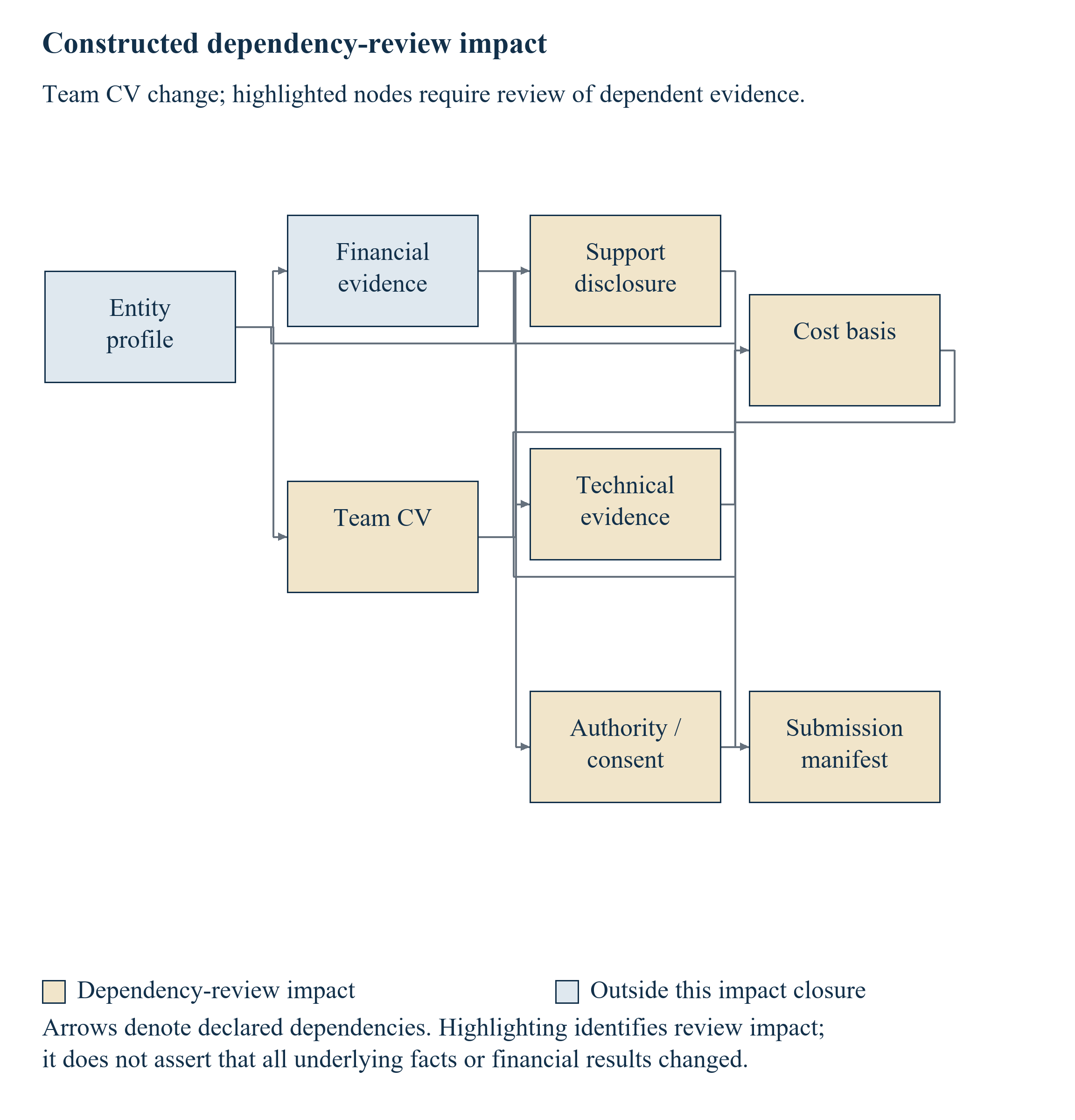
Scroll horizontally to read the figure at full size. You can also open the full-size figure.
Constructed graph. Highlighting identifies required revision review in the model; it does not assert that a personnel change alters an experimental result.
14 Trace format compatibility and changed evidence through the cases
Both constructed format profiles begin with a stored version called v1. In the flexible profile, the stipulated later pending-application rule accepts v1 or v2. In the strict profile, it accepts v2. The transition is placed on constructed day forty-five, and the main cases have pending applications whose deadlines begin on day sixty. A separate already-submitted state has its own accepted set. These labels and dates are fixtures used to test the decision logic. They are not copied from an actual sponsor's current transition timetable.
Under the flexible profile without an upstream change, direct reuse remains available for the stipulated source records. The existence of an additional format does not make an accepted source version invalid. Under the strict profile, a target-specific refresh into an accepted format is selected at the declared cost. Each output retains the required checking and approval effort. The experiment therefore distinguishes a formatting transition from a change in the underlying facts. A live application would need its own accepted-version rule, supported by the actual instructions and submission state.
The change-present fixture updates the team-CV dependency on constructed day ten. The graph links that record to support disclosure, technical evidence, cost basis, authority and consent, and the submission manifest. Those six module roles receive the stipulated revision-review requirement. Entity profile and financial evidence remain outside this particular impact closure. The graph describes records that require review after the declared change; it makes no claim that a person's biography changes an experimental result. The review determines the supported current representation of each dependent record.
Every application starts from the same frozen source snapshot in this experiment. A target-specific refresh does not update another application's source automatically, and no cross-application refreshed-document cache is credited. The central three-hour maintenance entry concerns classification and administration of the change. Refresh preparation and checking remain charged for each affected target. A company operating a continuously updated shared library could define another policy, with explicit shared-update effort and destination-specific review. That policy would require a separate state and accounting specification.
The hard eligibility conditions remain ahead of the effort choice. Current facts, consent, call eligibility, scientific-overlap clearance and cost-overlap clearance are stipulated as established in the main cases. The tests separately place an unknown fact, missing consent and unavailable required certifier on hold, including under recreation. These controls keep the exercise within known admissible facts. The profile comparisons demonstrate the consequence of declared compatibility rules; they supply no assertion that the same project can be submitted simultaneously to the actual programmes cited in the documentary review.
| Parameter | Constructed value | Interpretation |
|---|---|---|
| Application volumes | 2, 4 and 8 | Twelve main settings across format and change profiles |
| Setup and change maintenance | 16 h; 3 h | Separate central tasks, charged once when applicable |
| Formats and change | Flexible or strict; none or present | Stipulated conditions, with no actual-call mapping |
| First deadline and interval | Day 60; then 20-day intervals | Illustrative calendar only |
| Available preparation capacity | 25 h first prefix; then 15 h more per application | Allocated hours, not assumed continuous staffing |
| Shared refresh cache | None | Every target begins from the same frozen snapshot |
| Current factual clearances | Established in main cases | Unknown-fact and permission controls tested separately |
All model inputs are constructed. Source verification and actual programme eligibility remain separate from these settings.
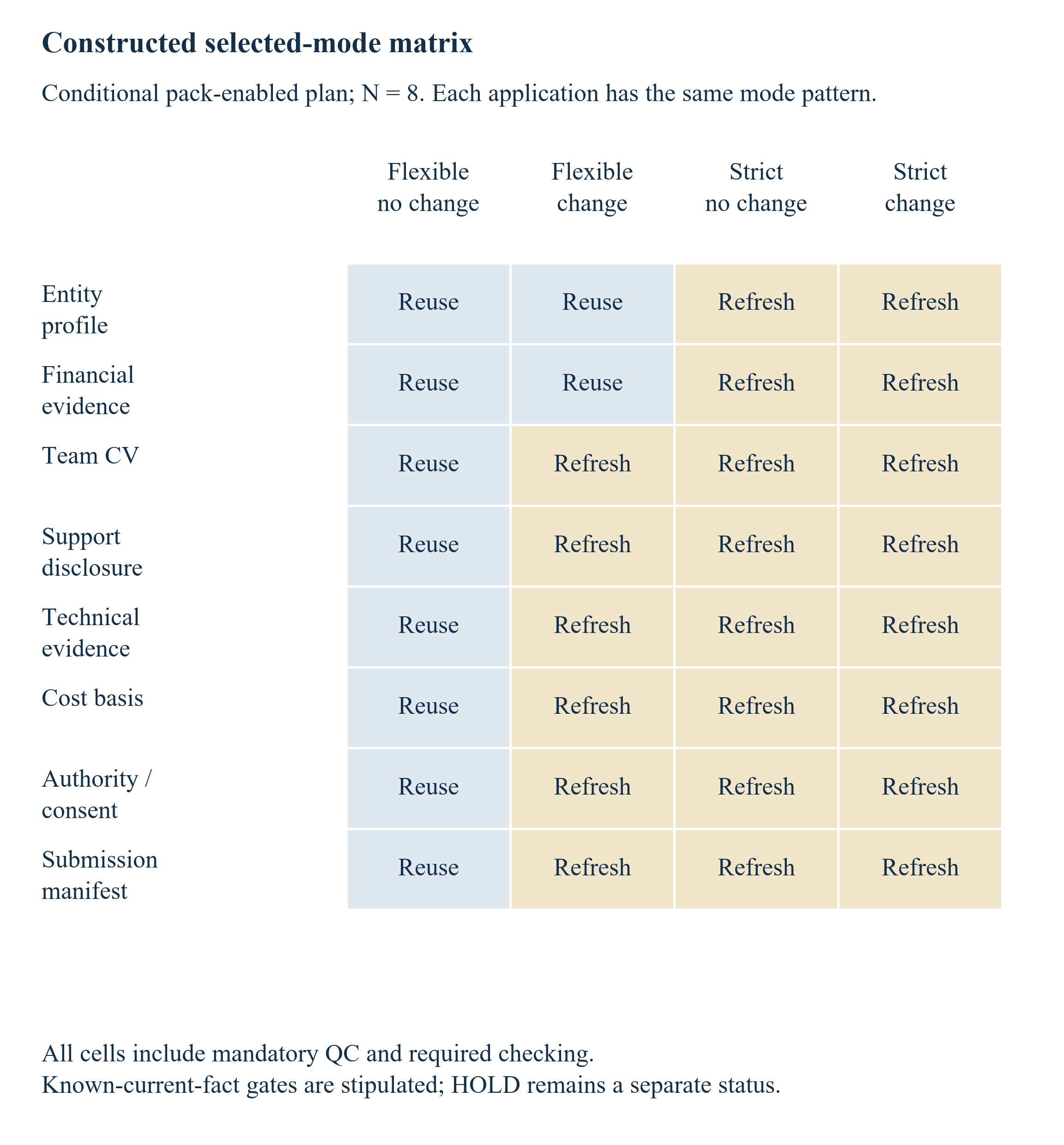
Scroll horizontally to read the figure at full size. You can also open the full-size figure.
Shown for the eight-application cases. Format and dependency conditions control method availability; the diagram is not a grant-eligibility approval.
15 Compare prospective effort across the application pipeline
The fresh eight-module work package requires 14.25 constructed hours per application. Of that total, 3.75 hours are mandatory checking and the stipulated approval or certification component. The same mandatory component remains in the pack calculations. Across two, four and eight applications, the fresh totals are 28.5, 57 and 114 hours respectively. The prospective pack calculation adds sixteen setup hours, plus three maintenance hours when the upstream-change-present profile applies. All reported differences follow from these declared quantities and the available preparation methods.
For two applications, fresh preparation has the lower declared total in all four main profiles. In the flexible, unchanged case, the pack total is 29.5 hours against 28.5 hours fresh. The pack-enabled result still has an available reuse method; its prospective setup exceeds the preparation reduction at this volume. The changed and strict-format cases require more target-specific work. These results illustrate the importance of counting an approved, credible application pipeline and the prospective setup investment before treating a reusable pack as the lower-effort policy.
At four applications, the flexible, unchanged pack requires 43 hours against 57 fresh, a fourteen-hour constructed difference. With the declared upstream change, its pack total reaches 57 hours and the tie rule selects fresh. The strict-format pack totals are 58 hours without the change and 61 hours with it, both above the 57-hour fresh total. The comparison shows how accepted-format conditions and target-specific refresh can alter the decision even when the application volume and evidence-module list remain unchanged.
At eight applications, all four pack-enabled profiles have lower declared total effort than the 114-hour fresh alternative. The flexible, unchanged total is seventy hours. The flexible, changed total is ninety-five hours. The strict-format totals are one hundred hours without the change and 103 hours with it. The corresponding constructed differences are forty-four, nineteen, fourteen and eleven hours. These quantities describe the specified work package and frozen-source policy. They establish no typical saving for a company, sector, grant programme or preparation tool.
Management should read the total together with the action and capacity record. A lower-effort pack policy still needs the declared sources, permissions and approvals. Its setup also consumes work before the application that relies on it. The next section checks the selected sequence against the constructed availability budget. That additional screen reports capacity separately from whole-pipeline effort. In a company implementation, the comparison should retain the work-package boundary and the observations supporting each input.
| Apps | Formats | Change | Fresh h | Pack h | Cost choice |
|---|---|---|---|---|---|
| 2 | Flexible | None | 28.5 | 29.5 | Fresh |
| 2 | Flexible | Present | 28.5 | 38 | Fresh |
| 2 | Strict | None | 28.5 | 37 | Fresh |
| 2 | Strict | Present | 28.5 | 40 | Fresh |
| 4 | Flexible | None | 57 | 43 | Pack |
| 4 | Flexible | Present | 57 | 57 | Fresh (tie) |
| 4 | Strict | None | 57 | 58 | Fresh |
| 4 | Strict | Present | 57 | 61 | Fresh |
| 8 | Flexible | None | 114 | 70 | Pack |
| 8 | Flexible | Present | 114 | 95 | Pack |
| 8 | Strict | None | 114 | 100 | Pack |
| 8 | Strict | Present | 114 | 103 | Pack |
Constructed effort comparison; all mandatory checking is included. Cost choice precedes the separately reported selected-prefix capacity diagnostic.
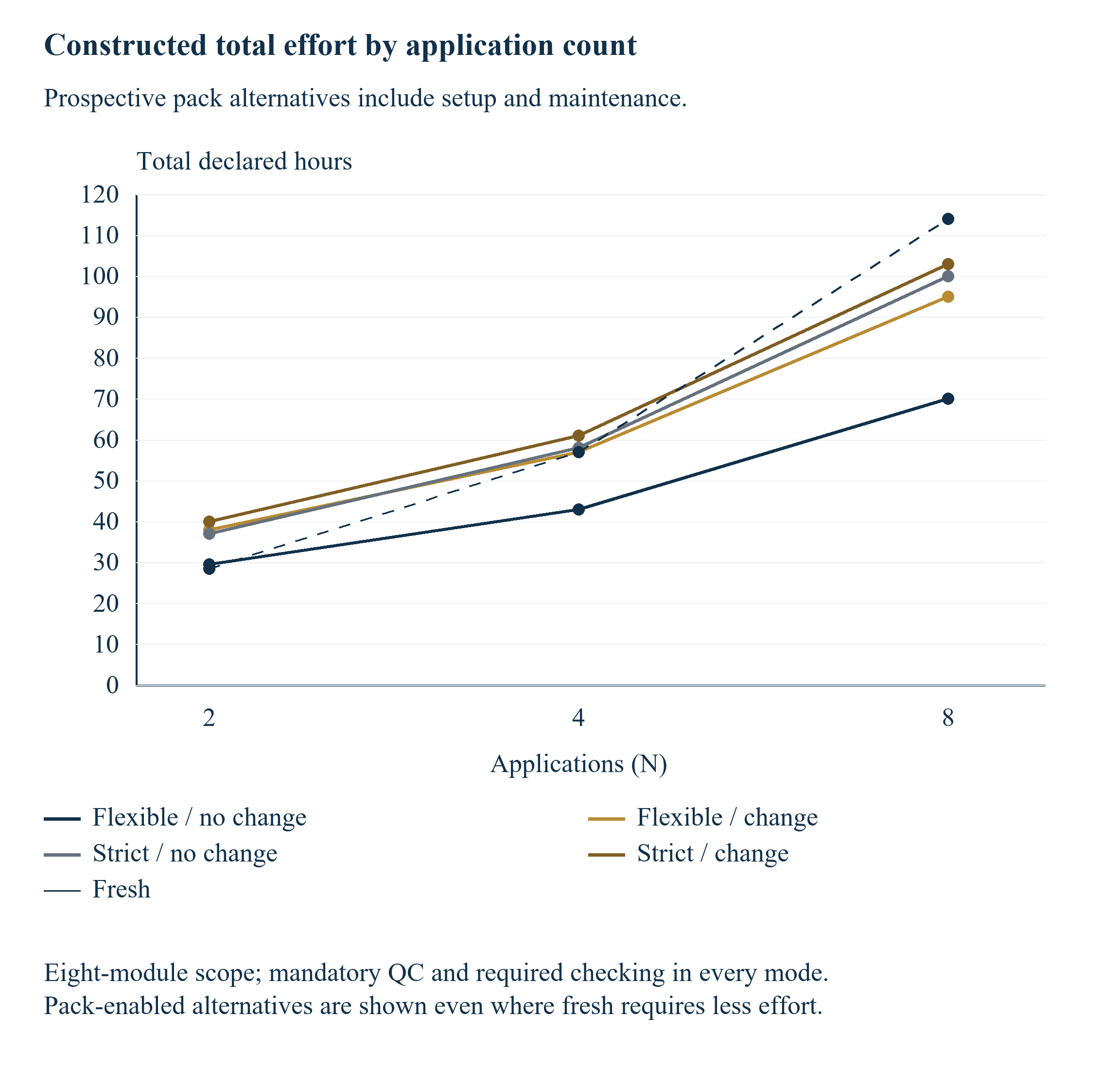
Scroll horizontally to read the figure at full size. You can also open the full-size figure.
All quantities are constructed and cover eight evidence-module roles. Setup and applicable maintenance are included; no empirical saving or complete-application cost is shown.
16 Check the selected plan against early deadline capacity
The constructed capacity budget allocates twenty-five staff hours by the first application deadline and another fifteen hours by each additional deadline. Deadlines begin on day sixty and advance by twenty days. These are scenario dates and preparation-hour allocations. They describe no actual grant calendar, staffing contract or sponsor service standard. The diagnostic compares the cumulative work of the cost-selected sequence with the cumulative capacity available at each point. All pack setup and the stated maintenance are charged before the first deadline.
The flexible, unchanged eight-application case fits this declared sequence. Its first prefix requires 22.75 hours, including setup, against twenty-five available. The three other eight-application pack profiles show an early shortfall despite having lower whole-pipeline effort than fresh preparation. The flexible, changed first prefix requires 28.5 hours; the strict, unchanged prefix requires 26.5; and the strict, changed prefix requires 29.5. Their first-deadline shortfalls are therefore 3.5, 1.5 and 4.5 hours respectively.
The selected policy remains the minimum-total-effort choice in the implementation; the capacity diagnostic does not silently replace it. Its shortfall is a signal to revisit the operating plan. The company could investigate earlier authorised preparation, an additional allocation of capacity, another application sequence or another preparation policy. The model does not solve those alternatives. The declared fresh sequence passes the prefix screen in these cases, so the shortfall of a selected pack plan supplies no finding that every available preparation approach is infeasible.
A live tracker should include the constraints omitted from this simple screen. Evidence may become available only after an event. A partner may need time to approve a letter. A required individual may have limited availability. Portal preparation and final submission may involve separate tasks. The proposed operating process assigns those dependencies, owners and actual dates explicitly. The model's allocated staff hours cannot describe those waiting and release-time constraints. A company should use an appropriate scheduling method and the actual opportunity requirements when those constraints determine its submission decision.
The useful management distinction is visible in the decision record: minimum declared total effort, readiness under the selected capacity budget and unresolved factual requirements are separate results. A pack can be economical over a pipeline while requiring additional early preparation capacity. A small fresh-preparation policy can fit the same initial capacity with another total effort. The board or delegated owner can assess that trade-off against the approved pipeline and resources. The numerical total and prefix status establish no award outcome or completed submission.
| Policy profile | Demand h | Available h | Headroom h | First-prefix result |
|---|---|---|---|---|
| Fresh policy | 14.25 | 25 | 10.75 | Pass |
| Flexible stable | 22.75 | 25 | 2.25 | Pass |
| Flexible changed | 28.5 | 25 | -3.5 | Shortfall |
| Strict stable | 26.5 | 25 | -1.5 | Shortfall |
| Strict changed | 29.5 | 25 | -4.5 | Shortfall |
Selected-plan diagnostic with all central work charged before the first deadline. A shortfall does not prove every alternative schedule infeasible.
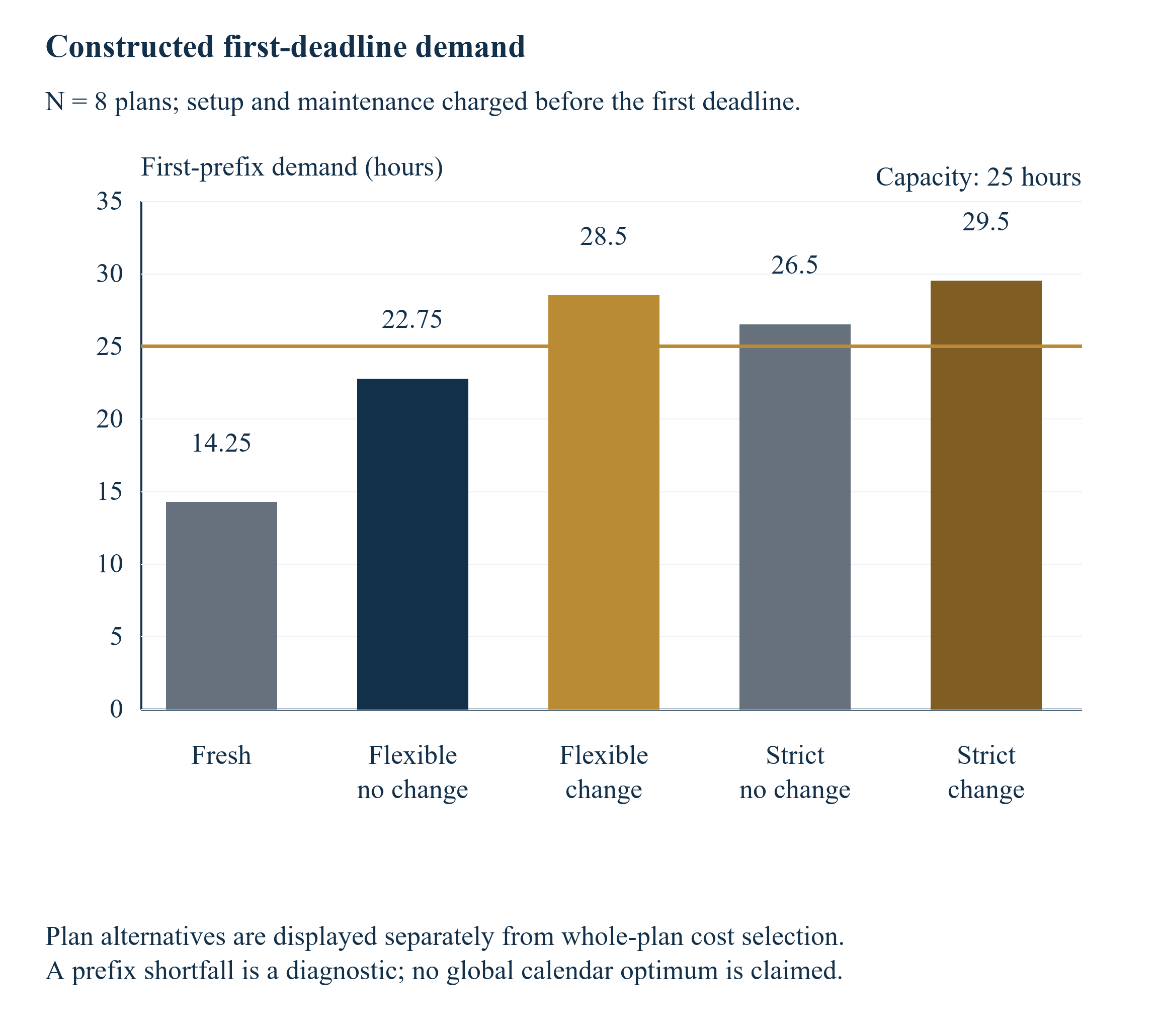
Scroll horizontally to read the figure at full size. You can also open the full-size figure.
Constructed eight-application profiles. Three pack policies need more early allocated hours under this sequence; the fresh sequence passes. No calendar optimisation is performed.
17 Test setup sensitivity and the next forward decision
The sensitivity grid contains fifty constructed combinations. Application count takes the values one, two, four, eight and twelve. Prospective setup takes zero, eight, sixteen, twenty-four and thirty-two hours. The grid uses the flexible and strict accepted-format profiles while holding the upstream-change profile absent. It therefore examines scale, setup and the stated formatting conditions within that boundary. The twelve main cases separately show the declared change profile. A reader should retain those dimensions when interpreting a plotted decision region.
A small homogeneous fixture checks the basic crossover arithmetic independently of the eight-module case. Its setup is three hours, fresh work is two hours per application and reusable work is 1.25 hours per application. At three applications, fresh requires six hours and the pack requires 6.75. At four applications, both require eight hours and the stated rule selects fresh. At five applications, fresh requires ten hours and the pack 9.25. The strict reduction begins above four applications for those particular declared inputs.
Sunk setup changes a forward comparison. In the two-application flexible, unchanged main case, a new pack requires 29.5 hours against 28.5 fresh. When the sixteen setup hours have genuinely already been incurred and are excluded from the next prospective decision, the pack's remaining target work is 13.5 hours. That comparison uses the same declared checks and source compatibility. It supplies no evidence that a particular company has already established the pack or that the earlier expenditure was justified when incurred.
Prospective maintenance remains in the sunk-setup calculation. For the two-application flexible, changed case, the warm-pack total is twenty-two hours, including the three-hour central maintenance and the target-specific refresh work. For the strict, changed case it is twenty-four hours. The corresponding fresh work remains 28.5 hours. The calculation excludes the stipulated incurred setup alone. A company should keep future maintenance, further evidence collection and required review in its forward assessment, with any additional work outside the model included through an explicit extension.
The sensitivity results support a set of conditional questions. How many applications are management actually approving? Which source and form conditions apply to each? What work remains necessary when those conditions change? Which part of setup is prospective and which is already incurred? Can the selected policy fit the actual preparation calendar? The framework makes those questions inspectable through declared inputs and separate results. Company observations can replace constructed quantities when a consistent work package and checking standard have been recorded.
| Profile | New pack h | Remaining pack h | Fresh h | Maintenance h |
|---|---|---|---|---|
| Flexible stable | 29.5 | 13.5 | 28.5 | 0 |
| Flexible changed | 38 | 22 | 28.5 | 3 |
| Strict stable | 37 | 21 | 28.5 | 0 |
| Strict changed | 40 | 24 | 28.5 | 3 |
Remaining pack hours exclude sixteen genuinely incurred setup hours only. Future maintenance and target-specific checks remain charged.
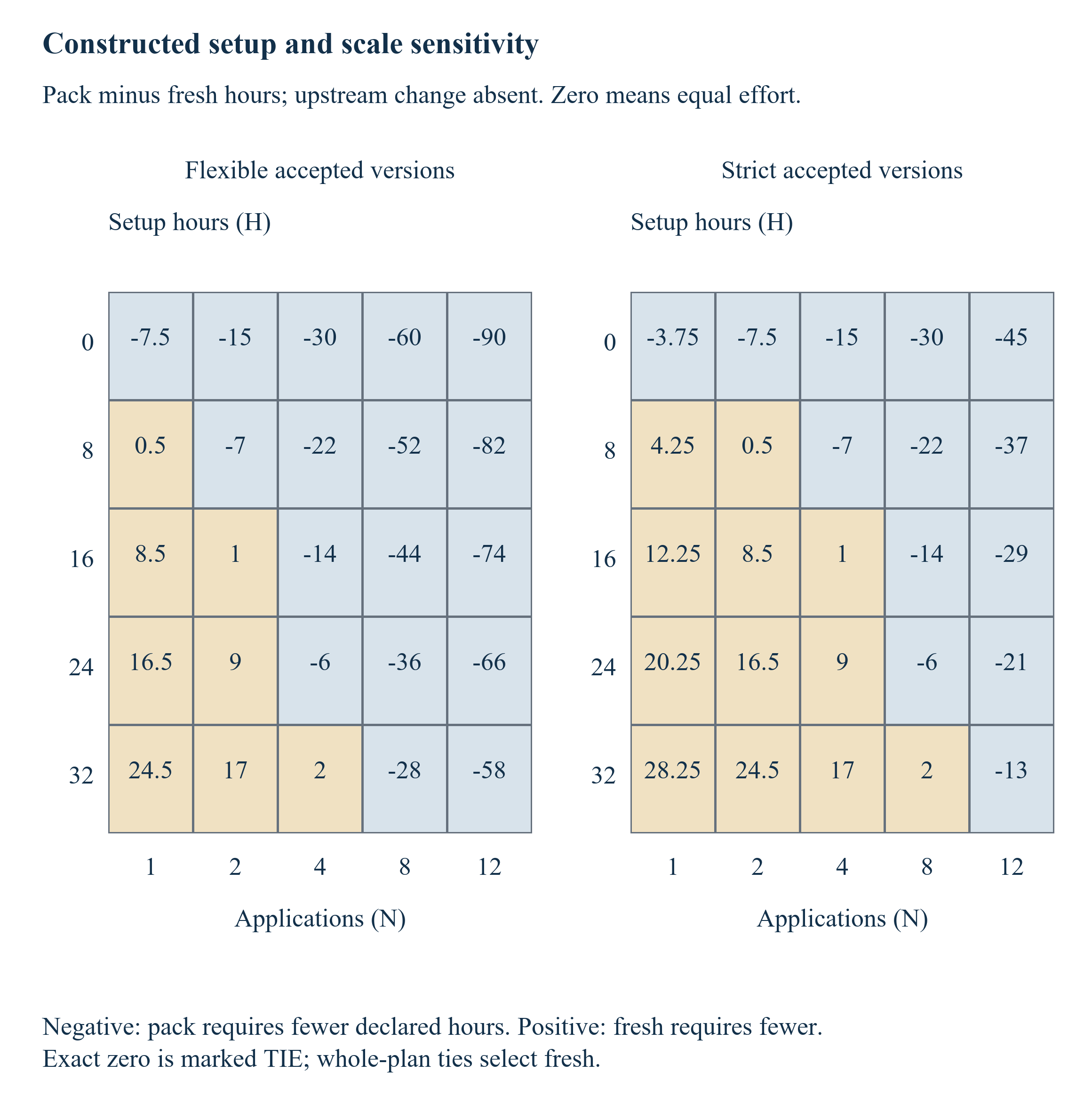
Scroll horizontally to read the figure at full size. You can also open the full-size figure.
Fifty constructed nodes; upstream change is absent in this grid. Negative values indicate fewer declared pack hours. Equality selects fresh under the model tie rule.
18 Prepare an auditable handover from application to award
The proposed handover preserves the approved application and identifies the obligations that begin after an offer. Retain the submitted document set, confirmation, responsible approvals and the evidence versions that supported material statements. Add the actual offer, agreement, amendments and reporting instructions when they become available. An application pack then provides an indexed starting point for the award team. The team should review each obligation against the agreement and establish the records needed for implementation, reporting and any cost claim. A successful application alone establishes no conclusion about whether later delivery or spending meets those requirements.
The EU Annotated Grant Agreement distinguishes evidence for actual costs from evidence for lump-sum implementation. Its Article 20 explains the need for verifiable and auditable supporting material within the relevant funding form. The signed agreement and Data Sheet remain controlling, including the applicable retention period. The proposed register therefore labels records by the obligation they support: an application statement, a cost declaration or implementation of specified work. It keeps the factual record and its use available for the review appropriate to that obligation. [6]
US retention rules also need their specified trigger and exceptions. Section 200.334 generally measures the cited federal award retention period from submission of the final financial report, with listed exceptions. The proposed retention register records the actual rule, trigger and owner for each relevant record family. It should account for the obligations of the organisation and award rather than apply one period from the date an application file was created. An unresolved litigation, audit or other relevant condition should be referred to the responsible owner before a disposition decision. [16]
A useful handover separates obligations already met from information that will be generated during the project. A historic test report may support the original technical case. Later progress claims need the relevant delivery evidence. A budget can supply a baseline while actual transactions require their own records and allocations. The proposed register links those records to the approved work and reporting period. Changes to the plan should carry the required approval and an explanation of their effect on the original baseline. This supports a review of what the organisation undertook and what it subsequently evidenced.
The handover should be proportionate enough for the delivery team to use. A concise obligations matrix can identify the requirement, governing source, responsible person, next relevant date and evidence location. The retained application pack supplies provenance for earlier statements without becoming a substitute for project management. The company should test the handover through a small number of representative questions: where a reported number came from, which agreement provision governs it and which person owns the next action. Unanswered questions become specific preparation tasks for the award team.
19 Assign finance and board responsibility for the preparation decision
The proposed investment decision belongs within the company's normal allocation of management time and cash. The finance function can define the prospective preparation budget, document the application pipeline and identify the checks that will remain necessary. Technical and commercial owners can assess whether the available evidence supports the intended projects. The board or delegated decision-maker can then approve a preparation policy within a stated scope. That decision should record the expected work, its assumptions and the conditions that would trigger a review of the investment.
An application pipeline should contain opportunities that the company is actually prepared to investigate and pursue. Counting every advertised programme as an available application would make a reusable pack appear to serve a larger workload than management has approved. The proposed forecast distinguishes identified opportunities, eligibility under review, approved submissions and completed submissions. A volume sensitivity can then show how the preparation decision changes if fewer opportunities proceed. The paper's constructed application counts are scenario inputs and provide no evidence about a particular company's reachable funding pipeline.
Finance should separate preparation effort from expected funding receipts. The effort model measures declared hours for a defined work package. It assigns no probability of an award, value to programme access or timing to a grant payment. A company's funding plan requires those separate assumptions and the actual opportunity terms. Where public funding is contingent or reimbursed after specified activity, the company should identify the resources needed to carry its own commitments under the relevant agreement. The preparation model supplies no conclusion that an application will finance that requirement.
The board information can remain concise. Show the proposed preparation policies, prospective setup and maintenance, required application-level work and the selected calendar's capacity. Identify unresolved evidence, consent or approval requirements. Explain which hours are supported by the company's observations and which remain planning assumptions. A decision to proceed can specify a limited pilot and a review point before a larger pack investment. A decision to prepare an application individually can retain a small evidence index that supports later review and handover.
Review should examine both the decision and its implementation. Compare recorded effort with the declared work package, retain the corrections found by reviewers and identify the assumptions that changed. A pack may need additional maintenance when a company reorganises, changes its technical programme or revises its reporting basis. The proposed control asks management to update the prospective comparison using those facts. Previously incurred setup expenditure can be identified separately when assessing the next application. A desire to justify earlier spending should not change the evidence or the cost boundary used for a forward decision.
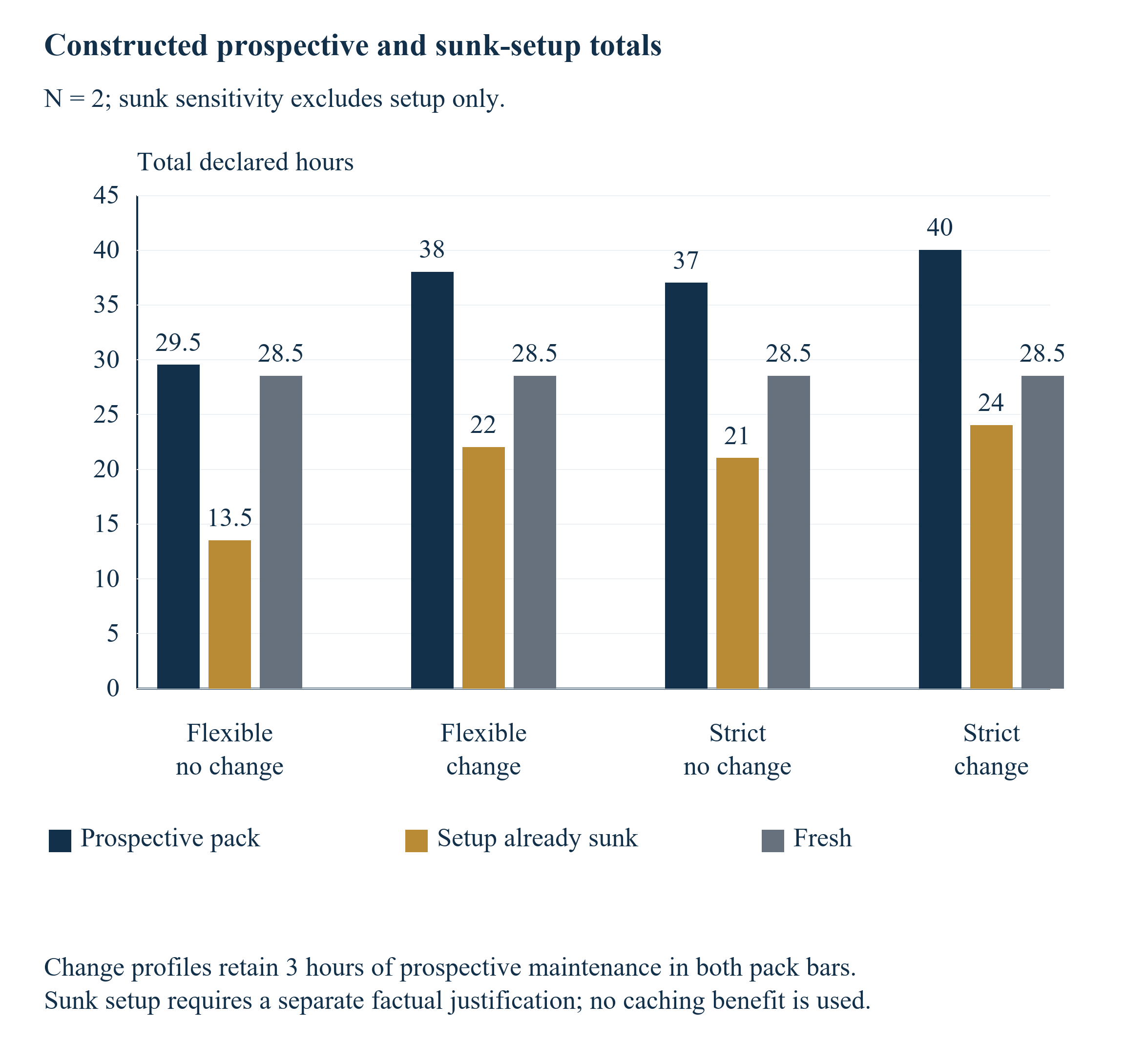
Scroll horizontally to read the figure at full size. You can also open the full-size figure.
Constructed hours. The setup-incurred comparison excludes sixteen setup hours; applicable three-hour maintenance and all target checking remain included.
20 Adapt the framework across sectors entities and jurisdictions
The evidence families provide a common organisational structure while the underlying records remain sector-specific. A hypothetical hardware developer may need evidence about a tested configuration, supplier assumptions and the planned development work. A hypothetical software company may need evidence about a defined product, evaluation conditions and the permission to use relevant data. A hypothetical clean-technology project may need evidence tied to a site, operating assumptions and the proposed activity. These examples illustrate how to scope the record. They establish no programme eligibility or claim that one sector's evidence satisfies another's requirements.
A technical owner should define the statement that each result supports. Testing evidence can retain the conditions, sample or system boundary and the responsible approval. Commercial evidence can identify the customer problem and the permission to disclose any supporting material. The application writer can then explain the relationship to the proposed project using statements within that scope. When the proposed activity relies on a different operating condition or additional development, that requirement should remain visible in the plan. A reusable catalogue can help the team identify the next evidence task.
Jurisdictional transfer also requires the actual applicant and funding instrument to be checked. Corporate records, financial measures and responsible-person declarations may need different presentations. The proposed register retains the original source and records the authorised mapping into the target form. A translated record should retain its factual definitions and an identified review. A country label in a file name supplies no conclusion about the applicant's eligibility, the acceptance of a translation or the permissible location of funded work. Those questions need the current sponsor's instructions and the relevant owner assessment.
The documentary examples in this paper should be used within those boundaries. Innovate UK guidance applies to the stated process and claimant scope. The EU example form and agreement annotation serve their described roles. NIH, NSF and the cited US cost provisions have their own applicability. The UAE university checklist is an institutional example whose current call and commercial eligibility have not been established. The comparison provides questions to ask of another opportunity. It supplies no universal checklist that a company can treat as a substitute for the governing documents.
A company expanding its application pipeline can add a jurisdiction profile that records the actual source, instrument, applicant requirements and responsible advice. The proposed evidence graph then links each claim to that profile and to its factual sources. New opportunities can reuse compatible records while unresolved requirements remain separately assigned. The method can support a portfolio with several entities or projects when those identifiers are maintained consistently. Its value should be assessed through the company's documented preparation and review experience, with the new jurisdiction's conditions kept explicit.
21 Implement the pack through a bounded operating pilot
A practical implementation can begin with one approved opportunity and a limited set of evidence families. Identify the actual template, required declarations, submission route and deadline. Select the records that support the company's intended response and assign their owners. Record unresolved items before drafting begins. This creates a defined pilot whose work can be observed. The company can then review whether a more structured pack would support another identified application. The proposed approach makes the additional preparation investment a decision based on a visible pipeline and a defined scope.
During the first stage, create an index of the selected sources and their factual boundaries. Keep the files in the company's approved environment and apply the relevant access permissions. Record the versions and approvals actually available. A short owner review should check whether each intended claim has an appropriate supporting source. Where the material is incomplete, assign the next evidence task and its responsible person. The pilot should retain those unresolved items as work to complete, with the application status reflecting their effect on readiness.
The next stage maps the sources into the live application. Record the destination question, definition, period and required form. Prepare the answer or table through the authorised process and keep its source link. Check calculations, statements and required permissions. Obtain the approvals and certifications that actually apply. A final review should examine the version intended for submission and the actual portal state. The proposed pilot retains both its completed checks and the corrections made, so that management can assess the work needed to produce an approved submission.
A second application provides a bounded test of portability. Compare its requirements with the first pack's records and assign a preparation method to each relevant item. Record the time spent finding, checking, refreshing and preparing material, including the work of reviewers and owners. Count the effort of maintaining the shared register separately. The company can then compare its experience with the assumptions used in its prospective decision. Differences in project scope or funder rules should remain visible in that comparison. They should not be treated as evidence of a general preparation-time effect.
The operating decision after the pilot should be explicit. Management can retain a concise index, expand selected evidence families or postpone a wider pack investment. The decision should identify the current owner, maintenance responsibilities and review point. A larger register needs a process that people can sustain as facts and permissions change. The proposed pilot therefore examines usability and accountability alongside preparation hours. A company should retain the records that support its decision and specify what would need to change before another expansion is justified.
22 Interpret sensitivity results within the model boundary
The effort comparison is conditional on its inputs. Preparation times, quality-control effort, setup and maintenance are constructed quantities in the numerical experiment. A reader can change those inputs to test a different declared work package, with the compatibility and source-availability conditions retained. The direction and size of a result should be interpreted within that package. An attractive number does not establish the company's actual preparation cost or the value of a funding award. The paper provides a calculation structure and identifies the observations needed to calibrate it.
The frozen-source assumption is particularly important. Each constructed application starts from the same evidence snapshot, and the model charges its target-specific refresh work. It grants no cross-application benefit from a refresh performed for another target. A maintained shared library could follow another policy, with common update effort and distinct review work for each destination. That policy would need its own state, permissions and accounting. The current experiment also omits unlisted activities and waiting time. These boundaries have different potential effects, so the result is not presented as an upper or lower bound on real preparation effort.
The selected-prefix capacity check is a diagnostic of the declared plan. It records the cumulative demand and stated available capacity at the constructed deadlines. A shortfall identifies a planning issue for that sequence. The model performs no allocation of individual workers, external approval waiting times or full calendar optimisation. A company may respond by changing the preparation policy, starting earlier, adjusting the approved pipeline or obtaining authorised capacity. Each response should be evaluated with its own constraints and costs. The diagnostic supplies no conclusion that every alternative schedule is infeasible.
The documentary review also has a defined boundary. It samples official materials to identify relevant controls and examples of reuse. It does not claim a comprehensive census of grant programmes or provide legal advice on a particular agreement. Current calls can introduce requirements that differ from a general guide or example form. Future versions can alter a transition rule, declaration or retention condition. A reader using the framework should obtain and record the source that governs the actual opportunity at the relevant time, with qualified advice where the applicability remains uncertain.
A stronger empirical study could follow consented application histories from evidence preparation to submission and decision. It would record work packages, reviewer effort, corrections, related applications and programme changes. A comparison should account for applicant experience, project scope and the decision to pursue or abandon an opportunity. Award outcomes would require separate definitions and analysis. Such a study could estimate observed preparation differences within its sample. The present paper establishes no such estimate and uses the constructed cases to make the decision conditions and accounting choices inspectable.
23 Use an accountable submission decision checklist
The proposed final decision starts with the actual opportunity. Confirm the applicant, project, instrument, current rules and intended submission state. Identify the sources that govern the template, accepted versions, deadline and required declarations. Record the responsible application owner and authorised submitter. Any unresolved condition should have an owner and a stated effect on readiness. This provides a practical boundary for the evidence-pack decision: preparation work can proceed within an approved scope, while a submission decision depends on the requirements that actually apply.
Next, examine the material claims. Each significant number should retain its entity, period, unit, definition and source or declared forecast assumption. Each technical assertion should be supported within the record's scope. Check the permissions for confidential, personal and third-party material. Review related applications, scientific overlap and proposed cost funding through their appropriate controls. The proposed checklist links these decisions to the relevant evidence owner so that a correction can be made at its source and followed through the affected presentations.
Then examine approvals and the actual submission representation. Confirm the applicable person's certification, the relevant partner permissions and any required signatures. Compare the approved answers and attachments with the versions held in the portal. Check the destination's requirements for file format, permitted content and submission action. Retain the confirmation available from the system. The proposed control treats this as an accountable review step, including an explicit record of any unresolved issue. A completion indicator is useful when it points to those actual checks and their owners.
Finally, review the preparation investment. Separate prospective setup, maintenance and target-specific work. Include the review and certification effort required under each policy. Treat incurred setup separately when making the next forward decision. Examine the selected plan's capacity at each relevant deadline and document any needed change. A company should use supported observations where available and label remaining planning assumptions. The numerical comparison should remain attached to its work-package definition so that another decision-maker can see which activities have been included and which need a separate budget.
The decision record can end with a clear disposition: proceed to the authorised submission process, complete specified outstanding work, or defer the application. For a pack investment, identify the approved evidence families and the next review point. For award handover, identify the relevant obligations and the responsible delivery owners. These dispositions support a continuing record of evidence and accountability. They should reflect the actual checks and permissions available when the decision is made, with later changes linked to the earlier version through an approved process.
| Observed control state | Proposed next action | Record to retain |
|---|---|---|
| Required fact or permission unresolved | Hold the affected use and assign its owner | Missing requirement and resolution route |
| Compatible evidence and actual approvals available | Complete the authorised submission process | Checked target version and system confirmation |
| Lower hours with a capacity shortfall | Review timing, capacity or preparation policy | Approved operating decision and its assumptions |
| Material source change after submission | Check the actual amendment or notification process | Prior representation, new source and authorised action |
| Pack investment unsupported by approved pipeline | Review a smaller preparation scope | Prospective work and volume assumptions |
| Retention or disposition condition unresolved | Refer to the responsible record owner | Applicable obligation, trigger and decision |
Proposed operating checklist. It confers no sponsor approval, legal clearance or permission to bypass a submission requirement.
24 Conclusion
A reusable grant evidence pack is a governed set of sources and mappings that can support more than one application when the relevant compatibility conditions are met. Its preparation decision has a factual and an economic part. The factual part identifies the records, claims, permissions and declarations that the target requires. The economic part compares prospective setup, maintenance and application-level effort for the available preparation policies. Both parts need an explicit scope, responsible owners and a record of the checks that support the decision.
The documentary examples establish useful boundaries. Some official processes expressly support transfer or stage-specific reuse while retaining review and certification responsibilities. Actual call instructions, agreement terms and submission state determine their application. Financial evidence also needs a project-appropriate allocation and the records required for the relevant funding form. The paper uses these distinctions to propose a compatibility framework that retains unresolved facts as holds and separates document preparation from scientific-overlap and funding-duplication checks.
The constructed experiment makes its declared effort accounting available for inspection. It retains quality control and the required approval effort under every method. It distinguishes prospective setup from sunk expenditure and charges its stated maintenance and target-specific refresh work. Its capacity screen concerns the selected sequence under constructed availability assumptions. These features support a conditional comparison for the stated evidence work package. The paper reports no observed savings, award-probability effect or finding that the resulting numbers describe another company's process.
A company can apply the framework through a bounded pilot. Select an actual opportunity, identify the sources and owners, map the material into the approved template and retain the checks that support submission. A second approved opportunity can test which records remain compatible and what refresh work is required. Management can then review its own effort observations and the usability of the controls before expanding the pack. The relevant decision is the scope of a maintainable evidence system and the work needed for an accountable submission.
The continuing research task is to test this framework against consented preparation histories with clear work packages, sources and review standards. That evidence could support estimates within a defined sample and identify the conditions under which a reusable pack is useful. Until then, the proposed method provides a transparent basis for stating assumptions, examining compatibility and comparing the declared work. The final application remains the responsibility of the people and organisations making its representations under the rules that govern it.
References
- UK Research and Innovation. Your application: General guidance for Innovate UK applicants. Updated 16 July 2026; accessed 13 November 2026. https://www.ukri.org/councils/innovate-uk/guidance-for-applicants/general-guidance/your-application/
- UK Research and Innovation. Costs guidance for non-academic organisations. Updated 5 November 2026; accessed 13 November 2026. https://www.ukri.org/councils/innovate-uk/guidance-for-applicants/costs-we-fund/costs-guidance-for-non-academic-organisations/
- Innovate UK. Terms and conditions of an Innovate UK grant award. Document dated October 2025; publication page updated 17 November 2025; accessed 13 November 2026. https://www.ukri.org/wp-content/uploads/2025/11/IUK-171125-Sept-2025-IUK-TCs.pdf
- UK Research and Innovation. Use of generative artificial intelligence in application preparation and assessment. Published 23 September 2024; policy collection updated 6 July 2026; accessed 13 November 2026. https://www.ukri.org/publications/generative-artificial-intelligence-in-application-and-assessment-policy/use-of-generative-artificial-intelligence-in-application-preparation-and-assessment/
- European Commission. Standard application form: Horizon Europe RIA and IA. Part A version 3.0, 10 November 2025; example template; accessed 13 November 2026. https://ec.europa.eu/info/funding-tenders/opportunities/docs/2021-2027/horizon/temp-form/af/af_he-ria-ia_en.pdf
- European Commission. EU Grants: Annotated Grant Agreement. Version 3.0, 1 November 2026; Article 20, printed pages 205 to 207; accessed 13 November 2026. https://ec.europa.eu/info/funding-tenders/opportunities/docs/2021-2027/common/guidance/aga_en.pdf
- European Commission. European Innovation Council Work Programme 2027. C(2026)7629; printed pages 79 to 80; accessed 13 November 2026. https://eic.ec.europa.eu/document/download/ed9ab103-1ffb-4d5f-a6ad-168ac3b36900_en?filename=EIC-2027-Work-Programme.pdf
- National Institutes of Health. NIH's Implementation of Common Forms for Biographical Sketch and Current and Pending (Other) Support. NOT-OD-26-018, 2 December 2025; accessed 13 November 2026. https://grants.nih.gov/grants/guide/notice-files/NOT-OD-26-018.html
- National Institutes of Health. Announcement of Upcoming System Enforcement for Common Forms. NOT-OD-26-079, 21 April 2026; accessed 13 November 2026. https://grants.nih.gov/grants/guide/notice-files/NOT-OD-26-079.html
- National Science Foundation. FAQ: Using SciENcv. Publication date not displayed; accessed 13 November 2026. https://www.nsf.gov/policies/document/faq-using-sciencv
- National Science Foundation. Common Form for Current and Pending (Other) Support. 1 November 2023; accessed 13 November 2026. https://www.nsf.gov/policies/nspm-33/common-form-cps
- National Institutes of Health, Center for Scientific Review. Evaluation of Unallowable Resubmission and Overlapping Applications. Updated 26 October 2026; accessed 13 November 2026. https://public.csr.nih.gov/ForApplicants/SubmissionAndAssignment/DRR/evaluationofapplications
- US Small Business Administration. SBIR and STTR FAQ: General Questions. Publication date not displayed; accessed 13 November 2026. https://www.sbir.gov/faq
- Electronic Code of Federal Regulations. 2 CFR 200.403: Factors affecting allowability of costs. Displayed current through 10 November 2026; accessed 13 November 2026. https://www.ecfr.gov/current/title-2/section-200.403
- Electronic Code of Federal Regulations. 2 CFR 200.405: Allocable costs. Displayed current through 10 November 2026; accessed 13 November 2026. https://www.ecfr.gov/current/title-2/section-200.405
- Electronic Code of Federal Regulations. 2 CFR 200.334: Record retention requirements. Displayed current through 10 November 2026; accessed 13 November 2026. https://www.ecfr.gov/current/title-2/section-200.334
- Zayed University. Research Incentive Fund Grants. Page footer updated 24 April 2024; university-faculty programme example; current call not verified; accessed 13 November 2026. https://www.zu.ac.ae/main/en/research/funding_opportunities/_funding_links/rif
- World Wide Web Consortium. PROV-O: The PROV Ontology. W3C Recommendation, 30 April 2013; accessed 13 November 2026. https://www.w3.org/TR/prov-o/
- UK Research and Innovation. What happens if you receive a funding offer. General Innovate UK guidance; accessed 13 November 2026. https://www.ukri.org/councils/innovate-uk/guidance-for-applicants/general-guidance/what-happens-if-you-receive-a-funding-offer/
About the Author
Chennakeshav (CK) is a corporate finance and investment banking executive with 25+ years of global experience in deal origination, structuring and execution across M&A, growth capital and corporate strategy. He has led value-creation mandates for founders, corporates and funds — bridging the boardroom view to hands-on execution and close.
His career spans Morgan Stanley, HSBC, Lloyds Banking Group, EWEC, ADQ portfolio companies and Emirates Growth Fund, across TMT, real estate, fintech, deeptech, cleantech, infrastructure and energy. He has partnered with C-suite leaders, private equity and venture funds, sovereign wealth funds and family offices to finance complex fund raises and scale-up ventures, and has led M&A due diligence, post-merger integration and business-transformation initiatives to create value.
At Matchpoint Partners he is Managing Partner, leading the firm's corporate finance, M&A and capital-raising practice. He holds an MBA from London Business School, an engineering degree from VTU and a Master of Laws (LLM, in progress) from UCL London.
An active start-up mentor, CK mentors at Techstars, DIFC FinTech Hive, Startup Grind, Founder Institute and IN5, serves as Entrepreneur Mentor in Residence (EMiR) at London Business School, and judges the Entrepreneurship World Cup.
https://www.linkedin.com/in/ckadya/
https://www.matchpoint-partners.com/team/ck-adya.html
Disclaimer
This paper is part of a continuing series on the structure of private and alternative markets. The views expressed are the author's own. The paper is for information only, describes market structure in general terms, and does not constitute investment, legal, tax or regulatory advice or a recommendation in respect of any security, vehicle or counterparty.
