

1 Define the financing decision around a funded milestone
A founder choosing between a grant and an accelerator needs a dated financing decision. The decision begins with the milestone that the company must reach, the cash needed to reach it and the ownership that existing shareholders retain afterwards. A grant announcement and an accelerator offer describe different arrangements. Their headline amounts become comparable only after the company reconstructs cash availability, permitted expenditure, contractual conditions and subsequent conversion. This paper develops that comparison for a company with a defined operating plan. The objective is to identify feasible financing paths and the economic conditions under which one path compensates shareholders for its additional dilution.
The decision should be specified before a programme is scored. Management identifies the legal entity receiving support, the product or technical milestone being financed, the period of expenditure and the minimum unrestricted cash balance required to continue. Existing investors, employee options, outstanding convertible instruments and committed liabilities form part of the starting position. Changing any of these boundaries changes the comparison. An apparently attractive offer can fund a different entity or a narrower project, leaving the operating company exposed. A useful decision record therefore connects the programme documents to the company budget and capitalisation table at the same observation date.
The proposed method makes cash feasibility a condition of the economic comparison. A company that cannot pay an invoice before reimbursement cannot implement the planned grant path using that reimbursement alone. Additional finance, a permitted expenditure change or a different timetable is then required. Ownership retention remains relevant, but an ownership percentage without a financeable operating plan does not establish a viable choice. The method records the first month in which the cash floor fails and the extra committed funding needed to remove that failure. It does not convert an unavailable funding source into cash through an expected-value adjustment.
For paths that remain feasible, the analysis compares retained ownership and a conditional equity-value hurdle. The hurdle asks how much more valuable the company would need to become under the more dilutive path for the original shareholders to hold the same value. It is an algebraic threshold under stated inputs. It supplies no estimate of the programme's ability to create that value. Customer access, mentoring, investor introductions and signalling require their own evidence before management gives them a financial benefit in the base case. The distinction keeps the decision useful when reliable programme-specific outcome data are unavailable.
The paper combines a dated review of selected published programme terms with an authored financing experiment. The worked companies, spending profiles, financing dates and later valuations are constructed inputs. They are not observed applicants, signed offers or client transactions. Published terms establish contractual categories and selected advertised features; they do not establish acceptance probabilities or a common causal return from joining a programme. The practical output is a financing decision pack that a board can update with its own executed documents, bank evidence and expenditure commitments before choosing a route.
2 Separate deployable cash from credits and conditional support
A financing comparison needs separate registers for cash, restricted cash, avoided expenditure and contingent benefits. Unrestricted cash can meet the operating obligations allowed by the relevant agreement. A reimbursement receivable depends on eligible expenditure and the applicable claim process. A service credit reduces a particular bill only when the company would otherwise buy that service and can use the credit within its conditions. A possible follow-on investment has a further decision before it becomes available. Combining these items into one headline total conceals the sequence of transactions that the company must actually finance.
Hub71's published Access package provides a useful category distinction. Its programme page describes AED 250,000 in cash through a SAFE and AED 250,000 of in-kind support, with a further equity-linked top-up reserved for qualifying high-performing companies. The cash, service support and possible top-up have different economic roles. The page is a published programme description rather than the company's executed offer. A decision pack should show each component separately, retain its original currency and identify the documentation needed before placing it on the cash forecast. No fixed ownership percentage follows from adding the support components together. [11]
Management can value an expenditure credit against an explicit purchase plan. Suppose a programme makes a service available that the company would not otherwise buy. Its advertised price is not a cash saving in the company's existing budget. If the company already needs the service, the comparison uses the avoidable cash expenditure, the credit's permitted scope and any additional implementation cost. The same item must not appear as both a cash receipt and a reduction in expenditure. This treatment also avoids assigning an immediate value to unused credits simply because a large list price appears in the programme materials.
Conditional support belongs in a separate branch. An additional award, discretionary extension or investment committee decision requires a stated trigger and a responsible decision-maker. A board can examine a scenario in which the trigger is satisfied, but the base cash path should reflect funding already available on its documented terms. Assigning a probability to an unsupported promise adds a numerical appearance without supplying evidence. The paper therefore uses deterministic branches and explicit decision dates. A company can replace those branches with an estimated probability distribution when it has a defensible dataset and an agreed estimation method.
The register should retain gross cash, programme fees, taxes, transaction costs and any amounts that cannot be used for the operating plan. This is a reconciliation rather than a ranking score. It connects every amount to a bank movement, an eligible cost or a separately described option. Where benefits are in another currency, management should provide the chosen conversion basis and a currency sensitivity. The worked financing cases use one stated currency within each comparison. They do not rank international programmes by converting published package totals into an unsupported common purchasing-power measure.
| Programme | Cash or financing component | Other support | Ownership or cost basis | Version and timing boundary | Sources |
|---|---|---|---|---|---|
| Y Combinator | USD 125,000 fixed-percentage SAFE plus USD 375,000 uncapped MFN SAFE | Programme resources; YC states that it charges no programme fee | 7% fixed component plus separately converting MFN exposure | Acceptance initiates commitment; actual settlement and signed documents govern | [1,2] |
| Techstars | USD 20,000 CEA plus USD 200,000 MFN SAFE; APAC MFN amount USD 100,000 | Programme and ongoing shareholder relationship | 5% common plus MFN conversion; priced-round trigger at least USD 1 million | APAC total USD 120,000; standard total USD 220,000; exact programme and instruments govern | [3,4] |
| Hub71 Access | AED 250,000 cash through a SAFE | AED 250,000 in-kind support; qualifying top-up is conditional | Uncapped, no-discount MFN SAFE; fixed ownership percentage not established | 2027 cohort description; applicant-specific cash dates and signed terms unverified | [11,12] |
| Innovate UK | Grant amount and rate depend on the competition and award | Only eligible project costs support a claim | Paid-cost reimbursement in arrears under the reviewed general terms | Payment normally within 30 days subject to information; final 10% retention; offer conditions apply | [9,10,13,14] |
| EIC Accelerator | EUR-denominated grant and/or investment components; applicable amounts require the controlling version | Component and agreement-specific support | Specified June 2026 grant uses lump sums, up to 70% coverage and 30% co-funding | Later August amendment metadata and published 2027 programme require separate version checks | [5,6,7,8] |
Original currencies are retained without exchange-rate conversion. Reviewed descriptions are not executed offers. Cash, credits and conditional support remain separate. Innovate UK's reviewed reimbursement terms and EIC's specified lump-sum arrangement must not share an assumed payment schedule.
3 Check eligibility before comparing the economics
A financing route enters the comparison only after management records which entity and activities can participate. The eligibility record should distinguish a published general rule, a competition-specific condition and a term confirmed for the applicant. Location, incorporation, ownership, project stage, sector, expenditure period and previous support can each affect the available route. A comparison that assumes all routes are available overstates management's options. An unanswered eligibility question remains an unresolved condition. It should not be converted into a positive score because the company resembles a successful participant described in programme marketing.
The evidence record needs a version and a date. Funding pages can change to a new intake while an older work programme, grant offer or application remains relevant to another applicant. The company's decision depends on the terms governing its own opportunity. Management should preserve the source document, the date checked, the application reference and any written clarification that resolves a material ambiguity. A deadline stated on a current webpage should not be carried into another cohort. Equally, a programme's continuing existence does not establish that its current application window can fund expenditure that the company has already committed.
Separate project eligibility from company readiness. The company may fit a programme's published category while its proposed expenditure, legal structure or documentation remains unsuitable. Conversely, a well-prepared company may pursue an activity outside the specified scope. The financing pack should identify the condition that fails and the specific change needed to address it. A corporate reorganisation, delayed start or redesigned project creates costs and dependencies that belong in the economic comparison. Treating those changes as free administrative tasks would understate the cost of accessing the proposed capital.
Application sequencing also matters. A team can examine several routes while accepting only the combinations permitted by the relevant documents. Receiving support from one source can create disclosure requirements or affect which costs another source can reimburse. Equity funding and a grant are not automatically incompatible, and their combination is not automatically permitted for every expense. The comparison should identify the expenditure lines, financing sources and declarations involved. Contractual confirmation is required before a combined route is entered as feasible. This paper does not turn a general funding category into jurisdiction-wide legal clearance.
The resulting eligibility register should be short enough for the board to challenge. Each material condition has a source, an applicant-specific answer, a supporting document and an owner for any remaining action. The register records whether the route is admissible for modelling, not whether the application is likely to succeed. A company without a signed award still needs a separate financing contingency. This structure keeps the analysis focused on the decision at hand and provides a clear handover to legal, tax or grant specialists where the published material does not settle the company's position.
| Record | Date or calendar evidence | Supported interpretation | Open item | Sources |
|---|---|---|---|---|
| EIC 2026 landing page and June programme | 17 June 2026 download label; June text lists 4 November 2026 | June provisions and that dated submission point were read; the date precedes this review | No claim that June is the latest consolidated legal position | [5,6] |
| Later EIC 2026 amendment metadata | Published 4 August 2026; decision C(2026)5609 | Official metadata identifies a later STEP Defence amendment | Substantive amendment text was not verified; effects on the earlier provisions remain unconfirmed | [7] |
| Published EIC 2027 work programme | Published 5 November 2026; batching time stated as 17:00 Brussels time | A published future programme has its own application sequence | Exact applicable batch date and current portal-open status must be checked | [8] |
| Hub71 Access intake | Programme description concerns a 2027 cohort | Cohort year is recorded | Exact application deadline and applicant cash date are not verified in this register | [11,12] |
| Innovate UK competition and award | General terms labelled October 2025; post-offer guidance updated 8 September 2026 | Competition conditions, award letter and go-live permission govern | No competition-specific deadline or applicant start date is supplied here | [9,10,14] |
Dates describe the records actually reviewed, not an admission, award, settlement or future payment commitment. No unverified Hub71 deadline or EIC portal status is substituted.
| Gate | Applicant-specific evidence | Financial consequence | Treatment while unresolved |
|---|---|---|---|
| Legal entity and jurisdiction | Incorporation record, intended recipient and executed or proposed instrument | Reorganisation, location or ownership conditions may alter available routes | Keep admissibility unresolved |
| Project scope, cost and start | Competition scope, approved project, cost records and start permission | Only permitted expenditure and dates support the relevant funding path | Exclude unsupported cost eligibility |
| Private co-contribution | Documented unrestricted cash or permitted committed private finance | Funding must be available before the relevant payment | Do not treat an unpaid claim as cash |
| Combined support and duplicate costs | Grant and equity documents, disclosures and required consents | A combined route needs its own permission and cost allocation | Reject a prohibited combination before ranking |
| Conversion and pool definitions | All SAFEs, MFN window, cap basis, pool request and priced-round terms | Holder claims must use a common stated event boundary | Do not infer ownership from a headline amount |
| Version, conditions and settlement | Dated governing document, intake and cash-release evidence | An offer and a bank receipt belong to different calendar events | Retain unknown dates and uncompleted conditions |
This is an evidence checklist, not an application score or selection probability. Published general descriptions do not settle an individual company's permissions.
4 Place offers and expenditure on the same cash calendar
The cash calendar begins with the bank balance available to the company and the date on which each obligation must be paid. Programme selection, contract signature, conditions precedent and bank settlement are separate events. A letter describing a future investment can be valuable evidence without being a current bank balance. The model records the date on which cash is stipulated to arrive and tests the operating plan against that date. It gives no funding credit to an application that has not reached the relevant condition. The same discipline applies to the timetable for a grant, an equity subscription or a bridging facility.
The company's operating plan should separate recurring expenditure from discrete milestone payments. Salaries, rent and ordinary subscriptions can follow a monthly profile, while equipment deposits, trials, certification or manufacturing commitments may require larger payments on specified dates. A monthly ending balance can conceal a shortfall before a large receipt within the same month. The worked model states its event ordering explicitly and uses a conservative within-period cash floor. A live decision involving material intra-month payments should move to dated bank events. Greater calendar detail is justified by the payment pattern rather than by the desire to make a forecast appear precise.
The analysis also separates expenditure that creates an eligible claim from expenditure that merely keeps the company operating. If the operating company incurs costs outside the funded project, those costs still consume cash. Management should reconcile the grant-cost schedule to the general ledger and operating budget, with a separate explanation for any excluded item. A financing comparison built only around the reimbursable project can overlook the cash needed by the rest of the business. The cash floor applies to the company that pays the bills, while the claim calculation applies to the costs admitted under the relevant agreement.
A delay is modelled at the event that causes it. Application review can shift an award decision; project setup can shift permitted expenditure; claim preparation can shift submission; and a payment query can shift receipt. Adding one generic delay to every cash flow can misstate the effect of these different events. The experiment therefore varies the stipulated receipt lag separately from the operating expenditure profile. An expenditure reduction would be a distinct management action requiring a credible revised milestone and budget.
The board should receive the earliest cash-floor breach, the largest cumulative shortfall and the funding commitment needed before that breach. These quantities answer different questions. A company can have positive cash at the end of the model period after an earlier funding failure. It can also have a modest total funding gap that becomes impossible to close within the available calendar. The decision record should therefore retain the entire path and the source of any bridge. A facility that has not been committed remains outside the funded base case, even when its eventual repayment appears affordable.
| Input group | Stipulated baseline | Boundary |
|---|---|---|
| Starting position | GBP 100,000 unrestricted cash; GBP 10,000 floor; founders 100%; existing pool 0% | The floor is an authored reserve, not a universal rule |
| Calendar | Twelve 30-day operating periods; priced closing and comparison on day 361 | Relative constructed days, not an actual programme timetable |
| Operating cash | GBP 20,000 paid and GBP 10,000 received per period | Payments precede same-day receipts |
| Eligible expenditure | GBP 12,000 within each operating payment; GBP 120,000 eligible-cost cap | Eligible expenditure is not a second payment |
| Reimbursement grant | GBP 60,000 award cap; 50% reimbursement; 50% minimum private co-funding; baseline receipt lag 30 days | Approval days 90, 180, 270 and 360; no advance |
| Route expenses | GBP 4,000 for grant; GBP 6,000 for accelerator, paid on day 0 | These authored expenses are ineligible; the combined route incurs both |
| Accelerator components | GBP 50,000 fixed claim at 5% plus GBP 100,000 MFN SAFE; both received on day 30 | Fixed percentage settles after SAFE conversion, before new pool and new money |
| Financing and operating value | GBP 1,000,000 new money at GBP 4,000,000 pre-money equity; separate conditional operating EV of GBP 4,000,000 | Equal numbers have different meanings; no pool top-up in the baseline |
All amounts are hypothetical GBP assumptions. The initial 100% founder position precedes financing. The pre-money financing valuation is an equity-price input; the separate operating enterprise-value benchmark excludes cash, grant receivables and debt added later in the value bridge. Route expenses are constructed inputs, not quoted programme fees.
5 Reconstruct ownership at the converting financing round
Published accelerator amounts need to be read alongside their investment instruments. YC currently describes USD 500,000 across two SAFEs: USD 125,000 for a fixed 7 per cent and USD 375,000 under an uncapped MFN SAFE. Its description also orders conversion, an option-pool creation or increase, and the subsequent new-money investment. These features make a headline amount divided by one stated percentage an incomplete representation of the transaction. The company's own capitalisation table and executed agreements remain necessary to calculate its actual outcome. The published description supplies a worked financing structure, not a complete capitalisation table for an individual applicant. [1]
Techstars' published standard offer similarly has separate components: USD 20,000 through a convertible equity agreement for 5 per cent common stock and USD 200,000 through an uncapped MFN SAFE. The page states a minimum USD 1 million priced-round trigger and a different Asia-Pacific amount of USD 100,000 for the MFN component. Programme and document distinctions therefore belong in the comparison. The analysis should not transfer the general offer to a location with an explicit exception, or treat the fixed component as the entire future ownership cost. Signed instruments determine how the particular company implements these advertised terms. [3]
The paper measures ownership at a specified stage in the financing sequence. Existing shareholders and an existing option pool begin with a defined percentage. Converting claims are then admitted using the stated denominator. A new option-pool allocation and new equity financing follow under their own assumptions. Every stage must reconcile to 100 per cent. Comparing a pre-conversion founder percentage on one path with a post-round percentage on another path would attribute a denominator change to the programme itself. The correct comparison carries both paths to the same event and states which investors and employee interests are included.
A fixed percentage and a cash amount divided by a later cap are distinct inputs. Adding the two can be appropriate within a deliberately specified post-money conversion example, but it does not settle every contract. Pre-money instruments, discounts, multiple convertible classes, existing options, promised grants and participation rights can alter the calculation. The model therefore states the simplified conversion regime it uses and excludes instruments that require another denominator. A live financing should reproduce the signed definitions in a share-level schedule, with legal review of conversion and liquidation provisions. A percentage summary supports that schedule and does not replace it.
The comparison also identifies who supplies later capital. If an existing programme investor exercises a participation right, its additional subscription is new financing with its own cash contribution. It should not appear as a free preservation of its original stake. Similarly, a founder who funds a bridge contributes additional value and may receive a different claim. The paper's ownership schedules keep programme securities, other bridge investors, employee allocations and later new-money investors separate. This makes the total financing cost visible and permits management to change one term without silently altering the treatment of the others.
6 Treat the MFN instrument as a separate future exposure
An uncapped MFN instrument has no initial valuation cap of its own, but later financing can supply conversion terms under the governing agreement. YC's programme description identifies automatic use of qualifying subsequent favourable terms within a specified period. Techstars' current description also discusses subsequent caps or discounts. These published programme descriptions should be read alongside the actual instruments, including the MFN start date, qualifying securities, amendment process and conversion trigger. A generic SAFE guide cannot establish that every programme agreement uses the same election or automatic-conversion mechanism. The transaction-specific document determines the applicable branch. [1,3]
A later bridge can therefore affect ownership through more than its own investment amount. If it supplies terms adopted by an earlier MFN instrument, it can also change the earlier investor's conversion. The proposed analysis records the new bridge subscription and the repricing of the earlier claim separately. It then reconciles their combined ownership effect. This is useful when a small urgent financing is negotiated shortly before the larger priced round. The model does not assume that every new security qualifies. It requires an explicit authored MFN-adoption condition for the worked case and contractual confirmation for a live financing.
The financing team should preserve a sequence of proposed terms before choosing a bridge. Each proposed cap or discount is tested against the instruments already outstanding, with the relevant effective dates and exclusions. A comparison that examines only the latest investor's requested percentage can miss another claim affected by the same term. The board should see the change in each investor's ownership and the change in the original shareholders' combined stake. This supplies a direct economic description without treating the existence of an MFN clause as evidence that a particular future financing will occur.
Hub71's FAQ describes its cash instrument as a future-looking, uncapped, no-discount MFN SAFE. Its published description provides no fixed ownership percentage for the cash component. That percentage must be resolved through the applicable future financing and signed terms. The paper therefore does not manufacture a standard equity cost for the programme. Its worked MFN cases use declared model inputs and remain separate from the published programme comparison. This keeps the UAE example relevant while avoiding a numerical claim that the public description does not support. [12]
The decision consequence is to compare an ownership range conditional on financing terms, with each endpoint calculated from a specified contract branch. A smaller later cap can require a larger stake for the same original cash amount within the model's stated conversion regime. A favourable operating outcome does not remove that contractual sensitivity. Management can decide whether the earlier cash and programme benefits justify the exposure only after seeing its magnitude and timing. The subsequent sections connect this ownership analysis to the grant cash path, the cost of any bridge and the equity-value hurdle required to compensate the original shareholders.
7 Reconcile existing options and the next equity round
The ownership comparison needs an explicit definition of the employee option pool. Existing issued shares, exercised options, outstanding awards and an unallocated reserve have different legal and economic characteristics. A fully diluted capitalisation table can include reserved options for financing purposes without establishing that every reserved option will be exercised or receive exit proceeds. The worked analysis therefore reports fully diluted common-equivalent ownership. Its dilution-adjusted value is a comparison device under the stated convention. It is not a distribution waterfall for a sale, and it does not calculate an employee's exercise decision or the value of an unallocated reserve.
The next financing should identify whether an option-pool target is measured before or after the new subscription. A target stated after the round requires a different number of additional option units from the same percentage stated before it. The required top-up also depends on the existing pool and the securities converting in the financing. Management should obtain the negotiated denominator and reproduce it in units. Subtracting a pool percentage from founder ownership after an otherwise complete calculation can count the dilution twice. The financing schedule should reconcile the additional units, the final target and every shareholder's resulting percentage.
YC's published SAFE User Guide explains why the capitalisation definitions in the actual documents matter. Its discussion distinguishes existing options and financing-related option-pool increases, and its generic MFN discussion includes an amendment election. These provisions should be read at instrument level rather than converted into one universal SAFE rule. The worked cases in this paper declare their conversion sequence and pool basis separately. They do not substitute a generic guide for an executed accelerator agreement. This document-level distinction is particularly important when another investor or adviser describes an instrument using the same short name. [2]
The board should see ownership both immediately before and immediately after the later new-money round. The new investor's subscription contributes cash to the company and receives its specified securities. The comparison carries that cash into the operating ledger once. An apparent improvement in the founder's retained stake obtained by omitting the next round is not comparable with a path that includes it. Equally, adding the next round's cash to enterprise value while leaving its dilution out of the ownership calculation overstates the original shareholders' position. Both sides of the transaction must use the same event boundary.
8 Match grant claims to the permitted expenditure basis
Grant funding needs its own expenditure and payment logic. Innovate UK's linked grant terms address quarterly claims in arrears, qualifications on payment and a retained final portion. Its cost guidance specifies eligible categories rather than approving every item in a company's budget. A company should therefore separate its project-cost record from its bank forecast and reconcile the two. The applicable competition and grant offer letter remain part of that assessment. A general description of grant support does not establish that an accelerator fee, incorporation expense or service package is an eligible project cost. [9,13]
Different grant structures require different models. The specified June 2026 EIC work programme describes a lump-sum grant arrangement, alongside co-financing and agreement-dependent pre-financing. That arrangement should not be represented by copying a reimbursement claim schedule from another authority. This paper's numerical grant is a deliberately specified paid-cost reimbursement contract. It includes no grant advance and is not a numerical reproduction of an EIC award. The programme comparison retains the published structural difference, while the experiment isolates a financing question that can be reproduced under its own stated rules. [6]
For a reimbursement contract, the cost ledger should show when an eligible amount is paid, the portion admitted to a claim and the amount approved. Approved claims and cash received are separate totals. A claim that is approved but unpaid remains a receivable under the worked convention and supplies no spendable cash. The cumulative claim calculation subtracts previously approved claims, including those awaiting payment. Subtracting only receipts would allow the same eligible costs to generate another claim during a payment delay. The model's reconciliation exposes that error without asserting anything about an actual authority's processing time.
Management should also identify retained amounts, disallowed costs and conditions that survive payment. A retention release is a separate dated event. A disputed or conditional amount needs its own evidence and treatment rather than automatic inclusion at face value. The primary experiment values stipulated unconditional approved receivables at face value for a transparent arithmetic comparison, with a separate zero-to-face bound. That convention is not a collectability estimate. A real decision must review the agreement, accounting treatment and claim evidence before treating a grant-related asset as unconditional or placing a value on it.
| Approval day | Eligible paid costs to date (GBP) | New approved claim (GBP) | Receipt day | Received by day 361 (GBP) | Unpaid at day 361 (GBP) |
|---|---|---|---|---|---|
| 90 | 36,000 | 18,000 | 120 | 18,000 | 0 |
| 180 | 72,000 | 18,000 | 210 | 18,000 | 0 |
| 270 | 108,000 | 18,000 | 300 | 18,000 | 0 |
| 360 | 144,000 | 6,000 | 390 | 0 | 6,000 |
Constructed reimbursement schedule. Incremental entitlement subtracts previously approved claims, including unpaid amounts. The final cost total is GBP 144,000; the eligible-cost cap is GBP 120,000. Total approval is GBP 60,000, of which GBP 54,000 is received and GBP 6,000 remains unpaid at day 361. The day-390 receipt is scheduled beyond the comparison date.
9 Finance the co-contribution without charging the same cost twice
A grant percentage needs a cost denominator. If a grant covers a specified fraction of eligible project expenditure, the company must fund the remainder of that same expenditure as well as its non-eligible costs. The specified June 2026 EIC document describes grant coverage up to 70 per cent and a 30 per cent co-funding requirement. These are version-specific programme provisions, not a universal grant rate. Innovate UK's funding guidance likewise makes eligibility and rates dependent on the competition and activity. Management should carry the actual rate and eligible-cost boundary into its own project plan. [6,14]
The private contribution is a financing requirement within the expenditure already paid. It must not become a second expense in the cash forecast. If the company pays an eligible invoice and later receives a reimbursement, its net contribution is the difference between those two amounts under the model's stated conditions. Subtracting a further co-funding line from cash would count part of the invoice again. The paper keeps total expenditure, approved support and the company's retained contribution as a reconciliation. Each line has one economic role, and the ledger checks that the components add back to the same eligible cost.
A contribution can be economically affordable yet unavailable at the necessary date. Opening cash, retained operating receipts and committed private finance may provide the required funding, subject to the actual programme rules. A proposed future round cannot meet a payment due before its cash arrives. Management should identify which source finances each interval before reimbursement and which source bears a delay or disallowance. This allocation also makes the company's exposure visible when several projects run at once. One unrestricted bank balance cannot be committed in full to each project independently without a consolidated cash check.
The worked combined route expressly permits private accelerator capital to support the company's contribution, while its paired prohibited route does not. These permissions are authored case conditions. They establish no general approval from a grant authority. A company considering the combination needs to reconcile duplicate-cost funding, ownership disclosures, project location and contractual consent under its own documents. The model first tests that permission and only then calculates the financial path. This sequence avoids presenting an economically attractive but prohibited combination as an available solution to the cash shortfall.
10 Identify the earliest cash-floor failure
A cash-floor test asks whether the company can complete the stipulated sequence of payments without falling below its chosen minimum balance. The minimum is an authored control in the experiment and a board decision in a live plan. It should reflect the purpose of the analysis rather than a universal market rule. Management may use a different operating reserve, but it must state the amount and apply it consistently to every route. A route passing with no reserve should not be ranked against another route required to maintain a larger buffer.
The experiment checks cash immediately after each event. On a shared model day, operating and route-fee payments occur before operating receipts, grant payments and financing receipts. This ordering is conservative and explicit. It can reveal a failure that a net month-end balance would conceal. The ordering is not a claim about the banking practice of a particular company. A live plan should replace the convention with documented payment and settlement times when those times matter. Until then, the conservative result identifies the extra evidence or committed liquidity needed before management can rely on same-day funding.
An approved claim is not part of available cash. A later subscription also cannot repair a cash breach that occurs before the subscription under the stated plan. The model records those failures even when its diagnostic ledger continues to a later date for comparison. Such continuation is arithmetic showing the consequences of the inputs; it is not a financeable history. The paper's decision rule excludes a breached route from recommendation until a specified additional funding commitment or expenditure change removes the earlier shortfall. A high conditional terminal value does not change that feasibility condition.
The most useful reporting quantities are the first breach date, the lowest balance and the additional opening reserve needed to meet the floor under the same event schedule. The reserve calculation holds every other input fixed. If management instead raises a bridge later, the bridge has its own cash date, cost and ownership consequences, and the ledger must be recalculated. The diagnostic reserve should therefore be read as a funding requirement under one timing convention. It does not identify a lender, prove that finance is available or establish that the company's operating milestone can be postponed without consequence.
| Case | First breach day | Cash at first breach (GBP) | Minimum cash (GBP) | First floor deficit (GBP) | Maximum floor deficit (GBP) |
|---|---|---|---|---|---|
| D | 300 | 4,000 | 2,000 | 6,000 | 8,000 |
| F | 240 | 4,000 | -16,000 | 6,000 | 26,000 |
| G | 300 | 400 | -12,400 | 9,600 | 22,400 |
| H | 300 | 4,000 | -7,000 | 6,000 | 17,000 |
Every case uses a GBP 10,000 floor. A positive cash balance can fail that floor; negative minimum cash is a separate diagnostic fact. The first deficit and the maximum deficit differ. Continuation after the breach is unfunded arithmetic, not evidence of actual paid costs or valid claims. D uses a 120-day grant lag; F receives accelerator cash on day 300; G has a 20% grant fraction; H has GBP 6,000 of eligible costs within each monthly payment.
11 Price the bridge as a separate financing decision
A bridge changes the comparison only when its cash arrives before the relevant shortfall. Management should record the bridge's commitment, conditions, funded amount, settlement date and any fee deducted from proceeds. A gross principal amount can overstate usable cash when a fee is withheld or another payment is due at drawdown. The worked bridge is a specified convertible SAFE rather than a bank facility. Its cash receipt is entered once, and its funded principal enters the conversion calculation once. The model makes no claim that an actual investor would provide that instrument on the stated terms.
Debt and a convertible claim need different terminal treatment. A repaid loan has already reduced cash through its repayment event. Deducting it again from the terminal equity bridge would understate the company's value. An outstanding loan requires a separate liability adjustment under the chosen value convention. A SAFE converting into shares contributes to the ownership denominator and should not also be subtracted as unpaid debt in the same common-equivalent calculation. These are reconciliation rules within the model. Actual contractual repayment, priority and accounting treatment must be established from the relevant instruments before applying them to a transaction.
A bridge issued while an earlier MFN instrument remains outstanding can also affect conversion terms. The financing schedule should distinguish the stake attributable to the bridge itself from the additional stake attributable to the earlier instrument's adopted terms. Their combined effect can be larger than the new investor's direct share. The worked analysis reports both components under an expressly stipulated eligibility and election rule. It does not assume that every later financing activates every MFN. Where documents have different cap definitions, discounts or amendment rights, those terms need a separate instrument-level calculation.
The board should compare the bridged grant route with the available alternatives after including the bridge's entire financial effect. A grant remains grant support, but the capital structure needed to make its timing feasible can be dilutive. The correct description is a grant-plus-bridge financing path. Management should not label the whole path non-dilutive merely because one component has no equity claim. The proposed decision record retains that distinction and the remaining conditions on the grant. It also shows whether the bridge changes only timing or finances additional activity that makes the operating outcomes no longer comparable.
12 Charge management time to the decision it displaces
Application work and programme participation consume management capacity. Their economic cost depends on which activity is displaced and whether the company pays additional cash. A founder's existing salary does not become a second cash payment because the founder attends a workshop. A separate consultant invoice, travel payment or temporary hire does create another cash event. The analysis should distinguish those effects. Assigning the same hourly cost to every hour and adding it to a cash forecast already containing the salary can count one resource twice and obscure the actual financing requirement.
The decision record should identify the displaced milestone. If application work delays a customer implementation, management needs an evidence-based explanation of the resulting revenue timing, costs and contractual consequences. It should not insert an unsupported sales uplift for the accelerator and an unsupported opportunity-cost penalty for the grant merely to produce a preferred answer. A constrained comparison can instead show the management hours required under declared planning inputs and leave their commercial effect unvalued. This gives the board a transparent capacity trade-off while preserving the distinction between a resource estimate and a verified cash consequence.
Relocation and corporate reorganisation deserve their own line items when a route requires them. The company should obtain applicable estimates and distinguish one-off costs, recurring expenditure and conditions that affect where staff or assets must be located. The model does not import a standard relocation allowance or assume that an international programme provides legal or tax clearance. Unpriced conditions remain unresolved. The financing comparison can show how much additional cost a preferred route can absorb before its advantage disappears, but that threshold is a model result rather than an estimate of the actual cost.
A decision-quality budget therefore has both a cash schedule and a capacity schedule. The cash schedule governs liquidity. The capacity schedule records accountable people, dates, displaced tasks and the evidence needed to value a commercial consequence. A board can authorise a bounded application effort while requiring another decision before accepting equity terms or committing relocation costs. This preserves management's ability to gather information without assuming an award or surrendering the distinction between application, acceptance and funded participation. The numerical experiment that follows concentrates on the cash and ownership quantities for which its inputs are fully specified.
13 State the experiment and its exclusion boundaries
The experiment contains twelve authored financing cases and twenty one-at-a-time sensitivities. Every quantitative input is a constructed GBP assumption. None is an observed programme average, an applicant success rate or an estimate drawn from the author's transaction experience. The cases use the same operating milestone and a declared conversion convention so that the source of each difference can be inspected. A separate register records selected published programme terms in their original currencies. Those programme descriptions supply context for the decision and are not silently substituted for the experiment's inputs or presented as its underlying applicant dataset.
The common operating plan has twelve stipulated thirty-day periods, followed by a later priced financing. These are relative model days rather than a real programme calendar. The reimbursement grant uses a defined award cap, eligible-cost cap, reimbursement fraction, claim schedule and receipt lag. The accelerator uses a fixed percentage claim and a separate uncapped MFN SAFE. The fixed claim is settled after the specified SAFE conversions and before the incremental option pool and new financing. A later eligible capped SAFE can supply terms to the MFN instrument within the declared election rule. Other contracts require their own conversion definitions.
The calculation uses exact rational arithmetic and rounds only the displayed results. It enumerates the permitted cap-price or round-price conversion branch and the presence or absence of a pool top-up. A valid result must satisfy its own branch conditions, reconcile all holder units and produce exactly one admissible capitalisation. The cash ledger separately reconciles every receipt, payment, approved claim and outstanding receivable. This design makes the arithmetic reproducible without random simulation. It establishes how the method behaves under the stated contracts and inputs; it does not validate those inputs as representative of the market.
The comparison excludes tax, liquidation-preference waterfalls, warrants, discounted or pre-money SAFEs and legal interpretation of non-financial MFN rights. The option pool is treated as an allocated or exercised common-equivalent claim with no separate exercise proceeds in the value calculation. The resulting value is a dilution-adjusted common-equivalent proxy. It does not calculate an actual founder's exit proceeds. Approved unconditional receivables receive an explicit face-value convention and a zero-to-face bound. A transaction with disputed claims, restricted advances or contingent repayments needs additional states before the framework can be used for that transaction.
A prohibited combination is rejected before financial ranking. A cash-floor breach remains a failure even when the diagnostic ledger continues to later receipts. Payments and claims after that breach are conditional arithmetic, not evidence that an unfunded company actually paid eligible costs or obtained a valid reimbursement. This treatment preserves the failure signature and the size of the missing commitment. The later priced financing cannot retrospectively fund the earlier shortfall. Only a newly specified, admissible financing or operating change that removes the breach can convert that route into a feasible plan.
| Holder | A: reimbursement grant | B: accelerator |
|---|---|---|
| Founders | 80.00% | 74.00% |
| Accelerator fixed claim | 0.00% | 4.00% |
| Accelerator MFN SAFE | 0.00% | 2.00% |
| Existing option pool | 0.00% | 0.00% |
| Incremental option pool | 0.00% | 0.00% |
| New priced investors | 20.00% | 20.00% |
| Total | 100.00% | 100.00% |
Case A is the baseline grant; B is the baseline accelerator. No other SAFE or bridge exists in these two routes. The original founder holding is 100% before financing. Every displayed holding is after the common priced round; exact fractions reconcile to 100%. The fixed accelerator claim is settled after SAFE conversion and then diluted by new money.
14 Compare twelve financed operating paths
The twelve cases separate route selection from funding sufficiency. Seven cases satisfy the stipulated cash floor, four breach it and one is inadmissible because its programme combination is expressly prohibited. Case A is the baseline reimbursement grant. Case B is the baseline accelerator. Both finance the same operating plan under their constructed terms. They leave founders with 80% and 74% respectively after the later priced round. These ownership outcomes incorporate the financing sequence. They are not the advertised ownership prices of any named programme, and the financial inputs are not a current offer from one.
The cash distinction is visible before the later round. The baseline grant reaches a minimum of GBP 20,000 against a GBP 10,000 floor. The accelerator reaches GBP 74,000. Both pass, but the grant has much less spare cash under the stated operating plan. The grant pays GBP 54,000 by the comparison date and carries GBP 6,000 of approved unpaid claims. Its total approved entitlement is GBP 60,000. Distinguishing entitlement, receipts and receivables explains how a nominally non-dilutive award can leave the company with a substantial expenditure-fronting requirement.
Case C extends the grant receipt lag to sixty days and remains feasible with minimum cash of GBP 12,000. Case D uses a 120-day lag. It first breaches the floor on day 300, when the outgoing operating payment leaves GBP 4,000 before that day's later receipt. Its lowest diagnostic balance is GBP 2,000. A positive closing balance does not remove the earlier breach. The continuation after day 300 is an unfunded diagnostic ledger. The model does not establish that the company could pay those subsequent costs or submit valid reimbursement claims without another commitment.
Case E adds a GBP 60,000 capped SAFE on day 180 to the delayed-grant path. The resulting minimum cash is GBP 26,000 and the founders retain 78.4% after conversion and the priced round. This separate, fully specified path passes the cash test. It shows how an equity-linked bridge can make the complete grant strategy dilutive even when the grant itself issues no shares. The comparison does not assign a value ranking between feasible E and failed D. Management must first specify a feasible alternative to D before comparing shareholder value on an executable basis.
The remaining cases test a later accelerator payment, a lower grant fraction, a narrower eligible-cost base, permitted and prohibited combinations, a later capped SAFE with MFN repricing and a new pool. Cases F, G and H breach the floor. Case I is expressly permitted and feasible. Case J is excluded before a cash or ownership result is calculated. Cases K and L are feasible but reduce founder ownership through different mechanisms. The paired tables retain all twelve outcomes, including failures, so that a financing route cannot disappear from the comparison merely because its final percentage looks attractive.
All companies start with founder-owned ordinary capital and no existing pool. The later priced round raises GBP 1 million at an independently stipulated GBP 4 million pre-money equity valuation. The operating enterprise-value benchmark used in the value comparison is also GBP 4 million, but it is a separate input with a different economic meaning. Their numerical equality is a declared construction. It does not establish an identity between enterprise value and pre-money equity value or supply a market valuation of an actual company.
| Case | Financing path | Minimum cash (GBP) | Founder ownership | Status |
|---|---|---|---|---|
| A | Grant; 30-day receipt lag | 20,000 | 80.0000% | Cash-feasible |
| B | Accelerator; cash on day 30 | 74,000 | 74.0000% | Cash-feasible |
| C | Grant; 60-day receipt lag | 12,000 | 80.0000% | Cash-feasible |
| D | Grant; 120-day receipt lag | 2,000 | 80.0000% | Cash-floor breach; diagnostic only |
| E | Delayed grant plus GBP 60,000 bridge SAFE | 26,000 | 78.4000% | Cash-feasible |
| F | Accelerator; cash on day 300 | -16,000 | 74.0000% | Cash-floor breach; diagnostic only |
Constructed GBP cases. Founder percentages are post-round common-equivalent holdings, displayed to four decimal places. For D and F, ownership and later ledger amounts are diagnostic arithmetic after a cash failure; they do not establish a funded operating history or a recommendation.
| Case | Financing path | Minimum cash (GBP) | Founder ownership | Status |
|---|---|---|---|---|
| G | Grant; 20% reimbursement | -12,400 | 80.0000% | Cash-floor breach; diagnostic only |
| H | GBP 6,000 monthly eligible component | -7,000 | 80.0000% | Cash-floor breach; diagnostic only |
| I | Expressly permitted combined route | 70,000 | 74.0000% | Cash-feasible |
| J | Prohibited combined route | Not calculated | Not calculated | Inadmissible; excluded before finance |
| K | Later GBP 250,000 SAFE with MFN election | 74,000 | 66.6667% | Cash-feasible |
| L | 10% post-round pool target | 74,000 | 64.5000% | Cash-feasible |
G and H retain unfunded diagnostic arithmetic. I alone expressly permits the combined grant and accelerator route with the stated private co-funding. J is rejected before cash, capitalization or value, so no financial figure is assigned. K and L change different ownership mechanisms. Percentages are rounded from exact saved fractions.
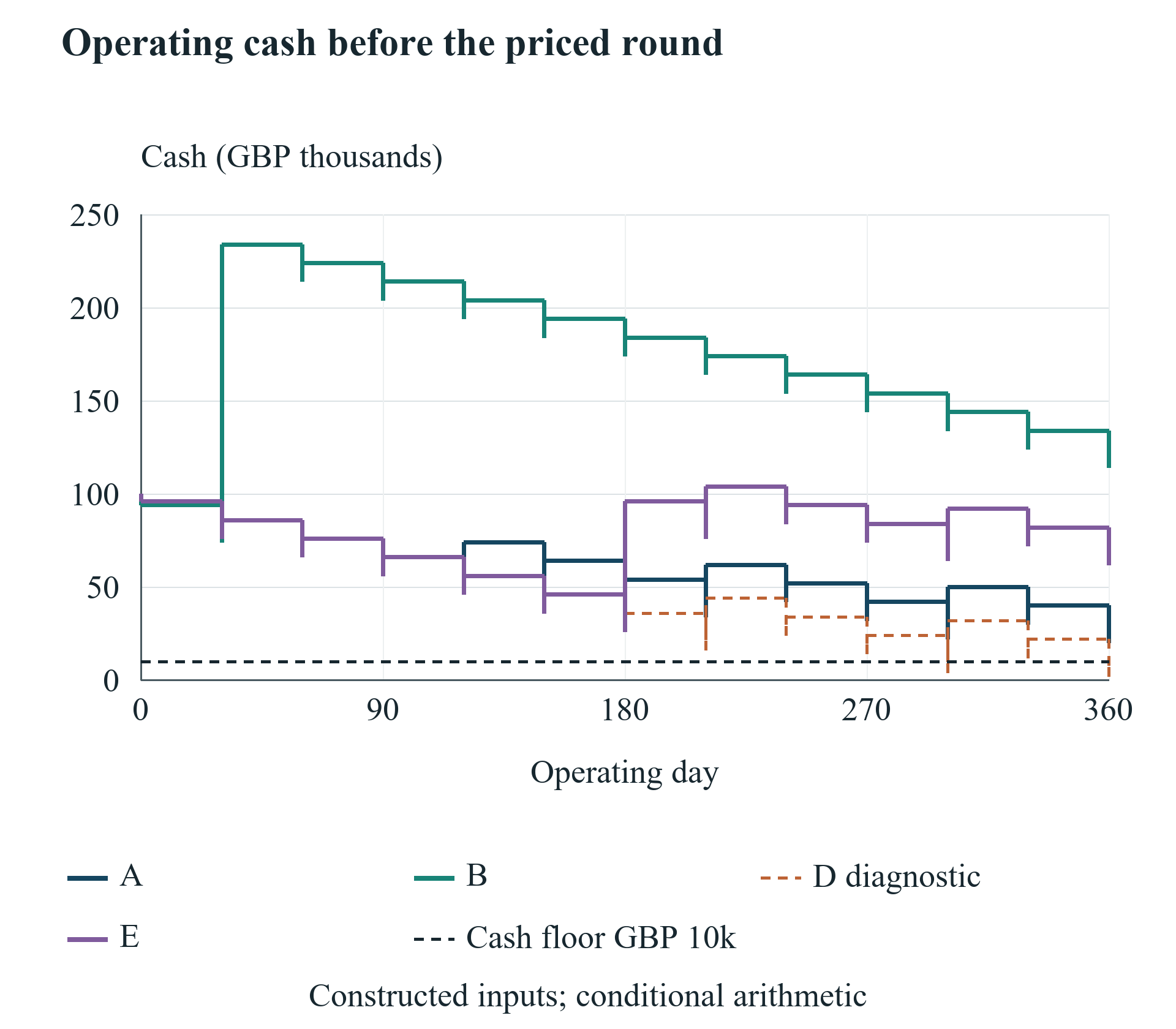
Scroll horizontally to read the figure at full size. You can also open the full-size figure.
Author's constructed GBP calculation. Same-day operating payments precede later receipts. D breaches the floor on day 300; its subsequent path is unfunded diagnostic arithmetic. A, B and E remain feasible under the stated inputs.
15 Stress claim timing and the opening cash reserve
Five grant-delay sensitivities hold the award, eligible spending and operating plan constant while varying the receipt lag. Lags of zero, thirty and sixty days pass the stipulated cash floor. Their minimum balances are GBP 20,000, GBP 20,000 and GBP 12,000. The ninety-day case first fails on day 360; the 120-day case first fails on day 300. Both reach a diagnostic minimum of GBP 2,000. These results depend on the declared event order, including operating payments before same-day receipts. An aggregate monthly balance would obscure the funding needed to cross that interval.
The experiment also varies the accelerator cash date independently of its acceptance date. Payments on days zero, thirty, ninety and 180 remain feasible, with minimum cash of GBP 94,000, GBP 74,000, GBP 54,000 and GBP 24,000 respectively. Payment on day 300 fails first on day 240 and reaches a negative diagnostic balance of GBP 16,000. Each sensitivity eventually shows the same terminal cash, because the same investment is eventually entered in the ledger. That equality does not make the routes operationally equivalent. The company needs committed money before it can incur the obligations that lead to that terminal balance.
A minimum cash-floor deficit is a useful reserve calculation under a fixed event schedule. The difference between the floor and the lowest ledger balance gives the additional opening cash needed to remove every breach if that extra cash has no associated cost, repayment or ownership consequence. For case D the difference is GBP 8,000; for F it is GBP 26,000. These are conditional reserve gaps. The model does not assume that another provider offers those amounts free of charge. An actual bridge must enter with its own availability date, fees, conversion or repayment and programme permissions.
The first breach and the worst deficit answer different questions. Case D first falls GBP 6,000 below the floor on day 300, while its eventual diagnostic gap reaches GBP 8,000. Covering only the first shortage would leave another failure later in the unchanged plan. Case F first falls GBP 6,000 below the floor on day 240 and subsequently has a much larger gap. A board therefore needs the full dated cash path, the first decision deadline and the maximum commitment required. A single first-breach figure is insufficient for sizing a complete financing remedy.
The lower-rate and narrower-eligibility cases illustrate the same mechanism through a different channel. A lower reimbursement fraction and fewer admissible costs reduce the money returning to the company. They do not reduce the operating bills in this experiment. Management cannot solve that gap by relabelling an ineligible payment as co-funding or by treating a service credit as general cash. An altered spending plan would be a new case. Its technical scope, milestone deliverability and grant permissions must be assessed alongside its revised cash ledger before calling the change a feasible alternative.
Delay also changes the split between cash and unpaid claims at the comparison date. The experiment's face-value convention can leave a grant route's conditional shareholder-value proxy unchanged while the same route fails its earlier cash test. That is a property of the stipulated accounting boundary, not evidence that delay has no economic cost. The paper reports the cash failure first and retains a zero-to-face receivable bound. It does not estimate claim default, discount rates or a financing premium from the constructed delays. Those inputs require evidence specific to the actual claim and counterparty.
| Receipt lag (days) | Minimum cash (GBP) | First breach day | Unpaid claims at day 361 (GBP) | Status |
|---|---|---|---|---|
| 0 | 20,000 | None | 0 | Cash-feasible |
| 30 | 20,000 | None | 6,000 | Cash-feasible |
| 60 | 12,000 | None | 6,000 | Cash-feasible |
| 90 | 2,000 | 360 | 6,000 | Unfunded diagnostic |
| 120 | 2,000 | 300 | 24,000 | Unfunded diagnostic |
One input changes from A: the approval-to-payment lag. Spending, approval days and award terms stay fixed. Outgoing payments precede same-day receipts. The 90-day and 120-day rows fail the cash floor; their later claims and cash are diagnostic. No delay probability or processing-time estimate is supplied.
| Both receipts on day | Minimum cash (GBP) | First breach day | Founder ownership | Status |
|---|---|---|---|---|
| 0 | 94,000 | None | 74.00% | Cash-feasible |
| 30 | 74,000 | None | 74.00% | Cash-feasible |
| 90 | 54,000 | None | 74.00% | Cash-feasible |
| 180 | 24,000 | None | 74.00% | Cash-feasible |
| 300 | -16,000 | 240 | 74.00% | Unfunded diagnostic |
The fixed-cash and MFN-cash dates move together; acceptance remains on day 0. All receipts are eventually entered before the round, but payment on day 300 leaves an earlier day-240 failure. Its displayed ownership is conditional diagnostic arithmetic. Equal terminal cash does not establish equal liquidity.
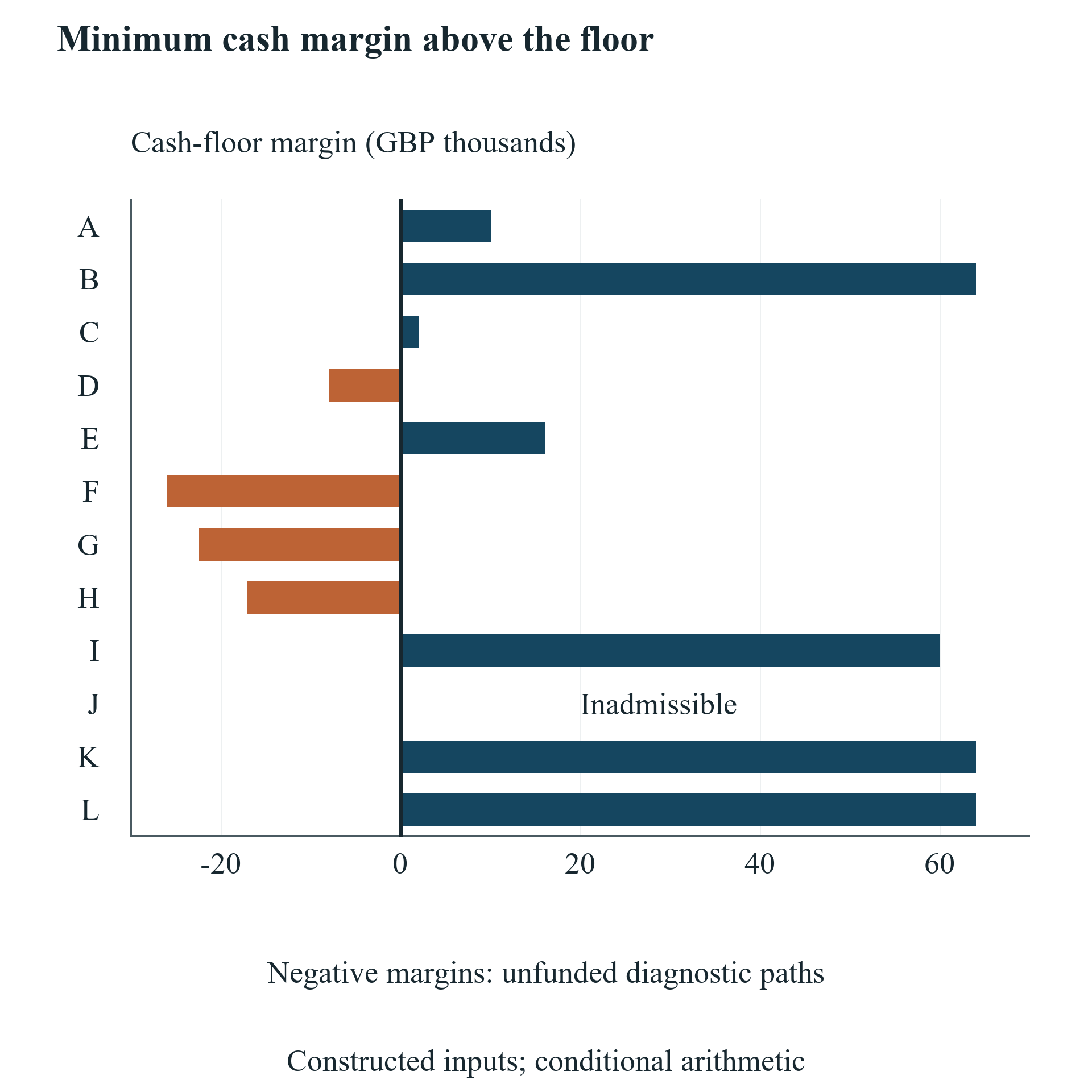
Scroll horizontally to read the figure at full size. You can also open the full-size figure.
Author's constructed calculation, GBP thousands. A margin is minimum cash minus the floor. J has no cash calculation; it is not a zero-margin result. The figures do not estimate actual grant or accelerator failure rates.
16 Test MFN repricing alongside the next subscription and pool
An MFN calculation needs the eligible later instrument and the conversion boundary as well as the original cash amount. The sensitivity family begins with the accelerator case and adds a GBP 250,000 later SAFE. The original GBP 100,000 MFN SAFE can elect the stipulated later valuation-cap terms. The experiment varies that later cap through GBP 2 million, GBP 3 million, GBP 4 million, GBP 6 million and GBP 8 million. Each case includes both subscriptions. The resulting change from the original accelerator case therefore combines additional financing with repricing; it is not an isolated estimate of the cost of one MFN clause.
Founder ownership after the priced round is 62% at the GBP 2 million cap, two thirds at GBP 3 million and 69% at each of GBP 4 million, GBP 6 million and GBP 8 million. The two SAFEs use the cap branch in the first three cases, including the exact tie at GBP 4 million. They use the priced-round branch at the higher two caps. The unchanged founder percentage above that boundary follows from conversion at the lower applicable round price. Forcing the cap formula into every case would overstate the founder retention in the high-cap cases.
The ownership table exposes the two SAFE claims separately. At the GBP 2 million cap the MFN SAFE holds 4% and the later SAFE 10% after the round. At GBP 3 million they hold approximately 2.6667% and 6.6667%. At GBP 4 million and above they hold 2% and 5% under this experiment. The fixed accelerator claim holds 4% and new priced investors hold 20% throughout this sensitivity family. These figures sum with founder ownership to 100%. The exact fractions remain the calculation basis; the displayed four-decimal percentages are rounded.
The interpretation depends on the definition of the fixed claim. Here its 5% applies after the specified SAFE conversions and before the incremental pool and new priced financing. A contract using another denominator requires another calculation. The paper's published programme descriptions are checked separately because fixed percentages, MFN wording and qualifying financing triggers differ across providers and documents. The generic experiment provides a transparent test of one defined sequence. It does not certify that a founder can reproduce its percentages by substituting only the name of an actual accelerator.
The pool sensitivity changes a second ownership boundary. Post-round pool targets of zero, 5%, 10%, 15% and 20% leave founders with 74%, 69.25%, 64.5%, 59.75% and 55% respectively. A 10% target therefore reduces founder ownership by 9.5 percentage points from the no-top-up baseline. The fixed claim falls from 4% to 3.5% as well. In the stipulated round-price regime the MFN SAFE remains at 2% and new priced investors remain at 20%. This is why a pool percentage should be calculated within the full conversion sequence rather than subtracted mechanically from founders alone.
The pool is a fully diluted, allocated or exercised common-equivalent claim in this experiment. No separate exercise proceeds enter the value calculation. Actual employee awards, vesting, forfeitures, exercise prices, preferences and exit distributions can change the economic allocation. Management should keep the contractual cap table and the chosen value convention together, and obtain transaction-specific advice where terms are ambiguous. A percentage chart is useful for reconciling ownership; it cannot establish an individual's realised proceeds from a later sale.
| Later cap (GBP) | Both SAFE conversion branches | Founder ownership | MFN SAFE ownership | Later SAFE ownership |
|---|---|---|---|---|
| 2,000,000 | Cap price | 62.0000% | 4.0000% | 10.0000% |
| 3,000,000 | Cap price | 66.6667% | 2.6667% | 6.6667% |
| 4,000,000 | Cap price; exact tie | 69.0000% | 2.0000% | 5.0000% |
| 6,000,000 | Round price | 69.0000% | 2.0000% | 5.0000% |
| 8,000,000 | Round price | 69.0000% | 2.0000% | 5.0000% |
The later subscription is GBP 250,000 and the earlier MFN principal GBP 100,000 in every row. Both use the stipulated same-capitalization terms. Fixed accelerator ownership is 4% and new priced investors 20%; no pool is added. Cap wins the exact tie. Percentages are rounded to four decimal places; exact fractions sum to 100%. This changes both financing and MFN terms, not a causal programme benefit.
| Pool target | Founder ownership | Fixed accelerator claim | MFN SAFE ownership | New priced investors |
|---|---|---|---|---|
| 0.00% | 74.00% | 4.00% | 2.00% | 20.00% |
| 5.00% | 69.25% | 3.75% | 2.00% | 20.00% |
| 10.00% | 64.50% | 3.50% | 2.00% | 20.00% |
| 15.00% | 59.75% | 3.25% | 2.00% | 20.00% |
| 20.00% | 55.00% | 3.00% | 2.00% | 20.00% |
Only the post-round pool target changes from B. The starting pool is zero. The fixed claim is diluted by the incremental pool and new money; the round-price MFN remains at 2%. Pool units are allocated or exercised common-equivalent claims with no separately modelled exercise proceeds. These are not realised exit distributions.
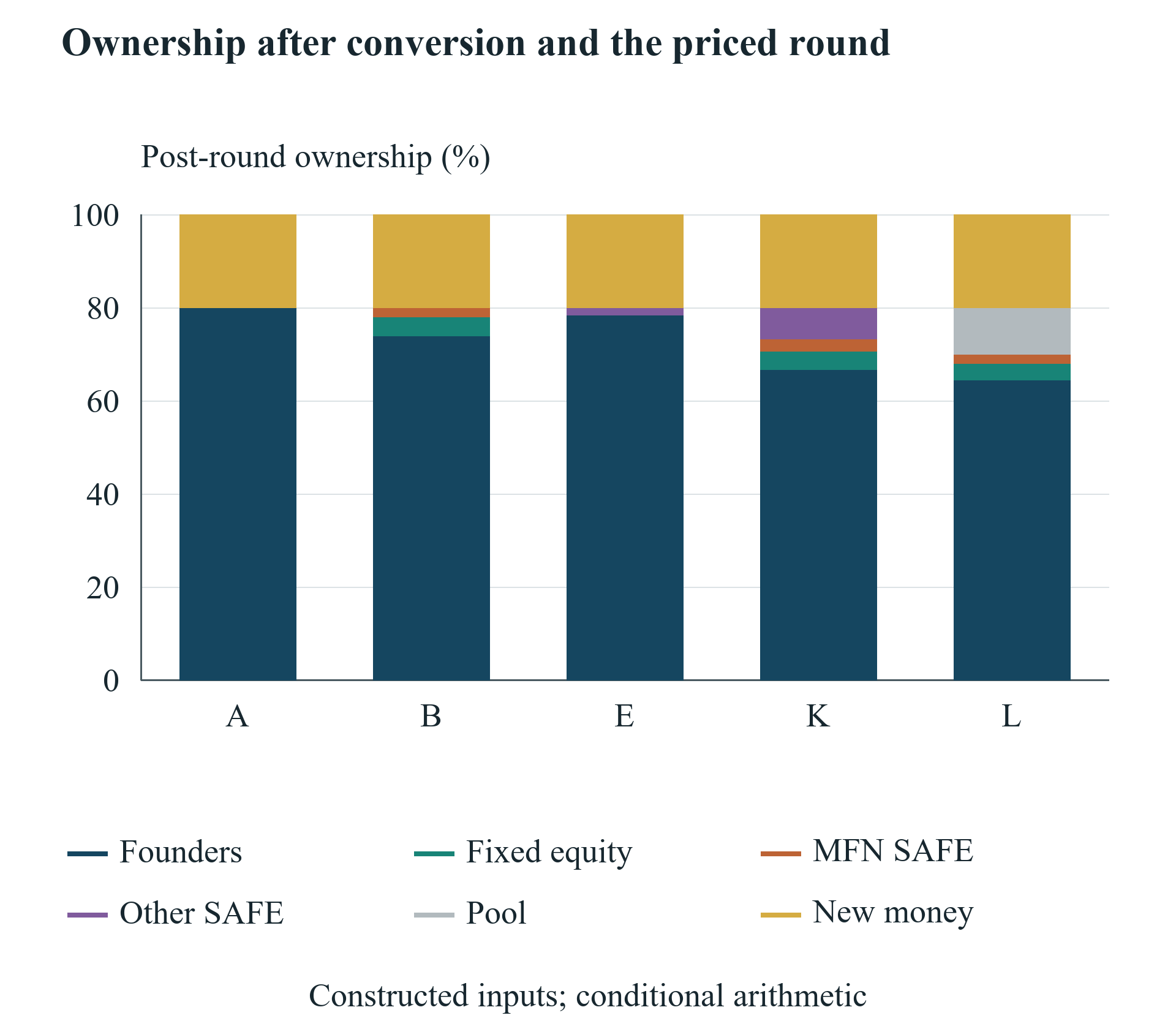
Scroll horizontally to read the figure at full size. You can also open the full-size figure.
Author's constructed common-equivalent capitalisation. A is the baseline grant; B the baseline accelerator; E adds the grant bridge; K adds a later SAFE with MFN election; L adds a 10% post-round pool. The pool convention does not represent realised exit proceeds.
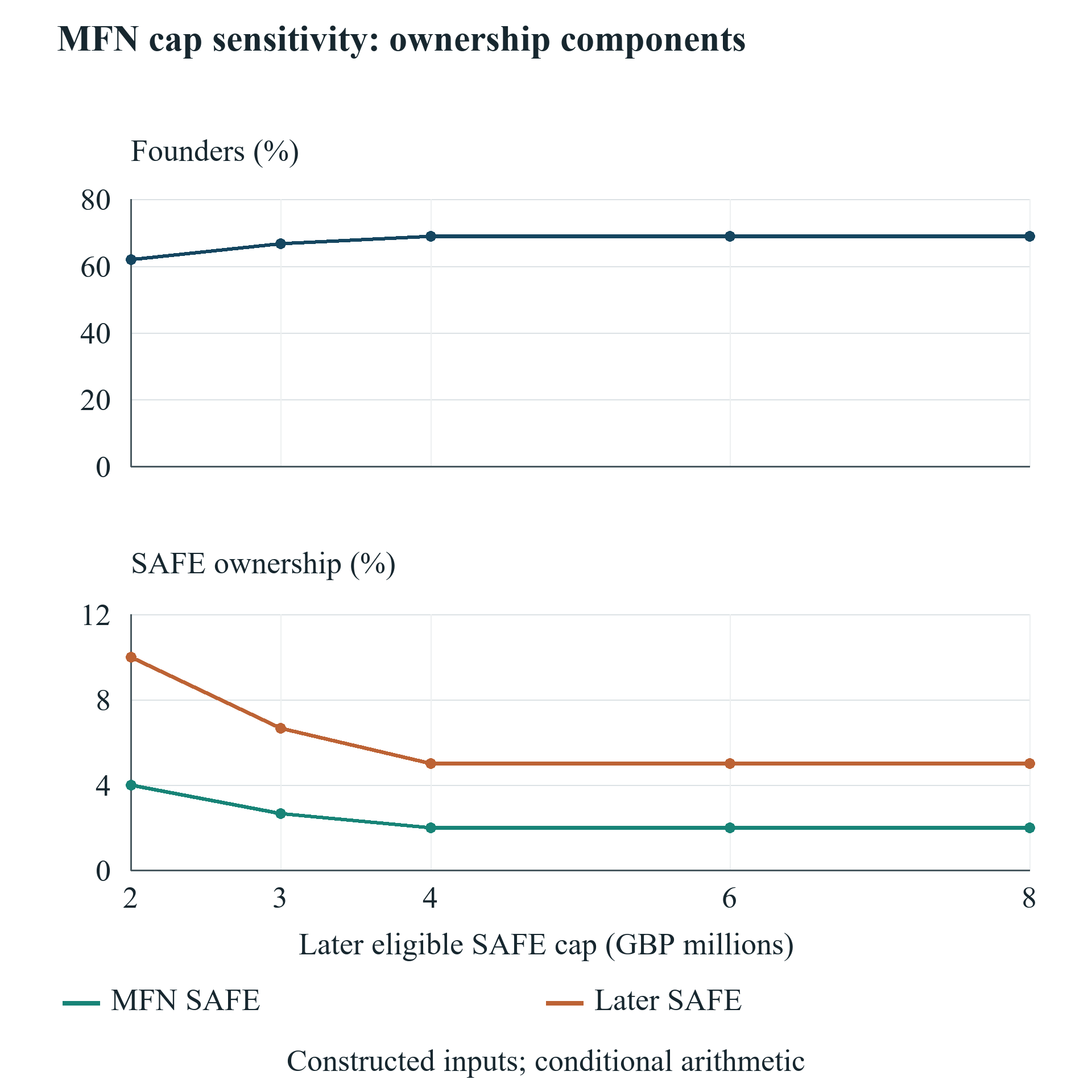
Scroll horizontally to read the figure at full size. You can also open the full-size figure.
Author's constructed sensitivity. Every case includes the original GBP 100,000 MFN SAFE and the additional GBP 250,000 SAFE. The figure is not an isolated causal estimate of the MFN clause or an actual programme outcome.
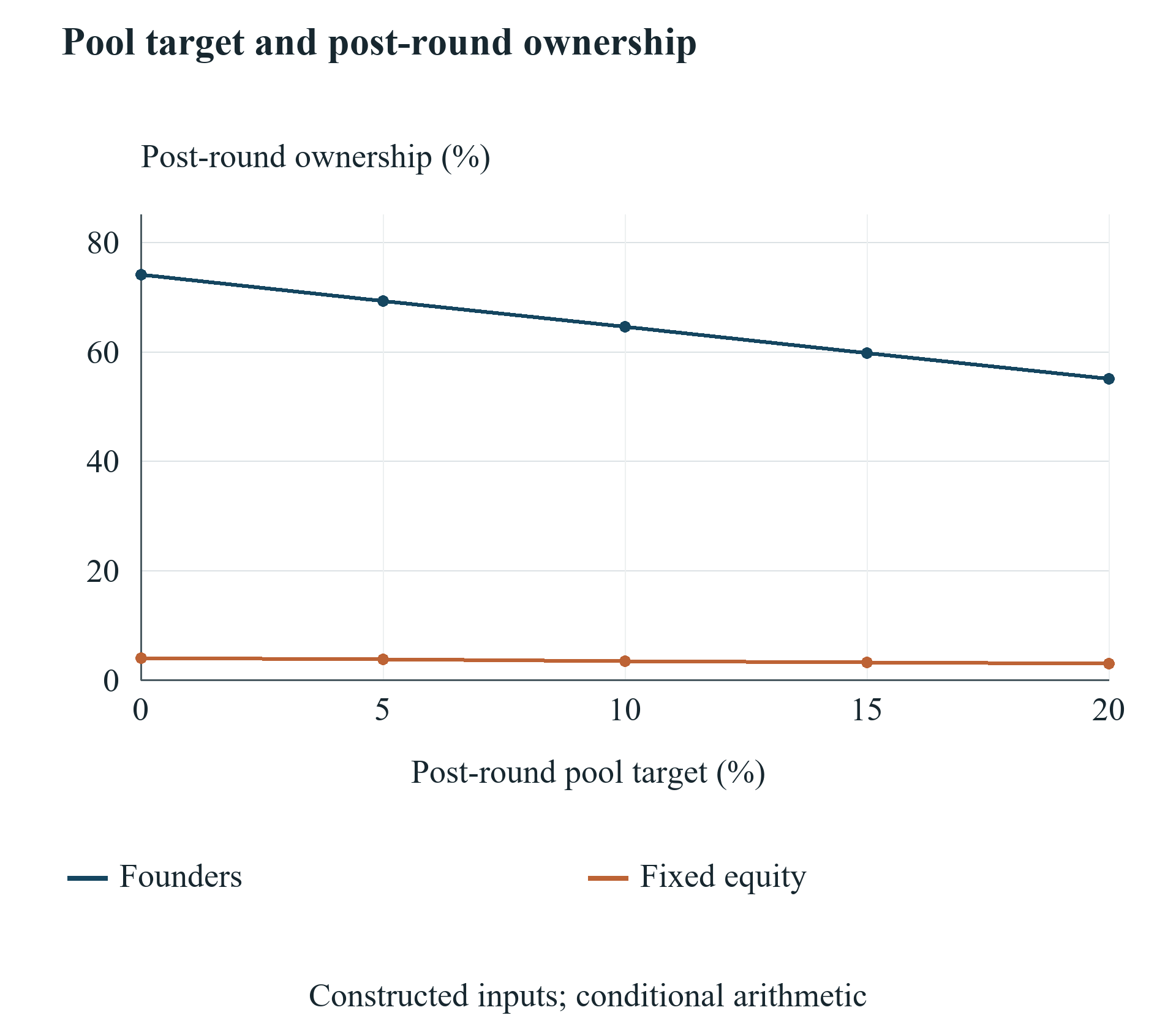
Scroll horizontally to read the figure at full size. You can also open the full-size figure.
Author's constructed accelerator sensitivity with no additional GBP 250,000 SAFE. Pool claims are allocated or exercised common equivalents with no separate exercise proceeds. All other inputs and the declared conversion sequence are held fixed.
17 Calculate the operating-value hurdle for extra dilution
The value comparison applies only after both named routes pass the contractual and cash tests. It adds operating enterprise value, comparison-date cash and the stated value of approved unpaid receivables, subtracts debt, floors that equity proxy at zero and multiplies it by the founders' fully diluted common-equivalent share. Financing receipts enter cash once. Programme expenses have already reduced cash. The calculation adds neither grant entitlement nor financing subscriptions a second time. This produces a conditional common-equivalent ownership proxy. It is not a cash distribution, an observed transaction value or a substitute for a liquidation-preference waterfall.
At the stipulated GBP 4 million operating enterprise value, baseline grant A produces a founder proxy of GBP 4,028,800. Baseline accelerator B produces GBP 3,791,760. The grant calculation includes GBP 1,030,000 of terminal cash and GBP 6,000 of approved unpaid claims at face value, multiplied by 80%. The accelerator includes GBP 1,124,000 of cash and no grant receivable, multiplied by 74%. The comparison separates the extra cash raised from the lower retained percentage. It does not assume that equal operating expenditure or equal technical milestones necessarily produce equal market valuations.
Holding B's cash, claims, debt and ownership fixed, the operating enterprise value required for B to match A's reference proxy is exactly GBP 159,852,000 divided by 37. This is approximately GBP 4.320324 million, or GBP 4,320,325 when a whole-pound minimum is rounded upwards. The difference from the GBP 4 million benchmark is approximately GBP 320,324, or 8.01%. This is the required conditional uplift under the stated inputs. The experiment supplies no estimate that an accelerator will create it, no probability of doing so and no inference about an actual programme's average value.
Each additional hurdle names its own reference. Holding baseline accelerator B's reference proxy fixed, permitted combination I needs GBP 3,944,000 of operating enterprise value; the later-SAFE and MFN case K needs GBP 4,313,640; and pool case L needs approximately GBP 4.754698 million. The grant-delay case C needs GBP 3,703,700 to match B's proxy under the face-value receivable convention. The thresholds are not a common league table because their references and candidate capital structures differ. A board should use the comparison relevant to the actual decision and preserve the cash-feasibility condition beside it.
A useful interpretation of the baseline threshold is a diligence question. Management asks what specific, evidenced commercial change could support the additional operating value while retaining the assumed expenditure, financing and timing. A contracted revenue improvement, a documented margin change or a different milestone may justify a new valuation analysis. A meeting count, a programme logo or a possible investor introduction does not supply that valuation evidence by itself. Where a claimed benefit changes operating cash or financing needs, management must update those inputs as well as enterprise value to avoid inconsistent accounting.
The threshold can be recalculated for a different receivable convention or negotiated capital structure, but the paper does not silently substitute one in its reported results. Failed routes have their value comparisons suppressed. Inadmissible J has no financial result to rank. The fixed GBP 4 million operating benchmark and the distinct pre-money equity valuation remain declared assumptions rather than appraisals. The decision framework's practical contribution is the sequence from governing permissions to cash, conversion and a conditional value requirement. Commercial evidence must then establish whether the proposed route can meet that requirement.
| Reference to candidate | Reference founder proxy (GBP) | Exact operating-EV hurdle (GBP) | Whole-GBP minimum |
|---|---|---|---|
| A to B | 4,028,800 | 159,852,000/37 | 4,320,325 |
| B to C | 3,791,760 | 3,703,700 | 3,703,700 |
| B to I | 3,791,760 | 3,944,000 | 3,944,000 |
| B to K | 3,791,760 | 4,313,640 | 4,313,640 |
| B to L | 3,791,760 | 204,452,000/43 | 4,754,698 |
Each row uses its own named reference proxy at the separate GBP 4,000,000 operating-EV benchmark. Both routes pass admissibility and cash tests. The minimum whole-pound hurdle is the ceiling of the exact threshold; a rounded display is not used to choose it. Candidate cash, receivables, debt and ownership stay fixed. Breached or prohibited routes are excluded. No probability, causal uplift or achievable valuation is estimated.
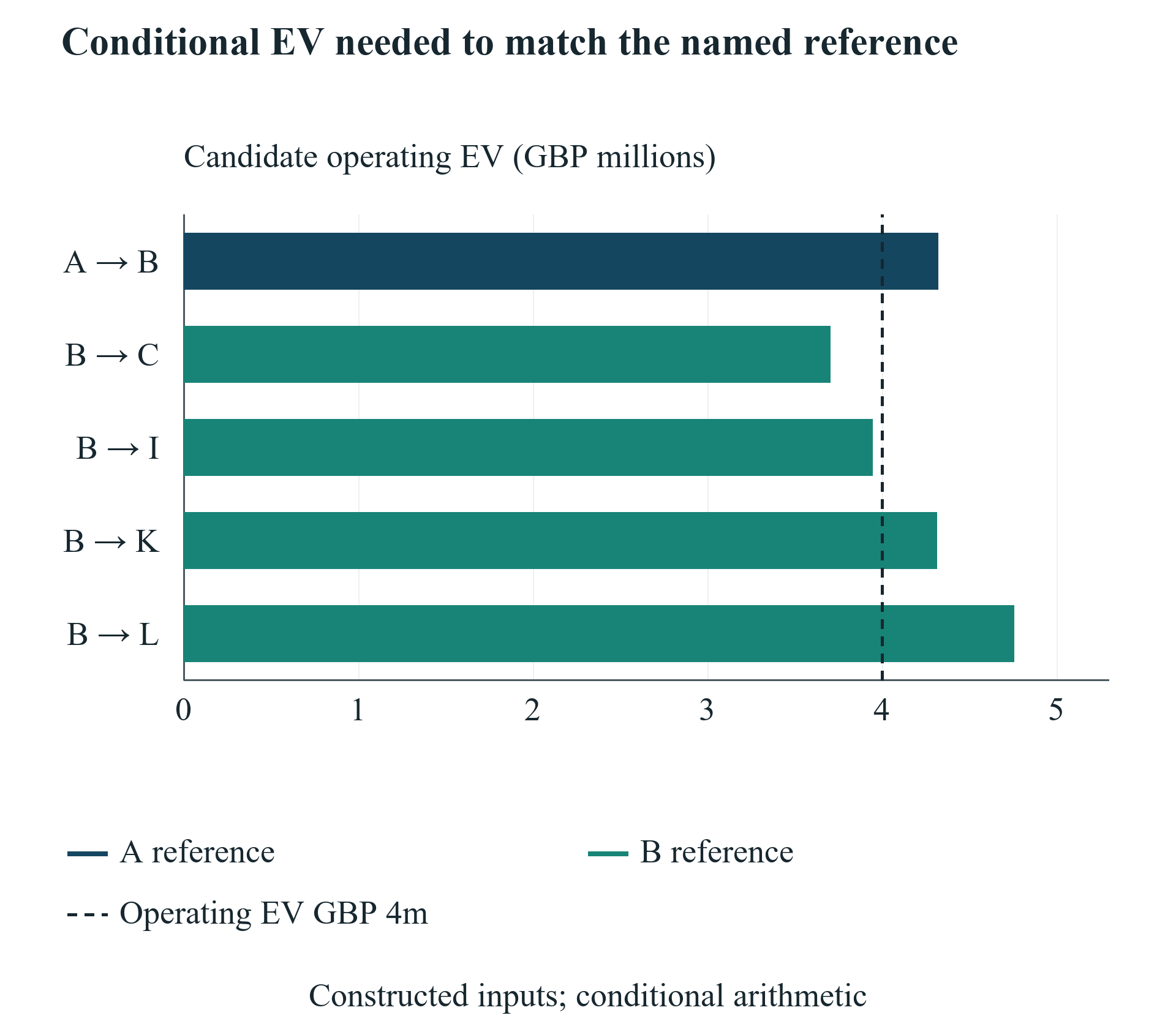
Scroll horizontally to read the figure at full size. You can also open the full-size figure.
Author's constructed conditional arithmetic, GBP millions. A reference and B reference use different founder-value targets. Both routes in every displayed pair pass the cash and permission tests. No probability of achieving a hurdle or realised exit payoff is estimated.
18 Value service credits against expenditure the company can avoid
The numerical ownership comparison should not absorb a service package as though it were unrestricted cash. A company first identifies the services it actually needs, the dates on which it needs them and the cash price it would otherwise pay. It then checks the programme's permitted providers, usage limits, expiry, additional charges and any restrictions on combining offers. Only the expenditure that the company can genuinely avoid enters the revised operating budget. This is a company-specific substitution calculation. A published list price by itself does not establish the same saving for every participant.
Service use can also create expenditure. A free implementation period may require staff time, integration work or a paid subscription later. A credit for a service already supplied without charge has no incremental saving against that baseline. Management should show the original purchase plan and the revised plan together. The cash difference then feeds the ledger once. It should not be added again to terminal enterprise value as a separate programme benefit. Any commercial improvement from using the service needs evidence of its own, including the costs required to obtain and sustain that improvement.
The same treatment applies to promised customer and investor access. A meeting, introduction or demo-day invitation is a recorded activity. Its financial consequence depends on subsequent decisions and delivery. The company can track whether the introduction produced a qualified opportunity, signed contract, funded investment or collected cash. Those stages should remain separate in the evidence record. Converting an introduction directly into revenue or a financing valuation would skip the events that determine whether value was created. The paper's base comparison therefore assigns no unsupported causal uplift to access or mentoring.
Management can still examine a conditional benefit threshold. After calculating the extra dilution and costs, the board can ask what documented improvement would be needed to compensate the original shareholders. The improvement might arise through a different operating value, earlier cash receipts or lower expenditure, but each channel needs a consistent financial treatment. The hurdle is a question for commercial diligence. It does not establish that the programme can deliver the answer. This gives founders a practical way to negotiate and test the claimed benefits without accepting either an unsupported premium or a blanket assumption that all support is worthless.
19 Sequence grant and equity commitments on the governing terms
A company can investigate grants and equity routes in parallel while keeping its commitments distinct. The decision register should identify what can be submitted, signed, disclosed and funded at each stage. It should also record whether accepting one route changes the eligibility or conditions of another. Published programme guidance cannot settle every interaction between an individual grant agreement and a negotiated equity instrument. A combined route enters the funded model only after the relevant restrictions and consents are resolved. The company's wish to combine capital sources is not itself a contractual permission.
Innovate UK's terms address duplicate-cost funding and disclosure matters, while its post-offer guidance separates notification, project setup and permission to begin on the confirmed date. These provisions make the expenditure boundary and sequence of approvals material. A team should preserve its grant offer letter and the written basis for any co-funded cost allocation. This paper supplies no blanket approval for accelerator participation alongside an Innovate UK award. The worked permitted combination is a stipulated contract case; its paired prohibited combination demonstrates why permission must be tested before ranking financial outcomes. [9,10]
Calendar comparisons must also use the correct intake. Hub71's Access page, read for this paper, describes a 2027 cohort timetable. The published EIC 2027 work programme supplies its own future application sequence and conditional treatment of earlier short-application decisions. A company should verify the route and version governing its intended application rather than treating a continuing programme as immediate finance. The dates in the source register are observations of the documents reviewed. They do not establish the date on which an applicant will receive an award, complete a financing or obtain cash. [8,11]
Sequencing can preserve a decision option without assigning it a fictional value. The board can authorise limited application work, reserve expenditure pending an award or negotiate a financing condition before making an irreversible commitment. Each action should have a cost limit, an accountable owner and a further decision date. The company should also specify the alternative plan if the route is unavailable or late. A useful schedule connects those decision points to the cash floor. It shows when management must obtain another commitment, reduce the operating plan or abandon the route before an unfunded obligation arises.
20 Distinguish programme selection from programme value
Published research already examines accelerator and grant outcomes. Gonzalez-Uribe and Leatherbee study Start-Up Chile using local discontinuities in programme admission and schooling. Their design distinguishes elements of the service bundle and makes the setting and comparison group part of the interpretation. The study is relevant prior art for evaluating programme value. It does not supply a common effect for every accelerator, country or contract. A current investor-led programme with a different selection process and financial offer needs its own evidence before management transfers a historical estimate to its expected financing outcome. [15]
Howell's published study examines ranked applicants to the US Department of Energy's SBIR programme using a quasi-experimental approach. Its abstract reports financing and innovation effects in that setting, and its accompanying appendix provides supporting identification evidence. The full published article was access-limited in this review, so the discussion stays within the abstract and appendix actually read. The study establishes relevant empirical prior art, rather than a current grant acceptance probability or a forecast of the founder's benefit from a particular offer. It cannot replace the cash and ownership terms of the transaction being considered. [16,17]
A comparison of accepted accelerator participants with rejected grant applicants can mix programme effects with differences that existed before selection. Technical maturity, founder background, prior capital, market access and willingness to accept equity terms can influence both participation and subsequent outcomes. A company receiving an accelerator offer and a grant award also represents a selected subset of applicants. The paper's constructed cases hold a specified operating plan constant to make arithmetic differences visible. That choice does not correct real selection bias. It provides a controlled financing comparison and leaves the empirical effect of participation unanswered.
Survival and observation rules also affect an outcome dataset. A dataset containing only companies that completed the programme can exclude unsuccessful applicants or participants that closed. A financing event is not the same as revenue, collected cash or a realised shareholder return. Management should define each outcome and its measurement date before comparing groups. The paper does not estimate a programme ranking from public package descriptions. Its contribution is a reproducible financing decision under declared inputs, together with an evidence design for testing commercial benefits when suitable applicant-level data and lawful access become available.
21 Build the evidence needed for a real comparison
A real financing study needs a defined unit of observation. One useful unit is the company-programme application with a preserved submission date, programme version and legal-entity identifier. Applications by the same company to several programmes should remain linked rather than counted as unrelated businesses. The record should identify the available alternatives at the decision date, including offers declined or unavailable. The resulting dataset can distinguish an application decision from a choice between actual funded offers. Without that distinction, a comparison of advertised terms can be mistaken for the financing options that a founder truly had.
The cash evidence should connect the original operating plan to bank receipts, paid costs, submitted claims and approved amounts. Revisions need their own dates and reasons. A company that changes its project after receiving support should not be assessed against an undocumented reconstruction of its original plan. The same discipline applies to cap tables: retain the instrument versions, subscriptions, conversion events and agreed pool changes. These records permit a researcher or adviser to reproduce the cash and ownership path. They also reveal where a later interpretation relies on missing documents or an assumption rather than contemporaneous evidence.
Commercial outcomes require a pre-agreed horizon and consistent definitions. Signed investment, funded investment, invoiced revenue and collected revenue should be recorded separately. A valuation at a financing date needs the security terms and capitalisation basis; it is not automatically an estimate of the founder's exit proceeds. Programme completion, company closure, acquisition and missing follow-up should remain visible in the denominator. The data protocol should specify how unresolved outcomes are reported and whether any bounds are used. Imputation assumptions should be examined separately rather than allowed to create an apparently complete sample.
Any causal question needs an identification design justified by the actual selection process. A randomised allocation, a defensible cutoff or another credible comparison can be evaluated when the programme and data support it. A propensity adjustment or matched sample is not a substitute for checking the assumptions that make the comparison interpretable. This paper collected no matched applicant-to-payment-to-ownership panel and estimates no treatment effect. Its proposed record is a design for future evidence collection. The immediate company decision can still use verified contracts and a deterministic cash model while the broader empirical benefit remains unresolved.
22 Give the board a dated financing decision pack
The board pack should lead with the decision, the commitment being requested and the date by which it is needed. It should identify the operating milestone, the starting unrestricted cash balance and the minimum reserve used in the analysis. A short comparison then separates admissibility, cash feasibility and the conditional ownership calculation. This ordering helps a director see whether the choice concerns an available funded route, an application worth pursuing or an unresolved contract question. A single weighted score would conceal those differences and can permit a large modelled benefit to offset a condition that the company cannot satisfy.
The pack should include a source register for the actual offer, a dated cash path and a capitalisation bridge to the same financing event for each route. It should show approved-but-unpaid claims, retained amounts and the first cash-floor failure. Where a bridge removes that failure, the board needs its commitment and full terms rather than an assumed facility amount. The ownership schedule should identify every security and the pool basis. A director should be able to trace a displayed percentage or financing receipt to the governing instrument or the explicit model input that produced it.
The commercial case belongs beside those reconciliations. Management should explain the support it intends to use, the expenditure it expects to avoid and the evidence behind any claimed operating improvement. The dilution-adjusted value hurdle can frame the question, but its threshold remains conditional arithmetic. The board should record which benefits are established, which require further diligence and which have deliberately been left unvalued. This permits a decision without inventing precision. It also creates a basis for reviewing the outcome later against the commitments and expectations actually recorded at the time.
Approval should specify the permitted next action. Submitting an application, accepting an offer, executing a SAFE and paying a project invoice are distinct authorities. The board can assign an owner to each unresolved condition and require an updated cash or ownership schedule when a material term changes. The record should preserve the prior version rather than replacing it with the successful financing story after the event. A dated decision pack is useful both for current execution and for a subsequent assessment of whether programme benefits, costs and financing dates matched the company's original case.
23 Apply the rule to an actual financing offer
The first step is to assemble the company's signed and proposed documents without filling missing fields from a programme's generic marketing page. Management reconciles the legal entity, eligibility, permitted project, award conditions and funding sources. It then identifies the expenditure and cash dates that the company must meet before support arrives. An unresolved condition is assigned to a responsible adviser or decision-maker. The analysis does not treat silence in a public webpage as permission. Once the route is admissible on documented terms, the company can calculate whether its commitments and available cash support the proposed milestone.
The next step is to replace the experiment's inputs with the company's own dates, amounts and instruments. A reimbursement award needs its claim and retention rules. A lump-sum or advanced-funded award needs a different payment and restriction schedule. A convertible instrument needs its actual definitions and triggers. Pre-money SAFEs, discounts, warrants, preferences and unallocated employee options require calculations beyond the restricted common-equivalent engine used here. The purpose of the worked model is to make its inputs and reconciliation visible, so that an adviser can identify which parts apply and which parts must be replaced.
A route passing the cash test can then be compared at the same operating and financing boundary as its alternatives. The company should calculate the full ownership effect, include any bridge and avoid adding funding proceeds twice to value. The conditional hurdle makes the remaining commercial question explicit: what additional documented improvement would compensate for the extra dilution and costs? Management should test that question against evidence of customer demand, delivery capability and the programme support it can actually use. A preferred narrative about a prestigious programme does not establish that the threshold is achievable.
The decision is ready for execution when the required commitment, its conditions, the financing path and the downside response have been recorded together. Material changes trigger a new version: a later cash date, a lower eligible-cost base, a changed MFN cap, an additional pool request or a different priced round can alter the result. The operating team should maintain the register while the transaction progresses. The framework supports structured financing analysis and adviser discussion; it does not provide legal, tax, accounting or investment advice for an individual company or promise that an application, financing or operating milestone will succeed.
24 Resolve the limitations before the next commitment
The worked cases establish arithmetic relationships under explicit contracts and inputs. They do not establish that a particular accelerator adds value, that a grant creates additional innovation or that either route improves realised founder wealth. Those questions require suitable empirical evidence and security-specific distribution analysis. The experiment's fixed operating plan, common-equivalent conversion and conditional operating value make the financing comparison inspectable. They also limit its transfer to companies with other instruments, costs, operating choices and outcomes. A user of the framework should preserve those limits when presenting a precise numerical result.
The public-source review is bounded by the documents and versions actually opened. The EIC 2026 landing page links a June amendment, while official metadata also identifies a later August amendment whose substantive text was not established in this review. The paper therefore labels the June provisions by version and uses no claim of a latest consolidated 2026 legal position. The published 2027 programme and an applicant's executed agreements need their own careful reading. Public-source inconsistencies are reasons to obtain the controlling document before committing, rather than reasons to choose the most attractive figure. [5,6,7,8]
Liquidity results depend on event timing. The experiment uses twelve constructed thirty-day periods and a stated conservative order for payments and receipts. An actual company may need a daily or transaction-level schedule. It may also require a restricted-cash ledger, retention releases, tax payments, contingent repayments or a different receivable valuation. The cases contain no grant advance and no observed delay distribution. Their sensitivity checks show the consequences of selected input changes. They do not assign a probability to those changes or estimate a required reserve for a population of applicants.
Ownership and value results have equally explicit boundaries. The calculation treats the modelled securities on an as-converted common-equivalent basis and treats the pool through its stated allocation convention. Real preference waterfalls, exercise proceeds, seniority, taxes and founder-specific holdings require further analysis. A term described as an MFN also needs its scope, trigger and amendment mechanism verified. The paper supplies no admission or award probability, expected valuation uplift or monetised network effect. Missing evidence stays outside the base case rather than becoming an unsupported management estimate.
The decision rule is usable within these limits. Confirm the route and its governing terms, finance the dated operating obligations, reconcile the entire capitalisation and then test the commercial improvement required to justify the additional cost. Keep an unfunded or prohibited route outside the feasible set until an explicit change resolves its failure. For a company facing a grant and an accelerator offer, that process identifies the documents and commitments that matter before another payment or signature. It also leaves a reproducible record of the assumptions that a later commercial review can test against actual evidence.
| Step | Required reconciliation | Decision boundary |
|---|---|---|
| Permission | Recipient, expenditure dates, combined support and duplicate-cost restrictions | Exclude a prohibited route before financial ranking |
| Cash | Test the opening balance, then opening cash plus dated receipts less dated payments after each event | Record the first breach and the greatest deficit against the declared floor |
| Claims | Cap the eligible cost base and award; subtract all previously approved entitlement before the next increment | Approved entitlement equals cash received plus approved unpaid claims; a receivable is not bank cash |
| Private contribution | Separate the eligible-cost contribution, expenditure above the cap and ineligible route expenses | Do not add an eligible-cost component as another payment or use one public payment twice |
| Fixed claim and SAFEs | Solve the fixed percentage and every funded SAFE using the stated conversion denominator and eligible MFN election | Check that each cap-price or round-price branch satisfies its own conditions |
| Pool and new money | Add only the required incremental pool and the priced-round subscription | Reconcile every fully diluted holder claim to 100% at the same event boundary |
| Founder value proxy | Add operating enterprise value, cash and valued unpaid claims, less debt; floor at zero and apply the founder share | Count each item once; retain the common-equivalent and receivable conventions |
| Conditional hurdle | For a positive reference proxy and positive candidate founder share: divide the reference proxy by that share, subtract candidate cash and valued claims, add debt and floor at zero | A zero reference proxy has a zero minimum non-negative operating-EV hurdle. A zero candidate founder share cannot match a positive reference. Both routes must be feasible; no achievable value is estimated |
| Evidence | Retain the governing documents, dated budget, bank support and conversion calculations | Published descriptions and constructed examples do not establish an applicant-specific outcome |
These are the analytical steps used in the constructed experiment. A different contract, preferred-equity waterfall, exercise-proceeds convention or operating plan requires corresponding changes before the comparison is used. The table supplies no programme permission or legal interpretation.
References
- The Y Combinator Deal. Accessed 11 November 2026. https://www.ycombinator.com/deal
- Post-Money SAFE User Guide. Accessed 11 November 2026. https://bookface-static.ycombinator.com/assets/ycdc/SAFE%20User%20Guide-a47c6588327d73aa2799e61ed7c2cae9f1a0ee9acfa9c43b62039dc06e715832.pdf
- Techstars Investment Terms. Accessed 11 November 2026. https://www.techstars.com/investment-terms
- What investments does Techstars make in its Accelerator Portfolio companies? Accessed 11 November 2026. https://help.techstars.com/support/solutions/articles/4000207063-what-investments-does-techstars-make-in-its-accelerator-portfolio-companies-
- EIC 2026 work programme. Accessed 11 November 2026. https://eic.ec.europa.eu/eic-funding-opportunities/eic-2026-work-programme_en
- EIC Work Programme 2026, second amendment, Annex C(2026)4080. Accessed 11 November 2026. https://eic.ec.europa.eu/document/download/52598755-1351-4b54-b46b-e2682d0a3aec_en?filename=EIC-Work-Programme-2026.pdf
- Commission Implementing Decision amending C(2025)7410 as regards introduction of the STEP Defence Call, C(2026)5609. Accessed 11 November 2026. https://op.europa.eu/en/publication-detail/-/publication/241df7ea-9016-11f1-9262-01aa75ed71a1/language-en
- EIC Work Programme 2027, C(2026)7629. Accessed 11 November 2026. https://eic.ec.europa.eu/document/download/ed9ab103-1ffb-4d5f-a6ad-168ac3b36900_en?filename=EIC-2027-Work-Programme.pdf
- Terms and Conditions of an Innovate UK Grant Award, document labelled October 2025. Accessed 11 November 2026. https://www.ukri.org/wp-content/uploads/2025/11/IUK-171125-Sept-2025-IUK-TCs.pdf
- General guidance: What happens if you receive a funding offer. Accessed 11 November 2026. https://www.ukri.org/councils/innovate-uk/guidance-for-applicants/general-guidance/what-happens-if-you-receive-a-funding-offer/
- Hub71 Access Programme. Accessed 11 November 2026. https://www.hub71.com/program/access-programme
- Hub71 Frequently Asked Questions. Accessed 11 November 2026. https://www.hub71.com/faqs
- Costs guidance for non-academic organisations. Accessed 11 November 2026. https://www.ukri.org/councils/innovate-uk/guidance-for-applicants/costs-we-fund/costs-guidance-for-non-academic-organisations/
- General guidance: Funding rules. Accessed 11 November 2026. https://www.ukri.org/councils/innovate-uk/guidance-for-applicants/general-guidance/funding-rules/
- Gonzalez-Uribe and Leatherbee (2018). The Effects of Business Accelerators on Venture Performance: Evidence from Start-Up Chile. Review of Financial Studies 31(4), 1566 to 1603 (2018), DOI 10.1093/rfs/hhx103; accepted manuscript dated August 2017. Accessed 11 November 2026. https://eprints.lse.ac.uk/84553/1/Gonzalez-Uribe_Effects%20of%20Business%20Accelerators.pdf
- Howell, Sabrina T. (2017). Financing Innovation: Evidence from R&D Grants. American Economic Review 107(4), 1136 to 1164 (2017), DOI 10.1257/aer.20150808. Accessed 11 November 2026. https://www.aeaweb.org/articles?id=10.1257/aer.20150808
- Howell, Sabrina T. (2017). Financing Innovation: Evidence from R&D Grants; Online Appendix. Accessed 11 November 2026. https://assets.aeaweb.org/asset-server/files/4006.pdf
About the Author
Chennakeshav (CK) is a corporate finance and investment banking executive with 25+ years of global experience in deal origination, structuring and execution across M&A, growth capital and corporate strategy. He has led value-creation mandates for founders, corporates and funds — bridging the boardroom view to hands-on execution and close.
His career spans Morgan Stanley, HSBC, Lloyds Banking Group, EWEC, ADQ portfolio companies and Emirates Growth Fund, across TMT, real estate, fintech, deeptech, cleantech, infrastructure and energy. He has partnered with C-suite leaders, private equity and venture funds, sovereign wealth funds and family offices to finance complex fund raises and scale-up ventures, and has led M&A due diligence, post-merger integration and business-transformation initiatives to create value.
At Matchpoint Partners he is Managing Partner, leading the firm's corporate finance, M&A and capital-raising practice. He holds an MBA from London Business School, an engineering degree from VTU and a Master of Laws (LLM, in progress) from UCL London.
An active start-up mentor, CK mentors at Techstars, DIFC FinTech Hive, Startup Grind, Founder Institute and IN5, serves as Entrepreneur Mentor in Residence (EMiR) at London Business School, and judges the Entrepreneurship World Cup.
https://www.linkedin.com/in/ckadya/
https://www.matchpoint-partners.com/team/ck-adya.html
Disclaimer
This paper is part of a continuing series on the structure of private and alternative markets. The views expressed are the author's own. The paper is for information only, describes market structure in general terms, and does not constitute investment, legal, tax or regulatory advice or a recommendation in respect of any security, vehicle or counterparty.
