

1. Define the financing decision
A green project bond should begin with a precise financing decision. The board must identify the borrowing entity, asset perimeter, funding requirement, debt purpose, repayment source, security package, eligible expenditure and environmental objective. These elements determine whether the proposed instrument is a project-finance credit with a green use-of-proceeds overlay, a corporate green bond, a refinancing, or a mixed portfolio financing.
The International Capital Market Association Green Bond Principles establish four core components: use of proceeds, project evaluation and selection, management of proceeds, and reporting [1]. These components describe the environmental integrity process. They do not determine whether the issuer can pay interest and principal. Credit analysis must continue to examine construction, operations, revenue, counterparties, liquidity, leverage, security and recovery.
The decision paper should therefore state two approval questions. The environmental question asks whether the issuer can evidence and maintain allocation to eligible assets or expenditure. The credit question asks whether the legal and financial structure protects debt service under the approved downside. Both questions require affirmative evidence before launch.
An issue should not be approved because a project appears intuitively green. The board needs a controlled path from taxonomy or framework criteria to asset evidence, expenditure records, allocation, measured impact and continuing disclosure. It also needs an executable debt structure that remains resilient if allocation takes longer, impact differs from estimates or operational performance weakens.
2. Use five approval gates
The Real-Asset Green Bond Control System uses five gates. Gate One defines the real-asset perimeter. Gate Two tests environmental eligibility and safeguards. Gate Three verifies expenditure and manages proceeds. Gate Four protects cash flow and credit. Gate Five establishes reporting, review and remediation.
Gate One requires legal ownership, project location, asset status, technical configuration, permits, contracts and expenditure boundaries. Gate Two maps each asset or activity to the chosen criteria and records exclusions, significant-harm tests, social safeguards and evidence. Gate Three links eligible invoices and capitalised expenditure to the allocation ledger, reconciles net proceeds and controls temporary placement.
Gate Four tests construction or operating risk, revenue, expenses, debt sizing, reserves, covenants, security and downside liquidity. Gate Five specifies allocation and impact reporting, external review, evidence retention, change control and correction if an asset ceases to qualify or a claim proves unsupported.
Each gate should have an accountable owner, evidence standard, approval authority and stop condition. Marketing, investor education and execution can proceed only within the authority supported by passed gates. The structure turns the label from an assertion into a controlled financing process.
3. Fix the asset perimeter before selecting the label
The asset perimeter should identify what the bond actually finances. A project company may own a renewable-power plant while related entities own the land, grid connection, storage system, operating company or environmental attributes. The green framework, legal documents, financial model and allocation ledger should use consistent boundaries or explain every difference.
The perimeter register should list each asset, owner, location, technical capacity, construction or operating status, acquisition date, useful life, eligible expenditure period and financing history. It should distinguish new financing from refinancing and identify whether the same expenditure has been financed by another labelled instrument, grant, tax credit or public programme.
For a portfolio, the issuer should define substitution and replenishment rules. Assets can be sold, impaired, completed, refinanced or rendered ineligible by a change in technology, use or criteria. The portfolio should maintain eligible value at least equal to the amount required under the applicable framework and documents, subject to the selected standard and any permitted allocation period.
The perimeter also anchors credit analysis. Security, cash flow, insurance, contracts and creditor rights may cover a narrower or wider group than the green asset pool. Investors should see the relationship clearly. Environmental allocation and debt repayment can involve different legal routes; hidden divergence weakens disclosure and recovery analysis.
4. Choose the governing standard deliberately
The issuer should state which standard, principles, taxonomy and legal regime govern the bond. ICMA's Green Bond Principles are voluntary process guidelines centred on transparency and disclosure [1]. Climate Bonds certification applies additional criteria, verification and governance requirements [2]. The European Green Bond designation applies statutory requirements under Regulation (EU) 2023/2631 [3].
The choice affects eligibility, disclosure, external review, allocation, impact reporting and change management. It can also affect investor access, internal systems, transaction cost and timetable. A structure aligned only to broad project categories may be faster to prepare, while a taxonomy-based or certified instrument can require more granular technical evidence and continuing assurance.
The board should approve a standards matrix rather than combining attractive elements from different regimes without explaining their legal status. The matrix should identify mandatory provisions, voluntary commitments, issuer policies and transaction-specific undertakings. It should also record which requirements apply at issuance and which continue during the bond's life.
Cross-border offerings require particular care. A bond can be marketed in multiple jurisdictions while using one primary framework. The issuer should obtain current legal advice on naming, disclosure, listing, product governance and anti-greenwashing requirements in each relevant market. Market convention does not replace applicable law.
5. Translate categories into asset-level eligibility
Broad categories such as renewable energy, clean transport, water management or green buildings are starting points. The investment committee needs asset-level criteria that can be tested against evidence. Each criterion should specify the technical threshold, measurement period, permitted expenditure, exclusions, safeguards and required source document.
The ICMA Principles encourage issuers to describe environmental objectives, the process used to determine fit with eligible categories, taxonomy alignment and management of material environmental and social risks [1]. Climate Bonds uses sector criteria to establish science-based technical requirements for particular assets and activities [2]. The selected approach should be explicit.
An eligibility memorandum should show the logical chain for each asset. It should identify the activity, environmental objective, criterion, evidence, result, reviewer and date. Where a criterion depends on future performance, the memorandum should distinguish a design commitment from an observed outcome and specify the monitoring needed after completion.
Ambiguity should remain visible. A component may enable a green asset without being independently eligible; a retrofit may improve efficiency without meeting the chosen threshold; an asset may have positive climate benefits and material adverse effects. The committee should record the treatment and avoid treating narrative relevance as technical compliance.
6. Test environmental safeguards and trade-offs
Eligibility for one environmental objective does not remove other environmental or social risks. A hydropower, transmission, battery, water or transport asset can reduce emissions while affecting biodiversity, land, communities, water use, waste or worker safety. The evaluation process should identify these risks and the applicable mitigation plan.
ICMA encourages issuers to describe how perceived social and environmental risks are identified and managed [1]. The European framework links taxonomy alignment to substantial contribution, do-no-significant-harm criteria and minimum safeguards [3]. The exact legal test depends on the selected regime, but the governance principle is broader: material trade-offs require evidence and ownership.
The safeguards register should cover permits, impact assessments, stakeholder consultation, resettlement where relevant, biodiversity, water, pollution, circularity, labour, supply chain, health and safety, and grievance mechanisms. It should identify open conditions, monitoring obligations and the consequence of non-compliance.
The bond committee should receive unresolved safeguards alongside the eligibility conclusion. A project should not pass because the positive metric is large enough to obscure an unmanaged harm. Where mitigation depends on future action, the action should have budget, authority, timetable and verification.
7. Establish evidence lineage
Every material claim should be traceable through a controlled evidence chain. The chain begins with legal ownership and technical definition, passes through design documents, permits, contracts, invoices and payment records, and ends with allocation and impact reporting. Each source should have an owner, date, version and retention requirement.
The evidence register should distinguish original records, third-party reports, calculated outputs and management assumptions. Technical certificates, engineer reports and metering data may support different parts of the claim. A single consultant presentation should not become the sole source for asset eligibility, expenditure and impact.
Version control matters because project specifications change. Capacity, technology, route, contractor, budget or operating assumptions can move between framework approval and allocation reporting. The issuer should record the approved baseline and require re-evaluation when a change affects eligibility or reported impact.
Evidence lineage improves both disclosure and transaction execution. External reviewers, auditors, underwriters, counsel and investors can examine the same controlled record. Questions can be resolved by reference to source material rather than competing spreadsheets. The result is an auditable claim that survives staff turnover and refinancing.
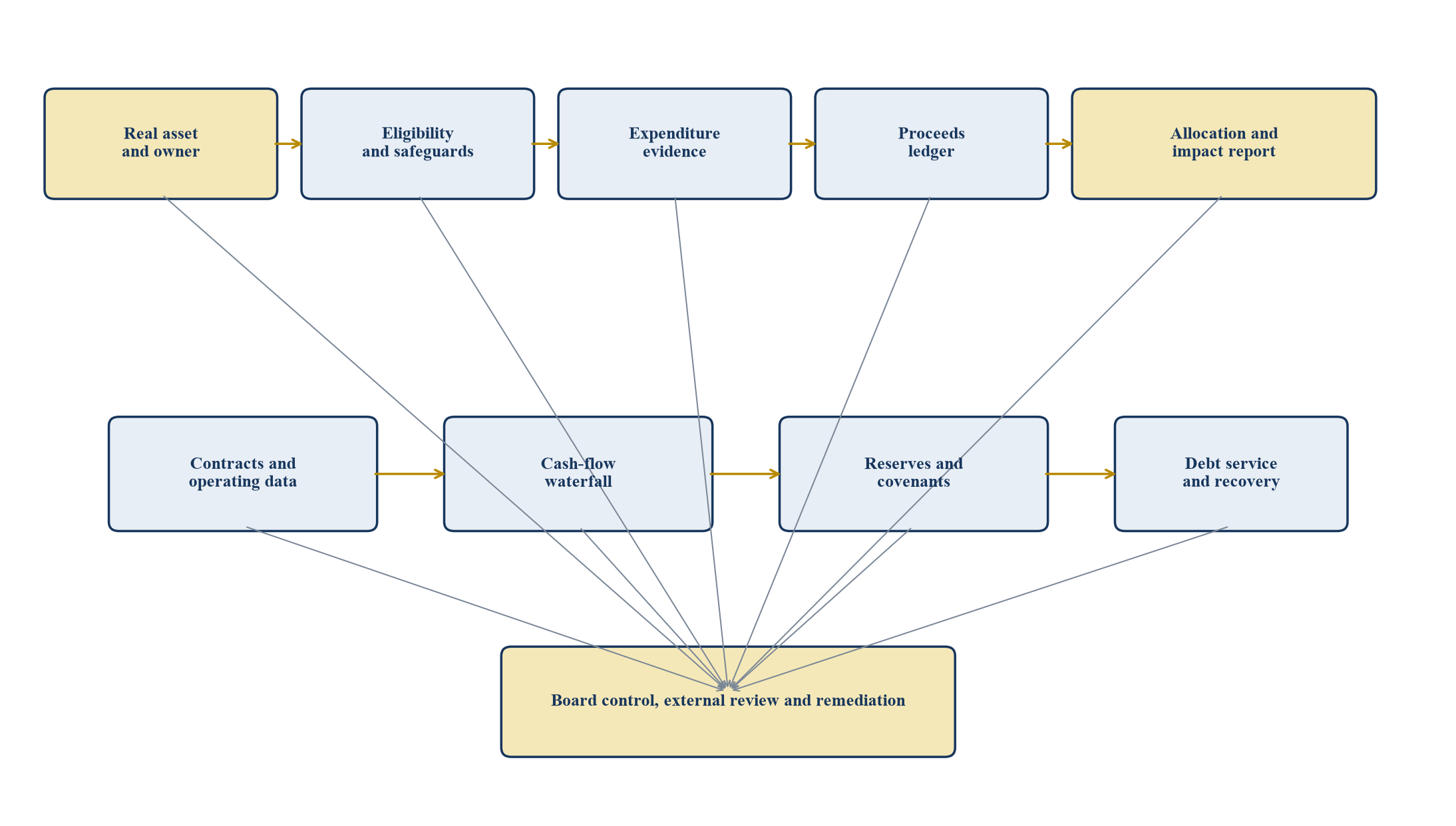
The proposed architecture links the physical asset and expenditure record to environmental eligibility, proceeds control, protected cash flow and continuing assurance.
8. Define eligible expenditure precisely
The allocation policy should define which costs qualify, when they qualify and how they are evidenced. Fixed assets, capital expenditure, selected operating expenditure, acquisition cost and refinancing can receive different treatment under different standards. The issuer should avoid using accounting labels as a substitute for eligibility analysis.
For each cost category, the policy should specify the responsible entity, invoice date, payment date, capitalisation treatment, eligible proportion, evidence and exclusion logic. Shared infrastructure, development cost, financing cost, land, taxes, contingencies and corporate overhead need explicit rules because they can be material and difficult to attribute.
The European Green Bond Regulation permits allocation to fixed assets, qualifying capital and operating expenditure, certain financial assets and household assets under defined conditions [3]. Where future taxonomy alignment depends on a capital-expenditure plan, the plan carries its own timetable and external assessment requirements. Issuers using another framework should still define timing and evidence with similar precision.
The expenditure boundary should be stable enough for audit and adaptable to legitimate project change. Changes should require documented approval. Retrospective expansion of eligible categories to absorb unallocated proceeds creates credibility and control risk.
9. Prevent double financing and double counting
The issuer should test whether an expenditure item has already been allocated to another green bond, loan, grant, tax-credit monetisation, subsidy or certificate programme. Multiple sources can finance one project, but the allocation and impact claims must describe their respective shares accurately.
The control begins with a unique asset and expenditure identifier. Each invoice or capitalised cost should map to one project, one eligible category and an allocation history. The register should show gross cost, external contributions, issuer-funded cost, previous labelled allocation and remaining eligible capacity.
Impact attribution requires a separate rule. If a USD 100 million asset receives USD 40 million from the bond and USD 60 million from other sources, the issuer should state whether it reports total project impact or a financing share. ICMA's impact reporting guidance recommends transparency about calculation methodologies and assumptions [4].
Certificates and environmental attributes also require attention. Renewable-energy certificates, carbon credits or similar instruments may be sold separately from electricity. The issuer should explain how attribute ownership affects environmental claims. Financial allocation alone does not establish exclusive ownership of every claimed benefit.
10. Design the allocation ledger
The allocation ledger should reconcile opening unallocated proceeds, new allocations, reallocations, repayments, asset disposals, ineligible items and closing balance. It should operate at a level that permits independent review and should reconcile to the general ledger, bank accounts and bond records.
The issuer can manage proceeds bond by bond or through a portfolio approach where the governing framework permits it. ICMA recognises both approaches and recommends that tracked proceeds be periodically adjusted to match allocations [1]. The chosen method should be described before issuance and applied consistently.
The ledger should record the amount allocated to each asset or category, financing or refinancing share, expenditure period, currency, exchange rate, approval date and evidence reference. It should also identify temporary placement of unallocated proceeds and any restricted categories for that placement.
Control ownership should be divided deliberately. Project teams validate physical assets and invoices; sustainability teams test eligibility and impact; treasury controls proceeds; finance reconciles accounting; legal and compliance review disclosure; internal audit or external assurance tests the system. One team should not originate, approve and report the same allocation without independent challenge.
| Gate | Required evidence | Decision owner | Stop condition |
|---|---|---|---|
| Real-asset perimeter | Ownership, location, design, status, permits and financing history | Board and project committee | Asset boundary cannot be reconciled |
| Eligibility and safeguards | Criteria map, technical evidence, exclusions, safeguards and mitigants | Sustainability and risk committees | Material criterion or safeguard remains unsupported |
| Expenditure and proceeds | Invoice register, payment evidence, allocation ledger and temporary-placement policy | Finance and treasury committees | Allocation cannot reconcile to net proceeds |
| Cash-flow protection | Contracts, model, reserves, covenants, security and downside liquidity | Board and financing committee | Debt service fails the approved downside |
| Reporting and remediation | Allocation report, impact methodology, external review and correction plan | Disclosure committee | Claim cannot be verified or corrected |
The gates are decision controls and require transaction-specific legal, technical, environmental, accounting and financing review.
11. Control temporary placement of proceeds
Unallocated proceeds should be managed under a written policy. The policy should identify permitted instruments, liquidity, maturity, credit quality, currency, concentration, custody, exclusions and approval authority. It should also explain how temporary placement aligns with the issuer's disclosed environmental commitments.
The treasury team should maintain enough liquidity to meet project disbursements without forcing a sale at an adverse time. The investment horizon should match the expected allocation schedule. Foreign-currency exposure should be identified where proceeds and expenditure use different currencies.
Temporary placement does not itself satisfy use-of-proceeds eligibility. The issuer should report the unallocated balance and the types of temporary placement, consistent with its framework and applicable requirements. Interest earned should be treated according to the documents, accounting policy and disclosed approach.
An allocation delay should trigger escalation before it becomes a reporting failure. The committee should compare the current schedule with the original plan, identify the cause and decide whether to accelerate eligible expenditure, substitute assets, retain the balance temporarily or redeem debt where permitted and appropriate.
12. Separate the allocation ledger from the cash waterfall
The allocation ledger answers where an amount equal to net proceeds has been assigned. The project-finance cash waterfall answers how operating receipts are collected, applied and protected for debt service. They are connected, but they are not the same accounting system.
The secured cash waterfall should show revenue accounts, operating cost, tax, maintenance, reserve funding, hedging, debt service, permitted capital expenditure and distributions. It should define timing, priority, account control, withdrawal tests and remedies. The green designation does not alter creditor ranking unless the legal documents do so expressly.
The two systems should reconcile to the same real-asset perimeter. If green proceeds finance one group of assets while secured cash flow comes from a wider business, disclosure should identify that difference. If the project company is ring-fenced, the relationship may be direct. If the issuer uses a portfolio approach, allocation and repayment can be structurally separate.
The financing committee should review both systems together. An environmentally eligible portfolio can still have weak cash conversion or excessive leverage. A strong credit can still have a deficient allocation record. The bond requires both integrity systems to remain effective.
13. Build the project cash-flow model
The model should connect physical operations to cash available for debt service. Renewable generation, storage dispatch, water volume, building savings or transport activity should translate through price, contract terms, availability, operating cost, maintenance, tax, working capital and reserves.
Historical data should be reconciled where assets are operating. Construction assets should use an approved budget, schedule, contingency and draw profile. Forecast improvements should identify the contract, technical change, tariff, efficiency measure or capacity addition that supports them.
The model should distinguish environmental output from revenue output. Avoided emissions can rise while cash flow falls, and strong revenue can coexist with weak environmental performance. The board needs separate indicators and an explanation of their relationship.
Debt sizing should use the lower of contractual capacity, operating evidence, rating or lender requirements, legal constraints and market capacity. The proceeds amount should not be determined by the size of the eligible asset pool alone.
14. Protect construction and completion risk
For assets under construction, the credit structure should define budget, contingency, equity funding, draw conditions, contractor obligations, delay and performance damages, completion tests and longstop dates. Eligibility at issuance does not establish successful completion.
The project schedule should identify which expenditure can be allocated before completion and how failed or abandoned work would be treated. The issuer should record whether replacement expenditure is available and whether allocation reports require correction.
Technical due diligence should test design maturity, resource or demand studies, grid or network connection, supply chain, permits, contractor capacity, interface risk and commissioning. Environmental criteria should be incorporated into specifications and acceptance tests where they depend on technical performance.
The financing documents should preserve enough liquidity to complete the asset under the approved downside. A green label does not fund cost overruns. Contingency, sponsor support, completion guarantees, reserve facilities and contractual remedies should be evidenced before launch.
15. Test operating and revenue resilience
Operating assets require evidence on availability, output, degradation, outages, operating expenditure, maintenance, insurance, billing and collection. Revenue analysis should distinguish contracted, regulated, merchant and subsidised sources and should test counterparty and change-in-law exposure.
The green framework may remain valid when revenue underperforms, yet bondholders still depend on cash. The committee should test correlated stresses: lower output, weaker price, delayed collection, higher maintenance, reserve draw and interest-rate or currency movement. Scenarios should show timing, covenant and liquidity consequences.
Contracts should be translated into model drivers. The analysis should cover term, price, indexation, curtailment, dispatch, availability, performance deductions, termination, force majeure, credit support, assignment and dispute. A headline power-purchase agreement or concession is insufficient without enforceable cash-flow detail.
The board should define operational indicators that trigger intervention before debt service is threatened. These indicators can include availability, collection days, maintenance backlog, reserve adequacy, covenant headroom and unplanned outage duration.
16. Design reserves and covenants
Reserves should match the risks of the financed assets. Debt-service, major-maintenance, lifecycle, decommissioning, working-capital, tax or insurance reserves may be appropriate. Each reserve should have a target size, funding method, permitted form, draw rule, replenishment priority and release condition.
Covenants should protect cash flow, asset condition and reporting. Distribution lock-up, additional-debt, asset-sale, related-party, maintenance, insurance, hedging and information covenants should align with the secured structure. Green reporting obligations can be contractual without changing payment priority.
The documents should specify consequences for allocation or reporting failure. Possible responses can include remediation, replacement assets, enhanced reporting, external review, investor notice or other agreed action. The legal consequences depend on the instrument; an environmental breach should not be described as a payment default unless the documents provide that result.
The issuer should avoid covenant conflict. A requirement to replace an ineligible asset may require capital expenditure that another covenant restricts. The transaction should preserve the capacity and authority to correct the environmental record while maintaining credit protection.
17. Set impact metrics before issuance
Impact metrics should follow the asset and environmental objective. Renewable power may use capacity, generation and estimated avoided emissions. Energy efficiency may use energy savings and emissions reduction. Water projects may use treated, saved or supplied volume with quality and beneficiary information. The metric should have a baseline, boundary, unit, method, frequency and owner.
ICMA's harmonised impact reporting guidance promotes common principles, project or portfolio information, quantitative indicators where feasible and disclosure of assumptions and methodologies [4]. The EIB carbon-footprint methodology provides a structured approach to absolute and relative project emissions [5]. The issuer should choose a method that is suitable and consistently applied.
Expected impact should be distinguished from achieved impact. Before commissioning, calculations may rely on design capacity, resource assumptions, operating hours, efficiency or counterfactual baselines. After operations begin, the issuer should incorporate measured data and explain material variance.
The metric register should also identify data limitations. Meter coverage, estimation, shared assets, grid factors, leakage, rebound effects and double counting can affect results. A precise number without a defensible method can create false confidence.
18. Govern baselines and counterfactuals
Many impact measures compare the project with a baseline or counterfactual. The choice can materially change the reported result. A renewable project might be compared with the relevant grid factor; a retrofit with pre-project consumption; a water project with a defined loss or supply condition.
The baseline should be documented before results are reported. It should identify geography, technology, period, data source, exclusions and update policy. Where a standard method specifies the baseline, the issuer should follow it or explain a justified departure.
Changes should be controlled. Updating a grid factor, occupancy assumption or operating boundary can alter previously reported outcomes. The issuer should retain the old value, new value, reason and quantified effect. Restatement policy should be defined before a dispute arises.
Environmental impact is different from the financing contribution. The report should explain whether the metric covers the entire asset, the allocated share or another attribution approach. Investors should be able to reproduce the logic from disclosed inputs and method.
19. Measure adverse effects as well as benefits
A decision-ready impact report should identify material adverse effects alongside benefits. Land use, biodiversity, water consumption, hazardous materials, waste, end-of-life obligations, community effects and supply-chain exposure may be relevant depending on the asset.
The analysis should use indicators suited to the risk. A battery project can report storage capacity and renewable integration while also addressing mineral sourcing, fire safety, degradation and recycling. A desalination or water-reuse asset can report reliable supply while addressing energy intensity, brine or residual management and ecosystem effects.
Mitigation should be measurable. The report should identify the risk, control, responsible party, target, observed performance and unresolved exception. Generic statements about compliance add little when permits contain asset-specific conditions.
This balanced approach supports investor diligence and board oversight. It reduces the risk that a positive headline metric conceals a material project exposure that later affects permits, operations, cash flow or reputation.
20. Build an external review plan
External review should be scoped before issuance. The issuer should decide whether it requires a second-party opinion, verification, certification, assurance, rating or a combination. Each service answers a different question and has different evidence, independence and timing requirements.
ICMA's Guidelines for External Reviewers set voluntary expectations for professional and ethical standards, organisation, content and disclosure [6]. Climate Bonds certification requires approved verification against its standard and sector criteria [2]. The European Green Bond regime establishes requirements for registered external reviewers [3].
The engagement letter should define scope, criteria, information access, management representations, materiality, deliverables, publication, reliance, liability and change procedures. The issuer should identify potential conflicts and the internal owner for reviewer questions.
External review does not transfer responsibility for the claim. Management approves the framework, records and disclosure. The board should understand qualifications, limitations and unresolved items rather than treating a positive opinion as a substitute for internal control.
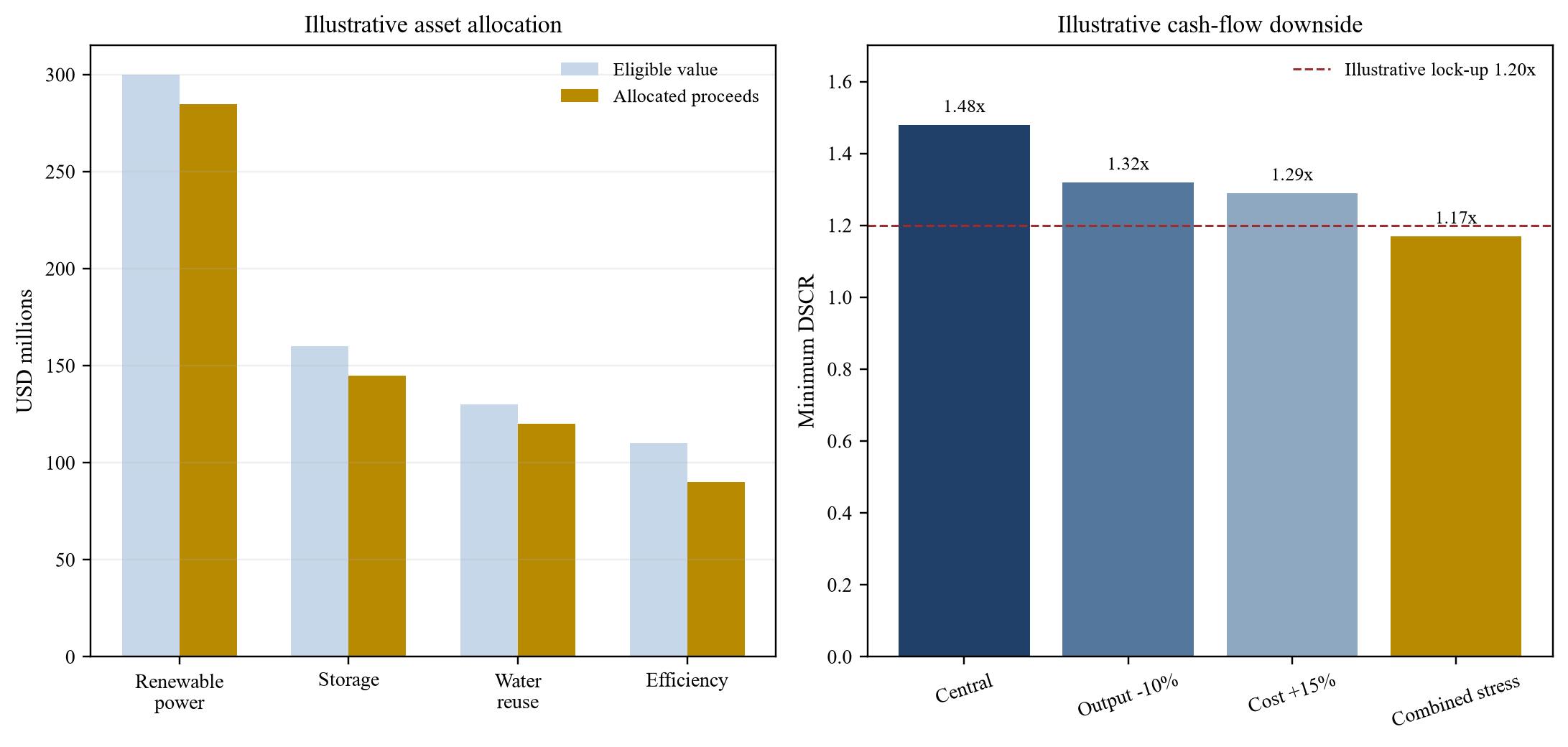
All amounts, coverage ratios and allocation outcomes are illustrative management assumptions and require replacement with approved transaction data.
21. Prepare allocation reporting
Allocation reporting should show the amount raised, net proceeds, allocated amount, unallocated balance, financing versus refinancing, project categories, geographic distribution and temporary placement. It should be renewed at the frequency required by the framework and applicable law, commonly annually until full allocation and when material developments occur.
ICMA recommends an annual list of financed projects or appropriately aggregated information, allocation amounts and expected impact [1]. The European Green Bond framework prescribes factsheets, allocation reports and impact reports for instruments using its designation [3]. The issuer should build its report from the ledger rather than from marketing materials.
The report should explain material change. Asset substitution, cancellation, disposal, impairment, delayed completion, methodology change or reallocation should be visible. Comparative figures and prior-period reconciliations make the record easier to audit.
Confidentiality can justify aggregation, but it should not erase the ability to understand the asset pool. The issuer should disclose enough information for investors to assess category, location, status, allocation and impact while protecting legitimate commercial or security-sensitive data.
22. Prepare impact reporting
Impact reporting should connect each category to indicators, methodology, assumptions, reporting period and results. It should distinguish expected and achieved outcomes and indicate whether figures are estimated, modelled, measured or externally assured.
The report should avoid adding unlike metrics. Megawatt-hours, tonnes of carbon-dioxide equivalent, cubic metres of water and energy savings answer different questions. Portfolio summaries should preserve meaningful units and explain any conversion or aggregation.
Method changes should be transparent. If improved metering or a revised emissions factor changes the result, the issuer should disclose the change and its effect. If an asset underperforms, the report should explain the operational cause and remediation rather than substituting another metric.
Impact information should reconcile with operating and financial records where they share inputs. Generation used for avoided-emissions reporting should be consistent with settlement or metering data, subject to explained adjustments. This reconciliation strengthens environmental and credit reporting simultaneously.
23. Integrate disclosure and liability review
The framework, offering document, investor presentation, external-review report, allocation report and impact report should form a coherent disclosure set. Definitions, asset counts, expenditure amounts, technical thresholds and methodologies should be consistent or reconciled.
The disclosure committee should maintain a source register and approve material claims. Legal counsel should review applicable securities, listing, market-abuse, consumer or product rules and anti-greenwashing requirements. Technical and environmental specialists should review claims within their expertise.
Forward-looking statements require particular control. Construction completion, future taxonomy alignment, expected impact and allocation timing depend on assumptions and execution. The disclosure should identify the basis, conditions and material risks without presenting estimates as achieved outcomes.
The issuer should define a correction protocol. If a material error is found, the protocol should identify escalation, investigation, board or committee approval, investor notice, report correction, reviewer involvement and record retention.
24. Compare labelled and unlabelled financing economics
The financing decision should compare the green bond with realistic alternatives on a common basis. Coupon or spread is only one component. The analysis should include underwriting, legal, listing, rating, external review, reporting systems, assurance, hedging, reserves, execution risk and continuing administration.
Any pricing benefit should be treated as transaction-specific until evidenced by actual orders and terms. The committee should avoid assuming a green premium. Investor diversification, tenor, liquidity and strategic value may still support the route even when direct pricing is similar.
The comparison should also value internal capability created by the transaction. A reliable asset register, expenditure ledger, impact system and investor-reporting process can support future financing. These benefits remain management estimates unless observed through lower cost, faster execution or improved access.
The board should approve maximum all-in economics and minimum structural protections before launch. Pricing authority should include the ability to withdraw when investor demand requires unacceptable leverage, covenants, disclosure or concentration.
25. Model the hypothetical transaction
The illustrative case assumes a USD 650 million gross bond and USD 640 million of net proceeds after assumed transaction costs. The eligible portfolio comprises USD 300 million of renewable-power assets, USD 160 million of battery storage, USD 130 million of water-reuse infrastructure and USD 110 million of energy-efficiency expenditure. The illustrative eligible value is USD 700 million.
The assumed initial allocation is USD 285 million, USD 145 million, USD 120 million and USD 90 million respectively, totalling USD 640 million. This is a management scenario, not evidence of market allocation or eligibility. Every category would require asset-level criteria, invoices, payment records and independent review under the selected framework.
The illustrative central minimum debt-service coverage ratio is 1.48 times. Output reduction, operating-cost increase and combined stress produce assumed minimum ratios of 1.32, 1.29 and 1.17 times. The model uses an illustrative 1.20-times distribution lock-up. These figures do not establish a suitable covenant or rating.
The combined case demonstrates why allocation capacity and debt capacity should be tested separately. The eligible pool exceeds net proceeds, while cash-flow protection weakens under correlated stress. The board could reduce debt, add reserves, strengthen contracts, retain cash or change amortisation even though the environmental allocation remains sufficient.
| Asset category | Illustrative eligible value | Illustrative allocation | Evidence required | Primary operating indicator |
|---|---|---|---|---|
| Renewable power | 300 | 285 | Ownership, design, permits, invoices, generation and grid evidence | Metered generation and availability |
| Battery storage | 160 | 145 | Technology, safety, grid services, invoices and operating records | Usable capacity and dispatch availability |
| Water reuse | 130 | 120 | Treatment design, permits, quality, invoices and delivery records | Reused water delivered to specification |
| Energy efficiency | 110 | 90 | Baseline, retrofit scope, invoices, metering and savings method | Verified energy saving against baseline |
| Total | 700 | 640 | Reconciled asset and allocation ledger | Category-specific measured result |
All values are illustrative management assumptions in USD millions and do not represent market data, verified eligibility or an offer.
26. Stress eligibility and allocation
Eligibility can change after issuance. Technical criteria can evolve, project scope can change, assets can be delayed or cancelled, and evidence can prove incomplete. The issuer should model how much headroom exists between eligible value and allocated proceeds.
The scenario register should test removal of the largest asset, cost disallowance, delayed commissioning, foreign-exchange movement, partial ineligibility and substitution. It should show the resulting eligible pool, unallocated balance, reporting consequence and remediation period.
The European framework contains detailed rules on criteria applicable at issuance, later amendments, capital-expenditure plans and limited flexibility [3]. Other instruments may use contractual rules. The committee should follow the applicable regime and avoid importing percentages or grace periods from an unrelated standard.
Allocation headroom should not replace evidence. A large pool can reduce substitution risk, but each included asset still needs a defensible record. Portfolio systems should prevent an asset from remaining in the pool after disposal, impairment or material change.
27. Stress cash flow and liquidity
The credit model should combine operational, market and financing stresses. Relevant cases can include lower output, weaker price, delayed offtaker payment, higher operating cost, maintenance event, construction delay, currency movement, interest-rate change and reserve draw.
Each scenario should show cash available for debt service, coverage, lock-up, default, reserves and minimum liquidity by period. Management actions should have evidence, authority and timing. Assumed cost reduction, refinancing or sponsor support should not be treated as immediate cash.
Environmental underperformance can overlap with credit stress. Lower generation reduces avoided-emissions results and revenue. Water-quality failure can reduce eligible output, trigger operating cost and affect contractual payment. The model should identify common drivers rather than treating the reports as independent.
The board should approve leverage based on the combined control system. A bond that maximises proceeds against the green asset pool can leave inadequate financial resilience. Credit headroom supports the ability to operate, maintain and report the assets throughout the bond life.
28. Build a risk heat map
The risk register should cover environmental integrity, project execution, credit, legal, operational, reporting and reputation. Each risk should have a cause, consequence, control, owner, trigger, current status and residual assessment.
High-priority integrity risks include unsupported eligibility, double allocation, weak safeguards, inconsistent boundaries, unreliable impact data and missed reporting. High-priority credit risks include completion, revenue, counterparty, liquidity, reserve, covenant, currency and refinancing exposure.
The register should identify connections. Delayed completion can create unallocated proceeds, weaker coverage and delayed impact. Asset disposal can reduce eligible value and secured cash flow. A regulatory change can affect both taxonomy treatment and operating economics.
Risk reporting should drive action. A coloured matrix without evidence, deadlines and authority does not protect the transaction. The financing committee should review exceptions until they are closed, accepted within mandate or escalated to the board.
| Risk | Environmental consequence | Credit consequence | Proposed control | Escalation trigger |
|---|---|---|---|---|
| Unsupported asset eligibility | Allocation claim becomes unreliable | Investor confidence and market access weaken | Criterion map and independent technical evidence | Material criterion lacks source evidence |
| Delayed project completion | Allocation and impact are delayed | Cost overrun and debt-service pressure rise | Completion tests, contingency and longstop plan | Forecast completion exceeds approved date |
| Double financing | Allocation and impact are overstated | Disclosure and remediation cost increase | Unique expenditure ledger and funding-source check | Duplicate invoice or asset identifier found |
| Operating underperformance | Achieved impact falls below estimate | Revenue and coverage weaken | Metering, maintenance, reserves and downside model | Performance breaches operating threshold |
| Safeguard failure | Environmental or social harm occurs | Permit, operating and liability exposure rises | Safeguards register and verified mitigation | Material permit or mitigation breach |
| Reporting-control failure | Investors receive incomplete information | Legal, reputation and refinancing exposure rise | Source register, disclosure committee and assurance | Report cannot reconcile to source systems |
Likelihood and consequence require transaction-specific assessment; the controls shown are proposed minimums.
29. Establish change control
Change control should apply to asset scope, technical design, eligibility criteria, expenditure, ownership, allocation, impact methodology, contracts, financing structure and disclosure. The issuer should define which changes require project approval, sustainability re-evaluation, external review, lender or trustee consent, investor notice or board approval.
The change request should describe the proposed change, reason, affected documents, eligibility effect, financial effect, safeguards, evidence and implementation date. It should preserve the prior state and record the approving authority.
Projects often change through ordinary execution. The control should be usable rather than ceremonial. Clear thresholds can allow minor changes within delegated authority while escalating changes that affect criteria, allocation, impact, cash flow or security.
The framework and bond documents should be checked together. A change that preserves environmental eligibility may still breach a financing covenant. A lender-approved operational change may still require update of the allocation or impact record.
30. Create a remediation ladder
The issuer should define what happens when an asset becomes ineligible, an expenditure item is disallowed, an allocation report does not reconcile, an impact claim is incorrect or a safeguard condition is breached. The response should be proportionate and consistent with the documents and applicable law.
The ladder can begin with investigation and evidence correction, followed by reclassification, replacement allocation, enhanced review, report restatement, investor notice and further contractual action where required. Each step should have an owner, authority and deadline.
Remediation should preserve credit. Replacing an asset or funding corrective expenditure can affect liquidity and covenants. The financing committee should model cash consequences before approving the response.
The issuer should retain a complete incident record. Root-cause analysis should identify whether the issue arose from criteria interpretation, source data, project change, systems, governance or disclosure. Lessons should update the framework and controls.
31. Organise governance and responsibilities
The board should approve the financing purpose, governing framework, asset perimeter, eligibility policy, debt structure, disclosure and delegated authorities. A green financing committee can recommend eligible assets and allocations, while treasury, finance, risk, legal, sustainability and project teams retain defined operational responsibilities.
The committee charter should cover membership, quorum, conflicts, evidence, decision rights, escalation and record keeping. It should state who can add or remove an asset, approve methodology, sign reports and communicate with reviewers and investors.
Internal audit or an independent assurance function should test control design and operation. Testing should cover sample invoices, asset evidence, system access, reconciliations, change approvals, report generation and remediation. Findings should remain open until verified closure.
Governance should continue after full allocation. Impact reporting, asset substitution, covenant compliance, external review and investor communication can continue for years. Responsibility should survive transaction-team demobilisation and staff changes.
32. Execute through a controlled timetable
The transaction timetable should integrate financing and environmental workstreams. Days 0 to 30 define the decision, perimeter, standard, eligibility criteria and adviser scope. Days 31 to 70 reconcile assets, expenditure, safeguards, cash flow and legal structure. Days 71 to 110 complete the framework, model, external review, disclosure and governance approvals.
Days 111 to 145 prepare investor materials, rating or credit work, documentation, listing and operational controls. Days 146 to 170 conduct investor engagement, update evidence and approve final terms. Days 171 to 180 launch, price, settle and transfer responsibilities to post-issuance teams.
Each stage should have exit criteria. The transaction should pause if the asset perimeter, eligibility evidence, proceeds controls, credit structure, disclosure or approvals fall outside mandate. Market timing can accelerate execution only when the underlying evidence is ready.
The project-management office should maintain one dependency plan. Environmental and financing deliverables should not run as separate calendars that meet only before publication. Their shared inputs and approvals should be explicit.
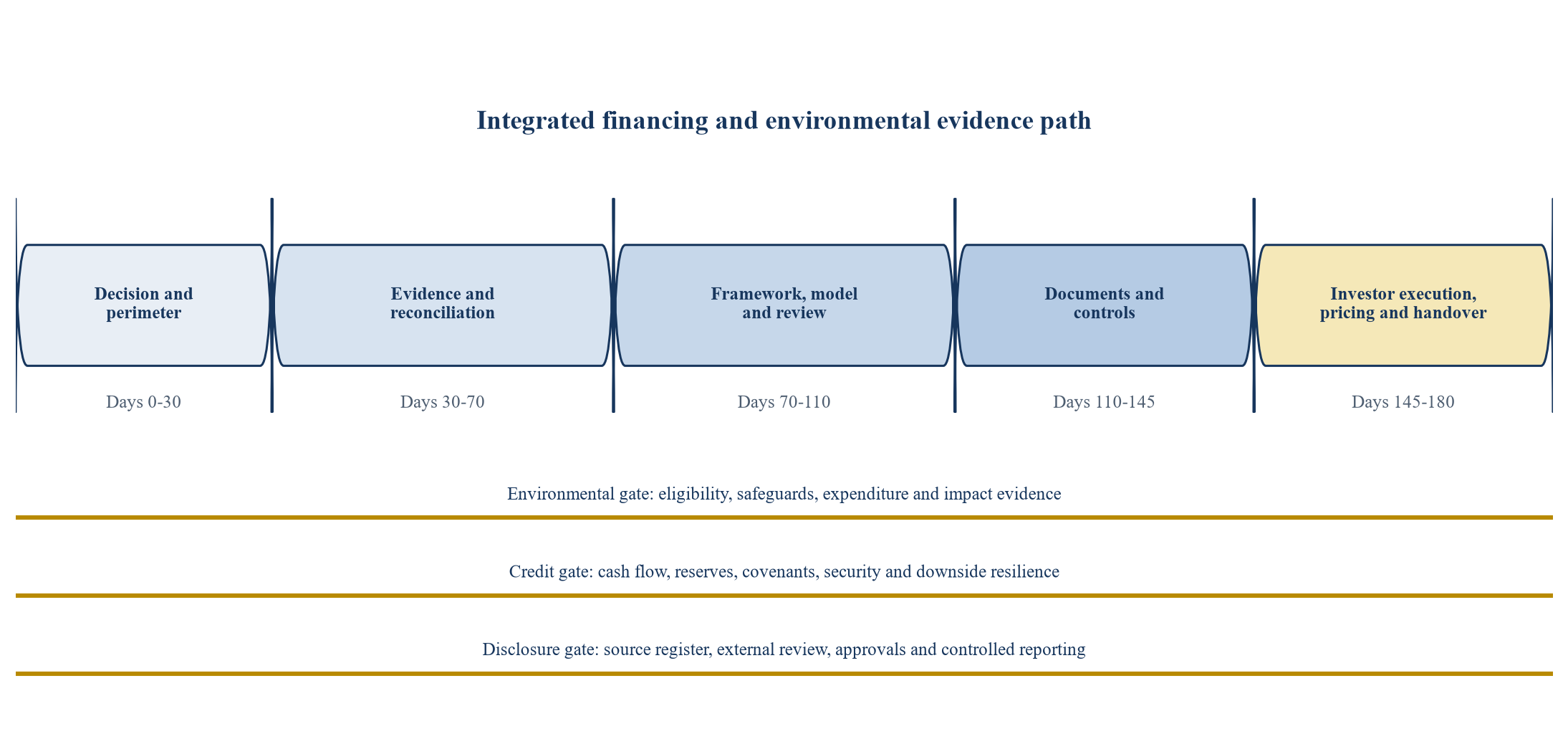
The sequence is illustrative and should be adapted to the assets, governing standard, jurisdiction, review process and market conditions.
33. Prepare the board decision pack
The board pack should state the financing objective, alternatives, asset perimeter, governing standard, eligibility conclusion, safeguards, expenditure capacity, allocation plan, impact methodology, credit structure, downside, disclosure, external review and continuing obligations.
It should identify every management assumption and unresolved item. The hypothetical case should be replaced with approved transaction data. Sensitivities should show which variables drive eligible headroom, coverage, liquidity and reported impact.
The board should approve launch and withdrawal thresholds. These can include maximum all-in cost, minimum rating or investor quality, leverage, covenant protection, reserve funding, allocation readiness and disclosure conditions. Delegated pricing authority should remain within these boundaries.
The final close paper should compare the executed transaction with the approved mandate. Changes in proceeds, assets, terms, allocation, reviewer conclusion or reporting commitment should be visible and accepted by the proper authority.
34. Operate a post-issuance control calendar
The issuer should convert transaction commitments into a calendar covering allocation, impact data, financial reporting, covenant testing, external review, investor updates and framework maintenance. Each obligation should have an owner, due date, evidence source and approval route.
Monthly or quarterly controls can reconcile the allocation ledger, asset changes and operating indicators. Annual controls can support allocation and impact reports, assurance and board review. Material events require prompt assessment outside the routine calendar.
The control system should retain source data at a useful level. Aggregated reports alone are insufficient if future reviewers cannot trace them to assets, invoices, meters and contracts. Access controls and backup should protect the record.
Performance review should examine both systems. The board should see eligible value, allocation, impact, safeguards, operational performance, coverage, liquidity, covenant headroom and investor questions. This integrated view supports timely correction and future refinancing.
35. Convert the label into a durable financing capability
A credible green project bond finances identified real assets through a repeatable evidence and control system. Its environmental case begins with eligibility and expenditure, continues through proceeds management and reporting, and remains open to review and correction. Its credit case begins with contracts and operations, continues through cash flow, reserves and covenants, and remains subject to downside and recovery analysis.
The issuer should preserve the separation between these systems while making their connections explicit. The allocation ledger cannot demonstrate debt capacity. The cash waterfall cannot prove environmental eligibility. Their common asset perimeter, source register, governance and change control create the integrated transaction record.
This discipline can improve future capital access. The organisation develops a verified asset register, consistent expenditure rules, impact methods, reviewer relationships, investor reporting and board decision processes. The value of that capability should be assessed through observed execution, funding and control outcomes rather than promotional claims.
The final test is simple. An informed reviewer should be able to identify the financed assets, establish why they qualify, trace how proceeds reached them, understand their environmental effects, reconstruct the cash available for debt service and see how exceptions are corrected. A bond that passes this test represents financed real assets with a durable governance system.
| Decision question | Evidence required | Approval owner |
|---|---|---|
| Is the real-asset perimeter complete and legally clear? | Ownership, location, design, status, permits, contracts and financing history | Board and project committee |
| Do assets and expenditure meet the selected criteria? | Criterion map, safeguards, invoices, payments and reviewer evidence | Sustainability and risk committees |
| Can proceeds be controlled and reported? | Allocation ledger, reconciliation, temporary-placement policy and reporting calendar | Finance and treasury committees |
| Can the assets service debt under stress? | Operating model, contracts, reserves, covenants, security and downside liquidity | Board and financing committee |
| Can the issuer sustain the claim through the bond life? | Impact methodology, external review, change control and remediation ladder | Disclosure committee and board |
The checklist supports an auditable decision and does not replace transaction-specific legal, technical, environmental, tax, accounting or investment advice.
Sources
- International Capital Market Association, Green Bond Principles, June 2025. Read the primary source
- Climate Bonds Initiative, Climate Bonds Standard and Certification Scheme. Read the primary source
- European Union, Regulation (EU) 2023/2631 on European Green Bonds and optional disclosures. Read the primary source
- International Capital Market Association, Impact Reporting and Harmonised Framework resources. Read the primary source
- European Investment Bank, Project Carbon Footprint Methodologies, January 2023. Read the primary source
- International Capital Market Association, Guidelines for External Reviews. Read the primary source
- International Capital Market Association, Guidance Handbook, June 2025. Read the primary source
- International Capital Market Association, Green Enabling Projects Guidance. Read the primary source
- Climate Bonds Initiative, Climate Bonds Standard Version 4.1. Read the primary source
- World Bank, Green Bond Proceeds Management and Reporting Guide. Read the primary source
- World Bank, Guide to Green Bond Issuance for Financial Institutions. Read the primary source
- World Bank, Green Bond Issuance Handbook. Read the primary source
- European Commission, European Green Bond Standard Regulation and implementing measures. Read the primary source
- European Commission, EU Taxonomy for sustainable activities. Read the primary source
- International Finance Corporation, Green Bond Impact Report. Read the primary source
- OECD, Guidance on Transition Finance, 2022. Read the primary source
- World Bank, What You Need to Know About Green Bonds. Read the primary source
- Climate Bonds Initiative, Certification Resources. Read the primary source
