
Introduction
Green steel is often described as a production technology. For investors and lenders, it is a chain of interdependent contracts. Hydrogen-based direct reduction requires suitable ore, large volumes of electricity, an electrolyser or hydrogen supply, storage and compression, a direct-reduction plant, an electric arc furnace, downstream finishing, logistics, certification and customers willing to accept the product and its price. Weakness in one link can impair the economics of the whole project.
The International Energy Agency reports that blast-furnace and basic-oxygen-furnace routes still account for about 70 per cent of global steel production, while early commercial plants using 100 per cent hydrogen blends are estimated to cost materially more than conventional production.[1] The OECD identifies high-quality ore, scrap, excess capacity, energy cost and market creation as central constraints on steel decarbonisation.[2] These conditions turn the green premium into a commercial-allocation problem.
This paper asks who pays, under which contract, for how long and against what evidence. It connects the physical steel chain to cash flow, debt capacity and enterprise value. The analysis is designed for steelmakers, miners, energy companies, infrastructure investors, lenders, governments and industrial customers considering a project, partnership or acquisition.
1. Define the product before defining the premium
The commercial unit must be specified. Hot-briquetted iron, direct-reduced iron, crude steel, slab, coil, plate, long products and finished components have different buyers, logistics and processing requirements. A tonne of low-emissions iron is not economically interchangeable with a qualified automotive-grade coil.
State the product specification, annual volume, delivery point, certification method and embodied-emissions boundary. Identify the conventional product against which price and performance are compared. The premium cannot be measured until both products satisfy the same mechanical, dimensional, surface, delivery and warranty requirements.
Define the claims permitted to the buyer. Terms such as low-emissions, near-zero, fossil-free and green can refer to different thresholds and accounting systems. The IEA calls for interoperable definitions, transparent measurement and coherent chain-of-custody rules.[1] Contract drafting should identify the standard, assurance provider, reporting period and remedy for a failed claim.
2. Draw the complete production boundary
Map mining, beneficiation, pelletising, transport, hydrogen production, storage, direct reduction, melting, refining, casting, rolling, finishing and outbound logistics. Assign energy, material loss, emissions and ownership at each step. A narrow plant boundary can hide substantial cost or emissions in ore preparation, electricity generation or transport.
Separate existing shared infrastructure from project-specific assets. Port capacity, transmission lines, water systems, gas networks, oxygen supply and rail may serve several users. The project model should include the access payment and expansion capital needed to secure reliable capacity.
Fix the accounting boundary used for customer claims and regulation. The European Union Carbon Border Adjustment Mechanism covers iron and steel and requires declared embedded emissions for relevant imports.[3] A product-value model should reconcile regulatory reporting, customer procurement requirements and internal decarbonisation targets without assuming that one certificate satisfies every purpose.
3. Select the steelmaking route
Hydrogen-based direct reduction and electric-arc-furnace steelmaking is one pathway. Other routes include natural-gas direct reduction with increasing hydrogen blends, scrap-based electric furnaces, blast-furnace retrofits, carbon capture and storage, biomass substitution and emerging electrochemical processes. Regional energy, ore, scrap and policy conditions determine relative value.
Define the route that supports the target product and commissioning date. Record technology maturity, reference scale, input tolerances, ramp profile, emissions and residual exposure to fossil fuel. The IEA states that new infrastructure and technologies at demonstration or prototype stage contribute materially to long-run sector decarbonisation.[4] Development risk therefore belongs in capital contingency, schedule and financing terms.
Preserve alternatives at early stages. A plant can be designed for an initial natural-gas phase with increasing hydrogen content, subject to emissions and customer requirements. Flexibility has value when hydrogen availability, electricity prices and product standards remain uncertain.
4. Establish the ore-quality envelope
Direct reduction typically requires iron ore with suitable iron content, gangue, pellet strength and metallurgical behaviour. Ore that is adequate for a blast furnace may require additional beneficiation or may reduce productivity and increase electricity, slag and yield loss in a direct-reduction and electric-furnace route.
Define acceptable chemistry, size distribution, reducibility, degradation, moisture and physical form. Test representative ore against the selected furnace design. Record the effect of lower grade or changing supply on hydrogen consumption, plant throughput, slag volume, refractory use and product quality.
The OECD identifies high-quality iron ore availability as a key transition challenge and notes that ironmaking may move toward regions with abundant suitable ore and low-cost renewable energy.[2] The ore contract should therefore cover quality adjustment, rejection, blending rights, source substitution and long-term resource confidence. A nominal tonne price cannot capture the cost of poor metallurgical performance.
5. Decide where beneficiation and pelletising sit
Beneficiation and pelletising can be located near the mine, the steel complex or an intermediate logistics hub. Each configuration changes transport mass, energy source, water need, emissions, tax, ownership and interface risk. Transporting upgraded product can reduce waste movement while increasing dependence on upstream processing.
Build a delivered-reactor-feed comparison. Include ore recovery, pellet yield, binders, fuel or electricity, capital, port handling, freight, inventory and working capital. Reconcile the output specification to direct-reduction guarantees.
Allocate completion and operating risk. A steel plant cannot ramp if the pellet plant is late or produces off-specification material. Common ownership can reduce commercial interfaces while concentrating capital exposure. Separate ownership requires aligned testing, availability, expansion and termination terms. Lenders should see one integrated commissioning schedule even when the assets have different sponsors.
6. Quantify the renewable-power requirement
Electricity supports electrolysis, hydrogen compression, direct-reduction auxiliaries, electric-furnace melting, oxygen production, material handling and downstream finishing. Calculate annual energy, maximum demand, load shape, ramp rate, power quality and required reliability for every major component.
The IEA identifies access to low-cost renewable electricity as a competitive advantage for hydrogen-based direct reduction.[4] A project should use site-specific generation profiles, grid rules, curtailment, losses and firming costs. A headline power-purchase-agreement price can omit transmission, balancing, shaping, congestion, taxes and standby supply.
Model the physical relationship between generation and production. Electrolysers may vary output within operating limits, while a direct-reduction plant and steel shop benefit from stable material flow. Hydrogen storage, grid imports, generation oversizing and production flexibility each provide firming. Compare their complete cost and operating consequence.
7. Choose the power-procurement portfolio
Power can come from onsite generation, a dedicated offsite asset, a physical power purchase agreement, a virtual contract, utility supply, wholesale purchases or a portfolio. Define which arrangement delivers physical energy, price protection, renewable attributes and capacity.
Match contract tenor and volume to project debt. A short power agreement leaves price exposure during the debt term. A long fixed contract can create above-market cost if technology or market prices fall. Volume commitments can produce take-or-pay payments during plant outages. Shape and basis risk remain where renewable output does not match consumption.
Use a portfolio that separates objectives. One tranche may provide stable baseload pricing, another may follow production, and a smaller merchant tranche may retain flexibility. Document curtailment rights, negative pricing, change in law, grid outages, credit support and replacement power. Debt sizing should use the residual delivered-price distribution after all contracts.
8. Size the electrolyser system
Electrolyser capacity depends on hydrogen demand, efficiency, utilisation, degradation, maintenance, storage and power availability. Oversizing can capture low-cost renewable hours and support maintenance coverage while increasing capital. Undersizing raises dependence on purchased hydrogen or production curtailment.
Build an hourly or representative-period model. Convert power availability into hydrogen output using a performance curve rather than a single efficiency. Include compression, purification, water treatment, cooling, auxiliaries, start-up, standby and stack replacement. Reconcile output to direct-reduction demand by operating state.
Define the technology and supply-chain risk. Alkaline, proton-exchange-membrane and other systems have different operating characteristics and materials. Require reference evidence at relevant scale, availability guarantees and a funded replacement plan. Preserve contractual remedies for delayed manufacturing, underperformance and unavailable spares.
9. Secure water and treatment capacity
Electrolysis requires high-purity water, and the wider complex may need cooling, steam, dust control and process water. Identify the source, quality, seasonal availability, treatment process, brine or wastewater route and permits. Water scarcity can constrain operating hours or create social and environmental risk.
Model delivered water cost across desalination, pumping, treatment, storage and discharge. Allocate common infrastructure between hydrogen, steel and other users. Include electricity consumption and replacement membranes or chemicals.
Contract for quantity and quality together. A water supplier may meet volume while failing purity, or a project may face curtailment during drought or maintenance. Define priority, storage, backup and compensation. Lenders should test a prolonged restriction case and the capital required for alternative supply. Customer claims should account for water impacts where procurement standards require them.
10. Design hydrogen storage and logistics
Hydrogen storage separates variable production from steady industrial demand. Options differ by pressure, duration, geography, safety, capital and loss. Onsite vessels can cover short interruptions; underground storage or pipeline networks may support longer balancing where geology and infrastructure permit.
Define the required autonomy for renewable variation, electrolyser maintenance, power outage and direct-reduction operating transitions. Model minimum inventory, compression energy, cushion gas, leakage and withdrawal constraints. The storage system should support safe shutdown and restart.
If hydrogen is purchased, specify delivery pressure, purity, carbon intensity, availability and title transfer. Pipeline, trailer, ammonia-derived and other logistics have distinct conversion and handling costs. Avoid treating external supply as a simple commodity price when delivery infrastructure and counterparty credit are essential to continuous production.
11. Integrate the direct-reduction plant
The direct-reduction unit converts ore to metallic iron while preserving material and energy conditions required by the electric furnace. Define metallisation, carbon content, temperature, fines generation, discharge form and storage. Hot charging can reduce electricity use but increases operational coupling between plants.
Model hydrogen circulation, heat recovery, gas purification and any transitional natural-gas use. State the emissions and product claims under each operating mode. A ramp that relies on more fossil input than expected can affect customer contracts and policy support.
Set integrated performance tests. Throughput, hydrogen consumption, metallisation, availability and product quality should be measured with specified ore and utilities. Interface warranties must identify whether underperformance arises from ore, hydrogen, equipment or operation. Without a resolution mechanism, each supplier can attribute failure to another part of the chain.
12. Configure the electric-arc-furnace charge
An electric arc furnace can use direct-reduced iron, hot-briquetted iron, scrap, pig iron and alloys. Charge composition affects energy, yield, residual elements, slag, electrodes, productivity and product quality. High-quality scrap can reduce primary iron demand, while scrap availability and contamination vary by region.
Define the product-grade requirements and permissible charge mix. Model the cost and emissions of each input, including preparation and transport. A project should not assume unlimited clean scrap at historical prices.
Preserve operating flexibility through material handling and procurement. The furnace may need to change charge mix during ore disruption, hydrogen shortage or price movement. Customer emissions thresholds can limit that response. Contracts and financing should distinguish a temporary production solution from a qualifying low-emissions product.
13. Include downstream finishing and qualification
Customers purchase usable steel products. Casting, rolling, coating, heat treatment and finishing determine dimensions, surface, mechanical properties and delivery. A low-emissions melt has limited commercial value until the full production route is qualified.
Create a qualification plan by grade and customer. Include samples, trial coils or batches, testing, certification, production-part approval and warranty. Automotive, energy, construction and engineering customers can have lengthy processes that begin before commercial operation.
Link ramp assumptions to qualification evidence. The plant may produce saleable lower-value grades before premium products are approved. The financial model should apply volumes and prices by product during ramp, account for rework and downgrade, and include customer engineering resources. Debt service should not depend on immediate full premium capture without signed qualification milestones.
14. Define the green-premium value pool
The premium equals the difference between the delivered low-emissions product economics and the relevant conventional counterfactual after quality, location and contract terms are aligned. It includes production cost, capital recovery, financing, policy, carbon exposure, scarcity and customer value.
Break the value pool into components. Renewable power and hydrogen can increase cost. Better ore and new infrastructure add cost. Carbon pricing, avoided border charges, public support, lower financing risk, customer commitments and operating learning can reduce the residual premium. A buyer may value embodied-carbon reduction, supply security, marketing or compliance.
Present the premium per tonne and as a percentage of the buyer's final product value. A material increase at the steel mill can be a smaller percentage of an automobile, appliance or building. That observation does not prove willingness to pay; it identifies where commercial negotiation can occur.
15. Allocate the premium through contract design
The buyer can pay an explicit surcharge, a carbon-indexed adjustment, a price floor, a capacity reservation, a prepayment or an equity contribution. The producer can absorb part through operating efficiency or lower return. Government can provide grants, contracts for difference, tax support or procurement preference. Suppliers can share risk through performance pricing.
Choose instruments according to the underlying exposure. A fixed premium supports debt while creating market risk for the buyer. A carbon-indexed premium aligns regulation but may leave a cost gap. A floor with market participation supports downside and preserves upside. A prepayment can reduce capital need but creates delivery security obligations.
Avoid double recovery. The contract should state how grants, free allowances, carbon credits, border costs and other support affect customer price. Transparency supports durable partnerships and reduces renegotiation risk.
16. Build the customer-of-take strategy
Segment customers by product, geography, credit, decarbonisation obligation, qualification time and willingness to contract. Automotive manufacturers, appliance companies, energy developers, public infrastructure buyers and construction supply chains may value different attributes.
Use an anchor portfolio rather than relying on one buyer where feasible. Anchor contracts can cover base capacity, while shorter agreements and spot sales preserve market discovery. Concentration can support coordination but creates credit and renewal exposure.
Begin commercial engagement during development. Buyers can help define grades, certification and delivery. Conditional memoranda should be converted into bankable terms before financial close. Record volume, tenor, price, indexation, take-or-pay, quality, delivery, carbon claim, force majeure, change in law, credit support and termination compensation.
17. Draft the volume commitment
A lender values predictable sales, while customers need flexibility. Minimum annual quantity, take-or-pay, make-up rights, tolerance bands and nomination windows balance those interests. The contract should address plant ramp, customer shutdowns and market disruption.
Define whether payment is due for undelivered product caused by the producer. A take-or-pay obligation generally requires available qualifying product. Availability tests, planned maintenance and force majeure therefore affect contracted revenue.
Set ramp-specific commitments. Early years may use lower minimum volume and broader specification, rising as qualification and production stabilise. Make-up rights should expire within a defined period and remain compatible with plant capacity. Debt models should avoid counting deferred volume twice.
18. Construct the price formula
Start with a transparent conventional benchmark adjusted for grade, geography, freight and conversion. Add or subtract a low-emissions component tied to a fixed amount, carbon price, verified emissions difference, production-cost index or combination. Define currency, publication source, timing and fallback.
Match indices to costs where possible. Power, ore, alloys, freight and carbon can move differently from steel benchmarks. A formula that passes every input to the buyer may be commercially unacceptable; an unhedged fixed price can impair the producer. Use collars, lags and sharing bands to allocate volatility.
Address negative and extreme outcomes. Carbon prices, certificate rules or steel benchmarks can change materially. Include review triggers without making the contract optional. The financial model should reproduce the legal formula exactly under central and downside cases.
19. Connect product emissions to payment
Specify the emissions metric, system boundary, data hierarchy, allocation method, electricity treatment, renewable attributes, assurance and reporting frequency. Define the threshold for the premium and the consequence of missing it.
Use graded outcomes where appropriate. A product slightly above target may receive a reduced premium rather than total rejection, subject to customer requirements. Repeated failure can trigger remediation, replacement product or termination. The contract should prevent unsupported environmental claims.
Preserve chain of custody. Physical segregation, mass balance or book-and-claim systems can support different markets and standards. State which method applies and whether attributes can be sold separately. The IEA emphasises coherent chain-of-custody rules for market development.[1] Data systems and audit rights are therefore commercial infrastructure.
20. Use public procurement as an anchor
Governments purchase steel through buildings, transport, energy and other infrastructure. UNIDO's Industrial Deep Decarbonisation Initiative works on common definitions, reporting and procurement guidelines intended to stimulate demand for low- and near-zero-emissions materials.[5]
Translate policy into a contractable opportunity. Tender rules may use maximum embodied carbon, bid preferences, minimum shares or performance scoring. The project should confirm eligible products, delivery timing, local-content rules and enforceability.
Public demand can support scale while creating procurement-cycle, budget and political exposure. Avoid treating a policy statement as an offtake contract. Lenders should require awarded volumes, payment authority and remedies. Sponsors should diversify customers and preserve product flexibility if procurement schedules move.
21. Model carbon-border effects
The European Union's definitive Carbon Border Adjustment Mechanism applies from 1 January 2026 to covered sectors including iron and steel. Authorised declarants report embedded emissions and surrender certificates, with a deduction available for qualifying carbon prices paid in the country of production.[3]
Model product-level embedded emissions, certificate price, free-allocation transition, exporter data and importer responsibility. Identify who bears data failure, default values, methodology change and certificate-price movement. The commercial benefit can sit with an EU importer rather than the producer unless the sales contract shares it.
Use scenario analysis. Product scope, reporting rules and benchmark details can evolve. A project outside Europe may still face indirect effects through customer supply chains. Obtain legal, customs and tax advice for transaction-specific conclusions. The financial model should keep policy value separate from the underlying production-cost case.
22. Treat policy support as conditional cash flow
Support may include capital grants, tax credits, concessional debt, guarantees, carbon contracts for difference, operating subsidies, free land, infrastructure or procurement. Each instrument has eligibility, milestones, reporting, clawback and timing.
Build three views: unsupported economics, approved support and net project economics. A programme announcement is not cash. Recognise support only when the project meets the relevant approval and accounting criteria. Preserve a delay and clawback case.
Match support to the market failure. Capital grants address first-of-a-kind cost, while operating support can bridge hydrogen or carbon economics. Guarantees can reduce financing cost, and procurement can create demand. Layering should avoid duplicate compensation and should remain robust if one mechanism expires.
23. Structure the project perimeter
The integrated development may sit in one company or several special-purpose vehicles for power, hydrogen, ore processing, ironmaking, steelmaking and logistics. The choice affects financing, tax, governance, interface contracts and insolvency risk.
A single vehicle reduces contractual boundaries and concentrates capital. Separate vehicles can attract specialist investors and non-recourse finance while increasing interdependence. Map cash, title, control and security across the structure.
Identify the asset that earns customer revenue and the entities that incur major fixed cost. Ensure intercompany agreements are bankable, arm's length where required and aligned in tenor. A project company cannot support debt if essential affiliates can terminate supply without adequate cure or compensation.
24. Build a complete sources-and-uses case
Uses include development, engineering, land, permits, power connection, renewable generation, electrolyser, storage, direct-reduction plant, electric furnace, finishing, logistics, owner cost, financing fees, interest during construction, contingency, working capital and reserve accounts.
Separate committed cost from allowances. Use currencies, escalation and tax treatment supported by contracts or studies. Include production ramp, initial consumables, spare parts and qualification inventory. Record sunk development cost separately from remaining funding need.
Sources can include sponsor equity, strategic equity, grants, senior debt, subordinated debt, export credit, equipment finance, customer prepayments and supplier support. Match availability conditions to the construction schedule. A delayed grant or customer payment can create a liquidity gap even when total sources equal total uses.
25. Estimate capital with interface discipline
Reconcile every package to a responsibility matrix. Equipment quotations can omit foundations, utilities, freight, duties, erection, commissioning, owner engineering and performance integration. Shared infrastructure can be excluded from multiple packages.
Use stage-appropriate contingency based on design maturity, geotechnical evidence, supply chain, technology and interfaces. First-of-a-kind integration merits explicit risk allowances rather than a generic percentage alone. Track escalation and currency separately.
Create an integrated schedule with critical paths for permits, grid, renewable assets, long-lead equipment, port works, ore qualification, customer qualification and financing. Delay cost includes extended owner teams, interest, escalation and lost margin. Test whether each contract's liquidated damages cover the exposure they are intended to address.
26. Forecast operating cost from physical drivers
Model tonnes, yield, ore, pellets, hydrogen, electricity, alloys, electrodes, refractory, oxygen, lime, water, labour, maintenance, logistics and waste. Link costs to operating rates and product mix. Separate fixed, variable and semi-variable components.
Use performance degradation and replacement schedules. Electrolyser stacks, furnace components and refractory require maintenance and renewal. Include planned outage and spare strategy. Model the cost of operating at partial rate during ramp and input disruption.
Reconcile cost to contracts. Apply minimum purchases, capacity charges, indexation, take-or-pay and balancing. A plant can incur large cash expense while producing fewer tonnes. Present cash cost, full cost and debt-service cash flow separately.
27. Build the revenue stack
Revenue begins with saleable product volume by grade and destination. Apply conventional benchmark, conversion, quality, delivery and low-emissions adjustments. Deduct rebates, claims, freight and selling cost according to contract.
Add only distinct, supportable revenue. By-products, renewable attributes, carbon instruments, balancing services and waste-heat sales require ownership, eligibility and markets. Avoid counting the same environmental attribute in both product premium and certificate revenue unless rules permit separation.
Distinguish contracted, indexed and merchant revenue. The debt case should use terms that survive downside conditions and contract expiry. Customer prepayments are financing sources or contract liabilities rather than immediate economic profit. Reconcile commercial invoices to the valuation model.
28. Set the financing strategy
Development equity funds studies, permits, land options and commercial work. Construction capital may combine sponsor and strategic equity with debt after key risks are reduced. Operating assets can refinance once performance and sales are proven.
Choose financing according to risk. Project finance relies on contracted cash and enforceable interfaces. Corporate finance uses sponsor balance-sheet support. Export-credit and development-finance institutions may address technology, equipment origin or climate objectives. Customer and supplier capital can align the value chain.
Stage commitments. Early works should have caps, termination rights and a funding plan. Full notice to proceed should follow an integrated package of permits, contracts, equity, debt, contingency and governance. Financial close is a risk-allocation milestone rather than evidence that every risk has disappeared.
29. Size senior debt
Debt capacity depends on available cash for debt service, coverage ratio, tenor, interest, amortisation, reserve and downside resilience. Use cash after operating cost, sustaining capital, tax, working capital and required reserves. Apply the lender definition consistently.
Construct base, downside and severe cases. Test lower production, delayed ramp, reduced premium, higher power and ore cost, carbon-policy change, customer default and prolonged outage. Preserve correlations; a weak steel market can coincide with low utilisation and reduced customer demand.
Shape amortisation to ramp and contract profile. A grace period can protect early cash while increasing later burden. Balloon debt creates refinancing exposure. Debt tenor should not exceed the credible duration of essential supply, offtake and policy support without a tested merchant tail.
30. Protect completion
Completion requires mechanical completion, performance, product quality, environmental compliance, customer qualification and sustained operation. Define objective tests and responsible parties. One equipment package passing its test does not prove integrated completion.
Use engineering, procurement and construction arrangements, package contracts, wrap agreements, sponsor support, contingency and reserve according to market capability. Where no contractor accepts full wrap, create an interface-management plan and sufficient sponsor capacity.
Set tests for throughput, availability, energy, hydrogen, metallisation, yield, emissions and product quality across a representative period. Include retest, cure and damages. Lenders may require sponsor support until completion evidence and cost-to-complete are certified.
31. Allocate ramp risk
New plants rarely move immediately from commissioning to nameplate output and premium product mix. Build a monthly ramp for availability, throughput, yield, consumption, grade mix, qualification and claims. Use evidence from technology suppliers and comparable assets.
Fund the ramp. Include operating losses, inventory, receivables, customer trials and additional maintenance. Maintain liquidity beyond the expected completion date. A delayed ramp can consume debt-service reserves and trigger covenant pressure before the plant stabilises.
Use operating support and incentives. Technology suppliers and operators can earn performance payments tied to sustained integrated results. Preserve independent verification and clear data rights. Avoid incentives that increase tonnes while worsening quality, energy or emissions.
32. Manage market and excess-capacity risk
The OECD reports persistent global steel excess capacity and warns that market imbalances weaken financial performance and can delay low-carbon investment.[2] A green-steel project competes inside that market even when its process is differentiated.
Model conventional steel-price cycles, imports, trade measures and regional demand. The green premium may compress during a downturn as customer budgets tighten. Product quality, delivery reliability and cost position remain central.
Use offtake, product mix and cost flexibility to protect downside. Avoid assuming that low-emissions status guarantees market share. Evaluate closures, conversions and brownfield options alongside greenfield capacity. An acquisition or retrofit can reduce added capacity while creating legacy, integration and remediation risks.
33. Value the project
Build an after-tax discounted-cash-flow model with construction tranches, ramp, maintenance, working capital, tax, financing and terminal assumptions. Use nominal or real inputs consistently. Separate project value from financing value where required.
Present a bridge from conventional benchmark to low-emissions cash flow. Show power, hydrogen, ore, yield, policy, premium, capital and financing. This identifies which party can influence each value driver.
Use risk-adjusted discount rates or probability-weighted scenarios without double counting. Technology, completion, market and policy risks may change over development. Update valuation at each gate as contracts replace assumptions. A high headline premium does not create value if it is unsupported by customer credit, duration or qualifying volume.
34. Value strategic flexibility
Flexibility can include phased capacity, modular electrolysers, hydrogen blending, alternative ore, product switching, storage expansion, merchant power exposure and future carbon capture. Each option has enabling capital and operating constraints.
Use decision trees for material choices. State the trigger, exercise cost, timing and cash consequence. A design provision has value only when the future conversion remains technically and legally feasible.
Avoid paying for incompatible flexibility. Equipment optimised for one route may perform poorly under another, and multiple interfaces can increase failure risk. Prioritise options linked to credible uncertainty and management authority. Record which decisions can still change after each capital commitment.
35. Assess acquisition opportunities
An investor may acquire a mine, pellet plant, steelworks, renewable portfolio, hydrogen developer or customer platform to control the chain. Vertical integration can secure inputs and coordination while adding capital, operating complexity and commodity exposure.
Diligence technical condition, reserves, permits, contracts, emissions, grid, water, labour, technology, product approvals and capital backlog. Reconcile seller plans to independent engineering and market evidence. Identify related-party pricing and stranded legacy assets.
Value synergies once. Input margin captured through integration should not also appear as lower cost without eliminating the supplier profit. Include separation, integration, governance and funding. Preserve arm's-length decision rights where minority partners or project lenders require them.
36. Design risk allocation
Allocate each risk to the party best able to control, absorb or price it. Ore suppliers can control specification and delivery. Power providers can control generation availability within defined limits. Technology suppliers can control warranted performance. Producers control operations, and customers control committed demand.
Some risks require sharing. Change in law, systemic grid curtailment, carbon methodology and force majeure can exceed one party's control. Define thresholds, notice, mitigation, relief and termination. Unlimited transfer can make a contract unfinanceable or produce hidden pricing.
Create one risk register that connects contracts to the financial model. For each exposure, record owner, evidence, mitigation, residual cash effect and approval authority. Update it through construction and operation.
37. Align contract tenors
Power, ore, hydrogen, technology service, offtake and debt may have different durations. A ten-year product agreement cannot fully support twenty-year debt if the renewal case is untested. A long ore contract may become expensive after the premium expires.
Map contracted cash and cost by year. Identify cliffs, reopener dates and renewal concentrations. Use staggered portfolios, extension options and reserve mechanisms where appropriate. Test replacement contracts under conservative market assumptions.
Align termination payments. If an offtaker terminates while power and ore commitments remain, the producer can carry stranded obligations. Compensation should reflect unavoidable costs, debt and mitigation. Cross-default and direct agreements should be used selectively to preserve lender cure without spreading every default across the structure.
38. Establish governance
Integrated projects involve sponsors, suppliers, customers, financiers and governments with different objectives. Define board rights, reserved matters, budgets, related-party contracts, information and conflicts. Technical committees can coordinate interfaces while leaving commercial accountability clear.
Set decision rights for capital, contingency, product mix, hedging, contract amendments, claims and shutdown. Deadlock mechanisms should reflect project urgency. Minority protections should not make routine operation impossible.
Maintain an assumption register with source, date, owner and range. Link model inputs to signed contracts, studies and meter data. Material changes in capital, schedule, power, ore, hydrogen, qualification, premium or support should trigger reapproval. Preserve prior cases for audit.
39. Build the data and assurance system
Meter electricity, hydrogen, ore, direct-reduced iron, scrap, alloys, product, fuel, water and emissions across the agreed boundary. Capture origin and certificate data. Reconcile operational, financial and customer reporting.
Define system ownership, cybersecurity, retention, audit rights and fallback. A customer premium can depend on timely verified data. Missing or inconsistent information can delay invoices or invalidate claims even when physical performance is sound.
Use automated controls for anomaly detection and reconciliation, subject to human review. Preserve raw data and calculation versions. Independent assurance should test both measurements and methodology. Contract remedies should distinguish data failure, methodology disagreement and actual emissions underperformance.
40. Apply scenario analysis
Create central, downside and severe cases. Change power cost, electrolyser efficiency, ore quality, yield, production, ramp, premium, carbon price, support, capital and schedule. Use joint scenarios where exposures correlate.
Calculate breakeven premium, maximum delivered power price, minimum utilisation, maximum capital overrun and minimum contract tenor. Present annual liquidity, debt-service coverage and covenant headroom. A project can show positive present value while failing near-term liquidity.
Use reverse stress testing. Identify the combination that exhausts contingency, reserve or equity. Define management actions and their lead time, including production reduction, alternative charge, contract relief, capital deferral or additional funding. Avoid assuming that every action is simultaneously available.
41. Create investment gates
Gate one should establish product, route, site and resource plausibility. Gate two should complete concept engineering, ore tests, grid and water studies, customer engagement and policy eligibility. Gate three should produce front-end engineering, binding contracts, permits and a financeable model.
Final investment approval should require committed funding, cost and schedule confidence, integrated completion design, approved offtake, essential supply, contingency and governance. Early works should be capped and reversible where practical.
After commissioning, require measured performance and customer qualification before releasing retained capital or refinancing. Portfolio expansion should follow operating evidence. Each gate should specify required documents, decision owner, maximum new capital at risk and conditions for reapproval.
42. Decide who pays
The producer pays when efficiency, location or integration creates a cost advantage. The customer pays where verified low-emissions steel supports compliance, procurement or product strategy. Energy and ore suppliers pay through performance or shared pricing when they can control the relevant cost. Government pays where policy seeks first-of-a-kind learning, infrastructure or market creation. Investors and lenders price residual risk.
The durable answer is a negotiated allocation supported by evidence. No participant should pay for an attribute it cannot verify, a volume it cannot use or a risk it cannot control. The contract stack must turn the residual premium into predictable cash while preserving remedies when physical performance changes.
Management should present the allocation transparently. Show the conventional counterfactual, incremental cost, policy value, customer value, supplier contribution, financing effect and residual sponsor return. This framework turns a broad sustainability claim into an auditable investment decision.
Conclusion
Low-emissions steel projects are integrated infrastructure and manufacturing systems. Their bankability depends on the compatibility of ore, power, hydrogen, steel conversion, finishing, certification, customer demand and financing. The green premium is the residual amount required after operating advantage, carbon value, support and risk-sharing have been recognised.
Sponsors should define the product and emissions boundary, test ore and technology, secure firm delivered power, align supply and offtake tenors, fund ramp and connect every contract to the financial model. Customers should receive verified attributes and reliable product. Lenders should underwrite contracted cash and tested downside rather than policy aspiration.
The resulting contract architecture identifies who pays, why, for how long and against which performance. It also shows which risks remain with sponsors. That transparency supports investment decisions, negotiation and disciplined capital allocation across the green-steel value chain.
Decision exhibits
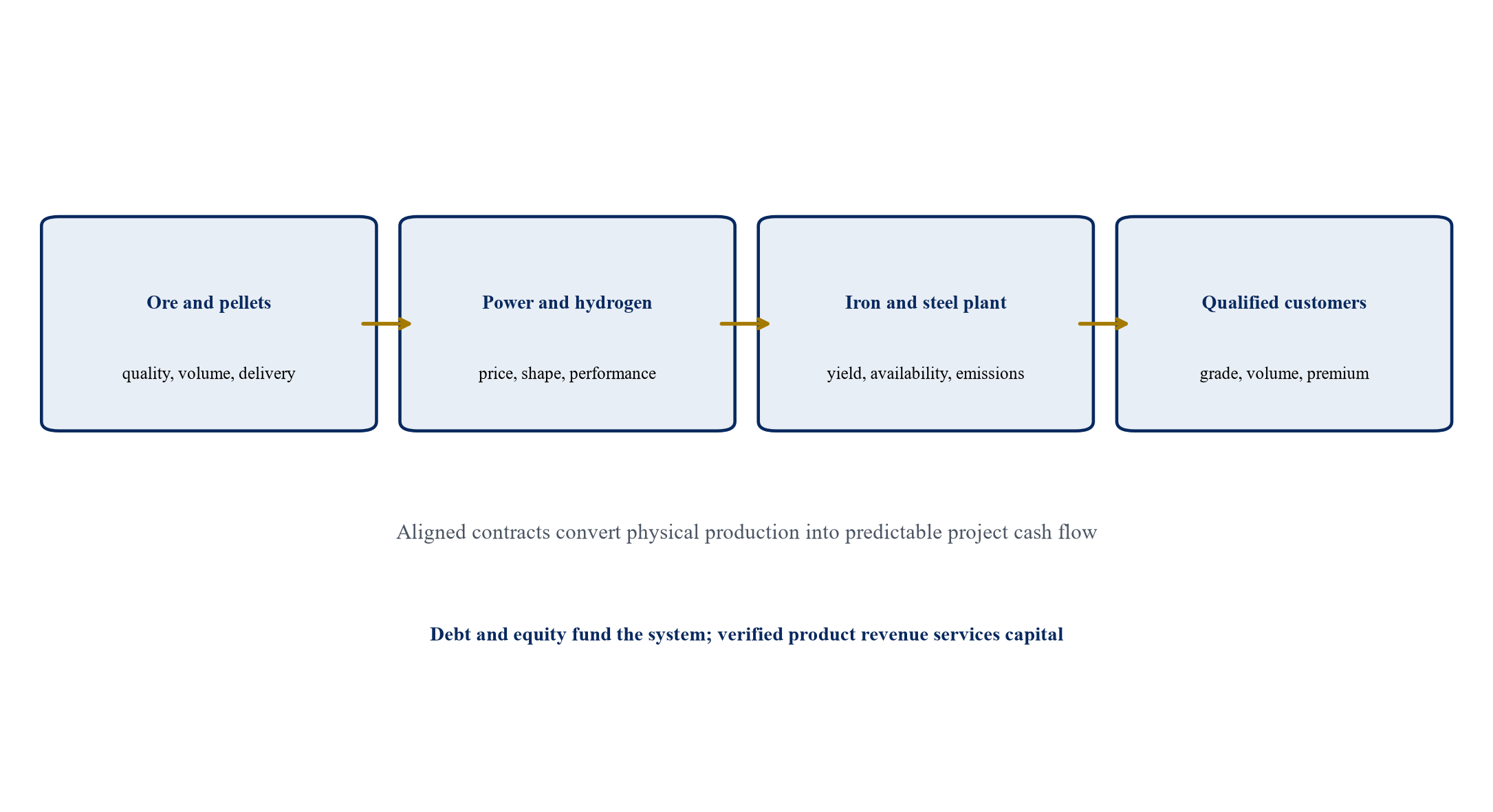
Proposed decision framework based on the sources and analysis in this paper.
Table 1. Illustrative sources and uses for an integrated green-steel project
| Uses | Share of uses | Sources | Share of sources |
|---|---|---|---|
| Renewable power and grid | 22% | Sponsor and strategic equity | 38% |
| Electrolyser, storage and hydrogen systems | 21% | Senior project debt | 34% |
| Ore preparation and direct reduction | 19% | Public capital support | 12% |
| Electric furnace and finishing | 20% | Subordinated or concessional debt | 9% |
| Logistics, owner cost and working capital | 8% | Customer and supplier capital | 7% |
| Contingency and financing cost | 10% | Total | 100% |
| Total | 100% |
Wholly hypothetical percentages; they describe no identified project and do not constitute a cost estimate.
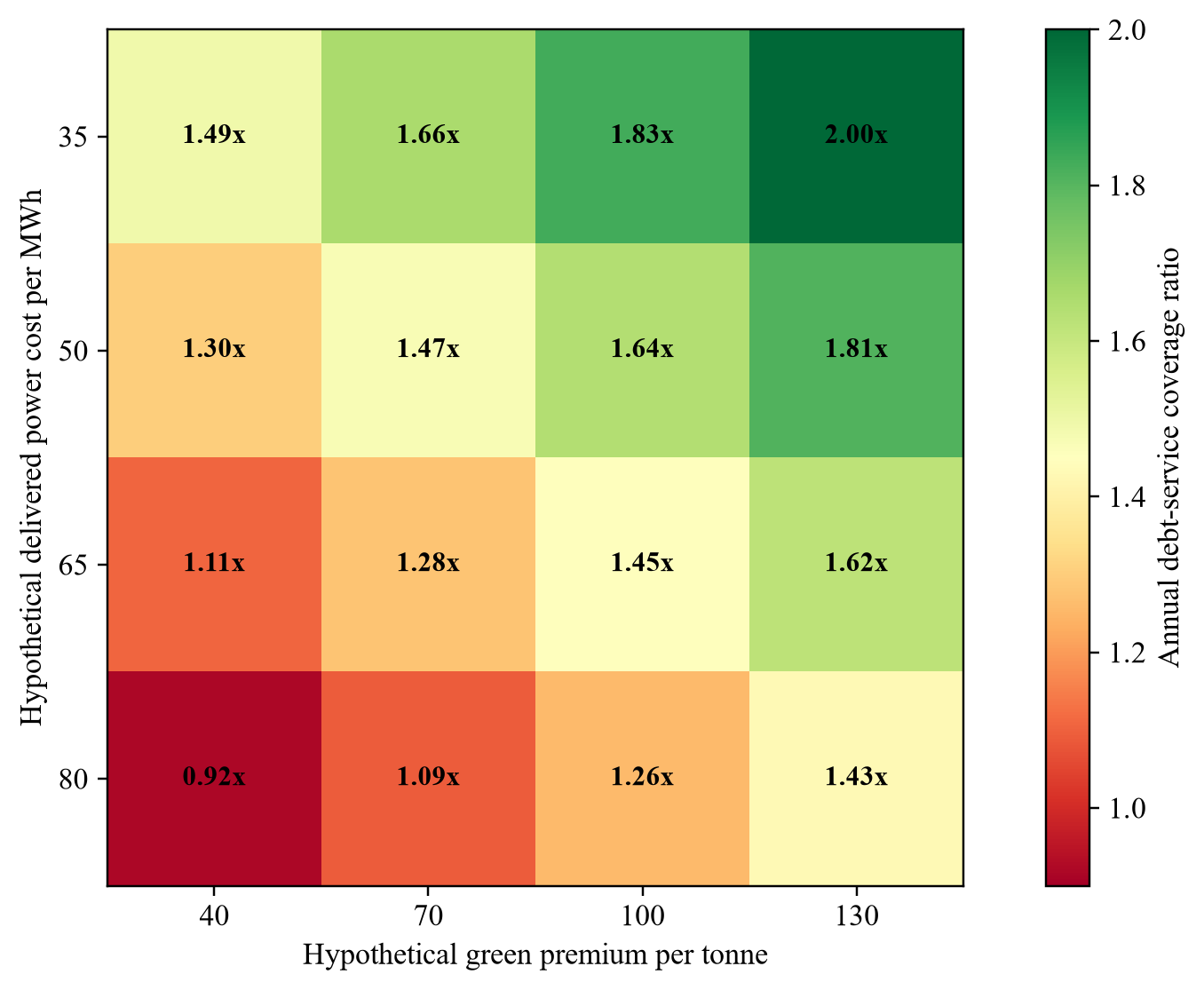
Wholly hypothetical; the values describe no identified company or project.
Table 2. Contract risk-allocation matrix
| Exposure | Primary control | Contract mechanism | Residual financing concern |
|---|---|---|---|
| Ore quality and delivery | ore supplier and producer | specification, assay, adjustment, rejection and replacement | concentration and reserve confidence |
| Power price and shape | generator, utility and producer | portfolio price, volume bands, balancing and curtailment | basis, tenor and grid outage |
| Hydrogen performance | technology and operating parties | output, efficiency, availability, replacement and damages | integrated ramp and supply chain |
| Plant completion | contractors and sponsors | tests, security, contingency, cure and sponsor support | interface gaps and schedule |
| Product qualification | producer and customer | trial plan, grades, acceptance and ramp volumes | delayed premium revenue |
| Emissions claim | producer, verifier and customer | boundary, data, assurance, threshold and remedy | methodology or policy change |
| Customer demand | customer and producer | minimum volume, take-or-pay, price floor and credit support | renewal and concentration |
Proposed framework; transaction-specific legal and technical advice is required.
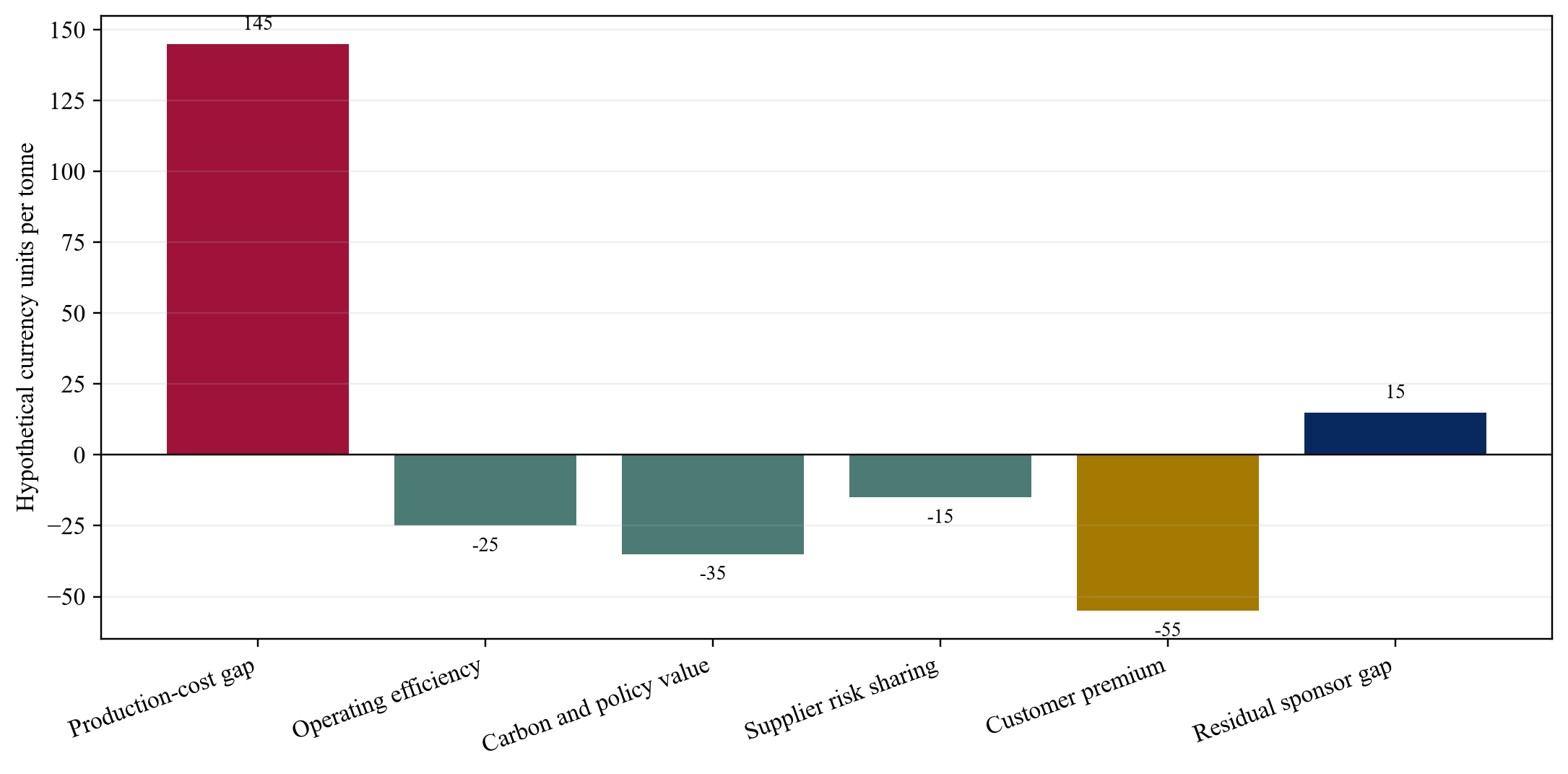
Wholly hypothetical; values describe no identified transaction.
Table 3. Investment gates for a green-steel development
| Gate | Minimum evidence | Maximum cumulative capital at risk | Decision |
|---|---|---|---|
| Product and route | target products, emissions boundary, site and route screen | 0.2% | select development case |
| Integrated concept | ore tests, power and water studies, technology and customer engagement | 1.5% | approve front-end work |
| Bankable definition | front-end engineering, permits, term sheets, cost and schedule | 5% | approve conditional commitments |
| Final investment | funding, contracts, contingency, governance and completion plan | 100% | issue notice to proceed |
| Completion | integrated performance, qualification and assurance | retained capital | release support or require cure |
| Expansion | measured operation and updated market case | next phase budget | expand, redesign or stop |
Proposed governance framework; percentages are hypothetical caps on new capital at risk.
Appendix A Questions for the investment committee
1. Which product, grade, delivery point and emissions boundary define the low-emissions offer?
2. Which ore tests support the direct-reduction performance case?
3. What is the complete delivered-power cost and shape after grid, balancing and firming?
4. Which hydrogen-output, efficiency and replacement assumptions are contractually supported?
5. How are integrated completion and ramp funded and tested?
6. Which customer volumes, prices, qualification milestones and credit support are binding?
7. How does the sales contract share carbon-policy value and methodology change?
8. Which costs remain exposed after power, ore and offtake contracts?
9. What minimum premium, utilisation and contract tenor protect debt service?
10. Which support is approved, conditional, delayed or subject to clawback?
11. Where do contract tenors, termination payments and renewal dates misalign?
12. What evidence triggers each capital commitment and reapproval?
References
- International Energy Agency, Breakthrough Agenda Report 2025: Steel, 2025. https://www.iea.org/reports/breakthrough-agenda-report-2025/steel
- Organisation for Economic Co-operation and Development, OECD Steel Outlook 2025: Steel decarbonisation efforts challenged by excess capacity, 2025. https://www.oecd.org/en/publications/oecd-steel-outlook-2025_28b61a5e-en/full-report/steel-decarbonisation-efforts-challenged-by-excess-capacity_1d8e1abc.html
- European Commission, Carbon Border Adjustment Mechanism definitive regime, accessed 2 October 2026. https://taxation-customs.ec.europa.eu/carbon-border-adjustment-mechanism/cbam-definitive-regime_en
- International Energy Agency, Iron and Steel Technology Roadmap, 2020. https://www.iea.org/reports/iron-and-steel-technology-roadmap
- United Nations Industrial Development Organization, Industrial Deep Decarbonisation Initiative, accessed 2 October 2026. https://www.unido.org/IDDI
- Organisation for Economic Co-operation and Development, Addressing steel decarbonisation challenges for industry and policy, 2024. https://www.oecd.org/content/dam/oecd/en/publications/reports/2024/12/addressing-steel-decarbonisation-challenges-for-industry-and-policy_4caf7860/e6cb2f3c-en.pdf
- European Commission, Carbon Border Adjustment Mechanism entered into force on 1 January 2026, 14 January 2026. https://taxation-customs.ec.europa.eu/news/cbam-successfully-entered-force-1-january-2026-2026-01-14_en
- United Nations Industrial Development Organization, Green Public Procurement Guide: How to set commitments to buy low and near-zero emission concrete, steel and construction projects, 2024. https://decarbonization.unido.org/wp-content/uploads/2024/11/final_iddi-gpp-guide_-setting-commitments.pdf
- International Renewable Energy Agency, Green hydrogen cost reduction: Scaling up electrolysers to meet the 1.5 degree climate goal, 2020. https://www.irena.org/publications/2020/Dec/Green-hydrogen-cost-reduction
- IFRS Foundation, IAS 36 Impairment of Assets, accessed 2 October 2026. https://www.ifrs.org/issued-standards/list-of-standards/ias-36-impairment-of-assets/
- International Valuation Standards Council, International Valuation Standards, effective 31 January 2025. https://www.ivsc.org/standards/
About the Author
Authored by Chennakeshav Adya Independent Researcher
Chennakeshav (CK) is a corporate finance and investment banking executive with 25+ years of global experience in deal origination, structuring and execution across M&A, growth capital and corporate strategy. He has led value-creation mandates for founders, corporates and funds — bridging the boardroom view to hands-on execution and close.
His career spans Morgan Stanley, HSBC, Lloyds Banking Group, EWEC, ADQ portfolio companies and Emirates Growth Fund, across TMT, real estate, fintech, deeptech, cleantech, infrastructure and energy. He has partnered with C-suite leaders, private equity and venture funds, sovereign wealth funds and family offices to finance complex fund raises and scale-up ventures, and has led M&A due diligence, post-merger integration and business-transformation initiatives to create value.
At Matchpoint Partners he is Managing Partner, leading the firm's corporate finance, M&A and capital-raising practice. He holds an MBA from London Business School, an engineering degree from VTU and a Master of Laws (LLM, in progress) from UCL London.
An active start-up mentor, CK mentors at Techstars, DIFC FinTech Hive, Startup Grind, Founder Institute and IN5, serves as Entrepreneur Mentor in Residence (EMiR) at London Business School, and judges the Entrepreneurship World Cup.
Matchpoint profile: https://www.matchpoint-partners.com/team/ck-adya.html LinkedIn: https://www.linkedin.com/in/ckadya/
