

1. Define the investment decision
System operators, networks and asset owners must decide how much grid-forming capability is required, where it is needed and whether it should be mandated, procured or co-optimised with energy and storage. The decision should connect measurable system need to qualified technical performance and financeable revenue.
The evidence package should reconcile system study, technical specification, validated model, site test, operating envelope and commercial obligation. Vendor claims and management estimates should remain distinguished from observed field performance.
A financeable service has measurable need, technology-neutral requirements, credible tests and predictable settlement. Procurement should preserve competition while recognising locational and first-of-a-kind constraints.
2. Map the changing system
Retiring synchronous generation reduces rotating mass, fault current and voltage-source behaviour while inverter-based resources grow. Planning should identify the operating conditions and locations where stability constraints become binding.
The valuation should separate required connection capability from incremental procured service. Dependable quantity, availability, location, energy headroom, opportunity cost and technology risk should be measured under common scenarios.
The board and system operator should see low-inertia, weak-grid, non-delivery, vendor-failure and market-reform cases. The preferred portfolio should remain secure and economically defensible across credible conditions.
3. Separate stability services
Inertia-like response, phase-jump power, fault current, voltage control, damping, system strength, island operation and restoration are distinct capabilities. A single grid-forming label should not substitute for product-specific performance.
The financing model should connect qualified performance to enforceable revenue and downside coverage. Accreditation, warranty, cyber, degradation and change-in-requirement risks should have accountable owners and contractual controls.
Implementation should translate the framework into planning, modelling, procurement, accreditation, operations and finance workstreams. Capital commitment should follow readiness gates and field evidence.
4. Define the counterfactual
The counterfactual may use synchronous generation, synchronous condensers, network reinforcement, operational constraints or curtailment. Value should be measured against the least-cost secure alternative.
The evidence package should reconcile system study, technical specification, validated model, site test, operating envelope and commercial obligation. Vendor claims and management estimates should remain distinguished from observed field performance.
A financeable service has measurable need, technology-neutral requirements, credible tests and predictable settlement. Procurement should preserve competition while recognising locational and first-of-a-kind constraints.
5. Quantify inertia need
Frequency stability depends on credible loss, system inertia, primary response and load behaviour. Procurement should specify the response characteristic and operating envelope rather than an unsupported equivalent-inertia claim.
The valuation should separate required connection capability from incremental procured service. Dependable quantity, availability, location, energy headroom, opportunity cost and technology risk should be measured under common scenarios.
The board and system operator should see low-inertia, weak-grid, non-delivery, vendor-failure and market-reform cases. The preferred portfolio should remain secure and economically defensible across credible conditions.
Table 1. Stability-service evidence map
| Service | System need | Qualification evidence | Commercial unit | Principal risk |
|---|---|---|---|---|
| Inertia-like response | Limit frequency change after disturbance | Validated RoCoF response across operating envelope | MW response characteristic and availability | Headroom and saturation |
| Phase-jump power | Maintain stability after angle disturbance | EMT model and site test | Qualified capability and availability | Control interaction |
| Fault-current contribution | Operate protection and support voltage recovery | Sequence, magnitude, duration and waveform tests | Event capability and availability | Current limit and protection mismatch |
| Voltage and system strength | Support weak-grid operation | Frequency-domain and EMT studies | Locational capability | Network change and model error |
| Restoration | Energise and sustain islands | Black-start and load-pickup test | Availability and successful event | Auxiliary power and coordination |
Exact requirements remain system-specific and require validated studies and tests.
6. Quantify RoCoF response
Active power response to rate of change of frequency can reduce frequency excursions. The model should capture measurement, delay, saturation, energy headroom and interactions with other controls.
The financing model should connect qualified performance to enforceable revenue and downside coverage. Accreditation, warranty, cyber, degradation and change-in-requirement risks should have accountable owners and contractual controls.
Implementation should translate the framework into planning, modelling, procurement, accreditation, operations and finance workstreams. Capital commitment should follow readiness gates and field evidence.
7. Quantify phase-jump response
A phase-angle disturbance can demand rapid active-power response. Capability should be demonstrated across credible network strength and operating conditions.
The evidence package should reconcile system study, technical specification, validated model, site test, operating envelope and commercial obligation. Vendor claims and management estimates should remain distinguished from observed field performance.
A financeable service has measurable need, technology-neutral requirements, credible tests and predictable settlement. Procurement should preserve competition while recognising locational and first-of-a-kind constraints.
8. Quantify fault-current contribution
Protection-quality current requires adequate magnitude, duration, sequence content and waveform properties. AEMO's current trial illustrates the need for evidence before this service is relied upon at scale.
The valuation should separate required connection capability from incremental procured service. Dependable quantity, availability, location, energy headroom, opportunity cost and technology risk should be measured under common scenarios.
The board and system operator should see low-inertia, weak-grid, non-delivery, vendor-failure and market-reform cases. The preferred portfolio should remain secure and economically defensible across credible conditions.
9. Quantify voltage support
Grid-forming controls can establish voltage and support weak-grid operation. Reactive current limits, transformer impedance, network strength and recovery after faults determine useful performance.
The financing model should connect qualified performance to enforceable revenue and downside coverage. Accreditation, warranty, cyber, degradation and change-in-requirement risks should have accountable owners and contractual controls.
Implementation should translate the framework into planning, modelling, procurement, accreditation, operations and finance workstreams. Capital commitment should follow readiness gates and field evidence.
10. Quantify oscillation damping
Controls can damp or amplify network and converter interactions. Small-signal and electromagnetic-transient studies should cover multiple vendors, operating points and credible contingencies.
The evidence package should reconcile system study, technical specification, validated model, site test, operating envelope and commercial obligation. Vendor claims and management estimates should remain distinguished from observed field performance.
A financeable service has measurable need, technology-neutral requirements, credible tests and predictable settlement. Procurement should preserve competition while recognising locational and first-of-a-kind constraints.
11. Define black-start capability
Restoration requires energisation, voltage build-up, load pickup, island control, synchronisation and resilience. Grid-forming capability is necessary for some designs but does not alone prove a complete restoration service.
The valuation should separate required connection capability from incremental procured service. Dependable quantity, availability, location, energy headroom, opportunity cost and technology risk should be measured under common scenarios.
The board and system operator should see low-inertia, weak-grid, non-delivery, vendor-failure and market-reform cases. The preferred portfolio should remain secure and economically defensible across credible conditions.
12. Compare synchronous condensers
Synchronous condensers provide physical inertia, fault current, reactive power and familiar protection behaviour. Their capex, losses, maintenance, construction time and locational value should be compared with inverter options.
The financing model should connect qualified performance to enforceable revenue and downside coverage. Accreditation, warranty, cyber, degradation and change-in-requirement risks should have accountable owners and contractual controls.
Implementation should translate the framework into planning, modelling, procurement, accreditation, operations and finance workstreams. Capital commitment should follow readiness gates and field evidence.
13. Compare grid-forming batteries
Batteries can combine grid-forming controls with active-power headroom and energy services. Duration, state of charge, degradation and energy-market opportunity cost affect stability availability.
The evidence package should reconcile system study, technical specification, validated model, site test, operating envelope and commercial obligation. Vendor claims and management estimates should remain distinguished from observed field performance.
A financeable service has measurable need, technology-neutral requirements, credible tests and predictable settlement. Procurement should preserve competition while recognising locational and first-of-a-kind constraints.
14. Compare grid-forming wind
Wind converters can provide grid-forming behaviour subject to turbine, converter and resource constraints. Commercial value depends on available power, control mode, headroom and warranty.
The valuation should separate required connection capability from incremental procured service. Dependable quantity, availability, location, energy headroom, opportunity cost and technology risk should be measured under common scenarios.
The board and system operator should see low-inertia, weak-grid, non-delivery, vendor-failure and market-reform cases. The preferred portfolio should remain secure and economically defensible across credible conditions.
15. Compare grid-forming solar
Solar and co-located storage can provide voltage-source behaviour when irradiance, headroom and DC-energy support are adequate. Night-time and low-resource operation require explicit design.
The financing model should connect qualified performance to enforceable revenue and downside coverage. Accreditation, warranty, cyber, degradation and change-in-requirement risks should have accountable owners and contractual controls.
Implementation should translate the framework into planning, modelling, procurement, accreditation, operations and finance workstreams. Capital commitment should follow readiness gates and field evidence.
16. Compare STATCOM and power-electronic devices
Converter-based network devices can provide rapid voltage and stability support. Active-power services require an energy source or stored energy beyond reactive capability.
The evidence package should reconcile system study, technical specification, validated model, site test, operating envelope and commercial obligation. Vendor claims and management estimates should remain distinguished from observed field performance.
A financeable service has measurable need, technology-neutral requirements, credible tests and predictable settlement. Procurement should preserve competition while recognising locational and first-of-a-kind constraints.
17. Compare VSC-HVDC capability
Voltage-source converters can support connected AC systems and restoration under defined configurations. Contracting should separate mandatory link performance from incremental system services.
The valuation should separate required connection capability from incremental procured service. Dependable quantity, availability, location, energy headroom, opportunity cost and technology risk should be measured under common scenarios.
The board and system operator should see low-inertia, weak-grid, non-delivery, vendor-failure and market-reform cases. The preferred portfolio should remain secure and economically defensible across credible conditions.
18. Build a hybrid portfolio
Synchronous condensers, grid-forming batteries, network devices and retained generation can cover different services and locations. Portfolio design should manage common-mode and vendor-control risk.
The financing model should connect qualified performance to enforceable revenue and downside coverage. Accreditation, warranty, cyber, degradation and change-in-requirement risks should have accountable owners and contractual controls.
Implementation should translate the framework into planning, modelling, procurement, accreditation, operations and finance workstreams. Capital commitment should follow readiness gates and field evidence.
19. Specify the operating envelope
Performance should be defined across power, reactive output, state of charge, voltage, frequency, system strength and temperature. A narrow test point can overstate dependable capability.
The evidence package should reconcile system study, technical specification, validated model, site test, operating envelope and commercial obligation. Vendor claims and management estimates should remain distinguished from observed field performance.
A financeable service has measurable need, technology-neutral requirements, credible tests and predictable settlement. Procurement should preserve competition while recognising locational and first-of-a-kind constraints.
20. Set minimum technical requirements
Connection requirements establish a baseline, while procured services may demand higher performance. Mandates and markets should avoid paying twice for the same obligation.
The valuation should separate required connection capability from incremental procured service. Dependable quantity, availability, location, energy headroom, opportunity cost and technology risk should be measured under common scenarios.
The board and system operator should see low-inertia, weak-grid, non-delivery, vendor-failure and market-reform cases. The preferred portfolio should remain secure and economically defensible across credible conditions.
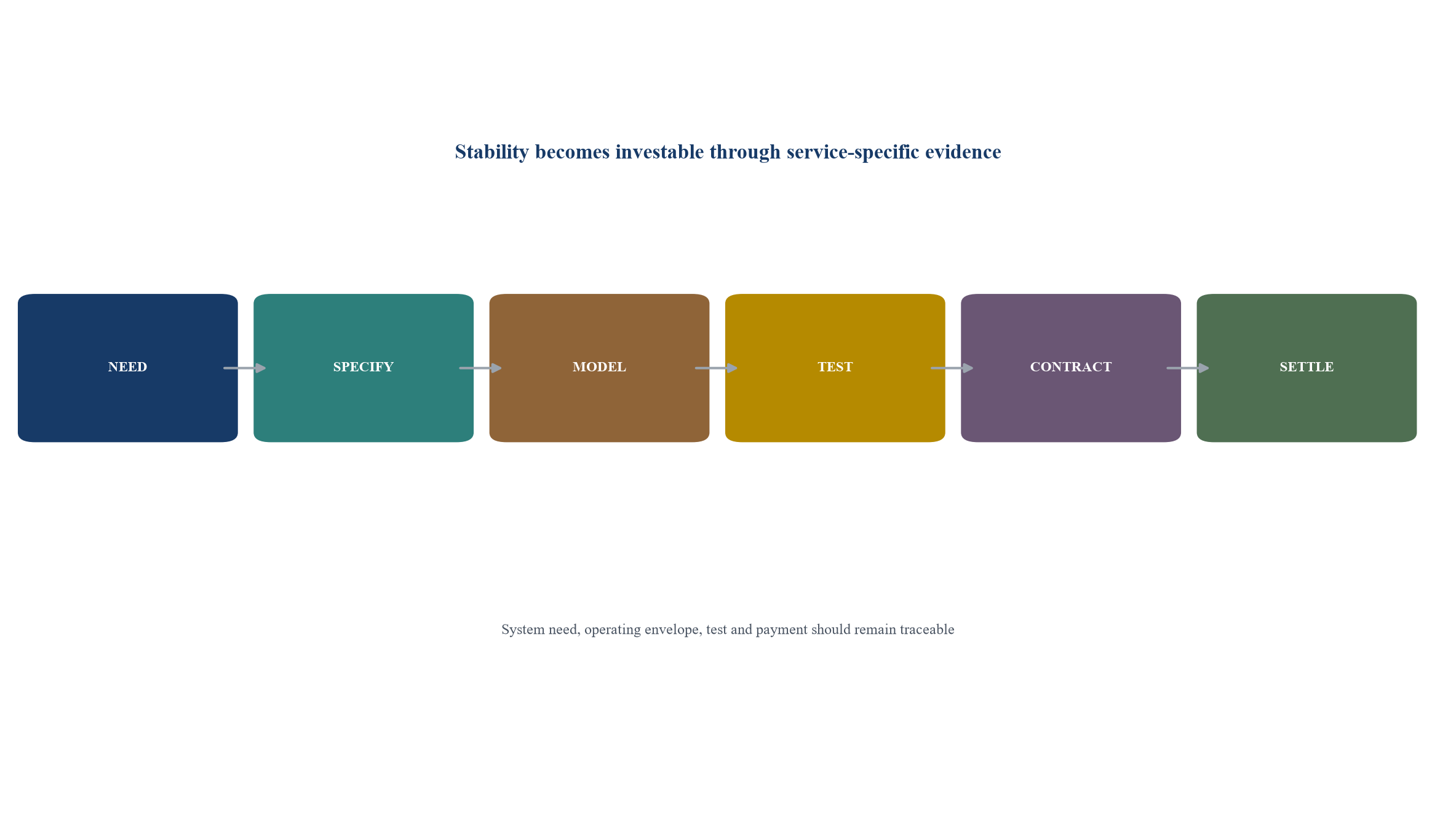
Commercial value requires evidence from system need through qualified settlement.
21. Design model validation
RMS, positive-sequence, frequency-domain and electromagnetic-transient models serve different questions. Validation should reconcile simulation, hardware tests, site commissioning and field events.
The financing model should connect qualified performance to enforceable revenue and downside coverage. Accreditation, warranty, cyber, degradation and change-in-requirement risks should have accountable owners and contractual controls.
Implementation should translate the framework into planning, modelling, procurement, accreditation, operations and finance workstreams. Capital commitment should follow readiness gates and field evidence.
22. Test interoperability
Multiple grid-forming and grid-following controls can interact. System studies should include vendor diversity, communication failure, protection, current limits and mode transitions.
The evidence package should reconcile system study, technical specification, validated model, site test, operating envelope and commercial obligation. Vendor claims and management estimates should remain distinguished from observed field performance.
A financeable service has measurable need, technology-neutral requirements, credible tests and predictable settlement. Procurement should preserve competition while recognising locational and first-of-a-kind constraints.
23. Redesign protection where needed
Lower or controlled fault current can challenge legacy relays. Protection changes, communications and fault-current products should be planned with the stability portfolio.
The valuation should separate required connection capability from incremental procured service. Dependable quantity, availability, location, energy headroom, opportunity cost and technology risk should be measured under common scenarios.
The board and system operator should see low-inertia, weak-grid, non-delivery, vendor-failure and market-reform cases. The preferred portfolio should remain secure and economically defensible across credible conditions.
24. Manage energy headroom
Active-power response requires upward or downward headroom and sufficient energy. Reservation reduces energy-market revenue and should be included in service cost.
The financing model should connect qualified performance to enforceable revenue and downside coverage. Accreditation, warranty, cyber, degradation and change-in-requirement risks should have accountable owners and contractual controls.
Implementation should translate the framework into planning, modelling, procurement, accreditation, operations and finance workstreams. Capital commitment should follow readiness gates and field evidence.
25. Model current saturation
Inverter current limits can force trade-offs between active and reactive response during faults. Control priorities should be specified and tested under credible disturbances.
The evidence package should reconcile system study, technical specification, validated model, site test, operating envelope and commercial obligation. Vendor claims and management estimates should remain distinguished from observed field performance.
A financeable service has measurable need, technology-neutral requirements, credible tests and predictable settlement. Procurement should preserve competition while recognising locational and first-of-a-kind constraints.
26. Define response duration
Sub-cycle response, seconds of inertia-like support and longer balancing energy address different system needs. Payment and testing should match the required duration.
The valuation should separate required connection capability from incremental procured service. Dependable quantity, availability, location, energy headroom, opportunity cost and technology risk should be measured under common scenarios.
The board and system operator should see low-inertia, weak-grid, non-delivery, vendor-failure and market-reform cases. The preferred portfolio should remain secure and economically defensible across credible conditions.
27. Value locational need
System strength and voltage stability are often local or regional. Procurement zones should follow electrical need and should be reviewed as the network changes.
The financing model should connect qualified performance to enforceable revenue and downside coverage. Accreditation, warranty, cyber, degradation and change-in-requirement risks should have accountable owners and contractual controls.
Implementation should translate the framework into planning, modelling, procurement, accreditation, operations and finance workstreams. Capital commitment should follow readiness gates and field evidence.
28. Build the stability requirement forecast
Forecasts should combine generation retirements, inverter connections, network outages, demand, interconnectors and operating patterns. Uncertainty supports staged procurement and periodic recalibration.
The evidence package should reconcile system study, technical specification, validated model, site test, operating envelope and commercial obligation. Vendor claims and management estimates should remain distinguished from observed field performance.
A financeable service has measurable need, technology-neutral requirements, credible tests and predictable settlement. Procurement should preserve competition while recognising locational and first-of-a-kind constraints.
29. Set the procurement product
The product should define capability, availability, location, tests, telemetry, dispatch, outages and penalties. Technology-neutral specifications improve competition where equivalence can be demonstrated.
The valuation should separate required connection capability from incremental procured service. Dependable quantity, availability, location, energy headroom, opportunity cost and technology risk should be measured under common scenarios.
The board and system operator should see low-inertia, weak-grid, non-delivery, vendor-failure and market-reform cases. The preferred portfolio should remain secure and economically defensible across credible conditions.
30. Use competitive tenders
Tenders can reveal cost and bring forward new assets when requirements and contract tenure are clear. Bid assessment should compare service portfolios, dependencies and total system cost.
The financing model should connect qualified performance to enforceable revenue and downside coverage. Accreditation, warranty, cyber, degradation and change-in-requirement risks should have accountable owners and contractual controls.
Implementation should translate the framework into planning, modelling, procurement, accreditation, operations and finance workstreams. Capital commitment should follow readiness gates and field evidence.
Table 2. Technology and commercial comparison
| Option | Stability capability | Energy source | Revenue profile | Key diligence |
|---|---|---|---|---|
| Synchronous condenser | Physical inertia, fault current and reactive support | Grid losses and auxiliaries | Long-term availability | Location, losses and outage |
| Grid-forming battery | Fast active and reactive response | Stored energy | Availability plus stacked markets | State of charge, degradation and controls |
| Grid-forming wind or solar | Converter response with resource constraints | Renewable resource and headroom | Energy plus incremental service | Warranty, headroom and night operation |
| Power-electronic network device | Voltage and control support | DC link or limited stored energy | Regulated or contracted availability | Active-power duration and interoperability |
| Hybrid portfolio | Complementary physical and inverter services | Multiple | Diversified contracted and market | Coordination and common-mode risk |
Ratings are qualitative and project-specific; detailed engineering remains necessary.
31. Use enduring markets
Regular markets can adapt volumes and prices as need changes. Participation rules, accreditation, clearing and performance monitoring require sufficient liquidity and standardisation.
The evidence package should reconcile system study, technical specification, validated model, site test, operating envelope and commercial obligation. Vendor claims and management estimates should remain distinguished from observed field performance.
A financeable service has measurable need, technology-neutral requirements, credible tests and predictable settlement. Procurement should preserve competition while recognising locational and first-of-a-kind constraints.
32. Use bilateral contracts selectively
Bilateral procurement can support first-of-a-kind or location-specific solutions. Price discovery and change control need governance where competition is limited.
The valuation should separate required connection capability from incremental procured service. Dependable quantity, availability, location, energy headroom, opportunity cost and technology risk should be measured under common scenarios.
The board and system operator should see low-inertia, weak-grid, non-delivery, vendor-failure and market-reform cases. The preferred portfolio should remain secure and economically defensible across credible conditions.
33. Choose availability payments
Grid-forming services may be delivered continuously when an asset is connected, as NESO notes for grid-forming batteries. Availability payment can align with this service when performance is independently verified.
The financing model should connect qualified performance to enforceable revenue and downside coverage. Accreditation, warranty, cyber, degradation and change-in-requirement risks should have accountable owners and contractual controls.
Implementation should translate the framework into planning, modelling, procurement, accreditation, operations and finance workstreams. Capital commitment should follow readiness gates and field evidence.
34. Define utilisation payments
Some services require instruction or measurable activation. Utilisation payment should avoid duplicating availability revenue and should reflect incremental energy, degradation and opportunity cost.
The evidence package should reconcile system study, technical specification, validated model, site test, operating envelope and commercial obligation. Vendor claims and management estimates should remain distinguished from observed field performance.
A financeable service has measurable need, technology-neutral requirements, credible tests and predictable settlement. Procurement should preserve competition while recognising locational and first-of-a-kind constraints.
35. Set performance deductions
Deductions should reflect unavailable capability, failed tests, outages and non-delivery. Caps and cure rights should preserve proportionality while protecting system security.
The valuation should separate required connection capability from incremental procured service. Dependable quantity, availability, location, energy headroom, opportunity cost and technology risk should be measured under common scenarios.
The board and system operator should see low-inertia, weak-grid, non-delivery, vendor-failure and market-reform cases. The preferred portfolio should remain secure and economically defensible across credible conditions.
36. Build the capex model
Capex includes converters, controls, storage, transformers, connection, protection, modelling, testing, cyber and owner cost. Incremental grid-forming cost should be separated from the host asset.
The financing model should connect qualified performance to enforceable revenue and downside coverage. Accreditation, warranty, cyber, degradation and change-in-requirement risks should have accountable owners and contractual controls.
Implementation should translate the framework into planning, modelling, procurement, accreditation, operations and finance workstreams. Capital commitment should follow readiness gates and field evidence.
37. Build the operating-cost model
Software, maintenance, testing, monitoring, insurance, warranties, energy losses and specialist support create lifecycle cost. Vendor licence and upgrade terms should remain visible.
The evidence package should reconcile system study, technical specification, validated model, site test, operating envelope and commercial obligation. Vendor claims and management estimates should remain distinguished from observed field performance.
A financeable service has measurable need, technology-neutral requirements, credible tests and predictable settlement. Procurement should preserve competition while recognising locational and first-of-a-kind constraints.
38. Measure avoided system cost
Benefits can include reduced must-run generation, fewer synchronous condensers, lower curtailment, faster connections, improved restoration and deferred reinforcement. Each benefit needs an attributable counterfactual.
The valuation should separate required connection capability from incremental procured service. Dependable quantity, availability, location, energy headroom, opportunity cost and technology risk should be measured under common scenarios.
The board and system operator should see low-inertia, weak-grid, non-delivery, vendor-failure and market-reform cases. The preferred portfolio should remain secure and economically defensible across credible conditions.
39. Co-optimise energy and stability
Energy, frequency, reserve, capacity and stability commitments share converter, current and energy limits. Dispatch and valuation should prevent double counting.
The financing model should connect qualified performance to enforceable revenue and downside coverage. Accreditation, warranty, cyber, degradation and change-in-requirement risks should have accountable owners and contractual controls.
Implementation should translate the framework into planning, modelling, procurement, accreditation, operations and finance workstreams. Capital commitment should follow readiness gates and field evidence.
40. Stack revenues with controls
Revenue stacking can improve financeability when service obligations are compatible. Contract priority, availability windows, dispatch rights and default consequences should be explicit.
The evidence package should reconcile system study, technical specification, validated model, site test, operating envelope and commercial obligation. Vendor claims and management estimates should remain distinguished from observed field performance.
A financeable service has measurable need, technology-neutral requirements, credible tests and predictable settlement. Procurement should preserve competition while recognising locational and first-of-a-kind constraints.
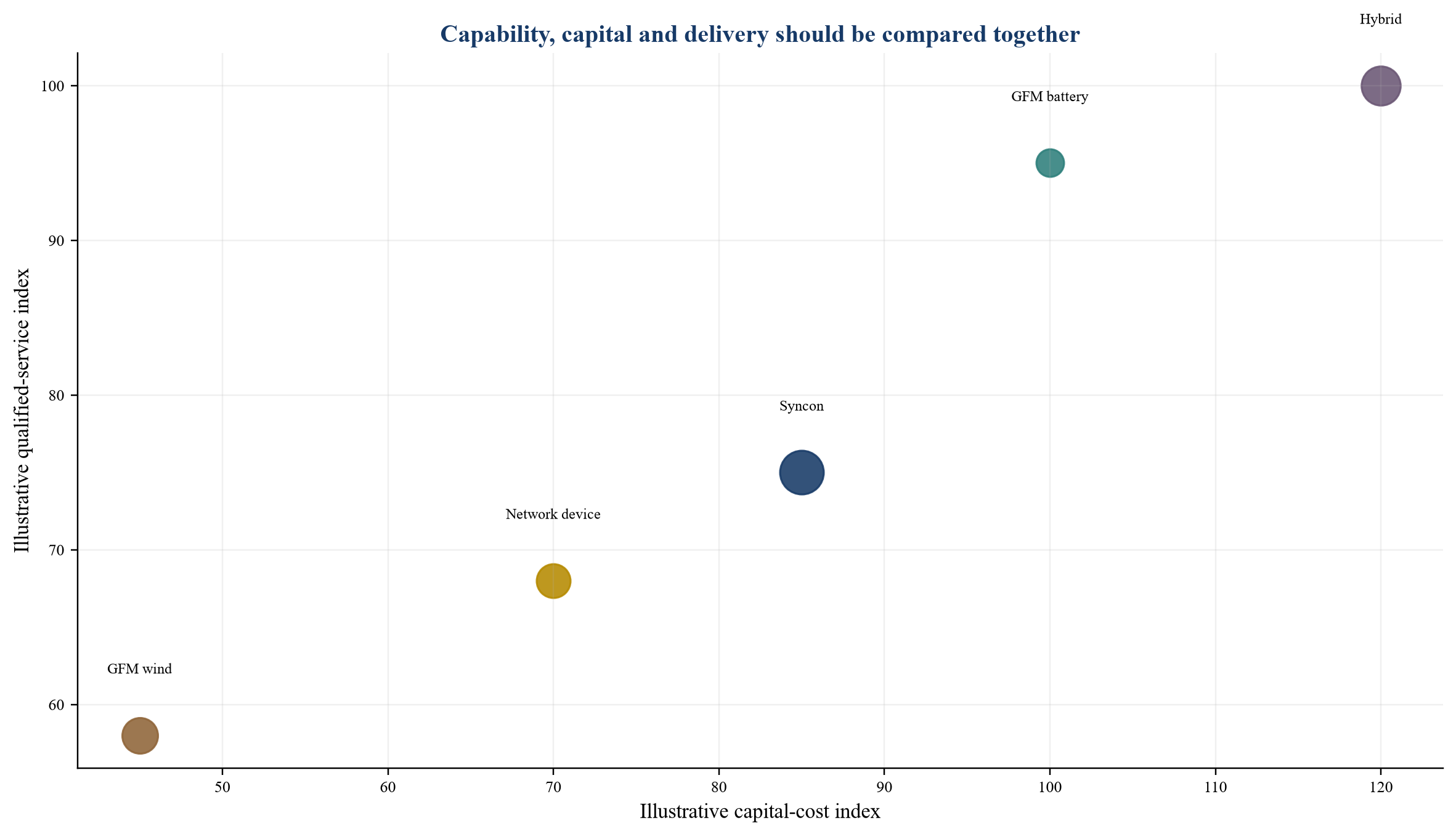
Values are hypothetical management assumptions used solely to demonstrate trade-offs.
41. Price opportunity cost
Providing headroom or maintaining state of charge may displace energy and ancillary-service earnings. Bids should include the foregone margin under expected and stressed conditions.
The valuation should separate required connection capability from incremental procured service. Dependable quantity, availability, location, energy headroom, opportunity cost and technology risk should be measured under common scenarios.
The board and system operator should see low-inertia, weak-grid, non-delivery, vendor-failure and market-reform cases. The preferred portfolio should remain secure and economically defensible across credible conditions.
42. Model battery degradation
Stability services can cause cycling, high-power events and calendar exposure. Degradation should be linked to duty cycle, warranty and augmentation rather than assumed negligible.
The financing model should connect qualified performance to enforceable revenue and downside coverage. Accreditation, warranty, cyber, degradation and change-in-requirement risks should have accountable owners and contractual controls.
Implementation should translate the framework into planning, modelling, procurement, accreditation, operations and finance workstreams. Capital commitment should follow readiness gates and field evidence.
43. Create revenue certainty
Long-term tenders can support financing while short markets adapt to need. A blended structure can combine contracted base revenue with merchant upside and periodic volume review.
The evidence package should reconcile system study, technical specification, validated model, site test, operating envelope and commercial obligation. Vendor claims and management estimates should remain distinguished from observed field performance.
A financeable service has measurable need, technology-neutral requirements, credible tests and predictable settlement. Procurement should preserve competition while recognising locational and first-of-a-kind constraints.
44. Set contract tenor
Tenor should reflect asset life, technology maturity, forecast confidence and financing need. Short contracts can underwrite little capex, while long contracts require reopeners and performance evolution.
The valuation should separate required connection capability from incremental procured service. Dependable quantity, availability, location, energy headroom, opportunity cost and technology risk should be measured under common scenarios.
The board and system operator should see low-inertia, weak-grid, non-delivery, vendor-failure and market-reform cases. The preferred portfolio should remain secure and economically defensible across credible conditions.
45. Allocate technology risk
The asset owner generally bears design and performance risk, while the system operator specifies need and tests. First-of-a-kind uncertainty may justify pilots, staged acceptance and shared learning.
The financing model should connect qualified performance to enforceable revenue and downside coverage. Accreditation, warranty, cyber, degradation and change-in-requirement risks should have accountable owners and contractual controls.
Implementation should translate the framework into planning, modelling, procurement, accreditation, operations and finance workstreams. Capital commitment should follow readiness gates and field evidence.
46. Manage vendor concentration
Proprietary controls, models and service tools can create dependency. Source-code escrow, model access, data rights, spare capability and transition support should be considered.
The evidence package should reconcile system study, technical specification, validated model, site test, operating envelope and commercial obligation. Vendor claims and management estimates should remain distinguished from observed field performance.
A financeable service has measurable need, technology-neutral requirements, credible tests and predictable settlement. Procurement should preserve competition while recognising locational and first-of-a-kind constraints.
47. Protect cybersecurity
Grid-forming controls and remote access are critical operational systems. Security design should cover identity, firmware, logging, incident response, recovery and supply-chain assurance.
The valuation should separate required connection capability from incremental procured service. Dependable quantity, availability, location, energy headroom, opportunity cost and technology risk should be measured under common scenarios.
The board and system operator should see low-inertia, weak-grid, non-delivery, vendor-failure and market-reform cases. The preferred portfolio should remain secure and economically defensible across credible conditions.
48. Align warranties and market obligations
OEM warranties may restrict control modes, current, cycling or field changes. Service contracts should not require operation that invalidates equipment support.
The financing model should connect qualified performance to enforceable revenue and downside coverage. Accreditation, warranty, cyber, degradation and change-in-requirement risks should have accountable owners and contractual controls.
Implementation should translate the framework into planning, modelling, procurement, accreditation, operations and finance workstreams. Capital commitment should follow readiness gates and field evidence.
49. Use Great Britain evidence
NESO has procured stability through competitive tenders and moved toward enduring Stability Markets. Its requirements distinguish connection-code obligations from higher commercial performance.
The evidence package should reconcile system study, technical specification, validated model, site test, operating envelope and commercial obligation. Vendor claims and management estimates should remain distinguished from observed field performance.
A financeable service has measurable need, technology-neutral requirements, credible tests and predictable settlement. Procurement should preserve competition while recognising locational and first-of-a-kind constraints.
50. Use Australian evidence
AEMO is developing methods to quantify grid-forming system-strength support and is procuring a fault-current trial. The evidence supports staged qualification and service-specific valuation.
The valuation should separate required connection capability from incremental procured service. Dependable quantity, availability, location, energy headroom, opportunity cost and technology risk should be measured under common scenarios.
The board and system operator should see low-inertia, weak-grid, non-delivery, vendor-failure and market-reform cases. The preferred portfolio should remain secure and economically defensible across credible conditions.
Table 3. Hypothetical revenue and debt sensitivity
| Case | Contracted availability revenue | Merchant revenue share | Qualified availability | Minimum debt-service coverage | Decision implication |
|---|---|---|---|---|---|
| Base contract | 70% | 30% | 96% | 1.55x | Financeable with tested performance |
| Accreditation delay | 45% | 30% | 80% | 1.08x | Needs equity and delayed draw |
| Lower merchant prices | 70% | 15% | 96% | 1.37x | Contracted base protects coverage |
| Higher opportunity cost | 70% | 30% | 90% | 1.24x | Reprice headroom commitment |
| Blended long and short contracts | 82% | 18% | 96% | 1.68x | Stronger coverage with reopeners |
All values are hypothetical management assumptions and do not represent an actual asset, market or forecast.
51. Use US research evidence
DOE, NREL and the UNIFI consortium identify modelling, validation, standards, interoperability and commercialisation as central to deployment. Research maturity does not remove project-specific diligence.
The financing model should connect qualified performance to enforceable revenue and downside coverage. Accreditation, warranty, cyber, degradation and change-in-requirement risks should have accountable owners and contractual controls.
Implementation should translate the framework into planning, modelling, procurement, accreditation, operations and finance workstreams. Capital commitment should follow readiness gates and field evidence.
52. Address GCC conditions
Rapid renewable, battery and data-centre growth can create weak-grid and stability needs in specific areas. High temperature, network structure, operating practice and procurement rules should inform design.
The evidence package should reconcile system study, technical specification, validated model, site test, operating envelope and commercial obligation. Vendor claims and management estimates should remain distinguished from observed field performance.
A financeable service has measurable need, technology-neutral requirements, credible tests and predictable settlement. Procurement should preserve competition while recognising locational and first-of-a-kind constraints.
53. Value the asset
Valuation should separate host energy cash flow, contracted stability revenue, merchant upside, incremental capex, degradation, technology risk and terminal obligations.
The valuation should separate required connection capability from incremental procured service. Dependable quantity, availability, location, energy headroom, opportunity cost and technology risk should be measured under common scenarios.
The board and system operator should see low-inertia, weak-grid, non-delivery, vendor-failure and market-reform cases. The preferred portfolio should remain secure and economically defensible across credible conditions.
54. Structure debt
Debt sizing should rely on enforceable availability revenue, tested performance, warranty alignment and downside coverage. Merchant stability prices and unaccredited services should receive conservative credit.
The financing model should connect qualified performance to enforceable revenue and downside coverage. Accreditation, warranty, cyber, degradation and change-in-requirement risks should have accountable owners and contractual controls.
Implementation should translate the framework into planning, modelling, procurement, accreditation, operations and finance workstreams. Capital commitment should follow readiness gates and field evidence.
55. Structure equity
Equity absorbs development, accreditation, technology, merchant and residual-value risk. Return analysis should include opportunity cost and potential changes in mandatory requirements.
The evidence package should reconcile system study, technical specification, validated model, site test, operating envelope and commercial obligation. Vendor claims and management estimates should remain distinguished from observed field performance.
A financeable service has measurable need, technology-neutral requirements, credible tests and predictable settlement. Procurement should preserve competition while recognising locational and first-of-a-kind constraints.
56. Build the risk-allocation matrix
The matrix should assign specification, model, commissioning, availability, market, cyber, warranty and change-in-law risk to parties with control and balance-sheet capacity.
The valuation should separate required connection capability from incremental procured service. Dependable quantity, availability, location, energy headroom, opportunity cost and technology risk should be measured under common scenarios.
The board and system operator should see low-inertia, weak-grid, non-delivery, vendor-failure and market-reform cases. The preferred portfolio should remain secure and economically defensible across credible conditions.
57. Create the contract suite
Connection agreements, stability contracts, energy-market terms, OEM warranties, LTSA, finance documents and data licences should align. Conflicting dispatch and performance obligations require resolution before close.
The financing model should connect qualified performance to enforceable revenue and downside coverage. Accreditation, warranty, cyber, degradation and change-in-requirement risks should have accountable owners and contractual controls.
Implementation should translate the framework into planning, modelling, procurement, accreditation, operations and finance workstreams. Capital commitment should follow readiness gates and field evidence.
58. Create the lender-grade data room
The data room should contain system need, studies, models, tests, contracts, warranties, capex, operating plan, cyber controls and financial cases. Each assumption needs a source and owner.
The evidence package should reconcile system study, technical specification, validated model, site test, operating envelope and commercial obligation. Vendor claims and management estimates should remain distinguished from observed field performance.
A financeable service has measurable need, technology-neutral requirements, credible tests and predictable settlement. Procurement should preserve competition while recognising locational and first-of-a-kind constraints.
59. Run implementation governance
System planning, operations, markets, engineering, procurement, cyber, legal and finance require shared decisions. A controlled baseline should govern service definition, tests, costs and change.
The valuation should separate required connection capability from incremental procured service. Dependable quantity, availability, location, energy headroom, opportunity cost and technology risk should be measured under common scenarios.
The board and system operator should see low-inertia, weak-grid, non-delivery, vendor-failure and market-reform cases. The preferred portfolio should remain secure and economically defensible across credible conditions.
60. Adopt the scorecard and 90-day plan
The final record should state need, services, portfolio, procurement, economics, finance, risks and readiness gates. The first 90 days should close evidence gaps that could change investment.
The financing model should connect qualified performance to enforceable revenue and downside coverage. Accreditation, warranty, cyber, degradation and change-in-requirement risks should have accountable owners and contractual controls.
Implementation should translate the framework into planning, modelling, procurement, accreditation, operations and finance workstreams. Capital commitment should follow readiness gates and field evidence.
Table 4. Illustrative 90-day stability-investment programme
| Period | Workstream | Core actions | Decision output | Accountable owner |
|---|---|---|---|---|
| Days 1-15 | Need and services | Confirm system conditions, locations and product definitions | Approved need statement | System planner |
| Days 16-30 | Models and options | Validate models, operating envelopes and technology portfolio | Feasible option set | Stability engineer |
| Days 31-45 | Tests and accreditation | Define factory, site and field evidence | Qualification plan | System operator |
| Days 46-60 | Economics and markets | Model capex, opportunity cost, degradation and revenue | Risk-adjusted value model | Commercial lead |
| Days 61-75 | Contracts and finance | Align service, warranty, security, covenants and downside | Financeable term sheet | Corporate-finance adviser |
| Days 76-90 | Approval and governance | Close risks, owners, KPIs and implementation gates | Authorised investment plan | Board and system operator |
Timing is indicative and should be adapted to system and transaction governance.
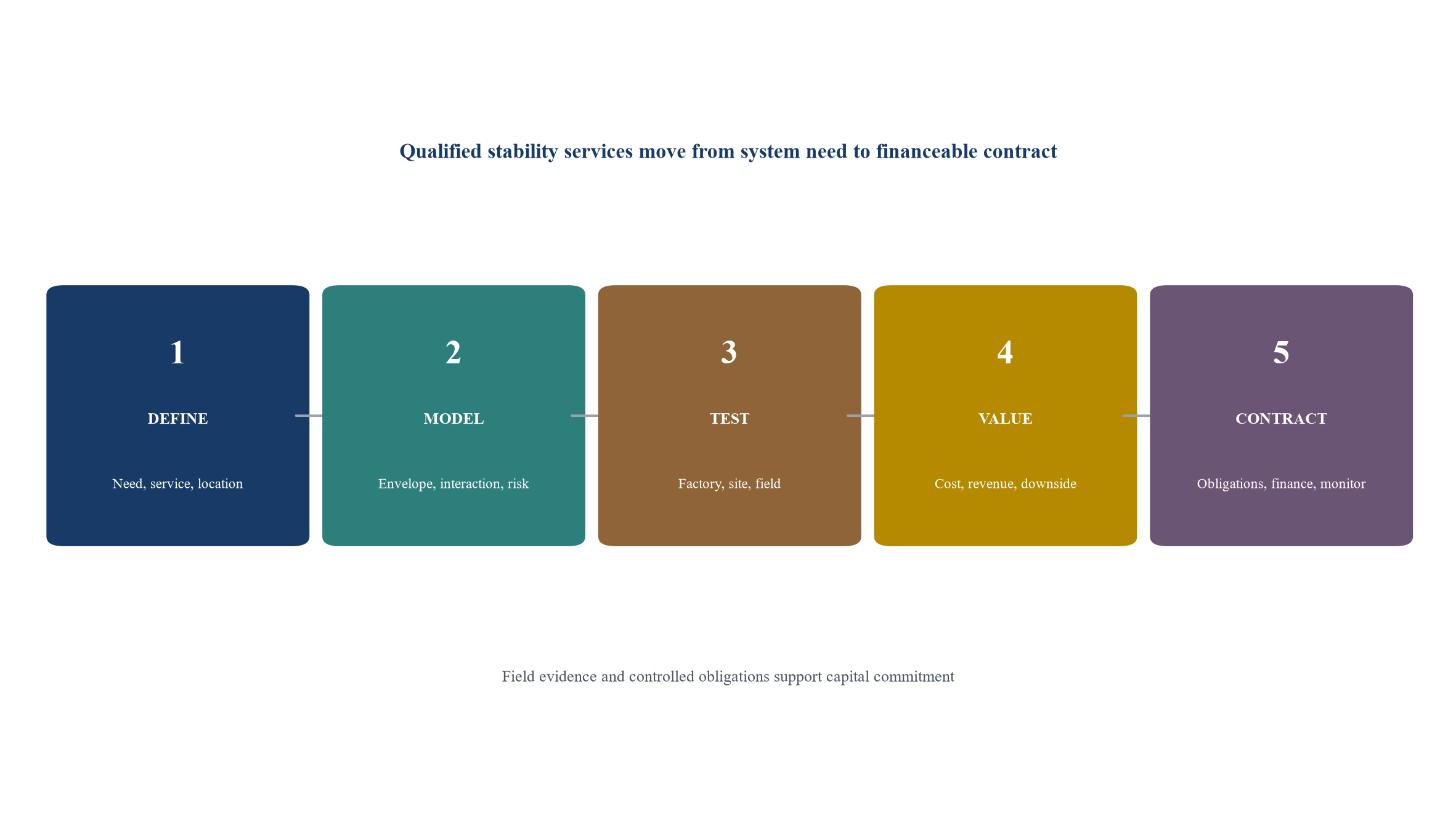
Each gate requires documented evidence before the next capital commitment.
The framework converts an emerging control capability into measurable stability products and financeable obligations. It preserves traceability from system need through field evidence to revenue and downside protection.
Investment should proceed through staged qualification. Market design, warranties, cyber controls and operating experience should evolve with the technical evidence.
References
- National Energy System Operator, "Why is Grid Forming Important?" 9 June 2026, https://www.neso.energy/news/why-grid-forming-important
- National Energy System Operator, "Stability Pathfinder Service Information," https://www.neso.energy/data-portal/stability-pathfinder-service-information
- National Energy System Operator, "GC0137: Minimum Specification Required for Provision of GB Grid Forming Capability," https://www.neso.energy/industry-information/codes/gc/modifications/gc0137-minimum-specification-required-provision-gb-grid-forming-gbgf-capability-formerly-virtual-synchronous-machinevsm-capability
- Australian Energy Market Operator, "Engineering Roadmap Execution Reports," https://www.aemo.com.au/initiatives/major-programs/engineering-roadmap/engineering-roadmap-execution-reports
- Australian Energy Market Operator, "Grid-Forming Inverter Protection-Quality Fault Current Trial," https://www.aemo.com.au/energy-systems/electricity/national-electricity-market-nem/nem-forecasting-and-planning/transition-planning/transitional-services---type-2-services/grid-forming-inverter-protection-quality-fault-current-trial
- US Department of Energy, "Powering On with Grid-Forming Inverters," 4 January 2021, https://www.energy.gov/cmei/systems/articles/powering-grid-forming-inverters
- National Renewable Energy Laboratory, "Research Roadmap on Grid-Forming Inverters," https://www.nrel.gov/docs/fy21osti/79761.pdf
- US Department of Energy, "UNIFI Consortium," https://www.energy.gov/cmei/systems/unifi-consortium
- National Renewable Energy Laboratory, "Planning for Reliable Operations," https://www.nrel.gov/grid/planning-for-reliable-operations.html
- National Energy System Operator, "MinGFM," https://www.neso.energy/about/innovation/our-innovation-projects/mingfm
About the Author
Chennakeshav (CK) is a corporate finance and investment banking executive with 25+ years of global experience in deal origination, structuring and execution across M&A, growth capital and corporate strategy. He has led value-creation mandates for founders, corporates and funds — bridging the boardroom view to hands-on execution and close.
His career spans Morgan Stanley, HSBC, Lloyds Banking Group, EWEC, ADQ portfolio companies and Emirates Growth Fund, across TMT, real estate, fintech, deeptech, cleantech, infrastructure and energy. He has partnered with C-suite leaders, private equity and venture funds, sovereign wealth funds and family offices to finance complex fund raises and scale-up ventures, and has led M&A due diligence, post-merger integration and business-transformation initiatives to create value.
At Matchpoint Partners he is Managing Partner, leading the firm's corporate finance, M&A and capital-raising practice. He holds an MBA from London Business School, an engineering degree from VTU and a Master of Laws (LLM, in progress) from UCL London.
An active start-up mentor, CK mentors at Techstars, DIFC FinTech Hive, Startup Grind, Founder Institute and IN5, serves as Entrepreneur Mentor in Residence (EMiR) at London Business School, and judges the Entrepreneurship World Cup.
