

Introduction
Industrial efficiency and electrification can produce measurable operating value, yet the equipment often loses the internal competition for capital. A plant may need furnaces, compressors, motors, pumps, boilers, heat pumps, waste-heat recovery, controls or storage. Management may support the economics while reserving cash and borrowing capacity for core production, reliability, working capital and expansion. The investment case therefore requires a commercial structure as well as an engineering solution.
An energy or heat service agreement changes the proposition. A provider designs, finances, owns or controls the equipment and delivers an agreed service over time. The customer pays for availability, useful energy, verified savings or a defined combination. The provider may fund the asset with equity and debt supported by the customer contract. The arrangement can remove the customer's upfront payment, transfer selected delivery and performance risks and create a single accountable interface.
The model also creates new exposures. Industrial production changes, energy prices move, baselines become disputed, equipment interacts with the customer's process and service interruptions can affect output. Customer credit rather than equipment value may determine debt capacity. Termination can leave specialised plant without an alternative user. Accounting, tax, security and regulatory treatment remain transaction-specific.
The International Energy Agency reports that industry represents nearly forty per cent of global final energy consumption and that energy-intensive industries account for three-quarters of industrial demand. It identifies process optimisation, efficient motor systems and electrification of lower-temperature heat as important measures.[1] The European Commission describes energy efficiency as a service as a model in which an energy service company finances and manages projects while users pay performance-based fees linked to savings or service provision.[2] This paper translates those principles into a finance and contract framework for industrial decisions.
1. Define the board decision
The board decision is whether a long-term service contract creates more value than self-funded equipment, leased equipment or deferred investment. The comparison should cover total cash cost, risk transfer, operating flexibility, financing capacity, technical capability and exit exposure. A lower upfront payment alone does not establish value.
The approval paper should state the service required, the equipment boundary, contract term, expected operating benefit, payment formula, performance standard, credit support, termination exposure and residual-value assumption. It should identify which risks remain with the customer and which transfer to the provider.
The decision should use a common operating scenario across alternatives. Production volume, utility prices, maintenance regime and equipment life must be consistent. Any accounting, tax or regulatory conclusion should be supported by transaction-specific professional analysis.
2. Start with the industrial process
The service begins at the production process rather than at the financing instrument. Map the required temperature, pressure, flow, quality, uptime, ramp rate, redundancy and maintenance windows. Identify the production constraint that the service must respect.
Heat, power, compressed air, cooling and motor output have different operating characteristics. A heat pump may suit a stable low-temperature load. An electric boiler may respond quickly while carrying power-price exposure. Thermal storage can shift consumption. Waste-heat recovery depends on the availability and condition of a source stream.
The technical boundary should show where the provider takes responsibility and where the customer retains it. Ambiguous interfaces create disputes when performance is affected by feedstock, production schedules, upstream equipment or operator actions.
3. Separate the asset from the service
The provider may own equipment while the customer purchases useful output. The contract should distinguish title, possession, control, maintenance responsibility and the service obligation. Ownership alone does not determine who bears performance or utilisation risk.
A service specification can state delivered heat, electricity, compressed air, cooling, steam or verified energy savings. The provider should remain free to optimise equipment within agreed limits, while the customer retains protections for safety, production quality and site operations.
The financing model should value contracted cash flow separately from residual equipment value. Site-specific assets can have limited removal value. Debt should not rely on an optimistic resale assumption when dismantling, transport and recommissioning are uncertain.
4. Choose the service model
Four common structures are output-as-a-service, shared savings, guaranteed savings and managed energy. Under output-as-a-service, the customer pays for useful energy or capacity. Under shared savings, the provider receives a defined share of measured cost reduction. Under guaranteed savings, the customer may finance equipment and the provider guarantees performance. Managed energy combines operation, maintenance and optimisation.
The World Bank distinguishes shared-savings and guaranteed-savings models and notes that financing responsibility differs between them.[3] The structure should follow the customer's capital constraint, the provider's balance sheet, measurement feasibility and the controllability of savings.
For heavy industry, an availability charge plus a variable output charge often gives clearer risk allocation than a pure savings share. The customer receives reliable service and the provider can recover fixed capital independently of production volume within defined bands.
5. Establish the counterfactual
Savings exist only against a counterfactual. Define what would have happened without the project: continued operation of existing equipment, scheduled replacement, production growth, maintenance changes or compliance expenditure. A weak counterfactual can overstate value and provoke disputes.
Record baseline energy consumption, production output, product mix, operating hours, weather where relevant, equipment condition and utility tariffs. Define the historical period and explain exclusions. The baseline must be representative enough for the decision and practical enough for continued administration.
The US Department of Energy states that baselines are compared with post-installation use and that the measurement and verification plan should document conditions, assumptions, calculations, utility rates, responsibilities and adjustment rules.[4] Those items should be agreed before capital is committed.
6. Select the measurement boundary
The measurement boundary determines which effects enter the payment calculation. An equipment-level boundary can isolate a motor, furnace or compressor. A system boundary can capture interactions. A whole-site boundary can reflect total performance while introducing production and operational noise.
Use the narrowest boundary that captures material effects. Complex integrated projects may require multiple meters and a reconciliation to site consumption. The chosen method should reflect the size, variability and performance risk of the measure.
DOE guidance describes measurement options ranging from key-parameter and full-parameter measurement to whole-facility analysis and calibrated simulation.[5] A complex process-heat project generally needs more rigorous measurement than a standard lighting replacement.
7. Write the adjustment protocol first
Industrial baselines change when production, product mix, shift patterns, raw materials, weather, maintenance or site configuration changes. The contract should state routine and non-routine adjustments, data sources, approval rights and dispute procedures.
Routine adjustments can use agreed formulas for output, ambient conditions or operating hours. Non-routine adjustments address events such as a new production line, decommissioning or a major process redesign. Each adjustment should preserve the economic intent without rewriting the bargain.
The provider should not bear demand changes controlled by the customer. The customer should not pay for savings created by an unrelated production shutdown. Transparent adjustment rules protect both positions and improve lender confidence.
8. Define useful output
A process-heat agreement should specify temperature, pressure, flow, quality, availability and delivery point. An electricity service should specify capacity, voltage, frequency, power quality and permissible interruptions. A compressed-air service should specify pressure, dryness, purity and volume.
Useful output should be measurable at a clearly identified meter. State meter ownership, calibration, access, data retention and fallback treatment. Define how data gaps are estimated and when an independent test applies.
The payment formula should follow useful output rather than gross energy input unless input efficiency is the service itself. This keeps the provider responsible for conversion performance while the customer pays for production value received.
9. Split fixed and variable payments
The provider incurs capital and fixed operating cost even when the customer's plant runs below plan. A pure volumetric tariff transfers customer utilisation risk to a party that cannot control it. A fixed availability payment can recover debt service, fixed maintenance, insurance and required return for reserved capacity.
The variable payment should reflect actual output and variable inputs. It can pass through power, fuel, water, consumables and emissions costs using objective indices. The split makes risk visible and reduces pressure to hide fixed recovery in an inflated unit price.
Availability deductions should apply when the provider fails to deliver. Their size should reflect production impact, available redundancy and cure. Repeated failure can trigger stronger remedies while a single minor event receives a proportionate credit.
10. Set a minimum service commitment
A provider cannot finance dedicated equipment against optional demand. The contract can require a minimum annual payment, reserved capacity fee, minimum quantity or deficiency payment. The obligation should reflect capital committed for the customer.
Flexibility can be preserved through nomination bands, make-up rights and seasonal profiles. A customer that pays a shortfall may use additional service later when capacity is available. Make-up rights should expire before they interfere with later contracted demand.
The minimum commitment should be stress-tested against the customer's own production economics. An obligation that becomes unaffordable during a normal downturn creates renegotiation and credit risk, even when legally enforceable.
11. Allocate utility-price risk
Power and fuel prices can dominate service cost. The parties should decide which prices pass through, which remain fixed, which are hedged and which move within sharing bands. The allocation should follow control and hedgeability.
The provider can bear conversion efficiency while the customer bears the market price of electricity. Alternatively, the provider can quote a bundled tariff supported by hedges or supply contracts. The contract should address hedge cost, collateral, basis risk and replacement when an index disappears.
EIB guidance notes that ESCOs commonly avoid taking unpredictable energy-price risk and measure physical savings valued under an agreed price convention.[6] Heavy-industry service contracts should avoid placing unhedgeable commodity exposure inside a fixed fee without adequate capital.
12. Allocate production-volume risk
Production volume belongs with the customer unless the provider influences it. The provider should remain responsible for capacity, efficiency and availability within the agreed operating envelope. The customer should provide forecasts and nominations and maintain minimum payments for dedicated capacity.
The financial model should test downturns, outages and product-mix shifts. Correlated pressure can arise when low production reduces both service revenue and customer credit. A minimum payment helps but cannot substitute for a solvent customer.
Contracts can include relief for prolonged site closure, yet relief should trigger a buyout, term extension, credit support or other economic restoration. Uncompensated suspension can make project debt unserviceable.
13. Allocate performance risk
Performance risk includes installation quality, efficiency, output, degradation and availability. The provider should bear risks it can manage through design, procurement, operation and maintenance. The guarantee must specify the test method, operating conditions and remedy.
A performance shortfall can create service credits, additional work, fee reduction or compensation. Remedies should restore the agreed economics without creating unlimited liability. Severe or repeated failure can trigger replacement, step-in or termination.
DOE describes quality assurance and measurement as central to performance contracts because savings and equipment performance must be verified during the contract term.[7] The contract should connect engineering acceptance, ongoing measurement and payment.
14. Allocate site and interface risk
The customer controls site access, production schedules, upstream equipment and many safety systems. The provider controls its equipment and personnel. A responsibility matrix should allocate permits, utilities, shutdowns, tie-ins, civil works, hazardous materials and operator coordination.
Site-condition risk requires surveys and a change process. Hidden utilities, contamination, structural limitations or inadequate electrical capacity can change cost and schedule. The party best able to investigate and manage each condition should bear it.
The schedule should reserve defined outage windows. Delayed access can extend completion and increase financing cost. The contract should state compensation, mitigation and the effect on the service commencement date.
15. Design construction acceptance
Construction acceptance should verify safe installation, legal compliance, output, efficiency, controls, metering and integration. Mechanical completion alone does not establish service performance.
Use staged tests: factory acceptance, site acceptance, commissioning, reliability run and final performance test. Define test conditions and correction when customer production cannot provide the planned load. Independent witnessing may be appropriate for material tests.
Debt draw and service payments should follow objective milestones. Retention, liquidated damages, bonds and parent support can protect delay and performance exposure. The financing model should include commissioning ramp and contingency.
16. Coordinate maintenance
The provider should maintain the assets required to deliver the service. The scope should include preventive, predictive and corrective maintenance, spare parts, software, controls, inspections and statutory tests. The customer should maintain connected site equipment under its control.
State response times, planned outages, spare strategy and lifecycle replacements. A low operating fee that omits major overhaul creates a later funding gap. The tariff and reserve policy should cover the full contract term.
Performance data can support condition-based maintenance. Access, cybersecurity and data ownership must be defined. The provider should receive enough data to operate; the customer should retain protections for production and commercially sensitive information.
17. Protect operational continuity
Industrial service failure can interrupt production far beyond the value of the energy supplied. The architecture should include redundancy, backup supply, bypass, storage or an agreed customer contingency. The required level follows the production consequence.
Liability should distinguish service credits, direct damage and consequential production loss. Insurance and contractual caps need to align. A provider cannot finance an obligation with uncapped exposure to an entire plant's lost margin.
The customer should retain emergency rights to operate or bypass equipment when safety or production requires it. Those rights should preserve warranty and performance allocation through documented procedures.
18. Establish customer credit quality
Provider debt is often supported by the customer's long-term payment obligation. Review financial statements, liquidity, leverage, ownership, industry cyclicality, site importance and legal enforceability. A strong operating site can still sit within a weak contracting entity.
Credit support may include a parent guarantee, bank letter of credit, funded reserve, deposit, insurance or prepayment. Size support to the cure and replacement period, debt service, fixed operating cost and decommissioning exposure.
Credit should be monitored through reporting covenants and objective triggers. A downgrade, ownership change, repeated late payment or covenant breach can require additional support before the exposure becomes acute.
19. Reduce customer concentration
A portfolio of service agreements can support diversified financing. The benefit depends on independence across customers, sectors, geographies, technologies and contract expiry. Several plants in one cyclical sector may fail together.
Standardised contracts, equipment and measurement methods reduce portfolio administration and refinancing cost. Bespoke site interfaces can remain while core payment, credit and reporting provisions follow a common framework.
The lender model should apply single-name limits, sector limits and stressed default timing. A reserve cannot permanently replace lost revenue. The provider needs remarketing, equipment redeployment or replacement-customer options where practical.
20. Use a dedicated project company
A special-purpose company can own equipment, receive service payments and borrow against the contract. It separates project cash flow and security from the wider provider group. The structure must retain sufficient technical and financial support.
The project company can contract with an engineering contractor, operator, equipment supplier and customer. Lenders may take security over assets, accounts, shares and material contracts subject to local law. Direct agreements preserve cure and transfer rights.
Thinly capitalised structures create fragility. Sponsor equity, contingent funding and reserve accounts should cover construction, ramp, performance and customer-payment volatility that senior debt cannot absorb.
21. Size debt from contracted cash flow
Debt capacity should begin with fixed and minimum contracted payments. Deduct operating cost, maintenance, insurance, taxes, reserves, performance deductions and conservative availability. Variable output above the minimum can support limited debt only where it is demonstrably dependable.
The model should calculate debt-service coverage, loan life coverage, break-even availability and customer-default exposure. It should stress utility prices, production, operating cost, degradation, delays and interest rates.
Residual value, contract extensions and future projects belong in the equity case until supported by evidence. Senior debt should be repaid from the existing agreement within an appropriate tail before expiry.
22. Match debt tenor to contract tenor
The loan should amortise within the non-cancellable service term, leaving time to cure operational underperformance or refinance. A debt maturity beyond contract expiry relies on renewal or merchant value that may not exist.
Customer termination options shorten the effective term unless protected by a buyout. Renewal options controlled by the customer should be treated as upside. Extension rights become base-case value only after they are exercised or otherwise enforceable.
Equipment life can exceed the service term, but site-specific removal cost may absorb residual value. The financing should show whether the asset can serve another customer and what modification would be required.
23. Build reserve architecture
Reserves should address debt service, major maintenance, lifecycle replacement, customer payment delay and decommissioning. Their size should follow quantified exposures rather than a generic percentage.
A debt-service reserve protects short disruption while a liquidity facility can address seasonal working capital. A major-maintenance reserve accumulates cash for scheduled overhaul. Credit support addresses customer default and should not be double-counted as unrestricted liquidity.
Release tests can depend on performance history, coverage, remaining term and customer credit. Restricted cash should remain visible in equity-return analysis because trapped liquidity has a cost.
24. Price the service transparently
The service price should identify fixed availability, variable output, input pass-through, maintenance, monitoring, taxes and extraordinary change. Transparency improves approval and makes later disputes easier to resolve.
Benchmark the price against the customer's avoided capital, avoided energy, avoided maintenance, reliability value and emissions obligations. The provider should earn a return for capital and risks assumed, while the customer retains measurable value.
A headline unit price can mislead when production varies. Compare present-value cash cost across scenarios and show the break-even production, utility price and availability. Include termination and end-of-term options.
25. Protect against inflation
Long-term contracts require an inflation mechanism. Different cost components may follow different indices. Labour, equipment, insurance and local services do not necessarily move together.
Use a weighted formula, cap, floor or periodic reset that reflects the cost base. A single broad index can create margin mismatch. Pass-through items should require evidence and efficient procurement obligations.
Debt should be tested under inflation scenarios. A nominal fixed tariff with floating operating cost weakens coverage. An indexed tariff can preserve coverage while increasing the customer's budget variability.
26. Treat accounting as a separate workstream
The commercial label does not decide accounting treatment. Asset control, identified equipment, substitution rights, payment structure, term and other facts can affect classification under applicable standards.
The parties should obtain accounting advice on the actual contract and technical configuration before approval. Desired presentation should not drive artificial risk allocation that undermines the economics or conflicts with substance.
The financial comparison should remain valid under plausible accounting outcomes. Liquidity, cash flow, covenant and return are distinct from presentation. The board paper should state any unverified accounting assumption as an assumption and identify the required opinion.
27. Address tax and legal structure
Tax treatment can affect ownership, depreciation, indirect tax, withholding, import duties and transfer at expiry. Local law determines security, step-in, enforceability and licensing. Cross-border equipment and services can add permanent-establishment and currency issues.
The structure should allocate tax changes and compliance responsibilities. A gross-up or change-in-law clause needs boundaries, evidence and mitigation. A tax benefit assumed in pricing should be confirmed before financial close.
Legal diligence should review site rights, permits, environmental obligations, access, insolvency treatment, assignment and termination. The provider needs durable rights to operate, maintain and recover equipment where removal is practical.
28. Coordinate permits and grid capacity
Electrification can require additional grid connection, transformers, substations, protection systems or demand-response controls. Grid capacity can determine schedule and economics. The responsibility matrix should state who applies, pays and bears delay.
Process-heat systems may require pressure-system, emissions, water, fire and environmental approvals. Provider ownership does not remove the customer's site obligations. Both parties need coordinated compliance.
The service commencement date should follow critical permits and connections. Early equipment orders should be limited until long-lead and approval risks are understood or contractually protected.
29. Integrate renewable power
On-site solar, storage or a power purchase agreement can support electrified heat. Their output profile must be reconciled with industrial demand. An annual renewable-energy balance does not guarantee hourly power for a continuous process.
The contract should allocate intermittency, grid imports, curtailment, storage operation and environmental attributes. The customer may value emissions evidence while the lender values dependable payment. Each attribute should have a clear owner.
The financial model should separate energy cost, network charges, demand charges and balancing. Electrification can reduce fuel exposure while increasing sensitivity to power tariffs and connection constraints.
30. Manage carbon value
Carbon savings may create compliance value, customer value or tradable attributes. Define the calculation boundary, emissions factors, ownership, verification and double-counting protections. The service fee should not assume a carbon value that lacks an enforceable route.
Where the customer retains environmental attributes, the provider may still guarantee technical performance. Where the provider monetises attributes, the customer needs clarity on which claims it may make.
Change in emissions methodology should use an objective adjustment process. Payment disputes should not suspend essential service unless the underlying safety or legal condition is affected.
31. Use digital control carefully
Sensors, analytics and optimisation software can improve efficiency and detect degradation. The contract should define data collection, model governance, cybersecurity, access, retention and permitted use. Industrial operational data can be commercially sensitive and safety-critical.
Automated recommendations should remain within approved operating limits. Control authority, human override and incident response must be explicit. Software updates should follow testing and change control.
The IEA identifies digitalisation-enabled AI as a tool for detecting industrial inefficiencies.[1] The business case should value verified operating improvement rather than assume a generic technology premium.
32. Create lender direct agreements
A direct agreement gives lenders notice and cure rights before the customer terminates. It can recognise step-in, replacement of the provider and transfer to a qualified operator. These rights protect service continuity as well as debt.
The customer should retain safety, compliance and technical qualification protections. Cure periods should reflect the default while avoiding indefinite uncertainty. Payment obligations during cure should be clearly defined.
Direct agreements should align with site rights, equipment security and major subcontract transfers. Conflicting consent rights can make enforcement unworkable.
33. Design termination payments
Termination compensation should reflect cause. Customer default can require outstanding allocated debt, break costs, committed operating liabilities, removal cost and an agreed return component, less recoveries. Provider default should protect the customer and recognise cure, equipment value and transition cost.
Prolonged force majeure can use a shared formula. Change in law can follow control and jurisdiction. Voluntary customer termination should restore the provider's expected capital recovery within agreed limits.
The formula should be capable of calculation at any date. A large theoretical payment from a weak customer adds little credit value unless supported by a guarantee, letter of credit or funded mechanism.
34. Plan the end of term
End-of-term options may include customer purchase, provider removal, extension or transfer to a new service contract. The agreement should specify price, condition, testing, data, spare parts and site restoration.
A purchase price can be fixed, formula-based or independently valued. A nominal transfer can affect accounting and tax analysis. Removal rights require practical access and a plan for connected systems.
Lifecycle maintenance should preserve the asset through the final year. A provider with no residual obligation may otherwise defer expenditure. Handover standards and inspection rights should begin before expiry.
35. Aggregate smaller projects
Individual efficiency projects may be too small for efficient standalone financing. A provider can aggregate sites under standard contracts, equipment and measurement protocols. Portfolio scale can diversify customer risk and reduce transaction cost.
The EIB-backed Solas Sustainable Energy Fund illustrates financing for ESCO projects and service models, including fixed monthly payments for lighting as a service.[8] EIB initiatives also support financing platforms that combine standardisation, guarantees and long-term capital.[9]
Aggregation requires data consistency. Each project should meet eligibility, credit, technical and documentation standards. Weak assets should not enter the pool merely to increase volume.
36. Use credit enhancement selectively
Guarantees, first-loss capital and public facilities can address lender unfamiliarity, small project size or emerging-provider credit. They should cover a defined risk and preserve incentives for diligence and performance.
The World Bank's work on Indian ESCO finance describes a partial risk-sharing facility designed to support bank lending to qualified ESCO projects.[10] The broader lesson is that finance, standard contracts and technical capacity must develop together.
Credit enhancement should not conceal an uneconomic service. The project must still demonstrate customer value, credible payment and technical delivery after support expires.
37. Create a procurement process
The customer should procure a defined output, baseline method, risk allocation and evaluation model. Bidders can then optimise technology and financing while remaining comparable. A specification that dictates every component can weaken provider accountability.
Evaluation should include present-value service cost, performance guarantee, availability, credit, financing certainty, contract terms, operating capability and transition plan. The cheapest nominal tariff may carry higher pass-through or weaker guarantees.
Dialogue can refine site interfaces and measurement before final bids. The customer should preserve competition while giving bidders sufficient data to price risks responsibly.
38. Run confirmatory diligence
Confirmatory diligence should test energy data, production records, equipment condition, site access, permits, customer credit, utility supply, tax, legal rights and the proposed measurement plan. Each finding should flow into contract, design or model.
Data gaps should produce conditions, contingencies or conservative assumptions. They should not be hidden inside a point estimate. The provider should identify which assumptions remain customer dependencies.
Independent technical review can focus on performance, degradation, maintenance and interface risks. Lender diligence should use the same controlled evidence base as the investment committee.
39. Build the implementation plan
The plan should sequence audit, design, permits, financing, procurement, site works, commissioning and service commencement. It should identify long-lead equipment, outage windows and customer dependencies.
Use stage gates that cap capital at risk. Development expenditure can proceed before final documentation; equipment orders and construction should require executed contracts, permits, financing and acceptable credit.
Each gate should state evidence, authority and expiry. Changed production plans, utility prices, capital cost or customer credit should trigger revalidation.
40. Monitor performance monthly
Monthly reporting should show availability, output, input consumption, verified savings, baseline adjustments, service credits, maintenance, incidents, invoicing and collections. The report should reconcile technical and financial performance.
Exceptions require owners and deadlines. Persistent meter gaps, customer access delays or deteriorating efficiency can become financing issues before annual review. Lenders may receive a defined subset of reports.
DOE guidance requires continuing measurement and verification during the performance period and emphasises documented annual review.[11] Industrial contracts benefit from more frequent operational control where process value is high.
41. Test the customer value case
The customer comparison should include avoided upfront capital, service payments, residual value, maintenance, utility cost, reliability, internal resources, accounting outcomes and termination. Discount rates should reflect each alternative's risk.
The service agreement can preserve liquidity while costing more over time because the provider funds capital, risk and capability. The premium is justified only when risk transfer and execution value exceed its cost.
Sensitivity should identify the conditions under which self-funding becomes preferable. A transparent crossover analysis supports negotiation and prevents a capital-light narrative from replacing economics.
42. Test the provider value case
The provider needs a return after construction, operating, credit, financing and residual-value risk. The model should separate contracted margin from optional optimisation and future projects.
Equity return should be tested under delay, lower availability, higher maintenance, customer downgrade, lower production and early termination. Funding headroom should cover scenarios that remain plausible after mitigation.
Portfolio growth can create value, but each contract should stand on its own evidence. The provider should avoid using new projects to fund deficits in existing ones.
43. Use a risk-adjusted contract benchmark
Compare structures across capital source, customer payment, performance guarantee, baseline dependence, volume risk, utility-price risk, credit exposure and residual value. A shared-savings contract is not inherently superior to an output tariff; suitability depends on facts.
The European Commission describes service fees linked to savings or service provision and highlights removal of upfront cost and management barriers.[2] Those advantages require enforceable measurement and capable delivery.
The benchmark should indicate which risk each clause transfers and the price of that transfer. Undefined risk eventually reappears as contingency, financing cost or dispute.
44. Set investment-committee thresholds
The committee should approve minimum customer credit, contract term, fixed-revenue coverage, availability, contingency, reserve and debt-service metrics. Thresholds should reflect technology maturity and customer concentration.
The paper should show base, downside and break-even cases. Hypothetical values can illustrate the method; actual approval requires transaction evidence. All assumptions should have an owner and verification date.
Conditions should be limited to matters that can be closed. Open-ended reliance on future savings, refinancing or accounting treatment weakens governance.
45. Protect amendment control
Material amendments to price, minimum payment, term, performance, credit support, termination or site rights can change debt capacity. The finance documents should require consent for defined changes while allowing ordinary operational administration.
Every amendment should update the model and risk register. Side letters and informal concessions can create unrecorded value leakage. A central contract owner should maintain the controlled version.
Customer-requested expansions should pass a new investment gate. Existing lenders, equipment capacity and service performance may constrain incremental commitments.
46. Use an evidence-led negotiation plan
Quantify the value of each term before negotiation. A longer term, stronger minimum payment or parent guarantee can support more debt and lower the tariff. Greater customer flexibility may require higher fixed cost or equity.
Offer coherent packages rather than isolated concessions. The customer can choose between stronger commitment at a lower price and greater flexibility at a higher price. Each option should preserve minimum financeability.
Maintain an issues list connecting commercial language, legal drafting, technical effect, model impact and approval authority. Resolve high-value terms early.
47. Apply the final investment gate
Final investment requires an executed service agreement, confirmed site rights, permits, customer credit support, coordinated construction contracts, funded capital, verified baseline, measurement plan and acceptable downside coverage. Each item should have documentary evidence.
The approval should state remaining risks and the party bearing them. It should distinguish observed data, contractual facts and hypothetical modelling. Any condition waived should have a quantified effect and named authority.
Approval should expire if financial close or construction notice does not occur by a stated date. Material changes should return to the committee.
48. Define the operating mandate
The final mandate should authorise the service system, financing package and governance process. It should specify output, minimum payment, performance standard, credit support, debt limit, reserves, contract tail and reporting.
Management authority should cover routine delivery within those limits. Changes that reduce fixed revenue, weaken credit, increase debt, alter termination protection or expose the customer to unapproved production risk should require reapproval.
The operating mandate turns a project approval into a controlled long-term service business. It connects industrial value to contractual cash flow and measurable performance.
Conclusion
Heavy-industry service agreements can fund efficiency, electrification and process heat while preserving customer capital for core operations. Their value comes from an integrated structure: a defined output, clear equipment boundary, durable site rights, transparent measurement, dependable payment and capable delivery.
Financeability depends on allocation. The provider can bear design, construction, maintenance and controllable performance. The customer generally bears production demand and retains obligations for site interfaces under its control. Utility-price exposure should follow hedgeability. Customer credit and termination protection support the provider's debt.
The strongest commercial model separates availability from variable output and agrees the baseline before construction. Debt is sized from conservative contracted cash flow, with reserves for temporary disruption and equity for residual uncertainty. Accounting, tax and legal treatment receive separate transaction-specific analysis.
The board can then compare service procurement with self-funded capital on a complete basis. The decision becomes a choice about cash flow, risk and operating capability, supported by evidence and governed through the life of the agreement.
Decision exhibits
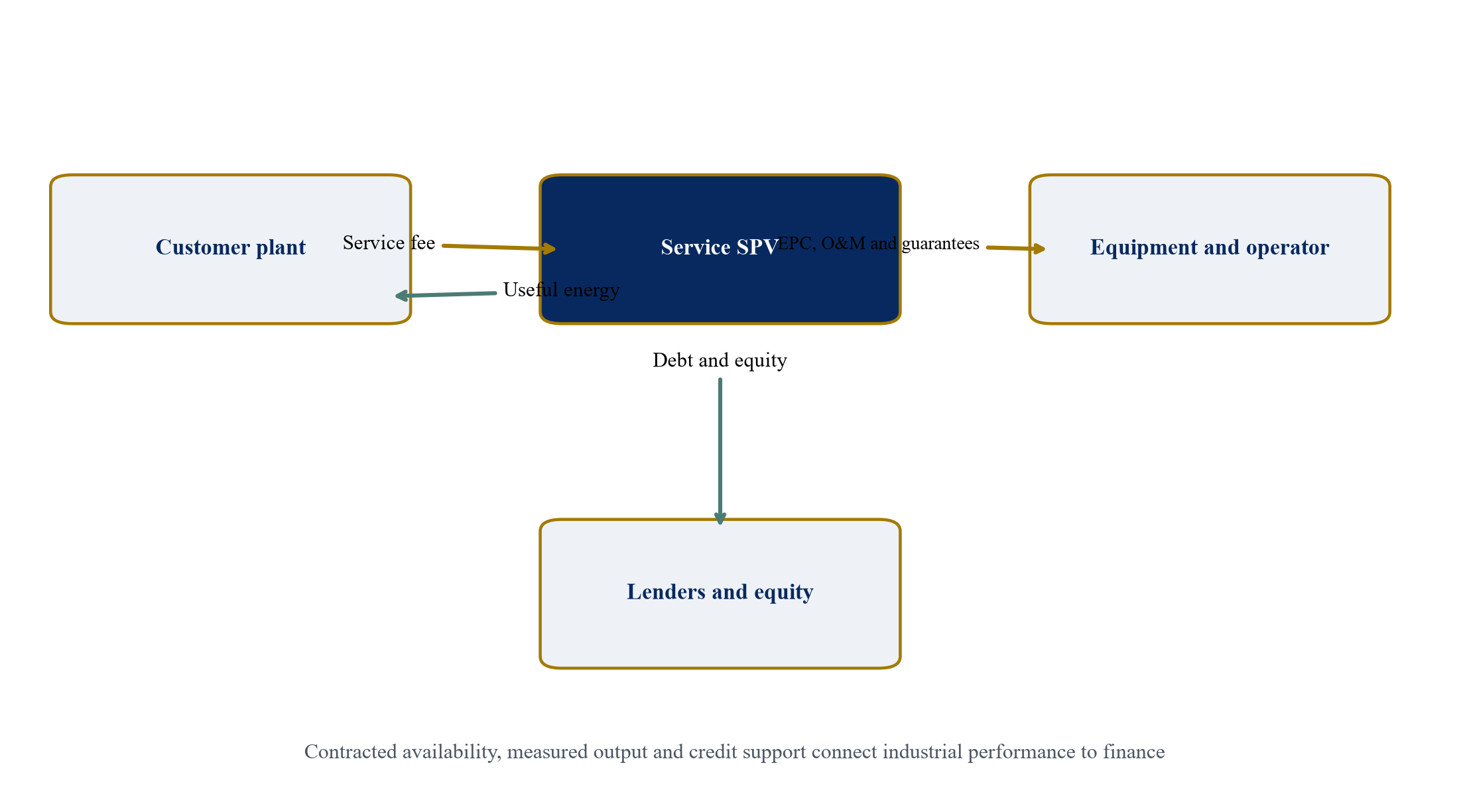
Proposed decision architecture based on the sources and analysis in this paper.
Table 1. Heavy-industry service-model benchmark
| Model | Customer payment | Provider risk | Customer risk | Best fit |
|---|---|---|---|---|
| Output as a service | availability plus useful output | equipment, operation and efficiency | demand and site interfaces | measurable heat, power, air or cooling |
| Shared savings | agreed share of verified saving | capital, performance and baseline | production and adjustment integrity | stable, measurable consumption |
| Guaranteed savings | debt payment plus performance guarantee | performance shortfall | financing and repayment | creditworthy customer with funding capacity |
| Managed energy | operating fee and pass-through | operation and maintenance | capital and commodity price | customer-owned infrastructure |
| Hybrid service | fixed capacity, variable output and savings incentive | defined capital and performance | minimum commitment and demand | complex industrial integration |
Proposed qualitative benchmark; applicable law and transaction documents control.
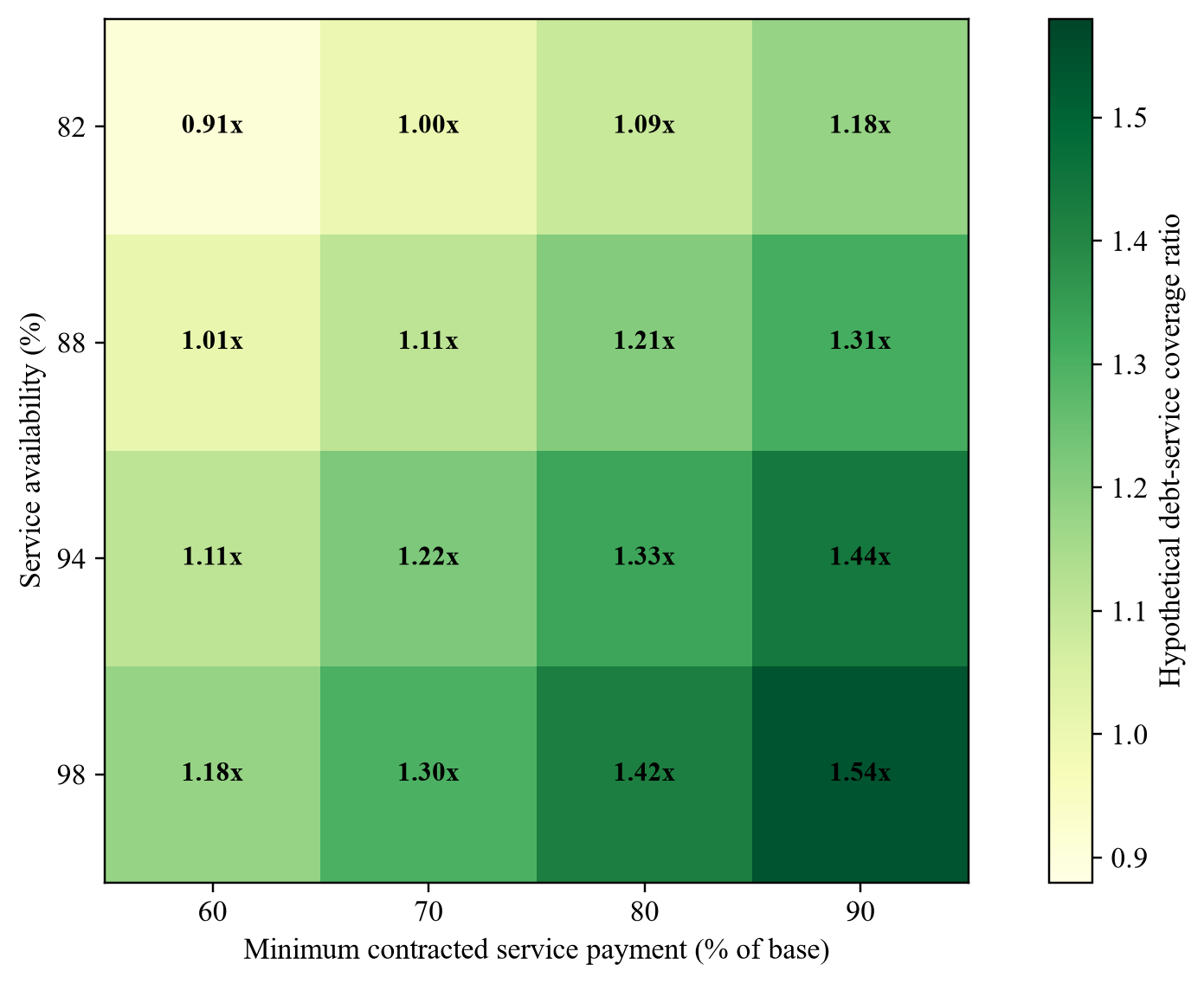
Wholly hypothetical; values describe no identified company or transaction.
Table 2. Hypothetical sources and uses for a service project
| Uses | Share of total uses | Sources | Share of total sources |
|---|---|---|---|
| Process and energy equipment | 47% | Sponsor equity | 32% |
| Electrical, civil and site integration | 20% | Senior project debt | 48% |
| Engineering, development and permits | 9% | Customer contribution | 8% |
| Financing, reserves and working capital | 12% | Grant or credit enhancement | 12% |
| Contingency | 12% | Total sources | 100% |
| Total uses | 100% |
Illustrative percentages only; transaction-specific commitments and costs are required.
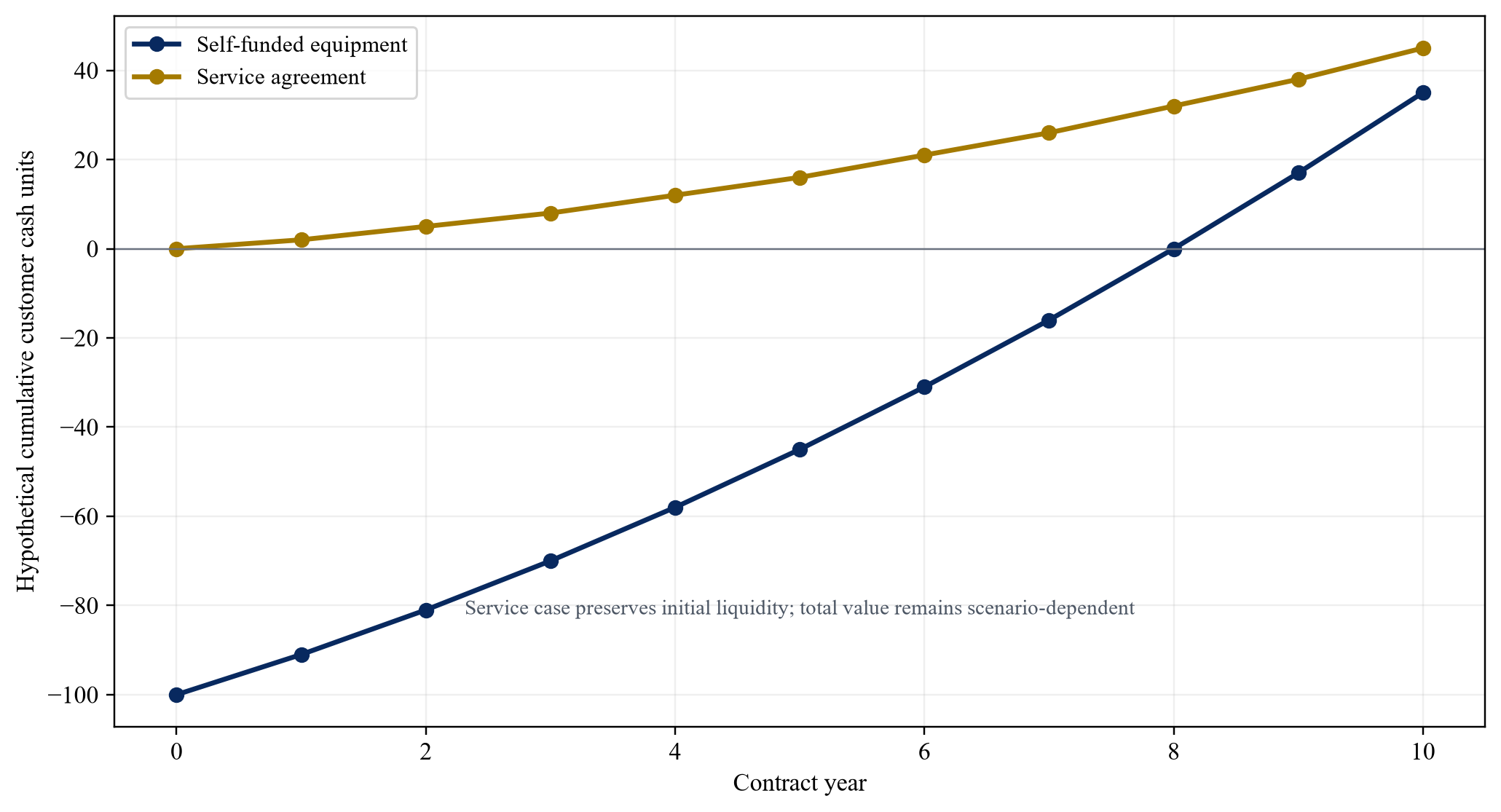
Wholly hypothetical; cumulative values describe no identified company or transaction.
Table 3. Risk allocation and investment gates
| Gate | Minimum evidence | Principal risk allocation | Maximum cumulative capital at risk |
|---|---|---|---|
| Opportunity screen | process need, utility data and site sponsor | provider development risk | 0.2% |
| Investment-grade audit | baseline, operating envelope and concept design | shared data and design risk | 1.0% |
| Bankable contract | minimum payment, M&V, credit and site rights | allocated by contract | 4.0% |
| Final investment | permits, finance, EPC security and downside coverage | sponsor, customer and lenders | 100% |
| Service commencement | acceptance tests, meters and operating readiness | contractor and operator | retained capital |
| Expansion | performance history and new contracted demand | project board | next module budget |
Proposed governance framework; percentages are hypothetical caps on cumulative capital at risk.
Appendix A Questions for the investment committee
1. Which industrial output or saving is being purchased and at which measurement boundary?
2. Which equipment, site interfaces and operating obligations sit with each party?
3. Which fixed or minimum payments support capital recovery and debt?
4. How are utility prices, production changes and baseline adjustments allocated?
5. Which performance standards, testing methods and remedies apply?
6. Which customer entity signs and what credit support protects payment and termination?
7. How does the non-cancellable contract term compare with debt tenor and equipment life?
8. Which permits, connections and shutdown windows remain outstanding?
9. Which downside cases reduce coverage below covenant or equity thresholds?
10. Which reserves, guarantees and direct agreements protect temporary disruption?
11. What happens at expiry, early termination, customer default or provider failure?
12. Which changes require management action or board reapproval?
References
- International Energy Agency, Energy Efficiency 2025: Industry, 2025. https://www.iea.org/reports/energy-efficiency-2025/industry
- European Commission, Private and innovative financing for energy efficiency, accessed 2 October 2026. https://energy.ec.europa.eu/topics/energy-efficiency/financing/private-and-innovative-financing_en
- World Bank, Fostering the Development of ESCO Markets for Energy Efficiency, 2016. https://documents1.worldbank.org/curated/en/709221467753465653/pdf/103932-REVISED-LW54-fin-logo-OKR.pdf
- United States Department of Energy, Measurement and Verification Activities Required in the Energy Savings Performance Contract Process, accessed 2 October 2026. https://www.energy.gov/cmei/femp/measurement-and-verification-activities-required-energy-savings-performance-contract
- United States Department of Energy, Measurement and Verification Options for Federal Energy- and Water-Saving Projects, accessed 2 October 2026. https://www.energy.gov/cmei/femp/measurement-and-verification-options-federal-energy-and-water-saving-projects
- European Investment Bank, Guidance on Energy Efficiency in Public Buildings, 2012. https://www.eib.org/attachments/epec/epec_guidance_on_energy_efficiency_in_public_buildings_en.pdf
- United States Department of Energy, Quality Assurance in Energy Savings Performance Contracts, accessed 2 October 2026. https://www.energy.gov/cmei/femp/quality-assurance-energy-savings-performance-contracts
- European Investment Bank, EIB-backed Solas Sustainable Energy Fund Reaches Final Close with EUR 220 Million of Institutional Investor Commitments, 15 December 2022. https://www.eib.org/en/press/all/2022-488-eib-backed-solas-sustainable-energy-fund-reaches-final-close-with-eur220-million-of-institutional-investor-commitments
- European Investment Bank, Energy Efficiency for SMEs Initiative on Track to Surpass Targets, 11 February 2026. https://www.eib.org/en/press/news/eib-group-s-energy-efficiency-for-smes-initiative-on-track-to-surpass-targets
- World Bank, Transforming India's Energy Efficiency Market by Unlocking the Potential of Private ESCOs, 11 December 2020. https://blogs.worldbank.org/en/ppps/transforming-indias-energy-efficiency-market-unlocking-potential-private-escos
- United States Department of Energy, Federal ESPC Process Phase 5: Post-Acceptance Performance, accessed 2 October 2026. https://www.energy.gov/cmei/femp/federal-espc-process-phase-5-post-acceptance-performance
- United States Department of Energy, M&V Guidelines: Measurement and Verification for Performance-Based Contracts Version 5.0, 14 October 2024. https://www.energy.gov/cmei/femp/articles/mv-guidelines-measurement-and-verification-performance-based-contracts-version-0
- International Energy Agency, Gaining an Edge: The Role of Energy Efficiency in Enhancing Competitiveness, 11 June 2025. https://www.iea.org/reports/gaining-an-edge
- International Finance Corporation, Cooler Finance: Mobilizing Investment for the Developing World's Sustainable Cooling Needs, 2024. https://www.ifc.org/content/dam/ifc/doc/2024/cooler-finance-report.pdf
About the Author
Authored by Chennakeshav Adya Independent Researcher
Chennakeshav (CK) is a corporate finance and investment banking executive with 25+ years of global experience in deal origination, structuring and execution across M&A, growth capital and corporate strategy. He has led value-creation mandates for founders, corporates and funds — bridging the boardroom view to hands-on execution and close.
His career spans Morgan Stanley, HSBC, Lloyds Banking Group, EWEC, ADQ portfolio companies and Emirates Growth Fund, across TMT, real estate, fintech, deeptech, cleantech, infrastructure and energy. He has partnered with C-suite leaders, private equity and venture funds, sovereign wealth funds and family offices to finance complex fund raises and scale-up ventures, and has led M&A due diligence, post-merger integration and business-transformation initiatives to create value.
At Matchpoint Partners he is Managing Partner, leading the firm's corporate finance, M&A and capital-raising practice. He holds an MBA from London Business School, an engineering degree from VTU and a Master of Laws (LLM, in progress) from UCL London.
An active start-up mentor, CK mentors at Techstars, DIFC FinTech Hive, Startup Grind, Founder Institute and IN5, serves as Entrepreneur Mentor in Residence (EMiR) at London Business School, and judges the Entrepreneurship World Cup.
Matchpoint profile: https://www.matchpoint-partners.com/team/ck-adya.html LinkedIn: https://www.linkedin.com/in/ckadya/
