
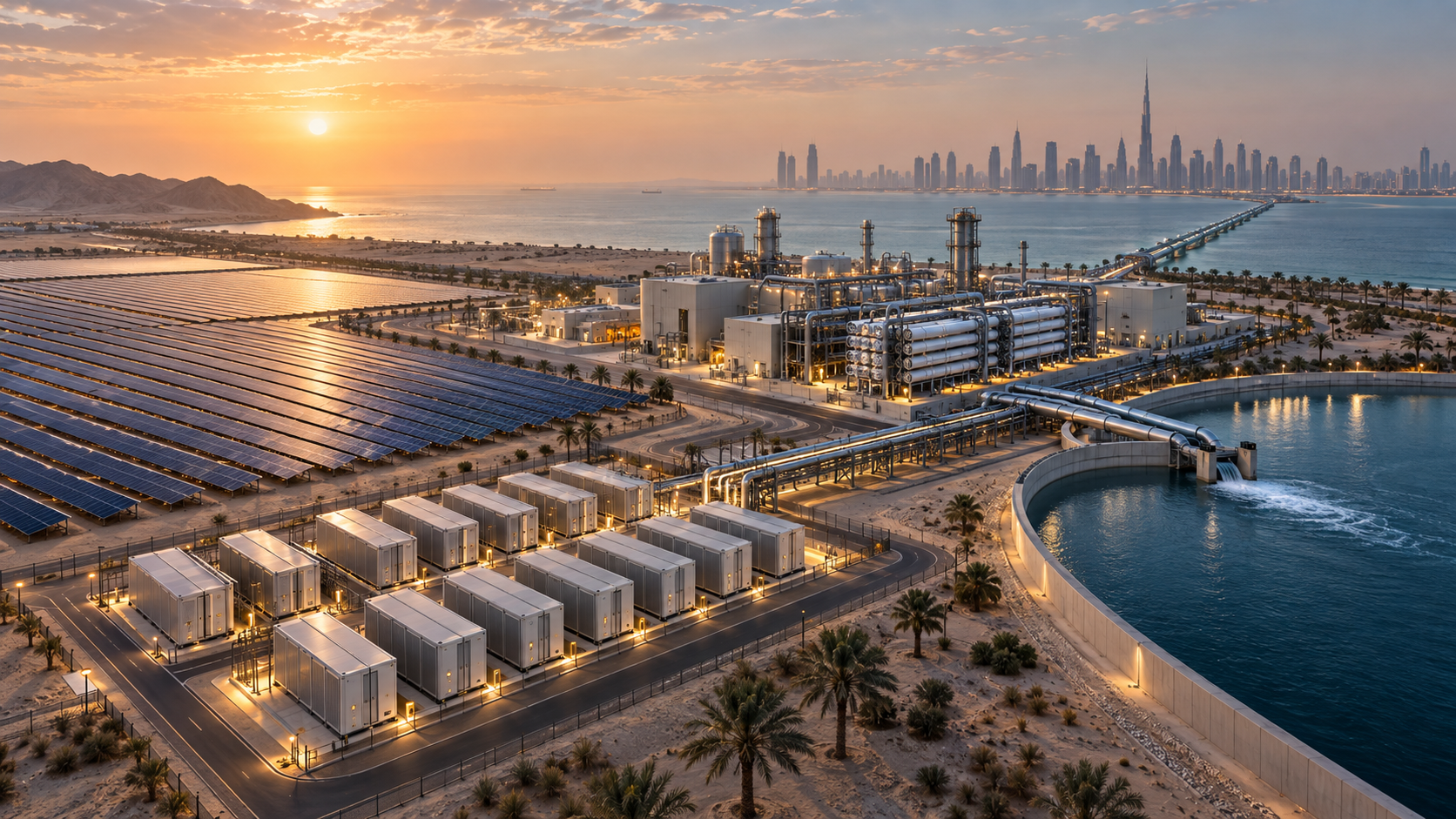
1. Define the procurement decision
The procurer must decide whether it is buying electricity, dispatchable capacity, potable water or an integrated service. The answer determines the tariff, performance tests and allocation of solar, battery, grid and water risks.
The service should be stated before the technology solution. A requirement for reliable water may permit several energy configurations. A requirement for firm renewable electricity may require different battery sizing and water operations.
2. Identify the three assets
The solar plant converts irradiance into electricity. The battery charges, stores and discharges electricity subject to power, energy, efficiency and degradation limits. The reverse-osmosis plant consumes electricity and feedwater to produce compliant water.
Each asset can be independently available while the integrated service fails at an interface. The financing perimeter must therefore include the converters, controls, connections and storage that link them.
3. Define the three products
Solar provides energy and potentially environmental attributes. The battery provides time shift, capacity, ramping and ancillary capability. The desalination plant provides water capacity, availability, quality and output.
The contract should avoid treating these products as interchangeable. One megawatt-hour stored is not one megawatt-hour discharged, and one cubic metre of water embeds power, treatment and delivery obligations.
4. Choose a contract architecture
The project can use one hybrid PWPA, parallel PPAs and a water-purchase agreement, or a master agreement with asset schedules. One agreement simplifies coordination; separate agreements can improve product clarity.
The choice should preserve a single interface for essential service while retaining asset-specific measurement, relief and default. Lenders need a reconciled hierarchy when provisions conflict.
5. Map the physical system
The system includes solar modules, inverters, substation, battery, energy-management system, grid connection, intake, pretreatment, high-pressure pumps, membranes, post-treatment, water storage and delivery.
The map should identify every meter, control boundary and single point of failure. It should distinguish electrical energy storage from water storage, since both shift service through time but carry different losses and operating constraints.
Table 1. Three-asset product, evidence and debt-service map
| Asset or interface | Contracted product | Core evidence | Principal risk | Debt-service consequence |
|---|---|---|---|---|
| Solar PV | Available renewable energy and agreed delivery profile | Irradiance, inverter status, meter and yield model | Resource shortfall, degradation, curtailment or equipment failure | Lower energy value and higher grid imports |
| Battery storage | Available power, energy, response and efficiency | State of charge, capacity tests, dispatch logs and cycle data | Degradation, insufficient duration, fire or control failure | Reduced firming revenue and lifecycle capex |
| Reverse osmosis | Potable-water capacity, quality, availability and output | Flow, pressure, quality, specific energy and plant status | Feedwater variance, membrane degradation or process outage | Lower water revenue and higher operating cost |
| Grid interface | Import, export, backup and balancing service | Connection capacity, outages, price and meter data | Constraint, price exposure, outage or imbalance | Margin compression or service interruption |
| Integrated controls | Optimised dispatch across all assets | Forecasts, algorithms, instructions and audit logs | Control conflict, cyber event or poor optimisation | Lost output, dispute and covenant pressure |
The allocation is illustrative and requires project-specific technical and legal diligence.
6. Define the project perimeter
The perimeter can include the three assets, dedicated connections, marine works, reservoir and pipeline. A narrower project may rely on public grid and water infrastructure.
Each exclusion creates an interface. Tender documents should state ownership, capacity, condition, access, completion and operating responsibility. Unpriced legacy infrastructure should not become project risk by implication.
7. Choose co-location or virtual integration
Co-location can share land, connection and controls. Virtual integration can contract geographically separate solar and storage against the desalination load through the grid.
Virtual structures introduce network loss, basis, congestion and certificate questions. Co-location concentrates construction and environmental interfaces. The contract should follow the actual energy path and legal market structure.
8. Define the water service
The essential product is potable water at a specified capacity, quality, pressure and delivery point. Availability should distinguish installed, tested, available and dispatched capacity.
The contract should state whether water storage forms part of availability. Stored water can buffer power variability, yet it should not conceal persistent desalination underperformance.
9. Define the solar service
Solar obligations should cover installed capacity, availability, performance ratio, degradation, grid-code compliance and environmental attributes. Resource risk usually remains with the project unless the purchaser provides data or guarantees.
The yield model should state temperature, soiling, clipping, losses and curtailment. Energy used internally for water production should be measured separately from exports.
10. Define the storage service
The battery product should specify power, usable energy, duration, response, efficiency, state-of-charge range, availability and augmentation. A nameplate energy figure does not establish deliverable service across the term.
Dispatch rights determine degradation and revenue. The party controlling cycles should bear the corresponding lifecycle consequence or compensate through an agreed usage regime.
11. Define the grid service
The grid can provide backup, balancing, import and export. Connection capacity, tariff, outages and curtailment materially affect the hybrid system.
The contract should define the grid as primary, backup or residual source. It should state who bears price, volume, imbalance and network loss.
12. Define the operating hierarchy
The energy-management system needs an objective hierarchy. It may prioritise water security, battery reserve, grid services, renewable export or minimum cost.
The hierarchy should change only under documented instructions. Conflicting objectives can cause the battery to discharge for market value when water production later requires power.
13. Set the water-security floor
Water demand can be essential even when solar output is low. The system should maintain a minimum reservoir, desalination readiness and backup-energy path.
The floor should be calibrated to demand, storage, grid reliability and outage response. Maintaining it has an economic cost that belongs in the tariff.
14. Set the battery reserve
A minimum state of charge can support water continuity, black start or grid response. The reserve reduces energy available for arbitrage or export.
The contract should define who can release it, how it is restored and how prolonged emergencies are treated. A reserve that is never tested may not be credible.
15. Set solar allocation priority
Solar energy can serve desalination, charge the battery or export. The allocation rule should be explicit and measurable.
Priority to water can stabilise input cost, while export may be more valuable during high-price periods. The commercial structure should reward the chosen system objective.
16. Separate capacity and output
Fixed payment can recover efficiently incurred capital and fixed operating cost for available assets. Variable payment can follow delivered electricity, battery throughput and water output.
An all-in volumetric tariff can expose debt service to dispatch. A pure capacity tariff can weaken efficiency. The model should show the trade-off.
17. Avoid double payment
The purchaser should not pay simultaneously for the same solar energy as exported electricity, battery discharge and embedded water input. Conversion stages require a clear revenue boundary.
The invoice should reconcile energy generated, charged, discharged, lost, imported, exported and consumed by desalination. Water payment should contain only the agreed energy component.
18. Price grid imports
Grid imports may cover low solar periods, battery reserve or outages. The allocation should distinguish planned balancing from failures caused by the project.
A benchmark import volume and indexed price can protect uncontrollable market exposure while preserving efficiency. Basis and demand charges should be included.
19. Price exported electricity
Surplus output can earn a contracted tariff, market price or avoided-cost credit. Export rights depend on connection and dispatch.
The lender case should use enforceable arrangements. A forecast merchant price should not be treated as contracted revenue.
20. Build the contract map
The master PWPA should connect the offtaker, project company, grid operator, EPC contractors, O&M providers, battery supplier and lenders. Asset schedules should align term, tests, relief and termination.
The map should also show data and dispatch authority. One instruction should not create inconsistent obligations across the three assets.
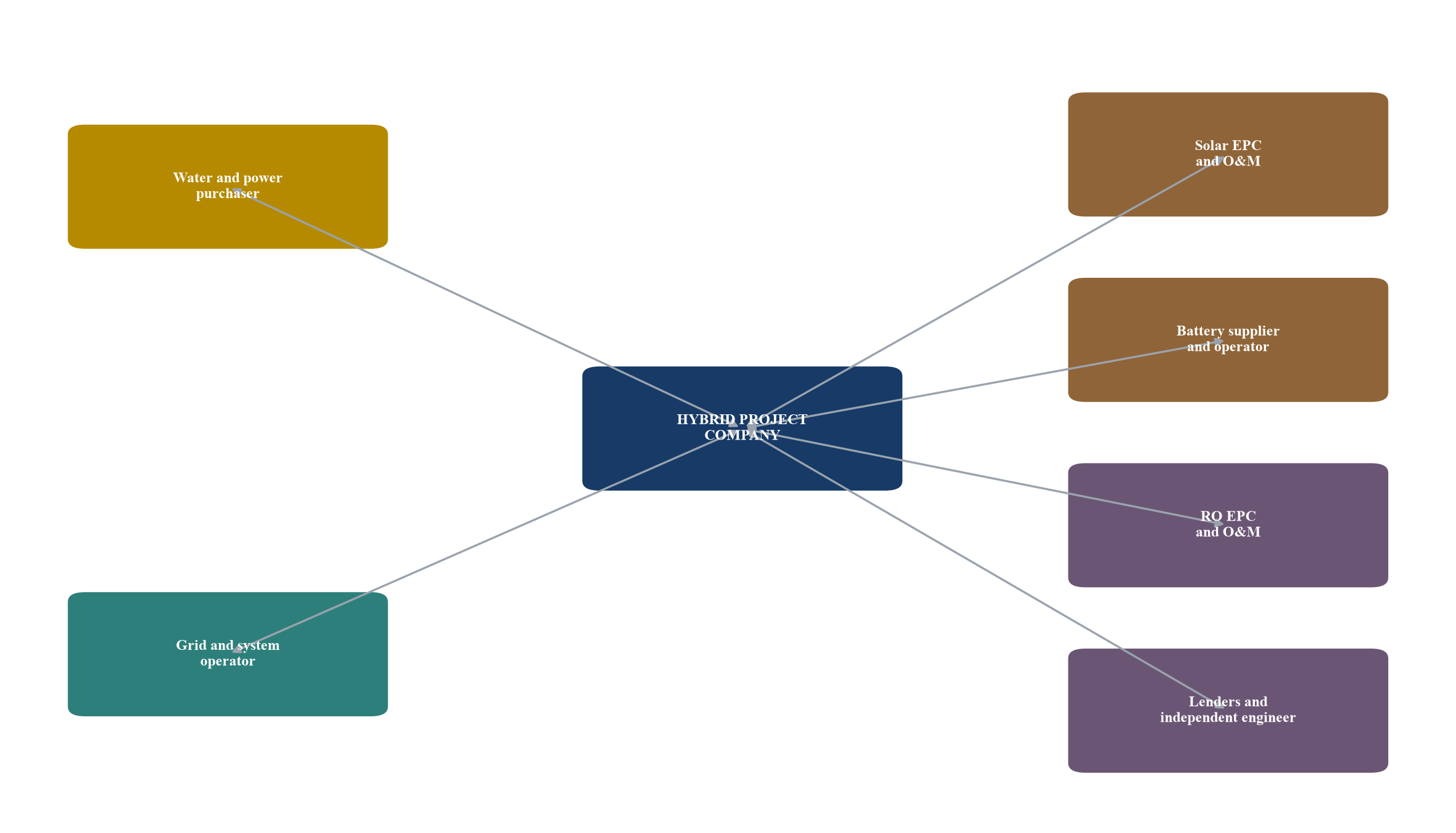
The diagram is a generic transaction framework; project-specific rights require document review.
21. Structure the master PWPA
The master agreement should define the integrated service, term, payment, dispatch, data, credit support, change in law, force majeure, default and termination. Asset schedules should carry detailed performance.
The hierarchy clause should prevent an asset schedule from removing essential water protection without explicit wording. Finance documents should use the same definitions.
22. Align the power schedule
The power schedule should define solar availability, grid import, export, curtailment, metering, attributes and tariffs. It should distinguish project-produced and grid-supplied energy.
Deemed energy treatment should avoid compensating solar that could have been used for contracted water production unless the operating hierarchy required export.
23. Align the storage schedule
The storage schedule should define dispatch, response, capacity, energy, efficiency, augmentation, warranty and end-of-term condition. It should allocate cycle and calendar degradation.
Capacity tests need temperature and state-of-charge conditions. The payment formula should distinguish unavailable power from reduced energy duration.
24. Align the water schedule
The water schedule should define capacity, quality, availability, output, feedwater, storage, dispatch and deemed availability. Electricity treatment should reconcile with the power schedule.
Specific energy guarantees need stated feedwater and operating conditions. Grid or battery failure outside the RO operator's control should receive appropriate relief.
25. Align the EPC packages
The project can use one integrated EPC contract or separate solar, battery and RO packages. Separate packages require a strong interface agreement and coordinated schedule.
Completion should prove both asset performance and integrated operation. Delay allocation should avoid a gap where every contractor blames another package.
26. Align O&M responsibility
One operator can optimise the whole system, while specialist operators may protect technical competence. The arrangement should define control authority and interface response.
Fees and penalties should not encourage one operator to improve its metric at the expense of water service or battery life. Shared KPIs may be needed.
27. Define integrated completion
Commercial operation should require the assets needed for contracted service. Solar completion alone is insufficient if the battery or desalination plant cannot perform.
Phased completion can permit early revenue, but debt service and liquidated damages must reflect the actual service. Temporary grid supply should not mask unfinished assets without approval.
28. Test the solar plant
Tests should cover capacity, performance ratio, inverter availability, grid-code response, metering and controls. Resource conditions may require correction methods or extended testing.
The test result should feed the integrated model. A solar shortfall can increase grid imports and change water cost even if water output remains compliant.
29. Test the battery
Tests should cover power, usable energy, duration, round-trip efficiency, response, auxiliary load, controls and safety. Results should be measured at the contractual boundary.
The test should establish the starting degradation baseline and augmentation requirement. Warranty conditions must match expected dispatch.
30. Test the RO plant
Tests should cover water capacity, recovery, quality, specific energy, reliability, intake, outfall and delivery. The plant should be tested across relevant operating points.
Integrated tests should demonstrate operation on solar, battery and grid supply. Switching should not compromise water quality or equipment.
Table 2. Illustrative three-asset risk-allocation matrix
| Risk | Project company | Purchaser or system | Shared mechanism |
|---|---|---|---|
| Solar resource | Bear normal variability and maintain equipment | Provide disclosed site and system information | Independent yield review and agreed reference data |
| Battery degradation | Maintain capacity and augment for agreed duty | Compensate dispatch beyond contracted usage | Cycle budget, state-of-health tests and change process |
| Feedwater condition | Operate within agreed envelope | Provide relief for conditions outside disclosed range | Sampling, baseline and independent testing |
| Grid price and outage | Manage agreed imports and efficiency | Bear defined tariff and external outage risk | Benchmark pass-through and backup protocol |
| Dispatch conflict | Follow operating hierarchy | Issue consistent instructions | Control logic, reason codes and audit trail |
| Interface delay | Coordinate packages and cure project failures | Complete public interfaces and access | Interface schedule, long-stop and expert process |
Allocation should follow control, evidence and project-specific procurement law.
31. Model the energy balance
Every interval should reconcile solar generation, battery charge, battery discharge, losses, grid import, export, RO consumption and auxiliary load. The equation should close within meter tolerance.
The annual model should retain hourly or representative time-series logic where storage value depends on timing. Annual averages can overstate firm supply.
32. Model the water balance
Water production, reservoir inflow, demand, losses and minimum storage should be reconciled. Water storage can shift desalination operation toward solar hours.
The model should include preservation, flushing, minimum train loading and quality constraints. Unlimited operational flexibility is not realistic.
33. Model battery state of charge
State of charge evolves with charge, discharge and losses. The model should impose power, energy, efficiency, reserve and degradation constraints.
Initial and terminal state assumptions can create artificial value if unconstrained. Daily and seasonal cycles should be consistent.
34. Model degradation
Solar output declines gradually, membranes and pumps lose efficiency, and batteries lose capacity with time and cycling. Each path changes the integrated cost.
Lifecycle replacements should be scheduled and funded. Guarantees, reserves and augmentation should align with the model.
35. Model dispatch
Dispatch should minimise contracted system cost while satisfying water, battery and grid obligations. The objective function should be transparent enough for audit.
Rules-based controls may be more bankable than an opaque optimisation model. Any algorithm change should be governed and tested.
36. Build the revenue waterfall
Revenue can include water capacity, water output, solar export, storage capacity, ancillary service and environmental attributes. Deductions can follow availability, quality, efficiency and dispatch failure.
The waterfall should prevent double counting and state payment priority. Essential water revenue may support senior debt more reliably than merchant ancillary value.
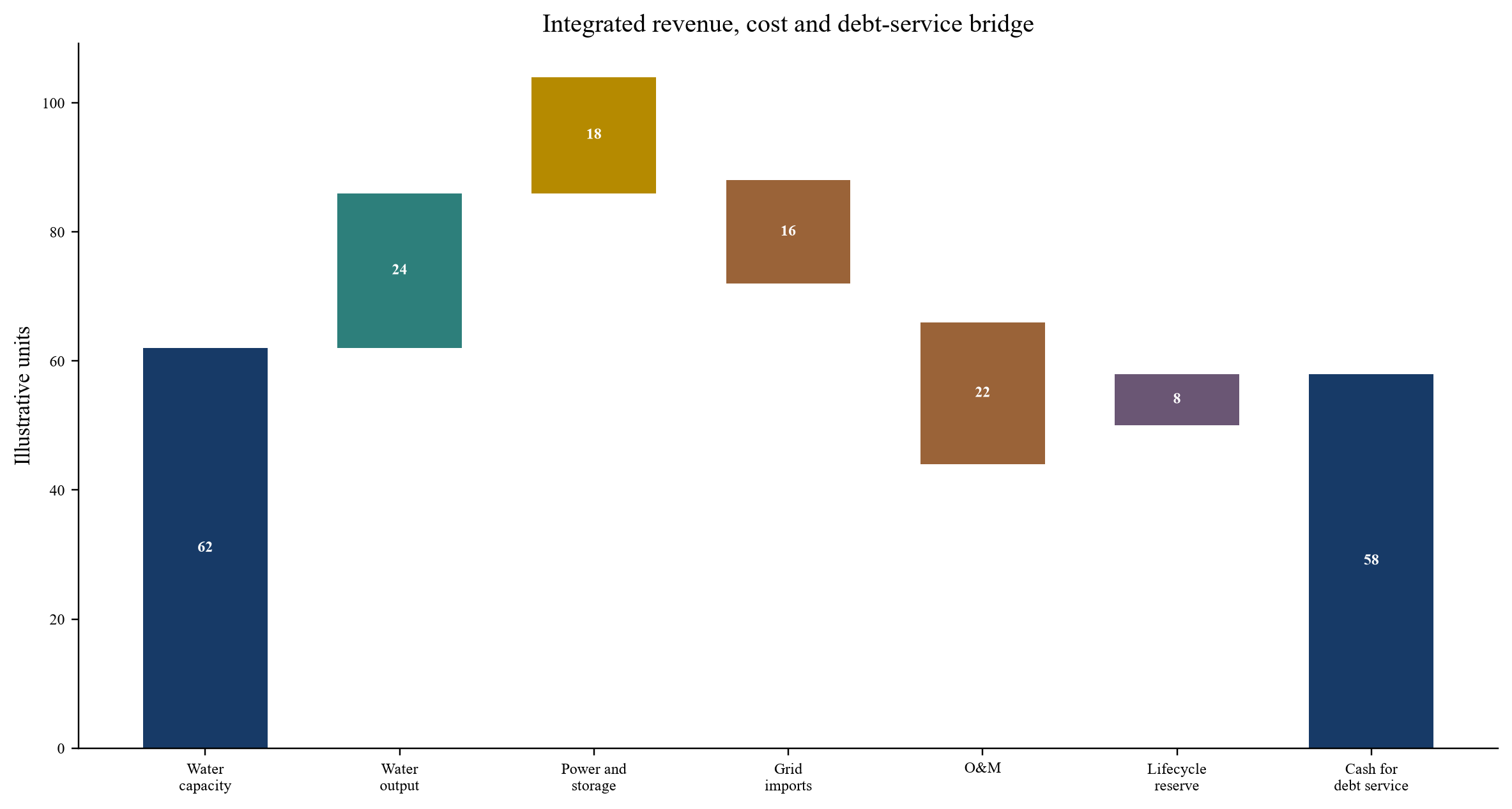
Values are hypothetical management assumptions and do not describe a market project.
37. Establish debt-service coverage
Debt service should be supported by contracted and resilient cash flow. The model should distinguish essential-service payments from exposed power or ancillary revenue.
Minimum coverage should be tested under correlated failures. Solar shortfall can increase grid cost, accelerate battery use and reduce water margin simultaneously.
38. Size reserve accounts
Reserves may cover debt service, battery augmentation, membrane replacement, major maintenance and working capital. Shared reserves can create competition between assets.
The financing documents should define permitted use, replenishment and priority. Lifecycle reserves should reflect actual duty.
39. Model power-price risk
Grid price exposure can be fixed, indexed, hedged or passed through. The allocation should preserve an incentive for efficient dispatch and RO energy use.
Basis, demand charges, network fees and taxes should be included. A generic energy price understates exposure.
40. Model battery augmentation
Augmentation can restore usable energy as cells degrade. The plan should specify timing, cost, technology compatibility, permits and warranty.
The lender model should not assume future cost reduction without a downside case. Funding can come from reserve, tariff or sponsor obligation.
41. Model membrane replacement
Membrane life depends on feedwater, pretreatment, pressure, cleaning and operating pattern. Cycling the RO plant around solar output may affect degradation.
The contract should align flexible operation with warranties. Replacement cost and downtime belong in the lifecycle case.
42. Test solar downside
Lower irradiance, soiling or equipment loss reduces internal renewable supply. The project may import more grid energy or produce less water.
The model should separate revenue and cost effects. Contracted water availability may remain intact if backup power is available and priced.
43. Test battery downside
Lower capacity, efficiency or availability can increase grid imports and reduce firming value. A fire or prolonged outage can also affect site access.
Guarantees, spare strategy and replacement timelines should be reflected. Insurance recovery may lag debt service.
44. Test water downside
Feedwater deterioration, membrane fouling, intake outage or quality failure can reduce production and increase power use. Solar and battery may remain available.
The model should show stranded energy value and alternative dispatch. Cross-default should follow material impact rather than automatic contagion.
45. Test combined stress
High water demand, low solar resource, battery degradation and high grid price can coincide. This is the decisive integrated stress.
The model should identify the service preserved, reserve draw, coverage and cure. It should not rely on perfect operating optimisation.
Table 3. Illustrative hybrid debt-service sensitivities
| Scenario | Solar output | Battery usable energy | Grid price | Water availability | Minimum DSCR | Illustrative consequence |
|---|---|---|---|---|---|---|
| Base case | 100% | 100% | Base | 97% | 1.35x | Scheduled distributions continue |
| Solar downside | 90% | 100% | Base | 97% | 1.22x | Higher grid imports reduce margin |
| Storage degradation | 95% | 80% | +10% | 95% | 1.12x | Augmentation reserve is drawn |
| Water-process stress | 100% | 95% | Base | 88% | 1.03x | Distribution lock-up and cure plan |
| Combined stress | 88% | 75% | +20% | 85% | 0.86x | Debt cure or restructuring required |
All values are hypothetical management assumptions used to demonstrate the framework.
46. Protect water quality
Energy optimisation should never compromise potable-water standards. The control system should block dispatch that creates unsafe process conditions.
Quality failure should trigger isolation, notification and remediation. Stored water needs monitoring and turnover.
47. Protect battery safety
Battery design should address thermal runaway, separation, detection, suppression, ventilation, emergency response and environmental conditions. Safety systems can constrain dispatch.
Permits and insurer requirements should be integrated early. A battery incident should not disable the entire water site where separation is feasible.
48. Protect marine systems
Intake and outfall design must address ecology, fouling, salinity and cumulative impact. Variable operation can change discharge concentration and plume behaviour.
Environmental permits should cover the operating range. Monitoring should connect to dispatch and water-production limits.
49. Define cyber controls
The energy-management system links critical power and water assets. Cyber compromise can affect dispatch, quality and public service.
Access, segmentation, authentication, patching, incident response and recovery should be contractual. Remote supplier access should be controlled.
50. Define payment security
The purchaser's obligation can cover several revenue streams. Security should match essential water payments and any contracted power or storage exposure.
Letters of credit, escrow, guarantees or undertakings need amount, tenor and replenishment. A complex invoice should not weaken draw rights.
51. Define change in law
Power-market, battery, water-quality, environmental and grid rules may change. The contract should distinguish general and project-specific change.
Relief should avoid double recovery and preserve service. Technology standards should not be frozen where safety requires improvement.
52. Define force majeure
Force majeure can affect one asset or the whole system. The contract should state partial performance, revenue, mitigation and termination.
A solar event should not excuse water production if grid supply remains available unless the economics or limits make performance impossible under the contract.
53. Define cross-default
Cross-default should apply when an asset failure materially prevents the integrated service or financing. Automatic cross-default for every minor asset breach can create disproportionate termination risk.
Cure rights should permit substitution, temporary grid supply, battery replacement or process repair. Lenders need notice and step-in.
54. Define termination compensation
Termination compensation should allocate debt, break costs and equity according to cause. Partial asset value and continued service should be considered.
The project may have separable solar, battery or water assets. Security enforcement and transfer need a practical operating plan.
55. Govern performance data
Solar, battery, grid and water meters should share time standards and data governance. Raw records should be immutable and available to authorised parties.
Monthly reporting should reconcile energy and water balances, availability, losses, degradation, instructions, invoices and disputes.
56. Refinance after operating proof
Operating history can establish yield, battery duty, RO efficiency, grid dependence and payment performance. Evidence may support repricing or tenor extension.
Refinancing should preserve lifecycle funding and purchaser protections. Upside allocation should follow the agreements.
57. Apply five bankability gates
The first gate confirms products and perimeter. The second confirms technical integration and control. The third confirms tariff and measurement. The fourth confirms lifecycle funding and debt resilience. The fifth confirms credit, safety and remedies.
Failure at a gate should produce redesign, repricing or rejection. Integration should create value that exceeds added interface risk.
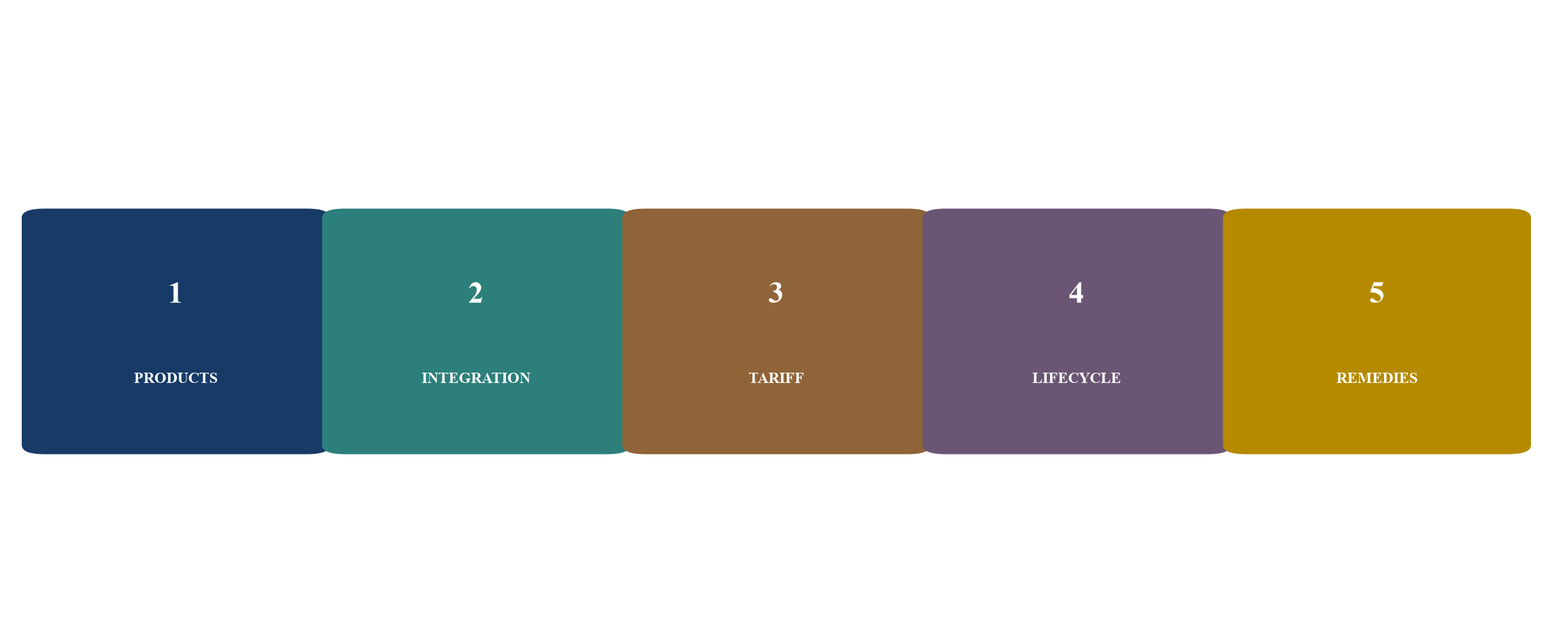
Each gate requires project-specific evidence and an accountable decision.
58. Build the decision record
The record should preserve demand, resource, grid, feedwater, storage, design, bids, models, contracts, permits, tests and approvals. It should identify assumptions and evidence.
Changes to dispatch, battery duty or water requirements should be traceable. The record supports credit review and later optimisation.
59. Use a ninety-day bankability plan
The first month should define products, perimeter, data and interfaces. The second should align contracts, tariffs, models and lifecycle obligations. The third should resolve exceptions and approve procurement or financing.
Complex environmental and grid studies may take longer. The plan should prioritise decisions that change service and debt capacity.
Table 4. Ninety-day hybrid bankability plan
| Period | Core work | Decision output | Principal control |
|---|---|---|---|
| Days 1-30 | Demand, resource, feedwater, grid, storage and interface diligence | Agreed products and perimeter | Independent data, system map and owner sign-off |
| Days 31-60 | PWPA, tariff, dispatch, EPC, O&M and financial model | Bankable allocation and base case | Energy-water reconciliation and sensitivities |
| Days 61-75 | Tests, reserves, security, safety and long-stop rights | Approved financing structure | Legal, technical and credit review |
| Days 76-90 | Final exceptions, approvals and conditions precedent | Procurement or financing decision | Evidence register and closing plan |
Timing is illustrative and should be adapted to project scope and procurement law.
60. Conclusion
Solar, storage and desalination can form a coherent infrastructure system. Solar supplies low-cost renewable energy, the battery shifts electricity and provides control, and reverse osmosis converts energy into an essential water service. The integration can reduce emissions, improve resilience and create a firm service profile.
The Three-Asset Hybrid Contract Framework coordinates the assets without hiding their distinct economics. It defines products, meters every conversion, governs dispatch, funds degradation and tests debt service under combined stress. It protects water quality and public service while preserving incentives for energy efficiency and asset availability.
An investment committee should require a complete energy and water balance, aligned completion tests, a transparent revenue waterfall, funded lifecycle obligations, enforceable payment security and credible remedies. The transaction should proceed only when the integrated value exceeds the cost and risk of the interfaces.
The committee should also reconcile the operating philosophy with the debt case. If water has priority, the base case must reserve the energy and storage required to maintain service. If electricity exports have priority, the water contract must accept the resulting production pattern or provide a separate backup source. A model that optimises each revenue stream independently can promise the same battery capacity or solar megawatt to several obligations. The control hierarchy and financial model should allocate each unit once.
The contract should distinguish energy capacity from energy throughput. Battery power determines instantaneous response, battery energy determines duration, and annual throughput affects degradation. Water storage creates another duration resource measured in hours or days of demand. These resources can substitute for one another only within technical limits. A larger reservoir may reduce battery duration needed for water continuity, while it may not support electricity export or grid services. The procurement should compare alternatives on total system cost.
The lender case should identify the minimum viable operating mode during each material outage. Loss of solar may be covered by grid import. Loss of the battery may still permit direct solar and grid operation. Loss of the grid may permit islanded water production if controls and capacity support it. Loss of the RO plant leaves solar and storage value but removes the essential service. Each mode needs safe switching, contractual payment and a cure timetable.
Integrated availability should therefore avoid a single blunt percentage. The contract can measure solar availability, storage power and energy availability, RO availability and essential-service availability. Payments can weight these measures according to value. A minor solar outage should not cause the same deduction as failure to deliver potable water. A water payment should not remain whole when the project relies repeatedly on expensive grid imports because the renewable assets underperform.
The final approval paper should present one schedule linking every service to a meter, formula, responsible party, remedy and model line. It should show which revenues are contracted, indexed, merchant or contingent. It should disclose reliance on future grid, battery augmentation, membrane replacement and water-demand assumptions. This schedule provides the bridge from an appealing technology concept to an executable project-finance transaction.
The first investment-committee test should challenge the procurement counterfactual. The integrated project should be compared with separate solar, storage and water procurements using the same demand, resource, grid and financing assumptions. Integration may save connection, land and transaction cost, yet it can also concentrate construction risk and reduce competition among specialist suppliers. The approval case should quantify the benefit that justifies the additional interfaces. A general sustainability narrative does not establish value for money.
The second test should review sizing logic. Solar capacity should reflect annual and hourly resource, desalination load, export rights and clipping. Battery power should reflect the fastest required response, while usable energy should reflect the duration of water support, energy shifting or grid service. RO capacity should reflect demand, reservoir and maintenance. Oversizing one asset can transfer cost into the blended tariff. Undersizing can create recurring grid imports, service failure or premature battery replacement.
The third test should reconcile warranties. Solar performance warranties commonly use annual degradation and equipment availability. Battery warranties can use retained capacity, throughput, cycles, temperature and operating limits. Membrane and pump warranties use specific energy, recovery, quality and feedwater conditions. The integrated dispatch regime must remain inside all three warranty envelopes. If the purchaser controls dispatch outside an envelope, the contract should adjust the relevant guarantee, lifecycle allowance and payment.
The fourth test should examine the grid as an economic participant rather than a passive backup. Import capacity can support water security, while export capacity can monetise surplus solar. Demand charges, time-of-use prices, imbalance, losses and curtailment may determine whether battery operation creates value. The connection agreement should align with the PWPA. A project cannot promise islanded service unless protection, controls, earthing and restart capability permit it.
The fifth test should examine the reservoir as a form of storage. Producing more water during solar hours and drawing the reservoir later can shift electrical demand without battery cycling. The value depends on reservoir capacity, water-demand shape, quality residence time, pumping and network constraints. The model should compare incremental water storage with battery energy on a service-equivalent basis. This comparison can materially change the optimal system architecture.
The sixth test should trace every energy unit through losses. Direct solar-to-RO energy passes through inverter and electrical systems. Solar-to-battery-to-RO energy also incurs charging, storage, discharge and auxiliary losses. Grid energy can include network loss and demand charge. The model should use measured boundaries consistent with invoices. Treating battery charging as final consumption or ignoring round-trip loss can understate the real water-energy cost.
The seventh test should trace every water unit through the process. Intake volume differs from product water because of recovery and reject flow. Product water may then incur storage, pumping and network losses before delivery. Specific energy should be measured against the contractually defined water volume and point. Changing the denominator can appear to improve efficiency without changing physical performance. Quality rejection and flushing should be treated consistently.
The eighth test should examine construction sequencing. Marine works, substations and grid interfaces often have different programmes from solar modules, battery containers and process trains. The critical path may move during execution. A common schedule should identify access, energisation, water for commissioning, test resource and public interfaces. Liquidated damages should reflect the service delayed and avoid duplicative recovery. Interim operation should be priced and insured.
The ninth test should examine supply-chain concentration. Modules, inverters, cells, battery-management systems, membranes and high-pressure pumps may come from different global suppliers. Trade restrictions, shipping delay, obsolescence and intellectual-property controls can affect completion and replacement. The project should identify qualified alternatives, spare strategy and compatibility. A low initial price can create lifecycle dependence on a supplier whose product is unavailable before the contract expires.
The tenth test should examine operating authority. The energy-management system may automatically dispatch solar, battery and grid power, while the water-control system protects process conditions. The contract should define which system has priority when instructions conflict. Operators need manual override, safe fallback and recorded reason codes. Algorithm updates should pass testing and approval. The project should be able to demonstrate why a material dispatch decision occurred.
The eleventh test should examine environmental boundaries. Solar land use, battery materials, marine intake, brine discharge and chemical handling create different impacts. An integrated permit strategy should assess cumulative effects without allowing one workstream to delay all others unnecessarily. Monitoring should connect permit conditions to operation. Battery replacement and end-of-life management require a funded route, while membranes and process chemicals require appropriate disposal and reporting.
The twelfth test should examine insurance as one programme with asset-specific coverage. Construction, delay in start-up, machinery breakdown, business interruption, marine works, cyber and battery fire can have different deductibles and exclusions. A battery event may interrupt water production even when the RO plant is undamaged. The revenue model should reflect waiting periods and uninsured exposure. Insurance should supplement contractual allocation and engineering controls.
The thirteenth test should examine termination and transfer in operating reality. A purchaser or lender taking over the project needs rights to land, software, data, warranties, spares, grid connection, intake, outfall and operating licences. Specialist operators may need replacement. Battery software and remote access can be essential to safe use. Transfer provisions should address intellectual property, cybersecurity and supplier consents before distress occurs.
The fourteenth test should examine expansion. Water demand, solar capacity, storage economics and grid conditions can change over a long contract term. Reserved land, modular electrical design, intake capacity and pipeline rights can preserve options. Expansion should use an agreed valuation and procurement process, maintain debt protections and avoid giving either party an unrestricted right to rewrite the base economics. The original project should remain operable during construction.
The fifteenth test should examine refinancing and residual value. The solar plant, battery and RO equipment have different useful lives and replacement cycles. Debt tenor should follow the integrated cash flow and funded lifecycle plan. Residual value should not assume that a degraded battery, ageing membranes or obsolete controls can operate without capital. Handback tests should specify remaining solar performance, battery usable energy, water-plant condition and availability of critical spares.
These committee tests create an approval discipline for hybrid infrastructure. They reveal whether integration genuinely reduces system cost and improves resilience, whether it merely bundles several contracts, or whether it conceals an underfunded interface. The most bankable structure preserves a clear essential service, separate technical accountability, measurable conversions, financed lifecycle obligations and a control hierarchy that operators can execute under stress.
Credit review should then separate cash flows by quality. Water-capacity revenue may be highly contracted because the purchaser pays for an available essential service. Water-output revenue may vary with dispatch. Solar exports may be contracted, indexed or merchant. Storage revenue may depend on availability, throughput or ancillary instructions. The debt case should assign each stream an appropriate haircut and payment-delay assumption. A blended tariff should not cause a contingent power-market revenue to appear equivalent to a firm water payment.
The model should also disclose internal transfer prices. Solar energy used by the RO plant has an opportunity value even when no cash invoice occurs between assets. Battery discharge carries degradation and loss. Assigning transparent transfer values permits comparison of direct solar use, storage, grid import and export. It also prevents water economics from appearing artificially cheap because the model treats internally supplied energy as free.
Performance deductions need a similar decomposition. A water shortfall caused by RO equipment should attach to the water operator and relevant guarantees. A shortfall caused by battery unavailability may attach to storage obligations if the battery was required under the operating plan. A shortfall caused by purchaser-directed battery dispatch may qualify for relief. The incident record should identify the causal chain and avoid applying several deductions to one economic loss unless the contract clearly protects distinct interests.
Change governance should recognise that the optimal dispatch can evolve. Battery ageing, new grid tariffs, improved forecasts, changing water demand or additional solar capacity may justify a revised operating strategy. The project company should propose changes with quantified effect on service, warranty, degradation, revenue and debt. Purchaser approval should follow defined criteria and timing. Emergency settings can change immediately, followed by review. Permanent changes should be version-controlled and reflected in the financial model.
Procurement data should be sufficient for comparable bids. Bidders need hourly or representative water demand, solar resource, grid tariff, connection limits, feedwater envelope, reservoir operation, dispatch priorities and the required battery duty. The procurer should provide a common evaluation model or precise assumptions. Without consistent data, each bid can optimise a different service and the apparent lowest tariff may reflect omitted scope or a more favourable assumption rather than greater efficiency.
Finally, the approval should use a concise set of conditions precedent. These can include executed grid and water agreements, secured land and marine permits, completed independent yield and feedwater studies, fixed or capped EPC pricing, battery warranty aligned with duty, funded lifecycle reserves, approved safety studies and a lender model that passes the agreed combined stress. Each condition needs an owner, evidence requirement and long-stop date. This converts the integrated concept into a controlled closing programme.
References
- Dubai Electricity and Water Authority. Solar-Powered Reverse-Osmosis Desalination Unit at Mohammed bin Rashid Al Maktoum Solar Park. 2016. https://dewa.gov.ae/en/about-us/media-publications/latest-news/2016/05/mohammed-bin-rashid-al-maktoum-solar-park
- Dubai Electricity and Water Authority. Cooperation Between Suqia and DEWA on Solar Desalination and Storage. 2017. https://www.dewa.gov.ae/en/about-us/media-publications/latest-news/2017/05/cooperation-between-suqia-and-dewa-to-find-best-solutions-in-the-field-of-water-desalination
- Dubai Electricity and Water Authority. Hassyan Seawater Reverse Osmosis IWP Financial Close. 2024. https://www.dewa.gov.ae/en/about-us/media-publications/latest-news/2024/04/dewa-and-acwa-power-reach-financial-close
- Dubai Electricity and Water Authority. Seventh Phase Solar Park with Battery Storage. 2026. https://www.dewa.gov.ae/en/about-us/media-publications/latest-news/2026/1/dewa-highlights-7th-phase
- International Renewable Energy Agency. 24/7 Renewables: The Economics of Firm Solar and Wind. 2026. https://www.irena.org/Publications/2026/May/24-7-renewables-The-economics-of-firm-solar-and-wind
- International Renewable Energy Agency. Renewable Power Generation Costs in 2024. https://www.irena.org/Digital-Report/Renewable-Power-Generation-Costs-in-2024
- International Renewable Energy Agency. Renewable Desalination: Technology Options for Islands. 2015. https://www.irena.org/-/media/Files/IRENA/Agency/Publication/2015/IRENA_RE_Desalination_2015.pdf
- World Bank Group. Unlocking the Energy Transition: Guidelines for Planning Solar-Plus-Storage Projects. 2023. https://www.worldbank.org/en/news/press-release/2023/11/27/world-bank-unveils-comprehensive-framework-to-accelerate-solar-plus-storage-adoption-in-developing-countries
- World Bank Group. Guidelines to Implement Battery Energy Storage Systems under Public-Private Partnership Structures. https://documents1.worldbank.org/curated/en/099053024203034064/pdf/P174202109ad5c077194dc19a7249bbc5ab.pdf
- Dubai Electricity and Water Authority. Jebel Ali SWRO Desalination Plant. 2020. https://dewa.gov.ae/en/about-us/media-publications/latest-news/2020/09/md-ceo-reviews-progress-on-swrobased-desalination-plant-in-jebel-ali
- Emirates Water and Electricity Company. Statement of Future Capacity Requirements. https://ewec.ae/
- International Finance Corporation. Environmental and Social Performance Standards. https://www.ifc.org/en/insights-reports/2012/ifc-performance-standards
- World Health Organization. Guidelines for Drinking-water Quality. https://www.who.int/publications/i/item/9789241549950
- International Organization for Standardization. ISO 24512 Drinking Water Utilities. https://www.iso.org/standard/37248.html
- International Electrotechnical Commission. Electrical Energy Storage Standards. https://www.iec.ch/
- National Fire Protection Association. NFPA 855 Standard for Installation of Stationary Energy Storage Systems. https://www.nfpa.org/
- Equator Principles Association. Equator Principles. https://equator-principles.com/
- Loan Market Association. Green Loan Principles. https://www.lma.eu.com/sustainable-lending/resources
- International Project Finance Association. Project Finance Resources. https://www.ipfa.org/
- International Energy Agency. Batteries and Secure Energy Transitions. https://www.iea.org/reports/batteries-and-secure-energy-transitions
- International Energy Agency. Water-Energy Nexus. https://www.iea.org/topics/water
- World Bank PPP Resource Center. Power Purchase Agreements. https://ppp.worldbank.org/sector/energy/energy-power-agreements/power-purchase-agreements
- World Bank PPP Resource Center. Water and Sanitation PPPs. https://ppp.worldbank.org/sector/water-sanitation
- GCC Interconnection Authority. Annual Reports and System Information. https://www.gccia.com.sa/
- Dubai Electricity and Water Authority. Sustainability Report 2023. https://dewa.gov.ae/-/media/Files/Sustainability/DEWA_Sustainability_Report_2023_ENG.ashx
- ACWA Power. Water and Renewable Energy Portfolio. https://www.acwapower.com/
- Masdar. Renewable Energy Projects. https://masdar.ae/
- International Valuation Standards Council. International Valuation Standards. https://www.ivsc.org/standards/
- IFRS Foundation. IFRS 13 Fair Value Measurement. https://www.ifrs.org/issued-standards/list-of-standards/ifrs-13-fair-value-measurement/
- World Bank Group. Private Participation in Infrastructure Database. https://ppi.worldbank.org/
About the Author
Chennakeshav (CK) is a corporate finance and investment banking executive with 25+ years of global experience in deal origination, structuring and execution across M&A, growth capital and corporate strategy. He has led value-creation mandates for founders, corporates and funds — bridging the boardroom view to hands-on execution and close.
His career spans Morgan Stanley, HSBC, Lloyds Banking Group, EWEC, ADQ portfolio companies and Emirates Growth Fund, across TMT, real estate, fintech, deeptech, cleantech, infrastructure and energy. He has partnered with C-suite leaders, private equity and venture funds, sovereign wealth funds and family offices to finance complex fund raises and scale-up ventures, and has led M&A due diligence, post-merger integration and business-transformation initiatives to create value.
At Matchpoint Partners he is Managing Partner, leading the firm's corporate finance, M&A and capital-raising practice. He holds an MBA from London Business School, an engineering degree from VTU and a Master of Laws (LLM, in progress) from UCL London.
An active start-up mentor, CK mentors at Techstars, DIFC FinTech Hive, Startup Grind, Founder Institute and IN5, serves as Entrepreneur Mentor in Residence (EMiR) at London Business School, and judges the Entrepreneurship World Cup.
