
1. Begin with the delivered product
The infrastructure decision begins at the customer's battery limit. A refinery that requires continuous high-purity hydrogen, a fertiliser producer that consumes ammonia, a shipping customer that needs bunker fuel and a steelmaker that can relocate reduction activity create different transport problems. Describing all four as hydrogen demand obscures the molecule, pressure, purity, timing and reliability that the infrastructure must deliver.
The first investment question is therefore what must arrive, where, in what form and under what operating profile. Direct ammonia use avoids cracking and hydrogen purification. A pure-hydrogen user may favour a pipeline when demand is concentrated and a viable corridor exists. A customer buying green iron or another hydrogen-derived commodity may avoid moving hydrogen altogether. The trade route should be designed around the least-cost compliant product, not around an upstream asset seeking a market.
This product-first approach also improves commercial diligence. It identifies who signs the offtake, which specification governs acceptance, which conversion assets are required, and where losses and liabilities sit. It prevents a production cost advantage from being quoted without the transport, storage, conversion and delivery costs required to monetise it.
2. Announced trade volumes remain weak evidence of utilisation
Hydrogen trade has attracted extensive project announcements, but announced capacity does not establish throughput for a pipeline or terminal. The IEA's 2026 review states that trade would underpin more than 40 percent of announced low-emissions hydrogen volumes by 2030 if every project materialised. Less than 8 percent of that trade-oriented volume was operational, in construction or backed by committed investment [1]. The difference is central to infrastructure underwriting.
An infrastructure asset earns its return through contracted and delivered volume. It still carries fixed operating cost, maintenance, debt service and minimum staffing when upstream production or downstream demand slips. A long-distance corridor can therefore appear competitive at design utilisation and become uneconomic at the lower throughput supported by firm offtake.
The sponsor should rebuild the market from project-level evidence. For each potential shipper or user, it should verify production status, offtake, power, permits, financing, certification, delivery date, credit and competing routes. Capacity should enter the base case only when the counterparty and project evidence support it. Announcements and memoranda belong in optional scenarios with explicit probabilities and dates.
3. Carrier selection is a system optimisation problem
A carrier changes more than transport. It changes conversion equipment, storage, port design, vessels, safety systems, energy use, emissions accounting, product specification and the assets required at destination. Comparing pipeline tariff with vessel freight excludes most of the economic chain.
The decision model should start at production and end at customer acceptance. It should include compression or synthesis, intermediate storage, loading, transport, boil-off or carrier losses, unloading, reconversion, purification, final compression, inland distribution and reserve capacity. Capital, operating cost, electricity, heat, working inventory, availability and replacement cycles should use a common basis.
IRENA's carrier review illustrates why whole-chain analysis matters. Its scenarios show pipelines as strong options for shorter distances and sufficiently large flows, while ammonia becomes attractive across many long-distance shipping cases. Conversion and reconversion frequently contribute more cost than the sea voyage itself [2]. The result is sensitive to scale, utilisation, distance, existing assets and whether ammonia is used directly. A route ranking without those variables is a narrative, not an investment case.
4. A disciplined route screen precedes detailed engineering
The first screen should eliminate routes that fail a commercial, physical or regulatory condition before sponsors spend heavily on engineering. A pipeline needs a connectable corridor, viable materials, permits, compression, compatible network rules and enough durable throughput. A shipping route needs suitable production and destination ports, safe storage and handling, vessels, certification, unloading rights and an end-use pathway.
The figure provides a generic sequence. The sponsor first defines the delivered product and demand cluster. It then tests geographic feasibility and existing assets. The remaining routes undergo whole-chain cost, energy, emissions, safety and financing analysis. Optionality is preserved until route-specific evidence supports commitment.
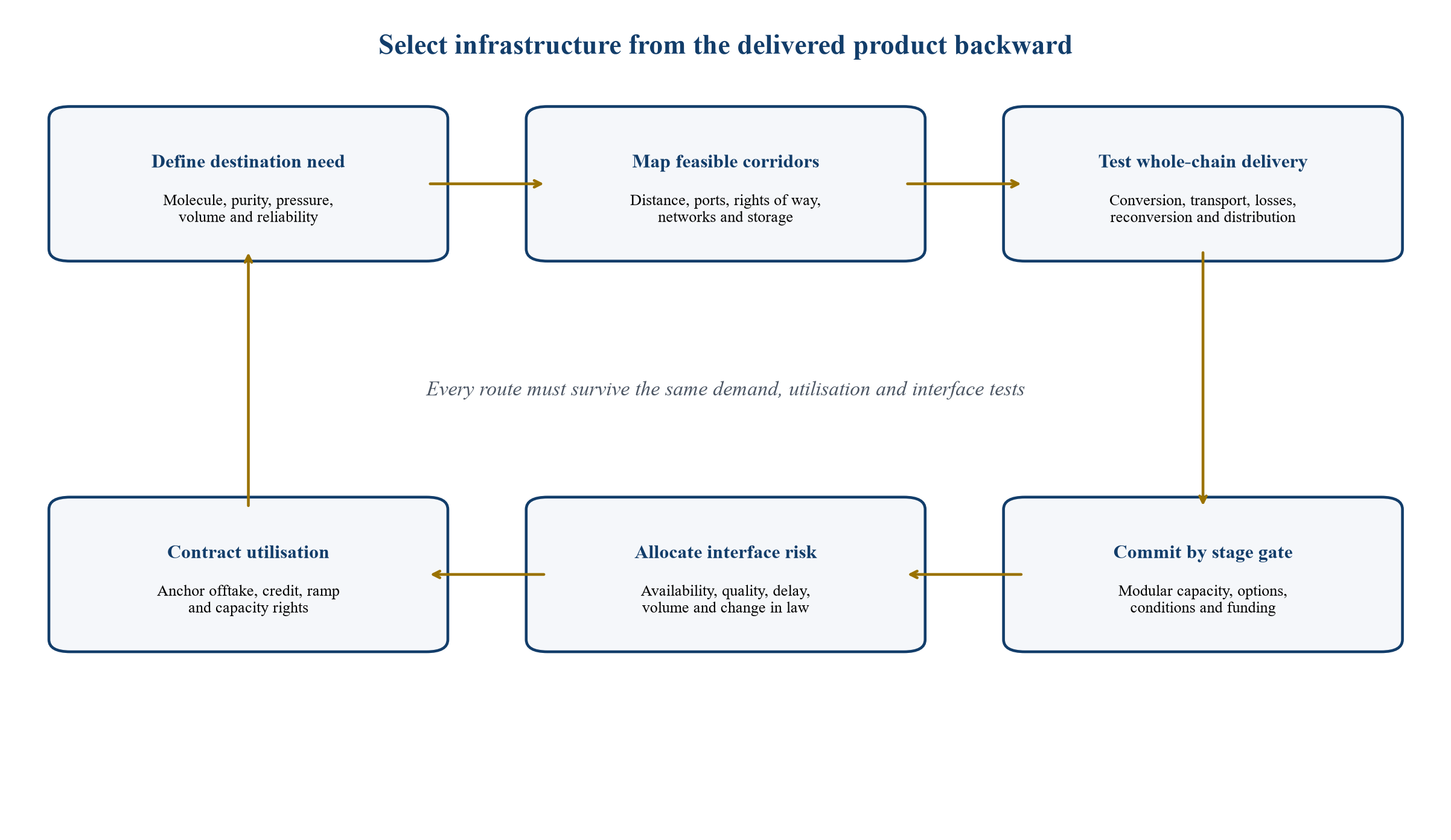
The sequence is a generic investment framework. It does not select a route for a named project or jurisdiction.
5. Pipelines depend on density and utilisation
Pipelines can move large continuous volumes without repeated conversion and loading cycles. Their economics improve when demand is concentrated, the route is connectable and the asset achieves high utilisation over a long life. They can also provide linepack and integrate with storage, although hydrogen's physical characteristics limit how directly natural-gas operating assumptions can be transferred.
IRENA's 2022 analysis found pipeline transport particularly competitive over shorter distances, with the economic range expanding for larger flows and repurposed assets [2]. The IEA's 2026 review similarly describes pipelines as often the lowest-cost option for pure hydrogen where suitable routes and high utilisation are available [1]. These are scenario findings, not universal thresholds. Terrain, seabed, compressor design, materials, regulation and financing can move the result materially.
The decisive variables are contracted throughput and corridor readiness. A pipeline sized for an optimistic cluster can carry years of negative operating leverage while producers and users ramp. A staged system, initial lateral or shared industrial network may provide a better risk-adjusted entry. The base case should use firm capacity commitments and a credible ramp rather than the sum of announced projects.
6. Repurposing requires asset-specific proof
Repurposed gas pipelines can reduce capital and accelerate corridor development when the asset, route and market transition align. Institutional studies report material savings relative to new build in suitable cases [2, 3]. A percentage saving cannot be applied across a network without inspecting the actual pipe, welds, compressors, valves, seals, metering, pressure regime and operating history.
Hydrogen can affect materials through embrittlement and fatigue mechanisms. Its lower volumetric energy density changes throughput and compression requirements. Existing branches, stations and cross-border interconnections may need modification. The pipeline may also remain necessary for natural-gas security during the proposed conversion period.
The repurposing case should therefore include an integrity programme, materials verification, fracture and fatigue assessment, compressor strategy, leakage detection, metering, purity management and regulatory approval. It should identify which assets can be retained, modified or replaced. It should also price the opportunity cost of removing gas service and the transitional period during which both systems may be needed. Route ownership creates an option; technical and market evidence determine whether that option has investable value.
7. New pipelines carry corridor and sequencing risk
A new pipeline provides design freedom and avoids legacy constraints. It can select pressure, diameter, materials, compression and monitoring for hydrogen service. The same freedom creates a large, lumpy commitment exposed to permitting, land, cross-border coordination and demand timing.
The sponsor should separate route development from final capacity commitment. Early work can secure surveys, environmental studies, land rights, interconnection concepts and market tests. Diameter and compression should follow credible demand scenarios and modular expansion analysis. Oversizing may reduce later duplication, but it also raises initial capital and tariff requirements when utilisation is low.
Cross-border pipelines add regulatory and allocation questions. Network access, tariff design, balancing, quality, capacity booking and cost sharing can influence returns as much as construction cost. The European Union's hydrogen market rules provide for integrated planning, network access and future tariff arrangements, including a role for the European Network of Network Operators for Hydrogen [4, 5]. Projects in other regions require their own equivalent framework. A physically complete pipe without bankable access and revenue rules is not commercially complete.
8. Shipping provides portfolio flexibility
Shipping can connect multiple producers and import terminals without a fixed point-to-point corridor. That flexibility can diversify supply, enable cargo optimisation and allow new trade lanes to develop before a continuous pipeline is justified. It also exposes the chain to vessel availability, port slots, weather, working inventory and conversion interfaces.
Ammonia benefits from an existing global chemical trade, specialised vessels and operational experience. The IEA reported around 170 ammonia terminals in operation in its 2026 infrastructure review [1]. Existing capacity does not automatically satisfy low-emissions certification, bunkering or large-scale import requirements. Storage, unloading rates, exclusion zones, emergency systems and inland links may need investment.
The buyer of shipping flexibility pays for synthesis or liquefaction, storage at both ends and potentially reconversion. A route that looks more resilient because it can receive cargoes from several origins may still be economically dependent on one anchor buyer or one cracker. The investment case should value flexibility explicitly through avoided outage, replacement-cargo options and portfolio optimisation, while charging the complete fixed and variable cost of providing it.
9. Ammonia is both a product and a carrier
Ammonia can be sold for fertiliser, chemicals, power or marine fuel, or used as a carrier that is cracked back into hydrogen. These pathways should not be combined in one demand number. Direct use and reconversion create different assets, specifications, losses, buyers and margins.
Direct ammonia use can avoid the energy and capital required for cracking and hydrogen purification. IRENA's trade analysis emphasises that much future ammonia trade could be consumed as ammonia rather than reconverted [6]. This supports a strategy of locating ammonia synthesis near low-cost hydrogen production and selling the derivative into an established or emerging ammonia market.
Cracking broadens access to pure-hydrogen users but creates a destination conversion plant with heat demand, availability risk and product-purity requirements. The IEA reports that shipping pathways supplying pure hydrogen can involve minimum additional costs around USD 2 per kilogram of hydrogen and energy use exceeding 10 kilowatt-hours per kilogram in some cases, reflecting intensive liquefaction or reconversion [1]. A sponsor should verify project-specific numbers. The strategic question is whether destination customers value pure hydrogen enough to pay for the added chain.
10. Liquid hydrogen remains a specialised route
Liquid hydrogen offers direct delivery of hydrogen without a chemical carrier, but liquefaction requires very low temperatures and substantial energy. Storage, transfer and vessels require cryogenic systems, and boil-off must be managed. The route can be relevant where pipelines are unavailable, pure hydrogen is essential and sufficient scale supports specialised assets.
IRENA identifies liquefaction energy and cryogenic equipment as major cost drivers, with distance and boil-off affecting route competitiveness [2]. The route therefore requires tight integration between liquefier, storage, vessel schedule, terminal and customer demand. Delays or low utilisation can increase unit cost because the capital base is highly specialised.
The investment case should verify liquefier efficiency, availability, storage duration, boil-off treatment, vessel cycle, loading and unloading rates, and destination regasification. It should also test technology scale-up and residual value. Equipment designed for liquid hydrogen may have fewer alternative uses than conventional chemical-terminal assets. Optionality should be demonstrated through contracts and technical compatibility rather than assumed from the broad growth of hydrogen markets.
11. Liquid organic carriers trade handling simplicity for conversion burden
Liquid organic hydrogen carriers can use familiar liquid-fuel logistics and avoid cryogenic boil-off. Hydrogen is chemically bound into a carrier at origin and released at destination. The pathway requires hydrogenation, dehydrogenation, heat, carrier inventory and a return loop for the depleted material.
IRENA's carrier review notes challenges related to carrier cost, limited production scale, low hydrogen content by weight, heat demand and losses across repeated cycles [2]. These constraints create working-capital and logistics questions beyond the conversion plant. The sponsor must finance the carrier inventory and ensure it returns at the required quality and timing.
The route can still be relevant where existing liquid infrastructure, safety characteristics or distributed delivery justify the added conversion steps. A decision model should include carrier degradation, replacement, backhaul, contamination, heat integration, catalyst life and licensing. It should also compare the route with shipping ammonia for direct use and with moving a finished hydrogen-derived product. Familiar tanks and vessels provide only part of the chain; carrier chemistry and reverse logistics determine the investable system.
12. Moving derivatives can remove an infrastructure layer
Hydrogen is often an intermediate input rather than the product a customer ultimately values. Ammonia, methanol, synthetic fuels, direct-reduced iron and other derivatives can embed hydrogen in a tradable commodity. Producing the derivative near low-cost energy can avoid hydrogen reconversion and move more established cargoes through existing logistics.
IRENA's 2025 work evaluates trade in hydrogen and related commodities under common cost and financing assumptions [7]. Its framing reinforces the need to compare the location of conversion, not simply the mode of hydrogen transport. A destination country may prefer domestic value addition, employment and supply security. An exporter may capture more margin by converting before shipment. Tariffs, carbon accounting, standards and local infrastructure can change the balance.
The sponsor should therefore include derivative pathways in the route screen. The comparison should use the same final product, quality and carbon boundary. Moving green iron instead of hydrogen, for example, changes mining, pellet, reduction, steelmaking and port requirements. It can simplify hydrogen transport while creating another industrial value chain. The proper decision follows total delivered economics and strategic policy, not the narrow cheapest carrier.
Table 1. Route-screening matrix for hydrogen trade infrastructure
| Route | Strongest conditions | Principal value driver | Critical evidence | Common failure mode |
|---|---|---|---|---|
| Repurposed hydrogen pipeline | Existing compatible corridor, dense pure-hydrogen demand and high utilisation | Lower capital and continuous flow | Integrity, gas-system release, compression, regulation and capacity contracts | Assuming the whole gas asset can transfer unchanged |
| New hydrogen pipeline | Durable regional cluster and bankable cross-border or industrial demand | Scale and direct pure-hydrogen delivery | Rights of way, permits, diameter, compressor design, tariffs and anchor shippers | Building ahead of contracted demand |
| Ammonia shipping for direct use | Long distance, port access and ammonia-compatible end use | Established cargo form and avoided cracking | Product specification, storage, vessels, safety and direct offtake | Treating ammonia demand and hydrogen demand as interchangeable |
| Ammonia shipping with cracking | Long distance and destination need for pure hydrogen | Supply diversification and maritime reach | Cracker efficiency, heat, purity, availability and hydrogen distribution | Underpricing reconversion and single-point failure |
| Liquid hydrogen shipping | No pipeline, pure-hydrogen requirement and sufficient specialised scale | Direct hydrogen without chemical carrier | Liquefaction energy, boil-off, vessels, cryogenic storage and cycle time | Applying pilot performance to commercial throughput |
| Liquid organic carrier | Existing liquid logistics and value from non-cryogenic handling | Familiar storage and transport | Carrier inventory, conversion heat, losses, return logistics and licences | Ignoring working inventory and backhaul |
| Hydrogen-derived commodity | Customer values ammonia, methanol, fuel or reduced iron | Avoided reconversion and captured value addition | Final-product market, certification, conversion plant and port chain | Comparing different final products on an inconsistent basis |
The matrix is a generic guide. Project-specific engineering, safety, legal and commercial analysis is required.
13. Distance is only one break-even variable
Distance is often presented as the decisive break-even variable between pipe and ship. It matters, but the result can move more sharply with flow, utilisation, conversion efficiency, existing infrastructure and end use. A large repurposed pipeline can remain attractive over a longer route than a small new build. Ammonia can remain attractive over shorter water routes when the customer consumes it directly. A high-cost cracker can reverse that conclusion when pure hydrogen is required.
The model should therefore use a surface rather than a single threshold. Distance belongs on one axis, annual delivered volume on another, and separate cases should represent utilisation, asset reuse and end use. The sponsor should show where the ranking changes and which assumptions cause the change.
The figure uses hypothetical values to illustrate the method. It does not estimate an actual corridor. Its purpose is to reveal that a route can move from preferred to uneconomic when utilisation falls or reconversion is added. Investment committees should see those boundaries before authorising front-end engineering or capacity reservation.
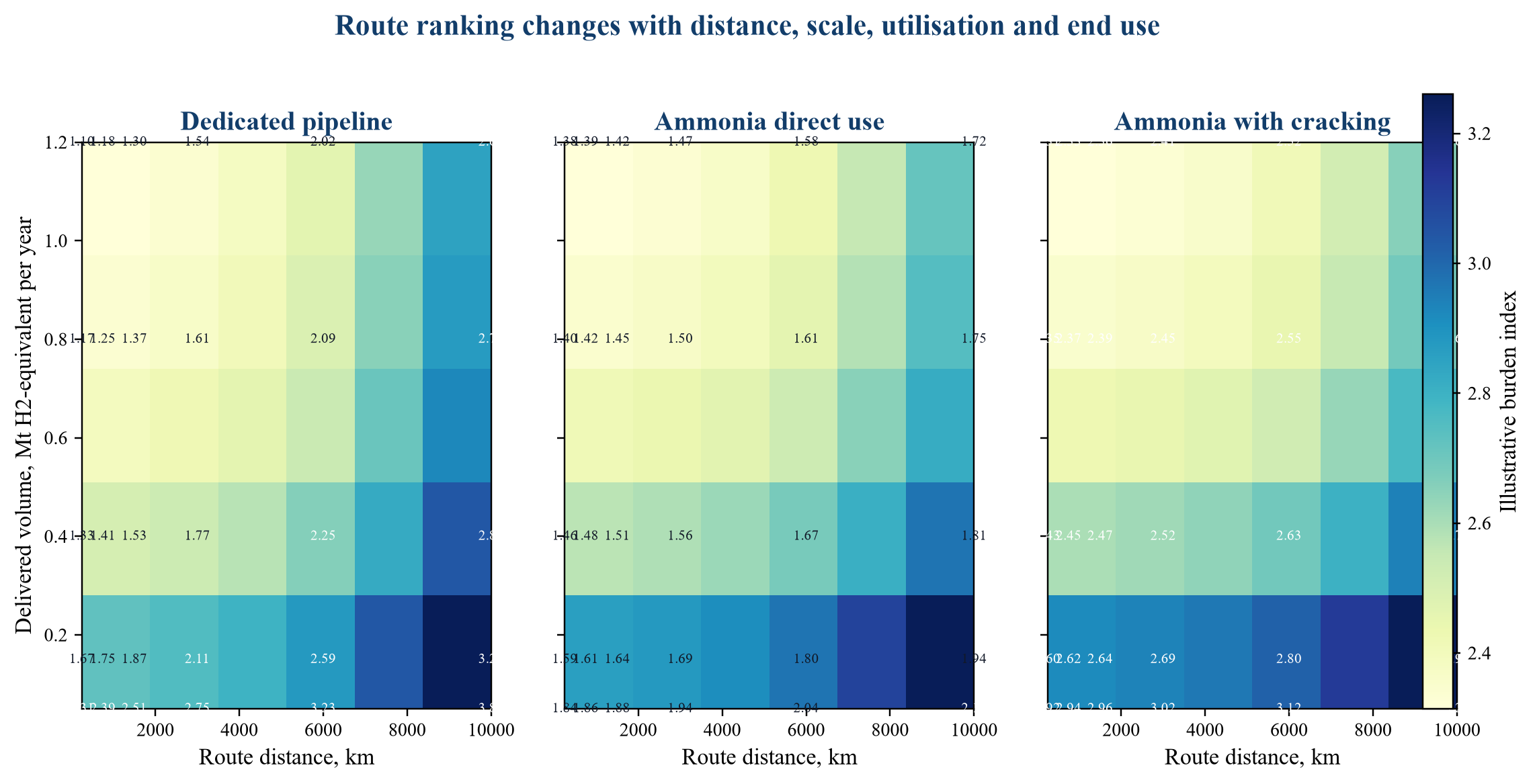
Scores are illustrative analytical outputs, not engineering costs or forecasts. Lower scores indicate a lower hypothetical delivered-infrastructure burden.
14. Utilisation should be contracted before it is forecast
Infrastructure utilisation is a commercial outcome. It depends on production availability, customer demand, vessel or network access, maintenance and the timing of connected projects. A forecast that assumes every announced project starts on schedule can conceal the largest risk in the investment case.
The sponsor should build a capacity stack from firm ship-or-pay or take-or-pay commitments, conditional contracts, probable projects and uncontracted upside. Each layer should state commencement, ramp, volume flexibility, credit support, termination, force majeure and default remedies. Contracted capacity should reconcile to physical deliverability and the customer's ability to use the product.
Minimum revenue commitments can support debt, but their value depends on counterparty credit and enforceability. A project company with no operating asset or strong sponsor support provides limited protection. Capacity reservation can also create stranded slots when a weak project blocks stronger demand. The commercial model needs release, reallocation and secondary trading mechanisms. Utilisation is bankable when contracts, connected assets and credit work together; a percentage in a spreadsheet does not provide that evidence.
15. Storage is part of the route rather than an accessory
Storage balances variable production, vessel schedules, pipeline maintenance and customer demand. It can protect reliability and reduce forced curtailment. It also adds capital, losses, safety requirements and working inventory. A route without sufficient storage may be physically connected and commercially unable to meet delivery obligations.
Hydrogen storage options include compressed vessels, linepack and geological formations such as salt caverns where geology permits. Ammonia storage uses established refrigerated or pressurised designs but requires toxic-release controls and compatible port layouts. Liquid hydrogen needs cryogenic tanks and boil-off management. Each route has a different optimum inventory and emergency operating plan.
The IEA reported that announced underground hydrogen storage could reach 11 terawatt-hours by 2035, while only a small fraction had reached final investment decision or construction by its 2026 review [1]. Sponsors should not assume storage appears with the corridor. The model should define operating inventory, strategic reserve, heel, outage cover, seasonal swing and working-capital ownership. Storage should be sized against actual variability and contractual reliability, with expansion options where uncertainty is high.
16. Port readiness needs an interface audit
A port with chemical-handling experience can shorten development, but existing jetties and tanks may not fit the proposed cargo, scale or safety case. The IEA identifies a set of ports with chemical-handling readiness and nearby potential supply, indicating where early trade may concentrate [8]. Readiness remains a starting point for diligence.
The interface audit should cover channel depth, berth availability, vessel size, loading arms, unloading rate, storage, exclusion zones, emergency response, utilities, electricity, cooling water, flare or treatment systems, truck and rail access, pipeline connections and space for conversion. It should also test community acceptance and cumulative risk with neighbouring operations.
Port economics depend on shared assets and tariffs. A dedicated terminal can give control but carries concentrated utilisation risk. A multi-user terminal can diversify volume but needs transparent capacity rules, quality segregation and expansion governance. Brownfield conversion may reduce initial capital while creating integration and outage risk. The sponsor should allocate every interface to a responsible owner and define the acceptance test that transfers risk from one asset to the next.
17. Safety design changes the commercial perimeter
Hydrogen and ammonia create distinct hazards. Hydrogen has a wide flammability range, low ignition energy and leakage behaviour that requires suitable detection, ventilation and materials. Ammonia is toxic and corrosive under some conditions, and a release can affect people beyond the immediate asset boundary. Safety design influences land, separation distances, equipment, staffing, insurance and permitting.
The International Maritime Organization has issued interim safety guidelines for ships using ammonia and hydrogen as fuel [9]. These guidelines illustrate the developing operating framework for alternative fuels. Cargo terminals, pipelines and onshore conversion plants also require jurisdiction-specific standards and approvals. A sponsor should not treat regulatory evolution as a generic contingency percentage.
The commercial perimeter should identify who owns hazardous inventory, controls transfer, stops flow, manages emergency response and bears losses during an incident. Contracts should align these responsibilities with operational control. The financing case should include safety studies, quantitative risk assessment, training, monitoring, inspection, security, emergency equipment and community engagement. A route that cannot obtain a credible safety case cannot support the assumed schedule or terminal value.
18. Certification must survive every custody transfer
Low-emissions value depends on production route, electricity attributes, emissions boundary, chain of custody and market rules. Conversion and transport consume energy and can change delivered emissions intensity. A cargo that qualifies at origin may fail a destination threshold if losses, electricity or methane emissions are accounted for differently.
The sponsor should map certificate data through production, synthesis, storage, shipping, reconversion and final delivery. Metering, mass balance, book-and-claim eligibility, temporal rules and audit rights should be designed before commercial operation. The contract should state which party bears the risk that a methodology, registry or destination rule changes.
European rules distinguish renewable and low-carbon gases and are developing network and cross-border arrangements [4, 5]. Other importing markets have different definitions and support mechanisms. The route should be tested against each target market rather than one generic green label. Certification value should enter revenue only when the product, evidence chain and buyer eligibility are aligned. Where methodologies remain unsettled, the base case should use conservative value and preserve access to more than one compliant market.
19. Network access and tariffs can determine corridor value
A pipeline can operate as a dedicated asset, a negotiated multi-user system or regulated network. The model affects access, pricing, expansion, balancing and investment recovery. Sponsors and lenders need to know whether revenue comes from long-term capacity contracts, regulated tariffs, merchant spreads or a combination.
The EU hydrogen and gas package establishes principles for market integration, network access, entry-exit arrangements, tariff publication, balancing and infrastructure planning [4, 5]. Implementation will develop over time and across jurisdictions. A cross-border project must align national rules, interconnection quality and capacity allocation.
The project model should show allowed or contracted revenue, volume exposure, inflation, operating efficiency incentives, expansion treatment and stranded-asset risk. It should identify who funds early capacity needed for later market growth. Socialising underutilised capacity can create political and regulatory resistance. Charging the first users the full cost can suppress demand. A credible corridor therefore needs a transparent allocation mechanism that protects consumers, supports investment and preserves open access where required.
20. Conversion assets create single points of failure
Synthesis, liquefaction, cracking, purification and compression sit between production and customer delivery. Each can constrain the entire chain. A terminal with ample tank and berth capacity cannot deliver pure hydrogen when its cracker is unavailable. A pipeline cannot earn full revenue when compressor or purification capacity limits flow.
The reliability model should use component availability, planned maintenance, common-mode failures, spares, restart time and upstream or downstream constraints. Redundancy should be placed where it reduces contractual exposure, not simply where engineering practice suggests another train. Spare capacity can be valuable when penalties, replacement purchases or customer outages are severe.
Performance guarantees should specify throughput, energy use, purity, ramp, emissions and availability at defined boundary conditions. The sponsor should test whether guarantee remedies cover the economic loss created by underperformance. A liquidated-damages cap may be small relative to foregone infrastructure revenue. Insurance may exclude technology performance. Lenders will therefore focus on proven scale, completion tests, contractor strength, reserve accounts and the sponsor's ability to fund remedial work.
21. Electricity and heat can erase an origin cost advantage
Hydrogen production cost is only the first energy input. Compression, ammonia synthesis, liquefaction, refrigeration, pumping, cracking, purification and final compression consume electricity or heat. The route can transform cheap upstream hydrogen into expensive delivered product when conversion is inefficient or destination energy is costly.
The model should state energy intensity at each boundary and apply time-appropriate electricity, fuel and carbon prices. Waste heat may improve a cracking case, but it should enter the base case only when quantity, temperature, availability and contractual access are proven. Renewable-power attributes may also affect certification.
The IEA's 2026 review highlights material energy requirements for shipping routes that return ammonia or liquid hydrogen to pure hydrogen [1]. IRENA similarly identifies reconversion heat as a major component of ammonia-carrier cost [2]. Sponsors should perform an energy balance before focusing on transport tariff. Sensitivity should cover conversion efficiency, local power price, heat source, operating hours and carbon treatment. The cheapest production region does not automatically provide the cheapest delivered molecule.
22. Whole-chain emissions belong in the commercial model
Low-emissions hydrogen infrastructure can create emissions through electricity, natural gas supply, carbon capture performance, ammonia synthesis, shipping fuel, boil-off, auxiliary heat and reconversion. Destination rules and customer claims may depend on the whole chain. Emissions can therefore affect price, eligibility and market access.
The sponsor should define the measurement boundary and data owner for each step. It should distinguish observed metered data, engineering estimates and policy defaults. Upstream methane, grid intensity, capture rate, shipping emissions and conversion losses require consistent treatment. The model should avoid mixing lifecycle values from different methodologies.
Contracts can allocate emissions-intensity risk through specifications, warranties, price adjustments and termination. Those provisions should correspond to the party controlling the relevant asset. A producer cannot fully control a chartered vessel's fuel or a destination cracker's heat source without contractual rights. The route selection should compare delivered emissions alongside delivered cost and reliability. A lower-cost route that fails the buyer's emissions threshold may have no qualifying revenue.
23. Demand aggregation can solve or magnify coordination risk
Shared infrastructure can connect several producers and users, improving scale and diversification. It can also create circular dependence: producers wait for infrastructure, customers wait for supply, and the infrastructure sponsor waits for contracts. A credible aggregator must convert interest into compatible commitments.
The market process should use standard data and contract terms. Potential users should state product, location, volume, pressure, purity, start date, flexibility and credit. Producers should state capacity, certification, availability and delivery point. The infrastructure developer can then test a coherent network rather than add incompatible megawatts.
Aggregation magnifies risk when one anchor project drives most capacity but depends on smaller users to justify the route. It can also conceal correlations; several announced projects may rely on the same subsidy, port, grid connection or buyer. The sponsor should identify common dependencies and size initial capacity to the firm cluster. Expansion rights can preserve upside. A transparent market test with deposits or bid security provides stronger evidence than non-binding expressions of interest.
24. Anchor offtake should support the infrastructure, not only production
An upstream hydrogen offtake agreement may not provide revenue to the pipeline or terminal. The infrastructure needs its own capacity, throughput, availability and credit arrangements. Rights and obligations across the production, transport and customer contracts should be aligned.
The anchor contract should define reserved capacity, minimum revenue, commencement, ramp, quality, pressure, scheduling, outages, imbalance, force majeure, change in law, termination and security. For shipping, it should also address cargo size, laytime, vessel nomination, demurrage, title transfer, losses and terminal compatibility. A pure-hydrogen supply contract through ammonia should allocate cracker availability and conversion losses.
The IEA reported that only a minority of new low-emissions hydrogen offtake in 2025 was firm [10]. Infrastructure sponsors should examine the legal and credit quality of each commitment rather than cite aggregate contracted tonnes. Lenders will test whether revenue survives delay in one connected asset and whether replacement capacity or customers exist. An anchor provides bankability when it transfers manageable risks to a creditworthy party and leaves the infrastructure operable under plausible downside.
25. Revenue architecture should match the risk controlled
Infrastructure revenue can come from reservation charges, throughput fees, commodity margins, terminal services, storage, conversion, balancing and ancillary services. Each source exposes the asset to different volume, price and performance risks. A project financed on a blended revenue line should separate the contracts and assumptions supporting each component.
A fixed capacity charge can support debt service when the customer is creditworthy and the capacity is available. A throughput charge aligns payment with use but leaves the owner exposed to market ramp. A merchant spread can capture upside and also transmit hydrogen, ammonia, power and freight volatility. Storage and conversion revenues can diversify the business while introducing technology and inventory risk.
The board should see a revenue waterfall from contracted availability through variable services to merchant upside. Operating costs, energy pass-through and working capital should map to the same services. Revenue should not be counted twice when one bundled fee covers transport and conversion. The commercial structure is strongest when each risk is held by the party with operational control, financial capacity and information to manage it.
26. Cost comparison requires a common boundary
Route comparisons often fail because one estimate ends at the export terminal while another includes destination cracking and inland delivery. Currency, base year, utilisation, financing, taxes and subsidies can also differ. These inconsistencies can dominate the apparent spread between options.
The sponsor should define one boundary, one product specification and one delivery profile. Every route should include production-interface cost, conversion, storage, transport, losses, destination processing and final delivery. Capital should use a common price basis, contingency and financing convention. Operating cost should distinguish fixed, variable and energy components.
The table presents a hypothetical scenario bridge. The values are analytical assumptions, not market quotations. It shows how the apparent advantage of maritime transport can narrow when cracking and inland delivery are required, and how pipeline economics deteriorate when utilisation falls. The correct result for an actual corridor requires engineering quantities, supplier information, permits, financing and contracts.
Table 2. Hypothetical delivered-infrastructure cost scenarios
| Component | Repurposed pipeline at high utilisation | New pipeline at low utilisation | Ammonia shipped for direct use | Ammonia shipped and cracked | Liquid hydrogen shipping |
|---|---|---|---|---|---|
| Origin conversion and conditioning | 0.20 | 0.20 | 0.85 | 0.85 | 1.35 |
| Origin storage and loading | 0.08 | 0.08 | 0.18 | 0.18 | 0.35 |
| Long-haul transport | 0.42 | 1.05 | 0.32 | 0.32 | 0.58 |
| Destination storage and unloading | 0.06 | 0.06 | 0.18 | 0.18 | 0.33 |
| Reconversion and purification | 0.00 | 0.00 | 0.00 | 1.05 | 0.14 |
| Final compression or inland link | 0.17 | 0.17 | 0.10 | 0.22 | 0.20 |
| Illustrative losses and reserve | 0.09 | 0.12 | 0.08 | 0.20 | 0.31 |
| Total illustrative burden | 1.02 | 1.68 | 1.71 | 3.00 | 3.26 |
Values are illustrative USD per kilogram of delivered hydrogen-equivalent and do not represent forecasts, quotations or a named route. Direct ammonia use is not economically identical to pure-hydrogen delivery.
27. Financing follows completion and interface evidence
Hydrogen trade infrastructure combines large capital, long development periods and several connected assets. Project finance becomes difficult when lenders cannot isolate completion, throughput, price or interface risk. An upstream producer, pipeline, terminal, vessel fleet, cracker and customer may each reach readiness at a different time.
The financing plan should identify the minimum complete chain that can generate contracted revenue. Conditions precedent should cover permits, land, engineering, construction contracts, technology, interconnections, offtake, feedstock, power, port rights, insurance and sponsor equity. Interface agreements should define testing, schedule, quality and remedies across assets.
Public support can address externalities, first-of-a-kind technology or early network capacity. It should not be treated as a substitute for weak demand. Grants, guarantees, contracts for difference, concessional debt and export credit have different risk effects and conditions. The base case should show economics before discretionary support and then show the support actually awarded, its milestones and clawback. Lenders require evidence that the asset can complete, operate and earn revenue when one part of the broader hydrogen market develops more slowly than planned.
28. Capital structure should reflect ramp and optionality
Construction debt sized to mature utilisation can create stress during ramp. The capital structure should absorb delays in connected projects, lower early throughput and performance testing. Equity, subordinated instruments, contingent facilities and reserve accounts can protect senior debt until the route demonstrates stable operation.
The model should separate construction, commissioning, ramp and steady state. Interest during construction, commitment fees, debt-service reserves, working inventory and initial losses belong in funding needs. A terminal that handles ammonia may require material inventory finance. A pipeline may need early operating support before its customer cluster fills capacity.
Optional expansion can reduce initial capital and preserve flexibility. The sponsor should protect land, rights of way, berth space, tie-ins and modular design without paying for all final capacity on day one. Expansion should have defined triggers based on signed capacity, not management expectation. Financing documents should allow additional trains or loops without unfairly subordinating existing lenders or blocking commercial response. Optionality has value when the technical design, permits and contracts make exercise realistic.
29. Currency and cross-border risks need explicit allocation
Export projects can incur capital in one currency, power cost in another, freight in dollars and revenue under a destination support scheme. Currency mismatch can change delivered cost and debt capacity. Political, convertibility and transfer risks may also affect cash flow.
The sponsor should map every material cash flow by currency and index. Natural hedges, tariff indexation, swaps, reserves and contractual reopeners can reduce exposure. Long-dated hedging may be expensive or unavailable in an emerging market. The investment case should show residual risk and the party bearing it.
Cross-border routes also depend on customs, sanctions, maritime access, certification recognition and treaty or regulatory cooperation. Recent disruptions to trade in hydrogen-derived products demonstrate that shipping flexibility does not remove geopolitical concentration [11]. A diversified route should be tested for chokepoints, replacement ports, alternative customers and inventory. Political-risk insurance and export-credit support can reduce selected exposures, but exclusions, waiting periods and claims procedures require diligence.
30. Technology optionality should be designed into interfaces
The market may evolve toward different carriers, customers or conversion technologies over the asset life. A terminal designed around one route can preserve options through land, utilities, modular storage, pipeline corridors and flexible jetties. Optionality should not compromise safety or create equipment that serves no credible second use.
The sponsor should identify which interfaces are genuinely common. Ammonia storage and unloading may support fertiliser, fuel or cracking pathways, subject to specification and safety. A hydrogen pipeline can serve several producers and users when quality and pressure align. Liquid-hydrogen tanks have fewer adjacent uses. Conversion equipment is often route specific.
Option value should be priced through a decision tree. It depends on exercise cost, timing, permissions, market probability and the cash flow of the alternative use. A vague statement that a terminal is hydrogen-ready does not establish adaptability. The design basis, space reservation, tie-in points and permit envelope should show what can change and at what cost.
31. Diligence should concentrate on interfaces
Failures often occur where ownership changes: producer to pipeline, synthesis plant to terminal, terminal to vessel, vessel to import terminal, cracker to network and network to customer. Each interface has specifications, custody transfer, measurement, scheduling and liability. A complete asset can remain unusable because a connected asset fails one of those conditions.
The diligence team should build an interface register. Every boundary should identify inputs, outputs, owner, standard, test, data, schedule, remedy and fallback. Technical, commercial, legal, insurance and financing workstreams should use the same register. Unresolved items should affect price, contingency, conditions or route choice.
The figure shows a hypothetical diligence heatmap. High scores indicate areas where weak evidence can change value or schedule. The scores are not observations about a named project. They direct management attention toward the evidence needed before commitment.
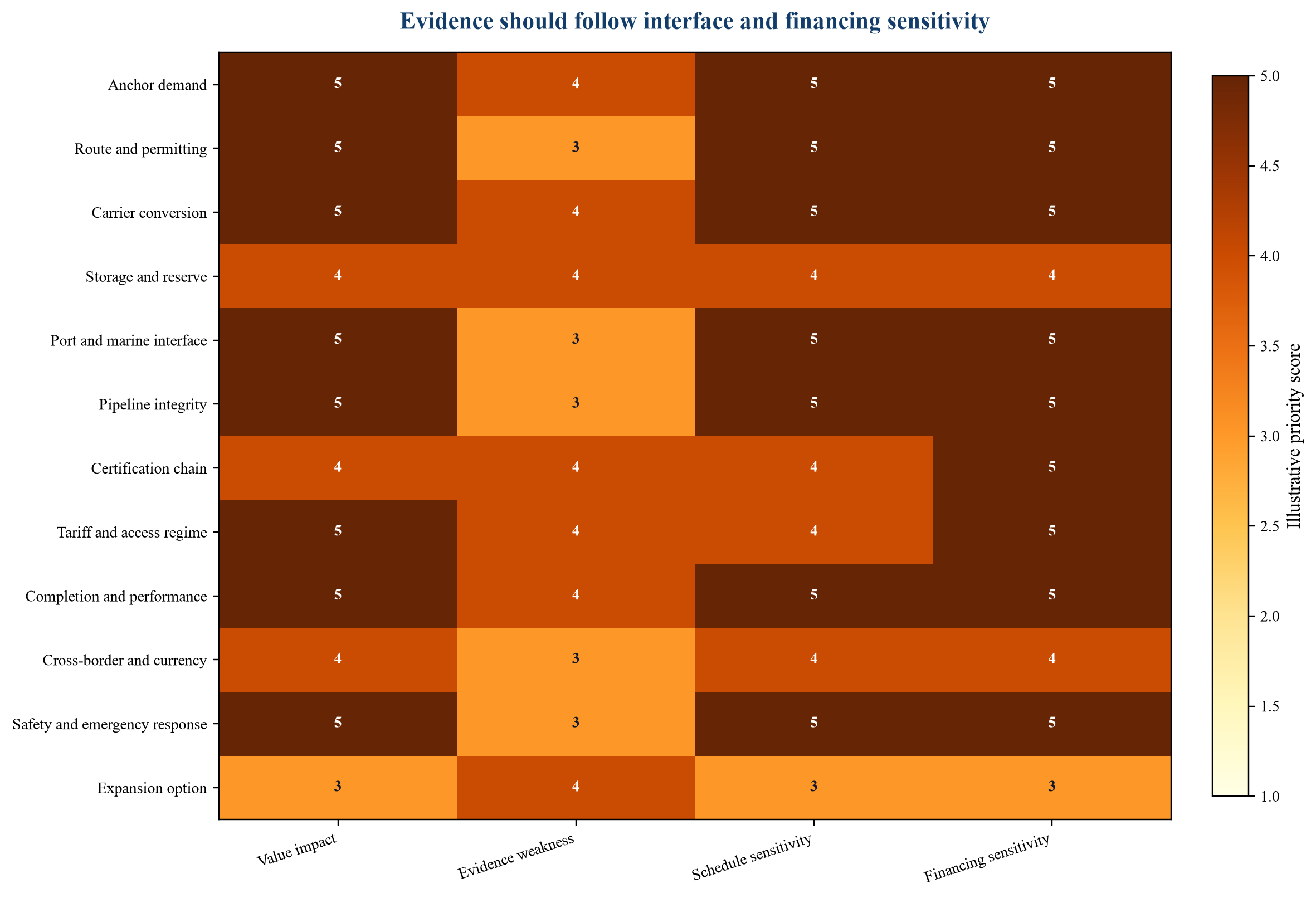
Scores are hypothetical priorities from 1 to 5 and do not assess a named corridor or asset.
32. Stage gates should protect capital before route lock-in
The development plan should move from market evidence to route commitment in defined stages. Early spending can test demand, corridor feasibility, safety and regulatory treatment. Front-end engineering should begin only after the route survives a common whole-chain comparison. Major equipment and construction commitments should follow contracted capacity and completed interfaces.
The table provides a generic gate plan. Each gate requires evidence and a decision authority. Sponsors should update assumptions rather than carry early estimates through successive approvals. A route that loses its advantage should return to option analysis or stop.
Table 3. Development and financing stage gates
| Gate | Decision | Required evidence | Capital at risk | Exit test |
|---|---|---|---|---|
| Product and market definition | What must reach which customer | Product specification, demand cluster, credit and competing supply | Concept development | A defined delivered product and credible buyer set |
| Route screen | Which routes remain feasible | Distance, scale, existing assets, storage, ports, safety and regulation | Studies and options | At least one route with defendable whole-chain logic |
| Pre-FEED and market test | Which route warrants detailed development | Common-boundary cost, expressions of interest, corridor and interface register | Surveys, options and preliminary design | Route advantage survives downside and market evidence |
| FEED and commercial structuring | Can the chain complete and earn contracted revenue | Engineering, permits, capacity contracts, EPC strategy, performance and tariff | Material development capital | Bankable scope, schedule, contracts and risk allocation |
| Final investment decision | Should construction capital be committed | Funding, conditions precedent, sponsor support, reserves and complete interface package | Full construction commitment | Board and lender cases pass downside and completion tests |
| Commissioning and ramp | Can contracted performance be demonstrated | Integrated testing, product certification, custody transfer and operator readiness | Drawn debt and equity | Reliable delivery and acceptance at contractual boundaries |
| Expansion | Should reserved option capacity be exercised | Signed additional capacity, updated engineering, permits and financing | Modular expansion capital | Incremental returns and system reliability meet thresholds |
The sequence is illustrative. Actual approvals depend on project, technology and jurisdiction.
33. Governance needs one integrated decision model
Hydrogen infrastructure decisions cross strategy, engineering, commercial, finance, legal, safety, policy and operations. Separate workstream models can produce inconsistent volumes, dates and boundaries. Governance should maintain one controlled assumption set and one interface register.
The investment committee should see contracted and optional demand separately, route comparisons on a common boundary, completion dependencies, funding needs and downside liquidity. Each assumption should have a source, owner, date and status. Engineering estimates should be distinguished from supplier quotations and executed contracts. Management cases should be labelled as scenarios.
Change control is essential because a shift in offtake, carrier, port or destination can alter the entire chain. Material changes should trigger revalidation of safety, certification, permits, cost and financing. A decision log should record why the route remains preferred and which alternatives are preserved. Governance creates value when it identifies a failing premise early enough to change course before irreversible capital is committed.
34. Limits of the analysis
This paper provides a general investment and transaction framework. It does not assess a named project, route, terminal, pipeline, carrier, technology, customer or jurisdiction. Engineering design, safety, emissions, certification, tax, legal, regulatory, accounting and financing conclusions require project-specific professional work.
The numerical exhibits are hypothetical analytical assumptions. They are not observed costs, forecasts, supplier quotations, market prices, engineering designs, offers, fairness opinions or valuations. Actual results depend on route, distance, scale, utilisation, energy prices, conversion efficiency, storage, permits, contracts, credit, financing, policy and construction.
Institutional reports use scenarios and definitions that differ by year and analytical boundary. Their findings should not be transferred mechanically into a project model. Sources and policies can change. Sponsors should update every input at the decision date, reconcile definitions, retain evidence and test the route against current law and engineering standards.
35. Conclusion
Hydrogen trade infrastructure should be selected from the delivered product backward. A pipeline, ammonia terminal, liquid-hydrogen route, organic carrier or derivative chain creates a distinct combination of capital, energy, losses, safety, certification and market risk. Distance provides one input. Demand density, utilisation, end use, existing assets and conversion interfaces can matter more.
Pipelines are strongest when pure-hydrogen demand is concentrated, connected and contracted. Repurposing can create value where the asset is technically suitable and natural-gas service can be released. Ammonia shipping is strongest where maritime flexibility, existing chemical logistics and direct ammonia use justify synthesis and storage. Cracking can reach pure-hydrogen users while adding energy, cost and a critical conversion asset. Moving a hydrogen-derived product can remove a reconversion layer.
Bankability follows evidence. Anchor capacity, completion alignment, storage, safety, certification, tariffs and credit should be proven before irreversible commitment. A modular, stage-gated plan preserves options while the market matures. The investment decision is therefore neither pipe nor ship in the abstract. It is the specific chain that delivers a compliant product reliably, under contracts capable of paying for the infrastructure through realistic downside.
References
- International Energy Agency. Global Hydrogen Review 2026: Trade and infrastructure. https://www.iea.org/reports/global-hydrogen-review-2026/trade-and-infrastructure
- International Renewable Energy Agency. Global Hydrogen Trade to Meet the 1.5 C Climate Goal, Part II: Technology Review of Hydrogen Carriers. 2022. https://www.irena.org/publications/2022/Apr/Global-hydrogen-trade-Part-II
- International Energy Agency. Global Hydrogen Review 2022: Executive summary. https://www.iea.org/reports/global-hydrogen-review-2022/executive-summary
- European Commission. Hydrogen and decarbonised gas market. https://energy.ec.europa.eu/topics/markets-and-consumers/hydrogen-and-decarbonised-gas-market_en
- European Union. Regulation (EU) 2024/1789 on the internal markets for renewable gas, natural gas and hydrogen. https://eur-lex.europa.eu/legal-content/en/TXT/?uri=CELEX:32024R1789
- International Renewable Energy Agency. Global hydrogen trade. https://www.irena.org/Energy-Transition/Technology/Hydrogen/Global-hydrogen-trade
- International Renewable Energy Agency. Analysis of the potential for green hydrogen and related commodities trade. 2025. https://www.irena.org/Publications/2025/Jun/Analysis-of-the-potential-for-green-hydrogen-and-related-commodities-trade
- International Energy Agency. Global Hydrogen Review 2025: Trade and infrastructure. https://www.iea.org/reports/global-hydrogen-review-2025/trade-and-infrastructure
- International Maritime Organization. Alternative fuel and technology safety guidelines. https://futurefuels.imo.org/safety-guidelines/
- International Energy Agency. Global Hydrogen Review 2026: Demand. https://www.iea.org/reports/global-hydrogen-review-2026/demand
- International Energy Agency. Global Hydrogen Review 2026: Key questions about hydrogen. https://www.iea.org/reports/global-hydrogen-review-2026/key-questions-about-hydrogen
- European Climate, Infrastructure and Environment Executive Agency. Hydrogen energy networks. https://cinea.ec.europa.eu/hydrogen-eu-supporting-europes-transition-climate-neutrality/hydrogen-energy-networks_en
- International Energy Agency. Global Hydrogen Review 2026. https://www.iea.org/reports/global-hydrogen-review-2026
- International Energy Agency. Hydrogen Tracker. Updated 18 June 2026. https://www.iea.org/data-and-statistics/data-tools/hydrogen-tracker
- United States Department of Energy. Hydrogen Delivery. https://www.energy.gov/cmei/fuels/hydrogen-delivery
- United States Department of Energy. Hydrogen Program: Delivery. https://www.hydrogen.energy.gov/program-areas/delivery
- United States Department of Energy. Hydrogen Delivery Infrastructure Options Analysis. https://www1.eere.energy.gov/hydrogenandfuelcells/pdfs/delivery_infrastructure_analysis.pdf
- United States Department of Energy. 2024 Annual Merit Review and Peer Evaluation Report: Hydrogen Infrastructure Technologies. https://www.hydrogen.energy.gov/docs/hydrogenprogramlibraries/pdfs/review24/2024-amr-06-hydrogen-infrastructure-technologies.pdf
- European Union. Directive (EU) 2024/1788 on common rules for the internal markets for renewable gas, natural gas and hydrogen. https://eur-lex.europa.eu/eli/dir/2024/1788/oj/eng
- European Commission. First Union list of Projects of Common Interest and Projects of Mutual Interest, technical document. 2024. https://energy.ec.europa.eu/document/download/944b96b9-4efd-44a3-bbfe-45b752b0b55f_en
- International Energy Agency. The Role of Low-Carbon Fuels in the Clean Energy Transitions of the Power Sector. https://www.iea.org/reports/the-role-of-low-carbon-fuels-in-the-clean-energy-transitions-of-the-power-sector/executive-summary
- International Energy Agency. The Future of Hydrogen. https://www.iea.org/reports/the-future-of-hydrogen
- International Renewable Energy Agency. World Energy Transitions Outlook 2022. https://www.irena.org/Digital-Report/World-Energy-Transitions-Outlook-2022/
- International Energy Agency. Unlocking Ukraine's Hydrogen Opportunity: A Roadmap. https://www.iea.org/reports/unlocking-ukraines-hydrogen-opportunity-a-roadmap
- International Finance Corporation. Environmental, Health, and Safety Guidelines. https://www.ifc.org/en/insights-reports/2000/general-environmental-health-and-safety-guidelines
- International Valuation Standards Council. International Valuation Standards. https://www.ivsc.org/standards
About the Author
Chennakeshav (CK) is a corporate finance and investment banking executive with 25+ years of global experience in deal origination, structuring and execution across M&A, growth capital and corporate strategy. He has led value-creation mandates for founders, corporates and funds — bridging the boardroom view to hands-on execution and close.
His career spans Morgan Stanley, HSBC, Lloyds Banking Group, EWEC, ADQ portfolio companies and Emirates Growth Fund, across TMT, real estate, fintech, deeptech, cleantech, infrastructure and energy. He has partnered with C-suite leaders, private equity and venture funds, sovereign wealth funds and family offices to finance complex fund raises and scale-up ventures, and has led M&A due diligence, post-merger integration and business-transformation initiatives to create value.
At Matchpoint Partners he is Managing Partner, leading the firm's corporate finance, M&A and capital-raising practice. He holds an MBA from London Business School, an engineering degree from VTU and a Master of Laws (LLM, in progress) from UCL London.
An active start-up mentor, CK mentors at Techstars, DIFC FinTech Hive, Startup Grind, Founder Institute and IN5, serves as Entrepreneur Mentor in Residence (EMiR) at London Business School, and judges the Entrepreneurship World Cup.
LinkedIn: https://www.linkedin.com/in/ckadya/
Profile: https://www.matchpoint-partners.com/team/ck-adya.html
