

1. The test is financial close
Hydrogen policy is often described through capacity targets, auction budgets and awarded projects. A financing decision asks a narrower question: does the support package convert uncertain hydrogen revenues into cash flows that can service debt and reward equity through plausible operating conditions? A project reaches financial close only when capital providers accept the allocation of construction, operating, market, policy and counterparty risks.
The distinction matters because an award can coexist with an unfinanceable project. A premium may apply only to eligible output while the plant carries fixed costs during low utilisation. A strike price may be indexed to consumer inflation while electricity, equipment or transport costs move differently. A grant may pay after verified production while the sponsor needs funding for construction. A ten-year support period may begin before the plant reaches stable operation or may be shorter than the proposed debt tenor.
This paper treats the support instrument as one contract within an integrated transaction. The analysis begins with the project cash-flow waterfall, identifies the risks that block investment, and then determines which party can manage each risk. Public support is most effective when it creates an investable operating margin and preserves incentives to reduce cost, secure buyers and deliver compliant product.
2. Hydrogen requires a different support architecture
Electricity contracts for difference benefit from a traded commodity, liquid reference prices and established networks. Low-emissions hydrogen markets remain fragmented by production route, carbon intensity, geography, delivery form, certification and end use. A kilogram sold to a refinery through a short pipeline differs economically from ammonia delivered to an overseas power plant or e-methanol supplied to shipping.
The OECD and World Bank note that electricity-style reference pricing cannot be copied directly where a liquid hydrogen benchmark does not exist [1]. Governments may use achieved sales prices, fossil-fuel proxies, administrative floors or fixed premiums. Each choice creates basis risk between the support calculation and the project's realised economics. Volume uncertainty is also acute because new production and new demand must develop together.
A hydrogen support contract therefore needs to address both price and volume. It must also interact with electricity procurement, emissions rules, offtake, transport, storage, derivative conversion and certification. The instrument should specify which volumes qualify, which sales prices count, how support changes when markets improve, and what happens when an offtaker, network or certification system fails. The commercial design is a market-creation mechanism as well as a subsidy calculation.
3. The financing gap is observable
The International Energy Agency reported that potential low-emissions hydrogen production announced for 2030 substantially exceeded the portion that was operational or had reached final investment decision. It also reported that cumulative firm offtake agreements covered only a small fraction of announced potential production [2]. These observations identify demand certainty and the cost premium over conventional alternatives as central barriers.
The financing gap cannot be reduced to technology cost. Electrolysers may be technically proven at component level while a particular project lacks a creditworthy buyer, firm power, a completed pipeline or durable certification route. Export-oriented projects face additional infrastructure, foreign-exchange and destination-market risks. IEA analysis found that only a small share of announced export-oriented capacity had reached the investment stage [3].
Support design should respond to the specific missing contract. A production premium can close an operating-cost gap, but it cannot replace physical offtake unless it includes volume support or a market intermediary. A capital grant can reduce leverage and construction funding, but it does not establish long-term revenue. Public procurement can anchor demand, but it may leave production-cost volatility. The support package should target the binding gap rather than add disconnected incentives.
4. Start with the cash-flow waterfall
A financeable support mechanism can be designed by tracing one unit of compliant hydrogen from production to cash. The project pays for power, water, operations, maintenance, transport, certification and debt. It receives an offtake price and, where conditions are met, a support payment. The remaining margin must fund reserves, taxes, debt service and equity distributions.
The support formula should therefore be tested against the same variables used by lenders. These include operating availability, conversion efficiency, electricity price, achieved sales price, eligible volume, inflation, curtailment, certification loss, payment delay and termination. A term that looks remote in legal drafting can become material when it affects a high-probability downside or a debt-service period.
Designers should distinguish revenue adequacy from cost reimbursement. A cost-plus mechanism can weaken efficiency incentives and create information asymmetry. A fixed strike price can preserve cost discipline while exposing the project to unindexed inputs. A fixed premium can stimulate competition while leaving merchant price risk. The policy objective determines the appropriate balance, but the model must show whether the remaining risk sits with a party capable of bearing it.
5. The support contract sits inside a network of agreements
The figure maps the principal contractual interfaces. A hydrogen revenue-support agreement cannot be evaluated in isolation because the payment depends on performance and evidence produced under other contracts.
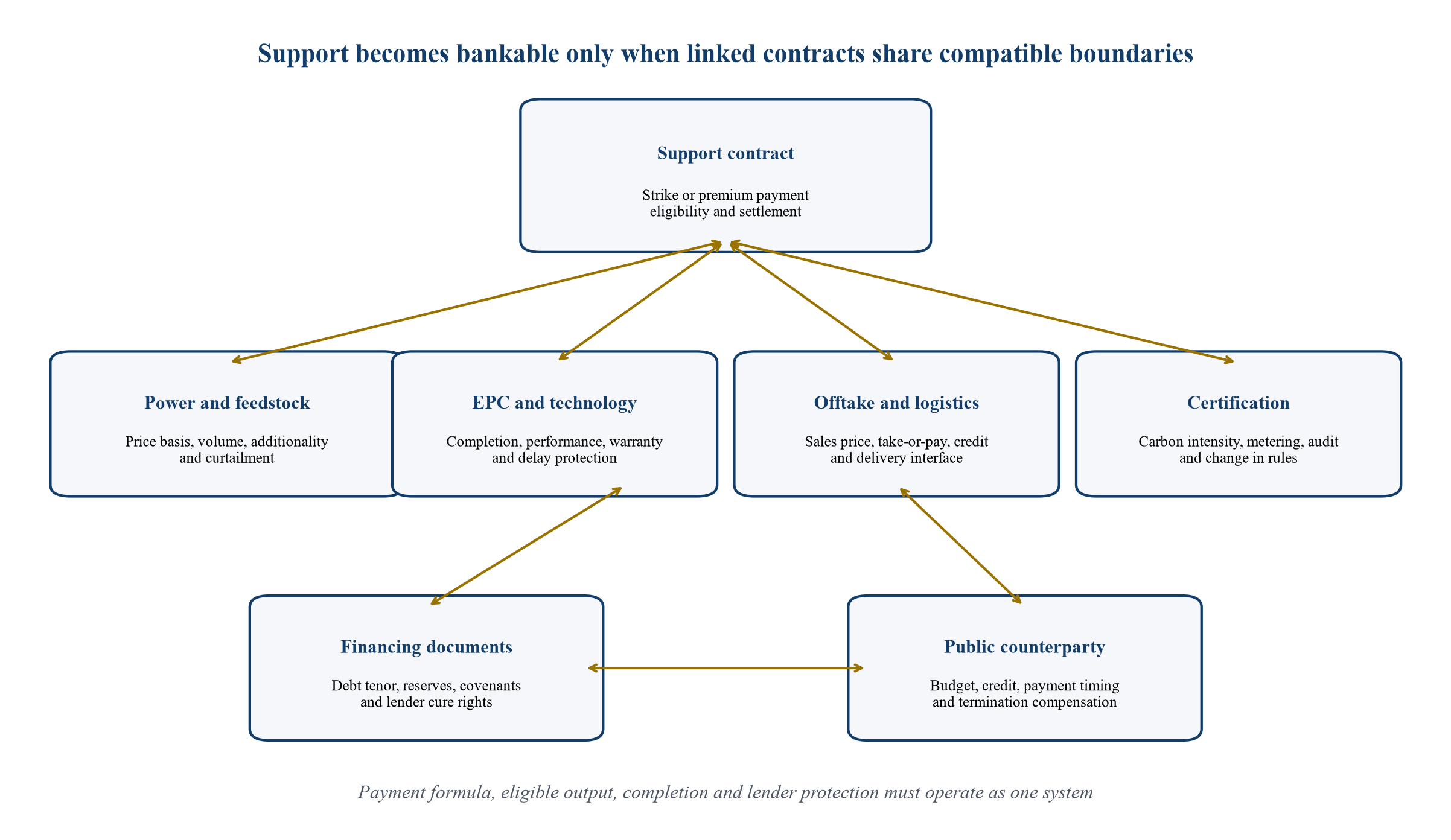
The diagram is a generic transaction map. Contract parties, security packages and payment flows vary by jurisdiction and project.
6. A contract for difference has five economic elements
The first element is the strike price, which represents the supported revenue level or a cost-reflective target. The second is the reference price, which represents market revenue that the project is expected to earn without support. The third is eligible volume. The fourth is the contract tenor. The fifth is the settlement rule, including indexation, reconciliation and repayment when the reference exceeds the strike.
In a two-way structure, the public counterparty pays when the strike price exceeds the reference price, and the producer pays back when the reference price exceeds the strike. A one-way premium may stop at zero without requiring repayment. A fixed premium pays the awarded amount per eligible unit regardless of the sales price, subject to the scheme's rules. These structures allocate upside and downside differently.
Bankability depends on the interaction among all five elements. A high strike price applied to narrow eligible volume may provide less coverage than a lower fixed premium over stable production. A long tenor with weak change-in-law protection may carry greater residual risk than a shorter but clearer contract. Comparison should use expected and downside cash flows, not headline support rates.
7. The United Kingdom combines price and volume support
The United Kingdom delivers its Hydrogen Production Business Model through the Low Carbon Hydrogen Agreement between a designated counterparty and the producer [4]. The HAR1 structure provides a variable premium based on the difference between a strike price and a reference price. The final contract materials also include sliding-scale volume support because early hydrogen demand is uncertain [5].
The reference price for qualifying volume is based on the higher of the achieved sales price and an applicable floor. The floor uses a natural-gas reference for fuel uses, with an alternative treatment for certain feedstock sales. The design seeks to avoid subsidising sales below a proxy value and to allow support to decline as producers realise higher prices. A price-discovery incentive gives the producer a share of improvement above the floor within defined limits [5].
This approach addresses the absence of a liquid hydrogen benchmark through observable project sales and a fossil-fuel proxy. It also requires extensive rules for affiliate sales, non-qualifying volume, metering, achieved-price calculation and information rights. The financeability benefit is substantial, while the administrative and basis-risk consequences must be modelled.
8. European Hydrogen Bank auctions use fixed premiums
The European Hydrogen Bank's domestic auctions award a fixed premium in euros per kilogram of verified and certified hydrogen produced [6]. The Innovation Fund structure places projects through admissibility, eligibility and maturity tests, then ranks qualified bids by requested premium. Support is paid on production for a maximum period specified by the auction, commonly ten years in recent rounds [7].
A fixed premium simplifies settlement and competition. The producer retains the achieved hydrogen price and therefore has an incentive to secure valuable offtake. The public budget exposure is more predictable per eligible kilogram. The project retains market-price risk because the premium does not automatically increase when sales prices fall or input costs rise. Bidders must price that residual exposure into the bid, capital structure and offtake.
The second auction required financial close within 2.5 years and production within five years after grant signature. Invited projects also had to provide completion guarantees. Several initially invited projects did not proceed through grant preparation, after which reserve-list projects were invited [7]. The experience shows why low bid price and project maturity must be evaluated together.
9. H2Global creates a market intermediary
H2Global addresses both sides of the market through a double-auction mechanism. Its intermediary enters long-term purchase contracts with producers and shorter-term sales contracts with buyers. Public funding covers the difference between the purchase and resale prices [8]. The structure can create producer revenue certainty while allowing demand-side prices to be rediscovered through repeated auctions.
This model is particularly relevant for internationally traded hydrogen derivatives where buyers may resist long take-or-pay commitments. The producer obtains a long-term contract with an intermediary. Buyers obtain shorter commitments. The public fund absorbs the intertemporal price gap and the intermediary manages procurement, delivery and resale.
The structure moves critical risks rather than removing them. The intermediary needs strong credit, operational capacity and clear treatment of delivery failure, product quality, logistics and currency. The funding envelope must cover the realised spread over time. Short demand contracts reveal market prices but can expose the programme to weak resale proceeds. Project lenders will examine the purchase contract, not only the public budget announcement.
10. Japan links support to a project-specific reference
Japan's price-gap support, described in an OECD case study, uses a contract-for-difference approach over an extended support period. The strike price reflects production, import and supply costs plus a reasonable return, while the reference is set by end use and comparable conventional products. The structure includes repayment when the reference price exceeds the strike [9].
This approach recognises that hydrogen competes with different products in different applications. Hydrogen or ammonia for power may be referenced to fuels such as liquefied natural gas or coal, while established industrial use can use historic cost evidence. Project-specific references can reduce mismatch with the relevant end market.
They can also increase negotiation complexity and reduce comparability across awards. The authority needs cost assurance, market evidence and safeguards against overcompensation. Sponsors need clarity on formula changes, audit rights and future market evolution. Lenders need a payment rule that can be modelled without recurring discretionary determinations.
11. Mechanisms solve different gaps
Table 1. Comparison of principal hydrogen support architectures
| Architecture | Primary risk addressed | Producer revenue exposure | Public-sector exposure | Bankability strength | Principal residual risk |
|---|---|---|---|---|---|
| Variable premium or CfD | Difference between supported revenue and a reference price | Reference-price basis, eligible volume and performance | Variable payments; possible upside repayment | Can stabilise unit revenue and support longer debt | Reference construction, volume and complex settlement |
| Fixed production premium | Cost gap estimated through competitive bid | Hydrogen sales price, input-cost escalation and eligible volume | Predictable amount per verified unit | Simple and transparent; strong cost competition | Merchant price and cost basis risk remain |
| Double auction with intermediary | Missing long-term producer offtake and weak buyer commitment | Delivery performance and contract-specific costs | Purchase-resale spread and intermediary funding | Long-term producer purchase contract can anchor debt | Intermediary credit, logistics and resale-price risk |
| Capital grant | Upfront construction funding and leverage | Full operating revenue and volume risk | Defined capital contribution | Lowers funding requirement and debt burden | Does not create operating cash-flow certainty |
| Public procurement or demand mandate | Weak or uncertain end demand | Buyer credit, delivery and market-price terms | Procurement cost or compliance burden | Can create firm offtake for qualifying demand | May not cover production-cost or input-price gap |
The table summarises generic attributes and selected public programmes. Exact terms are governed by each scheme's legal documents.
12. Strike price should follow a defined cost boundary
A strike price cannot be evaluated without its inclusions. It may cover production capital recovery, fixed and variable operating costs, power, network charges, water, transport to a delivery point, certification, taxes and an allowed return. Excluded costs remain with the sponsor and can create unhedged exposure.
The boundary should align with the project's contracts and model. If the strike price includes electricity but indexation does not follow electricity, the project retains power-price risk. If it excludes a pipeline but the offtake price is measured at the buyer's gate, the producer may face transport exposure outside support. If it assumes a particular capital structure, refinancing or delay can change the economic return.
Competitive allocation encourages cost discipline, while first-of-a-kind projects contain uncertainty. Cost assurance should distinguish efficient contingency from padded bids. Governments can use reference designs, independent engineering, open-book negotiation for limited items and competitive auctions once market depth is sufficient. Sponsors should preserve an auditable bridge from the awarded price to the final financing model.
13. Reference price design determines basis risk
The reference price should reflect revenue that a prudent producer can realise. An achieved sales price is close to project economics but may be influenced by affiliate transactions, bundled services, delivery terms and buyer-specific concessions. A commodity proxy is transparent and hedgeable but may diverge from hydrogen value. An administrative floor can protect public value while reducing support when buyers will not pay the proxy.
The UK design uses achieved sales price subject to floor rules and includes mechanisms intended to encourage price discovery [5]. This responds to the absence of a liquid hydrogen benchmark. Over time, schemes may migrate toward published indices as market depth, standardisation and reporting improve.
Lenders will focus on the downside mismatch. If the support reference rises with natural gas while the actual buyer price does not, subsidy can fall before revenue improves. If the reference includes an assumed carbon value that the buyer will not pay, the project retains the gap. The model should therefore stress the reference and realised price separately.
14. Volume support is often as important as price support
Hydrogen plants carry fixed costs even when demand is weak. A pure per-unit premium pays nothing on unsold or ineligible production. The producer may have adequate margin at full utilisation and insufficient cash for debt service at the volume actually sold. This makes volume a separate bankability problem.
Volume support can take several forms: sliding-scale top-ups at low sales, minimum purchase commitments, take-or-pay offtake, public procurement, a market intermediary, storage support or staged capacity. Each creates different incentives. Full revenue guarantees can weaken pressure to develop customers. No volume protection can make debt impossible during market formation.
A balanced structure protects a defined portion of fixed-cost recovery while preserving the producer's obligation to market output. Eligibility should reward genuine sales and avoid artificial transactions. The support profile can decline as the market develops. Sponsors should show lenders how volume risk is shared among the public contract, offtakers, storage and equity reserves.
15. Offtake remains central
Support does not make the physical product disappear. Hydrogen must be accepted, transported and used. An offtake contract establishes delivery point, specification, nomination, volume, price, credit support, force majeure and termination. It can also provide evidence used to calculate support.
The OECD and World Bank identify long-term offtake with creditworthy buyers and take-or-pay or take-and-pay provisions as important tools for addressing demand uncertainty [1]. Public support may allow shorter or more flexible offtake, but lenders will still test the buyer's obligations and replacement market. A government-backed premium cannot compensate for a missing pipeline or an offtaker that has not converted its equipment.
The offtake price and support reference should use compatible definitions. Transport, storage, certificates, imbalance, taxes and ancillary services should be allocated consistently. Affiliate sales need arm's-length controls. Termination of a major offtake should trigger a defined replacement period rather than an immediate collapse of support where the policy seeks market development.
16. Tenor should cover the financing case
Support duration should be long enough to amortise debt and allow a reasonable operating period after commissioning. Recent European Hydrogen Bank fixed-premium awards use support periods of up to ten years, while UK Hydrogen Allocation Rounds allocate support over longer periods [6, 10]. H2Global describes long-term producer purchase contracts combined with shorter buyer contracts [8].
Tenor begins with a precise event. Starting at grant signature, commercial operation or first qualifying production produces different value. Delayed completion can shorten effective support if the expiry date is fixed. A longstop date protects public budgets but can create cliff risk for projects facing grid or permitting delays.
The debt model should identify the support tail after scheduled repayment. Lenders often require a period between debt maturity and support expiry. If the contract ends before debt, refinancing or merchant assumptions carry the risk. Sponsors should negotiate extension rules only for delays outside their control and should not rely on discretionary relief.
17. Indexation should match the cost stack
Indexation protects against changes between award and operation and during the support period. Consumer-price inflation is transparent, but hydrogen costs are driven by equipment, labour, electricity, network charges, water, maintenance and financing. A single index cannot perfectly match them.
The UK HAR1 contract summary states that the electrolytic-project strike price is indexed to consumer inflation, with specified treatment for certain charges and qualifying changes in law [5]. A fixed-premium auction can leave more cost inflation with the producer. Bidders may hedge, secure fixed-price contracts or include risk premiums.
The financing model should break costs into fixed, indexed, pass-through and merchant components. It should test divergence between support indexation and actual costs. Governments can index only the portion demonstrably exposed to inflation, preserving efficiency incentives and public affordability. Transparent formulas are preferable to recurring discretionary reopening.
18. Electricity risk can overwhelm the hydrogen premium
Electrolytic hydrogen economics are highly sensitive to electricity price, load factor and network costs. A support mechanism based on hydrogen output may not move with power costs. Fixed-price renewable contracts, co-location, hedging and operational optimisation can reduce exposure, but each has basis and delivery risks.
If the support formula fully passes through electricity prices, the producer has less incentive to procure efficiently and the public budget becomes volatile. If it ignores them, projects may bid large contingencies or fail when prices rise. Hybrid designs can define benchmark consumption, eligible power-cost components or limited reopeners for exceptional regulatory changes.
The project should also test negative power prices, curtailment, grid congestion and renewable-qualification rules. Running solely to collect support can conflict with system objectives. Eligibility and dispatch rules should preserve incentives to consume clean power at useful times while allowing the plant to meet offtake and technical constraints.
19. Carbon intensity is a payment condition
Hydrogen support is generally conditional on an emissions standard or renewable-fuel definition. Measurement boundaries can include electricity sourcing, temporal and geographic correlation, methane emissions, capture rates, transport, conversion and certification. A volume that fails the standard may lose support even when it is physically saleable.
Certification risk belongs in the financing model. The sponsor should quantify how often metering gaps, renewable-supply shortfalls, grid factors, upstream data or methodology changes can make production ineligible. Contracts should define evidence, audit, correction periods and treatment of disputed certificates.
The support instrument and offtake must use compatible standards. A buyer may require a stricter carbon threshold than the public scheme, or a destination country may use a different methodology. The project can then qualify for support and fail the sale, or satisfy the buyer and lose the subsidy. A single data architecture and a mapped hierarchy of standards reduce this risk.
20. Completion rules protect funds and can create cliffs
Public authorities need evidence that awarded projects are mature and deliverable. Bid bonds, completion guarantees, financial-close deadlines, production deadlines and longstop termination deter speculative bidding. The European Commission's second hydrogen auction required a completion guarantee and defined deadlines for financial close and production [7].
These controls should be proportionate to risks the sponsor can manage. A guarantee that is forfeited for grid delay outside the project boundary may increase bids or discourage strong developers. A weak guarantee can allow underpriced projects to occupy scarce budgets and later withdraw. Milestones should distinguish sponsor default from authority, network and force-majeure events.
Lenders need a cure process before support termination. The financing timetable should align with permit, EPC, equipment, grid, water and offtake conditions. The project should not promise a financial-close date that precedes the authority's final contract or key infrastructure commitments.
21. Counterparty and budget credibility matter
A long-term support promise has value only if the payer can meet it. The counterparty may be a government entity, state-owned company, regulated levy-funded body, grant agency or intermediary. Lenders assess legal capacity, funding source, payment priority, sovereign linkage, appropriation risk, currency convertibility and dispute enforcement.
A policy announcement is weaker than an executed contract with a funded payment mechanism. The UK uses a designated counterparty for Low Carbon Hydrogen Agreements [4]. H2Global uses an intermediary whose purchase commitments are backed by programme funding [8]. European Innovation Fund premiums rely on grant agreements and the fund's legal framework [6].
The financing package should include evidence of authority, budget, enforceability and payment mechanics. Where sovereign or public-entity risk remains, guarantees, political-risk insurance, escrow, liquidity reserves or multilateral support may be needed. Counterparty analysis should extend beyond credit rating to the precise legal obligation.
22. Payment timing affects liquidity
Hydrogen support is often paid after production, verification and certification. The lag can create working-capital needs, especially when electricity and operating costs are paid earlier. Reconciliation, audit and disputes can delay part of the cash flow.
The model should include billing frequency, document submission, review periods, provisional payments, true-ups, taxes and late-payment interest. A reserve or revolving facility may be necessary. Lenders may discount receivables that depend on unresolved certification or discretionary approval.
Digital metering and standardised reporting can reduce cost and delay. They should include controls for data integrity, estimation during meter failure and correction of errors. A scheme should distinguish routine verification from a full re-performance of technical due diligence each billing period.
23. Change in law must be allocated precisely
Hydrogen projects operate within evolving rules for emissions, electricity, networks, safety, trade and certification. Broad protection for every change can create unlimited public exposure. No protection can make a long-term contract unfinanceable.
The UK LCHA materials distinguish categories of qualifying change in law and define compensation or termination consequences [5]. This type of drafting identifies project-specific, technology-specific and discriminatory changes while excluding foreseeable or general business risks except where expressly addressed.
Sponsors should map changes into cost, revenue, eligibility and schedule. The contract should define thresholds, notice, mitigation, calculation, dispute and termination. Lenders need protection where a qualifying change makes construction or operation impossible. Governments need incentives for the project to mitigate and avoid double recovery under other contracts or insurance.
24. Termination economics determine debt recovery
Termination can follow producer default, prolonged force majeure, failure to meet milestones, illegality, scheme breach or public-counterparty default. The amount paid on termination determines whether lenders recover debt or face a sudden loss.
Bankable contracts commonly distinguish termination causes. Producer default can lead to reduced or no compensation and may include a termination payment. Public-counterparty default or political termination may justify debt and equity protection. Force majeure and change in law can use negotiated formulas. The exact allocation depends on policy and legal framework.
Lender direct agreements should provide notice, cure periods and step-in rights before termination where cure is possible. The public counterparty needs an acceptable replacement entity and continued compliance. Sponsors should model termination proceeds, timing and enforcement rather than assume full debt recovery.
25. Transfer and refinancing provisions influence capital availability
Projects often require changes in ownership, security enforcement or refinancing after construction. A support contract that prohibits transfer can prevent lenders from taking security or sponsors from recycling capital. Uncontrolled transfer can undermine the authority's selection of a qualified developer.
Consent standards should distinguish ordinary security, lender step-in, internal reorganisation and third-party sale. Objective qualification criteria and response periods improve certainty. Change-of-control rules can preserve technical and financial capacity without creating arbitrary veto risk.
Refinancing gains may be shared where public support materially reduced risk. The formula should avoid penalising efficient refinancing or creating disputes over ordinary debt optimisation. The original bid model, risk changes and refinancing costs need clear treatment.
26. Auction design must screen price and deliverability
Price competition can discover support requirements and allocate a limited budget efficiently. Hydrogen bids are vulnerable to optimistic power, equipment, offtake and schedule assumptions. Awarding solely to the lowest premium can select projects that later fail to close.
A robust auction uses prequalification, bid bonds or completion guarantees, maturity evidence, standardised financial assumptions and transparent ranking. Quality thresholds can cover land, permits, grid, renewable supply, technology, EPC strategy, offtake and financing plan. Once a project passes the threshold, price can determine rank.
Authorities should disclose bid ceilings, budget, tie-breaks, volume caps, related-party rules and award timetable. Repeated auctions create learning and reduce the incentive to bid at any price for a scarce one-off award. Reserve lists can preserve budget when selected projects withdraw, as seen in the European auction process [7].
27. Bid discipline requires a shadow financing model
Sponsors should bid from a financing model that includes lender downside cases rather than a single equity target. The bid must cover the support needed after offtake revenue, with allowances for construction contingency, degradation, downtime, certification loss, working capital and debt service.
A low bid can win and destroy value if it assumes perfect availability, merchant upside or unsupported cost reductions. A high bid can lose despite strong engineering. Management should approve a minimum acceptable premium or maximum affordable strike based on evidence, not competitive anxiety.
The shadow model should show the probability and consequence of failing financial close. It should identify which risks can be hedged before bid and which require contract protection. Bid conditions should be limited because heavily conditional awards are difficult to compare and may not create policy value.
28. Public value extends beyond the lowest nominal premium
Governments seek emissions reduction, industrial development, energy security, learning, infrastructure and market creation. The lowest premium per kilogram may not maximise these outcomes if the project is unlikely to deliver, serves a weak use case or consumes scarce infrastructure.
Evaluation can include cost per avoided tonne, additionality, deliverability, system value, domestic capability and future cost reduction. Criteria should be measurable and disclosed. Excessive complexity can reduce competition and create discretionary selection.
Portfolio design can diversify technology, region, end use and completion timing. It can also fragment supply chains or sacrifice scale. Authorities should state whether the auction optimises a single metric or a portfolio. Sponsors should demonstrate value through verified project characteristics rather than generic economic-impact claims.
29. Emerging-market projects need currency and political-risk treatment
Many prospective export projects are located where renewable resources are strong and local capital costs are high. A support contract denominated in a hard currency can reduce revenue risk while local costs or taxes remain in another currency. A local-currency contract can leave debt-service mismatch.
Currency indexation, hedging, convertibility protection, reserve accounts and multilateral guarantees can address parts of the risk. The support provider should decide which currency risk it can absorb and which belongs with the sponsor. Long-dated hedges may be expensive or unavailable.
Political-risk insurance and development-finance participation can strengthen government or state-owned offtaker obligations. They do not correct an uneconomic product route or weak completion plan. The transaction should separate country risk from project fundamentals and price each transparently.
30. Cross-border products require delivery-basis clarity
Hydrogen derivatives such as ammonia, methanol and synthetic fuels introduce conversion, shipping, storage and reconversion. A premium measured at the production gate may not cover delivery cost. A buyer may value the product at destination. Currency, freight, boil-off, quality and customs create additional basis risk.
The support contract should define the supported product, measurement point and eligible logistics. It should state whether transport emissions and conversion losses affect certification. H2Global's product-specific tenders illustrate how geography, duration, sustainability and product can be configured within a market-intermediary model [8].
Sponsors should avoid using a production support award as proof of delivered competitiveness. The integrated model needs the complete route. Lenders will examine port capacity, shipping contracts, storage, import certification and buyer acceptance alongside the production premium.
31. Support stacking needs an explicit hierarchy
Hydrogen projects may receive capital grants, tax credits, renewable-power support, carbon credits, concessional debt and production premiums. Stacking can close multiple gaps and can also create overcompensation, conflicting obligations and double counting.
Each instrument should identify eligible costs, priority, adjustment and clawback. A capital grant may reduce the strike price. A tax credit may be included in bid economics. Carbon revenue may reduce the reference gap. Change in one instrument can affect another.
The sponsor should maintain a support register and a common financial model. Legal opinions should address compatibility, state-aid or subsidy-control rules, tax and security. Lenders need assurance that a breach under one programme does not automatically terminate every revenue source without cure.
32. Hypothetical payment mechanics show residual risk
Consider a hypothetical plant producing 20,000 tonnes a year. The model compares a variable premium with a fixed premium. It is a simplified decision tool. It excludes taxes, construction, working capital, transport and financing fees and does not represent an actual project.
Table 2. Hypothetical annual support under alternative mechanisms
| Case | Eligible output tonnes | Strike price per kg | Realised reference per kg | Variable premium support | Fixed premium per kg | Fixed premium support |
|---|---|---|---|---|---|---|
| Base | 18,000 | 6.00 | 3.00 | 54.0 million | 2.20 | 39.6 million |
| Weak demand | 10,000 | 6.00 | 2.50 | 35.0 million | 2.20 | 22.0 million |
| Strong market | 18,000 | 6.00 | 5.50 | 9.0 million | 2.20 | 39.6 million |
| High market | 18,000 | 6.00 | 6.50 | negative 9.0 million repayment | 2.20 | 39.6 million unless scheme caps or claws back |
All values are hypothetical. Currency is generic monetary units. Eligible output and realised price are independent assumptions.
The fixed premium offers predictable public payment per eligible unit and leaves the producer with market upside and downside. The variable premium stabilises supported unit revenue but remains sensitive to eligible volume. A two-way design returns value when the reference exceeds the strike. The table shows why public-cost comparison and project-bankability comparison can produce different rankings.
33. Debt service depends on coverage, not headline support
The figure converts the hypothetical operating margin into a simplified debt-service coverage ratio. The values demonstrate method only. Lenders will use project-specific definitions, reserves and covenants.
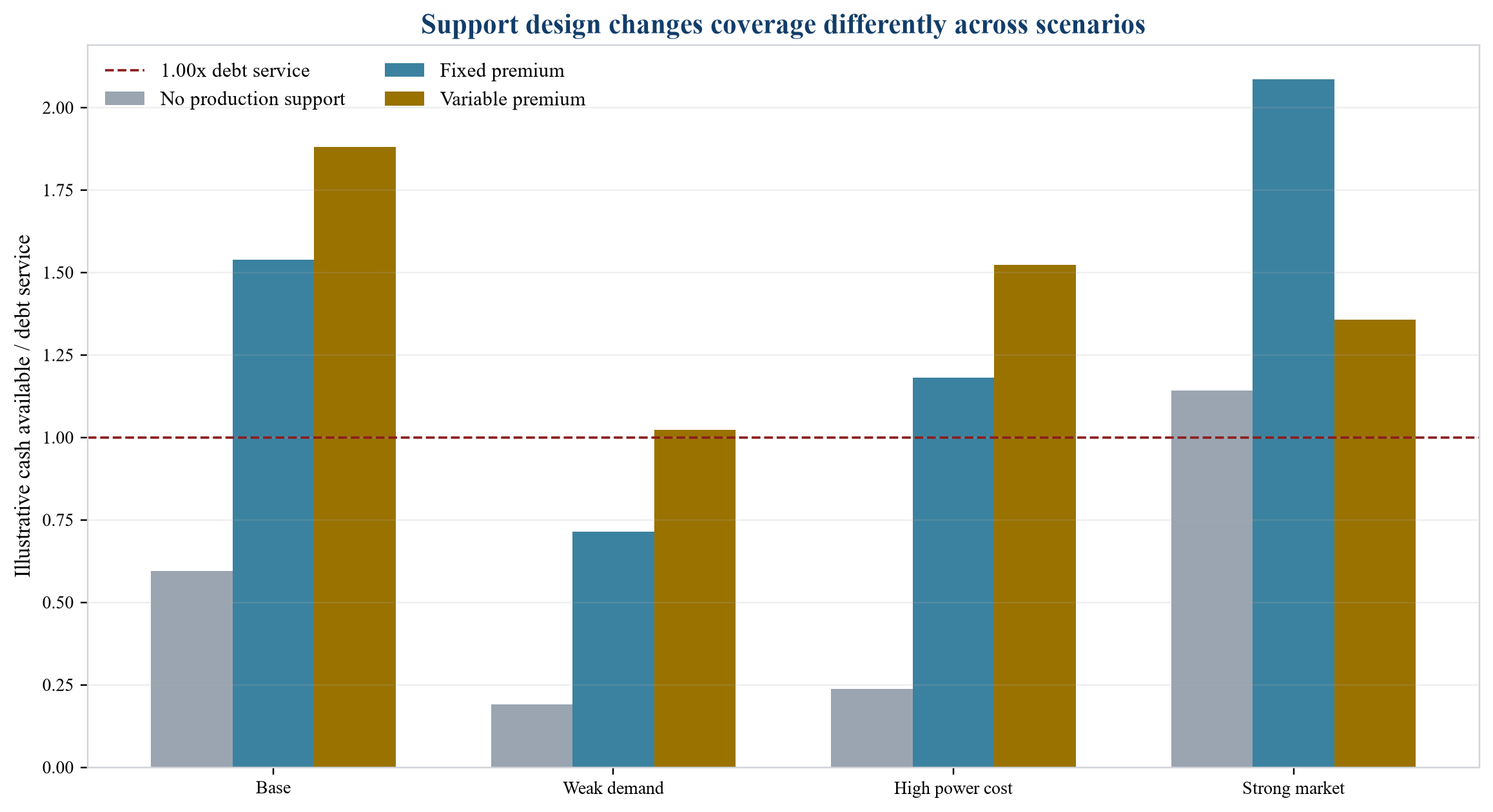
Illustrative calculations only. Annual debt service is assumed at 42 million monetary units; operating cash before support varies by scenario.
34. A bankability matrix connects terms to remedies
Table 3. Support-contract bankability matrix
| Issue | Financing question | Evidence required | Potential contractual response |
|---|---|---|---|
| Payment formula | Does support cover the modelled gap under downside prices? | Formula audit, reference data, sensitivity model | Clear strike, reference, floor, cap and reconciliation |
| Eligible volume | Can the plant produce and sell enough qualifying output? | Resource, offtake, transport, availability and certification cases | Defined qualifying volume, measured volume support or reserve |
| Tenor | Does support extend beyond scheduled debt maturity? | Debt profile and commissioning cases | Start-date clarity, delay relief and support tail |
| Indexation | Does revenue move with material costs? | Cost-stack analysis and hedge evidence | Partial indexation, pass-through or limited reopener |
| Counterparty | Is payment enforceable and funded? | Authority, budget, credit and legal opinions | Guarantee, levy funding, escrow or liquidity support |
| Completion | Can deadlines be met without uncontrolled interfaces? | Permit, grid, EPC, equipment and infrastructure plan | Milestone relief, proportionate guarantee and cure |
| Certification | Can output remain eligible through operations? | Metering, methodology and audit plan | Correction periods, dispute process and change protection |
| Termination | Can lenders cure and recover value? | Direct-agreement and security analysis | Notice, cure, step-in and cause-specific compensation |
The matrix is a transaction checklist, not legal advice. Required terms depend on jurisdiction, funding source and project structure.
The heatmap below separates the risks that each mechanism can cover directly from the risks that remain in linked contracts. The ratings are analytical classifications rather than empirical scores. A project should replace them with contract-specific conclusions.
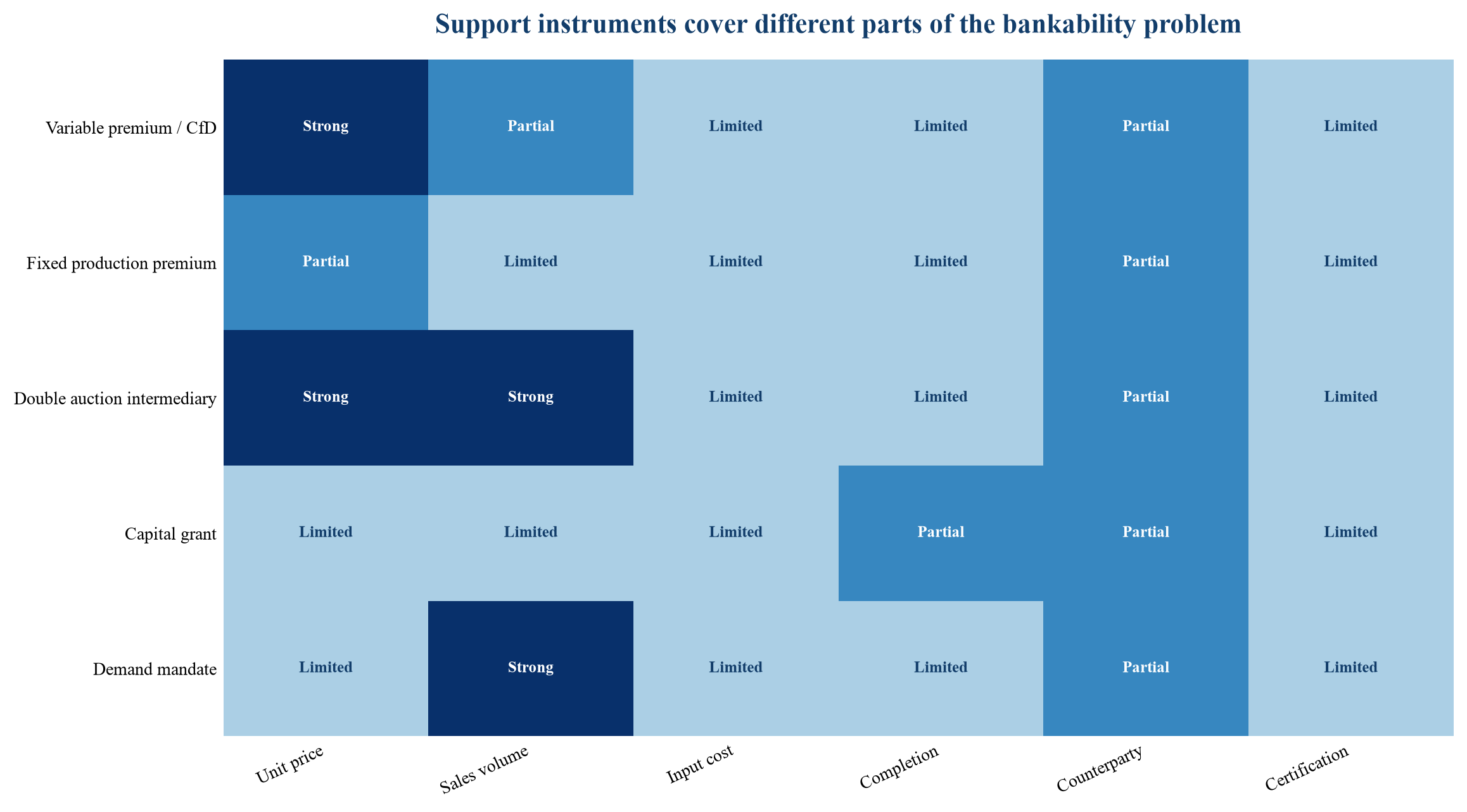
Qualitative analytical classification only. Darker cells indicate stronger direct coverage by the named support architecture; actual coverage depends on legal terms.
35. Government design should follow twelve gates
The first gate defines the policy outcome and eligible product. The second identifies the binding financing gap. The third chooses the payment architecture. The fourth defines the strike or bid boundary. The fifth establishes the reference or fixed premium. The sixth sets eligible volume and tenor.
The seventh gate aligns emissions certification and metering. The eighth tests completion requirements against infrastructure reality. The ninth establishes counterparty authority and funding. The tenth provides change, dispute, termination and lender rights. The eleventh runs public-budget and market-distortion sensitivities. The twelfth creates transparent monitoring and a path to reduce support as markets mature.
These gates should be completed before launching an auction. Standard contracts should be published early enough for sponsors and lenders to price terms. Material changes after bid can invalidate competition. Market engagement is useful when it seeks evidence and preserves transparent final rules.
36. Sponsors need a parallel twelve-gate process
The sponsor should build a contract-to-model map, validate the cost boundary, secure power and offtake, prove eligible production, align certification, test schedule, negotiate infrastructure interfaces, confirm support counterparty credit, design the financing package, obtain lender-right protections, complete downside sensitivities and set a board-approved bid limit.
Each gate should have evidence and an owner. The project should not treat award as the final commercial milestone. After award, the team needs a contract close plan, financing diligence room, conditions-precedent matrix and integrated schedule. Deviations from bid assumptions should be escalated before they consume contingency.
The sponsor's value comes from translating policy language into executable contracts. A strong bid describes how power, product and support cash settle in the same model. It preserves alternatives for offtake and financing while avoiding dependencies that breach eligibility.
37. Due diligence should trace every payment condition
Lenders and investors should read the support contract alongside the model. For every payment, they should identify the required production, sale, metering, certificate, invoice, approval and timing. They should examine historic or pilot administration where available and test the public counterparty's systems.
Technical diligence should confirm that the plant can deliver the qualifying product under realistic degradation and availability. Market diligence should test reference and realised prices. Legal diligence should cover authority, enforceability, security, direct agreements, termination and dispute. Tax and accounting diligence should determine treatment of grants, premiums and repayments.
The final report should identify uncovered risks and their mitigants. A red flag is material when it can remove support, delay payment, breach a covenant or cause termination. The solution may be contract amendment, reserve, insurance, hedge, sponsor support or lower leverage.
38. A phased commercialisation roadmap reduces commitment risk
Early projects can combine a smaller first phase, existing demand and established infrastructure. Later phases can expand after operating data, buyer conversion and network completion. The support award should define whether phased capacity is eligible and how milestones apply.
Repeated auctions can improve price discovery and standardisation. Contract data can inform future reference indices while protecting commercially sensitive information. Governments can reduce support gradually as equipment, financing and demand mature.
Sponsors can use early operations to prove efficiency, certification, dispatch and customer value. Refinancing after stable operation can release equity. Expansion should depend on verified market and infrastructure capacity rather than aspirational demand.
39. The architecture should preserve market formation
Support should help a market emerge rather than lock every transaction into an administrative price. Achieved-price references, price-discovery incentives, auctions and short demand-side contracts can reveal value. Transparent standards and interoperable certificates allow buyers to compare products.
The transition path should be specified at award. It may include declining premiums, periodic auctions, merchant exposure, increased buyer obligations or migration to an index. Sudden withdrawal can strand projects and raise future policy risk. Indefinite protection can suppress competition and innovation.
A well-designed contract creates a temporary bridge. It gives capital providers enough certainty to fund assets while retaining incentives for producers to lower cost and develop customers. The bridge is successful when support per unit falls, voluntary demand deepens and private contracts replace public risk absorption.
40. Conclusion
Hydrogen contracts for difference can unlock investment when their legal and economic design reflects the actual project. The central decision is the allocation of price, volume, input, certification, completion, counterparty and termination risk. A headline strike price or fixed premium provides only part of the answer.
The strongest mechanisms start with the cash-flow waterfall, use transparent payment rules, protect public value, require deliverable projects and give lenders enforceable cure and step-in rights. Variable premiums can stabilise unit revenue, fixed premiums can simplify competition, and double auctions can create long-term producer offtake. Each leaves residual risk that must be carried by contracts, capital or public policy.
Financial close is the practical test. Support reaches it when the project can convert compliant production into timely, enforceable cash through downside conditions. Governments and sponsors should design the complete transaction, not only the subsidy rate.
References
- OECD and World Bank. Leveraging De-Risking Instruments and International Co-ordination to Catalyse Investment in Clean Hydrogen. 2024. https://www.oecd.org/en/publications/leveraging-de-risking-instruments-and-international-co-ordination-to-catalyse-investment-in-clean-hydrogen_9a377303-en.html
- International Energy Agency. Global Hydrogen Review 2025, executive summary. 2025. https://www.iea.org/reports/global-hydrogen-review-2025/executive-summary
- International Energy Agency. Global Hydrogen Review 2025, trade and infrastructure. 2025. https://www.iea.org/reports/global-hydrogen-review-2025/trade-and-infrastructure
- UK Department for Energy Security and Net Zero. Hydrogen production business model. Updated 19 December 2025. https://www.gov.uk/government/publications/hydrogen-production-business-model
- UK Department for Energy Security and Net Zero. Low Carbon Hydrogen Agreement key terms summary with explanatory notes for Hydrogen Allocation Round 1. 2025. https://assets.publishing.service.gov.uk/media/693941eb7a605b2d61cd9014/lcha-key-terms-summary-explanatory-notes-har1-december-2025.pdf
- European Commission. European Hydrogen Bank. Accessed 29 September 2026. https://energy.ec.europa.eu/topics/eus-energy-system/hydrogen/european-hydrogen-bank_en
- European Commission. Innovation Fund 2024 Hydrogen Auction. Updated 2026. https://climate.ec.europa.eu/areas-action/eu-funding-climate-action/innovation-fund/calls-proposals/if24-auction_en
- H2Global Foundation. The H2Global Instrument. Accessed 29 September 2026. https://h2-global.org/the-h2global-instrument/
- OECD. Case studies developed in 2024: Japan's low-carbon hydrogen price-gap support. 2024. https://www.oecd.org/en/publications/leveraging-de-risking-instruments-and-international-co-ordination-to-catalyse-investment-in-clean-hydrogen_9a377303-en/full-report/case-studies-developed-in-2024_cf1f9c10.html
- UK Department for Energy Security and Net Zero. Hydrogen Allocation Rounds. Updated 7 April 2025. https://www.gov.uk/government/collections/hydrogen-allocation-rounds
- UK Department for Energy Security and Net Zero. Hydrogen Production Business Model and Net Zero Hydrogen Fund HAR1 successful projects. 2023. https://www.gov.uk/government/publications/hydrogen-production-business-model-net-zero-hydrogen-fund-shortlisted-projects/hydrogen-production-business-model-net-zero-hydrogen-fund-har1-successful-projects
- UK Department for Energy Security and Net Zero. HAR2 Cost Challenge guidance. 2025. https://www.gov.uk/government/publications/hydrogen-allocation-round-2-har2-due-diligence-and-cost-assurance/har2-cost-challenge-guidance-for-shortlisted-projects-on-being-cost-competitive
- European Commission. Innovation Fund 2025 Hydrogen Auction call document. 2025. https://ec.europa.eu/info/funding-tenders/opportunities/docs/2021-2027/innovfund/wp-call/2025/call-fiche_innovfund-2025-auc-h2_en.pdf
- European Commission. European Hydrogen Bank second auction terms and conditions. 2024. https://climate.ec.europa.eu/news-other-reads/news/second-renewable-hydrogen-auction-european-commission-publishes-terms-and-conditions-2024-09-27_en
- International Energy Agency. From promise to practice: How policy can help anchor demand for hydrogen. 2025. https://www.iea.org/commentaries/from-promise-to-practice-how-policy-can-help-anchor-demand-for-hydrogen
- International Energy Agency. Breakthrough Agenda Report 2025, Hydrogen. 2025. https://www.iea.org/reports/breakthrough-agenda-report-2025/hydrogen
- OECD. Scaling Hydrogen Financing for Development. 2024. https://www.oecd.org/en/publications/scaling-hydrogen-financing-for-development_0287b22e-en.html
- International Renewable Energy Agency. Carbon contracts for difference. Accessed 29 September 2026. https://www.irena.org/Innovation-landscape-for-smart-electrification/Power-to-hydrogen/16-Carbon-contracts-for-difference
- H2Global Foundation. The Market Ramp-Up: Renewable Hydrogen and Derivatives. 2025. https://h2-global.org/wp-content/uploads/2025/06/market-ramp-up-renewable-hydrogen-derivatives-h2global.pdf
- H2Global Foundation. Best practices for designing effective hydrogen auctions. 2024. https://h2-global.org/wp-content/uploads/2025/06/H2Global-report-WG-3-Aligning-Auction-Designs-v5-WEB-RES.pdf
- UK Department for Energy Security and Net Zero. Hydrogen update to the market. July 2025. https://assets.publishing.service.gov.uk/media/6880b2139fab8e2e86160efe/hydrogen-update-to-the-market-2025.pdf
- UK Department for Energy Security and Net Zero. Second Hydrogen Allocation Round due diligence and cost assurance guidance. 2025. https://assets.publishing.service.gov.uk/media/67efa328ba15e341025cef76/har2-due-diligence-and-cost-assurance-guidance.pdf
- European Commission. Innovation Fund 2025 Hydrogen Auction. 2026. https://climate.ec.europa.eu/areas-action/eu-funding-climate-action/innovation-fund/calls-proposals/if25-hydrogen-auction_en
- International Energy Agency. Northwest European Hydrogen Monitor 2025. 2025. https://www.iea.org/reports/northwest-european-hydrogen-monitor-2025/executive-summary
- Hydrogen Council. Global Hydrogen Compass 2025. 2025. https://hydrogencouncil.com/wp-content/uploads/2025/09/Hydrogen-Council-Global-Hydrogen-Compass-2025_Final.pdf
About the Author
Chennakeshav (CK) is a corporate finance and investment banking executive with 25+ years of global experience in deal origination, structuring and execution across M&A, growth capital and corporate strategy. He has led value-creation mandates for founders, corporates and funds — bridging the boardroom view to hands-on execution and close.
His career spans Morgan Stanley, HSBC, Lloyds Banking Group, EWEC, ADQ portfolio companies and Emirates Growth Fund, across TMT, real estate, fintech, deeptech, cleantech, infrastructure and energy. He has partnered with C-suite leaders, private equity and venture funds, sovereign wealth funds and family offices to finance complex fund raises and scale-up ventures, and has led M&A due diligence, post-merger integration and business-transformation initiatives to create value.
At Matchpoint Partners he is Managing Partner, leading the firm's corporate finance, M&A and capital-raising practice. He holds an MBA from London Business School, an engineering degree from VTU and a Master of Laws (LLM, in progress) from UCL London.
An active start-up mentor, CK mentors at Techstars, DIFC FinTech Hive, Startup Grind, Founder Institute and IN5, serves as Entrepreneur Mentor in Residence (EMiR) at London Business School, and judges the Entrepreneurship World Cup.
LinkedIn: https://www.linkedin.com/in/ckadya/
Profile: https://www.matchpoint-partners.com/team/ck-adya.html
