
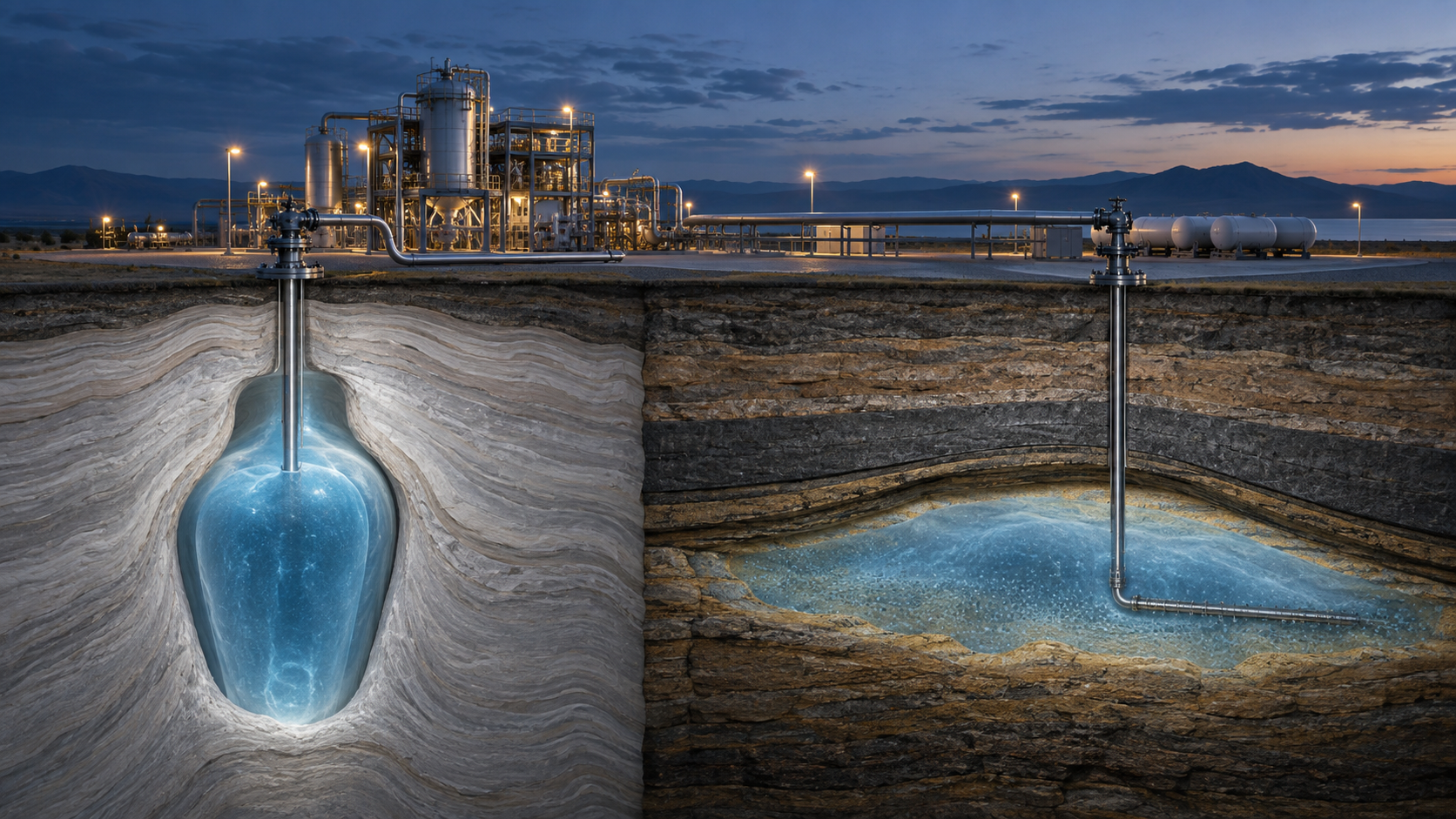
1 Define the asset as a deliverable storage service
Hydrogen storage is often introduced through a large geological number. A basin may have extensive pore volume, a salt structure may accommodate several engineered cavities, and a former gas field may have an impressive historical production record. None of these descriptions establishes the service that a buyer can contract. The buyer needs a quantity of hydrogen delivered at a specified pressure, composition, rate, location and notice period. The operator needs a facility that can receive, hold, condition and return that quantity while staying within a tested pressure envelope. The investor needs a cash claim on this service with a credible counterparty and funded end-of-life obligations.
The decision examined here is narrower than national hydrogen-resource planning. Consider an identified salt-cavern prospect and an identified depleted hydrocarbon reservoir serving the same proposed demand node. Which configuration can provide the contracted working capacity and deliverability at the lower risk-adjusted whole-life cost? The answer can change with cavern geometry, brine-disposal route, reservoir permeability, historical well condition, cushion-gas requirement, pipeline distance and the customer's draw profile. A site with larger theoretical inventory can be inferior if it cannot withdraw quickly enough during an outage.
The International Energy Agency's 2026 review places announced underground hydrogen storage at about 11 TWh by 2035, while just over 7% has reached final investment decision or construction [1]. That gap makes project maturity a central valuation issue. The same source expresses the committed portion as only 0.6% of estimated throughput from committed low-emissions hydrogen projects. Storage capacity and production throughput have different units; a meaningful local balance requires a time profile and cycle assumption. The IEA also reports that announced hydrogen transport pipelines greatly exceed operational or committed mileage [1]. A storage project can be geologically attractive and commercially stranded while its connecting network remains uncommitted.
This paper treats a storage right as a staged development option until the physical service, permissions and contract are supported. A positive preliminary map or policy announcement can justify investigation. It cannot justify booking the full net present value of an unbuilt, uncontracted facility. The capital decision should be tied to explicit evidence gates and a clearly defined alternative, including above-ground storage, a different underground site or a customer operating without a storage contract.
2 Separate inventory from working capacity
Total hydrogen in an underground system has at least two economic categories. Working gas is the quantity intended to be injected and withdrawn during the operating cycle. Cushion gas remains to sustain the pressure and deliverability needed by the design. The separation is not a simple fixed percentage transferable from one site to another. It depends on geometry, pressure limits, reservoir properties, rate, wells and the operating schedule. Some cushion inventory may be recoverable at closure; the amount, timing, quality and cost of recovery require evidence.
The National Energy Technology Laboratory's review of subsurface hydrogen storage discusses differences among depleted hydrocarbon reservoirs, saline aquifers and salt caverns, including pressure, containment and operating behaviour [2]. A depleted reservoir may offer a large connected pore space and existing infrastructure, yet its cushion requirement and existing well inventory can be material. A cavern may support a high injection or withdrawal rate within its engineered operating envelope, while its cavity volume and suitable salt occurrence constrain scale. These are technology characteristics to investigate, not site-level performance guarantees.
An investment memorandum should state five quantities separately: maximum gas in place under the approved pressure envelope; minimum gas retained as cushion; usable working mass under a specified cycle; firm deliverable mass at the contract boundary; and expected gas remaining or recovered at closure. Each quantity should be linked to a test, model or contract. A conversion from tonnes to energy units should name the heating-value convention, and any gross-to-net adjustment should be visible. Otherwise a public capacity figure can be mistaken for cash-generating throughput.
Capital treatment also differs. Cushion hydrogen purchased at commissioning ties up cash. It may be an inventory asset, but its eventual recovery is uncertain and distant. A lender can rationally discount that terminal claim more heavily than a signed annual capacity payment. Insurance and title must specify whose hydrogen occupies the cushion, who pays for loss, and whether a customer can withdraw gas that the operating design needs to retain. A storage price that excludes cushion ownership can conceal a major funding requirement.
3 Specify rate, cycle and quality at the boundary
A contracted store sells a performance envelope, not merely a tank size. The operator must define how many tonnes per day it can inject, how many it can withdraw, how those rates change as pressure falls, how many cycles it can perform, and how much notice the customer must provide. A twenty-day seasonal withdrawal service is different from a rapid ten-day reserve response. The facility may need more wells, compression or conditioning for the second case even when both contracts name the same working-gas mass.
Define the metering boundary between storage and transport. A project may report reservoir withdrawal at one pressure while the buyer needs pipeline entry at another. Compression power, purification, drying, losses and downtime sit between those points. If a depleted field produces hydrogen mixed with residual hydrocarbons or other gases, a gross withdrawal figure is not equivalent to delivered hydrogen meeting the buyer's specification. The storage agreement should state product composition, testing method, rejection rights and who pays for off-specification treatment or replacement supply.
DOE's SHASTA research investigates subsurface hydrogen behaviour in porous formations, including microbial consumption, geochemical effects, migration and well integrity [2,3]. These processes can change recoverable mass or gas quality. Their incidence and magnitude depend on site conditions; a generic loss allowance is a placeholder until tests and history support a distribution of outcomes. The Environment Agency's salt-cavern review identifies uncertainty around repeated pressure and temperature cycling and possible integrity consequences [4]. A cavern's rate promise must fit an engineering envelope that addresses those uncertainties.
The commercial model should show an hourly or daily dispatch simulation for the customer use case. It must include injection energy, operating constraints, planned testing and forced outages. Calculate firm service under a stress condition, then compare it with the contract's penalty regime. A model that demonstrates a comfortable annual average can still fail a peak-day requirement. The boundary specification is the common denominator for comparing a cavern with a depleted field on equal terms.
Table 1. Equal-service diligence specification for two underground alternatives
| Decision field | Salt-cavern evidence | Depleted-field evidence | Contract implication |
|---|---|---|---|
| Working mass | Cavern geometry and pressure-volume model | Reservoir simulation and pressure limits | Reserve only tested deliverable mass |
| Cushion inventory | Minimum safe operating pressure | Pressure support and recovery history | Allocate funding, ownership and terminal claim |
| Daily rate | Well and compressor tests across pressure range | Multi-well deliverability and decline tests | Define firm injection and withdrawal rates |
| Gas quality | Salt and brine contact, surface treatment | Residual fluids, microbes and geochemistry | Set composition, testing and remedy |
| Containment | Cavern shape, roof, creep and borehole | Caprock, faults, legacy penetrations and wells | Set monitoring, stop and insurance duties |
| Connection | Pipeline route and pressure interface | Pipeline route and pressure interface | Price a complete delivered service |
| Closure | Decommissioning, brine and site works | Wells, residual gas and field obligations | Fund the terminal obligation |
Author-developed framework. Values must be populated from site tests, engineering and customer negotiations.
4 Test salt-cavern geometry and operating integrity
Salt caverns are engineered by dissolving salt and managing the resulting brine. A project needs suitable thickness, depth and lateral separation, an acceptable cavern shape and a route for handling brine. The facility must maintain pressure in a range that supports the cavern's roof and walls without breaching the surrounding formation or well system. A plan drawing of salt coverage is therefore the start of a site study, not a storage-capacity certificate. The drilling, leaching, testing and connection schedule can dominate the date at which the facility begins to earn revenue.
The Environment Agency's 2025 review, which applies to England, discusses how geology influences cavern depth, shape and size; it also highlights pressure, temperature and cycle-related uncertainty during operation [4]. The review identifies potential consequences of loss of integrity, including gas release and geological effects. It does not approve a given cavern, set a universal cycle count or transfer directly into another jurisdiction's permit regime. A project engineer should translate it into site-specific design tests and monitoring limits.
The investor needs a cavern development basis that shows one or more staged cavities, not an assumed simultaneous fleet. Review salt seismic data, design geometry, geomechanical model, planned spacing, solution-mining water supply, brine disposal or use, well construction, leak testing and surface compression. Commission independent review of pressure and temperature extremes. The model should make pressure-related deliverability a variable over each cycle, with limits on rapid changes. If brine disposal requires a separate environmental approval, that approval belongs on the critical path before debt draws predicated on commissioning.
Existing natural-gas cavern experience can inform engineering, but hydrogen service introduces a different gas and potentially different cycling profile. A reused cavern requires proof that its well, seals and operating history fit the new service. The commercial case should compare conversion with new construction after accounting for remediation, downtime, test risk and remaining life. A quick conversion cost saving can disappear if the facility later needs a new well or prolonged operating restriction.
5 Underwrite depleted-field containment and well history
A depleted hydrocarbon reservoir may have useful historic data, defined structures and connections. Natural-gas containment over geological time can motivate hydrogen investigation. It does not establish that injected hydrogen will be fully recoverable at the required rate and quality, or that every old well is a secure barrier. Hydrocarbon production can have changed pressure, fluid distribution and completion condition. Historical logs, interventions and abandonment files therefore become transaction-critical records.
DOE and NETL identify porous-media questions involving caprock, faults, existing wells, geochemical reactions and microbes [2,3]. The project must map every relevant penetration, not merely the wells proposed for hydrogen injection. A legacy well with uncertain cement or an old sidetrack can create a risk outside the initial construction budget. A reservoir model should simulate injection, migration, mixing, pressure, withdrawal and resulting gas quality under the actual cycle schedule. Laboratory and field tests should constrain the model rather than be described as proof of a general conversion rate.
The existing field may offer a large storage volume but require more cushion hydrogen to maintain pressure and deliverability. That inventory can consume capital even if the field's drilling cost is lower than the cavern alternative. The need for multiple wells, remediation, compression and purification can also increase fixed operating cost. Conversely, a field with well-characterised geology and healthy wells can have a strong advantage. The valuation has to be site-specific; a technology label cannot resolve the economics.
An acquisition of a depleted-field opportunity should require complete well schedules, subsurface data rights, pressure and production history, environmental and abandonment liabilities, access rights and evidence of the proposed hydrogen permit route. The purchase agreement should distinguish liability for historic hydrocarbon operations from new hydrogen activity. A seller representation about reservoir size is inadequate if deliverable working mass and service quality depend on post-close field tests. Transaction structure should allocate test risk through staged consideration, conditions or retained remediation responsibility where negotiated.
6 Account for chemistry, microbes and gas quality
Hydrogen is a reactive energy carrier in some subsurface environments. Microbes can consume it under certain conditions; mineral and fluid interactions may change composition or reservoir behaviour. NETL's SHASTA programme studies hydrogen loss from biogeochemical reactions, including methanogenesis and other reduction processes, as well as caprock, well and sensor performance [3,5]. These are research questions requiring local sampling. They cannot be reduced to one universal annual loss factor across salt, sandstone and depleted fields.
Characterise formation water, residual gas, rock and microbial communities before setting a commercial quality guarantee. Sample and test the intended injection gas. Simulate the effects of pressure, temperature and flow on contact time. Specify tests for hydrogen concentration and contaminants at withdrawal. If the buyer's industrial process or pipeline imposes a strict composition standard, include the conditioning train, waste handling and availability consequences in the engineering estimate. A reserve for undefined 'purification' is not an executable design.
Contractual loss accounting matters as much as physical measurement. The operator, shipper and customer must agree the measurement points and who owns hydrogen during injection, storage and withdrawal. The contract should specify allowed shrinkage, metering uncertainty, causes of off-specification gas, investigation procedures and replacement-gas valuation. A third-party inventory reconciliation can support lender confidence. Without defined ownership, the same molecule can appear as the customer's asset and the project's cushion asset in two financial statements.
Salt caverns and depleted fields present different primary test programmes. For a cavern, brine and well-material interactions, tightness, cavern shape and cycling are central. For a porous reservoir, mineral-fluid-microbe interactions, residual hydrocarbons, displacement and legacy wells receive more attention. These lists guide scope; they do not assume that one medium always has zero loss or the other always fails quality. Evidence should be recorded as measured, modelled, uncertain or unresolved for the specific site.
7 Make the connection a separate investment gate
An underground store needs both a source of hydrogen and an outlet to a buyer. Connection can require new pipeline, easements, compressors, grid power, valves, metering and safety systems. The pipeline route may cross land, roads or protected areas, bringing approvals independent of subsurface storage. A storage site can be economically attractive at its wellhead and uncompetitive at the customer's gate. The transaction model should show both wellhead and delivered-service economics.
IEA's 2026 review observes that announced hydrogen pipeline projects exceed 40,000 km by 2035, with only 9% operational or backed by committed investment [1]. These are global pipeline figures. A project cannot credit an announced line as available infrastructure until the exact route, capacity, operating pressure, timetable and access terms are committed. A captive industrial hub may develop storage and pipe together; that arrangement still needs a combined capital budget and coordinated critical path.
Identify the chain of counterparties: hydrogen producer, transport operator, storage operator, end user and any public support agency. Determine which one pays for capacity before utilisation builds. A store serving several producers or consumers can diversify demand, but it also needs transparent nomination, priority, balancing and curtailment rules. A single anchor contract may be bankable if credit and term are strong; it can leave concentration and renewal risk after the first customer exits.
Connection timing belongs in the development probability. A storage project that reaches mechanical completion two years before its pipeline should not forecast full capacity revenue from its own commissioning date unless an enforceable availability payment covers the gap. The financing plan should cap spending before network certainty, reserve rights of way early and place termination or delay remedies in the relevant agreements.
8 Build a public benchmark with disciplined units
Public evidence can frame the size and maturity of the market. It should not be treated as a project tariff. IEA reports 11 TWh of announced underground storage capacity by 2035, equivalent to 335 kilotonnes of hydrogen, with just over 7% at final investment decision or under construction [1]. It also reports large salt-cavern projects under construction in the United States, Germany and China [1]. This is evidence that the technology is moving beyond pure concept in selected places. It is not evidence that a proposed local cavern or depleted field has reached a comparable gate.
NETL's 2022 state-of-knowledge report compares underground storage media and their technical challenges [2]. NETL/SHASTA workshop material reports case-specific cost estimates and identifies cushion gas, site preparation and compression as major cost drivers in its modelled cases [6]. The published cases use particular geological, operational and cost assumptions. Their dollar-per-kilogram figures should not be pasted into an acquisition model as a universal present-day charge. A buyer should instead use their cost categories as a checklist against a vendor and independent engineer estimate.
The UK's hydrogen transport-and-storage pathway and subsequent government material describe policy intent to support strategic networks and investment [7,8]. They are relevant to the possibility of support in that jurisdiction. A policy pathway is not an award, permit or project-specific revenue guarantee. The Environment Agency's geomechanics review adds a risk taxonomy for England [4]. These sources have different units of analysis: global pipeline, research experiment, national policy and site engineering. A fair comparison preserves those boundaries.
Table 2. Public observations and permissible investment use
| Public observation | Legitimate use | Further project evidence required |
|---|---|---|
| IEA: 11 TWh announced storage by 2035; just over 7% at FID or construction [1] | Assess pipeline maturity and financing risk | Signed local demand, commissioned connection, site permits |
| IEA: large salt caverns under construction in three countries [1] | Identify execution precedents to study | Comparable geology, scope, cycle and regulatory pathway |
| NETL: microbial, geochemical and well risks remain research priorities [2,3] | Design sampling and independent tests | Site fluids, wells, reservoir and operating model |
| NETL workshop: cushion, preparation and compression drive modelled cases [6] | Check completeness of capex and operating scope | Current quotations and project-specific inventory |
| UK pathway and model proposals [7,8] | Map possible support and policy interfaces | Current eligibility, allocation, contract and permit |
Sources [1-8]. Figures and policy statements are dated observations, not site forecasts or tariffs.
9 Compare sites at the same service boundary
To compare a cavern with a depleted field, first define the buyer's required service, then design each site independently to meet it. Use the same working mass, minimum daily withdrawal, injection rate, operating season, delivery pressure, purity and contract boundary. Record exceptions explicitly. If one option cannot meet a hard requirement without major additional works, its cheaper base construction estimate has no meaning for that mandate.
Normalise costs across the whole system. Include subsurface development, wells, surface plant, compression, dehydration and purification, pipeline connection, power, land, brine or produced-fluid handling, owner costs, contingencies, cushion hydrogen, monitoring, insurance, maintenance, replacement equipment and closure. An existing gas field can have past investment that is sunk to the seller yet a valuable transferable asset to the buyer. The price paid for it still enters the buyer's return calculation. A new cavern can have a more visible construction cost but fewer inherited wells.
Separate quantities by evidence maturity. Measured pressure test and well logs are different from reservoir-simulation output. A vendor quotation is different from a preliminary allowance. An announced pipeline is different from a signed connection agreement. The board paper should show an evidence grade beside each cost and performance input, and state the downside if the grade is low. Sensitivity analysis cannot compensate for a missing title or permit; those are binary or staged conditions.
The ranking should be made at least three times: on gross engineering cost; on risk-adjusted whole-life cost for the required service; and on equity value under feasible contract and financing terms. These rankings can differ. A cavern may cost more to build but need less cushion inventory. A field may cost less to construct but require expensive purification. Neither observation proves a general winner. The correct question is which site can deliver the specified service with a credible, financeable cash-flow and safety case.
10 Price capacity, throughput and availability distinctly
Hydrogen storage can be paid through a reservation charge, injection and withdrawal fees, an availability payment, an energy-arbitrage share or a combination. The contract must match the service actually provided. A fixed capacity reservation can fund capital when the customer values assured access. A throughput fee compensates for variable compression, conditioning and wear. A performance or availability component can align incentives. A pure arbitrage model exposes the project to hydrogen and power price spreads that may have little relationship to its fixed costs.
The capacity contract should define the booked working mass, nomination windows, minimum withdrawal rate at the delivery point, pressure and composition, planned maintenance, force majeure, make-up service, testing, penalties and termination. If the operator retains discretion to restrict cycling for cavern integrity or reservoir pressure, that right must be reconciled with the customer's firm commitment. A lender should model the stricter of the engineering limit and the contractual obligation, with penalty cash flows when the two diverge.
Credit quality and duration matter. A fifteen-year capacity agreement from a weak startup is not economically equivalent to the same tariff backed by strong collateral or a diversified utility. Parent guarantees, letters of credit, payment security and step-in rights can change the capital structure. The operator also needs protection against a buyer's failure to provide hydrogen for injection. If the storage contract depends on a proposed producer and pipeline, the agreement should address delays and coordinated commencement.
Revenue support schemes may alter the risk allocation where they are actually awarded. The United Kingdom has described hydrogen storage business-model development and network planning [7,8]. Current application terms, eligibility and executed contract status must be checked at the transaction date. A financial model should carry a support-free case unless a documented award and binding terms justify inclusion. A press release or consultation does not create contracted revenue.
11 Build a fictional whole-life comparison
The following case is an author-created teaching exercise. It is not based on a real facility, vendor quotation, policy award or prevailing hydrogen price. Two fictional projects are assumed to provide the same 5,000 tonnes of working storage capacity and a tested 500 tonnes per day withdrawal commitment at the same metering boundary. Both operate for twenty years. The discount rate is assumed at 10% nominal, with constant annual operating cost and no tax, inflation, debt, major replacement capex or construction delay. All dollar values are USD millions at year zero unless stated.
The cavern case assumes USD 120 million initial project capital, 1,000 tonnes cushion hydrogen purchased at an assumed USD 3/kg for USD 3 million, USD 7 million annual operating cost, USD 15 million closure cost in year twenty, and recovery of half the initial cushion-gas value at closure. The depleted-field case assumes USD 100 million capital, 4,000 tonnes cushion hydrogen for USD 12 million, USD 10 million annual operating cost, USD 25 million closure cost, and recovery of half its cushion-gas value in year twenty. The capex, inventory, opex and closure numbers are deliberate fictional assumptions to illustrate the decision mechanism; no public source validates them for a site.
At 10%, the present-value annuity factor for twenty equal year-end payments is approximately 8.5136 and the year-twenty discount factor is approximately 0.14864. Define the annual break-even capacity payment as annual opex plus the present value of initial capex and cushion purchase, less discounted terminal cushion recovery, plus discounted closure, divided by the annuity factor. The resulting payment is about USD 21.68 million per year for the cavern and USD 23.49 million for the depleted field. Dividing by 5 million kilograms of booked working capacity yields approximately USD 4.34 and USD 4.70 per kg of working capacity per year. These are model outputs, not observed tariffs or storage costs.
Table 3. Fictional equal-service case and break-even capacity payment
| Item | Salt cavern | Depleted field |
|---|---|---|
| Working capacity, tonnes | 5,000 | 5,000 |
| Firm withdrawal, tonnes/day | 500 | 500 |
| Initial project capital | 120.00 | 100.00 |
| Cushion gas bought at assumed USD 3/kg | 3.00 | 12.00 |
| Annual operating cost | 7.00 | 10.00 |
| Year-twenty closure cost | 15.00 | 25.00 |
| Year-twenty cushion value recovered | 1.50 | 6.00 |
| Annual break-even capacity payment | 21.68 | 23.49 |
| USD/kg working capacity/year | 4.34 | 4.70 |
All financial and operating inputs are author assumptions. The case excludes tax, financing, inflation and construction risk. USD million unless stated.
This exercise shows why the project with lower initial construction expenditure can have a higher required recurring payment when other assumptions differ. It does not establish that real depleted fields require the assumed cushion, that real caverns have the assumed capex, or that customers will pay either threshold. If the two options cannot genuinely meet the same daily rate and gas-quality standard, the comparison must be redesigned rather than forcing an equal-service table.
12 Expose the threshold to sensitivities
The worked case has deterministic inputs chosen for clarity. In practice, the uncertain variables interact. Cushion inventory depends on pressure and rate; compression power depends on flow and electricity tariff; gas recovery depends on field behaviour and closure permissions; monitoring cost responds to integrity findings. A proper investment model should show distributions or scenario ranges supported by engineering and market evidence. The teaching model can still illustrate which inputs deserve testing first.
Under the fictional cavern assumptions, adding USD 20 million to initial capital raises the annual break-even payment by approximately USD 2.35 million. A USD 3 million rise in annual opex raises the payment by exactly USD 3 million. Removing the assumed terminal cushion recovery raises the annual threshold by only about USD 0.03 million because the recovery is distant and small. The field has a larger cushion inventory, so deleting its assumed USD 6 million terminal recovery increases annual threshold by about USD 0.105 million. These calculations use the stated 10% rate and twenty-year term; they are sensitivity mechanics rather than market forecasts.
The more decisive uncertainty may be physical performance. If the field can contract only 300 rather than 500 tonnes per day, the assumed same annual capacity payment may not be available at all. If a cavern needs a brine route costing more than budgeted, it can lose its illustrative advantage. If a pipeline is delayed two years while fixed costs accrue, the simple year-one annuity overstates value. These risks should be represented with revised cash-flow timing and contract terms, not only a single extra contingency percentage.
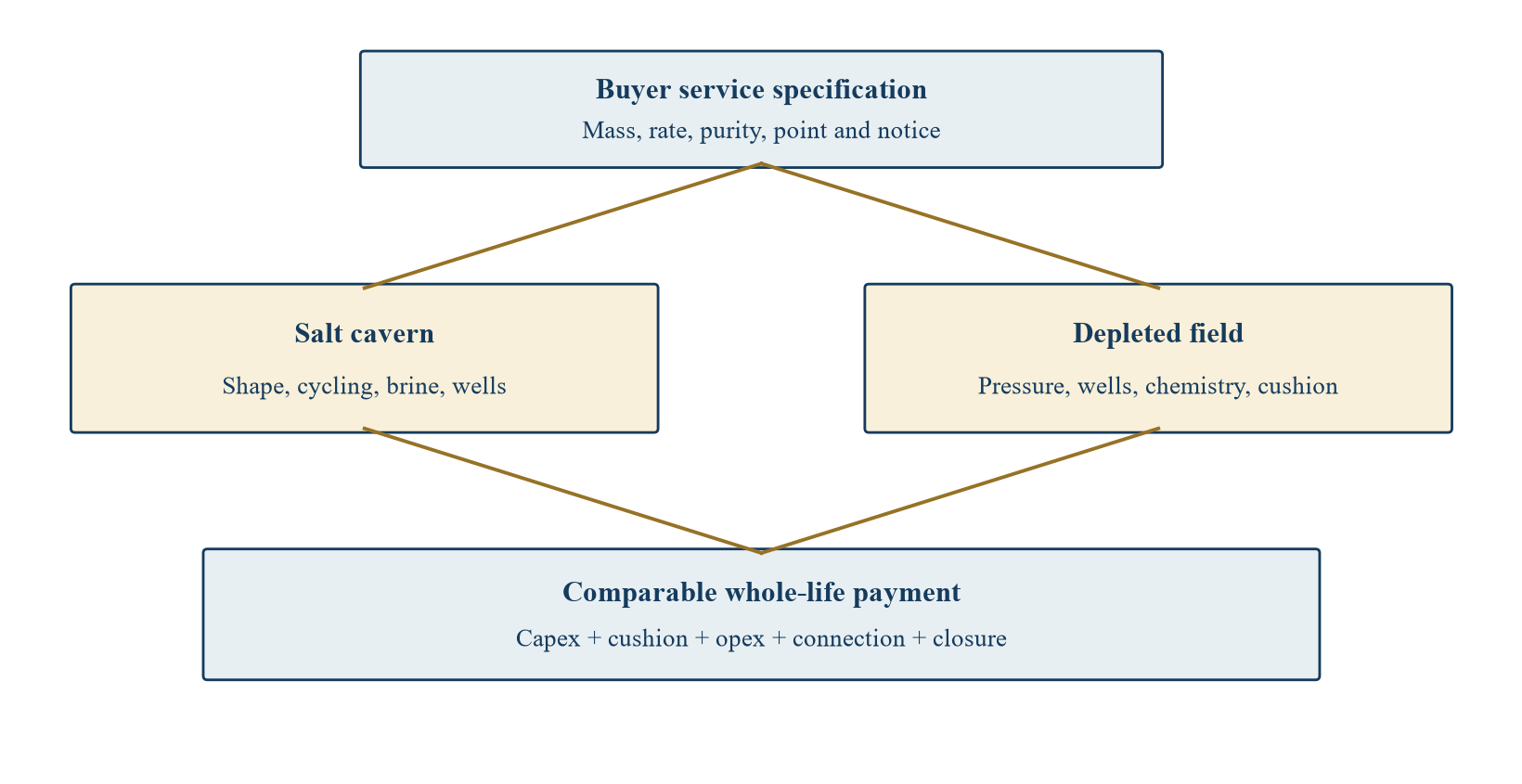
Boxes show a decision framework, not measured attributes or universal technology rankings.
The figure forces both options through one service specification and one whole-life accounting boundary. A large pore volume is not carried directly to valuation. It becomes valuable only after engineering establishes working mass and deliverability, a buyer contracts those attributes, and costs and liabilities are funded. That sequence prevents a favourable geology slide from standing in for a commercial investment case.
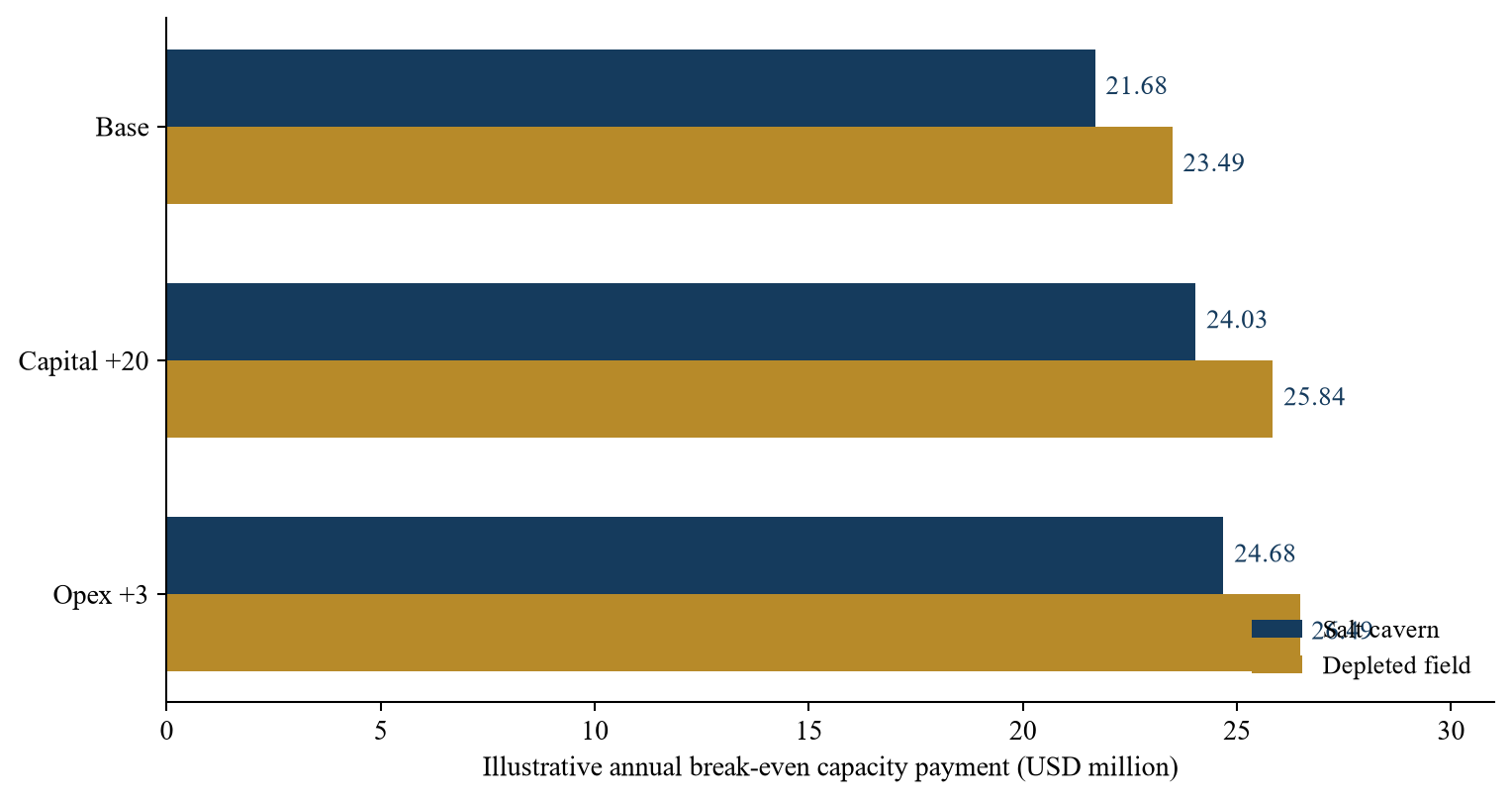
Calculated from author assumptions in Table 3; USD million per year. These bars are not market tariffs.
The two altered-cost cases change one assumption for both facilities at a time. They do not represent actual cost shocks. The chart makes the annual-payment consequence visible while leaving physical service unchanged. For a real asset, the more important test may be whether an expensive design revision also changes firm daily deliverability, gas quality or commissioning date. Those effects require a new operating model and contract assessment.
13 Treat construction timing as a valuation variable
Construction of an underground store can involve site appraisal, land and pore-space rights, well works, solution mining or reservoir conversion, surface plant, connection and commissioning. These activities do not always progress together. A permitted cavern with no brine route is incomplete. A field with existing wells but uncertain hydrogen compatibility can require lengthy testing. A ready store with no hydrogen pipeline may earn no revenue. Timing uncertainty should be expressed as dated milestones and spending limits.
Build a critical-path schedule with dependencies and stop points. Identify the dates for subsurface appraisal, independent design, environmental studies, permit applications, customer contract, connection agreement, final investment decision, construction, pressure and integrity tests, first gas, reliability run and commercial operations. Assign an owner and evidence artifact to each milestone. The cost estimate should include escalation and owner cost through the actual likely schedule rather than assuming every invoice is paid at final investment decision.
Delayed cash receipts can change the ranking between sites. An existing field might be faster if rights, wells and pipe are usable; it can also be slower if historical files are incomplete or remediation extensive. A new cavern might have a clear engineered scope while brine disposal delays its permit. Neither outcome follows from the technology name. Discounted cash flow should model the site-specific sequence, and debt drawdown should track evidence of completion.
Contracts need corresponding timing protection. A producer may start delivering hydrogen before storage is ready, or the store may be ready before the producer. Define long-stop dates, liquidated damages where negotiated, temporary alternatives, commissioning tests and termination. If one party bears the other's delay, quantify that exposure. A storage developer should not promise a fixed first-service date without an integrated path from both subsurface and network contractors.
14 Allocate rights and liabilities before signing
The operator may need rights to drill, construct and operate wells; rights to use subsurface space; surface access; pipeline easements; water and brine permissions; and title to stored hydrogen. These rights are jurisdiction-specific and can belong to different parties. A hydrocarbon licence, expired field lease or land ownership entry should not be assumed to cover hydrogen injection. Local legal analysis must identify the relevant instruments, consent and transfer requirements before the project is priced as executable.
Depleted-field acquisitions are especially sensitive to legacy obligations. Existing wells may carry abandonment, environmental or third-party claims. The seller may have decommissioning security or commitments that cannot simply be assigned to a new hydrogen entity. The buyer should identify historical contamination, well-integrity repairs, ownership of seismic and reservoir data, and responsibility for any residual hydrocarbon. Escrow, security, staged payments and specific indemnities can allocate known or uncertain exposures, subject to a solvent obligor.
A cavern project has different inherited risks: salt and brine rights, land access, solution-mining impacts, wellbore and cavern integrity, and closure. New construction avoids some legacy field liabilities but does not eliminate environmental and long-term obligations. Contracts should name who funds emergency response, monitoring, final gas removal, well plugging and surface restoration. A special-purpose vehicle's limited capital may be insufficient for those duties unless security and reserve mechanisms are designed at financial close.
The contractual architecture should distinguish storage operator liability from customer gas title and network operator liability. A leak or contamination event can affect all three. Define notification, stop-work, testing, allocation of physical loss, insurance and dispute resolution. An acquisition valuation is incomplete if historic and future obligations have no credible payer. This paper offers a diligence map, not a legal determination in any jurisdiction.
15 Put safety and monitoring into the operating model
Containment and occupational safety are operating conditions, not optional risk disclosures. A project needs a pressure-management plan, barrier tests, gas detection, emergency isolation, well surveillance and incident response. For a cavern, monitor pressure, temperature, deformation indicators and well integrity within the approved envelope. For a depleted field, include the pressure distribution, legacy wells, possible migration, gas composition and reservoir response. The exact system must be set by qualified engineers and the competent authority for the site.
NETL describes monitoring technologies and research aimed at gas migration, leakage, microbial activity and well integrity [3]. The Environment Agency's salt-cavern review discusses the potential environmental effects of integrity loss, including subsidence, seismicity and gas release [4]. These sources justify a monitoring budget and stop thresholds. They do not provide an off-the-shelf sensor count, alarm level or insurance premium for an individual project. The operating plan should be supported by site-specific hazard analysis and regulator-approved conditions where required.
Monitoring data need commercial treatment. The operator should maintain a time-stamped evidence trail from instrument to reported performance. Lenders may require periodic independent integrity reviews and advance notification of excursions. Customers need a process for availability changes. Insurers need disclosure of the true use and pressure regime. Board members should know who can order an immediate shutdown without commercial override when a threshold is breached.
The financial model should provide for routine testing, sensor replacement, workovers, outages, emergency response and closure. An annual operating-cost line that omits these functions will produce a misleading break-even tariff. A safety investment can protect continuity and capital value, but its cost and remaining risk must be explicit. The project should also model an orderly cessation case in which revenue ends and obligations continue.
16 Finance the contracted service, not theoretical geology
Bankability depends on a package: independent subsurface assessment, tested operating envelope, permitted construction, fixed or bounded cost, commissioned connection, contracted capacity, credible counterparty, insurance and funded closure. Each element supports a different part of the lender's downside case. A strong geological model cannot cure a missing customer; a strong customer cannot cure an untested well. Equity may finance earlier development stages, but it should price failure and the right to stop.
Debt sizing should use the lower of contracted capacity and independently supported firm performance. Model maintenance periods, pressure-related rate reduction, quality excursions and counterparty interruption. A reserve account may cover debt service and integrity work. Covenants can require tested working-gas inventory, minimum gas quality, periodic well audits, insurance, permit compliance and funding of closure security. The remedies need to be practical after a physical failure; the lender cannot force unsafe injection to restore financial ratios.
The cushion-gas structure requires special attention. If the project buys cushion hydrogen, fund it before first operation and define security interest and recovery rights. If a customer provides cushion inventory, assess whether termination lets the customer remove gas essential to continuing operation. A third-party working-gas model may reduce project commodity exposure but increases metering, title and loss-allocation complexity. A financing agreement should match the actual custody and ownership structure.
An infrastructure investor may accept a development portfolio with multiple sites. Portfolio value should be the sum of gated site cases plus any demonstrable shared execution benefit. A count of screened caverns and depleted fields is not a contracted capacity portfolio. Report projects by evidence stage: prospect, appraised, permitted, contracted, financed, under construction and operational. The IEA's global announced-to-committed gap [1] is a warning against collapsing these stages in a valuation multiple.
17 Make policy and geography explicit
Storage policy varies across jurisdictions. The United Kingdom has published a pathway for hydrogen transport and storage networks and materials on business-model development [7,8]. The 2025 Environment Agency salt-cavern study applies to England [4]. These sources establish policy and risk context there. They do not grant a permit, subsidy or revenue contract to a site. The investment team must verify the current allocation window and eligibility at the decision date, then use executed terms in the base case only when they exist.
DOE and NETL sources describe US technical research [2,3,5,6]. They do not establish that a project in the Gulf, India or another market has equivalent pore-space rights, hydrogen standards or regulatory approval. A cross-border investor should create a jurisdiction schedule covering subsurface title, storage licensing, well safety, environmental approvals, surface works, pipeline access, hydrogen ownership, decommissioning security and public support. Each item should cite the current local law or authority at transaction time. Transfer the engineering questions across borders; verify the legal answer locally.
Demand also varies. A refinery, ammonia complex, steel plant, hydrogen-to-power project or grid-balancing system has a different draw and quality profile. Geography matters through the location of these customers, available geology and network routes. A national map that combines prospective supply and storage zones is a useful screen. It is not a customer contract. IEA's global hydrogen review discusses offtake weakness and infrastructure commitments [1,9]. Those global observations should sharpen local diligence, not substitute for it.
Public support can be important in an emerging network where early capacity may be underused. Its economic value depends on award criteria, contract duration, revenue sharing, availability standards and state-aid or other local constraints. A management estimate of future support belongs in a separate scenario, identified as such. The base case should be able to show how the store survives if support is delayed or unavailable, or state candidly that the project cannot proceed without it.
18 Use data and modelling to reduce uncertainty
The data room for a cavern should contain geological and seismic interpretation, salt-quality and depth data, geometry and geomechanical modelling, well design, leaching and brine plan, pressure and leak tests, surface process design, route and power studies, and regulator correspondence. The data room for a depleted field should add historical production and pressure data, every well and intervention, reservoir fluids, core and laboratory tests, caprock and fault analysis, existing contracts and abandonment obligations. The comparison file should normalise units, dates and provenance across both alternatives.
Dynamic models can simulate pressure, mass balance, gas composition and deliverability under candidate dispatch profiles. They should be calibrated against measured data and run under downside cases. A machine-learning classifier may help find candidate sites or flag missing well records, but it cannot certify containment or issue a permit. Preserve the original source for every extracted figure, the model version and the assumptions changed by an analyst. Model outputs should be tagged as simulated until independently tested.
Data innovation has a commercial use when it reduces decision time without concealing uncertainty. Standardise a service specification, a cost taxonomy and an evidence-grade score. Capture the dates at which a prospect passed or failed each gate. Over time, the sponsor can estimate its own attrition and development cost from actual outcomes. Until then, an assumed conversion probability should be disclosed as an author or management estimate. Do not train a valuation model solely on surviving successes; rejected and delayed projects contain the information about downside risk.
Digital monitoring can strengthen operations after commissioning. Continuous pressure and composition streams can detect deviations against a site-specific baseline, and a controlled data trail can support contract settlement. The value depends on calibration, maintenance and human review. Alerting software does not replace a barrier or an emergency-response plan. The goal is to make physical and contractual performance observable to the parties financing it.
19 Stage investment through evidence gates
Gate one establishes the buyer's service specification and identifies a credible demand node. Gate two establishes rights, geometry or reservoir history, and an initial environmental and safety path. Gate three tests physical deliverability, gas quality, containment and wells under the proposed cycle. Gate four prices the complete system using engineering scope, connection, cushion inventory, monitoring and closure. Gate five obtains binding customer and network terms, permits and an investable financing package. Gate six commissions the facility against the contracted boundary and maintains surveillance through closure.
Each gate needs a cap on capital at risk and a stop decision. An early screen may reject a field because no party controls pore-space rights. A sampling campaign may reject a site whose hydrogen quality cannot be delivered economically. A pressure test may limit a cavern's daily rate below the customer's requirement. A network route may prove too slow or expensive. Stopping at these points is an expected output of development discipline, not a failure of the research programme.
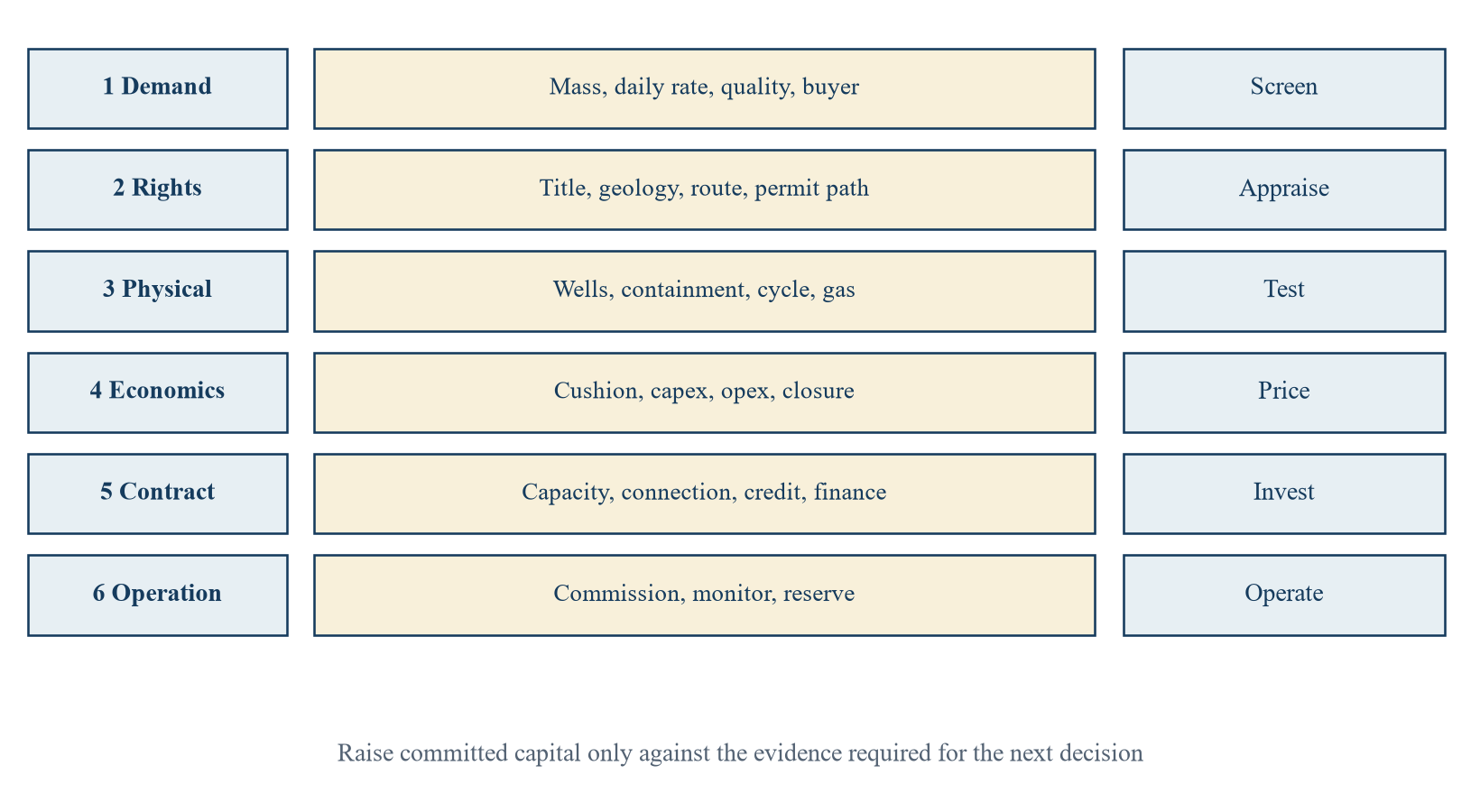
The sequence is illustrative; some permits and engineering activities may run in parallel under the applicable rules.
An investment committee should require a one-page gate record. List the evidence received, unresolved items, owner, budget and decision. Separate a failed hard condition from a variable that can be repriced. A missing permit cannot be made acceptable by a higher discount rate alone. A higher independently quoted compressor cost can be modelled and renegotiated. The paper's framework makes these different decisions visible and protects development capital from moving by default into construction.
20 State limitations and research needs
This paper is an educational framework, not an engineering certification, safety approval, resource assessment, legal opinion, tariff study or offer of securities. It does not establish the cost, recoverable hydrogen, working capacity, cycle life or environmental impact of any named site. The modelled twenty-year cavern and field are fictional. Every capital, operating, inventory, closure and recovery input was selected by the author to illustrate arithmetic. Taxes, financing, construction duration, inflation, replacement capital, downtime and project-specific risk probabilities are omitted. The resulting annual payments are not market benchmarks.
The public sources operate at different levels. IEA's 2026 report is a global project-pipeline and demand analysis [1,9]. NETL and DOE materials identify research priorities and selected modelled technical or economic cases [2,3,5,6,10]. The Environment Agency reviewed salt-cavern geomechanics in England [4]. UK government material describes policy direction and business-model work [7,8]. None certifies a particular cavern, reservoir, pipeline, customer or subsidy. Site decisions require qualified local professionals and current source documents.
Further empirical research should publish comparable site outcomes while preserving safety and commercial confidentiality: working-to-cushion ratios, injection and withdrawal profiles, gas-quality changes, microbial observations, remediation cost, compressor consumption, brine handling, construction delay, contract pricing and closure spending. Failed appraisals should be recorded alongside successful projects. Matched data would help distinguish technology effects from geography, customer requirements and project maturity.
The decision framework remains useful without a claim of predictive accuracy. It forces a prospective investor to demand a complete physical and contractual service definition, to separate site tests from public analogues, and to pay for only the risked cash flow supported at the current gate. A technology may be promising even when one site fails. A public policy may be supportive even when one application is ineligible. Recording those distinctions makes a storage development portfolio more investable and more accountable.
21 Conclusion
Hydrogen beneath the ground has economic value when a site can deliver the quantity, rate, quality and reliability that a real buyer will pay for, through a permitted and monitored system. The amount of salt or depleted pore space is an input to that possibility, not the price of the service. Cushion gas, compression, connection, wells, containment, contamination and closure can reverse the apparent ranking of two geological options.
The fictional comparison puts this principle into arithmetic. Under author-assumed equal 5,000-tonne working capacity, 500-tonne daily withdrawal and a twenty-year 10% model, the cavern requires about USD 21.68 million a year and the depleted field about USD 23.49 million a year to cover its assumed costs. The field's lower initial capital is outweighed in this fictional case by higher assumed cushion inventory, annual operations and closure. These values do not predict actual project costs or prices. A different site or dispatch requirement can change the result.
The practical route is staged. Define the customer service, establish rights and geology, test physical performance and gas quality, engineer the complete networked system, contract the capacity, fund the closure, then finance and commission against the agreed boundary. Public research gives the team better questions. The investment case is earned by site evidence and enforceable payments.
References
- International Energy Agency. Global Hydrogen Review 2026, Trade and Infrastructure (2026). Accessed 6 October 2026. https://www.iea.org/reports/global-hydrogen-review-2026/trade-and-infrastructure
- US Department of Energy, National Energy Technology Laboratory. Subsurface Hydrogen and Natural Gas Storage: State of Knowledge and Research Recommendations (2022). Accessed 6 October 2026. https://www.netl.doe.gov/projects/files/SubsurfaceHydrogenandNaturalGasStorageStateofKnowledgeandResearchRecommendationsReport_041122.pdf
- US Department of Energy, National Energy Technology Laboratory. SHASTA: Subsurface Hydrogen Assessment and Technology Acceleration. Accessed 6 October 2026. https://www.netl.doe.gov/sites/default/files/rdfactsheet/R-D232.pdf
- Environment Agency. The Geomechanics of Hydrogen Storage in Salt Caverns: Environmental Considerations (2025). Accessed 6 October 2026. https://www.gov.uk/government/publications/the-geomechanics-of-hydrogen-storage-in-salt-caverns-environmental-considerations
- US Department of Energy, National Energy Technology Laboratory. Subsurface Microbiology and Geochemical Reaction Research Paving the Way for the Hydrogen Economy (2022). Accessed 6 October 2026. https://www.netl.doe.gov/node/11998
- US Department of Energy, National Energy Technology Laboratory. SHASTA Workshop Summary (2024). Accessed 6 October 2026. https://edx.netl.doe.gov/sites/shasta/wp-content/uploads/2024/05/SHASTA-Workshop-Summary-040324.pdf
- UK Department for Energy Security and Net Zero. Hydrogen Transport and Storage Networks Pathway (2023). Accessed 6 October 2026. https://www.gov.uk/government/publications/hydrogen-transport-and-storage-networks-pathway/hydrogen-transport-and-storage-networks-pathway
- UK Department for Energy Security and Net Zero. Clean Flexibility Roadmap (2025). Accessed 6 October 2026. https://www.gov.uk/government/publications/clean-flexibility-roadmap/clean-flexibility-roadmap
- International Energy Agency. Global Hydrogen Review 2026, Executive Summary (2026). Accessed 6 October 2026. https://www.iea.org/reports/global-hydrogen-review-2026/executive-summary
- US Department of Energy, Office of Fossil Energy and Carbon Management. DOE Three-Year US Underground Hydrogen Storage Assessment Expands Future Opportunities (2024). Accessed 6 October 2026. https://www.energy.gov/hgeo/articles/doe-three-year-us-underground-hydrogen-storage-assessment-expands-future
- UK Department for Energy Security and Net Zero. Hydrogen Infrastructure Strategic Planning: Policy Statement (2025). Accessed 6 October 2026. https://www.gov.uk/government/publications/hydrogen-infrastructure-strategic-planning-policy-statement/hydrogen-infrastructure-strategic-planning-policy-statement-accessible-webpage
- US Department of Energy, National Energy Technology Laboratory. Underground Hydrogen Storage Remains a Key Research Topic for NETL (2022). Accessed 6 October 2026. https://www.netl.doe.gov/node/11982
About the Author
Chennakeshav (CK) is a corporate finance and investment banking executive with 25+ years of global experience in deal origination, structuring and execution across M&A, growth capital and corporate strategy. He has led value-creation mandates for founders, corporates and funds — bridging the boardroom view to hands-on execution and close.
His career spans Morgan Stanley, HSBC, Lloyds Banking Group, EWEC, ADQ portfolio companies and Emirates Growth Fund, across TMT, real estate, fintech, deeptech, cleantech, infrastructure and energy. He has partnered with C-suite leaders, private equity and venture funds, sovereign wealth funds and family offices to finance complex fund raises and scale-up ventures, and has led M&A due diligence, post-merger integration and business-transformation initiatives to create value.
At Matchpoint Partners he is Managing Partner, leading the firm's corporate finance, M&A and capital-raising practice. He holds an MBA from London Business School, an engineering degree from VTU and a Master of Laws (LLM, in progress) from UCL London.
An active start-up mentor, CK mentors at Techstars, DIFC FinTech Hive, Startup Grind, Founder Institute and IN5, serves as Entrepreneur Mentor in Residence (EMiR) at London Business School, and judges the Entrepreneurship World Cup.
