

1. Define the liquidity and credit decision before selecting the instrument
An infrastructure fund should begin with the cash need, its date, duration and value expected from meeting it. Uses can include committed capital expenditure, lifecycle maintenance, acquisition funding, reserve replenishment, refinancing, hedging, tax, fund expenses, investor distributions or protection of an asset through a temporary disruption. Each purpose has a different effect on asset value, cash coverage, investor outcomes and lender risk.
The approval paper should identify the asset, guarantors, fund and asset entities, legal purpose, requested amount, currency, tenor, repayment source, security, distribution policy and alternatives. A facility that protects contracted cash or prevents value-destructive delay has a different investment case from debt raised only to accelerate distributions. The governing body should preserve the no-action case and compare NAV finance with asset-level debt, equity, asset sale, capital call, delayed deployment and refinancing.
Facility economics should be expressed as dated net cash. Interest, fees, hedging, amortisation, reserves, cash sweeps, valuation cost, monitoring and covenant restrictions reduce future flexibility. Asset-level refinancing or sale may create liquidity while changing recourse, control and upside. The decision should test central, delayed, operating-stress and correlated-downside cases before lender engagement.
The lender decision is equally specific: whether verified eligible value, controlled cash, diversification, liquidity and enforceable rights support the proposed exposure through maturity and downside. Reported NAV is an input rather than the answer. The financing case should state which asset evidence, valuation adjustments and controls make repayment credible.
2. Establish authority perimeter and decision ownership
Read the trust deed, limited-partnership or company documents, private placement memorandum, subscription agreements, side letters, investment-management agreement, committee mandates, valuation policy, borrowing policy, distribution policy and asset documents as a connected system. Identify who may borrow, guarantee, grant security, redirect cash, transfer interests, amend project contracts, incur asset-level debt and make distributions.
The entity map should cover the fund, sponsor, investment manager, trustee, parallel vehicles, feeders, holding companies, project special-purpose vehicles and operating companies. Debt placed below a fund can still create portfolio leverage and structural subordination. Security over units, shares, accounts, receivables or distributions produces different enforcement routes and consents. Counsel should map benefit, authority, approvals, restrictions, notice, perfection and insolvency treatment for every relevant entity.
Indian vehicles can fall under different frameworks. SEBI regulates Infrastructure Investment Trusts and Alternative Investment Funds within their respective regimes. RBI regulates banks, eligible non-bank lenders and Infrastructure Debt Fund-NBFCs within their applicable directions. The National Bank for Financing Infrastructure and Development has its own statutory mandate and prudential framework. A commercial label such as infrastructure fund does not determine the legal perimeter.
Decision ownership should remain explicit. Investment, asset management, engineering, risk, valuation, finance, legal, compliance, operations and investor relations hold different evidence. Independent valuers, engineers, auditors, administrators, model validators and counsel provide defined professional assessments. The governing body and lender retain approval authority within their mandates.
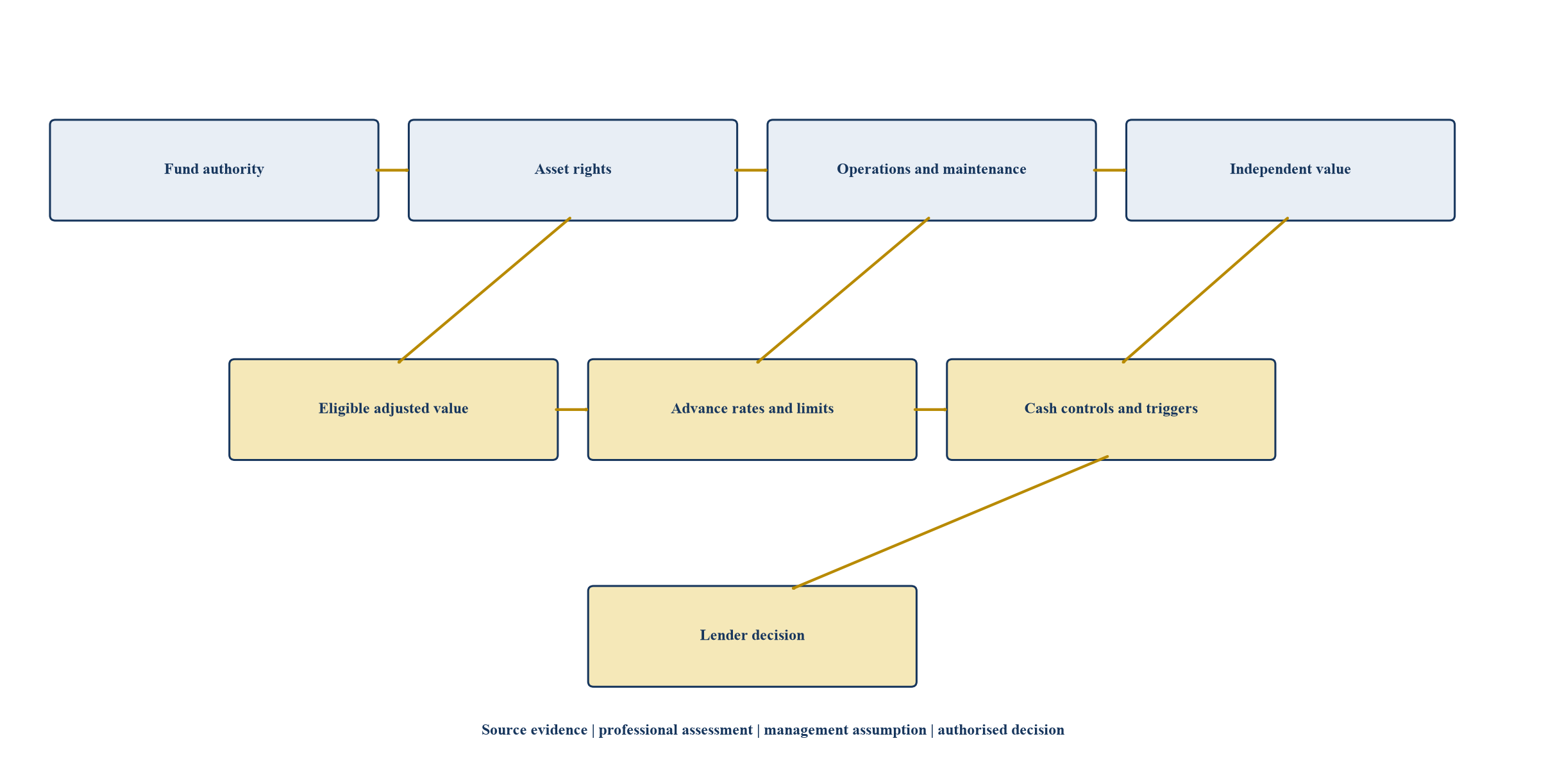
Proposed framework linking legal authority, asset evidence, value and lender controls.
| Question | Evidence | Decision owner | Release gate |
|---|---|---|---|
| fund may borrow | governing and offering documents | governing body and counsel | purpose, amount and tenor confirmed |
| entity may grant security | constitutional and transaction documents | entity board and counsel | benefit and approvals documented |
| distributions may be controlled | project and account agreements | finance, operations and counsel | cash path and priority tested |
| valuation may support borrowing | valuation policy and facility definition | valuation committee | current method and adjustments accepted |
| portfolio limits remain satisfied | regulation, policy and covenants | risk function | central and stress compliance demonstrated |
| data and model may be used | governance, privacy and validation record | data and model owners | lineage, validation and access approved |
| transaction can close | conditions precedent and funds-flow memorandum | authorised signatories | evidence, funding and controls complete |
Approvals depend on the actual vehicle, documents, assets, lender and applicable law.
3. Map portfolio cash obligations before sizing liquidity
Available fund cash is not the bank balance. Cash can be reserved for committed capital expenditure, major maintenance, debt service, working capital, tax, hedging, insurance, concession payments, performance security, environmental obligations, fund expenses and distributions. Build a dated obligation register by asset, entity, currency, legal priority, confidence and downside date.
Infrastructure assets often contain lumpy obligations. A road concession may require periodic resurfacing. A renewable portfolio can face inverter, blade, module or battery replacement. Transmission and digital infrastructure can require capacity upgrades and equipment renewal. Availability deductions, liquidated damages, curtailment, delayed tariff receipts and disputed change orders can consume liquidity at the same time as maintenance rises.
The register should distinguish committed, probable and discretionary uses. It should reconcile to approved budgets, contracts, work orders, project-finance covenants, reserve accounts and board decisions. Undrawn project commitments and sponsor obligations should be visible even when current accounting value is unchanged.
The facility should fund a defined liquidity bridge rather than conceal a permanent asset or capital-structure deficit. Maturity and amortisation should align with credible asset distributions, refinancing or sale paths. Currency and timing mismatches should be separately modelled and controlled.
4. Compare four routes through one decision tree
The first route is retention. The fund preserves cash, delays a discretionary use, reduces new origination or allows assets to amortise. Retention can avoid financing cost and sale discount, although it can forgo attractive deployment or a planned distribution.
The second route is NAV or asset-backed portfolio finance. It releases liquidity against portfolio value and controlled cash. The fund retains exposure to asset upside and income while accepting facility cost, covenants, cash sweeps, concentration tests, valuation controls, maturity and enforcement rights.
The third route is an asset sale. The fund transfers an entire position or participation for cash. The sale can provide price evidence, remove risk, reduce concentration and eliminate future funding. It can also crystallise a discount, transfer future income and require asset, agent, security-trustee, regulatory or other consents.
The fourth route is recycling. Realised principal, sale proceeds or other permitted capital is redeployed rather than distributed. Recycling avoids an external creditor while changing the timing of investor cash and the portfolio's duration. It remains subject to the fund's investment period, recycling provisions, concentration limits and disclosure obligations.
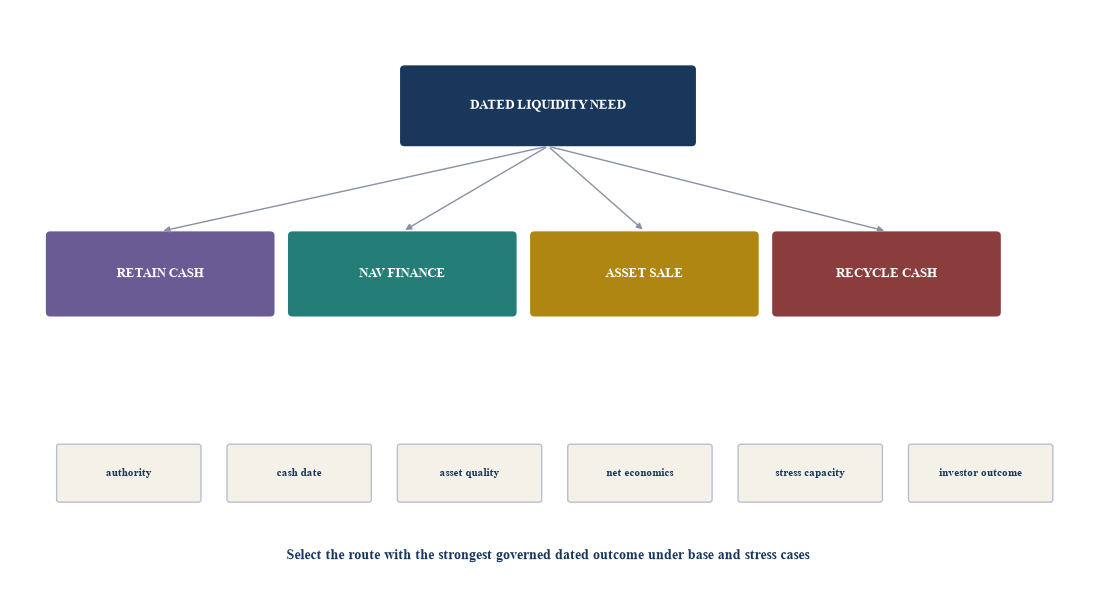
Author framework. The route follows authority, timing, asset quality, economics and resilience.
5. Build an asset-level eligibility and health file
A headline fund NAV does not determine reliable borrowing capacity. Each asset should enter a controlled file with legal owner, sector, location, concession or contract, counterparty, operating date, remaining term, asset-level debt, distribution restrictions, revenue, cash collection, availability, utilisation, maintenance, lifecycle capital, insurance, disputes, environmental and social status, valuation and data completeness.
Eligibility should be rule-based and reproducible. A lender can exclude an asset with incomplete ownership evidence, unresolved default, material concession breach, insufficient operating history, prohibited security, excessive asset-level debt, restricted distributions, stale valuation, missing monitoring data or material environmental or safety issue. Partial eligibility can use lower advance rates, reserves or concentration haircuts.
Operational health should be asset-specific. Roads can use traffic, toll collection, lane availability, pavement condition and major-maintenance schedules. Renewable assets can use generation, availability, curtailment, degradation, resource and equipment condition. Transmission can use availability, fault, loading and outage evidence. Digital infrastructure can use uptime, contracted capacity, energy and equipment condition. The credit file should connect each indicator to cash and value.
| Field | Evidence | Borrowing-base relevance | Control question |
|---|---|---|---|
| legal identity and ownership | registers, trust and company records | security and enforcement | does the borrower control the economic right? |
| concession or offtake | executed contract and amendments | cash duration and termination | does the right outlast the facility? |
| operating performance | meters, SCADA, traffic, availability and invoices | cash and deterioration | are definitions consistent and current? |
| maintenance and lifecycle capital | EAM, work orders, engineer and budget | value preservation | is deferred work quantified and funded? |
| asset-level debt | facilities, accounts and covenants | structural subordination | can distributions reach the borrower? |
| valuation | independent report and model | adjusted eligible value | does value reflect current operating evidence? |
| concentration | sector, authority, geography, technology and maturity | diversification and stress | are economically linked risks aggregated? |
| data completeness | lineage, cut-off and exceptions | confidence and haircut | can the lender reproduce the conclusion? |
The exact fields and thresholds depend on the asset, documents and facility.
6. Govern valuation as a financing input
Valuation should reconcile the independent valuation report to the facility definition and the current asset-health file. SEBI's current InvIT regulations require specified full and half-yearly valuation processes and detailed disclosures within their scope [1]. A lender may require more frequent or event-driven review when the borrowing base changes monthly or when a material asset event occurs.
The valuation bridge should identify enterprise or asset value, asset-level debt, restricted cash, minority interests, tax, transaction cost, maintenance backlog, lifecycle capital, disputes, contingent liabilities and currency. Contracted and forecast cash should remain distinguishable. A stale or high-level NAV can obscure operating deterioration, refinancing pressure or structural subordination.
Valuation uncertainty should influence eligibility and advance rate. Assets with long observable operating histories, clear contracts, independent cash collection and low capital uncertainty can support a different treatment from development assets, merchant exposure, disputed concessions or new technology. The facility should define valuation frequency, permitted valuers, methodology, information rights, challenge, event-driven revaluation and dispute resolution.
AI can help reconcile model inputs to source systems and flag changes. It cannot determine fair value or replace the independent valuer. Every adjustment should identify source, cut-off, method, owner, reviewer and effect on availability.
7. Calculate an eligibility-based borrowing base
The borrowing base should be reproducible from asset-level evidence. Begin with reported asset value, deduct asset-level debt and non-distributable interests, apply legal and data eligibility, adjust for operating condition and maintenance, apply concentration and valuation haircuts, then multiply eligible adjusted value by the approved asset-specific advance rate. Deduct reserves, concentration excess and other facility adjustments to determine availability.
Avoid double counting. Maintenance backlog should not reduce both cash flow and value twice unless the effects are distinct. Asset-level debt should be captured consistently with the valuation basis. Cross-collateral, guarantees and restricted cash should be mapped to the actual legal structure. A minority interest should reflect control, distribution rights and exit restrictions.
The hypothetical case begins with INR 68.0 billion of gross asset value across eight assets. Operating, maintenance, legal, data, valuation and concentration adjustments reduce eligible adjusted value to INR 46.1 billion. Asset-specific advance rates generate INR 25.6 billion of gross borrowing base. Reserves and concentration deductions reduce availability to INR 21.8 billion. These amounts demonstrate calculation mechanics only.
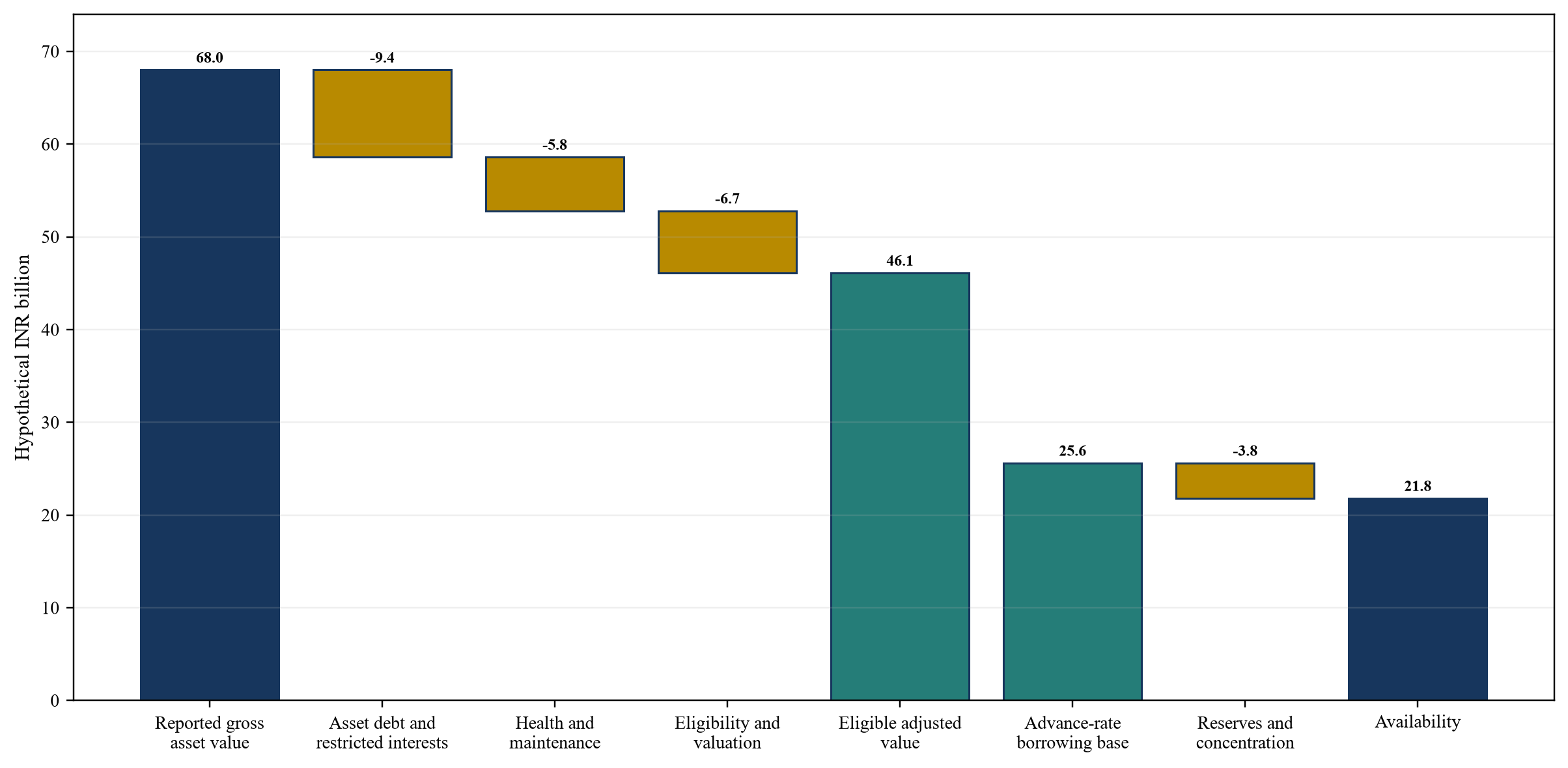
All values are hypothetical management assumptions for demonstrating the framework.
8. Design the cash waterfall around the approved purpose
The cash architecture should distinguish asset-level operating accounts, project-finance waterfalls, distribution accounts, fund accounts, facility accounts and reserves. The lender needs to understand which cash can legally and practically reach the asset, when it arrives, which obligations rank ahead and which events can lock it at the asset.
Draws should reconcile to approved uses. A capital-expenditure draw can enter a controlled disbursement account and release against contracts, invoices, certifications and contribution evidence. An acquisition draw can follow closing conditions and funds flow. A refinancing draw should discharge identified debt and security. A distribution draw, where permitted, requires explicit authority, conflicts review, disclosure and evidence of remaining resilience.
The payment waterfall should cover taxes and essential operating or administration cost, hedging, interest, reserve top-up, scheduled amortisation, mandatory prepayment, permitted asset expenditure and distributions in the documented order. Asset proceeds, insurance, termination payments and disposals require allocation rules. The facility should address currency conversion, set-off, account-bank risk and transfer timing.
Cash control needs an operational test. Before closing, run a sample cycle from asset distribution through bank reconciliation, facility calculation, payment approval and lender report. Document cut-off times, rejected payments, manual overrides, authorised users, backup procedures and reconciliation tolerances. A security document without a functioning cash process provides weak day-to-day protection.
9. Align asset cash, facility maturity and investor liquidity
A portfolio facility has a maturity profile even when its collateral is long-dated. Asset extensions, payment-in-kind elections, restructurings, delayed exits and borrower drawdowns can move cash beyond the facility's expected repayment date.
The liquidity model should map asset interest, principal, fees, prepayments, sale proceeds and recoveries against asset commitments, expenses, hedge flows, debt service, amortisation, facility maturity and investor obligations. It should contain base, delay and downside cases.
Refinancing should not be the sole repayment plan. The IMF notes that infrastructure-fund fund leverage can carry rollover risk and loan-to-value triggers.[4] A robust maturity plan identifies controlled amortisation, scheduled asset sales, expected asset repayments and a contingency case with no refinancing.
Closed-end funds generally reduce redemption mismatch through long-term investor capital. Semiliquid structures introduce additional liquidity obligations. The EU's amended AIFMD framework sets leverage limits and liquidity requirements for loan-originating AIFs within its scope, distinguishing open-ended and closed-ended structures.[6] The applicable rules depend on the vehicle and jurisdiction.
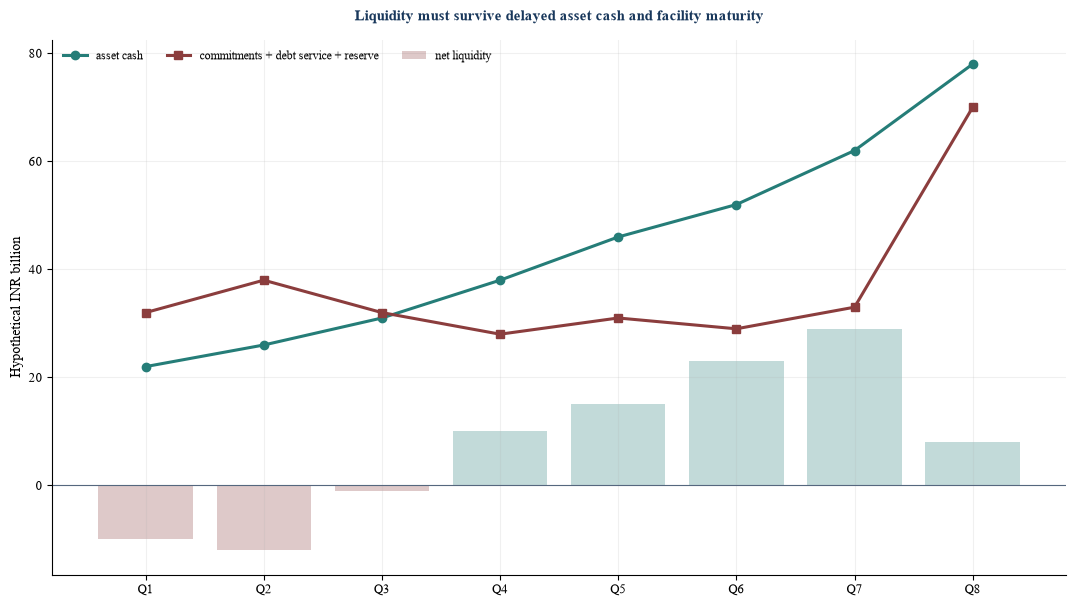
All timing and amounts are hypothetical management assumptions in INR billion.
10. Treat asset sales as portfolio construction
An asset sale is a portfolio decision rather than a residual source of cash. The fund should identify the asset's expected hold return, current bid, transaction cost, remaining funding, concentration contribution, downside risk, strategic relevance and effect on the residual portfolio.
Sale candidates can include low-conviction assets, concentrated positions, assets with high future funding, positions with strong market bids, short residual maturities or exposures that release a binding facility constraint. Selling the strongest liquid asset can raise cash quickly while weakening the quality of the remaining borrowing base.
Transfer mechanics should be mapped early. A sale can require borrower or agent consent, minimum hold, lender-of-record requirements, confidentiality arrangements, data-room permissions, sanctions screening, regulatory analysis, security-trustee mechanics, participation terms or tax review. Economic exposure and legal title can transfer at different times.
The sale price should be compared with the full retained case. The retained case includes coupon, fees, prepayment, extension, default, recovery, future funding and cost of capital. The sale case includes cash date, price, costs, released reserves, concentration relief and redeployment return. Both should use consistent dates and assumptions.
11. Govern capital recycling as a defined mandate
Recycling can preserve investment capacity after asset repayments or sales. It is economically different from borrowing because it does not introduce an external fixed claim. It still changes investor cash timing and can extend exposure.
The fund should define eligible recycling proceeds, the permitted period, aggregate cap, qualifying uses, portfolio limits and distribution treatment. Principal proceeds, income, fees and recallable distributions can have different treatment. Side letters can add investor-specific obligations.
Recycled capital should pass the same underwriting and portfolio tests as original capital. The availability of proceeds should not lower credit standards. The committee should compare the new asset's expected return and downside with distributing cash, repaying debt or reserving liquidity.
Investor reporting should show gross realisations, amounts recycled, amounts distributed, portfolio-finance debt, interest and fees, and the effect on remaining commitments and duration. This enables investors to distinguish operational capital efficiency from delayed liquidity.
12. Compare financing and liquidity routes on one economic basis
Compare NAV financing with asset-level refinancing, asset sale, co-investment, capital call, delayed investment, retained cash and permitted recycling. Use the same date, currency, forecast, tax basis, transaction costs and downside assumptions. Report proceeds and future economics separately.
For a facility, include interest, commitment fee, arrangement fee, legal and valuation cost, hedge, reserve funding, amortisation, distribution restrictions, cash sweeps and refinancing risk. For an asset sale, include price, leakage, tax, consent, transaction cost and transferred future cash. For equity or co-investment, include dilution, governance and exit rights. For delayed deployment, include opportunity cost and value-preservation risk.
Performance measures should not obscure leverage-generated timing. Show the actual investor outcome and a consistent view that isolates financing timing where appropriate. The committee should see dated net cash, remaining value, concentration, liquidity, covenant headroom and fund-level return under each route.
Route selection should remain reversible where possible. A short bridge to a well-evidenced asset disposal differs from a facility that depends on repeated maturity extensions. Approval should identify the expected exit, evidence needed, responsible owner, long-stop date and fallback if the exit fails.
| Route | Liquidity source | Principal advantage | Principal constraint | Decision evidence |
|---|---|---|---|---|
| retain cash | existing portfolio cash | no new creditor or dilution | delayed deployment or distribution | obligation and opportunity-cost register |
| NAV facility | adjusted portfolio value and cash | retains asset exposure and provides flexible liquidity | leverage, covenants and refinancing | borrowing base and stress capacity |
| asset-level refinancing | project cash and security | aligns debt to one asset | consents, structural seniority and execution | project model and lender terms |
| asset sale | realised disposal proceeds | removes risk and concentration | loss of future cash and possible discount | bids, value and transaction costs |
| co-investment or equity | new investor capital | increases permanent capital | dilution, governance and exit rights | term sheet and investor alignment |
| recycling | permitted realised cash | avoids external debt | fund-document and duration limits | authority and investor disclosure |
The comparison should use transaction-specific evidence and consistent assumptions.
13. Stress the portfolio as a connected infrastructure system
Stress should combine asset and financing pressures that can occur together. Examples include lower traffic or generation, tariff or payment delay, grid curtailment, equipment failure, concession dispute, operating-cost inflation, maintenance acceleration, interest-rate increase, currency movement, asset-level refinancing and valuation compression. Correlation should be assessed by concessioning authority, offtaker, sponsor, geography, technology, contractor and lender.
The model should transmit an operating shock through cash, distributions, value, eligible value, availability, covenant headroom and repayment. A fall in asset value can create a borrowing-base deficiency before cash interest fails. Maintenance deferral can temporarily support cash while damaging future value. A lender should see both paths.
Scenarios should include a central case, asset-specific event, sector stress, valuation stress and correlated downside. For each case, calculate facility utilisation, loan-to-value, interest coverage, reserve use, cash trap, cure amount and time to action. The governing body should understand which remedy is executable: equity cure, debt repayment, asset addition, asset sale, distribution suspension, maintenance action, hedge or refinancing.
| Scenario | Transmission | Borrowing-base effect | Controlled response |
|---|---|---|---|
| single-asset outage | lower cash and adjusted value | asset haircut and lower availability | engineering review and cash trap |
| offtaker or authority delay | collections and distribution delay | liquidity reserve use | enhanced reporting and reserve top-up |
| maintenance acceleration | near-term cash and lifecycle capital | value adjustment and reserve | funded maintenance programme |
| sector valuation stress | multiple or discount-rate change | portfolio deficiency | amortisation, equity cure or asset sale |
| correlated downside | cash, value and refinancing pressure | covenant breach risk | distribution stop and negotiated cure plan |
Illustrative assumptions only; actual thresholds require transaction-specific underwriting.
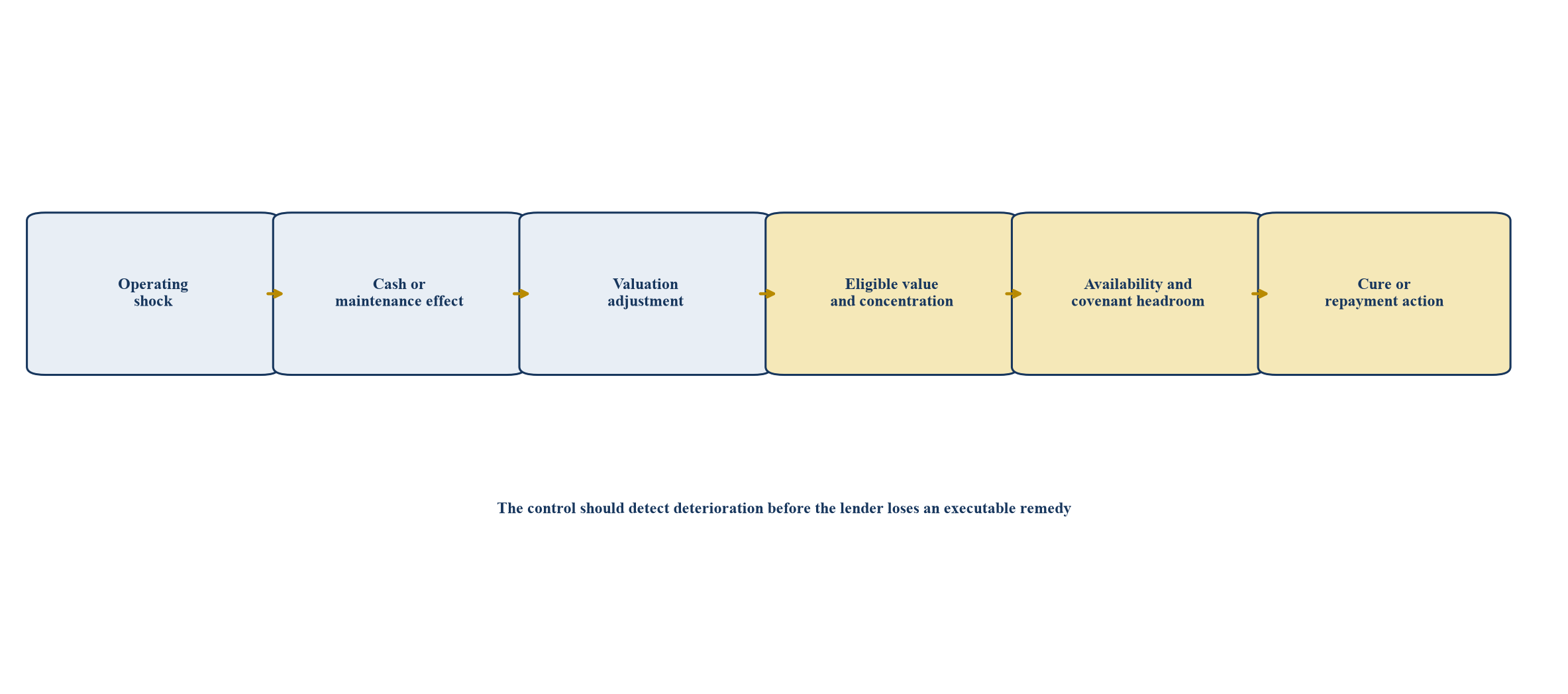
Proposed control map; the actual transmission depends on asset and facility terms.
14. Protect governance transparency and alignment
Fund-level leverage changes the risk borne by investors and can create conflicts between current liquidity, future distributions, manager incentives and lender protection. Governance should therefore address authority, purpose, pricing, related parties, valuation, conflicts, disclosure, allocation, amendments, waivers and use of proceeds.
The governing body should approve a facility policy before repeated use. The policy can define permitted purposes, maximum exposure, maturity, security, asset eligibility, concentration, valuation frequency, distribution conditions, model governance and investor communication. Transaction approval should show compliance with that policy and explain every exception.
Valuation independence matters because availability can depend on value. The valuer should not be directed toward a financing outcome. Operational analytics can supply current evidence and questions; they should not alter valuation methodology or suppress adverse information. The lender should receive the approved valuation bridge, material assumptions, changes and limitations.
Conflicts can arise when the manager benefits from accelerated fees, distributions, acquisitions, extensions or avoidance of a capital call. Record the beneficiaries, alternatives and quantitative effect. Use the conflict forum required by the documents and law. Investor reporting should describe facility purpose, amount, security, cost, maturity, borrowing-base basis, covenant state and material changes at the required frequency.
15. Apply the Indian regulatory and professional perimeter
The facility may interact with SEBI regulations for InvITs or AIFs, RBI requirements for regulated lenders, company and trust law, foreign-exchange rules, insolvency, security, project concessions, sector licences, tax, accounting and investor documents. The applicable perimeter depends on the asset, lender, fund form, asset and security; current Indian counsel should determine it.
SEBI's InvIT regulations address investment conditions, borrowings, valuation, disclosures, related-party matters and governance within their scope [1]. SEBI's AIF framework and master circular address fund operation, valuation, reporting and due diligence within their scope [2-5]. RBI's directions cover infrastructure finance companies, IDF-NBFCs, project finance, bank investment valuation and regulated-entity exposures to AIFs within their respective scopes [6-10].
Asset authorities and contracts matter. NHAI's asset-monetisation strategy describes asset registers, operating information, monitoring and performance evaluation for road assets [11]. Electricity regulators, concessioning authorities and sector ministries establish other requirements. A fund-wide facility should preserve asset-specific compliance rather than reduce every project to a generic NAV line.
Data and technology add another perimeter. The programme should map controller and processor roles, lawful purpose, access, retention, cybersecurity, incident response, cross-border transfers and vendor use under applicable Indian law and contracts. Operational systems can contain critical infrastructure, employee, customer, location and commercially sensitive data. The facility should request only information needed for credit and monitoring and should control model-development copies.
AI governance should specify intended use, prohibited use, training and validation data, performance metrics, human review, override, change control, vendor risk, incident response and retirement. Model outputs should be separated from source facts and professional assessments in lender reports. A prediction of equipment failure or cash deterioration is an analytical estimate with a stated confidence and cut-off, rather than a certification.
Professional boundaries remain clear. Engineers assess condition and remaining life. Independent valuers determine value under applicable standards. Auditors and accountants address recognition, consolidation and disclosure. Counsel addresses authority, security and enforcement. Model validators challenge analytics. The lender and governing body make credit and investment decisions.
16. Demonstrate a hypothetical capital and borrowing-base plan
Assume an Indian infrastructure fund owns eight operating assets with reported gross asset value of INR 68.0 billion. Asset-level debt and restricted interests reduce the starting economic exposure by INR 9.4 billion. Operating-health and maintenance adjustments reduce value by INR 5.8 billion. Legal, data, valuation and concentration adjustments reduce it by a further INR 6.7 billion, producing INR 46.1 billion of eligible adjusted value.
Asset-specific advance rates produce a gross borrowing base of INR 25.6 billion. A lifecycle and liquidity reserve of INR 2.0 billion and concentration deduction of INR 1.8 billion reduce availability to INR 21.8 billion. Assume initial utilisation of INR 16.0 billion, leaving INR 5.8 billion of availability before costs and any minimum-cash requirement. Every number is hypothetical.
The proposed use is INR 7.0 billion of acquisition consideration, INR 3.5 billion of committed asset capital, INR 2.0 billion of lifecycle reserve funding, INR 1.5 billion of refinancing and INR 2.0 billion of facility and liquidity buffer. Draws follow evidence gates. The fund retains distribution restrictions until the acquisition and capital programme satisfy the approved operating and borrowing-base tests.
| Month | Approved use | Draw | Evidence gate | Post-draw control |
|---|---|---|---|---|
| 1 | refinance identified obligation | 1.5 | discharge and security release | account reconciliation |
| 2 | acquisition closing | 7.0 | conditions and funds flow | asset eligibility review |
| 3 | committed asset capital | 1.5 | engineer and contract evidence | use-of-proceeds test |
| 4 | lifecycle reserve | 2.0 | reserve agreement and account | minimum balance test |
| 5 | committed asset capital | 2.0 | milestone certification | updated health and value |
| 6 | liquidity and facility buffer | 2.0 | borrowing-base headroom | distribution condition |
| Total | 16.0 | INR 5.8bn unused availability |
All amounts are illustrative management assumptions in INR billion.
17. Operate through one asset-health and NAV dashboard
The dashboard should combine asset operations, maintenance, cash, valuation, concentration, facility utilisation and governance. It should show current state, trend, threshold, forecast, data cut-off, source, owner and action. Users should be able to drill from the portfolio borrowing base to the asset, contract, operating record and valuation adjustment.
Core measures include asset availability or utilisation, collections, operating cost, maintenance compliance, backlog, lifecycle capital, asset-level debt, distribution capacity, value, eligible adjusted value, advance rate, concentration, reserve, facility availability and covenant headroom. Each measure needs a stable definition and reconciliation to source systems.
AI-supported monitoring can rank exceptions, detect anomalous patterns, compare work orders with sensor or operating evidence and identify valuation inputs that have changed. The dashboard should display confidence and missingness. High financial consequence or low confidence should route to engineering, valuation, legal or credit review.
The data contract should define each field, unit, time zone, frequency, source system, permitted transformation and accountable owner. It should reconcile asset names and identifiers across supervisory-control systems, enterprise asset management, accounting, banks, valuation and legal records. Changes to definitions should be versioned so a historical covenant result can be reproduced.
Monitoring targets should align with decisions. A predictive-maintenance model can estimate failure in a defined horizon. A cash model can estimate distribution delay. A valuation-input monitor can identify movements that require valuer review. A concentration engine can aggregate related risks. The model should not generate an undefined composite health score that conceals which evidence moved and how the facility responds.
Validation should use time-based holdouts, asset-class segments and periods of operational stress. Assess calibration, discrimination, stability, missingness and override rates. False negatives can delay intervention; false positives can create unnecessary reserves or maintenance. The validation plan should therefore weigh the financial consequence of each error and require conservative treatment while evidence is incomplete.
Human review should be structured. The reviewer should see source records, model output, relevant contract or covenant, prior interventions and the proposed decision. Overrides need a reason, evidence, authority and expiry. Outcomes should feed back into monitoring so repeat false signals and missed events are visible.
| Indicator | Evidence | Early warning | Escalation owner |
|---|---|---|---|
| availability or utilisation | operating system and contract definition | sustained adverse variance | asset manager and engineer |
| maintenance compliance | EAM and work orders | overdue critical task | operations committee |
| lifecycle capital | engineer plan and approved budget | unfunded increase | fund and lender credit teams |
| distributions | bank and project-finance records | lock-up or delay | finance and legal |
| adjusted value | valuer and borrowing-base bridge | threshold migration | valuation committee |
| concentration | linked exposure register | approved limit approached | risk function |
| data quality | lineage and exception log | missing or conflicting source | data owner and validator |
Proposed control register; metrics should be tailored to each asset class.
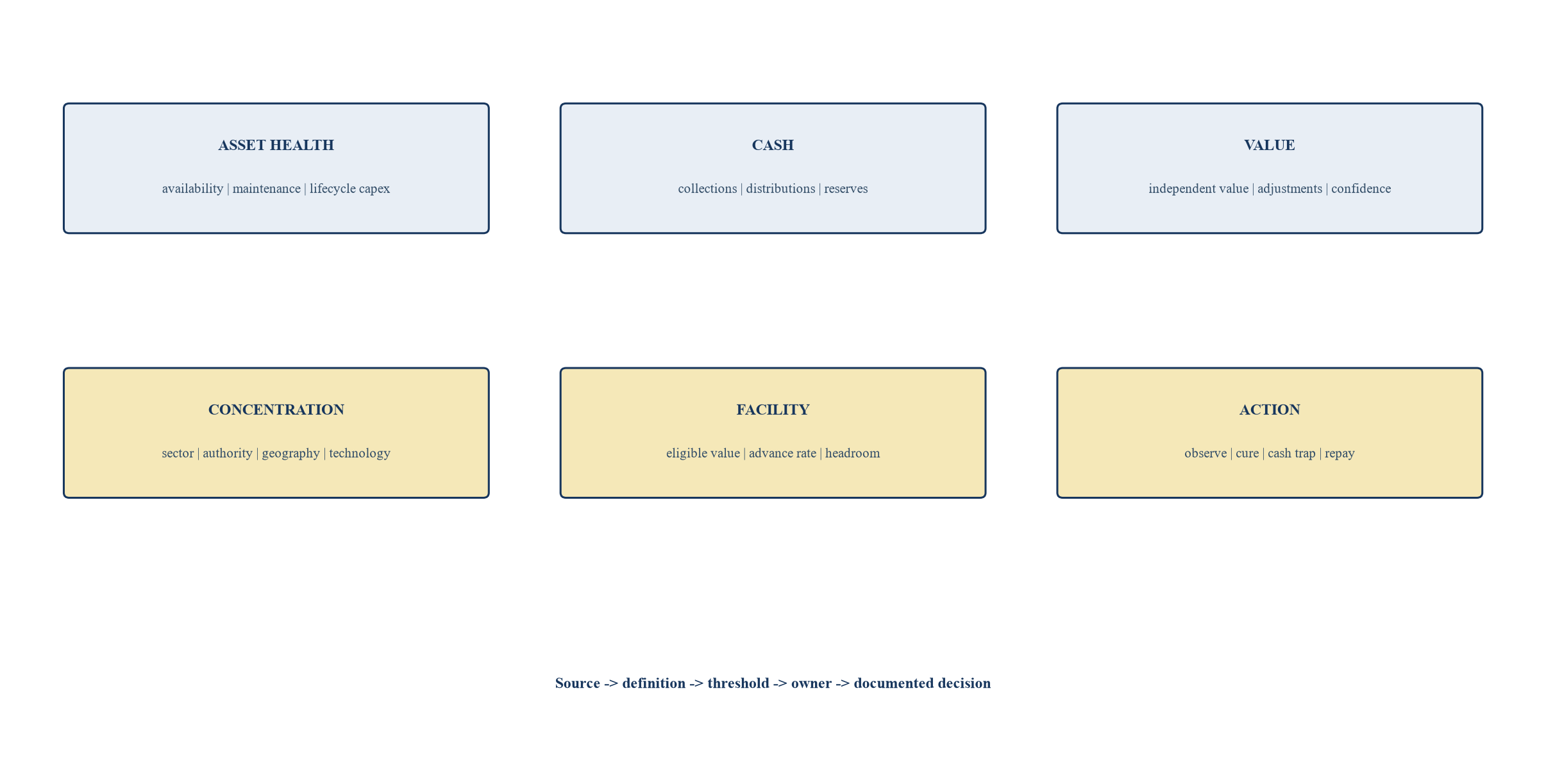
Proposed design linking operating evidence to borrowing-base and credit actions.
18. Implement the operating model in 120 days
A controlled implementation can proceed through five workstreams. The first confirms mandate, authority, entities, assets, purpose and decision rights. The second builds the source-data and contract inventory. The third reconciles operating, maintenance, cash, debt and valuation evidence. The fourth designs eligibility, adjusted value, advance rates, concentration, reserves, covenants and reporting. The fifth validates systems, runs the waterfall, completes documents and prepares closing.
Days 1 to 20 should freeze definitions and identify gaps. Days 21 to 50 should reconstruct asset-level evidence and link source systems. Days 51 to 80 should build the borrowing-base model, stress cases and dashboard. Days 81 to 100 should complete independent engineering, valuation, model-validation and legal work. Days 101 to 120 should test accounts, reporting, draw conditions, triggers, cure actions and lender delivery.
The programme should prioritise high-consequence exceptions. Missing ownership or distribution rights can exclude an asset. Unreconciled operational data can require a conservative haircut. Deferred critical maintenance can change cash and value. Concentration can reduce availability even where each asset performs individually. Each exception should identify owner, source, due date, provisional treatment and approval authority.
Close only after a dry run. Reproduce the borrowing base from a fixed data cut, execute a sample draw, trace cash, generate the lender report, simulate a threshold breach and complete the escalation record. Retain the closing baseline, model, source hashes, approvals and documents so later changes can be explained.
| Period | Principal work | Evidence gate | Decision output |
|---|---|---|---|
| days 1-20 | authority, perimeter and definitions | approved entity and purpose map | mandate and workplan |
| days 21-50 | asset, contract, cash and system reconstruction | reconciled asset-health file | eligibility exceptions |
| days 51-80 | borrowing base, concentration and stress | reproducible model | indicative structure |
| days 81-100 | engineering, valuation, validation and legal | professional assessments complete | credit approval pack |
| days 101-120 | documents, accounts, reporting and dry run | operational test passed | closing readiness |
Timing is illustrative and depends on data, jurisdictions, counterparties and facility complexity.
19. Recognise limitations and conclude the financing case
Operational and AI models are limited by sensor coverage, inconsistent definitions, maintenance-record quality, rare events, asset heterogeneity, regime change and model design. A model can perform well across a portfolio and fail on the asset that matters most. Physical inspection, professional assessment, contractual evidence and downside scenarios remain necessary.
The framework does not determine whether an identified fund may borrow, whether a lender may provide the facility, how security should be perfected, how an InvIT or AIF must account or report, or how an asset should be valued. It does not replace engineering, valuation, legal, tax, accounting, regulatory, environmental, cyber, insurance, credit-rating or investor-suitability work.
The hypothetical portfolio, values, adjustments, advance rates, reserves, availability and scenarios are illustrative. Current rules and source data should be checked at the date of a live transaction.
Implementation also requires a stable measurement constitution. The facility parties should define each operating indicator, source system, observation period, unit, treatment of missing records, restatement process and sign-off authority before the first borrowing-base certificate. That constitution should distinguish information used for surveillance from evidence used to change eligibility, value, reserves or availability. A sensor anomaly can prompt investigation; it should not automatically reduce value or trigger enforcement. A verified outage, missed maintenance obligation or sustained collection shortfall can have a different consequence when the contract, engineering assessment and finance model support the conclusion.
The lender and fund should agree how evidence matures. An early signal may enter an observation queue, a reviewed exception may receive a provisional adjustment, and a validated event may change the formal borrowing base. Each transition needs a time stamp, responsible person and retained evidence. This approach keeps the model useful between valuation dates while preserving the authority of independent valuation, engineering and legal conclusions. It also prevents repeated manual overrides from becoming an undocumented substitute for policy.
Performance should be assessed at three levels. The asset level asks whether monitoring identified deterioration early enough to protect service and cash. The portfolio level asks whether concentration, correlation and liquidity were represented coherently. The facility level asks whether certificates, draw decisions, cures and lender reporting were accurate and timely. Suitable review measures can include data completeness, reconciliation breaks, days to investigate an alert, override frequency, missed-event rate, forecast error, certificate restatements and time to complete a cure. Thresholds should reflect the consequence of error and should be revised when assets, contracts or market conditions change.
Periodic independent review remains valuable. It can test source lineage, access controls, model versions, validation evidence, valuation linkage and a sample of alerts through to the final decision. The review should also test whether excluded or weakly evidenced assets are quietly re-entering availability through manual processes. Findings should be assigned, time-bound and reported to the appropriate fund and lender governance bodies.
An infrastructure NAV facility can create useful portfolio liquidity when the fund can demonstrate authority, asset rights, operating health, maintenance, cash, independent value, diversification and lender control as one evidence chain. AI-supported monitoring can shorten detection and reconciliation. Accountable professionals and decision makers retain responsibility for every material conclusion.
The facility should proceed when adjusted eligible value and controlled cash support repayment under central and correlated downside cases, and when the fund can execute cures before value loss becomes irreversible. Transparent borrowing-base reviews, concentration limits, reserves, cash controls and investor reporting turn periodic NAV into a governed financing capability.
Sources
- Securities and Exchange Board of India, Infrastructure Investment Trusts Regulations 2014, last amended 17 April 2026. Read the primary source
- Securities and Exchange Board of India, Alternative Investment Funds Regulations 2012. Read the primary source
- Securities and Exchange Board of India, Master Circular for Alternative Investment Funds, 2025. Read the primary source
- Securities and Exchange Board of India, Guidelines for valuation of investment portfolio of Alternative Investment Funds, 2023. Read the primary source
- Securities and Exchange Board of India, Upload of latest NAV of AIF units in depository system, 6 February 2026. Read the primary source
- Reserve Bank of India, Review of Regulatory Framework for Infrastructure Debt Fund-NBFCs, 18 August 2023. Read the primary source
- Reserve Bank of India, Investments in Alternative Investment Funds, 27 March 2024. Read the primary source
- Reserve Bank of India, Prudential Framework for Income Recognition Asset Classification and Provisioning pertaining to Advances, as updated. Read the primary source
- Reserve Bank of India, Master Direction Classification Valuation and Operation of Investment Portfolio of Commercial Banks, as updated. Read the primary source
- Reserve Bank of India, Draft Directions on investment by regulated entities in Alternative Investment Funds, 19 May 2025. Read the primary source
- National Highways Authority of India, Asset Monetization Strategy Document. Read the primary source
- National Bank for Financing Infrastructure and Development, Annual Reports. Read the primary source
- Department of Economic Affairs, Harmonised Master List of Infrastructure Sub-sectors. Read the primary source
- Insolvency and Bankruptcy Board of India, Insolvency and Bankruptcy Code and regulations. Read the primary source
- IFRS Foundation, IFRS 13 Fair Value Measurement. Read the primary source
- IFRS Foundation, IFRS 9 Financial Instruments. Read the primary source
- International Valuation Standards Council, International Valuation Standards. Read the primary source
- National Institute of Standards and Technology, Artificial Intelligence Risk Management Framework 1.0. Read the primary source
- National Institute of Standards and Technology, AI RMF Core. Read the primary source
- International Finance Corporation, Performance Standards on Environmental and Social Sustainability. Read the primary source
- World Bank, Benchmarking Infrastructure Development. Read the primary source
- International Monetary Fund, Global Financial Stability Report chapters on private credit and financial stability. Read the primary source
