
Introduction
The fastest-looking route to new compute capacity can begin with an old industrial load. A shuttered factory may have drawn hundreds of megawatts. Its site may contain a substation, transmission line, cooling water, heavy foundations, fibre routes and large tracts of appropriately zoned land. Repurposing can appear cheaper and faster than a greenfield connection.
Historical load is evidence of past use. It is not proof of current deliverability. The network may have reassigned capacity after closure, retired local generation or changed its security standards. The customer-specific agreement may have terminated. Transformers, switchgear and protection systems may be at the end of their lives. The former process could tolerate interruption, seasonal operation or manual restart that a data centre cannot accept.
The International Energy Agency has described rapid growth in data-centre electricity demand and tightening bottlenecks in grids and equipment. The US Department of Energy has identified sites with in-place energy infrastructure as candidates for accelerated AI and data-centre development. The Environmental Protection Agency's brownfield guidance emphasises that infrastructure availability, environmental condition, market feasibility and community reuse objectives must be assessed together. These sources support a disciplined diligence question: what can the site deliver now, after which works, under which rights and with which liabilities?
The central conclusion is that inherited grid infrastructure creates value only after its legal, physical and system status is revalidated for the new load. The transaction should pay for verified milestones, reserve for environmental and electrical conversion, and preserve an alternative exit when the compute thesis cannot be completed.
1 Define stranded grid capacity
Stranded capacity is a commercial description rather than a universal legal category. It can mean a retired customer's former demand, underused network equipment, land adjacent to transmission, a generation interconnection, an available utility allocation or a broader area's declining industrial consumption. Each meaning supports a different right.
The transaction team should define five quantities. Historical peak load records what the facility consumed. Contractual capacity records the service preserved under an agreement or tariff. Physical capacity records what the site equipment can carry. System deliverability records what the network can supply under current reliability conditions. Compute-ready critical load records what remains after conversion, redundancy, cooling and auxiliary consumption.
Value follows the smallest binding quantity until the constraint is removed. A 300 megawatt historical factory can have a 200 megawatt substation, 120 megawatts of current network deliverability and 80 megawatts of critical IT capacity after redesign. A purchase price tied to the 300 megawatt headline would pay for unavailable capacity.
2 Identify the transaction perimeter
The buyer may acquire land, a lease, project-company shares, electrical equipment, a utility contract, environmental liabilities, permits, water rights, fibre, buildings or a combination. The perimeter should be mapped before valuation. A connection right held by a seller affiliate may remain outside an asset acquisition. Environmental obligations can follow ownership or operation under applicable law.
The preferred structure depends on contract transfer, tax, liability and consent. A share acquisition can preserve customer-specific agreements while transferring corporate history. An asset acquisition can isolate selected assets while requiring assignment and new permits. A joint venture can keep the incumbent industrial owner involved through decommissioning and utility transition.
The board paper should state which entity controls each critical right at signing, closing, construction and operation. It should also show the security perimeter for lenders. Rights essential to energisation should not depend on an undocumented affiliate arrangement.
3 Establish the historical-load record
Historical bills, interval data, tariffs, metering, outage records and operating schedules show how the former facility used power. The analysis should identify peak demand, annual energy, power factor, load factor, ramping, seasonal shutdowns, interruptible service and on-site generation. The network may have planned around these characteristics.
A compute campus can behave differently. It may use high power continuously, ramp quickly and transfer to backup generation during disturbances. Recent PJM work on large computational loads illustrates the reliability consequences of abrupt load transfer and disconnection. The new load should therefore be studied as a new operating profile even when it occupies an old connection point.
Historical consumption also helps detect double counting. The former operator may have sold or surrendered rights. A utility forecast may already allocate the released headroom elsewhere. The diligence conclusion should distinguish measured history from current contractual and system rights.
4 Revalidate the connection legally
The utility and transmission documents should be read for termination, abandonment, reduction, change of use, assignment, demolition, load profile, deposits and milestones. A service agreement can expire when operations cease. A tariff can allow the utility to reduce reserved capacity after sustained non-use. A new owner or materially different load can require a fresh application.
FERC's large-load interconnection docket and regional proceedings demonstrate that rules for substantial new loads are evolving. The developer should identify the applicable utility, transmission provider, regulator and effective tariff on the diligence date. An informal statement that the old factory was powered should remain outside the binding case.
The acquisition should require direct confirmation of current service status and the process for conversion. Assignment and change-control consent should be obtained where needed. Lender notice and cure rights should be tested before financing.
5 Revalidate the network technically
The point of connection must be studied under current system conditions. Generation retirements, transmission constraints, protection changes, fault levels and adjacent loads can alter deliverability. The old connection equipment may remain physically present while its former system capability no longer exists.
The study should cover steady-state loading, contingencies, voltage, stability, harmonics, protection, short-circuit duty, power quality and restoration. It should identify upstream works, outages, procurement and testing. The data-centre load model should include expected ramping, backup transfer and ride-through behaviour.
The output is a capacity-and-works schedule. It should separate capacity available before reinforcement, capacity available after defined works and capacity that remains uncertain. Each stage should have a date, cost, owner and evidence source.
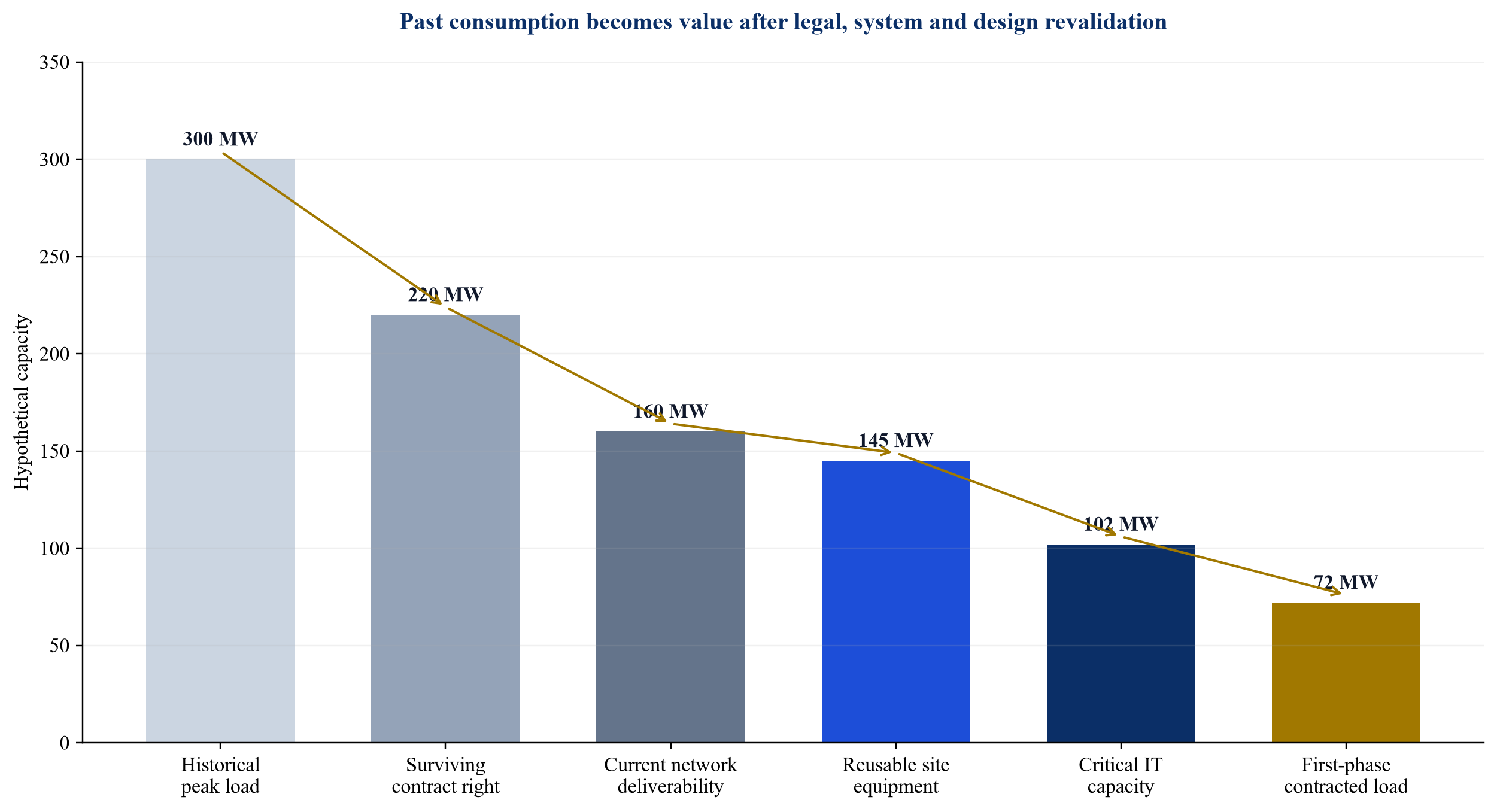
Capacities are hypothetical author-developed assumptions. They do not describe a particular factory, network or data-centre project.
6 Assess reusable electrical equipment
The electrical inventory can include transmission lines, substations, transformers, switchgear, protection, cables, generators, batteries, control systems and meters. Age alone does not determine reuse. Condition, ratings, maintenance, fault duty, spare parts, insulation, oil testing, cyber support and compatibility with the new design matter.
An independent engineer should classify each item as reusable, refurbishable, relocatable or replacement. Reuse cost should include testing, engineering, compliance, warranty and outage. Equipment kept in service can shorten the schedule while creating lifecycle and reliability risk.
Ownership requires confirmation. Utility-funded or customer-funded assets can be owned by the network. Easements and access rights may survive or terminate. A buyer should not include utility property in collateral or replacement value.
7 Convert industrial power into compute power
Industrial processes and data centres impose different requirements. Data centres need electrical distribution to the rack, cooling, uninterruptible power, backup generation, controls, fire protection and fibre. Critical IT load is smaller than gross import because supporting systems consume power.
The conversion model should reconcile incoming voltage, usable gross capacity, redundancy configuration, power-usage effectiveness, cooling architecture and rack density. It should test staged halls and shared infrastructure. The design should accommodate expected computing technology without relying on an unproven final configuration.
High-density AI equipment can require liquid cooling and rapid changes in electrical load. The facility should be designed for ride-through and controlled transfer. A former factory's robust supply can be valuable while its internal distribution remains unsuitable.
8 Test time to first power
Brownfield conversion can reduce some lead times and add others. Existing land, roads and substations can accelerate development. Environmental investigation, demolition, remediation, utility re-study and equipment refurbishment can delay it. The critical path should integrate all workstreams.
The schedule should identify the earliest safe energisation, first billable customer capacity and full campus capacity. It should include long-lead equipment, permits, utility outages, commissioning and customer acceptance. A single target date should be supplemented with moderate and severe delay cases.
Customer obligations, land carrying cost and financing should follow the same schedule. Early investment should be capped until the highest-risk path is supported by evidence.
9 Conduct environmental diligence before control
Former industrial sites can contain contaminated soil, groundwater, asbestos, hazardous materials, tanks, waste areas and legacy infrastructure. EPA guidance advises environmental due diligence before taking control and links reuse planning to investigation and cleanup. Requirements vary by jurisdiction and site.
The buyer should commission appropriate Phase I and Phase II assessments or local equivalents, define cleanup standards for the intended use, allocate responsibility and establish cost ranges. Data-centre redevelopment can involve extensive excavation and groundwater management that changes exposure.
Liability protection, indemnities and insurance require legal advice. A seller indemnity is only as valuable as its scope, duration and credit support. Escrow or funded remediation can improve execution. The model should include monitoring and long-term obligations.
Table 1. Industrial-to-compute conversion gates
| Gate | Required evidence | Common failure | Transaction response |
|---|---|---|---|
| Site control | Title or lease, access, easements and permitted use | Control expires before utility conversion | Extend control or stage closing |
| Environmental readiness | Investigation, cleanup plan, cost, responsibility and approvals | Unknown contamination or use-specific cleanup gap | Price reserve, escrow, indemnity or stop |
| Electrical revalidation | Current utility confirmation, network study and equipment assessment | Historical load presented as current deliverability | Apply zero recognition until revalidated |
| Compute conversion | Gross-to-critical-load design, cooling, fibre and commissioning plan | Industrial equipment cannot support data-centre reliability | Replace, redesign and reprice |
| Commercialisation | Customer evidence, capacity, commencement and support | Revenue depends on an uncommitted future tenant | Use merchant case and higher return threshold |
| Financeability | Complete capital stack, cost-to-complete, reserves and security | Value depends on refinancing or unfunded remediation | Stage leverage and require committed equity |
This author-developed matrix is a screening tool. Transaction-specific legal, technical, environmental, tax and regulatory advice remains necessary.
10 Determine demolition and reuse scope
Existing buildings can provide shells, foundations and utility routes. They can also constrain layout, ceiling height, floor loading, security and cooling. Selective reuse should be based on whole-life cost and schedule, not sunk capital.
The demolition survey should address hazardous materials, structural condition, underground services and interaction with live electrical equipment. The sequence must protect reusable infrastructure. Salvage value should be supported by realistic markets and net of removal cost.
The master plan should preserve access for the utility and future phases. It should also consider the site's industrial heritage and community expectations. A visually isolated compute campus can face different acceptance than a jobs-intensive factory.
11 Verify water and cooling
Industrial sites can have water rights, intake, discharge and treatment systems. These assets may support cooling or may be tied to the former process and permits. Water quality, quantity, drought exposure, temperature, discharge and community use should be assessed.
Cooling selection affects electricity, water, capital and rack density. Air cooling, evaporative systems and liquid cooling create different requirements. A former process-water system may need major refurbishment or replacement.
Water constraints should be translated into design and valuation. The power connection has limited value if the intended cooling solution cannot be permitted or operated. Alternative designs can preserve the site while changing capacity and cost.
12 Establish fibre and latency
Industrial power does not guarantee digital connectivity. The site needs diverse fibre routes, carrier availability, resilient entry points and acceptable latency for target workloads. Route construction can require rights of way and local works.
The commercial model should identify which customers require metro proximity, cloud adjacency or long-haul connectivity. Training workloads can tolerate different latency than certain inference or financial applications. The appropriate customer segment affects the site's revenue case.
Fibre should be contracted and designed with the same discipline as power. A conceptual route is not a resilient service. Capital and timing should include diverse paths and network equipment.
13 Evaluate planning and permitting
Industrial zoning can support heavy infrastructure while data centres introduce different building form, backup generation, noise, fuel, traffic and water. A change of use or new environmental permit may be required. Local authorities can attach community or sustainability conditions.
The planning strategy should address massing, setbacks, visual impact, noise, emissions, construction traffic and emergency systems. It should integrate the remediation plan. Existing permits should be tested for transfer and relevance.
Fast-track assumptions should be supported by written process and precedent. Government interest can improve coordination without removing legal requirements. The valuation should use a credible approval schedule.
14 Map community value and impact
A factory closure can leave employment loss and a strong expectation of replacement jobs. Data centres can create substantial construction and tax activity while using fewer permanent workers than manufacturing. The redevelopment plan should describe direct, indirect and community effects accurately.
Community engagement should begin before design is fixed. Topics can include jobs, skills, tax base, water, noise, backup generation, grid cost, land use and local procurement. Commitments should be costed and governed.
The buyer should avoid assuming that prior industrial use guarantees acceptance. A different project creates different concerns. Community opposition can affect permits, schedule and reputation.
15 Separate connection capacity from resource adequacy
A network can physically connect a load while lacking sufficient generation capacity under planning rules. FERC and PJM processes increasingly distinguish transmission connection, resource adequacy and cost allocation for large loads. A brownfield's old service does not automatically solve current resource adequacy.
The diligence team should identify energy, capacity and ancillary-service requirements. It should test whether the project needs new generation, a bilateral arrangement, flexible service or phased load. Any bring-your-own-capacity structure should be matched to actual rules and contracts.
The financing model should include supply and capacity cost, curtailment and commissioning. A site that can energise only under restricted service may remain valuable for flexible workloads if customer contracts permit it.
16 Avoid double counting released capacity
When industrial load declines, the utility and system operator can incorporate the change into forecasts and commitments. Other customers or generation retirements can consume the headroom. The buyer should obtain current confirmation rather than subtract the old factory load from a historical network forecast.
Capacity can also be claimed by multiple development options on the same site. An owner may market several parcels against one connection. The transaction should define exclusivity, allocation and expansion rights.
The valuation report should show the exact capacity recognised for the subject asset. Adjacent opportunities remain outside the case until separately controlled.
17 Design phased energisation
Phasing can match network works, remediation, customer ramp and financing. The first phase can use validated existing equipment. Later phases can follow transformer replacement or upstream reinforcement. Each phase should be independently operable or have clearly allocated shared assets.
The customer contract should align with the phase schedule. Payment commencement, acceptance, delay relief and expansion options should use the same capacity definitions as the engineering plan. The financing should avoid funding later-phase assets from first-phase cash without approval.
Phasing also preserves exit options. A buyer can sell an energised first phase and retain development land, subject to access, shared infrastructure and intercreditor arrangements.
18 Build the conversion capital budget
The budget should include acquisition, demolition, remediation, electrical refurbishment, network works, buildings, cooling, fibre, water, security, design, permits, professional fees, contingency, escalation, financing and reserves. Legacy assets should be credited only after condition and ownership are verified.
Environmental and electrical work can interact. Excavation can expose cables and contamination. Substation outages can constrain demolition. The programme should coordinate scopes and include interface contingency.
The budget should distinguish committed, quoted and estimated amounts. Long-lead equipment quotes require validity and indexation. A cost overrun case should identify the equity and liquidity response.
Table 2. Hypothetical industrial-to-compute conversion budget and capacity bridge
| Item | Base assumption | Downside assumption | Decision implication |
|---|---|---|---|
| Historical factory peak load | 300 MW | 300 MW | Context only; no automatic recognition |
| Current deliverable connection | 160 MW | 120 MW | Requires current network evidence |
| Critical IT capacity after conversion | 102 MW | 72 MW | Drives commercial capacity |
| First-phase contracted load | 72 MW | 48 MW | Determines initial revenue |
| Acquisition and site control | $55m | $55m | Paid only for controlled rights |
| Demolition and remediation | $48m | $95m | Escrow and contingency required |
| Electrical and network conversion | $190m | $285m | Reflects refurbishment and reinforcement |
| Data-centre buildings and systems | $610m | $690m | Phased around customer acceptance |
| Time to first billable power | 30 months | 54 months | Drives carrying cost and customer risk |
| Stabilised fixed revenue | $118m | $72m | Excludes uncommitted expansion |
All values are hypothetical author-developed assumptions in US dollars. They are not a valuation, budget, bid or financing proposal for a particular site.
19 Value the site through scenarios
The valuation should compare a compute conversion, alternative industrial reuse, land sale and orderly wind-down. The compute case probability-weights capacity, schedule, capital and customer cash flow. The alternative-use case establishes the downside floor after cleanup.
A cost approach can inform the value of reusable infrastructure. The income approach values completed operations. Market evidence can test the result when comparable connection state and geography are available. The acquisition price is the residual that preserves the required return after all remaining investment.
The model should identify buyer-specific synergies separately. An operator with customers and procurement scale can earn more than a passive land buyer. That investment value should not be represented as universal market value.
20 Quantify time-to-power value
The value of an inherited site often rests on schedule advantage. The analysis should compare the conversion programme with a credible greenfield alternative. Time saved can accelerate revenue and reduce customer loss. It can also be consumed by remediation or re-study.
The sensitivity below combines time to first billable power and compute-ready capacity. It holds other variables within a simplified hypothetical model. The result illustrates why a smaller verified phase can be worth more than a larger uncertain headline.
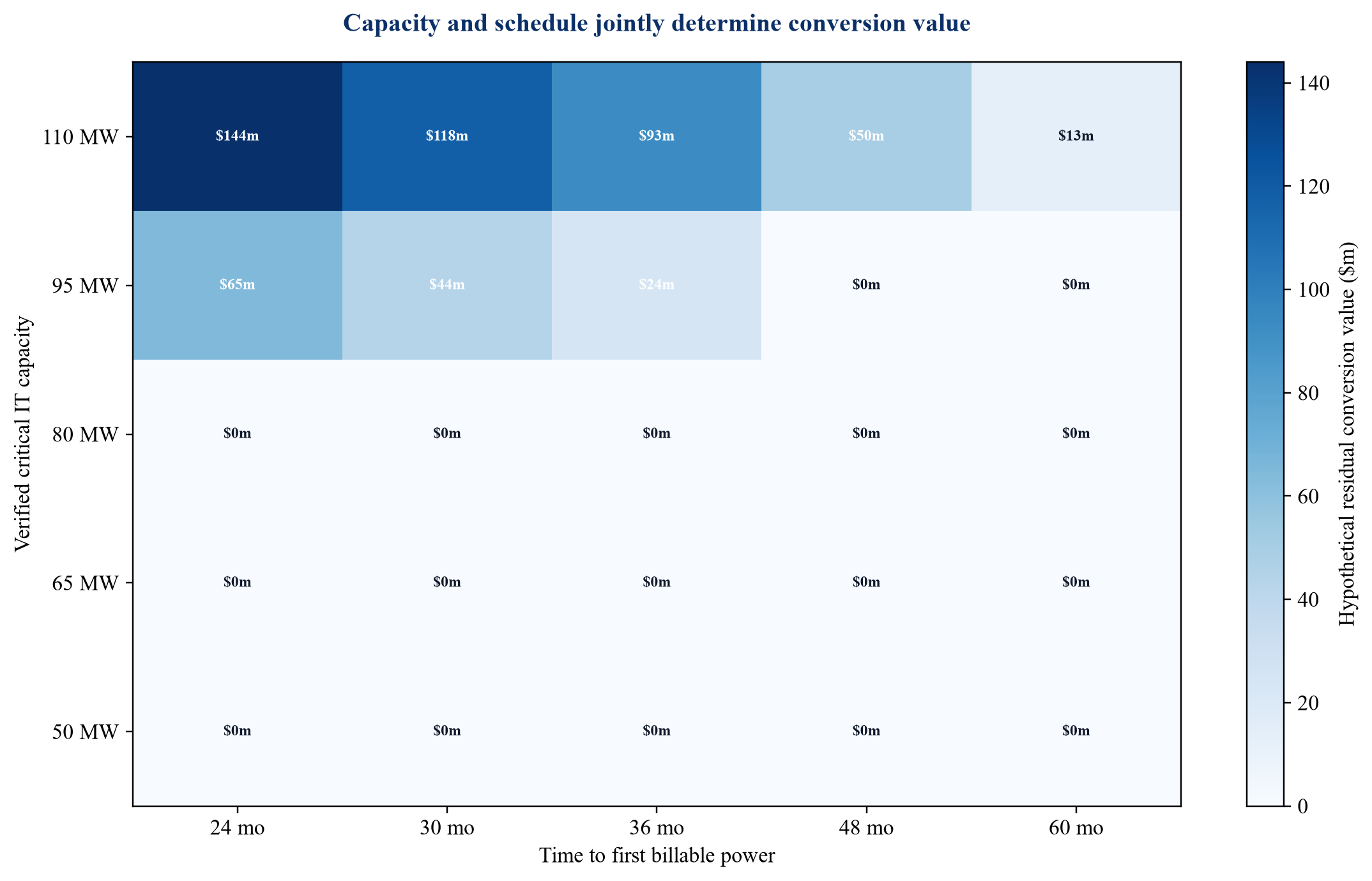
Values are hypothetical author-developed assumptions in US dollars millions. They do not represent a particular site or forecast.
21 Structure staged consideration
The purchase price can follow evidence. A closing payment can cover land and verified reusable assets. Deferred payments can follow utility confirmation, environmental closure, network works, energisation and customer acceptance. This structure protects the buyer from paying for capacity that does not survive conversion.
Milestones should be objective and independently verifiable. They should state capacity, delivery point, firmness, date and tests. A seller should not receive full consideration for equipment that passes inspection while the network right fails.
Escrow, holdback and set-off can support indemnities. The seller's credit and remaining business matter. A clean contractual remedy without recoverable security provides limited protection.
22 Allocate environmental risk
The transaction should define known and unknown contamination, responsibility, cleanup standard, regulator interface, access, reporting and cost. The intended data-centre use can drive a different cleanup scope from continued heavy industry.
Seller remediation before closing can provide control while delaying the transaction. Buyer remediation with price adjustment can integrate design while transferring execution risk. A joint programme can align knowledge and implementation. The preferred structure depends on liability law and capability.
The financing should fund approved remediation separately and preserve contingency. Lenders may require environmental insurance, indemnity support and completion evidence before construction draws.
23 Align customer contracting
The first customer can validate the conversion and support financing. The contract should reflect staged capacity, acceptance, power quality, environmental works and timing. Conditions should avoid a circular dependency in which financing requires the customer and the customer requires a fully funded build.
Counterparty support, take-or-pay obligations, deposits and termination payments can improve visibility. They do not cure a failed grid or environmental case. Customer technical changes should have a defined change-order process.
The facility should retain re-leasing potential. A design built solely around one customer can lose value on termination. Adaptability should be assessed against cost and schedule.
24 Finance by development stage
Early development capital can fund control, studies, environmental assessment and utility work. Its amount should be capped because the project can fail. Construction debt should begin after defined evidence: utility rights, permits, remediation plan, customer commitments, equity, budget and completion support.
Term debt should follow energisation, integrated testing, customer acceptance, insurance, reserves and compliant operations. Debt service should rely on contracted and billable capacity. Pipeline and later phases can support option value while remaining outside current debt sizing.
The financing perimeter should address shared infrastructure and environmental liabilities. Lenders need step-in rights, operating continuity and access. Intercreditor terms should coordinate land, equipment and project-company security.
25 Design completion tests
Completion is broader than construction. It should include environmental approvals, utility energisation, protection tests, electrical and cooling systems, fibre, controls, backup transfer, fire systems, security and customer acceptance. The test should reflect the financed service.
Legacy equipment should pass performance and reliability testing under the new load. A transformer that operates at low industrial load may behave differently under continuous high utilisation. Maintenance and replacement plans should be funded.
Phased completion requires shared-infrastructure tests and allocation. The first phase should not depend on unfunded later works. Customer payment commencement should align with the accepted boundary.
26 Preserve operational resilience
Compute campuses require disciplined operations, maintenance, spares, cyber controls, incident management and utility coordination. The legacy site's staff and systems may not transfer. The operating model should be established before commissioning.
NIST guidance on operational technology security and the Cybersecurity Framework can inform controls. Asset-management systems can support lifecycle planning. Relevant standards should be applied through project-specific design and governance.
The network should receive accurate load models and operating parameters. Sudden transfer to backup generation can affect the grid. Ride-through and ramping should be tested and agreed.
27 Track public cost and benefit
Brownfield redevelopment can involve grants, tax incentives, cleanup programmes and infrastructure support. Eligibility, conditions, clawbacks and reporting should be modelled. Public support should not be assumed before award.
The project should report jobs, tax, local procurement, land remediation, energy and water using defined methods. Management estimates should be identified. Community benefits can support approval while creating enforceable obligations.
The transaction model should keep public incentives separate from core economics. A viable project should show how it performs if timing or amount changes.
28 Apply an evidence hierarchy
Executed agreements, regulator approvals, completed studies, certified works and measured operating data carry the highest weight. Historical bills and asset records provide context. Management estimates, letters of intent and marketing statements require lower recognition.
Every material assumption should link to a document, date, owner, expiry and transaction consequence. Open items should change price, conditions, contingency or authority. A red flag that does not affect the decision remains unresolved.
The evidence register should be maintained through financing and construction. It supports future refinancing and sale by preserving the chain from former industrial load to accepted compute capacity.
Table 3. Industrial-site acquisition evidence gate
| Decision area | Evidence required | Failure signal | Financing or transaction response |
|---|---|---|---|
| Historical load | Interval data, bills, tariff and operating profile | Peak load presented without duration or service terms | Use history only as context |
| Current grid right | Executed agreement, tariff status, capacity and assignment | Service terminated or subject to a new study | Defer capacity value and consideration |
| Network deliverability | Current studies, works, cost, schedule and operating model | Old equipment exists with no present system support | Require reinforcement plan and contingency |
| Environmental condition | Investigations, cleanup standard, approvals and funding | Unknown contamination or unsupported indemnity | Escrow, insurance, reserve or stop |
| Compute conversion | Critical-load design, cooling, fibre and integrated testing | Gross industrial supply treated as billable IT load | Apply conversion haircut and replacement cost |
| Customer route | Contract, support, ramp, acceptance and termination | Uncommitted demand funds the base case | Use merchant downside and stage capital |
| Capital structure | Committed equity, debt conditions, reserves and completion support | Funding gap under delay and remediation stress | Reprice or require additional support |
| Downside recovery | Alternative use, refund rights, salvage and sale route | Most capital is site-specific and unrecoverable | Limit early exposure and preserve abandonment rights |
This author-developed checklist supports transaction planning and does not replace transaction-specific professional advice.
29 Stress correlated failures
The downside case should combine risks that can occur together. Environmental discovery can delay utility works and customer commencement. Equipment failure can require a re-study and replacement. A delayed connection can cause customer termination and financing expiry.
Scenario design should trace the event, contractual consequence, cash draw, remedy and recovery period. Single-variable sensitivities remain useful for attribution. The combined case determines liquidity and capital at risk.
The board should identify stop-loss points before capital becomes irreversible. It should compare maximum exposure with land value, refundable deposits, salvage, insurance and seller support.
30 Build a downside-recovery waterfall
The recovery case begins with alternative-use land value after required cleanup. It adds refundable deposits, reusable or saleable equipment, insurance and enforceable seller support. It deducts demolition, security, taxes, claims and transaction cost.
The waterfall should use conservative timing. Environmental recovery and asset sales can take years. Some infrastructure may have value only to the local utility or another large-load buyer.
The figure below distinguishes gross completed value from residual acquisition value and capital at risk. It demonstrates the need to price the inherited site after conversion obligations.
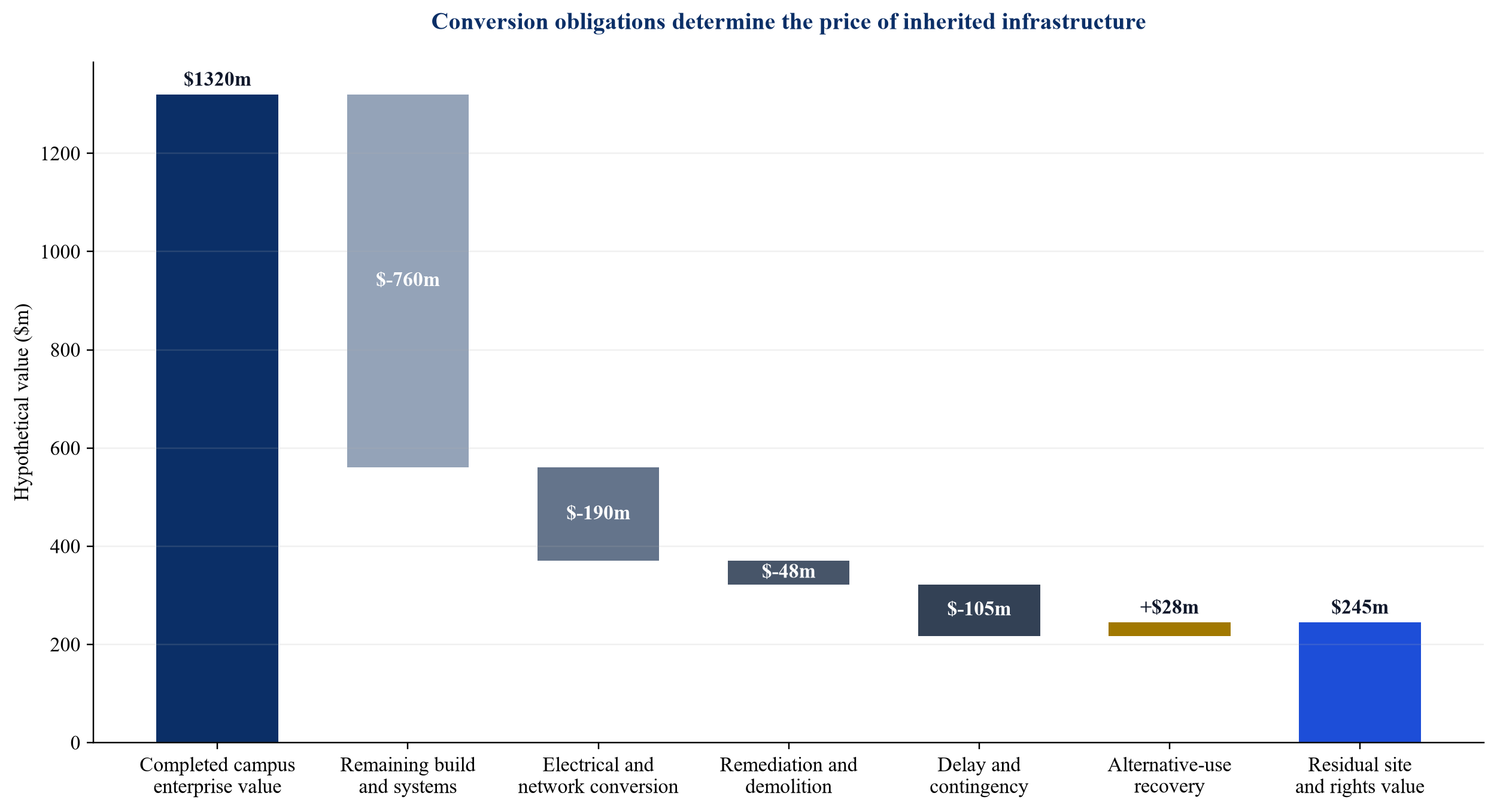
Values are hypothetical author-developed assumptions in US dollars millions. They do not represent a particular acquisition or redevelopment.
31 Compare brownfield and greenfield paths
The brownfield path can offer existing land, infrastructure and permitting familiarity. The greenfield path can offer clean design, lower environmental uncertainty and freedom from obsolete assets. The investment committee should compare complete programmes rather than headline connection dates.
The comparison should use equivalent critical IT capacity, resilience, customer timing and lifecycle. A brownfield with 160 megawatts of gross service may deliver less billable capacity than a greenfield designed for the customer. A greenfield may face a longer network queue.
The choice can also be a portfolio decision. A brownfield first phase can meet near-term demand while a greenfield campus develops. Shared customers and procurement can create value, subject to execution capacity.
32 Address geography and regulation
The framework applies across markets while rules differ. In the United States, utility tariffs, state regulation, RTO or ISO rules, environmental law and local permits interact. In the United Kingdom, demand-connection reform and queue management are active. European markets combine national regimes with EU energy and data-centre requirements. Gulf markets can use integrated utilities, free zones and national development programmes.
The diligence report should identify the competent authority, connection code, environmental regime, land law, foreign ownership, data rules, incentives and tax. Functional milestones should be compared across geographies because instrument names can conceal different rights.
Current legal and regulatory advice is essential. Active rulemaking should be treated as a scenario until effective.
33 Recognise common failure modes
Common failures include equating historical peak demand with current capacity, assuming existing equipment is reusable, overlooking terminated service, excluding remediation from the critical path, and valuing gross power as critical IT load. Each can materially overstate value.
Another failure is paying for speed before comparing the complete conversion programme with a greenfield alternative. A brownfield premium should be supported by verified time savings after investigation, cleanup, redesign and testing.
Public incentives and community support can also be overstated. The model should include only awarded or contractually supported amounts in the binding case. Jobs and tax claims should use transparent assumptions.
34 Apply a board decision sequence
The board begins with the transaction perimeter and alternative use. It establishes historical load, current utility rights and system deliverability. It completes environmental, equipment, planning, water and fibre diligence. The design converts gross supply into phased critical IT capacity.
The financial model integrates capital, schedule, customers, financing and downside recovery. Transaction terms link consideration to evidence and allocate environmental and connection risk. The board records stop conditions and capital limits.
The decision is revisited after utility confirmation, environmental closure, construction readiness, energisation and customer acceptance. Each milestone changes recognised value and financing capacity.
35 Limitations
This paper presents a general analytical framework. It does not establish the legal status, environmental condition, technical feasibility, grid capacity, value, financeability, credit quality or expected return of a particular industrial site or data-centre project. Outcomes depend on jurisdiction, network, land, environmental law, equipment, design, permits, customers, financing and market conditions.
The figures and tables use hypothetical author-developed assumptions. They do not represent observed project data, a valuation opinion, capacity award, financing offer, tariff, credit rating or investment recommendation. Public sources describe their own programmes and transactions. Project-specific legal, environmental, technical, regulatory, accounting, tax, insurance, financing and valuation advice is required.
Conclusion
Retired industrial sites can shorten the path to compute capacity when land, grid rights, equipment, environment and commercial demand align. Historical megawatts create a lead, not a conclusion. Current value depends on the rights and capacity that survive revalidation.
The Industrial-to-Compute Conversion Framework separates historical load from contractual, physical, system and compute-ready capacity. It integrates environmental cleanup, equipment reuse, design, customers, financing and recovery. It also structures price around verified milestones.
The strongest conversion case has current utility evidence, a funded remediation and electrical plan, a credible first phase, adaptable design, community alignment and sufficient downside liquidity. These elements turn a former factory into a financeable compute campus.
References
- International Energy Agency, Energy and AI: Executive Summary, 2025. https://www.iea.org/reports/energy-and-ai/executive-summary
- International Energy Agency, Energy and AI: Energy demand from AI, 2025. https://www.iea.org/reports/energy-and-ai/energy-demand-from-ai
- International Energy Agency, Energy and AI: Energy supply for AI, 2025. https://www.iea.org/reports/energy-and-ai/energy-supply-for-ai
- International Energy Agency, Data centre electricity use surged in 2025, 2026. https://www.iea.org/news/data-centre-electricity-use-surged-in-2025-even-with-tightening-bottlenecks-driving-a-scramble-for-solutions
- US Department of Energy, DOE Identifies 16 Federal Sites for Data Center and AI Infrastructure Development, 2025. https://www.energy.gov/articles/doe-identifies-16-federal-sites-across-country-data-center-and-ai-infrastructure
- US Department of Energy, Powering AI and Data Center Infrastructure Recommendations, 2024. https://www.energy.gov/sites/default/files/2024-08/Powering%20AI%20and%20Data%20Center%20Infrastructure%20Recommendations%20July%202024.pdf
- US Department of Energy, Reliability resources and US grid assessment, 2025. https://www.energy.gov/topics/reliability
- Lawrence Berkeley National Laboratory, 2024 United States Data Center Energy Usage Report, 2024. https://eta-publications.lbl.gov/publications/2024-lbnl-data-center-energy-usage-report
- Federal Energy Regulatory Commission, Interconnection of Large Loads to the Interstate Transmission System, Docket RM26-4-000. https://www.ferc.gov/rm26-4
- Federal Energy Regulatory Commission, FERC Launches Targeted Action to Speed Large Load Integration, 2026. https://www.ferc.gov/news-events/news/ferc-launches-aggressive-targeted-action-speed-large-load-integration
- Federal Energy Regulatory Commission, FERC Directs PJM to Create Rules for Co-Located Large Loads, 2025. https://www.ferc.gov/news-events/news/fact-sheet-ferc-directs-nations-largest-grid-operator-create-new-rules-embrace
- PJM Interconnection, Large Load. https://www.pjm.com/markets-and-operations/large-load
- PJM Interconnection, Critical Issue Fast Path: Large Load Additions. https://www.pjm.com/committees-and-groups/cifp-lla
- PJM Interconnection, Data Center Planning. https://www.pjm.com/planning/service-requests/data-center-planning
- PJM Inside Lines, PJM and Dominion Review Large Load Transfer Event, 2026. https://insidelines.pjm.com/pjm-dominion-review-large-load-transfer-event/
- North American Electric Reliability Corporation, Characteristics and Risks of Emerging Large Loads, 2025. https://www.nerc.com/globalassets/who-we-are/standing-committees/rstc/whitepaper-characteristics-and-risks-of-emerging-large-loads.pdf
- US Environmental Protection Agency, Revitalization-Ready Guide: Reuse Assessment. https://www.epa.gov/land-revitalization/revitalization-ready-guide-chapter-3-reuse-assessment
- US Environmental Protection Agency, Revitalization-Ready Guide: Reuse Plan. https://www.epa.gov/land-revitalization/revitalization-ready-guide-chapter-4-reuse-plan
- US Environmental Protection Agency, Local Officials Guide to Brownfields Redevelopment, 2025. https://www.epa.gov/brownfields/local-leadership-makes-difference-local-officials-guide-brownfields-redevelopment
- US Environmental Protection Agency, Eligible Planning Activities. https://www.epa.gov/brownfields/eligible-planning-activities
- US Environmental Protection Agency, Smart Growth and Infill Brownfields Redevelopment. https://www.epa.gov/smartgrowth/smart-growth-and-infill-brownfields-redevelopment
- US Environmental Protection Agency, Navigating Funding for Brownfields Revitalization, 2025. https://www.epa.gov/brownfields/navigating-funding-brownfields-revitalization
- US Environmental Protection Agency, Brownfields Federal Programs Guide, 2025. https://www.epa.gov/brownfields/brownfields-federal-programs-guide
- US Environmental Protection Agency, Understanding Brownfields. https://www.epa.gov/brownfields/understanding-brownfields
- Ofgem, Ofgem acts to free up grid capacity by tackling speculative data centre projects, 2026. https://www.ofgem.gov.uk/press-release/ofgem-acts-free-grid-capacity-tackling-speculative-data-centre-projects
- European Commission, Energy efficiency in data centres. https://energy.ec.europa.eu/topics/energy-efficiency/energy-efficient-products/energy-efficiency-data-centres_en
- European Commission, Commission Delegated Regulation EU 2024/1364 on data-centre reporting. https://eur-lex.europa.eu/eli/reg_del/2024/1364/oj
- International Valuation Standards Council, International Valuation Standards. https://www.ivsc.org/standards/
- IFRS Foundation, IFRS 13 Fair Value Measurement. https://www.ifrs.org/issued-standards/list-of-standards/ifrs-13-fair-value-measurement/
- Royal Institution of Chartered Surveyors, RICS Valuation: Global Standards. https://www.rics.org/profession-standards/rics-standards-and-guidance/sector-standards/valuation-standards/red-book
- Digital Realty Trust, Annual Report on Form 10-K for the year ended 31 December 2025. https://www.sec.gov/Archives/edgar/data/1297996/000110465926015365/dlr-20251231x10k.htm
- Equinix, Annual Report on Form 10-K for the year ended 31 December 2025. https://www.sec.gov/Archives/edgar/data/1101239/000110123926000032/eqix-20251231.htm
- CoreWeave, Annual Report on Form 10-K for the year ended 31 December 2025. https://www.sec.gov/Archives/edgar/data/1769628/000176962826000104/crwv-20251231.htm
- World Bank Group, Project Finance: Key Concepts. https://ppp.worldbank.org/financing/project-finance-concepts
- World Bank Group, Risk Allocation in Public-Private Partnerships. https://ppp.worldbank.org/allocating-risks
- International Finance Corporation, Performance Standards on Environmental and Social Sustainability, 2012. https://www.ifc.org/en/insights-reports/2012/ifc-performance-standards
- National Institute of Standards and Technology, Guide to Operational Technology Security, SP 800-82 Revision 3, 2023. https://doi.org/10.6028/NIST.SP.800-82r3
- National Institute of Standards and Technology, Cybersecurity Framework 2.0, 2024. https://doi.org/10.6028/NIST.CSWP.29
- Uptime Institute, Tier Standard: Topology. https://uptimeinstitute.com/tiers
- ASHRAE, Data Center Resources. https://www.ashrae.org/technical-resources/bookstore/datacom-series
- International Organization for Standardization, ISO 50001 Energy management systems. https://www.iso.org/iso-50001-energy-management.html
- International Organization for Standardization, ISO 55001 Asset management systems. https://www.iso.org/standard/83054.html
About the Author
Chennakeshav (CK) is a corporate finance and investment banking executive with 25+ years of global experience in deal origination, structuring and execution across M&A, growth capital and corporate strategy. He has led value-creation mandates for founders, corporates and funds — bridging the boardroom view to hands-on execution and close.
His career spans Morgan Stanley, HSBC, Lloyds Banking Group, EWEC, ADQ portfolio companies and Emirates Growth Fund, across TMT, real estate, fintech, deeptech, cleantech, infrastructure and energy. He has partnered with C-suite leaders, private equity and venture funds, sovereign wealth funds and family offices to finance complex fund raises and scale-up ventures, and has led M&A due diligence, post-merger integration and business-transformation initiatives to create value.
At Matchpoint Partners he is Managing Partner, leading the firm's corporate finance, M&A and capital-raising practice. He holds an MBA from London Business School, an engineering degree from VTU and a Master of Laws (LLM, in progress) from UCL London.
An active start-up mentor, CK mentors at Techstars, DIFC FinTech Hive, Startup Grind, Founder Institute and IN5, serves as Entrepreneur Mentor in Residence (EMiR) at London Business School, and judges the Entrepreneurship World Cup.
