

1. Define the tariff decision
The procurer must decide which cash flows remain fixed, which move with observable indices, and which pass through at verified cost. That decision influences bid price, financing capacity, consumer affordability and incentives throughout the concession.
The indexation schedule should be designed with the payment mechanism, financing model and service requirements. A formula drafted after bidder selection can redistribute value and expose the procurement to challenge.
2. Explain the 25-year problem
A 25-year contract spans multiple inflation, interest-rate, commodity and technology cycles. Costs that appear stable at signing can move at different speeds and in different currencies.
The project company cannot control macroeconomic inflation. It can control procurement, staffing, maintenance and operating efficiency to varying degrees. The tariff should protect external risk without reimbursing avoidable inefficiency.
3. Separate nominal and real economics
A nominal tariff includes expected inflation. A real tariff is stated in constant purchasing-power terms and converted to nominal payments through an index.
Bid comparison should use a common convention. A low opening nominal tariff with aggressive escalation can cost more than a higher fixed tariff. Evaluation should compare discounted payments and stress cases, not the first-year price alone.
4. Disaggregate before indexing
Indexing the whole tariff to one consumer-price index is convenient and often inaccurate. Debt, equity, labour, chemicals, insurance and fuel have different drivers.
The model should create components only where the economic distinction matters and remains administrable. Excessive fragmentation increases calculation risk, disputes and audit cost.
5. Match risk to control
Indexation is a risk-allocation mechanism. The private side should retain productivity, availability and controllable procurement risk. The public side may absorb defined inflation, currency and input risks where transferring them would produce a larger bid premium.
World Bank guidance links indexation to cost components affected by local inflation, foreign inflation and fuel reference prices [1][2]. The formula should reflect that principle rather than offer general revenue protection.
Table 1. Tariff-component and indexation evidence map
| Tariff component | Principal economic driver | Possible index | Adjustment approach | Core control |
|---|---|---|---|---|
| Senior debt principal | Contracted amortisation and currency | Usually fixed schedule; FX index only where allocated | Fixed or currency-linked | Approved debt and currency split |
| Senior debt interest | Fixed or floating benchmark and margin | Contracted reference rate where risk is allocated | Fixed, hedged or formula-linked | Hedge and refinancing controls |
| Fixed O&M labour | Local wages and services | Local CPI or wage index | Partial annual indexation | Efficiency factor and payroll evidence |
| Imported fixed O&M | Foreign equipment and specialist services | Relevant foreign CPI and FX rate | Partial annual indexation | Foreign-cost share and invoice audit |
| Variable O&M | Throughput, chemicals and consumables | Relevant producer or commodity index | Volume multiplied by indexed unit cost | Efficient consumption norms |
| Fuel or purchased electricity | Commodity or regulated supply price | Contract benchmark or verified pass-through | Monthly or invoice-period adjustment | Heat rate, efficiency and procurement rights |
| Equity return | Bid return and retained risk | Fixed nominal or defined partial indexation | Usually bounded | No duplicate inflation recovery |
| Change in law and exceptional tax | Defined legal event | Verified incremental cost | Event-driven adjustment | Materiality, mitigation and audit |
The allocation is illustrative and requires project-specific cost, currency, financing and legal evidence.
6. Establish the base date
Every index requires a base date. It may be the bid deadline, preferred-bidder date, contract date, financial close or commercial-operation date.
The base date should match the period for which bidders priced risk. Construction-period indexation needs separate treatment from operating-period escalation. A late financial close should not create an unpriced gap.
7. Establish the base tariff
The base tariff should reconcile to the financial model and bid schedule. Capacity, energy, water, availability, take-or-pay and pass-through elements should be stated separately.
The model should distinguish the quoted bid tariff from the invoiced tariff after commissioning tests, delay adjustments and final financing. Any rebasing should follow a pre-agreed formula.
8. Establish the currency split
Project costs can be local, foreign or mixed. Debt and major equipment may be denominated differently from tariff receipts.
The bid should disclose cost and financing currency shares. Foreign-currency indexation should be limited to the approved foreign exposure and reduced when the exposure amortises or is refinanced.
9. Establish the cost baseline
The operating-cost baseline should identify labour, maintenance, chemicals, membranes, catalysts, fuel, electricity, insurance, land, licences and overhead. Historical benchmarks and technical assumptions should support each material line.
Indexation protects movement from an efficient baseline. It should not validate an inflated or poorly evidenced starting cost.
10. Establish the financing baseline
The financing baseline should show fixed and floating debt, hedges, reserve accounts, sculpted amortisation, coverage ratios and equity distributions. The tariff formula should reconcile with the model used by lenders.
The public counterparty should understand which indexed revenues support debt and which support operating margins. That distinction guides affordability and refinancing analysis.
11. Choose local inflation index
Local CPI is widely understood and often available. It can be a weak proxy for utility labour, industrial services or construction materials.
The parties should evaluate coverage, publication quality, revision policy, frequency and historical volatility. The contract should name the issuing authority and exact series, including whether headline or core inflation applies.
12. Choose foreign inflation index
Foreign CPI or producer-price indices may match imported equipment and services. The chosen geography should reflect the genuine supply chain rather than sponsor domicile.
A weighted basket can be justified where costs span several markets. The added complexity should produce a material improvement in risk matching.
13. Choose sector-specific index
Wage, machinery, chemicals, metals or industrial-services indices can track certain costs more closely than CPI. They can also be volatile or less transparent.
Use a sector index where the cost share is material, the series is independently published and the relationship is stable. A bespoke vendor quote is not a neutral index.
14. Choose fuel benchmark
Fuel adjustment should match commodity, quality, transport, capacity and take-or-pay obligations. Gas, coal, liquid fuel and purchased electricity require different benchmarks.
The formula should distinguish price from consumption. Efficient heat rate or specific energy consumption should remain a project-performance obligation.
15. Choose chemical and consumable benchmark
Desalination cost can depend on membranes, chemicals, filters and electricity. A general CPI may not reflect these inputs.
The contract can use indexed unit allowances, periodic market testing or verified pass-through for exceptional items. Consumption standards and quality requirements should prevent volume leakage.
16. Define index publication
The contract should state the publication source, series identifier, release date, preliminary and final treatment, seasonal adjustment and rounding.
An invoice formula that says only “CPI” is incomplete. Different series or vintages can produce different payments over 25 years.
17. Define adjustment frequency
Annual indexation reduces administration and smooths volatility. Monthly or quarterly adjustment can better match fuel, FX and high-volatility inputs.
Frequency should follow cash-flow need and data availability. Debt service may require timely recovery, while minor fixed-cost components can tolerate an annual lag.
18. Define the lag
Indices are published after the period they measure. The formula must state which observation applies to each invoice.
A defined lag avoids estimates and later revisions. The model should quantify working-capital consequences, particularly where input prices move before tariff recovery.
19. Define compounding
Indexation can apply to the original base tariff or the prior adjusted tariff. Both methods can be mathematically equivalent when specified correctly, but caps and floors can make them diverge.
The contract should state the equation and preserve sufficient decimal precision. Worked examples should be attached to remove ambiguity.
20. Build the contract structure
The indexation mechanism connects the PWPA, fuel or electricity supply, financing, hedging, O&M, EPC and government support documents. Each contract may carry a different cost and currency risk.
The map should identify risk that is naturally hedged, contractually indexed, financially hedged or retained. A gap becomes a project-company exposure; an overlap can create double recovery.
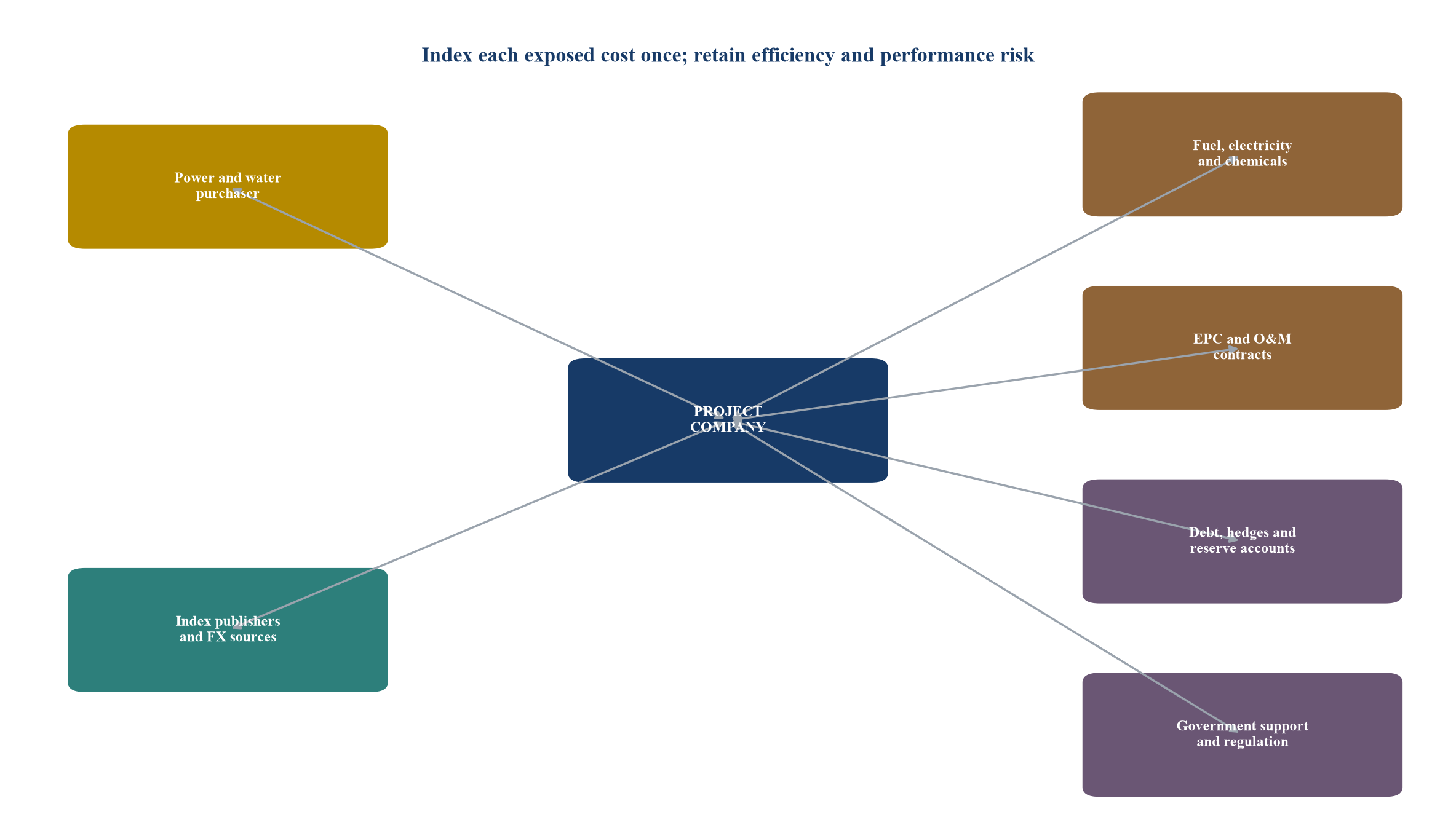
The diagram is a generic framework; executed documents and project economics govern each transaction.
21. Separate capacity and energy
A two-part power tariff can place financing and fixed cost in capacity payment and variable cost in energy payment. World Bank sample guidance uses this structure and assigns indices to affected price elements [1].
Availability should govern capacity revenue. Dispatch and efficient input use should govern energy revenue. Indexation should not protect payment for unavailable capacity.
22. Separate water capacity and output
A water tariff can distinguish available production capacity from actual delivered volume. Fixed recovery supports financing and readiness; variable payment supports electricity, chemicals and consumables.
Quality, pressure, availability and specific-energy standards should link payment to service. Indexed cost recovery should remain subject to those obligations.
23. Treat debt principal
Debt principal is usually a scheduled nominal obligation. Indexing the same principal through tariff and foreign exchange can produce overprotection.
The tariff should reflect the approved debt currency and amortisation. Foreign-linked recovery should decline where exposure declines, unless the parties expressly choose another allocation.
24. Treat fixed-rate debt
Fixed-rate debt creates payment certainty. It generally does not require interest-rate indexation after financial close.
The procurement should recognise the cost of fixing or hedging. A later refinancing requires rules for sharing gains and adjusting any indexed debt component.
25. Treat floating-rate debt
Floating-rate debt can expose coverage to benchmark movement. The risk can be hedged, borne by sponsors, passed through or shared.
Any tariff linkage should use the same benchmark, reset dates, tenor and approved notional. It should exclude margin changes caused by project credit deterioration.
26. Treat equity return
Equity absorbs retained risk and receives the bid return. Full indexation of equity alongside indexed costs can duplicate inflation protection.
The parties should state whether equity is nominal, real or partially indexed. Distributions already protected through cost escalation should not receive a second general uplift.
27. Treat fixed O&M
Fixed O&M includes staffing, routine services, insurance and minimum maintenance. Some costs follow local inflation; others depend on imported suppliers.
Partial indexation can reflect the evidenced local and foreign shares. An efficiency factor can return expected productivity gains to the purchaser.
28. Treat variable O&M
Variable O&M should combine indexed unit allowances with actual metered output. The formula should define consumption norms and quality conditions.
The project retains the risk of inefficient use within its control. Exceptional input changes can be addressed through a threshold or review mechanism.
29. Treat major maintenance
Major maintenance is periodic and can involve imported equipment, specialist labour and outage planning. Annual CPI may not match the expenditure profile.
Options include a prefunded reserve, lifecycle schedule, foreign equipment index or periodic market test. The method should preserve maintenance incentives and lender confidence.
30. Treat insurance
Insurance premiums can move with global market cycles and project claims. Pure CPI indexation may be inaccurate.
The contract can include an allowance, benchmark review or defined pass-through for mandatory cover, subject to competitive procurement, deductibles and exclusion of claim-driven increases caused by project breach.
31. Treat taxes and duties
Baseline taxes should be priced. New or discriminatory taxes may fall under change-in-law relief rather than routine inflation indexation.
The contract should prevent recovery through both the tariff formula and an event claim. Tax gross-up and withholding require separate analysis.
32. Treat foreign exchange
FX indexation should protect genuine foreign obligations while preserving incentives to localise and hedge. The formula should identify the source rate, date and conversion direction.
The public side should see the exposure curve. A fixed foreign share for 25 years can overstate risk after foreign debt amortises and imported lifecycle spending falls.
33. Treat devaluation shocks
Sharp devaluation can create an immediate affordability and liquidity problem even where formulaic recovery exists. Caps can defer rather than remove the cost.
The contract can use bands, smoothing, a reserve, delayed catch-up or exceptional review. Each choice should be modelled for debt service and public cash flow.
34. Treat deflation
Indexation should normally operate symmetrically. A floor at zero inflation protects the project while denying the purchaser the benefit of deflation.
A floor may be justified for rigid nominal obligations. Its value should be disclosed at bid evaluation and paired with appropriate caps or non-indexed components.
35. Treat index discontinuation
An index can be rebased, revised or discontinued during a 25-year term. The contract should identify a successor hierarchy and equivalence method.
An independent expert can determine a replacement where no official successor exists. The replacement should preserve economic intent rather than maximise either party's outcome.
Table 2. Illustrative risk-allocation matrix for tariff indexation
| Risk | Project company | Purchaser | Shared mechanism | Evidence requirement |
|---|---|---|---|---|
| Efficient operating quantity | Retained | None | Performance tests | Metering and technical benchmarks |
| Local labour inflation | Baseline efficiency | Defined indexed share | CPI or wage index less efficiency factor | Cost share and official series |
| Imported equipment inflation | Procurement discipline | Defined foreign share | Foreign producer-price index | Approved lifecycle plan |
| Fuel price | Heat-rate performance | Benchmark price movement | Indexed fuel component | Contract benchmark and fuel invoices |
| Foreign exchange | Unapproved or residual exposure | Approved foreign share | FX formula, hedge or band | Debt and cost currency schedule |
| Interest rate | Margin and unapproved debt | Approved benchmark exposure | Hedge or benchmark adjustment | Finance documents and hedge confirmation |
| General productivity | Retained through efficiency factor | Receives tariff reduction | Periodic review | Comparable operating evidence |
| Extraordinary legal change | Mitigation | Defined qualifying cost | Change-in-law mechanism | Legal causation and audited cost |
The entries describe a possible allocation; they are not market observations or legal conclusions.
36. Choose partial indexation
Partial indexation protects the share of cost genuinely exposed to the selected driver. The remaining share stays fixed and rewards efficiency.
The indexed weight should come from the bid cost structure and financing model. It should be locked or adjusted only through a defined rebasing event.
37. Use caps and floors
Caps limit annual tariff movement and support public affordability. Floors protect minimum cash flow. Both transfer value and can accumulate hidden exposure.
The contract should state whether unrecognised movement is lost, deferred or carried forward. Lenders should model the effect on coverage and liquidity.
38. Use collars
A collar creates a range within which indexation applies normally and outside which a different sharing rule operates. It can absorb ordinary volatility while controlling extremes.
The collar should be calibrated using historical and forward stress cases. A narrow collar can behave like a cap; a wide collar may add complexity without changing risk.
39. Use smoothing
Moving averages or phased adjustments can smooth volatile indices. Smoothing reduces invoice shocks but creates lag and working-capital requirements.
The model should quantify the unpaid balance and its financing. An indefinite catch-up mechanism can become a contingent public liability.
40. Build the tariff formula
The formula should start with the base tariff, apply component weights, update each relevant index, convert approved currencies and add verified pass-throughs. Performance deductions follow separately.
The equation, data source and worked example should be contract schedules. Spreadsheet logic alone is insufficient as a legal definition.
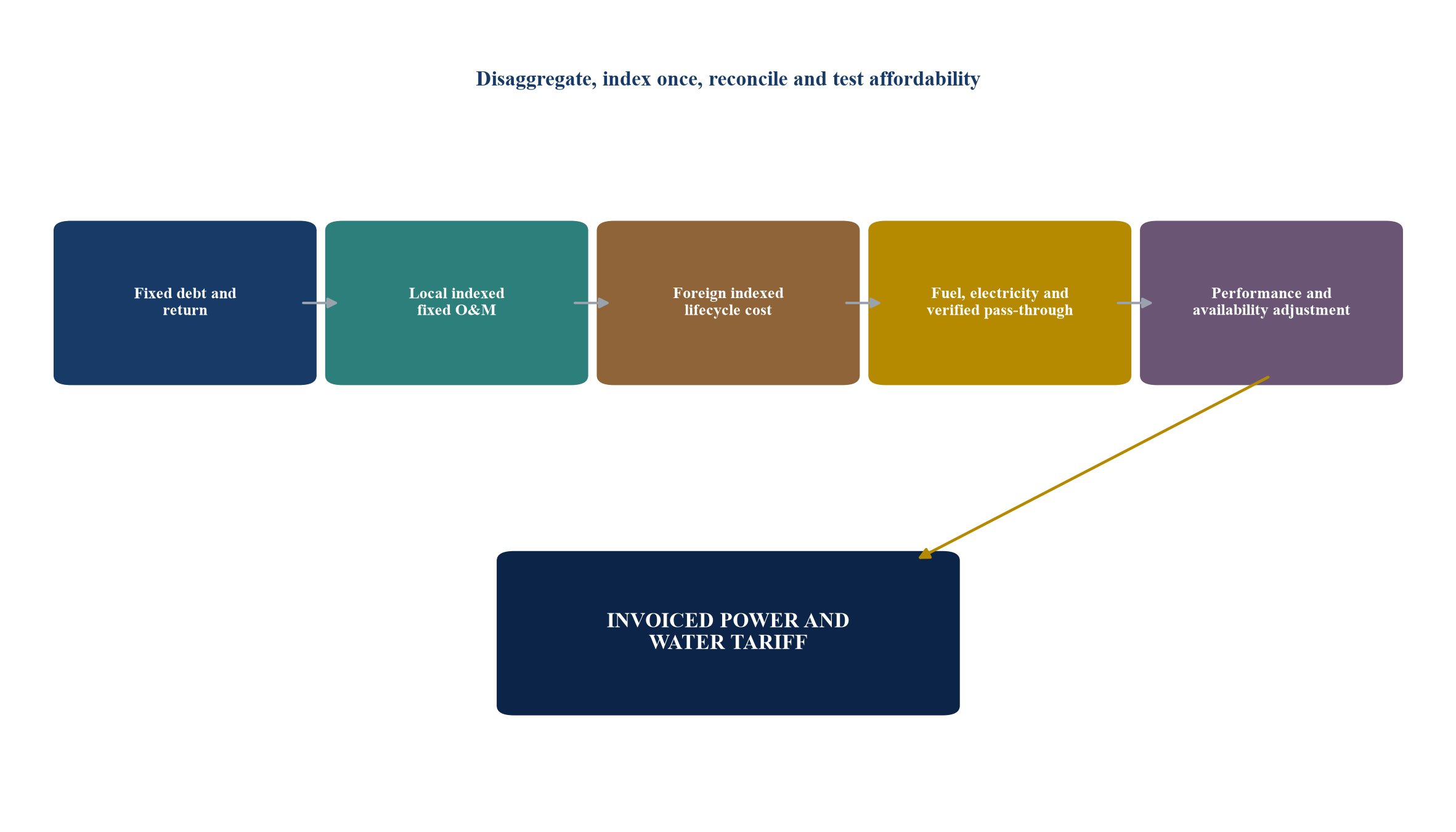
The formula is conceptual and must be calibrated to project-specific costs, financing and risk allocation.
41. Model a base case
The base case should use the bid indices, base dates, weights and financing assumptions. It should generate every annual and monthly payment for the full term.
The model should reconcile tariff revenue to debt service, operating cost, tax, reserves and distributions. It should also show purchaser cost in nominal and real terms.
42. Model inflation sensitivity
The sensitivity below demonstrates how different indexation structures can affect debt coverage and public cost. The values are hypothetical management assumptions.
The analysis should vary local and foreign inflation independently. Correlation, compounding and lag matter over a long term.
Table 3. Hypothetical tariff and debt-service sensitivity
| Scenario at year 10 | Fully fixed tariff index | Fully CPI-linked tariff index | Targeted component tariff index | Minimum DSCR under targeted design | Purchaser implication |
|---|---|---|---|---|---|
| Low inflation | 100 | 112 | 108 | 1.34x | Lower escalation; fixed tariff retains more real value risk |
| Base inflation | 100 | 134 | 121 | 1.28x | Targeted recovery supports service and debt |
| High local inflation | 100 | 163 | 139 | 1.18x | Coverage tightens where foreign and debt costs differ |
| FX devaluation plus inflation | 100 | 163 | 156 | 1.12x | Approved foreign share dominates affordability |
| Deflationary period | 100 | 94 | 97 | 1.25x | Symmetry benefits purchaser subject to debt floor |
All figures are hypothetical management assumptions for method demonstration. Tariff values are index numbers with year 1 equal to 100; DSCR is a ratio.
43. Model debt-service coverage
Lenders should test annual and lock-up DSCR under each index path. A tariff can be economically fair over 25 years and still fail during a short lag or cap period.
Liquidity reserve, distribution lock-up and cure equity should address timing gaps. They should not replace a structurally mismatched formula.
44. Model purchaser affordability
The purchaser should test nominal payments, real unit cost, subsidy requirement and end-user tariff implications. Exposure should be reported by driver and currency.
Affordability analysis should include multiple projects. Portfolio-wide foreign and inflation indexation can create concentrated public risk even when each project appears manageable.
45. Model construction inflation
EPC price may be fixed, partially indexed or reopened for defined inputs. Construction inflation can affect completion and financing before operating tariff starts.
IRENA notes that contract indexation can reduce bidder risk premiums and support delivery while increasing government exposure [4]. Procurement should price this trade-off explicitly.
46. Model commissioning delay
A delay changes index dates, interest during construction and the start of revenue. The contract should distinguish project delay, purchaser delay and force majeure.
Indexation should not reward project-company delay. Purchaser-caused delay may justify tariff or completion-cost adjustment under a defined mechanism.
47. Calibrate bid evaluation
Bids should be evaluated with a common index forecast and disclosed scenario set. The procurer should calculate expected and stressed net present cost.
This prevents a bidder from appearing cheap through low opening price and high indexed weight. Evaluation assumptions should not become guaranteed future indices.
48. Calibrate performance deductions
Availability and quality deductions should apply after tariff indexation or through a clearly equivalent formula. Otherwise inflation can unintentionally dilute or amplify performance incentives.
The maximum deduction regime should be modelled against fixed costs and debt. Penalties must remain commercially meaningful without creating automatic instability.
49. Calibrate efficiency factor
An efficiency factor reduces indexed recovery to reflect expected productivity. It can be fixed, benchmarked or reset at review.
The factor should account for mature technology, digital operations and learning while recognising lifecycle ageing. An aggressive factor can underfund maintenance.
50. Calibrate rebasing
Rebasing updates weights or baselines after a defined structural event such as major expansion, refinancing or required technology change. It should not become routine renegotiation.
The trigger, evidence, valuation date and approval process should be stated. Rebasing should preserve the original allocation of ordinary business risk.
51. Integrate refinancing
Refinancing can reduce interest cost, extend tenor or change currency. The tariff and index weights should reflect any approved change.
Gain-sharing rules should operate with the indexation formula. The purchaser should not continue paying for an expensive or foreign exposure that no longer exists.
52. Integrate change in law
Change in law should address defined incremental cost that ordinary indices do not capture. It requires causation, materiality, mitigation and audit.
The parties should prevent overlap with tax, CPI, FX and pass-through components. A change should be recovered once.
53. Integrate force majeure
Force majeure can reduce output while fixed costs continue. Relief, deemed availability and term extension may interact with indexed payment.
The contract should distinguish tariff adjustment from event compensation. Payment should follow the risk allocation and verified effect.
54. Integrate technology change
Technology can reduce energy use, maintenance cost or input consumption. The project should retain incentives to adopt efficient methods consistent with service standards.
Periodic benchmarking may share material gains. The mechanism should respect financing and avoid mandatory investment without a recovery route.
55. Integrate audit and data
The purchaser should receive index calculations, source publications, currency schedules, invoices and efficiency data. Automated calculation can reduce error but requires governance.
The contract should state record retention, audit frequency, correction period and interest on underpayment or overpayment. Historical invoices should be reproducible.
56. Run the economic gate
The first gate confirms the cost and currency baseline, component weights, risk owners and base tariff. It tests whether the formula follows actual economic exposure.
The bid model, financing model and contract schedule should reconcile. Any unexplained difference is resolved before signing.
57. Run the data gate
The second gate confirms each index, publisher, series, lag, fallback, rounding and revision rule. A worked example should reproduce the invoice.
The index must be available for the full intended period or have a robust successor mechanism. The parties should store source observations.
58. Run the credit gate
The third gate tests DSCR, reserves, hedge coverage and payment timing under base and stressed scenarios. It identifies any cap-induced liquidity gap.
Lender protection should be targeted to approved exposures. Sponsor risk remains visible and financeable.
59. Run the affordability and governance gate
The fourth gate tests purchaser cash flow, public contingent exposure, end-user affordability, accounting and approvals. Portfolio concentration should be included.
The fifth gate confirms contract wording, calculation files, audit rights, change control and operational ownership. The formula must remain executable after staff and advisers change.
60. Adopt the decision record and 90-day plan
The decision record should state each component, weight, index, currency, cap, floor, lag, fallback, review trigger and risk owner. It should include expected and stressed cost, minimum coverage and residual risks.
The 90-day plan below can support procurement design or amendment of an existing PWPA. It connects technical cost, financing, legal drafting, affordability and calculation controls.
During the first two weeks, the team should freeze the authoritative model and contract set. It should reconcile the base tariff to cost, financing and service obligations. Each index proposal should carry a named data series and an explanation of the cost it represents. Any component without a defensible economic driver should remain fixed, be treated as a verified pass-through or be redesigned.
The finance workstream should compare fully fixed, fully indexed and targeted designs under identical assumptions. It should show bid premium, debt capacity, distribution profile and public payment. Stress cases should combine local inflation, foreign inflation, FX, interest rate, output and delay. The analysis should identify timing gaps caused by publication lag, annual caps or deferred catch-up.
The technical workstream should validate consumption, maintenance and replacement assumptions. For desalination, specific electricity use, membrane life, chemical consumption, intake conditions and water quality can materially affect cost. For generation, heat rate, starts, ramping, auxiliary load and outage shape the relationship between input price and delivered service.
The legal workstream should turn the model into equations, definitions and procedures. It should attach worked examples for the first adjustment, a cap year, a deflation year, an index discontinuation and an FX shock. The schedule should specify invoice evidence, review, dispute and correction without relying on an editable spreadsheet as the contract.
The public finance workstream should aggregate indexation across the offtaker portfolio. It should identify annual cash exposure, currency concentration and subsidy implications. The approval paper should state which risks are accepted because they reduce bid cost or protect delivery and which risks remain with investors because they are controllable.
After signing, the calculation should become a controlled operational process. Responsibility for source data, model execution, invoice review and approval should be assigned. Annual governance should test whether weights still correspond to approved debt and cost exposure and whether any refinancing, change in law or technology event requires formal rebasing.
The tariff register should contain every base value, index code, observation date, currency rate, weight, cap, floor and rounding convention used in the signed agreement. It should identify the original source and the person responsible for retrieval. A locked calculation model should reproduce the examples attached to the contract. Changes to formulas, links or macros should require documented approval and regression testing against historical invoices.
The first live adjustment deserves a formal readiness review. The project company can prepare a shadow invoice before commercial operation, and the purchaser can recalculate it independently. Differences should be resolved before material cash flow depends on the formula. This rehearsal also tests publication lags, rate retrieval, invoice cut-off, evidence format and the treatment of revised index observations.
Monthly invoice governance should distinguish calculation from approval. One team retrieves source data and runs the model; a separate reviewer confirms the series, dates, weights, metered quantities and performance deductions. The approved invoice should be archived with a calculation report and source evidence. This record becomes important years later when personnel, systems and advisers have changed.
The parties should agree how index revisions are treated. Some statistical authorities revise recent observations after publication. Reopening every invoice creates administrative burden, while ignoring material revisions can transfer value. A practical rule can use the first official observation available on a defined date, subject to correction only for publisher error above a threshold. The same convention should apply symmetrically.
Rounding should be specified at each calculation stage. Rounding indices, FX rates, component amounts and the final unit tariff at different levels can create cumulative differences over millions of units. The worked example should state decimal precision and order of operations. System implementations should be tested against that result before billing begins.
The annual review should reconcile the approved foreign-cost share with actual remaining exposure. Debt amortisation, hedge reduction, localisation, equipment replacement and refinancing can alter the economic basis. The review should identify divergence; it should change contractual weights only through the agreed rebasing mechanism. This preserves predictability and prevents informal renegotiation.
Affordability governance should examine the combined effect of indexation, volume, performance and system demand. A unit tariff can remain within expectations while total payment rises because contracted capacity or water demand changes. The purchaser should therefore report unit-price movement, total nominal payment, total real payment and the contribution of each driver. Portfolio aggregation should show common exposure to the same currency or index.
The project company should maintain a liquidity plan for formula lags and capped adjustments. Working-capital facilities, reserves and distribution restrictions can bridge timing without converting temporary stress into service failure. Any deferred tariff balance should be measured, financed and disclosed. Its recovery period should be bounded so that an affordability measure does not become an opaque future claim.
Lender monitoring should use the same index data as invoicing. Base-case and downside DSCR should be refreshed when inflation, FX or rates move materially. A deteriorating coverage forecast can trigger distribution lock-up, hedge review, reserve funding or sponsor action before a payment default. The public counterparty should receive enough information to understand the exposure while respecting protected financing terms.
Dispute procedure should separate objective calculation error from economic reallocation. An accountant or calculation expert can resolve the chosen series, date, arithmetic and rounding. Legal or broader economic disputes may require a different forum. Undisputed amounts should remain payable, and correction interest should apply symmetrically to underpayment and overpayment.
Periodic strategic review can assess whether the tariff continues to support service, maintenance and public value. It should examine performance, lifecycle condition, technology, financing and affordability without reopening ordinary risks that were deliberately fixed. A review mechanism with defined scope, evidence and approval is more predictable than ad hoc relief after a cost shock.
At contract expiry, the tariff record should support final reconciliation, handback and audit. Indexed maintenance recovery should be compared with required asset condition and reserve use. Outstanding true-ups, deferred balances and disputes should be identified early enough to avoid delaying handover. The final account closes the economic cycle created at procurement.
Procurement documents should require bidders to submit both the formula and the economic evidence behind each weight. The submission can include a sources-and-uses schedule, debt currency table, operating-cost breakdown, lifecycle profile and sensitivity model. The procurer can then compare risk allocation across bids on a common basis. A bidder that requests a larger indexed share should demonstrate the corresponding cost exposure rather than rely on a general claim of inflation risk.
Negotiation should retain a clear audit trail of every change. Increasing indexation can lower the opening tariff or reduce financing cost, while increasing public exposure. The evaluation memorandum should quantify the exchange. Decision-makers can then see whether a change creates value across the term or merely moves cost outside the headline bid tariff.
The financial-close process should confirm that the final debt, hedge, EPC and O&M structures remain consistent with the awarded indexation. A bidder may change lenders, currency, equipment source or maintenance strategy after award. Material divergence should trigger approval and, where required, a neutral tariff adjustment. This protects procurement integrity and prevents the purchaser from paying for exposure that is no longer present.
For brownfield amendments, the team should reconstruct the original economics before changing the formula. Historical invoices, cost accounts, financing documents and performance data can show which risks were priced and which outcomes arose from efficiency or inefficiency. The amendment should state its effective date, settlement of past claims and interaction with existing caps, reserves and change-in-law provisions.
Indexation should also be tested against termination payments. If termination compensation is linked to outstanding debt, future cash flow or contract value, the tariff formula can materially affect the exit amount. The financing model should avoid counting inflation protection twice. The termination schedule, direct agreement and tariff schedule should use consistent definitions of approved debt, revenue and recoveries.
Water and power components can require different escalation within the same PWPA. A co-located project may share debt, labour, land and control systems while consuming different inputs. The model should allocate shared cost through an agreed method and preserve technical incentives. A single blended index can conceal cross-subsidy and make future expansion or partial termination difficult to value.
Digital metering and invoice automation can strengthen control when governance is explicit. The source system should preserve raw observations, timestamps, approval status and calculation version. Access should follow segregation of duties, and formula changes should be logged. Automation reduces manual error; it does not resolve an economically weak index or an ambiguous contract.
The strongest outcome is a tariff whose movement can be explained to lenders, public finance officials, operators and consumers through the same evidence. Each adjustment should trace from an external driver to an approved component and then to a verified invoice. That traceability supports bankability, affordability and accountability throughout the concession.
Table 4. Illustrative 90-day tariff-indexation workplan
| Period | Workstream | Core actions | Decision output | Accountable owner |
|---|---|---|---|---|
| Days 1-15 | Baseline | Reconcile bid tariff, costs, currencies, financing and service standards | Approved component and exposure map | Transaction director and CFO |
| Days 16-30 | Index design | Select series, weights, lags, caps, floors, fallbacks and efficiency factors | Draft tariff formula and data register | Commercial and economic advisers |
| Days 31-45 | Scenario modelling | Test inflation, FX, rates, output, delay, DSCR and public affordability | Base and stressed payment profile | Financial adviser and treasury |
| Days 46-60 | Technical and legal | Validate cost drivers; draft equations, evidence, audit and correction | Contract schedule and worked examples | Technical adviser and counsel |
| Days 61-75 | Market and lender testing | Test formula with bidders, lenders and internal approvers | Bankability and affordability revisions | Procurement lead |
| Days 76-90 | Approval and control | Finalise model, governance, owner, audit trail and signing package | Executable tariff and control record | Contracting authority board |
Timing is indicative and should be adapted to procurement, financing and approval requirements.
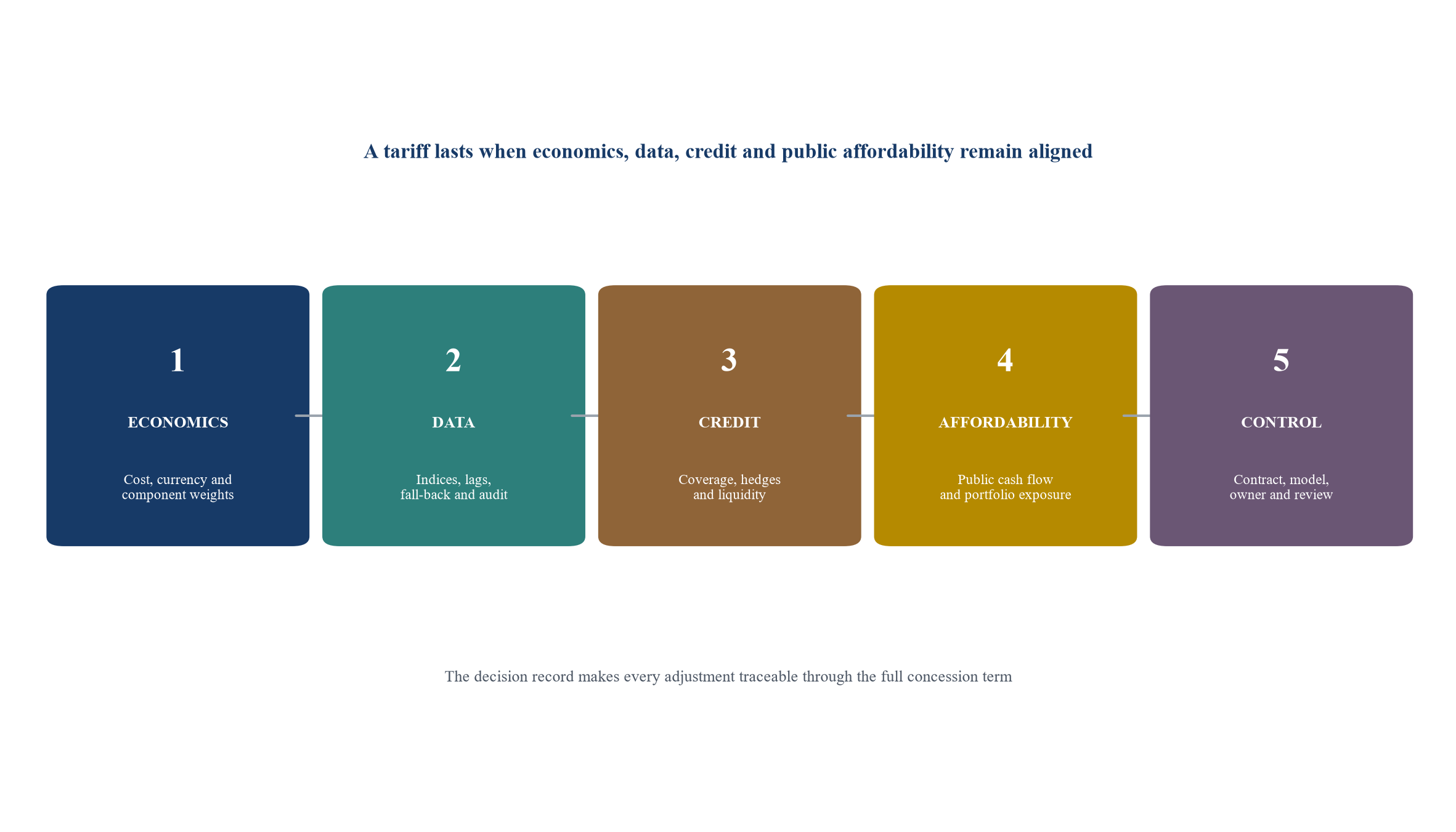
Each gate requires documented evidence before the tariff is approved.
The framework creates a tariff that can survive changing macroeconomic conditions without abandoning cost discipline. Indexation protects approved external exposure; performance, efficiency and procurement risks remain with the party best able to manage them. The purchaser gains visibility over long-term affordability, and lenders gain confidence that debt-service cash flow is connected to the economic risks embedded in the asset.
Durability depends on operating discipline after signing. The model, index sources, exposure weights and approvals should be maintained as controlled records. Annual review should detect drift while preserving the negotiated allocation. A transparent formula reduces the need for emergency renegotiation and supports credible procurement across successive projects.
References
- World Bank Group, "Schedule 4: Tariff, Tariff Adjustments and Default Prices," sample PPA, https://ppp.worldbank.org/sites/default/files/2024-07/energy%20ppa%201.pdf
- World Bank Group, "Power Generation Module," PPP Resource Center, https://ppp.worldbank.org/energy-and-power/power-generation-module
- World Bank Group, "Payment Mechanism," PPP Resource Center, https://ppp.worldbank.org/payment-mechanism
- International Renewable Energy Agency, "Renewable Energy Auctions: Design for Risk Allocation," 2026, https://www.irena.org/-/media/Files/IRENA/Agency/Publication/2026/Jan/IRENA_POL_RE_auction_design_risk_allocation_2026.pdf
- International Finance Corporation, "Utility-Scale Solar Photovoltaic Power Plants: A Project Developer's Guide," https://ppp.worldbank.org/sites/default/files/2022-03/IFC_Solar_Report_Web__08_05.pdf
- European Bank for Reconstruction and Development, "PPP Regulatory Guidelines Collection, Volume II," 2024, https://www.ebrd.com/content/dam/ebrd_dxp/assets/pdfs/legal-reform/infrastructure-and-natural-resources/public-private-partnerships-and-concessions/volume-2/volume2.pdf
- World Bank Group, "Power Purchase Agreements and Energy Purchase Agreements," PPP Resource Center, https://ppp.worldbank.org/sector/energy/energy-power-agreements/power-purchase-agreements
- International Renewable Energy Agency, "Renewable Power Generation Costs in 2024," https://www.irena.org/Digital-Report/Renewable-Power-Generation-Costs-in-2024
- World Bank Group, "Understanding Power Purchase Agreements," PPP Resource Center, https://ppp.worldbank.org/library/understanding-power-purchase-agreements
- Equator Principles Association, "The Equator Principles EP4," 2020, https://equator-principles.com/app/uploads/The-Equator-Principles_EP4_July2020.pdf
About the Author
Chennakeshav (CK) is a corporate finance and investment banking executive with 25+ years of global experience in deal origination, structuring and execution across M&A, growth capital and corporate strategy. He has led value-creation mandates for founders, corporates and funds — bridging the boardroom view to hands-on execution and close.
His career spans Morgan Stanley, HSBC, Lloyds Banking Group, EWEC, ADQ portfolio companies and Emirates Growth Fund, across TMT, real estate, fintech, deeptech, cleantech, infrastructure and energy. He has partnered with C-suite leaders, private equity and venture funds, sovereign wealth funds and family offices to finance complex fund raises and scale-up ventures, and has led M&A due diligence, post-merger integration and business-transformation initiatives to create value.
At Matchpoint Partners he is Managing Partner, leading the firm's corporate finance, M&A and capital-raising practice. He holds an MBA from London Business School, an engineering degree from VTU and a Master of Laws (LLM, in progress) from UCL London.
An active start-up mentor, CK mentors at Techstars, DIFC FinTech Hive, Startup Grind, Founder Institute and IN5, serves as Entrepreneur Mentor in Residence (EMiR) at London Business School, and judges the Entrepreneurship World Cup.
