

1. Define the transaction decision
An insurer can create valuable technology without creating a separable technology business. A policy platform may use group data, regulated permissions, enterprise contracts, shared people, brand credibility and captive distribution. A transaction can reveal external value, attract specialist capital and give the platform commercial freedom. It can also weaken customer service, transfer scarce capability or convert an internal dependency into a third-party concentration.
The board decision has three linked parts. It must define which technology, people, contracts, data and liabilities can move. It must select an ownership structure that gives the platform enough independence to grow. It must preserve the insurer's ability to manufacture, distribute and service products within its risk appetite and regulatory obligations.
The structure cannot be selected from valuation alone. A full sale may produce immediate proceeds and clear ownership while creating a critical supplier dependency. A controlled spin-out can protect influence but may leave the platform inside group consolidation and governance. A joint venture can bring distribution or technology capability while requiring durable decision rules. A minority investment can validate value with limited disruption while leaving monetisation and separation incomplete.
The proposed framework converts these choices into one decision record. It joins transaction economics to customer outcomes, regulated accountability, operational resilience, data and intellectual-property rights, commercial autonomy, accounting treatment and future exit feasibility.
2. Establish why monetisation is being considered
The board should state the specific objective before selecting a route. Possible objectives include releasing capital, attracting technical talent, funding product development, serving external insurers, entering a new market, sharing investment with a strategic partner, improving valuation transparency or removing a non-core activity. Different objectives support different structures.
A technology platform that needs external customers requires credible neutrality, independent sales capability and contractual rights to use its technology beyond the parent. A platform that primarily supports the parent may derive most of its value from service quality and cost efficiency. Selling it at a high multiple can destroy value if the insurer later pays an excessive service fee, loses priority or must rebuild the capability.
The objective record should identify the expected source of value, the period in which it should arise, the cash and management capacity required, the risks accepted and the evidence that would disprove the thesis. It should also identify whether the transaction is intended to transfer control, share control, retain significant influence or introduce a commercial counterparty without changing ownership.
The board should distinguish cash proceeds from continuing value. Proceeds can be measured at completion. Continuing value depends on distribution economics, customer retention, service performance, innovation rights, cost, capital and the ability to change providers. Both belong in the transaction case.
3. Start with the customer and policy service
The platform's technology map should begin with customer and policy outcomes. Relevant journeys can include quotation, onboarding, underwriting, payment, policy issue, endorsement, renewal, claims, complaint handling, cancellation and regulatory reporting. Each journey should be linked to the legal entity, product, distributor, system, data, people and third party required to complete it.
Insurance distribution obligations continue after a technology transaction. The Insurance Distribution Directive requires product approval processes to identify a target market, assess relevant risks and align the distribution strategy with that market [1]. The related delegated regulation applies product oversight and governance requirements to manufacturers and distributors [2]. A change in platform ownership does not transfer those responsibilities automatically.
The service map should identify which party designs the product, controls pricing, provides advice or information, accepts risk, collects premium, handles claims, owns the customer relationship and monitors outcomes. It should also identify hand-offs where poor data or unclear authority could affect customers.
The central continuity test is practical. The insurer should be able to show that a customer can buy, use, amend, claim on and exit a product through central, adverse and provider-failure scenarios. That evidence should exist before the technology asset is valued as independently monetisable.
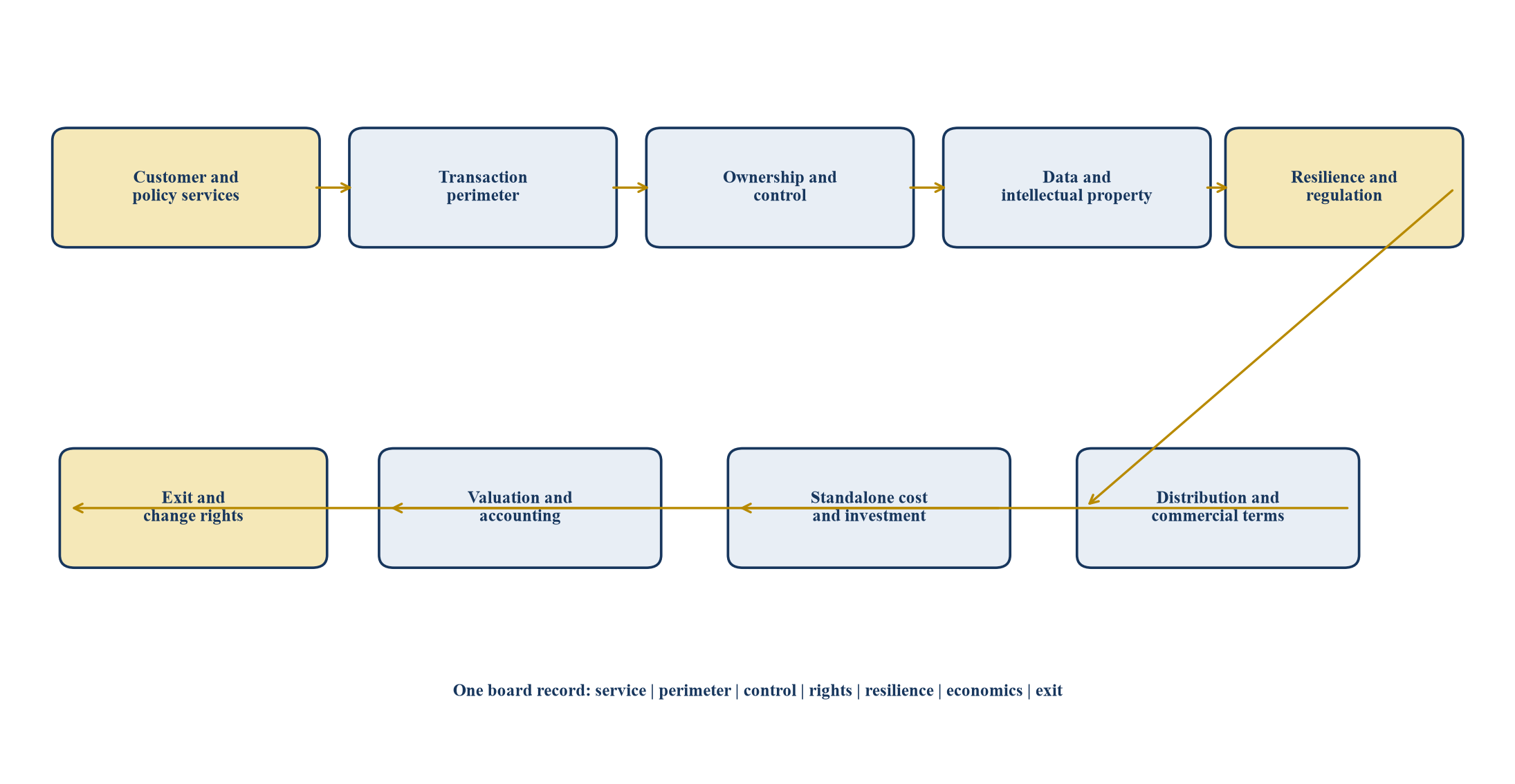
The framework begins with customer and policy services and links the transaction perimeter to control, data, resilience, economics and future exit.
4. Ground the decision in digitalisation evidence
Insurance technology already spans much of the value chain. EIOPA's 2024 digitalisation report found varied levels of digital maturity across European insurers and reported that digital-only distribution still lagged physical or hybrid channels, particularly for life products [3]. It also reported extensive cloud use and material adoption of artificial intelligence. These findings matter because a platform's value can depend on hybrid distribution and group infrastructure rather than on software alone.
EIOPA reported that nearly 80 per cent of survey respondents used BigTech companies for cloud storage, while 50 per cent of non-life insurers and 24 per cent of life insurers used artificial intelligence [3]. Those findings do not establish a valuation multiple. They show that technology assets can carry concentrated third-party, data and governance dependencies.
IAIS work on operational resilience identifies cyber resilience, third-party outsourcing and business continuity management as material insurance-sector issues [4]. The Financial Stability Board's final third-party-risk toolkit similarly focuses on critical services and the lifecycle management of third-party relationships [5].
The implication for monetisation is direct. A platform can become an external company while remaining a critical service provider to the insurer. Transaction documents, regulatory analysis and the operating model should therefore be designed together.
5. Define the transaction perimeter
The perimeter should identify every asset, liability, right, obligation and dependency required for standalone operation. The legal-entity schedule alone is insufficient. The technology may be spread across group companies, shared contracts, central teams, cloud tenants, source-code repositories, data environments and customer agreements.
The perimeter register should cover software, code, models, documentation, domains, trademarks, patents, databases, licences, infrastructure, devices, vendor contracts, employees, contractors, premises, financial records, customer rights, regulatory records and known disputes. It should identify ownership, user, location, transferability, consent, cost, replacement route and Day-One requirement.
Shared components require an explicit decision. They can be transferred, duplicated, licensed, replaced or supplied temporarily. Each choice changes standalone cost, completion timing, service risk and bargaining power. A shared policy-administration core may be impossible to transfer without disrupting other products. A reusable pricing engine may require separate model governance and data rights. A group cloud agreement may not permit assignment or independent pricing.
The perimeter should follow the service-to-cash chain. It should include the capability to quote, issue, service, bill, collect, reconcile and report. An attractive product interface without the operational and financial infrastructure behind it is not a standalone business.
6. Define the hypothetical platform
The worked case assumes an insurer owns a digital platform that supports direct and partner distribution, policy administration and selected claims workflows. The platform supports 1.2 million active policies and products with USD 540 million of annual gross written premium. These amounts are illustrative management assumptions.
The platform has USD 82 million of attributed annual revenue. This consists of an internal service charge, distribution-related income and limited external revenue. Standalone recurring cost is estimated at USD 61 million, producing a USD 21 million management EBITDA proxy. Neither the revenue allocation nor the EBITDA proxy is audited or presented as observed company performance.
The platform employs 310 people and depends on 44 group-provided roles during separation. It uses 27 material applications, nine critical interfaces and four cloud or data providers. The insurer attributes 38 per cent of new policy volumes to journeys in which the platform is material. These inputs are management scenarios for testing transaction structures.
The board compares four structures: a full sale with a long-term service and distribution agreement; a controlled spin-out with external growth capital; a 50:50 joint venture with a strategic technology or distribution partner; and a minority strategic investment with a commercial partnership. Table 1 summarises the starting case.
| Item | Illustrative assumption | Decision relevance | Required evidence |
|---|---|---|---|
| Active policies supported | 1.2m | Service criticality | Reconciled policy and platform records |
| Annual gross written premium supported | USD 540m | Distribution exposure | Product and channel reporting |
| Attributed annual platform revenue | USD 82m | Valuation base | Carve-out revenue bridge |
| Standalone recurring cost | USD 61m | Independent economics | Resource and vendor cost model |
| Management EBITDA proxy | USD 21m | Scenario comparison | Audited bridge and accounting review |
| Employees | 310 | Operating perimeter | Role and employment inventory |
| Group-provided roles | 44 | Separation dependency | Named transition and replacement plan |
| Material applications | 27 | Technology perimeter | Application and interface inventory |
| New volume with material platform dependency | 38% | Distribution continuity | Journey-level attribution |
| Model period | 5 years | Structure comparison | Board-approved scenario horizon |
Every amount, policy count, employee count, dependency and valuation input is an illustrative management assumption rather than observed company data or a forecast.
7. Separate revenue from transfer pricing
An internal service charge can support management reporting without proving third-party revenue. The transaction case should separate external contracted revenue, arm's-length internal charges, allocated group income, pass-through costs and economic benefits that remain with the insurer.
The platform revenue bridge should identify payer, service, contract, pricing unit, volume, term, renewal, indexation, service level, credit risk and termination rights. It should also identify whether a payment is consideration for technology, distribution, data, brand, personnel, claims services or regulated activity. Bundled charges obscure both value and conduct risk.
The insurer's continuing agreement should be priced through an observable mechanism. Possible units include policy, quote, claim, active user, premium volume, API call, module or fixed capacity. The selected mechanism should align incentives without rewarding unsuitable sales or poor customer outcomes. The Insurance Distribution Directive requires distributors to act honestly, fairly and professionally in customers' best interests [1].
The board should model two values: the platform's standalone enterprise value and the insurer's total value after service charges, distribution economics, retained obligations, tax, separation cost and risk. A structure can raise the first while reducing the second.
8. Compare the four ownership structures
A full sale transfers control and can create immediate proceeds. It offers the buyer broad strategic freedom and can produce a clean valuation benchmark. The insurer requires durable service, distribution, data, audit, resilience and exit rights because it becomes dependent on a third party.
A controlled spin-out introduces outside capital while the insurer retains control. It can preserve strategic direction and distribution alignment. It may restrict commercial neutrality, retain consolidation and capital demands, and produce related-party governance challenges.
A joint venture combines capabilities and shares investment. It can open a new distribution network or technology stack. Its value depends on reserved matters, funding obligations, deadlock, business plan approval, intellectual-property rights, data, exclusivity and exit. IFRS 11 focuses on the rights and obligations created by a joint arrangement rather than legal form alone [6].
A minority strategic investment causes less disruption and can test a commercial thesis. The platform remains primarily insurer-controlled, and monetisation is partial. Information rights, strategic influence, future funding and exit terms need definition. IAS 28 uses significant influence, rather than ownership percentage alone, to determine associate accounting [7].
| Structure | Immediate monetisation | Insurer control | Distribution relationship | Principal execution dependency |
|---|---|---|---|---|
| Full sale | Highest potential upfront proceeds | Relinquished | Long-term arm's-length agreement | Durable service, data, audit and exit rights |
| Controlled spin-out | Partial proceeds with retained ownership | Retained through majority ownership and governance | Related-party commercial agreement | Standalone capability and related-party discipline |
| 50:50 joint venture | Shared funding and value | Joint decision-making | Partnership agreement with deadlock protection | Funding alignment, reserved matters and continuity during deadlock |
| Minority strategic investment | Limited initial monetisation | Largely retained | Commercial partnership with defined rights | Strategic influence, future funding and credible investor exit |
The comparison identifies the principal commercial effect of each route. Company-specific evidence and authorised advice remain required.
9. Establish control and reserved matters
Control determines who can direct product development, pricing architecture, customer journeys, technology investment, cybersecurity, data use and external sales. It also affects consolidation and the ability to protect the insurer when strategic interests diverge.
IFRS 10 defines control through power over the investee, exposure or rights to variable returns and the ability to use power to affect those returns [8]. Contractual rights, board composition and decision processes therefore matter alongside share ownership. Protective rights should not be treated as operating control without accounting analysis.
Reserved matters should cover annual plans, budgets, capital calls, debt, acquisitions, disposals, material contracts, related-party transactions, data use, intellectual property, product changes, outsourcing, cybersecurity, key executives, litigation, distributions and exit. The list should be matched to decision thresholds and time limits. Excessive vetoes can prevent ordinary operation; weak rights can expose regulated services.
Deadlock provisions should reflect the consequence of delay. Escalation, mediation, expert determination, rotating authority, buy-sell mechanisms or a defined separation path can be appropriate for different decisions. Customer and regulatory matters require a continuity solution that operates while ownership disputes are unresolved.
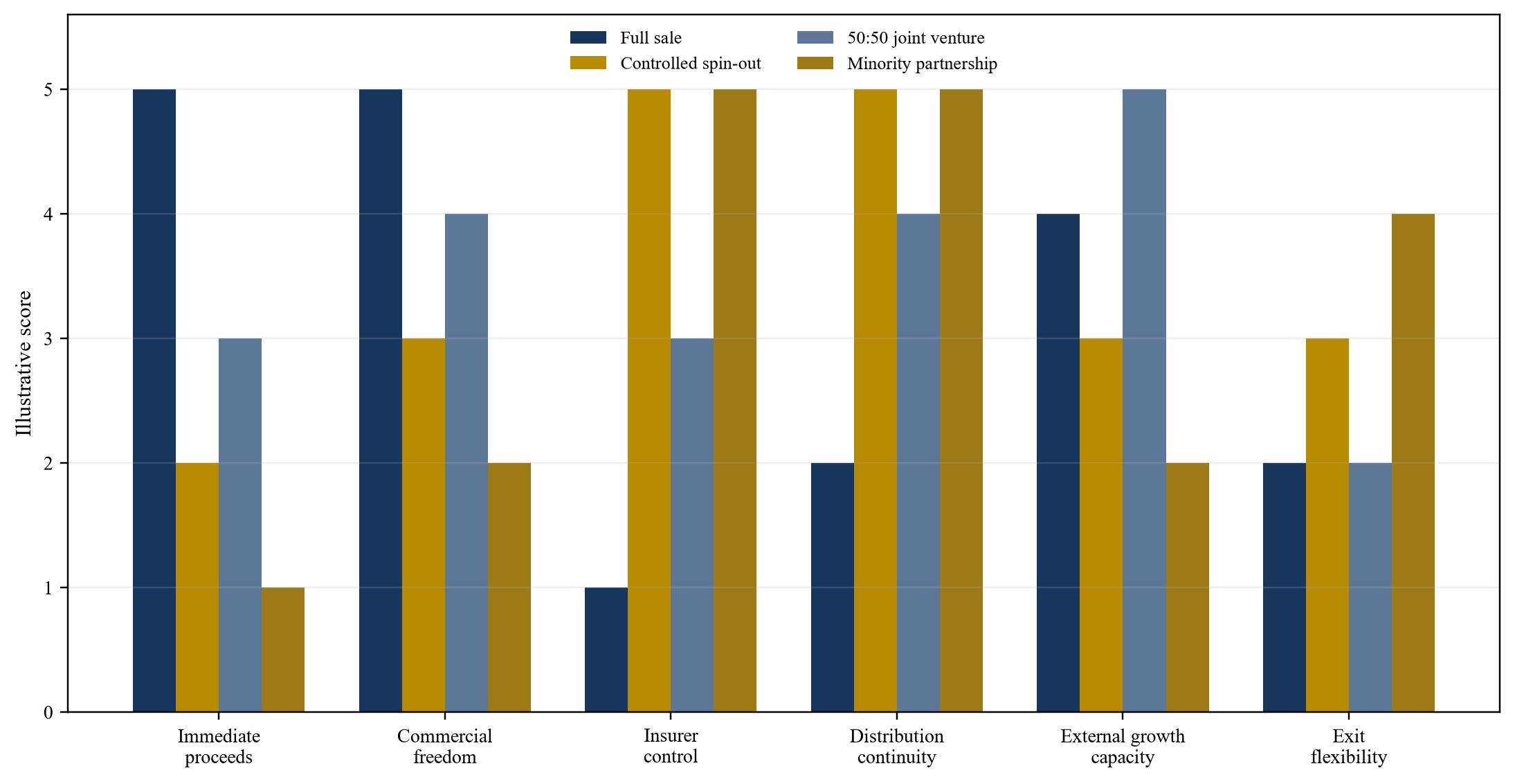
Scores are illustrative management assessments on a five-point scale and do not represent market observations or legal conclusions.
10. Preserve distribution without creating dependency
The insurer and platform need a commercial agreement that defines channel access, products, territories, customer ownership, lead allocation, service levels, economics and term. Exclusivity can support investment and value while reducing flexibility and competition. The agreement should define scope, duration, performance conditions, exceptions and remedies.
Distribution rights should be separated from technology services. The insurer may need continued access to a digital channel while retaining the ability to add products, use alternative channels or bring services in-house. The platform may need permission to serve other insurers without using confidential information or creating unacceptable conflicts.
The agreement should address product approval, target market, customer communications, sales quality, remuneration, complaints, vulnerable customers, renewals and post-sale service. The insurer should retain sufficient information and authority to discharge obligations that remain with it.
The downside case should include platform underperformance, strategic sale to a competitor, ownership deadlock, insolvency, cyber incident and termination. For each case, the insurer needs a defined continuity route, data access and transition period. An untested contractual right to exit is weaker than a technically executable alternative.
11. Map regulated activities and accountability
The operating model should identify every activity that may be regulated or supervised. Technology development, lead generation, customer communication, product comparison, advice, underwriting support, claims decisions and complaint handling can carry different legal consequences depending on the jurisdiction and facts.
The insurer should maintain an accountability map that identifies the legal entity responsible for each customer and regulatory outcome. Outsourcing does not remove the insurer's obligations. EIOPA's Solvency II rulebook requires written outsourcing policies and terms consistent with the undertaking's obligations [9].
The map should distinguish delegated authority from information supply. A platform can provide tools, data or recommendations while the insurer retains the decision. If the platform exercises discretion, accepts customers, alters terms or communicates regulated decisions, the legal and supervisory analysis may change.
Regulatory engagement should be planned from the proposed facts. The plan should identify notifications, approvals, change-of-control requirements, outsourcing assessments, fit-and-proper considerations, product governance and information requests. The transaction timetable should include sufficient time for those steps and alternatives if approval conditions affect value.
12. Protect operational resilience
The platform may support an important business service even after ownership changes. The insurer should map the people, processes, technology, facilities and information required to deliver that service. The FCA expects firms to understand those dependencies when managing outsourcing and third parties [10].
DORA requires covered financial entities to assess ICT third-party risk, conduct due diligence, maintain contractual rights and create tested exit strategies for ICT services supporting critical or important functions [11]. The regulation requires exit without disruption, impaired regulatory compliance or detriment to client service. These principles provide a useful transaction test even where another regime applies.
The service agreement should cover availability, capacity, recovery, incidents, security, audit, subcontracting, locations, data access, remediation, regulatory cooperation and termination. Service levels should measure customer and policy outcomes rather than infrastructure activity alone.
Resilience evidence should include mapped services, impact tolerances, scenario tests, recovery results, incident records, capacity tests and exit rehearsals. A seller warranty cannot replace current operating evidence. Material weaknesses should affect price, conditions, investment, contractual protection and the structure itself.
13. Allocate data rights and responsibilities
Insurance platforms can depend on customer, policy, claims, health, telematics, behavioural, pricing and fraud data. A transaction should classify each dataset by controller, processor, purpose, lawful basis, consent where relevant, location, retention, access, sharing, portability and deletion.
Ownership language alone does not resolve data rights. Personal data is governed by applicable law and cannot be transferred or reused solely because a contract calls it an asset. The EU General Data Protection Regulation allocates responsibilities to controllers and processors and requires purpose, security and data-subject rights to be addressed [12].
The platform may require continued access to insurer data to provide services and develop products. The insurer may require data generated by the platform to monitor distribution, underwriting, claims and customer outcomes. Rights should be specific to purpose, field, geography, duration and permitted users. Model training and derived data require separate treatment.
The separation plan should define extraction, migration, reconciliation, residual copies, access revocation and evidence of deletion. The EU Data Act includes switching and portability requirements for data-processing services, including contractual information and transition support [13]. Applicable requirements should be confirmed for the services and jurisdictions involved.
14. Separate intellectual property and innovation rights
The intellectual-property register should identify code, models, inventions, documentation, databases, interfaces, content, trademarks, domains and know-how. For each item, the register should identify creator, employer or contractor, legal owner, evidence, licences, restrictions, open-source components, jurisdictions and transfer route.
Shared intellectual property requires a deliberate structure. The insurer can transfer ownership and retain a licence, retain ownership and license the platform, or divide rights by field, geography or product. Each structure affects value, freedom to operate, enforcement, investment and future exit.
Improvements should be allocated before development begins. The agreement should define ownership of platform-wide improvements, insurer-specific configurations, jointly developed functionality, models trained on insurer data and interfaces built for other customers. Rights to use background intellectual property should survive termination where continuity requires them.
Open-source and third-party licences should be tested for transfer, change of control, distribution and source-code obligations. Weak chain-of-title evidence can reduce value and delay completion. The remediation plan should include contractor assignments, missing records, licence consents and code-provenance review.
15. Build the standalone operating model
Standalone cost should be built from activities and service volumes. It should cover leadership, engineering, product, sales, customer support, finance, risk, legal, compliance, data protection, security, procurement, human resources, facilities, insurance and corporate systems.
The current group cost allocation may omit capabilities supplied centrally or include costs the platform will not need. The standalone model should therefore identify transferred resources, new hires, outsourced services, duplicated systems, scale loss and investments required for external customers. It should distinguish recurring cost from one-time stand-up and separation cost.
The operating model should also identify capabilities that remain with the insurer. The insurer may need vendor management, architecture, information security, data governance, business continuity and product oversight functions to supervise the separated provider. Those retained costs belong in the insurer value case.
The resource plan should state timing, scarcity, hiring lead times and interim coverage. A transaction can close legally while the platform remains dependent on group staff. Each dependency should have an owner, service period, exit milestone and tested replacement.
16. Design transitional services around exits
Transitional services should support continuity while permanent capability is established. They should not conceal an unresolved operating model. Each service needs scope, users, volume, service level, cost, security, data, subcontractors, change control, exit deliverables, planned exit date and final stop date.
Technology services can include hosting, identity, networks, security operations, service desk, data, integration, development tools, finance systems and workplace technology. Business services can include payroll, procurement, legal, finance, risk and regulatory reporting. Both types require measurable acceptance criteria.
The TSA schedule should distinguish provider obligations from buyer readiness. A delay can result from missing data, unavailable interfaces, incomplete target systems or late decisions. Charges and extensions should reflect responsibility and preserve incentives to exit.
Exit should be tested through service rehearsals. The platform should operate, recover and produce evidence without seller support. The insurer should confirm continued service and monitoring after each dependency ends. The TSA closes only when acceptance evidence is complete, residual access is removed and cost is reconciled.
17. Translate structure into accounting and reporting
The accounting analysis should follow the contractual rights and facts. A sale, controlled subsidiary, joint arrangement and associate can produce different consolidation, presentation and earnings outcomes. These effects should be modelled separately from economic value.
IFRS 5 requires a disposal group to be classified as held for sale when specified criteria are met and sets related measurement and presentation requirements [14]. The board should confirm when the criteria are satisfied and how the perimeter affects assets, liabilities and discontinued-operation presentation.
IFRS 10 uses control to determine consolidation [8]. IFRS 11 classifies joint arrangements through rights and obligations [6]. IAS 28 applies the equity method to associates and joint ventures, subject to its requirements and exceptions [7]. The legal structure and board rights should be reviewed with accounting advisers before financial effects are presented as settled.
The model should also address revenue recognition, related-party transactions, intangible assets, taxes, employee incentives, retained interests and impairment. A transaction can create cash proceeds while reducing reported revenue or adding equity-accounted volatility. The board pack should reconcile cash, accounting and economic views.
18. Value the platform and the retained relationship
Valuation should use evidence appropriate to the business model. Relevant approaches can include discounted cash flow, public-company references, precedent transactions and unit economics. A captive platform with allocated revenue requires a bridge to arm's-length revenue and standalone cost before external multiples are meaningful.
The model should separate platform value from distribution value. Distribution can create customer access, renewal economics and data that support the platform's growth. The insurer should not transfer those benefits without consideration or rights. The commercial agreement may contain minimum volumes, exclusivity, pricing, marketing support or product commitments that affect both businesses.
The retained stake should be valued under central and downside cases. Governance restrictions, illiquidity, dilution, future funding, preference rights, transfer restrictions and exit timing can affect its economic value. A high headline enterprise value does not equal cash available to the insurer.
The total-value bridge should include cash proceeds, retained interest, service costs, distribution economics, tax, separation cost, stranded cost, retained investment, risk exposure and exit cost. This bridge is the basis for comparing structures.
| Measure | Full sale | Controlled spin-out | 50:50 joint venture | Minority partnership |
|---|---|---|---|---|
| Upfront cash proceeds | USD 185m | USD 70m | USD 105m | USD 45m |
| Illustrative platform enterprise value | USD 210m | USD 225m | USD 235m | USD 250m |
| Insurer ownership after transaction | 0% | 65% | 50% | 80% |
| Five-year insurer service and distribution cost | USD 162m | USD 126m | USD 132m | USD 119m |
| One-time separation and stand-up cost | USD 34m | USD 28m | USD 31m | USD 18m |
| Downside transition and exit reserve | USD 52m | USD 31m | USD 38m | USD 24m |
| Illustrative control score | 1.5/5 | 4.5/5 | 3.0/5 | 4.5/5 |
| Illustrative commercial freedom score | 5.0/5 | 3.0/5 | 4.0/5 | 2.5/5 |
| Indicative board conclusion | Highest immediate liquidity | Strong control and partial monetisation | Capability partnership with deadlock risk | Lowest disruption and incomplete monetisation |
Values are hypothetical management scenarios before jurisdiction-specific tax, accounting, legal and regulatory analysis. They are not valuations or forecasts.
19. Test central and adverse scenarios
The central case should reflect the board-approved business plan, supported customer volumes, current cost and contracted investment. The adverse case should test lower external sales, slower product delivery, higher standalone cost, service failure, customer remediation, regulatory conditions and delayed TSA exit.
The severe case should combine failures that can occur together. A cyber incident can reduce service, increase remediation cost, delay external sales and trigger regulatory scrutiny. A strategic-owner dispute can delay investment and force the insurer to retain expensive alternatives. The model should avoid adding independent probabilities to correlated events.
The hypothetical model uses three scenarios. The central case assumes planned external growth and TSA exit within eighteen months. The adverse case assumes a twelve-month sales delay, 15 per cent higher standalone cost and a six-month TSA extension. The severe case assumes a material service incident, two-year growth delay, 25 per cent cost overrun and an accelerated insurer transition.
Scenario outputs should include cash proceeds, retained-interest value, service cost, policy and premium exposure, customer remediation, capital requirement, liquidity, separation cost and time to an executable exit. The result should identify the binding constraint for each structure.
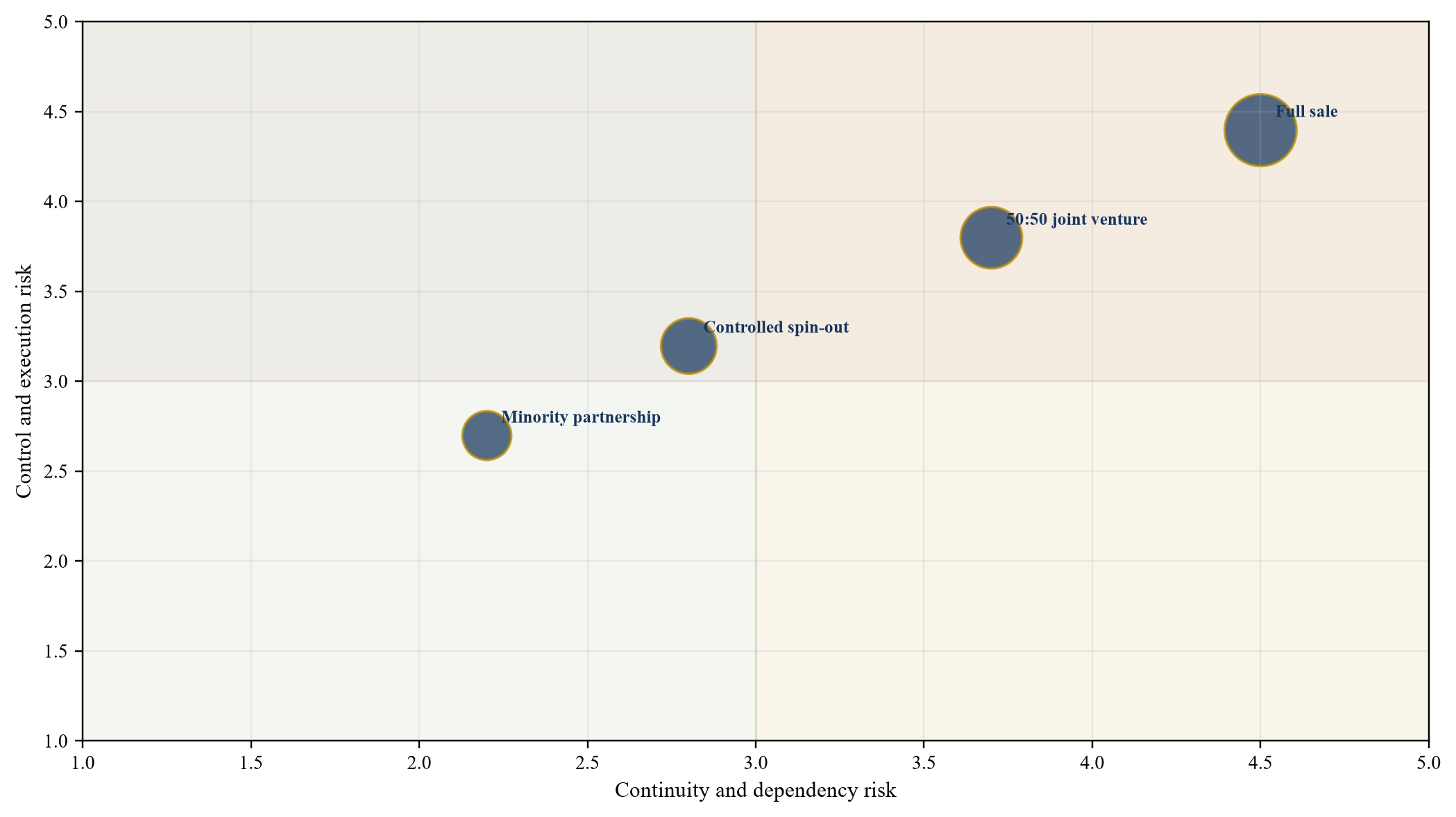
Bubble size represents hypothetical downside exposure. Scores are management assumptions and do not represent measured risk or legal conclusions.
20. Pre-agree management actions
Management actions should be executable, owned and reflected in contracts. Possible actions include reducing exclusivity, retaining source-code escrow, adding a secondary provider, delaying transfer of a critical service, retaining a larger stake, funding a resilience programme or changing the transaction route.
Each action should state trigger, authority, lead time, cost, customer effect and evidence of readiness. A right to terminate can be economically weak when migration requires years. A right to audit can be weak when the insurer lacks access, skill or remediation rights.
The severe case should include actions that remain available after ownership changes. The insurer may need continued licences, data extraction, step-in rights, transition assistance and access to key personnel. The platform may need funding commitments, minimum commercial support and protection against abrupt withdrawal of distribution.
Actions should be tested before completion where possible. Recovery tests, data exports, source-code build tests, alternate routing, manual workarounds and communication exercises can establish whether the contractual remedy is operationally useful.
21. Govern artificial intelligence and third-party models
An InsurTech platform may use artificial intelligence in pricing, underwriting, fraud detection, claims, customer service or distribution. The transaction perimeter should identify each system, purpose, owner, data, model, third party, validation, performance limit and human decision point.
The NAIC Model Bulletin reminds insurers that consumer-impacting decisions supported by artificial intelligence remain subject to applicable insurance laws and sets expectations for a written governance programme [15]. NAIC work in 2025 and 2026 has also focused on regulatory evaluation of AI systems and third-party data and models [16].
Ownership change can alter model access, data rights, development incentives and accountability. The insurer should retain evidence needed to explain and challenge decisions that affect customers. The platform should define which models can be used for external clients and how confidential information is separated.
The commercial agreement should address model changes, validation, drift, bias, incidents, audit, regulator access, data provenance, subcontractors and exit. High-risk use cases require approval and evidence before they are transferred or commercialised.
22. Build the transaction decision scorecard
The scorecard should use evidence thresholds and red-line conditions. A weighted average can hide a failure in customer continuity, regulated accountability, data rights, cybersecurity, financial viability or exit capability.
The board should assess each structure across strategic fit, proceeds, retained value, commercial freedom, distribution, customer outcomes, control, regulation, operational resilience, data, intellectual property, people, accounting, tax, capital, execution and exit. Evidence confidence should be recorded separately from the score.
Red-line conditions can include an unserviceable product journey, unassignable critical rights, unresolved data legality, missing source-code ownership, insufficient capital, a provider-failure scenario outside impact tolerance or a distribution agreement that creates unacceptable conduct incentives.
The decision record should identify why one structure was chosen, the conditions that could change the recommendation and the evidence required before signing and completion. Table 3 provides an illustrative scorecard.
| Dimension | Board decision | Minimum evidence | Accountable owner | Red-line condition |
|---|---|---|---|---|
| Customer and distribution | Approve continuing journey and economics | Journey map, outcomes, contracts and monitoring | Chief customer officer | Material journey cannot operate through stress |
| Regulatory accountability | Confirm roles and approvals | Activity map, notifications and legal analysis | Chief compliance officer | Responsibility or permission remains unresolved |
| Technology and resilience | Confirm service and recovery | Architecture, tests, incidents and exit plan | Chief technology officer | Critical service outside impact tolerance |
| Data and AI | Approve lawful use and control | Data map, model register and governance evidence | Chief data officer | Required use lacks supported rights or oversight |
| Intellectual property | Confirm ownership and licence | Chain of title, licences and code review | General counsel | Critical asset cannot transfer or be licensed |
| Economics and value | Approve total-value bridge | Carve-out accounts, cost model and scenarios | Chief financial officer | Value depends on unsupported allocation |
| Governance and control | Approve rights and decision process | Shareholders agreement and reserved matters | Board sponsor | Deadlock can interrupt customer service |
| Exit | Confirm executable alternative | Transition plan, data export and tested capability | Chief operating officer | No viable exit from provider dependency |
The scorecard is a governance template. Thresholds and scores require company-specific evidence and authorised advice.
23. Execute through staged transaction gates
Execution should proceed through definition, evidence, market preparation, documentation, separation and post-close assurance. Each gate should release a specific commitment only when required evidence is complete.
The definition gate approves the objective, perimeter and candidate structures. The evidence gate completes carve-out financials, service maps, ownership records, regulatory analysis and the standalone plan. The market gate confirms buyer or partner qualification and information boundaries. The signing gate completes agreements, conditions, funding and separation commitments. The completion gate requires Day-One readiness. The exit gate closes transitional dependencies.
The workstreams should share one decision log. Changes in perimeter, ownership or commercial terms can affect regulation, data, accounting, tax, technology and valuation. The model and documents should be updated from the same approved facts.
The programme should include rehearsals for policy service, billing, claims, identity, data exchange, incident response, financial close, regulatory reporting and provider exit. Exceptions should have named owners, interim controls and closing consequences.
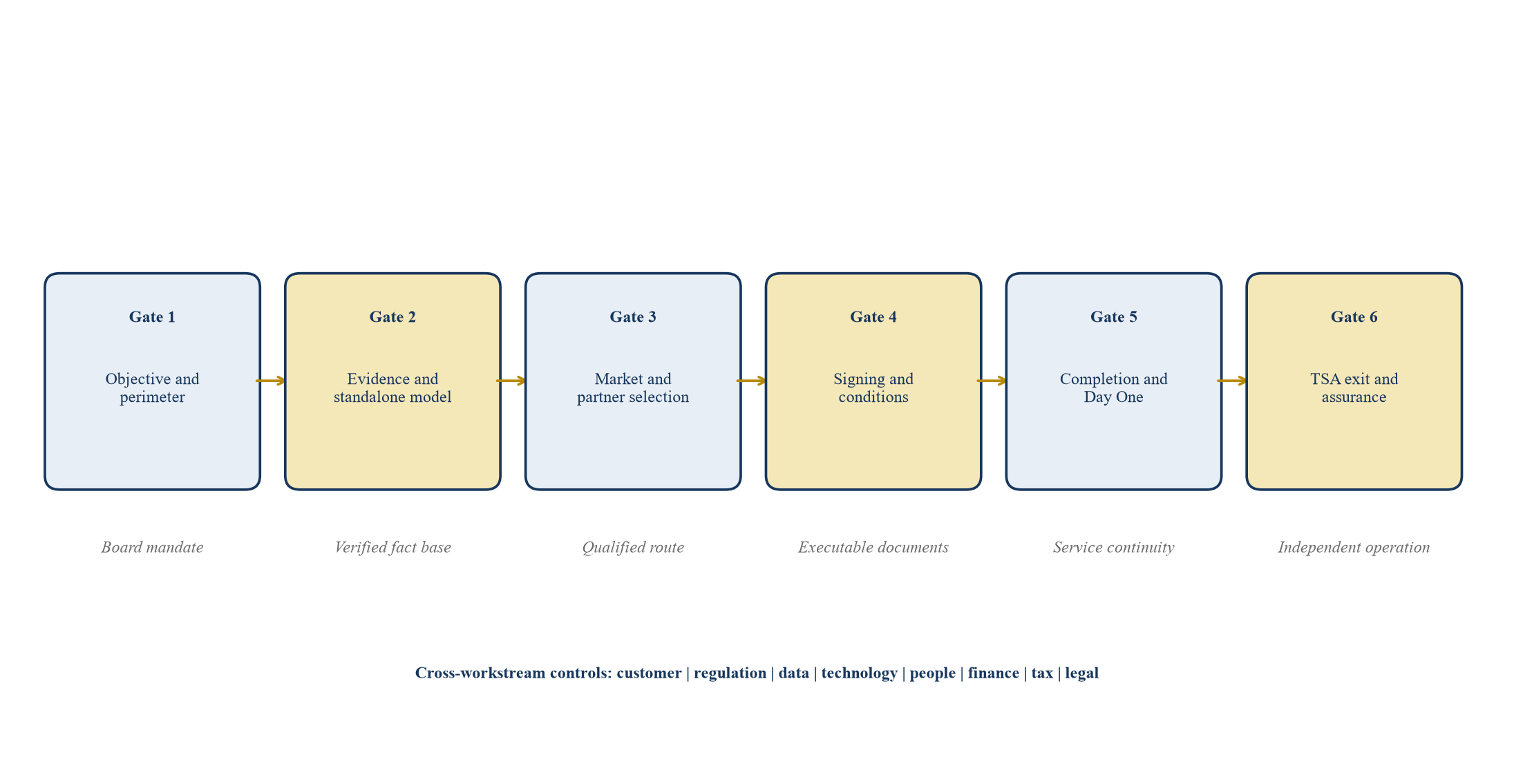
Each gate releases a defined commitment only after evidence, customer continuity and operating readiness meet the approved threshold.
24. Govern the business after completion
Post-close governance should monitor both the platform and the continuing relationship. The board dashboard should cover revenue, cost, cash, product delivery, external sales, service levels, incidents, customer outcomes, complaints, model changes, cyber risk, data, capital, related-party matters and exit readiness.
The insurer should maintain a supplier and distribution oversight function with access to information, audit rights and escalation authority. The platform board should manage commercial growth while respecting protected information, service commitments and conflicts.
Related-party pricing and changes require controlled approval. A retained controlling shareholder should avoid using the platform solely for group objectives when external investors and customers expect independent governance. A strategic partner should not receive information that weakens competition or customer confidentiality.
The continuing relationship should be reviewed after material incidents, ownership changes, acquisitions, regulatory developments and business-model changes. The board should refresh the value case annually and compare actual results with the assumptions used to approve the transaction.
25. Apply the monetisation framework
The framework can be applied in a disciplined sequence. First, define the board objective and customer services that must remain continuous. Second, establish the transaction perimeter and standalone operating model. Third, confirm regulated activities, accountability, data and intellectual-property rights. Fourth, compare ownership structures through control, commercial freedom, accounting and exit.
Fifth, build the total-value bridge across proceeds, retained interest, service and distribution economics, tax, cost and risk. Sixth, negotiate commercial, governance, resilience and transition documents from the same facts. Seventh, test Day-One and provider-failure scenarios. Eighth, monitor the post-close relationship and execute planned exits.
In the hypothetical case, the controlled spin-out produces lower immediate proceeds than a full sale while preserving stronger distribution continuity and control. The minority partnership has the lowest disruption and the highest illustrative headline enterprise value, while leaving monetisation incomplete. The joint venture brings external capability and introduces material deadlock and funding risk. These are scenario results, not transaction recommendations.
The board should select a structure only after company-specific evidence, valuation and authorised legal, regulatory, accounting and tax advice. The preferred route is the one whose total value remains supportable after customer, resilience and exit constraints are included.
The final approval paper should record the rejected alternatives, the evidence that changed the decision, the unresolved conditions and the person accountable for each condition. That record gives the board a stable baseline for completion, post-close monitoring and any later decision to expand, restructure or exit the relationship.
26. Limitations and conclusion
This paper provides a transaction decision framework for insurer-owned technology assets. It does not determine regulatory permissions, outsourcing classification, data legality, intellectual-property ownership, accounting treatment, tax, valuation, competition law, employment transfer or contractual enforceability.
The worked case is hypothetical. Policy volumes, premium, revenue, costs, values, scores, probabilities, timing and risk amounts are illustrative management assumptions. They are not observed company results, market benchmarks, forecasts or valuations.
An InsurTech asset can create value through external customers, specialist capital and commercial focus. Its value can also depend on access to the insurer's products, data, brand, people and regulated operating model. The transaction should make those dependencies visible and price them.
The insurer should preserve customer service, evidence, accountability and executable exit capability through the entire ownership cycle. The platform should receive sufficient rights, resources and governance to operate as a credible business. The InsurTech Monetisation and Distribution Continuity Framework provides a controlled route from board objective to transaction structure, separation and continuing oversight.
Sources
- European Union, Directive (EU) 2016/97 on insurance distribution, 20 January 2016, accessed 17 September 2026, Read the primary source
- European Commission, Delegated Regulation (EU) 2017/2358 on product oversight and governance requirements for insurance undertakings and distributors, 21 September 2017, accessed 17 September 2026, Read the primary source
- European Insurance and Occupational Pensions Authority, Report on the Digitalisation of the European Insurance Sector, 30 April 2024, accessed 17 September 2026, Read the primary source
- International Association of Insurance Supervisors, Issues Paper on Insurance Sector Operational Resilience, 23 May 2023, accessed 17 September 2026, Read the primary source
- Financial Stability Board, Enhancing Third-Party Risk Management and Oversight: A Toolkit for Financial Institutions and Financial Authorities, 4 December 2023, accessed 17 September 2026, Read the primary source
- IFRS Foundation, IFRS 11 Joint Arrangements, standard overview and issued requirements, accessed 17 September 2026, Read the primary source
- IFRS Foundation, IAS 28 Investments in Associates and Joint Ventures, standard overview, accessed 17 September 2026, Read the primary source
- IFRS Foundation, IFRS 10 Consolidated Financial Statements, issued requirements, accessed 17 September 2026, Read the primary source
- European Insurance and Occupational Pensions Authority, Solvency II Single Rulebook Article 274 on Outsourcing, updated 12 April 2024, accessed 17 September 2026, Read the primary source
- Financial Conduct Authority, Outsourcing and Operational Resilience, updated 14 July 2026, accessed 17 September 2026, Read the primary source
- European Union, Regulation (EU) 2022/2554 on Digital Operational Resilience for the Financial Sector, 14 December 2022, accessed 17 September 2026, Read the primary source
- European Union, Regulation (EU) 2016/679 General Data Protection Regulation, 27 April 2016, accessed 17 September 2026, Read the primary source
- European Union, Regulation (EU) 2023/2854 on harmonised rules on fair access to and use of data, 13 December 2023, accessed 17 September 2026, Read the primary source
- IFRS Foundation, IFRS 5 Non-current Assets Held for Sale and Discontinued Operations, standard overview, accessed 17 September 2026, Read the primary source
- National Association of Insurance Commissioners, Model Bulletin on the Use of Artificial Intelligence Systems by Insurers, adopted 4 December 2023, accessed 17 September 2026, Read the primary source
- National Association of Insurance Commissioners, Insurance Topics: Artificial Intelligence, updated 2026, accessed 17 September 2026, Read the primary source
- Bank of England, Prudential Regulation Authority, SS2/21 Outsourcing and Third Party Risk Management, March 2021, accessed 17 September 2026, Read the primary source
- European Insurance and Occupational Pensions Authority, Guidelines on Outsourcing to Cloud Service Providers, 6 February 2020, accessed 17 September 2026, Read the primary source
