
1. Gravity is a physical principle, not an investment category
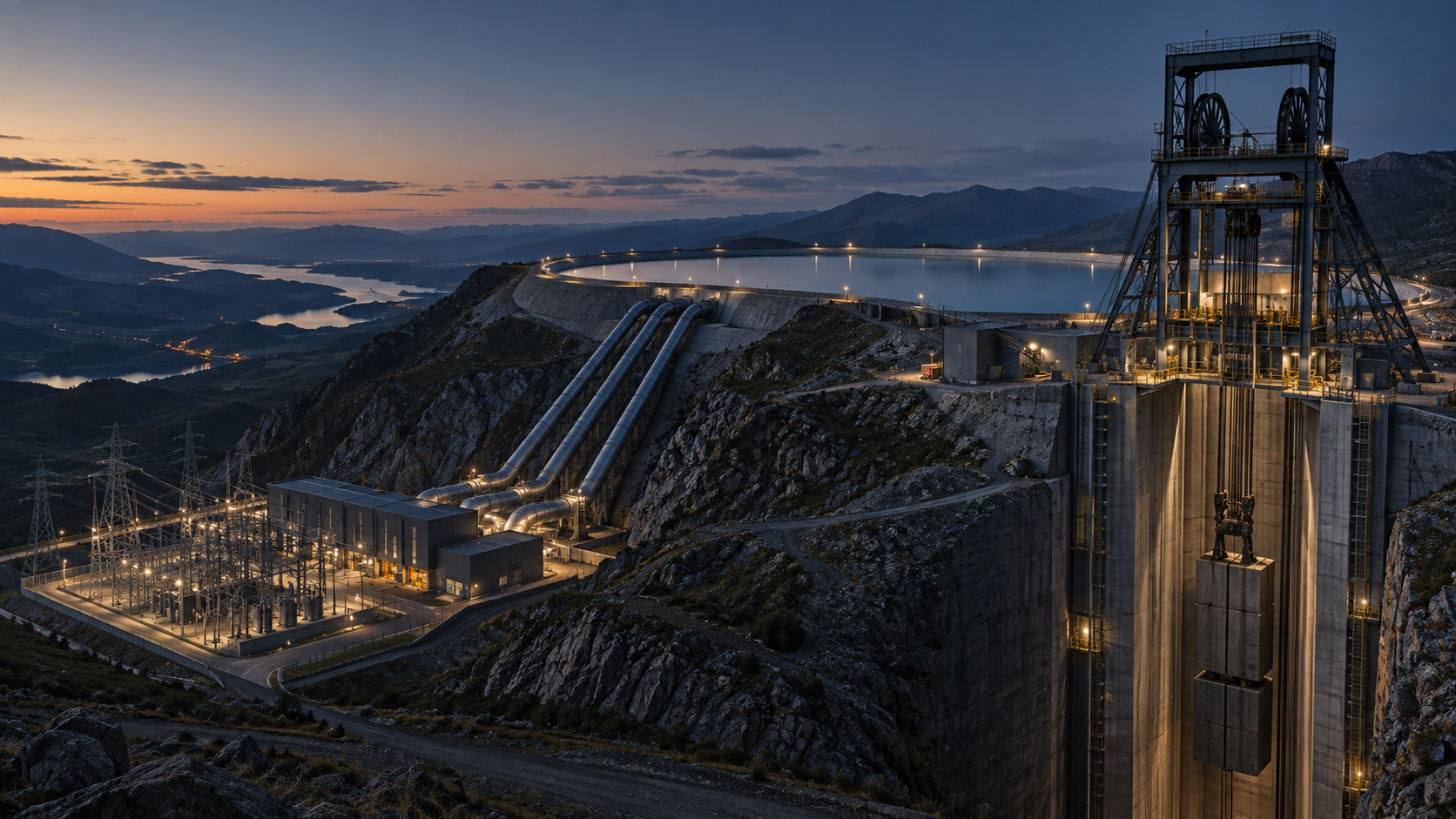
Every gravity-storage concept stores potential energy by changing the position or pressure state of a mass. Water can move between reservoirs. Solid weights can move through shafts, towers or slopes. Pressurised water can deform an underground formation. These systems share a physical foundation and differ materially in engineering, permitting, operating evidence and contractual risk.
The investment question therefore begins with the complete asset. A credible project needs a controlled site, a measurable energy-conversion path, grid access, construction certainty, operating evidence and revenue suited to its duration and response. A familiar equation cannot substitute for those elements.
Comparisons should use the same system boundary. Gross stored energy, rated motor power and theoretical head describe different attributes. Net export, usable duration, auxiliary load, losses, availability and commercial dispatch determine cash generation.
2. The governing equation imposes a scale discipline
The theoretical potential energy of a lifted mass is the product of mass, gravitational acceleration and vertical height. The relationship is linear. Doubling the mass or effective head doubles theoretical energy before conversion losses. It does not create the large energy density available from a chemical fuel.
This simple relationship is a powerful diligence tool. A proposed shaft system must reconcile claimed megawatt-hours with payload, travel distance, number of masses, operating sequence and conversion efficiency. A pumped system must reconcile reservoirs, usable water volume, head variation, turbine range and environmental constraints.
The calculation should then move from theoretical to deliverable energy. Mechanical, hydraulic, electrical and auxiliary losses; operating margins; minimum reservoir levels; unavailable travel; and maintenance states all reduce the commercial quantity.
3. Power and energy scale through different equipment
Power is governed by the rate at which energy can be converted. Energy capacity is governed by mass, height, volume and usable operating range. A larger motor-generator can increase megawatts without increasing stored megawatt-hours. Additional reservoir volume or lifted mass can extend duration while leaving the power block unchanged, subject to conveyance and control limits.
This distinction matters for cost. A financeable estimate should separate power-related equipment from energy-related infrastructure, common civil works, development, grid connection and owner costs. A single currency-per-kilowatt-hour benchmark can hide a project with an expensive power block or an impractical energy store.
Revenue also separates. Fast response may value power and controls. Capacity and long-duration arbitrage value sustained energy. The design should follow a defined service stack.
4. Pumped storage is the commercial reference class
Pumped storage hydropower moves water uphill during charging and returns it through turbines during discharge. It has an extensive operating history and represents the largest deployed category of grid-scale mechanical storage. Closed-loop systems use reservoirs that are largely isolated from natural waterways, while other configurations interact with existing reservoirs or river systems.
Commercial maturity does not make a project generic. Head, geology, water availability, tunnelling, dams, waterways, grid connection and environmental approvals are site-specific. Development periods can extend across many years. Construction risk can concentrate in underground works and geological conditions that become fully visible only after excavation.
Pumped storage should therefore serve as an evidence benchmark rather than an automatic winner. Its operating record is valuable; its schedule and civil complexity remain central valuation inputs.
5. Closed-loop pumped storage changes the permitting perimeter
Closed-loop projects can reduce direct interaction with continuously flowing waterways. Their reservoirs, embankments, tunnels, access roads and transmission still create land, water, ecology, cultural-heritage and community issues. Initial fill, evaporation and seepage require a durable water strategy.
The United States National Renewable Energy Laboratory models new closed-loop pumped storage as a distinct technology in its Annual Technology Baseline. Its representative system and cost ranges provide a transparent public benchmark. They remain modelling inputs rather than a bid for a specific site.
Investors should trace every cost advantage claimed for closed-loop design to site evidence. Reduced river interaction may simplify one regulatory issue while excavation, lining, transmission or water supply creates another.
6. Existing-reservoir projects can inherit legacy risk
Connecting or modifying existing reservoirs can lower selected construction requirements and benefit from known infrastructure. The asset may also inherit dam-safety obligations, sediment, ageing equipment, restricted operating rules, competing water uses and unclear allocation between legacy and new works.
The project company needs enforceable rights to water levels, access, outages and future modifications. A storage model based on unrestricted reservoir cycling has limited value when flood control, irrigation, recreation or ecological constraints take priority.
Condition surveys should cover dams, tunnels, penstocks, gates, electrical systems, monitoring and emergency arrangements. Reused infrastructure deserves value only after ownership, condition, capacity and remaining life are established.
7. Mine-shaft systems offer head and impose conveyance limits
Disused mine shafts can provide vertical distance and existing industrial locations. A solid mass can be raised during charging and lowered through a generator during discharge. The economic case depends on usable depth, payload, hoisting speed, shaft condition, conveyance design, cycle frequency and the cost of rehabilitation.
Peer-reviewed studies of Polish mine shafts show why physical reconciliation matters. One case found low economic effects under the examined market conditions. A later assessment calculated that typical shaft payload and depth could yield limited energy per cycle without extensive modification. These results are jurisdiction- and asset-specific; they demonstrate the need for measured site data.
Existing hoisting equipment may support inspection or mine operations without meeting energy-storage duty. Repeated cycling, braking, ropes, guides and emergency systems require a new assurance basis.
8. Bulk-material concepts change the logistics problem
Some underground concepts move sand, aggregate or another granular material between surface and underground storage. The storage medium can be inexpensive and can remain in place without self-discharge. The system must repeatedly load, transport, unload and recover large volumes without blockage, dust, wear or unacceptable auxiliary consumption.
Energy capacity follows total mass and vertical displacement. Commercial performance also depends on conveyors, skips, bins, crushers if needed, material handling, shaft availability and the geometry of underground voids. A theoretical resource estimate should not be confused with a constructible project.
Diligence should quantify tonnes moved per hour, equipment utilisation, energy used by material handling, spillage, degradation and maintenance. The operating sequence should demonstrate that charging and discharging can meet the market product.
9. Tower and block systems trade geology for structure
Tower or building-based systems lift solid masses within an engineered structure. They can avoid reservoirs and some geological constraints. The structure, cranes or lifts, foundations, control system, wind loads, fatigue, noise and land use become the principal engineering perimeter.
Modularity can help staged construction and factory production. It does not remove system integration. Many moving units must coordinate with high reliability. Collision avoidance, braking, precise placement, cable or rail wear and safe maintenance influence availability.
An investor should require operating hours and cycle evidence at relevant scale. A visually persuasive demonstration can establish motion and control while leaving commercial cost, sustained availability and maintenance unproven.
10. Rail and incline systems need a rare site combination
Rail-based concepts move masses along a slope. They require suitable elevation, route geometry, ground stability, land rights and a grid location that values the service. Track, wheel, traction, braking and weather exposure shape operating performance.
The apparent simplicity of a vehicle moving uphill can conceal the civil and logistical system. Energy density per unit route length, fleet size, passing arrangements, maintenance access and safe stopping determine usable power and duration. Land disturbance can become substantial when many vehicles or long tracks are required.
Site screening should test constructible grade, geotechnical stability, transmission, environmental constraints and alternative land value. A concept that works physically can remain commercially stranded by location.
11. Building-integrated gravity creates a multi-use asset
Building-integrated systems propose lifting masses within tall structures or using elevators and architectural elements as part of storage. Combining functions could share foundations, land and grid infrastructure. It also couples the storage asset to occupancy, safety, insurance and building operations.
The storage duty should not compromise evacuation, tenant service, vibration standards or structural life. Ownership and control must survive a sale, refinancing or change in building use. The value of shared infrastructure should be allocated between property and energy businesses without double counting.
Completion tests require both structural and electrical performance. A project may need separate remedies for unavailable storage and interruption to the host building.
12. Geomechanical storage moves water into subsurface pressure
Geomechanical systems inject water under pressure into an underground formation, storing energy through pressure and deformation, then return water through a turbine. They share equipment with pumped hydropower and add subsurface reservoir behaviour, well integrity and geomechanical monitoring.
A 2025 peer-reviewed techno-economic study assessed a 100 MW, 1 GWh configuration across multiple United States balancing areas. Reported results were model outputs tied to stated assumptions and locations. They do not establish project-level bankability.
Subsurface performance must be demonstrated through site characterisation, injection tests, pressure response, containment and cyclic operation. Revenue modelling should recognise water handling, pumping losses, reservoir decline and operating constraints.
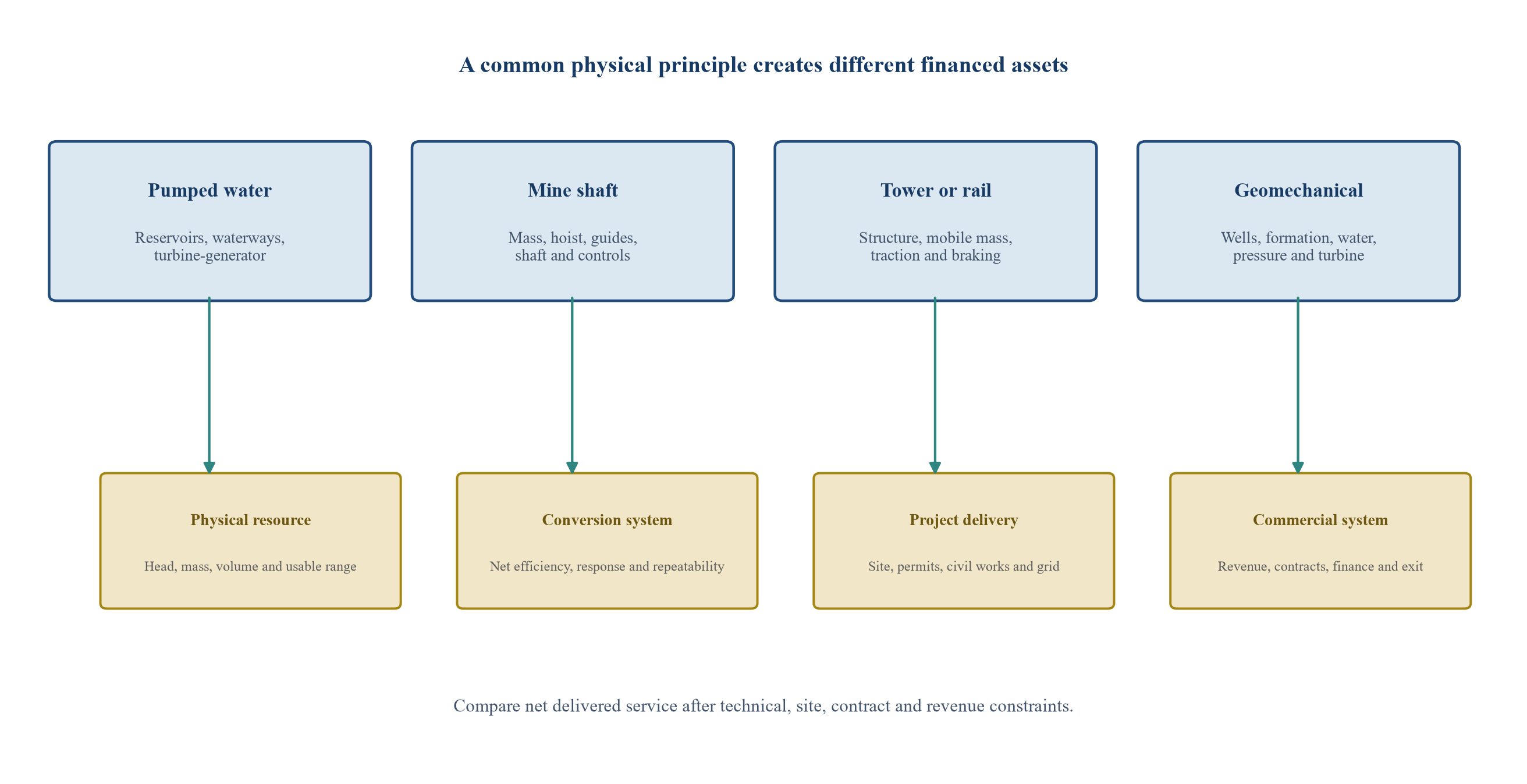
The diagram compares system boundaries. Commercial designs, performance and responsibilities remain project-specific.
13. Technology readiness should be evidence-specific
Readiness labels are useful only when their basis is visible. A concept can have mature motors, generators and controls while the integrated architecture remains unproven. A pilot can show response while leaving cost and maintenance at commercial scale unresolved.
The evidence file should state scale, configuration, duty cycle, operating hours, number of cycles, environmental conditions, outages, maintenance and measurement boundaries. Evidence from a different mass, head, structure or control architecture should receive an explicit transfer argument.
Public announcements and animations can identify a development path. Financing should depend on witnessed data, contracts and independent review. Company disclosures can be useful and remain subject to corporate reporting context.
14. Demonstration must reproduce the financed duty
A fast response test does not prove eight-hour discharge. A single full-power run does not prove repeated cycling. A successful lift does not establish low maintenance. The demonstration programme should reproduce the intended commercial sequence.
Tests should measure net charging energy, net export, duration, ramp, start reliability, state of charge, auxiliary consumption, standby losses and recovery after an interruption. Multi-cycle tests reveal thermal, mechanical and control interactions. Long-hold tests reveal leakage or parasitic load.
The project should define which results support design, construction release and debt draw. Failed tests should lead to correction, retest, additional contingency or a stop decision.
15. Public cost data require boundary reconciliation
The Department of Energy and Pacific Northwest National Laboratory include gravitational storage in the 2022 Grid Energy Storage Technology Cost and Performance Assessment. The report provides a useful transparent method across durations. It also states that emerging gravity inputs were obtained from developers and extrapolated for duration.
That limitation matters. A common published number may reflect a technology estimate rather than a contracted project price. It may omit development, site, grid, taxes, financing, contingency or owner costs.
An investment model should preserve the published source and rebuild the estimate by quantity. Each line should identify basis, date, geography, maturity, escalation and contingency. Comparable cost requires comparable scope.
16. Civil works can dominate both value and variance
Reservoirs, shafts, tunnels, foundations, towers, tracks, wells and grid works are not peripheral. They establish the storage geometry and can control schedule. Geological uncertainty, access, weather, labour productivity and interfaces create material variance.
Reference-class estimates should separate repeatable equipment from site-specific civils. A factory learning curve may reduce motor or module cost while excavation and concrete remain local. A modular headline can therefore coexist with a bespoke project cost.
Front-end engineering should quantify earthworks, rock support, lining, structures, haulage, water management and construction power. Contingency should follow uncertainty and design maturity rather than a uniform percentage.
17. Round-trip efficiency needs a metered definition
Round-trip efficiency divides net energy exported by net energy imported across an agreed cycle. The boundary should include motors, pumps, generators, power electronics, controls, cooling, conveyance and other auxiliaries. Standby consumption and conditioning should be treated consistently.
NREL's current pumped-storage modelling uses an 80 per cent central round-trip efficiency assumption and presents a wider range. That is a benchmark input. A project requires site-specific turbine, pump, hydraulic and operating evidence.
Emerging systems should report efficiency across relevant load and head. Peak component efficiency can overstate annual performance when dispatch includes starts, partial load, idle periods and state-of-charge constraints.
18. Availability is a system property
Availability depends on the weakest critical path. A hoist can be operational while a guide, brake or control channel prevents dispatch. A pumped system can have healthy turbines while a reservoir restriction or tunnel outage limits output. A geomechanical system can have available surface equipment while subsurface pressure is outside its operating range.
The reliability model should map components, common-cause failures, inspection intervals, spares and repair time. Multiple modules can provide redundancy if failures are independent and controls can isolate them.
Contracted availability should reflect the service sold. Mechanical availability alone may not satisfy a capacity or dispatch obligation.
19. Degradation changes form across technologies
Mechanical storage can avoid the electrochemical capacity fade associated with batteries. It still experiences wear, fatigue, erosion, corrosion, seal degradation, rope or rail wear, bearing damage, concrete ageing, sediment and control obsolescence.
The financial model should use inspection and overhaul intervals supported by equipment evidence. Civil life and replaceable-equipment life should be separated. Long asset life has value only when maintenance, access and replacement cost are credible.
Warranty duration should allow enough cycles and seasonal exposure for defects to emerge. Major-maintenance reserves should survive the end of vendor support.
20. Standby duration can be an advantage with conditions
A raised mass or stored water can retain potential energy for long periods with low physical self-discharge. The complete plant may still consume energy for controls, dewatering, ventilation, heating, cooling, lubrication, monitoring and security.
The distinction matters for seasonal or infrequent strategic reserve. A low self-discharge store can remain uneconomic if fixed operating cost and capital recovery exceed the value of rare dispatch.
The model should include monthly standby consumption, readiness tests, reservoir or shaft management and the energy required to return from maintenance state. Revenue should pay for readiness as well as energy when the system values insurance.
21. Site control must cover the full operating geometry
Land rights should include reservoirs, shafts, structures, slopes, wells, tunnels, access, laydown, spoil, transmission, water and safety zones. Subsurface rights may differ from surface ownership. Legacy mines can carry closure and environmental obligations.
The project should hold rights for construction, operation, inspection, remediation, expansion, refinancing and transfer. Time-limited options should align with development schedule. Rights that expire before a support award or permit decision create hold-up risk.
Boundary surveys, title, mineral rights, easements and host agreements should be complete before significant capital is committed.
22. Water is a financial input for hydraulic systems
Pumped and geomechanical systems require a defined water source, quality and operating balance. Initial fill, evaporation, seepage, treatment, make-up and discharge can affect cost and permits. Drought and competing use can restrict operation or create community opposition.
The water model should reconcile annual and extreme conditions. Rights should be enforceable for the project life. The design should specify lining, leakage monitoring, treatment and emergency release.
A water cost assumed to be immaterial can become a schedule constraint when permits or infrastructure are delayed. Its value should be treated as a controlled project right.
23. Mine reuse needs a closure-risk allocation
An abandoned mine may contain unstable workings, water, gas, contamination, inaccessible records and deteriorated supports. Reuse can defer closure activity while adding a new operating duty. Responsibility for historic conditions must be clear.
Condition assessment should include shaft lining, headframe, guides, hoisting systems, water ingress, ventilation, gas, subsidence and surrounding workings. Unknown areas should carry investigation plans and contingency.
The contract should allocate remediation, latent condition, ongoing pumping and final closure. An energy project should not acquire unlimited legacy liability through an imprecise lease.
24. Safety cases differ and remain system-wide
Large moving masses, high-pressure water, deep shafts, dams, tunnels and tall structures create low-frequency, high-consequence hazards. Brakes, catches, exclusion zones, overspeed protection, structural monitoring and emergency procedures require independent assurance.
Package compliance does not establish system safety. Interfaces between control, power, mechanical restraint and human access need a common hazard register. Design changes should pass formal safety review.
Completion should require closure of critical hazards, tested protection and trained operations. Insurance and financing should follow the disclosed residual risk.
25. Grid location can outweigh technology advantage
Storage value depends on congestion, renewable curtailment, capacity need, ancillary services and connection cost at a specific node. Gravity assets are often location-constrained by terrain, mines or geology. The best physical site may have weak market value or expensive transmission.
The project should model nodal prices, constraints, losses, queue position, network reinforcement and curtailment rights. A connection offer should match charge and discharge operation. Export capacity alone may not permit economic charging.
Site selection should integrate physical resource and grid value from the beginning. Moving the project later can invalidate engineering work.
26. Revenue stacking must follow chronology
Energy arbitrage, capacity, reserves, inertia, voltage support, congestion relief and strategic reserve can create value. The same megawatt or stored megawatt-hour cannot serve incompatible commitments simultaneously.
A chronological dispatch model should maintain state of charge, head or pressure, ramp, minimum run, start limits, maintenance and market obligations. It should show foregone revenue and penalties as well as gross income.
For long-duration assets, capacity and availability payments may be important because energy spreads alone can be insufficient or volatile. Contract terms should align with physical readiness and duration.
27. Cap-and-floor regimes reshape financeability
Ofgem's long-duration electricity storage programme uses a cap-and-floor framework intended to support investment while protecting consumers. Project assessment requires evidence on costs, delivery, need and benefits. Financial models are updated at defined stages including regime award, financial close and post-construction.
The regime can reduce selected revenue risk. It does not absorb construction, performance or financing risk outside its terms. Investors need to model allowed revenue, incentives, sharing, availability requirements, cost assessment and termination.
Support should be treated as a contract and regulatory system with compliance obligations. A headline award is not equivalent to unconditional cash flow.
28. Merchant models require conservative leverage
Merchant revenue can capture scarcity and volatility. Forecast error, competition, market redesign and cannibalisation can reduce realised spreads. A long-lived gravity asset can outlast current market rules.
Debt sizing should use downside dispatch and independently reviewed prices. It should test low volatility, delayed connection, lower availability, operating constraints and competing storage. Liquidity should cover charging energy, collateral and weak revenue periods.
Equity can retain upside without assigning it full debt value. Refinancing can follow operating evidence and more durable revenue.
29. Evidence gates protect development capital
Gate one confirms system need, market service and candidate location. Gate two verifies the physical resource, site rights and preliminary grid route. Gate three establishes concept design, measured data, environmental path and cost range. Gate four completes front-end engineering, permits, procurement and commercial strategy. Gate five fixes construction, completion, revenue and financing. Gate six authorises full notice to proceed.
Every gate needs evidence, owner, budget, decision rights and stop conditions. Negative findings preserve capital. Positive evidence increases development value only when it remains transferable and controlled.
Acquisition and joint-venture payments can follow the same gates. Milestones should be objective and independently verifiable.
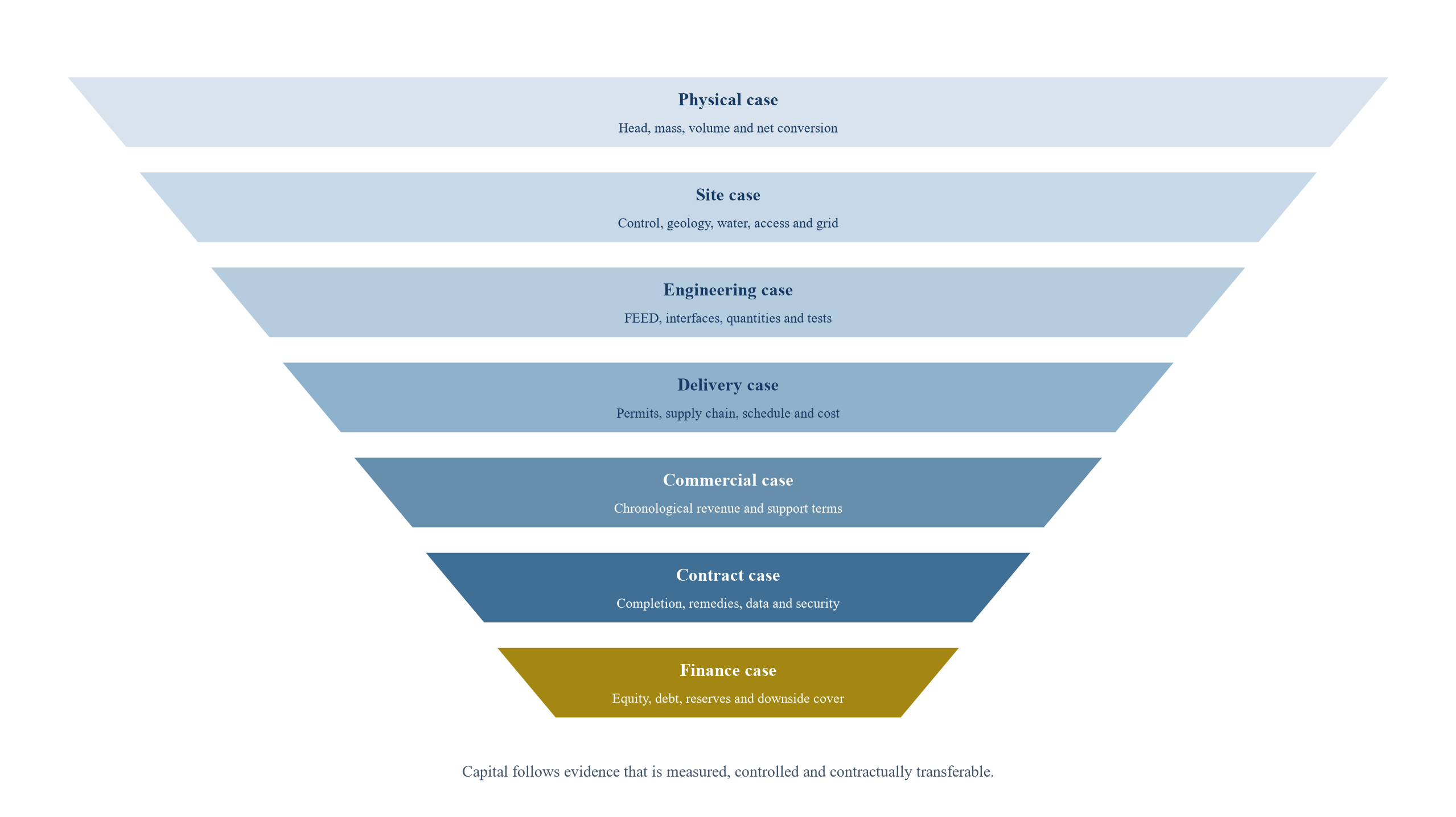
The funnel is a governance framework. Evidence requirements and investment decisions remain project-specific.
30. A common diligence matrix exposes false comparisons
The same questions should be asked across technologies: what moves, how far, how often, through which conversion equipment and within which measured boundary? The next layer tests site, construction, permits, grid, operating data, contracts and revenue.
A project should receive credit for evidence it has, not for maturity elsewhere in the category. A new pumped project benefits from proven turbine technology while retaining site-specific underground and permitting risk. A solid-mass project can use proven hoisting components while retaining integrated cycling and cost risk.
The matrix also identifies the work required to reach the next capital decision.
Table 1. Technology and evidence matrix for mechanical gravity storage
| Archetype | Physical resource | Principal scale-up question | Strongest available evidence | Critical project proof | Typical financing constraint |
|---|---|---|---|---|---|
| Pumped storage hydropower | Water volume and elevation difference | Site-specific civil works, tunnelling and schedule | Extensive operating fleet; public cost and performance benchmarks | Geology, permits, water, fixed quantities, grid and completion | Long development period and civil-cost variance |
| Mine-shaft suspended mass | Shaft depth, payload and travel sequence | Commercial energy capacity, hoist duty and repeated cycling | Hoisting components and selected demonstrations; academic site studies | Shaft condition, payload, net efficiency, cycles, maintenance and safety | Limited relevant-scale operating record and legacy liability |
| Bulk-material underground | Large material volume and vertical transport | Continuous high-throughput material handling | Mining and conveyance equipment; conceptual and academic studies | Tonnes per hour, parasitic load, wear, storage geometry and recovery | Integration, site works and operating-cost uncertainty |
| Tower or block system | Engineered height and multiple mobile masses | Structure, module coordination, durability and cost | Commercial demonstrations and company disclosures | Relevant-scale cycles, availability, fatigue, maintenance and EPC wrap | Technology and completion risk at project scale |
| Rail or incline system | Suitable slope, route and fleet of masses | Land intensity, traction duty and fleet coordination | Mature rail and drive components; limited project deployment | Constructible route, geotechnics, net output, safe braking and grid | Site scarcity and construction economics |
| Geomechanical storage | Suitable formation, pressure response and water | Repeatable subsurface performance and containment | Injection, drilling and hydro equipment; recent techno-economic studies | Site tests, cyclic response, well integrity, losses and monitoring | Reservoir evidence and long-term operating uncertainty |
Classifications are directional. Each project requires current, site-specific evidence.
31. Hypothetical cases should use comparable boundaries
Three hypothetical cases can illustrate the method. They are not forecasts, vendor offers or descriptions of named projects. All costs, schedules, performance and revenue assumptions require replacement with current bids, studies and contracts.
Case A is a 1,000 MW closed-loop pumped-storage project with ten hours of rated discharge. Case B is a 100 MW mine-shaft suspended-mass project with four hours. Case C is a 100 MW tower or block project with eight hours. The cases use the same investment lens: net export, total installed cost, completion evidence, schedule, operating duty and downside support.
The comparison avoids declaring a winner. It shows which evidence controls value for each architecture.
Table 2. Hypothetical mechanical-storage investment cases
| Attribute | Case A: closed-loop pumped storage | Case B: mine-shaft suspended mass | Case C: tower or block system |
|---|---|---|---|
| Rated discharge | 1,000 MW for 10 hours | 100 MW for 4 hours | 100 MW for 8 hours |
| Illustrative net round-trip efficiency | 80% | 78% | 82% |
| Illustrative annual availability after stabilisation | 88% | 90% | 92% |
| Illustrative development and construction period | 9 years | 5 years | 4 years |
| Dominant capital driver | Reservoirs, tunnels, waterways, powerhouse and grid | Shaft rehabilitation, hoist, masses, guides, safety and grid | Structure, foundations, modules, lifts, controls and grid |
| Principal completion evidence | Reservoir integrity, hydraulic performance, net output, duration and grid tests | Repeated full-duty cycles, braking, net efficiency, duration and shaft safety | Multi-module cycling, coordination, fatigue, availability, net output and duration |
| Illustrative revenue basis | Capacity, arbitrage and ancillary services | Capacity, congestion service and ancillary services | Capacity, arbitrage and ancillary services |
| Financing posture before full completion | Construction debt with strong civil, geological and cost protections | Predominantly risk capital with staged debt after relevant-scale proof | Staged capital; leverage follows commercial-scale completion evidence |
Every value is an illustrative modelling assumption. None is an observed project result, offer, valuation or forecast.
32. Levelised cost is useful and incomplete
Levelised cost of storage spreads discounted capital and operating costs across discharged energy. It can compare technologies under common utilisation, life, efficiency and financing assumptions. Results change materially with cycle frequency, duration, charging price, refurbishment and cost of capital.
A low levelised cost does not establish revenue or deliverability at a valuable node. A high-utilisation assumption can improve the metric while exceeding the market's need. A long technical life can improve the result while leaving near-term refinancing exposed.
The model should publish assumptions and show sensitivities. Investors should also examine net present value, debt service, liquidity, downside completion and strategic option value.
33. Schedule risk can erase apparent cost advantage
Long development and construction periods delay revenue and increase capitalised interest, overhead and exposure to inflation. A lower overnight cost can produce a weaker present value when delivery is uncertain or late.
The schedule should integrate permitting, land, investigations, grid, design, procurement, construction, testing and support-award milestones. Critical paths should be logic-linked. Float ownership and relief events should be contractual.
Valuation should probability weight schedule outcomes. Development value should increase as specific risks close, rather than assuming a fixed date from concept stage.
34. Procurement strategy should follow controllability
A single EPC wrap can simplify accountability when a contractor can control and price the complete system. Bespoke civil works, proprietary technology and subsurface risk may prevent a full fixed-price wrap. Multiple packages can access specialist capability while increasing interface risk retained by the owner.
The procurement comparison should include total risk-adjusted cost. Low package prices can be offset by gaps, duplicated contingency, claims and delayed integrated testing. A wrap can still exclude geology, water, grid, technology output or host conditions.
Every financial-model assumption should map to an obligation, test, security and remedy. Untransferred risk should appear in contingency, reserves and leverage.
35. Completion tests must protect the economic threshold
Completion should demonstrate the commercial cycle, including charging, holding, sustained discharge, response, auxiliary load and recovery. The procedure should define initial state, ambient conditions, instruments, uncertainty, correction curves, retest and minimum acceptance.
Repeated cycles are essential for emerging systems. They reveal control, fatigue, heat, wear and operating consistency. Pumped systems require reservoir, waterway, turbine, pump and grid tests. Shaft and tower systems require safe motion and stopping under representative duty.
Performance damages can compensate defined shortfalls. Rejection or mandatory correction may apply below a minimum threshold. Remedies need credit support.
36. Data rights support operation, refinancing and sale
Design models, control code, condition monitoring, test data, event logs and maintenance history are core project assets. Investors and lenders need them for diligence. Operators need them for safe dispatch. Buyers need them to assess remaining life.
Contracts should establish ownership, access, cybersecurity, retention, export and transfer rights. Vendor-hosted platforms should preserve continued access after termination or change of control. Proprietary protection should coexist with project assurance.
The data room should connect requirements, designs, tests, deviations, waivers and remedies. A static certificate has less value than a traceable evidence chain.
37. Valuation should separate proven value from option value
The base project value should reflect evidence-supported performance, cost, schedule and revenue. Upside from future duration expansion, replication, new services or policy should be presented as option value with explicit probability and capital requirements.
Development value equals the probability-weighted operating value less remaining development cost and risk capital. Probability should move when rights, studies, permits, contracts and tests are completed. Promotional capacity does not create value without control and delivery evidence.
Platform value may exist in data, designs, supply relationships and a repeatable development process. Transferability and intellectual-property rights determine whether a buyer can realise it.
38. A risk-adjusted bridge disciplines the investment case
The illustrative bridge begins with an engineering reference value. Grid location, contracted capacity and long asset life can add value. Civil uncertainty, scale-up, delay and merchant exposure reduce it. Each adjustment should trace to evidence and control.
The percentages are hypothetical. Their purpose is to prevent a single headline cost or efficiency from dominating valuation. A real bridge should use project models, bids, contracts and independently reviewed market assumptions.
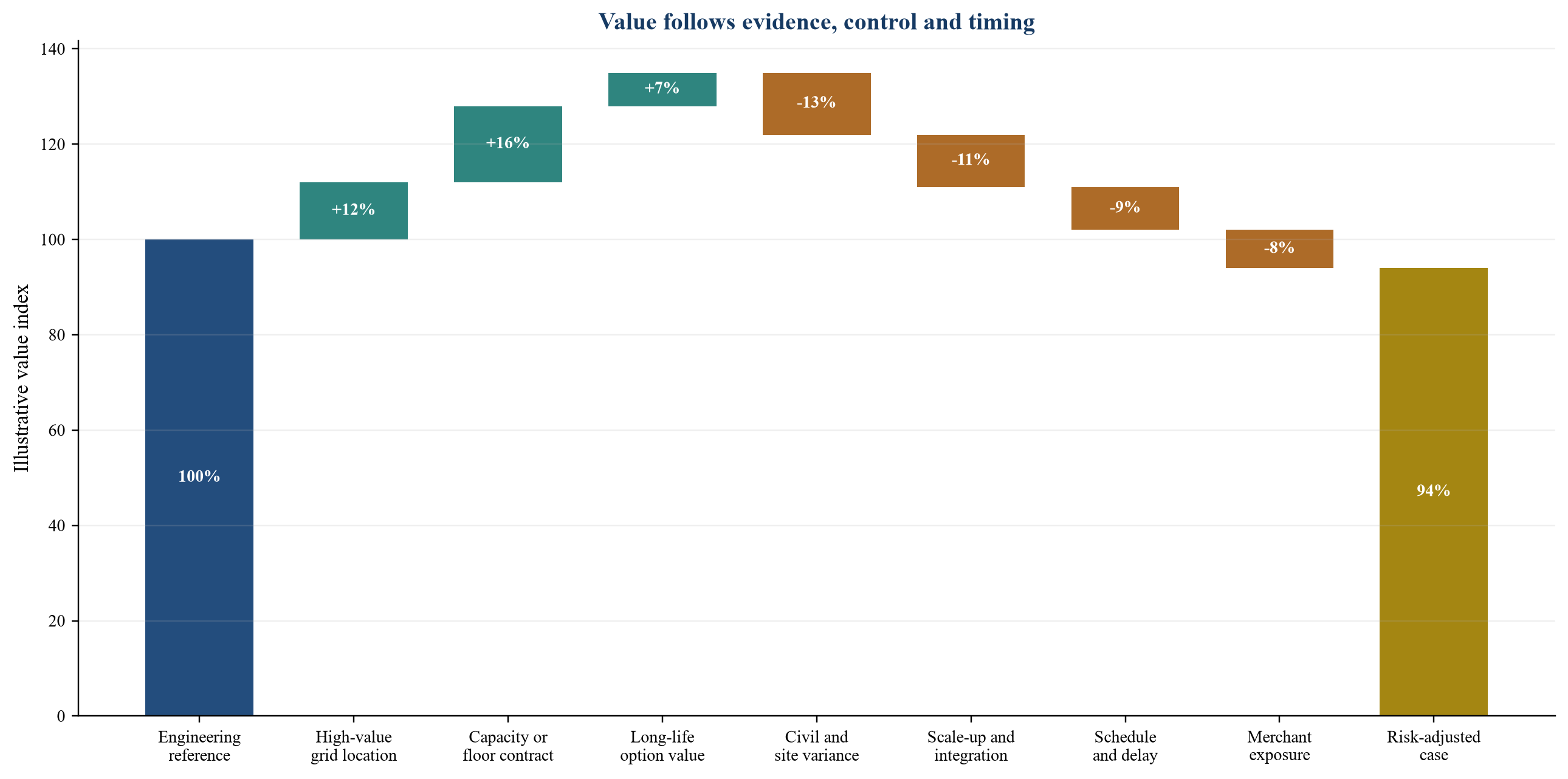
Values are hypothetical percentage adjustments to a reference index. They are not observed economics, valuations or forecasts.
39. Risk allocation should follow control and credit
Technology suppliers should bear risks within their design and equipment boundary. Civil contractors should control methods and quality within known conditions. The integrator should own defined interfaces. Operators should control procedures and maintenance. The project company retains site, market and residual risks that cannot be transferred economically.
Allocation has value only when the responsible party has financial capacity and the obligation survives. Parent guarantees, bonds, letters of credit, retention, insurance and reserve accounts can support remedies.
The contract suite should be tested as one system. Conflicting caps, exclusions, relief events and schedules can leave a gap at project level.
Table 3. Risk allocation and financing response for mechanical gravity storage
| Risk | Evidence before commitment | Natural control party | Contract mechanism | Financing response |
|---|---|---|---|---|
| Physical resource | Measured head, water, shaft, formation, mass path and operating range | Project developer and specialist engineer | Site warranties, baseline report, access and termination rights | Development capital until resource is independently verified |
| Civil and geological conditions | Investigations, FEED, quantities and reference class | Civil contractor for defined conditions; owner for disclosed residuals | Baseline, target or fixed price, pain-share, contingency and insurance | Cost-overrun support and staged drawdown |
| Integrated performance | Common model, component curves and relevant-scale operating data | System integrator within the agreed boundary | Net efficiency, output, duration, availability, retest and damages | Debt case uses guaranteed downside performance |
| Technology scale-up | Demonstration duty, cycles, failure record and design transfer | Technology supplier and sponsor | Milestone tests, warranty, parent support, escrow and rejection | Risk capital and contingent equity until completion |
| Grid and market | Connection studies, queue rights, chronology and eligibility | Project and grid contractor within allocated roles | Connection milestones, curtailment rights and revenue conditions | Conservative leverage before firm grid and revenue |
| Permitting and water | Application path, stakeholder record, water balance and studies | Project company with specialist support | Long-stop, conditions precedent and change protection | Schedule contingency and phased capital |
| Revenue | Chronological model and binding support or offtake | Equity for merchant exposure; counterparty for contracted exposure | Capacity, toll, floor, availability and termination payments | Contracted downside supports debt; upside remains equity value |
| Operations and maintenance | Reliability model, spares, overhaul plan and staffing | Operator and original equipment suppliers | Availability guarantee, service agreement, parts and data rights | Major-maintenance and liquidity reserves |
| Legacy mine or dam liability | Condition survey, title, environmental baseline and closure plan | Historic owner and project as specifically allocated | Indemnity, escrow, access, remediation and surviving obligations | Exclude unlimited liability; fund defined closure reserve |
Final allocation depends on project design, evidence, counterparties and applicable law.
40. Debt should follow completed evidence
Development equity should fund uncertain site, design and permitting work. Construction debt becomes more credible after site control, permits, grid rights, fixed scope, completion support, tested technology and durable revenue are established.
Debt sizing should use net cash flow after charging energy, auxiliary load, maintenance, host payments, availability deductions, taxes and reserves. Merchant spreads should receive conservative treatment. Cost overruns and delay should have funded support.
Draw conditions should map to evidence gates. A project can refinance after commercial operation establishes availability, efficiency, maintenance and revenue performance.
41. Acquisition diligence should test replicability
A buyer of a gravity-storage platform should distinguish project-specific rights from repeatable capability. Designs, control systems, operating data, supplier relationships and development processes can support platform value when they transfer and apply across sites.
The buyer should reconcile every pipeline megawatt with land, resource, grid, permits, cost maturity and commercial rights. Reference-project performance, warranty claims, key-person dependency, litigation and intellectual property require review.
Earn-outs can link consideration to objective milestones such as permits, grid contracts, support awards, financial close or performance tests. Governance should define who controls each milestone.
42. The first hundred days should close decisive gaps
The first programme should establish the physical balance, metering boundary, site data, integrated model, evidence register and development gates. Independent engineering should test energy, power, efficiency, civil quantities, scale-up and completion.
Commercial work should define market products, chronology and revenue eligibility. Legal work should secure land, subsurface, water, grid, technology, data and transfer rights. Procurement should validate long-lead equipment, contractor capacity and credit support.
At day one hundred, the sponsor should decide which gaps require tests, design change, contract protection, contingency, more capital or termination. Continued spend should follow a documented evidence plan.
43. Limits and conclusion
Public sources provide operating benchmarks, technology assessments, programme rules, company disclosures and academic models. They do not establish the cost, performance, schedule or bankability of an unidentified project. Investment decisions require current site studies, designs, permits, bids, tests, contracts and qualified advice.
The analysis shows that gravity technologies should compete on net delivered service and controlled risk. Pumped storage has the strongest operating reference class and remains exposed to site, schedule and civil complexity. Mine-shaft, tower, rail, bulk-material and geomechanical systems may solve specific constraints; each requires evidence at the financed scale.
An investable project reconciles physical claims, releases capital through gates, contracts interfaces, tests the full duty, models chronological revenue and sizes debt against downside cash flow. The principle of gravity is universal. Project economics are local, engineered and earned through evidence.
References
- United States Department of Energy and Pacific Northwest National Laboratory, 2022 Grid Energy Storage Technology Cost and Performance Assessment, August 2022. https://www.energy.gov/sites/default/files/2022-09/2022%20Grid%20Energy%20Storage%20Technology%20Cost%20and%20Performance%20Assessment.pdf
- United States Department of Energy, Pathways to Commercial Liftoff: Long Duration Energy Storage, July 2025. https://www.energy.gov/sites/default/files/2025-07/LIFTOFF_DOE_Long-Duration-Energy-Storage.pdf
- United States Department of Energy, Achieving the Promise of Low-Cost Long Duration Energy Storage, August 2024. https://www.energy.gov/sites/default/files/2024-08/Achieving%20the%20Promise%20of%20Low-Cost%20Long%20Duration%20Energy%20Storage_FINAL_08052024.pdf
- United States Department of Energy, Pumped Storage Hydropower Technology Strategy Assessment, July 2023. https://www.energy.gov/sites/default/files/2023-07/2023-07-25%20DOE%20PSH%20Technology%20Strategy%20Assessment.pdf
- National Renewable Energy Laboratory, Annual Technology Baseline: Pumped Storage Hydropower, 2024. https://atb.nrel.gov/electricity/2024/pumped_storage_hydropower
- National Renewable Energy Laboratory, Closed-Loop Pumped Storage Hydropower Resource Assessment, accessed September 2026. https://www.nrel.gov/gis/psh-supply-curves
- Department for Energy Security and Net Zero and Ofgem, Long Duration Electricity Storage: Technical Decision, March 2025. https://www.ofgem.gov.uk/sites/default/files/2025-03/Long%20Duration%20Electricity%20Storage%20Technical%20Decision%20Document.pdf
- Ofgem, Long Duration Electricity Storage Window 1 Eligibility Assessment Outcome, September 2025. https://www.ofgem.gov.uk/sites/default/files/2025-09/LDES%20Eligibility%20Assessment%20Outcome.pdf
- Ofgem, Long Duration Electricity Storage Multi-Criteria Assessment Framework, September 2025. https://www.ofgem.gov.uk/guidance/ldes-project-assessment-multi-criteria-assessment-mca-framework
- Ofgem, Long Duration Electricity Storage Cap and Floor Financial Model and Handbook, October 2025. https://www.ofgem.gov.uk/guidance/long-duration-electricity-storage-ldes-cap-and-floor-financial-model-and-handbook
- Ofgem, Long Duration Electricity Storage Programme, updated July 2026. https://www.ofgem.gov.uk/energy-policy-and-regulation/policy-and-regulatory-programmes/long-duration-electricity-storage
- International Hydropower Association, World Hydropower Outlook 2026, 2026. https://www.hydropower.org/publications/2026-world-hydropower-outlook
- Energy Vault Holdings, Inc., Annual Report on Form 10-K for the year ended 31 December 2025, filed 2026. https://www.sec.gov/ixviewer/doc/action?doc=Archives/edgar/data/1828536/000182853626000021/nrgv-20251231.htm
- United Kingdom Department for Business, Energy and Industrial Strategy, Longer Duration Energy Storage Demonstration Programme: Stream 1 Phase 1 Details, accessed September 2026. https://www.gov.uk/government/publications/longer-duration-energy-storage-demonstration-programme-successful-projects/longer-duration-energy-storage-demonstration-programme-stream-1-phase-1-details
- Tomasz Siostrzonek, The Mine Shaft Energy Storage System: Implementation Threats and Opportunities, Energies, 2023, 16(15), 5615. https://doi.org/10.3390/en16155615
- Technical and Economic Aspects of Electric Energy Storage in a Mine Shaft: Budryk Case Study, Energies, 2021, 14(21), 7337. https://doi.org/10.3390/en14217337
- Underground Gravity Energy Storage: A Solution for Long-Term Energy Storage, Energies, 2023, 16(2), 825. https://doi.org/10.3390/en16020825
- Smart Microgrid Construction in Abandoned Mines Based on Gravity Energy Storage, Heliyon, 2023, 9(11), e21481. https://doi.org/10.1016/j.heliyon.2023.e21481
- Levelised Cost of Storage Comparison of Energy Storage Systems for Use in Primary Response Application, Journal of Energy Storage, 2023, 59, 106573. https://doi.org/10.1016/j.est.2022.106573
- Overview of Converting Abandoned Coal Mines to Underground Pumped Storage Systems: Focus on the Underground Reservoir, Journal of Energy Storage, 2023, 73, 109153. https://doi.org/10.1016/j.est.2023.109153
- Gravity Energy Storage and Its Feasibility in the Context of Sustainable Energy Management with an Example of Mine Shafts in Poland, Energies, 2025, 18(13), 3374. https://doi.org/10.3390/en18133374
- Quidnet Geomechanical Energy Storage: Unlocking New Markets for Pumped Storage Hydro, IEEE Energy Sustainability Magazine, 2025, 1(3), 30-40. https://doi.org/10.1109/ESM.2025.3606177
About the Author
Chennakeshav (CK) is a corporate finance and investment banking executive with 25+ years of global experience in deal origination, structuring and execution across M&A, growth capital and corporate strategy. He has led value-creation mandates for founders, corporates and funds — bridging the boardroom view to hands-on execution and close.
His career spans Morgan Stanley, HSBC, Lloyds Banking Group, EWEC, ADQ portfolio companies and Emirates Growth Fund, across TMT, real estate, fintech, deeptech, cleantech, infrastructure and energy. He has partnered with C-suite leaders, private equity and venture funds, sovereign wealth funds and family offices to finance complex fund raises and scale-up ventures, and has led M&A due diligence, post-merger integration and business-transformation initiatives to create value.
At Matchpoint Partners he is Managing Partner, leading the firm's corporate finance, M&A and capital-raising practice. He holds an MBA from London Business School, an engineering degree from VTU and a Master of Laws (LLM, in progress) from UCL London.
An active start-up mentor, CK mentors at Techstars, DIFC FinTech Hive, Startup Grind, Founder Institute and IN5, serves as Entrepreneur Mentor in Residence (EMiR) at London Business School, and judges the Entrepreneurship World Cup.
LinkedIn: https://www.linkedin.com/in/ckadya/
Profile: https://www.matchpoint-partners.com/team/ck-adya.html
