
Introduction
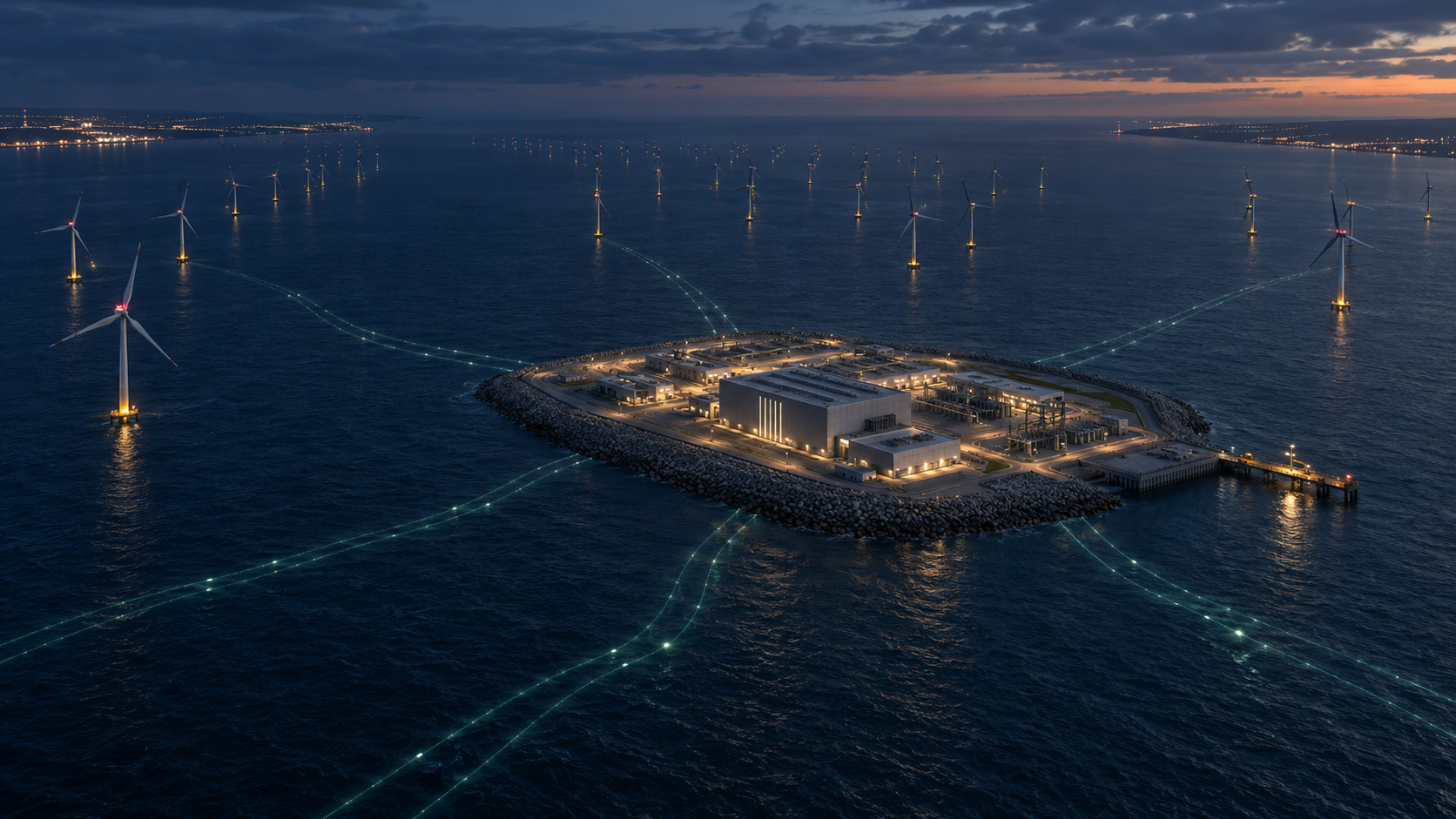
Offshore electricity infrastructure is moving from radial connections toward coordinated networks. A radial connection carries output from one wind farm to one shore. An energy island or offshore hub can collect several wind farms, connect more than one market and host common electrical equipment. Later phases may add storage, hydrogen production or further interconnectors. The shared architecture can reduce landing points and duplicate equipment, but it also joins assets with different cash flows and public purposes.
Europe provides the most developed policy setting. The European Union's revised Trans-European Networks for Energy framework includes offshore grids and hybrid projects. ENTSO-E's first Offshore Network Development Plans translate national sea-basin ambitions into indicative transmission corridors. Bornholm Energy Island is progressing as a Danish-German hybrid project with a European Union grant. Belgium's Princess Elisabeth Island is under construction as a hub for offshore wind and possible future interconnection. Great Britain has established a distinct legal and regulatory path for offshore hybrid assets.
The investment decision requires more than a positive system-benefit model. Sponsors and public authorities need a structure that can survive schedule mismatch, political change, cost escalation and evolving market rules. Lenders need an enforceable payment source. Regulators need evidence that users receive value. Wind developers need connection certainty and a workable price zone. Governments need an allocation of costs that reflects benefits beyond the host country. This paper converts those requirements into a staged financing framework.
1 Define the energy island
The term energy island can describe a natural island used as an electrical hub, an artificial island carrying substations and converters, or a platform-based offshore hub with similar functions. The financing analysis should begin with the services performed rather than the label. Physical form affects marine risk and cost; commercial function determines who benefits and who can pay.
A minimum configuration connects offshore generation to a national grid through shared equipment. A hybrid configuration also connects two electricity markets. A multi-terminal design can connect several countries or additional hubs. Storage, electrolysis and data or service facilities may be added where their economics, permits and interfaces are independently supported.
Every configuration needs a boundary schedule. The schedule should identify the island civil works, alternating-current collection system, high-voltage direct-current converters, export cables, interconnectors, onshore substations, wind-farm connections, control systems, telecoms and any storage or conversion plant. Each item needs an owner, operator, revenue basis and commissioning test.
2 Start with the system need
The planning case should state the network problem the hub is intended to solve. Possible needs include connecting offshore renewable generation, increasing cross-border transfer capacity, reducing coastal landing points, improving system resilience and preserving options for later expansion. These benefits accrue to different places and users. A combined benefit total can support policy approval, while investment recovery requires a traceable route from each benefit to a payer.
ENTSO-E's 2024 Offshore Network Development Plans identified hybrid infrastructure as part of the efficient integration of offshore generation, especially in the Northern Seas and Baltic Sea. The plans also show that radial connections remain the most common solution. A hub should therefore be compared with credible radial and point-to-point alternatives under the same generation, demand and network assumptions.
The system need should include the onshore network. Offshore transfer capacity has limited value when the receiving grid cannot carry power to demand centres. The investment programme should identify the onshore reinforcements, their permits, cost, schedule and funding. A hub completion date that precedes the required onshore capacity can create stranded availability or curtailment.
3 Separate the investment modules
One financing vehicle rarely fits every component. Common civil works and electrical infrastructure may sit with a regulated transmission owner. Wind farms can be financed as separate projects under renewable support or corporate offtake. Interconnector assets may receive regulated, cap-and-floor or merchant treatment. Storage and hydrogen assets may depend on separate markets and contracts.
Module separation clarifies credit. A lender to the common hub can assess regulated or contracted network revenue without relying on wind-resource output. A wind-farm lender can assess construction, resource, price and support risk without carrying the entire interconnector programme. Public funding can be directed to the shared or cross-border elements that create regional benefits.
Separation also creates interface risk. The programme agreement should bind module owners to common technical standards, information duties, access arrangements, commissioning sequences and change control. Direct agreements should allow lenders to cure a default that could interrupt shared service. The goal is legal separation with coordinated delivery.
4 Map the physical and commercial system
The physical diagram should show power flows and asset boundaries. The commercial diagram should add service agreements, tariff or support mechanisms, congestion revenue, grant conditions, operating authority and data exchange. Both views are needed because electricity can follow one route while cash follows another.
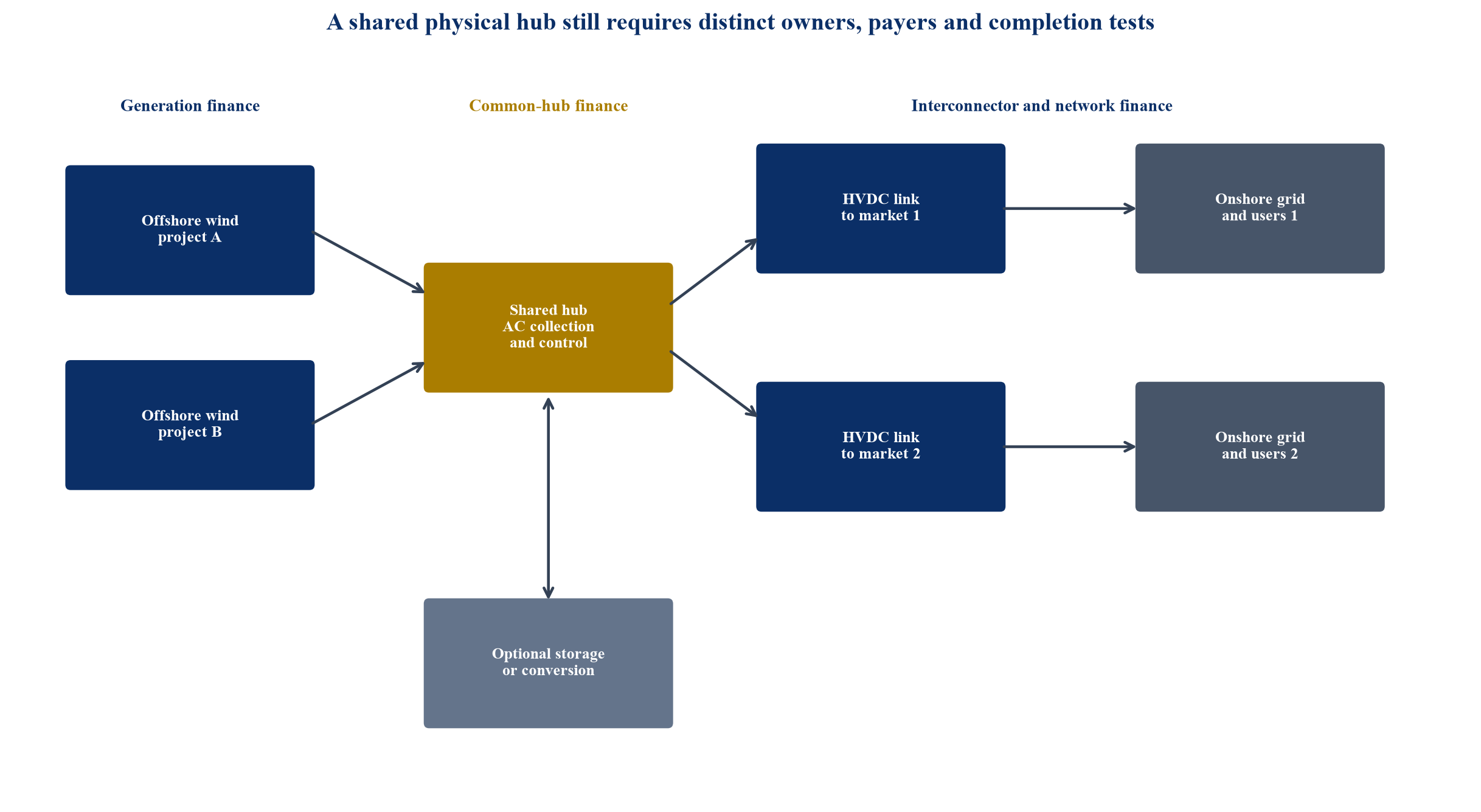
The diagram is an author-developed framework. It illustrates possible modules and does not prescribe a particular project architecture.
The map should state which equipment can operate before every module is complete. An alternating-current hub may connect early wind phases while a high-voltage direct-current link follows later. Temporary operating modes need protection settings, metering, dispatch rules and revenue treatment. The financial model should test each mode rather than assume the final configuration from the first day.
5 Compare current market precedents
Live projects show different definitions of an energy island. Bornholm uses an existing Danish island as a hub linking offshore wind with Denmark and Germany. Princess Elisabeth Island is an artificial island intended to gather Belgium's Princess Elisabeth Zone and provide a base for future hybrid interconnection. Britain's offshore-hybrid framework includes non-standard and multi-purpose interconnectors that may use offshore converter platforms rather than an island.
Table 1. Selected offshore-hub precedents and investment lessons
| Project or framework | Current public scope | Public financing or regulatory signal | Principal investment lesson |
|---|---|---|---|
| Bornholm Energy Island | 3 GW hub linking offshore wind with Denmark and Germany | €645.2 million Connecting Europe Facility grant announced in September 2025 | Cross-border benefit can support grant funding, while national and bilateral cost allocation remains central |
| Princess Elisabeth Island | Belgian artificial island connecting up to 3.5 GW of offshore wind with possible future hybrid links | €650 million EIB green credit facility for the first phase signed in October 2024 | Common civil and electrical infrastructure can receive network finance; converter scope and cost still require active control |
| UK offshore hybrid assets | Pilot non-standard interconnectors and a developing regime for multi-purpose interconnectors | Cap-and-floor treatment for pilot assets; offshore bidding zones selected for future MPIs in March 2026 | Market design and revenue support must be settled together because price-zone choice affects wind and interconnector cash flow |
| ENTSO-E offshore network plans | Indicative sea-basin corridors for radial and hybrid offshore transmission | More than €400 billion of offshore transmission investment identified through 2050 | Regional planning establishes need; each project still requires permits, cost sharing, commercial structure and delivery evidence |
The table summarises public information available from the cited project authorities. Project scope, timing and cost can change after publication.
The precedents do not create a single template. They demonstrate that the hub concept can move forward under regulated transmission ownership, public grants and project-specific international agreements. They also show how converter procurement, support-cost allocation and market design can become critical path items after the civil concept has been approved.
6 Establish a common programme authority
The programme needs one body with authority over the integrated schedule, interface register, technical baseline and change process. The body may be a joint steering committee, treaty-based entity, coordinated group of transmission system operators or special-purpose programme company. Its authority should be defined before major contracts are awarded.
The programme authority should maintain the system model, design basis, interface control documents, permitting map, procurement plan, cost estimate, risk register and commissioning sequence. It should distinguish binding decisions from recommendations. Participants should know which issues require unanimity, regulatory approval or ministerial agreement.
Governance should survive changes in government, regulator and management. A long programme benefits from documented decision rights, fixed reporting cycles and escalation procedures. Political sponsorship supports cross-border delivery, while contracts and regulatory decisions provide the continuity required by lenders and suppliers.
7 Choose the ownership model
Ownership should follow regulatory authority and operational responsibility. A transmission system operator can own common network assets where national law supports regulated recovery. A jointly owned project company can hold cross-border assets where the participating operators and regulators agree. A concession can allocate design, construction and long-term availability to a private party under a public service contract.
Civil works and electrical works may have different owners. The island foundation can be owned by one entity and leased to transmission operators. Converter stations and cables can remain with regulated network companies. Shared control systems may require joint ownership or detailed access rights. The structure should avoid a gap where no entity carries lifecycle responsibility for the common platform.
Private capital can enter through corporate borrowing, project debt, institutional co-investment, green bonds or concession equity. The financing route should match the cash-flow regime. A regulated asset backed by a strong transmission owner may use corporate or ring-fenced debt. A project company with availability payments may support non-recourse finance. Merchant revenue alone provides a weaker base for common infrastructure with high fixed cost.
8 Identify every payer
Energy-island value may accrue to transmission users, wind generators, interconnector users, consumers in several countries and governments pursuing climate or security objectives. Each payer should be linked to a legal mechanism. Possible routes include network tariffs, connection charges, renewable support, congestion income, availability payments, grants and budget contributions.
The base case should exclude value that lacks an enforceable payment route. Wider consumer savings can justify a regulatory decision, but they do not directly pay debt service. Security-of-supply benefits can justify a public contribution, but the contribution must be appropriated or contracted. Carbon benefits may support policy approval or grants, while revenue requires a market or certificate mechanism.
The payer map should include timing. Connection charges may be paid during construction, tariffs after commissioning and grants against eligible milestones. Congestion revenue begins only when cross-border capacity operates. A complete sources-and-uses plan should therefore fund development, construction, testing and delayed revenue periods.
9 Allocate costs across borders
Cross-border cost allocation is required when the country hosting an asset bears costs while other countries receive material benefits. The TEN-E framework allows national regulators and ACER to allocate efficient investment costs for projects of common interest. The European Commission's 2024 guidance recommends early discussion of cost-sharing principles at the stage when offshore network needs are identified.
The allocation method should define the scenarios, benefits, time horizon, discount rate, affected countries, uncertainty treatment and adjustment mechanism. Benefits can include reduced generation cost, lower curtailment, improved adequacy, lower emissions, avoided network reinforcement and greater cross-border capacity. Each benefit should use the same system boundary as the cost estimate.
A negotiated allocation can include fixed contributions, milestone payments, regulated asset shares or transfers linked to realised scope. Adjustment rules matter because generation, market prices and neighbouring projects can change before commissioning. The parties should specify which changes reopen cost allocation and which remain with the original sponsor.
10 Use grants for regional and first-of-kind value
Public grants can fund benefits that extend beyond the paying network or reduce the cost of a first-of-kind design. The €645.2 million Connecting Europe Facility grant for Bornholm Energy Island illustrates the role of European funding in a cross-border hub. Grant eligibility, milestones, procurement rules, reporting and clawback should be integrated into the financing plan.
Grant funding does not remove cost discipline. Eligible cost can differ from total project cost, and payment may follow verification. The project needs liquidity for expenditures before reimbursement. A bridge facility can fund the timing gap where the grant award and public budget support are enforceable and lender rights are clear.
The economic model should show the project with and without grant support. This reveals whether the grant addresses a genuine regional benefit, a first-of-kind premium or an otherwise unfinanceable gap. It also helps regulators test whether remaining costs are reasonable for tariff recovery.
11 Define the regulated revenue base
Common transmission infrastructure can be remunerated through a regulated asset base, an approved capital allowance or a project-specific revenue regime. The regulator should determine eligible cost, construction-work-in-progress treatment, depreciation, operating allowance, incentive mechanisms and the treatment of grants or congestion income.
The revenue start date should match the service actually available. Partial commissioning may justify partial revenue if the asset provides measurable network service. A civil platform without usable electrical capacity should not automatically receive the same treatment as an operating connection. The project agreement should define tests for each revenue stage.
Cost overruns need an ex-ante rule. Efficient cost may receive recovery after review, while imprudent cost can remain with the owner. A first-of-kind project also needs a treatment for design development, technology price movements and changes requested by public authorities. Clear sharing rules can reduce the cost of capital and preserve incentives.
12 Structure interconnector revenue
An interconnector can earn congestion revenue from price differences between connected markets. Revenue depends on capacity, availability, market spreads, allocation rules, outages and future network development. These variables can be volatile. A cap-and-floor regime or regulated return can share risk between investors and consumers.
The floor should provide sufficient downside protection for efficient debt without guaranteeing every cost. The cap returns excess value to consumers or users. Availability incentives, outage allowances and force-majeure treatment should align operational performance with the revenue regime. Expansion of the meshed grid may change flows and congestion revenue; the regime should address this possibility.
The interconnector cash flow should remain separate from renewable-support cash flow. Power from connected wind farms may face an offshore bidding-zone price. A lower offshore price can improve dispatch efficiency while reducing generator revenue. The wind-support mechanism, market design and interconnector regime should therefore be tested together.
13 Choose the offshore market design
An offshore hub can use a home-market model or an offshore bidding zone. A home-market model assigns connected generation to an onshore price area. An offshore bidding zone forms a separate price area whose price reflects constraints between the hub and connected markets. Each design changes dispatch, congestion income and generator exposure.
In March 2026, the UK government and Ofgem selected offshore bidding zones with implicit trading as the preferred model for future multi-purpose interconnectors. Their decision also identifies unresolved issues, including wind-farm revenue risk, compatibility with Contracts for Difference, curtailment, balancing and operability. Those issues belong in the financing model before investment approval.
The model should simulate energy prices at each node, available transfer capacity, curtailment, balancing cost and support payments. It should include outages and network constraints. Revenue support may need an offshore reference price, an adjustment for transmission constraints or another method consistent with competition rules.
14 Protect wind project bankability
Wind farms connected to a shared hub depend on the hub's schedule and availability. The connection agreement should define the connection date, capacity, technical standard, outage rights, curtailment rules, compensation and security. A wind project cannot carry unlimited delay risk from a common asset outside its control.
The renewable support contract should match the offshore market design. A fixed-price contract based on an onshore reference price can leave basis risk when the wind farm receives an offshore price. The support mechanism should state how congestion, negative prices, unavailability and curtailment affect payment.
Lenders need a direct agreement with the connection provider or programme company. Cure rights, information access and compensation can preserve the wind asset when the hub defaults. The interface should also identify who pays for changes in grid code, protection settings or connection capacity.
15 Sequence civil and electrical procurement
The civil island, alternating-current equipment, high-voltage direct-current converters, cables and onshore works have different design and procurement cycles. Long-lead converters and cables can determine the critical path. Awarding civil works before converter scope is stable can create redesign, unused space or interface claims.
The procurement plan should use verified decision dates. Civil design can preserve defined envelopes for later equipment, while those envelopes still need load, cooling, foundation, access and electromagnetic requirements. Options can reserve production capacity when price and specification risk are understood. Open-ended options can transfer little risk and create expensive commitments.
Package boundaries should reflect market capacity. A single turnkey contract can concentrate integration responsibility but reduce competition and create a large counterparty exposure. Multiple packages can improve competition while increasing interface risk. An independent engineer and systems integrator can support the programme authority, though accountability must remain clear.
16 Control converter cost escalation
High-voltage direct-current converters are specialised assets with limited supplier capacity. Elia's 2025 project communications on Princess Elisabeth Island identified substantial HVDC cost pressure and postponed a converter contract while civil and alternating-current work continued. This experience demonstrates the need for staged scope, independent cost review and clear authority to defer a module.
The estimate should separate quantities, design development, commodity exposure, labour, supplier margin, contingency and escalation. Benchmarking requires adjustment for capacity, topology, voltage, offshore location, redundancy, programme timing and local content. A headline cost per megawatt can conceal material differences.
The contract can use fixed prices, indexed elements, target cost or open-book mechanisms. Each approach should allocate the risks that suppliers can price and control. Currency hedging, advance procurement and framework agreements can reduce exposure. The investment committee should see the residual risk after these measures.
17 Build a complete sources and uses plan
Uses include development, surveys, environmental studies, land or seabed rights, civil works, converters, transformers, cables, onshore reinforcements, control systems, commissioning, financing costs, reserves and contingency. Decommissioning security and long-term maintenance facilities should also be included.
Sources can include transmission-owner equity, corporate debt, project debt, green bonds, public grants, wind-generator connection contributions and government budget support. Each source needs timing, conditions, permitted use and repayment treatment. A grant linked to commissioning does not finance early construction unless it can be bridged.
The plan should fund common costs even when a connected wind phase or interconnector is delayed. Committed capital, contingent contributions and liquidity facilities can cover the gap. Distribution restrictions should preserve funds for completion, maintenance and future equipment replacement.
18 Test capital cost sensitivity
Energy-island estimates change as design matures. A useful model separates the common civil platform, alternating-current collection, high-voltage direct-current systems, cables, onshore works, development and contingency. Each category has a different risk driver and potential payer.
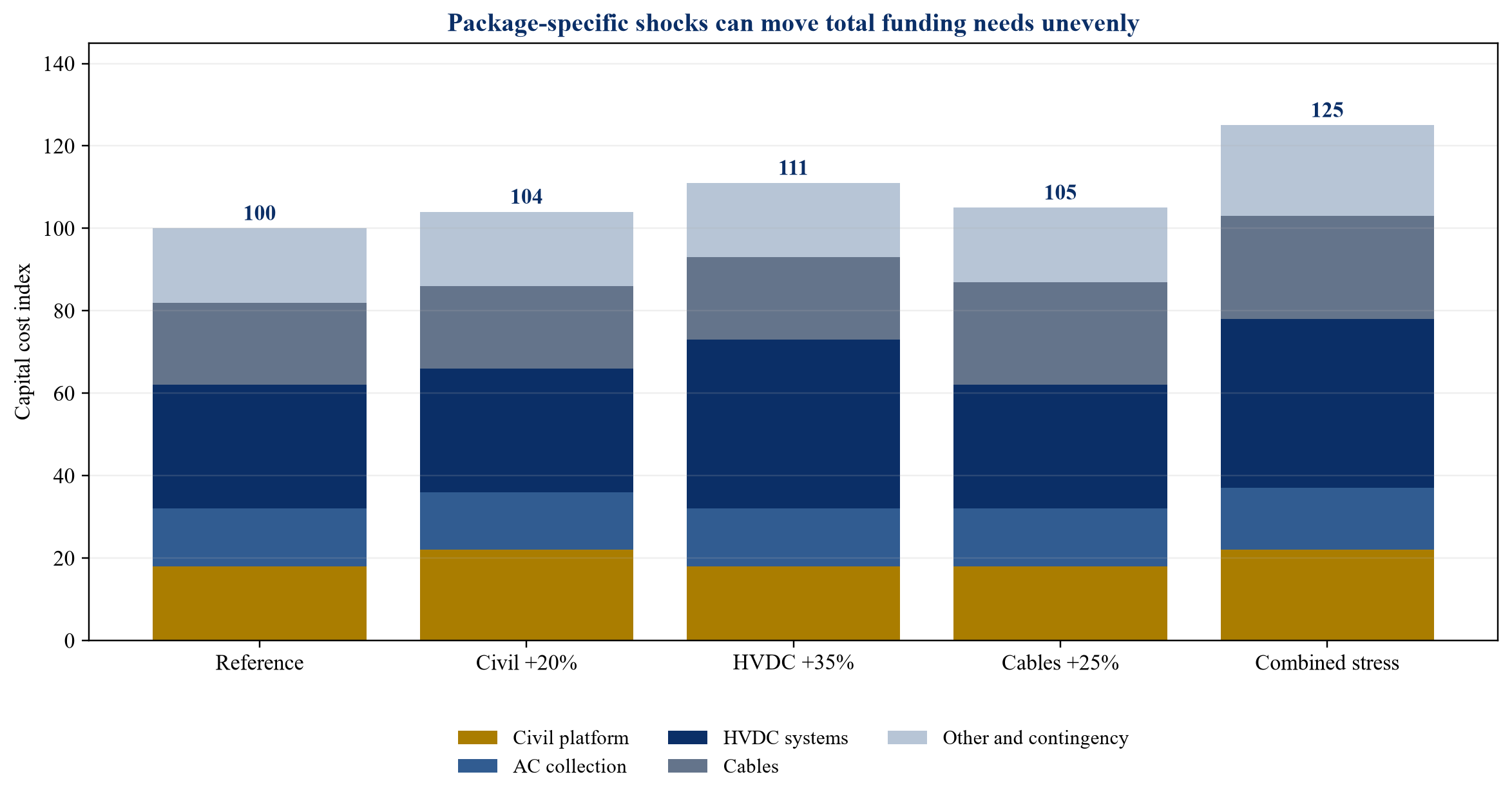
Values are author-modelled indices with the reference case set to 100. They are not project estimates, forecasts or market quotations.
The sensitivity should show funding responsibility rather than only total cost. A converter overrun may sit with a regulated transmission owner, a supplier or consumers subject to review. A civil overrun may affect every module using the platform. The model should identify covenant headroom, additional equity, grant limits and tariff implications for each case.
19 Match debt to the revenue regime
Senior debt should be sized to the enforceable revenue assigned to the borrowing entity. A transmission owner can borrow against its regulated business subject to corporate leverage and regulatory treatment. A ring-fenced hub company can borrow against availability payments, tariff entitlements or approved regulated revenue. Interconnector debt may rely on a cap-and-floor regime.
Construction debt requires committed equity, contingency and a completion plan. Lenders should review permits, package contracts, supplier credit, interface obligations, insurance and independent-engineer reports. Draw conditions should match physical milestones and grant eligibility. Term conversion should follow integrated testing and revenue approval.
Debt service should be tested under delayed connection, lower availability, disallowed cost, reduced congestion income and higher operating expense. The base debt case should exclude future storage, hydrogen and additional-country revenue until those modules have contracts and permits.
20 Design completion as a sequence
Completion cannot be represented by one date. The programme needs civil readiness, alternating-current energisation, cable testing, converter commissioning, wind connection, market registration and cross-border operation. Each milestone should have objective evidence and a responsible certifier.
Early operation can create value if a partial configuration safely connects wind to one market. The contracts should define temporary protection, metering, dispatch, maintenance and revenue. Temporary operation should not weaken the obligations required for final multi-terminal service.
Delay damages should reflect the service lost and the responsible package. A supplier should not pay for delay caused by an unavailable onshore grid. The programme should allocate concurrent delay, relief events and mitigation duties. Long-stop dates should support termination or restructuring before capital remains trapped indefinitely.
21 Coordinate procurement across packages
An energy island combines markets that are usually procured separately. Marine civil works, offshore substations, high-voltage direct-current systems, alternating-current collection equipment, export and interconnector cables, protection, telecommunications and onshore reinforcements have different suppliers, lead times and risk conventions. A single turnkey contract can concentrate accountability, but it can also reduce competition and place risks with a contractor that cannot control them. A multi-package structure preserves specialist competition while increasing the burden on the programme integrator.
The procurement strategy should be chosen after an interface map has been approved. Each interface needs a design authority, information timetable, acceptance test, change process and liability position. The common data environment should identify the governing version of drawings, cable routes, load cases and protection studies. A shared platform creates physical dependencies that cannot be managed by separate bilateral contracts alone.
Long-lead equipment requires early reservation without surrendering competitive tension. The programme can use framework agreements, conditional notices to proceed, capacity reservations and staged engineering contracts. These instruments should specify cancellation cost, intellectual-property access, price adjustment, delivery windows and the consequences of investment approval moving later than planned.
22 Build a credible supply-chain plan
Cable factories, converter suppliers, specialist vessels and offshore labour can become schedule constraints across several projects. A credible plan should test whether manufacturing slots and installation seasons align with the target energisation sequence. Supplier capacity should be evidenced through binding commitments or independently verified production plans rather than expressions of interest.
Concentration requires financial and technical diligence. A supplier may have strong technology and a stretched order book. The buyer should review factory throughput, subcontractors, performance security, parent support, warranty capacity and exposure to simultaneous project delays. Alternative suppliers can reduce dependency only where designs and certifications are sufficiently interoperable.
Local-content objectives need explicit cost and schedule treatment. Domestic capability can improve resilience and retain economic value. Requirements introduced after bid can create claims and redesign. The procurement documents should state which activities must be local, how compliance is measured and which costs qualify for regulated recovery or public support.
23 Protect the marine construction window
Offshore construction is governed by weather, vessel access, seabed conditions, environmental restrictions and port capacity. The schedule should distinguish fixed calendar milestones from weather-dependent windows. Contingency should reflect the probability that a missed window delays work by a season rather than several weeks.
Site investigation is a financing input. Geotechnical, metocean, unexploded-ordnance, archaeological and environmental data influence foundations, cable burial, dredging and insurance. The owner should define reliance rights and the allocation of undisclosed conditions. Transferring all ground risk to contractors can increase bid prices or leave an allocation that fails when an exceptional condition appears.
Ports and assembly yards should be contracted as enabling infrastructure. Their capacity, depth, lifting equipment, laydown area and access routes can determine the feasible installation method. The base case should include mobilisation, demobilisation, standby and remobilisation exposure.
24 Integrate environmental and permitting obligations
The project may require approvals for the hub site, cable corridors, offshore substations, wind connections, onshore landings and protected habitats across more than one jurisdiction. A consent matrix should show the authority, evidence, consultation, appeal exposure, conditions and expiry for every approval. Permits should align with the technical design used in procurement.
Environmental obligations continue into construction and operation. Monitoring, seasonal restrictions, fisheries coexistence, navigation, aviation, noise, seabed disturbance and decommissioning should be priced and assigned. A financing model should include recurring compliance cost and the risk that mitigation reduces installation flexibility.
Cross-border projects also require a process for changes in national plans. The investment agreements should address a state delaying a connected wind zone, onshore reinforcement or market reform. Compensation and cost reallocation may be appropriate where one party changes the agreed system need after others have committed capital.
25 Treat storage as a contracted module
Storage can support congestion management, restoration, reserve and renewable firming. It should be evaluated as a separate module with defined ownership, dispatch, market access, degradation, replacement and safety obligations. The financing case should recognise only contracted or regulated services.
26 Keep hydrogen optional until contracted
Future hydrogen compatibility can be designed through reserved space, loads, connection points and corridors. Hydrogen revenue should remain outside the initial financing case until capacity, power supply, offtake, permits and delivery infrastructure are contracted through a separate approval gate.
27 Design the market interface
The hub may connect several bidding zones, wind farms and transmission systems. The market design determines dispatch, congestion income, balancing responsibility and the treatment of losses. Ofgem's March 2026 multi-purpose-interconnector decision identified offshore bidding zones as the preferred arrangement for future projects in Great Britain, subject to project and market development. That illustrates how market architecture can shape the financeable service.
Rules should be determined early enough for lenders and investors to model cash flow. The project needs clarity on capacity calculation, allocation, curtailment, redispatch, imbalance, losses, outage coordination and revenue distribution. Transitional arrangements are required if market reform is scheduled after construction starts.
Where political agreement remains open, the base case should rely on the regulated or contracted minimum. Congestion income can be modelled in separate cases with transparent price and flow assumptions. The financing structure should survive a less favourable market configuration.
28 Establish a transparent cost-allocation method
Cross-border cost allocation should begin with the beneficiaries and services. Benefits can include renewable integration, reduced curtailment, security of supply, market integration, avoided domestic reinforcement and option value for future connections. Each benefit needs a method, data source and governance process.
The allocation should distinguish common costs from country-specific costs. Onshore works used only by one system should normally remain with that system unless the parties agree otherwise. Shared civil and converter costs can be allocated through capacity, usage, measured benefit or negotiated shares. A hybrid formula can reduce extreme outcomes.
The method should also allocate overruns and savings. A fixed initial share can become contentious if one country changes capacity or timing. Reopener provisions should be limited to defined events and use independent evidence. Final reconciliation should avoid indefinite exposure after the asset is commissioned.
29 Use regulation to create financeable cash flow
Regulated revenue can support debt when the allowed cost base, return, depreciation, incentives and review process are sufficiently clear. The regulator should define the treatment of efficient development expenditure, shared assets, grants, abandonment, refinancing and cross-border receipts. Investors also need the timetable for revenue commencement and the consequences of delay.
A cap-and-floor structure can limit extreme merchant outcomes for interconnection. Availability-based revenue can support shared infrastructure with limited market exposure. A project-specific regime may be required where an island performs several functions that do not fit an existing transmission category.
Incentives should reward controllable performance. Availability, loss reduction, timely connection and cost efficiency may be measurable. Penalties should exclude outages caused by connected generators, foreign systems or instructed market actions outside the owner's control.
30 Allocate risk to control and capacity
The project should maintain one risk register across public sponsors, system operators, regulators, contractors, generators and financiers. Allocation should follow control, capacity to absorb the consequence and the public-interest objective. A risk transferred to a party without control returns through price, qualification or dispute.
Table 2. Illustrative energy-island risk allocation
| Risk | Indicative allocation | Principal mitigation | Contract or regulatory mechanism | Financing focus |
|---|---|---|---|---|
| Common design and system integration | Hub owner or programme integrator | Integrated design authority and interface register | Coordination agreement, design assurance and change control | Completion certainty and residual liability |
| Package performance | Relevant contractor | Proven design, factory tests and performance security | EPC obligations, warranties and liquidated damages | Credit quality, caps and cure rights |
| Cross-border policy and cost allocation | Participating states and regulators | Intergovernmental framework and agreed methodology | Treaty, cooperation agreement or regulatory decision | Stability of payment and reopener limits |
| Offshore wind connection timing | Generator and shared programme by cause | Coordinated milestones and phased energisation | Connection agreement, delay relief and capacity reservation | Stranded common assets and revenue start |
| Market-design change | Public authorities and regulated owner | Early decision and transition rules | Revenue adjustment, compensation or tariff reset | Cash-flow preservation |
| Seabed and environmental conditions | Shared by data quality and control | Surveys, reference data and mitigation plan | Baseline reports, relief events and defined compensation | Contingency and insurability |
| Supply-chain capacity | Owner and contractor by commitment | Slot reservations and supplier diligence | Conditional notices, reservation terms and performance security | Replacement lead time and price exposure |
| Operating availability | Asset owner or operator | Redundancy, spares and maintenance | Availability incentive and outage protocol | Debt service under deductions |
| Decommissioning | Asset owners and public authority by asset | Funded plan and coordinated removal standard | Reserve, security and residual-liability rules | End-of-term liability |
The matrix is an author-developed starting point. Project agreements, regulation and applicable law determine the final allocation.
31 Create an integrated financial model
The financial model should cover each module and the consolidated programme. It should identify currency, inflation, tax, grant, regulated asset value, depreciation, allowed return, operating cost, replacement, decommissioning and financing assumptions. Intercompany transfers should reconcile to the service agreements.
Timing is central. Development cost may be incurred years before construction. Civil works can start before every connected wind farm reaches final investment decision. Revenue may begin in stages. The model should therefore show committed cost, cancellable cost, capitalised interest, unused debt fees and liquidity at each gate.
The model should provide traceable outputs for consumers and public sponsors. Tariff impact, grant use, risk exposure and expected benefit should be visible alongside investor returns and debt coverage. A single commercial case can then support regulatory, fiscal and financing decisions without hiding stakeholder transfers.
32 Test operating value across market conditions
The programme should test value under low and high renewable output, onshore constraints, low and high price spreads, converter outages and delayed connections. The purpose is to identify which benefits depend on market conditions and which remain structural.
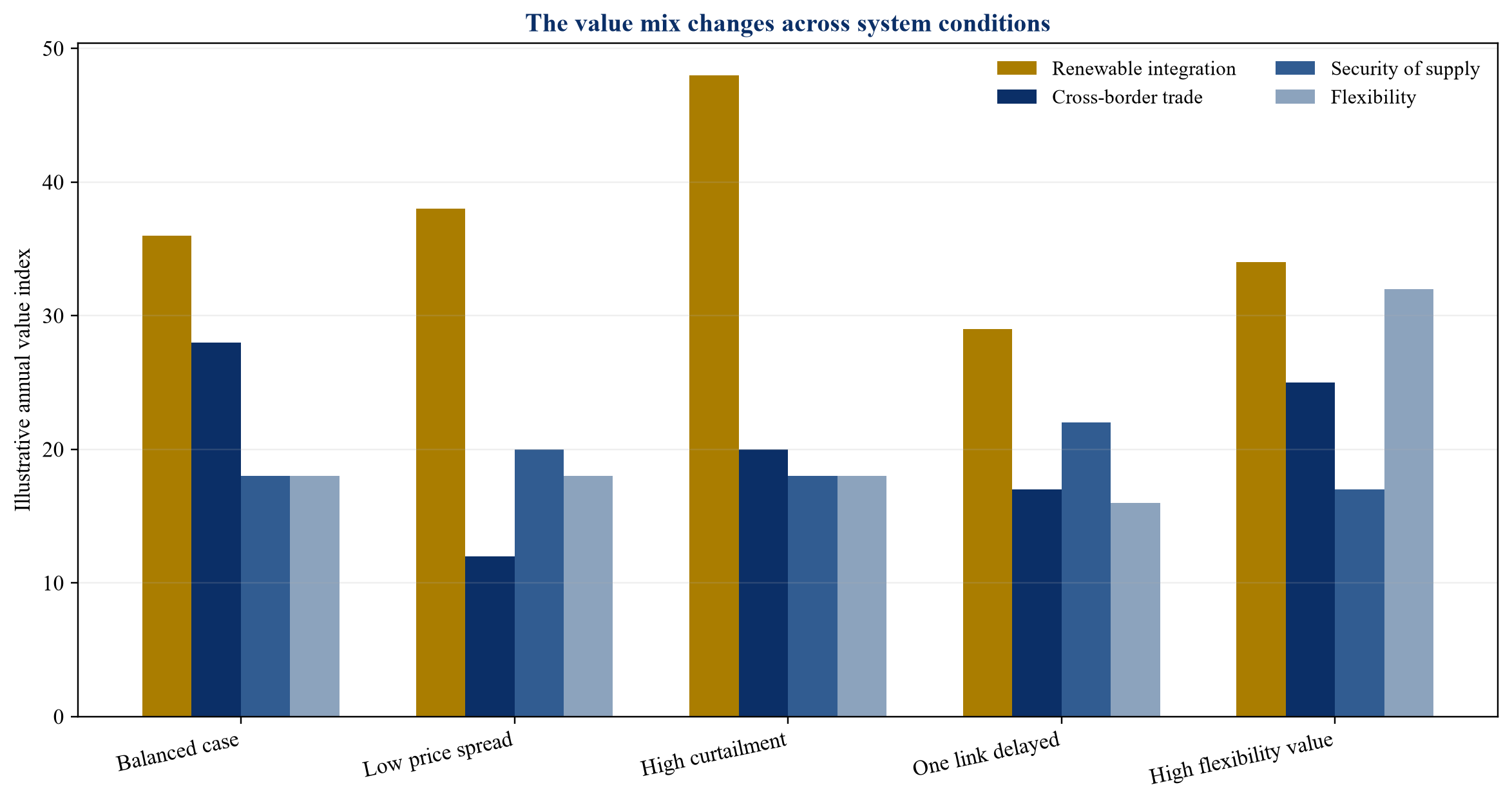
Values are author-modelled indices for framework illustration. They are not forecasts, observed project results or market quotations.
The results should be interpreted by payer and beneficiary. Higher renewable-integration value may accrue through avoided curtailment, lower balancing cost or faster generator connection. Trade value may accrue through congestion income or consumer price effects. Security value may be public or system-wide unless a payment mechanism captures it.
Debt cases should focus on cash available to the borrower. Economic-benefit cases can support government and regulatory approval. Keeping the cases separate prevents a public benefit from being counted as project revenue.
33 Build liquidity for delay and rephasing
Large offshore programmes can face approval, manufacturing or installation delay. The financing plan should include committed contingency, standby liquidity and rules for additional equity. A reserve should cover debt service and essential operating cost during commissioning or revenue interruption.
Rephasing rights should be agreed before a disruption. The owner may need to slow one package while protecting a critical supplier slot. Lenders should receive an updated completion plan and independent-engineer review. Distributions should remain restricted while the programme is outside the approved base case.
Public support should have a defined purpose and ceiling. A grant can fund cross-border benefits or early-stage risk. A guarantee can address specified policy or payment risk. Open-ended public coverage weakens incentives and makes the fiscal exposure difficult to govern.
34 Preserve refinancing discipline
After objective completion and performance tests, the asset may support longer-tenor debt. The agreements should define how gains are shared among consumers, public sponsors and investors after transaction costs. Refinancing should preserve lifecycle investment, tariff affordability, security, step-in, information and reserve obligations.
35 Govern information and cybersecurity
The hub will exchange operational data across generators, system operators, market platforms and maintenance providers. Data ownership, access, quality, retention and security need a common framework. The operator should maintain an authoritative asset and interface record throughout the lifecycle.
Cybersecurity should cover converters, substations, protection, telecommunications, remote maintenance and corporate systems. Segmentation, identity control, logging, secure configuration, supplier access and recovery testing should be specified. Cross-border incident coordination should define notification, command, evidence and restoration.
Commercial transparency must coexist with infrastructure security. Public reporting can show cost, schedule, availability and benefit delivery. Detailed configurations, vulnerabilities and access credentials require controlled distribution.
36 Plan operations before construction
The operating model should identify the asset operator, control rooms, maintenance responsibilities, outage coordination and emergency command. It should address how the hub interacts with each national system operator and connected generator. The operating agreement should be developed alongside the technical design.
Spares and specialist support require long-term planning. Converter and cable failures can have long repair times. The programme should identify strategic spares, vessel access, repair frameworks and manufacturer support. The cost should be included in the lifecycle case.
Performance reporting should reconcile technical availability, commercial availability, energy flows, losses, congestion, outages, maintenance and incidents. Revenue deductions and incentives should be traceable to the same evidence.
37 Fund decommissioning and repowering
Energy islands can outlast individual wind farms and electrical components. The end-of-life plan should distinguish common civil infrastructure, replaceable equipment, cables and connected-generation assets. Repowering can extend system value if structural capacity, permits and grid rights remain suitable.
Decommissioning obligations should be allocated by asset and jurisdiction. Security may take the form of reserves, guarantees or regulated allowances. The programme should avoid leaving common removal costs to the last remaining user.
Periodic condition reviews should update the remaining-life and decommissioning plan. A funded approach protects future consumers and public budgets while preserving the option to reuse valuable infrastructure.
38 Use evidence gates from concept to operation
Development should proceed through system need, concept selection, cross-border agreement, market and regulatory design, permitting, procurement, financing, construction and operation. Each gate should have a decision owner and defined evidence. Spending authority should match the maturity of the programme.
Table 3. Energy-island implementation roadmap
| Gate | Required evidence | Principal decision | Financing consequence |
|---|---|---|---|
| System need | Coordinated network study, alternatives and benefit map | Confirm common infrastructure need | Authorise bounded development funding |
| Concept selection | Module architecture, interface map and site evidence | Select hub configuration and phasing | Define investable entities and cost envelope |
| Cross-border framework | Governance, cost allocation and dispute process | Commit participating authorities | Establish payment and policy support |
| Market and regulation | Revenue regime, bidding-zone approach and connection rules | Confirm financeable service | Support lender and investor base case |
| Consent and procurement | Permit pathway, surveys, package strategy and supplier evidence | Launch binding procurement | Quantify contingency and completion exposure |
| Final investment decision | Executable contracts, funding, insurance and independent review | Commit construction capital | Draw equity, grants and debt |
| Phased commissioning | Tested modules, temporary operating rules and accepted interfaces | Start eligible services | Begin defined revenue and convert debt by stage |
| Full operation | Integrated tests, regulatory approval and lifecycle plan | Accept the complete system | Release completion support and commence long-term regime |
Timing is project-specific. The roadmap identifies decision evidence rather than a prescribed calendar.
The gate process should preserve the ability to stop or reconfigure a weak programme before the largest commitments. It should also protect development knowledge and supplier relationships when a justified delay occurs.
39 Build a replicable regional platform
The first energy island can establish standard agreements and a common data model for later hubs. A credible portfolio can support factory, vessel, port and workforce investment. Replication should use actual cost, delay, loss, availability and maintenance evidence while preserving project-specific engineering and asset-owner accountability.
40 Recognise limitations
This framework does not provide electrical design, marine engineering, environmental approval, regulatory determination, legal opinion, tax advice, market forecast or investment recommendation. Each project requires qualified technical, economic, regulatory, legal, environmental and financial review.
The figures and tables use hypothetical author-modelled assumptions. They should not be treated as observed performance, project estimates, market pricing or forecasts. Costs, revenues, market rules, regulatory regimes and public-support instruments vary by jurisdiction and date.
Energy-island benefits depend on future generation, networks, market design and system conditions. Those variables remain uncertain. The framework is intended to expose dependencies, link benefits to payers and connect technical modules to financeable obligations.
Conclusion
An energy island is financeable when its shared infrastructure is divided into coherent modules, each module has an accountable owner, and every cash flow is connected to an enforceable service. The civil platform, collection system, converters, interconnectors, storage and future conversion technologies should not be blended into one unsupported business case.
The programme should begin with coordinated system need. It should compare the hub with radial connections, conventional interconnectors and onshore reinforcement. Cross-border governance then converts the preferred system architecture into cost shares, decision rights, dispute mechanisms and a stable regulatory path.
The financing structure should follow the payer map. Grants can support defined cross-border or innovation benefits. Regulated revenue can support transmission services. Cap-and-floor or contracted arrangements can limit interconnector volatility. Connected generators should fund the obligations assigned through connection and market rules. Future storage and hydrogen should enter the case only when their services are contracted.
Delivery depends on interface control, supply-chain evidence, marine planning, phased completion and lifecycle funding. The risk matrix should allocate each exposure to a party with control and capacity. The model should preserve the distinction between economic benefit and project cash flow.
The resulting hub is a governed system of assets and contracts. Its investment value comes from connecting several forms of infrastructure while keeping their risks visible. That discipline gives public sponsors, regulators, generators and capital providers a common basis for deciding whether one hub can support many connections.
References
- European Network of Transmission System Operators for Electricity, Offshore Network Development Plans, 2024. https://www.entsoe.eu/outlooks/offshore-hub/tyndp-ondp/
- European Network of Transmission System Operators for Electricity, European Offshore Network Transmission Infrastructure Needs, 2024. https://eepublicdownloads.blob.core.windows.net/public-cdn-container/tyndp-documents/ONDP2024/ONDP2024-pan-EU-report.pdf
- European Network of Transmission System Operators for Electricity, Offshore Roadmap, 2025. https://www.entsoe.eu/2025/06/26/entso-e-publishes-offshore-roadmap/
- European Network of Transmission System Operators for Electricity, Position on Offshore Cost Sharing, 2025. https://www.entsoe.eu/2025/07/02/entso-e-publishes-position-paper-on-offshore-cost-sharing/
- European Network of Transmission System Operators for Electricity, Ten-Year Network Development Plan 2024. https://tyndp2024.entsoe.eu/
- European Commission, Commission supports Bornholm Energy Island with EUR 645 million, 4 September 2025. https://energy.ec.europa.eu/news/commission-supports-bornholm-energy-island-eu645-million-2025-09-04_en
- European Commission, Guidance on collaborative investment frameworks for offshore energy projects, 2024. https://energy.ec.europa.eu/publications/guidance-collaborative-investment-frameworks-offshore-energy-projects_en
- European Commission, Offshore renewable energy. https://energy.ec.europa.eu/topics/renewable-energy/offshore-renewable-energy_en
- European Commission, Trans-European Networks for Energy. https://energy.ec.europa.eu/topics/infrastructure/trans-european-networks-energy_en
- European Commission, Cross-border renewable energy projects. https://energy.ec.europa.eu/topics/renewable-energy/financing/cross-border-renewable-energy-projects_en
- European Commission, Connecting Europe Facility Energy. https://cinea.ec.europa.eu/programmes/connecting-europe-facility/energy-infrastructure-connecting-europe-facility-0_en
- European Commission, North Seas Energy Cooperation. https://energy.ec.europa.eu/topics/infrastructure/high-level-groups/north-seas-energy-cooperation_en
- European Commission, EU Strategy on Offshore Renewable Energy. https://energy.ec.europa.eu/topics/renewable-energy/offshore-renewable-energy/eu-strategy-offshore-renewable-energy_en
- Agency for the Cooperation of Energy Regulators, Cross-border cost allocation. https://www.acer.europa.eu/electricity/infrastructure/cross-border-cost-allocation
- Agency for the Cooperation of Energy Regulators, Monitoring report on cross-border cost allocation decisions, 2025. https://www.acer.europa.eu/monitoring/MMR/cross-border-cost-allocation
- Danish Energy Agency, Energy Island Bornholm. https://ens.dk/en/energy-sources/energy-islands/energy-island-bornholm
- Danish Energy Agency, The North Sea Energy Island. https://ens.dk/en/energy-sources/energy-islands/north-sea-energy-island
- Energinet, Bornholm Energy Island. https://en.energinet.dk/infrastructure-projects/project-list/bornholm-energy-island/
- Energinet, Business case for Bornholm Energy Island. https://en.energinet.dk/about-our-reports/reports/business-case-for-bornholm-energy-island/
- 50Hertz, Bornholm Energy Island. https://www.50hertz.com/en/Grid/Griddevelopement/ProjectsOffshore/BornholmEnergyIsland
- Siemens Energy, Bornholm Energy Island converter technology order. https://www.siemens-energy.com/global/en/home/press-releases/bornholm-energy-island.html
- European Investment Bank, EIB supports construction of Princess Elisabeth Energy Island with EUR 650 million green credit facility, 25 October 2024. https://www.eib.org/en/press/all/2024-407-eib-supports-construction-of-world-s-first-artificial-energy-island-with-eur650-million-green-credit-facility
- Elia Group, Princess Elisabeth Island. https://www.elia.be/en/infrastructure-and-projects/infrastructure-projects/princess-elisabeth-island
- Elia Group, Cost increase for HVDC infrastructure leads to adjusted timing, February 2025. https://www.elia.be/en/press/2025/02/20250210_press-release-princess-elisabeth-island
- Elia Group, Final report of the Princess Elisabeth Island task force, 2025. https://www.elia.be/en/news/press-releases/2025/07/20250718_final-report-task-force-princess-elisabeth-island
- European Investment Bank, Princess Elisabeth Zone Lot 1 offshore wind farm project. https://www.eib.org/en/projects/pipelines/all/20230446
- Ofgem, Multi-purpose interconnectors: decision on market arrangements, 13 March 2026. https://www.ofgem.gov.uk/decision/multi-purpose-interconnectors-decision-market-arrangements
- Ofgem, Offshore Hybrid Asset pilot projects. https://www.ofgem.gov.uk/energy-policy-and-regulation/policy-and-regulatory-programmes/offshore-hybrid-assets
- Ofgem, Interconnector cap and floor regime. https://www.ofgem.gov.uk/energy-policy-and-regulation/policy-and-regulatory-programmes/electricity-interconnectors
- UK Department for Energy Security and Net Zero, Interconnection policy update, 25 March 2026. https://www.gov.uk/government/publications/electricity-interconnection-policy
- UK Parliament, Energy Act 2023. https://www.legislation.gov.uk/ukpga/2023/52/contents
- WindEurope, Energy islands. https://windeurope.org/intelligence-platform/product/energy-islands/
- International Energy Agency, Offshore Wind Outlook 2019. https://www.iea.org/reports/offshore-wind-outlook-2019
- International Renewable Energy Agency, Offshore Renewables: An Action Agenda for Deployment, 2021. https://www.irena.org/publications/2021/Jul/Offshore-Renewables-An-Action-Agenda-for-Deployment
- World Bank Group, Offshore Wind Development Program. https://www.worldbank.org/en/programs/offshore-wind-development-program
About the Author
Authored by Chennakeshav Adya Independent Researcher
Chennakeshav (CK) is a corporate finance and investment banking executive with 25+ years of global experience in deal origination, structuring and execution across M&A, growth capital and corporate strategy. He has led value-creation mandates for founders, corporates and funds — bridging the boardroom view to hands-on execution and close.
His career spans Morgan Stanley, HSBC, Lloyds Banking Group, EWEC, ADQ portfolio companies and Emirates Growth Fund, across TMT, real estate, fintech, deeptech, cleantech, infrastructure and energy. He has partnered with C-suite leaders, private equity and venture funds, sovereign wealth funds and family offices to finance complex fund raises and scale-up ventures, and has led M&A due diligence, post-merger integration and business-transformation initiatives to create value.
At Matchpoint Partners he is Managing Partner, leading the firm's corporate finance, M&A and capital-raising practice. He holds an MBA from London Business School, an engineering degree from VTU and a Master of Laws (LLM, in progress) from UCL London.
An active start-up mentor, CK mentors at Techstars, DIFC FinTech Hive, Startup Grind, Founder Institute and IN5, serves as Entrepreneur Mentor in Residence (EMiR) at London Business School, and judges the Entrepreneurship World Cup.
LinkedIn: https://www.linkedin.com/in/ckadya/ Matchpoint Partners: https://www.matchpoint-partners.com/team/ck-adya.html
This paper is part of a continuing series on the structure of private and alternative markets. The views expressed are the author's own. The paper is for information only, describes market structure in general terms, and does not constitute investment, legal, tax or regulatory advice or a recommendation in respect of any security, vehicle or counterparty.
