
Introduction
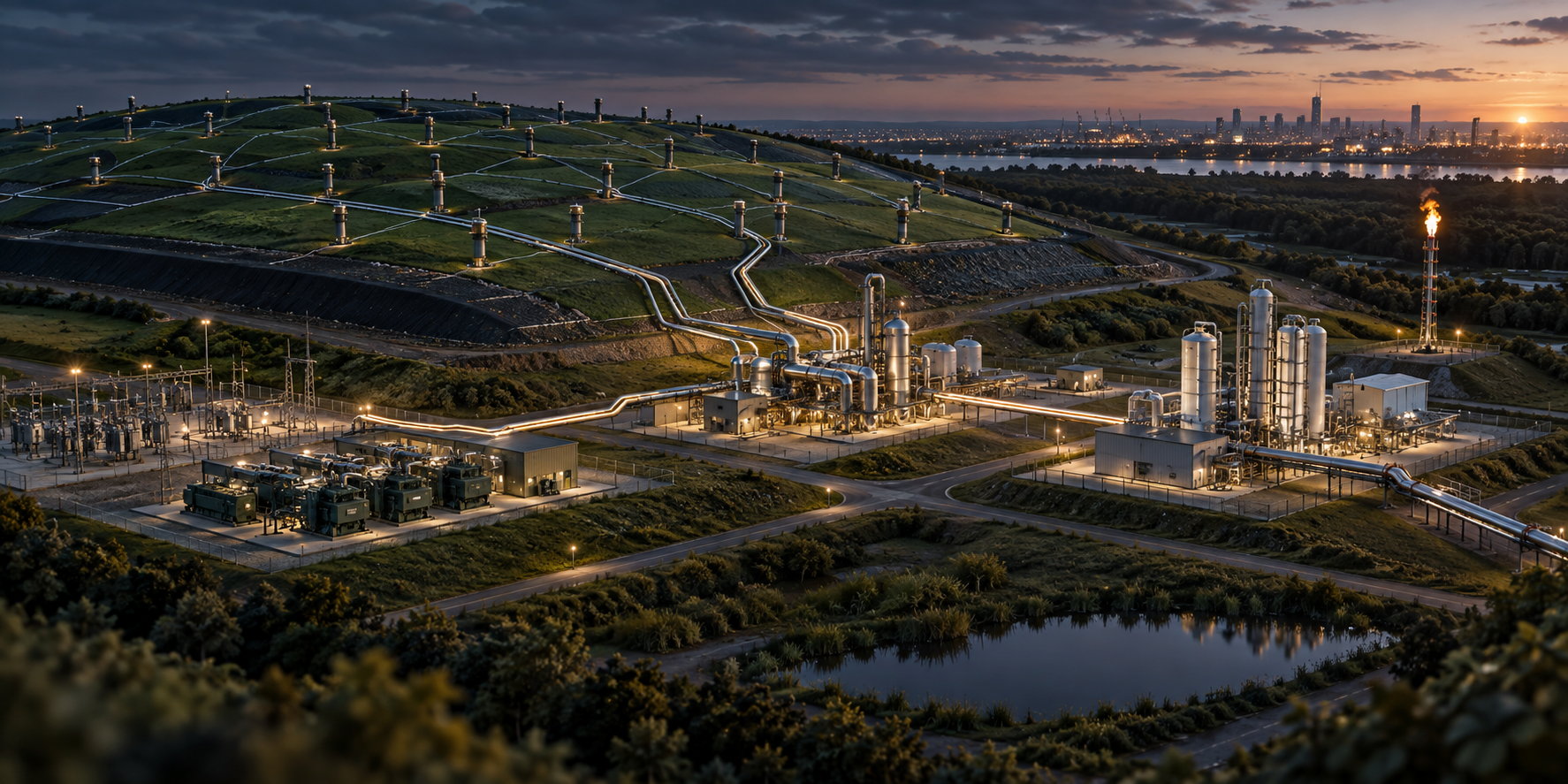
Landfill gas is a consequence of waste decomposition and a long-duration operating obligation. It is also a potential energy resource. Gas collected from a landfill commonly contains methane and carbon dioxide with moisture, oxygen, nitrogen and trace contaminants. The methane can be combusted in a flare, used in engines or turbines, supplied directly to a thermal customer, or upgraded into renewable natural gas or biomethane.
The United States Environmental Protection Agency describes landfill gas as roughly half methane and half carbon dioxide, with smaller quantities of other compounds.[1] The agency’s development handbook frames electricity, direct use and renewable natural gas as distinct project pathways with different technical, commercial and regulatory requirements.[2] The United Kingdom Environment Agency requires operators to manage collection, treatment, emissions and utilisation through a site-specific gas-management system.[3]
The investment problem is dynamic. Gas generation rises and falls with waste placement, composition, moisture, temperature and age. Collection changes with cell development, capping, settlement, wells, condensate and vacuum. Revenue changes with power prices, gas prices, environmental attributes, grid access and offtake. An attractive machine can become underused if the gas forecast, collection system or contract is weak.
This paper provides a decision framework for investors, landfill owners, municipalities, developers and lenders. It starts with the environmental duty, establishes the recoverable molecule, compares revenue routes, and sequences capital through operating evidence.
1. Define the decision
The decision should identify the landfill area, waste history, gas-control obligation, existing collection system, candidate technology, product route, connection, contract, capital envelope and operating term. It should state whether the project is a new installation, an expansion, a conversion from electricity to gas, or a replacement for ageing equipment.
Approval should cover a defined stage. Early capital can fund waste-data validation, field testing, wellfield improvement, gas analysis, connection studies, permits and commercial negotiation. Construction approval should follow verified gas availability and an executable sales route.
The investment committee needs explicit stop rules. Examples include insufficient recoverable flow, unacceptable contaminants, a connection cost above the value threshold, unresolved ownership of environmental attributes, or a contract whose minimum delivery exceeds resilient production.
2. Separate control from utilisation
Landfill-gas collection may be required for environmental or safety reasons. Energy recovery creates an incremental use for collected gas. The financial model should distinguish mandatory collection, treatment and flaring cost from additional capital and operating cost for utilisation.
This separation matters because an energy project can end while the landfill retains gas-control and aftercare obligations. The UK Environment Agency states that a landfill operator remains responsible for monitoring, collecting and minimising emissions even when utilisation is subcontracted.[3]
Contracts should allocate utilisation performance without obscuring statutory responsibility. The landfill owner needs access, data and contingency rights sufficient to maintain compliance.
3. Map the molecule and revenues
The physical system begins with waste cells and gas generation. Wells and horizontal collectors draw gas into laterals and headers. Condensate systems protect flow. Blowers create vacuum. Treatment then supports a flare, power plant, direct user or upgrading facility.
Commercial flows include electricity, heat, gas, capacity, renewable attributes, low-carbon fuel value, carbon-related value and avoided operating cost. Each cash flow requires a quantity, price, owner, counterparty, eligibility rule and settlement process.
The map should also show the environmental baseline, monitoring boundary, residual emissions and closure obligations. Financial value should reconcile to physical gas and verified environmental evidence.
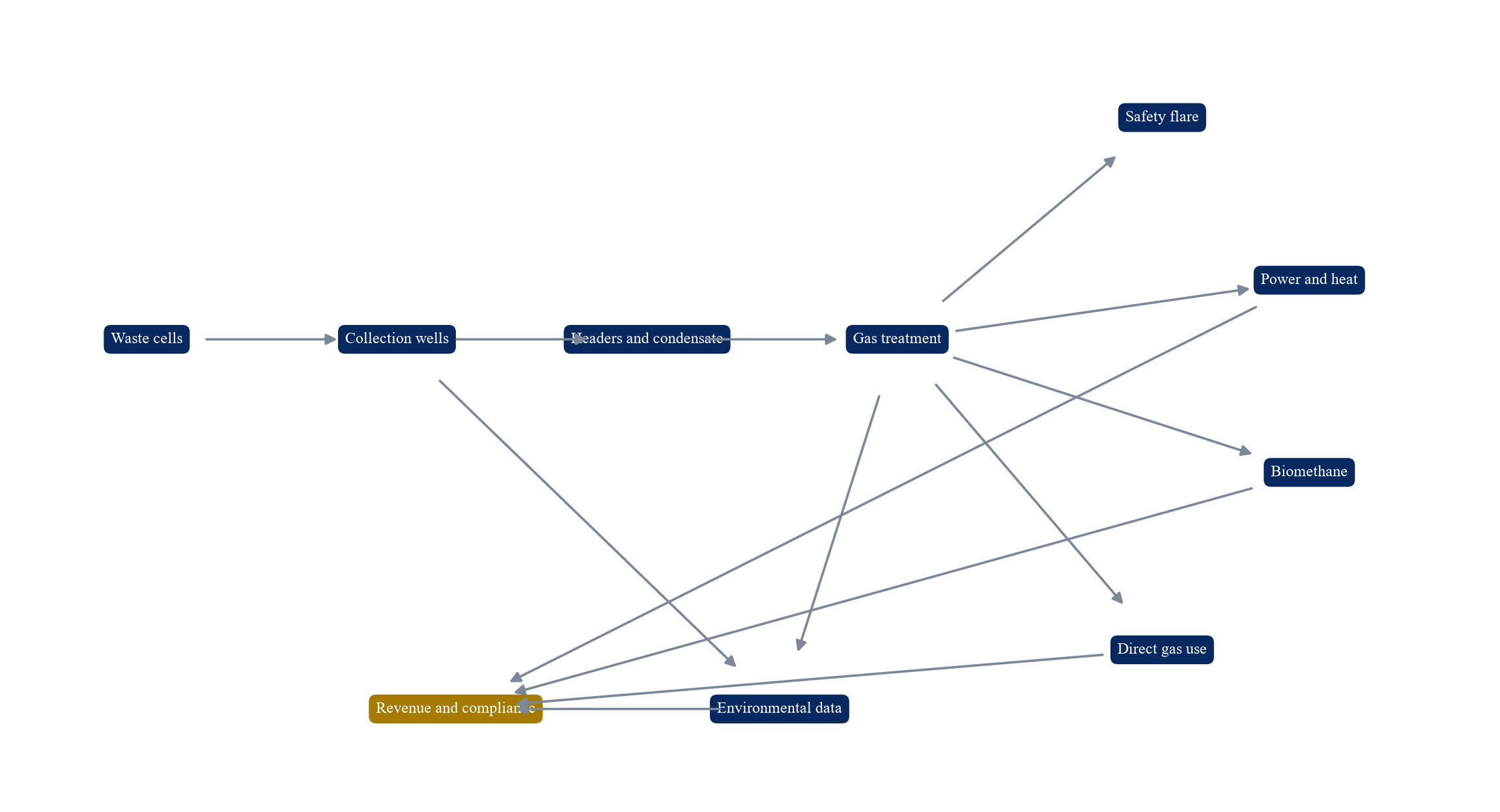
Proposed system map; actual ownership, technology, products and contracts depend on the landfill and jurisdiction.
4. Establish the site history
Gas forecasting begins with the landfill record. The model should capture opening date, annual waste receipts, cell boundaries, waste composition, biodegradable fraction, moisture, compaction, cover, leachate recirculation, closure dates and planned future intake.
Historical records often contain gaps or inconsistent categories. Weighbridge data, permits, aerial imagery, construction drawings and operating records should be reconciled. Unknown quantities need ranges rather than unsupported precision.
The site history should distinguish active, temporarily capped and permanently capped areas. Collection timing and performance differ across those conditions.
5. Model gas generation
Landfill-gas models estimate methane generation from waste mass, decay rate and methane-generation potential. The EPA’s LandGEM and the UK GasSim approach are screening and planning tools whose results depend on site inputs and assumptions.[4][5]
The model should be calibrated to measured flow and methane concentration where operating data exist. A model that fits one year may still misstate future decline if collection changed or measurement quality is weak.
Use low, base and high cases for waste intake, decay and recoverable fraction. The forecast should extend through the proposed financing term and residual aftercare period.
6. Estimate recoverable gas
Generated gas is not the same as collected gas. Recovery depends on cap integrity, well density, vacuum, liquid levels, settlement, air intrusion, operational access and the proportion of the landfill under collection.
EPA cost-model guidance uses collection-efficiency ranges as modelling inputs and states that site-specific assumptions should replace defaults where evidence exists.[6] The investment case should use measured extraction and surface-emission evidence rather than a generic percentage alone.
The forecast should separate gross methane generation, collection efficiency, methane concentration, treatment loss, parasitic use and saleable product.
7. Audit the collection field
The technical audit should inspect wells, wellheads, laterals, headers, valves, condensate traps, pumps, blowers, meters, flares and access. It should review vacuum balance, oxygen and nitrogen, temperature, carbon monoxide, liquids, corrosion, settlement and surface emissions.
The Environment Agency requires continuous adjustment to maximise collection while limiting air ingress, regular inspection and maintenance, and periodic assessment of collection-system efficiency.[3]
The audit should create a prioritised improvement programme. New utilisation equipment cannot compensate for a poorly performing wellfield.
8. Manage condensate and liquids
Cooling gas releases condensate that can block pipework, restrict flow and damage equipment. Leachate levels can drown wells. Pipe gradients, traps, pumps, sumps and disposal routes need inspection under actual settlement conditions.
The collection model should link liquid-control improvements to incremental gas only when evidence supports the relationship. Pumps require power, maintenance, alarms and backup.
Landfill settlement changes drainage over time. The design should provide access and flexibility for adjustment or replacement.
9. Characterise the gas
Sampling should cover methane, carbon dioxide, oxygen, nitrogen, moisture, hydrogen sulphide, siloxanes, halogenated compounds and other contaminants relevant to the selected technology and permit.
Composition can vary by cell, season, vacuum and waste type. Composite averages can hide a stream that damages engines or breaches an upgrader inlet specification.
The gas-quality programme should define sampling frequency, methods, laboratory assurance and response. Treatment design should use both normal and credible upset conditions.
10. Design treatment around end use
Power generation often needs moisture removal, particulate filtration and contaminant control. Direct thermal use depends on the customer’s burners and product specification. Biomethane upgrading requires much deeper removal of carbon dioxide, contaminants and moisture, plus methane recovery and final gas-quality compliance.
The EPA’s 2024 handbook describes treatment and technology options by end use.[2] The design should include redundancy, turndown, consumables, waste streams, emissions, noise and maintenance access.
Treatment cost and parasitic energy should enter the netback. A higher-value product can require materially more capital and operating complexity.
11. Preserve a compliant flare
A flare is a safety and environmental control when utilisation is unavailable, off specification or below turndown. It should have sufficient capacity, reliable ignition, monitoring and access to backup power.
The utilisation plant should not reduce the landfill’s ability to control gas. Contracts should define priority between compliance and production.
Flare use is also a performance signal. High flaring during available utilisation may indicate equipment or commercial failure. Zero flaring can indicate poor collection as well as good utilisation.
12. Compare electricity generation
Electricity options include reciprocating engines, turbines, microturbines and other technologies. Suitability depends on gas flow, methane content, contaminants, plant size, grid access, heat use, maintenance and emissions limits.
Reciprocating engines have historically matched many landfill-gas project sizes.[7] The current decision should use available equipment and local emissions standards. Engine output declines with gas availability and ambient conditions.
The model should include generator, gas treatment, switchgear, substation, interconnection, auxiliary load, overhaul, catalyst where applicable and decommissioning.
13. Evaluate combined heat and power
Heat recovery can improve fuel utilisation when a credible customer exists. The heat load needs temperature, pressure, quantity, hourly profile, duration and backup requirements.
The customer should be close enough to support pipe cost and heat loss. A short contract relative to project life creates stranded infrastructure risk.
The model should not assume full heat use. It should use contracted and measured demand with seasonal downside.
14. Evaluate direct gas use
Medium-Btu gas can serve nearby boilers, kilns, dryers or other thermal processes after suitable treatment. Direct use can avoid electricity conversion losses and may require less upgrading than pipeline biomethane.
The EPA suggests that proximity and consistent thermal demand are central considerations for direct use.[8] The customer’s credit, fuel flexibility, shutdown schedule and gas-quality tolerance matter.
The project needs a backup disposition for gas when the customer is unavailable. The customer may also need backup fuel when landfill gas falls.
15. Evaluate biomethane
Biomethane upgrading can access pipeline gas, vehicle fuel or other higher-value markets. It requires sufficient flow and quality, gas cleaning, upgrading, compression, metering, connection and environmental-attribute compliance.
EPA guidance identifies gas-flow and market considerations for renewable-natural-gas conversion.[8] The IEA finds landfill gas among the lower-cost biomethane resources where capture systems can be installed effectively.[9]
The model should reflect methane recovery, reject gas, electricity consumption, connection charges, balancing, compression and quality risk.
16. Consider virtual delivery
Where a pipeline is distant, compressed or liquefied biomethane can be trucked to a customer or injection point. The business then includes compression or liquefaction, containers, loading, vehicles, routes, unloading and backup capacity.
Transport cost depends on energy density, distance, cycle time, fleet utilisation and return logistics. Road disruption can interrupt sales while gas generation continues.
The project should preserve flare capacity and storage discipline. Gas storage on site is limited and introduces safety requirements.
17. Match technology to the gas curve
Landfill gas rises, peaks and declines. Equipment should fit the expected curve rather than the peak alone. Modular units can stage capacity and preserve turndown.
An active landfill may add wells and generators over time. A closed landfill may require phased retirement. Upgrading facilities can face minimum-flow constraints later in life.
The investment model should include additions, removals, relocation, overhaul and salvage where supportable. Residual value should remain conservative.
18. Build the revenue stack
Revenue can include electricity, heat, direct gas, biomethane, capacity, renewable attributes, low-carbon fuel value, carbon-related value and avoided flare or energy cost. Each line needs a physical quantity, legal basis, price mechanism, owner and counterparty.
The EPA development handbook treats energy sales and other revenues or incentives as separate economic inputs.[2] The model should prevent double counting between gas sale, certificate sale and emissions value.
Base-case revenue should reflect signed or sufficiently advanced arrangements. Prospective attributes should remain conditional.
19. Contract power sales
The power contract should specify quantity, delivery point, price, escalation, availability, curtailment, metering, losses, imbalance, credit and environmental attributes. Merchant exposure should be explicit.
An expiring power-purchase agreement can create a conversion decision. The EPA provides tools for comparing continued electricity, direct use and renewable-natural-gas routes.[8][10]
The model should include interconnection life and upgrade cost. A favourable generation cost does not create value when the grid cannot accept output.
20. Contract gas sales
Gas contracts should define quality, pressure, quantity, nomination, balancing, interruption, measurement, index, floor, credit support and attribute ownership. Delivery and title points should match the physical system.
A fixed component can support debt service. An indexed component can preserve market participation. Minimum-delivery obligations should fit the resilient gas forecast.
The contract should address declining flow and end-of-life termination. Extension rights need corresponding site and collection rights.
21. Define environmental value
Environmental value can arise from avoided uncontrolled methane, displacement of fossil energy or compliance with a renewable or low-carbon programme. The baseline must reflect regulation and existing obligations.
EPA’s benefits calculator distinguishes direct methane reductions at sites not already required to collect and combust gas from avoided emissions associated with energy displacement.[11] It also states that the calculator is not a lifecycle assessment.
The project should use the applicable methodology, monitoring plan and verification process. It should avoid claiming a reduction already required or sold elsewhere.
22. Establish attribute ownership
Ownership may sit with the landfill owner, gas-rights holder, project company, energy buyer or public authority. Contracts should allocate current and future environmental attributes, data access, registration and audit obligations.
Ambiguous language can create disputes when a new market appears. The contract should address changes in methodology, invalidation, replacement and reversal where relevant.
The financial model should only include value the project can legally transfer.
23. Measure residual emissions
Collected gas is only part of the methane balance. Surface emissions, leaks, incomplete combustion, engine slip, upgrader reject gas and downtime affect environmental performance.
The UK Environment Agency requires surface-emission surveys, fault correction and measurement through capped areas.[12] Monitoring should include the full project boundary and operating states.
Environmental revenue and public claims should reconcile to actual collection and destruction. Increased utilisation should not encourage excessive vacuum or air intrusion.
24. Build the capital programme
Capital should include wellfield expansion, headers, condensate, blowers, treatment, flare, generation or upgrading, electrical or gas connection, buildings, controls, engineering, permits, owner costs, financing, contingency and decommissioning.
Separate mandatory gas-control capital from incremental utilisation capital. The allocation affects pricing, ownership and public-procurement treatment.
The estimate should state price date, procurement status, tax, escalation and accuracy. Live-landfill construction and settlement create specific contingency needs.
Table 1. Hypothetical sources and uses for a landfill-gas utilisation project
| Uses | Amount | Sources | Amount |
|---|---|---|---|
| Collection-field improvements | 18 | Sponsor equity | 32 |
| Gas treatment and safety flare | 16 | Senior project debt | 54 |
| Power or biomethane plant | 47 | Equipment finance | 21 |
| Grid or pipeline connection | 19 | Public or climate support | 13 |
| Development, monitoring and controls | 11 | Contingency facility | 7 |
| Contingency, financing and reserves | 16 | Landfill-owner contribution | 0 |
| Total hypothetical uses | 127 | Total hypothetical sources | 127 |
Illustrative values only; no identified landfill, operator, sponsor, borrower or transaction is represented.
25. Model operating cost
Operating cost should include wellfield technicians, condensate, electricity, chemicals, media, filters, laboratory testing, engine or upgrader maintenance, overhaul, emissions monitoring, flare, insurance, connection charges and central overhead.
Cost changes with gas decline. Fixed staffing and connection charges can increase unit cost as saleable output falls. Contaminants can drive maintenance and consumable use.
The model should include outage and recovery cost. Maintenance deferral can reduce collection, damage equipment and create permit exposure.
26. Test gas-flow and netback sensitivities
The core variables are saleable gas flow and unit netback. Saleable flow combines gross generation, collection, methane concentration, treatment recovery and availability. Netback combines commodity price, attribute value, transport, balancing and variable cost.
Downside should combine lower flow, faster decline, higher air intrusion, contaminant cost, longer connection delay and weaker price. These events can be correlated.
The model should identify break-even flow, minimum liquidity, debt-service pressure and the economic conversion point between technologies.
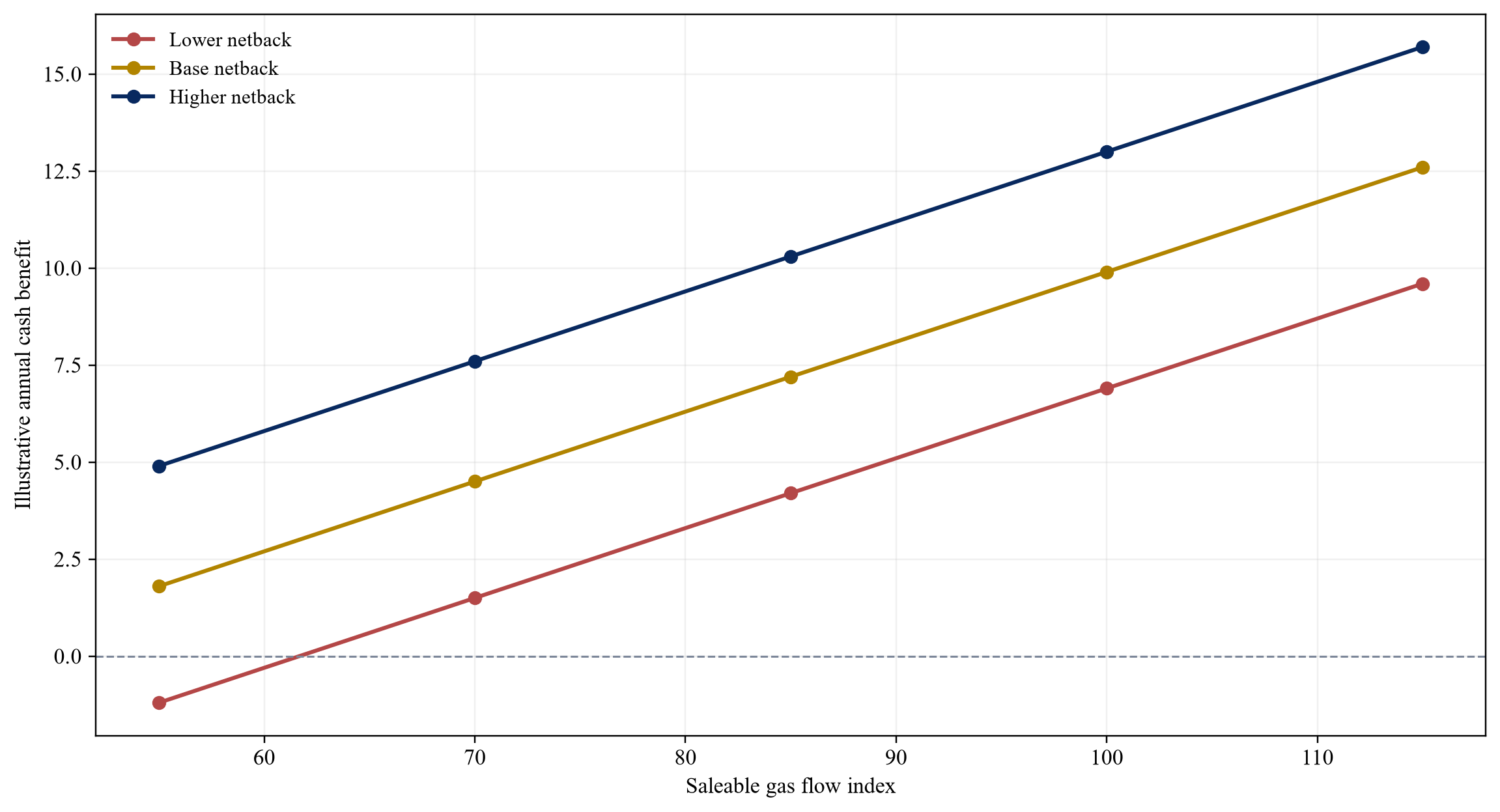
Illustrative scenario analysis only; values are not forecasts or transaction evidence.
27. Compare revenue pathways
Power, direct use and biomethane should be compared on the same gas forecast and financing basis. The comparison should include capital, operating cost, conversion efficiency, connection, contract, environmental value, decline fit and residual obligations.
The best headline price may have the weakest risk-adjusted return. Biomethane can access wider markets while adding upgrading and quality exposure. Direct use can be simple but concentrated in one nearby customer. Power can use established equipment while facing grid and tariff pressure.
The option study should include a compliant flare-only case as the control baseline.
Table 2. Proposed landfill-gas revenue-pathway scorecard
| Test | Electricity | Direct gas use | Biomethane | Control baseline |
|---|---|---|---|---|
| Minimum resilient flow | modular by unit size | customer-dependent | upgrader and connection dependent | flare turndown dependent |
| Treatment complexity | medium | low to medium | high | low |
| Connection exposure | power grid | dedicated pipe | gas grid or virtual delivery | none beyond site |
| Revenue concentration | power buyer or market | nearby thermal customer | gas and attribute buyers | no energy sale |
| Declining-flow flexibility | modular retirement possible | contract renegotiation may be needed | turndown can constrain late life | designed for control |
| Environmental evidence | collection, combustion and displacement | collection, combustion and displacement | collection, recovery, delivery and end-use rules | collection and destruction |
| Primary investment gate | grid and tariff | customer contract and distance | flow, quality, connection and eligibility | compliant capacity |
Proposed framework; conclusions require site-specific technical, regulatory, environmental and financial review.
28. Structure landfill rights
The project needs rights to collect, treat and use gas, occupy land, install and maintain equipment, access records, connect utilities and operate through the contract term. These rights should survive relevant ownership or operator changes.
The agreement should allocate collection-field improvement, waste-operation interference, settlement, relocation and restoration. It should define gas priority when environmental control conflicts with utilisation.
The term should cover construction, operations, decline and decommissioning. Extension rights should reflect permit and aftercare conditions.
29. Select the development model
The landfill owner can self-develop, procure a developer, form a joint venture or grant gas rights under a concession or service agreement. The choice depends on capital, expertise, procurement rules and desired risk allocation.
The EPA handbook describes partner-selection and development approaches.[2] The World Bank provides public-private partnership examples in which a project company designs, finances, builds, operates and maintains gas capture and power assets.[13]
The selection process should test technical capability, balance sheet, operating record, environmental controls and commercial proposal.
30. Match finance to the asset
Early development may use sponsor or municipal funds. Construction debt can fund defined assets after gas, permits, connection and offtake are sufficiently advanced. Term debt should rely on demonstrated and stress-tested cash flow.
Municipal ownership, project finance, equipment finance, climate facilities, grants and bonds may be relevant depending on jurisdiction and structure. The World Bank emphasises that landfill projects require site-specific financial plans.[14]
Debt sizing should reflect declining output and attribute uncertainty. Amortisation should not rely on unsupported terminal value.
31. Establish completion support
Construction completion should cover wells, headers, treatment, flare, plant, connection and controls. Operating completion should prove gas flow, quality, energy output, emissions, availability and commercial settlement over an appropriate period.
The sponsor should fund cost overrun and delay according to defined obligations. Contractor security should match package risk and counterparty strength.
Biomethane projects may need separate utility acceptance and programme registration. Mechanical completion alone does not release those risks.
32. Procure integrated interfaces
Wellfield, treatment, utilisation, connection and landfill operations interact continuously. Procurement should allocate interface design and performance authority.
Package competition can improve price while creating coordination risk. A system integrator or owner’s engineer should reconcile gas basis, pressure, quality, controls, safety and commissioning.
Long-term service, spares, software access and specialist maintenance should be included before award.
33. Build the operating model
The operating organisation should define landfill and utilisation responsibilities, staffing, monitoring, call-out, work permits, emergency response and data ownership. Daily wellfield adjustment is a core production activity as well as an environmental control.
The Environment Agency requires competent personnel, documented fault response, maintenance records and contingency measures when utilisation is unavailable.[3]
Incentives should balance collection, revenue, emissions, reliability and asset life. A production-only bonus can create unsafe vacuum or defer maintenance.
34. Integrate operating data
The data model should reconcile well flow, header flow, methane concentration, treatment inlet, product output, flare flow, engine or upgrader availability, energy consumption, emissions, billing and attributes.
Meters need calibration, time alignment, maintenance and defined ownership. Estimated data should remain visible and conservatively treated.
The board and lenders should see a physical-to-cash bridge. Unexplained imbalance can indicate leaks, meter error, air intrusion, treatment loss or settlement problems.
35. Apply predictive analytics with controls
Analytics can support gas forecasting, well balancing, condensate prediction, equipment maintenance and contaminant management. Model outputs require reliable sensors and clear operating actions.
Landfill geometry and waste conditions change. A model trained on one period should be monitored for drift. Automated vacuum adjustment should respect oxygen, temperature, carbon monoxide and permit limits.
Operators should retain authority over abnormal states. Data-driven optimisation should improve documented decisions rather than obscure them.
36. Protect operational technology
Blowers, flares, engines, upgrading and metering use connected control systems. Cybersecurity should cover segmentation, remote access, vendor accounts, patching, backups and incident response.
Legacy equipment can contain unsupported software. Acquisition and conversion due diligence should inspect control ownership and recovery capability.
Manual-safe states, flare availability and backup power should be tested. A cyber event must not compromise gas control.
37. Manage air emissions
Engines, turbines, flares and treatment systems can emit nitrogen oxides, carbon monoxide, volatile compounds and other pollutants. Permits may set equipment, testing and reporting requirements.
Gas contaminants affect combustion and emissions. Treatment and maintenance should support the permitted operating window.
Dispersion, stack design and nearby receptors need site-specific review. Revenue operation should remain subordinate to environmental compliance.
38. Manage safety and migration
Methane is flammable and can migrate through waste or surrounding geology. The gas plan should cover perimeter monitoring, buildings, confined spaces, ignition sources, pressure, fire and emergency isolation.
Settlement can damage wells and pipework. Air intrusion can support subsurface fires. Carbon monoxide and temperature trends require investigation according to the operating plan.[3]
Contractors need landfill-specific induction and permit-to-work controls. Insurance should reflect actual hazards and responsibilities.
39. Plan lifecycle transitions
An active landfill may move from temporary collection to permanent wells, add generation and later convert or retire units. A closed landfill may shift from engines to smaller equipment, direct use, flare or methane oxidation as flow declines.
UK guidance requires planning for low concentrations and review of technology as commercial gas generation falls.[5] The financial plan should fund late-life control and decommissioning.
Transition triggers should use flow, methane quality, operating cost, contract and permit evidence. Management should avoid extending uneconomic equipment at the expense of collection performance.
40. Test circular-economy exposure
Waste prevention, recycling and separate organic-waste collection can reduce future biodegradable material entering landfills. This may lower long-term gas generation at active sites while improving wider environmental outcomes.
The project should use the permitted and policy-consistent waste forecast. It should avoid assuming continuous historical intake where diversion rules apply.
Existing waste continues generating gas after closure. Circular-economy policy affects the future curve, not the obligation to manage the existing body.
41. Test policy and attribute exposure
Revenue may depend on renewable-energy rules, low-carbon fuel programmes, carbon methodologies, tax credits or grants. The model should map legal basis, qualification, duration, registration, price and change risk.
Environmental support can improve economics, particularly where methane destruction and fossil displacement are recognised.[9][11] Eligibility varies by jurisdiction and baseline.
The downside case should remove or delay uncertain attributes. Physical energy cash flow and compliance cost should remain separately visible.
42. Allocate risk to control
The landfill owner controls waste operations, access and core gas-management obligations. The developer controls design and financing. Contractors control construction. Operators control wellfield balance and equipment. Utilities and offtakers control accepted delivery and payment within contracts.
Some risks remain shared. Gas generation depends on historical waste and weather. Settlement affects infrastructure. Policy affects attributes. Interfaces require coordination and clear decision rights.
Liability caps, insurance and credit support should be compared with the consequence of undercollection, prolonged outage and permit breach.
43. Fund reserves and contingency
Reserves may cover debt service, engine overhaul, upgrader maintenance, wellfield expansion, flare repair, condensate equipment, attribute settlement and decommissioning. Liquidity should reflect recovery time.
An available flare and critical spares can protect compliance during utilisation failure. A major connection or upgrader failure can interrupt revenue for longer.
Distribution tests should respond to gas underperformance, permit events and reserve shortfalls.
44. Use an investment scorecard
The committee should compare evidence for gas resource, collection, treatment, connection, offtake, attributes, environment, operations and finance. A fatal compliance or safety weakness should not be averaged away.
Evidence quality and date should be visible. Measured flow from a poorly balanced field may need adjustment. A model without site calibration should carry a wider range.
The scorecard should direct the next value-creating study rather than reward document volume.
45. Build the implementation roadmap
Phase one validates waste history, gas model, field condition and product routes. Phase two improves collection, advances connection and negotiates contracts. Phase three completes design, permits, financing and procurement. Phase four constructs and commissions. Phase five proves sustained operation and converts financing. Phase six manages decline and technology transition.
Each phase needs evidence, decision authority, capital and stop rules. The schedule should integrate landfill cells, capping, wells, utilisation, grid or gas connection, environmental registration and customer readiness.
The flare and environmental controls should remain available throughout transition.
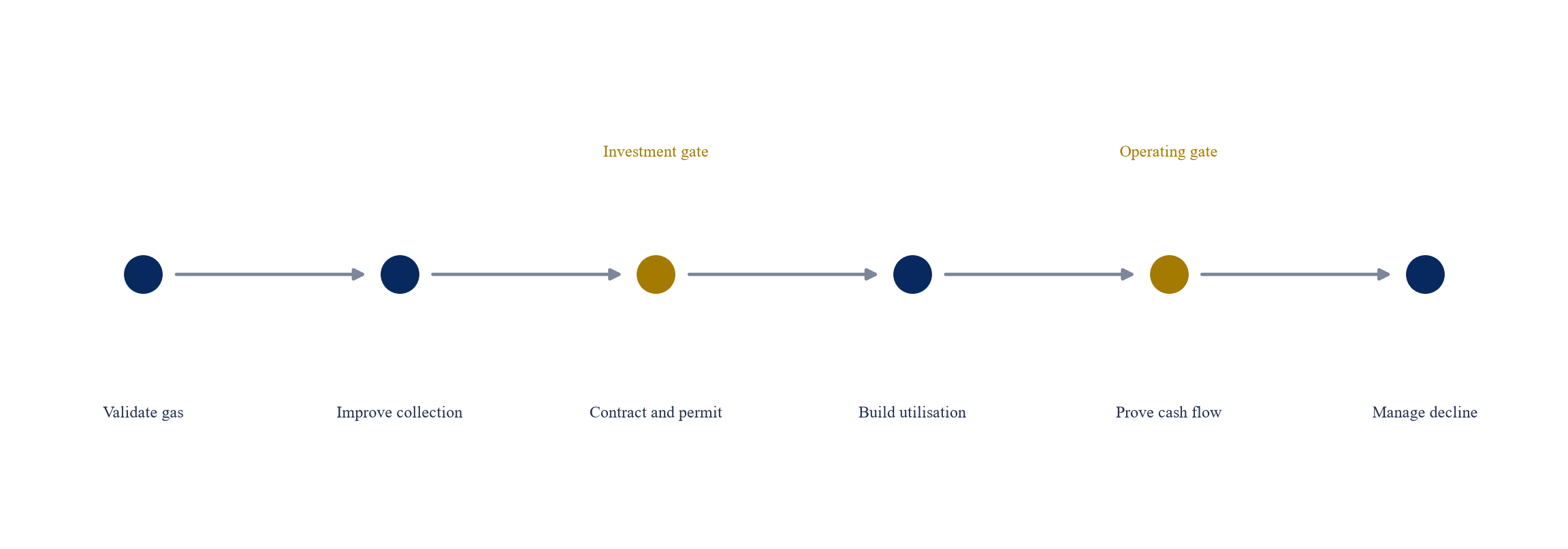
Proposed sequence; timing depends on gas evidence, permits, contracts, connection, waste operations and financing.
46. Define completion tests
Tests should cover wellfield performance, gas quantity and quality, condensate, treatment, flare, generator or upgrader output, product quality, connection, emissions, metering, controls and commercial settlement.
The test period should represent stable operation and credible landfill conditions. A short high-flow run can overstate sustainable performance.
Failure should trigger cure, retest, support or price adjustment. Environmental control should remain effective during testing.
47. Monitor performance
Management should track generated-gas model, collected flow, collection efficiency indicators, methane concentration, oxygen, nitrogen, surface emissions, flare use, product output, availability, parasitic energy, contaminants, revenue, cost and cash coverage.
Actual data should update the gas forecast and lifecycle plan. A favourable revenue variance can coexist with deteriorating collection or reserve underfunding.
Reporting should distinguish operational estimates, metered quantities and verified attributes.
48. Test the project against alternatives
The committee should compare power, direct use, biomethane, continued flare-only control, staged conversion and delayed investment. The same gas and compliance assumptions should apply to all cases.
The comparison should include capital, connection, contract, decline fit, operating capability, environmental value and decommissioning. A project can be technically feasible and economically inferior to improving collection and preserving optionality.
The selected route should maximise risk-adjusted captured value while maintaining environmental control.
49. Plan refinancing or exit
Refinancing should follow demonstrated gas, availability, product acceptance, attribute settlement and operating cost. Debt tenor should match the resilient gas curve and contract.
Potential exits include sale to an energy or infrastructure operator, municipal buyback, portfolio sale or long-term ownership. Transfer requires durable landfill rights, permits, data and decommissioning provisions.
Pipeline or attribute upside should remain separate from demonstrated operating value.
50. Apply the investment-committee test
The committee should ask whether gas is measured and recoverable, whether the collection system is compliant and maintainable, whether the selected route fits the gas curve, and whether each revenue stream is owned and contractible.
Approval should state stage, assets, capital, conditions, reserves, support and stop rules. It should identify the compliant fallback when utilisation fails.
The final test is physical-to-cash integrity. Waste history, collected methane, treatment recovery, delivered energy, environmental evidence and cash settlement should reconcile.
Table 3. Proposed landfill-gas risk-allocation matrix
| Risk | Natural owner | Contract mechanism | Evidence for capital release |
|---|---|---|---|
| Gas generation and decline | landfill owner and sponsor | data warranty, model range and review | reconciled waste history and calibrated model |
| Collection performance | landfill owner and wellfield operator | performance plan, access and improvement obligations | field audit, flow data and surface survey |
| Treatment and utilisation | equipment supplier and operator | product specification, availability and recovery guarantees | factory and site acceptance tests |
| Grid or gas connection | utility, sponsor and contractor | connection agreement, milestones and relief | accepted offer and executable programme |
| Offtake and attributes | project company and buyer | price rule, credit support and attribute transfer | signed contracts and eligibility evidence |
| Environmental compliance | permit holder and operator within control | monitoring, indemnity, incident and cure provisions | approved gas-management and monitoring plans |
| Construction and integration | sponsor and package contractors | coordinated design, schedule, contingency and security | design freeze and funded completion plan |
| Decline and decommissioning | landfill owner, project company and lenders | reserves, transition tests and restoration obligations | funded plan tied to the gas curve |
Proposed framework; allocation requires project-specific legal, technical, environmental and credit review.
Conclusion
Landfill methane is simultaneously an environmental control problem and a potential energy resource. The investment case begins with the waste body, collection field and regulatory baseline. It then selects a product route that fits recoverable gas, connection, customer demand, operating capability and the declining lifecycle.
Power, direct use and biomethane can each create value. Their economics depend on different interfaces. Environmental attributes can strengthen returns when the baseline, ownership and monitoring are defensible. Mandatory collection and aftercare obligations should remain visible throughout the commercial structure.
A disciplined project improves the collection field, preserves a compliant flare, stages equipment around measured flow, contracts only resilient output and reconciles the molecule to cash. This approach supports finance while protecting the underlying environmental purpose.
Investment-committee questions
1. What waste and operating evidence supports the gas-generation model? 2. How was collection performance calibrated to measured field data? 3. Which wells, headers, condensate and cap improvements are required? 4. What gas composition and contaminant range drives treatment design? 5. Which product route best fits resilient flow and the decline curve? 6. What compliant route manages gas during utilisation outages? 7. Who retains the statutory gas-control and monitoring obligations? 8. Which capital is mandatory control and which is incremental utilisation? 9. What connection, capacity and acceptance evidence is available? 10. What quantity and price are contracted for power, heat or gas? 11. Who owns the environmental attributes and project data? 12. Which emissions baseline and methodology support environmental revenue? 13. How are surface emissions, leaks and treatment losses measured? 14. Which fixed costs become exposed as gas flow declines? 15. What flow triggers modular retirement, conversion or shutdown? 16. Which reserves cover overhaul, wellfield work and decommissioning? 17. How does the model treat waste-diversion and circular-economy policy? 18. What completion tests prove sustainable rather than short-run output? 19. Does the debt tenor fit the resilient gas and contract term? 20. Why does the selected route outperform the best compliant alternative?
References
- United States Environmental Protection Agency, Landfill Gas Energy Project Development Handbook, updated January 2024. https://www.epa.gov/lmop/landfill-gas-energy-project-development-handbook
- United States Environmental Protection Agency, LFG Energy Project Development Handbook, full edition. https://www.epa.gov/system/files/documents/2024-01/pdh_full.pdf
- UK Environment Agency, Landfill Operators: Manage Landfill Gas, updated May 2025. https://www.gov.uk/guidance/landfill-operators-environmental-permits/manage-landfill-gas
- United States Environmental Protection Agency, Landfill Gas Emissions Model and LMOP Tools. https://www.epa.gov/lmop/list-tools-related-landfill-gas-and-waste-management
- UK Environment Agency, Develop and Maintain Landfill Management Plans. https://www.gov.uk/guidance/landfill-operators-environmental-permits/develop-and-maintain-management-plans
- United States Environmental Protection Agency, LFGcost-Web User Manual, Version 3.6, 2023. https://www.epa.gov/system/files/documents/2023-09/lfgcost_web_v3.6_usersmanual_sep2023.pdf
- United States Environmental Protection Agency, Basic Information about Landfill Gas. https://www.epa.gov/lmop/key-information-about-landfill-gas-and-lmop
- United States Environmental Protection Agency, Non-Electricity Project Options. https://www.epa.gov/lmop/non-electricity-project-options
- International Energy Agency, Outlook for Biogas and Biomethane: Prospects for Organic Growth. https://www.iea.org/reports/outlook-for-biogas-and-biomethane-prospects-for-organic-growth
- United States Environmental Protection Agency, Toolkit for Expiring Landfill Gas Electricity Power Purchase Agreements. https://www.epa.gov/lmop/list-tools-related-landfill-gas-and-waste-management
- United States Environmental Protection Agency, Landfill Gas Energy Benefits Calculator, updated December 2025. https://www.epa.gov/lmop/landfill-gas-energy-benefits-calculator
- UK Environment Agency, Monitor and Report Landfill Performance. https://www.gov.uk/guidance/landfill-operators-environmental-permits/monitor-and-report-your-performance
- World Bank Group, Waste-to-Power Model for Environmental Restoration Public-Private Partnership. https://ppp.worldbank.org/waste-power-model-erp
- World Bank Group, Financing Landfill Gas Projects in Developing Countries. https://documents1.worldbank.org/curated/en/591471490358551160/pdf/AUS106805-100p-financing-landfill-projects.pdf
- Global Methane Initiative, International Best Practices Guide for Landfill Gas Energy Projects: Project Economics and Financing. https://www.globalmethane.org/documents/toolsres_lfg_ibpgch7.pdf
- United Nations Environment Programme, Global Methane Assessment: 2030 Baseline Report. https://wedocs.unep.org/items/fc50311a-2340-4916-a7ca-2514c0d99aef
- European Union, Directive 1999/31/EC on the Landfill of Waste. https://eur-lex.europa.eu/legal-content/EN/TXT/?uri=CELEX:31999L0031
- European Union, Delegated Regulation (EU) 2023/2486, consolidated 2026. https://eur-lex.europa.eu/eli/reg_del/2023/2486/2026-01-01/eng/
- Global Methane Initiative, Unlocking Financing for Organic Waste Management Projects. https://globalmethane.org/resources/details.aspx?resourceid=5455
- UK Environment Agency, Design and Build Your Landfill Site. https://www.gov.uk/guidance/landfill-operators-environmental-permits/design-and-build-your-landfill-site
About the Author
Authored by Chennakeshav Adya Independent Researcher
Chennakeshav (CK) is a corporate finance and investment banking executive with 25+ years of global experience in deal origination, structuring and execution across M&A, growth capital and corporate strategy. He has led value-creation mandates for founders, corporates and funds — bridging the boardroom view to hands-on execution and close.
His career spans Morgan Stanley, HSBC, Lloyds Banking Group, EWEC, ADQ portfolio companies and Emirates Growth Fund, across TMT, real estate, fintech, deeptech, cleantech, infrastructure and energy. He has partnered with C-suite leaders, private equity and venture funds, sovereign wealth funds and family offices to finance complex fund raises and scale-up ventures, and has led M&A due diligence, post-merger integration and business-transformation initiatives to create value.
At Matchpoint Partners he is Managing Partner, leading the firm's corporate finance, M&A and capital-raising practice. He holds an MBA from London Business School, an engineering degree from VTU and a Master of Laws (LLM, in progress) from UCL London.
An active start-up mentor, CK mentors at Techstars, DIFC FinTech Hive, Startup Grind, Founder Institute and IN5, serves as Entrepreneur Mentor in Residence (EMiR) at London Business School, and judges the Entrepreneurship World Cup.
Matchpoint profile: https://www.matchpoint-partners.com/team/ck-adya.html LinkedIn: https://www.linkedin.com/in/ckadya/
