
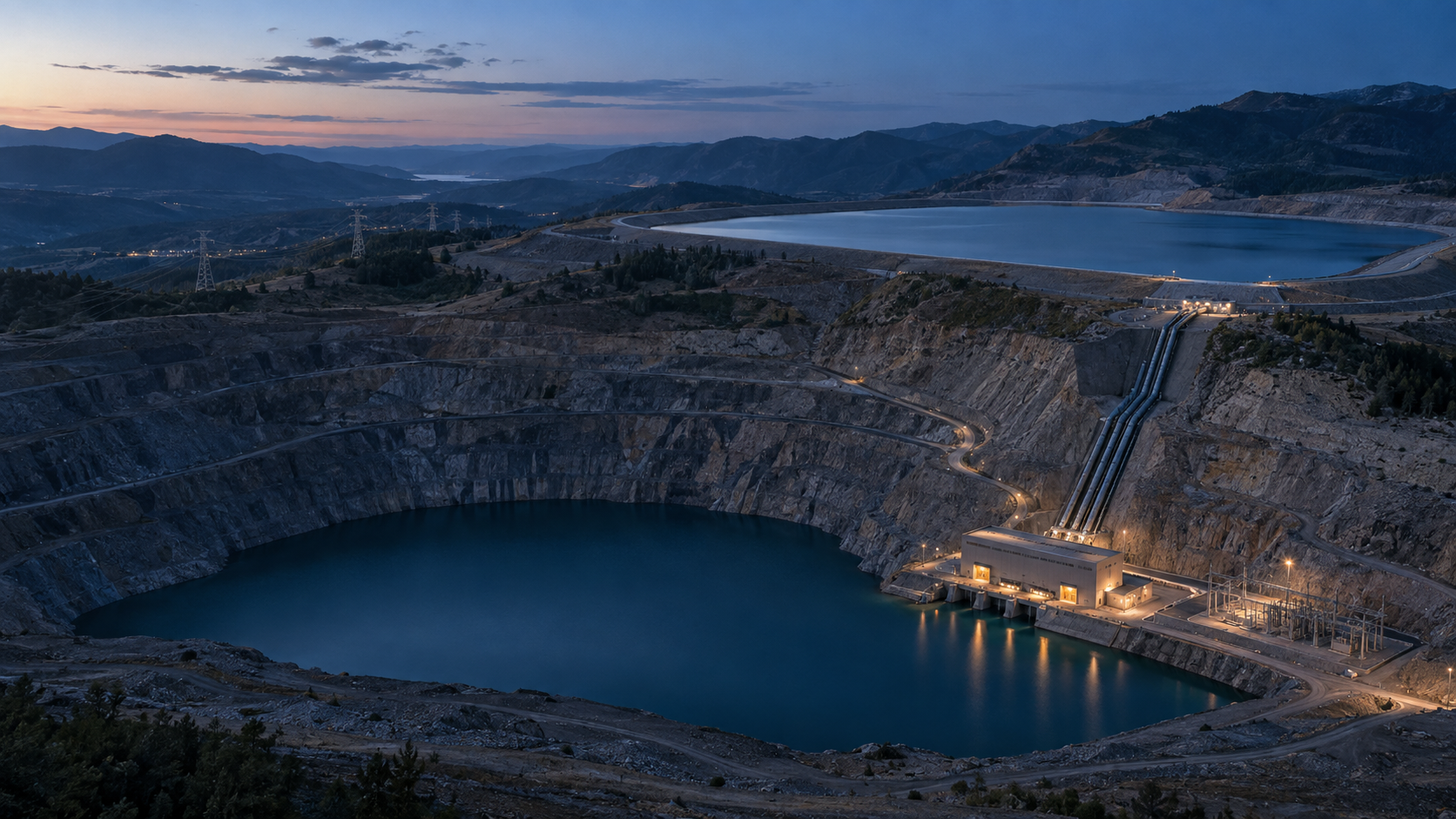
1. The excavation is a starting asset
An abandoned mine or quarry can contain two features that pumped storage needs: an elevation difference and a space that can hold water. It may also provide roads, power lines, substations, workshops, accommodation or industrial land. These assets can shorten selected development tasks and support a credible land-rehabilitation narrative.
The excavation is not the complete project. A working storage asset still requires stable reservoirs, controlled water movement, reversible generation equipment, access, grid rights, environmental approvals and a remunerated service. Mine history can create uncertainty around groundwater, contamination, slope stability, underground voids and closure obligations.
The investment question is therefore precise: which existing features remove future cost and risk, and which legacy conditions add cost and risk? A project should enter valuation only after those effects are separated.
2. Long-duration storage serves a system need
The International Energy Agency identifies dispatchable capacity and long-duration storage as important during extended periods of weak wind and solar generation. Pumped storage is a mature technology capable of shifting large quantities of electricity over hours, days and, in suitable systems, longer periods.
System need does not establish project economics. Storage value depends on location, transmission constraints, market design, competing flexibility and the rules governing capacity, reserves and ancillary services. A mine conversion can have excellent geometry and weak grid value, or modest geometry beside a valuable constraint.
The development thesis should start with a defined system service. The physical configuration, operating profile and revenue contract should then be designed around that service.
3. Closed-loop design changes the environmental perimeter
The United States Department of Energy defines closed-loop pumped storage as a system whose reservoirs have no ongoing hydrological connection to a naturally flowing water body. This can reduce some riverine impacts associated with open-loop development and can widen the search beyond conventional valleys.
Closed-loop does not mean water-free or impact-free. Initial fill, evaporation replacement, seepage management and construction water still require a lawful source. Underground configurations can interact with aquifers. Former mines can contain acidic or metal-bearing water. New reservoirs can affect land, habitat and drainage.
The environmental case should define the complete water balance, surface footprint, groundwater interaction and legacy condition. A broad closed-loop label cannot substitute for evidence.
4. Head and volume create the energy resource
Stored energy is proportional to water density, gravity, usable elevation difference and usable water volume, adjusted for conversion losses. Higher head reduces the volume required for a given energy target. Deep mines can therefore offer substantial theoretical energy with relatively compact water inventories.
Usable head differs from the maximum survey elevation. Water levels move during operation, hydraulic losses reduce pressure at the machine and operating limits preserve freeboard, submergence and equipment conditions. Usable volume excludes dead storage, sediment and inaccessible workings.
The first screening model should calculate deliverable energy across the operating range. It should reconcile survey data, water levels, losses and efficiency. Gross pit volume and shaft depth are insufficient investment metrics.
5. Power and duration are separate design choices
Reservoir volume and head principally determine stored energy. Water-conveyance diameter, machinery and electrical equipment principally determine power. The same excavation may support a high-power, shorter-duration plant or a lower-power, longer-duration plant.
The choice should reflect market need and grid access. A capacity product may reward sustained output for a defined period. Energy arbitrage may favour daily cycling. Reserve and system services can reward response, availability and operating range. Transmission constraints can limit charging or discharging power.
Developers should optimise power and duration together. A standard eight-hour label can hide weak economics where the grid values four hours or where a revenue regime requires materially longer discharge.
6. Five brownfield configurations recur
The first configuration uses two open pits at different elevations. The second pairs one existing pit or quarry with a new upper or lower reservoir. The third connects a surface reservoir to underground workings. The fourth uses two levels within a deep mine. The fifth combines an existing water infrastructure asset with a brownfield excavation.
Each arrangement changes the distribution of civil works, access, water management and operational risk. Two open pits offer visible reservoirs and conventional inspection. Underground reservoirs preserve surface land but require confidence in void geometry, structural integrity, ventilation and maintenance access.
Configuration selection should follow measured site conditions. Replicating a published concept without matching geology and interfaces creates false comparability.
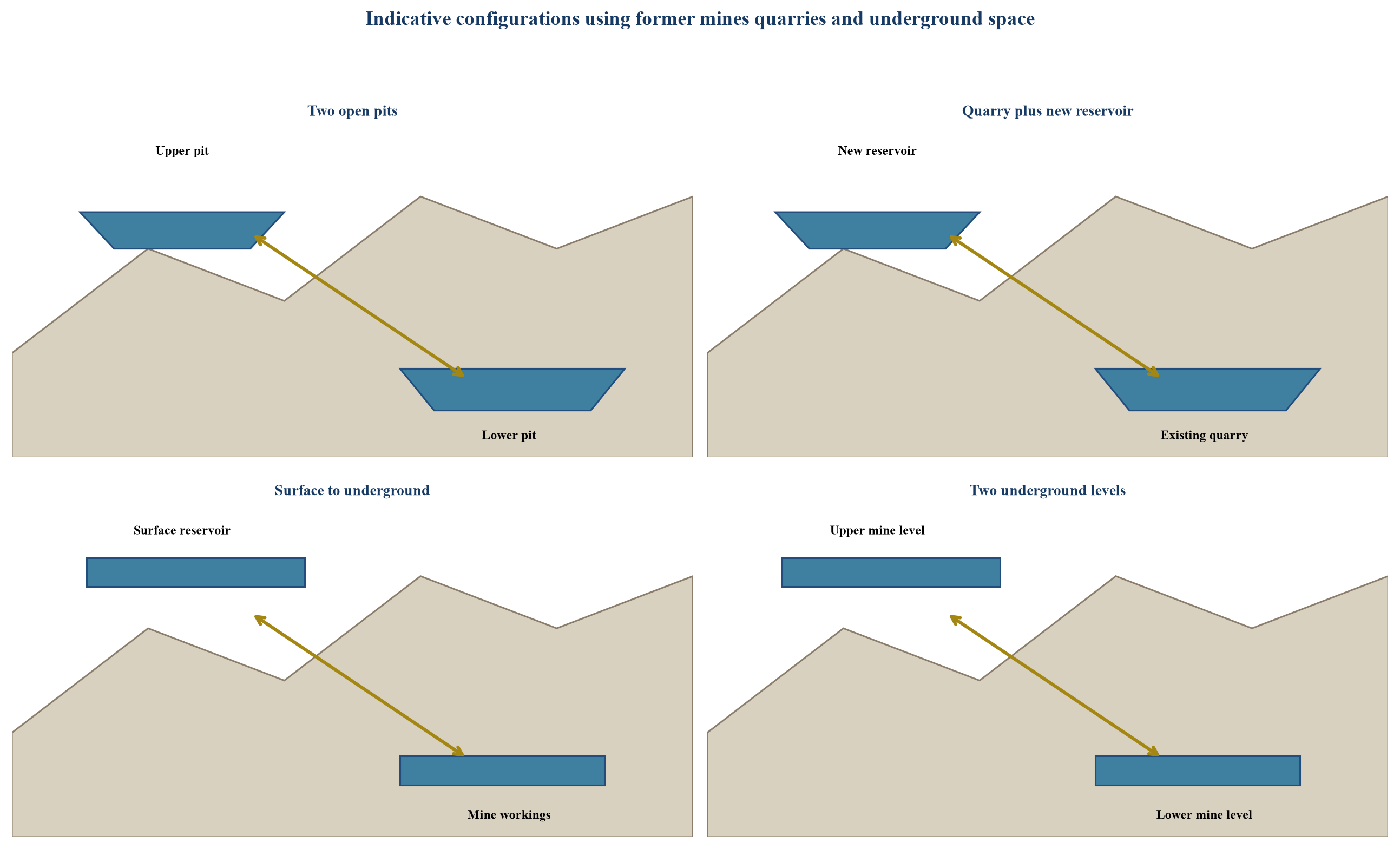
The cross-sections are simplified decision diagrams. Final layouts require site-specific engineering, water and geotechnical studies.
7. Open pits provide visible geometry
Open pits allow survey, slope inspection and reservoir access from the surface. Existing benches and haul roads may support construction. Two pits at different elevations can form a natural pair, as illustrated by the Kidston project in Queensland.
Visibility does not remove uncertainty. Pit walls were designed for mining conditions, not repeated reservoir cycling. Water-level movement can change pore pressure and slope behaviour. Benches, waste rock and legacy infrastructure can affect sealing, intake design and sediment. The lower pit can require continuous water management during construction.
An open-pit concept should include a slope-stability model for full, empty and cycling conditions. The design should state which surfaces require treatment and how inspections will be performed over the asset life.
8. Quarries can reduce land-development scope
Quarries often sit near roads, construction markets and electrical load. Their regular geometry may simplify preliminary storage estimates. A quarry can serve as one reservoir while a new reservoir is built at a suitable elevation.
The commercial advantage depends on rock condition, ownership, water rights and proximity to a grid node. Quarry walls can be fractured. Active extraction rights can conflict with energy development. The alternative value of continued quarrying can exceed the storage option.
The transaction model should therefore include mineral-rights diligence and opportunity cost. The project needs exclusive control of the storage perimeter for a period consistent with development, construction and operations.
9. Underground workings offer head and complexity
Deep mines can provide large elevation differences through shafts and multiple levels. Existing vertical access can reduce selected excavation. Surface impacts can be smaller where reservoirs and waterways remain underground.
Underground geometry is harder to verify and maintain. Collapsed workings, rubble, unknown connections, historic backfill and inaccessible voids can reduce usable volume. Pumps, turbines and valves need maintainable locations. Ventilation, emergency access, lifting, drainage and communication become permanent operating systems.
The prefeasibility study should build a three-dimensional ground and void model. Historical plans require verification against current surveys. Where access is unsafe, remote sensing and boreholes should be integrated with conservative uncertainty ranges.
10. Groundwater can change performance
Groundwater inflow or leakage can change storage volume, pumping requirements and water quality. Oak Ridge National Laboratory work on mine-based pumped storage highlights porous media and exchange with surrounding aquifers as material considerations.
A lower underground reservoir may fill naturally, while an upper reservoir can leak. Water can move through fractures or old workings outside the operating circuit. Continuous dewatering can consume energy and create discharge obligations. Pressure changes can mobilise contaminants.
Hydrogeological testing should estimate inflow, leakage, seasonal variation and interaction with nearby users. The operating model should include pumping, treatment and make-up water. A project should not capitalise theoretical volume that cannot be isolated.
11. Water chemistry affects equipment and permits
Mine water can contain dissolved metals, salts, suspended solids or acidity. Chemistry influences corrosion, scaling, abrasion, seals, coatings, treatment and disposal. Mixing water between levels can change reactions and regulatory status.
The design should establish a representative sampling programme across seasons and depths. Materials selection should use the expected operating chemistry, including upset conditions. Treatment residuals and sediment management require disposal routes.
The financial model should include ongoing monitoring, treatment chemicals, sludge handling and replacement. A one-time remediation budget is inadequate where the operating circuit continually interacts with legacy material.
12. Geotechnical evidence drives contingency
Civil works dominate many pumped-storage budgets. The DOE FAST analysis presents a representative closed-loop project in which civil works account for the majority of capital before contingency. Mine conversion changes civil scope; it does not remove civil risk.
Investigations should target reservoir walls and floors, tunnels, shafts, caverns, portals, foundations and fault zones. The estimate should link quantities and unit rates to investigation confidence. Unproven sealing or excavation quantities require explicit ranges.
Contingency should follow quantified uncertainty rather than a flat percentage selected to reach an affordable headline. Development capital that improves the ground model can create value by narrowing the construction distribution.
13. Existing infrastructure must be usable
Roads, substations, transmission lines, workshops and accommodation can reduce project scope. Their value depends on capacity, condition, legal rights and compatibility. A line built for a mine load may not permit bidirectional storage flows. A substation can require extensive protection and control upgrades.
Each reused asset should have a condition assessment, capacity study and ownership review. The model should compare refurbishment with replacement. Shared infrastructure needs access, outage and cost-allocation agreements.
Book value and historical construction cost are weak valuation measures. The relevant amount is the future cost and time avoided after adaptation, less remaining-life and interface risk.
14. Grid location can outweigh reservoir savings
A storage project earns value through the grid. Connection capacity, queue position, losses, congestion and local system needs can matter more than reservoir cost. Remote mines can face long transmission lines and difficult access despite attractive geometry.
The connection study should model charging and generation separately. It should identify curtailment, network reinforcement, reactive power, fault level, protection and telemetry requirements. Flexible or non-firm access can reduce connection cost while limiting charging readiness.
The valuation should include schedule risk before connection energisation and operating constraints after energisation. A cheap site with a delayed or weak connection can have lower present value than a more expensive site near the right node.
15. Market design determines bankability
Energy arbitrage buys electricity at lower prices and sells at higher prices. Pumped storage can also provide capacity, reserves, frequency response, balancing, black-start capability and congestion relief where market rules permit.
These revenues are not automatically additive. Reserving capacity for one service can reduce energy available for another. Qualification rules, dispatch obligations and penalties can change over time. Historical spreads may compress as storage competition grows.
The base case should include only revenue routes available to the project under current rules or executed contracts. Upside services should be modelled separately until technical qualification and commercial access are evidenced.
16. Policy support can unlock long-lived assets
The United Kingdom introduced a cap-and-floor regime for long-duration electricity storage because high upfront costs and uncertain merchant revenues had impeded investment. Ofgem's framework sets a minimum revenue floor and a maximum cap under which excess revenue is returned to consumers.
The design illustrates a broader principle. Long-lived storage can require a mechanism that shares market risk while preserving incentives for construction and operation. Project-specific costs and system benefits remain subject to regulatory assessment.
A developer should model merchant, contracted and regulated cases. Eligibility for a support programme should remain conditional until an award is final and its licence, cost review and delivery obligations are understood.
17. Kidston demonstrates the full development stack
The Australian Renewable Energy Agency describes Kidston as a 250 MW, 2,000 MWh project using a former gold mine in Queensland. Two existing pits form the upper and lower reservoirs. The project combines public support, private capital, an engineering and construction joint venture, an equipment supplier and a transmission-service provider.
ARENA's knowledge-sharing reports record issues involving access tunnels, water ingress, remote logistics, transmission and contracting. These disclosures are valuable because they show that reuse of mine pits does not simplify every interface.
Kidston should be treated as a development and construction case study. Its project status must be stated according to the latest authoritative update at publication.
18. Eagle Mountain shows regulatory persistence
The Eagle Mountain project in California is planned on an inactive iron-ore mine and holds a Federal Energy Regulatory Commission licence. A 2025 FERC order approved an amendment concerning the transmission route and project boundary.
The case illustrates the long duration of development and the continued importance of project-boundary, transmission and licence conditions. A licence is a material asset, but it is not proof of construction readiness or economic completion.
Acquisition diligence should identify every outstanding condition, amendment, land right, interconnection milestone and schedule requirement. Development value should be discounted for remaining capital, time and execution probability.
19. Screening should eliminate false positives
Large resource maps identify technical possibilities, not investment opportunities. DOE's closed-loop assessment provides a valuable geospatial and techno-economic starting point. It does not confirm land control, geology, grid access, water, permits or revenue.
A screening process should reject sites with inadequate usable head, irreconcilable water balance, unacceptable contamination, unstable workings, prohibitive connection scope or incompatible ownership. Remaining sites can be ranked by evidence quality and development pathway.
The purpose of screening is to spend investigation capital selectively. A broad list of theoretical sites has limited transaction value without an evidence hierarchy.
20. Stage gates protect development capital
The first gate confirms geometry and fatal flaws. The second secures land, data and exclusivity. The third produces prefeasibility and a ground-investigation plan. The fourth establishes bankable design, cost and performance. The fifth secures environmental, water and grid approvals. The sixth fixes contracts and financing. The seventh authorises construction.
Each gate should specify the evidence required, capital released, residual risks and stop conditions. Development budgets should be probability weighted. A failed test should end or redesign the project before the next major commitment.
This discipline also supports transactions. Buyers can value completed gates and price remaining work instead of paying for a headline pipeline.
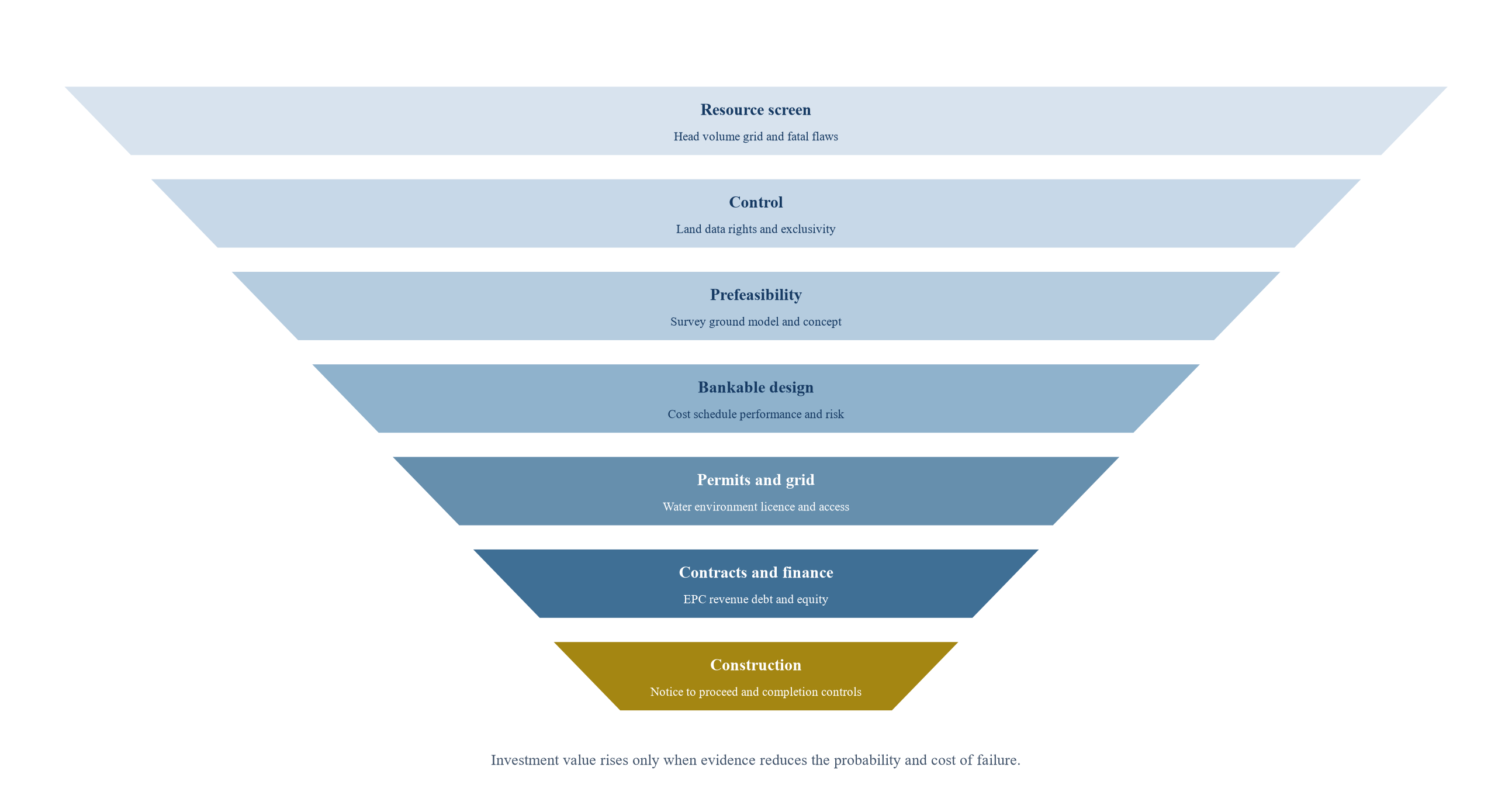
Each gate narrows the project set and increases the quality of evidence supporting capital commitment.
21. Configuration comparison should be explicit
Different configurations reuse different assets. Two pits can reduce reservoir formation. A quarry paired with a new reservoir reuses only one basin. Surface-to-underground designs can preserve land while adding access and sealing challenges. Two underground levels can provide high head but concentrate subsurface risk.
The comparison should use common fields: usable head, volume, conveyance length, investigation burden, civil scope, grid distance, water source, maintainability, environmental perimeter and route to revenue.
Qualitative labels should be supported by measurements. A project should not call underground space compact without including access and safety systems, or call an open pit low cost without assessing stability and lining.
Table 1. Brownfield pumped-storage configuration screen
| Configuration | Reusable asset | Principal value driver | Critical evidence | Common hidden cost | Suitable revenue profile |
|---|---|---|---|---|---|
| Two open pits | Two visible reservoir volumes and existing mine access | Avoided reservoir excavation and clear level difference | Survey, slope stability, sealing, water balance and pit ownership | Wall treatment, water ingress, intake works and transmission | Daily shifting plus capacity and ancillary services |
| Quarry plus new reservoir | One existing basin and industrial land | Reduced footprint and access near load | Rock permeability, alternative mineral value, upper-site control and grid capacity | New reservoir, conveyance, mineral-right settlement and remediation | Contracted industrial or grid storage with repeat cycling |
| Surface reservoir to underground mine | Surface water body and deep workings | High head with limited surface footprint | Groundwater, void geometry, shaft condition, water chemistry and maintenance access | Sealing, ventilation, underground powerhouse and permanent dewatering | Longer-duration capacity where high head supports compact volume |
| Two underground mine levels | Existing shafts and multiple elevations | Maximum head with minimal new surface reservoirs | Structural integrity, inter-level isolation, emergency access and usable voids | Investigation, rehabilitation, rubble removal and underground safety systems | Location-specific grid support with strong revenue certainty |
| Existing dam plus brownfield excavation | One proven reservoir and grid-adjacent infrastructure | Existing water management and connection potential | Dam operating rights, hydrology, environmental licence and brownfield compatibility | New waterway, boundary changes, outage coordination and shared liabilities | Regulated or contracted flexibility integrated with existing hydro |
The table is a decision framework. Every site requires project-specific technical, environmental and commercial evidence.
22. Avoided scope must be quantified
A brownfield project should build a reference greenfield estimate and a reuse bridge. The bridge should identify reservoir excavation avoided, access retained, grid assets reused and land-development savings. It should then deduct inspection, rehabilitation, sealing, dewatering, remediation, interface and legacy costs.
This method avoids a generic brownfield discount. A reused pit may save major earthworks while requiring expensive lining. An existing shaft may save excavation while needing structural rehabilitation and new conveyance. A substation may have limited export capacity.
Investment committees should see quantities, rates, evidence grades and contingency for every bridge item. Unsupported savings should remain outside the base case.
23. A component-level cost model is required
The National Laboratory of the Rockies Annual Technology Baseline describes a bottom-up pumped-storage model covering reservoirs, water conveyance, powerhouse, equipment, auxiliaries, indirect costs and grid connection. This structure is appropriate for brownfield projects because reuse affects components unevenly.
The estimate should also include investigation, land, permits, environmental mitigation, owner costs, financing, insurance, contingency and escalation. Underground projects require access, ventilation, drainage, communications and emergency systems. Closure and remediation can remain outside a conventional hydro estimate unless explicitly added.
Cost per kilowatt and per kilowatt-hour are useful outputs. They should never replace the underlying scope and schedule.
24. Three hypothetical cases show the trade-off
The illustrative model compares a two-pit project, a quarry paired with a new upper reservoir and a surface-to-underground mine project. All values are modelling assumptions. They are not bids, forecasts or observations.
Each case provides 250 MW and eight hours of deliverable storage. The same power and duration isolate differences in civil scope, investigation, efficiency, schedule and revenue support. The cases assume different levels of grid readiness and construction contingency.
The purpose is to show why existing excavation does not create a uniform valuation premium. Real projects require surveyed geometry, qualified estimates, market modelling and firm contractual evidence.
Table 2. Hypothetical 250 MW brownfield pumped-storage cases
| Input or outcome | Two open pits | Quarry plus new upper reservoir | Surface to underground mine |
|---|---|---|---|
| Rated generation | 250 MW | 250 MW | 250 MW |
| Deliverable duration | 8 hours | 8 hours | 8 hours |
| Illustrative round-trip efficiency | 78% | 80% | 74% |
| Illustrative total capital cost | USD 920 million | USD 1,080 million | USD 1,260 million |
| Illustrative development-to-operation period | 7 years | 8 years | 10 years |
| Illustrative construction contingency | 18% | 20% | 28% |
| Existing asset value | Two reservoir excavations and access | One reservoir and industrial site | High head and existing shafts |
| Principal downside | Slope, sealing, water ingress and remote grid | New reservoir, land interface and mineral rights | Groundwater, access, void condition and underground civil scope |
| Financing implication | Project debt possible after fixed completion and revenue support | Higher development equity until reservoir and grid scope mature | Lower leverage until subsurface scope and operating access are proven |
Every number is an illustrative modelling assumption and is not a quotation, forecast or investment recommendation.
25. The model should value evidence, not optimism
Development value equals the risk-adjusted present value of the operating project less remaining development cost. Each gate changes probability, schedule and required capital. A bankable ground model can increase value even before construction because it narrows cost uncertainty.
Probability should follow evidence. Land control without geotechnical work does not justify the same completion probability as a permitted project with fixed contracts. A revenue-support application should remain conditional until award.
The model should show value before and after each gate. This creates a rational basis for farm-downs, joint ventures, milestone payments and acquisition earn-outs.
26. Revenue needs chronological dispatch
Annual average prices cannot value storage. The model should use hourly or finer prices, charging limits, generation limits, state of charge, efficiency and outage schedules. It should reserve capacity for contracted services and prevent simultaneous revenue claims that conflict operationally.
Long-term scenarios should include renewable build-out, interconnection, competing storage, fuel prices and market reform. Price spreads can rise with volatility and narrow as flexibility enters. Capacity and ancillary-service rules can change.
Debt sizing should use a conservative dispatch case and contracted or policy-supported revenue where available. Merchant upside can support equity value without funding base debt service.
27. A value bridge should expose hidden costs
The intuitive brownfield thesis begins with avoided excavation and existing infrastructure. A disciplined bridge then deducts investigation, rehabilitation, sealing, water management, contamination, grid adaptation, construction interfaces and schedule uncertainty.
The example figure uses hypothetical values for a common reference project. Its purpose is explanatory. It does not estimate any named site.
The decision team should replace each illustrative item with project quantities and evidence. A value bridge that remains positive after conservative deductions provides a stronger basis for development capital.
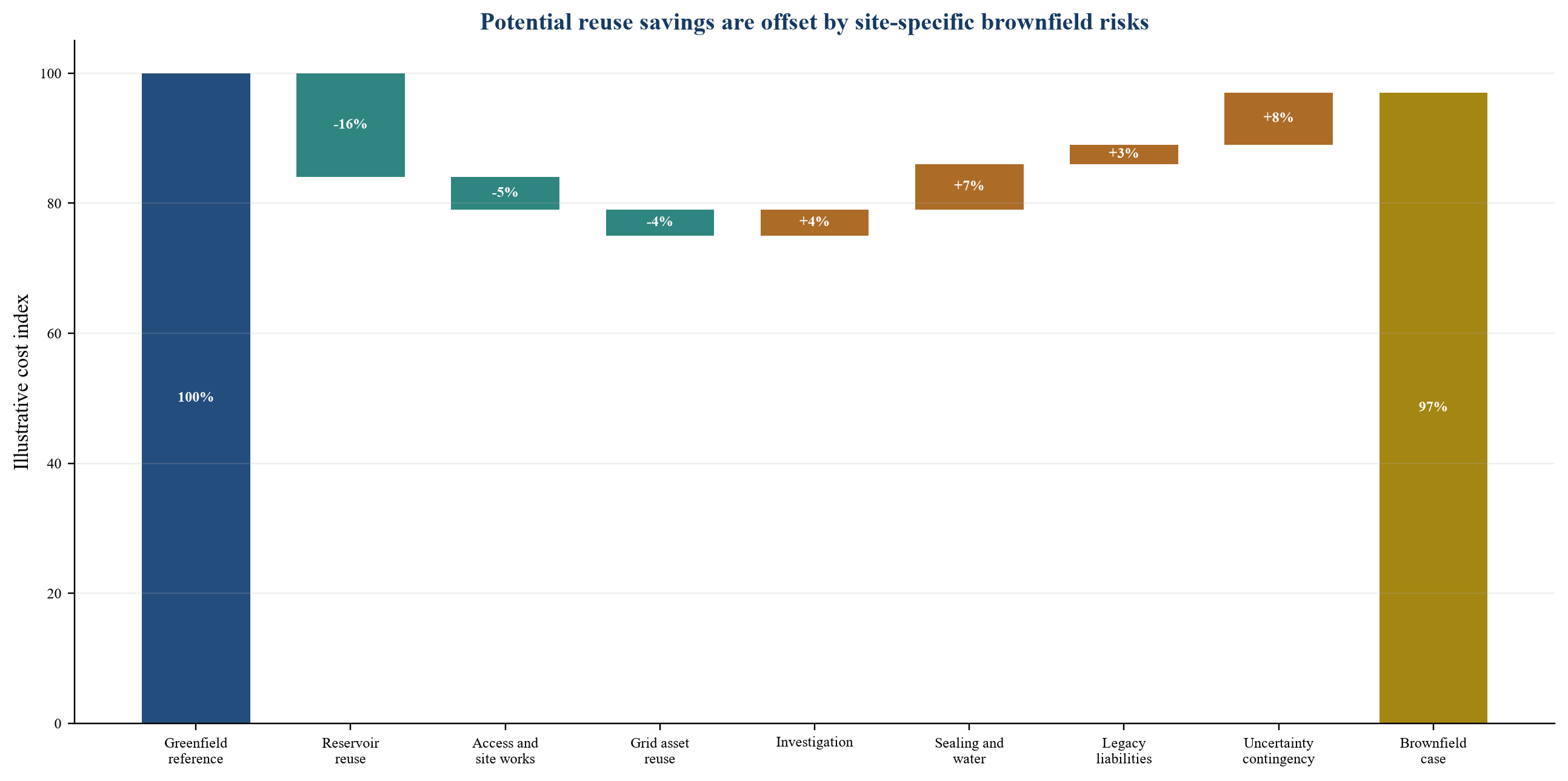
Values are hypothetical percentage adjustments to a greenfield reference capital cost. They are not observed project savings or forecasts.
28. Schedule risk compounds capital cost
Pumped-storage projects have long development and construction periods. Delays increase financing cost, escalation and exposure to policy or market change. Subsurface discoveries can interrupt access and redesign waterways or caverns.
The schedule should identify investigations, permits, grid milestones, long-lead machinery, tunnelling, reservoir works, water fill and commissioning. Interfaces need logic and contingency. Early completion assumptions should be tested against comparable infrastructure programmes.
The valuation should show delay sensitivity by year. A project with apparently low overnight cost can become unattractive when completion moves beyond a support deadline or connection window.
29. Construction contracts need geological realism
A fixed-price engineering, procurement and construction contract can improve financeability, but contractors will price or exclude subsurface uncertainty. Aggressive risk transfer can produce high bids, qualifications or disputes.
The contract should distinguish owner-retained baseline conditions, contractor-controlled methods and compensation events. Geotechnical baseline reports can allocate differing-site-condition risk against documented expectations. Investigation data should be complete and available to bidders.
Completion tests should cover power, energy, efficiency, availability, response, water balance and grid compliance. Security and liquidated damages should be sized to credible loss and contractor capacity.
30. Water rights and closure duties can collide
Mine owners can have closure, rehabilitation and water-treatment obligations. Converting the site to energy storage can modify timing, responsibility or security. Land, mineral and water rights may be held by different parties.
Transaction diligence should map every right and obligation across the operating life. The project company needs durable access to reservoirs, shafts, roads, grid assets and monitoring points. The legacy owner needs clarity on retained environmental liabilities.
Agreements should allocate pre-existing contamination, new operational impacts, closure security and handback. Unresolved liability can prevent non-recourse financing even where technical feasibility is strong.
31. Environmental advantage must be evidenced
Closed-loop and brownfield siting can avoid some new land disturbance and river impacts. Reuse can support rehabilitation and local employment. These benefits should be measured against the actual alternative and full project perimeter.
Construction can still affect habitat, dust, noise, traffic, groundwater and cultural heritage. Water sourcing and evaporation can matter in arid regions. Underground works can mobilise contaminated water.
Environmental claims should use approved studies and monitoring commitments. A brownfield label should never be used to bypass community engagement or site-specific assessment.
32. Operating access determines lifecycle cost
Pumped-storage assets can operate for decades. Underground machinery, waterways and reservoirs require inspection, maintenance and eventual replacement. A concept optimised only for construction can create expensive future access.
The design should provide lifting paths, ventilation, drainage, isolation, lighting, communications and emergency egress. Remote pits require roads and spares. Waterways need inspection and sediment management.
Lifecycle modelling should include major overhauls, outage duration, condition monitoring and replacement logistics. Debt tenor and reserve accounts should reflect the maintenance cycle.
33. Efficiency should be measured at the grid boundary
Round-trip efficiency depends on pumps, turbines, motors, generators, transformers, hydraulic losses and auxiliaries. Head and efficiency vary with reservoir level and dispatch. Dewatering or water treatment can add continuous load.
The acceptance test should measure electricity imported and exported at the agreed grid boundary across representative operating points. It should verify usable energy and sustained duration, not only machine peak efficiency.
The financial model should apply an efficiency curve and auxiliary loads. A single optimistic efficiency number can overstate arbitrage margin and available discharge.
34. Availability carries contract value
Capacity and support regimes can penalise non-availability during stress events. Mine-based plants introduce site-specific failure modes involving water ingress, access and underground equipment. Planned maintenance also removes capacity.
The owner should define availability, exclusions, notice periods and testing. Redundancy, spares and condition monitoring can reduce outage risk at additional cost. Shared shafts or waterways can create common-mode failure.
Revenue models should include forced-outage scenarios and performance penalties. Financing should preserve liquidity for extended repairs.
35. Data quality supports refinancing
Survey, borehole, water, construction and operating data should be structured and retained by the project company. Digital ground models and asset registers can improve design control and later diligence.
Contractors and technology suppliers may use proprietary methods while still providing the owner with measurements, assumptions, calibration and as-built records. Data rights should survive contract termination.
Transparent operating data can support warranty enforcement, refinancing and sale. A buyer will discount an asset whose performance depends on inaccessible vendor systems or incomplete subsurface records.
36. Financing should follow residual risk
Early development requires risk-bearing equity. Public grants or concessional capital can support studies with system or rehabilitation value. Construction debt becomes more plausible after land, permits, grid, revenue and completion arrangements are secured.
Leverage should reflect subsurface uncertainty, contractor strength, revenue floor and contingency. Underground projects may need lower initial leverage and larger reserves. A regulated floor can support debt, subject to cost review, licence obligations and delivery milestones.
The capital structure should allow for overruns without forcing distressed renegotiation. Equity commitments, standby facilities and sponsor support need clear triggers.
37. Acquisition structures can share development risk
A buyer can acquire the project company, purchase selected rights or form a joint venture. Consideration can combine upfront payment, milestone payments and contingent value tied to permits, support awards, fixed contracts or financial close.
Earn-outs should use objective evidence and clear control rights. A seller should not receive full value for theoretical volume or an untested grid assumption. A buyer should not control decisions that determine a seller's milestone without governance protections.
Representations should cover data, permits, land, environmental matters, ownership and disclosed liabilities. Indemnities need credit support where legacy obligations are material.
38. Risk allocation should follow control
The site owner controls access and legacy information. The developer controls investigations and permits. Designers control specifications. Contractors control construction methods. Equipment suppliers control machinery performance. Grid and market bodies control connection and qualification within their authority.
Contracts should allocate risk to the party able to manage it. Residual risk should appear in contingency, reserves, insurance or lower leverage. Unallocated risk should not disappear inside an optimistic base case.
The investment committee should review the allocation before approving financial close.
Table 3. Risk allocation and financing response for brownfield pumped storage
| Risk | Evidence before commitment | Natural risk bearer | Contractual response | Financing implication |
|---|---|---|---|---|
| Geology and void condition | Boreholes, surveys, ground model and baseline report | Owner for disclosed baseline; contractor for method | Baseline conditions, differing-site process and contingency | Debt sized after investigation; reserves for retained conditions |
| Water balance and chemistry | Pump tests, sampling, hydrogeological model and treatment design | Project company and specialist contractors | Performance standards, monitoring and treatment obligations | Operating reserve and downside energy consumption |
| Legacy contamination | Environmental assessment and liability register | Legacy owner for pre-existing condition where agreed | Indemnity, escrow, insurance and access rights | Credit support required for long-tail exposure |
| Civil quantities | Bankable design, measured quantities and bidder diligence | EPC contractor within defined baseline | Fixed scope, schedule relief rules and completion security | Contingency follows exclusions and contractor strength |
| Grid connection | Executed agreement, studies and construction scope | Project company and network party within roles | Milestones, delay allocation and curtailment rules | Drawdown conditions and long-stop dates |
| Machinery performance | Reference evidence and certified design | Equipment supplier and EPC integrator | Power, energy, efficiency and availability guarantees | Performance damages and warranty security |
| Merchant revenue | Chronological market study and dispatch model | Equity investors | Hedging, capacity contract or support regime | Lower merchant leverage and cash sweeps |
| Policy support | Final award, licence and cost-review framework | Project company subject to regulator | Compliance plan, reporting and change controls | Debt based on confirmed floor and delivery obligations |
| Closure and handback | Closure plan, security and land agreements | Project and legacy owner as allocated | Funding, handback standard and surviving liabilities | Decommissioning reserve and tail protection |
Final allocation depends on project contracts, site evidence, counterparties and applicable law.
39. The investment committee needs a failure case
The downside case should combine delay, civil overrun, lower efficiency, reduced availability, connection constraints and weaker spreads. It should test loss or delay of policy support and higher water-management costs.
Correlations matter. Difficult geology can increase cost and delay simultaneously. Delay can increase financing cost and miss a support window. Grid delay can reduce revenue while debt commitment fees continue.
The committee should see minimum liquidity, covenant headroom and additional equity required. A project is not financeable merely because its deterministic base case produces an acceptable return.
40. A first hundred days should narrow uncertainty
The initial programme should secure data and site access, confirm land and mineral rights, commission survey and hydrogeological work, open grid discussions and build a preliminary water balance. Market work should define the target service and candidate revenue route.
The team should create a fatal-flaw register and costed investigation plan. Early contractor and lender engagement can identify evidence gaps before the bankable study.
At day one hundred, the sponsor should decide whether to stop, redesign, option the site or proceed to prefeasibility. Continued spend should follow evidence rather than momentum.
41. Replication requires standard decisions
Mines and quarries are site-specific, but the decision process can be standardised. Common data schemas, configuration screens, investigation scopes, cost breakdowns and gate criteria allow a portfolio to be compared consistently.
Standardisation should not force one design across different geology. It should make differences visible and ensure every project answers the same investment questions.
A portfolio owner can then allocate development capital to sites with the best combination of resource, evidence, grid value and route to revenue.
42. Limits and further research
Public sources establish technology principles, resource methods, regulatory pathways and disclosed project experience. They do not establish the current cost, construction status or bankability of an unidentified site. Confidential surveys, bids, contracts and approvals are required for an investment decision.
The hypothetical cases illustrate method only. Further research should compare realised civil quantities, water management, efficiency, availability and lifecycle cost across operating brownfield projects. It should also test how capacity and cap-and-floor regimes affect dispatch and financing.
Engineering, environmental, legal, tax, accounting and regulatory conclusions require qualified advisers in the relevant jurisdiction.
43. Investment committee questions
The committee should ask whether head and volume are measured, whether reservoirs can be isolated, and whether groundwater and chemistry are understood. It should ask which civil works are truly avoided and which legacy conditions add cost.
It should review grid rights, water, permits, closure obligations, revenue eligibility, construction interfaces, contractor capacity, contingency and additional equity. Every material assumption should have evidence, ownership and a downside consequence.
The approval should state the current gate, capital released, required evidence and stop conditions.
44. Conclusion
Mines, quarries and underground workings can turn industrial excavations into long-duration electricity-storage sites. Their value comes from usable geometry, proven integrity, grid location and a credible route to revenue.
Brownfield reuse can avoid selected excavation, land and access costs. It can also import groundwater, contamination, stability, maintenance and legacy-liability risk. The correct valuation uses a component-level reuse bridge and a probability-weighted development model.
A disciplined sponsor screens fatal flaws, stages investigations, quantifies avoided scope, contracts around defined ground conditions and finances only the residual risk that the capital structure can absorb. This process can convert a compelling physical idea into an investable infrastructure asset.
References
- International Energy Agency, Electricity 2025: Supply, 2025. https://www.iea.org/reports/electricity-2025/supply
- International Energy Agency, Electricity 2026: Flexibility, 2026. https://www.iea.org/reports/electricity-2026/flexibility
- International Energy Agency, Hydropower Special Market Report: Executive Summary, 2021. https://www.iea.org/reports/hydropower-special-market-report/executive-summary
- United States Department of Energy, Pumped Storage Hydropower, accessed September 2026. https://www.energy.gov/cmei/water/pumped-storage-hydropower
- United States Department of Energy, WPTO Studies Find Big Opportunities to Expand Pumped Storage Hydropower, June 2022. https://www.energy.gov/cmei/water/articles/wpto-studies-find-big-opportunities-expand-pumped-storage-hydropower
- United States Department of Energy, Achieving the Promise of Low-Cost Long Duration Energy Storage, August 2024. https://www.energy.gov/sites/default/files/2024-08/Achieving%20the%20Promise%20of%20Low-Cost%20Long%20Duration%20Energy%20Storage_FINAL_08052024.pdf
- National Laboratory of the Rockies, Annual Technology Baseline 2024: Pumped Storage Hydropower. https://atb.nrel.gov/electricity/2024/pumped_storage_hydropower
- United States Department of Energy, Water Power Tools and Datasets, accessed September 2026. https://www.energy.gov/cmei/water/water-power-tools-and-datasets
- Oak Ridge National Laboratory, Pumped Storage Hydropower FAST Commissioning Technical Analysis, 2020. https://www.energy.gov/documents/pshfastcommissioningtechnicalreportornlpdf
- United States Department of Energy, A Comparison of the Environmental Effects of Open-Loop and Closed-Loop Pumped Storage Hydropower, 2020. https://www.energy.gov/sites/prod/files/2020/04/f73/comparison-of-environmental-effects-open-loop-closed-loop-psh-1.pdf
- Federal Energy Regulatory Commission, Hydropower Licensing and Abandoned Mine Guidance, accessed September 2026. https://www.ferc.gov/licensing
- Federal Energy Regulatory Commission, Eagle Mountain Pumped Storage Hydroelectric Project Order Amending License, October 2025. https://www.ferc.gov/sites/default/files/2025-10/P-13123-031.pdf
- Australian Renewable Energy Agency, Kidston Pumped Hydro Energy Storage, updated October 2025. https://arena.gov.au/projects/kidston-pumped-hydro-energy-storage/
- Australian Renewable Energy Agency, Kidston Pumped Hydro Energy Storage Financial Close Report, 2021. https://arena.gov.au/assets/2021/09/kidston-pumped-hydro-energy-storage-financial-close-report.pdf
- Australian Renewable Energy Agency, ARENA Commits 47 Million Dollars to Queensland Pumped Hydro Plant, March 2021. https://arena.gov.au/news/arena-commits-47-million-to-queensland-pumped-hydro-plant/
- Department for Energy Security and Net Zero and Ofgem, Long Duration Electricity Storage Technical Details, March 2025. https://www.gov.uk/government/publications/long-duration-electricity-storage-technical-details-of-the-scheme-and-its-operation
- Ofgem, Long Duration Electricity Storage Cap and Floor Financial Model and Handbook, October 2025. https://www.ofgem.gov.uk/guidance/long-duration-electricity-storage-ldes-cap-and-floor-financial-model-and-handbook
- Ofgem, Long Duration Electricity Storage Multi-Criteria Assessment Framework, September 2025. https://www.ofgem.gov.uk/guidance/ldes-project-assessment-multi-criteria-assessment-mca-framework
- Ofgem, Long Duration Electricity Storage, updated July 2026. https://www.ofgem.gov.uk/energy-regulation/low-carbon/long-duration-electricity-storage
About the Author
Chennakeshav (CK) is a corporate finance and investment banking executive with 25+ years of global experience in deal origination, structuring and execution across M&A, growth capital and corporate strategy. He has led value-creation mandates for founders, corporates and funds — bridging the boardroom view to hands-on execution and close.
His career spans Morgan Stanley, HSBC, Lloyds Banking Group, EWEC, ADQ portfolio companies and Emirates Growth Fund, across TMT, real estate, fintech, deeptech, cleantech, infrastructure and energy. He has partnered with C-suite leaders, private equity and venture funds, sovereign wealth funds and family offices to finance complex fund raises and scale-up ventures, and has led M&A due diligence, post-merger integration and business-transformation initiatives to create value.
At Matchpoint Partners he is Managing Partner, leading the firm's corporate finance, M&A and capital-raising practice. He holds an MBA from London Business School, an engineering degree from VTU and a Master of Laws (LLM, in progress) from UCL London.
An active start-up mentor, CK mentors at Techstars, DIFC FinTech Hive, Startup Grind, Founder Institute and IN5, serves as Entrepreneur Mentor in Residence (EMiR) at London Business School, and judges the Entrepreneurship World Cup.
LinkedIn: https://www.linkedin.com/in/ckadya/
Profile: https://www.matchpoint-partners.com/team/ck-adya.html
