

1 The decision that a missing file changes
A management team may say that an investor “dropped out” after asking for audited accounts, proof of a customer's commitment or a current ownership chart. That sequence establishes two events: an information request and an end to the discussion. It does not, by itself, establish why the capital provider stopped. The investor may have found a material contradiction, reached a mandate limit, lost capacity, faced a changing market, or decided that the amount and instrument did not fit. Some processes end because the issuer withdraws or delays. A useful financing review must preserve these alternatives.
The board's immediate decision is practical. Should the issuer pause outreach to repair the record, continue with a disclosed exception and a dated condition, change the financing route, or protect liquidity by arranging a bridge? The appropriate response depends on which decision gate is affected and how long the gap remains open. A missing statutory filing that prevents authority to issue shares has a different consequence from a missing presentation annex that can be supplied tomorrow. A bank's inability to complete customer due diligence has a different basis from an equity fund's choice not to pursue a company outside its mandate.
This paper addresses private-company financing in the UAE, while recognising that company law, financial-services rules and contractual rights vary across the mainland and free-zone entities involved. It does not offer a generic list of documents that every capital provider must request. It specifies how an issuer can establish the evidence perimeter for its own transaction, follow counterparty decisions through distinct stages and calculate the consequences of a delay or changed term under explicit assumptions. The title describes a possible outcome, not an observed market rate.
The final output is a board-level decision record. It names the proposed legal issuer or borrower, funding amount and date, uses of funds, capital providers approached, current decision gate, evidence gap, responsible person, plausible repair date and funded fallback. It preserves the counterparty's own stated reason separately from management's interpretation. This discipline allows advisers and directors to act on a live obstacle without claiming a causal result that the records cannot support.
2 Prior art and the limits of what is known
The Central Bank of the UAE's Credit Risk Management Standards require licensed financial institutions within scope to conduct documented credit due diligence, assess ownership and ultimate beneficial owners, collect financial information and cash-flow projections, and consider the facility purpose, obligations and repayment capacity [1]. The related regulation requires a documented credit-risk framework and credit-file controls [2]. Those provisions explain why a regulated lender asks for underlying evidence. They do not state that every missing item produces a decline, a particular price increase or a fixed number of days of delay.
The Central Bank's customer-due-diligence guidance addresses customer identification, beneficial ownership, the nature of business, source of funds and source of wealth within its scope [3,4]. A legal person with a complex group chart may need more verification than a simple operating entity. A request for beneficial-ownership records therefore may be a compliance gate rather than a negotiating tactic. The actual applicability and documentary requirements must be checked against the institution, customer and current rulebook. An investment fund subject to a different regulator or a private family investor should not automatically be described as bound by a bank-specific rule.
IFC's public application guidance begins with a preliminary proposal and may move to a detailed plan and appraisal [5]. Its project cycle separates appraisal, investment review, negotiation and disbursement [6]. IFC also describes environmental and social due diligence as part of appraisal, with scope commensurate with risk [7]. These materials demonstrate staged decisions and conditional evidence. IFC's development mandate, approval structures and disclosure practices limit transfer to UAE private debt or equity. The point is methodological: “interested”, “in diligence”, “approved” and “funded” should never be collapsed into one status.
The accounting standards supply another boundary. IAS 1 specifies a complete set of financial statements and addresses fair presentation [8]. IAS 7 classifies operating, investing and financing cash flows [9]. IFRS 15 concerns revenue and cash flows arising from customer contracts [10]. A set of statements can help a reviewer reconcile historical claims, but it does not prove a forecast, verify an unsigned order or establish that group cash can be transferred to the borrower. This paper's contribution is an author-developed gate and event ledger built from these established requirements. Its commercial usefulness requires testing in consented transactions; novelty is limited to that integrated decision method.
3 Define the financing before auditing the room
A data room cannot be called complete until the transaction has a defined perimeter. The issuer should state which legal entity will receive money, whether another company guarantees or owns a material asset, and which persons can approve and sign. It should state whether the transaction is a new share issue, secondary share sale, shareholder loan, bank credit facility, private credit note or combination. Each choice changes the records a reviewer needs and the order in which they matter.
The amount and payment date also shape materiality. A company seeking capital to cover payroll and supplier obligations in six weeks has less room for a long legal clean-up than one financing a later investment programme. The board should reconcile the use-of-funds schedule to its cash forecast and specify the minimum viable amount. If a facility can fund in tranches only after evidence or security perfection, the announced headline amount may not solve the first cash need. If an equity investor needs shareholder waivers, an attractive indicative valuation does not make the issue executable.
A financing mandate should therefore begin with four records: an entity map; a dated sources-and-uses schedule; a cap table and debt schedule; and a decision-rights map. The entity map identifies operating cash, contracts, assets, liabilities and bank accounts. The sources-and-uses schedule states which funds are committed, indicative or merely targeted. The ownership and debt records identify existing claims. The decision-rights map identifies board, shareholder, lender, regulator and counterparty consents. Each should have a named owner and a source document. A presentation summary can direct the reader to these records; it should not substitute for them.
This definition step matters because an apparently missing file may reveal a transaction-design problem. A fund may ask for the target company's audited accounts when the issuer is a newly incorporated holding company with no operating history. The answer is an entity and accounting bridge, not simply a duplicate upload. A bank may ask for an asset valuation when the proposed borrower does not own the asset. The answer requires rights, security and group-structure analysis. A financing diagnosis should identify the proposition being tested before counting the files delivered.
4 Six gates in a capital provider's decision
The first gate is eligibility. Does the sector, geography, ticket, stage and instrument fit the counterparty's mandate? A missing document seldom repairs a genuine mandate mismatch. The second is identity and authority. Can the provider establish the issuer's existence, ownership, beneficial owners and ability to enter the transaction? A failure here can prevent further review or account opening. The third is investment or credit merit: can the proposition, operating evidence and repayment or value-creation case survive analysis?
The fourth gate is commercial terms. A lender may change amount, tenor, margin, security or covenant requirements; an equity investor may change valuation, preference rights, governance or tranche conditions. The fifth gate is approval and documentation. The capital provider's internal authority, the issuer's approvals, regulatory checks and legal documents must align. The sixth is funding: all conditions precedent, accounts, security and transfer mechanics must be satisfied on the actual date. Passing an earlier gate does not imply the later ones are automatic.
At each gate, the event ledger should record the date entered, reviewer, specific request, document version, response, stated concern and result. The result can be advanced, paused, renegotiated, declined, withdrawn by issuer, expired or still open. “No response” should be a separate status under a predetermined contact protocol. A delay should be attributed to a missing item only when the item was on the critical path and other simultaneous gates were not independently blocking progress. This is a testable proposition about an individual process, not a claim about investor psychology.
The issuer should resist using a single coloured status such as green or red for the whole transaction. A deal may be commercially attractive and compliant with the equity investor's initial screen while having an unresolved legal authority issue. Another may have every file in the room yet fail the fund's return or ownership test. A gate matrix makes these differences visible to the board and to advisers who must allocate time between repairing records and finding a more appropriate capital provider.
Table 1. Evidence and decision-gate matrix for a private financing
| Gate | Debt reviewer may test | Equity reviewer may test | Issuer evidence and decision record |
|---|---|---|---|
| Eligibility | Facility purpose, borrower type, limits | Mandate, ownership target, return horizon | Funding brief and counterparty fit note |
| Identity and authority | Customer and beneficial-owner checks, borrowing powers | Legal issuer, owners, share-issue authority | Entity chart, registers, resolutions, verifications |
| Underwriting | Historical cash, obligations, collateral, downside | Market, contracts, unit economics, governance | Accounts, forecast bridge, contracts, diligence log |
| Terms | Repayment, security, covenants, conditions | Valuation, rights, dilution, tranches | Written, versioned term comparison |
| Approval | Credit and compliance decisions | Investment-committee and legal decisions | Dated decision and outstanding conditions |
| Funding | Security, draw conditions, account mechanics | Consents, subscription funds, share issue | Signed documents and receipt of cash |
Author-developed framework. The examples are possible reviewer questions, not a mandatory list for all UAE capital providers.
5 Grade the evidence gap by what it prevents
The first category is a retrieval gap: a valid record exists but has not been supplied in the requested version. The repair is to retrieve, confirm provenance and upload it with an explanation of the relevant section. A signed contract stored by counsel may be a retrieval issue. A second category is a reconciliation gap: two sources disagree. The audited group accounts may show a different subsidiary perimeter from the forecast; the capital table may differ from the legal register. Here the work is to establish which source is authoritative and correct the model or disclosure.
A third category is a fact gap: management lacks support for a material assertion. An unsigned order in the revenue plan or an untested asset-value claim cannot be fixed by formatting the deck. It requires a revised forecast, independent verification or a clearly qualified scenario. A fourth is an authority gap: the company lacks an approval, consent, licence or enforceable right that the proposed financing assumes. A fifth is a route gap: the capital provider's mandate or instrument does not fit, even if the documents are complete. A sixth is a timing gap: the evidence may arrive after the funding date, making a usable bridge or transaction redesign necessary.
These categories are author-developed and should be applied to the particular request. A document can sit in more than one category. A missing shareholder resolution may be retrievable if it was passed and signed, or an authority gap if no valid vote occurred. A customer contract can be retrieved yet expose a termination right that changes the investment case. Classification should therefore occur after reading the underlying record, not when the file name appears in a checklist. Management should record the original gap and the fact revealed by its repair as separate events.
Severity can be assessed without pretending to know a universal investor rule. Ask whether the item is legally required, a compliance prerequisite, necessary to underwrite the requested amount, material to economics, or merely helpful to presentation. Ask whether a substitute source is acceptable to the named reviewer and whether the reviewer has confirmed that in writing. A board should prioritise the gaps that prevent a real decision or funding by the required date. A large number of low-severity room items can be less important than one unresolved consent or unexplained beneficial owner.
6 Identity, ownership and control
An ownership chart should show the legal entities and the natural persons exercising ultimate control, with dates, percentages and sources. The Central Bank's beneficial-ownership guidance describes identification and verification requirements for institutions within its scope [4]. FATF's guidance on legal-person beneficial ownership explains the value of adequate, accurate and up-to-date information and of using multiple sources [11]. These sources do not prove that a specific private investor must use a particular percentage threshold or document form. The relevant institution's policy and governing rules determine the live requirement.
An issuer may hold a current commercial licence yet be unable to reconcile shareholders after transfers, options, convertibles or a family restructuring. A lender considering a guarantee needs to know who controls each obligor and whether the guarantor can bind itself. An equity investor needs the same legal reality to understand what shares it will receive and who can waive pre-emption or approve a new issue. An unexplained discrepancy should be disclosed and investigated. Deleting an inconvenient holder from a spreadsheet would create a more serious problem than the original incomplete record.
The reviewer should distinguish legal ownership, beneficial ownership and economic rights. A nominee, trust, holding company or shareholder loan may separate them. A founder may control votes while holding a lower economic percentage; another person may have veto rights. The document set may include registers, constitutional documents, share certificates or electronic records, transfer instruments, option plans, shareholder agreements and relevant resolutions. The correct set depends on the entity's jurisdiction. Counsel should resolve legal effect; the finance team should then update the fully diluted model and financing disclosure to match.
Identity and source-of-funds questions also arise at the investor end. The issuer and its bank may need to know where subscription proceeds originate and whether they can be received through the proposed account and timing. The Central Bank's customer-due-diligence guidance discusses source of funds and source of wealth for licensed institutions [3]. It is unsafe to announce a funding date based on a verbal commitment without checking the counterparty's funding vehicle, banking route and any applicable diligence. Both sides can have documentary conditions that sit outside headline valuation.
7 Financial statements, cash and the funding model
The financing model should bridge statutory financial statements to current management accounts and then to the forecast. IAS 1 identifies the components of a complete IFRS financial-statement set [8]; IAS 7 explains the cash-flow categories [9]. An audit report, where available, applies to specified statements and period. It does not certify the forward plan. The issuer should state whether a period is audited, reviewed or management-prepared, and whether the statements cover the same entities and activities as the proposed financing.
For debt, the lender must be able to analyse repayment from cash and the borrower's other obligations. The CBUAE credit standards call for financial information and cash-flow projections, including obligations to other lenders and related parties [1]. The issuer should reconcile revenue, EBITDA or operating profit to bank receipts, working capital, maintenance expenditure, tax and scheduled debt service. A forecast that assumes a new facility can repay itself without an operating or committed take-out source does not answer the credit question. Security may mitigate loss, yet it does not replace analysis of the facility's purpose and repayment path.
For equity, historical evidence supports the claims on growth, margin, unit economics and runway. The investor may value a business through a different horizon and risk lens from a lender. Its diligence can still focus on the same cash and accounting perimeter. If management presents a forecast based on revenue contracts, IFRS 15 provides a framework for reporting revenue arising from customer contracts [10]. The actual rights, performance, invoicing and collections need to be traced to the underlying agreements. An investor may accept a forecast scenario, but should know which inputs are signed, expected or merely targeted.
A financial gap should be expressed precisely. “No audited statements” is a different condition from “signed statements exist for the operating subsidiary, while the new issuing holding company has no comparable history.” “Cash flow not reconciled” may mean that bank statements are missing, accounting classifications changed, or receipts belong to another entity. The repair plan should specify the document, accounting bridge and date. The board should model whether the repair period increases its funding need, and should avoid asserting that an audit alone will improve valuation or terms without an actual counterparty response.
8 Contracts, concentration and performance evidence
Commercial diligence asks what the company has promised, delivered, billed and collected. These are separate events. A signed customer agreement may support a revenue forecast; an accepted purchase order may support a narrower commitment; a pipeline conversation supports only a probability-weighted management scenario. The issuer should present contract type, counterparty, legal entity, term, termination and renewal rights, minimum commitments, performance obligations, payment terms and subsequent receipts for material customers. IFRS 15 provides accounting context; legal enforceability depends on the documents and applicable law [10].
When one customer or project drives a large share of the financing case, the absence of its underlying agreement may block both equity and debt review. The lender may need to test repayment under delayed billing or collection. The equity investor may need to test revenue durability and the value of the customer relationship. Their decisions can differ even on identical facts. A five-year contract with an easy termination right and limited minimum purchases should not be described simply as five years of contracted revenue. A project award subject to notice to proceed should not be modelled as cash received.
The contract room should include a reconciliation from the management forecast to contractual and operational evidence. Each material forecast line can be tagged as executed, ordered, billed, certified, collected, renewing, bid or uncommitted. A commercial owner should explain disputed variations, customer concentration and any related-party sales. The purpose is not to make the room look perfect. It is to allow a reviewer to determine what is already supported and what remains an assumption. If a recovered document changes the forecast, management should issue a corrected version with a dated variance bridge.
The decision record must avoid causal overreach. An investor who receives a contract and later leaves may have found the termination clause material, or may have failed a separate return hurdle. The issuer should seek a reason in writing where appropriate, but cannot assume it will obtain one. The outcome can be recorded as “declined; reason not supplied” while the contract discrepancy is recorded separately. That preserves learning without retroactively inventing an investor's deliberations.
9 Debt security and conditions to draw
A credit term sheet can indicate appetite while leaving the security package unresolved. The borrower should identify each asset offered as security, its legal owner, existing pledges, required consents, valuation evidence and the proposed perfection route. The lender may also require guarantees, insurance, assignment of receivables, account controls or minimum equity contribution. The actual term sheet and applicable law govern which items matter. The CBUAE credit standards address collateral, risk mitigation, legal documentation and credit-file controls for institutions within scope [1,2]. Those requirements do not mean that every lender takes the same security.
A missing asset title or consent is an authority and funding-gate issue. The facility may pass a preliminary credit screen while remaining undrawable. Management should not count an indicative amount as cash until it understands the approval status and conditions precedent. A collateral consent can involve another lender, joint-venture partner, customer or property owner. The expected date should be supported by the consenting party's process; a verbal expectation should remain a forecast. Counsel should examine whether security can be granted and perfected, while finance models the cash date if it cannot.
Security evidence can also change economics. If a lender cannot rely on a proposed asset, it may reduce the amount, ask for a guarantee, shorten tenor or withdraw. Those are possible responses, not predictable rules. The issuer should request a written revised indication, stating which assumption changed. A simple “loan approved” status conceals whether the credit committee approved the same borrower, amount, collateral and repayment plan now being presented to the board. Versioned terms and conditions make the comparison possible.
10 Equity rights, consents and the real price
An equity term sheet can set a pre-money valuation yet leave the economic price incomplete. Preference rights, liquidation terms, anti-dilution protection, board seats, vetoes, information rights, founder vesting, redemption features and future funding obligations can change the value transferred. The issuer needs a fully diluted share model linked to legal records and a scenario analysis of the rights package. An investor considering a minority position may also need assurance that existing shareholders can validly authorise the issue and waive applicable rights.
A missing register or unsigned shareholder agreement may therefore matter for reasons beyond administrative neatness. If the fully diluted count changes, the proposed new investor's ownership changes at a fixed subscription price. If a consent cannot be obtained, closing may become impossible on the planned date. If a preference right was omitted from the deck, the new investor may seek different terms after discovery. Counsel should establish the legal position under the actual entity's jurisdiction and documents; the finance model should then show the economic effects. The company should avoid using a spreadsheet to decide a disputed legal right.
The equity investment committee may also require evidence about customers, management, financial controls and the exit route. The sequence of its review is particular to that investor. A request for the customer contracts should be logged as a request, not as proof that a certain valuation discount is coming. The issuer can ask which documents are necessary for a go/no-go decision and which can be conditions after a term sheet. A written answer helps focus the room and allows the board to see whether a repair task can occur in parallel with negotiations.
11 Two pathways through the same information gap
Imagine that a UAE operating group seeks both a working-capital loan and minority growth equity. A material customer agreement is unavailable in the initial room. The lender asks for it to assess cash receipts and assignment rights. The equity investor asks for it to assess recurring revenue and concentration. The same missing document affects different propositions. A signed agreement with a short cancellation notice could reduce confidence in both cases, but the lender's concern might be next-quarter repayment while the investor's concern might be multi-year value. The company should answer each question with a common corrected fact base.
Suppose the agreement is found and the economics match the deck. Both processes may advance after a short delay. Suppose instead that management included an unsigned renewal in “contracted” revenue. The information problem is no longer retrieval; it is an inaccurate claim. The forecast and funding need should be revised. The lender may change cash-flow assumptions. The equity investor may change its value case or stop. Both outcomes depend on their documented policies and decisions. No market-wide inference follows from this hypothetical branching.
The issuer should therefore maintain one versioned evidence register with separate reviewer-specific questions. A contract owner can establish the source; finance reconciles it to revenue, cash and forecast; counsel addresses enforceability or assignment; the adviser communicates a corrected, dated summary. Sending different versions to different capital providers creates a further integrity risk. If a change is material, the board should approve a consistent correction and record which counterparties received it.
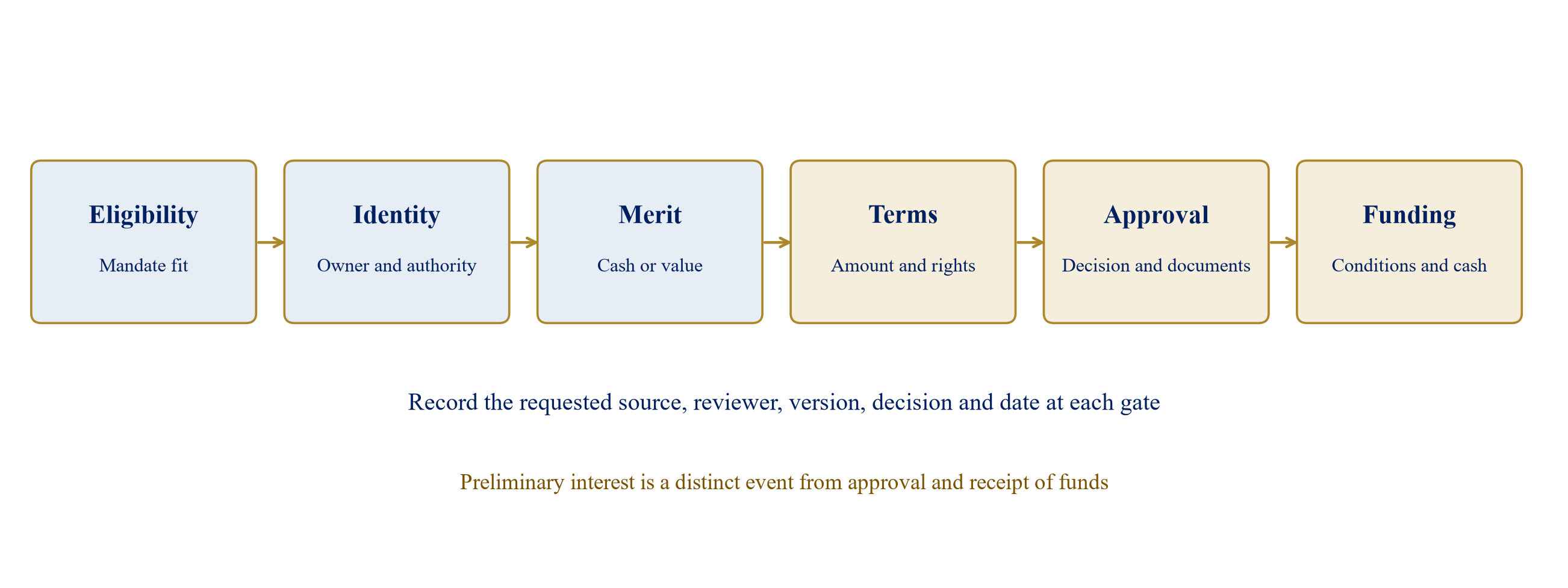
Author-developed process map. Gate order can vary by counterparty; the diagram does not represent an observed approval timetable.
12 An illustrative company and its dated financing choices
Consider a wholly fictional UAE company that needs AED 20 million by a board-defined investment date. Management has prepared an operating forecast, but a large customer renewal is unsigned, the ownership chart conflicts with the shareholder register, and a proposed security asset needs a third-party consent. These are invented facts for an arithmetic and governance exercise. They do not represent a client mandate, a common UAE transaction or a measured probability of capital-provider withdrawal. The investment date is assumed to be 60 days after first outreach.
One fictional lender has issued an indicative AED 12 million facility subject to cash-flow diligence, beneficial-owner verification and the asset consent. One fictional equity investor has discussed AED 20 million at an assumed AED 80 million pre-money value, subject to contract and share-register diligence. Neither source is committed or approved. The company has no basis to include either as cash in a bank balance. The board's funding plan must distinguish conditional interest from an executable obligation to fund. It should also assess the minimum investment that can proceed if only part of the target money arrives.
Suppose the ownership discrepancy takes 45 days to reconcile and the customer's renewal remains unsigned. Assume for illustration a net cash use of AED 0.8 million per 30-day month during the delay, with no compensating receipts or cost changes. Forty-five days would consume AED 1.2 million under that convention. If the original AED 20 million need remains unchanged apart from that consumption, the funding need would become AED 21.2 million. This calculation is conditional on the dates and cash assumptions; a live company would use its monthly forecast and actual bank balances. It does not show that the missing record caused the delay, because other gates may also be open.
At the assumed AED 80 million pre-money value, a simple new-share issue of AED 20 million would imply 20% post-money ownership for the investor, before preferences, options or transaction costs. If the company instead raises AED 21.2 million at the same pre-money value, the simple fraction is 21.2 divided by 101.2, or approximately 20.95%. If a written revised term sheet used AED 70 million pre-money with AED 21.2 million invested, the simple fraction would be approximately 23.25%. The alternative value is invented, not an asserted repricing caused by the missing record. The calculation exists to show what a board must model when cash need and actual offer terms change.
The lender's AED 12 million indication cannot be added to equity proceeds unless both sources' security, ranking, permitted indebtedness and ownership conditions are compatible. It cannot be assumed to arrive before the investment date. If the consent remains unavailable and the equity investor does not complete diligence, the board needs a funded fallback or a revised investment programme. A conditional illustration becomes useful only when it drives those concrete decisions, rather than a story that missing documents always destroy a raise.
Table 2. Fictional financing events and decision effects
| Item | Initial assumption | Evidence or decision needed | Board treatment |
|---|---|---|---|
| Funding need | AED 20.0m at day 60 | Dated cash and investment schedule | Model minimum viable amount |
| Lender interest | AED 12.0m indicative | Credit approval, owner checks, security consent and draw terms | Exclude from committed cash |
| Equity interest | AED 20.0m at AED 80.0m pre-money | Written terms, register, customer evidence and approval | Model dilution; treat as conditional |
| Ownership discrepancy | Resolution assumed at day 45 | Authoritative records and legal reconciliation | Record critical path only if confirmed |
| Cash during delay | AED 0.8m per 30 days | Bank-reconciled forecast | Illustrative AED 1.2m for 45 days |
| Customer renewal | Unsigned in the scenario | Executed agreement or revised forecast | Do not call renewal contracted revenue |
Every amount, date, offer and outcome is an invented illustration. “Open” means the fact or counterparty decision has not been established in the fictional case.
13 Build a critical-path timetable, not a file-count dashboard
An issuer can upload hundreds of files while one unresolved item controls the funding date. The timetable should begin at the desired cash receipt and work backwards through bank transfer, draw or subscription conditions, signatures, approvals, legal review, underwriting and preliminary eligibility. Each task should have a responsible person, earliest completion date, dependency and evidence of completion. The timetable should distinguish a task under issuer control from a third-party action such as a shareholder consent or lender credit committee.
Parallel work matters. The finance team can reconcile cash and accounts while counsel resolves ownership. The commercial team can seek a signed contract or amend the forecast. A lender can assess the core business while a valuation is finalised, if its policy permits. The company should ask the reviewer which information is needed before the next decision and which can arrive later. An apparently urgent missing file may not be on the actual critical path. Conversely, a three-day bank-account opening condition can become critical if started only after all other documents are signed.
Every timetable change should preserve its previous version. When a capital provider requests a new source, the adviser records whether the request was in the original list and whether it changes the promised decision date. Repeated diligence can reflect a new fact, a new reviewer or a poorly controlled room. It should not automatically be described as arbitrary delay. A precise request log helps the issuer respond efficiently and helps the board decide whether to continue investing time in that counterparty.
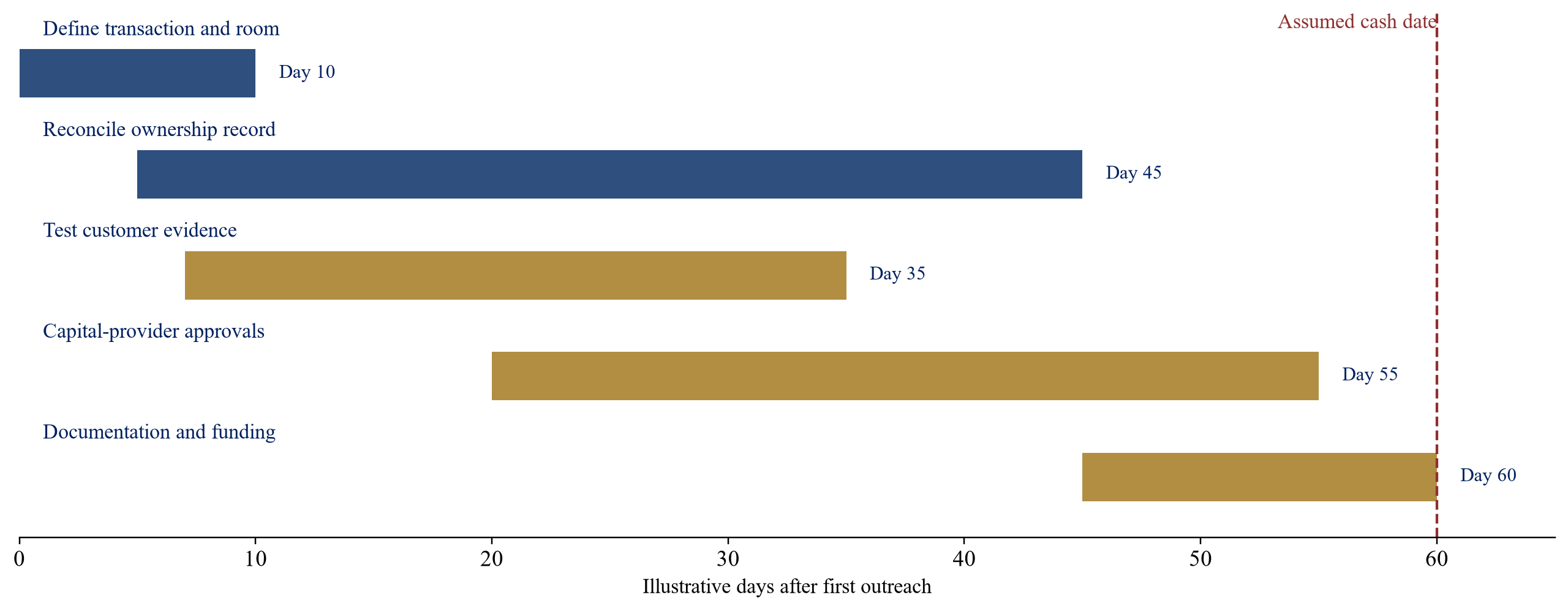
Author-developed illustrative timeline. Day numbers are hypothetical and do not describe UAE market practice or a real transaction.
14 Compare debt and equity at the same decision date
The comparison must use the same funding amount, cash date and operating scenario. A lower interest rate does not help if the facility cannot be drawn by the investment date. A high equity valuation is not sufficient if control rights, preference economics or shareholder approvals make the issue unacceptable. The board should compare net usable proceeds after fees and reserves, ownership effects, repayment and covenant cash, governance, conditions to funding, and the ability to withstand a downside scenario. Written terms are the input; indicative conversation is a separate category.
For the fictional company, the bank indication is smaller than the stated investment need. If drawn, it might be combined with equity or used for a narrower phase. The equity indication covers the initial amount but remains subject to the unsigned renewal and ownership reconciliation. A mixed structure may introduce intercreditor and consent questions. The board should not calculate an “optimal” mix by adding the headline amounts. It should test what each provider will actually approve once the corrected evidence and counterparties' conditions are known.
Different instruments have different evidence-sensitive terms. A lender may price or size the facility to verified cash flow, collateral and repayment timing. An equity investor may price a risked operating case and require governance protections. Both might decline a transaction whose ownership cannot be established. The matrix below helps management ask precise questions of counterparties. It does not rank all debt above equity or predict which instrument a given business should use.
Table 3. Debt-versus-equity decision matrix after an evidence gap
| Decision dimension | Debt route | Equity route | Evidence to resolve |
|---|---|---|---|
| Cash available by required date | Approved and drawable amount after conditions | Subscription proceeds after approvals and transfer | Dated conditions, accounts and approvals |
| Economic burden | Interest, fees, repayments and restrictions | Ownership, preferences and control rights | Facility draft; cap table and rights model |
| Operating downside | Coverage, liquidity and covenant headroom | Runway, dilution and exit-value range | Shared downside forecast |
| Ownership discrepancy | Customer and guarantor verification; borrowing authority | Share count, issue authority and pre-emption | Registers, constitution and legal reconciliation |
| Customer evidence | Repayment cash and security assignment | Revenue quality and growth value | Contract, invoices, collections and revised forecast |
| Unresolved consent | Security or draw condition | Corporate or shareholder closing condition | Written status and dated fallback |
Author-developed comparison. Actual costs and terms require written counterparty offers and legal review.
15 What a withdrawal record can and cannot prove
An investor or lender can stop at any gate. The issuer should capture the exact event: who communicated the decision, on what date, after which version of information, and using what words. A stated reason such as “the fund cannot make this size of investment” is a mandate-fit observation. A statement that “the credit committee cannot approve without audited obligor financials” is an evidence-related observation within that institution's process. Silence, by contrast, supplies no stated reason. Management may have hypotheses, but they belong in a separate, attributable field.
Several competing causes can operate at once. A corrected contract might reduce forecast cash while a lender simultaneously changes its sector limit. A fund may review an ownership discrepancy and then lose its remaining allocation for the year. A document request may occur because a new reviewer joined the transaction, even where the document was already supplied. The event ledger should record each change and avoid assigning a single cause unless the counterparty's decision and sequence justify it. This is a basic protection against turning an anecdote into a sales claim.
The board can still learn from incomplete data. It can count how often a named source is requested in its own process, how long requests remain open, and which stage has the longest elapsed time. It can identify a recurrent internal defect such as a cap table that requires correction before every conversation. These are issuer-specific operating measures, not market statistics. Counting only completed financings would omit the processes that ended earlier; counting every unresponsive approach as an evidence failure would create the opposite bias. Both errors would distort future capital planning.
Where a counterparty offers feedback, its permission and confidentiality terms should govern storage and any later use. A future external research study would require consented data, anonymisation and an agreed classification protocol. The present paper has no such dataset. It therefore proposes measurements that could be made rather than reporting a dropout rate or claiming that one missing file has an average price effect in the UAE.
16 Repricing, conditionality and withdrawal are separate outcomes
Repricing means a specific written term changes. The paper should identify the original and revised amount, valuation, interest margin, tenor, security, covenant or preference right. It should also record whether the revised term followed a new piece of evidence and whether other conditions changed. A capital provider can ask for more evidence while keeping terms unchanged. It can also change terms because of market rates, ticket availability or a change in the issuer's own funding request. Only the written comparison and contemporaneous explanation support a narrower conclusion.
Conditionality means that funding can proceed only if named actions occur. It is common in negotiated financing and should not be described as approval. A board should distinguish a condition before investment-committee review, a condition to signing and a condition to cash draw. The same requested source may sit at a different point for different providers. A tax certificate, consent or updated statement may be manageable after a term sheet but before closing if the provider accepts that sequence. The issuer should ask for confirmation and model the actual cash date.
Withdrawal is the end of a particular proposed route, not automatically the end of the company's financing options. It may be a formal decline, a terminated term sheet, lapse of an exclusivity period, or the issuer's own choice to abandon the offer. Record which party acted and whether any exclusivity, fees, confidentiality or break obligations survive. The board should review its fallback against current cash and obligations. Re-entering a process with another provider may require different diligence, so it should not be treated as an instant replacement for lost funds.
In the fictional example, an apparent valuation change from AED 80 million to AED 70 million would be meaningful only if there were two comparable written indications for the same instrument, funding amount and rights at stated dates. The paper's two values are assumptions used to show a calculation, not a history of negotiations. The distinction matters because a board can otherwise report “reclaimed” or “lost” value that no investor ever offered to pay.
17 A repair sequence that preserves credibility
The issuer should begin by acknowledging the exact gap to the authorised reviewers. It should not label an unsigned document signed or describe a draft audit as a completed opinion. The owner of the underlying record should establish the best current source, and finance or counsel should assess whether it changes any prior statement. If a deck or model needs correction, issue a dated replacement with a concise bridge from old to new. Preserve the prior version in the transaction record and identify which counterparties saw it.
Next, ask each provider how the gap affects its immediate decision. A reviewer may accept an independent confirmation, a condition in the documents, a more conservative model or a later completion date. Another may be unable to proceed under its policy. The issuer should capture the answer accurately, along with the person's authority to speak for the decision-making body. An adviser should not translate a junior deal-team expression of comfort into committee approval. The communication should state what remains outstanding and who owns it.
Then compare the repair timetable with the cash timetable. A factual correction that changes the amount needed may require a new board mandate. A slow shareholder dispute may require bridge financing or expenditure deferral. A collateral consent might support a smaller unsecured tranche if a provider offers it, but the extra price and refinancing risk need written analysis. The board should choose a path that can be executed under its stated downside; it should record alternative paths whose assumptions remain open.
Finally, preserve the evidence trail. The event ledger, source register, revised financial model, correspondence, minutes and executed documents should be linked by version and date. Access should reflect confidentiality and data-protection obligations. The purpose is substantive: a new lender or investment-committee member can reproduce why the financing case changed, while the issuer can avoid a different answer to the same question in every meeting. This is a proposed control procedure; it cannot guarantee a particular financing result.
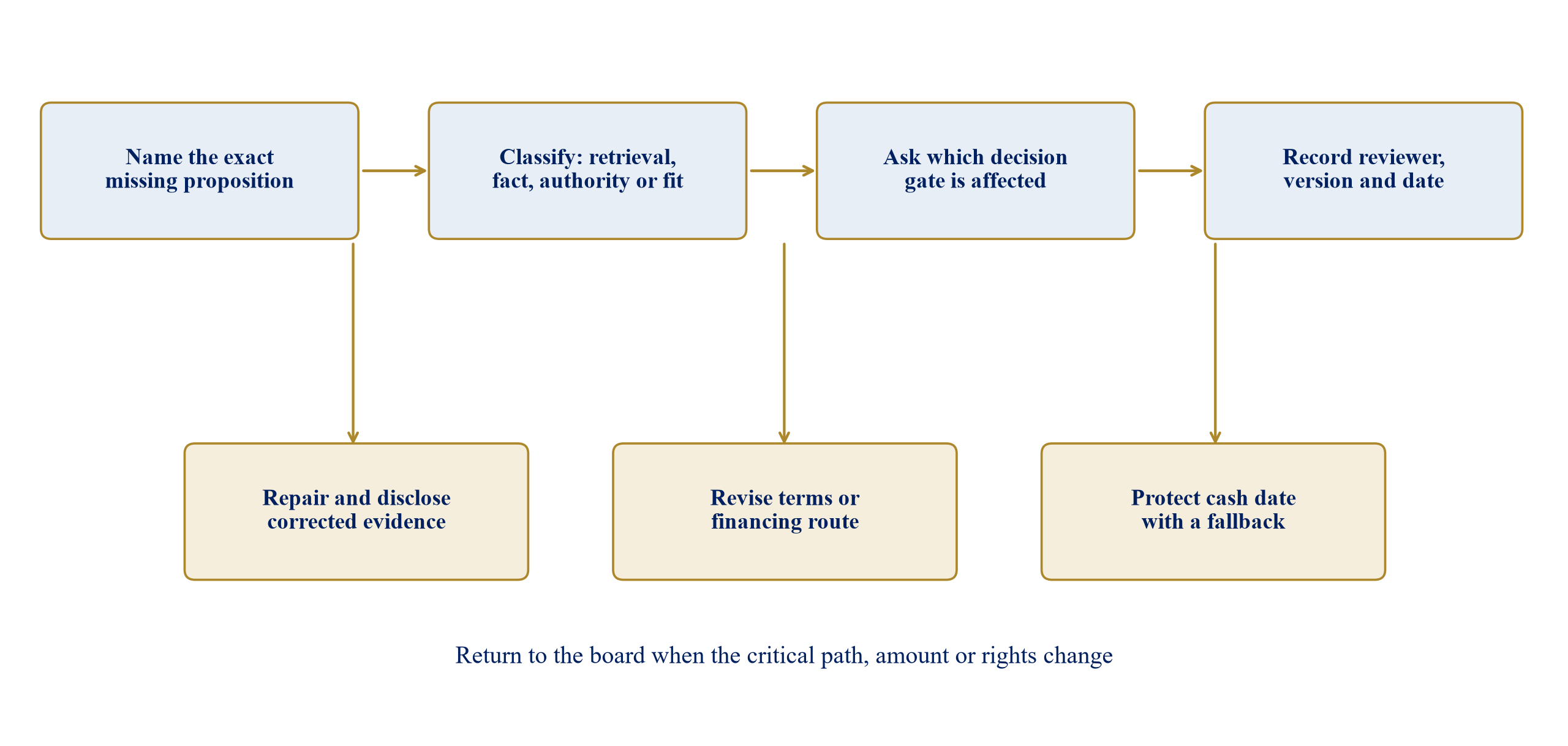
Author-developed workflow. The branches are decision prompts, not claims about how any specific capital provider will act.
18 A future matched-case research design
The research question about which missing documents cause repeat diligence, repricing or withdrawal needs a dataset that observes more than successful closings. A unit of observation could be one dated financing approach to one capital provider, linked to the issuer and proposed instrument. A consented case file would preserve the original brief, requested amount and terms, document requests, response dates, version changes, counterparty's stated decisions and final cash result. It should include failed, paused, withdrawn and ongoing approaches with an explicit cut-off. A single issuer approaching several providers contributes related observations, so the analysis must account for that clustering.
The design should distinguish observed request from researcher-coded severity. A transparent coding guide can classify evidence domain, gap type, decision gate, date and materiality. Independent reviewers should code a sample and resolve disagreements before estimating effects. The dataset should also capture sector, size, instrument, collateral, borrower age, audited history, customer concentration and counterparty mandate. These factors can influence both the likelihood of a request and the funding outcome. The analysis should never equate correlation with the causal effect of fixing a file.
A matched comparison might pair approaches with similar issuer, instrument, amount and counterparty characteristics that differ in a particular evidence gap. Even then, unobserved management quality, investor relationships and market timing may explain differences. A more credible within-issuer design could examine a dated correction followed by a decision from the same provider, while acknowledging that other facts can change between dates. Where a provider records a formal reason for decline, that text can strengthen classification but may still omit all internal deliberation. The research should report missing reasons and sensitivity to alternative classifications.
The output could estimate stage progression, elapsed time and term changes conditional on the observed sample and its limitations. It should publish sample definitions, denominators and privacy controls, not just a dramatic average. Without lawful access to the underlying files, this paper cannot produce those estimates. It does not claim a new empirical finding. Its narrower contribution is to specify the event and evidence structure that would allow a future test and improve an individual issuer's decision control today.
19 Board decision memo and adviser accountability
A board memo should start with the funding date and obligations that make it important. It should show cash on hand, committed funds, conditional indications and the minimum required amount separately. It should identify the current gate for each proposed provider and state whether any exclusivity limits alternatives. A source-and-use bridge should reconcile financing proceeds to the actual investment and near-term liquidity need. All illustrative scenario figures must be marked as assumptions in a live board paper.
The memo should then list only the material evidence gaps, each with its exact proposition, source, legal owner, reviewer request, current version, repair task and date. It should describe whether a gap blocks eligibility, identity, underwriting, terms, approval or draw. Where a provider has changed a term, attach the written comparison. Where it has withdrawn, quote or accurately summarise the stated reason with date and attribution. A management hypothesis about causation should be identified as management's view and accompanied by competing explanations where material.
Adviser accountability lies in keeping this record accurate and moving the right workstream. A useful adviser can coordinate finance, legal, commercial and counterparties, challenge a forecast whose evidence has changed, and obtain a specific answer about the next decision. The adviser should disclose its mandate, conflicts and fees, and should not imply that it can secure approval from a provider whose independent decision remains open. The board retains responsibility for choosing among executable options and for declining a structure that creates unacceptable risk.
The decision memo should end with triggers. If the missing ownership record is not resolved by a specified date, which expenditure is deferred? If the lender reduces the usable amount, how much equity or internal cash is required? If the contract renewal fails, what forecast and term-sheet assumptions change? These are scenario decisions, not predictions. The board can approve a conditional path while retaining a funded alternative and a date for escalation.
20 Conclusion and limitations
Financing evidence matters at the point where a named decision depends on it. A missing item may delay retrieval, reveal a different fact, prevent legal authority, alter commercial terms, or have no role in the counterparty's eventual choice. The useful question is not how many files are in a room. It is which proposition a reviewer must verify, which decision gate is open, what proof the issuer can lawfully supply, and how the cash date changes while the answer is pending.
The proposed framework links six decision gates to a request-and-event ledger, an evidence classification, a critical-path timetable and a matched debt-versus-equity comparison. The fictional example demonstrates arithmetic under explicitly invented amounts, dates and offers. It does not estimate the prevalence of missing evidence, the probability of investor withdrawal or the price of any real UAE financing. The regulatory sources cited apply within their stated perimeters; IFC's process is an example of staged institutional appraisal, and accounting standards do not decide an individual capital provider's mandate.
A live transaction requires its own documents, lawful data access, current rules, professional accounting and legal analysis, written counterparty decisions and a board-approved cash plan. The framework is intended to make those inputs visible and contestable. Its empirical propositions remain open until a consented matched dataset records the approaches that advance and those that fail. An issuer can still act now: define the financing precisely, repair the critical evidence, correct disclosed facts and plan against the cash actually available on the required date.
References
- Central Bank of the UAE. Credit Risk Management Standards, C 3/2024 STA, effective 30 November 2024, official rulebook; accessed 6 October 2026. https://rulebook.centralbank.ae/en/rulebook/credit-risk-management-standards
- Central Bank of the UAE. Credit Risk Management Regulation, C 3/2024, effective 30 November 2024, official rulebook; accessed 6 October 2026. https://rulebook.centralbank.ae/en/rulebook/credit-risk-management-regulation
- Central Bank of the UAE. Guidance for Licensed Financial Institutions on Customer Due Diligence/Know Your Customer and Record-Keeping, effective 7 November 2025, official rulebook; accessed 6 October 2026. https://rulebook.centralbank.ae/en/entiresection/6661
- Central Bank of the UAE. Beneficial Ownership Identification and Verification, official rulebook guidance; accessed 6 October 2026. https://rulebook.centralbank.ae/en/rulebook/325-beneficial-ownership-identification-and-verification
- International Finance Corporation. How to Apply for Financing, official application guide; accessed 6 October 2026. https://www.ifc.org/en/what-we-do/products-and-services/how-to-apply-for-financing
- International Finance Corporation. Project Cycle, official process overview; accessed 6 October 2026. https://www.ifc.org/en/what-we-do/products-and-services/ifc-project-cycle
- International Finance Corporation. Environmental and Social Review Procedures Manual, 2025, official publication. https://www.ifc.org/en/insights-reports/2025/environmental-and-social-review-procedures-manual
- IFRS Foundation. IAS 1 Presentation of Financial Statements, official standard overview; accessed 6 October 2026. https://www.ifrs.org/issued-standards/list-of-standards/ias-1-presentation-of-financial-statements/
- IFRS Foundation. IAS 7 Statement of Cash Flows, official standard overview; accessed 6 October 2026. https://www.ifrs.org/issued-standards/list-of-standards/ias-7-statement-of-cash-flows.html/
- IFRS Foundation. IFRS 15 Revenue from Contracts with Customers, official implementation materials; accessed 6 October 2026. https://www.ifrs.org/supporting-implementation/supporting-materials-by-ifrs-standards/ifrs-15/
- Financial Action Task Force. Guidance on Beneficial Ownership of Legal Persons, 10 March 2023, official guidance. https://www.fatf-gafi.org/en/publications/Fatfrecommendations/Guidance-Beneficial-Ownership-Legal-Persons.html
- Basel Committee on Banking Supervision. Principles for the Management of Credit Risk, 30 April 2025, official BIS publication. https://www.bis.org/publications/202504-guidelines-principles-management-credit-risk
About the Author
Chennakeshav (CK) is a corporate finance and investment banking executive with 25+ years of global experience in deal origination, structuring and execution across M&A, growth capital and corporate strategy. He has led value-creation mandates for founders, corporates and funds — bridging the boardroom view to hands-on execution and close.
His career spans Morgan Stanley, HSBC, Lloyds Banking Group, EWEC, ADQ portfolio companies and Emirates Growth Fund, across TMT, real estate, fintech, deeptech, cleantech, infrastructure and energy. He has partnered with C-suite leaders, private equity and venture funds, sovereign wealth funds and family offices to finance complex fund raises and scale-up ventures, and has led M&A due diligence, post-merger integration and business-transformation initiatives to create value.
At Matchpoint Partners he is Managing Partner, leading the firm's corporate finance, M&A and capital-raising practice. He holds an MBA from London Business School, an engineering degree from VTU and a Master of Laws (LLM, in progress) from UCL London.
An active start-up mentor, CK mentors at Techstars, DIFC FinTech Hive, Startup Grind, Founder Institute and IN5, serves as Entrepreneur Mentor in Residence (EMiR) at London Business School, and judges the Entrepreneurship World Cup.
