

1 Define the investor targeting decision
The capital-raising decision begins with a particular issuer, financing instrument, amount and execution window. A proposed recipient needs to be assessed against that opportunity. The issuer should record whether it seeks ordinary equity, preferred equity, a convertible instrument, a debt facility or another specified structure. It should identify the intended use of proceeds and the minimum funding needed for the planned transaction. A provider's involvement in the same industry supplies a starting point for review. The assessment still needs evidence about the relevant vehicle, investment stage, ticket interval and available decision process.
This paper asks whether verified strategy and ticket compatibility could predict substantive diligence beyond information available from a broad list of capital providers. It supplies a proposed method for investigating that question. It has no private outreach dataset, consented committee records or observed commitments. It makes no claim that an investor described in a source has available money, delegated signing power or current interest in an actual raise. The named profiles in the worked example are fictional labels. Their point assignments demonstrate a proposed calculation and carry no assertion about real institutions.
The practical choice is which eligible opportunity-provider pairings deserve an authorised approach, which require clarification and which fail a documented condition. Each choice should carry a dated basis. The decision record should identify the information used, its source, the person who reviewed it and any expiry or refresh condition. Ranking can then support the allocation of execution effort within the eligible set. Missing evidence should retain its unresolved status. A team should be able to explain why a high numerical score was held pending clarification or excluded after a failed essential condition.
The framework links that initial choice to later observable events. A qualified meeting, substantive diligence, a signed commitment and collected funding have separate definitions. Their distinction matters to evaluating whether the targeting method contributed useful information. An eventual study would require a prospective protocol and appropriate permissions. This paper provides the protocol structure and fictional arithmetic; it provides no empirical demonstration that the proposed ranking improves a raise.
2 Specify the financing opportunity before screening providers
An issuer's financing requirements should be documented before investor screening. The proposed opportunity brief records the legal entity seeking capital, its ownership perimeter, business activity, maturity and financing history. It states the required instrument, amount, currency, use of proceeds and decision timetable. Where the transaction includes multiple instruments or stages, each component should have its own requirement. A proposed equity round and a debt bridge can involve different capital providers, approvals and evidence. Combining their target recipients in one undifferentiated list would leave ticket compatibility difficult to assess.
The brief should distinguish an issuer's requested terms from terms already agreed with a counterparty. A proposed valuation, desired repayment schedule or intended security package remains an issuer proposal until the relevant parties document their agreement. The amount sought should also be separated from the minimum amount needed to execute the issuer's stated plan. A provider willing to evaluate only part of the raise may be relevant to a syndicate, while remaining insufficient for the issuer's minimum funding requirement. The screening record should state which role is contemplated and what complementary funding remains necessary.
Execution timing requires a clear interpretation. An issuer may have a date by which it needs a committee decision, a date by which documents must be signed and a date by which funds must arrive. Those are different milestones. The proposed brief records each separately and identifies the evidence for any externally imposed deadline. A provider's reported review timetable would be assessed against the relevant milestone. The framework does not assume that a provider can compress its approvals or that a signature delivers money on the issuer's required date.
Changes to the opportunity should create a new version. A larger ticket, revised instrument, new jurisdiction or amended use of proceeds can change which providers qualify for review. Earlier assessments should remain linked to the opportunity version used at first contact. The proposed study would need that history to evaluate progression consistently. Without it, a later success could be attributed to an initial match even though the issuer ultimately presented materially different financing requirements.
3 Establish what prior research can support
Gompers, Gornall, Kaplan and Strebulaev report a historical survey of 885 institutional venture capitalists at 681 firms. Their study discusses investment selection and differences in practices across industry, stage and geography [1]. Its relevance here is the need to define provider characteristics and decision context carefully. The survey does not estimate the effect of this paper's proposed GCC matching score. Its historical self-reported practices cannot establish the present mandate or available capital of an institution appearing in a current sourcing list.
Gompers, Kaplan and Mukharlyamov examine what 79 private-equity investors say they do, including valuation, governance and value-creation practices [2]. That study provides a separate historical perspective on investment decision processes. It gives no current investor-specific ticket interval for this paper. An institution's reported assets under management should not be entered as executable capital for a new transaction without opportunity-specific evidence. The proposed register therefore requests the relevant vehicle and current investment perimeter separately from general descriptions of an organisation's scale or history.
Bernstein, Korteweg and Laws use a randomised field experiment to investigate early-stage investors' responses to information about startups [3]. The publisher's account concerns investor interest in startup information. Interest should retain that outcome definition when the study is cited. It supplies a methodological precedent for carefully controlled information and a reason to define the measured event. It does not establish progression into substantive diligence, a signed commitment or receipt of funds for the present proposed study.
These sources inform the research question and design. The proposed contribution concerns a timestamped, opportunity-specific eligibility assessment, a separately specified score and a sequence of documented financing outcomes. Establishing whether that combination adds predictive information requires its own evidence. The paper claims no completed systematic review, universal novelty or absence of related research. A future empirical protocol should expand the literature review, define its comparisons and document the particular contribution before data collection. That review should also identify where existing concepts already explain the proposed measures.
4 Separate essential eligibility from optional ranking
Eligibility should be assessed through a declared set of essential conditions. The proposed register covers the lawful communication route, a relevant current mandate, compatibility with the financing instrument and ticket, an available sponsor or entry process, and the required decision authority where the contemplated action demands it. Each condition has an evidence requirement. The committee can declare a pairing eligible only for the stage that the evidence supports. Authority to receive a presentation should not be treated as authority to approve investment or sign transaction documents.
The proposed status set is eligible, excluded and unresolved. An excluded pairing has evidence of a failed essential condition. An unresolved pairing lacks sufficient evidence to decide a condition. Those statuses have different consequences. A failed ticket minimum might close the current route unless the issuer changes the proposed structure. An unknown minimum might justify a permitted clarification through an appropriate channel. The record should preserve the reason, the evidence date and the action available. Unresolved evidence should not be filled with a favourable assumption or presented as a confirmed refusal.
Table 1. Proposed eligibility and evidence register
| Condition | Evidence to request | Decision when unresolved or failed |
|---|---|---|
| Communication route | Applicable jurisdiction channel and professional review | Hold approach pending permission review |
| Current mandate | Relevant vehicle dated strategy and scope confirmation | Seek clarification or exclude evidenced mismatch |
| Instrument and ticket | Permitted instrument minimum and maximum participation | Compare with required role and issuer amount |
| Process entry | Reviewed sponsor contact or documented submission route | Hold until an authorised entry route is identified |
| Decision authority | Relevant committee delegation and signing process | Limit action to the authority actually evidenced |
| Execution timing | Required milestones and reported review availability | Clarify timing or exclude evidenced incompatibility |
Author-proposed governance checklist. Every field requires current opportunity-specific review. The table verifies no investor, permission, ticket or authority.
Optional ranking begins after the essential conditions for the intended approach are satisfied. Its purpose is to prioritise review effort within that eligible set. The proposed score has no authority to waive legal conditions, change a mandate or enlarge a provider's ticket. A committee override should state the reviewed reason and remain within the same essential requirements. A scoring rule should also identify which inputs are optional and how an incomplete input affects whether a rank can be assigned.
Separating eligibility from ranking makes the audit trail intelligible. A reviewer can see which pairings were never approached, which were held for clarification and which were ranked for a permitted contact. A later outcome study can preserve those populations separately. The proposed analysis should not count a prohibited or demonstrably incompatible pairing as an ordinary unsuccessful approach when evaluating the ranking method.
5 Verify mandate fit at the vehicle and opportunity level
The proposed mandate record identifies the capital provider's relevant vehicle and the source of its stated strategy. A general corporate website can describe several funds, businesses or investment teams. The screening reviewer should identify which vehicle could evaluate the issuer's proposed instrument and whether the source refers to current activity. A past investment can be recorded as historical context. Its existence does not prove that the current vehicle has the same investment perimeter or is accepting new opportunities.
Strategy fields should use definitions fixed before outcomes are observed. The proposed register records sector scope, issuer stage, geography, instrument, intended investment role and relevant restrictions where authorised evidence supports them. A provider's statement should be preserved with its date and context. A broad description such as technology investment can leave several required details unresolved. The reviewer should request the missing information through an appropriate permitted route and keep the uncertainty visible until that clarification has been received and reviewed.
The issuer's opportunity needs equivalent precision. A technology-enabled engineering business might be screened differently depending on whether the proposed capital finances a recurring software product, working capital for contracts, an acquisition or a long-lived physical asset. The framework offers no universal classification for those cases. It requires the issuer to explain the use of proceeds and the provider to be assessed against that explanation. A taxonomy label can support search; the eventual eligibility decision needs the reviewed investment perimeter.
Evidence freshness should be governed by the information's purpose. A dated strategy document may remain useful for understanding an investment approach while failing to establish current intake availability. An authorised current confirmation may resolve the latter question without proving final investment approval. The proposed committee record therefore stores separate fields for strategy fit, current review availability and decision status. It should also record when an amendment to the issuer's requirement makes an earlier provider assessment obsolete. That history supports a later evaluation of decisions made with the information actually available at the time.
6 Reconcile ticket size, syndication role and authority
Ticket compatibility requires a stated participation interval and a defined financing role. The issuer should compare the amount sought with the provider's reviewed minimum and maximum for the relevant vehicle and instrument. A headline investment size taken from an old transaction should be identified as historical information. It should not silently become a current minimum or maximum. Where the provider has not supplied sufficient evidence, the register should retain an unresolved ticket field and identify the clarification needed.
The participation interval should be evaluated against the role proposed. A sole investor needs to be assessed against the issuer's full requirement. A syndicate participant may evaluate a smaller portion, subject to any evidenced minimum. A lead investor's contemplated responsibilities may include terms negotiation or coordination, while another participant may only consider joining an established round. These are proposed role descriptions for screening. The record needs counterparty-specific evidence before attributing any such responsibility or willingness to an actual institution.
An authority map should distinguish the person who receives an opportunity, the person who sponsors its review, the committee that makes the relevant decision and the signatories required for documentation. A job title or public biography does not establish delegated authority for a particular commitment. The proposed process requests enough evidence to understand the next authorised step without collecting unnecessary personal information. A contact can be relevant to preliminary review while leaving committee powers, allocation limits and documentation authority unresolved.
Conditional participation should remain conditional in reporting. An investor might state that consideration depends on a lead, a revised instrument, additional evidence or a specified financing amount. The register should preserve those conditions and the source of the statement. It should not report them as an unconditional commitment. The same discipline applies after signature: the instrument, amount, conditions, expiry and observed receipt of money need separate records. This paper verifies none of those matters for a real investor and supplies no assurance that an eligible pairing reaches funding.
7 Review communication permissions across distinct regimes
Communication permission needs a transaction-specific review. ADGM's Financial Services and Markets Regulations address restrictions on financial promotion in section 18 and related provisions [4]. The official indexed text identifies approval, authorised-person and exemption routes within that framework. Full current consolidated text was not retrievable in this review. No exemption threshold or particular communication clearance is stated here. A proposed approach affecting ADGM should be reviewed against the applicable current instruments and its exact circumstances by appropriately qualified advisers.
ADGM's Conduct of Business material separately addresses client classification [5]. The relevant official indexed material distinguishes classification routes and indicates that classification can vary with the activity, service, product or transaction. Classification is a regulatory field in the proposed register. It does not establish current investment appetite, available allocation, delegated committee authority or permission for every form of contact. The paper therefore keeps classification evidence separate from its opportunity-specific mandate and process fields.
The DFSA's General Module rule 3.5.1 addresses financial promotions by the persons within its specified opening scope, including clear, fair and non-misleading communication requirements and stated exceptions [6]. The DFSA Conduct of Business classification provisions distinguish deemed, service-based and assessed professional-client routes within their respective conditions [7]. Those provisions should be read with the current applicable instruments. The proposed register records the reviewed communication route and classification basis separately. It derives no blanket permission from the words professional investor or from a provider's institutional appearance.
Saudi CMA's January 2026 amended securities-offer rules cover specified offers in the Kingdom, including marketing within their defined scope and exclusions. Their private-placement provisions address an arranging-licensed Capital Market Institution and information supplied to investors [8]. The English document is expressly an unofficial translation; Arabic is the official text. These identified frameworks establish distinct review questions. They supply no common GCC promotion exemption. The proposed workflow requires qualified review of the actual instrument, issuer, recipients, channel and jurisdictions before any consequential contact is authorised.
8 Design a transparent candidate scoring matrix
The proposed ranking uses five dimensions scored from zero to four. The illustrative weights are thirty percent for sector compatibility, twenty percent for issuer stage, twenty percent for ticket compatibility, fifteen percent for timing and fifteen percent for process availability. They sum to one. The score is one hundred multiplied by the weighted sum of component points, divided by four. These weights and scales are author-selected. They have no fitted relationship to observed outcomes and no validated interpretation as an investment probability.
Point definitions would need to be documented before application. The hypothetical scale could distinguish an evidenced close alignment, an evidenced acceptable alignment and a weaker permissible alignment within the eligible set. The reviewer should state what evidence supports each point assignment. A zero used for an optional ranking preference should remain distinct from a failed essential condition. A missing value should retain its missing status. The numerical scale has no permission to convert unavailable evidence into a ranked assertion about a real provider.
Table 2. Fictional pre-check point assignments and eligibility outcomes
| Fictional profile | Point vector | Pre-check score | Essential status |
|---|---|---|---|
| Alpha | 4 / 4 / 3 / 3 / 4 | 91.25 | Eligible in the invented example |
| Beta | 4 / 3 / 4 / 2 / 2 | 80.00 | Eligible in the invented example |
| Gamma | 3 / 4 / 2 / 4 / 3 | 78.75 | Eligible in the invented example |
| Delta | 4 / 4 / 4 / 4 / 4 | 100.00 | Excluded after ticket check |
| Epsilon | 4 / 3 / 3 / 3 / 4 | 86.25 | Unresolved current mandate |
| Zeta | 2 / 2 / 4 / 3 / 3 | 67.50 | Eligible in the invented example |
Vector order is sector stage ticket timing process. Weights are 0.30 0.20 0.20 0.15 0.15; score is 100 times the weighted sum divided by four. All labels and points are invented. Delta shows how an unvetted headline score can fail the subsequent essential ticket check. Epsilon remains unresolved and cannot enter the eligible ranking.
Delta deliberately illustrates an improperly vetted preliminary score. Its ticket point was assigned from an invented headline description before an incompatible current minimum was identified. The resulting one hundred is retained only to expose the screening error. It is invalid for prioritising an approach. Epsilon's unresolved mandate similarly keeps its preliminary numerical result outside the eligible ranking. Among the remaining fictional profiles, the computed order is Alpha, Beta, Gamma and Zeta. That order follows the selected weights and establishes no actual likelihood of diligence or commitment.
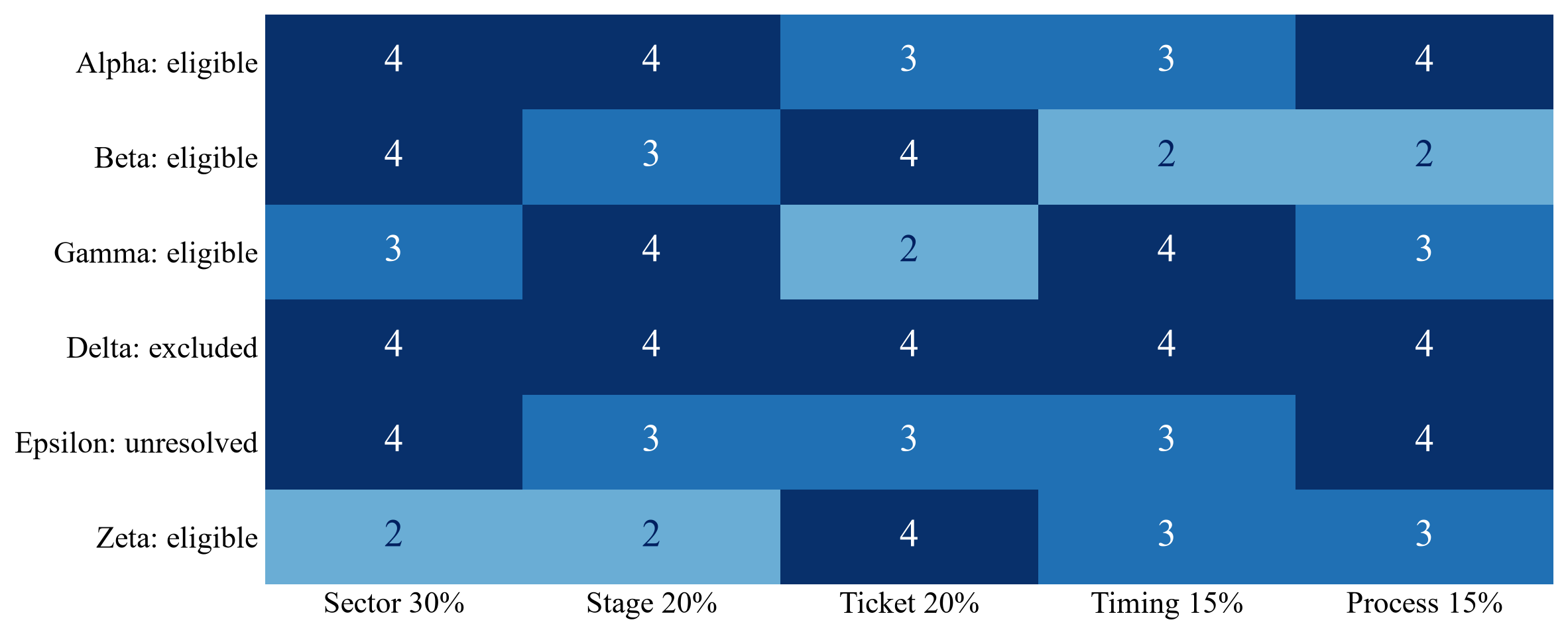
Author-selected points and weights. Delta and Epsilon are shown solely for the screening-error illustration; neither is an eligible ranked target. No profile identifies an actual investor.
9 Govern evidence quality and data permissions
The proposed register should collect the minimum information needed for its declared purpose. ADGM's 2021 data-protection guidance discusses purpose limitation, data minimisation, lawful basis and the conditions relevant to consent and legitimate interests [9]. Its transparency guidance addresses accessible information about processing [10], while implementation guidance addresses privacy by design and processing records [11]. These are identified guidance materials with their own status and dates. They should be used with the applicable current regulations and professional advice for an actual dataset.
ADGM announced amendments and new substantial-public-interest conditions in September 2025 [12]. That development illustrates why older guidance needs a currency check. It establishes no general permission to collect fundraising correspondence or reuse confidential information for research. The proposed study would need separate approval of its lawful basis, participant information, access arrangements and retention policy. The paper does not assert that consent is the only lawful basis in every jurisdiction or that the same basis applies to all outreach, operational and research activities.
Data fields should preserve provenance. A source-supported mandate statement, a management estimate, an unreviewed extracted passage and a private confirmation received with restricted permission have different statuses. The reviewer should document the source date, the permitted use and the resolution of ambiguities. The analytical dataset could use pseudonymous opportunity and provider identifiers, with raw correspondence accessible only to authorised reviewers. The proposal includes no licence to disclose participant identities or confidential negotiations in an eventual publication.
Data permissions should remain distinct from investment eligibility. A participant may permit preliminary contact while declining research reuse of their correspondence. A provider may authorise a research record while remaining unsuitable for the instrument. The workflow should preserve each decision independently. Before collection, the protocol should explain how withdrawal, retention expiry and correction requests would be handled. An eventual empirical report should describe those arrangements sufficiently for methodological review without revealing information outside the approved purpose. No private records have been processed under this proposal.
10 Report progression with explicit stage denominators
The fictional funnel uses two invented cohorts to illustrate reporting. Forty approaches in the matched cohort lead to twenty-eight meetings, sixteen diligence processes, six signed commitments and four funding events. One hundred approaches in the broader cohort lead to thirty-five meetings, fifteen diligence processes, five signed commitments and three funding events. The invented counts are nested within each cohort. Their construction provides no information about actual investor behaviour, amounts, timing, selection or opportunity quality. The illustration has no stated sampling distribution and supports no significance test.
Table 3. Fictional funnel counts and percentages of initial approaches
| Stage | Matched count | Broader count | Matched percent | Broader percent |
|---|---|---|---|---|
| Permitted approaches | 40 | 100 | 100 | 100 |
| Qualified meetings | 28 | 35 | 70 | 35 |
| Substantive diligence | 16 | 15 | 40 | 15 |
| Signed commitments | 6 | 5 | 15 | 5 |
| Funding events | 4 | 3 | 10 | 3 |
All observations are invented for denominator explanation. Matched and broader cohorts have different initial sizes. Each percentage divides the stage count by that cohort's approaches. Signed commitments and funding are separate constructed events; no money amount or causal effect is reported.
The matched approach-to-diligence proportion is sixteen divided by forty, or forty percent. The broader equivalent is fifteen divided by one hundred, or fifteen percent. Diligence among meetings uses different denominators: sixteen divided by twenty-eight is approximately 57.14 percent, and fifteen divided by thirty-five is approximately 42.86 percent. The subsequent signed-commitment proportions are six divided by sixteen, or 37.50 percent, and five divided by fifteen, or approximately 33.33 percent. Funding among signatures is four divided by six and three divided by five, approximately 66.67 and sixty percent respectively.
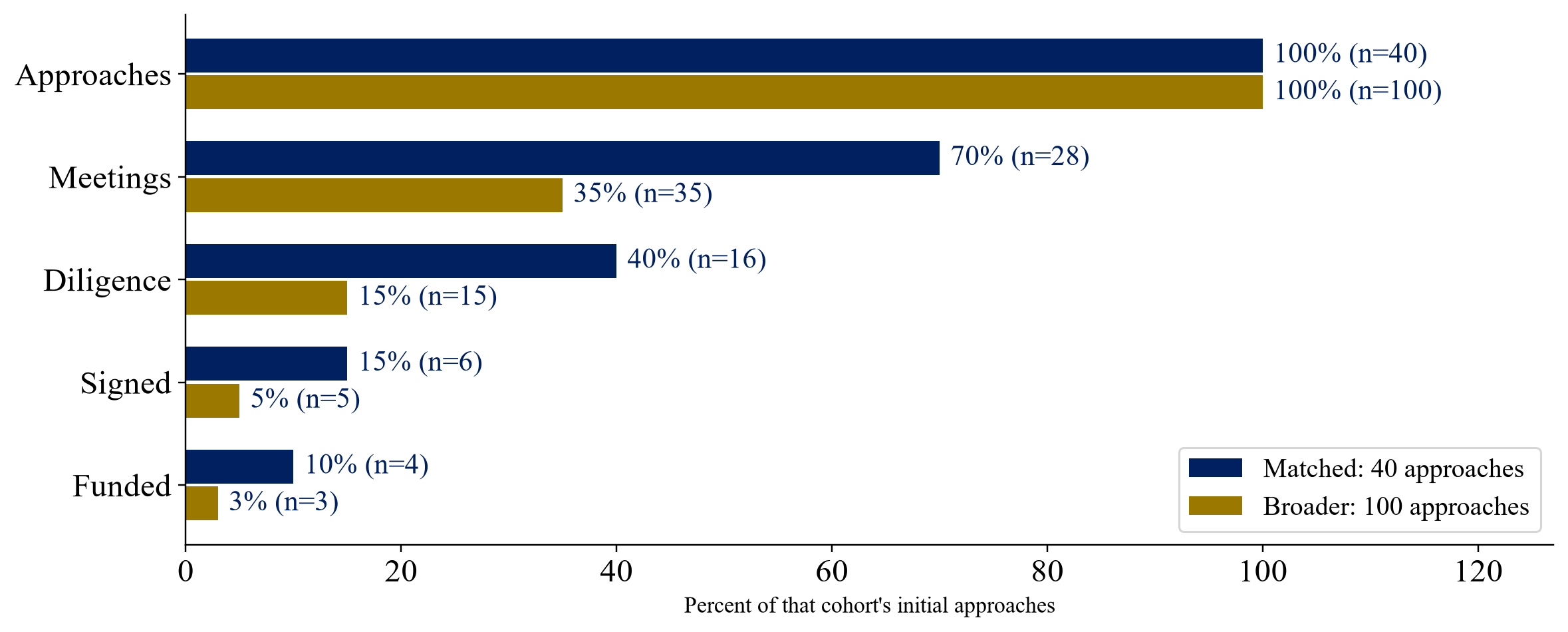
Labels show invented raw counts as n. Matched starts at 40; broader starts at 100. Different percentages reflect constructed examples and demonstrate no effectiveness or causal uplift.
Those arithmetic identities make the illustration reproducible. They do not establish why the counts differ. A later study would need common endpoint definitions, comparable follow-up and evidence about selection. It should also record signed amounts and received amounts separately where participants authorise their use. A count of funding events cannot establish the value of funds received. The proposed outcome register would retain document dates, conditions and observed receipts, with the relevant privacy and confidentiality controls.
11 Sequence review from permission to observed funding
The proposed sequencing map starts with the reviewed opportunity brief and communication route. The team then assesses current mandate, ticket compatibility and the available entry process. An unresolved essential field sends the pairing to clarification. An evidenced failure closes the current route with a recorded reason. An eligible pairing can proceed to optional ranking and an authorised approach. This is a governance sequence proposed by the author. It gives no authority to contact an actual individual, distribute an offer or submit a transaction.
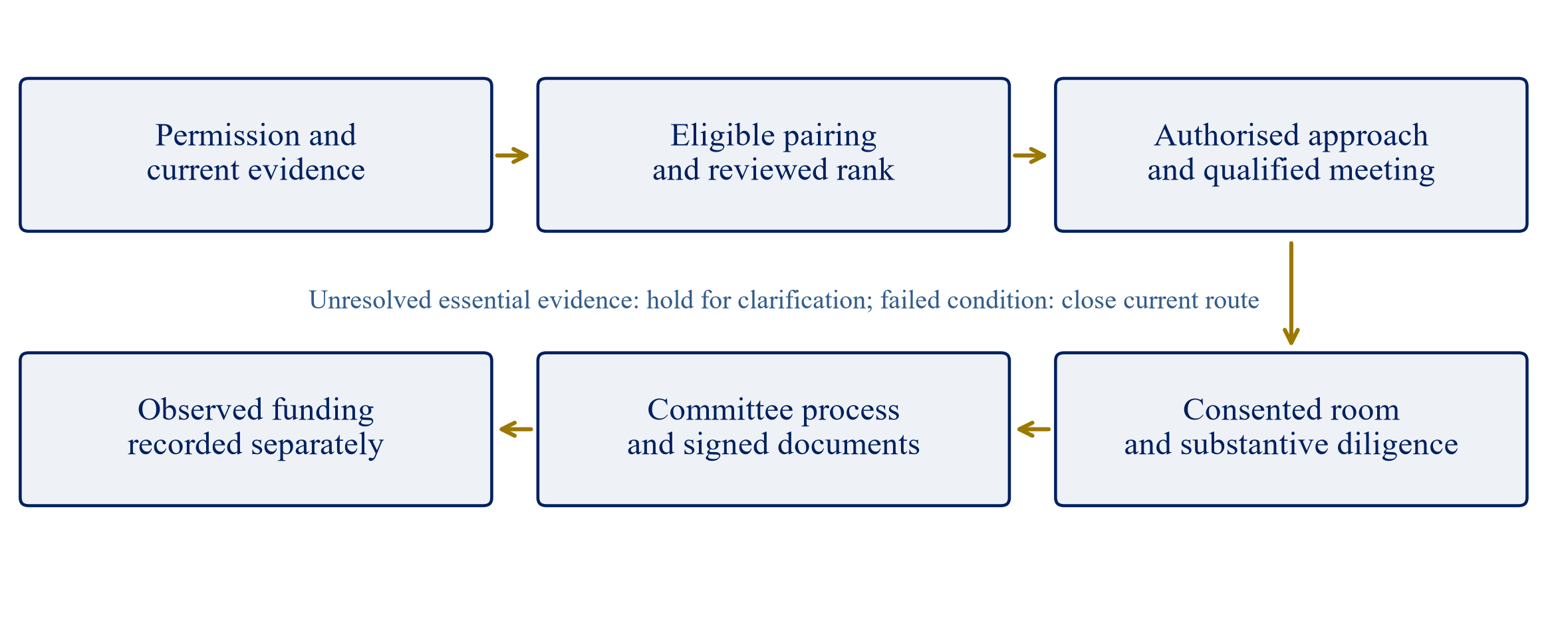
Author-proposed process. Each arrow represents a possible reviewed next step. Unresolved or failed essential conditions require clarification or closure. No elapsed times or event probabilities are asserted.
The meeting stage should clarify whether a relevant reviewer can sponsor substantive assessment and which materials are authorised for disclosure. Access to a data room should follow the applicable confidentiality and data permissions. A recorded request for documents should identify its purpose and the responsible review role. The proposed register should retain the date and scope of the event so that diligence can be distinguished from a generic request for information. It should also identify issuer-side delays and changes that alter what the provider is evaluating.
Committee consideration and documentation need separate evidence. The team should record the decision communicated by an authorised participant, its conditions and its scope. Any signed instrument should be reviewed for the amount, expiry and funding conditions relevant to the study's endpoint definition. Funding should be recorded only against an observed and appropriately verified receipt event within the authorised data perimeter. This paper provides no transaction-specific opinion about document enforceability, final approvals or settlement obligations.
Each stage should permit a recorded stop, a request for clarification or a revised opportunity version. The proposed sequence preserves those outcomes without treating every open case as a completed rejection. It also makes the later research question tractable: a study can examine whether information available before contact predicts a defined subsequent event. The following proposed protocol specifies the cohort, endpoint and validation requirements needed for that investigation.
12 DEFINING THE RESEARCH QUESTION
The proposed empirical question is whether verified strategy and ticket compatibility predict progression into substantive diligence after accounting for the conditions under which an issuer reaches an investor. A useful study would identify the information available before an approach, record the approach consistently, and follow its subsequent outcomes. This ordering matters because a record assembled after a successful meeting can acquire detail that unsuccessful records never receive. The resulting difference could describe documentation effort as readily as investment suitability. The proposed design therefore freezes the eligibility assessment and ranking inputs before first contact within each observed opportunity.
The unit of analysis would be an issuer opportunity presented to a particular capital provider during a defined observation period. The same investor could encounter several issuers, and an issuer could approach several investors. Those observations would share circumstances and would require an analysis that recognises their dependence. The question also needs a clear definition of substantive diligence. A courtesy meeting, a request for a generic presentation, and an internally authorised assessment of an opportunity represent different events. The study would specify its diligence threshold before collection, using observable evidence such as an agreed document request, named review responsibility, and a recorded assessment process.
The proposed hypothesis concerns incremental predictive value. Strategy and ticket fit would be assessed alongside issuer characteristics, approach channel, and market timing. An association would remain an association unless the design supported a stronger interpretation. A capital provider's current capacity, relationships, and internal priorities might influence both the quality of the initial match and the decision to investigate. No private dataset, actual provider commitments, or empirical conversion results are available for this paper. The framework consequently offers a testable research design and an operational discipline; its effectiveness requires subsequent observation and validation.
13 BUILDING TIMESTAMPED AND CONSENTED COHORTS
A proposed cohort would begin with a defined population of issuer opportunities and capital providers, followed by a documented observation window. The register would record the date on which an opportunity entered consideration, the evidence date for each provider attribute, the eligibility decision, and the first permitted approach. Later amendments would preserve the original version and identify their source. A time-stamped record makes it possible to ask what the team knew when it acted. It also supports review of an apparently strong match that became unsuitable after a mandate change, an allocation decision, or a revised issuer requirement.
Collection would operate within an agreed permission and confidentiality framework. Participating issuers and capital providers would receive an appropriate explanation of the data being recorded and the intended analytical use. The research register would distinguish permission to retain information, permission to contact a named person, and permission to share issuer materials. Each decision has a different purpose. A contact appearing in a source does not establish permission for every subsequent use. The study protocol would specify access restrictions, retention periods, withdrawal handling, and the treatment of information whose inclusion has not been authorised.
Cohort membership would be fixed through explicit entry rules. Those rules would identify the relevant raise type, issuer stage, geography, and capital-provider category without retrospectively removing inconvenient outcomes. An issuer withdrawal, a provider's declined participation, and an incomplete observation period would remain visible through their designated status. The register would preserve the reason for exclusion separately from the reason for non-progression. This separation would allow later readers to understand whether a case failed an entry requirement, could not be approached, or was approached and declined. The proposed method depends on that distinction for a credible account of conversion.
14 ESTABLISHING EQUIVALENT ELIGIBILITY AND CONTACT CONDITIONS
A comparison between a matched cohort and a broader sourcing cohort would need equivalent minimum eligibility. Every included provider would first pass the same requirements for a permissible approach and opportunity compatibility. Providers with an incompatible minimum ticket, an unavailable relevant mandate, or an unresolved essential permission would receive an exclusion or pending status before optional ranking. A high weighted score would have no authority to reverse a failed hard condition. The underlying register would identify the evidence supporting each condition, its date, and the person responsible for the decision.
The broader cohort would require a precise operational definition. It could comprise providers selected using less detailed ranking information after the common eligibility screen. The study would record the selection procedure, the information available to the team, and any human intervention. An undefined broad list could contain a mixture of impossible approaches, stale contacts, and suitable providers. Such a mixture would make any measured difference difficult to interpret. A valid comparison would preserve the shared screen while documenting exactly which additional strategy and ticket evidence influenced selection in the matched group.
Contact conditions would also require comparable treatment. The proposed protocol would record the approach message, available issuer materials, follow-up schedule, delivery channel, and sender role. Material differences would be disclosed and incorporated into interpretation. A warm introduction carrying a trusted endorsement could affect the response independently of the matching framework. Teams would therefore record its presence and origin rather than absorbing its effect into a fit score. Where equivalent contact conditions are impractical, the study could report separately defined channel groups. The resulting comparison would describe the observed context and the limits on conclusions about matching itself.
15 PREREGISTERING ENDPOINTS AND FOLLOW-UP
The proposed protocol would specify its principal endpoint before examining outcomes. Substantive diligence within a fixed period after the first permitted approach would be a suitable candidate for the central question. The observation period would need to accommodate the raise type under study and would be declared in advance. Secondary endpoints could include a qualified meeting, an indicative proposal, a signed commitment, and receipt of funds. Each endpoint would have an evidence standard, an event date, and a responsible reviewer. Teams would also define whether an event applies to the entire proposed amount or only a documented portion.
Signed commitments and funded amounts would remain distinct throughout collection and reporting. A signature can accompany conditions, expiry provisions, staged funding, or other requirements relevant to whether money is subsequently received. The proposed register would retain the nature of the document, the amount covered, the remaining conditions reported by authorised participants, and the observed funding event. The analysis would avoid treating an unsigned indication of interest as a signed commitment. It would equally avoid treating a signed commitment as collected funds. Those distinctions would carry through headline results, charts, and committee summaries.
Preregistration would cover the principal comparison, analytical approach, intended subgroup analyses, and handling of multiple endpoints. It would also specify the follow-up cadence and the procedure for identifying an outcome that occurs after the original window. A protocol amendment would be dated and explained before its consequences were assessed. Exploratory findings could still inform future work, provided they were identified as exploratory. This approach would make the eventual paper easier to evaluate because readers could distinguish the question originally posed from additional patterns discovered during observation. No endpoint result is claimed here; the proposed endpoints define what a later study would measure.
16 RECORDING ISSUER QUALITY AND APPROACH CONTEXT
Issuer quality would need explicit treatment because investor response can reflect the underlying opportunity as well as the appropriateness of the recipient. The proposed register would capture a predetermined set of issuer characteristics available at first approach. These could include the completeness of financial information, documented revenue status, clarity of the use of proceeds, governance materials, and preparedness for diligence. Their definitions would be established before outcomes became known. An assessment would distinguish source-supported information, management estimates, and information awaiting verification. The study would preserve those differences in the analytical record.
The register would also describe terms and transaction characteristics that could affect investor interest. Raise size, instrument, proposed valuation where applicable, existing financing position, and requested execution timing would enter through consistently defined fields. Changes during the observation period would be recorded as events. A revised financing structure could produce a different fit assessment, while an improved data room could affect diligence independently of recipient selection. The study would therefore preserve the initial snapshot and capture material subsequent developments. It would identify which assessment version governed each approach.
Warm introductions and market timing would receive their own fields. The team would document whether an introduction existed, the relationship category, and the date of the approach without assigning unsupported strength to the relationship. Market context would be represented through declared observation periods and relevant contemporaneous measures selected in the protocol. These variables would help evaluate whether an apparent matching association persisted within comparable circumstances. Unmeasured differences could remain, including private committee priorities and allocation pressures inaccessible to the study. Any resulting analysis would acknowledge that limitation and restrict its claims to the evidence actually collected.
17 ADDRESSING SELECTION BIAS AND DEPENDENT OBSERVATIONS
Selection bias could arise at several points in the proposed study. Issuers willing to provide structured records might be better prepared than the wider issuer population. Capital providers willing to participate might follow more transparent processes. Teams could reserve stronger opportunities for their most promising contacts. The register would record entry pathways, participation decisions, and the basis for allocating approaches wherever authorised information was available. These records would help describe the population to which the eventual results apply. A limited participant group would support conclusions about that group within its observed conditions.
Where participants authorise an allocation experiment and both groups satisfy the same eligibility and permission conditions, a prospective randomised selection procedure could provide a stronger test. Its feasibility would require separate review of commercial obligations, opportunity costs, and participant agreement. The protocol would preserve issuer control over consequential decisions and document departures from the assigned procedure. If random allocation were unavailable, the study could use a prospective observational design with declared adjustment variables and sensitivity analyses. The choice would be explained before outcomes were inspected, together with the limitations accompanying that choice.
Repeated observations would also require careful handling. An investor's response to several issuers could reflect shared policy, while several approaches for one issuer would share its materials, management team, and financing needs. The proposed analytical model would account for clustering at both levels where sample structure permitted. It would also consider intermediary and introducer effects if those fields were sufficiently complete. A later analysis would report the number of distinct issuers and providers alongside the number of approaches. This reporting would make the concentration of observations visible and support assessment of how much independent evidence the study actually contains.
18 TESTING RANKING THROUGH HELD-OUT VALIDATION
The proposed weighted ranking would be treated as a candidate decision aid whose predictive value remains untested. Its components would represent verified current strategy, issuer stage, ticket compatibility, timing, and decision-process availability. Weights would be documented before application, along with the evidence rules governing each point assignment. A reviewer could then reconstruct why a provider received its rank. Essential eligibility conditions would retain their separate authority. The model would also preserve an unresolved status where evidence was insufficient to support a ranking input, with that unresolved status explicitly retained.
Empirical validation would compare the candidate ranking with simpler declared baselines. Examples could include eligible-provider selection without weighted ranking and a model using strategy and ticket fields alone. The aim would be to establish whether added complexity produced useful predictive information in new observations. Evaluation would address calibration as well as discrimination. A high position in a ranking has limited meaning if users interpret it as a probability that has never been estimated. Any later probability model would require its own estimation, validation, and explanation of the population and endpoint to which it applies.
Cross-validation would separate observations by investor and deal to reduce information leakage. A provider or issuer appearing in both training and evaluation data could carry familiar characteristics into the test set. The proposed design would therefore use grouped splits and, where possible, a later time period for an additional prospective test. Weight adjustment would occur within the training process, with final evaluation reserved for held-out observations. The paper reporting that work would describe performance variation across splits and relevant groups. A result obtained from a small or concentrated sample would carry a corresponding limitation on its transfer to other raises.
19 MANAGING CENSORING AND MISSING INFORMATION
The proposed analysis would recognise that a raise can remain active when observation ends. An approach made near the end of the collection period has less opportunity to reach diligence or funding than an earlier approach. Treating every unresolved case as a definitive failure would obscure that difference. The protocol would define the follow-up period for each opportunity and identify right-censored observations. A time-to-event analysis could be considered if the data structure and sample supported it. Simpler fixed-window comparisons would require a sufficiently mature cohort and transparent reporting of cases without complete follow-up.
Missing information would receive reason codes because different absences carry different implications. A provider could decline to disclose a ticket interval, a team could fail to record an available field, or a source could contain an outdated value requiring clarification. Those cases would remain distinguishable. Essential missing eligibility evidence would place an opportunity-provider pairing in a pending status until resolved. Optional analytical fields could remain missing under a declared policy. The protocol would identify which analyses use complete observations and whether any statistical treatment of missing values is proposed.
Sensitivity analysis would examine how reasonable alternative treatments of unresolved outcomes affect the conclusion. It would also assess dependence on the stated diligence threshold and observation window. Any imputation would be described as a modelling procedure with assumptions, accompanied by an analysis that makes its influence visible. The study would avoid creating a fictional audit trail for fields that were never observed. Its reporting would disclose missingness by cohort and key variable, together with withdrawals and unresolved statuses. Readers would then be able to assess whether apparent conversion differences coincide with differences in record completeness or follow-up quality.
20 USING HUMAN-REVIEWED DATA ASSISTANCE
Data assistance could support the proposed workflow through structured extraction, duplicate identification, source organisation, and preparation of records for human review. Any AI-assisted activity would operate within the permissions governing the underlying material. Its proposed role would be limited to draft outputs that authorised reviewers compare with the cited source. A system-generated suggestion would carry the status of a suggestion until reviewed. The final record would identify the source, the review date, and the accountable person. No claim about tool accuracy or behaviour is required for this governance design.
The workflow would separate extraction from decision-making. An assistant could identify a passage describing a provider's strategy, while a reviewer would determine its relevance, currency, and sufficiency for the opportunity under consideration. An ambiguous statement about investment size would trigger clarification. A named investment professional would require separate verification of the available process and their relevant role. Contact permission would remain a separately reviewed field. These distinctions would preserve accountability for the judgements that determine eligibility and outreach. They would also provide a record of why an automated suggestion was accepted, changed, or rejected.
Quality review would use a declared sample of processed records and record discrepancies by field. The team would consider both accepted outputs and unresolved suggestions when assessing whether the workflow was appropriate for continued use. Access permissions, confidential issuer materials, and provider statements would require controls reflecting their authorised purposes. A revised extraction method would receive a version identifier, and material changes would prompt review of affected records. The proposed study could measure reviewer workload and discrepancy rates as operational outcomes, provided these measures were defined in advance. Any findings would describe the specific workflow and review conditions observed.
21 INTERPRETING A FICTIONAL CONVERSION EXAMPLE
A brief fictional funnel illustrates the reporting distinctions. In an invented matched cohort, forty permitted approaches lead to twenty-eight meetings, sixteen diligence processes, six signed commitments, and four funding events. In a separate invented broader cohort, one hundred approaches lead to thirty-five meetings, fifteen diligence processes, five signed commitments, and three funding events. Every number in this example is constructed for explanation. The example contains no observed investor behaviour, actual commitment, or research finding. Its role is to show the records a proposed study would need at successive stages.
The example also illustrates why denominators need consistent definitions. Reporting the proportion of approaches reaching diligence addresses one question, while reporting diligence progression among meetings addresses another. A committee would need to know whether the counted meeting was qualified, whether multiple meetings belonged to one opportunity, and whether a signed commitment covered the proposed financing amount. Funding would require its own documented event. The arithmetic could describe the invented cohorts, but their composition, selection procedure, and observation periods have not been supplied. Their numerical differences therefore support no claim of demonstrated uplift or causation.
An eventual empirical report would present the cohort flow, absolute counts, declared endpoint definitions, and uncertainty around its estimates. It would disclose differences in issuer preparedness, introduction channels, market periods, and missing data. A favourable association could justify further testing or a carefully scoped operational trial. An inconclusive result would remain informative about the evidence available and the design's precision. An adverse result could prompt examination of weights, evidence quality, or selection procedures. The proposed framework would keep those possibilities open and judge them through preregistered analysis with the fictional funnel retained solely as an explanatory example.
22 GOVERNING CAPITAL-PROVIDER SELECTION
The practical committee decision would begin with a reviewed eligibility register. Each proposed approach would carry current source evidence for relevant strategy, the ticket interval, the available decision process, authority information where verified, timing, and the permission governing contact. A responsible reviewer would record unresolved conditions and identify the clarification needed. Only eligible pairings would proceed to optional ranking. The committee would consider the ranking alongside source quality and issuer readiness, recording any override and its reason. This proposed procedure gives the eventual evaluation a traceable account of both the assessment and the decision.
Governance would extend beyond initial approval. The team would specify when a record requires refresh, who may amend it, and what evidence justifies a changed status. Material developments in the issuer's financing needs or the provider's stated strategy would prompt reconsideration of the relevant pairing. Approach activity and subsequent outcomes would remain separate from the eligibility snapshot. Review meetings would distinguish diligence progression, documented signed commitments, and observed funding. They would also examine pending cases and reasons for decline, with confidentiality maintained according to the authorised use of the information.
The central proposition remains a proposed and testable one: verified strategy and ticket compatibility may provide useful information when selecting eligible capital providers for a raise. Establishing its predictive value requires timestamped evidence, comparable contact conditions, defined outcomes, and a design that addresses confounding, selection, repeated observations, and incomplete follow-up. This paper provides no empirical demonstration of that value and no promise of financing success. Its committee-level contribution is a disciplined basis for deciding whom to approach, what remains unresolved, and how subsequent results should be evaluated. Future validation would determine the circumstances in which that discipline adds measurable value.
References
- Gompers P, Gornall W, Kaplan SN and Strebulaev IA. How Do Venture Capitalists Make Decisions? NBER Working Paper 22587, September 2016, DOI 10.3386/w22587. Historical survey and decision-process context; accessed 8 October 2026. https://www.nber.org/papers/w22587
- Gompers P, Kaplan SN and Mukharlyamov V. What Do Private Equity Firms Say They Do? NBER Working Paper 21133, April 2015; Journal of Financial Economics 121(3), 2016, pp. 449-476. Historical self-reported practice; accessed 8 October 2026. https://www.nber.org/papers/w21133
- Bernstein S, Korteweg A and Laws K. Attracting Early-Stage Investors: Evidence from a Randomized Field Experiment. Journal of Finance 72(2), 2017, pp. 509-538, DOI 10.1111/jofi.12470; first online 20 September 2016. Information and initial-interest outcome; accessed 8 October 2026. https://onlinelibrary.wiley.com/doi/10.1111/jofi.12470
- ADGM Financial Services Regulatory Authority. Financial Services and Markets Regulations 2015, section 18 and related financial-promotion provisions. Official indexed text reviewed; full current consolidation was inaccessible. No exemption threshold or transaction clearance asserted. Accessed 8 October 2026. https://en.adgm.thomsonreuters.com/entiresection/28430
- ADGM Financial Services Regulatory Authority. Conduct of Business Rulebook, chapter 2, VER19.290725, 29 July 2025. Official indexed classification material reviewed; full PDF access was unavailable. No numeric threshold asserted. Accessed 8 October 2026. https://en.adgm.thomsonreuters.com/sites/default/files/net_file_store/ADGM1547_8841_VER19290725.pdf
- Dubai Financial Services Authority. General Module, rule 3.5.1, Additional Rules for Financial Promotions. Requirements retain their specified person scope and exceptions; check applicable current instruments. Accessed 8 October 2026. https://dfsa-prod.60413.aws.thomsonreuters.com/rulebook/gen-351
- Dubai Financial Services Authority. Conduct of Business Module, chapter 2, Client Classification, including rules 2.3 and 2.4. Classification routes retain their service and assessment conditions; accessed 8 October 2026. https://dfsaen.thomsonreuters.com/rulebook/cob-2-client-classification
- Saudi Capital Market Authority. Rules on the Offer of Securities and Continuing Obligations. Amended resolution 3-6-2026, 19 January 2026; Articles 1, 8, 10 and 12 within stated scope. English unofficial translation; Arabic is official. Accessed 8 October 2026. https://cma.org.sa/en/RulesRegulations/Regulations/Documents/RULES_ON_THE_OFFER_OF_SECURITIES_AND_CONTINUING_OBLIGATIONS_en2026.pdf
- ADGM Office of Data Protection. Guidance on the Data Protection Regulations 2021, Part 1, VER1.0-11082021, 11 August 2021. Purpose limitation, minimisation and lawful-basis guidance; non-binding and subject to current regulations. Accessed 8 October 2026. https://assets.adgm.com/download/assets/ADGM%2BDPR%2B2021%2BGuidance%2BPart%2B1.pdf/b65534b2595411ef82c5a27efcbde115
- ADGM Office of Data Protection. Guidance on the Data Protection Regulations 2021, Part 2, VER1.0-11082021, 11 August 2021. Transparency and individual-rights guidance; use with current regulations. Accessed 8 October 2026. https://www.adgm.com/documents/office-of-data-protection/guidance/adgm-dpr-2021-guidance-part-2.pdf
- ADGM Office of Data Protection. Guidance on the Data Protection Regulations 2021, Part 3, VER1.0-11082021, 11 August 2021. Privacy by design and processing-record guidance; use with current regulations. Accessed 8 October 2026. https://assets.adgm.com/download/assets/ADGM%2BDPR%2B2021%2BGuidance%2BPart%2B3.pdf/12ba12da595611ef894152361f6b9c5e
- ADGM Registration Authority. ADGM Enacts New Substantial Public Interest Rules Under Data Protection Regulations 2021. Official announcement, 16 September 2025. Framework amendment and guidance-currency context; establishes no generic research permission. Accessed 8 October 2026. https://www.adgm.com/media/announcements/adgm-enacts-new-substantial-public-interest-rules-under-data-protection-regulations-2021
About the Author
Chennakeshav (CK) is a corporate finance and investment banking executive with 25+ years of global experience in deal origination, structuring and execution across M&A, growth capital and corporate strategy. He has led value-creation mandates for founders, corporates and funds — bridging the boardroom view to hands-on execution and close.
His career spans Morgan Stanley, HSBC, Lloyds Banking Group, EWEC, ADQ portfolio companies and Emirates Growth Fund, across TMT, real estate, fintech, deeptech, cleantech, infrastructure and energy. He has partnered with C-suite leaders, private equity and venture funds, sovereign wealth funds and family offices to finance complex fund raises and scale-up ventures, and has led M&A due diligence, post-merger integration and business-transformation initiatives to create value.
At Matchpoint Partners he is Managing Partner, leading the firm's corporate finance, M&A and capital-raising practice. He holds an MBA from London Business School, an engineering degree from VTU and a Master of Laws (LLM, in progress) from UCL London.
An active start-up mentor, CK mentors at Techstars, DIFC FinTech Hive, Startup Grind, Founder Institute and IN5, serves as Entrepreneur Mentor in Residence (EMiR) at London Business School, and judges the Entrepreneurship World Cup.
