
1 Define the investment perimeter
A critical-mineral project may contain a licence to explore, geological data, a potential mine, a concentration or chemical-processing plant, and enabling power, water, roads or logistics. The sponsor can own those components through one company or several. The economic problem is to identify which cash commitment depends on which piece of evidence. A licence gives its holder particular legal rights and obligations; it does not by itself establish a mineable resource or a future plant's feedstock. A processing design may have technical merit while its local deposit remains unproven. A power or water system may serve a wider industrial area. These propositions deserve separate investment questions.
The International Energy Agency reports strong recent demand for several energy minerals and notes that refining supply remains concentrated [1]. It also reports a decline in investment and exploration spending during 2025. This setting creates pressure to develop new sources while increasing scrutiny of commitments made ahead of evidence. The market account does not establish the value of any individual licence. It does support a decision framework that treats mineral demand, geological discovery and project bankability as distinct matters. A long-term strategic need cannot replace drilling results, a metallurgical test or an enforceable contract.
This paper uses an exploration special-purpose vehicle as a bounded capital and governance vehicle. The vehicle may hold the licence directly where permitted or hold contractual economic rights through an approved arrangement. Its scope, capital budget and exit rights should be documented before investors subscribe. A separate processing company can appraise technology, feedstock and product markets. An infrastructure company can evaluate shared-user economics. The boundaries work only if actual contracts, licences and financing arrangements respect them. Guarantees, cross-defaults, security, parent support and common cash management can reconnect exposures that an organisation chart appears to separate.
2 Identify the geological bet precisely
Exploration risk contains several components. A target may have encouraging geophysical signals yet lack a mineralised system at economic grade. Mineralisation may exist but be discontinuous, deeper than expected, difficult to mine or burdened by impurities. A resource estimate may require further sampling and quality assurance. A discovery can still fail on recovery, logistics, permitted land use or product specification. The investment committee should therefore define the result that would trigger its next capital decision. “Successful exploration” is too broad for a contractual milestone.
The CRIRSCO International Reporting Template differentiates Exploration Targets, Exploration Results, Mineral Resources and Mineral Reserves [2]. It is an advisory template; applicable national or regional codes take precedence. In a United States securities filing, the SEC's mining disclosure rules impose their own definitions and qualified-person requirements [3]. A Canadian issuer must consider the applicable National Instrument 43-101 framework [4]. A transaction involving a different host country, listing venue or private company needs specific reporting advice. An investor should never substitute a promotion deck's “potential tonnes” for a reserve or assume that a classification automatically permits debt financing.
For the exploration vehicle, the relevant asset is a documented right to conduct and benefit from a defined work programme. A data room should include the chain of title, boundaries, duration, work commitments, past sampling, adverse results, environmental obligations and any government consent required for a change of control or security. Geologists should specify the target mineral, deposit concept, sampling method, key unknowns and minimum evidence needed to proceed. Counsel should distinguish ownership of samples and data from ownership of minerals in situ. The vehicle's investment thesis should state a testable question, a capped cost of answering it, and what happens after an inconclusive answer.
3 Separate the three capital questions
Exploration capital pays for information and a possible right to develop. It is typically exposed before a revenue-producing asset exists. Processing capital buys engineering, equipment and operating capability. Its return depends on reliable feedstock quality, throughput, recovery, product specification and sales terms. Infrastructure capital buys long-lived services whose demand may come from one project or several. Each layer can have a different sponsor, financing instrument and governance timetable. The structure should let an investment committee approve the next irreversible payment only when its evidentiary conditions have been met.
The first question is whether the exploration programme can justify the next round of geological spending. The second is whether the processor has a viable feedstock portfolio and a tested route to a saleable product. The third is whether infrastructure demand, tariffs, physical design and credit support justify construction. The World Bank's minerals work discusses the value chain from extraction through processing and enabling systems [5]. A 2026 joint statement by multilateral development banks treats project preparation, processing and infrastructure as related investment needs [6]. Those policy sources support a broad opportunity set; the transaction-level separations proposed here are an author-developed analytical framework.
Where only one deposit could ever supply a proposed plant, processing and geology remain economically linked even if they have different shareholders. A processor cannot assume away feedstock failure by signing a supply agreement with an undercapitalised exploration company. Conversely, a plant with independently financeable third-party feedstock may proceed before the local deposit is proven. The committee should write down the alternative supply sources, grade and impurity tolerances, delivery logistics, pricing and credit quality. The organisation chart should follow the commercial facts rather than lead them.
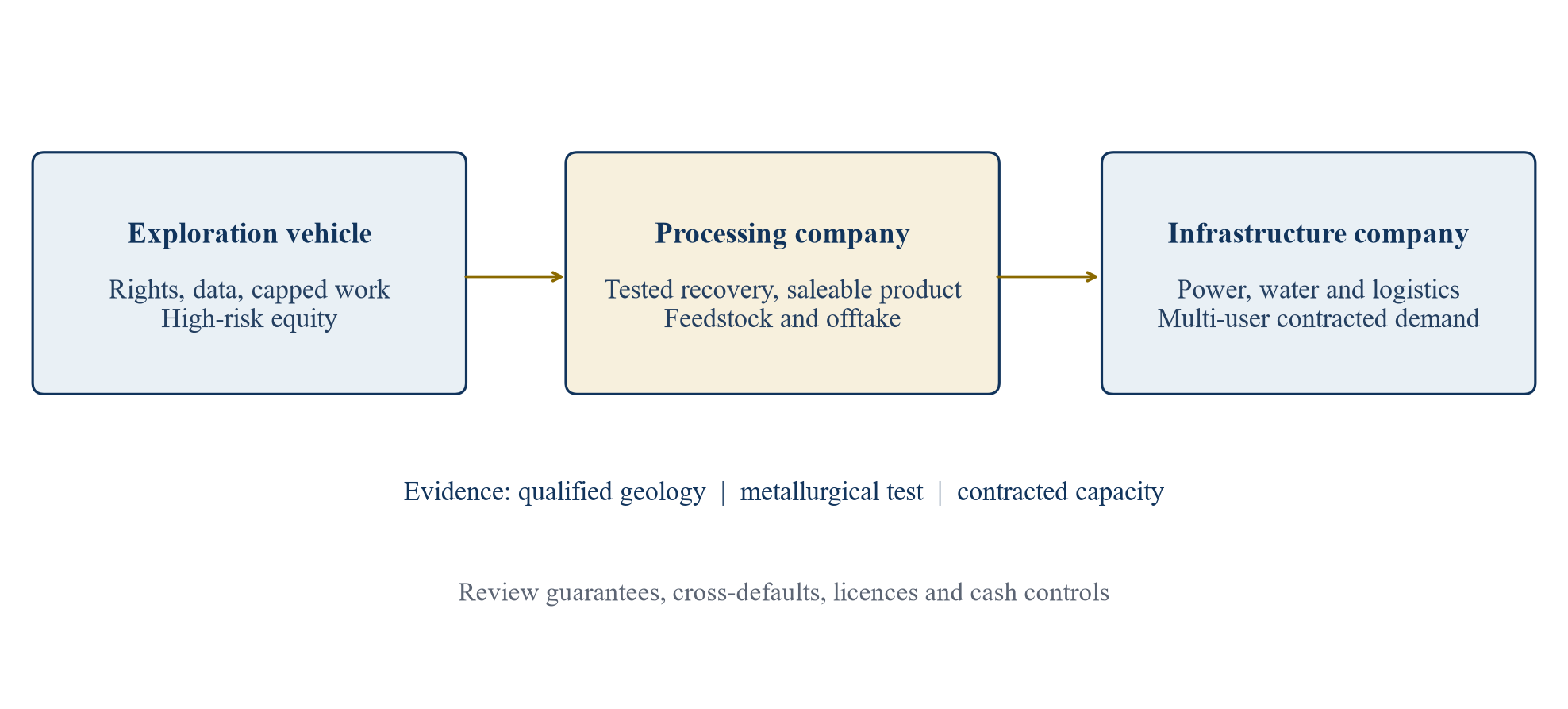
Conditional arrows represent diligence and contractual gates, not an assertion that legal separation is automatic.
4 Put real obligations inside the exploration vehicle
An exploration company needs enough capital to perform its legal work programme, protect the site, manage data, meet environmental duties and close or restore test areas when required. A nominally capitalised shell with an expensive work commitment does not create a credible risk boundary. The investment memo should show the schedule of mandatory expenditure, bonding or financial assurance, licence renewal, safety controls, community engagement and expected closure costs. It should also name who can approve a drilling programme, change a budget or relinquish acreage. These obligations may survive a disappointing technical result.
The licence holder and the vehicle's shareholders can have different exposures. A parent may guarantee performance. A regulator may require recourse to an approved operator. A vendor may demand parent support for drilling services. A co-investor may have a funding call or a carried interest. Counsel should map each claim to the party legally liable, the maximum amount where determinable, the duration, and the event that releases it. Accounting treatment and tax consolidation require separate professional analysis. The phrase “ring-fenced SPV” should be used only after this actual claim map is complete.
The World Bank describes a special-purpose project company as a common structure in project finance and discusses security and contractual allocation of risks [7]. That account addresses project-financed transactions, often with contracted infrastructure cash flow. A pre-discovery mineral vehicle has no equivalent cash-flow base. The analogy is useful for mapping contracts and recourse, not for assuming that non-recourse debt is available before discovery. Early exploration capital must be underwritten on the possibility that every invested dollar and further mandatory closure expenditure could be lost.
5 Treat the licence as a bundle of conditional rights
Exploration rights vary by jurisdiction and sometimes by mineral, land class and stage. The committee should ask whether the instrument permits reconnaissance, drilling, bulk sampling, mine development and processing, or whether later approvals are separate. It should review exclusivity, renewal, relinquishment, local ownership, transfer consent, state participation and public-data requirements. A buyer acquiring shares in the licence holder may inherit obligations that an asset buyer could avoid only if transfer is permitted. A lender's proposed security may be ineffective where licences cannot be pledged or enforced in the expected manner.
The data room should include a geographic information system layer that matches licence polygons with land access, protected areas, water, roads and potential grid connection. A licence boundary is a legal perimeter. A geological system can extend beyond it. A resource may straddle competing claims or require access through land held by another party. The proposed processing site may need a different industrial or environmental approval. These differences should be mapped before the sponsor advertises an integrated mine-to-refinery concept. The commercial option depends on rights that can be exercised, not only on subsurface prospectivity.
An investment agreement can preserve optionality through staged share subscriptions, a time-limited option, a funded farm-in or a carried interest. Milestones should refer to specified evidence such as completed drill metres, independently verified assays, a technical report or a permitted next work stage. A “commercial discovery” trigger needs detailed definitions and dispute resolution. The purchaser should know whether data created by a funded programme belong to the vehicle, the operating partner or both. That ownership affects valuation if the project stops and the knowledge can be used elsewhere.
6 Build an evidence ladder for geology
Exploration evidence should be organised from hypothesis to reproducible observation. Regional geological maps can support prospect selection. Remote sensing and geophysics can identify structures or anomalies. Surface samples can confirm mineralisation at sampled locations. Drilling can test continuity, depth and grade. Quality assurance, chain of custody and independent laboratories affect confidence in assays. Geological modelling can estimate a resource when the data and applicable reporting standard support that classification. An economic reserve requires further modifying factors and study work under the relevant code [2].
At each stage, the vehicle should specify what was learned, what remains open, and the cost of the next test. A strong anomaly may still generate several geological explanations. A high-grade intercept can be narrow or unrepresentative. A resource estimate can be sensitive to cut-off grade, commodity price, recovery, mining method and data density. The committee should see adverse holes as well as favourable ones. The technical adviser should keep a versioned model so the board can identify what changed between financing rounds. A glossy colour map cannot substitute for raw data and competent interpretation.
The evidence ladder also controls external communication. A claim that a deposit is “world class” needs a defined comparator, scale, grade, recoverability and cost context. Exploration Targets and Results should be described under the governing disclosure regime without implying economic extraction. Potential offtakers may ask for long-term volumes before a resource exists. The sponsor can discuss development scenarios while clearly separating them from contractual supply. A disciplined disclosure process protects the credibility of later fund raising and reduces the chance that a processor or infrastructure investor mistakes a target for proven feedstock.
Table 1. Decision evidence and exposure by investment layer
| Layer | Core evidence | Cash at risk before evidence | Approval question |
|---|---|---|---|
| Exploration | Rights, sampling, drilling, independent technical review | Equity work budget and closure obligations | Is the next geological test worth funding? |
| Processing | Feedstock, pilot recovery, engineering, product specification | Development and option costs | Is construction justified by tested supply and sales? |
| Infrastructure | Demand from users, engineering, tariffs, permissions | Site and design costs | Are contracted users enough to support capacity? |
Author-developed framework; legal and technical requirements depend on the project and jurisdiction.
7 Test metallurgy before financing a plant
A deposit's grade is only one input to a processing investment. Mineral association, grain size, impurities, variability, water demand, reagent consumption, waste and product quality determine whether material can be processed economically. A bench test can suggest a route. A pilot may reveal scale-up, throughput or recovery problems. A plant designed for one ore type may require expensive changes when feedstock shifts. The processor's investment case should therefore contain a test programme matched to the expected range of ore, not a single favourable composite sample.
The processor should produce a mass balance and a product specification understood by potential customers. It should identify whether value lies in concentrate, an intermediate chemical or a refined product, and where each conversion step occurs. Each stage has different equipment, environmental requirements, inventory financing and counterparty risk. The IEA documents supply-chain concentration in refining [1], which supports interest in new capacity. It does not prove that any new plant can meet cost, quality or reliability requirements. Investors should ask for vendor guarantees, engineering contingencies and a commissioning ramp that reflects the actual process.
The procurement strategy can change the geological dependency. A plant with credible third-party feedstock may support a separate project even while a nearby deposit is explored. That claim needs contracts or sufficiently advanced commercial terms, specifications, transport capacity and pricing that work under downside scenarios. A letter of interest without quantity, term or credit support is weaker. If only the sponsor's undiscovered deposit can feed the plant, its board should preserve an option on a site or preliminary engineering rather than committing full construction before the geology and metallurgy are established.
8 Ask whether infrastructure has other customers
Power, water, roads, rail, ports and telecommunications may serve an industrial corridor rather than one mine. Shared use can create a broader revenue base, but the design must match actual demand, location and timing. The World Bank's shared-use mining infrastructure framework discusses access and governance for infrastructure serving mines and other users [8]. It is a framework, not evidence that a particular corridor has paying customers. An infrastructure investment case should therefore start with a map of potential users and a status schedule for each service contract.
For a power asset, the analysis should identify peak and average demand, connection rights, backup needs, tariff currency, fuel or generation resource, and curtailment. For water, it should identify source rights, treatment, discharge, seasonal variability and competing community needs. For a road or port, it should identify volumes, axle loads or berth capacity, land access and maintenance. A planned mine's uncontracted future demand should be separately shown from the committed demand of an operating industrial user. The debt case should use actual contracted capacity and stress the loss or delay of the largest customer.
Shared infrastructure can also create related-party transfer-pricing disputes. If one sponsor owns the exploration vehicle and the utility provider, a tariff may shift value between the two entities. Transparent capacity reservation, independent tariff methodology, open-access rules where required, and conflict approvals become important. Lenders may seek step-in rights and long-term contracts; regulators may have different expectations. The legal architecture should preserve public and community obligations. Financing one asset with several users can reduce dependence on a single geological result only where those users are real, creditworthy and able to connect.
9 Sequence capital around irreversible commitments
The first capital gate should cover rights, existing data and a preliminary development concept. The second should fund a specified exploration programme and site management. The third should evaluate independent geology and metallurgical tests. A processor may then fund detailed engineering or a pilot, provided feedstock risk is stated. Infrastructure planning can proceed in parallel with site and user studies, but construction should await its own demand and permit test. The sequence is a governance tool; actual critical paths can force earlier expenditures on land, grid applications or equipment deposits.
Every gate should have a maximum approved spend, a dated evidence deliverable, a stop decision and a responsible board or investment committee. A failed test can require remediation or further sampling instead of an immediate abandonment. The committee should identify when an inconclusive result deserves one bounded repeat and when it should close the programme. Milestones in financing agreements should correspond to this decision logic. A cash call based solely on the passage of time can fund work that no longer has a positive rationale.
The stage plan must include the cost of waiting. A processing site may be lost to another user. Long-lead equipment may become more expensive. Licence work commitments can compel spending by a deadline. A potential customer may need supply sooner than the mine can deliver. The option to defer construction has value only when the option remains exercisable. The next sections use a fictional case to show how an investment committee can quantify the option to stop; the example does not incorporate the full legal, tax and scheduling detail required for an actual transaction.
10 Work a transparent three-branch case
Consider a fictional critical-mineral prospect. The author assumes an USD 18 million exploration programme and an optional USD 5 million payment that preserves a processing site and engineering option during the geological work. A fully integrated build would require a further USD 120 million of processing capital and USD 55 million of infrastructure capital, together USD 175 million. The example assumes three mutually exclusive outcomes after exploration: a 30 percent probability of a commercial result, a 25 percent probability of a marginal result and a 45 percent probability of failure. These are invented teaching inputs, with no claimed empirical calibration.
For an early integrated commitment, the author assumes present values of post-build cash flows and recoveries before the USD 175 million build cost of USD 255 million after a commercial result, USD 140 million after a marginal result and USD 75 million after failure. The failure amount is a hypothetical salvage or alternate-use value net of assumed disposition costs. The expected amount is 0.30 times 255 plus 0.25 times 140 plus 0.45 times 75, or USD 145.25 million. Subtracting the USD 18 million exploration programme and USD 175 million build yields negative USD 47.75 million. No actual plant salvage, orebody or market transaction is represented by these amounts.
Under the staged choice, the sponsor spends USD 18 million on exploration and USD 5 million preserving the commercial option. It exercises the USD 175 million build only after the commercial result. The commercial branch contributes USD 255 million less USD 175 million, or USD 80 million. Weighted at 30 percent, this produces USD 24 million before the USD 23 million of early spending. The staged expected value is positive USD 1 million. The difference between the staged and early results is USD 48.75 million. It arises from the specified right to withhold construction capital after marginal or failed evidence; it could shrink, disappear or reverse under different rights, timings, values and costs.
Table 2. Fictional investment choices in USD millions
| Item | Early integrated commitment | Staged commitment |
|---|---|---|
| Exploration spend | 18 | 18 |
| Site and engineering option | 0 | 5 |
| Processing and infrastructure build | 175 now | 175 only after commercial result |
| Commercial probability and conditional value | 30%; 255 | 30%; 255 |
| Marginal probability and conditional value | 25%; 140 | 25%; no build |
| Failure probability and conditional value | 45%; 75 | 45%; no build |
| Expected value | -47.75 | 1.00 |
All inputs are author assumptions; expected values exclude tax, discounting beyond the stated present-value inputs and transaction fees.
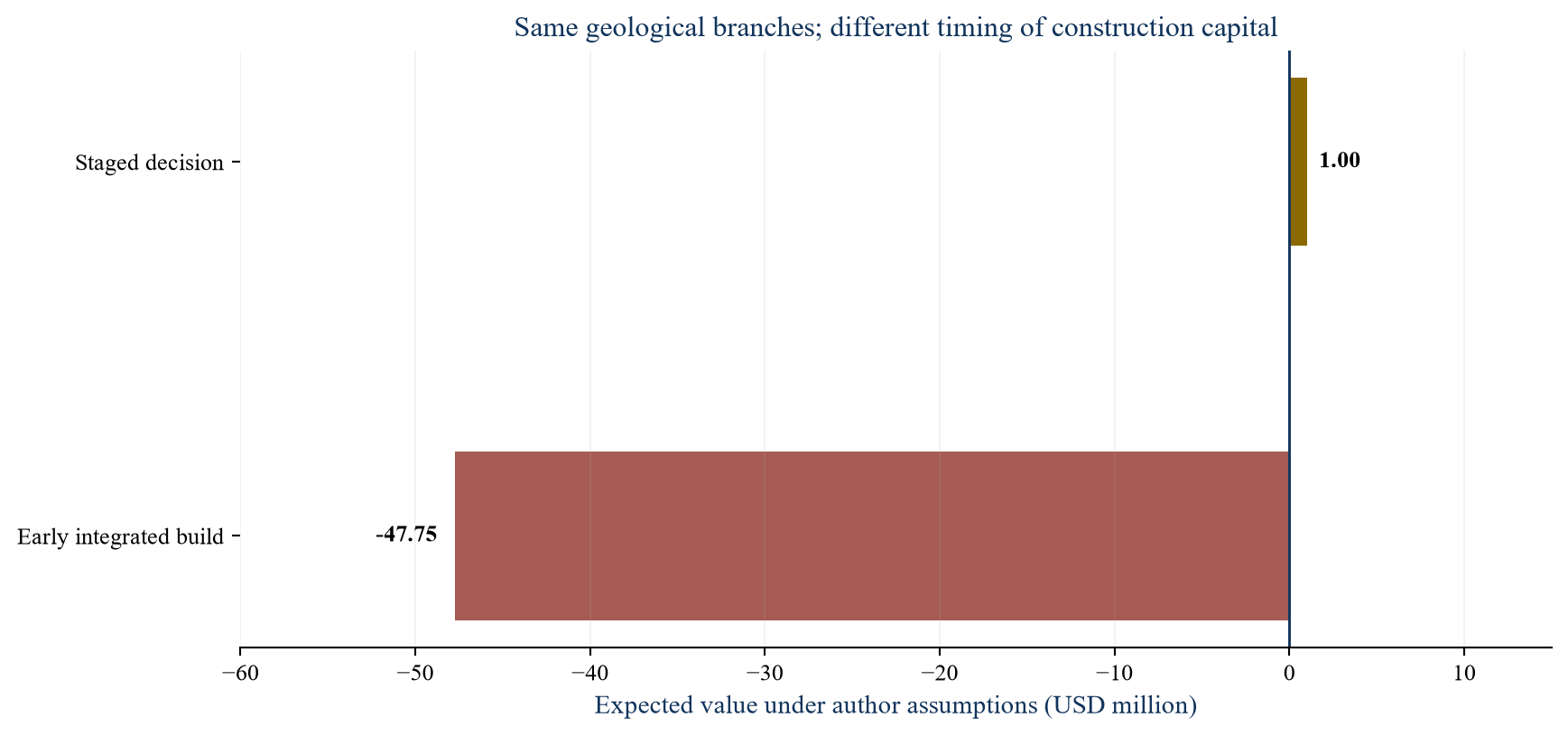
Author assumptions in USD millions. The positive staged value depends on a usable stop right after geological evidence.
11 Interpret the option without overstating it
The example's staged value is a calculation under stated assumptions. It should not be described as a market price or an observed success rate. The early and staged strategies also differ in commitments: the early case buys and builds everything immediately, while the staged case pays a small amount to preserve a later choice. In a real negotiation, that option may have an exercise deadline, exclusivity fee, vendor break payment and engineering work that cannot be postponed. The investor needs a dated cash-flow model with those actual payments and with tax, currency and financing terms. The clean arithmetic is useful because it makes the sources of value visible.
A staged programme can still destroy value. If the commercial result arrives after a buyer's procurement window closes, the project may lose its market. If the site option is unenforceable, the processor may not secure land. If major capital cost inflation occurs while waiting, the conditional USD 80 million spread can disappear. A marginal result may support a smaller plant, blend with third-party feedstock or a sale to a different operator; the example assigns it no staged build value for clarity. A failed exploration outcome may leave valuable geological data or a serviceable infrastructure corridor. Each alternative belongs in a richer model when evidence supports it.
The investor should compare the staged strategy with a portfolio of alternatives: farm into another licence, buy a proven resource, develop third-party processing, fund shared power first, or exit. The option to stop is valuable because the next spending decision can change after evidence. The location and enforceability of that decision right matter as much as the spreadsheet. A parent guarantee, mandatory build covenant or take-or-pay contract signed before exploration can remove the apparent flexibility. The investment agreement must preserve the stop right that the valuation assumes.
12 Test the model against probability and salvage
A single expected value can hide the conditions under which one strategy overtakes another. Keep the marginal-result probability at the example's assumed 25 percent, and let the commercial probability vary from 20 to 40 percent. The failure probability is the remaining 75 percent less the commercial probability. Keep the commercial and marginal conditional values at USD 255 million and USD 140 million, and vary the failed integrated project's net salvage from USD 50 million to USD 100 million. These values are additional author assumptions, not geological or resale evidence. The commercial probability should not be varied in isolation in a real model if it correlates with grade, plant scale or recovery.
At a 20 percent commercial probability, the staged expected value is negative USD 7 million; at 30 percent it is positive USD 1 million; at 40 percent it is positive USD 9 million. The early integrated strategy remains negative across the displayed assumptions. At the 30 percent probability and USD 75 million salvage base case, its value is negative USD 47.75 million. Higher salvage helps the early strategy because it limits loss after failure, yet the sponsor would need to substantiate saleable alternate use, dismantling cost and timing. A paper value assigned to equipment with no buyer or transport route would not support the case.
The investment decision also depends on the discount rate and time between stages. The simplified expected-value calculation assumes conditional amounts already reflect an appropriate present-value date. A live model should date exploration spend, option fee, construction draws, revenue, abandonment and salvage separately. It should test a cost overrun and a weaker mineral price alongside probability. A favorable geological result can coincide with adverse commodity pricing. Sensitivities should change the physical and commercial drivers that plausibly move together, rather than present an attractive grid of independent one-variable changes.
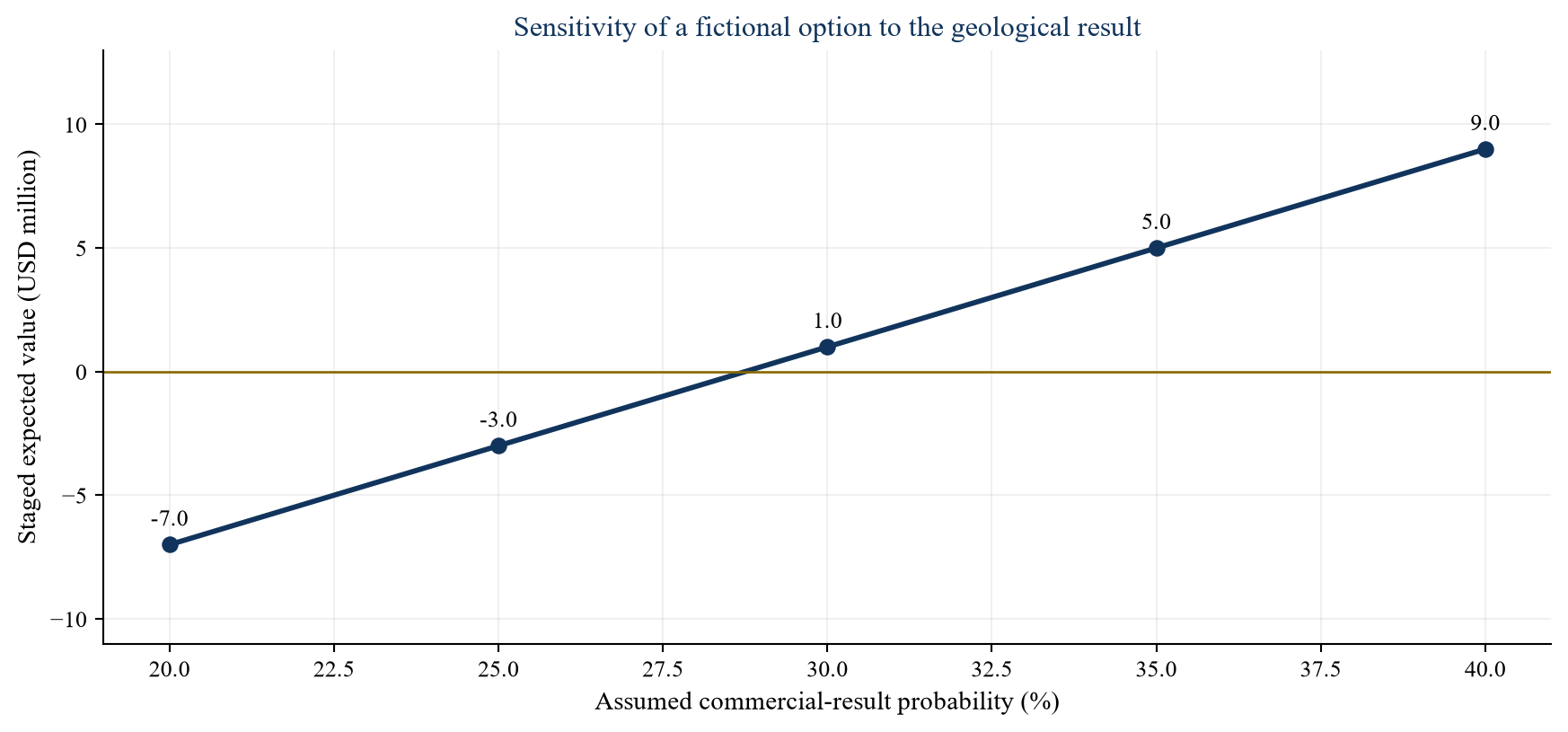
USD million author assumptions. Staged value equals 80 times commercial probability less 23; this is not a project forecast.
13 Map contractual interfaces and leakage
Three companies create at least three interfaces: mineral supply, processing services or product sale, and infrastructure service. Each interface needs a counterpart, specification, price mechanism, performance obligation, remedy and termination rule. A term sheet should identify which obligations exist during exploration and which become effective only after a technical and commercial decision. A processor that signs an unconditional minimum-volume commitment before a deposit is established may simply recreate the geological risk on its own balance sheet. An infrastructure provider with a guaranteed capacity payment from the exploration sponsor can likewise move the exposure without reducing it.
The interface matrix should record credit support and common-control conflicts. If a related-party processor buys ore from an affiliated mine, the price affects each vehicle's cash flow and may affect tax, royalties and lenders. An independent pricing formula, audit rights and a dispute mechanism can improve transparency. If the processor has external feedstock, the contract should address blending, contamination and priority during shortages. If infrastructure is shared, capacity allocation and outages need rules that do not silently subordinate third-party users to an affiliated mine.
The World Bank's project-finance materials describe the importance of security packages, covenants and risk allocation in financed projects [7, 9]. Those concepts apply as diligence prompts. They do not establish that a particular licence, supply contract or service concession can be pledged under local law. Counsel should provide an interface opinion before investment documents are signed. The finance team should translate each cross-guarantee, cross-default and cash-sweep clause into the financial model. An investor who sees three entities and one unavoidable group-wide repayment obligation should value the actual consolidated exposure.
Table 3. Contract and recourse map for three hypothetical vehicles
| Interface | Contractual question | Recourse leakage to test | Decision gate |
|---|---|---|---|
| Exploration to processor | Is mineral supply conditional on qualified evidence? | Minimum-volume damages and parent guarantees | Verified grade, recovery and mine plan |
| Processor to customer | Is product specification and price bankable? | Rejection, penalty and inventory exposure | Pilot product and sales agreement |
| Infrastructure to users | Are capacity and tariffs committed by several users? | Mine-only take-or-pay and common cash sweep | Credible connected demand and permits |
| Group to lenders | Which assets secure which borrowing? | Cross-default, security and sponsor support | Local-law opinion and stress test |
Author-developed checklist; no term is assumed to be available or enforceable in a particular jurisdiction.
14 Select financing instruments by the risk they fund
Exploration equity should be sized for a work programme and potential loss. A strategic buyer may accept the geological exposure to secure future supply, yet its option or offtake should be priced against the capital it advances and the other investors' dilution. A royalty or stream can provide early cash, but it may burden later project economics even if commodity prices are weak. A farm-in can transfer some exploration cost in exchange for earned ownership and operatorship. The term sheet should show how each instrument affects cash at risk, control of the technical plan, upside and future financing capacity.
Processing finance needs different evidence. Equity may fund pilot work and design. Later construction lending would require tested process performance, executable EPC and operating arrangements, credible feedstock, product contracts and permits. Infrastructure debt requires service revenue that survives downside tests, costed design and a bankable legal framework. The World Bank's project-finance account describes reliance on project contracts and cash flows [7]. There is no basis to call a pre-discovery exploration vehicle project-finance ready because it has a licence and an organisational chart.
Capital sources should be listed with their actual conditions. A preliminary policy announcement or strategic interest letter is not committed financing. Public agencies and development banks may support preparation or infrastructure under their own mandates; specific eligibility and approval remain to be verified. A realistic capital stack includes reserve funds for exploration follow-on, plant commissioning, environmental management and early operating losses. The financing plan should say who supplies the next dollar after a favorable result. An early investor can lose economic control if the company cannot fund the success branch it paid to discover.
15 Account for environmental and community obligations
Exploration may disturb land, water or communities before a commercial mine exists. A vehicle should budget for baseline studies, engagement, safe field work, rehabilitation and reporting required by its permits. IFC Performance Standards set out a risk-management framework used in IFC-supported projects [10]. Their applicability to a specific financing depends on the investor and transaction, while host-country legal obligations apply as determined by local counsel. The committee should record each obligation with the responsible entity and source. A legal separation that leaves an unfunded rehabilitation duty is economically and operationally weak.
Processing has its own footprint: energy and water consumption, reagents, residues, air emissions, transport and product handling. Infrastructure can affect other water users and landholders. The three assessments must communicate because a permit for one component may depend on the cumulative project design. A shared water asset serving several industrial users can have a different allocation and community profile from a dedicated mine pipeline. Technical and social risks can delay the project even after geological success. A finance model should include realistic approval sequence and mitigation cost instead of a single unexplained contingency.
The ownership structure should not fragment accountability for material impacts. It should make responsibilities clearer. Operating agreements can specify incident response, monitoring data, access rights and cost allocation between entities. The board should see a consolidated view of cumulative impacts and a vehicle-by-vehicle ledger of duties. A potential buyer or lender will need evidence that approvals can be transferred or maintained after ownership changes. The sponsor should obtain specialised environmental and local legal advice before using the separation framework in a live project.
16 Compare geographies through legal and commercial tests
A multi-jurisdiction strategy cannot use one generic exploration SPV document for every country. Mineral ownership, licence grant, transfer, foreign participation, state rights, community consent, public reporting, environmental security, currency conversion and dispute resolution vary. The issuer's listing venue may add disclosure obligations independent of the host jurisdiction. For example, the Canadian and United States reporting regimes discussed earlier are specific frameworks [3, 4]. They illustrate why transaction documents need a jurisdiction matrix; they are not a global standard that substitutes for local law.
Commercial geography also matters. The destination for the product may be far from the orebody. Concentrate could be exported for refining, while a local plant may require imported reagents and reliable energy. A buyer may value secure supply yet require traceability and specification. The investor should model freight, customs, FX, product qualification and time to customer acceptance. The World Bank's value-chain materials emphasise that extraction, processing and associated infrastructure involve different enabling conditions [5, 6]. A host country's aspiration to capture more value is a strategic context, not proof that a particular processing project is financeable.
A useful market-selection screen asks five questions in each jurisdiction. Can rights be acquired and funded? Can technical evidence be produced and reported to the relevant capital providers? Is a processing route commercially plausible? Is infrastructure available or contractible? Can capital and product revenues be repatriated under the expected terms? The answer should cite documents and specialist opinions. Where evidence is absent, the investment memorandum should record an open condition and defer the affected commitment. No paper can provide a universal legal conclusion across all mineral regimes.
17 Design governance for related but separate boards
Distinct vehicles require actual decision rights. The exploration board should approve the work programme and decide when to continue, farm out or relinquish. The processing board should evaluate feedstock and plant economics, including external supply. The infrastructure board should test capacity against all prospective users. A common sponsor can coordinate strategy, but its representatives may face conflicts when setting ore price, reservation fees or access priority. Shareholder agreements should provide conflict procedures, independent approvals and information rights.
The data room should have a shared interface register and separate capital registers. One entity may collect geological data needed by a processor. The processor may run metallurgical tests using samples from the licence. A utility designer may need demand forecasts from both. The documents should state who owns intellectual property, who may publish or transfer information, who pays for tests and what happens if one party exits. A confidentiality agreement can protect commercial information while allowing independent advisers and financing counterparties access under controls.
An investment committee should receive a consolidated risk map even when each company reports separately. It should see group-wide guarantees, related-party receivables, common contractors and scenario correlations. The governance point is disciplined accountability rather than cosmetic separation. If the sponsor intends to sell one company later, clean records and arm's-length contracts can support diligence. If it intends to combine the companies after the geology is proven, the governance documents should specify valuation and approval mechanics for that combination. Those mechanics must be negotiated, not assumed in a conceptual paper.
18 Prepare a diligence file that can support a transaction
The exploration file should contain the original licence, amendments, maps, obligations, historical work, raw assay and geophysical data, laboratory records, competent technical reports, environmental permits and the operating budget. The processing file should contain representative samples, test protocols, recoveries by ore type, product specifications, preliminary engineering, vendor information, utility needs and identified customers. The infrastructure file should contain route and site rights, user demand, proposed tariffs, engineering basis, permits, service terms and potential financing. A cross-file index should link dependencies.
Every headline claim should have a provenance field: source document, date, author or reviewer, exact measurement, quality limitations and commercial variable affected. A management estimate should say so. Negative tests and missed milestones belong in the same folder as favourable results. The diligence team should reconcile assumed tonnage, grade, recovery, throughput and product volume across technical and financial models. A discrepancy between the resource model and the plant model can materially alter capex and revenue. An unresolved difference should be escalated rather than smoothed by a spreadsheet formula.
The prospective investor also needs a claims map. It should list debt, royalties, streams, offtake rights, security, guarantees, change-of-control consents and remediation obligations. For each item, record whether it sits in the exploration, processing or infrastructure vehicle and whether another entity is exposed. A buyer may pay for only one layer and still inherit group-wide obligations. Diligence should also test tax, accounting and insolvency treatment through appropriate advisers. This file structure makes a staged deal executable and gives future capital providers a credible account of what has been proved and what remains conditional.
19 Compare transaction structures against the same facts
A funded farm-in can let a technically capable partner earn an interest by financing a defined exploration programme. A share subscription can put cash into the licence holder and create governance rights from day one. A time-limited option can reserve an acquisition decision until a named technical result arrives. A joint development agreement can allocate processing and infrastructure study costs while leaving construction subject to separate approvals. A full acquisition can be efficient when geology and economics are sufficiently established. The correct choice depends on rights, cost, counterparties and the sponsor's capital.
Each term sheet should be modelled using the same geological outcome tree and commercial case. The farm-in investor's value depends on the earned stake, committed work and operatorship. The original holder's value depends on retained interest, dilution, obligations and later funding. A processor's option to acquire feedstock may impose a price discount or exclusivity cost on the exploration vehicle. Infrastructure reservation fees can preserve capacity but also use cash before the mine is ready. The committee should show these transfers explicitly so a favourable valuation in one company is not financed by an undisclosed loss in another.
The negotiation should identify who can stop. A partner may have the right to withdraw after a failed drill campaign, while the original holder remains responsible for rehabilitation. A processor may have a right to terminate an offtake option if product tests fail. An infrastructure provider may reallocate unused capacity after a deadline. Each right affects the staged investment valuation. The rights also need workable notice, evidence and dispute provisions. Counsel should draft them for the applicable jurisdiction; this paper supplies the decision questions rather than legal language.
20 Run the investment process through explicit gates
The first committee paper should define the licence interest and funding perimeter. It should approve the minimum legal, technical and environmental diligence needed to identify the next test. The second should approve a capped exploration budget and an independently reviewed technical plan. The third should receive actual drilling and assay results, confidence classifications under the applicable regime, and a revised probability distribution. A fourth paper can decide whether to fund detailed metallurgy, engineering and market testing. Construction approval belongs to a later gate with permits, feedstock, product economics, infrastructure contracts and financing evaluated together.
Each gate should carry an exception report. It should show what the prior committee expected, what occurred, how the technical model changed, what cash has been spent, what further cash is mandatory and what alternatives remain. It should show sensitivity to price, recovery, capex, timing and counterparty failure. An independent reviewer should be able to reproduce the decision from source material. If a committee approves acceleration before evidence is complete, the paper should quantify the cost of that choice and identify the signer who accepts the exposure. Governance is credible when exceptions are visible.
The programme manager should maintain a single critical path across licence work, drilling, pilot tests, land, grid, water, customer qualification and financing. A delay in one element can change the value of every other option. The programme should specify next actions after a commercial, marginal, failed and inconclusive result. An inconclusive result deserves its own capped decision because it is a common route to unplanned spending. The board should close a stage formally and update the data room before seeking the next capital tranche or marketing the asset.
21 Conclusion
Critical-mineral development joins geological, industrial and infrastructure decisions. A sponsor can make those decisions more legible by allocating rights, evidence and capital to distinct vehicles and gates. The exploration vehicle should be funded for an honest technical test and its obligations. Processing should be assessed against tested recovery, real feedstock and customer specifications. Shared infrastructure should be assessed against contracted users and physical demand. The separation is effective only to the extent that licences, contracts, guarantees, security, accounting and local law preserve the intended boundaries.
The fictional case shows why timing matters. With author-assumed inputs, immediate integrated commitment produces negative USD 47.75 million of expected value. Paying for exploration and a defined option, and committing construction only after the assumed commercial outcome, produces positive USD 1 million. The USD 48.75 million difference is conditional on the right to stop and the value of keeping the opportunity available. It is a teaching result, not an observed investment return. Different mineral systems, contract deadlines, alternative feedstock and salvage values can change the comparison.
An actionable transaction process begins with a rights and claims map, proceeds to competent technical work, tests metallurgy and product economics, and approves each large capital commitment against current evidence. The investment committee should fund the next answer while preserving a credible route to finance a favorable result. Independent technical, legal, environmental and commercial advisers have distinct responsibilities. The corporate-finance function can integrate their outputs into a capital plan, structure and decision record that prospective investors can examine and revise as new evidence arrives.
References
- International Energy Agency (2026). Global Critical Minerals Outlook 2026: Market overview. https://www.iea.org/reports/global-critical-minerals-outlook-2026/market-overview
- Committee for Mineral Reserves International Reporting Standards (2019). International Reporting Template. https://crirsco.com/wp-content/uploads/2023/10/The-CRIRSCO-International-Reporting-Template.pdf
- US Securities and Exchange Commission. Modernization of Property Disclosures for Mining Registrants: Small Entity Compliance Guide. Accessed 5 October 2026. https://www.sec.gov/resources-small-businesses/small-business-compliance-guides/modernization-property-disclosures-mining-registrants-small-entity-compliance-guide
- British Columbia Securities Commission. National Instrument 43-101, Standards of Disclosure for Mineral Projects. Accessed 5 October 2026. https://www.bcsc.bc.ca/securities-law/law-and-policy/instruments-and-policies/4-distribution-requirements/current/43-101
- World Bank. Metals and Minerals. Accessed 5 October 2026. https://www.worldbank.org/ext/en/topic/metals-and-minerals
- World Bank and participating multilateral development banks (2026). Joint MDB Statement on Critical Minerals to Manufacturing Value Chains. https://www.worldbank.org/en/news/statement/2026/04/17/mdbs-powering-critical-minerals-value-chains
- World Bank PPP Reference. Project Finance: Key Concepts. Accessed 5 October 2026. https://ppp.worldbank.org/financing/project-finance-concepts
- World Bank (2014). A Framework for Shared-use Mining Infrastructure. https://ppp.worldbank.org/sites/default/files/2024-08/A-Framework-for-Shared-use_March-2014.pdf
- World Bank PPP Reference. Financing Issues in Project-Financed Transactions. Accessed 5 October 2026. https://ppp.worldbank.org/financing/issues-in-project-financed-transactions
- International Finance Corporation (2012). Performance Standards on Environmental and Social Sustainability. https://www.ifc.org/en/insights-reports/2012/ifc-performance-standards
- International Energy Agency (2025). Global Critical Minerals Outlook 2025: Executive summary. https://www.iea.org/reports/global-critical-minerals-outlook-2025/executive-summary
About the Author
Chennakeshav (CK) is a corporate finance and investment banking executive with 25+ years of global experience in deal origination, structuring and execution across M&A, growth capital and corporate strategy. He has led value-creation mandates for founders, corporates and funds — bridging the boardroom view to hands-on execution and close.
His career spans Morgan Stanley, HSBC, Lloyds Banking Group, EWEC, ADQ portfolio companies and Emirates Growth Fund, across TMT, real estate, fintech, deeptech, cleantech, infrastructure and energy. He has partnered with C-suite leaders, private equity and venture funds, sovereign wealth funds and family offices to finance complex fund raises and scale-up ventures, and has led M&A due diligence, post-merger integration and business-transformation initiatives to create value.
At Matchpoint Partners he is Managing Partner, leading the firm's corporate finance, M&A and capital-raising practice. He holds an MBA from London Business School, an engineering degree from VTU and a Master of Laws (LLM, in progress) from UCL London.
An active start-up mentor, CK mentors at Techstars, DIFC FinTech Hive, Startup Grind, Founder Institute and IN5, serves as Entrepreneur Mentor in Residence (EMiR) at London Business School, and judges the Entrepreneurship World Cup.
