

1. Define the market entry decision
The board decision is whether a joint venture is the best route for converting a Southeast Asian operating capability into a durable GCC business. The relevant alternatives include a wholly owned subsidiary, licence or distribution arrangement, acquisition, minority investment, branch, contractual alliance and staged combination. Each route allocates control, capital, regulatory responsibility and execution risk differently.
A joint venture is justified when the parties contribute assets or capabilities that are difficult to purchase independently and whose value increases when combined. Examples include protected technology, specialist talent, customer relationships, local licences, sites, procurement access, infrastructure, brand permission and balance-sheet support. Convenience, political signalling or a headline equity split is an insufficient investment thesis.
The approval paper should state the product, target customers, jurisdictions, permitted activities, route to revenue, operating entity, contribution schedule, funding need, governance, downside plan and exit route. It should identify which assumptions depend on a partner and which can be verified independently. The decision must remain testable after signing.
ASEAN received USD 226 billion of foreign direct investment in 2024, while cross-border M&A value fell to USD 11 billion.[1] The corridor has policy momentum under the ASEAN-GCC Framework of Cooperation 2024-2028 and subsequent economic-cooperation discussions.[2][3] Those facts provide context; they do not establish the viability of a specific venture.
2. Use the Joint Venture Market Entry Framework
The framework connects eight decisions: strategic necessity, contributions, permissions, operating model, economics and funding, governance, resilience and exit. Each decision produces an evidence record, conditions precedent, accountable owner and board conclusion. The framework is designed to prevent legal documents from becoming a substitute for operating design.
Strategic necessity tests why the venture must exist. Contribution design records what each party supplies, when delivery occurs and how acceptance is proved. Permission design maps licensed activities and foreign-investment restrictions. The operating model allocates people, customers, systems, data, suppliers and cash. Economics and funding translate these choices into capital requirements and returns.
Governance identifies decisions, thresholds, information rights and escalation. Resilience addresses default, underperformance, sanctions, cyber incidents, regulatory change and key-person loss. Exit design determines how assets, customers, licences, employees, data and intellectual property separate or transfer when the relationship ends.
The board should use the framework as a connected system. A local partner may accelerate customer access while demanding veto rights. A technology licence may preserve ownership while weakening the venture's financing capacity. An equal shareholding can signal alignment while creating deadlock. Every trade-off must be reflected across the documents and model.
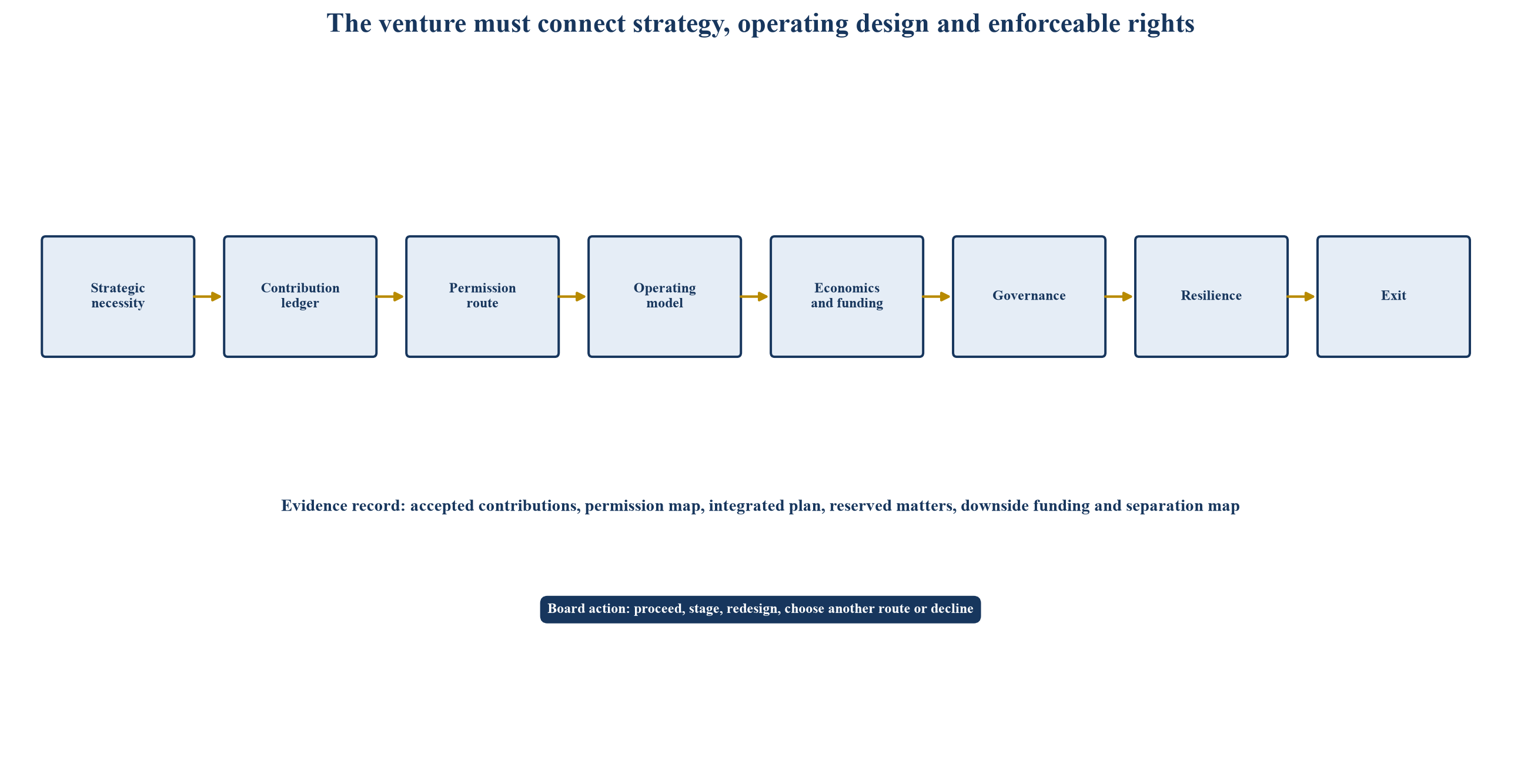
The framework is a proposed decision system and requires transaction-specific professional advice.
3. Prove why a joint venture is necessary
The sponsor should identify the scarce complement that makes a venture more valuable than a contract. A distribution agreement may be sufficient when one party supplies a finished product and the other provides sales access. A joint venture becomes more credible when the parties must combine regulated permissions, capital, specialist employees, proprietary systems and shared investment over several years.
The necessity test should compare control, speed, economics, reversibility and learning. A wholly owned route may offer better control but require slower permission building. An acquisition may provide an operating platform but import legacy liabilities. A contractual partnership may reduce capital at risk but give limited influence over service quality and customer ownership.
The board should reject circular logic. Local knowledge does not prove that a local equity partner is required. A government relationship is not a transferable asset unless the route is lawful, institutional and repeatable. Technology value is not established by source-code possession alone. Each claimed complement needs a deliverable, acceptance test and economic consequence.
ASEAN's investment framework seeks a liberal, transparent and competitive environment, while reservation lists preserve country-specific restrictions.[4][5] The venture structure must therefore begin with the exact activity and jurisdiction rather than a regional assumption.
4. Build a contribution ledger before negotiating equity
The contribution ledger lists cash, assets, licences, contracts, employees, services, intellectual property, data, guarantees, facilities and customer commitments promised by each party. It records the legal owner, transfer method, delivery date, acceptance test, valuation basis, tax treatment, ongoing cost and remedy for non-delivery.
Cash is easy to count but can still differ in quality. Equity, shareholder loans, guarantees and contingent funding create different rights and risks. A guarantee may support banking facilities without providing operating liquidity. A committed facility may remain unusable until conditions are met. The ledger should identify when funds become irrevocably available to the venture.
Non-cash contributions require stronger evidence. A customer pipeline is not a contract. A licence may be non-transferable. Seconded employees may remain controlled by the parent. Technology may include third-party components that cannot be sublicensed. Land or premises may carry use restrictions. The board should value accepted and usable contributions, not promotional descriptions.
| Contribution | Evidence required | Acceptance test | Remedy if absent |
|---|---|---|---|
| Cash and funding | Executed commitment, conditions and source | Cleared funds or drawable facility | Dilution, default interest or step-in |
| Licence and permission | Current authority record and activity scope | Venture may lawfully perform planned activity | Route change, delay or termination |
| Customers and channels | Executed contracts, consents and economics | Transferable revenue or qualified launch cohort | Earn-in reduction or performance cure |
| Technology and data | Ownership, dependency and licence schedule | Deployable rights, interfaces and lawful data use | Escrow, replacement or licence expansion |
| People and capability | Named roles, contracts and availability | Critical team employed or validly seconded | Recruitment funding or service credit |
| Assets and facilities | Title, valuation and operational condition | Usable asset delivered free of undisclosed burden | Price adjustment or substitute asset |
Values and remedies should be transaction-specific and supported by evidence.
5. Translate contributions into equity and economics
Equity should follow the value, risk and timing of contributions rather than a desire for symmetry. Cash paid at formation has different risk from a future customer commitment. Existing technology has different value from a licence limited by territory, field or termination. A guaranteed minimum purchase can support debt and valuation only when it is enforceable and economically viable.
The valuation bridge should separate contributed assets, access rights, services and contingent performance. Assets transferred permanently may support paid-up capital. Licensed assets may justify a royalty, preferred return or equity only if their availability and durability support the business plan. Ongoing services should usually be priced through transparent service agreements.
Contingent contributions can be handled through earn-in shares, options, ratchets, milestone releases or deferred consideration. These mechanisms must avoid automatic value transfer before performance is proved. They should also avoid incentives to delay decisions, manipulate revenue recognition or divert opportunities outside the venture.
The board should review the venture's economics after all intercompany payments. Royalties, management fees, procurement margins, interest, guarantees and transfer-pricing adjustments can move value away from the venture. A profitable consolidated relationship may still leave the venture undercapitalised or one party under-rewarded.
6. Map the legal and regulatory perimeter
The legal structure should follow the operating plan. The team should identify every entity, branch, free-zone company, mainland company, contractual venture, holding vehicle and service company required. For each it should state ownership, governing law, permitted business, licences, tax residence, employees, bank accounts, data responsibilities and contracting role.
The UAE Commercial Companies Law provides the federal company-law baseline, while financial free zones and sector regulators can have separate regimes.[12] Saudi Arabia's Companies Law allows partners and shareholders to use partnership agreements to govern their relationship and integrate relevant provisions into constitutional documents.[14][15] Current local advice remains necessary for each activity and entity.
The permission map should cover foreign ownership, sector caps, nominee or agency risks, local substance, beneficial ownership, competition approval, national-security screening, exchange controls, employment quotas, data transfer and product regulation. ACIA reservation lists illustrate that permitted structures and foreign-equity limits can vary materially by activity and country.[5]
The transaction documents should not promise an operating outcome that the authorised entity cannot deliver. Conditions precedent should be tied to evidence of formation, licensing, capitalisation, bank access, insurance, key contracts and regulatory non-objection where required.
7. Draw the transaction and operating map
The map should connect ownership, contracts, funding, services, customers, data, technology and regulatory accountability. A holding company may own shares while an operating subsidiary contracts with customers. One parent may license technology, another may provide premises or distribution, and external banks may provide working-capital or guarantee facilities.
The map should distinguish contractual flow, cash flow, control and accountability. A party that nominates directors may not control day-to-day regulated activity. A service provider may operate critical systems without owning the platform. Revenue may be received by one entity while costs, customer obligations and risk sit in another.
Every arrow needs an agreement, owner, term, price, termination effect and continuity plan. Intercompany arrangements should be executable and consistent with tax, transfer-pricing and regulatory requirements. Informal group support should not be treated as committed capacity.
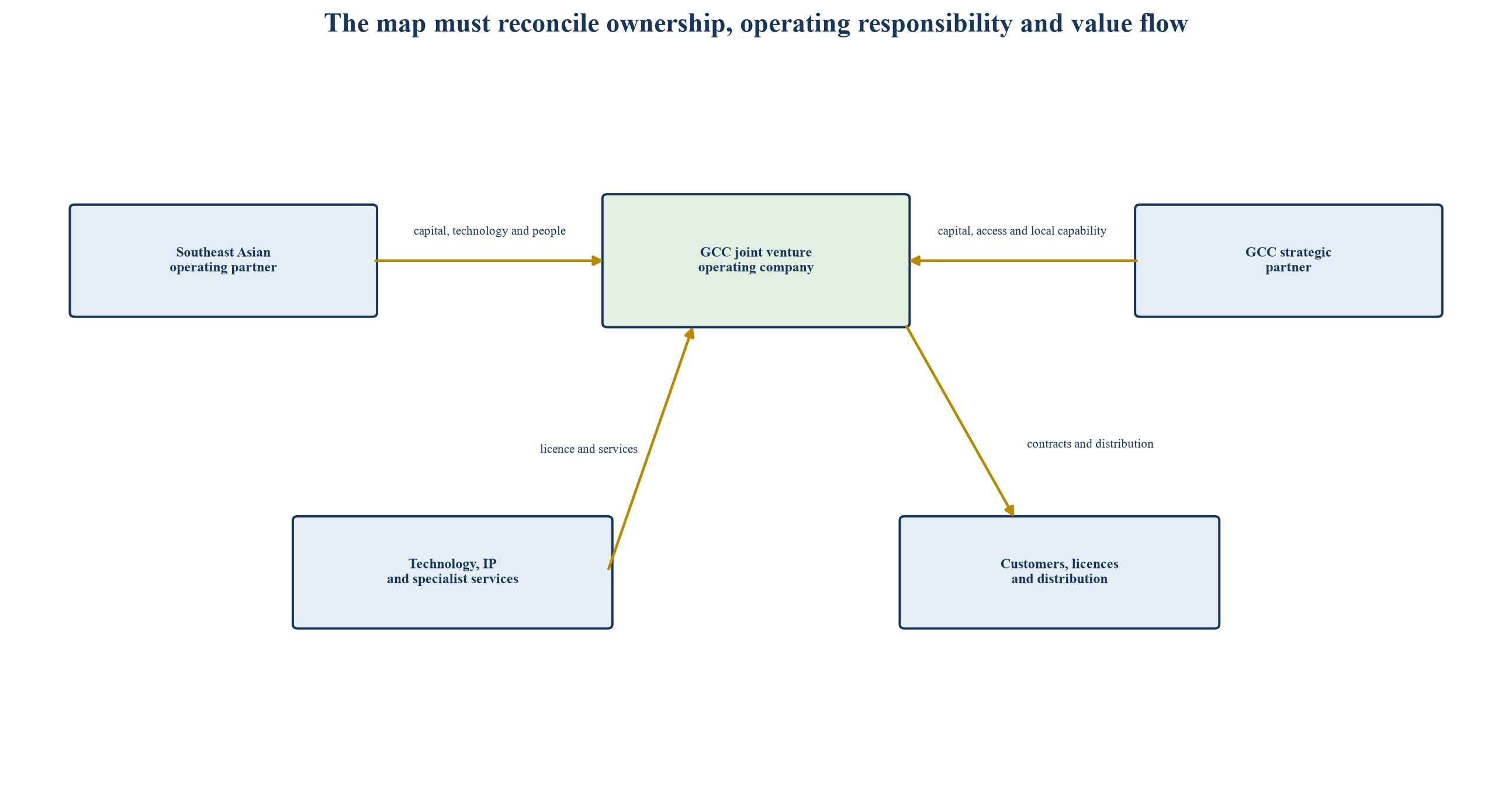
Entities, flows and percentages are hypothetical management assumptions.
8. Define the operating model before reserved matters
The operating model explains how the venture wins customers and delivers service. It should cover product ownership, sales, pricing, procurement, operations, compliance, finance, technology, data, risk, human resources and customer support. Each function needs an accountable executive, reporting line, budget and service dependency.
Reserved matters should protect the investment without forcing directors to approve routine operations. Excessive veto rights can turn the venture into a committee. Weak rights can allow one partner to change strategy or extract value. The governance design should distinguish shareholder decisions, board decisions, executive authority and regulated senior-management responsibility.
The first operating plan should include staffing, system access, service-level agreements, customer acquisition, supplier onboarding, cash controls and incident response. It should state what becomes local, what remains supplied by a parent and what must be independent. The design must function if one parent becomes distracted or uncooperative.
Management incentives should follow venture outcomes. Seconded executives can face divided loyalty, information barriers or parent-specific targets. Employment terms, reporting, confidentiality, conflicts and succession need explicit treatment.
9. Build an integrated base case and downside
The financial model should start with operational drivers: customers, volumes, price, gross margin, sales productivity, capacity, regulatory timing, staff, technology, working capital and capital expenditure. Parent charges, royalties, funding costs and tax should be visible. A consolidated profit number cannot reveal which partner supplies or captures value.
The downside should combine risks that can occur together. Delayed permission can postpone revenue while local staff and systems continue to cost money. Weak partner delivery can increase direct sales expense. A technology migration can require additional capital while reducing service quality. Currency changes can affect imported technology and repatriated returns.
The model should calculate peak cash, covenant headroom, additional funding, dilution and decision points. It should specify which costs can be stopped, which obligations survive termination and what assets retain value. Funding needs should be approved before the venture reaches distress.
Scenario probabilities should not create false precision. The board should focus on variables, evidence grades, triggers and actions. A range with explicit decision gates is more useful than a single discounted cash flow built on unverified cooperation.
10. Match funding rights to the operating plan
Initial capital should cover formation, licences, people, technology, launch, working capital and a defined contingency. Follow-on capital should be linked to evidence such as licence receipt, customer contracts, product readiness and contribution margin. Tranches protect capital only when milestones are objectively measurable.
The documents should state whether additional funding is equity, shareholder debt, third-party debt, guarantee support or a combination. They should specify priority, pricing, security, repayment, conversion, dilution and default consequences. A partner should not gain control cheaply by withholding previously expected funding.
Funding remedies can include cure periods, default loans, dilution, suspension of distributions, loss of veto rights, call options or step-in rights. Remedies must be proportionate and enforceable. They should distinguish unwillingness from lawful inability, sanctions, regulatory prohibition or force majeure.
| Funding event | Preferred evidence | Control concern | Possible design response |
|---|---|---|---|
| Formation capital | Cleared cash and accepted non-cash assets | Value transferred before contribution | Escrow, simultaneous completion or earn-in |
| Launch tranche | Permission, product and customer gates | Subjective milestone approval | Independent evidence and deemed acceptance |
| Working-capital need | Reconciled cash forecast and ageing | Repeated emergency funding | Committed facility and liquidity covenant |
| Downside funding | Board-approved recovery plan | One party cannot or will not fund | Default loan, dilution or scoped step-in |
| Expansion capital | Country-level economics and capacity | Growth before unit economics | Ring-fenced tranche and stop trigger |
| Exit bridge | Signed sale or separation plan | Hold-up during transition | Senior bridge with capped duration |
The table is diagnostic; transaction documents require jurisdiction-specific advice.
11. Design the decision-rights matrix
The matrix should allocate decisions to shareholders, the board, committees and management. It should state proposal rights, information requirements, voting thresholds, quorum, conflicts, abstention, emergency authority and escalation. The same decision should not require inconsistent approvals across constitutional documents, licences and service agreements.
Strategic matters may include business scope, annual plan, capital, acquisitions, disposals, new countries, material contracts, borrowing, related-party transactions, intellectual-property changes and litigation. Operational matters should remain with accountable executives within budget and policy. Regulated functions may require independence from shareholder direction.
Equal ownership does not require equal authority over every matter. Rights can reflect contribution and expertise. A technology partner may control changes to core background IP while the venture controls local product configuration. A regulated local entity may need final authority over compliance, onboarding and reporting.
The matrix should be tested through simulations. The team should run a budget delay, customer incident, data breach, urgent capital call, related-party procurement and strategic disagreement. If the venture cannot act within the required time, the rights are not operational.
12. Separate protection rights from operating control
Minority protection should prevent value destruction, dilution, asset leakage and uncontrolled strategy change. Operating control determines who can execute the approved plan. Confusing these objectives produces either an ungovernable business or an exposed investor.
Protection rights should be limited to matters that materially alter the investment. They can include changes to business, capital, constitutional documents, major borrowing, asset sales, related-party transactions, dividends and insolvency. Thresholds should be sized against the plan and reviewed as the venture grows.
The board should examine negative control for accounting, regulatory and competition consequences. A shareholder may lack majority ownership yet exercise joint or decisive control through vetoes, appointment rights or contractual dependencies. The transaction team should assess control under every relevant framework rather than rely on labels.
The UAE competition regime regulates economic concentrations, and thresholds effective from April 2025 include UAE relevant-market sales exceeding AED 300 million or market share exceeding 40 percent.[12][13] A full-function joint venture can also constitute a merger under Singapore's Competition Act.[16]
13. Protect background intellectual property
Background intellectual property includes patents, software, models, brands, processes, data, documentation, trade secrets and know-how created outside the venture. The schedule should identify owner, jurisdiction, registration, dependency, third-party restriction, permitted use, field, territory, exclusivity, sublicensing, duration and termination effect.
The licence must be sufficient for the operating plan and financing. A narrow licence can preserve parent value while making the venture unable to adapt products, appoint suppliers or continue after a dispute. A broad perpetual licence can transfer more value than the equity economics justify. The board should price scope explicitly.
WIPO guidance distinguishes exclusive, sole and non-exclusive licences and recommends defining rights, fields, markets, obligations, compensation, confidentiality and termination.[9][10] WIPO also advises early agreement on background and foreground IP in joint ventures.[11] These principles should be translated into asset-level schedules.
Operational access must match legal rights. Source-code escrow, documentation, administrator credentials, release triggers, security testing and transition support can be necessary. A licence that cannot be exercised in practice does not protect continuity.
14. Allocate foreground intellectual property and data value
Foreground intellectual property arises from the venture's work. It can include local product adaptations, datasets, models, interfaces, customer insights, inventions, documentation and brands. Ownership should follow the commercial objective and future financing plan, not default to whoever employs a developer.
Possible structures include ownership by the venture, ownership by a parent with a venture licence, field-specific ownership, or joint ownership. Joint ownership can create consent, enforcement and exit complexity. The documents should address improvements, derivative works, inventions, employee assignments and supplier-created rights.
Data requires a separate analysis. The venture may control customer relationships without owning personal data. Rights to use aggregated or derived information must respect law, consent, contracts and confidentiality. Training or improving models can create value while increasing privacy, cyber and exit obligations.
The exit map should state which data can transfer, which must remain, which must be deleted and which services must continue. IP and data arrangements that work during cooperation can fail during separation unless continuity is designed at formation.
15. Govern brand, customer and opportunity ownership
The venture may use a parent brand, create a new brand or combine identities. The brand licence should define standards, approval, quality control, crisis response, digital assets, domains, social accounts and termination. Reputation risk can flow in both directions.
Customer ownership requires more than a non-compete. The documents should state which opportunities belong to the venture, which remain reserved to a parent, how referrals are credited and how overlapping accounts are handled. Territory and product definitions should match commercial reality and competition law.
The parties should agree what happens when a customer wants a regional solution that crosses venture boundaries. Rules can include lead allocation, joint bids, service coordination, pricing, data sharing and revenue attribution. Ambiguity can encourage diversion or delay.
Post-exit customer rights should be linked to continuity and value. An automatic transfer to one parent can strand the other party's investment. A blanket restriction can damage customers. Transition, consent, service capability and consideration should determine the outcome.
16. Build a related-party transaction system
Most ventures buy services or assets from their parents. These arrangements can supply critical expertise, technology, procurement and funding. They also create opportunities for margin extraction, dependency and information asymmetry. Every material related-party service should have scope, price, performance measures, audit rights and termination support.
Pricing should be commercially and tax defensible. The venture should understand cost allocation, mark-ups, volume discounts, currency exposure and pass-through expenses. Parent invoices should not automatically override the approved budget. Transfer-pricing analysis should follow the functions, assets and risks actually borne by each entity.[24]
Governance should require conflicted directors to disclose interests and follow applicable abstention rules. An independent benchmark or committee can help for material transactions. The venture should retain sufficient records to support audit, tax and lender diligence.
Exit planning should identify which related-party services are replaceable and how long replacement takes. A parent should not be able to disable the business immediately through a service termination unrelated to the venture's default.
17. Test the hypothetical joint venture case
Assume a Southeast Asian technology-enabled services company and a GCC strategic partner plan a venture serving enterprise customers in the UAE and Saudi Arabia. The technology partner contributes software, implementation methods and specialist employees. The GCC partner contributes USD 28 million of cash, customer access, facilities and regulatory execution support.
The central case assumes total initial uses of USD 52 million, funded through USD 36 million of equity and USD 16 million of shareholder debt. Year-three revenue is assumed at USD 74 million with EBITDA of USD 15 million. Peak funding is USD 52 million. These figures are hypothetical management assumptions.
The correlated downside delays launch by nine months, converts fewer customer introductions, raises localisation cost and requires additional working capital. Year-three revenue falls to USD 47 million, EBITDA falls to USD 4 million and peak funding rises to USD 68 million. The balanced structure requires a pre-agreed recovery tranche and revised performance gates.
A staged structure forms the venture with USD 24 million, limits the initial territory and releases further capital after permission, product and customer milestones. Year-three revenue is assumed at USD 62 million, EBITDA at USD 10 million and peak funding at USD 45 million. Staging reduces capital at risk while potentially slowing scale.
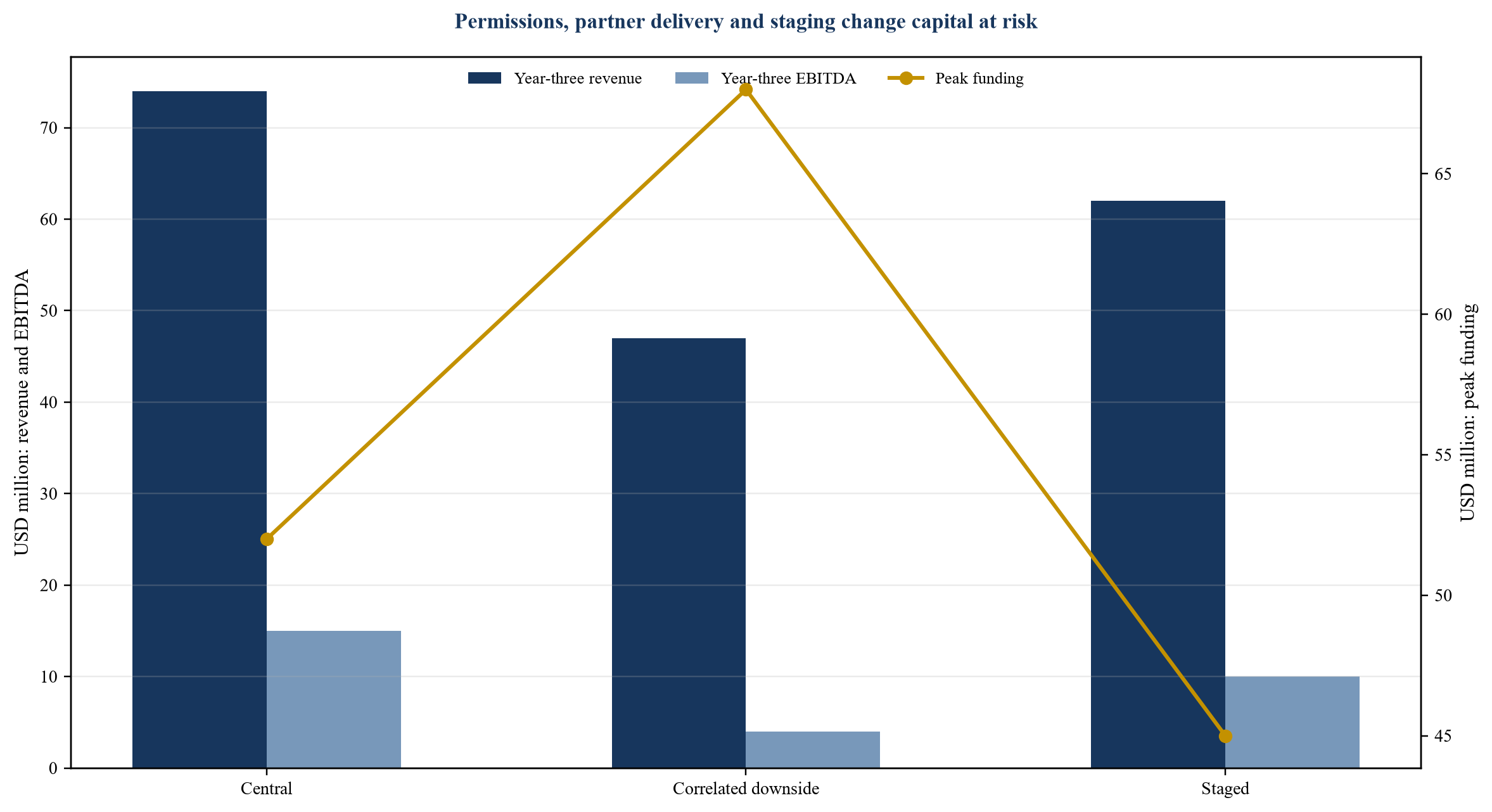
All amounts are hypothetical management assumptions and do not describe an actual transaction.
18. Tie economics to contribution performance
The model should show how each promised contribution affects revenue, cost, cash and value. Customer access influences acquisition time and sales expense. Technology affects product readiness, maintenance and gross margin. Facilities affect launch timing and fixed cost. Funding affects liquidity and dilution.
Performance measures should therefore connect to economic consequences. A parent should not receive full credit for a list of introductions when qualified customers do not progress. Technology delivery should be measured by accepted functionality, security and service levels. Local support should be measured by permission and operating outcomes within lawful boundaries.
Remedies can adjust future equity, fees, exclusivity, territory or control. They should not reward one party for obstructing acceptance or withholding approvals. Independent testing, objective evidence and clear timing reduce disputes.
The board should distinguish venture underperformance from contribution default. A jointly approved strategy can fail despite both parties delivering. In that case, the response should follow the business plan and exit design rather than punitive default remedies.
19. Design performance gates and an earn-in
An earn-in can align equity with delivered value when contributions are uncertain. Milestones might include permission, product deployment, contracted revenue, gross margin, customer retention, capacity, funding or intellectual-property delivery. Each milestone needs a measurement period, accounting policy, evidence source and dispute mechanism.
Binary milestones are simple but can create cliff effects. Graduated outcomes can reflect partial delivery, yet they increase complexity. The design should limit management discretion and prevent changes to budgets, pricing or customer allocation from manipulating achievement.
Shares can be issued progressively, transferred from an escrow or acquired through options. The tax, accounting, regulatory and financing consequences require specific advice. Unissued or conditional interests should not create ambiguous voting or economic rights.
The venture should remain governable during the earn-in period. Temporary rights should be stated clearly. A party awaiting equity should not control assets beyond its funded exposure, while the venture must still obtain the cooperation required to achieve the milestone.
20. Build the risk allocation matrix
The risk matrix should allocate ownership, mitigation, cost and residual exposure for permission, demand, technology, cyber, data, people, suppliers, funding, tax, foreign exchange, sanctions, competition, intellectual property and exit. The party best able to control a risk may not be able to absorb its financial consequence.
Representations allocate information risk at signing. Covenants control conduct before and after completion. Indemnities address specified losses. Insurance transfers selected exposure. Price, earn-in and funding design allocate uncertainty. These tools should operate together without duplicating or leaving gaps.
The venture itself needs risk capacity. Pushing every loss to a parent can make the company dependent and unfinanceable. Leaving all losses in the venture can expose minority investors and customers. Material risk should have a funded response and decision owner.
The matrix should be updated after launch. Risk ownership changes when licences are received, systems migrate, contracts renew or funding is drawn. Governance should require periodic revalidation rather than treating the transaction schedule as permanent.
21. Design a deadlock ladder that preserves operations
Deadlock should be defined narrowly. A failed vote on a reserved matter is different from operational delay, breach, funding default or regulatory prohibition. The documents should identify the affected decision, attempts required, time limits and interim operating rule.
The first stage should keep ordinary business running. Management can operate within the last approved plan, mandatory compliance requirements and an emergency budget. The second stage can move the issue from management to the board and then to senior principals. Expert determination may suit accounting, valuation or technical disputes.
Mediation can support negotiated resolution, while arbitration provides adjudication under the chosen agreement. UNCITRAL's Model Law addresses the full arbitral process, including interim measures and recognition.[19] Forum, seat, language, confidentiality and enforceability should be selected deliberately.
Terminal mechanisms may include a put, call, buy-sell, auction, sale process or winding-up. OECD guidance describes several contractual divorce mechanisms and highlights their risks.[8] A terminal mechanism should account for unequal funding capacity, licences, regulatory approvals and continuity.
22. Avoid distorted buy-sell mechanisms
A Russian roulette or Texas shoot-out can appear balanced because either party may buy or sell at the stated price. The mechanism can be distorted when one party has greater liquidity, information, regulatory eligibility or operational dependence. A financially stronger party may trigger a process during temporary stress.
The board should test the mechanism under the actual capital structure. The buyer may need approval, funding and change-of-control consent. The seller may lose technology or customer access required by another business. Debt repayment and parent guarantees can change the effective price.
Safeguards can include minimum process periods, independent valuation, financing evidence, eligibility tests, floor value, pre-emption, third-party sale testing or a structured auction. These features trade speed for fairness. The design should match the likely dispute and asset.
Some ventures are better served by a staged separation or sale of the whole company. A mechanism that cannot preserve licences, customers, data and employees can destroy value even when the share transfer completes legally.
23. Create a separation map at formation
The separation map records what happens to shares, assets, cash, debt, contracts, employees, licences, intellectual property, data, brands, customers, guarantees and records under each exit route. It should distinguish a good-leaver sale, strategic exit, default, deadlock, insolvency and regulatory termination.
Transferability should be tested. Customer and supplier contracts may require consent. Licences may not transfer. Employees may have local rights. Data may require notification, consent or deletion. A parent guarantee may remain outstanding after a share sale. Transition services may be essential.
The map should estimate time, cost, stranded liabilities and continuity risk. It should identify which assets can be divided, which must remain together and which party can operate them. A theoretical put option has limited value if no eligible buyer can hold the regulated asset.
The parties should fund the separation obligations they create. Escrow, retained amounts, insurance, guarantees or purchase-price adjustments can support performance. The plan should protect customers and lawful operations during the transition.
24. Protect information and beneficial ownership transparency
The venture will exchange commercially sensitive, personal, technical and regulatory information. Rights should be based on purpose, role and need. Board information rights do not automatically justify unrestricted parent access to customer data, competitor information or regulated records.
The information architecture should address classification, access, clean teams, retention, monitoring, breach response and return or deletion. Competition counsel may require protocols where parents compete. Technology logs should show who accessed critical information and when.
Ownership and control must remain transparent. FATF guidance expects adequate, accurate and up-to-date beneficial ownership information and warns that multi-country structures can obscure true ownership.[21] The venture should maintain records that reconcile registered ownership, control rights, nominees, trusts and funding sources.
Exit should trigger a controlled information transition. Copies, backups, model weights, credentials and shared workspaces need treatment. Confidentiality obligations should survive for an appropriate period, with longer protection for trade secrets where lawful.
25. Build cyber and operational resilience across parents
The venture may depend on parent systems, cloud providers, outsourced operations and shared security teams. The resilience map should identify critical services, data, interfaces, identities, recovery objectives and incident authorities. It should show where a failure in one parent affects the venture.
The service agreements should contain security standards, vulnerability management, audit, incident notification, recovery testing, data restoration, subcontracting and exit assistance. The venture needs evidence that controls operate, rather than policy documents alone. NIST's Cybersecurity Framework provides a common structure for governing and managing cyber risk.[22]
Incident authority must be clear. The venture may need to suspend service, notify regulators, contact customers, preserve evidence or release emergency funding. Parent approval should not block mandatory action. Cross-border response must consider time zones, language and legal privilege.
The downside model should include service interruption, remediation cost, customer loss and delayed growth. Cyber risk is an operating and valuation issue, not only a technology warranty.
26. Apply a risk heat map tied to remedies
The heat map should combine probability, severity, detectability, time to impact and mitigation effectiveness. A high score must produce an action: redesign, condition precedent, price adjustment, reserve, covenant, insurance, step-in right or rejection. A colour without a decision has limited value.
The hypothetical case assigns the highest initial exposure to permission delay, contribution non-delivery, intellectual-property dependency and funding default. Deadlock and customer concentration remain material. Scores are management assumptions and must be replaced with transaction evidence.
Residual risk should be measured after remedies. A licence condition can reduce permission risk only when the approval route is credible. A service-level agreement reduces technology risk only when replacement or step-in is operationally possible. A capital call reduces liquidity risk only when parties can fund it.
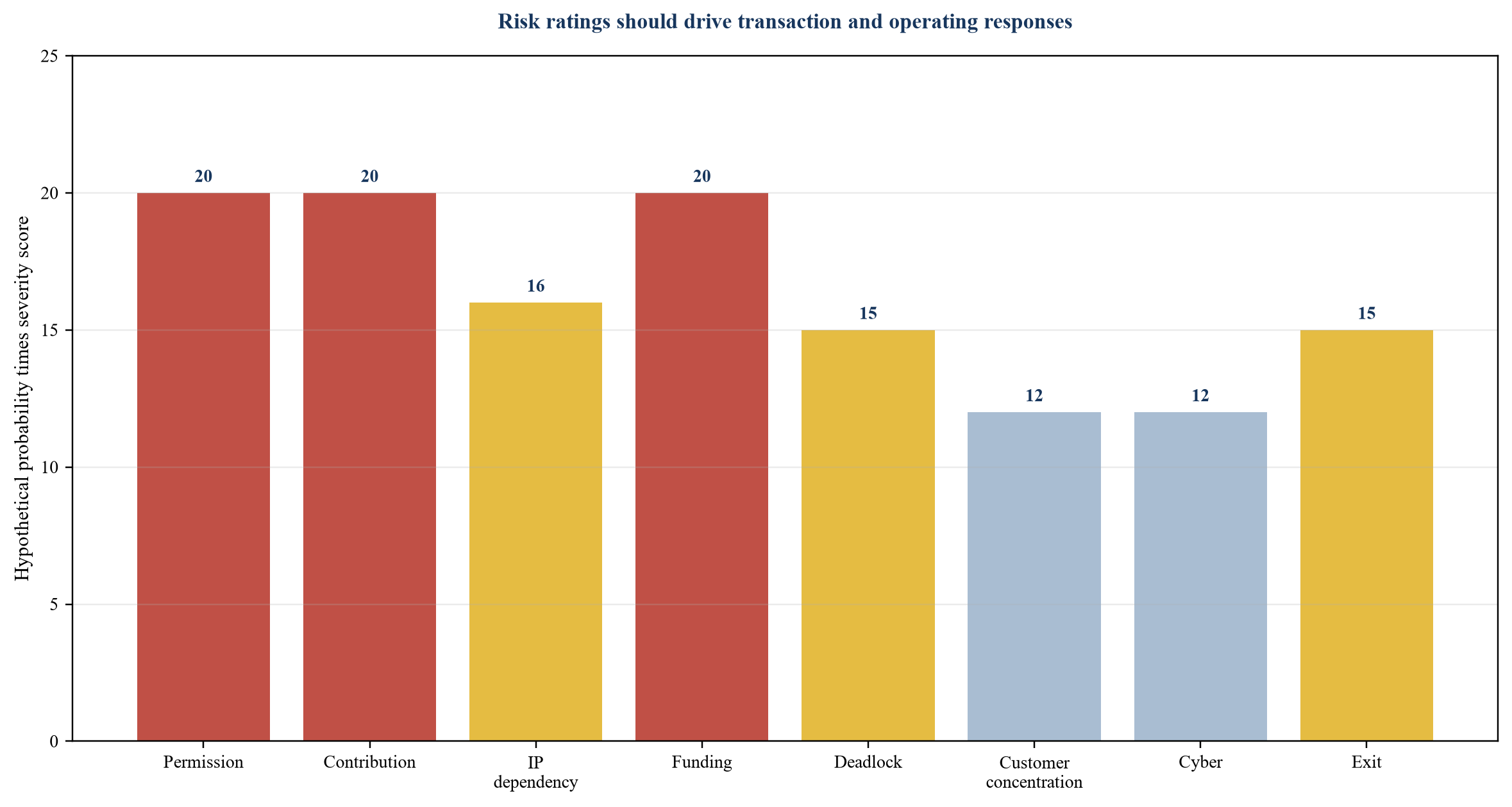
Scores are hypothetical and should be replaced with verified evidence.
27. Sequence the first two hundred days
Days one to thirty should complete formation, contribution acceptance, bank access, governance, delegated authorities, key employment, service activation and compliance ownership. The team should reconcile every closing assumption to the operating plan and create one issue register.
Days thirty-one to seventy-five should validate customer conversion, product localisation, pricing, interfaces, procurement, data lineage, risk controls and management information. Parent services should be tested against agreed performance. The board should approve the first evidence-based forecast.
Days seventy-six to one hundred and thirty should execute permission, customer and operational milestones, remediate control gaps and prepare any expansion tranche. Funding release should depend on verified evidence and updated peak-cash need.
Days one hundred and thirty-one to two hundred should stabilise service, evaluate unit economics, test resilience, review contribution performance and decide whether to scale, redesign or stop. Governance should move from formation activity to recurring oversight.
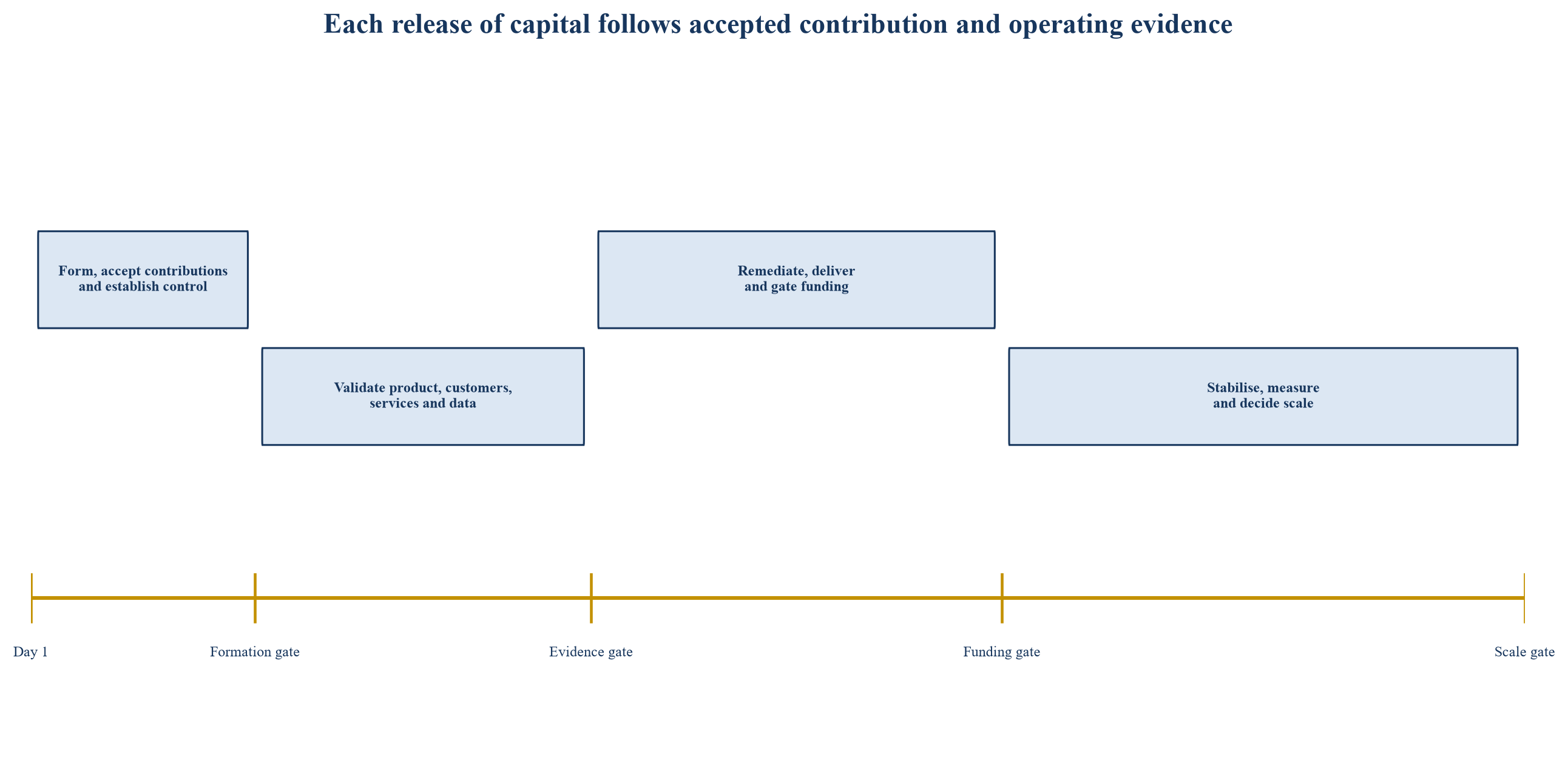
The timetable is illustrative and should be adapted to transaction and regulatory requirements.
28. Present a falsifiable board case
The investment case should state why the venture is necessary, what each party contributes, how acceptance is proved, which permissions apply, how customers and products are delivered, what funding is required, how value is shared and how the venture separates. Each material assumption should have an owner and evidence grade.
The board should see central, downside and staged cases with peak cash and stop triggers. It should know which assumptions depend on parent discretion and which are contractually committed. Sensitivities should reflect the operating system rather than arbitrary percentage changes.
Approval conditions should include accepted contributions, formation, permissions, key contracts, intellectual-property rights, funding, management appointments, service readiness, competition analysis and exit architecture. Deferred items should have dates, owners and consequences.
The board should reject the case when essential rights remain aspirational, funding is insufficient, deadlock can stop lawful operations or separation would destroy the core business. Approval should remain active after signing and return to the board when evidence or scope changes materially.
| Decision area | Evidence required | Committee decision |
|---|---|---|
| Strategic necessity | Route comparison and scarce complement | Approve venture rationale or choose another route |
| Contributions | Ledger, valuation and acceptance evidence | Approve equity and contingent rights |
| Permission and structure | Current legal and regulatory map | Approve entities and conditions precedent |
| Economics and funding | Integrated plan, downside and peak cash | Approve tranches, reserves and stop triggers |
| Governance and resilience | Decision matrix, services and incident authority | Approve control system and remediation |
| Exit | Transferability, valuation and separation map | Approve terminal mechanisms and continuity |
Approval conditions should be tied to evidence, owners and consequences.
29. Apply the framework by venture archetype
A technology-and-distribution venture should focus on intellectual property, localisation, customer ownership, service continuity and channel performance. A regulated-services venture should prioritise permission, accountable management, capital, compliance independence and customer protection. An industrial venture should add land, facilities, capacity, procurement, safety and long-term offtake.
An infrastructure venture may require project finance, construction contracts, concessions, tariffs, reserves and lender rights. A consumer venture may depend on brand, retail sites, digital channels, inventory and marketing. A professional-services venture may depend on key people, credentials, conflicts, utilisation and client portability.
The framework remains constant while evidence changes. Contribution, control, IP, funding, deadlock and exit should be calibrated to the asset. Standard documents can provide structure but cannot substitute for the operating model.
Geography also changes design. ASEAN Member States and GCC jurisdictions have different foreign-investment, licensing, competition, employment, tax and data rules. The venture should maintain a product-country and activity-country matrix rather than assume one regional permission.
30. Use a board action plan
First, define the operating decision and compare alternative routes. Second, build the contribution ledger and validate ownership, transferability and acceptance. Third, map entities, permissions, contracts, cash and accountability. Fourth, build the integrated model and downside funding plan.
Fifth, translate the operating model into governance, related-party services and intellectual-property schedules. Sixth, test the deadlock ladder and separation map through realistic scenarios. Seventh, set conditions precedent, milestones, reporting and stop triggers. Eighth, sequence the first two hundred days.
The board should require one reconciled evidence pack rather than disconnected legal, financial and operational workstreams. The shareholding agreement, constitutional documents, IP licences, service agreements, funding documents, business plan and permissions should describe the same venture.
Strategic rationale should be reviewed against operating evidence. A venture creates value when complementary contributions reach the company, management can act, capital arrives before need, intellectual property remains usable and exit preserves continuity. Those outcomes must be designed and verified.
| Stage | Required output | Evidence gate | Board action |
|---|---|---|---|
| Route design | Alternatives and venture necessity | Scarce complement and lawful route | Proceed, stage or choose another route |
| Transaction design | Contributions, structure and economics | Accepted value and integrated downside | Approve terms and conditions |
| Operating design | Governance, services, IP and controls | Executable day-one system | Authorise completion |
| Launch | Permission, people, product and customers | Verified readiness and peak-cash cover | Release launch capital |
| Scale | Unit economics and resilience | Performance and control evidence | Release expansion capital |
| Exit or separation | Valuation, transfer and continuity plan | Eligible buyer and executable transition | Sell, separate, restructure or wind down |
The action plan should remain live from design through exit.
Sources
- ASEAN Secretariat and UN Trade and Development, ASEAN Investment Report 2025: Foreign Direct Investment and Supply Chain Development. Read the primary source
- ASEAN Secretariat, ASEAN-Gulf Cooperation Council Framework of Cooperation 2024-2028. Read the primary source
- ASEAN Secretariat, ASEAN and GCC Chart Future Direction of Partnership, 14 August 2026. Read the primary source
- Invest ASEAN, ASEAN Comprehensive Investment Agreement. Read the primary source
- Invest ASEAN, ACIA Reservation Lists. Read the primary source
- Invest ASEAN, ASEAN Regional Investment Promotion Action Plan 2025-2030. Read the primary source
- UN Trade and Development, World Investment Report 2024: Investment Facilitation and Digital Government. Read the primary source
- OECD, Corporate Governance of Non-Listed Companies in Emerging Markets. Read the primary source
- World Intellectual Property Organization, How to Operate a Joint Venture. Read the primary source
- World Intellectual Property Organization, IP Assignment and Licensing. Read the primary source
- World Intellectual Property Organization, Technology Transfer Agreements. Read the primary source
- UAE Ministry of Economy, Regulation of Competition. Read the primary source
- UAE Ministry of Economy, Cabinet Decision No. 3 of 2025 on Competition Thresholds. Read the primary source
- Saudi Ministry of Commerce, Companies Law. Read the primary source
- Saudi Ministry of Commerce, Partnership Agreements under the Companies Law. Read the primary source
- Singapore Statutes Online, Competition Act 2004. Read the primary source
- International Finance Corporation, Corporate Governance Methodology Tools. Read the primary source
- OECD, Guidelines for Multinational Enterprises on Responsible Business Conduct. Read the primary source
- UNCITRAL, Model Law on International Commercial Arbitration. Read the primary source
- UNCITRAL, Convention on the Recognition and Enforcement of Foreign Arbitral Awards. Read the primary source
- Financial Action Task Force, Guidance on Beneficial Ownership of Legal Persons. Read the primary source
- National Institute of Standards and Technology, Cybersecurity Framework 2.0. Read the primary source
- National Institute of Standards and Technology, Privacy Framework. Read the primary source
- OECD, Transfer Pricing Guidelines for Multinational Enterprises and Tax Administrations. Read the primary source
- United Arab Emirates Legislation, Federal Decree-Law No. 32 of 2021 on Commercial Companies. Read the primary source
- UN Trade and Development, International Investment Agreements Navigator: ASEAN. Read the primary source
