

1 The decision before the permit
A site can be attractive while the proposed building remains conditional. The developer may know its location, a negotiated land price and a plausible design. It may still lack final permission to build the specified density, access infrastructure at an acceptable cost, register an off-plan project or draw development finance. Committing the entire purchase price at that stage converts an uncertain future project into a present cash obligation. A board needs to state exactly which rights it buys, which conditions remain open and what money can be recovered if the intended development cannot proceed.
The timing question is distinct from whether the land has value. A parcel may have alternative uses or a resale market even when the intended scheme fails. That salvage value belongs in the downside model and requires evidence about title, permitted use, transfer restrictions, sale costs and the likely time to dispose. The board should also recognise that an option or conditional purchase may have value to the seller. The seller may require a higher price, a non-refundable premium, a short long-stop date or limited access for investigation. A staged structure therefore changes both risk allocation and the commercial bargain.
The central decision is how much cash to make irreversible before each verifiable permission, legal and financing gate. This paper uses an author-developed gate ledger. For every proposed payment, the ledger identifies its due date, legal consideration, refund right, consent condition, transfer right, funder eligibility, downside recovery and responsible approver. It then links the ledger to a period-by-period cash model. The resulting output is a decision about rights and funding at specific dates, rather than a single headline land-price multiple.
Dubai and Abu Dhabi provide useful official examples. Dubai Land Department's project-registration service asks for an ownership deed, approved plans and final building permits, alongside other documents and a project guarantee [1]. Abu Dhabi Real Estate Centre describes a journey through land registration, planning approvals, project registration and escrow [3,4]. The detailed legal requirements differ, and a development in another emirate needs its own rule review. A board should not treat permission language from one authority as an automatic condition in another.
2 Scope, evidence and limits
The analysis combines public regulator and professional sources with a constructed transaction case. Dubai Land Department service pages establish stated project-registration, escrow and mortgage-deposit procedures [1,2,6]. Abu Dhabi Real Estate Centre describes its developer journey and regulatory framework [3,4]. The Central Bank of the UAE's Credit Risk Management Standards apply to licensed financial institutions within their stated scope and set requirements for credit assessment, collateral and facility structure [5]. RICS guidance explains why development-property valuation is sensitive to planning, costs, timing and completed value [7,8]. IFC financing guidance provides a separate example of project-information and appraisal discipline [9].
The sources have different purposes. A registration checklist is not a financing commitment. A bank credit standard does not set the loan amount for this hypothetical project. A valuation standard does not certify a negotiated purchase price. IFC's institutional project cycle is not a UAE private-bank timetable. The paper uses each source only to frame an evidence or decision question that a developer, owner and funder can answer for the actual site.
No consented database of UAE land options, permit applications, failed projects or project-loan terms was available for this paper. The fictional figures below are not market observations. They illustrate how the payoff of an immediate purchase differs from a legally effective conditional acquisition. The model omits tax, transaction costs beyond those explicitly stated, financing charges, discounting and strategic benefits unless a section introduces them as sensitivity variables. A live investment decision needs a qualified valuer, local counsel, planning consultant and financing counterparty, with current documents and jurisdiction-specific checks.
The research question is narrower than predicting land prices. It asks which expenditure should be financed at each evidence stage, and how the potential to wait, redesign, exercise or walk away affects the downside. A useful result is an auditable investment-committee paper showing the latest verified permission status, the cost of retaining control, the amount at risk before the next gate and the funder's actual conditions. A claim that an approval is “expected” should be recorded as a forecast with an owner and date, not as the approval itself.
3 Separate seven rights and permissions
Development discussions often combine distinct objects under the word “site”. The first is physical access for surveys and investigations. The second is a contractual right to acquire or develop. The third is registrable ownership or another recognised real-property interest. The fourth is the land-use and density position. The fifth is the building or construction permission for the proposed scheme. The sixth is project registration and the right to market or sell off-plan, where applicable. The seventh is eligibility for the particular capital provider's drawdown. One document rarely proves all seven.
In Dubai, the project-registration service lists an ownership deed as a condition and states that preliminary sales certificates are not accepted for that service. It also lists final building permits and approved plans [1]. That is a concrete reason to separate a developer's preliminary purchase agreement from the status needed for registration. The same page refers to a development agreement when the owner and developer are different. The exact legal and fee consequences of any proposed development arrangement need confirmation under the current service terms and signed documents.
Abu Dhabi's published journey separately identifies registering a land acquisition, obtaining planning approvals and registering the project before the sales phase [4]. Its framework addresses developer and project registration, escrow and buyer protection [3]. This sequence is relevant to a proposed Abu Dhabi off-plan development; it should not be pasted into a Dubai model. For any site, the team should obtain authoritative title and permit extracts directly from the competent authority, identify easements or restrictions and reconcile plot boundaries with the design and access plan.
A lender's security analysis creates another distinction. A right that helps a developer reserve land may have limited recovery value for a lender if it cannot be assigned, registered, mortgaged or enforced. The Central Bank's standards require in-scope lenders to assess the legal enforceability and registration of collateral and to align repayment with the development schedule [5]. A board should ask a prospective lender which specific land interest it will accept, what priority it requires and whether borrower-side contracts and authority consents permit that security. The answer belongs in a written term sheet or counsel's legal workstream.
4 Build a permission and cash chronology
The first model is a timeline. List the contractual deposit, remaining land consideration, investigation cost, planning submissions, utility applications, design fees, guarantee or cash contribution, project registration, construction start, first permitted sales and first lender draw. Each item needs a best-known due date and a source document. A single “land and permits” row masks the period when cash leaves the sponsor but project receipts and construction debt remain conditional.
The model should distinguish an application from a determination. An application may produce requests for revision, conditions, reduced density or rejection. A permit may be issued for a design that differs from the feasibility model. The permission gate should therefore be defined as a document and a set of economically material terms: approved gross floor area, use, parking, access, infrastructure obligations, validity period and any conditions before work starts. The board can then test a revised scheme rather than classifying every approval as the same success state.
Cash timing is just as important as legal sequence. A deposit due in seven days may be sponsor-funded. A purchase balance due at month nine may be intended for a land bridge, co-investment or sale of another asset. A construction facility whose draw is subject to registration, security perfection and equity contribution cannot be treated as available to pay the earlier balance without a written commitment that covers it. The cash model should reconcile funded money, conditional money and the unpaid gap at each date.
The chronology should include a decision date before each expiry or payment. If the investigation reveals a utility constraint at month six and the non-refundable balance falls due at month nine, management should have time to renegotiate, seek an extension or stop. A decision made after the contractual notice period may leave no lawful path to avoid the payment. The useful schedule therefore contains long-stop dates, notice periods and who has authority to exercise or terminate, in addition to a planning programme.
Table 1. Evidence gates before cash becomes irreversible
| Gate | Record to obtain | Cash decision | Downside question |
|---|---|---|---|
| Land control | Executed right, term, deposit and assignment clauses | Pay limited control cost | Can the right be extended or recovered? |
| Title and use | Authority extract, plot plan and permitted-use evidence | Confirm acquisition route | What interest remains if the intended scheme fails? |
| Design feasibility | Consultant plan, authority feedback and utility assessment | Fund diligence and design | Which density and infrastructure assumptions remain open? |
| Final permission | Issued permits and conditions for the modelled scheme | Exercise or complete purchase | Does consent support the forecast revenue and programme? |
| Project activation | Relevant project registration, escrow and guarantee evidence | Commit construction equity | Which receipts and draws are legally available? |
| Credit approval | Signed facility, security and draw conditions | Replace bridge with project debt | What cash is available, in which entity, on which date? |
Author-developed transaction checklist. Requirements vary with emirate, asset, rights and contract; each item requires local verification.
5 Value development land as a conditional asset
RICS defines development property by the contemplated or continuing development required to realise its highest and best use, and notes that valuations may incorporate optionality and material variation [7]. Its development-property standard describes a residual method that derives land value from the completed property's value less development costs and developer profit [8]. The model is sensitive to the proposed scheme, planning position, cost, programme and completed-market assumptions. It does not turn an unpermitted concept into a permitted asset.
A pre-permit appraisal should show at least three states. One is the current lawful use and transferable land interest. Another is the intended scheme if the required consent is granted on the modelled terms. A third is a revised or delayed permission, which may require lower density, more infrastructure or a later launch. The valuer should identify which state is the valuation premise, which assumptions are special assumptions and what evidence supports them. The investment committee should see the current state and conditional states separately.
The residual calculation is not a substitute for cash-flow timing. Suppose a scheme's completed value rises enough to make a positive residual at a future date. The sponsor may still be unable to pay an unconditional land balance next month or supply the guarantee required at registration. A static residual can also conceal cost escalation and finance carry while permission is delayed. The decision model should calculate cash to retain rights, cash to exercise, cash to reach registration and peak cash during construction, with the same price and design assumptions as the valuation.
Comparable land transactions can inform a view only after adjusting for the actual development rights and transaction terms. A fully permitted plot with utility access, clean title and transferable approvals differs from a site subject to unresolved use or infrastructure. A seller's asking price, a prior purchase and a later permitted sale are observations at different states. Each comparison should disclose permission, title, timing and payment differences. If usable evidence is thin, a sensitivity range is more defensible than a precise single land value.
6 Identify the real option in the contract
An option has economic value only if the developer can preserve a meaningful choice. The contract must allow a decision to acquire after specified information arrives, and it must state the exercise price, conditions, long-stop date, refund or forfeiture terms, permitted investigations, extension rights, assignment rules and remedy if the seller fails to perform. A label such as “option agreement” does not establish that these protections are enforceable for the particular UAE property. Local counsel must test the documents, registration route and authority requirements.
The choice may be to wait, exercise, redesign, seek a partner or abandon. Waiting incurs a premium and may allow a competing bidder or market movement. Exercising turns optional expenditure into committed land capital. Redesign may save value when consent grants less density than expected. Abandoning limits additional loss only if the contract releases further payment obligations. These choices should be mapped explicitly; otherwise the model may credit an exit that the buyer cannot legally take.
The seller's position matters. A long exclusive option ties up its asset and can shift market upside toward the developer. Compensation may take the form of a fee, a higher exercise price or an earlier deadline. The board should compare the total economics of the conditional arrangement with immediate purchase, including due-diligence access, seller credit risk, title-maintenance covenants and who bears taxes or registration charges. A conditional deal that cannot be perfected may create a different risk from an owned plot: the sponsor can spend on design without being sure it can close.
Option value is a comparative decision measure in this paper, not an appraised market value of a transferable financial derivative. A financial-option formula would require inputs that may not be observable for a unique site: volatility, exercise certainty, marketability, legal rights and competing uses. The practical measure is a scenario tree with actual contractual cash flows. The board can see how much downside is retained or shifted for a stated premium, then obtain a transaction-specific valuation opinion where one is needed.
7 Match early capital to early risk
Pre-permit expenditure normally buys information and control: deposit, planning advice, survey, design, utility enquiries, legal diligence and time. A sponsor can fund it with its own capital, a partner's risk capital or a financing facility if an actual lender underwrites a separate repayment source and legally effective security. The existence of later development debt should not be assumed to cover early payments. Early money faces a distinctive loss profile because the intended project may never be permitted.
After title and permission are established, the capital need changes. Acquisition completion, approved infrastructure, project guarantees, registration and initial construction may require additional sponsor equity, a JV contribution, subordinate capital or a committed bridge. A bank can assess its own borrower, collateral, repayment and draw conditions. The Central Bank's standards direct in-scope lenders to align project-finance repayment with the expected development schedule and verify security registration before disbursing secured lending [5]. The source does not prescribe one product or advance rate for every site.
Once an off-plan project is registered and its escrow arrangements are active, buyer receipts and project finance need to follow the applicable rules. Dubai's FAQ says payments from off-plan buyers and project financiers enter the project escrow account; its mortgage-deposit service requires particular financing documents and bank undertakings [2,6]. Abu Dhabi describes buyer payments into an approved escrow account and staged release tied to verified construction progress [3]. Cash held or controlled within these regimes should not be presented as unrestricted cash for an earlier land option unless the specific lawful mechanism is established.
The capital stack should therefore be dated. It starts with sponsor risk capital, may add a negotiated land or acquisition facility against eligible rights, and later includes construction funding and permitted project receipts. The layer that fits a future registered scheme may not fit an unpermitted plot. A financing proposal should name the borrower, asset, purpose, security, disbursement condition, repayment source and date available. Where those facts remain open, the amount is a potential source rather than committed liquidity.
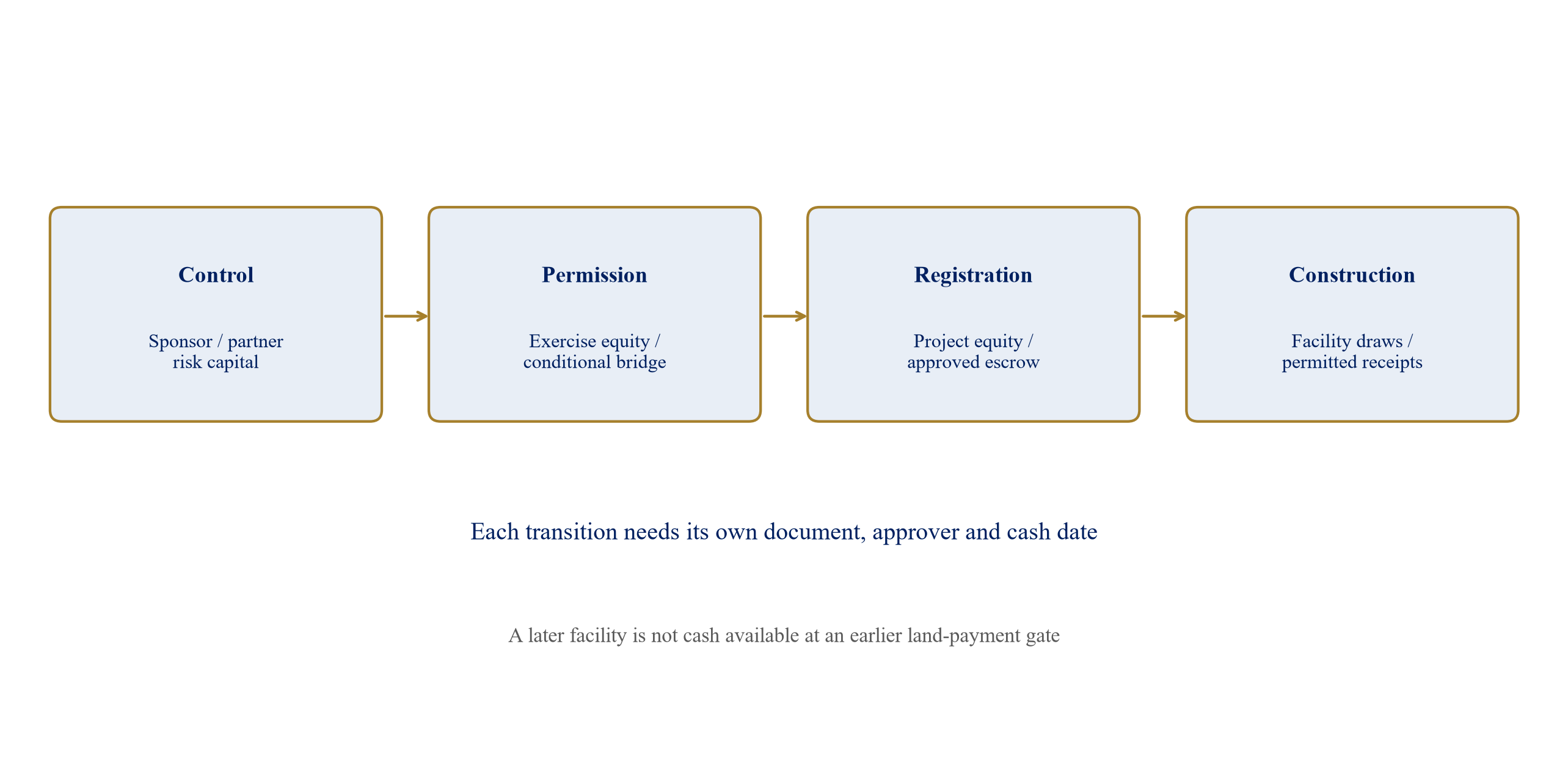
Author-developed sequence. Instruments are examples for analysis, not statements of market availability or regulatory permission for a particular transaction.
8 Distinguish equity at risk from construction debt
A developer may describe the first land payment as “bridgeable”. The word conceals the credit question. A lender must identify what it can enforce if permission fails: owned land, an assignable contractual right, a guarantee, another property or corporate cash flow. The Central Bank's standards require realistic documented assumptions for collateral and recovery, including legal enforceability, time and cost of recovery [5]. A plot's estimated value after a successful permission is not the same as recoverable value before the permission exists.
Sponsor or JV equity absorbs the first loss and can support option premiums, investigations and the early portion of acquisition. That does not make it cheap. Equity requires an agreed value for the opportunity, governance, further funding obligations and exit rights. A landowner contribution may reduce cash at completion but can introduce title, control and revenue-sharing issues. A mezzanine instrument may be described as subordinate, yet its cash coupon and redemption date can still stress a pre-revenue project. The structure should follow the actual risk, not a preferred label.
Construction finance has a separate underwriting path. A lender may require permission, title, approved budget, contractor package, cost-to-complete assessment, sponsor equity, security and escrow mechanics before the first draw. Conditions differ between lenders. The board should ask whether the finance proposal covers the land balance, only eligible construction costs or a reimbursement after the sponsor has already paid. A reimbursement is not a source for an earlier payment unless interim liquidity exists and both dates are contractually reliable.
The cash waterfall deserves equal attention. Off-plan receipts may enter a project escrow and be released under conditions; debt proceeds may be restricted to the project. The developer should model permitted uses and timing of each receipt. A headline presales number cannot be netted directly against a land purchase obligation if the receipts are unavailable for that use. The safer model has separate cash accounts and a source-to-use rule for every inflow and draw.
9 Model the immediate-purchase baseline
Consider a wholly fictional Dubai-area development opportunity. The invented site has an immediate cash purchase price of AED 80 million. A proposed design might obtain the economically necessary permission in nine months. The sponsor expects to spend AED 4 million on surveys, design, planning and legal work before that decision. For illustration only, the site has a cash-equivalent value of AED 110 million if the modelled permission is granted and AED 55 million if it is not. These values, dates and outcomes are author assumptions; they are not observed transactions or a valuation opinion.
If the sponsor buys immediately and the intended consent arrives, the simplified net project-land position is AED 110 million minus AED 80 million purchase price minus AED 4 million pre-permit work, or AED 26 million. If the intended consent fails and the land can be sold for the assumed AED 55 million, the position is AED 55 million minus AED 80 million minus AED 4 million, or negative AED 29 million. The two figures exclude registration, financing, selling, holding, tax and other costs. Real cash recovery could be lower and later.
The initial outlay is AED 80 million, plus investigation expenditure as incurred. The board should test whether the land can be acquired with a separate loan; no loan is assumed in this baseline. If any lender funds the acquisition, it will have its own security, interest, maturity and covenant conditions, which may amplify the loss in an adverse state. A collateralised loan does not transfer the economic loss away from the sponsor unless the documents genuinely limit recourse and the lender accepts it.
The baseline also carries upside outside the two-outcome tree. The land might be retained, sold to another developer or used differently. Those possibilities require evidence about permitted use and a buyer or operating plan. They cannot be added as a free residual simply because the site is in a growing city. The AED 55 million failure-state value in this example is an explicit simplifying assumption that a live appraisal would have to support.
10 Model a creditable-deposit option
Assume the same fictional seller offers an enforceable right to buy for AED 80 million after the nine-month decision. The developer pays an AED 8 million non-refundable deposit now, credited against the price if it exercises. It pays the same AED 4 million for investigation and an additional AED 3 million non-creditable exclusivity premium. If the stated permit condition is satisfied and the developer exercises, it pays the remaining AED 72 million. The total purchase consideration remains AED 80 million; total option-specific cost is AED 3 million. These contract terms are invented and need legal verification in any real transaction.
In the permitted state, the simplified position is AED 110 million less AED 80 million purchase consideration, AED 4 million work and AED 3 million premium, or AED 23 million. In the failed state, the developer walks away and loses AED 8 million deposit, AED 4 million work and AED 3 million premium, or AED 15 million. The difference from the immediate-purchase failure-state loss is AED 14 million. The option's premium reduces the permitted-state result by AED 3 million. The model assumes the seller performs, the deposit is creditable on exercise and the developer has no further liability after valid termination.
These outputs should not be called a market option price. They compare two invented cash paths under two invented values. The unpermitted site's AED 55 million resale value remains with the seller under the option, so the developer forgoes any separate upside from owning that land in the failure state. If failure of the intended scheme still leaves an attractive alternative use, an immediate purchase could outperform walking away. The board should add that third state before choosing a route.
The comparison needs a legal and operational test. An option expiring before the planning authority's likely decision may be unusable without an extension right. A condition drafted only as “satisfactory permits” may be disputed when permission arrives with lower density or expensive infrastructure. A deposit held by a weak counterparty may be hard to recover even if nominally refundable. The legal gate should specify the approval documents and economic tolerances. The cash gate should show the AED 72 million exercise balance as a separate, financed obligation.
Table 2. Fictional AED million two-outcome land-control comparison
| Route | Initial land cash | Additional pre-permit cash | Permitted net position | No-permit net position |
|---|---|---|---|---|
| Immediate purchase | 80 | 4 work | 110 - 80 - 4 = 26 | 55 - 80 - 4 = -29 |
| Creditable-deposit option | 8 deposit | 4 work + 3 premium | 110 - 80 - 4 - 3 = 23 | 0 - 8 - 4 - 3 = -15 |
| Difference, option less purchase | 72 less initial cash | 3 more premium | -3 | +14 |
Every figure and contract term is invented. Simple undiscounted arithmetic excludes finance, taxes, transaction fees, holding and sale costs. Negative figures are losses, not observed investment outcomes.
11 Compare option value without hiding assumptions
The simplest comparison reports the state-by-state spread. In the invented permitted state, immediate purchase produces AED 26 million and the option AED 23 million. In the no-permit state, immediate purchase loses AED 29 million and the option loses AED 15 million. The option trades AED 3 million of permitted-state upside for AED 14 million less loss in the failed state. Whether that trade is attractive depends on the likelihood, timing and severity of outcomes, financing constraints and alternative uses. No market frequency is supplied here.
For arithmetic illustration only, assume a 60 percent chance of the modelled permission and a 40 percent chance of the no-permit outcome. These percentages are invented inputs, not estimated UAE approval rates. The undiscounted probability-weighted position for immediate purchase is 0.6 times AED 26 million plus 0.4 times negative AED 29 million, or AED 4 million. For the option it is 0.6 times AED 23 million plus 0.4 times negative AED 15 million, or AED 7.8 million. The AED 3.8 million difference is generated entirely by the assumed two-state inputs; it is not a fair-value conclusion.
The same arithmetic can be written as a decision threshold. Before the separate premium, the option preserves AED 17 million of loss when the intended consent fails: the immediate-purchase loss of AED 29 million versus an option loss of AED 12 million without the premium. With the AED 3 million premium, a risk-neutral, undiscounted two-state model would prefer the option when the chance of failure exceeds 3 divided by 17, or approximately 17.6 percent. That threshold changes with any holding cost, alternative land use, price increase, financing charge, seller risk, tax or different contractual loss. It is a teaching device, not an approval-probability estimate.
For a cash-constrained sponsor, liquidity has its own value. Immediate purchase ties up AED 80 million before a decision; the option ties up AED 8 million plus work and premium. The difference can fund other obligations or reduce the need for risky interim debt. The board should calculate a dated liquidity measure alongside economic payoff, including the price of committed financing for the eventual AED 72 million exercise. A structure that improves downside but cannot fund exercise when consent arrives does not deliver the planned scheme.
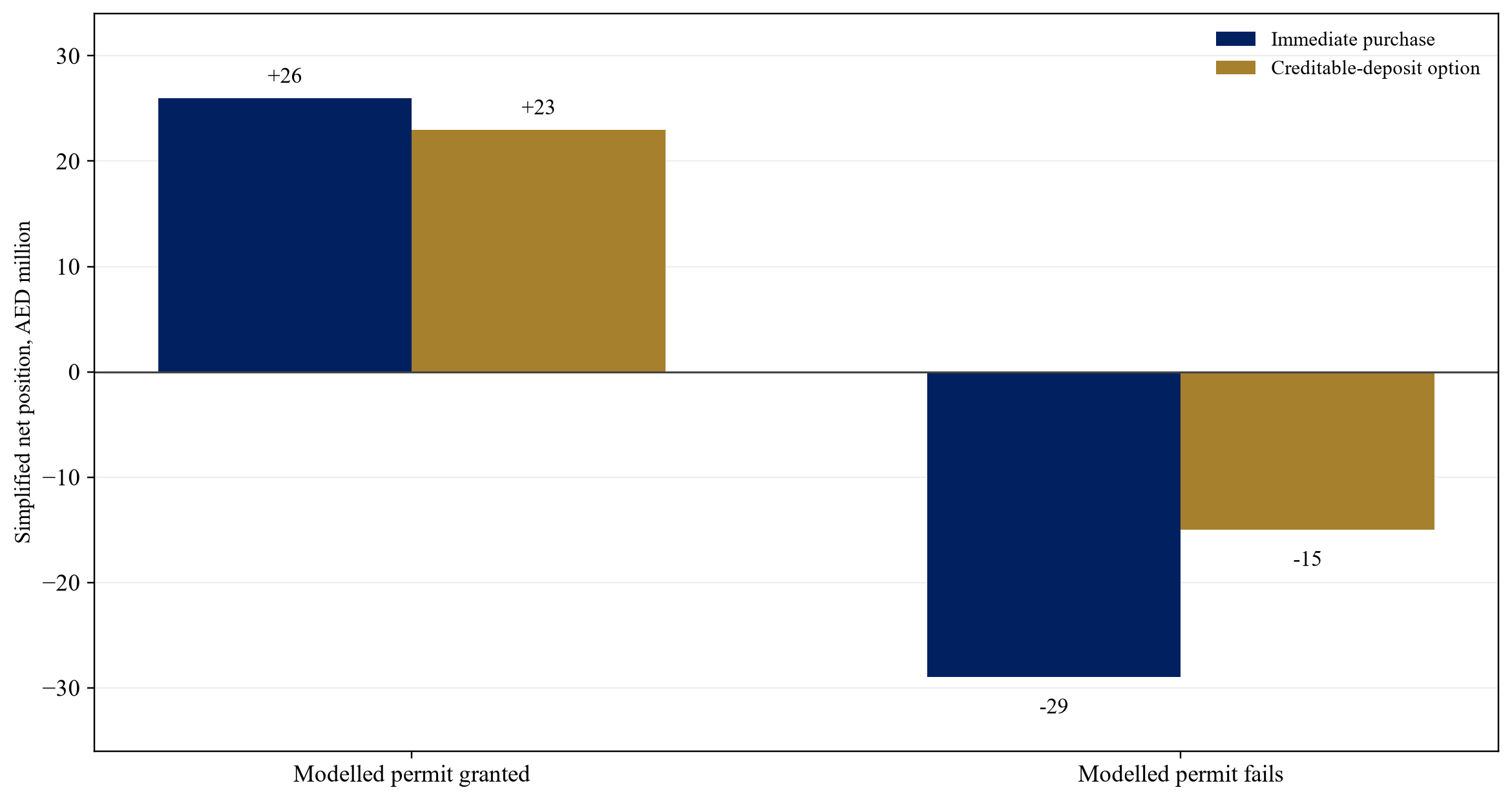
Author-developed illustration in AED million. Both outcomes and every amount are hypothetical. Bars omit financing, tax and time value.
12 Add delay, density and cost stress
A binary permit decision is only a starting point. The most financially important result may be a permission with lower saleable area, a requirement to pay for off-site infrastructure or a consent issued after the option expires. The model should include these distinct states. A lower-density approval changes forecast receipts and construction costs; it can make exercise unattractive even though a permit technically exists. The exercise condition should allow the board to reject a consent outside predefined economic tolerances if that is the agreed commercial intent.
Delay can harm both structures. An owner carries land finance, insurance, charges and opportunity cost while waiting. An option holder pays for extensions and may lose the right altogether if the long-stop date passes. For a fictional stress, assume the permit arrives six months after the original nine-month target, an extension costs AED 3 million and permitted land value at that later date remains AED 110 million. The option's simplified permitted payoff would fall from AED 23 million to AED 20 million, before any other carry. An immediate purchase would also incur six additional months of real holding and financing cost, which this illustration does not quantify.
Assume separately, for an illustrative sensitivity, that a lower-density consent reduces the permitted land value from AED 110 million to AED 94 million with all other stated amounts unchanged. Immediate purchase then yields AED 10 million. The option yields AED 7 million if exercised without an extension, or AED 4 million after the invented AED 3 million extension. The difference is not a recommendation to exercise. The sponsor must compare the exercise payoff with the contractually permitted walk-away loss, alternative uses, updated appraised value and any additional construction obligation.
The board should also stress a no-consent outcome with a lower resale value than AED 55 million. If the owned land could be sold for only AED 45 million, the simplified immediate-purchase loss becomes AED 39 million before sale costs. The option loss remains AED 15 million in the invented contract if termination is effective and no further obligations exist. These examples show why title, alternative use and disposal time should be evidenced rather than buried in a generic contingency. A live model should use a range validated by a qualified valuer.
Table 3. Fictional sensitivity of simplified net position, AED million
| State | Immediate purchase | Option if exercised or terminated | Main decision |
|---|---|---|---|
| Permit at month 9, land value 110 | 26 | 23 | Fund AED 72m exercise balance |
| Permit at month 15, value 110, extension 3 | 26 before carry | 20 | Compare extension with remaining option life |
| Lower-density permit, value 94 | 10 | 7 before extension | Recalculate scheme and exercise choice |
| No permit, land resale 55 | -29 | -15 | Terminate if contract permits |
| No permit, land resale 45 | -39 | -15 | Test real disposal evidence |
All assumptions are invented and undiscounted. The delayed option case adds only the stated AED 3m extension; the immediate-purchase delay case excludes its unquantified additional carry.
13 Translate permission states into bankability
Bankability is a sequence of evidence, not a general impression that the location is prime. The lender needs a borrower, eligible title or rights, verified project scope, plausible budget, repayment source and enforceable security. The Central Bank's standards require in-scope lenders to assess cash flows, collateral and documentation under their policies [5]. A developer should construct a lender-facing status sheet that shows what is complete, what is conditional, who can produce the missing record and when.
The sheet begins with land rights. It should include the authority title extract, plot identification, restrictions, charges, owner's capacity, purchase or development agreement and counsel's view of assignment and mortgage. The next block is permission: current use, final planning and building approvals, conditions, validity and utility access. The commercial block contains a design aligned to approval, a priced construction budget, contingency, sales or leasing evidence and a period cash flow. The finance block contains proposed equity, security priority, escrow, presale treatment, draw conditions and repayment under stress.
An indicative funding letter can be useful evidence of interest, but it should not be entered as available cash before its conditions are tested. A facility for construction may require project registration and escrow arrangements. Dubai's service page for depositing mortgage proceeds into the escrow account lists a financing contract and bank undertaking, and conditions linked to active project status and technical reports [6]. Those procedures bear on a Dubai project at the relevant stage; they do not establish that a lender will finance an earlier option premium or an unregistered plot.
The bankability review should state failure consequences. If final permission arrives after the land balance is due, who funds the gap? If permission is granted at a lower density, does the lender resize the facility? If a buyer deposit is restricted in escrow, can the sponsor still meet the equity contribution? If cost-to-complete rises, where does contingency come from? A good checklist ends with an owner and date for each missing item and an explicit decision about whether to proceed, renegotiate, seek new equity or stop.
14 Build a date-specific sources-and-uses ledger
The sources-and-uses ledger should use cash dates rather than total project amounts alone. At the option signing date, the uses are deposit, premium and due-diligence budget. At the permission decision, uses may include exercise balance, transfer costs and mobilisation. At project registration, a guarantee, approved budget and escrow arrangements may require cash or bank capacity. Construction then has phased invoices and reserves. Expected buyer payments and lender draws should appear only on the dates and within the legal entities where they are available.
For each source, the ledger should identify status: cash on hand, contractually committed but conditional, indicative, or merely targeted. It should show the conditions precedent and longest plausible lead time. A cash source from a sale of another asset needs sale proceeds net of debt and transaction costs, a buyer and a completion timetable. A proposed JV contribution needs partner approval and signed funding obligations. A lender's letter needs the facility amount, purpose, security, draw schedule and lapse date. This prevents a model from filling a gap with a term sheet that cannot fund the relevant use.
The fictional option requires AED 8 million deposit, AED 3 million premium and AED 4 million of investigation over nine months, or AED 15 million of pre-decision expenditure. It then needs AED 72 million at exercise. The first figure is the sponsor's simplified amount at risk if it walks away; the second is a contingent cash requirement, not a guaranteed loan. A developer with only AED 50 million of committed liquidity can afford the option phase under these assumptions but cannot exercise without at least AED 22 million of additional available money, before transfer and project costs. The permission may improve asset value while exposing a funding gap.
The ledger should reconcile to the board-approved forecast and bank balances every reporting period. It should identify trapped cash, restricted escrow balances and intercompany-transfer constraints. A guarantee consumes banking capacity even when it is not a cash deposit. If a sponsor plans to replace early equity with a later construction loan, the model must show when reimbursement is contractually permitted and whether the new loan can legally fund a past land purchase. A refinancing assumption without a term and date should remain outside committed liquidity.
15 Allocate permit risk in the acquisition documents
Commercial drafting determines whether the economic option exists. The contract should identify the exact plot and seller, seller authority, title representations, access for studies, permitted applications, consent to submit plans, exclusivity, deposit treatment, exercise method, long-stop date, extension mechanics and dispute remedy. Conditions should refer to approval documents and material economic terms. A developer may value a right to reject a permit that reduces saleable area below a threshold; the seller may demand an objective test to avoid discretionary termination. Those choices are negotiated and need counsel.
The agreement should also allocate costs of utilities and off-site works. A design may technically receive permission while requiring infrastructure expenditure that changes the residual land value. If the seller has supplied a development concept, the buyer should verify whether surveys, approvals and consultant work can be relied upon or transferred. A change in ownership or developer identity may require authority action. The board should not treat the seller's prior correspondence as a transferable final permit without confirmation from the competent authority.
An extension clause has a price and a process. The option holder should know the notice deadline, amount, maximum extension period and what happens if an authority delays for reasons beyond either party's control. A deposit-refund provision needs a practical payment mechanism and protection against seller non-performance. If the seller can mortgage or sell the land during the option period, the buyer's ability to close is uncertain. Counsel should assess any available registration, security or escrow arrangement for the specific property and contract; this paper does not assert a universal UAE method.
The funder will inspect these terms from a different angle. It may require the option to be assignable to a project vehicle, permit diligence access and allow security over the acquired interest after exercise. It may refuse to rely on a conditional right as collateral. The developer should show the proposed lender the key terms before signing an irreversible premium. A cheap option with a non-assignable right may be expensive if it blocks the intended capital stack.
16 Use project regulation as a financing gate
Dubai Land Department's project-registration service describes a process for registering a development and opening an escrow account for off-plan sales. Its listed conditions include ownership evidence, developer registration, approved plans, final building permits and a guarantee route [1]. Its FAQ explains that buyer and project-financier receipts enter the project escrow account and that disbursement follows the applicable stages and controls [2]. These are important cash-flow constraints for a Dubai off-plan plan. The service page is a current administrative source; a live project should confirm the latest requirements with DLD and its account trustee.
Abu Dhabi Real Estate Centre's public journey identifies a separate planning and project-activation sequence, including title or development agreement, design approvals, project registration, escrow and marketing authorisation [3,4]. The regulatory overview refers to the 2015 real-estate law and subsequent 2025 amendment and decision [3]. A project in Abu Dhabi needs its own analysis of the governing law, authority determinations and escrow agreement. It should not borrow Dubai's listed guarantee percentage or administrative fee as an Abu Dhabi input.
Regulation changes the timing of capital. A sponsor can pay to control land before a registered project exists, but buyer deposits may not be lawfully marketed or collected for the proposed scheme at that stage. Later, escrow funds may be available only for authorised project uses and verified progress. The financing model should mark each stage at which a receipt becomes lawful, held, releasable and usable for a given cost. Distinguishing those stages is more useful than putting all presales in a single “cash inflow” row.
The precise permit and escrow pathway also affects marketing statements. A developer should avoid promising a launch date, density or funding plan that depends on unsettled approvals. Investors and lenders need a consistent disclosure of remaining conditions and how a changed permit would affect cash requirements. The authority, counsel and account trustee determine the actual requirements; the board's role is to keep its commercial plan aligned with their verified outputs.
17 Decide whether to exercise, renegotiate or stop
The option decision should be made before the contractual deadline by a board or delegated committee with access to a refreshed valuation, permission documents, funding commitments and downside analysis. The exercise paper should state the actual approved scheme, changes from the original model, the funded exercise balance, remaining project equity, lender conditions and cash runway to the next gate. A positive permitted-state residual is insufficient if the sponsor cannot close the land purchase or support construction.
Exercise is appropriate for consideration when the legal right is valid, the approval supports an economic project, the committed cash covers purchase and near-term obligations, and the remaining financing path has credible conditions and timing. Renegotiation may be preferable where a reduced-density permit lowers residual value or an authority-imposed work package changes the cost. A seller may refuse; the board needs a walk-away value and a fallback plan before asking. Stop or expiry may be the rational outcome if the stated permit condition fails and the contract permits termination without further liability.
The decision should identify the counterfactual. If the developer walks away, it loses the deposit, work and premium under the fictional terms. If it exercises, it accepts the full purchase obligation and future project risk. The board should not compare the lost option expenditure with a future gross sales figure while ignoring construction costs, time and finance. It should compare forward cash flows from the exercise date, using the sunk amount only to explain total investment performance and governance accountability.
The minute should preserve evidence. It records the authority extracts and dates, valuer's assumptions, counsel's condition review, lender terms, available cash, stress results, conflicts, approvals and notices. A later investor or bank can then distinguish a deliberate staged decision from a rushed land acquisition. The record also protects the firm's ability to learn from expired options by documenting which assumption failed and whether the original premium was proportionate to information gained.
18 Test the structure against three independent shocks
The first shock is planning quality. The authority grants permission, but for a smaller or more costly scheme than projected. The model should calculate revised sales area, revenue, construction budget, cost to complete and residual land value. The option agreement should specify whether this outcome satisfies its condition. The board then chooses whether to exercise at the fixed price, renegotiate or abandon, using actual contractual rights. Treating all permits as success would conceal the central economic risk.
The second shock is time. A delay can push the permit decision beyond the option deadline or the seller's completion date. The sponsor may pay extension fees, face land-carry costs, lose a contractor price or miss a sales season. The lender's credit approval may expire. The stress should move each date and recompute the peak funding gap. A contract that provides an extension only at the seller's discretion is different from a pre-agreed extension at a fixed price; the model should follow the signed wording.
The third shock is liquidity. A partner or lender may reduce its proposed amount even when the permit arrives. The sponsor then faces an AED 72 million exercise balance in the fictional case and later registration or construction commitments. A funding gap can destroy the value of an otherwise attractive site option. The board should have a committed or highly credible funding route before the exercise notice, and should test whether staged equity, a JV or an approved facility changes control and returns. An unsigned expression of interest is not committed liquidity.
These shocks can combine. A lower-density scheme may shrink a lender's collateral value and presales at the same time that delay increases option cost. The board should avoid multiplying invented probabilities as if they were measured frequencies. A scenario matrix can show the joint cash requirement and decision rights without pretending to predict the distribution. Where historical project data exist and can be used lawfully, they may inform calibrated likelihoods; none are claimed in this paper.
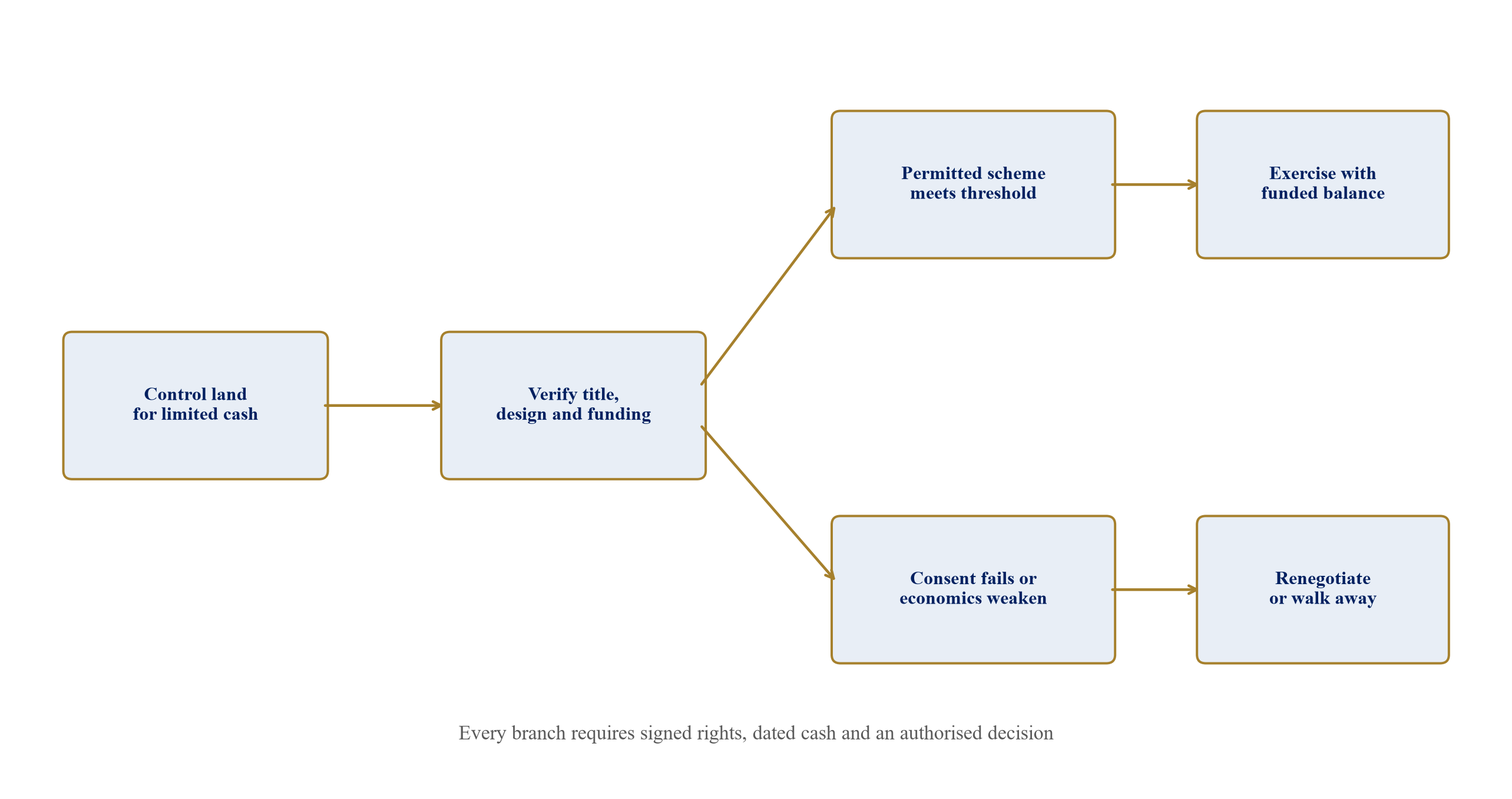
Author-developed decision logic. The branches are not estimated approval frequencies and do not imply the existence of a legally effective option in a specific transaction.
19 Design a lender and investment-committee pack
The pack should begin with a one-page decision. It names the land right, purchase price, option cost, remaining permission, available cash, next irreversible payment and action requested. It states the worst case under each supported scenario and the amount of cash that can be lost before a new decision. The supporting papers then prove title, planning position, design, costs, valuation assumptions, sponsor capacity and proposed finance. If a fact is unavailable, the pack should say who is obtaining it and by when.
The development model needs traceable inputs. Plot area and allowable use should come from official records; scheme yield from a consultant design and authority position; costs from a priced scope or clearly identified estimate; sales from relevant evidence with adjustments; finance from actual indicative or agreed terms. RICS guidance calls for transparent development valuation and sensitivity to assumptions [7,8]. A model with a high residual but no traceable source for density or infrastructure cost is not decision-ready.
The lender materials should separate purpose-specific facilities. One may fund land acquisition after title transfer; another construction costs after permits and registration; a corporate line may rely on the sponsor's wider balance sheet. Their borrowers, security, repayment and recourse differ. The Central Bank's standards provide a framework for how in-scope lenders evaluate these matters [5]. The issuer-side pack should make the questions answerable; it cannot substitute for lender approval or guarantee availability.
The committee should also see a permissions register with authority, application reference, document, issue date, expiry date, conditions and forecast next action. A “green” label is useful only if supported by the document. The pack ends with a decision log: approved limit at risk, exercise trigger, renegotiation authority, stop trigger and person who serves notices. This makes the finance and legal teams work from one version of the transaction, reducing the risk that cash is committed against an obsolete design assumption.
20 Conclusion and research agenda
Land before permits creates a financing problem because cash commitments can precede the rights and receipts that make the proposed scheme bankable. The solution is to make each commitment a separate decision. A developer should identify the specific interest controlled, the actual permission state, the earliest lawful and usable receipts, the funder's written conditions and the cash that remains at risk if the intended scheme fails. A staged purchase or option can reduce downside when it grants a legally effective choice and the seller's price for that choice is acceptable. It can also fail if the right expires, cannot be assigned or cannot be funded at exercise.
The fictional case illustrates the mechanics. An immediate AED 80 million purchase exposes the sponsor to the assumed no-permit land-resale outcome. A creditable-deposit option limits its pre-decision cash at risk to the deposit, work and premium, while creating a later AED 72 million exercise obligation. Its hypothetical payoff comparison depends on invented values and a legally effective termination right. The separate delay, density and liquidity stresses show how a permit can be granted without making the original financing plan executable. No UAE market approval rate or typical option premium is inferred.
The next empirical step would be a consented, anonymised transaction study. It would record land rights, contractual staging, permit submissions and determinations, density changes, financing conditions, cash dates, option extensions, exercise or expiry and eventual project outcomes. Project and authority records would need to be reconciled; incomplete and failed deals should be included to avoid survivorship bias. Until such evidence exists, the contribution of this paper is an auditable decision method. It helps a board ask the right transaction-specific questions while leaving valuation, legal and credit conclusions to the relevant professionals and counterparties.
References
- Dubai Land Department. Register Project, official service conditions and documents; accessed 7 October 2026. https://dubailand.gov.ae/en/eservices/register-project/
- Dubai Land Department. Frequently Asked Questions, real-estate development escrow and project registration; accessed 7 October 2026. https://dubailand.gov.ae/en/frequently-asked-questions
- Abu Dhabi Real Estate Centre. Project Development, regulatory services and legal framework; accessed 7 October 2026. https://adrec.gov.ae/en/sectors/regulatory-services/project-development
- Abu Dhabi Real Estate Centre. Developer Journey, land, planning, registration and project activation; accessed 7 October 2026. https://adrec.gov.ae/en/sectors/regulatory-services/project-development/developer-journey
- Central Bank of the UAE. Credit Risk Management Standards, C 3/2024 STA, official rulebook; accessed 7 October 2026. https://rulebook.centralbank.ae/en/rulebook/credit-risk-management-standards
- Dubai Land Department. Depositing a mortgage into an escrow account application, official service; accessed 7 October 2026. https://dubailand.gov.ae/en/eservices/request-for-mortgage-payment-in-escrow-account/
- Royal Institution of Chartered Surveyors. Valuation of development property, professional standard overview; accessed 7 October 2026. https://www.rics.org/profession-standards/rics-standards-and-guidance/sector-standards/valuation-standards/valuation-of-development-property
- Royal Institution of Chartered Surveyors. Valuation of development property, first edition professional standard, 2019; accessed 7 October 2026. https://www.rics.org/content/dam/ricsglobal/documents/to-be-sorted/valuation-of-development-property---first-edition.pdf
- International Finance Corporation. How to Apply for Financing, project-information requirements; accessed 7 October 2026. https://www.ifc.org/en/what-we-do/products-and-services/how-to-apply-for-financing
- International Finance Corporation. Project Cycle, appraisal, approval and disbursement stages; accessed 7 October 2026. https://www.ifc.org/en/what-we-do/products-and-services/ifc-project-cycle
About the Author
Chennakeshav (CK) is a corporate finance and investment banking executive with 25+ years of global experience in deal origination, structuring and execution across M&A, growth capital and corporate strategy. He has led value-creation mandates for founders, corporates and funds — bridging the boardroom view to hands-on execution and close.
His career spans Morgan Stanley, HSBC, Lloyds Banking Group, EWEC, ADQ portfolio companies and Emirates Growth Fund, across TMT, real estate, fintech, deeptech, cleantech, infrastructure and energy. He has partnered with C-suite leaders, private equity and venture funds, sovereign wealth funds and family offices to finance complex fund raises and scale-up ventures, and has led M&A due diligence, post-merger integration and business-transformation initiatives to create value.
At Matchpoint Partners he is Managing Partner, leading the firm's corporate finance, M&A and capital-raising practice. He holds an MBA from London Business School, an engineering degree from VTU and a Master of Laws (LLM, in progress) from UCL London.
An active start-up mentor, CK mentors at Techstars, DIFC FinTech Hive, Startup Grind, Founder Institute and IN5, serves as Entrepreneur Mentor in Residence (EMiR) at London Business School, and judges the Entrepreneurship World Cup.
